
A complete issue · 26 pages · 1905
Life — April 27, 1905
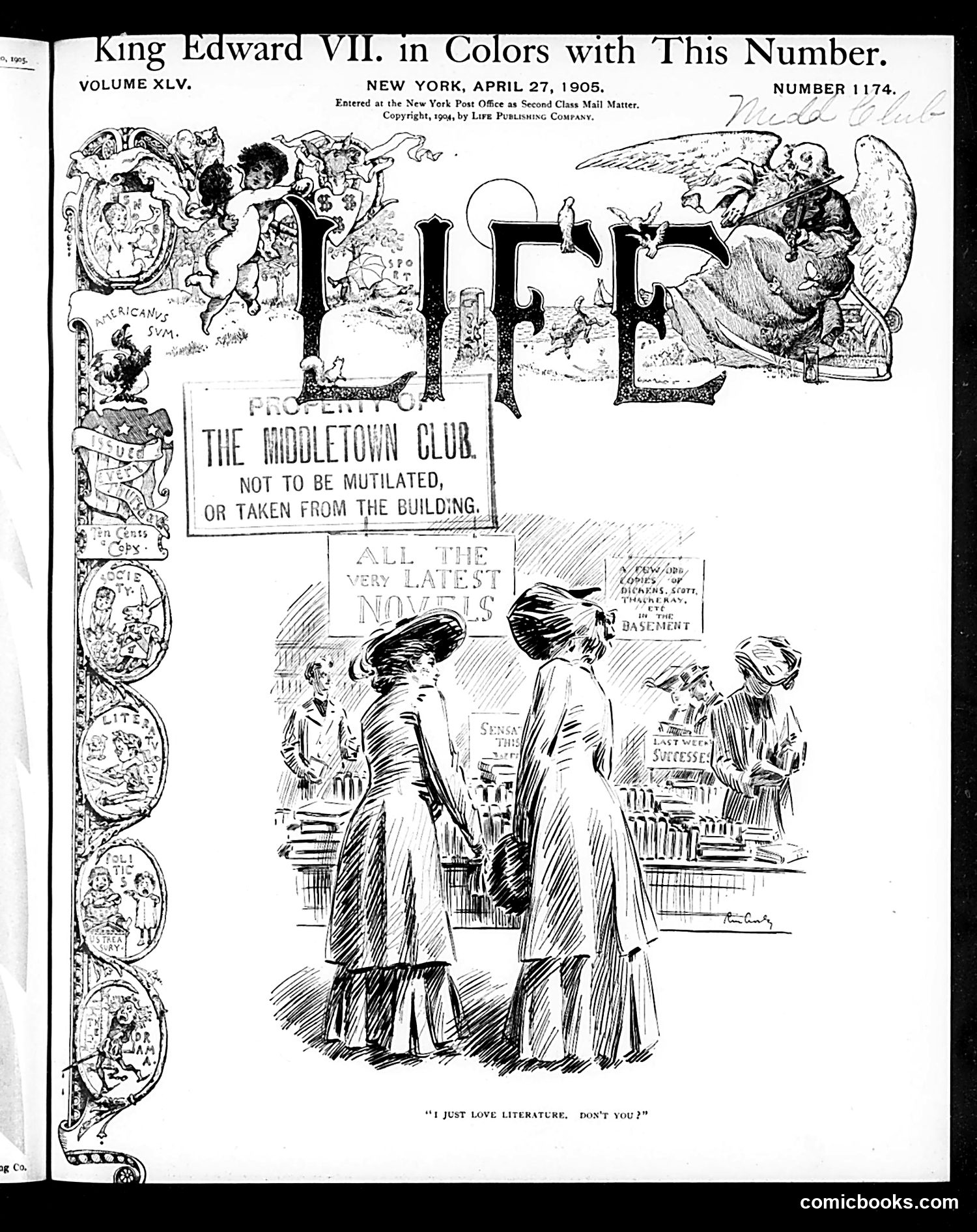
This page features a satirical cartoon about the Middletown Club library. The main illustration shows two well-dressed women browsing books in what appears to be a library basement or storage area, surrounded by stacks of novels. A sign warns: "NOT TO BE MUTILATED, OR TAKEN FROM THE BUILDING." The caption reads: "I JUST LOVE LITERATURE, DON'T YOU?" The satire targets women's reading habits and literary taste. It mocks patrons—particularly women—for treating serious literature carelessly and for their apparent love of cheap popular novels (visible titles include "sensational" works). The joke suggests these readers consume literature superficially, viewing it as entertainment rather than something to be respected. The protective sign underscores the library's concerns about book damage from casual readers.
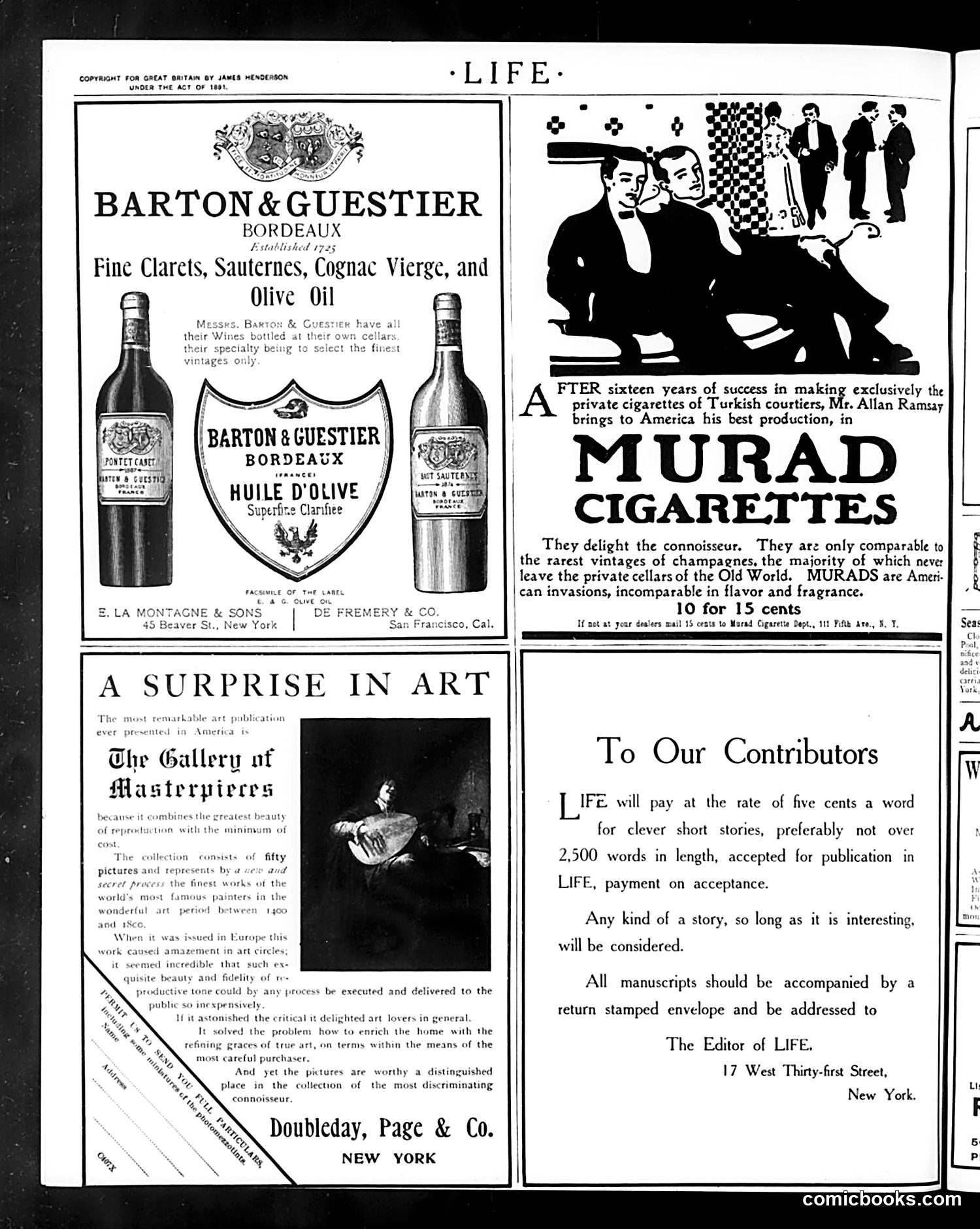
This page is primarily **advertising and editorial content** rather than political satire. The left side advertises **Barton & Guestier wines and olive oil** from Bordeaux, emphasizing their quality and French provenance. The top right features an advertisement for **Murad Cigarettes**, depicting two men in conversation with a chess game visible. The ad claims these cigarettes are comparable to "rare vintages of champagnes" and appeal to connoisseurs—a typical early 20th-century luxury product pitch. The bottom left advertises **"The Gallery of Masterpieces,"** an art book collection by Doubleday, Page & Co., marketed as an affordable way to own reproductions of famous paintings. The bottom right contains **editorial guidelines** for contributors to Life magazine, offering five cents per word for short stories. There is no apparent political cartoon or satire on this page.
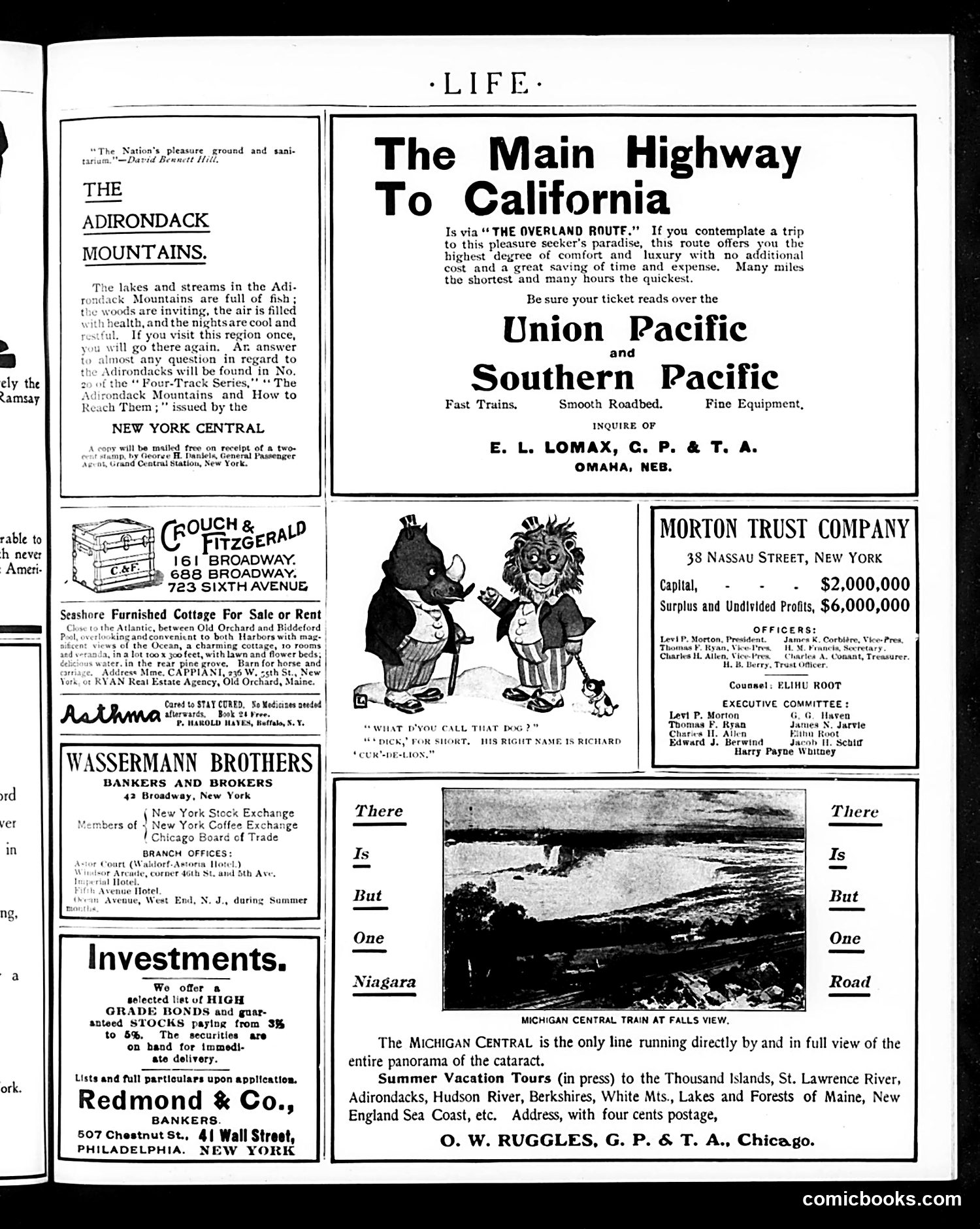
This page is primarily **advertising**, not political satire. It contains travel and financial service ads from the early 20th century, including: - Railroad promotions (Union Pacific, Southern Pacific, Michigan Central) - Banking and investment firms (Wassermann Brothers, Redmond & Co.) - Travel luggage (Crouch & Fitzgerald) The only cartoon appears to be a small illustration of two anthropomorphic animals in formal dress with the caption "WHAT D'YOU CALL THAT DOG?" / "WELL, HIS SHORT, HIS RIGHT NAME IS RICHARD" / "CUM-BERSTON." This appears to be a simple pun-based joke about a dog's name, rather than political commentary. The page reflects the commercial focus of *Life* magazine during this era—mixing entertainment content with substantial advertising revenue.
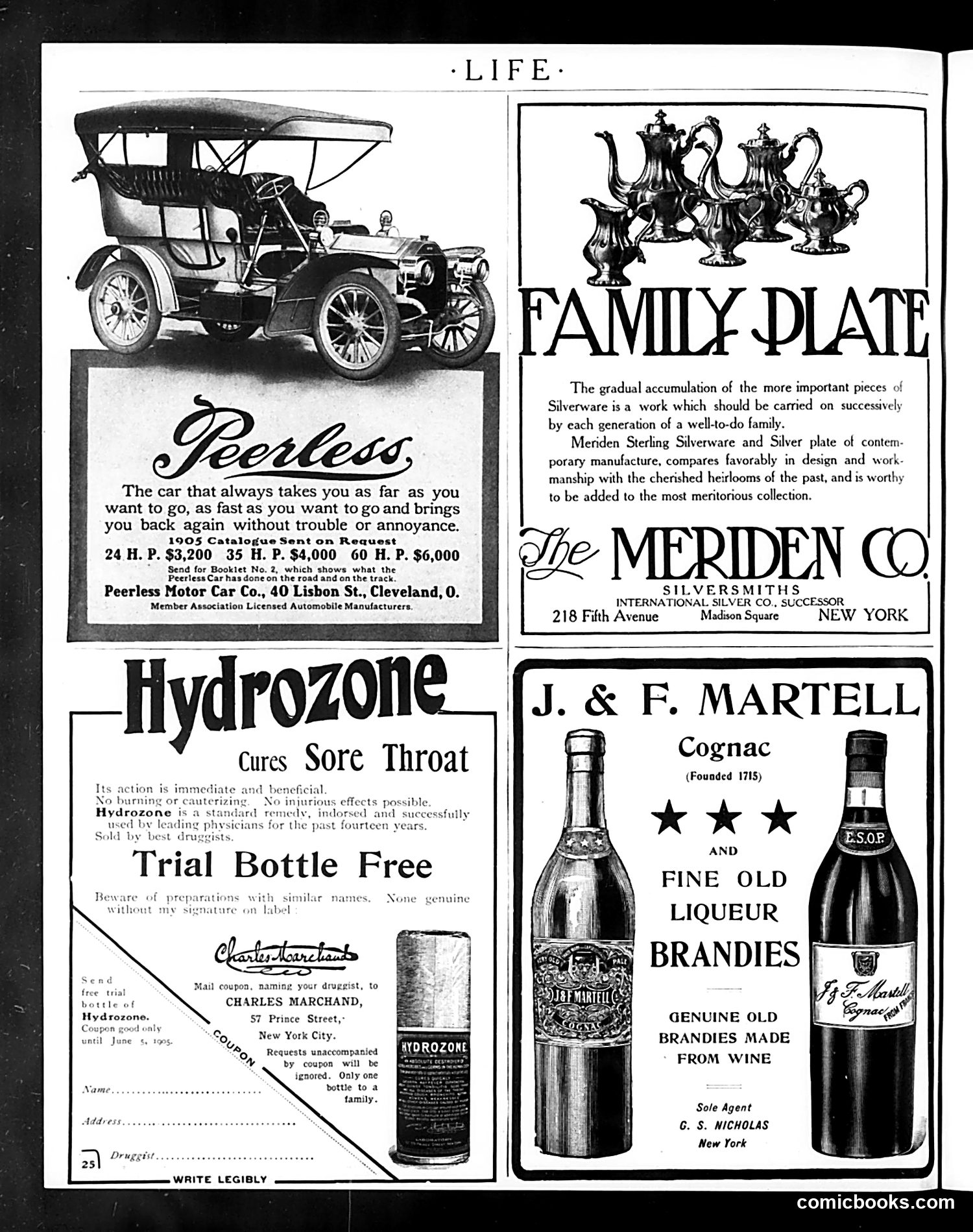
This page from *Life* magazine contains primarily **advertisements rather than political cartoons**. The ads include: - A **Peerless automobile** (1905), marketed with the tagline "the car that always takes you as far as you want to go"—typical early auto advertising emphasizing reliability and speed - **Hydrozone**, a throat remedy offered with a free trial coupon - **Meriden sterling silverware**, positioning itself as quality comparable to heirloom pieces - **J. & F. Martell cognac and brandies**, marketed as "genuine old" liqueurs There is **no discernible political satire or cartoon content** on this page. It represents the commercial advertising that *Life* magazine used to subsidize its satirical editorial content, reflecting early-1900s consumer goods and luxury markets.
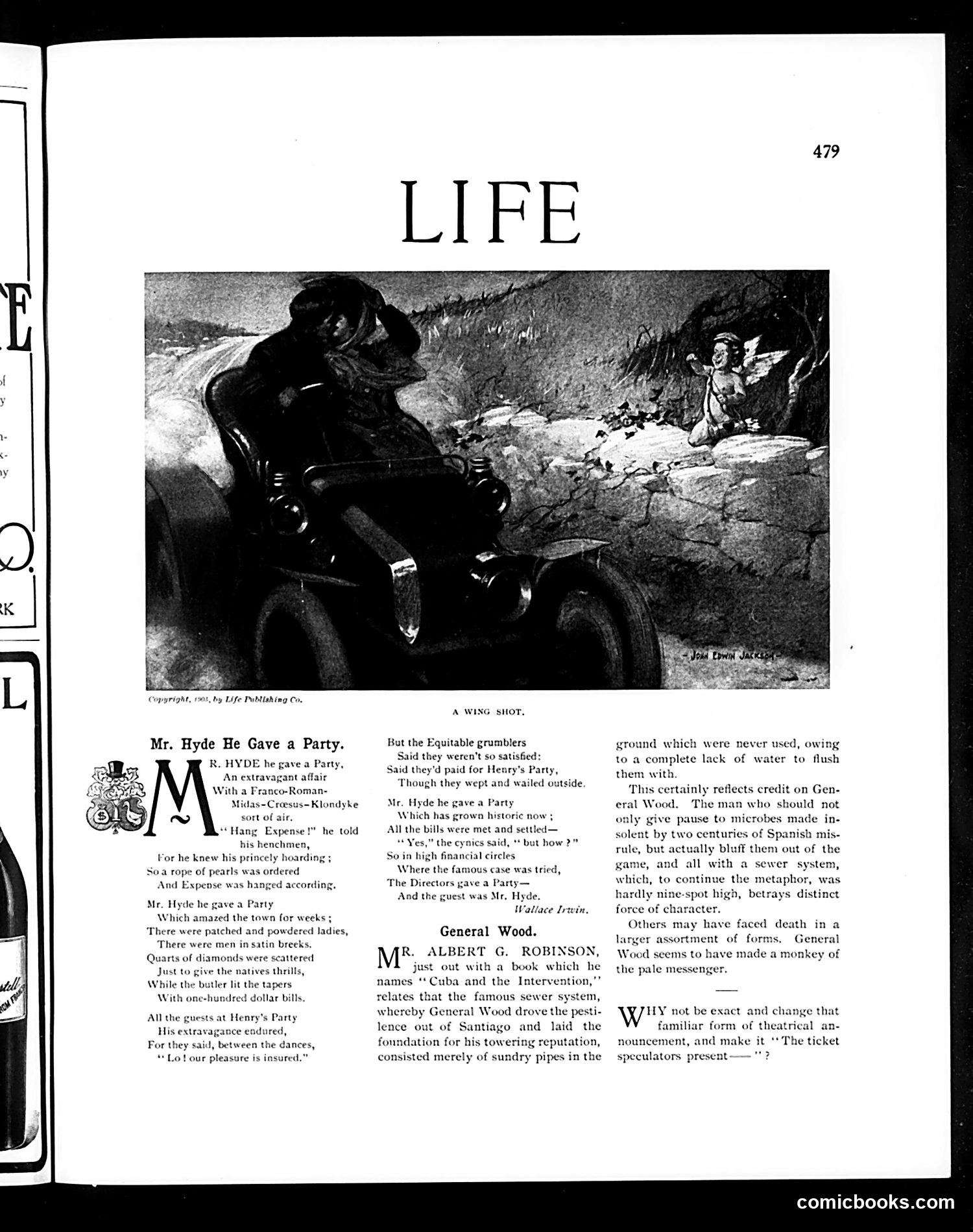
This page contains two separate satirical pieces: **"Mr. Hyde He Gave a Party"** (verse by Wallace Irwin) mocks a wealthy man's extravagant gathering. The poem describes Mr. Hyde hosting an ostentatious party with "powdered ladies," "diamonds scattered," and excessive luxury—satirizing the conspicuous consumption of the wealthy elite during the early 20th century. **"General Wood"** references Mr. Albert G. Robinson's book "Cuba and the Intervention," which apparently discusses General Wood's role in establishing control over Santiago. The brief commentary appears to critique Wood's reputation, suggesting it rested on "sundry pipes in the ground" rather than genuine accomplishment—likely referring to infrastructure projects as the basis of his colonial authority in Cuba. Both pieces employ satire to mock wealthy figures and military leadership.
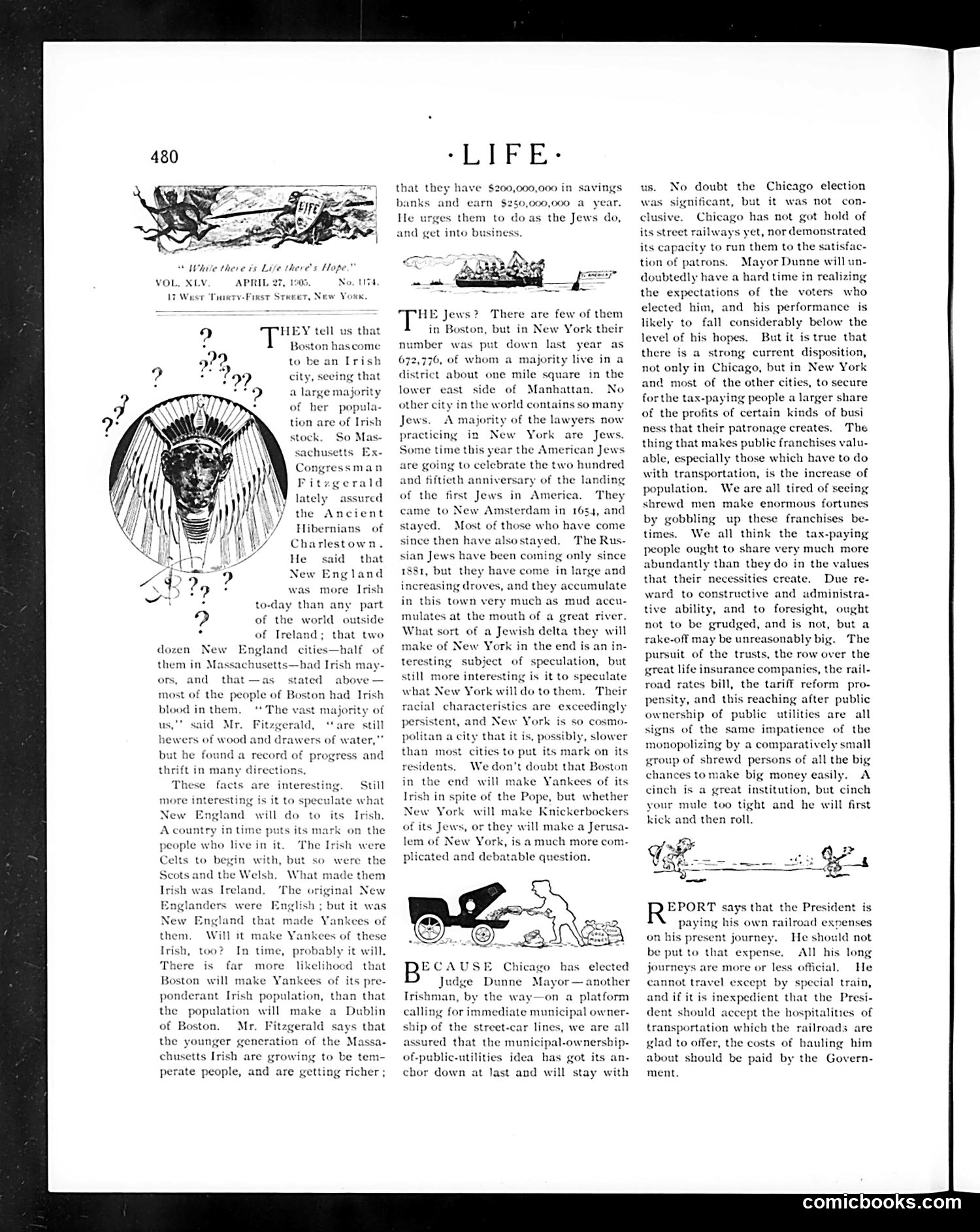
The main cartoon features a caricatured face labeled "Ancient Hieroglyphics of Charlestown" surrounded by question marks. This satirizes Boston's Irish population and their cultural characteristics, playing on the stereotype that Irish immigrants' features resembled ancient Egyptian hieroglyphics—a common racist trope of the era. The accompanying text discusses Boston's transformation into an Irish city, speculating whether this will make Boston "Yankees of its preponderant Irish population" as happened with other immigrant groups. It also compares Jewish migration to New York, debating whether New York will become a "Jerusalem." The satire mocks both Irish and Jewish immigration patterns, reflecting the nativist anxieties prevalent in early 1900s America about how immigration would reshape American cities and identity.
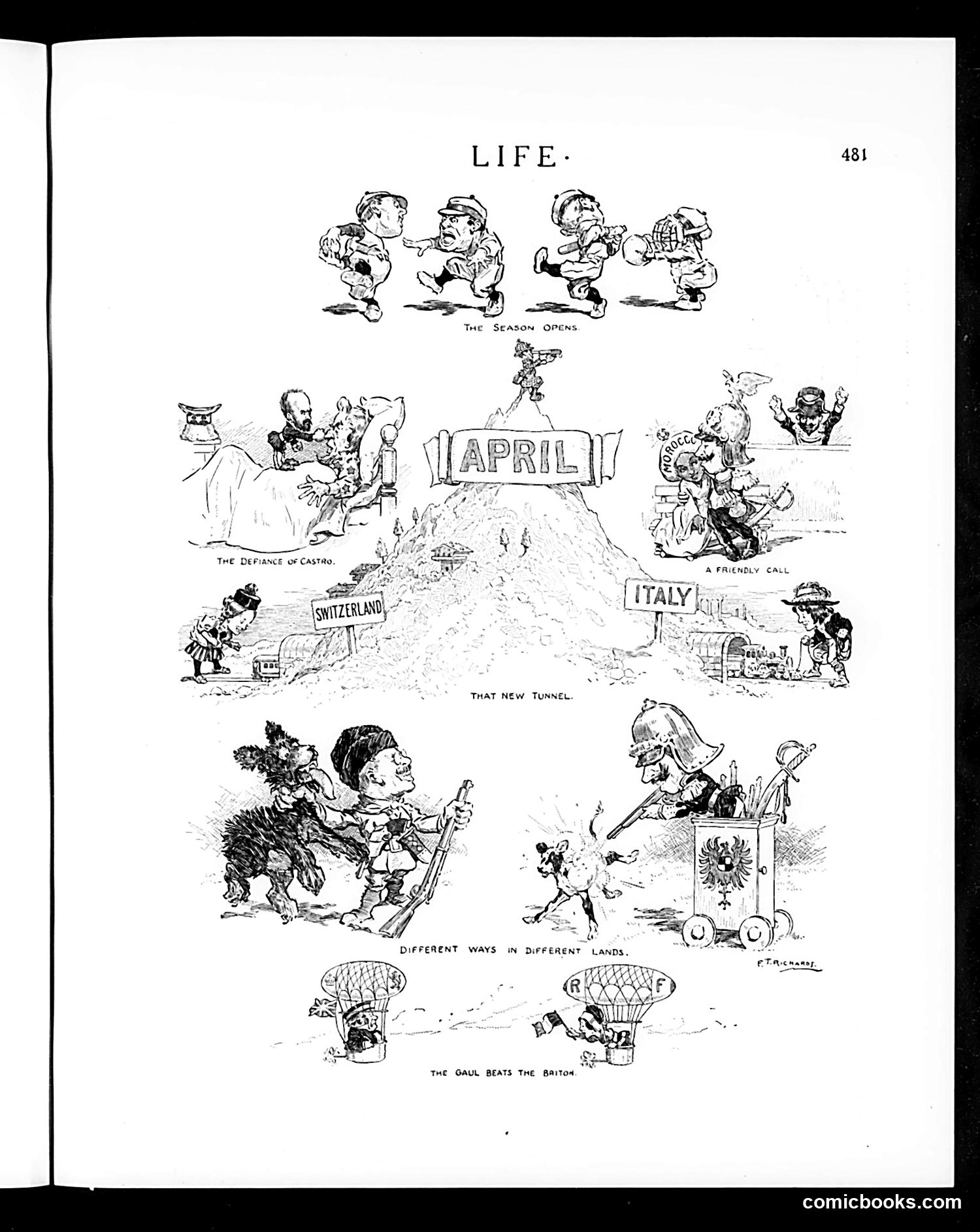
This page contains six political cartoons centered on April 1915 events, with "April" as the central theme. The cartoons reference: **"The Season Opens"** and **"The Defiance of Castro"** - appear to reference military/political conflicts, likely involving the Cuban leader Fidel Castro's predecessor or a similarly named figure. **"That New Tunnel"** - references Switzerland and Italy with a large mountain/tunnel, likely satirizing WWI neutrality or military strategy. **"A Friendly Call"** - depicts what appears to be diplomatic interaction. **"Different Ways in Different Lands"** - shows contrasting approaches, possibly to war mobilization. **"The Gaul Beats the Briton"** - references French and British competition, shown through hot air balloons, possibly satirizing aeronautical or military rivalry during early WWI. The satirical tone mocks various national responses to the ongoing First World War.
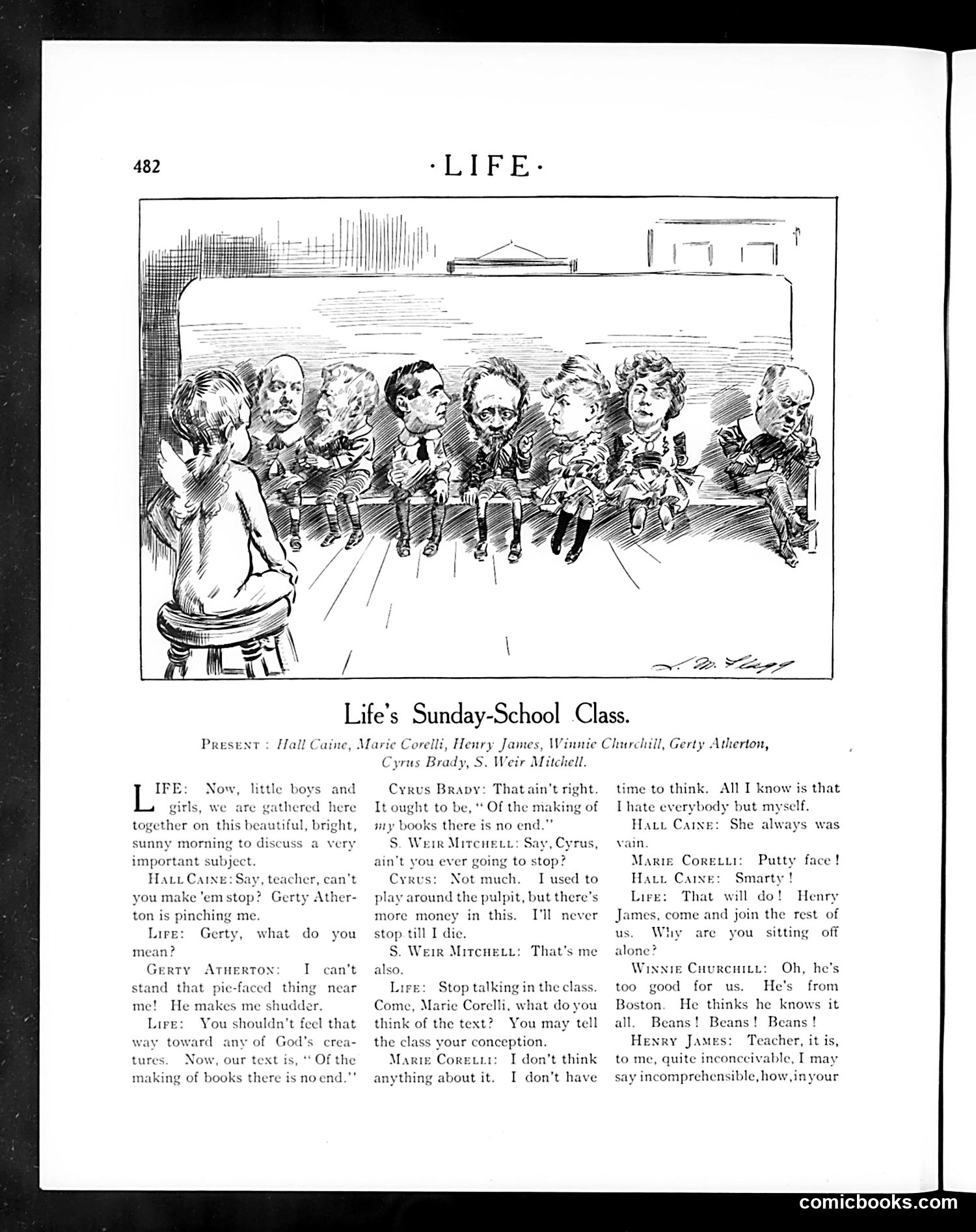
This satirical cartoon depicts eight famous literary and cultural figures of the era seated as misbehaving students in a Sunday school class. The teacher (left) attempts to discuss morality and religious texts. The caricatured figures listed are: Hall Caine, Marie Corelli, Henry James, Winnie Churchill, Gerty Atherton, Cyrus Brady, and S. Weir Mitchell—all prominent turn-of-the-century authors. The satire mocks these writers for their pretensions and actual behavior. The dialogue reveals contradictions: they discuss "the making of books" and profits while claiming moral authority. The cartoon suggests these celebrated authors are hypocritical—preaching virtue while pursuing commercial success and ego, much like unruly schoolchildren pretending to lessons they don't genuinely understand.
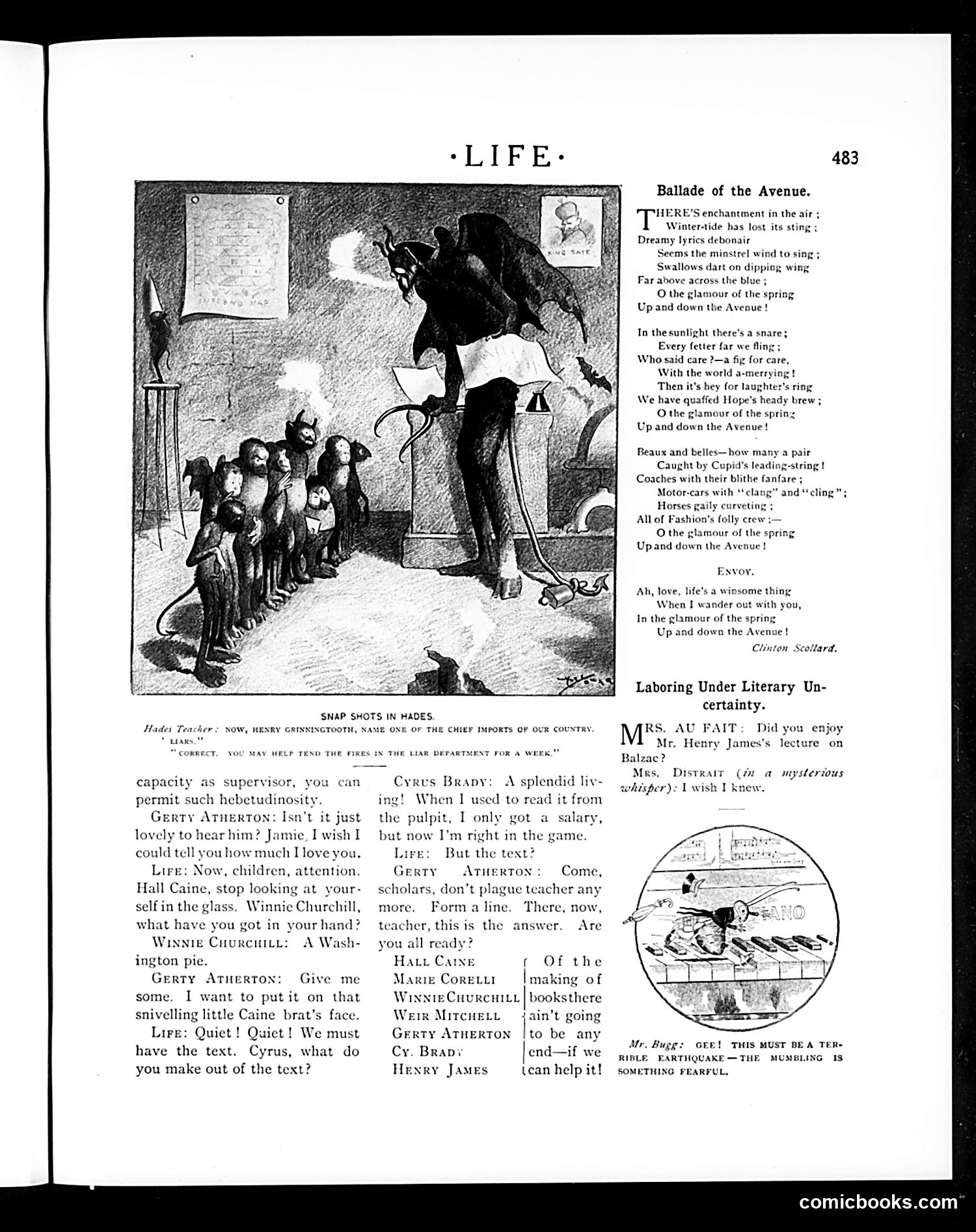
The main cartoon titled "SNAP SHOTS IN HADES" depicts a stern teacher figure instructing a group of small demons or imps. The caption credits "Hades Teacher" as "Henry Ginsgingtooth, name one of the chief imps of our country" and notes he's explaining "how the lie department for a week." This is satire about **American political deception and propaganda**. The "chief imps" reference suggests prominent public figures spreading deliberate falsehoods. The classroom setting in Hell implies lying is so fundamental to certain leaders that it requires formal instruction—a darkly comic commentary on corruption in government or public life. The accompanying dialogue snippet features characters discussing literary matters, providing lighter comic relief on the same page. The overall message criticizes systematic dishonesty at high levels of society.
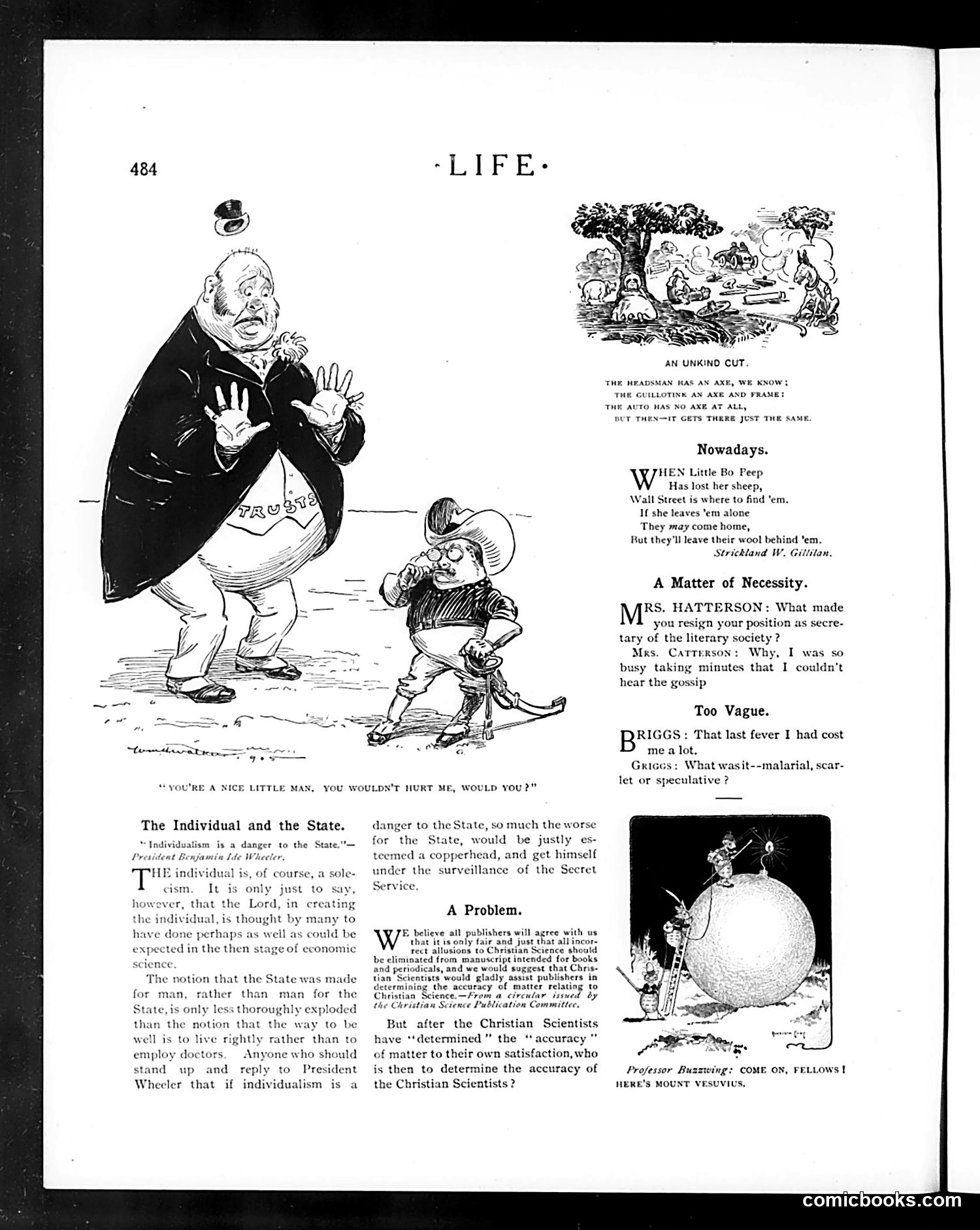
The main cartoon depicts a wealthy, rotund man (identified by his formal dress and distressed expression) confronted by a small child. The caption reads: "You're a nice little man, you wouldn't hurt me, would you?" This appears to satirize **individualism versus state power**. The accompanying article titled "The Individual and the State" argues that individualism poses danger to the state, yet quotes Benjamin Franklin's opposing view. The cartoon likely mocks wealthy industrialists or capitalists who, despite their power and resources, claim victimhood when challenged by ordinary citizens or state regulation. The juxtaposition suggests irony: the physically imposing figure appears threatened by someone powerless, inverting typical power dynamics—a commentary on how the powerful frame themselves as vulnerable when facing public scrutiny or regulation.
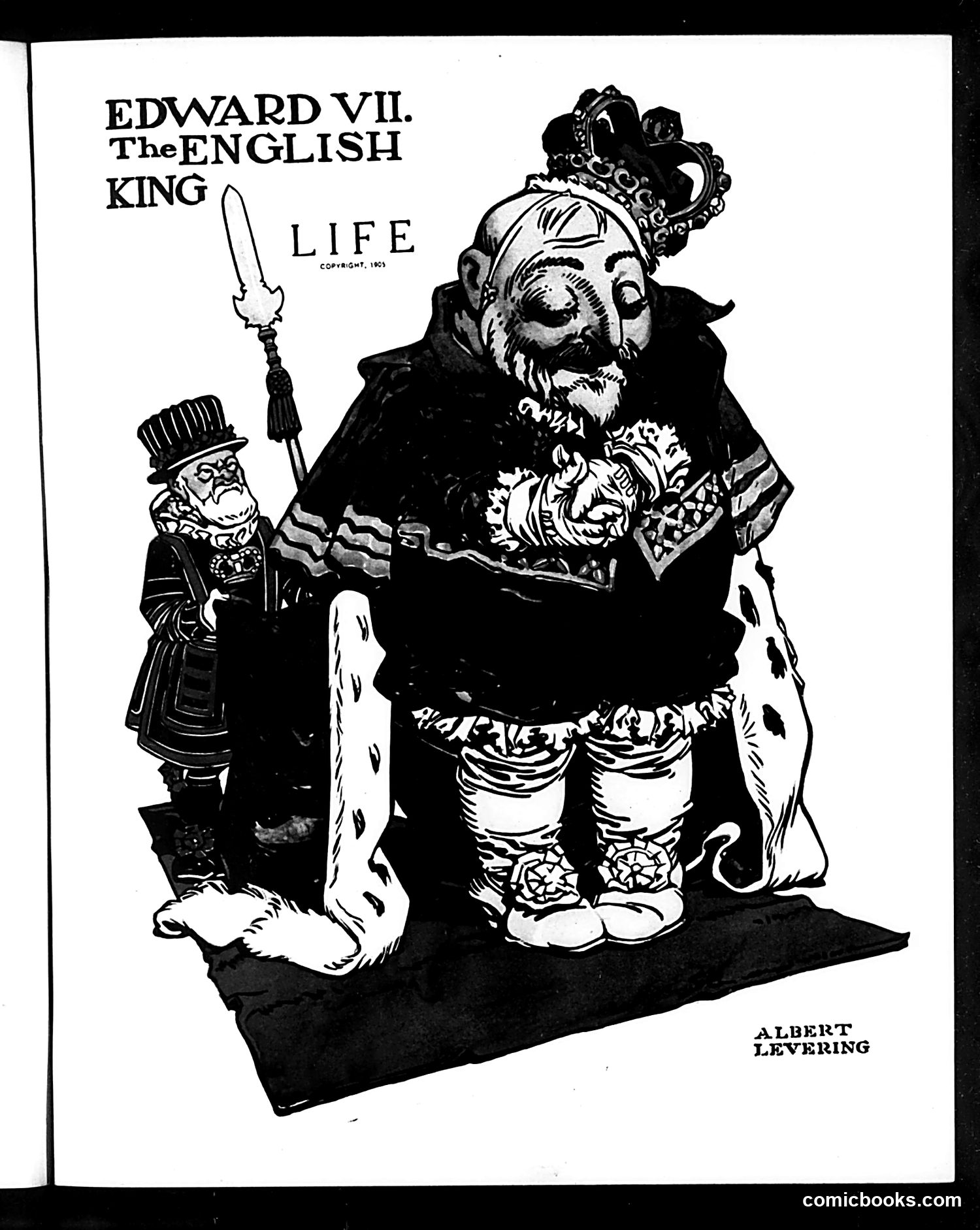
This is a cover illustration by Albert Levering for Life magazine (copyright 1903) depicting King Edward VII of England as an exaggerated, rotund figure in elaborate royal regalia—ornate crown, jeweled robes trimmed with ermine, and decorative stockings. A smaller figure, appearing to be a courtier or advisor, stands beside him holding a sword. The caricature emphasizes Edward's physical bulk and the ostentatious nature of British royal dress and ceremony. The satire likely mocks either Edward VII's personal indulgences, his lavish court, or perhaps broader criticisms of British monarchy and imperial pretension common in American satirical publications of the early 1900s. The exaggerated features and costume are typical of Life's sharp visual commentary on public figures.

I can see this is a blank or nearly blank page from Life magazine. The page appears to be mostly white space with minimal visible content or text. There are no discernible cartoon illustrations, caricatures, or satirical imagery that I can identify with confidence. Without clear visual elements or readable text to analyze, I cannot reliably explain what political or social satire this page contains. It's possible this is a title page, an advertising page, or a page where the image quality makes the original content illegible in this scan. To provide accurate historical context as requested, I would need a page with visible cartoon artwork or legible text. I cannot responsibly invent details about content I cannot see.
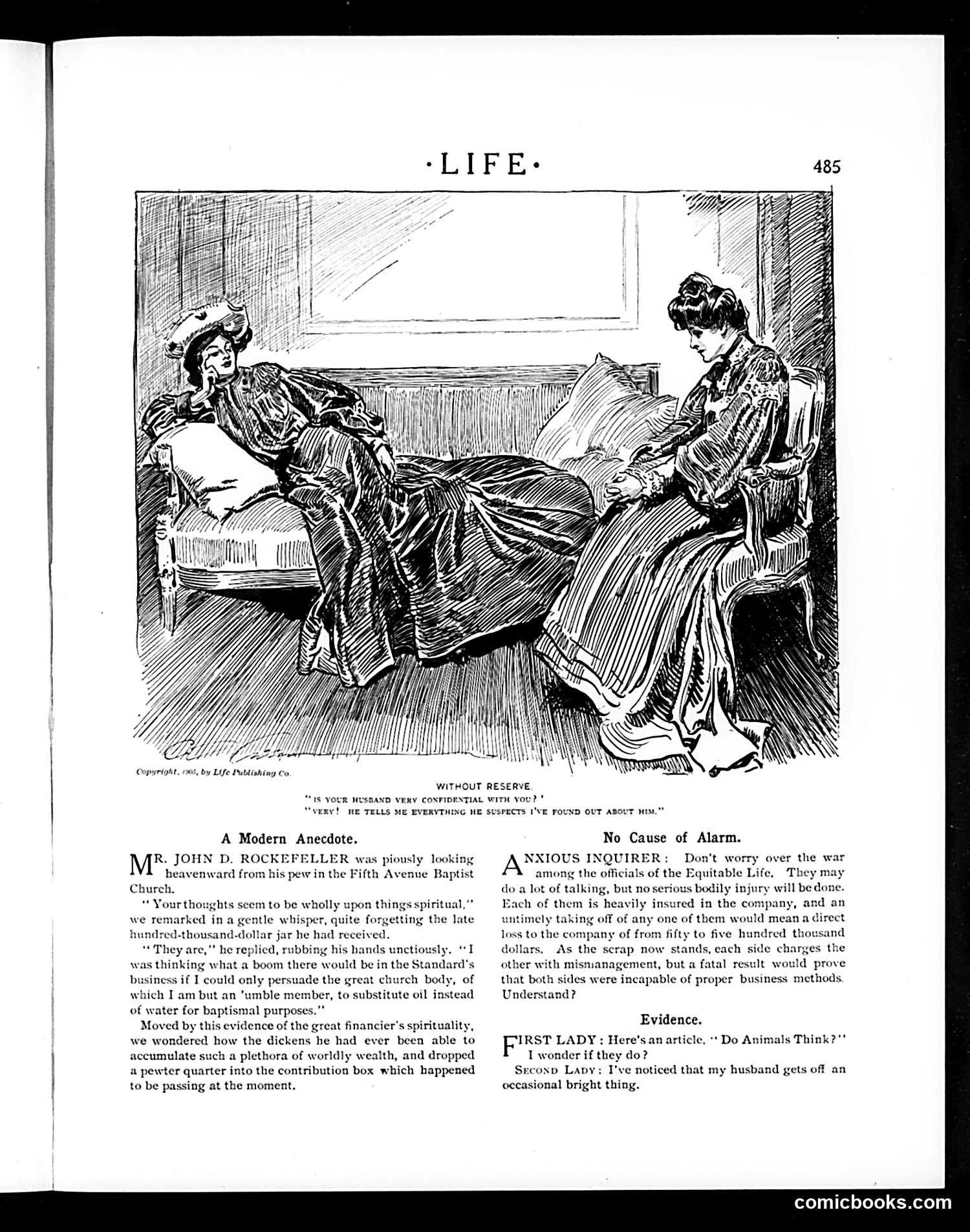
This 1908 page contains three separate satirical pieces mocking wealthy and influential figures: **"A Modern Anecdote"** targets **John D. Rockefeller**, the oil magnate and Standard Oil monopolist. The joke: Rockefeller's piety is exposed as self-serving—he's so profit-obsessed that even in church, he calculates business opportunities (suggesting oil replace baptismal water). The final line mocks his supposed generosity when he drops only a quarter into the collection box despite his vast wealth. **"No Cause of Alarm"** satirizes corruption at the Equitable Life Insurance Company during internal scandals. The humor lies in cynical logic: executives won't kill each other despite feuding because they're financially invested in the company—self-interest prevents actual harm. **"Evidence"** is a brief domestic joke playing on the stereotype that husbands rarely say intelligent things—the wife finds an article about animal thinking and sarcastically wonders if animals think, implying her husband occasionally does. All three pieces reflect early 20th-century American skepticism toward corporate titans and institutional corruption.
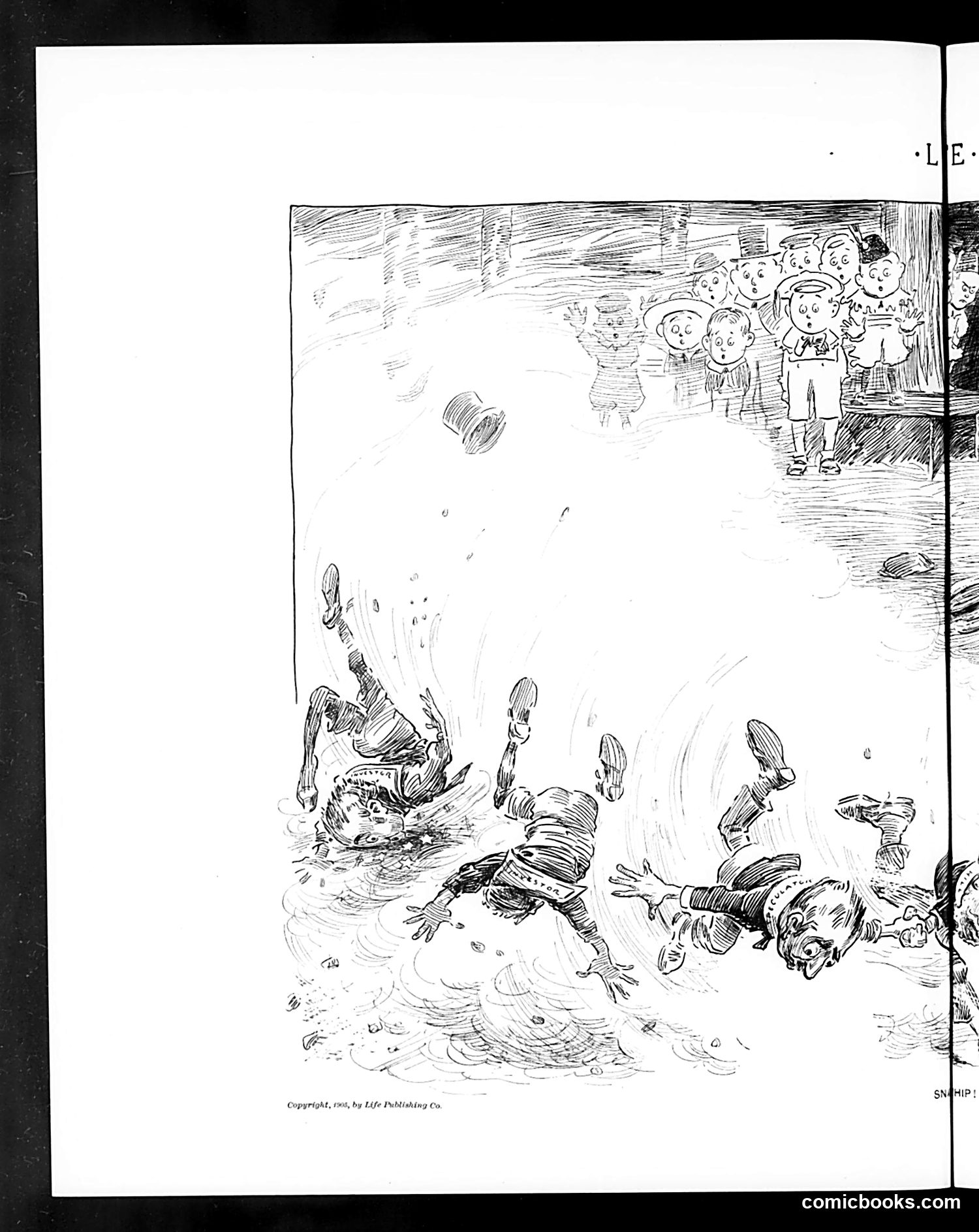
This cartoon depicts children playing in mud or water, with figures splashing and tumbling energetically while others watch from the side. The copyright date appears to be 1908 (not 1208). Without additional context visible on this page, the specific satirical target is unclear. However, given Life magazine's tradition of social commentary, this likely comments on childhood behavior, parenting norms, or class distinctions of the Edwardian era—possibly mocking either overly rigid Victorian propriety or the "natural" exuberance of children. The cartoon's style and subject matter are consistent with early 20th-century American humor focusing on everyday domestic scenes and childhood mishaps as vehicles for social observation or gentle mockery.
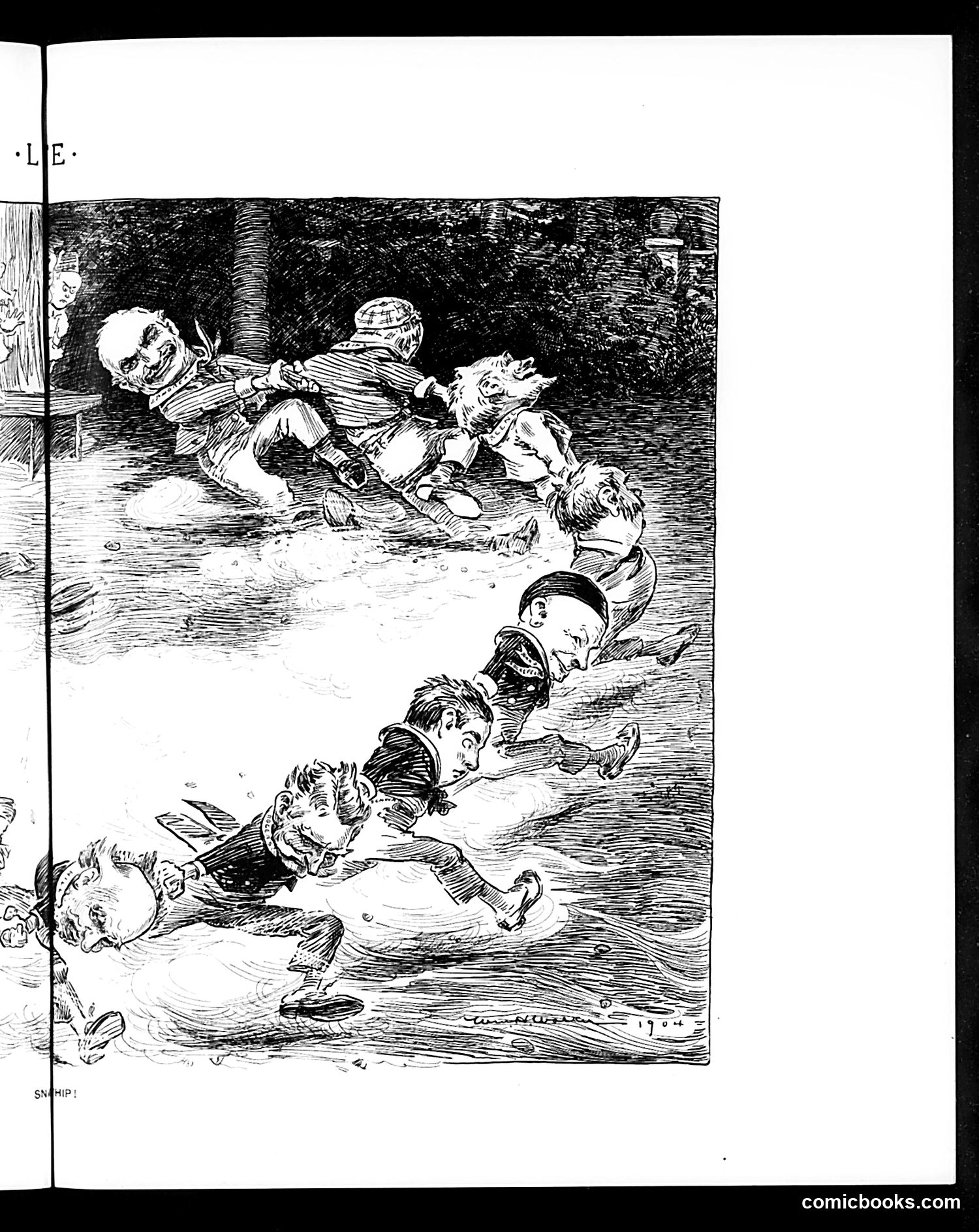
This appears to be a satirical illustration from Life magazine depicting a line of anthropomorphized figures (appearing as animals or caricatured humans) wading through water or mud. The style and composition suggest social or political commentary, likely about a queue or procession of some kind. However, without clearer textual context visible on the page—beyond "SNIP!" at bottom and "LIFE" at top—I cannot definitively identify which specific political figures, events, or social issues are being satirized. The caricatured nature and the line formation suggest commentary on either immigration, poverty, political corruption, or a contemporary social movement, but asserting a specific interpretation would require additional contextual information not clearly legible in this image. The artistic technique uses cross-hatching typical of early 20th-century American editorial cartooning.
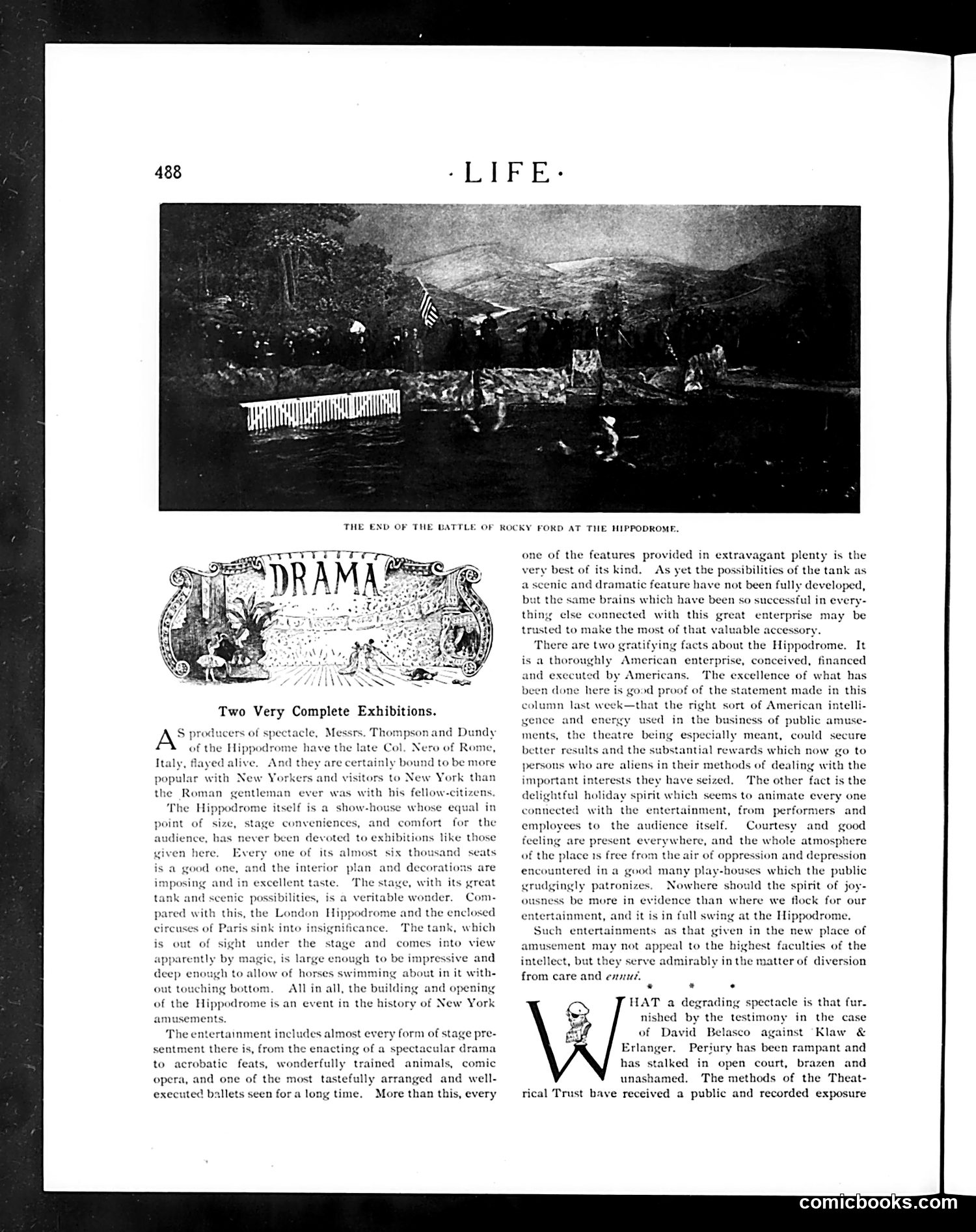
This page celebrates the Hippodrome, a new New York theatrical venue, while simultaneously attacking theatrical monopolies. **Main Content:** The top photograph shows "The End of the Battle of Rocky Ford at the Hippodrome"—a dramatic stage spectacle featuring a tank (military vehicle) as scenery. The article praises the Hippodrome as a thoroughly American enterprise with superior stage technology and pleasant atmosphere compared to European theaters. **The Satire:** The secondary article criticizes the "Theatrical Trust"—a monopoly controlled by producers Klaw & Erlanger. It references their lawsuit against impresario David Belasco, alleging perjury and unethical business practices. The Trust allegedly used intimidation tactics in court, representing everything corrupt about theatrical monopolies. **The Point:** Life presents the Hippodrome's success as proof that American innovation and honest business practices triumph over monopolistic intimidation. The contrast between celebrating one theater while exposing the Trust's corruption served Life's anti-monopoly editorial stance.
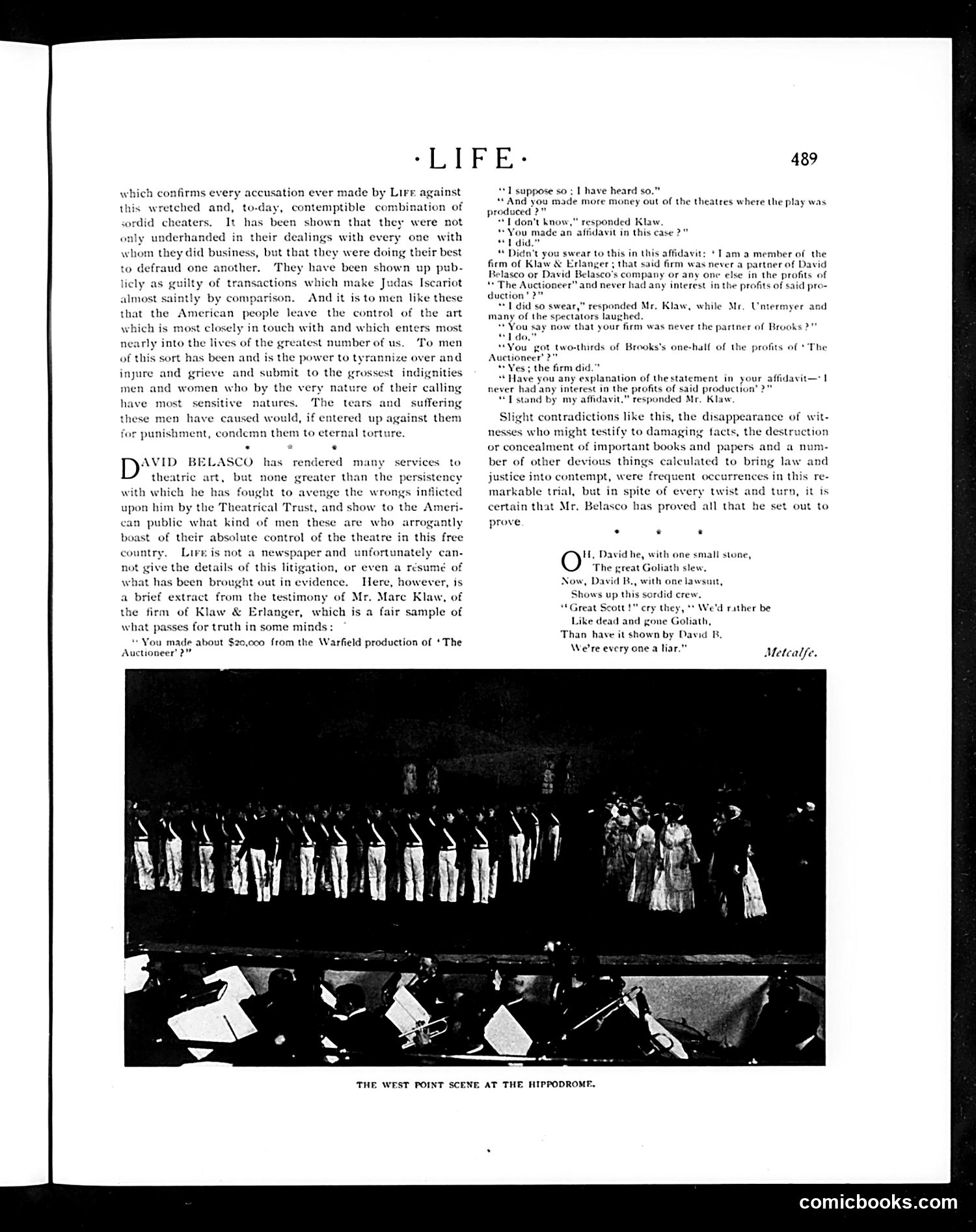
This page satirizes the **Theatrical Trust** (Klaw & Erlanger), powerful theater monopolists whom Life accused of cheating artists and controlling American theater. The article praises **David Belasco**, a theater producer who sued the Trust to expose their corruption. The text features testimony from Marc Klaw himself, caught in obvious contradictions: he testified the firm made $20,000 from a production, then claimed ignorance; he swore under oath they had "no interest" in profits, then admitted they received two-thirds of another show's profits. These contradictions—along with destroyed evidence and vanishing witnesses—exemplified the Trust's contempt for justice. The poem at bottom compares Belasco to David defeating Goliath, suggesting his lone lawsuit exposed these "sordid" men as liars. The photograph shows what appears to be a theatrical scene at the Hippodrome, illustrating the grand spectacles controlled by these corrupt theater leaders.
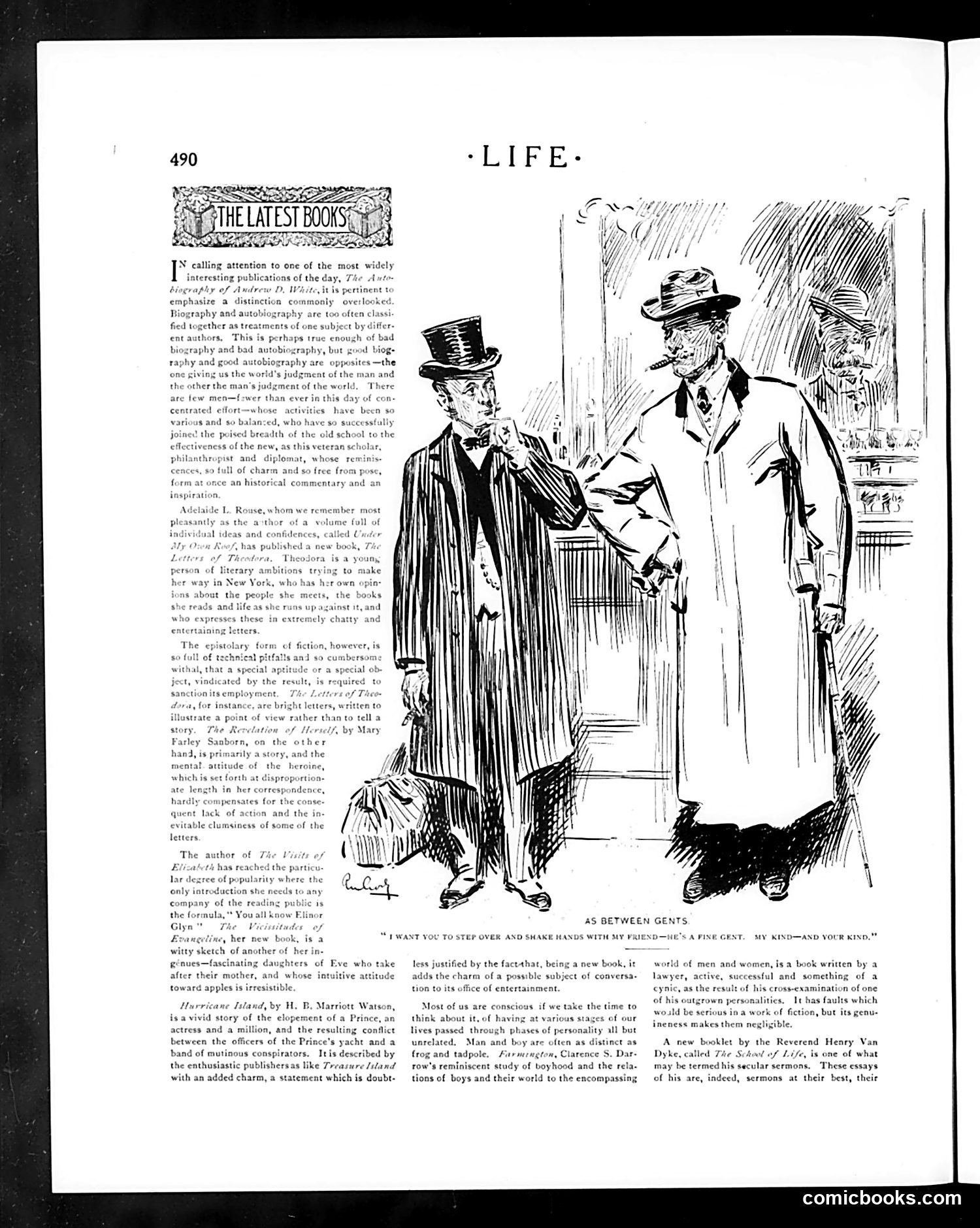
This page from *Life* magazine features a cartoon titled "As Between Gents" depicting two well-dressed men in formal attire (top hats and coats) introducing each other. The caption reads: "I want you to step over and shake hands with my friend—he's a fine gent. My kind—and your kind." **The satire:** The joke appears to be about class pretension and social climbing. Both men present themselves as "gents" (gentlemen), suggesting they belong to the same refined social class. However, the cartoon likely mocks the artificial nature of such claims—implying that not everyone calling themselves a "gentleman" actually qualifies, or that the standards for such designation are absurdly flexible. The emphasis on "my kind—and your kind" hints at ironic acknowledgment that they recognize each other as fellow social pretenders, despite outward appearances of propriety. The text discusses various books, but the cartoon's point concerns American attitudes toward class and respectability during the early 20th century, when *Life* specialized in such social commentary.
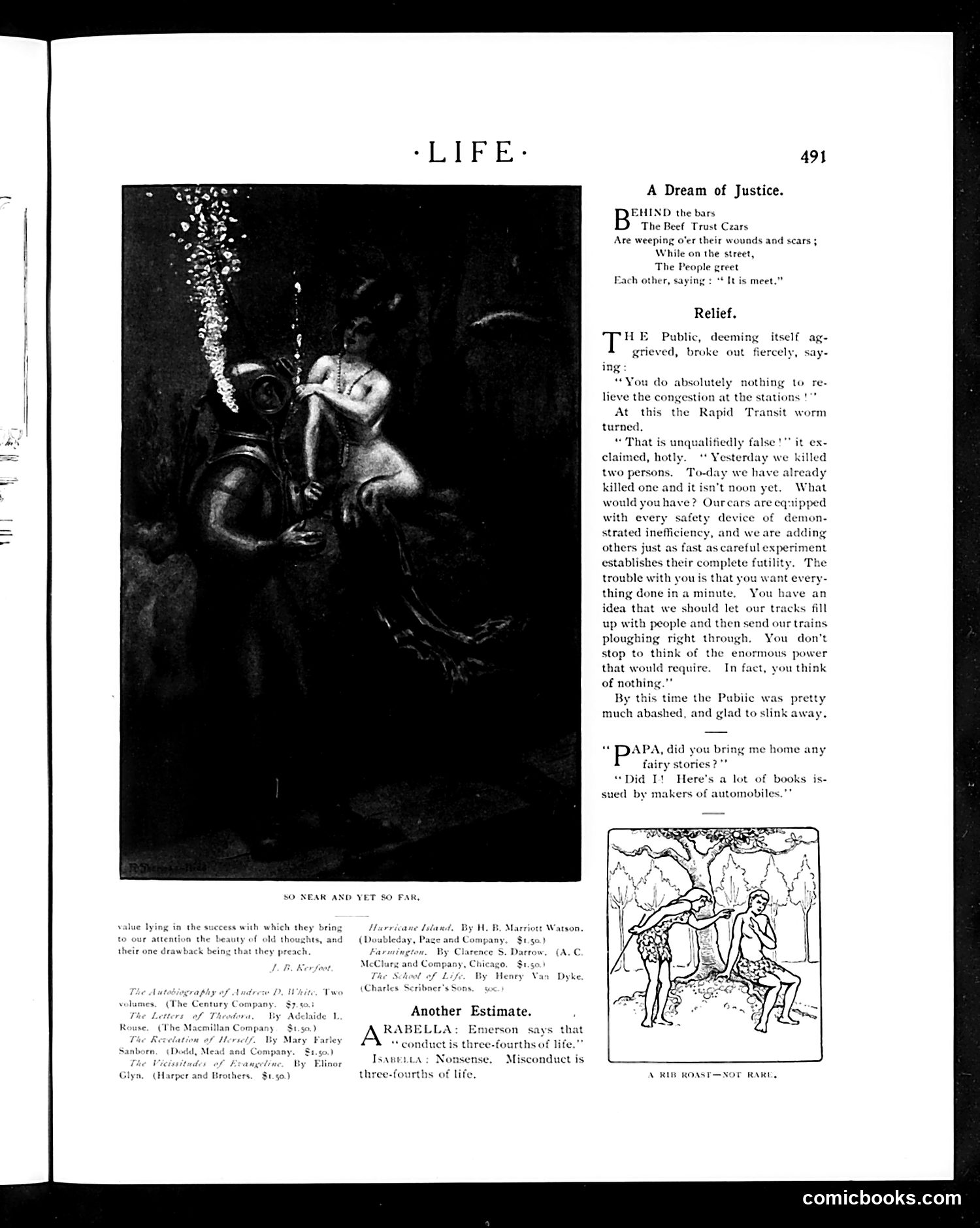
This page contains two separate satirical pieces criticizing American institutions circa early 1900s: **"A Dream of Justice"** (top poem): Mocks the "Beef Trust"—the monopolistic meat-packing industry that controlled U.S. beef production. The fantasy depicts these corporate "czars" imprisoned and suffering while the public celebrates their downfall, reflecting contemporary Progressive Era anger at corporate trusts. **"Relief"** (main text): Savagely ridicules the Rapid Transit system's response to public complaints about station congestion. The transit company's defense is absurdly self-congratulatory—bragging about killing passengers as proof of "safety devices"—exposing the callous incompetence of public utilities and their dismissive attitudes toward rider safety and concerns. The bottom cartoon and "Another Estimate" appear to be lighter fare about automobiles and conduct/misconduct. The overall thrust: satire of unchecked corporate power and institutional indifference to public welfare.
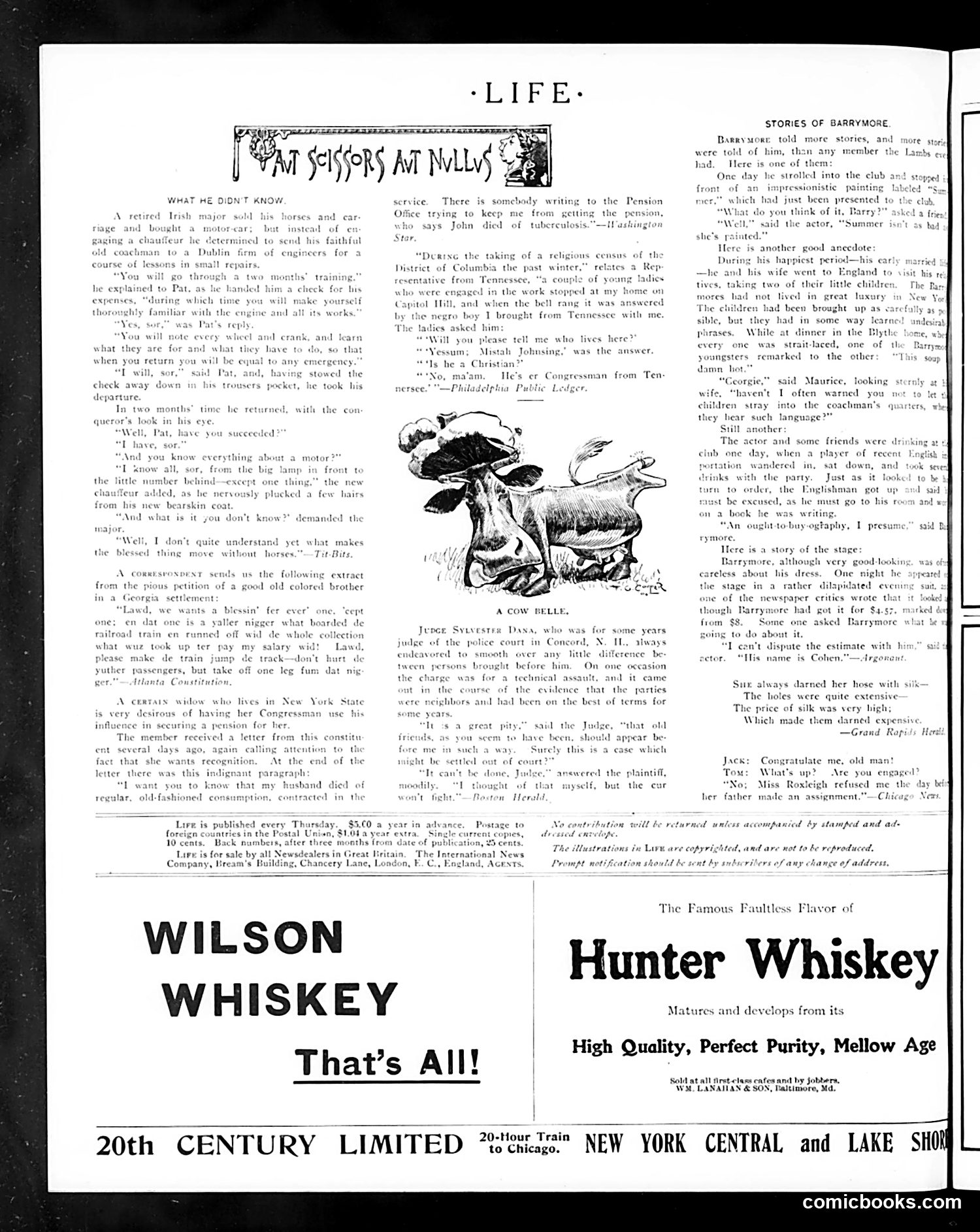
This page from *Life* magazine presents humor centered on racial stereotypes and social commentary typical of early 20th-century American satire. **Main Content:** The illustrated cartoon titled "A Cow Belle" depicts a conversation between what appears to be a white authority figure and a Black man, using dialect humor that was standard in the era's entertainment. The accompanying text stories mock racial and social pretensions through anecdotes. **"Stories of Barrymore"** section offers theatrical gossip about the famous actor, including jokes about his vanity and personal habits—typical celebrity mockery of the period. The page also contains various humorous social commentary vignettes, including a widow seeking Congressional pension recognition and legal/marital disputes told as jokes. **Context for Modern Readers:** The racial caricatures and dialect representations reflect attitudes considered acceptable in early-20th-century publications but are now recognized as deeply offensive. The humor relied heavily on ethnic and racial stereotyping that was commonplace in American mainstream media of this era.
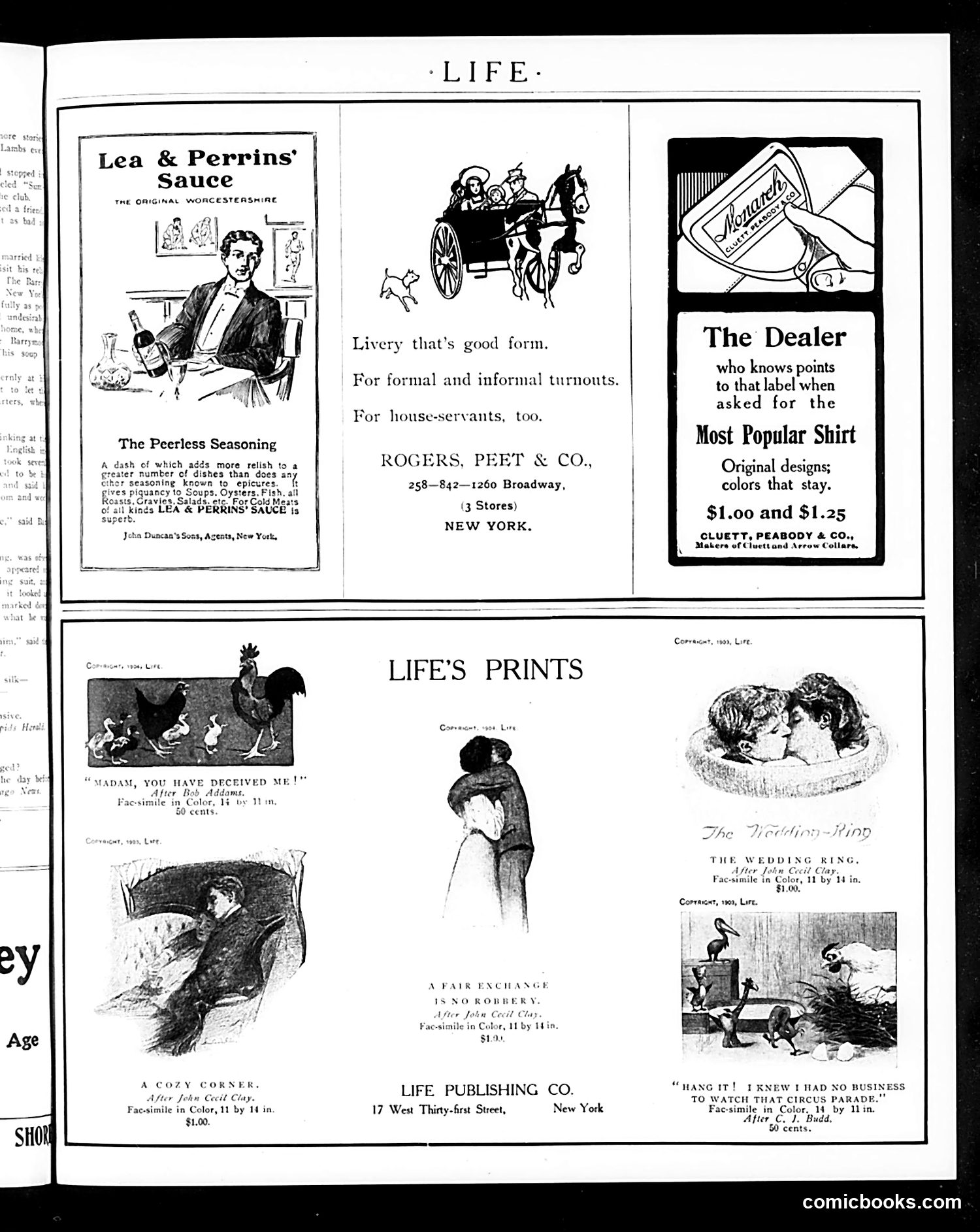
This is primarily an **advertising page** from Life magazine, not political satire. The top section contains three product advertisements: 1. **Lea & Perrins' Sauce** — promotes Worcestershire sauce with a gentleman dining, emphasizing it as "the peerless seasoning" 2. **Rogers, Peet & Co.** — advertises formal wear and livery services for carriages and house servants 3. **Cluett, Peabody & Co.** — promotes their "Most Popular Shirt" at $1.00-$1.25 The lower section features **"Life's Prints"** — decorative art reproductions available for purchase, including romantic and humorous illustrations by John Cecil Clay and others, priced around $1.00-$1.90. These represent typical early 20th-century magazine monetization: advertisements mixed with art merchandise. There is no political commentary or satire visible on this page — it functions as commercial content for affluent urban readers.
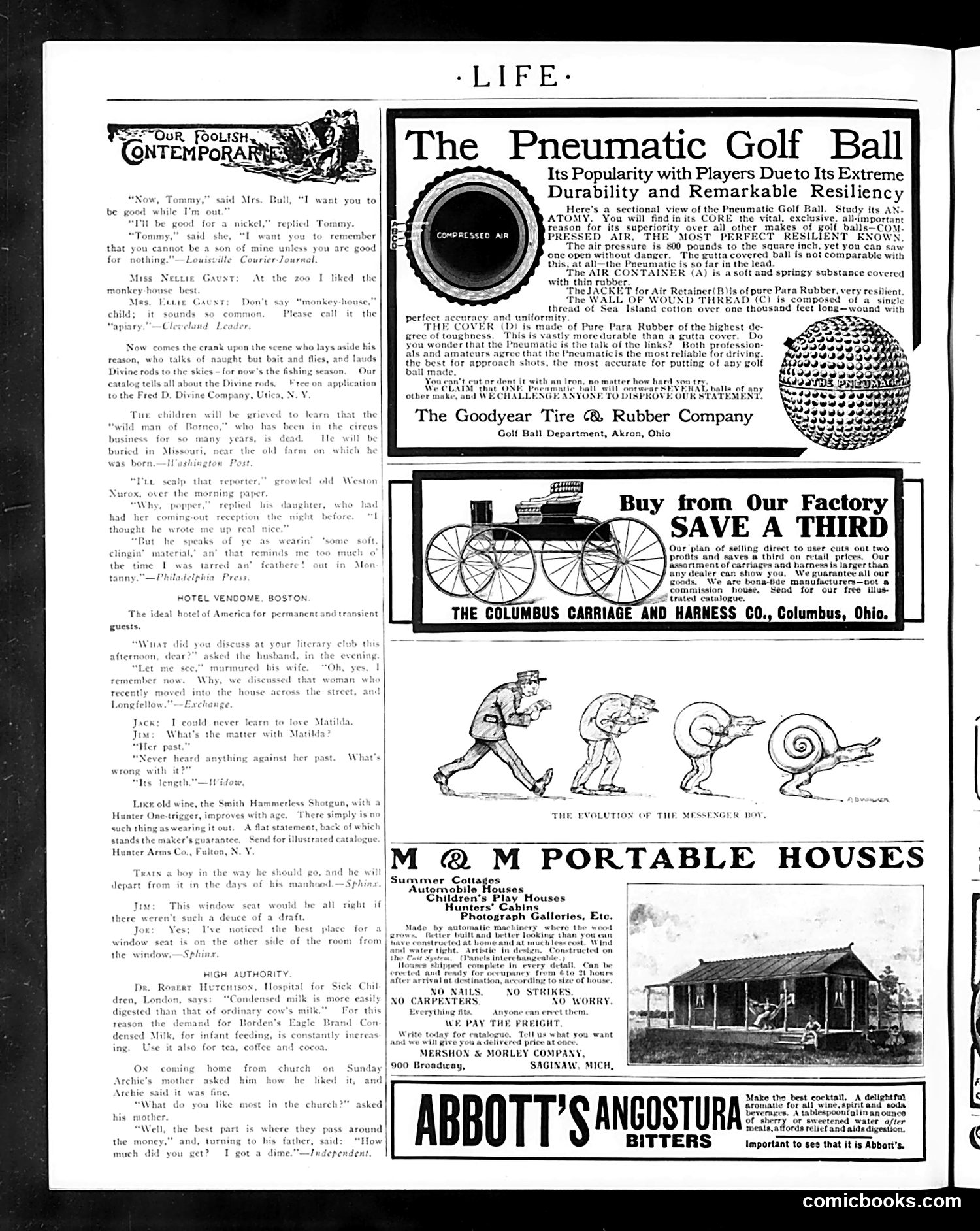
This page is primarily **advertising**, with minimal editorial content. The few cartoon/humor snippets visible ("Our Foolish Contemporaries") are brief anecdotes rather than political commentary. The main content features product advertisements typical of early 20th-century Life: 1. **Pneumatic Golf Ball** – detailed explanation of its construction advantages 2. **Columbus Carriage and Harness Co.** – promoting direct-to-consumer sales ("Save a Third") 3. **M&M Portable Houses** – prefabricated structures for various uses 4. **Abbott's Angostura Bitters** – a medicinal/cocktail ingredient The humor snippets reference domestic life (children, spouses, church visits) without apparent political content. The page reflects the magazine's shift toward advertising-heavy content and general-interest humor rather than satirical commentary on current events.
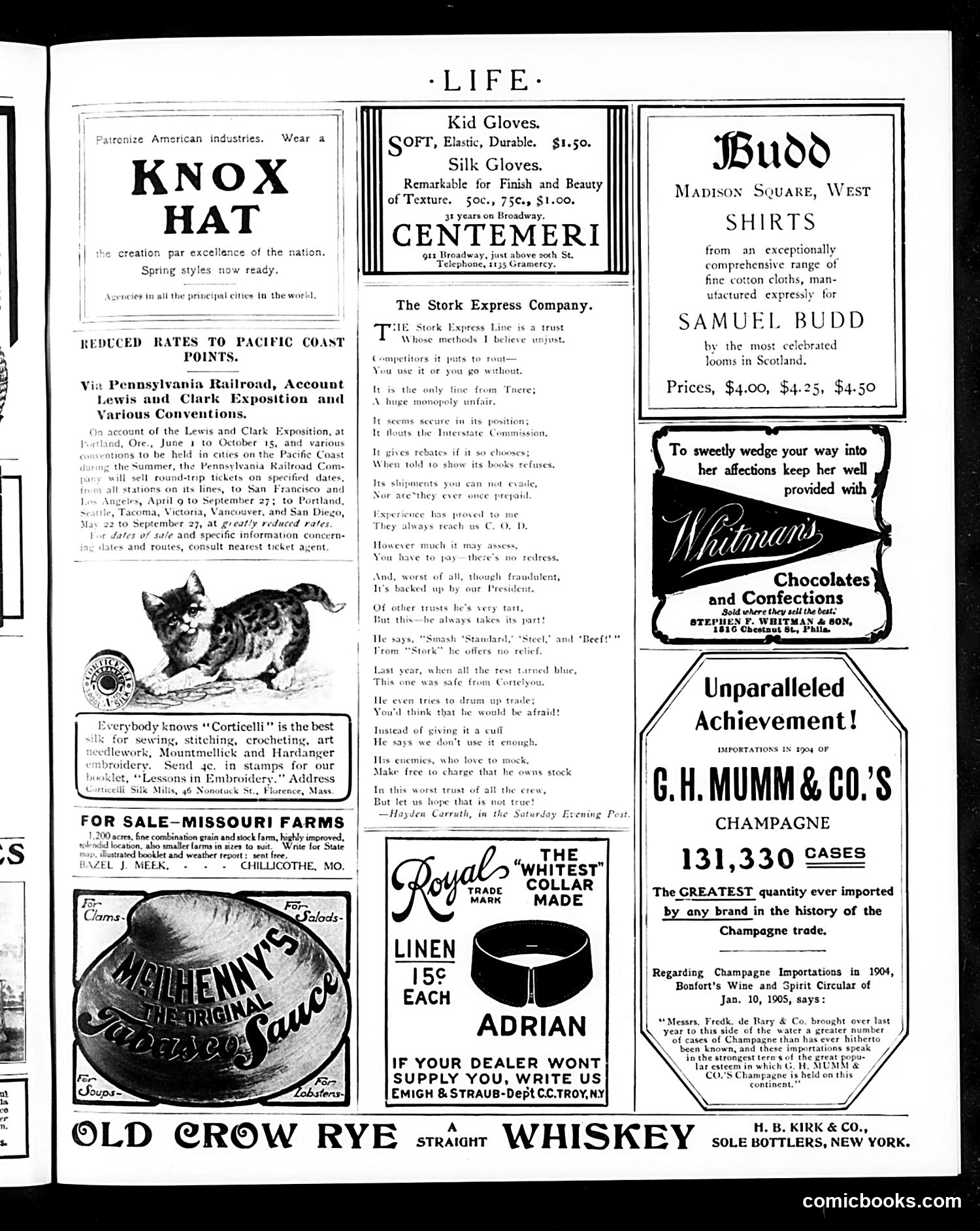
This is primarily an **advertising page** from Life magazine, circa 1904-1905, containing no political cartoons or satire requiring historical context. The page features standard commercial advertisements for products including Knox hats, Centemeri gloves, Budd shirts, Whitman's chocolates, and G.H. Mumm champagne. Most notably, there is **one humorous illustrated advertisement** for "The Stork Express Company"—a joke ad personifying the stork as a delivery service for babies, complete with verse describing the stork's "monopoly" and inability to be evaded or prepaid. This is gentle, family-oriented humor playing on the contemporary euphemism of "the stork brings babies." The remaining content includes practical classified ads (Missouri farmland for sale) and notices about railroad rates and embroidery supplies—typical magazine filler of the era. There are **no political references or satirical commentary** on this particular page; it represents straightforward commercial content interspersed with mild domestic humor.
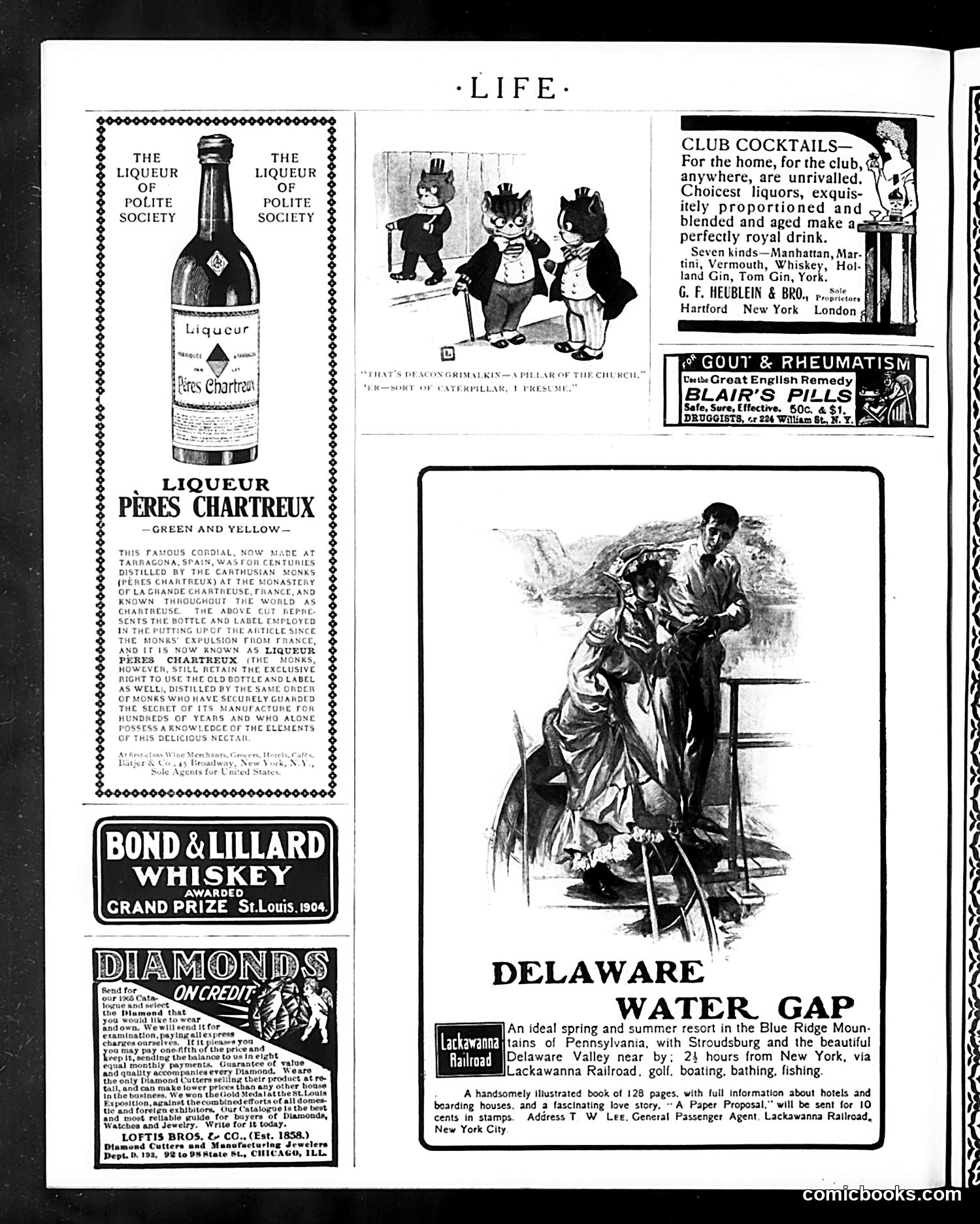
The central cartoon depicts a hypocritical church deacon ("Deacon Grimalkin") presented as respectable to society while apparently being a predatory cat stalking prey—likely a commentary on moral corruption hidden beneath religious propriety. The caption's dry tone ("a pillar of the church") suggests the satire: prominent religious figures may harbor vices or selfish behavior despite their public sanctimony. The page is primarily **advertising**, featuring liqueur, whiskey, pills, and a resort destination. The cartoon appears designed to capture reader attention amid commercial content—a common Life magazine strategy. The humor relied on readers recognizing the tension between social reputation and actual character, a recurring satirical theme of the era. The specific identity of "Deacon Grimalkin" is unclear; this appears to be generic social satire rather than targeting a particular person.
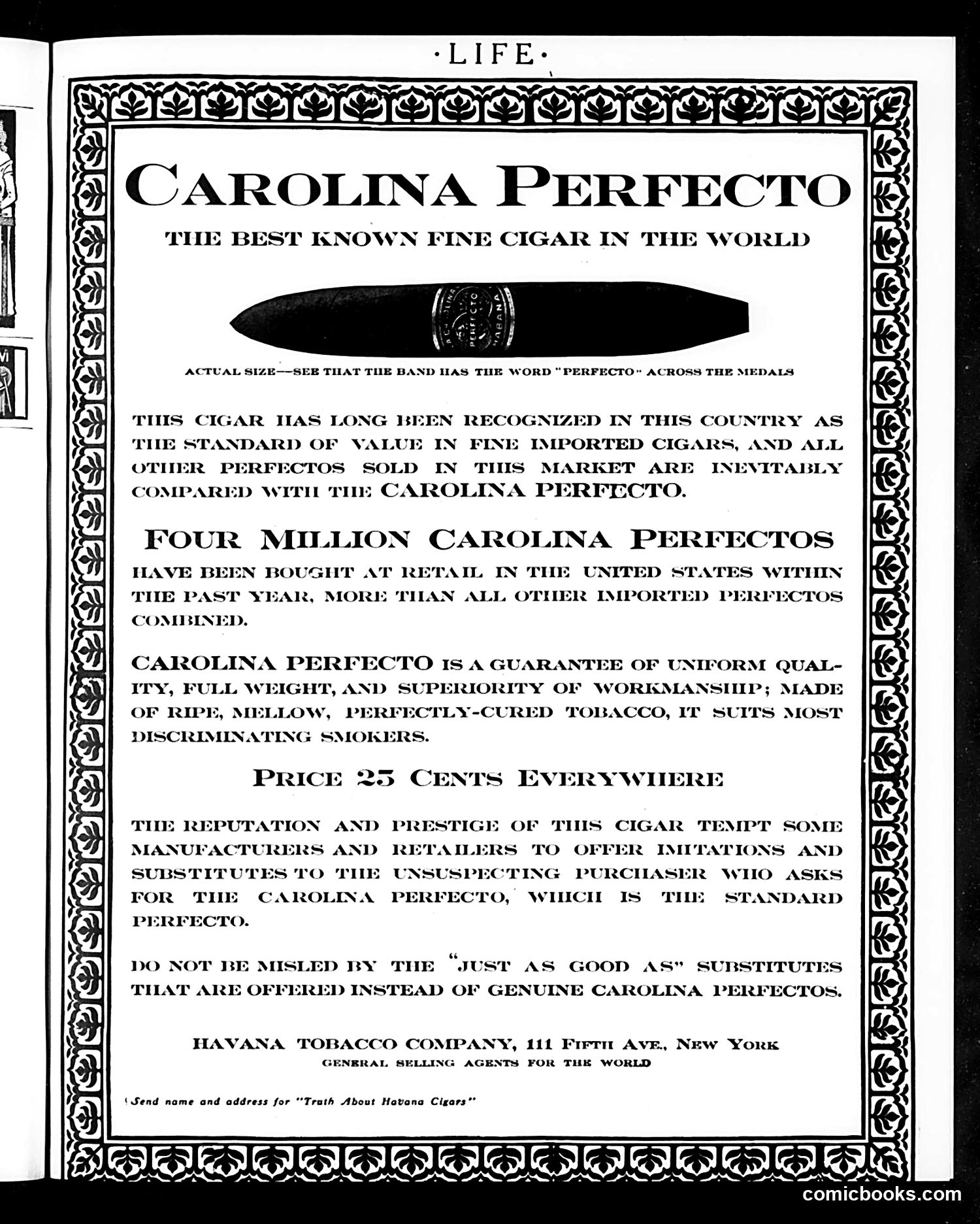
This is not a cartoon or satirical content—it's a **full-page advertisement** for Carolina Perfecto cigars, published in Life magazine. The ad claims Carolina Perfecto is "the best known fine cigar in the world" and reports four million sold in the past year. It emphasizes the product's quality, uniform construction, and use of Havana tobacco, priced at 25 cents. The advertisement's primary purpose is **consumer protection messaging**: it warns buyers against counterfeit imitations and "just as good as" substitutes, urging customers to verify the band reads "Perfecto" and to purchase only genuine products from the Havana Tobacco Company (111 Fifth Avenue, New York). This reflects early 20th-century concerns about brand counterfeiting and market deception, before modern trademark enforcement existed.
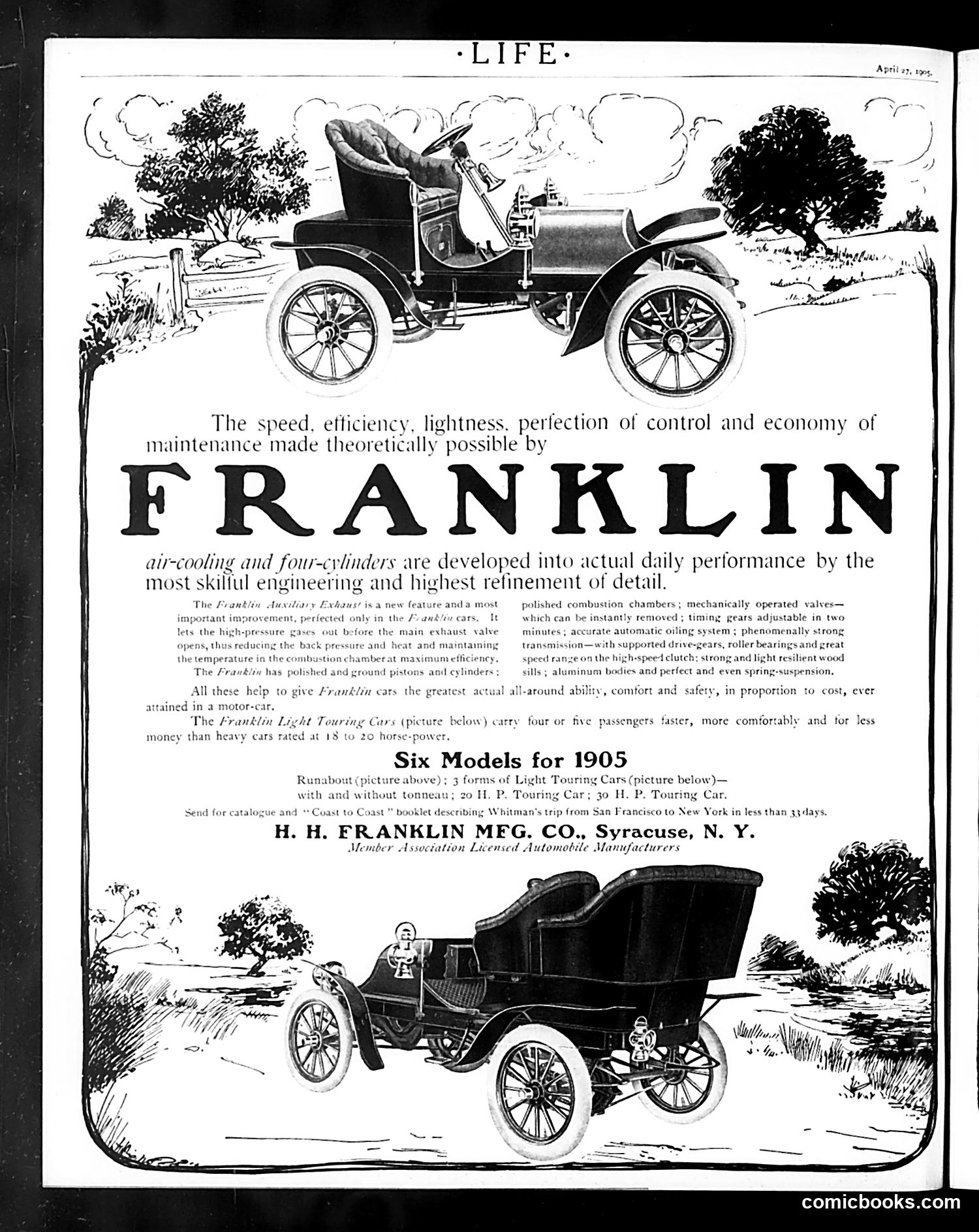
The page promotes Franklin motor cars manufactured in Syracuse, New York, for the 1905 model year. Two vehicles are illustrated—a light touring car (top) and a larger passenger model (bottom)—shown in pastoral countryside settings. The advertisement emphasizes Franklin's technological innovations: air-cooling, four-cylinder engines, mechanically operated valves, and adjustable timing gears. These features were marketed as enabling superior speed, efficiency, and low maintenance compared to competitors. The text references a cross-country journey from San Francisco to New York completed in under 33 days, apparently demonstrating the vehicles' reliability and performance. Six models are offered, ranging from 20 to 30 horsepower. This is straightforward product advertising typical of early automotive industry marketing—no satire or political content is present. The rural illustrations simply convey aspirational leisure and freedom associated with automobile ownership in this era.