
Life, 1905-04-27 · page 6 of 26
Life — April 27, 1905 — page 6: what you’re looking at
What you’re looking at
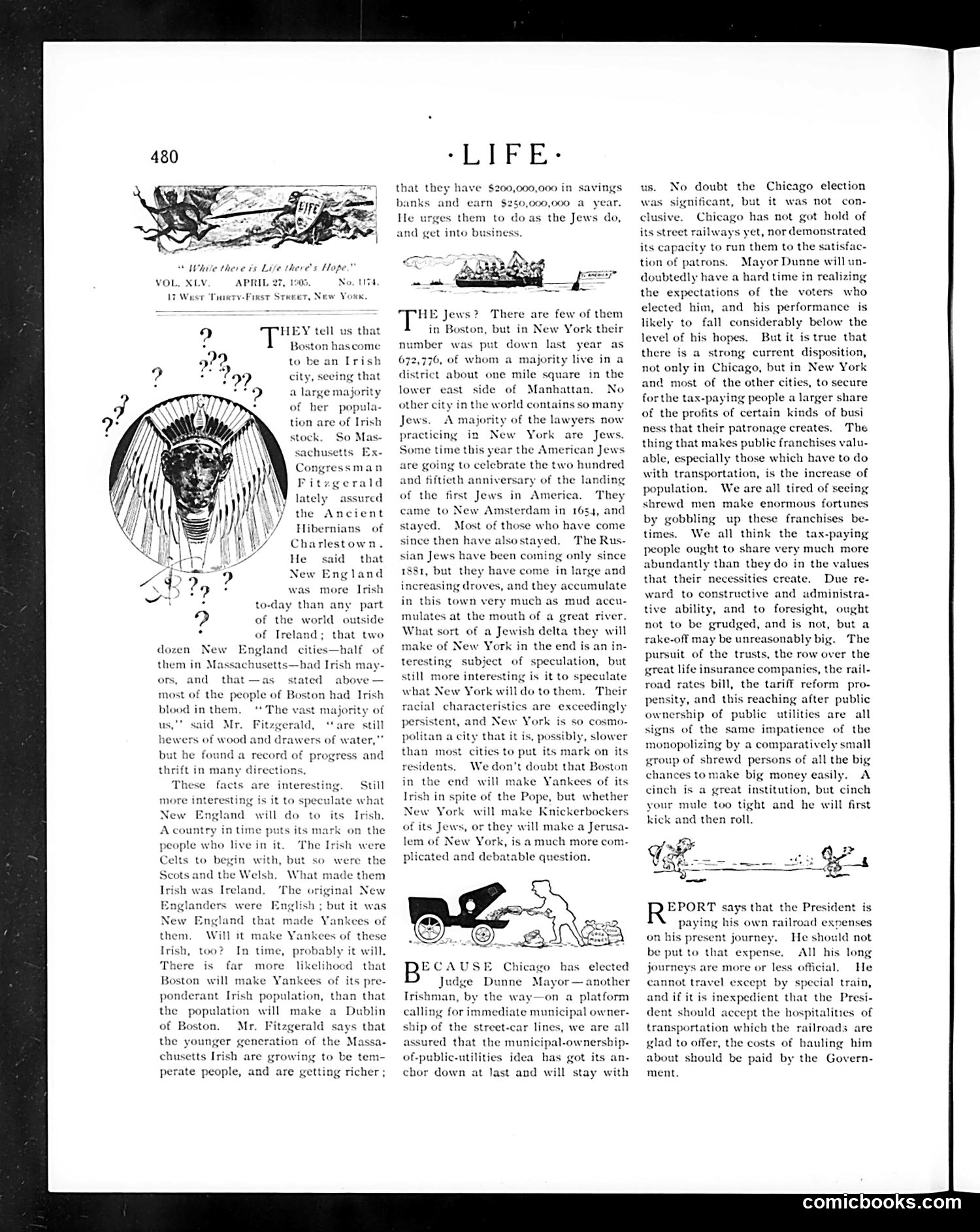
The main cartoon features a caricatured face labeled "Ancient Hieroglyphics of Charlestown" surrounded by question marks. This satirizes Boston's Irish population and their cultural characteristics, playing on the stereotype that Irish immigrants' features resembled ancient Egyptian hieroglyphics—a common racist trope of the era. The accompanying text discusses Boston's transformation into an Irish city, speculating whether this will make Boston "Yankees of its preponderant Irish population" as happened with other immigrant groups. It also compares Jewish migration to New York, debating whether New York will become a "Jerusalem." The satire mocks both Irish and Jewish immigration patterns, reflecting the nativist anxieties prevalent in early 1900s America about how immigration would reshape American cities and identity.
📄 Transcribed text from this page (OCR, searchable)
Machine-transcribed from the original scan — historical spelling and the odd misread are preserved.
“While there is Life the XLV APRIL 27, 190° No. 174 17 West Trawry-Fixst Steet, New Yous. VOL. HEY tell us that Boston hascome to be an Trish city, seeing that a large majority of her popula- tion are of Irish stock. So Mas- sachusetts Ex- Congressman Fitzgerald lately the assured Ancient Hibernians of Charlestown. He said that New England was more Irish day than any part of the world of Ireland; England them in Massac utside that two cities—half of usetts—had Irish ma that—as stated most of the people of Bc blood in them. “The v jority of Mr. Fitzgerald, are still hewers of wood and drawers of water," but he found a thrift in ma These dozen New ors, and above — n had Irish us,"" said . record of progress and y directions, facts are interesti more interes' New E Aco people who live in it. Celts to begin with, but so Scots and the Welsh. What made them Irish was Ireland. The original New Englanders were English ; but it was New England that made Yankees of them. Will it make Y. Irish, too? In time, probably it will. There is far more that Boston will make Yankees of its pre- on, than that the population will make a Dublin of Boston, Mr. Fitzgerald says that the younger gene Massa- chusetts Irish are growing to be tem- perate people, and are getting richer ; gg is it to spe gland will do to ry intime puts its mark on the The Irish were were the kees of these likelihood ponderant Irish popula *-LIFE-s that they have $200,000,000 in savings banks year, He urges them to doas the Jews do, and earn $250,000,000 a and get into business. HE Jews? There are few of them in Boston, but in New York their number was put down last year as 672,776, of whom a majority live in a district about one mile square in the lower east side of Manhattan, No other city in the world contains so many Jews. A majc practicing in y of the lawyers now New York are Jews. Some time this year the American Jews are going to celebrate the two hundred. and fiftieth anniversary of the landing of the first Jews in America. They came to New Amsterdam in 1634, and Most of those who have come The Rus- ve been coming only since stayed, since then have also stayed. sian Jews 1881, but the incr have come in large and asing droves, and they accumulate in this town very much as mud accu- mulates at the mouth of a great river. What sort of a Jewish delta they will nake of New York in the end is an in- teresting subject of speculation, but still m interesting is it to speculate New York will do to them. Their racial characteristics are exceedingly persistent, and New York is so cosmo- nacity that it is, possibly, slower 2 most cities to put its mark on its We don’t doubt that Boston will make Yankees of its Irish in spite of the Pope, but whether New York will make Knickerbockers, of its Jews, or they will make a Jer lem of New York, is a much more com- residents, in the end icated and debatable question. E CAUSE Chicago elected Judge Dunne Mayor—another Irishman, by the way—on a platform calling for immediate municipal owner- ship of the street-car lines, we are all assured that the municipal-ownership- of-public-utilities idea has got its an- chor down at last and will stay with us. No doubt the Chicago election was significant, but it was not con- clusive. Chicago has not got hold of its street railways yet, nor demonstrated its capacity to run them to the satisfac- tion of patrons. doubtedly have a hard time in realizing the expect. of the voters who elected him, and his performance is likely to fall considerably below the level of his hope: But it is true that there is a strong current disposition, not only in Chicago, but in New York and most of the other cities, to secure forthe tax-paying people a larger share of the profits of certain kinds of busi ness that their patronage creates. The thing that makes public franchises valu- able, especially those which have to do with transportation, is the increase of population, We are all tired of seeing shrewd men make enormous fortunes by gobbling up these franchises be- times. We all think the tax-paying people ought to share very much more abundantly than they do in the values that their necessities create. Due re- ward to constructive and administra- tive ability, and to foresight, ought not to be grudged, and is not, but a rake-off m sonably big. The pursuit of the trusts, the row over the great life insurance companies, the rail- road rates bill, the tariff reform pro- pensity, and this reaching after public ownership of public utilities are all signs of the same impatience of the monopolizing by a comparatively small group of shrewd persons of all the big chances to make big money easily. A cinch is a great institution, but cinch your mule too tight and he will first kick and then roll. Mayor Dunne will un- tions EPORT says that the President is ng his own railroad e on his present journey, He should not be put to that expense. All his long journeys are more or less official, He. cannot travel except by special train and if it is inexpedient that the Presi- dent should pt the hospitaliues of transportation which the railroads are glad to offer, the costs of hauling him about should be paid by the Govern- ment. comicbooks.com