
A complete issue · 22 pages · 1905
Life — January 26, 1905
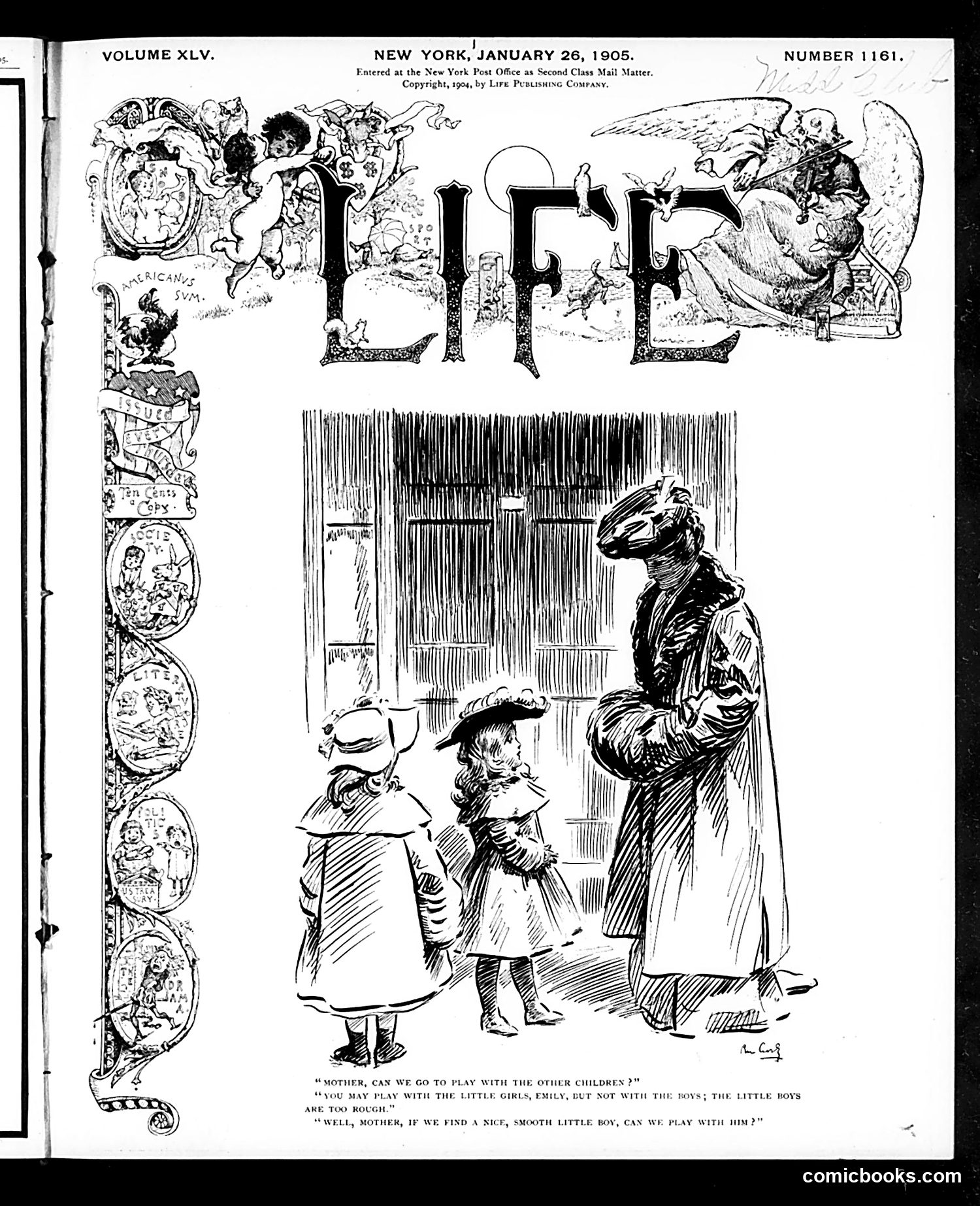
This page features a domestic humor cartoon about children's play restrictions. A mother stands with two young children asking permission to play outside with other children. The dialogue reveals the social anxieties of the era: The children request to play with "other children," but the mother refuses, saying boys are "too rough." When they ask about finding "a nice, smooth little boy," the mother agrees—suggesting she'll only permit play with well-behaved, refined boys of suitable social standing. The satire critiques Victorian-era parental overprotectiveness and class consciousness regarding children's socialization. The humor lies in the mother's standards being absurdly specific and the children's innocent negotiation with parental authority. The ornamental border features cherubs and decorative elements typical of Life's design aesthetic.
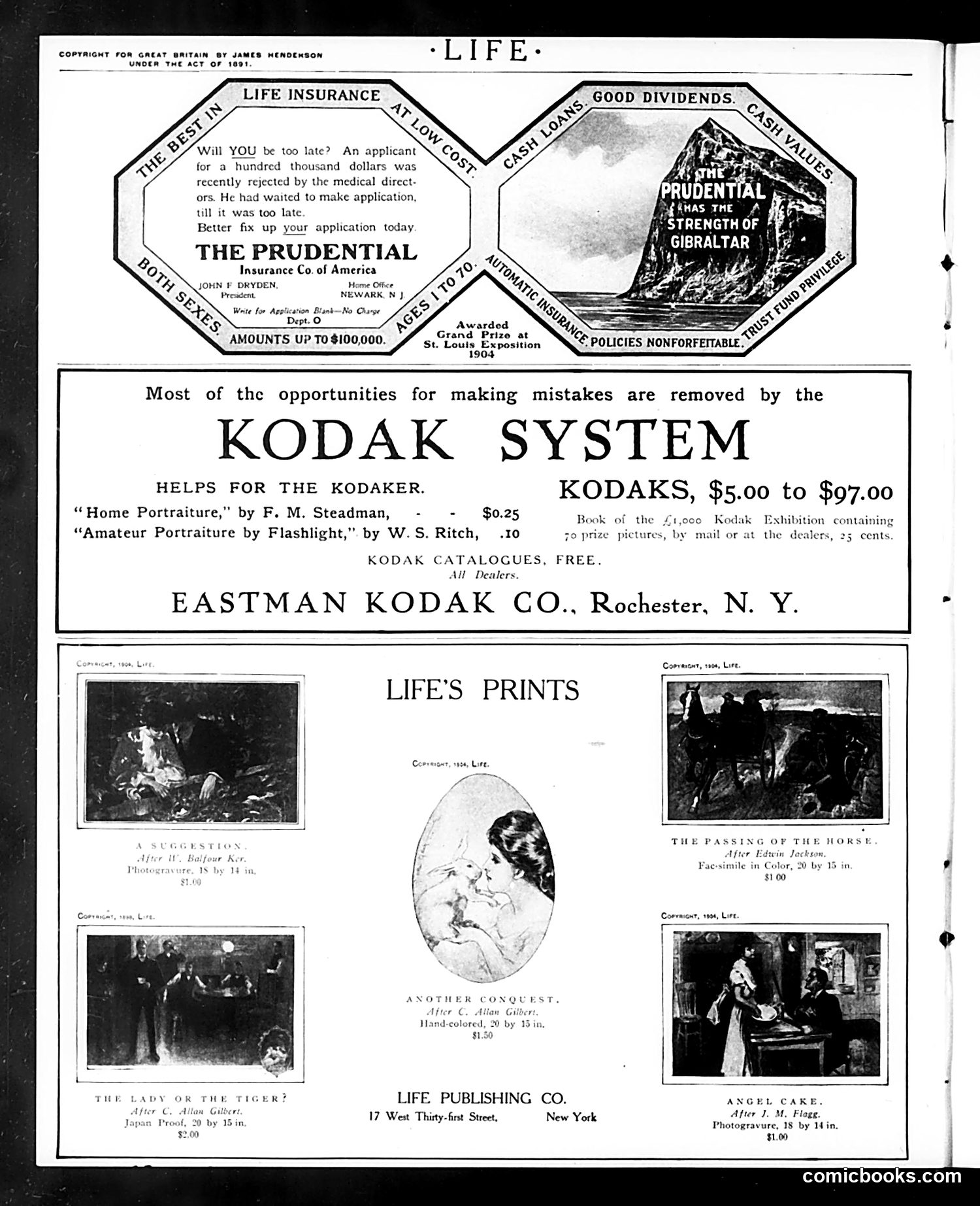
This page is **primarily advertising**, not satirical content. It contains three main advertisements: 1. **The Prudential Insurance Co.** — promoting life insurance with a cautionary anecdote about delayed applications 2. **Eastman Kodak Co.** — selling cameras and photography guides for amateur photographers 3. **Life Publishing Co.** — advertising fine art prints and reproductions The prints advertised feature classical and contemporary artworks (portraits, genre scenes) priced $1.00-$2.00, positioned as accessible art for the middle-class reader. There is **no political satire or cartoon commentary** on this page. It represents typical early 1900s Life magazine content: a mix of commercial advertisements targeting educated, affluent consumers interested in photography, insurance, and art reproduction. The format and products reflect early twentieth-century consumer culture.
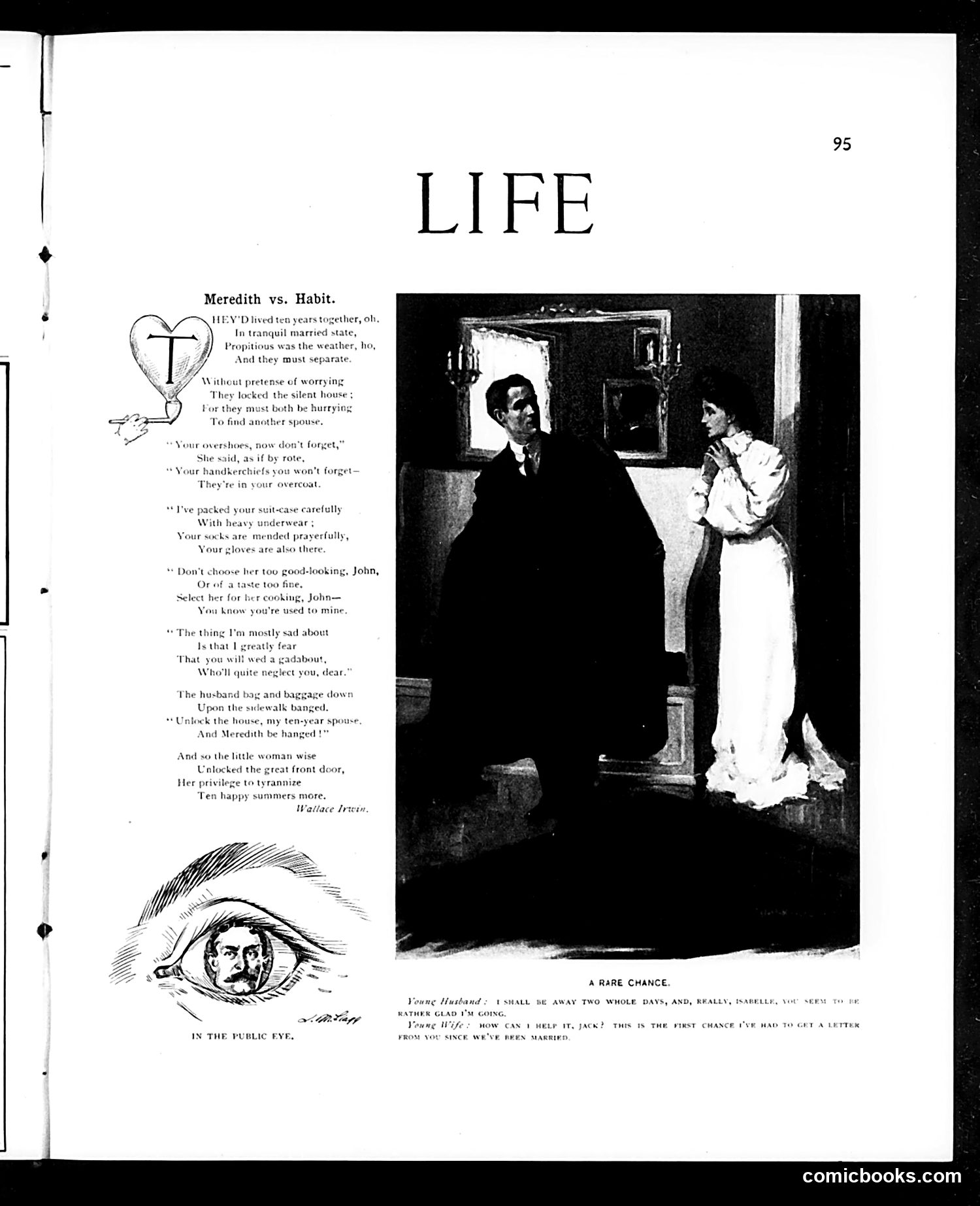
This page contains two satirical pieces about marriage: **"Meredith vs. Habit"** (left): A poem by Wallace Irwin contrasting romantic love with practical domestic realities. The wife advises her new husband to select a wife for cooking ability rather than appearance, warns of separation risks, and concerns about neglect. The accompanying sketch of an eye labeled "IN THE PUBLIC EYE" appears to reference public scrutiny of marriages. **"A Rare Chance"** (right): A photograph with accompanying dialogue shows a young couple. The husband mentions being away for two days—his first chance to get a letter from his wife since their marriage. The joke satirizes how quickly marital communication and emotional connection deteriorate after the wedding. Both pieces mock the transition from romantic courtship to mundane married life, a recurring theme in early 20th-century American satire about marriage's disillusionment.
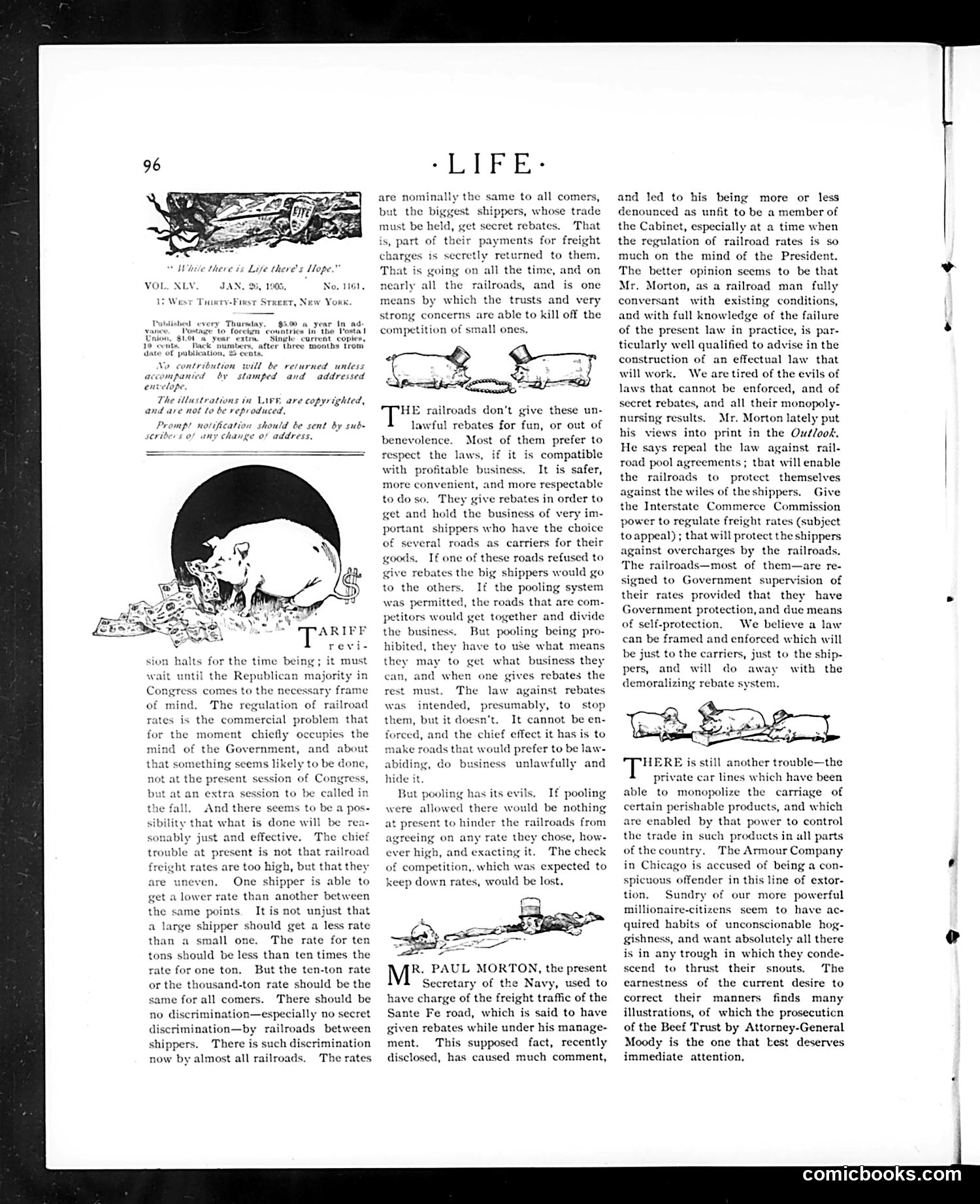
This page discusses railroad regulation and freight rate practices through text and accompanying political cartoons. The main targets are: **"Tariff Revision"** cartoon: Depicts railroad interests halting regulatory action, suggesting the GOP majority in Congress delays necessary railroad reforms. **"Mr. Paul Morton"** section: References the former Navy Secretary who managed Santa Fe railroad freight traffic, accused of giving secret rebates to favored shippers—a practice the article condemns as unlawful and monopolistic. The satire critiques how railroads circumvent anti-rebate laws through secret deals, monopolize shipping routes, and use political connections to avoid regulation. The cartoons visualize railroads as obstructionist forces blocking reform efforts in Congress, reflecting Progressive Era concerns about corporate malfeasance and the need for stronger Interstate Commerce Commission enforcement.
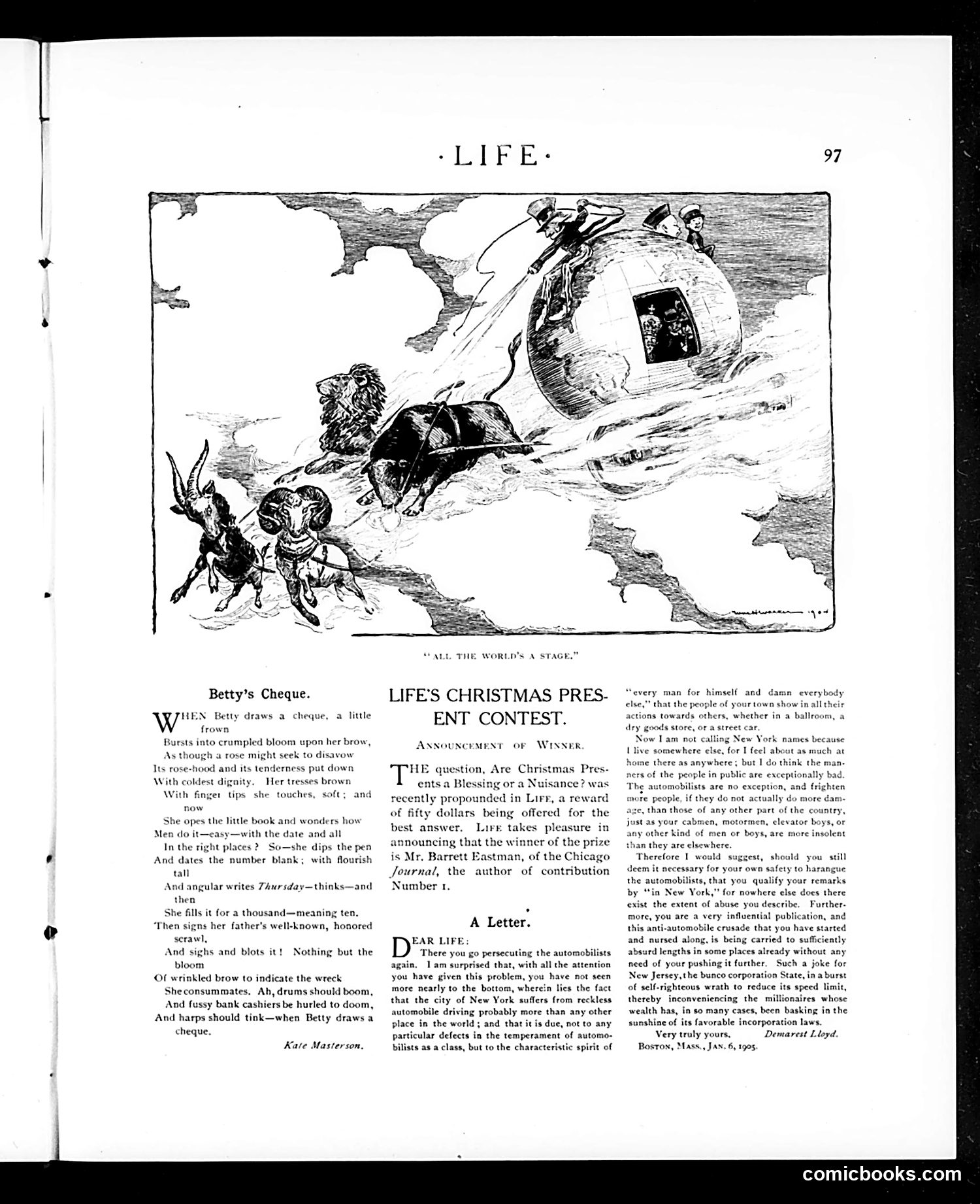
This page contains three distinct items: 1. **"Betty's Cheque"** (left): A satirical poem by Kate Masterson about a young woman named Betty who writes a check for a thousand dollars—a substantial sum at the time. The humor appears to lie in the audacity of her financial gesture and its consequences. 2. **"Life's Christmas Present Contest"** (center): An announcement that Life magazine is offering fifty dollars for the best answer to whether Christmas presents are a blessing or nuisance. The winner is identified as Mr. Barrett Eastman of the Chicago *Journal*. 3. **"A Letter"** (right): A reader's letter criticizing automobile drivers in New York City, arguing they drive recklessly and selfishly compared to drivers elsewhere, and calling for safety reforms. The illustrated cartoon at top appears to show a fantastical winter scene, possibly related to one of these pieces.
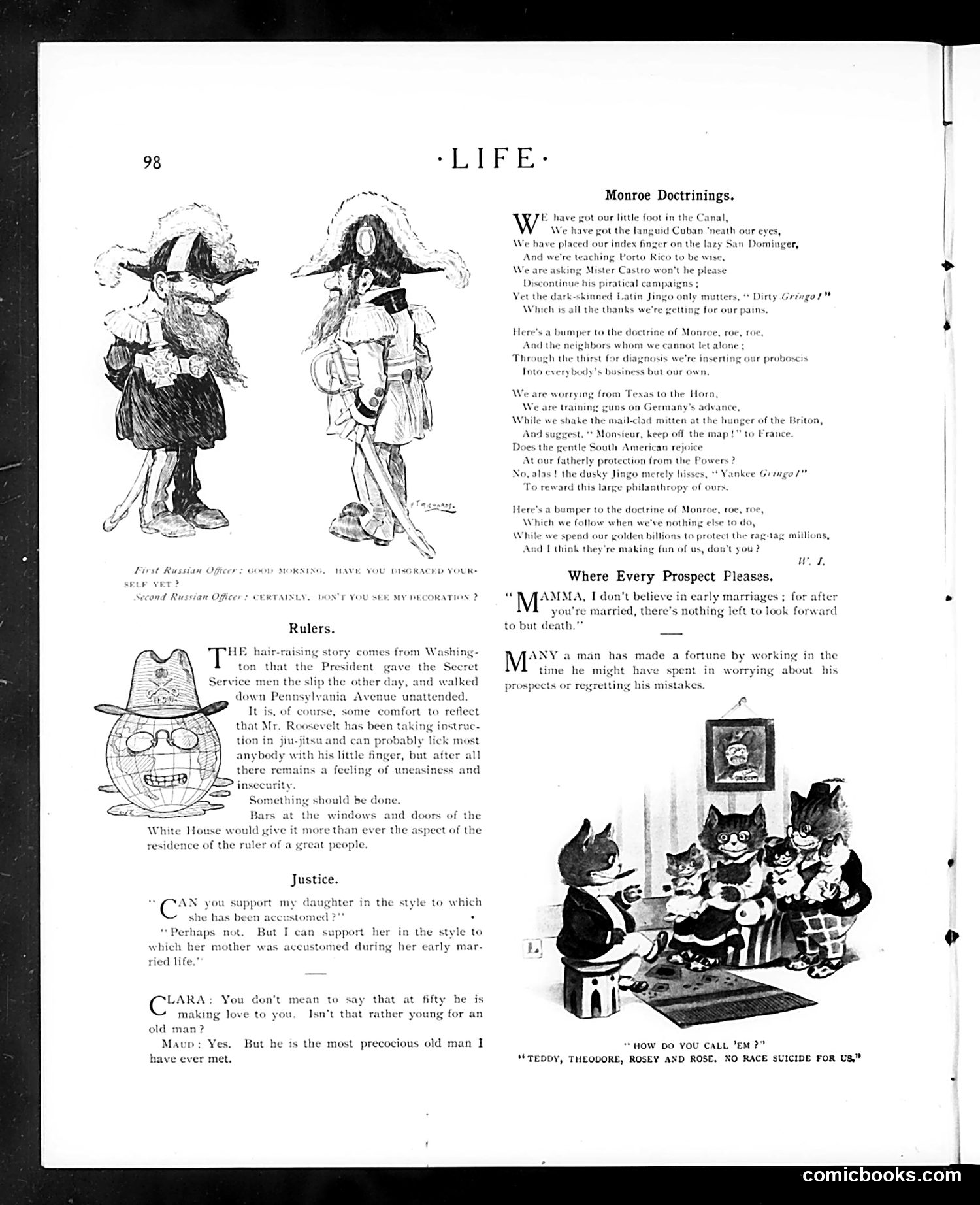
**"Monroe Doctrings"** mocks American foreign policy interventions. The poem satirizes U.S. military presence in Cuba, the Canal Zone, Puerto Rico, and ongoing involvement in Latin America and Europe. It criticizes American military spending and humanitarian concerns ("Dirty Gringo") while suggesting the country ignores its own domestic problems. **"Rulers"** features a caricatured face (appears to be a political figure) wearing a hat and glasses—likely mocking someone in power, possibly President Roosevelt based on context clues about "the Secret Service" and "Pennsylvania Avenue." **"Where Every Prospect Pleases"** contains a domestic humor dialogue about marriage and fortune-building, unrelated to political content. The bottom illustration shows anthropomorphic cats at dinner—apparently unrelated social satire about manners or relationships.
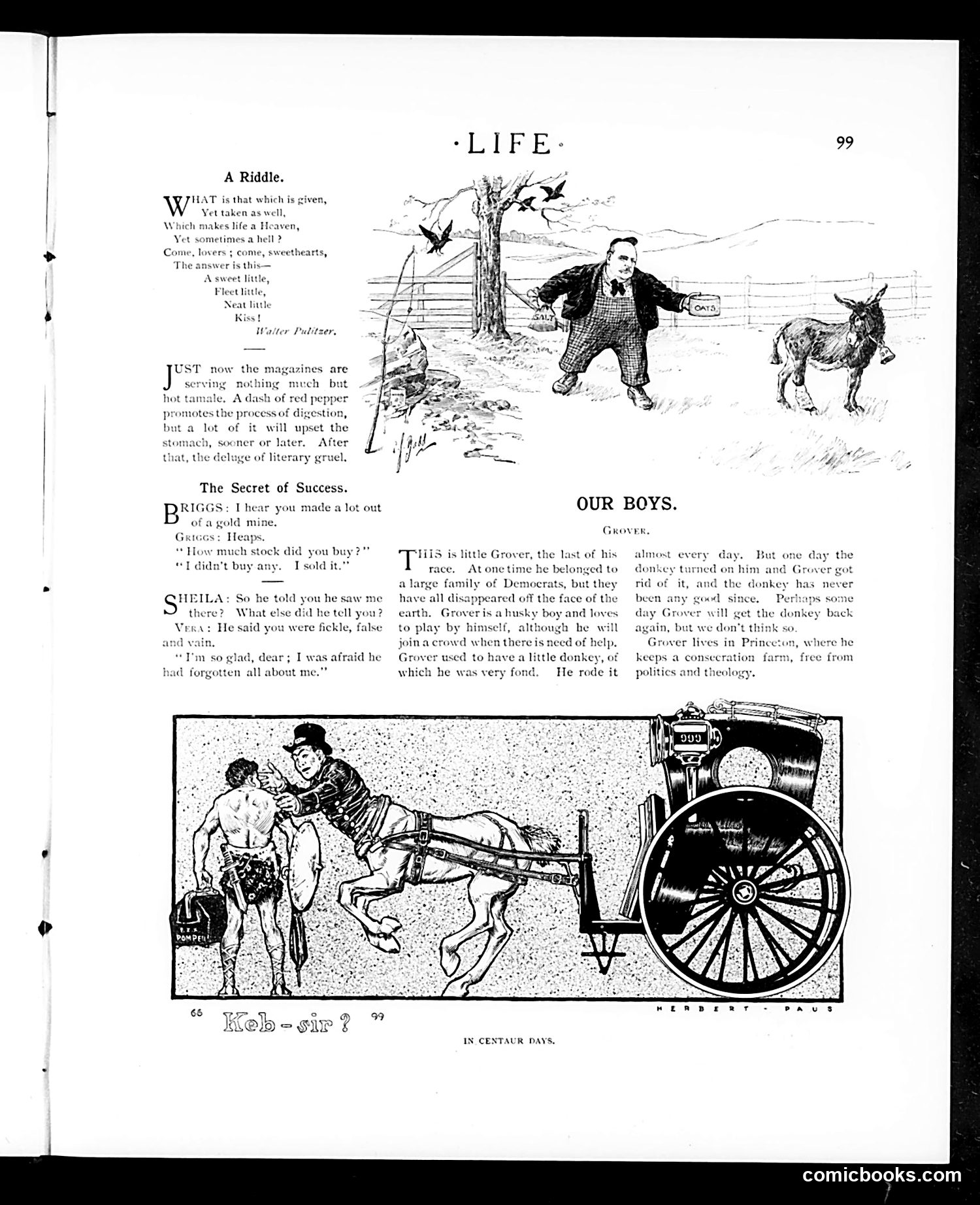
This page contains three separate satirical pieces: 1. **"A Riddle"** (top left): A poem playing on the double meaning of "life"—what is given yet taken, makes life a Heaven yet sometimes a Hell. Credited to "Frank Pulitzer." 2. **"The Secret of Success"** (middle): A dialogue joke where Briggs claims to have made money from a gold mine, but admits he actually sold it without buying anything—profiting through deception. The humor mocks get-rich-quick schemes. 3. **"Our Boys"** (right): A story about Grover, a donkey who once belonged to a large Democratic family but now lives in Princeton on a farm. The political reference to "Democrats" and "politics and theology" suggests satirical commentary on political families and their fading fortunes. The bottom illustration depicts centaur days—classical mythology imagery used for comic effect.
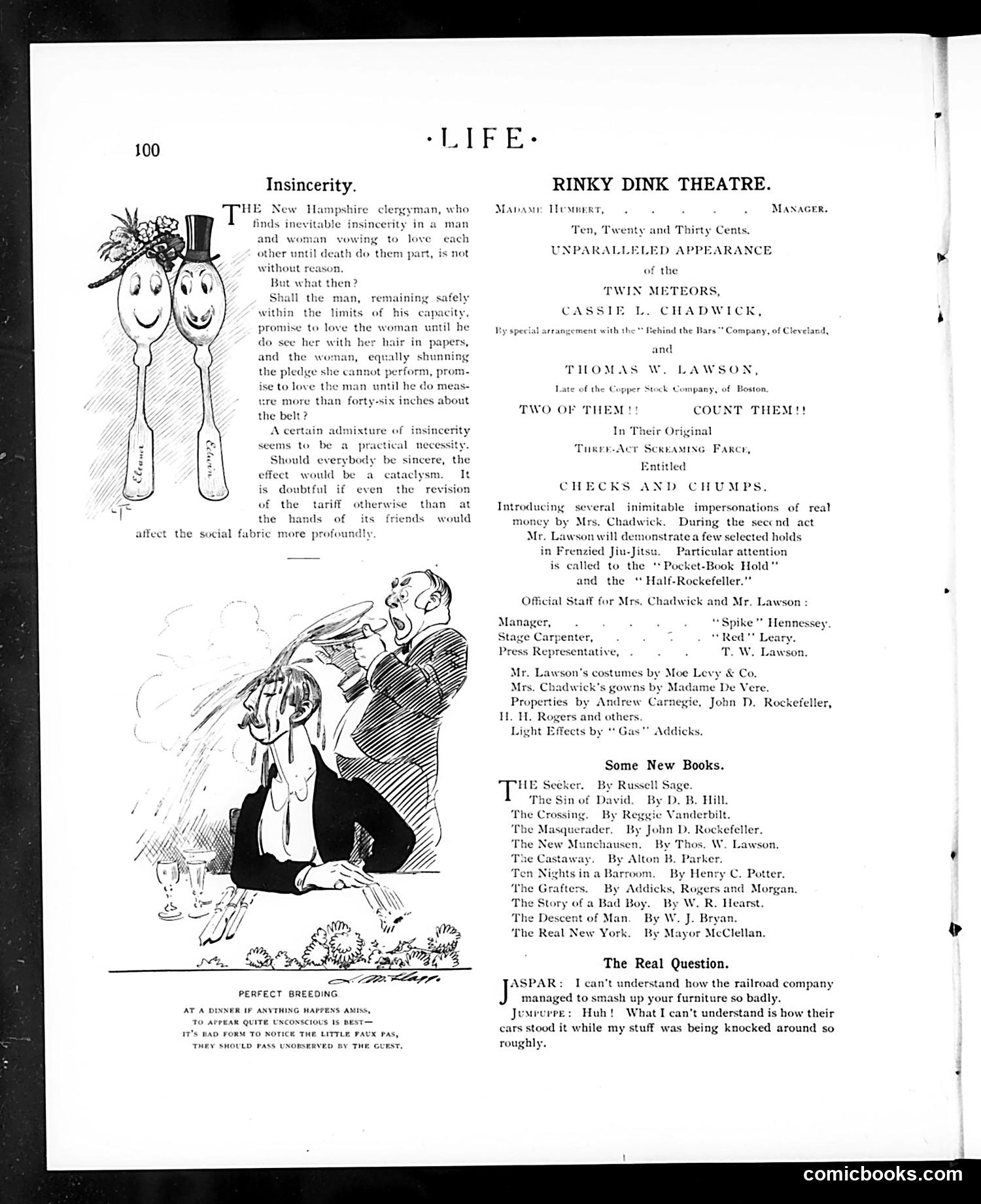
This page contains three distinct elements: 1. **"Insincerity" essay and cartoon**: A satirical piece about hypocrisy in relationships, illustrated with two anthropomorphized faces showing false smiles. The text argues that some dishonesty in romantic relationships is necessary. 2. **"Perfect Breeding" cartoon**: Shows a wealthy couple at dinner; the joke (in caption below) involves maintaining appearances of propriety despite chaotic circumstances—a critique of upper-class pretension and performative respectability. 3. **Theater advertisement and book reviews**: Announces a vaudeville act featuring "Twin Meteors" performers and lists contemporary books, including works by Russell Sage and other authors. The overall theme reflects turn-of-century American satire: mocking social hypocrisy, particularly among the wealthy classes who prioritize appearances over authenticity.
This page is primarily text—an editorial titled "FROM UNDER THE BAN" defending *Life* magazine against accusations of antisemitism. The piece responds to the Theatrical Managers' Association of New York, which declared *Life's* theater criticism "racial and religious attacks" and accused the publication of "Jew-baiting." *Life* argues the charges are unfounded, claiming it satirizes all groups equally. The editorial defends its critic (likely the now-excluded Mr. Metcalfe) and criticizes the Theatrical Trust for attempting intimidation and a libel suit. The piece concludes by warning that such pressure tactics threaten American press freedom while insinuating the Trust's actions reveal their own "iniquities." No cartoon appears on this page.
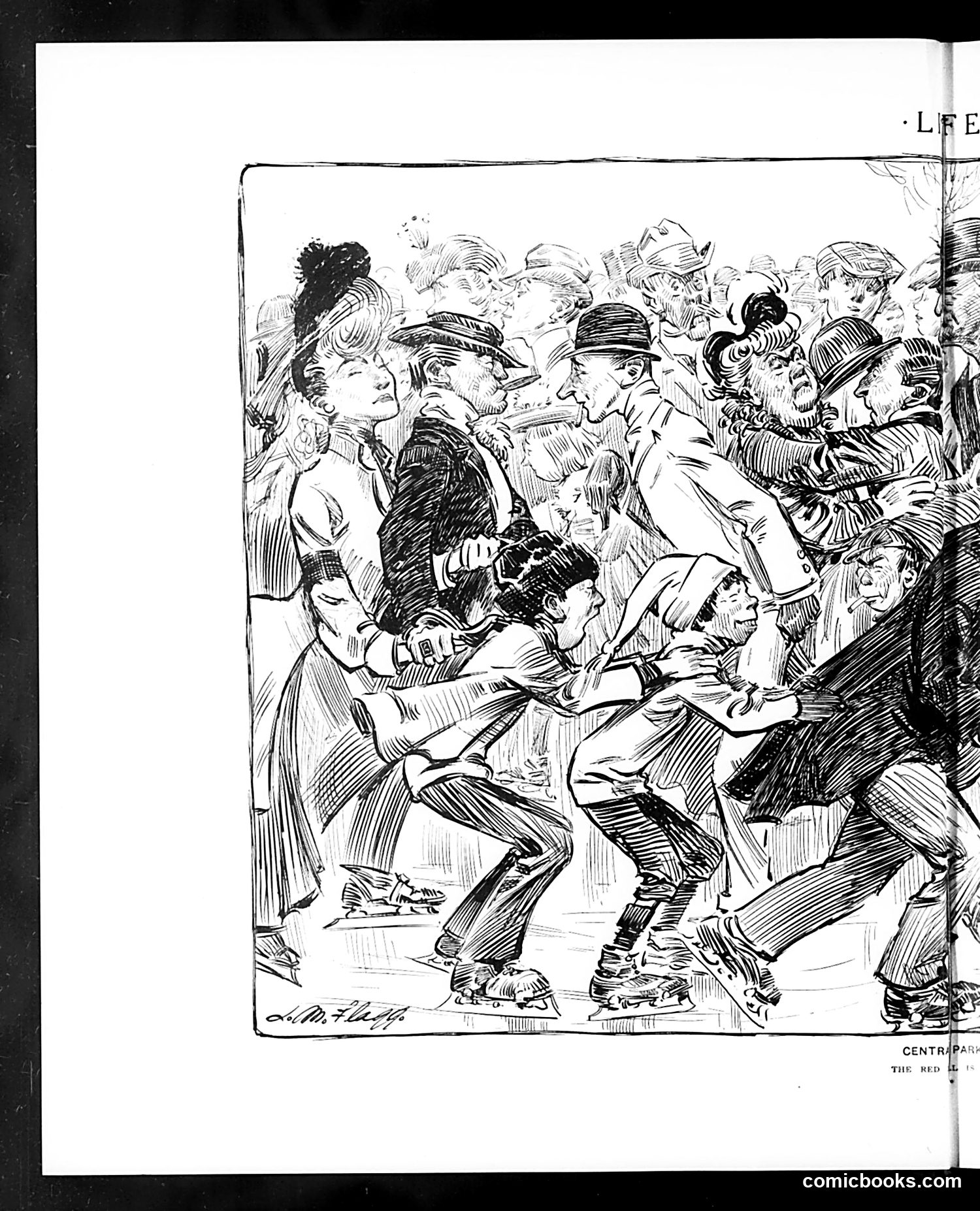
This political cartoon depicts a crowded street scene with men in period dress (appearing to be late 19th or early 20th century based on the hats and clothing styles). The composition shows what appears to be a public gathering or confrontation, with figures clustered together in animated poses suggesting conflict or heated discussion. The artist's signature is visible at bottom left. The page header indicates this is from "Life" magazine. Text fragments visible include "CENTRAL PARK" and "THE RED IS" (likely cut off). Without clearer OCR text or caption visible in the image, the specific political or social commentary remains unclear. The crowded, energetic scene suggests satire of urban life, politics, or social disorder of the period, but the exact subject and figures cannot be definitively identified from the visual information alone.
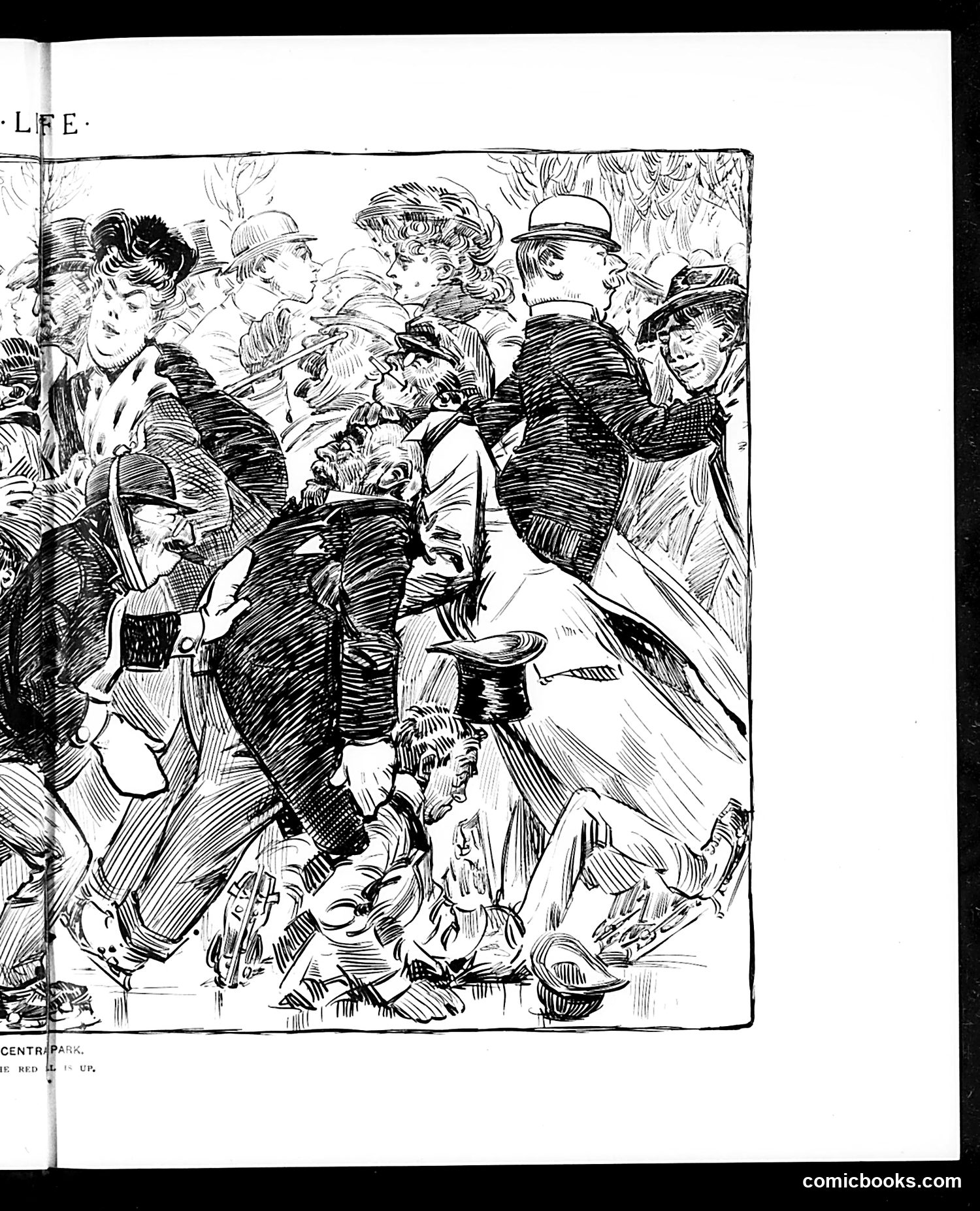
This is a sketch from *Life* magazine (visible header) depicting a crowded scene in Central Park. The OCR text fragment mentions "CENTRAL PARK" and "THE RED IS UP," though the latter is unclear in context. The illustration shows well-dressed men and women of the late 19th or early 20th century in fashionable attire—suits, hats, and coats—gathered densely together. The style suggests social satire about public leisure and urban crowding. Without clearer text or caption visible, I cannot definitively identify specific political figures or pinpoint the exact satirical target. The cartoon likely comments on fashionable society's behavior in Central Park—perhaps ridiculing pretension, overcrowding, or social posturing among the well-to-do—but the specific point remains unclear from this image alone.
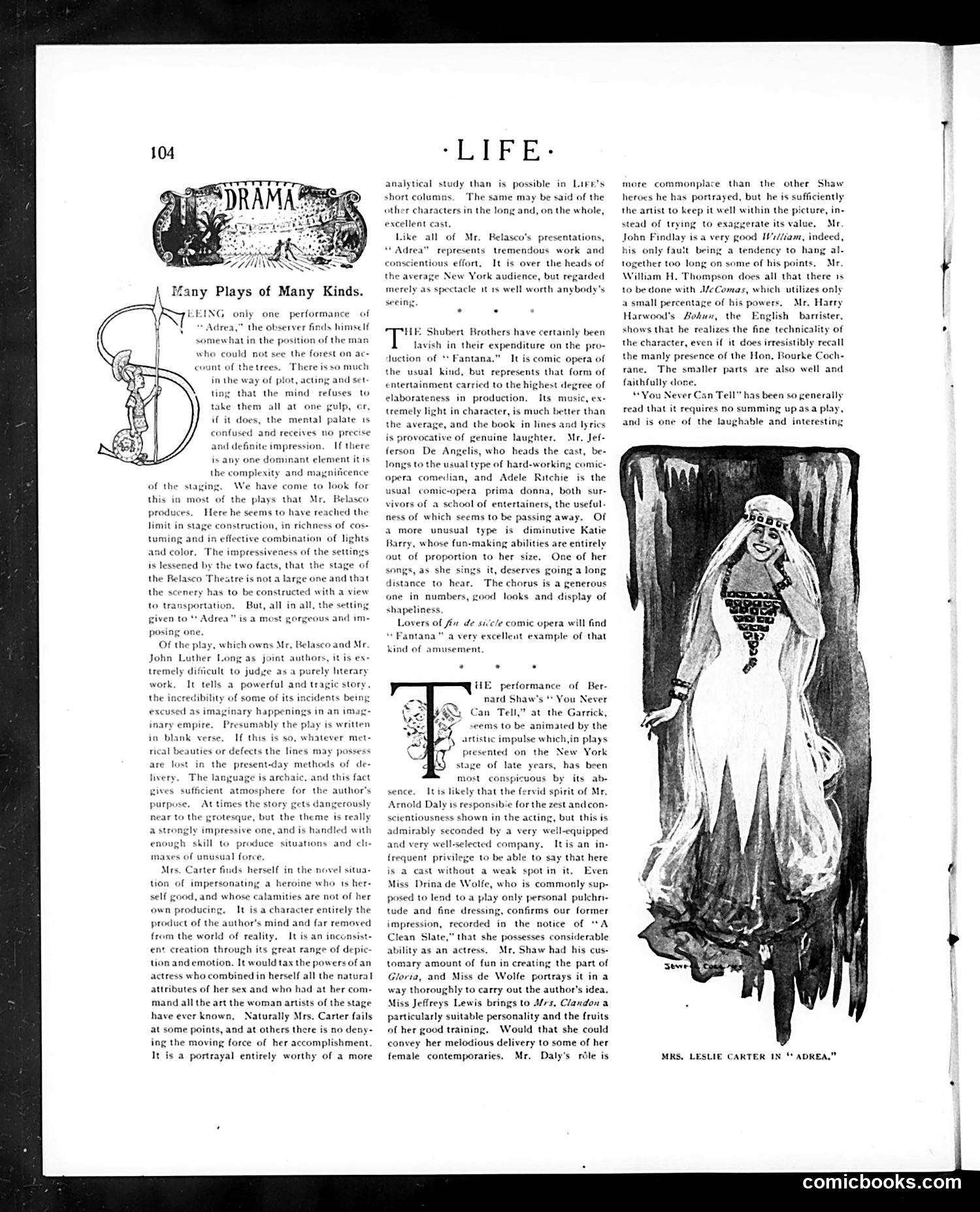
This page reviews contemporary theatrical productions. The "DRAMA" header and "Many Plays of Many Kinds" section discuss stage performances, including: - A production of "Adrea" involving complex staging and lighting effects - "Fantasia," a comic opera featuring Jefferson De Angelis and Adele Ritchie - Bernard Shaw's "You Never Can Tell" at the Garrick Theatre - A play by Carter involving Mrs. Leslie Carter (shown in the illustration as "Adrea") The accompanying illustration depicts Mrs. Leslie Carter in costume as her character, likely meant to showcase her dramatic role and appearance. The text evaluates acting performances, production quality, and artistic merit—typical of Life's theater criticism section during this early 20th-century period.
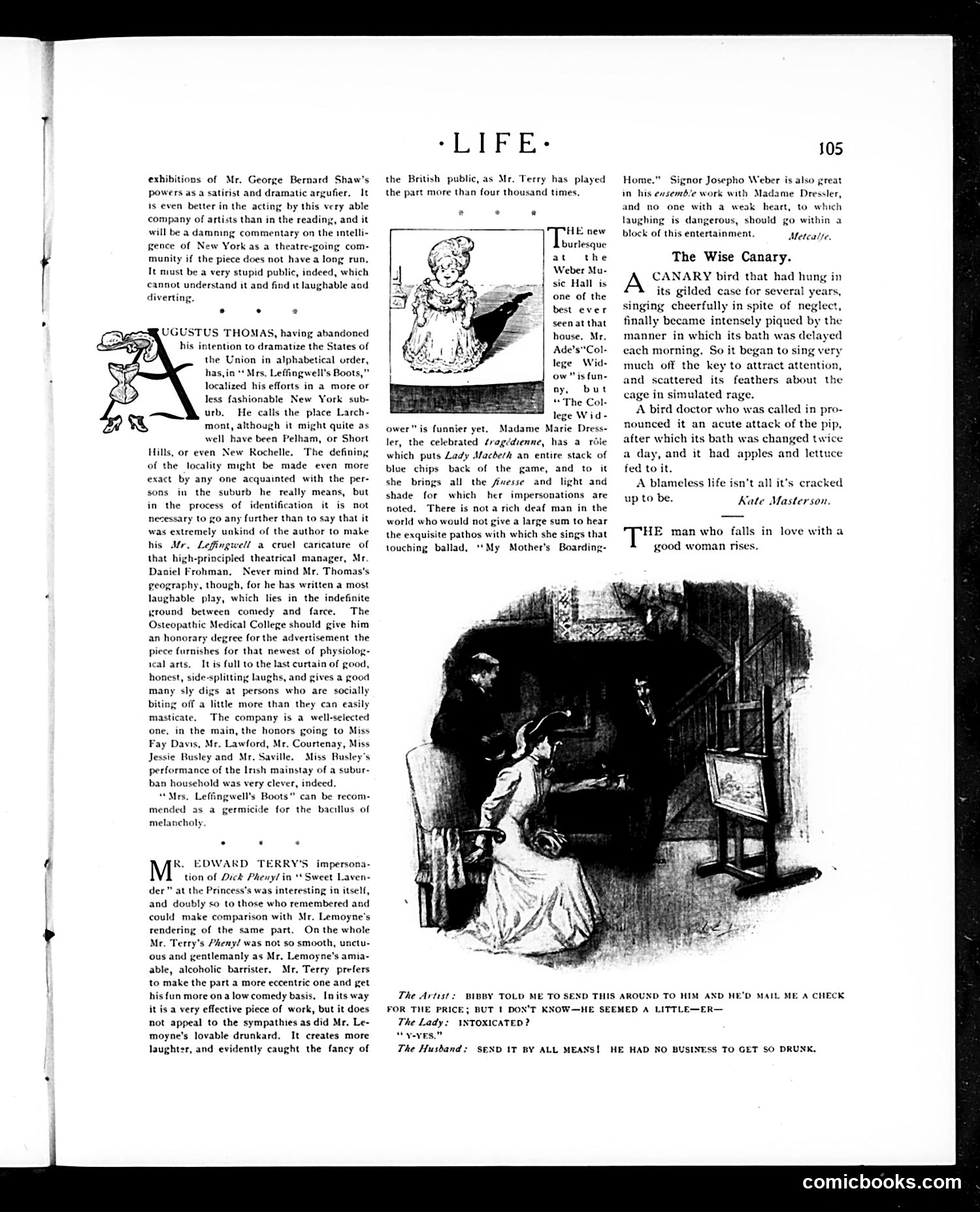
This page reviews several Broadway productions. The main content critiques theatrical performances rather than political satire: **Key reviews:** - George Bernard Shaw's play receives praise for intelligent satire - Augustus Thomas's "Mrs. Leffingwell's Boots" is reviewed as a comedy set in a fashionable New York suburb (likely Larchmont), with the author accused of caricaturing theater manager Daniel Frohman - Edward Terry's performance in "Sweet Lavender" is compared unfavorably to a previous actor's interpretation - "The College Widow" burlesque at Weber Music Hall is praised, particularly Marie Dressler's performance **The cartoon** (lower right) appears to be an unrelated satirical sketch about artistic pretension or romantic situations, with dialogue about sending something for payment. The page's satire targets social climbing New Yorkers and theatrical affectations rather than politics. "Mrs. Leffingwell's Boots" specifically mocks suburban pretension and people "socially biting off a little more than they can easily masticate."
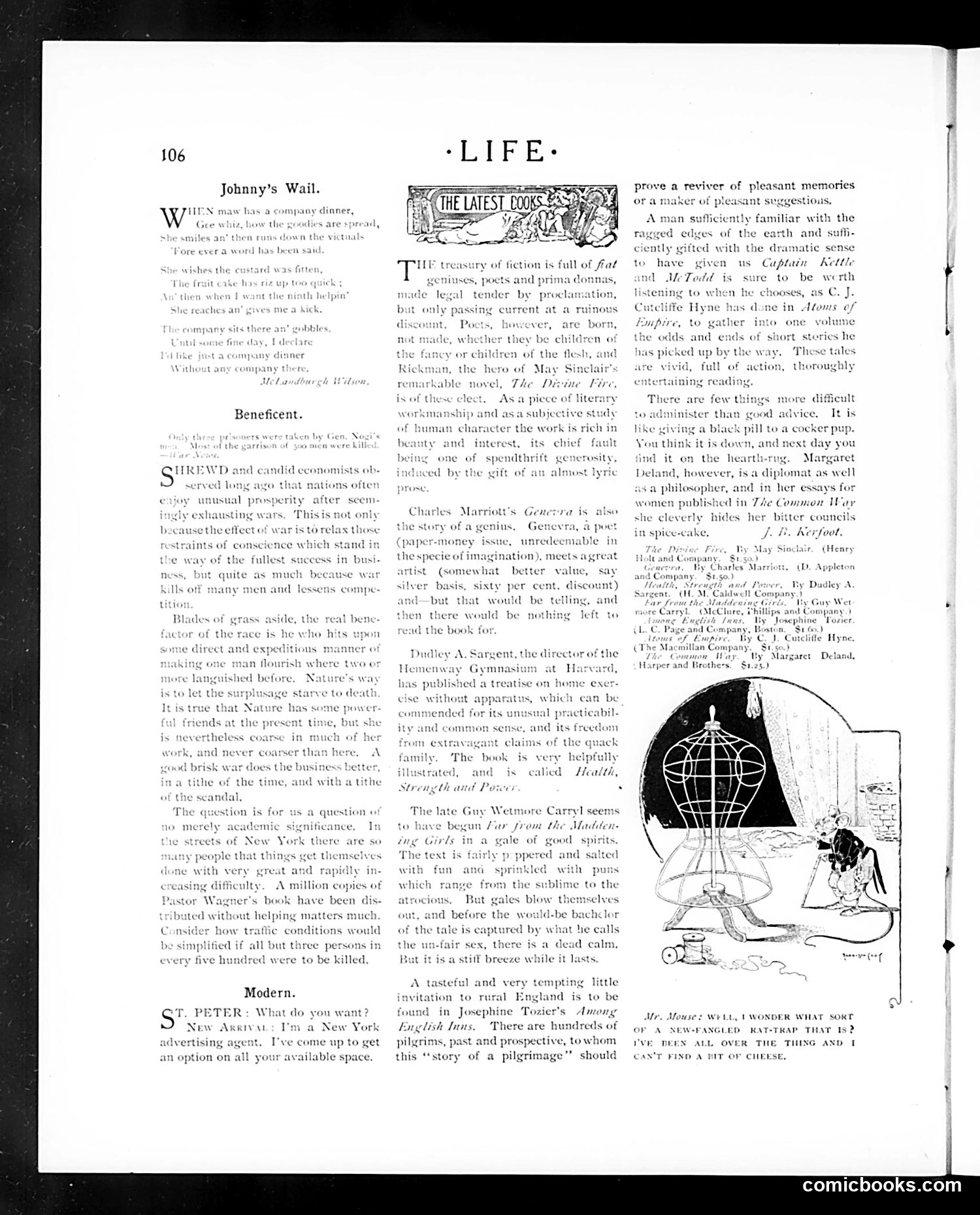
This page contains book reviews and literary commentary rather than political cartoons. The main content discusses recent fiction, including Captain Kettle novels and Charles Marriott's *Geneera*, praising their entertainment value and literary merit. The small cartoon at bottom right appears to be a domestic humor piece: a man complains to his wife about a new "rat-trap" throughout their home, unable to find cheese—likely satirizing either poor household management or marital frustration with clutter and ineffective solutions. A separate "Modern" dialogue section mocks New York advertising agents' sales pitches, suggesting satirical commentary on advertising industry's aggressive promotion tactics. The page primarily functions as a literary review section rather than political satire, typical of *Life* magazine's mixed content format during the early 20th century.
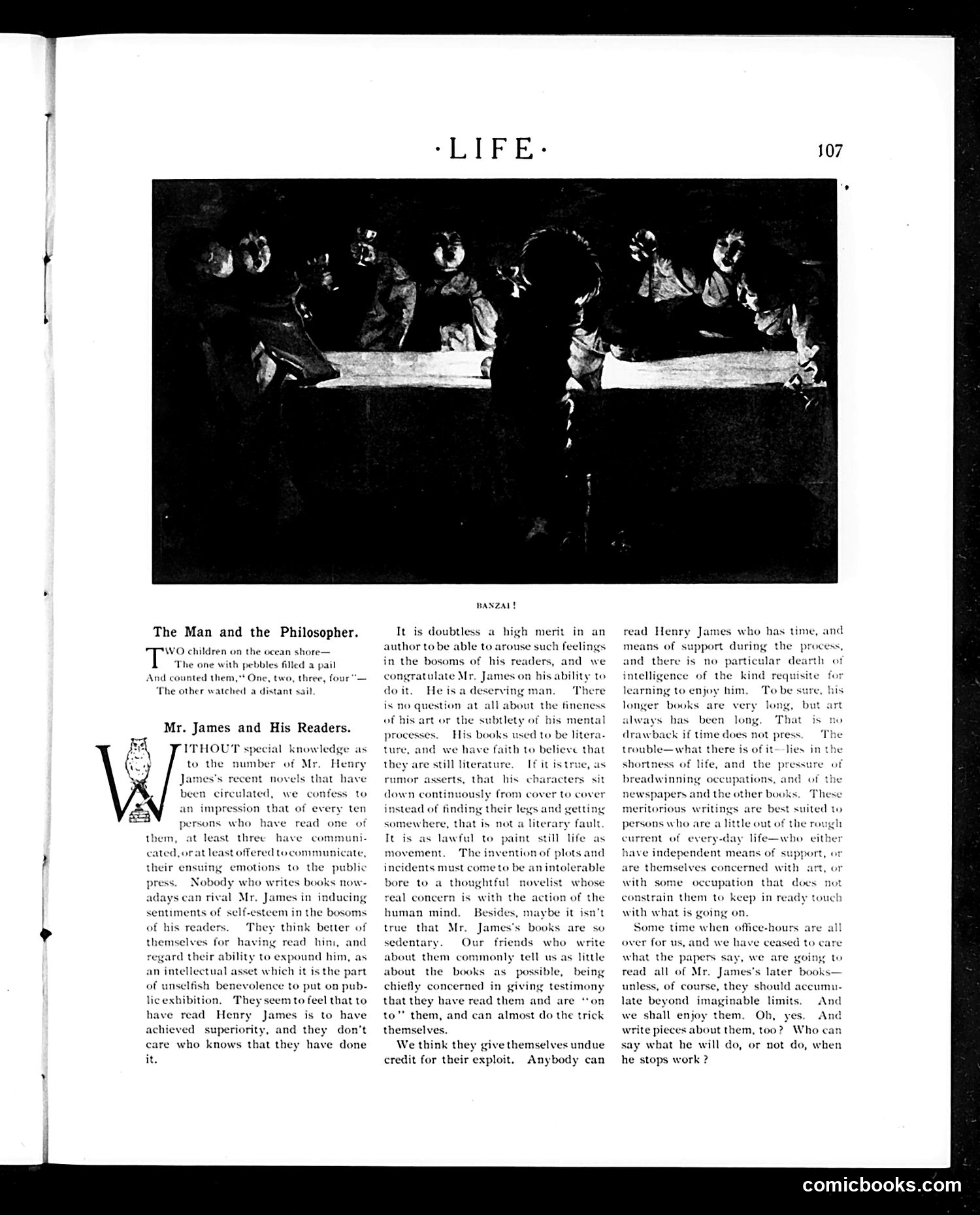
This page critiques the pretentiousness of Henry James's readers rather than James himself. The cartoon at top (titled "Banzai!") appears to show two contrasting scenes—likely representing the "man" (practical, action-oriented) versus the "philosopher" (contemplative, idle), based on the opening poem about children counting pebbles versus watching a sail. The main article mocks readers who feel intellectually superior after reading James's difficult novels. Life observes that James's admirers use their reading as a status symbol, boasting of their ability to "expound" him to demonstrate intellectual merit. The magazine notes this is undeserved vanity—anyone with time can read James. The satire suggests James's sedentary narratives (characters sitting rather than acting) aren't a literary flaw but reflect his real artistic concern with internal human consciousness rather than plot. The piece ultimately defends James's artistry while deflating his readers' snobbish self-regard.
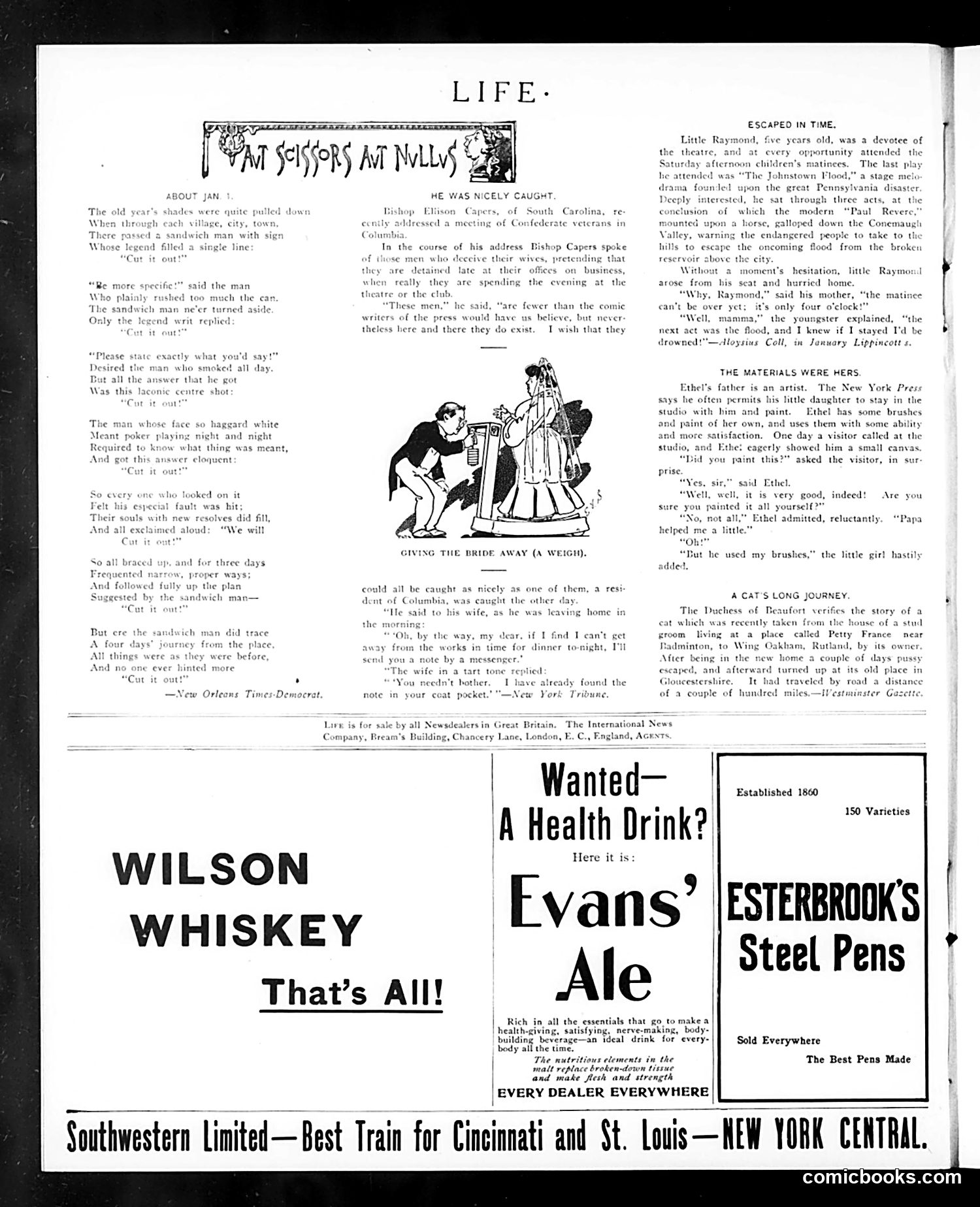
This page from *Life* magazine contains several distinct elements: **Main Cartoon:** "Giving the Bride Away (A Weigh)" depicts a comedic wedding scene where the groom appears anxious about his bride's weight or substantial figure—a classic turn-of-the-century joke about marriage and body size. **Poem "I'M Scissors at Nulls":** A humorous verse about a man caught in an embarrassing sandwich-related incident, playing on miscommunication and social awkwardness. **Short Stories:** Three brief anecdotes—"Escaped in Time" (about a child and the Johnstown Flood disaster), "The Materials Were Hers" (about a child artist), and "A Cat's Long Journey" (about a cat's travels between homes)—typical of the light satirical content *Life* featured. **Advertisements:** The page is dominated by period ads for Wilson Whiskey, Evans' Ale, Esterbrook's Steel Pens, and the Southwestern Limited train—reflecting early 1900s consumer products and services. The overall tone is gentle, domestic humor rather than sharp political satire.
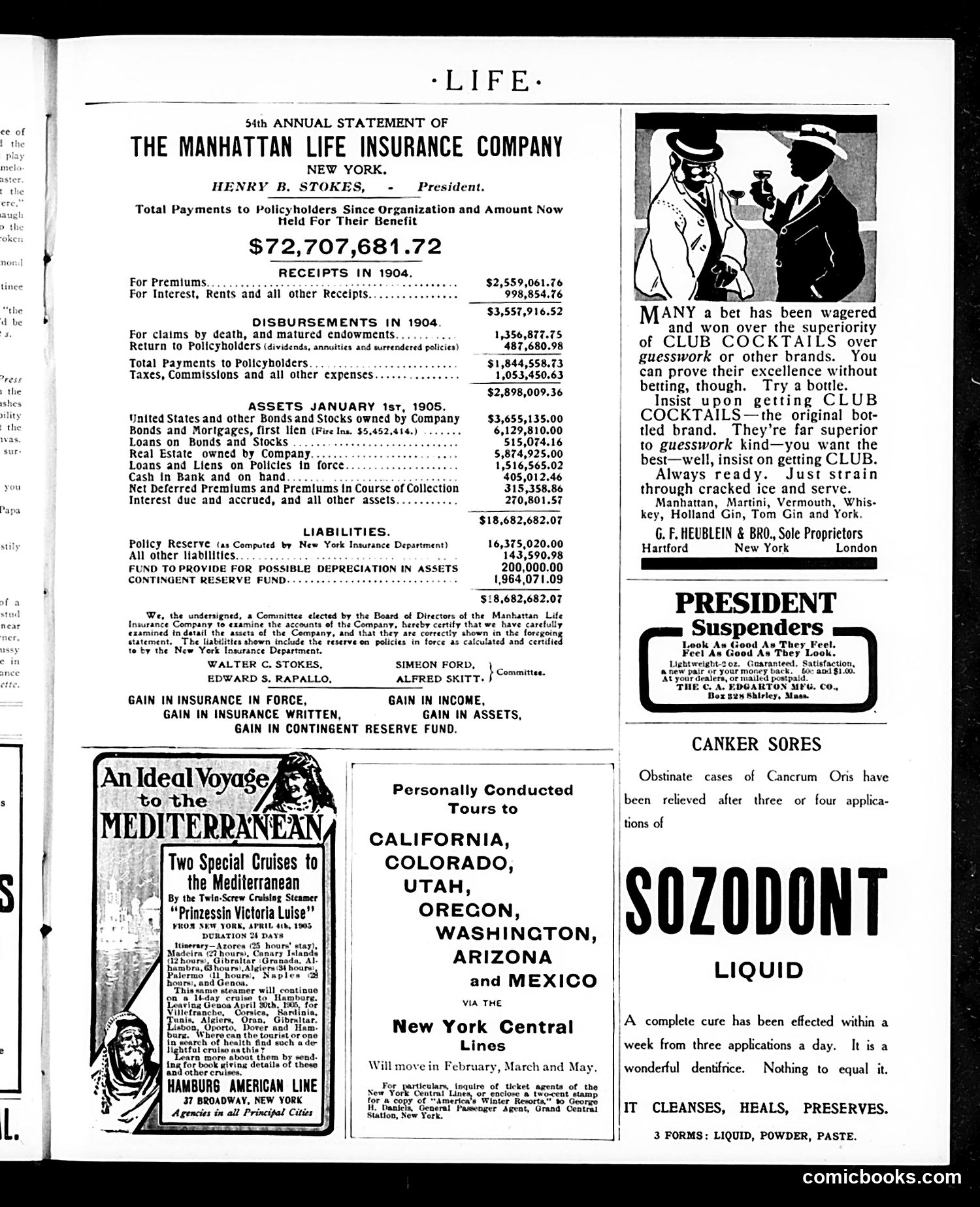
This page is primarily a **financial statement and advertising page**, not a political cartoon page. The main content is the 54th Annual Statement of The Manhattan Life Insurance Company (1905), detailing $72.7 million in total payments to policyholders and detailed financial assets/liabilities. The surrounding advertisements include: - **Club Cocktails** (liquor brand) - **Sozodont Liquid** (a toothpaste/dentifrice claiming to cure canker sores) - **Hamburg American Line** (cruise ship tours to Mediterranean and Western U.S.) - **President Suspenders** (clothing) There is **no political satire or cartoon visible**. The only illustration appears to be a decorative maritime scene with the cruise line ad. This is typical of Life magazine's format: financial/corporate announcements interspersed with period consumer product advertisements. The page reflects early 1900s commercial interests and medical product claims (like Sozodont's alleged cancer cure) that would be heavily regulated today.
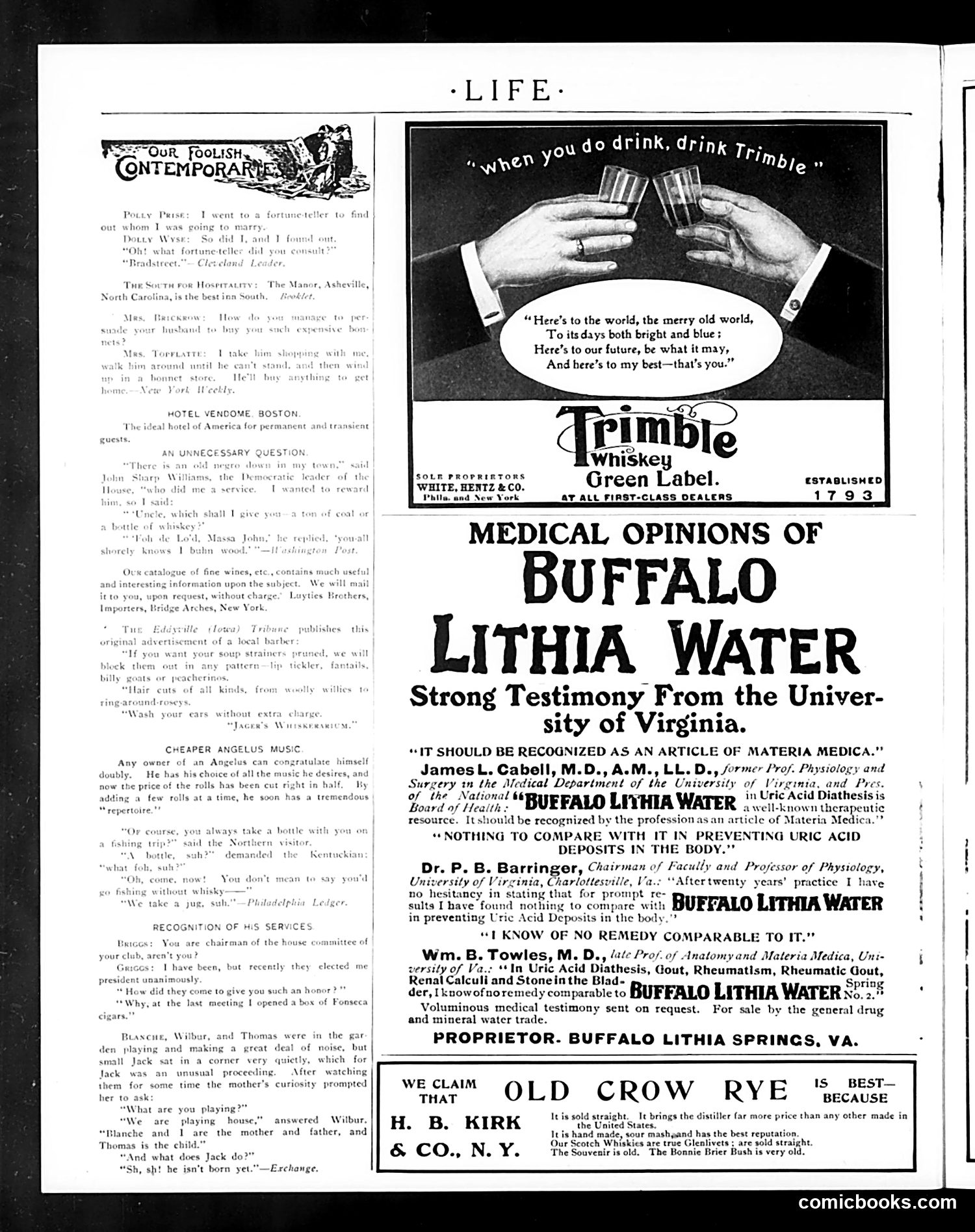
This page is primarily **advertising**, not satirical content. It features: **Main Advertisement**: Buffalo Lithia Water, marketed as a medical treatment for uric acid deposits, gout, and rheumatism. The ad includes testimonials from University of Virginia professors (James L. Cabell, P.B. Barringer, and Wm. B. Towles), lending scientific credibility to health claims. **Left Column**: "Our Foolish Contemporaries" section—brief humorous anecdotes about everyday social situations (fortune tellers, shopping, hotel service). **Top Right**: Trimble Whiskey advertisement with a toast, establishing the drink as a social ritual. **Bottom Right**: Old Crow Rye and H.B. Kirk whiskey ads emphasizing authenticity ("hand made, sour mash"). **Context for Modern Readers**: This reflects early 1900s medical marketing where mineral waters and spirits were heavily promoted with physician endorsements as treatments for serious ailments—practices now recognized as quackery. The ads illustrate how medical claims were largely unregulated.
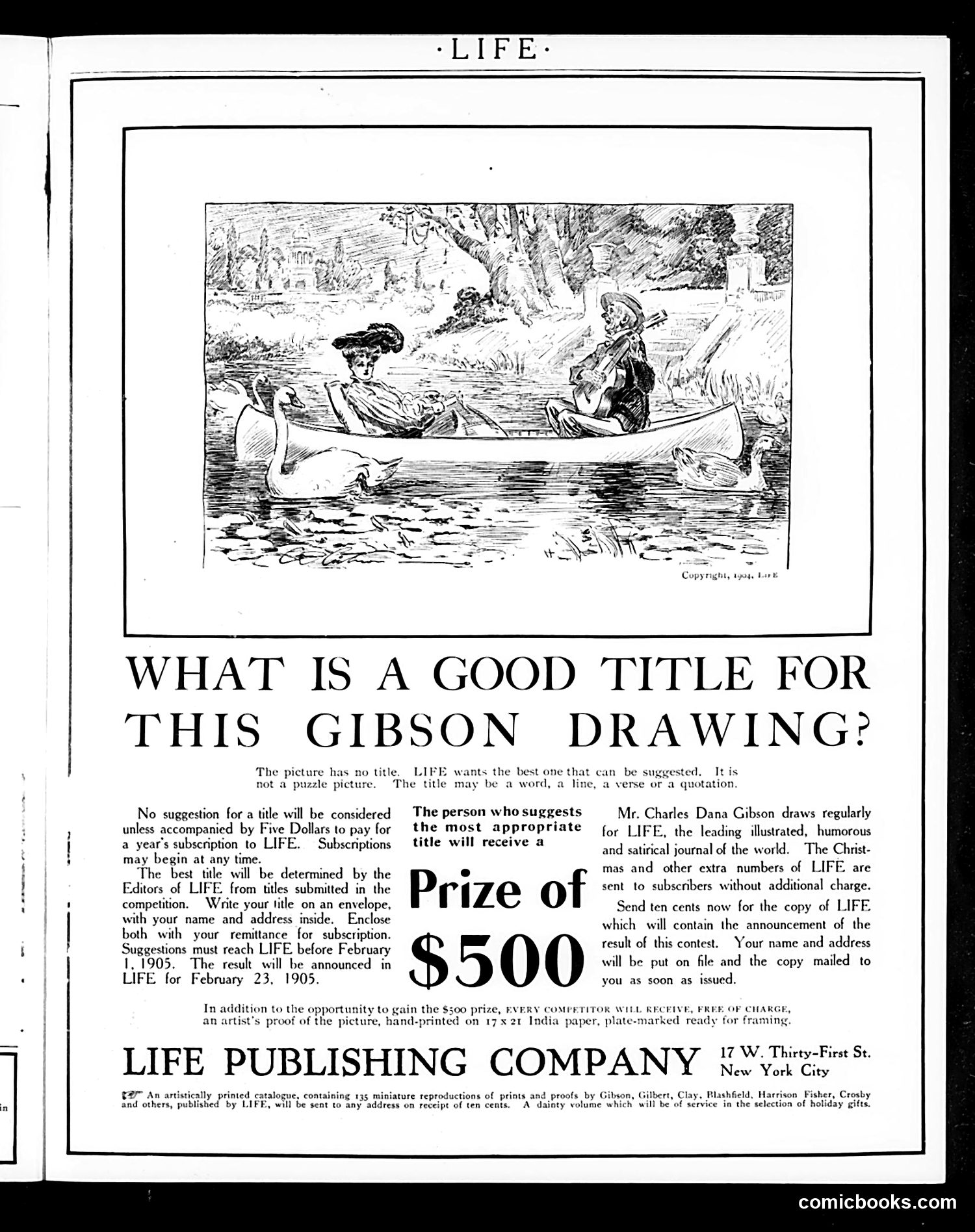
This is primarily a **contest advertisement** rather than a political cartoon. The page features a Charles Dana Gibson drawing depicting a romantic scene: a well-dressed couple in a small boat on a river, with swans nearby and a pastoral landscape in the background. The woman reclines leisurely while the man rows or tends the boat. **The Contest:** Life magazine is soliciting title suggestions from readers for this untitled Gibson drawing. The winner receives a $500 prize (substantial for 1905) and must pay a $5 subscription fee to enter. Submissions must arrive before February 1, 1905. **The Context:** Gibson was famous for his "Gibson Girl" illustrations—idealized depictions of fashionable American women. This image exemplifies that aesthetic: romantic, leisurely, upper-class leisure activity. **Modern relevance:** The high prize and subscription requirement suggest Life's commercial success and Gibson's celebrity status in early-1900s popular culture.
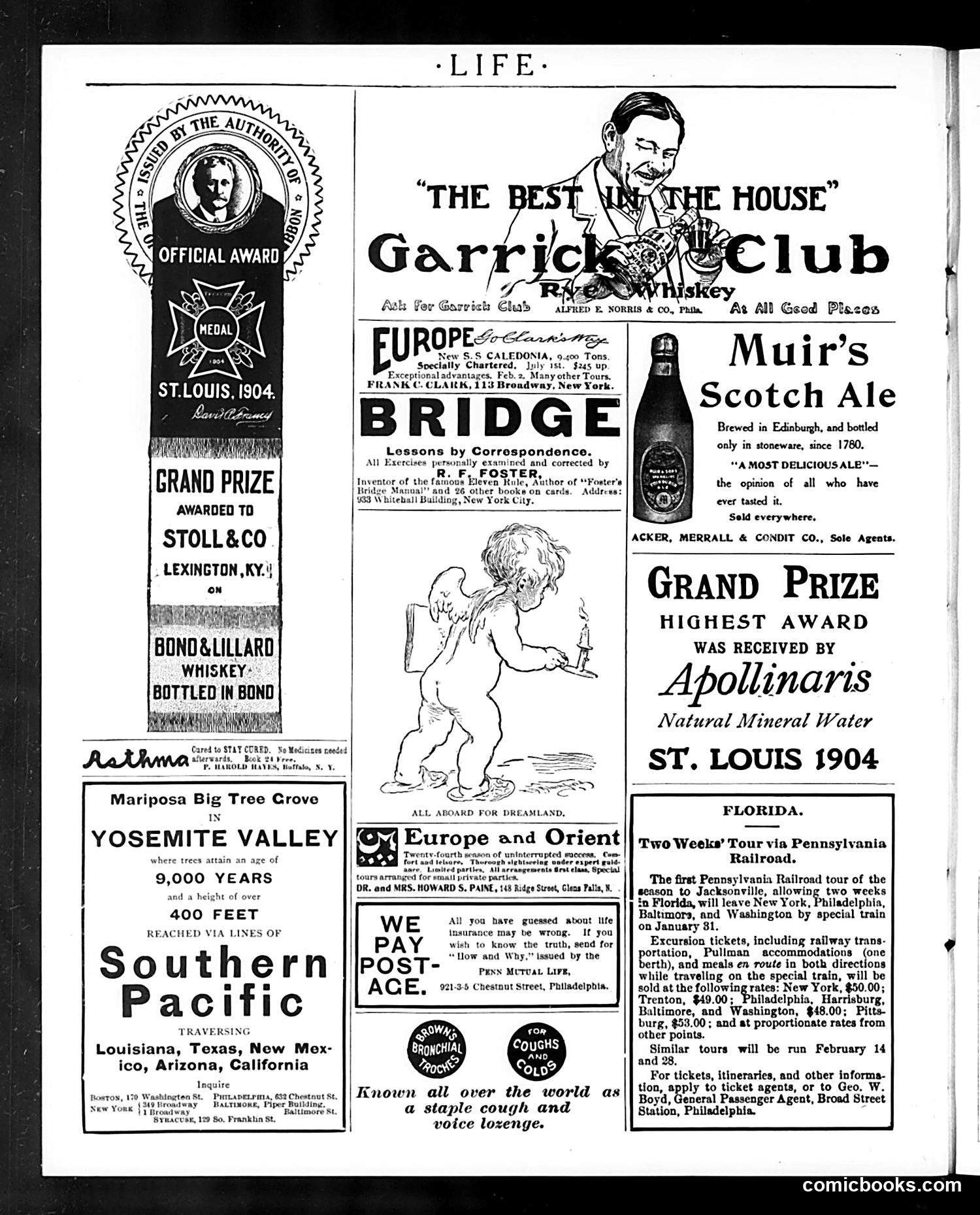
This is primarily a **advertisements page** from Life magazine, circa 1904. The central cartoon—a cherub figure labeled "ALL ABOARD FOR DREAMLAND"—is decorative rather than satirical, illustrating the travel and leisure theme of the ads. The page showcases products and services that won awards at the **1904 St. Louis World's Fair**, a major international exposition. Featured advertisers include whiskeys (Bond & Lillard, Garrick Club), Muir's Scotch Ale, Apollinaris mineral water, and travel services promoting Yosemite Valley via Southern Pacific Railroad and Florida tours via Pennsylvania Railroad. The satire is subtle: these luxury goods and expensive excursions represent the aspirational lifestyle of affluent Americans of the Gilded Age. The "dreamland" motif suggests these products offer escape and refinement to wealthy consumers. The repeated emphasis on world-class awards legitimizes these brands for readers seeking status markers.
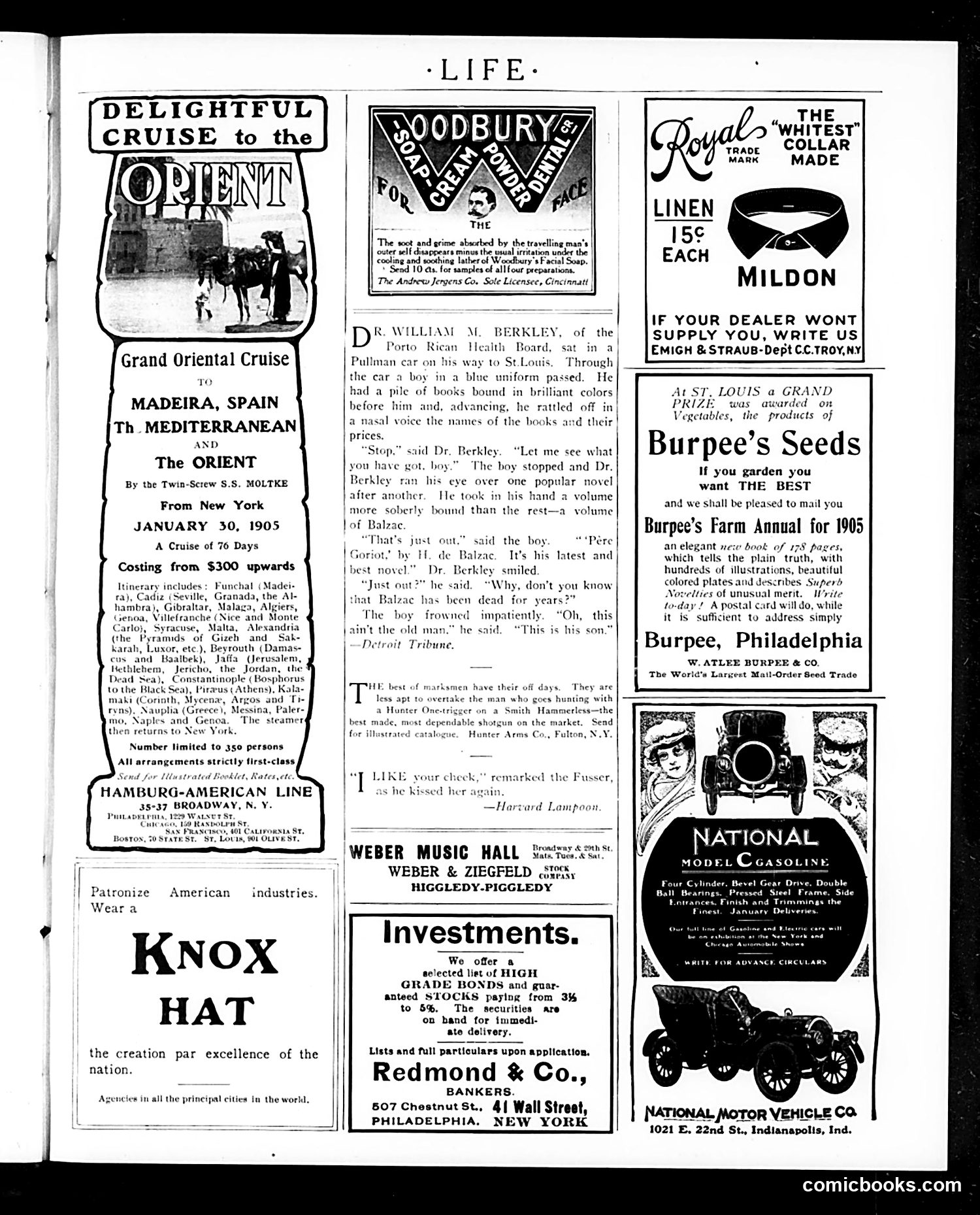
This page is **primarily advertising** with one substantial satirical anecdote embedded among commercial notices. The main content is a short humor piece titled "Dr. William M. Berkley" (likely a real person, given the specific title). The joke concerns a porter on a train to St. Louis who claims a Balzac novel is "his latest" work—unaware that Balzac died decades earlier. When corrected, the boy insists it's Balzac's son's work, not recognizing his error. The humor mocks either the porter's ignorance or perhaps feigned sales pitch. The surrounding advertisements reflect 1905 American consumer culture: cruise lines, clothing collars, seeds, music venues, and investment services. The page includes a notice to "Patronize American industries" via a Knox Hat ad, reflecting contemporary economic nationalism. The National Motor Vehicle advertisement features an early automobile, representative of the automotive industry's emergence during this period.
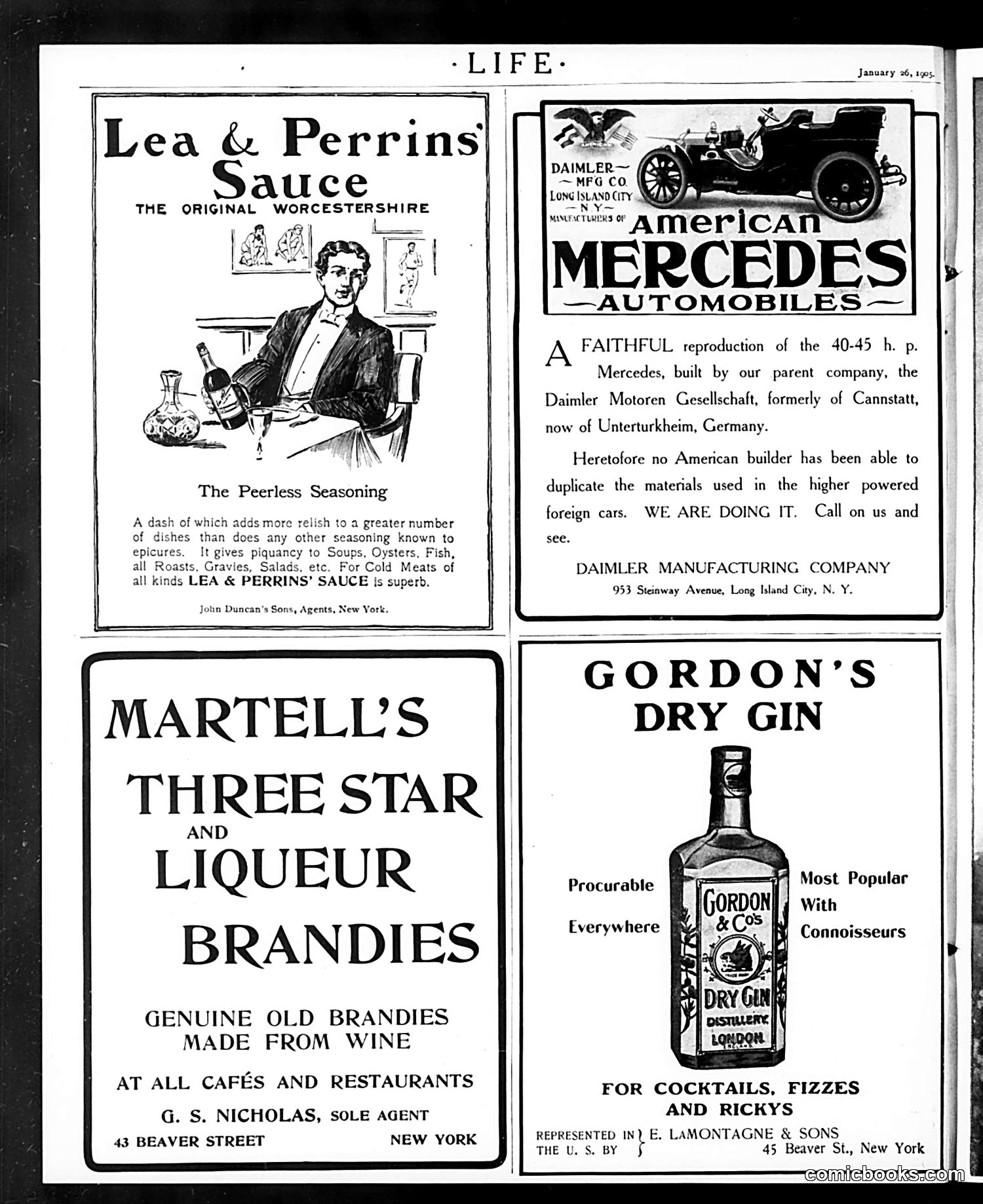
This is primarily a **advertising page**, not a satirical cartoon page. It contains four product advertisements from January 26, 1905: 1. **Lea & Perrins Sauce** – British Worcestershire sauce, promoted as a versatile seasoning for soups, fish, and meats. 2. **American Mercedes Automobiles** – A German-built car manufactured under license in Long Island City. The ad emphasizes that American builders previously couldn't match foreign materials and engineering, but "WE ARE DOING IT." 3. **Martell's Three Star Brandy** – Marketed as genuine old brandy available at cafés and restaurants. 4. **Gordon's Dry Gin** – Promoted as popular with connoisseurs for cocktails and mixed drinks. The page reflects early 1900s consumer culture: imported luxury goods (British sauce, German engineering, French brandy, British gin) were prestigious, and American manufacturers sought to claim competitive parity with European products.