
Life, 1905-01-26 · page 4 of 22
Life — January 26, 1905 — page 4: what you’re looking at
What you’re looking at
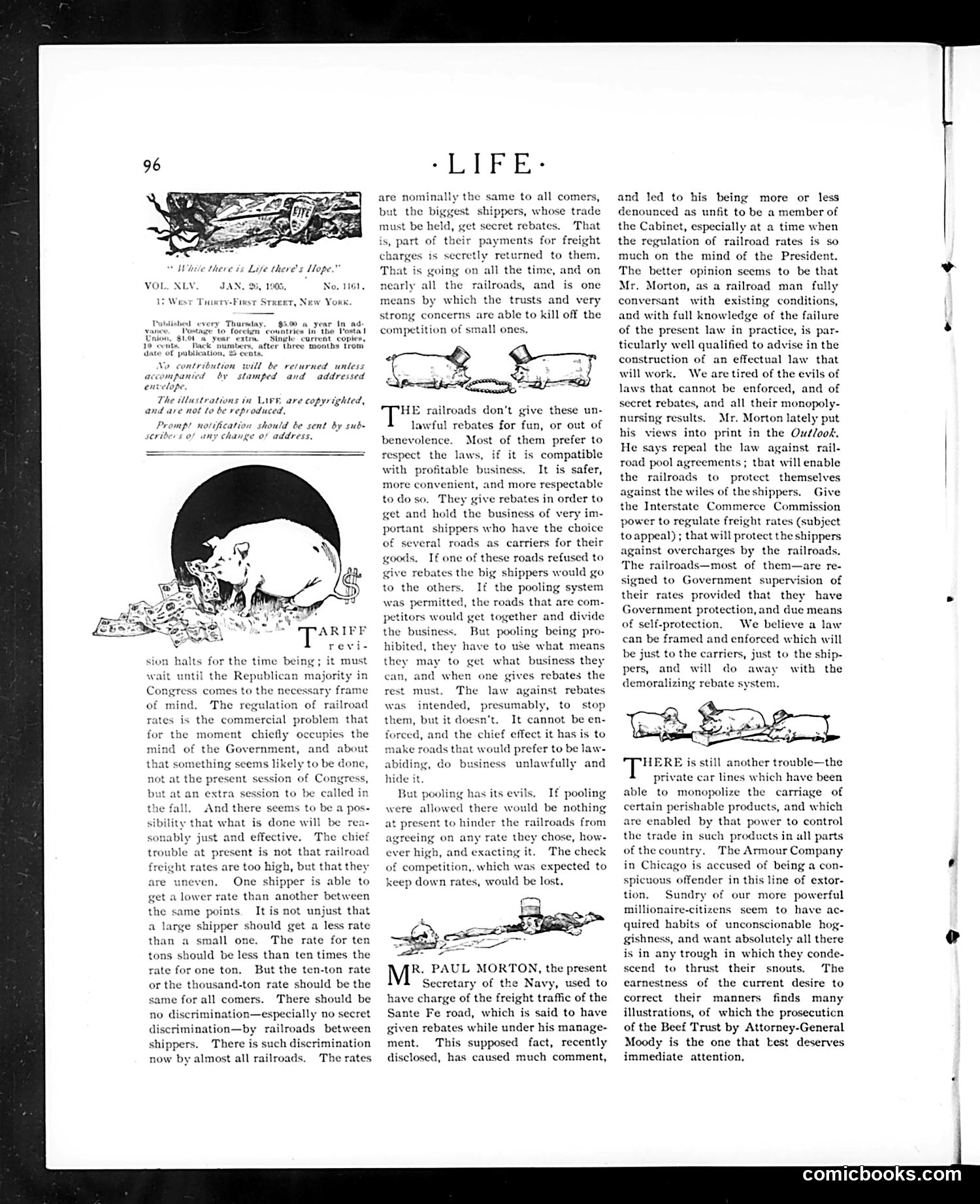
This page discusses railroad regulation and freight rate practices through text and accompanying political cartoons. The main targets are: **"Tariff Revision"** cartoon: Depicts railroad interests halting regulatory action, suggesting the GOP majority in Congress delays necessary railroad reforms. **"Mr. Paul Morton"** section: References the former Navy Secretary who managed Santa Fe railroad freight traffic, accused of giving secret rebates to favored shippers—a practice the article condemns as unlawful and monopolistic. The satire critiques how railroads circumvent anti-rebate laws through secret deals, monopolize shipping routes, and use political connections to avoid regulation. The cartoons visualize railroads as obstructionist forces blocking reform efforts in Congress, reflecting Progressive Era concerns about corporate malfeasance and the need for stronger Interstate Commerce Commission enforcement.
📄 Transcribed text from this page (OCR, searchable)
Machine-transcribed from the original scan — historical spelling and the odd misread are preserved.
* While there i Lise there's Hi 1905, VOL. XLV 1; West T JAN, ry-Finst Street, N No, 1161, w Yors, 1 every Thursday we to foreken a year In ad. rice in the cor hs trom’ Vo contribution will be returned unless accompanied by stamped and addressed envelope The illustrations in LAP®. are copyrighted, and are not to be reproduced, Prompt notification should be sent by sub= seriber s of any change of address, ARIFF revi- time being; it must wait until the Republican majority in Congress comes to the necessary frame of mind, The regulation of lroad es is the commercial problem that for the moment chiefly occupies the mind of the Government, and about at something seems likely to be done, not at the present session of Congress, but tan extra session to be the And there seems to be a pos- sibility that what is done will be r ably just and effective. The trouble at present is not that railroad ht rates are too high, but that they ineven, One shipper is able to get a lower rate than another between the same points. It is not unjust that a large shipper should get a less rate than a small one. The rate for ten tons should be less than ten times the rate for one ton. But the ten-ton rate or the thousand-ton rate should be the same for all comers. There should be no discrimination—especially no secret discrimination—by railroads between shippers. There is such discrimination now by almost all railroads. ‘The rates fre are -LIFE- are nominally the same to all comers, but the biggest shippers, whose trade must be held, get secret rebates. That is, part of r payments for freight Tges is secretly returned to them. That is going on all the time, and on nearly all the railroads, and is one means by which the trusts and very strong concerns are able to kill off the competition of small one: 4 © HE railroads don't give these un- lawful rebates for fun, or out of benevolence. Most of them prefer to respect the laws, if it is compatible with profitable business. It is safer, more convenient, and more respectable todo so. They give rebates in order to get and hold the business of very im- portant shippers who have the choice of several roads as carriers for their If one of these roads refused to goods, give rebates the big shippers would go to the others. If the pooling system S permitted, the roads that are com- petitors would get together and divide the business. But pooling being pro- hibited, they have to use what means they may to get what business they can, and when one gives rebates the rest must. The law against rebates intended, presumably, to them, but it doesn’t. It cannot be en- forced, and the chief effect it has is to ake roads that would prefer to be law- was abiding, do business unlawfully and hide it But pooling has its evils. If pooling were allowed there would be nothing present to hinder the railroads from agreeing on any rate they chose, how- ever high, and exacting it. ‘The check of competition, which was expected to keep down rates, would be lost. al > R, PAUL MORTON, the present Secretary of the Navy, used to have charge of the freight traffic of the Sante Fe road, which is said to have given rebates while under his manage- ment. This supposed fact, recently disclosed, has caused much comment, and led to his being more or less denounced as unfit to be a member of the Cabinet, especially at a time when the regulation of railroad ra much on the mind of the President. The better opinion seems to be that Mr. Morton, as a railroad man fully conversant with existing conditions, and with full knowledge of the failure of the present law in practice, is par- ticularly well qualified to advise in the construction of an effectual law that will work. We are tired of the evils of laws that cannot be enforced, and of secret rebates, and all their monopoly- nursing results. Mr. Morton lately put his views into print in the Outlook, He says repeal the law against rail- road pool agreements ; that will enable the railroads to prote emselves st the wiles of the shippers. Give the Interstate Commerce Commission power to regulate freight rates (subject toappeal) ; that will protect the shippers. against overcharges by the railroads, The railroads—most of them—are re- signed to Government supervision of their rates provided that they have Government protection, and due means, of self-protection. We believe a law es is so can be framed and enforced which will rriers, just to the ship- with the be just to the pers, and will do away demoralizing rebate system. HERE is still another trouble—the private car lines which have been able to monopolize the carriage of certain perishable products, and which are enabled by that power to control the trade in such products in all parts of the country. The Armour Company in Chicago is accused of being a con- spicuous offender in this line of extor- tion, undry millionaire our more powerful itizens seem to have ac- quired habits of unconscionable hog- gishness, and want absolutely all there is in any trough in which they conde- scend to thrust their snouts The earnestness of the current desire to correct their manners finds many illustrations, of which the prosecuticn of the Beef Trust by Attorney-General Moody is the one that test deserves immediate attention, comicbooks.com