
Life, 1905-01-26 · page 15 of 22
Life — January 26, 1905 — page 15: what you’re looking at
What you’re looking at
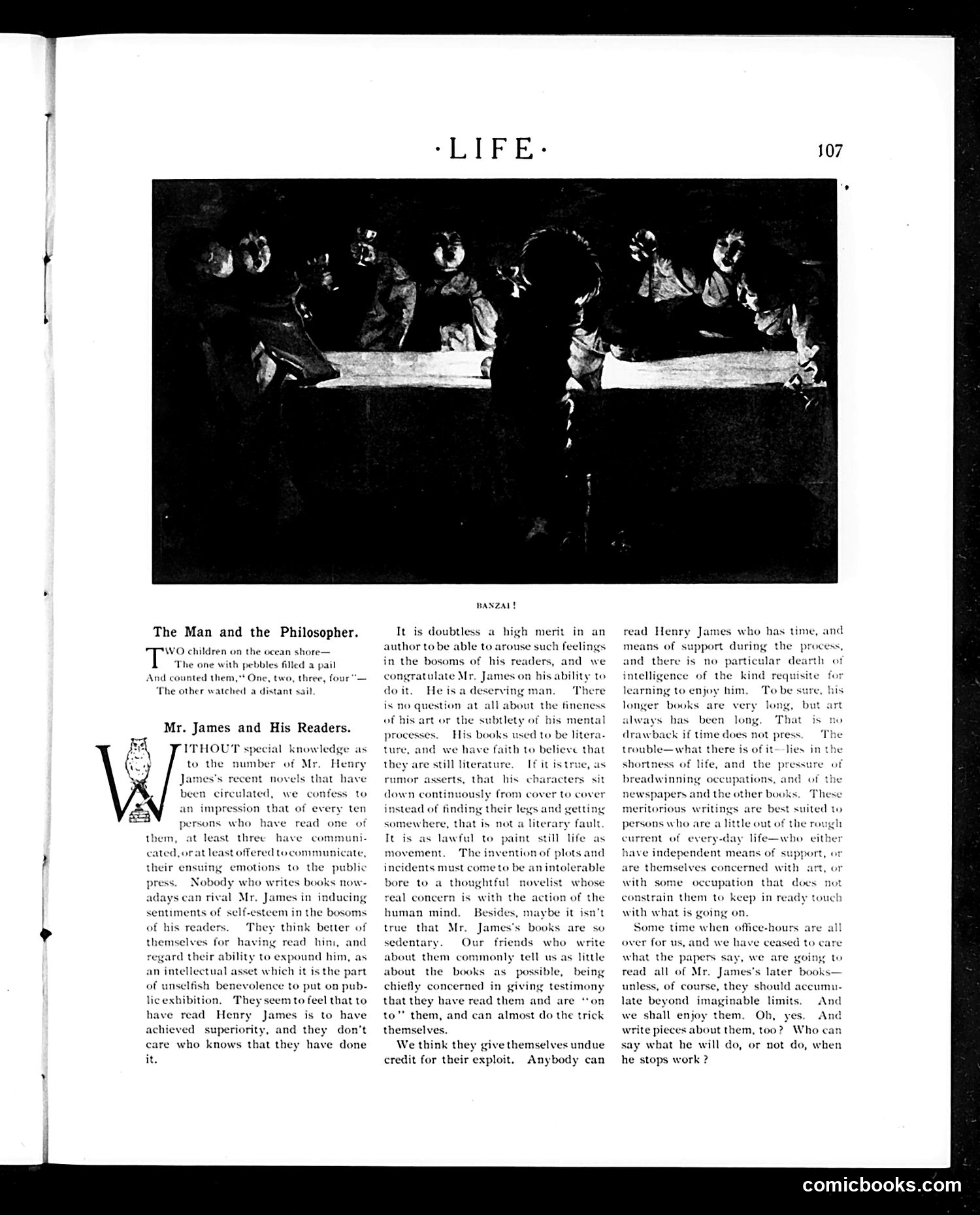
This page critiques the pretentiousness of Henry James's readers rather than James himself. The cartoon at top (titled "Banzai!") appears to show two contrasting scenes—likely representing the "man" (practical, action-oriented) versus the "philosopher" (contemplative, idle), based on the opening poem about children counting pebbles versus watching a sail. The main article mocks readers who feel intellectually superior after reading James's difficult novels. Life observes that James's admirers use their reading as a status symbol, boasting of their ability to "expound" him to demonstrate intellectual merit. The magazine notes this is undeserved vanity—anyone with time can read James. The satire suggests James's sedentary narratives (characters sitting rather than acting) aren't a literary flaw but reflect his real artistic concern with internal human consciousness rather than plot. The piece ultimately defends James's artistry while deflating his readers' snobbish self-regard.
📄 Transcribed text from this page (OCR, searchable)
Machine-transcribed from the original scan — historical spelling and the odd misread are preserved.
ot The Man and the Philosopher. Toes on the ocean shore— ‘The one with pebbles filled a pail On And counted them, two, three, four” — ‘The other watched a distant sail Mr. James and His Readers. ITHOUT spe to the number of Mr Ja ul knowledge as Henry es’s recent nov that have j been circulated, we confess to ‘& n impression that of every ten ay ccrsons-eho have read one: of them, at least three communi- cated, orat least offered tocomr ncir ensuing emotions to the public nave unicate, press, Nobody who writes books now- adays can rival Mr. James in inducing sentiments of self-esteem in the bosoms They think better of themselves for having read hin, and > ot his readers. regard their ability to expound him, as an intellectual asset which it is the part unselfish benevolence to put on pub- licexhibition. They seem to feel that to have read Henry James is to have achieved superiority, and they don't care who knows that they have done BANzal! Tt i: author to be able to arouse such feel doubtless a high merit in an in the bosoms of his readers, and we congratulate Mr. J do it. He isa deserving mes on his ability to an. ‘There is no question at all about the fineness of his art or the subtlety of bis mental His books used to be lite re, and we have faith to believe t If it iste ty they are still literature. rumor asserts, that his characters sit from cove down continously to cover sand getting tead of finding their le son newhere, that is not a literary fault lawful t still life as The i incidents must come to be an intolerable Tt is as paint movement vention of plots and bore to a thoughtful novelist whose real concern is with the action of the human mind. true that Mr. James's books are so sedentary. Our frie about them commonly tell us as little about the books as. possible, Besides, maybe it isn’t nds who write being chiefly concerned in giving testimony that they have read them and are ‘ton to” them, and can almost do the trick themselves. We think they give themselves undue credit for their exploit. Anybody can 107 read Henry James who has time, and port during and there is no parti ntelligence of the kind ri means of learning to enjoy him, ‘To be su longer books are very always has been long. drawback if time does not press trouble—what there is of it-lies in the shortness of life, and the press breadwinning occupations, and of The gs are best suited newspapers and the other books meritorious writin persons who are a little out of the rough current of ay life—who either have independent means of support, o7 erned with r ever: are themselves cc n some occupation th at does wi constrain them to keep in ready touct with what is going on Some time when office-hou are all over for us, and we have ceased to care what the papers ss read all of Mr. James's later books unless, of course, they should accumu- late beyond imaginable limits. And we shall enjoy them, Ob, yes. And write pie bout them, too? Who can say what he will do, or not do, when he stops work ? we are goi comicbooks.com