
A complete issue · 22 pages · 1904
Life — April 21, 1904
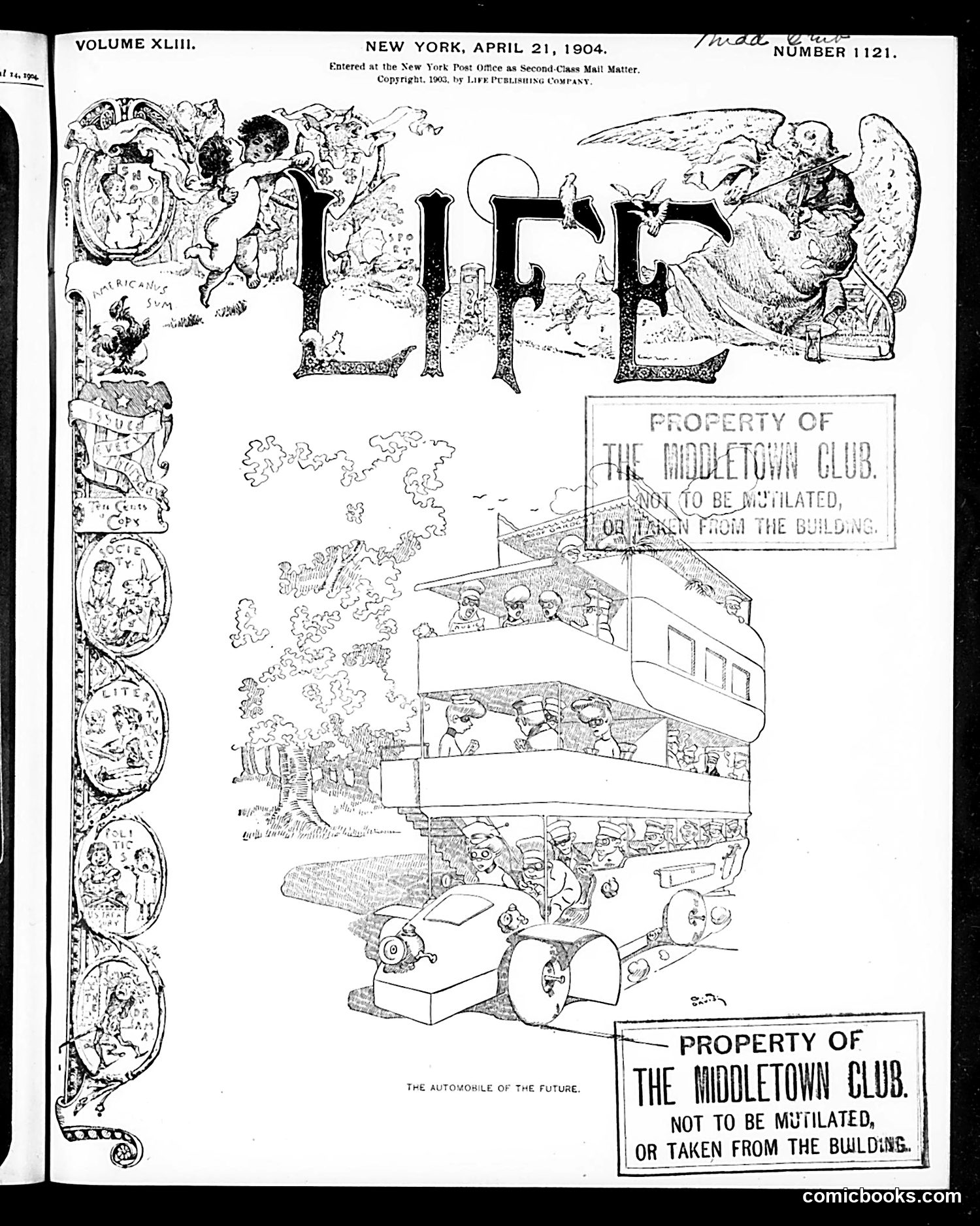
This satirical cartoon depicts an absurdly complex, multi-tiered contraption labeled "The Automobile of the Future." It's an early 20th-century joke about automotive technology's rapid, chaotic development. The drawing shows a sprawling mechanical apparatus with multiple levels of passengers, various mechanical components, and fantastical features—appearing simultaneously over-engineered and impractical. The satire mocks the era's breathless enthusiasm for automobile innovation and the bewildering pace of competing designs and improvements. The "Property of The Middletown Club" stamps suggest this was a magazine copy belonging to a social club, standard practice for institutional subscriptions of the period. The ornamental border features classical medallions, typical of *Life* magazine's design aesthetic.
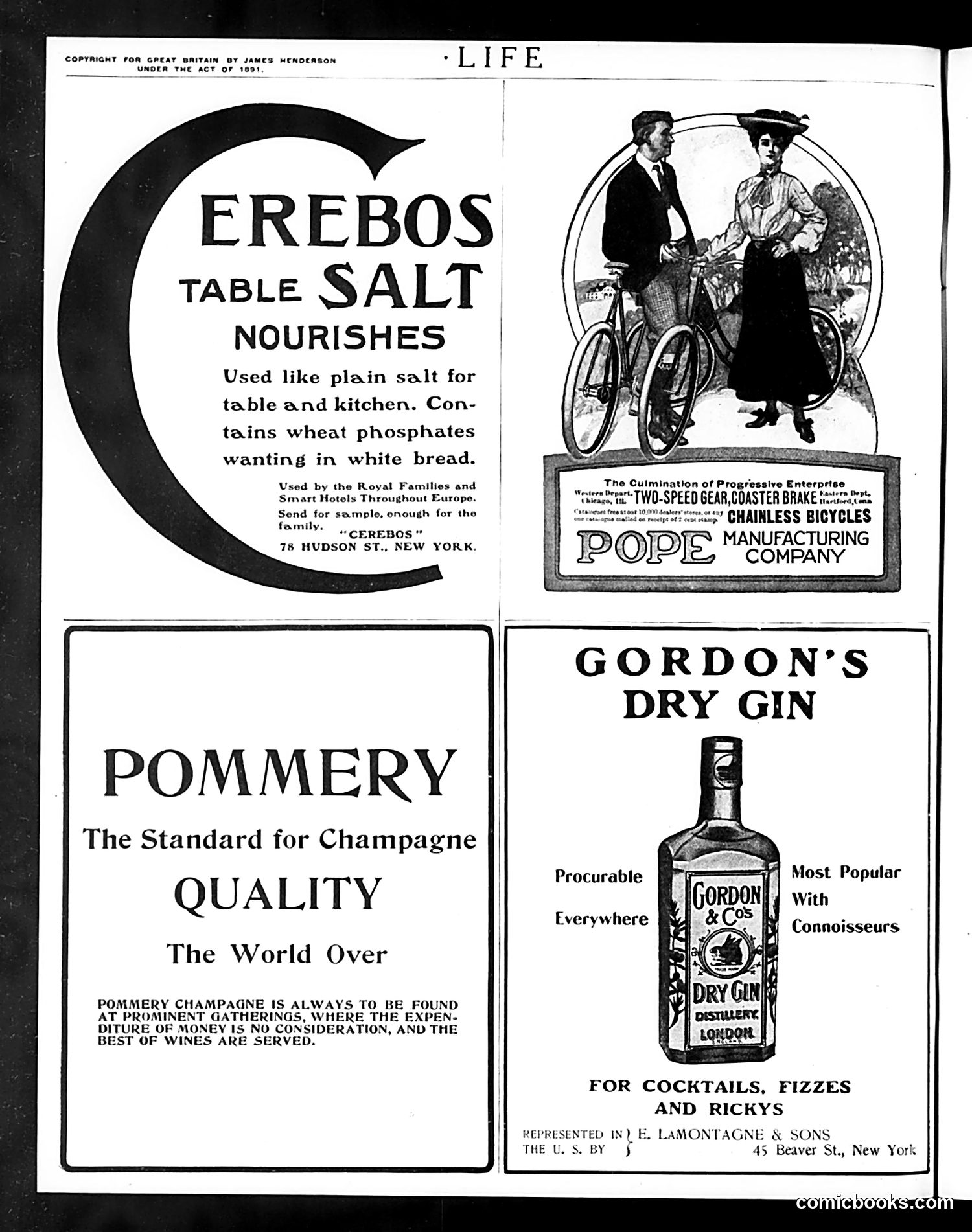
This page is primarily **advertising**, not satire or editorial cartoon. It contains four product advertisements from what appears to be an early 20th-century issue of Life magazine: 1. **Cerebos Table Salt** - promotes fortified salt with wheat phosphates 2. **Pope Manufacturing Company** - advertises chainless bicycles, showing a well-dressed couple 3. **Pommery Champagne** - emphasizes quality and prestige 4. **Gordon's Dry Gin** - promotes the spirit for cocktails The bicycle ad is the most visually interesting, depicting aspirational leisure and mobility for the well-to-do. None of these advertisements contain political satire or social commentary—they're straightforward product promotion targeting Life's affluent readership. The page reflects early 1900s consumer culture and advertising aesthetics.
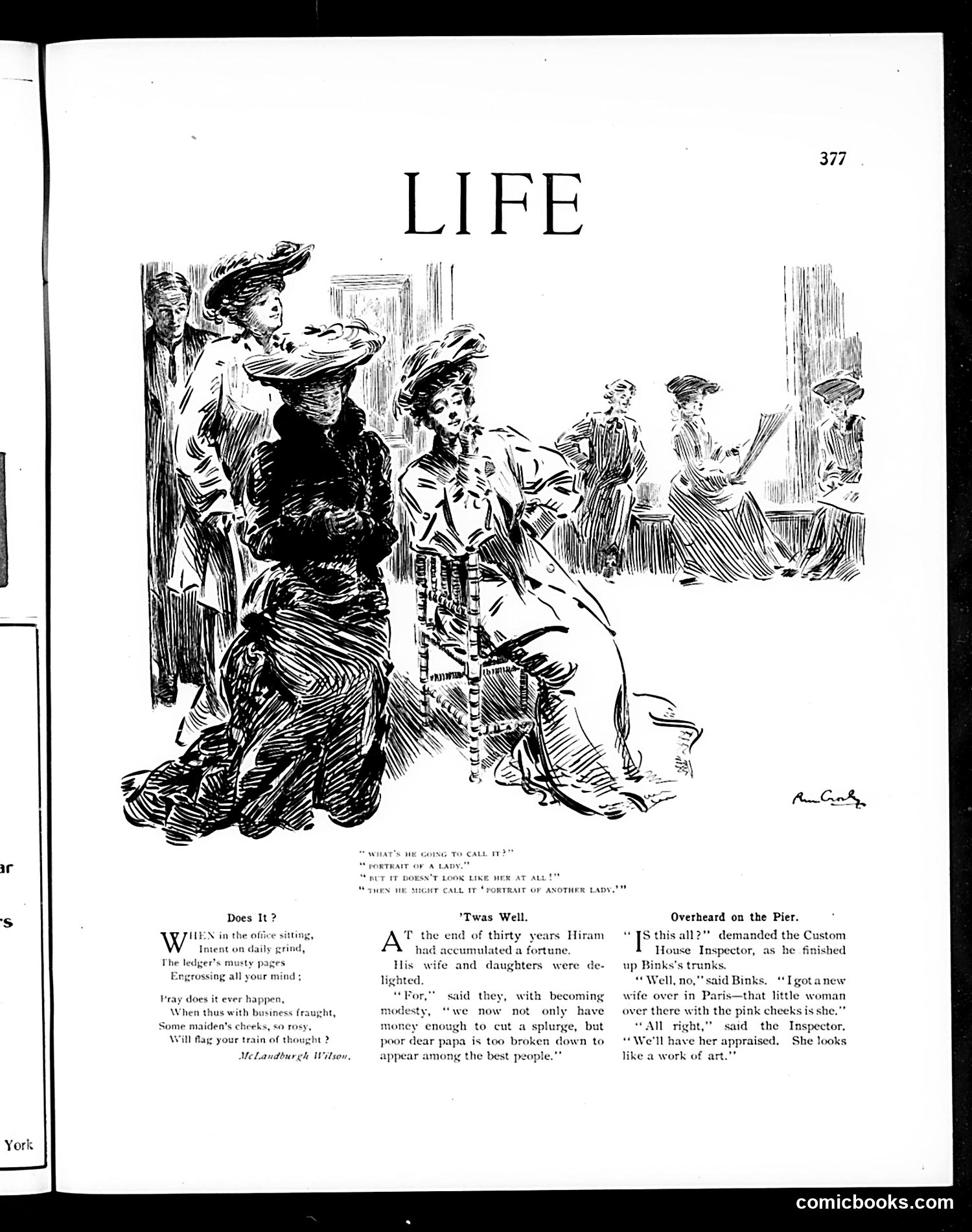
This page contains three distinct pieces of social commentary: **"Does It?"** critiques wealthy office workers who accumulate fortunes while remaining emotionally detached from their success—a critique of Gilded Age materialism. **"'Twas Well"** satirizes nouveau riche pretensions. After thirty years accumulating wealth, a man's family now aspires to "cut a splurge" and appear among "the best people," despite their working-class origins. The satire mocks their social climbing and assumption that money automatically grants respectability. **"Overheard on the Pier"** presents a customs inspector's dismissive observation of a wealthy wife's appearance after acquiring a Parisian mistress—suggesting moral corruption accompanies wealth acquisition. The cartoons collectively critique Edwardian-era materialism and social aspiration, depicting wealth as morally and aesthetically corrosive rather than ennobling.
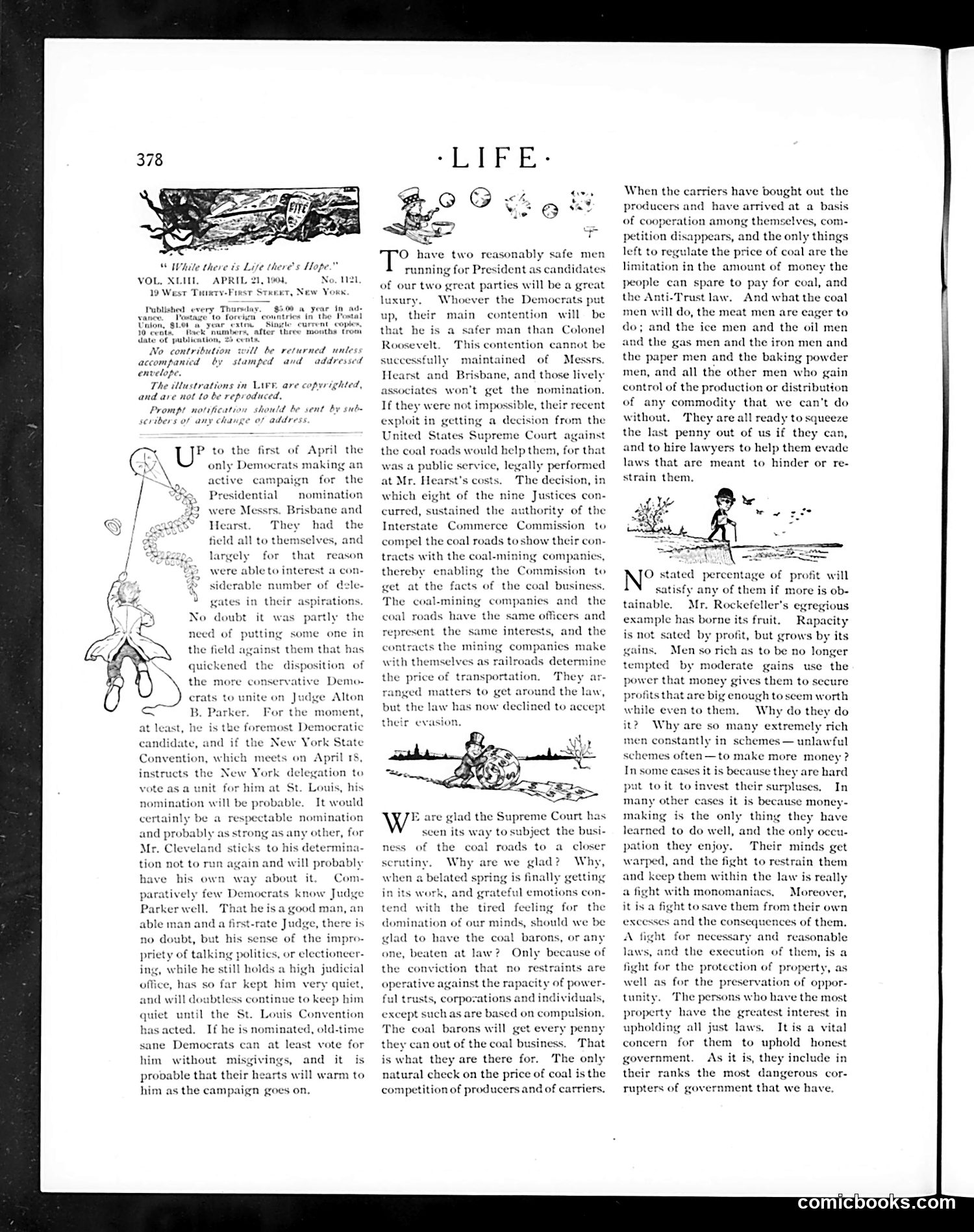
This page from *Life* magazine (April 22, 1904) critiques the coal industry and recent Supreme Court decisions affecting it. The text discusses Democratic presidential candidates and compares Judge Alton B. Parker favorably to other options, while arguing for government regulation of coal monopolies. The accompanying cartoons (rendered in simple pen-and-ink style) appear to satirize the wealthy coal barons and their outsized influence. The illustrations show figures in exaggerated poses, likely mocking the power dynamics between industrial magnates and ordinary citizens. The article argues that natural competition between coal producers and carriers is the only effective check on price-gouging, and warns that unrestrained capitalists represent genuine threats to democratic governance and honest administration of government.
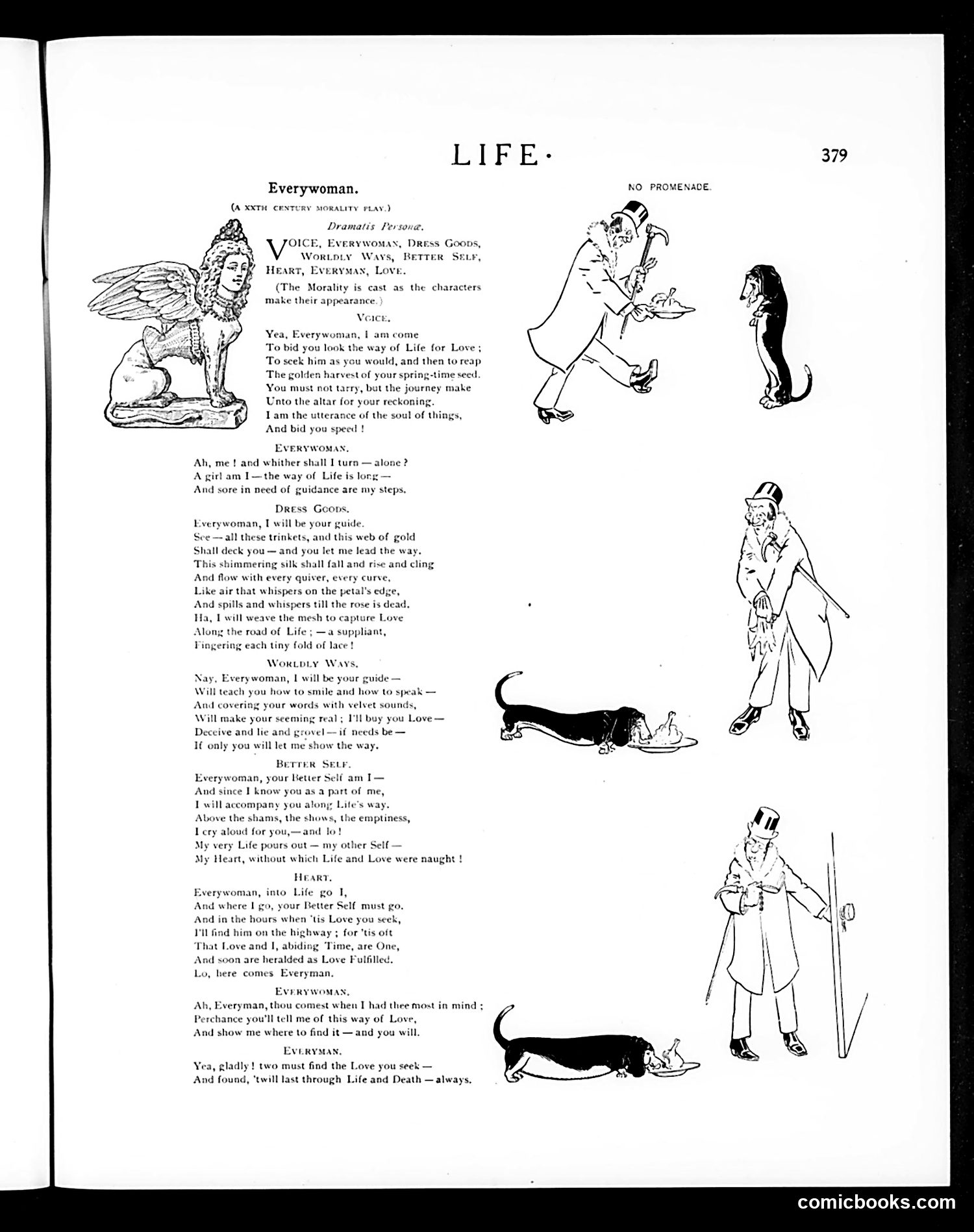
This is a theatrical script presented as satire, subtitled "A XVIth Century Morality Play." It's a modern adaptation of medieval morality plays—allegorical works where abstract concepts (Voice, Dress Goods, Worldly Ways, Better Self, Heart) appear as characters speaking to "Everywoman." The satire targets consumer culture and feminine materialism. Characters like "Dress Goods" and "Worldly Ways" tempt Everywoman with promises of love and status through clothing and social performance, while "Better Self" and "Heart" offer moral guidance. The accompanying illustrations show well-dressed figures and dachshunds, emphasizing the fashionable world's superficiality. The piece critiques how women are swayed by commercial desires and social pressures rather than genuine virtue—a common Progressive-era complaint about modern consumer society.
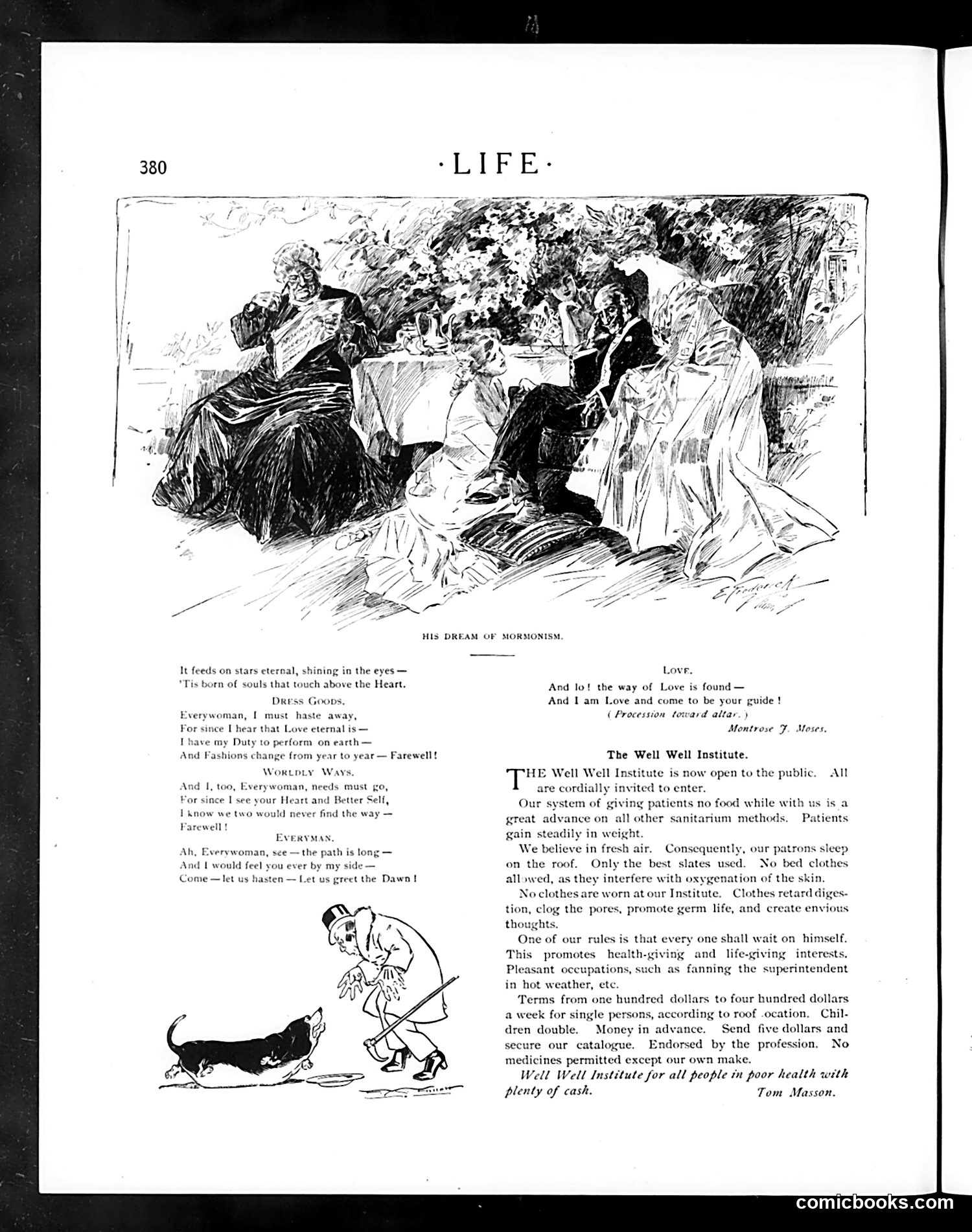
**Main Cartoon ("His Dream of Mormonism"):** The top illustration satirizes Mormonism, depicting a man's fantasy of multiple wives serving him. The accompanying verses mock both Mormon polygamy and the doctrine of eternal life, presenting the practice as absurd wish-fulfillment. The satire mocks Mormons' religious beliefs while critiquing male-centered polygamous arrangements. **Lower Cartoon:** A simple humorous sketch shows a man with a dachshund dog, likely playing on the dog's elongated shape. **"The Well Well Institute" Advertisement:** The right side contains a health institute advertisement claiming to cure patients through fresh air, light exposure, and no clothing—a health fad reflecting early 20th-century "nature cure" movements. The satirical title suggests skepticism about such dubious medical claims.
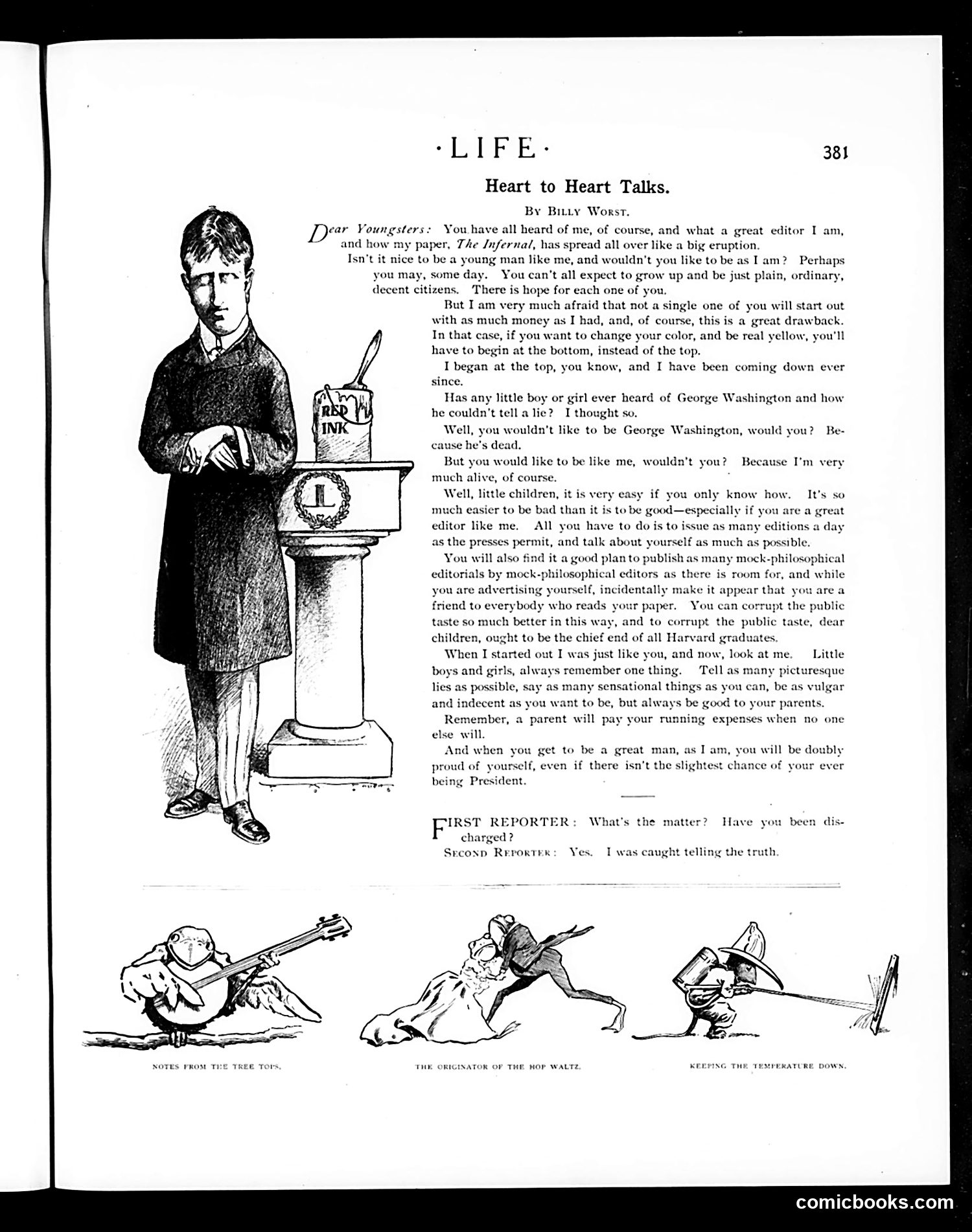
This satirical piece mocks sensationalist journalism and advice-giving. Billy Worst (likely a pseudonym) addresses "Dear Youngsters," cynically counseling them to become unethical editors like himself. **The satire:** Worst advises young people to become dishonest—issuing many editions daily, publishing mock-philosophical editorials, corrupting public taste, and spreading lies while appearing friendly. He boasts of his own moral decline ("I began at the top, you know, and I have been coming down ever since"). **The joke:** The advice is so transparently corrupt that it exposes actual journalistic practices Worst claims to practice. The character represents unscrupulous editors who prioritize sensationalism and self-promotion over truth. The three cartoon vignettes below depict absurd activities, likely mocking trivial or exaggerated content typical of yellow journalism of the era.
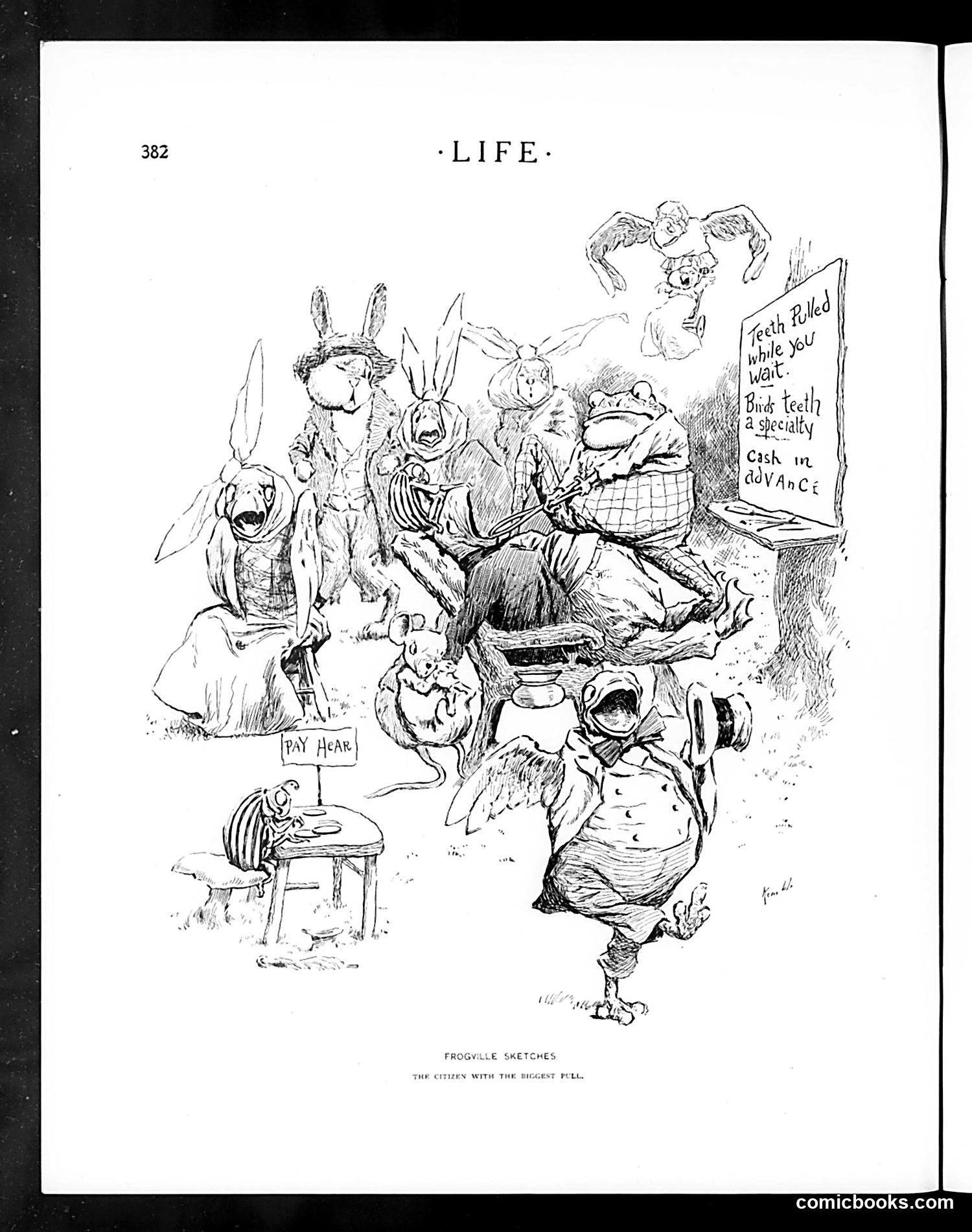
This is a satirical cartoon depicting anthropomorphic frogs in what appears to be a corrupt business or political scenario. The central figure is a well-dressed frog conducting what looks like a dental practice or tooth-extraction operation ("Teeth Pulled While You Wait"). A sign advertises "Birds Teeth a Specialty" and "Cash in Advance"—suggesting exploitation and payment demands. The "Pay Hear" sign at lower left indicates a toll or fee structure. The title "The Citizen with the Biggest Pull" likely satirizes someone wielding disproportionate influence or power, possibly commenting on political corruption, monopolistic business practices, or exploitation of public services during the early 20th century. The frog imagery suggests commentary on base or contemptible behavior.
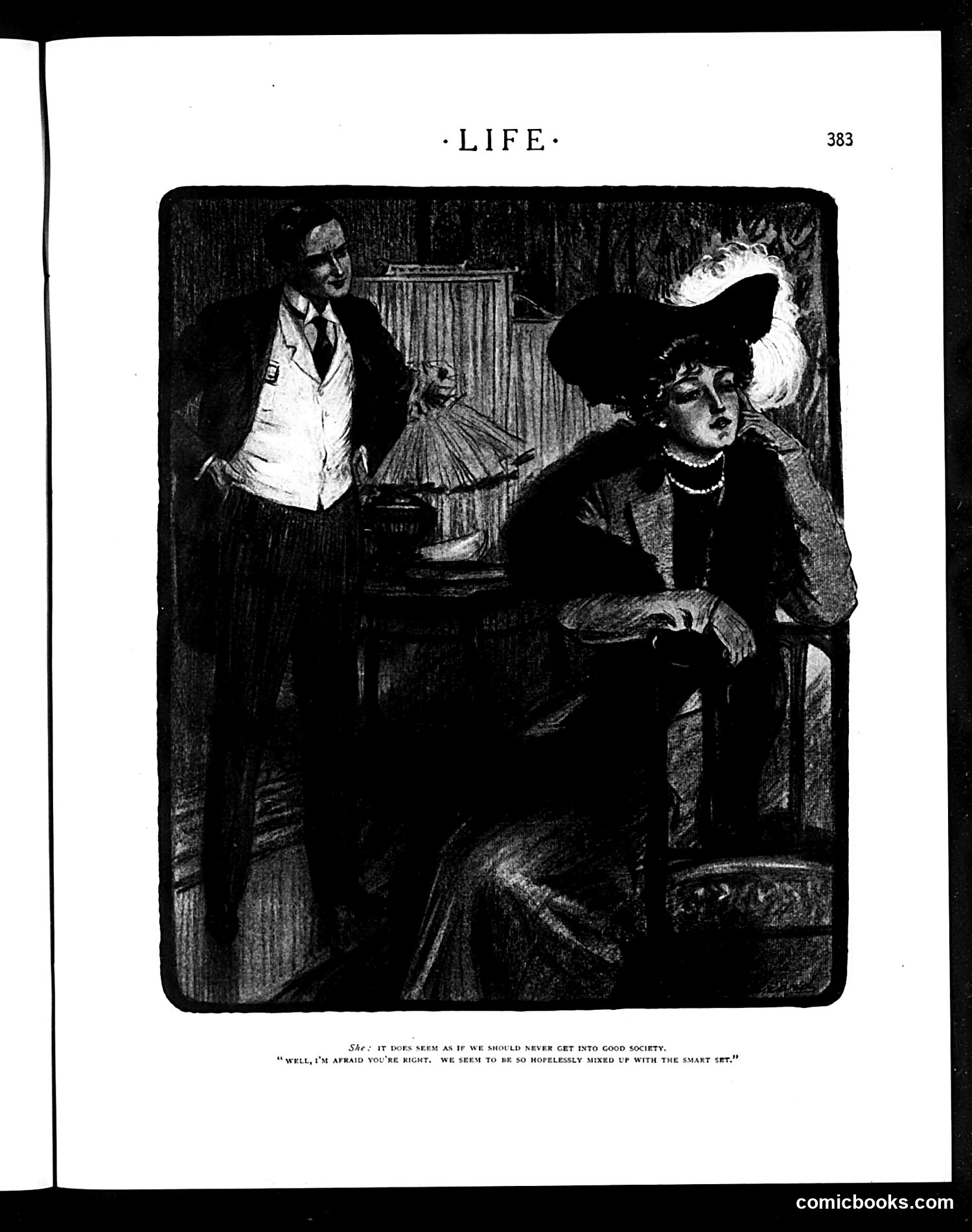
This is a satirical cartoon from *Life* magazine (page 383) depicting a social scene. A well-dressed man stands in the background while a fashionable woman in an elaborate hat sits in the foreground. The caption reads: "Well, I'm afraid you're right. We seem to be so hopelessly mixed up with the smart set." The satire targets high society's superficiality and moral compromises. The woman's comment suggests anxiety about their social standing among the wealthy elite ("smart set"), implying that keeping up with fashionable society requires compromising one's values or associating with questionable characters. The joke criticizes how the wealthy prioritize social status and appearance over integrity, depicting them as "hopelessly mixed up" with morally questionable people simply to maintain their prestigious social position.
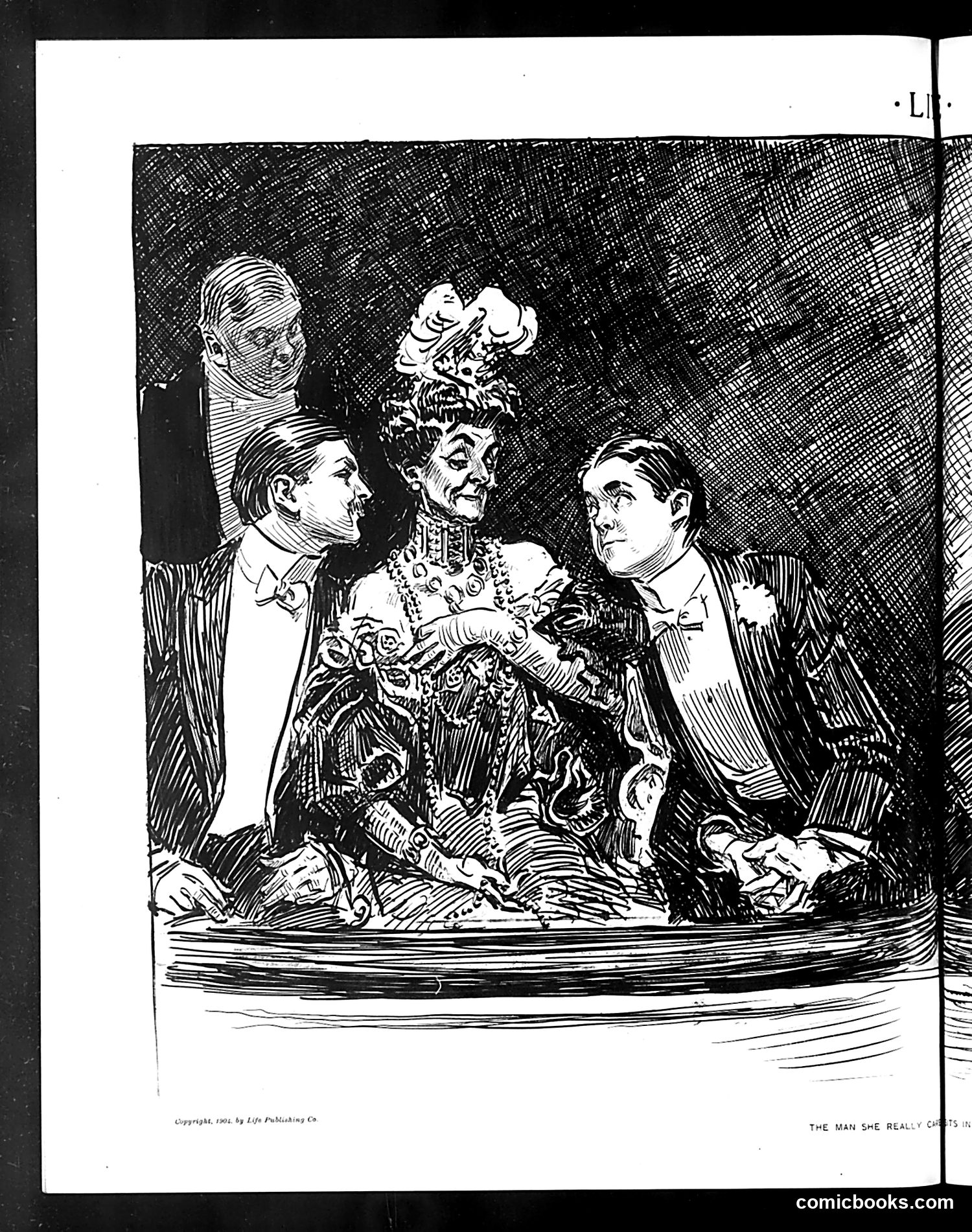
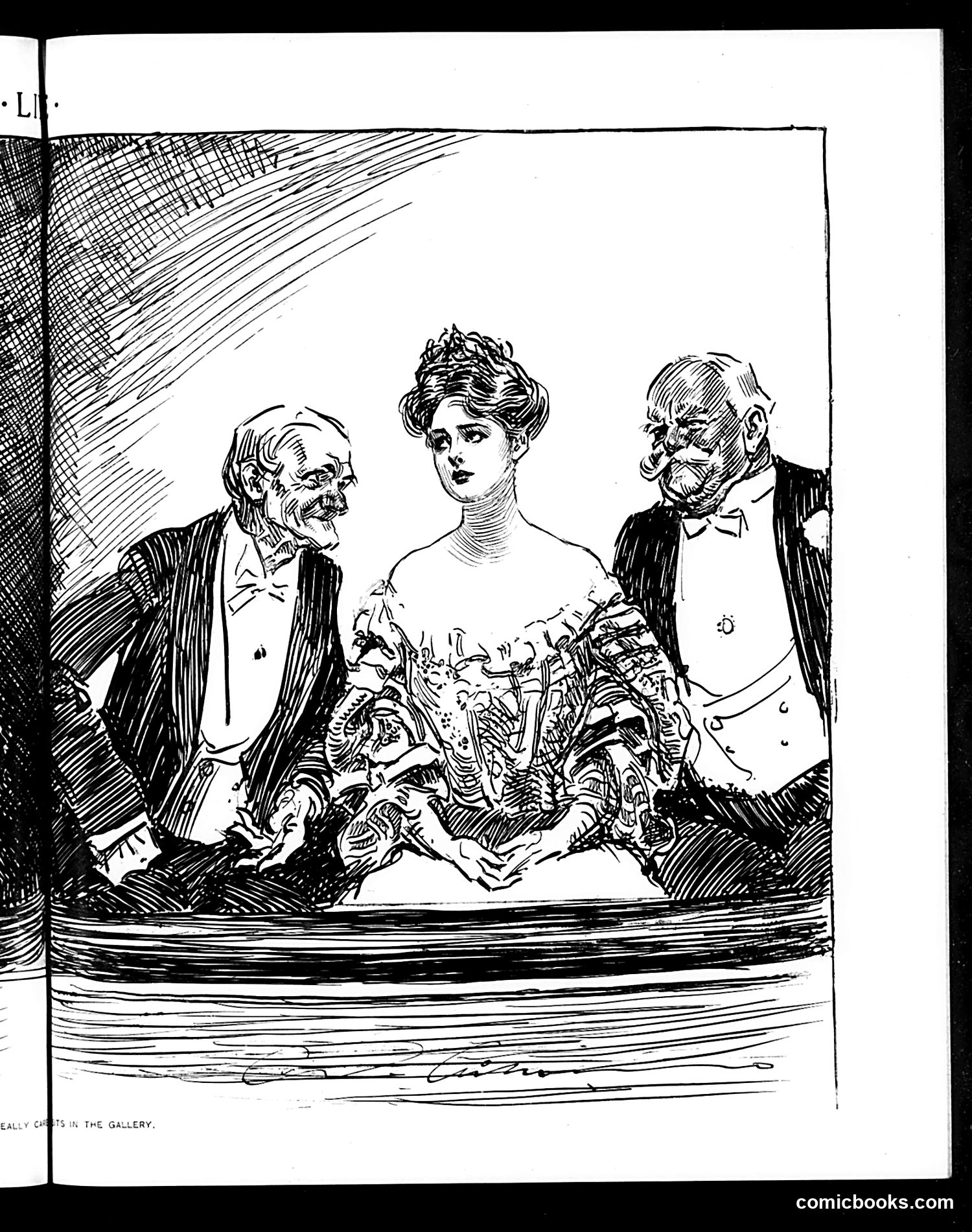
This is a satirical illustration from Life magazine (copyright 1902, per the footer). The caption reads "THE MAN SHE REALLY CARES FOR." The cartoon depicts a wealthy, elaborately dressed woman in the center wearing ornate jewelry and a fashionable updo, surrounded by three men in formal evening wear. The satire suggests that despite being courted by multiple suitors, the woman's true affection is directed elsewhere—likely toward wealth, luxury, or material possessions rather than genuine romantic attachment. This reflects early-1900s social commentary about wealthy society women and mercenary attitudes toward marriage. The caricatured style and her exaggerated costume emphasize the vanity being mocked. The specific identities of the men remain unclear, but they appear to represent eligible gentlemen competing for her attention.
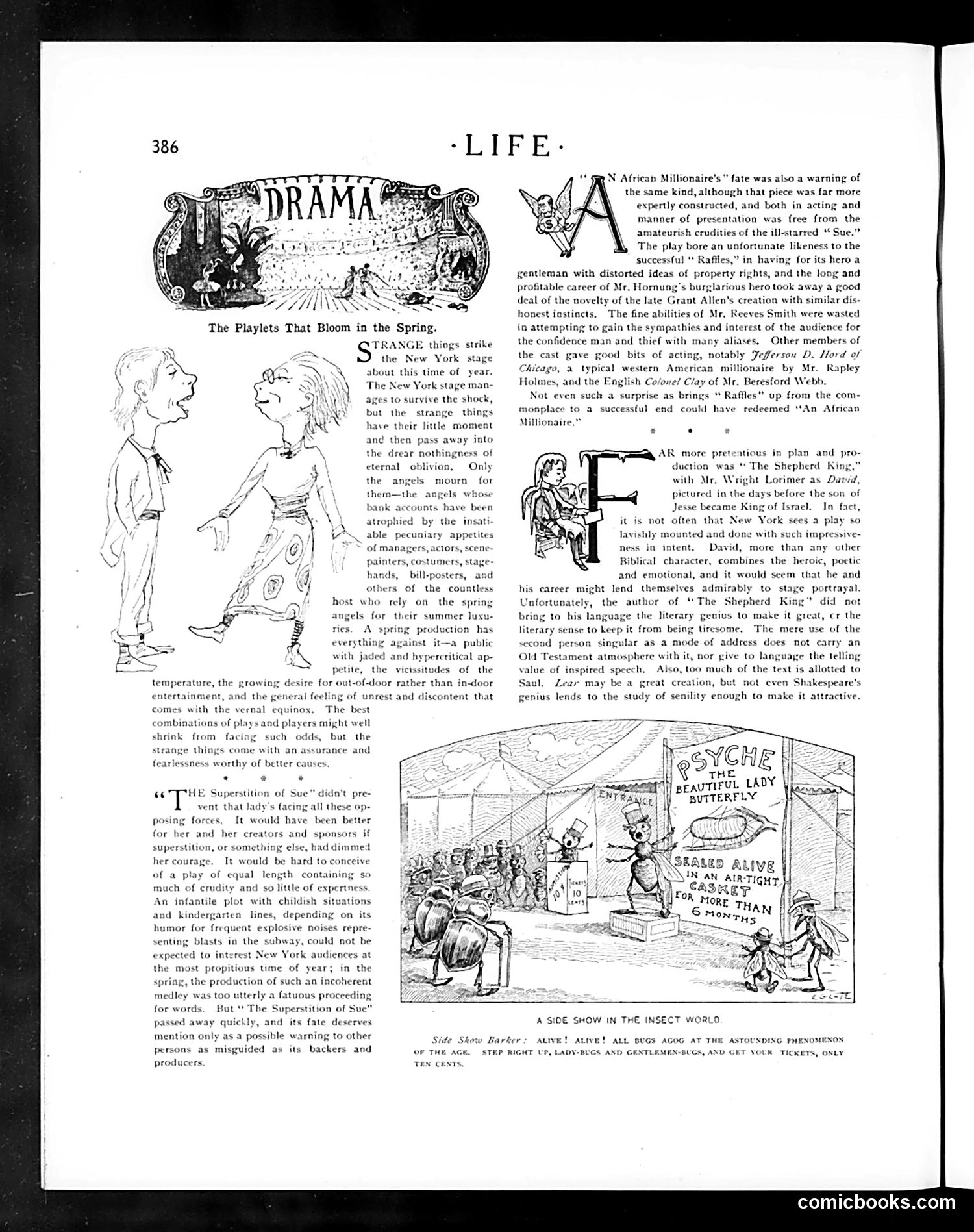
This page discusses spring theatrical productions on the New York stage. The main cartoon titled "The Playlets That Bloom in the Spring" shows two caricatured figures in conversation, illustrating the article's point about strange theatrical offerings during spring season. The text critiques several plays, including "Raffles" (featuring a dishonest protagonist), "An African Millionaire," and "The Shepherd King" (a Biblical drama featuring King David). The article expresses skepticism about these productions' literary merit and staging quality. The bottom illustration, "A Side Show in the Insect World," parodies circus side-shows, depicting insects as attractions—seemingly mocking both theatrical spectacle and contemporary entertainment sensationalism. The overall tone is satirical commentary on spring theater's questionable quality and commercial desperation.
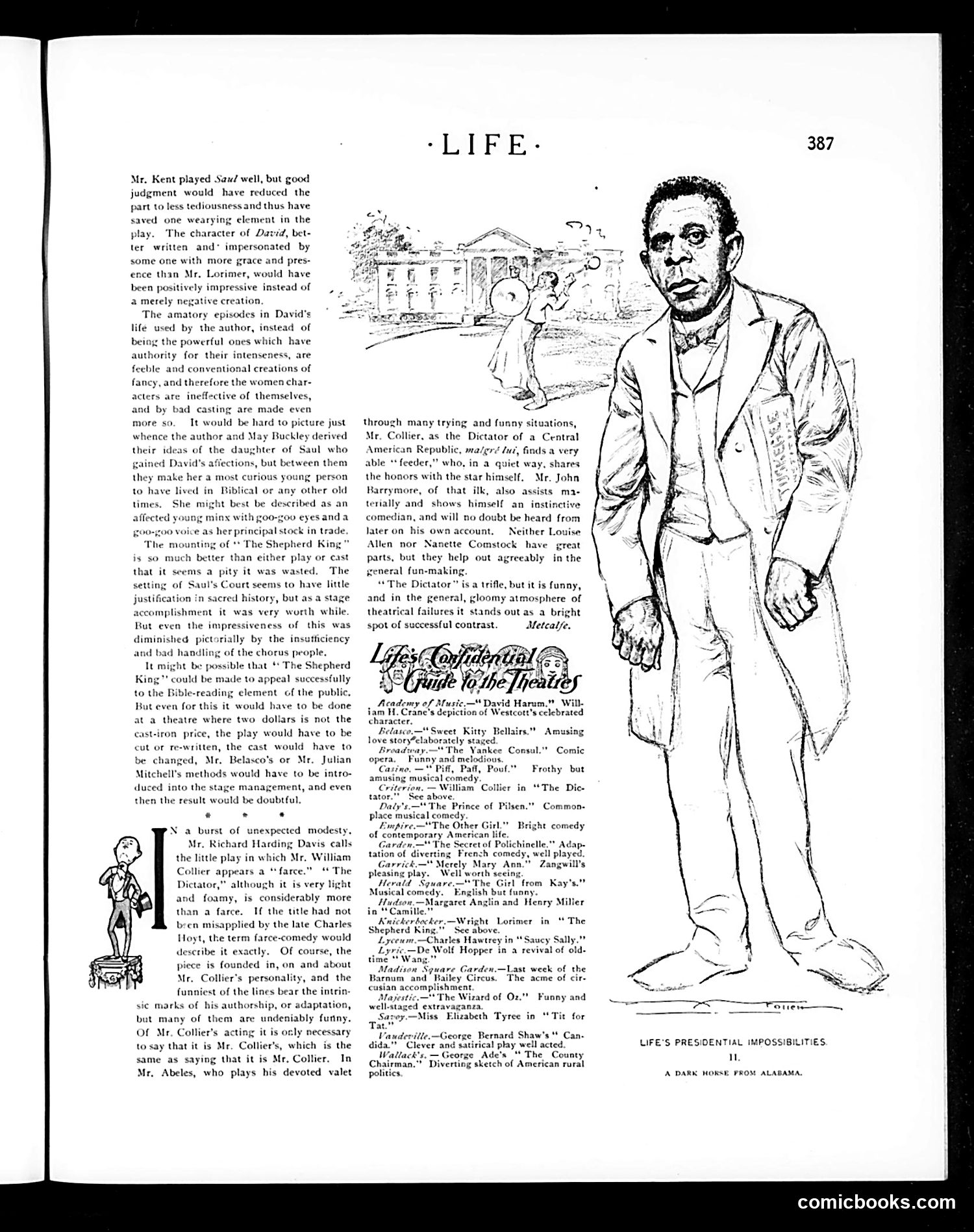
This page reviews theatrical productions, primarily focusing on two plays: "The Shepherd King" (a Biblical drama about King Saul and David) and "The Dictator" (a farce-comedy starring William Collier). The main illustration depicts a man in casual dress—likely William Collier—labeled "Life's Presidential Impossibilities: II. A Dark Horse from Alabama," satirizing him as an implausible presidential candidate. The joke appears to reference Collier's role as "Dictator of a Central American Republic" in the play, humorously suggesting an entertainer could become a dark-horse political candidate. The reviews are critical of "The Shepherd King" (poorly cast, tedious amatory episodes, weak female characters) while praising "The Dictator" as genuinely funny despite being lightweight, with particular praise for Collier's performance and John Barrymore's supporting role. The overall tone is witty theater criticism characteristic of Life magazine's satirical approach.
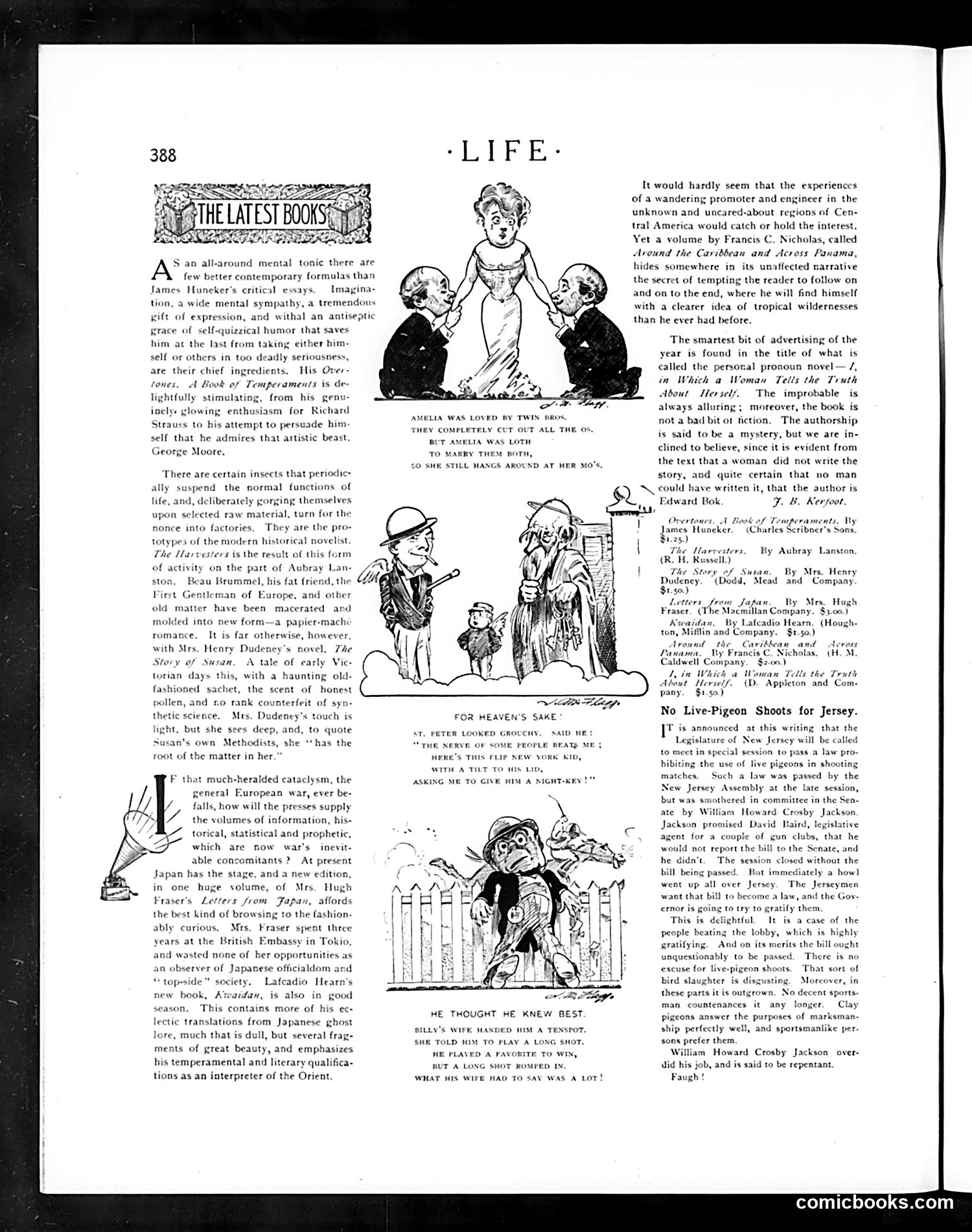
This page from *Life* magazine combines literary reviews with satirical cartoons. The text discusses contemporary books by James Huneker, Aubray Lanston, and others—standard literary criticism of the era. The cartoons illustrate humorous social scenarios: One depicts a woman with two suitors who "completely cut out all the o's" from her name—visual wordplay on "Amelia" becoming "Amll." Another shows St. Peter at heaven's gate annoyed by a brash "New York kid" demanding a "night-key," reflecting period stereotypes about New Yorkers' boldness. A third cartoon involves Billy's wife giving him betting advice that unexpectedly pays off. These are light domestic humor and character-type jokes typical of *Life*'s satirical approach—poking fun at social pretension, romantic complications, and the clash between cautious tradition and modern confidence. The humor relies on recognizable social types rather than specific political figures.
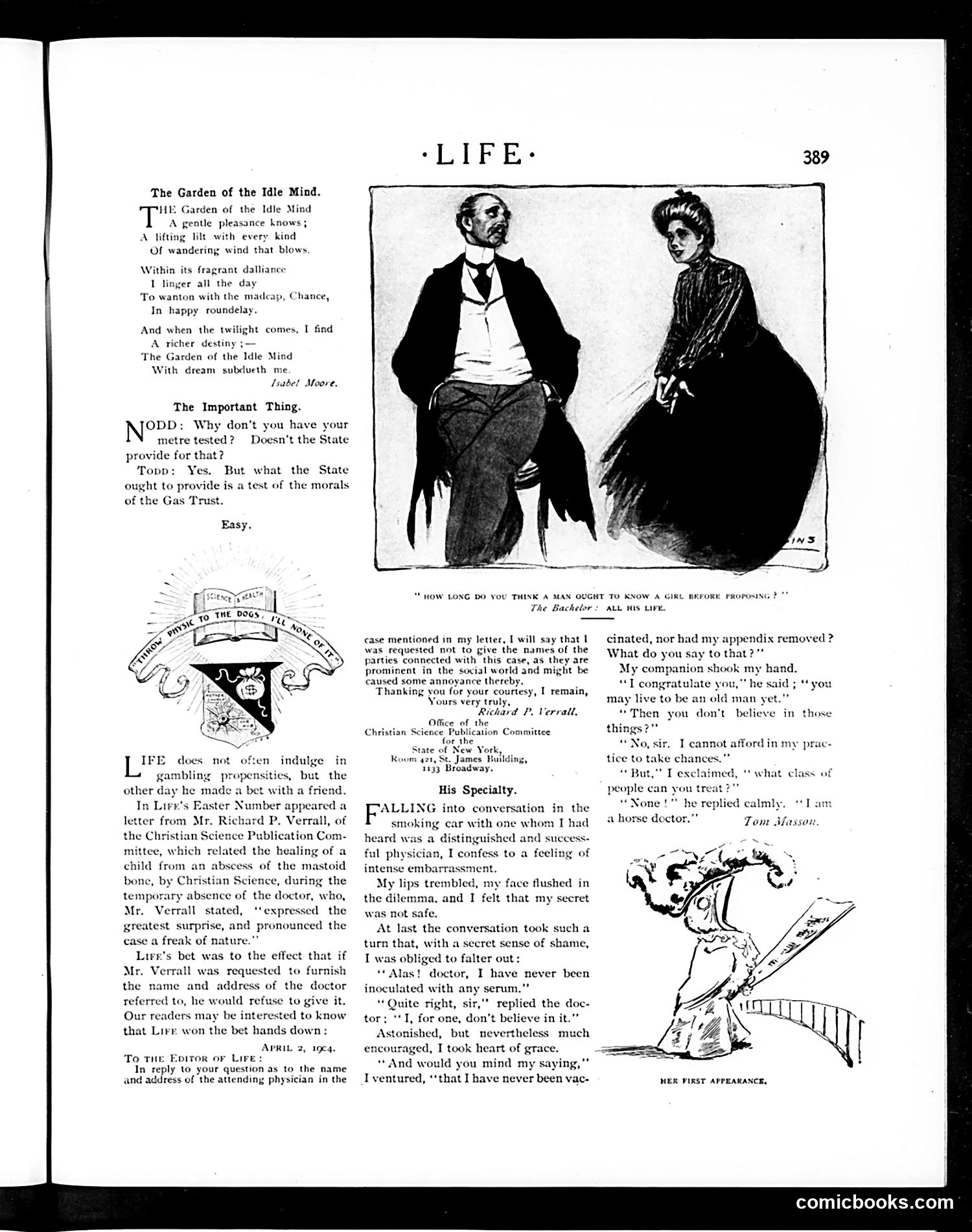
This page contains several satirical pieces critiquing early 1900s social and medical issues: **"The Important Thing" dialogue** mocks the "Gas Trust" (a corporate monopoly on gas utilities)—a major political concern of the Progressive Era. A character argues the State should test the morals of corporations rather than just regulate meters, reflecting contemporary anger at big business. **The Verrall letter exchange** satirizes Christian Science healing claims. Life had challenged a Christian Science publication to name a doctor who witnessed a miraculous cure; Verrall refused, citing the family's social prominence. Life ridiculed this evasion, suggesting the "miracle" was fabricated to avoid embarrassment to wealthy believers. **"His Specialty"** jokes about a physician who rejects modern medical interventions (serums, vaccinations, appendectomies), claiming he can treat "None!" of his patients—dark humor about medical quackery or willful ignorance among practitioners. The page reflects Progressive-era skepticism toward corporate power, alternative medicine, and medical pseudoscience.
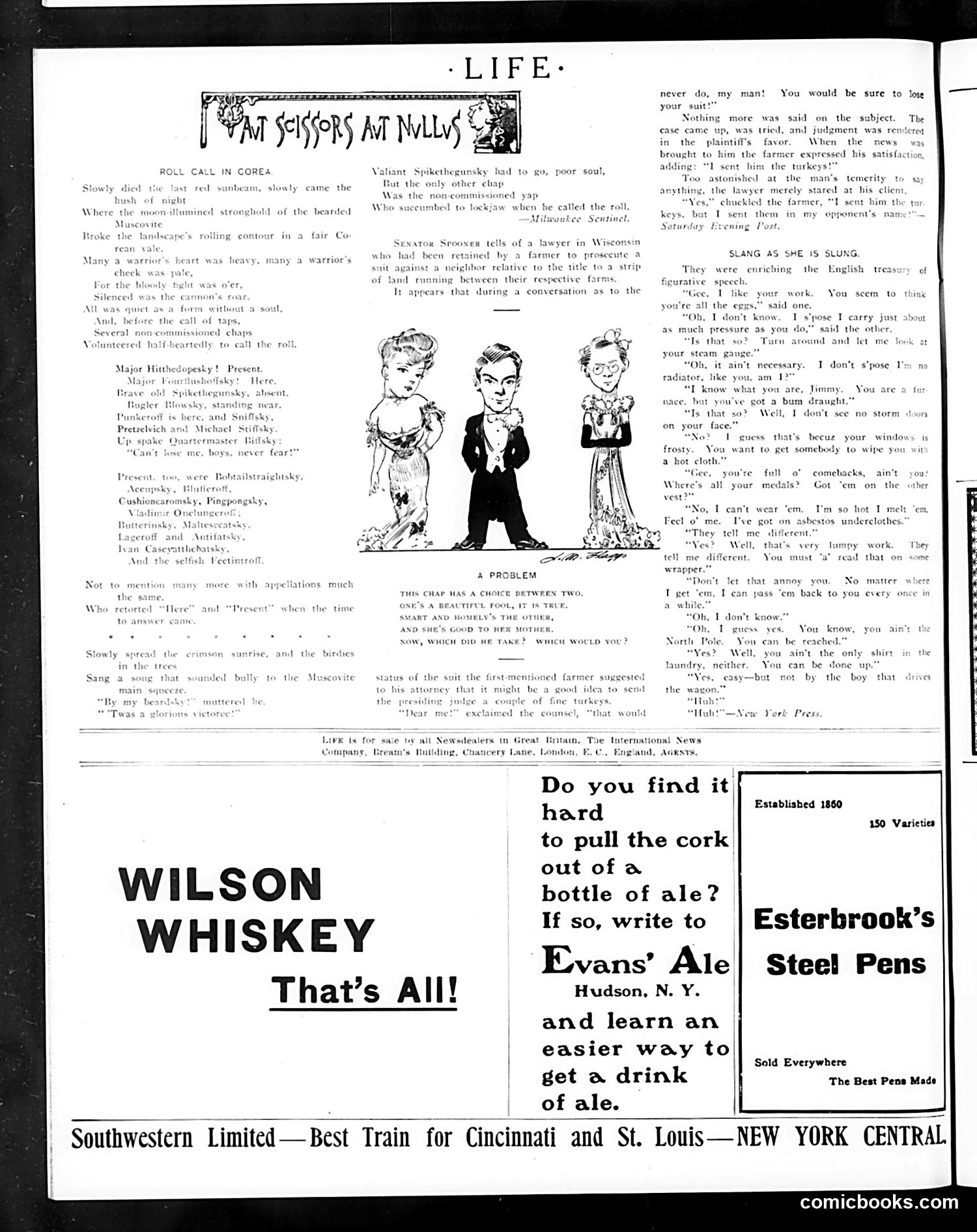
This page contains a satirical comic titled "At Scissors and Mills," depicting a domestic dispute between a husband and wife. The cartoon shows three figures: a woman in an elaborate dress, a man in formal evening wear, and what appears to be a servant or third party. The joke concerns a disagreement over laundry—specifically, the wife's complaint that the husband's shirt has shrunk or been damaged. The couple argues about the garment's condition, with the husband attempting to deflect blame while the wife insists on accountability. The humor derives from the mundane domestic conflict and the couple's escalating accusations. The page also includes advertisements for Wilson Whiskey, Evans' Ale, Esterbrook's Steel Pens, and railroad service—typical of Life magazine's revenue model. The satirical content targets ordinary middle-class domestic disputes rather than political figures.
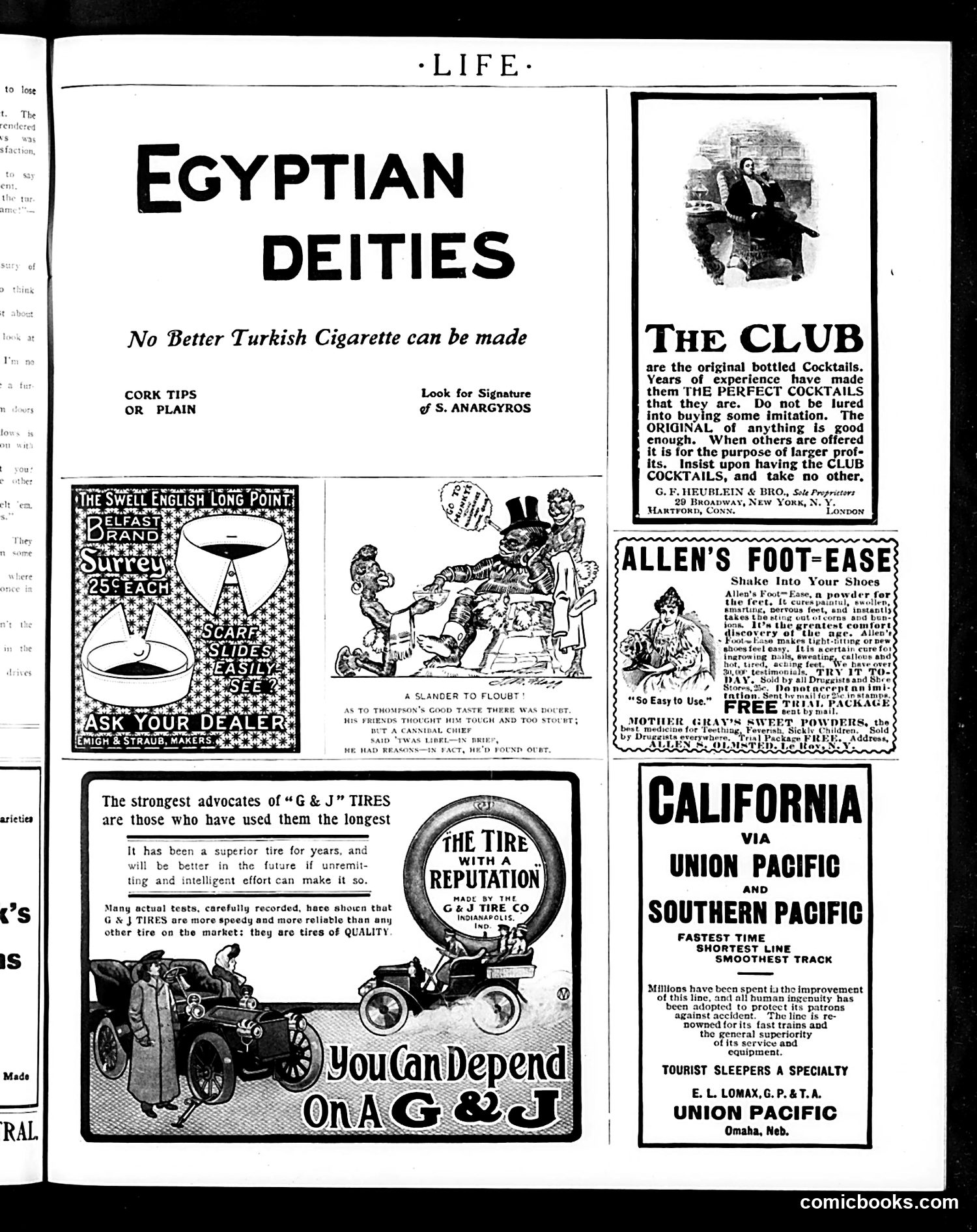
This is primarily an **advertising page** rather than satirical content. The page features vintage product advertisements typical of early 20th-century magazines. The main cartoon titled "A Slander to Flaunt" depicts a domestic scene where someone has apparently made a disparaging remark about another person's taste. The caption indicates this relates to Thompson's good taste in food—the joke appears to turn on the idea that criticizing someone's culinary preferences is an insult. Surrounding this are ads for: - **Egyptian Deities** cigarettes (Turkish brand) - **The Club** cocktails (claiming originality/authenticity) - **Allen's Foot-Ease** powder - **G & J Tires** (emphasizing reliability through long user testimonials) - **Union Pacific and Southern Pacific Railways** (promoting California travel) The advertisements use period-typical marketing appeals: quality claims, testimonials, and emphasis on being "original" products. The page reflects early 1900s consumer culture and advertising strategies.
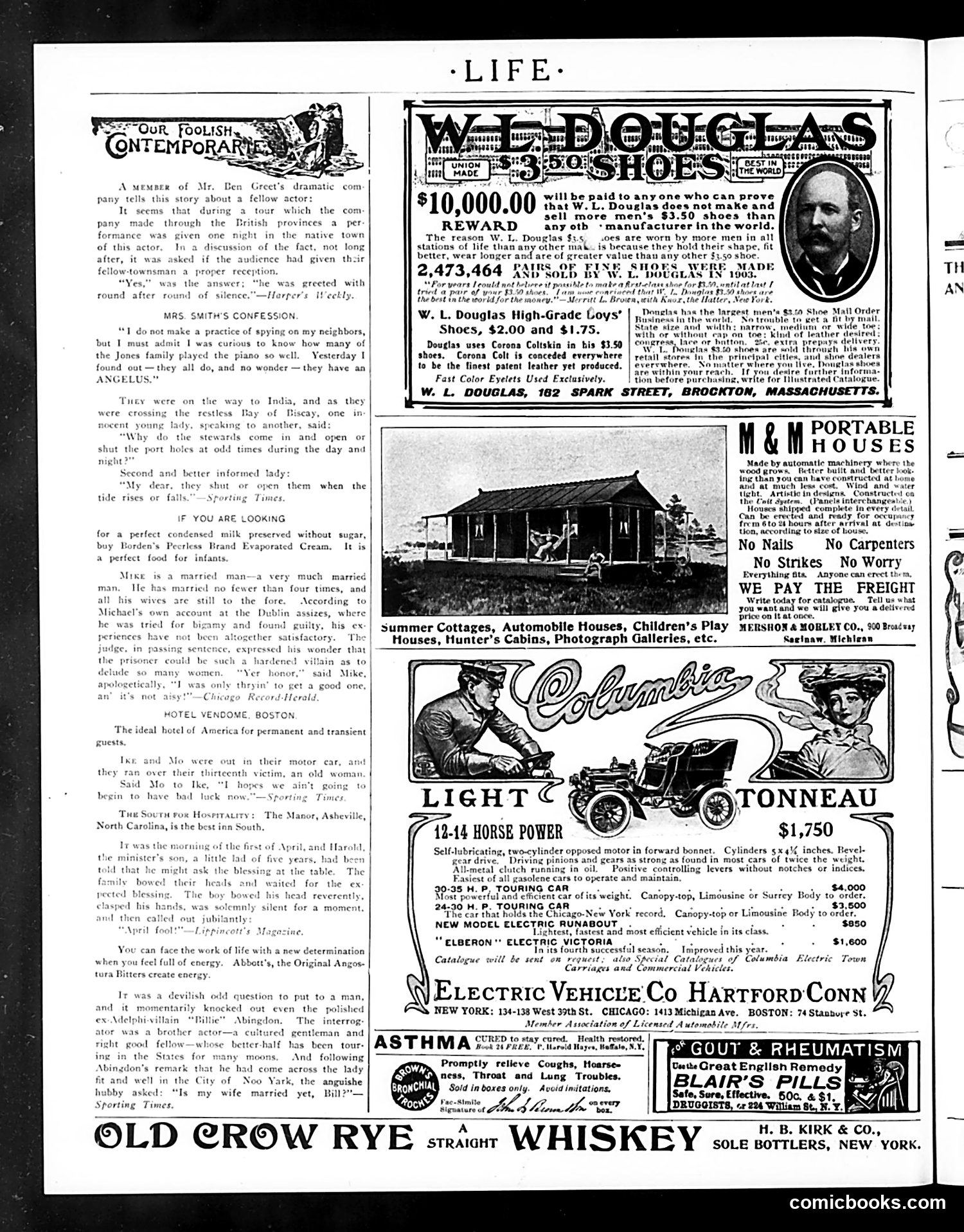
This page is primarily **advertising**, not political satire. The main content consists of commercial advertisements for consumer products typical of the early 1900s: W.L. Douglas shoes, portable houses, Columbia automobiles, and patent medicines. The small text stories ("Our Foolish Contemporaries," "Mrs. Smith's Confession") appear to be humorous anecdotes rather than political commentary—they mock everyday social behavior like pretentiousness and nosiness. The page reflects the era's advertising culture, where Life magazine (then a humor/satire publication) mixed light entertainment with extensive paid advertisements. The shoe ads emphasize durability and value, while the "portable houses" advertisement highlights emerging industrial manufacturing. These represent typical consumer concerns and technological innovations of the Edwardian period, not satirical targets. There are no identifiable political figures or events referenced on this particular page.
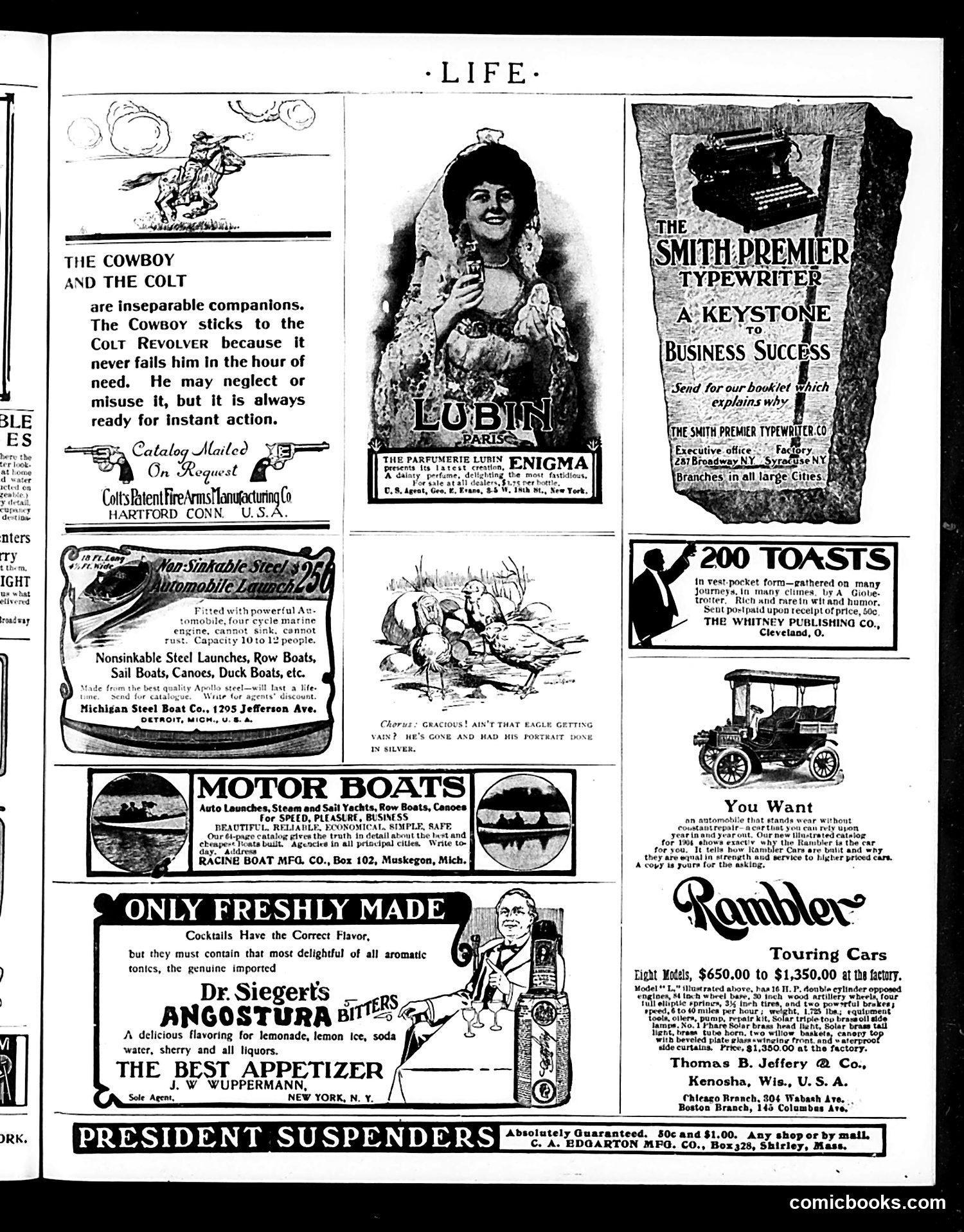
This is primarily an **advertising page**, not a satirical cartoon page. The only cartoon element is a small humorous illustration mid-page showing an eagle that has "gone and had his portrait done in silver"—a light visual gag about vanity. The page advertises early-1900s products: firearms (Colt revolvers), boats, typewriters, automobiles (Rambler touring cars), beverages (Angostura bitters), a cocktail guide book, and men's suspenders. The Colt Revolver ad uses frontier mythology—the "cowboy and colt" relationship—as a sales pitch emphasizing reliability. The automobile ads promote emerging automotive technology to skeptical buyers unfamiliar with cars. This reflects Life's dual purpose: satirical humor mixed with commercial advertising revenue. The page offers little political or social satire—it's primarily commercial content targeting early-20th-century American consumers of luxury goods and new technology.
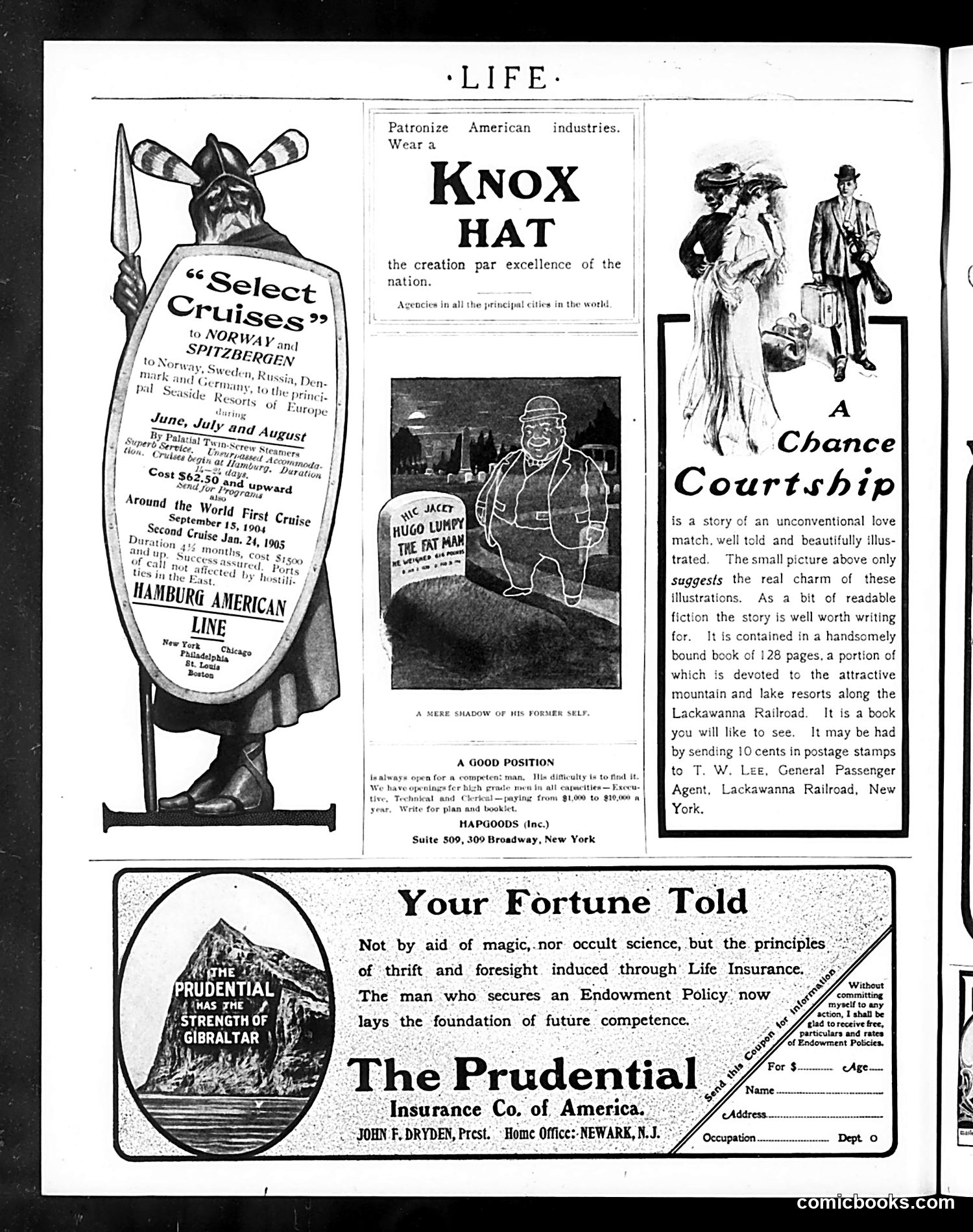
This is primarily an **advertising page** from Life magazine, not a satirical cartoon page. It contains four unrelated advertisements: 1. **Hamburg American Line cruise ad** (left): Features a Viking-like figure promoting Norwegian and Spitzbergen cruises for summer travel. 2. **Knox Hat ad** (center-top): Promotes Knox brand hats as quintessentially American products, with agencies worldwide. 3. **"A Chance Courtship" book ad** (right): Advertises a 128-page romance novel with illustrations, featuring Lackawanna Railroad resorts, obtainable for 10 cents postage. 4. **Prudential Insurance ad** (bottom): Uses the "Strength of Gibraltar" metaphor to pitch life endowment policies as financial security and "fortune-telling" through prudent planning rather than magic. The page reflects early 20th-century consumer culture: leisure travel, fashion, popular fiction, and emerging life insurance as middle-class financial planning. There is **no political satire** here—it's commercial content typical of Life's advertising sections.
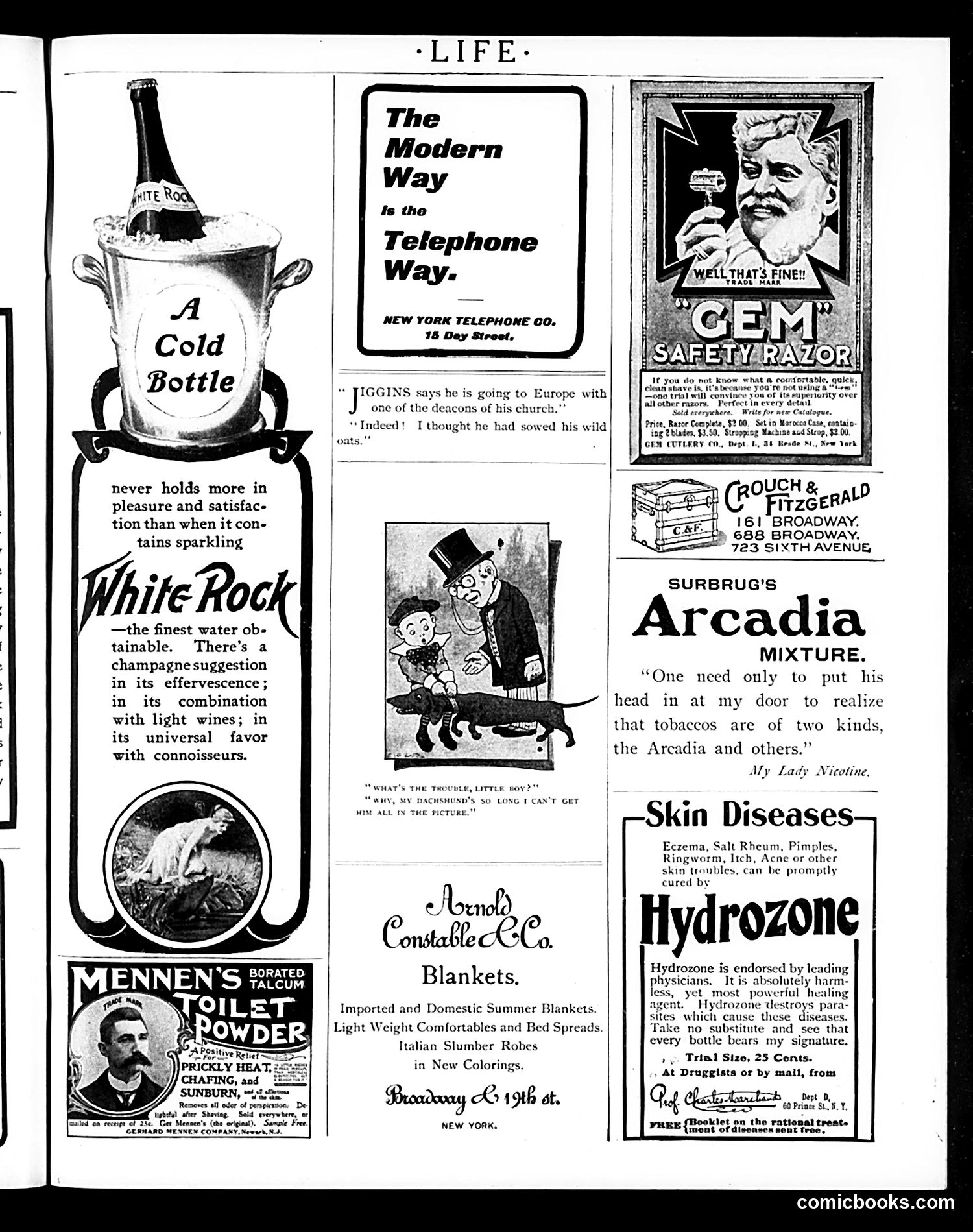
This page is primarily **advertising**, not editorial or satirical content. It contains various product advertisements from the early 20th century. The one cartoon present shows a man in a top hat with a small dachshund, captioned "What's the trouble, little boy?" / "Why, my dachshund's so long I can't get him all in the picture." This appears to be a simple visual joke about the breed's elongated body shape—the humor relies on the dog being literally too long to fit in frame. The advertisements promote period products: White Rock sparkling water, the New York Telephone Company, a GEM safety razor (with a satisfied customer testimonial), Crouch & Fitzgerald luggage, Surbrug's tobacco mixture, Arnold Constable blankets, Mennen's talcum powder, and Hydrozone skin treatment. These ads reveal consumer culture and product marketing conventions of the era, including medical claims that would be illegal today (the skin disease cure). The page reflects early 1900s American commerce and leisure-class consumption.
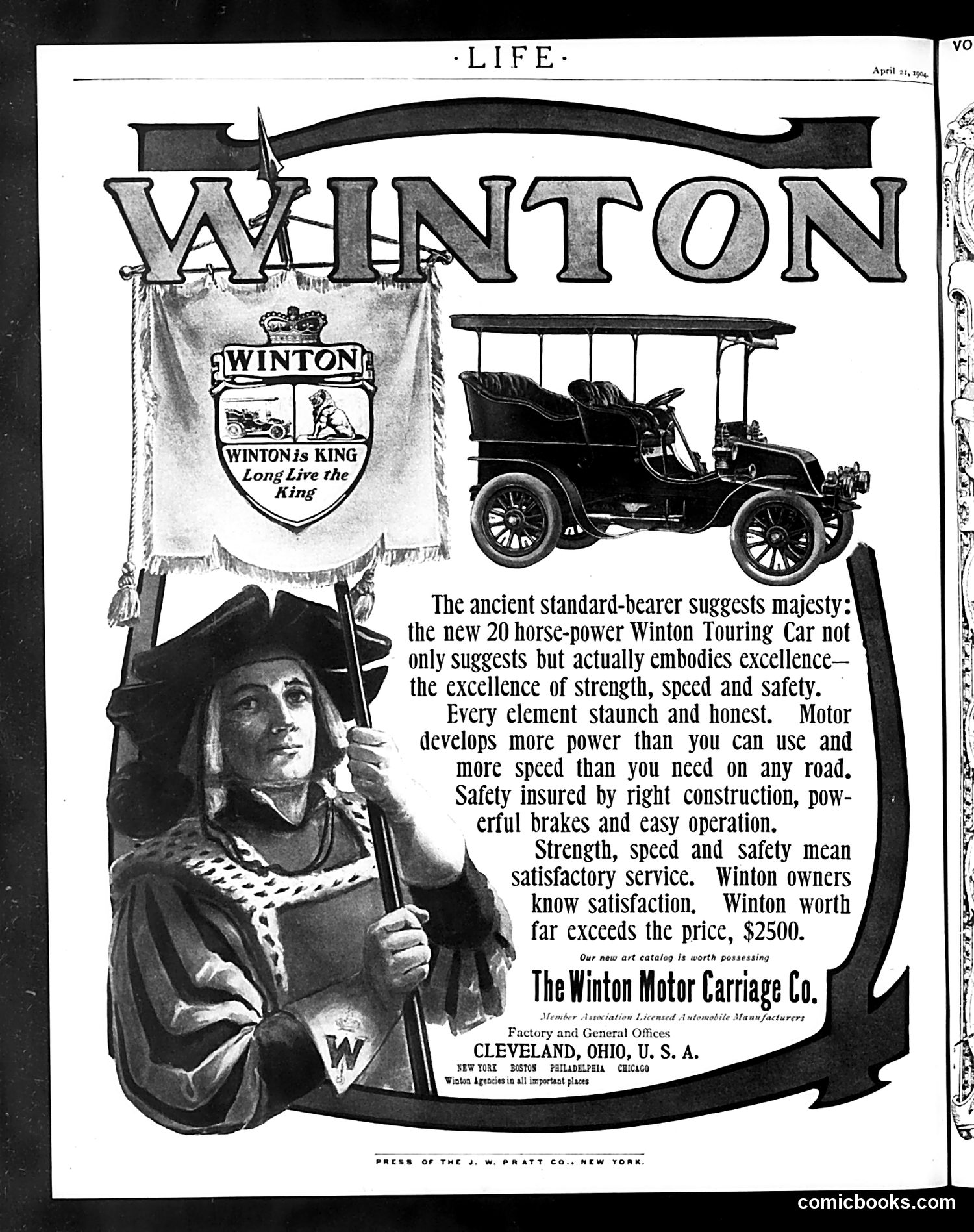
This is a **straight advertisement**, not satire. The Winton Motor Carriage Company uses a heraldic banner featuring a crowned figure (appearing to represent royalty or authority) with the slogan "WINTON is KING—Long Live the King." The imagery deliberately evokes medieval pageantry and legitimacy. The ad promotes the 20-horsepower Winton Touring Car at $2,500, emphasizing "strength, speed and safety" as markers of excellence and reliability. The text appeals to buyer satisfaction and brand prestige. For modern readers: this reflects early 1900s automotive marketing when cars were luxury items. The royal iconography suggests the manufacturer wanted to position their product as supreme and authoritative—essentially claiming dominance in the fledgling automobile market. There is no political criticism; it's aspirational consumer messaging.