
Life, 1904-04-21 · page 4 of 22
Life — April 21, 1904 — page 4: what you’re looking at
What you’re looking at
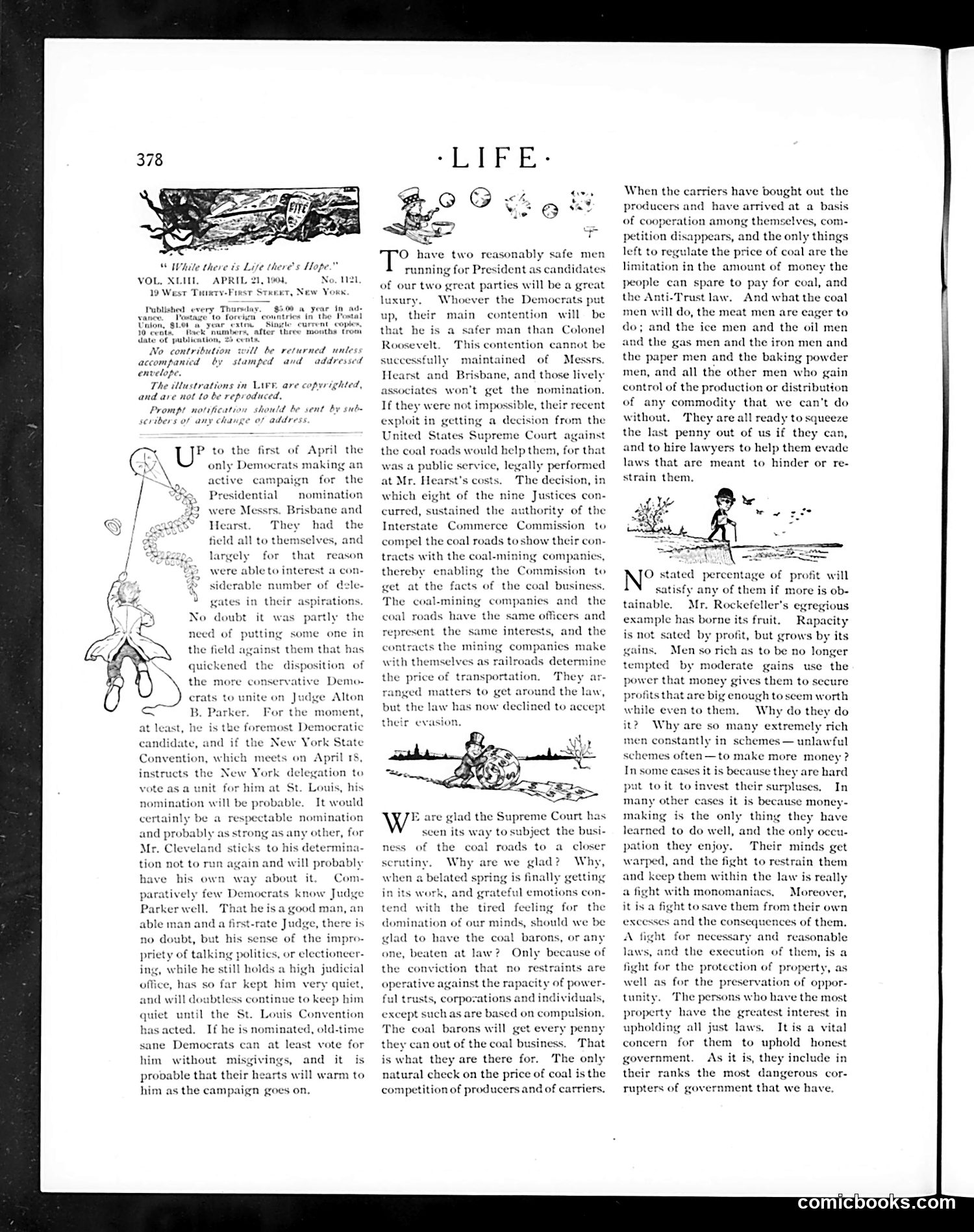
This page from *Life* magazine (April 22, 1904) critiques the coal industry and recent Supreme Court decisions affecting it. The text discusses Democratic presidential candidates and compares Judge Alton B. Parker favorably to other options, while arguing for government regulation of coal monopolies. The accompanying cartoons (rendered in simple pen-and-ink style) appear to satirize the wealthy coal barons and their outsized influence. The illustrations show figures in exaggerated poses, likely mocking the power dynamics between industrial magnates and ordinary citizens. The article argues that natural competition between coal producers and carriers is the only effective check on price-gouging, and warns that unrestrained capitalists represent genuine threats to democratic governance and honest administration of government.
📄 Transcribed text from this page (OCR, searchable)
Machine-transcribed from the original scan — historical spelling and the odd misread are preserved.
“ While there is Life there's H VOL. XLII. APRIL 21, 1004. Ne 19 West Tutery-Fiest Stxeet, New Yous, Published every Thursday. $509 a year in ade vance. to foreiia tries in the Postal Union, $1.01 a year extm | Single c 10 centa, Rack after Ubree mouths Crom date o€ publicatte No contribution accompanied by envelope. The illustrations in LAFR, are copyrighted, and are not to be reproduced. Prompt notification should be address. vl be returned untess stamped and addressed sent by sube V$ of any change of P to the first of April the Democrats making an the onl active campaign for Presidential were Messrs. Hearst. Th field all to the largely for nomination Brisbane and the elves, and that were able to interest number of had reason con- siderable dele- gates in their aspirations, » doubt it was partly the need of putting some one in the field against them that has quickened the disposi the more conservative Dem Judge Alton For the moment, crats to unite o rot B. Parker least, 1 candidate, and if the New York State be fe Convention, which meets on April 18, w York delegation to for him at St nomination will be probable. instructs thi vote as a unit Louis, his. It would certainly be a respectable nomination and probably as stron Mr. Cleveland sticks to his determi tion not to run again and will probably about it. Com- as any other have his ow paratively few Democrats know Judge Parker well. T able mi t he isa good man, an and a first-rate Judge, there is » doubt, but his sense of the impro- y of talking politics, or electioncer- while he still holds a high judicial has so far kept him very quiet, and will doubtless continue to keep him quiet until the St. Louis Convention has acted. If he is nominated, old-time least vote for and it is ts will warm to sane Democrats can him without misgivings, probable that their h him as the campaign goes on, 'O have two re running for President as candidates sonably safe men of our two great parties will be a great luxury. Whoever the Democrats put up, their will be that he is a safer man than Cc Roosevelt, ‘This contention cannot be ally maintained of ind Brisbane, and those lively main contention onel success! Messrs. Hearst associates won't get the nomination. If they wet possible, their recent exploit in getting a decision from the United States Supreme Court Ainst the coal roads would help them, for that was a public service, legally performed The decision, in > not in at Mr. Hearst's costs. which eight of the nine Justices con- curred, sustained the authority of the Inters' Commission to compel t tracts with the coal-mining companies, thereby enabling the Commission to get at the facts of the coal business, The coal-mining companies and the nads have the same officers and ¢ Commerce ¢ coal roads to show their con- coal represent the same interests, and the contracts the mining companies make with themselves as railroads determine the price of The r xd matters to get around the law, ‘ansportation. but the law has now declined to accept 2 are glad the Supreme Court t seen its way to subject the b ness of the coal roads to closer tiny. Why are we glad?) Why, when a belated spring is finally getting s work, and grateful emotions con- nd with the tired feeling for the domination of our minds, should we be glad to have the coal barons, or any Only because of no rest one, beaten at law? the operative ful trusts, corporations conviction that nints are gainst the rapacity of power- individuals, except such as are based on compulsion. The coal barons will get every penny they can out of the coal business. That is what they are there for. The only natural check on the price of coal is the competition of producers and of carriers, When the carriers have bought out the producers and have arrived at a basis of cooperation among themselves, com- petition disappears, and the only things left to regulate the price of coal are the limitation in the amount of money the people spare to pay for coal, and the Anti-Trust law. And what the coal men will do, the meat men are eager to do; and the ice men and the oil men and the gas men and the iron men and the paper men and the baking powder men, and all the other men who gain control of the production or distribution of any commodity that we can't do without. They are all ready to squeeze the last penny out of us if they can, and to hire lawyers to help them ev: laws that are meant to hinder or re- strain them. N° ted percentage of profit will satisfy any of them if more is ob- tainable. Mr. Rockefeller’s egregious mple has borne its fruit. Rapacity not sated by profit, but grows by its Men so rich as to be no longer mpted by moderate gains use the power that money gives them to secure profits that are big enough to scem worth while even to the: Why do they do it? Why are so many extremely rich tantly in schemes — unlawful —to make more money ? In some cases it is because they are hard to it toinvest their surpluses, In many other cases it is because money. making is the only thing they have learned to do well, and the only occu- pation they enjoy. Their minds get warped, and the fight to restrain them and keep them within the law is really Moreover, tosave them from their own ains, schemes ¢ a fight with monomaniacs, itisa excesses and the consequences of them. A fight for necessary and reasonable laws, and the execution of them, is a fight for the protection of property, as well as for the preservation of oppor- tunity. The persons who have the most property have the greatest interest in upholding all just laws, It is a vital concern for them to uphold honest government. As it is, they include in their ranks the most dangerous cor- rupters of government that we have.