
Life, 1904-04-21 · page 13 of 22
Life — April 21, 1904 — page 13: what you’re looking at
What you’re looking at
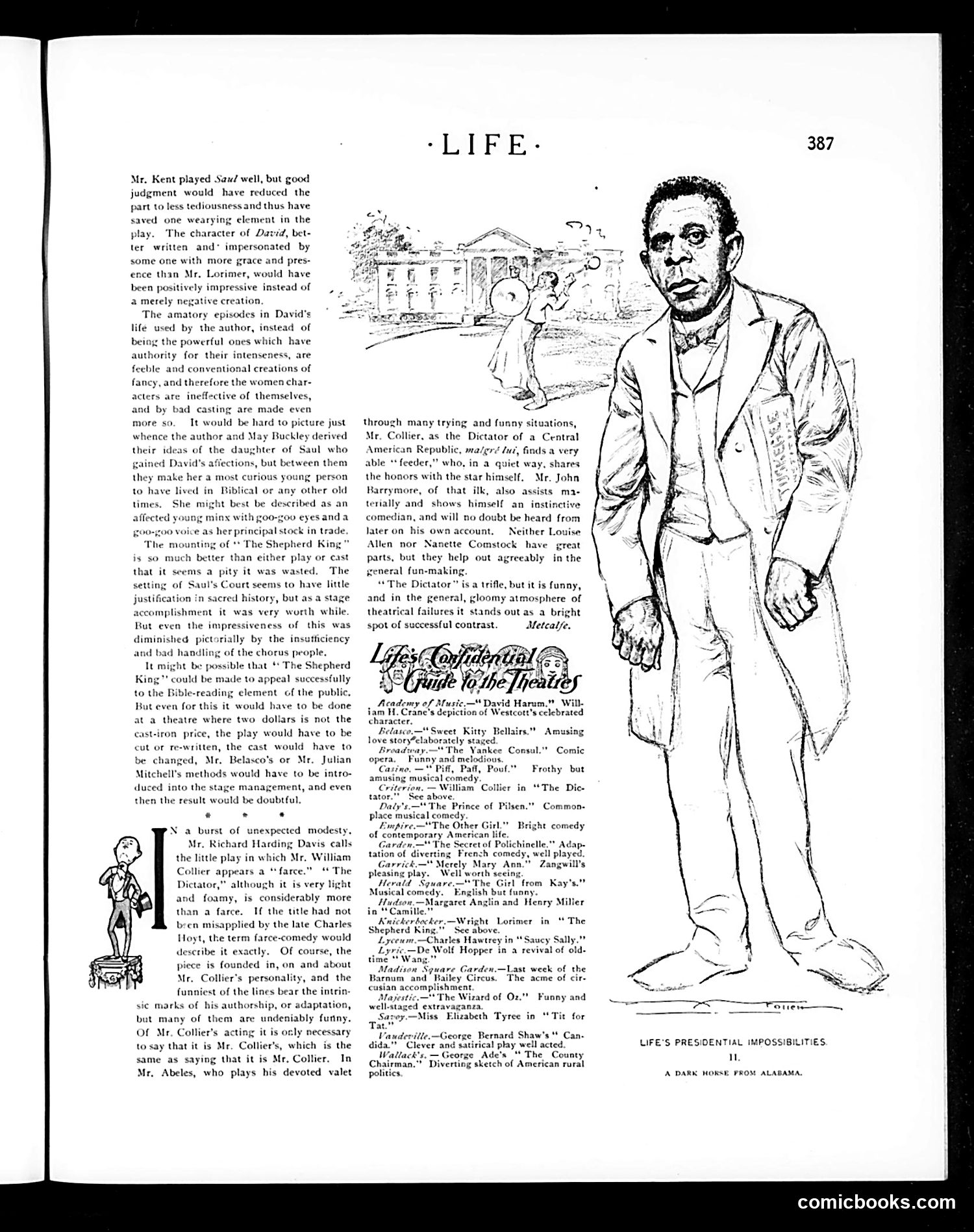
This page reviews theatrical productions, primarily focusing on two plays: "The Shepherd King" (a Biblical drama about King Saul and David) and "The Dictator" (a farce-comedy starring William Collier). The main illustration depicts a man in casual dress—likely William Collier—labeled "Life's Presidential Impossibilities: II. A Dark Horse from Alabama," satirizing him as an implausible presidential candidate. The joke appears to reference Collier's role as "Dictator of a Central American Republic" in the play, humorously suggesting an entertainer could become a dark-horse political candidate. The reviews are critical of "The Shepherd King" (poorly cast, tedious amatory episodes, weak female characters) while praising "The Dictator" as genuinely funny despite being lightweight, with particular praise for Collier's performance and John Barrymore's supporting role. The overall tone is witty theater criticism characteristic of Life magazine's satirical approach.
📄 Transcribed text from this page (OCR, searchable)
Machine-transcribed from the original scan — historical spelling and the odd misread are preserved.
Mr. Kent played Sau/ well, but good judgment would have reduced the part to less tediousness and thus have saved one wearying element in the play. The character of David, bet- ter written and’ impersonated by some one with more grace and pres- ence than Mr. Lorimer, would have been positively impressive instead of a merely negative creation The amatory episodes in David's life used by the author, instead of being the powerful ones which have authority for their intenseness, are feeble and conventional creations of fancy, and therefore the women char- acters are ineffective of themselves, and by bad casting are made even more so. It would be hard to picture just whence the author and May Buckley derived their ideas of the daughter of Saul who gained David's affections, but between them they make her a most curious young person to have lived in Biblical or any other old times, She might best be described as an affected young 200 voice as her principal stock in trade, i minx with goo-goo eyesanda he mounting of * The Shepherd King” is so much better than either play or cast that it seems a pity it was wasted. The setting of Saul’s Court seems to have little justification in sacred history, but as a stage accomplishment it was very worth while. But even the impressiveness of this was diminished pictorially by the insutficiency and bad handling of the chorus people, It might be possible that ‘ The Shepherd King’ could be made to appeal successfully to the Bible-reading element of the public, But even fort ata theatre where two dollars is not the cast-iron price, the play would have to be it would have to be done cut of re-written, the cast would have to be changed, Mr. Belasco's or Mr. Julian Mitchell's methods would have to be intro- duced into the stage management, and even then the result would be doubtful. N a burst of unexpected modesty, Mr. Richard Harding Davis calls the little play in which Mr, William Collier appears a “farce.” The Dictator,” although it is very light and foamy, is considerably more than a farce. If the title had not bren misapplied by the late Charles Hoyt, the term farce-comedy would esctibe it exactly. Of course, the piece is founded in, on and about Mr. Collier's personality, and the funniest of the lines bear the intrin sic marks of his authorship, or adaptation, but many of them are undeniably funny. Of Mr. Collier's acting i necessary to say that it is Mr. Collier's, which is the same as saying that it is Mr. Collier, In Mr. Abeles, who plays his devoted valet through many trying and funny situations, Mr. Collier, as the Dictator of a Central American Republic, ma/gré dui, finds a very able * feeder,” who, in a quiet way, shares the honors with the star himself. Mr. John Barrymore, of that ilk, also assists ma- terially and shows himself an instinct comedian, and will no doubt be heard from later on his own account, Neither Louise Allen nor Nanette Comstock have great parts, but they help out agreeably in the general fun-making The Dictator” isa trifle, but it is funny, and in the general, gloomy atmosphere of theatrical failures it stands out as a bright spot of successful contrast. Metcalfe. |, Academy o David Harum,” Will. iam H. Crane's depiction of Westcott's celebrated character. Kelasco.—" Sweet Kitty Bellairs." Amusing love story“claborately staged Broadiray—"'The Yankee Consul." Comic Casine * Frothy but amusing musical comedy’ erion. — William Collier in “The Dice tator."" See above. Daly's ne Prince of Pilsen.” Common. place musical comedy Empire—*The Other Girl.” Bright comedy of contemporary American life. Garden.—" The Secret of Polichinelle.” Adap- tation of diverting French comedy, well played. Garrick.—" Merely Mary Ann.” Zangwill’s pleasing play. Well worth scei Herald Square.—The Git) from Kay's.” Musical comedy. | English but funny. _ Hudson.—Margaret Anglin and Henry Miller in “Camille.” Knickerbocker.—Wright Lorimer in Shepherd King."” See above Lyceum.—Charles Hawtrey in “S Lyric.—De Wolf Hopper in a revival of old- time Wang.” Madison Square Garden.—Last week of the Barnum and Bailey Circus. The acme of cir- cusian accomplishment, Mayes The Wizard of Oz." Funny and well-staged extravaganza Saroy.—Miss Elizabeth Tyree in “Tit for Tat.” Vaudevitte.—George Bernard Shaw's * Can- dia.” Clever and satirical play well acted Watlack's, ~ George Ade’s “The County Chairman.” Diverting sketch of American rural politics, LIFES PRESIDENTIAL IMPOSSIBILITIES. A DARK MORSE PROM ALABAMA. comicbooks.com