
A complete issue · 20 pages · 1904
Life — January 21, 1904
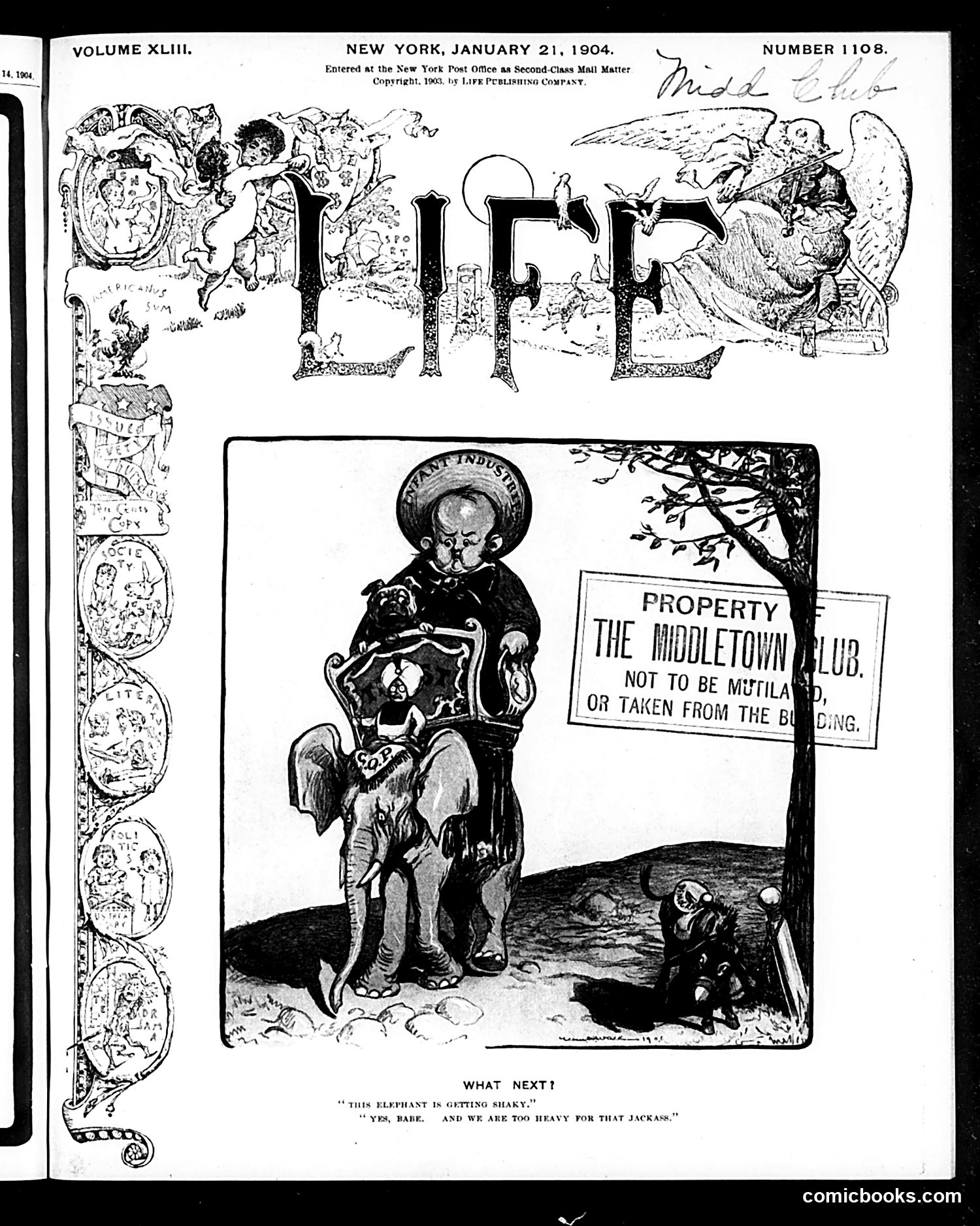
The main cartoon depicts an elephant (the Republican Party symbol) standing beside a sign reading "Property of the Middletown Club—Not to be mutilated or taken from the building." A small figure cowers nearby. The caption reads: "This elephant is getting shaky" / "Yes, babe. And we are too heavy for that jackass." This appears to satirize Republican Party instability or internal conflict in early 1904, likely related to Theodore Roosevelt's presidency or upcoming election decisions. The "Middletown Club" reference is unclear without additional context. The joke suggests the Republican Party (elephant) is becoming unreliable, and its current leadership is overtaxing or destabilizing it—blaming someone ("that jackass") for the burden.
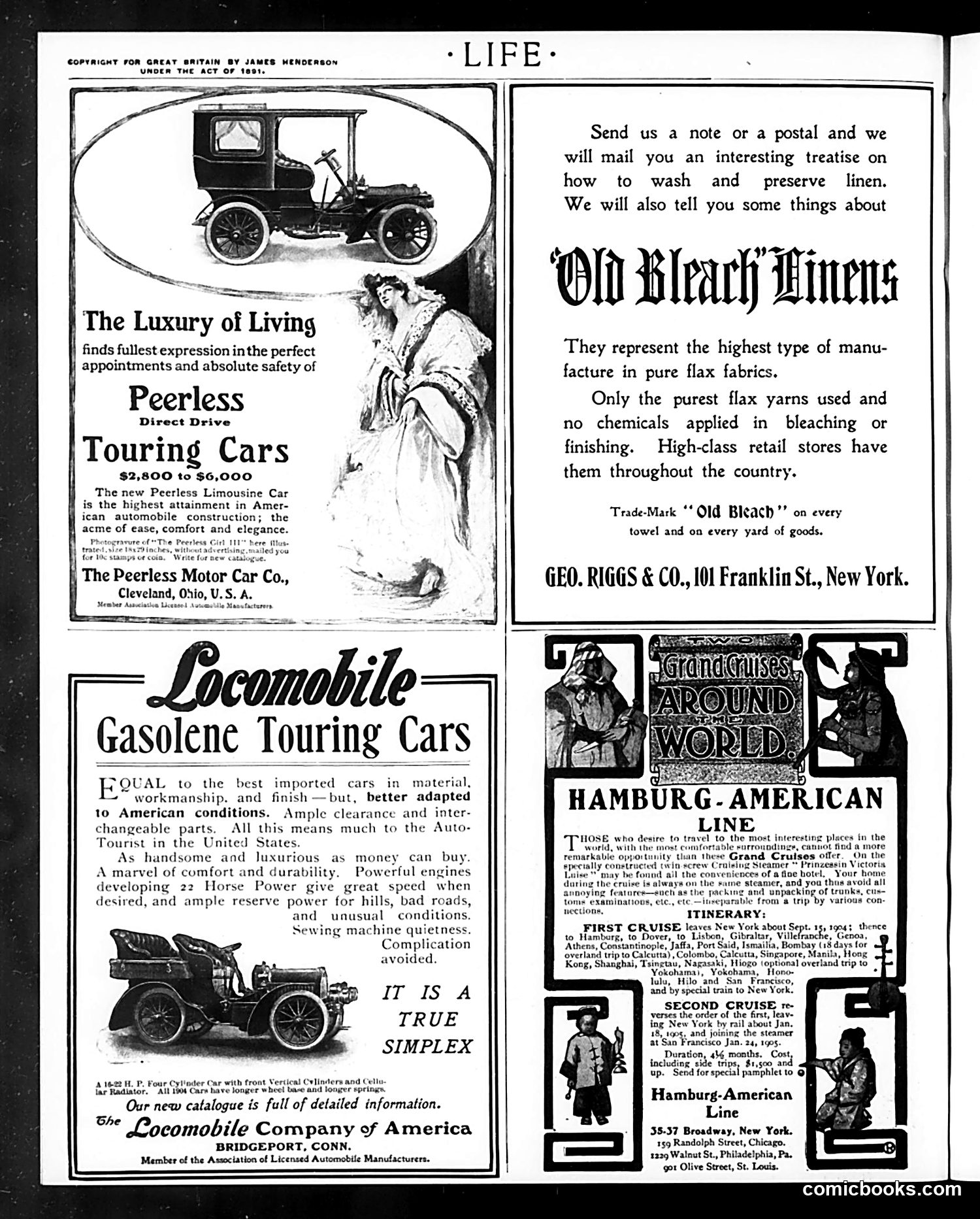
This page consists primarily of **advertisements rather than satirical cartoons**. The content includes: 1. **Peerless Direct Drive Touring Cars** ($2,600-$6,000) — positioned as a luxury automobile, with an illustration of an early motorcar and a woman in period dress 2. **Locomobile Gasoline Touring Cars** — another automobile advertisement emphasizing quality and power 3. **Old Bleach Linens** — a textile product advertisement by Geo. Riggs & Co. 4. **Hamburg-American Line** — a cruise ship company advertising world tours There are **no political cartoons or satirical content visible** on this page. The imagery is straightforward advertising typical of early 20th-century Life magazine, which mixed commercial advertisements with editorial humor. The page reflects the consumer culture and leisure activities available to wealthy Americans of that era.
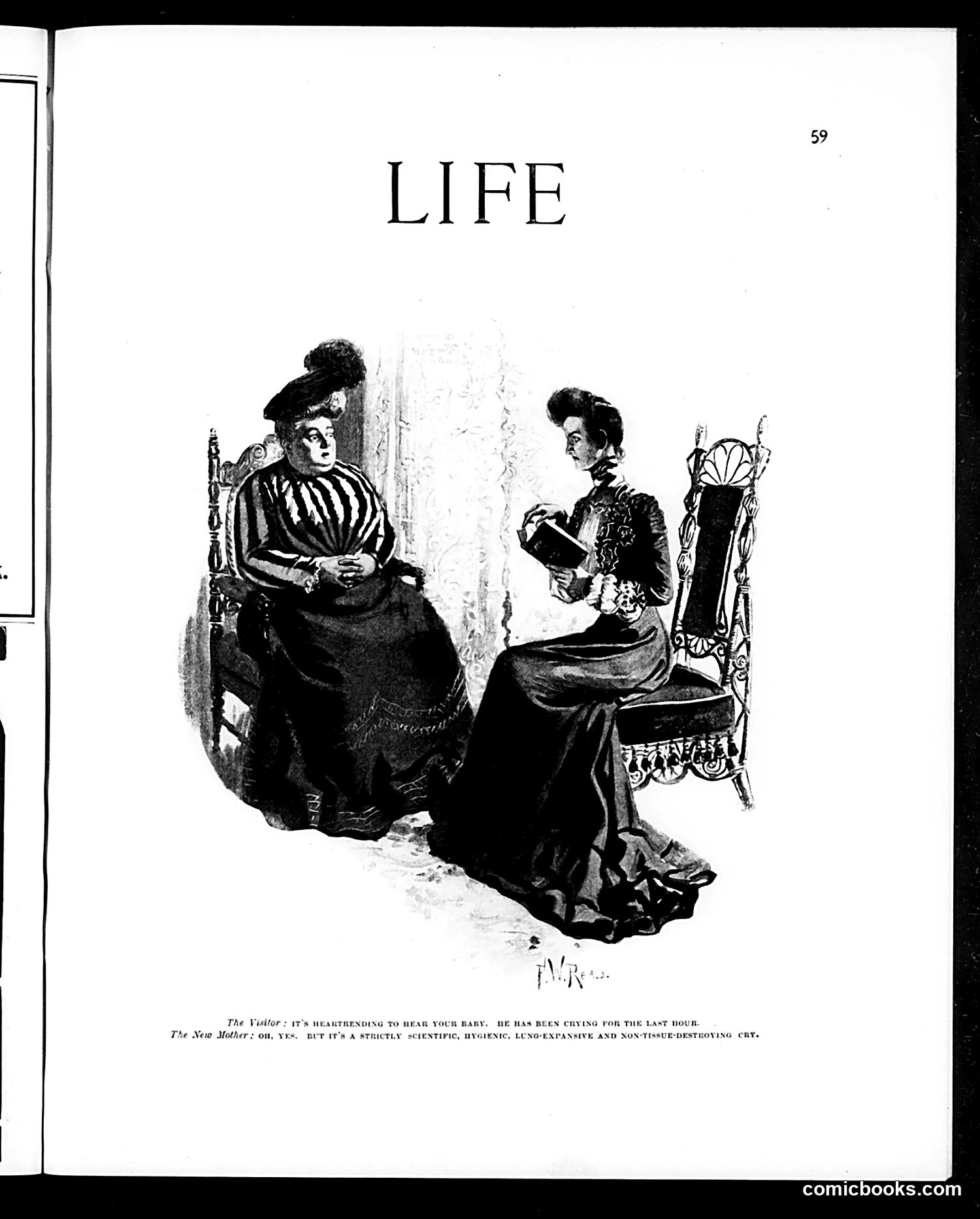
This satirical cartoon depicts a conversation between two women about childbirth methods. The visitor comments on hearing a baby crying, expressing sympathy. The new mother responds affirmatively but emphasizes her approach is "strict scientific, hygienic, un-so-expansive and non-tissue-destroying cry." The satire targets early 20th-century debates over modern vs. traditional motherhood practices. It mocks the "New Mother" who adopts trendy scientific and hygienic childrearing methods—likely referencing contemporary parenting guides promoting controlled, emotionally-restrained approaches rather than traditional nurturing. The joke suggests these scientific methods don't actually prevent infant crying, undermining their supposed superiority while poking fun at mothers who embraced fashionable, pseudo-scientific parenting theories.
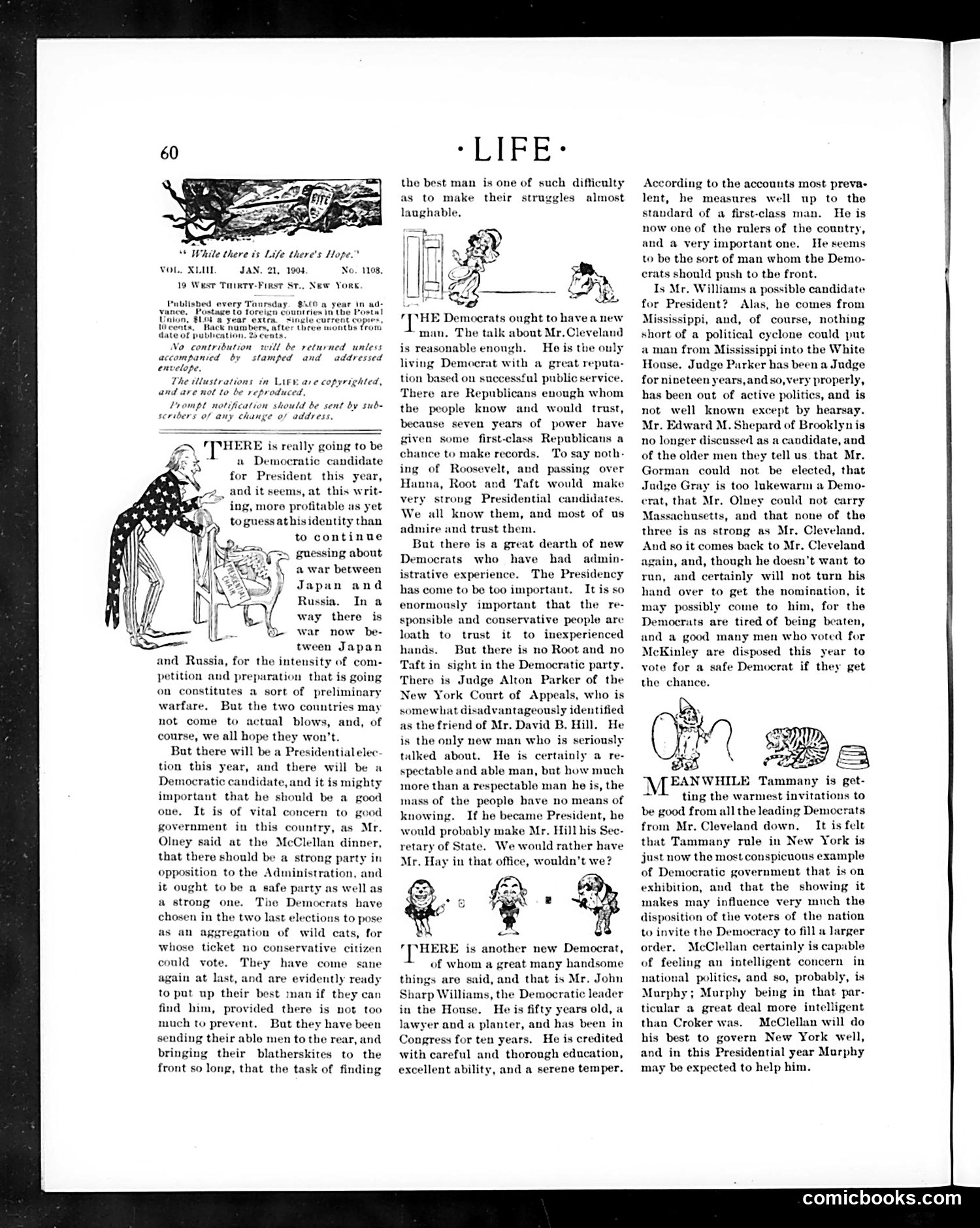
This page discusses potential Democratic presidential candidates for 1904. The main text criticizes the party's limited options, noting that strong Republicans like Roosevelt, Hanna, Root, and Taft make formidable candidates. The cartoons appear to satirize Democratic weakness: the top illustration shows a figure in an Uncle Sam costume looking troubled while reviewing documents—likely representing Democratic leadership assessing their poor prospects. The text favorably discusses Judge Alton Parker and John Sharp Williams as possible candidates, while suggesting that even respectable Democrats like these would struggle against Republican strength. The overall message mocks Democratic disarray and their difficulty finding a viable challenger to the sitting Republican administration.
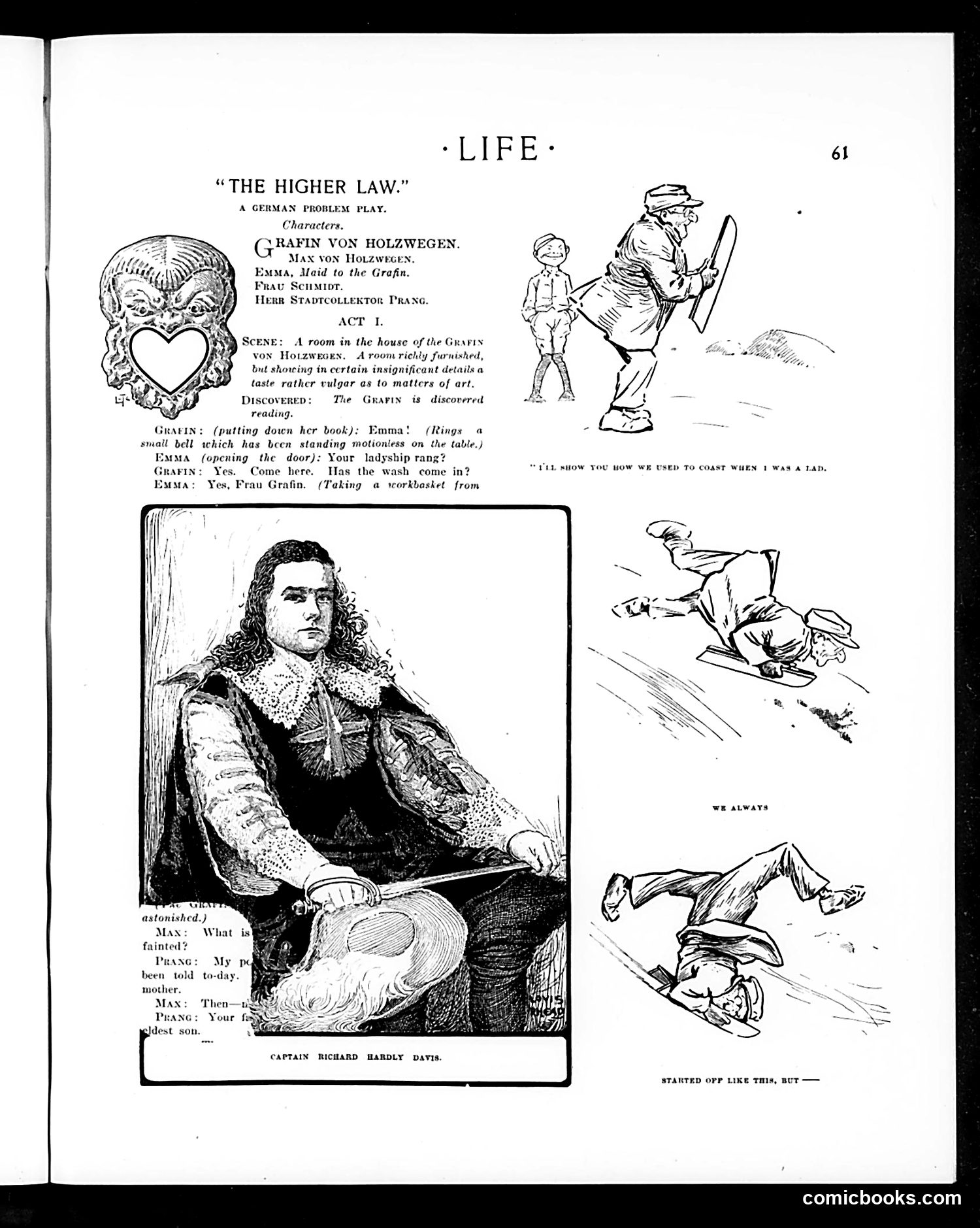
This page presents "The Higher Law," a German problem play being reviewed or excerpted in Life magazine. The main content shows Act 1, featuring characters including Gräfin von Holzwegen and her maid Emma in a domestic scene. The large portrait depicts Captain Richard Hardly Davis in period costume, identified in the caption below. The smaller cartoon sketches on the right illustrate physical comedy—a man attempting various acrobatic moves with captions like "I'll show you how we used to coast when I was a lad" and "We always started off like this, but—" These appear to mock either the play itself or period German theatrical conventions, using slapstick to satirize the "higher law" theme. The juxtaposition suggests Life was ridiculing this serious dramatic work through humorous commentary.
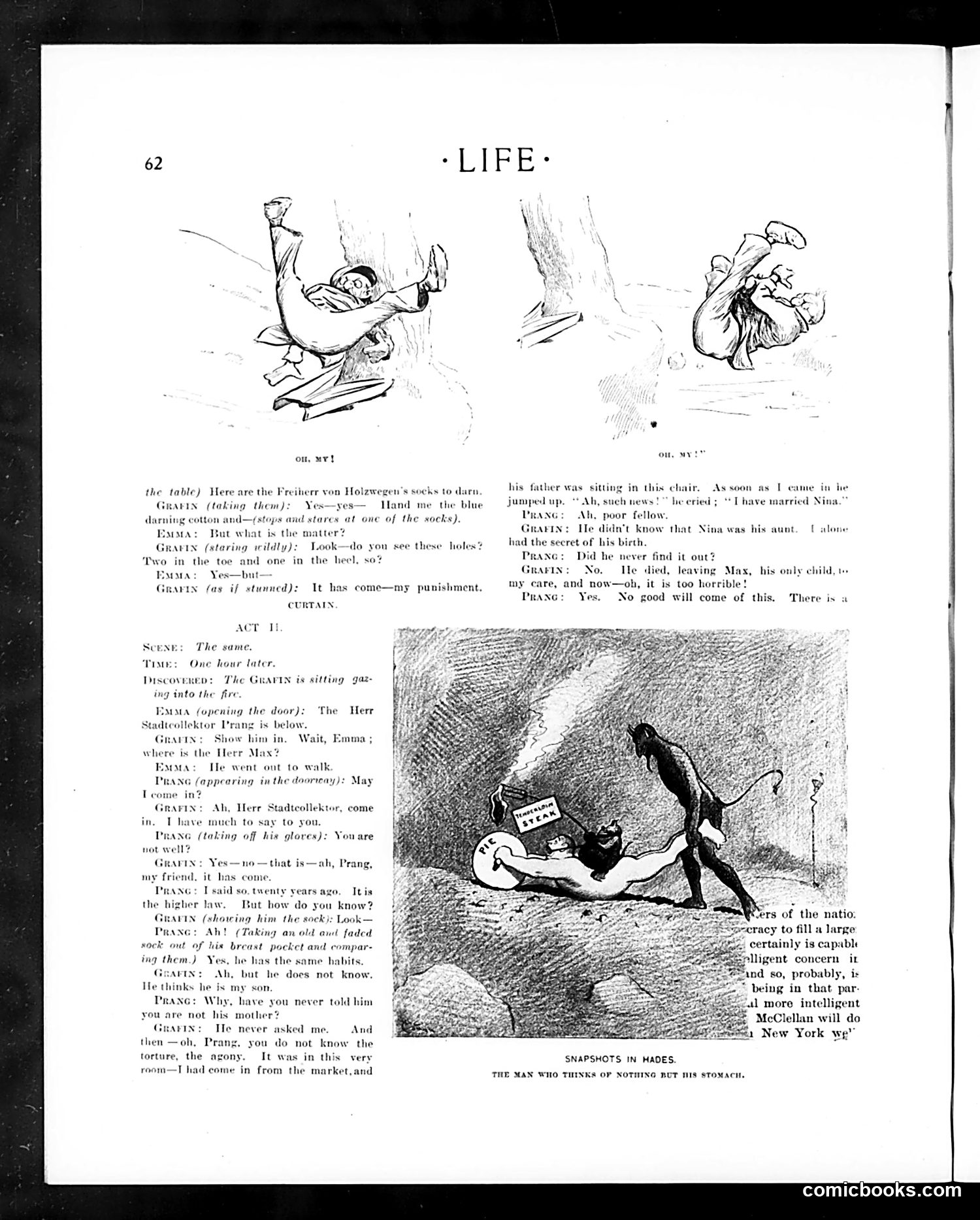
This page contains a theatrical sketch (Act II) featuring characters named Gravin, Emma, and Prang discussing family secrets and legitimacy. The dialogue reveals that Prang has discovered he is not Gravin's biological son, learning his mother was Gravin's aunt Nina. The sketch satirizes melodramatic theater conventions of the era—the shock revelations, emotional outbursts, and overwrought family secrets typical of stage comedies. The two small cartoons at top show figures falling or tumbling, labeled "OH, WY!" appearing to mock slapstick physical comedy. The larger illustration at bottom, captioned "Snapshots in Hades: The Man Who Thinks of Nothing But His Stomach," depicts a figure reclining, satirizing excessive gluttony or self-indulgent materialism as a moral failing.
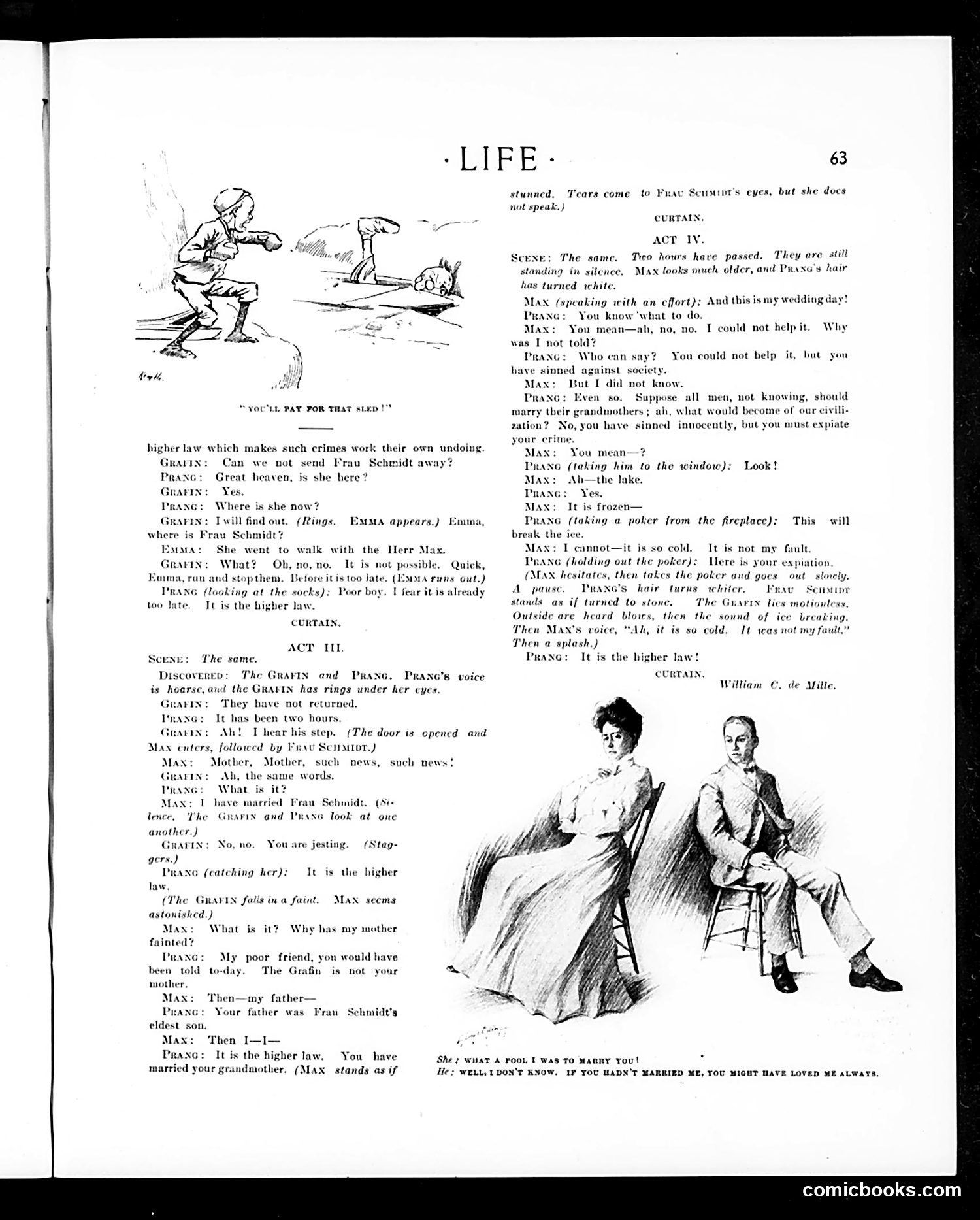
This page presents a dramatic scene from what appears to be a theatrical play. The dialogue reveals a plot involving **Frau Schmidt** and her grandson **Max**, who has unknowingly married his own grandmother—the "higher law" being family/blood relations superseding legal marriage. The top cartoon shows two figures in a comedic dispute over a sled, with the caption "YOU'LL PAY FOR THAT SLED!" — a simple visual joke about accountability. The illustrations below depict the emotional confrontation between characters as they realize the incestuous situation. The satire critiques how social conventions and ignorance can lead to moral transgressions, regardless of intent. The "higher law" phrase ironically refers to biological/familial bonds outweighing legal marriage contracts. This appears to be a serialized theatrical critique or parody piece.
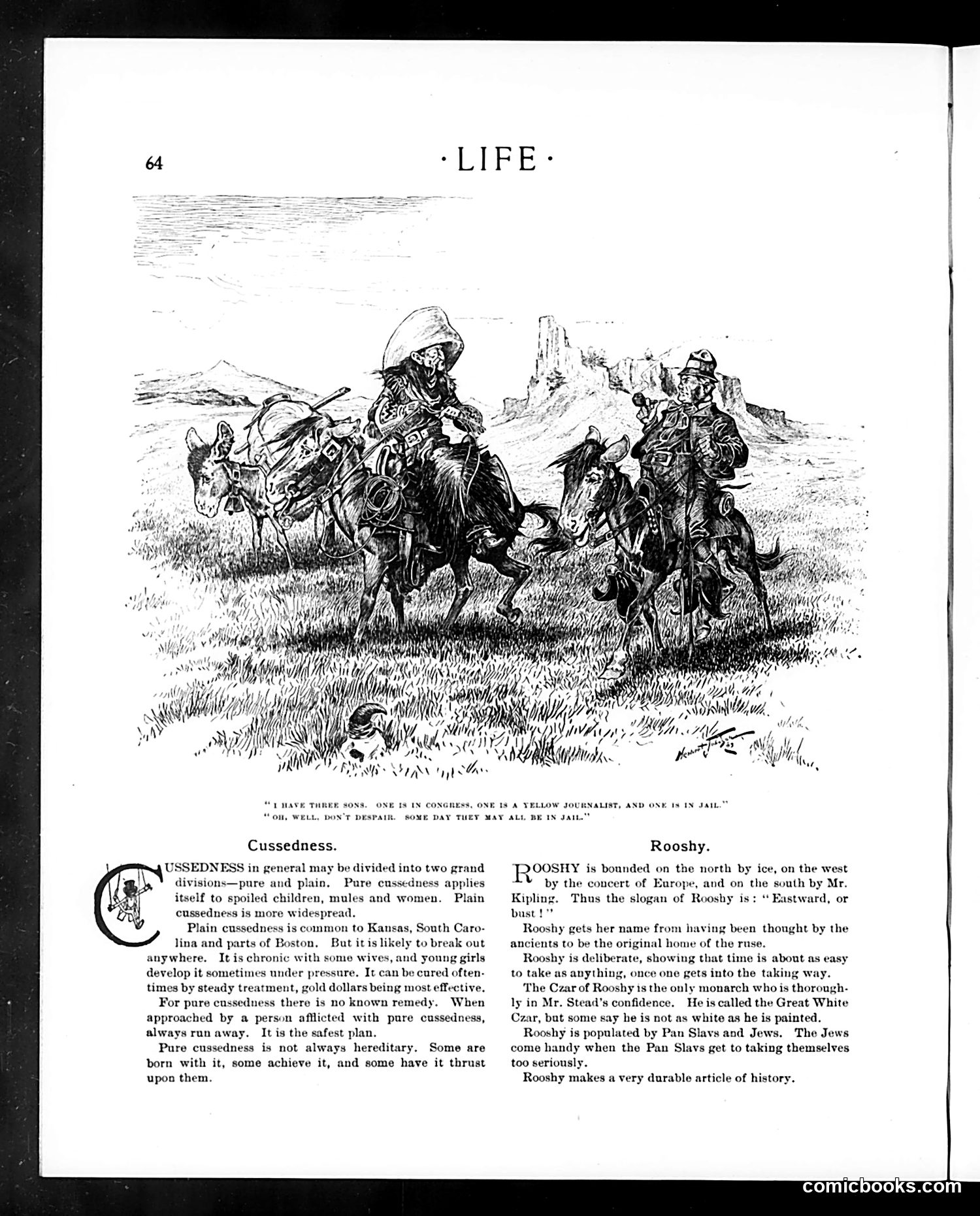
This page contains two separate satirical pieces. The main illustration depicts American frontier settlers on horseback encountering what appears to be Native Americans, with a caption about three sons in Congress, journalism, and jail—suggesting political corruption and family disgrace. Below are two regional satire pieces: "Cussedness" describes Kansas and South Carolina as places where pure cussedness is endemic and hereditary, mocking these states' rough character. "Rooshy" (likely "Rooshy" or a regional variant) satirizes a frontier territory, describing its harsh conditions, Czarist governance, and population of "Pan Slavs and Jews," suggesting ethnic stereotyping common to the era. The overall tone mocks American frontier life, regional character types, and ethnic groups through exaggerated description.
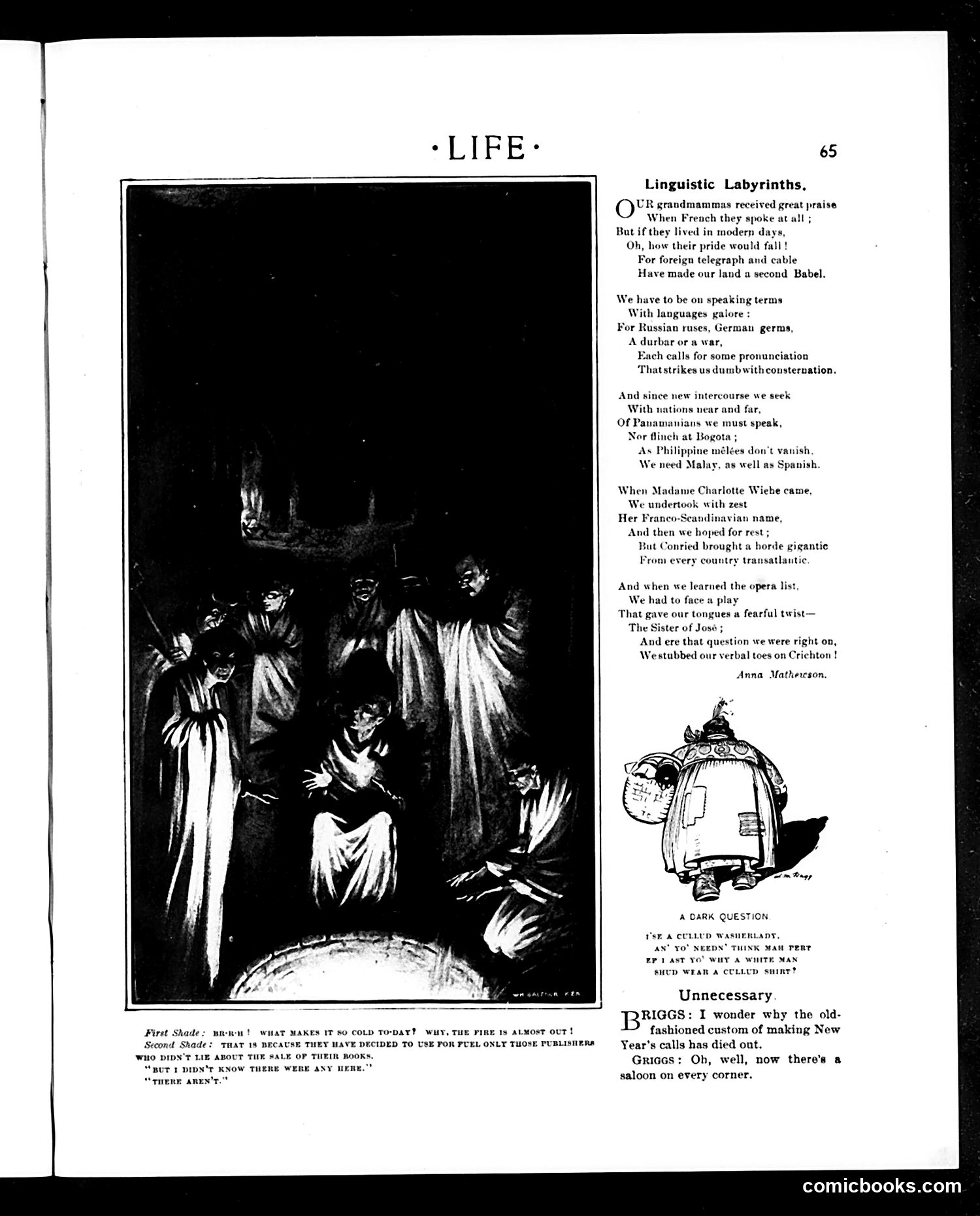
**"Linguistic Labyrinths"** is a poem by Anna Matherson satirizing the complications of modern international communication. It mocks how foreign languages and telegraph technology have created a "second Babel" (biblical reference to confusion of tongues). The poem specifically references learning opera in foreign languages and mentions "Madame Charlotte Wiebe" and the "Sister of Jose," suggesting difficulties with pronunciation and cultural exchange. **The dark illustration** shows figures gathered around what appears to be a globe or sphere, depicting the confusion described in the poem. **"Unnecessary"** is a short humorous dialogue where Briggs and Griggs discuss how the old custom of New Year's calls has died out, replaced by saloons on every corner—a joke about Prohibition-era America where bars were supposedly illegal yet omnipresent.
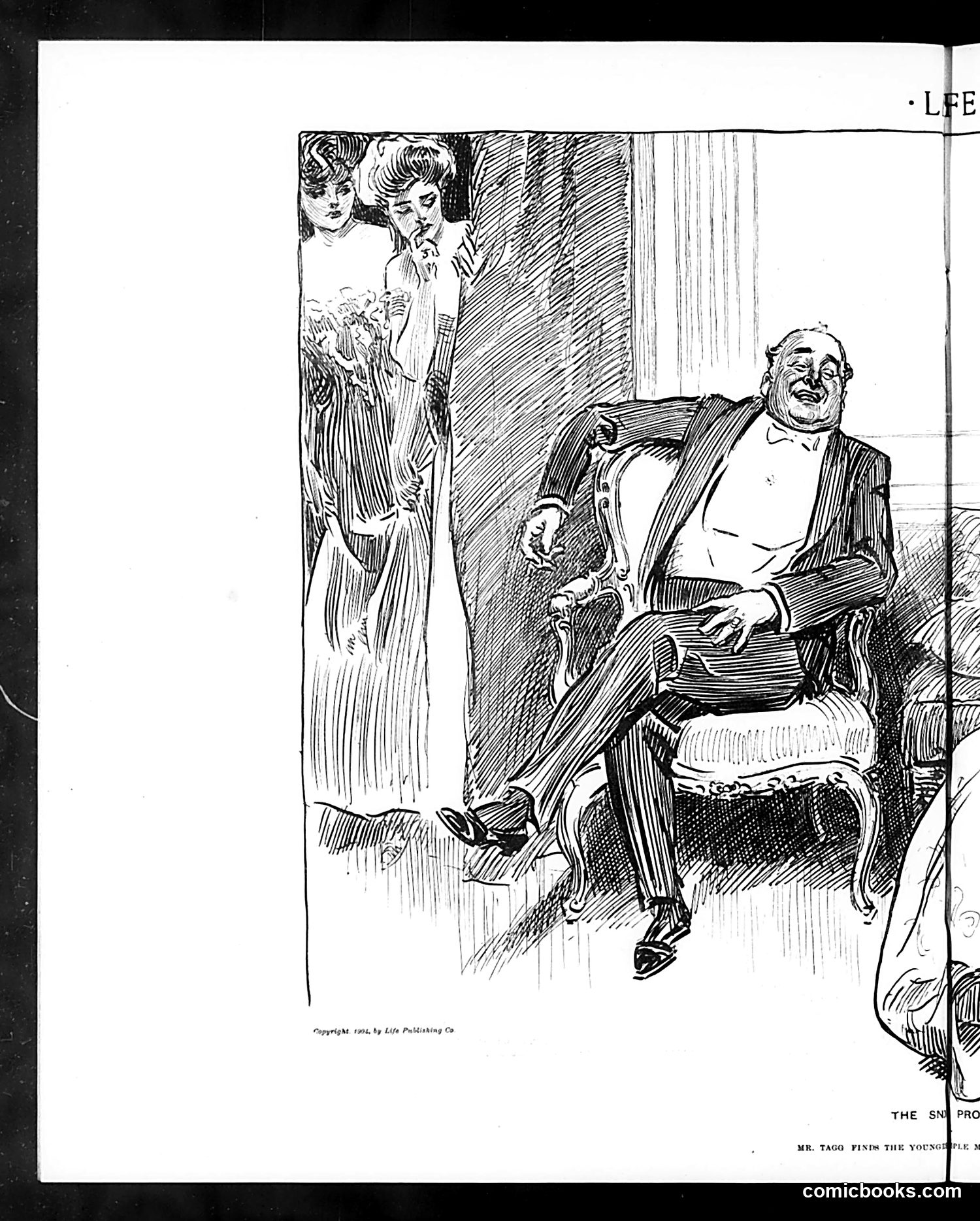
This appears to be a satirical illustration from *Life* magazine showing a domestic scene. The caption references "MR. TAGO FIXING THE YOUNGPLE" (OCR likely garbled; the actual caption is partially cut off). The cartoon depicts a portly, older gentleman seated in a chair while two young women stand nearby in long dresses, and a small child is present. The man appears to be in a position of authority or paternalism over the younger figures. Without the complete caption text visible, I cannot definitively identify who "Mr. Tago" is or what specific social/political situation is being satirized. The illustration style and clothing suggest early 20th-century America. The satire likely concerns generational dynamics, authority figures, or domestic arrangements of that era, but the exact target remains unclear from the visible elements alone.
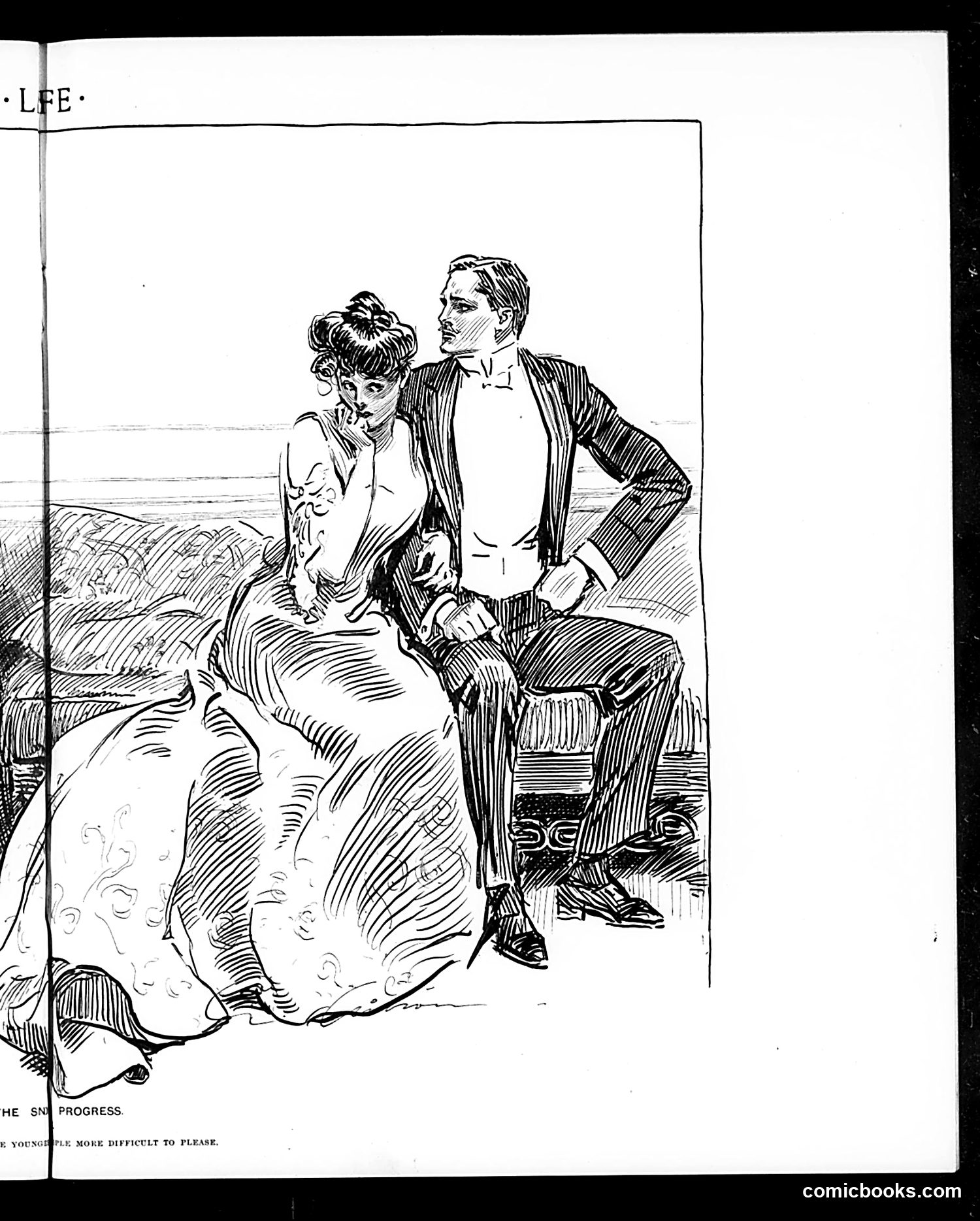
This Life magazine cartoon satirizes courtship rituals of the early 20th century. The title "The Snail's Progress" mocks the slow pace of romantic advancement between a well-dressed man and woman sitting together on a couch. The partially visible caption at bottom reads "...E YOUNGF...LE MORE DIFFICULT TO PLEASE," suggesting the joke concerns how young women are becoming harder to court or win over—a common theme in period satire about changing gender relations. The snail imagery implies the man's romantic progress is proceeding at an agonizingly slow pace, likely a commentary on evolving social conventions that made direct courtship more complicated or restrained than in previous generations.
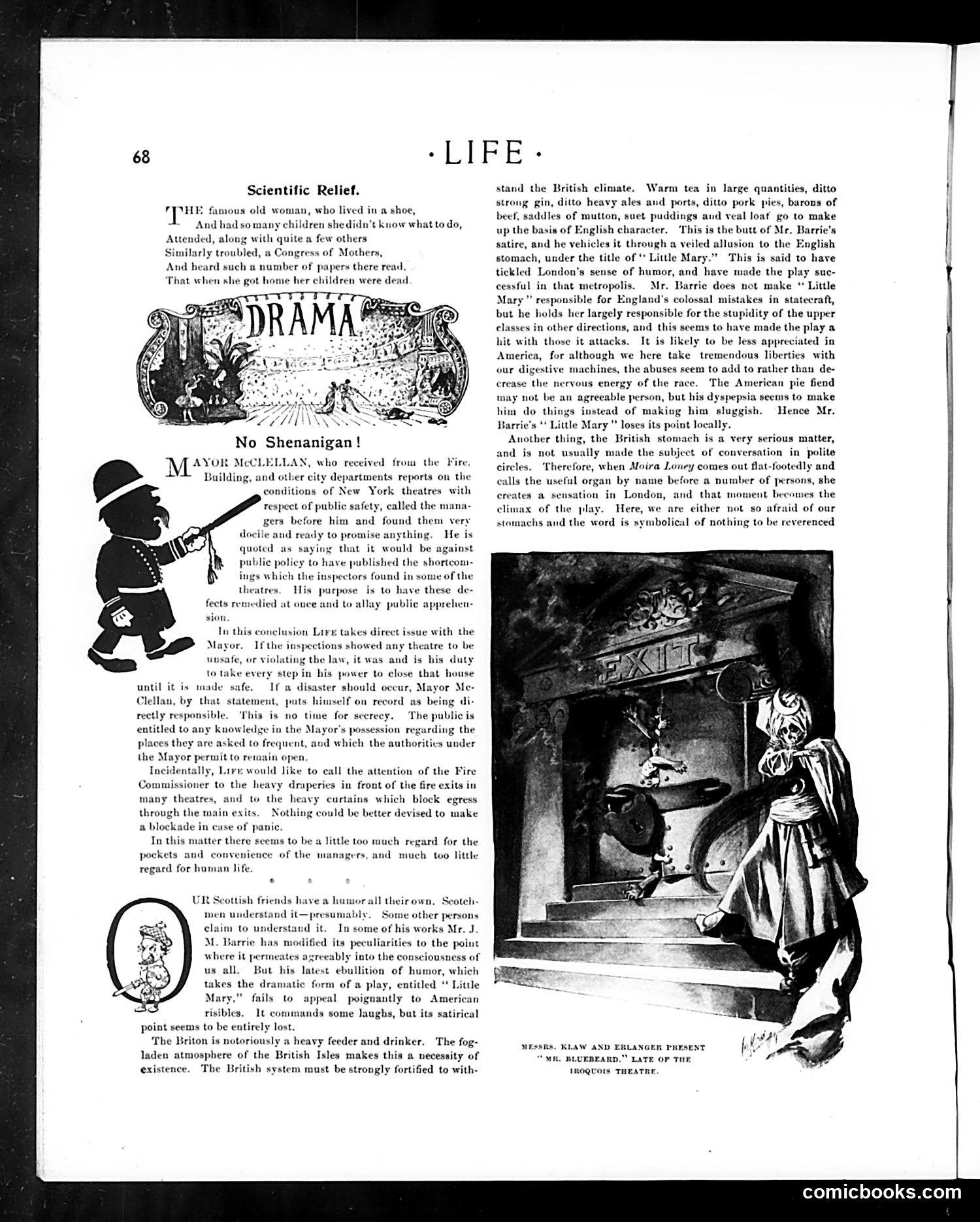
This page critiques **Mayor McClellan** of New York City regarding theater safety inspections. The left article "No Comparison!" reports that McClellan received complaints about unsafe conditions in theaters but found inspectors "docile and ready to promise anything." The satire argues he prioritizes political convenience over public safety—he won't enforce laws if violations are found. The illustration shows a figure (likely representing theater management or corruption) seemingly evading responsibility. The right section discusses J.M. Barrie's play "Little Mary," which mentions British digestive systems, calling this unsuitable for polite conversation. This is secondary satire about theatrical propriety. **Overall point**: The magazine attacks governmental negligence in protecting theater-goers from fire hazards, accusing officials of prioritizing appearances over actual safety.
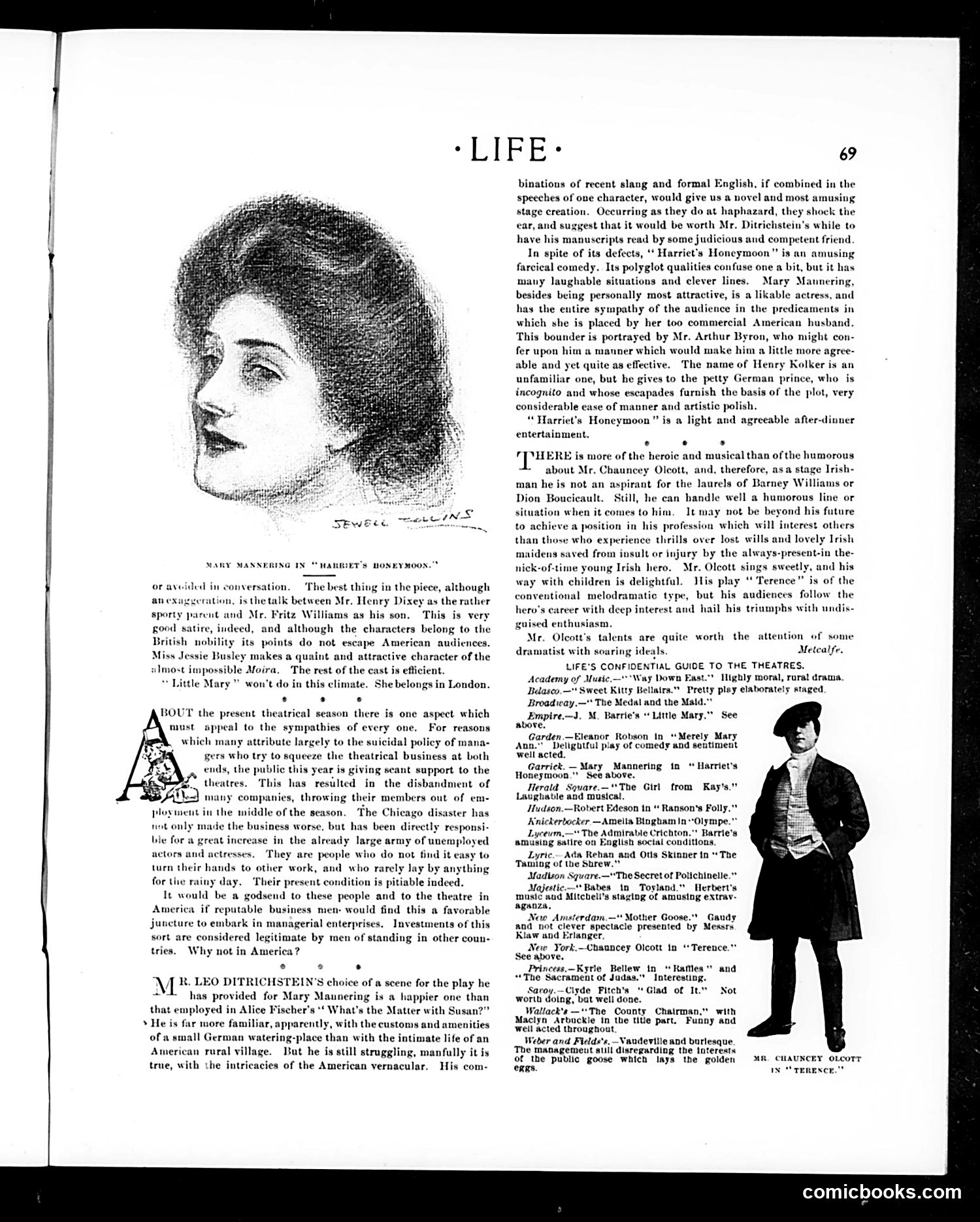
This page reviews contemporary Broadway productions. The two sketched portraits show **Mary Mannering** (left, in "Harriet's Honeymoon") and **Chauncey Olcott** (right, in "Terence"). The critic praises Mannering's attractiveness and sympathy in a German playwright Leo Ditrichstein's farce about an American husband and European intrigue. The humor stems from Ditrichstein's awkward mixing of slang and formal English—a foreigner's struggle with American vernacular. Arthur Byron plays an unlikeable "bounder" (cad); the plot involves a petty German prince's escapades. Regarding Olcott, the reviewer notes he's more "heroic and musical" than comedic, and while not aspiring to rival the great Irish stage comedians (Williams, Boucicault), handles humorous lines competently. The page also laments the theatrical season's struggles, with managers squeezing profits causing company disbandments and actor unemployment—calling for wealthy businessmen to invest in theater as "legitimate" enterprise (as they do abroad).
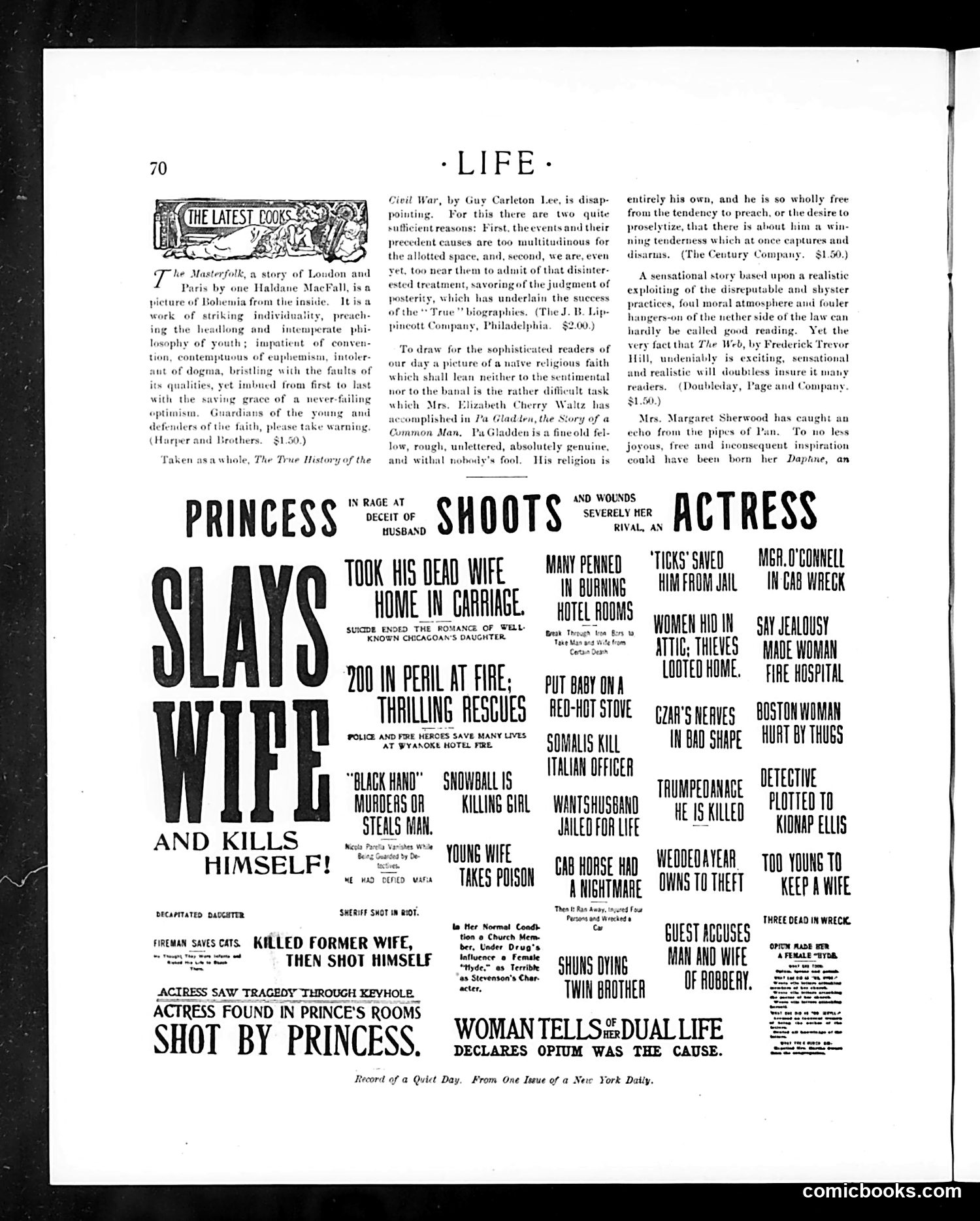
This page satirizes sensationalist newspaper headlines through visual collage. Rather than presenting a coherent narrative, Life deliberately reproduces dozens of lurid, disconnected crime and scandal headlines from a single day's newspaper—murders, shootings, robberies, affairs, and accidents—in varying typefaces and sizes. The central focus appears to be a domestic tragedy (a "Princess" shooting her husband's mistress, then herself), but this story is deliberately buried among dozens of other equally dramatic headlines, making it impossible to distinguish importance. **The satire's point**: Life mocks how newspapers of the era competed for attention by sensationalizing crime and domestic violence. By presenting all headlines with equal visual weight and no actual reporting, the page ridicules the absurdity of modern newspaper excess—where quantity of scandal overwhelms meaningful journalism. This reflects Progressive Era concerns about yellow journalism and the coarsening of public discourse through tabloid media.
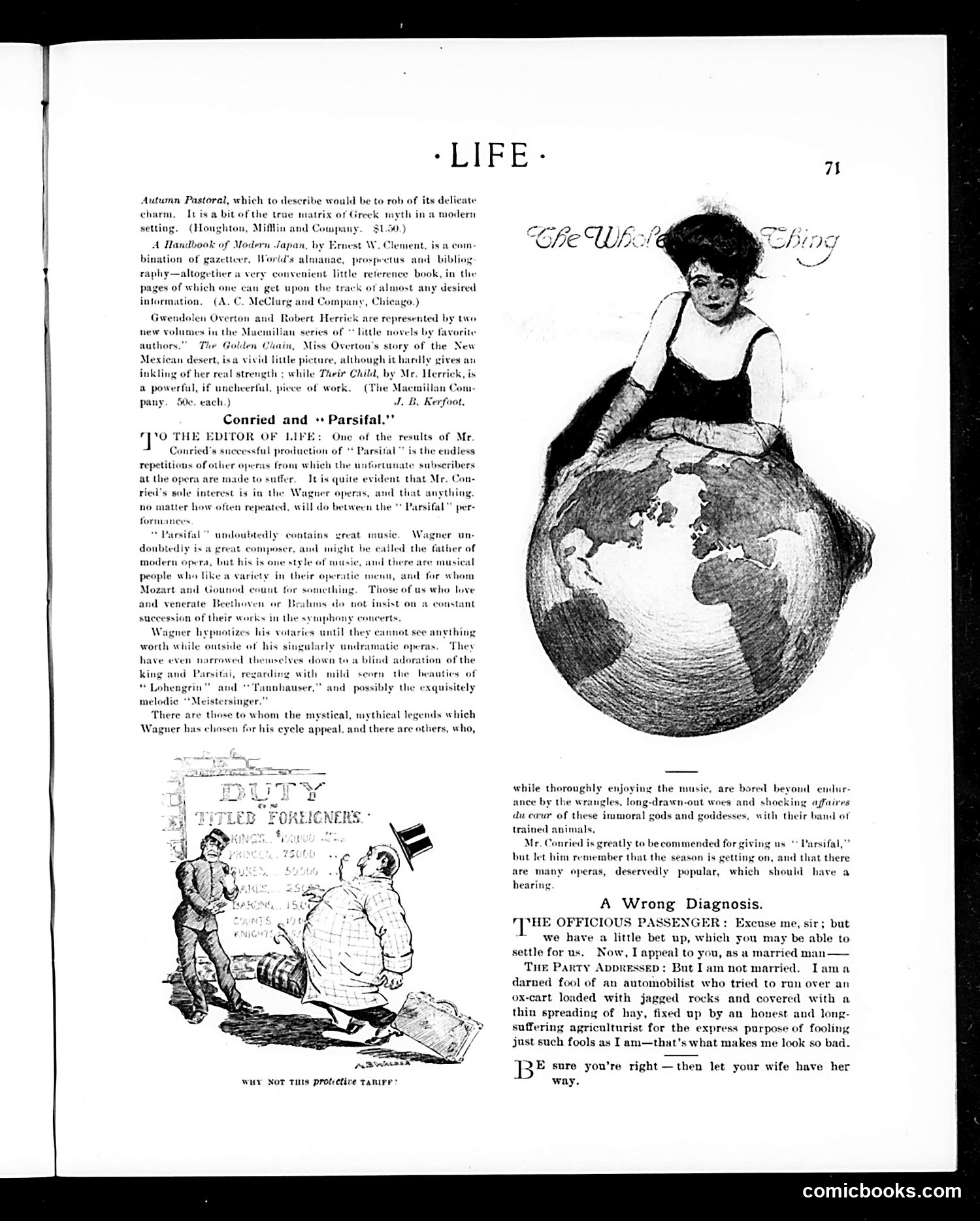
This *Life* magazine page contains two distinct pieces: **Upper section:** Book reviews, including discussion of Wagner's opera *Parsifal*, which had recently been successfully produced by impresario Heinrich Conried at the Metropolitan Opera. **Main cartoon ("A Wrong Diagnosis"):** A humorous dialogue between an "officious passenger" and a bedraggled automobilist. The joke plays on the passenger's assumption that the man's disheveled appearance indicates he's a married man in marital trouble. The automobilist corrects him—he's actually unmarried but foolish, having crashed his automobile into a hay-covered trap of jagged rocks placed by a farmer to protect crops from reckless drivers. The punchline mocks automobile drivers as reckless "fools" while poking fun at the passenger's stereotype that looking bad means domestic problems. The final caption sarcastically advises wives to have their way since husbands clearly lack judgment.
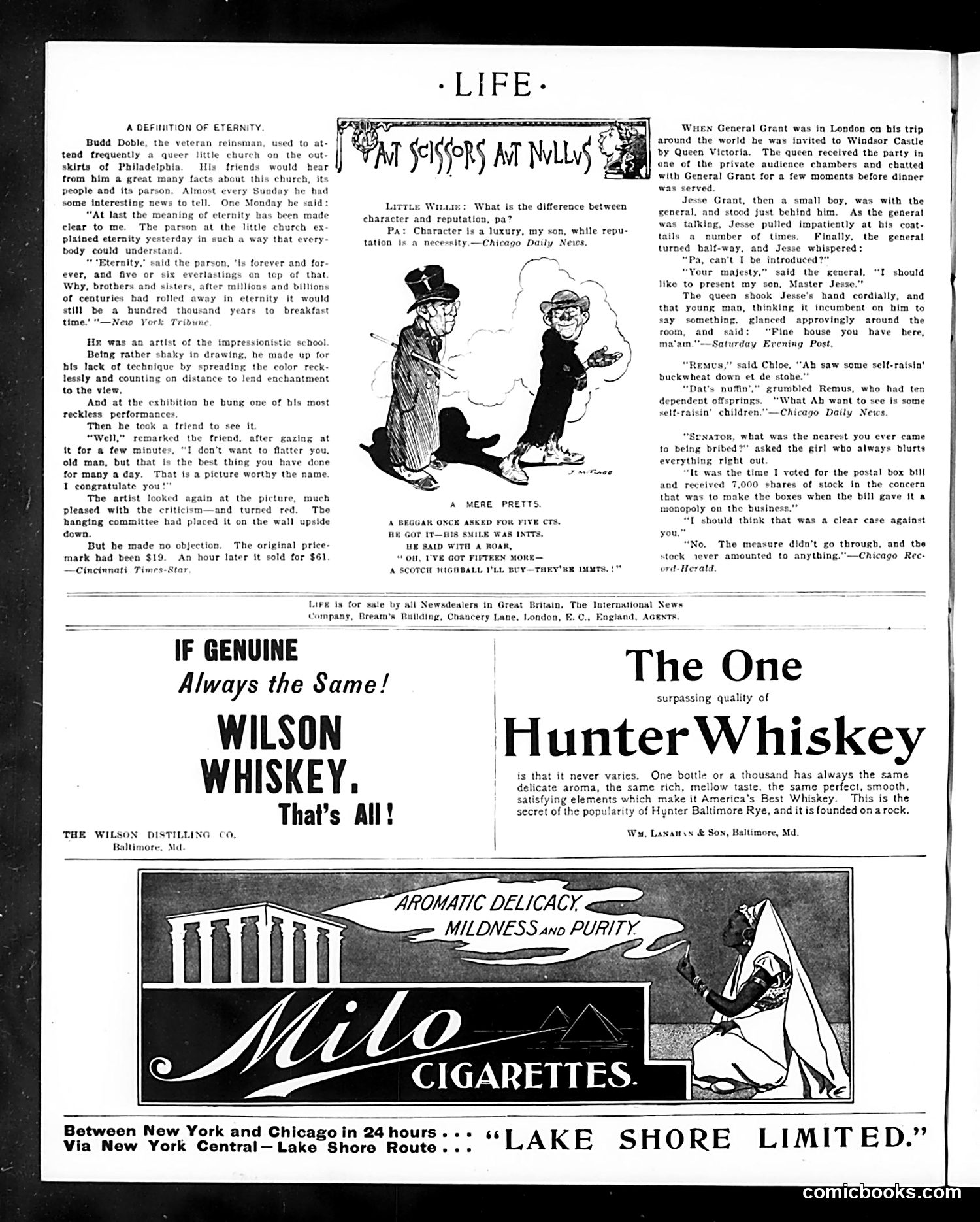
This page from *Life* magazine contains several humorous anecdotes and advertisements typical of early 20th-century American satirical journalism. The main cartoons illustrate brief jokes: one depicts a beggar receiving five cents and smiling broadly, then demanding fifteen more cents to buy a "Scotch highball"—satirizing both poverty and drinking culture. Another shows a poorly-executed painting selling for $61 after being hung upside down, mocking both amateur artists and art market absurdity. The text anecdotes include a story where young Jesse Grant, son of General Ulysses S. Grant, meets Queen Victoria and compliments her residence as "a fine house"—humor derived from a child's innocent directness toward royalty. Other jokes reference character versus reputation, self-raising buckwheat, and political bribery attempts. The advertisements for Wilson Whiskey, Hunter Whiskey, and Milo Cigarettes are period-typical, with no particular satirical content. The "Lake Shore Limited" train advertisement appears standard promotional material. Overall, this reflects *Life*'s format: social commentary through humor rather than overt political critique.
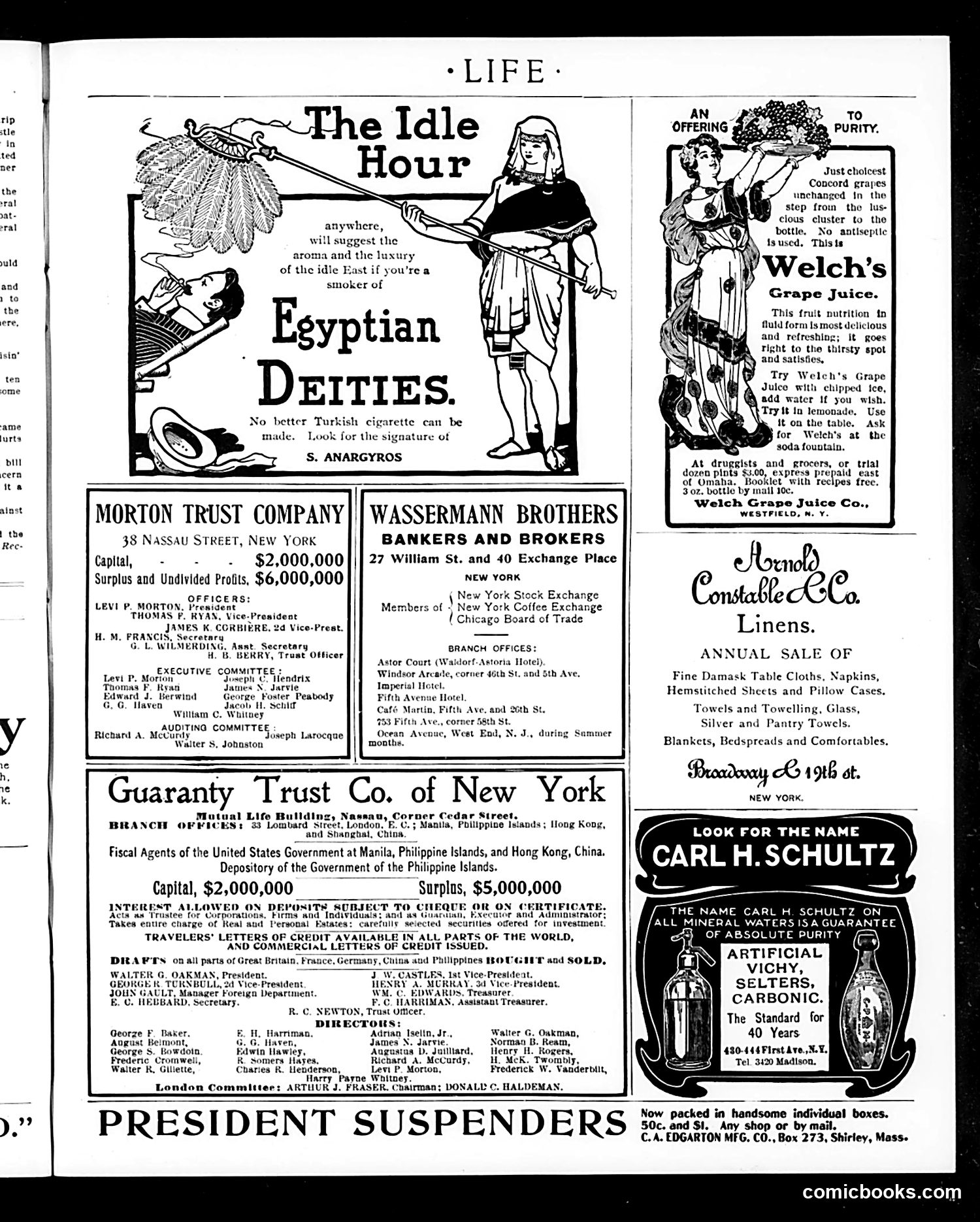
This page is primarily **advertising**, not a political cartoon. The main item is "The Idle Hour" — a cigarette advertisement for "Egyptian Deities" brand by S. Anargyros, which uses the visual trope of a classical female figure (Cleopatra-like) to market exotic leisure and luxury smoking. The remaining content consists entirely of **financial institution ads**: banks, trust companies, and consumer products (Welch's Grape Juice, mineral water). These represent major American finance firms of the early 20th century, including the Morton Trust Company (founded by former Vice President Levi P. Morton) and Guaranty Trust Co. The overall page reflects the magazine's business-oriented reader base and uses "the idle hour" and Egyptian exoticism as selling points for leisure and consumer goods aimed at wealthy Americans. There is no political satire present — this is a typical Life magazine advertising section from the period.
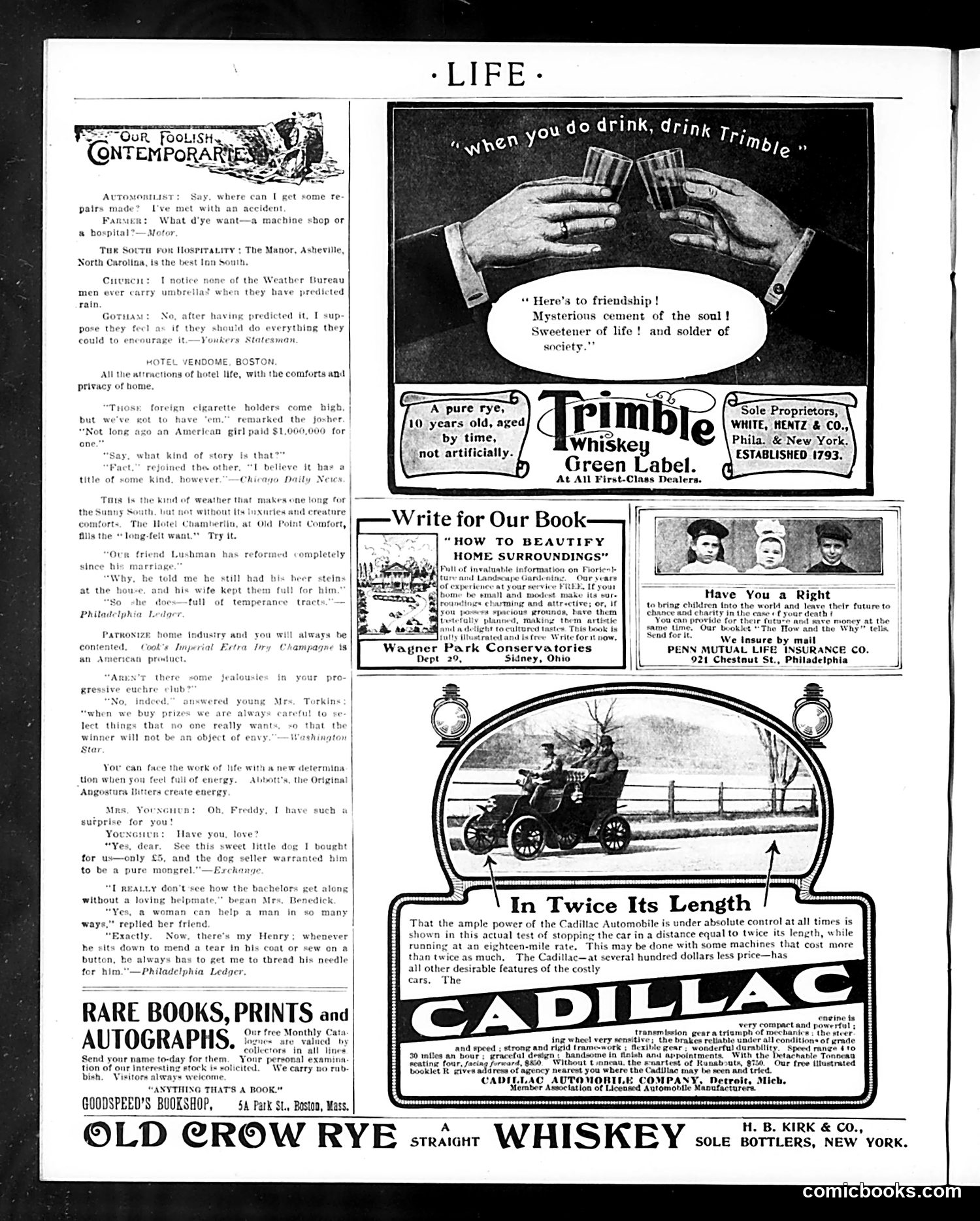
This page from *Life* magazine consists primarily of **short humorous vignettes** and **advertisements** rather than political cartoons. The jokes mock social pretensions and contemporary absurdities. For example, one quip contrasts an automobile mechanic with a hospital—implying cars are as dangerous as serious illness. Another jokes about Weather Bureau men never carrying umbrellas despite predicting rain, mocking meteorological incompetence. The advertisements dominate: **Trimble Whiskey** (featuring toasting hands), **Cadillac automobiles** (emphasizing stopping power), **Wagner Park Conservatories**, and **Penn Mutual Life Insurance** promoting life insurance for children's futures. The page reflects early 1900s concerns: automobile safety, life insurance as consumer protection, and social humor about marriage, wealth, and domesticity. The tone is lighthearted satire of middle-class anxieties and consumer culture rather than sharp political commentary.
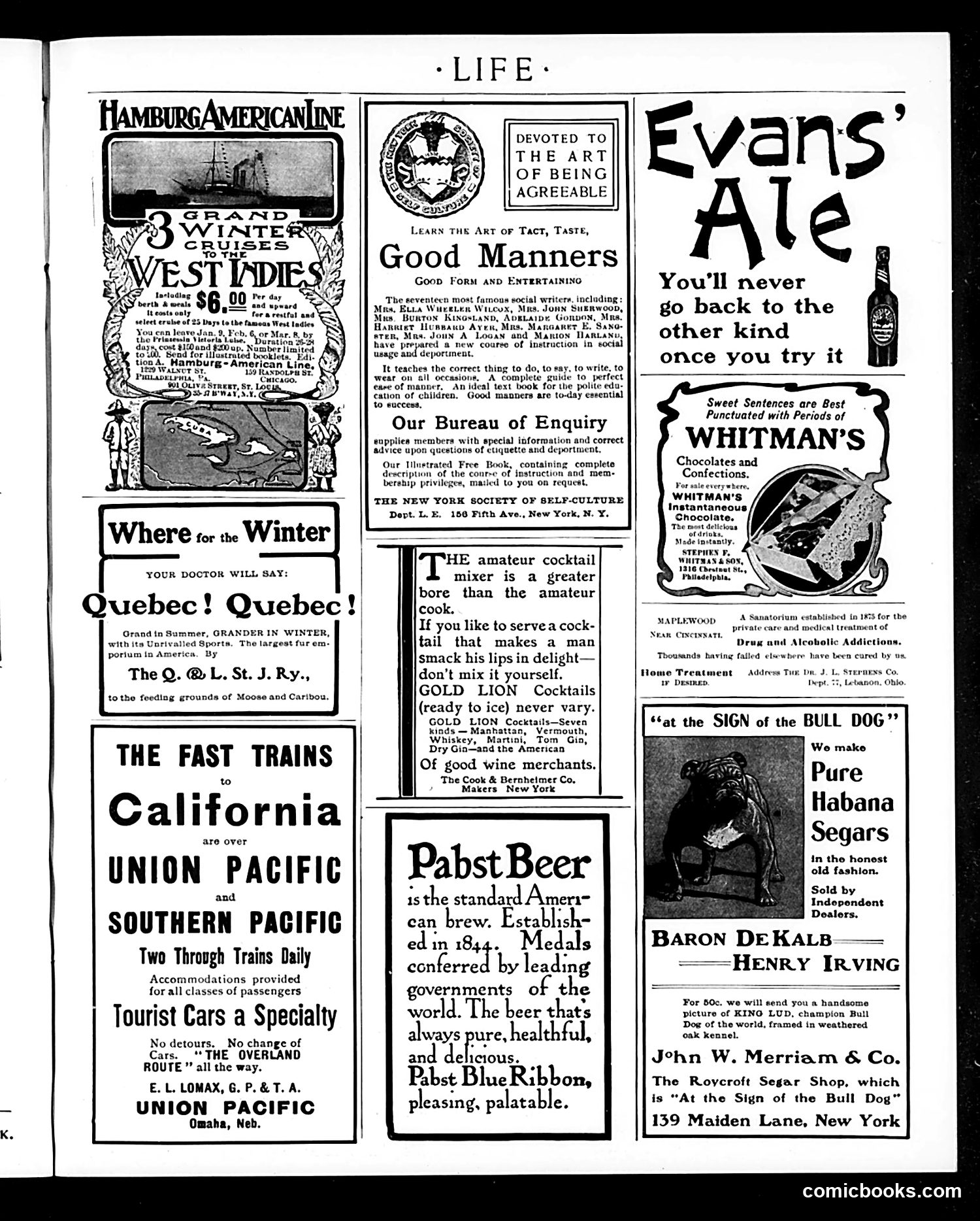
This page is primarily **advertising**, not satirical content. It showcases early 1900s commercial promotions reflecting period attitudes and products. Notable ads include: - **Travel/Transportation**: Hamburg-American cruise lines, railroad companies promoting winter sports in Quebec and California - **Social Etiquette**: A "New York Society of Self-Culture" course teaching "Good Manners," reflecting the era's class-consciousness about proper deportment - **Alcohol & Cocktails**: Gold Lion pre-made cocktails and Pabst Beer, normalizing casual home drinking - **Tobacco & Sweets**: Habana cigars, Whitman's chocolates, and segars at the "Sign of the Bull Dog" - **Health/Addiction**: A "Sanatorium" for treating "alcoholic addictions" with home treatment options—darkly ironic given surrounding alcohol advertisements The page reveals **Gilded Age values**: aspirational leisure travel, social climbing through etiquette learning, conspicuous consumption, and acceptable substance use. The addiction treatment ad suggests contemporary awareness of alcohol's dangers, yet contradicts the surrounding promotional culture.
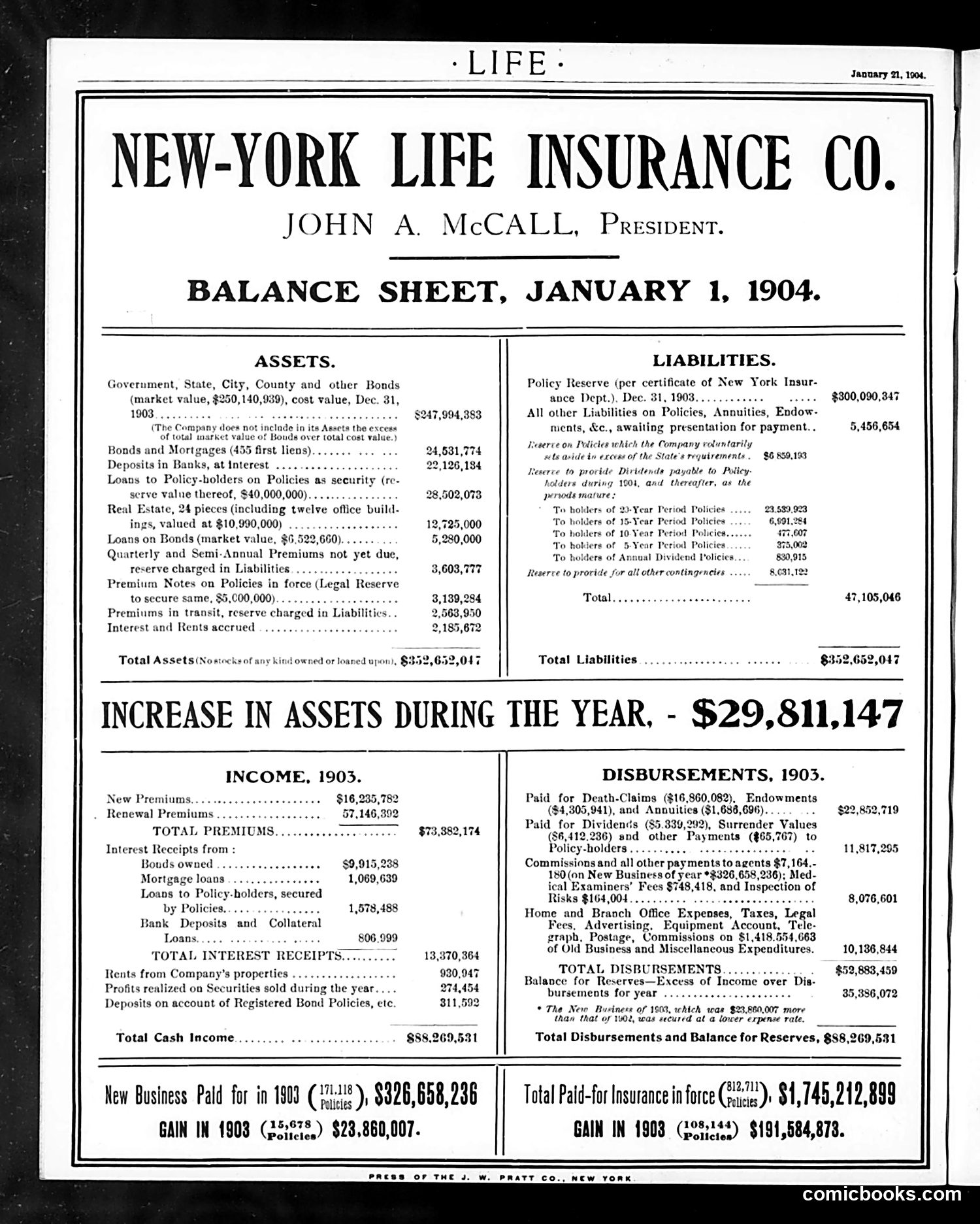
This page is **not a cartoon or satire**—it's a financial statement. It presents the New-York Life Insurance Company's balance sheet and annual report for January 1, 1904, under President John A. McCall. The document shows the company's substantial assets ($352.6 million), liabilities, income, and disbursements for 1903. Key figures include $73.3 million in total premiums, $88.2 million in cash income, and notably, a $29.8 million increase in assets during the year. The page emphasizes the company's financial strength and growth, highlighting that new business written in 1903 ($326.6 million) exceeded 1902's figures while maintaining lower expense rates—a selling point for the insurance company's stability and efficiency during this period. This appears in *Life* magazine likely as paid advertising or editorial promotion of the insurance company's financial health to potential policyholders.