
Life, 1904-01-21 · page 13 of 20
Life — January 21, 1904 — page 13: what you’re looking at
What you’re looking at
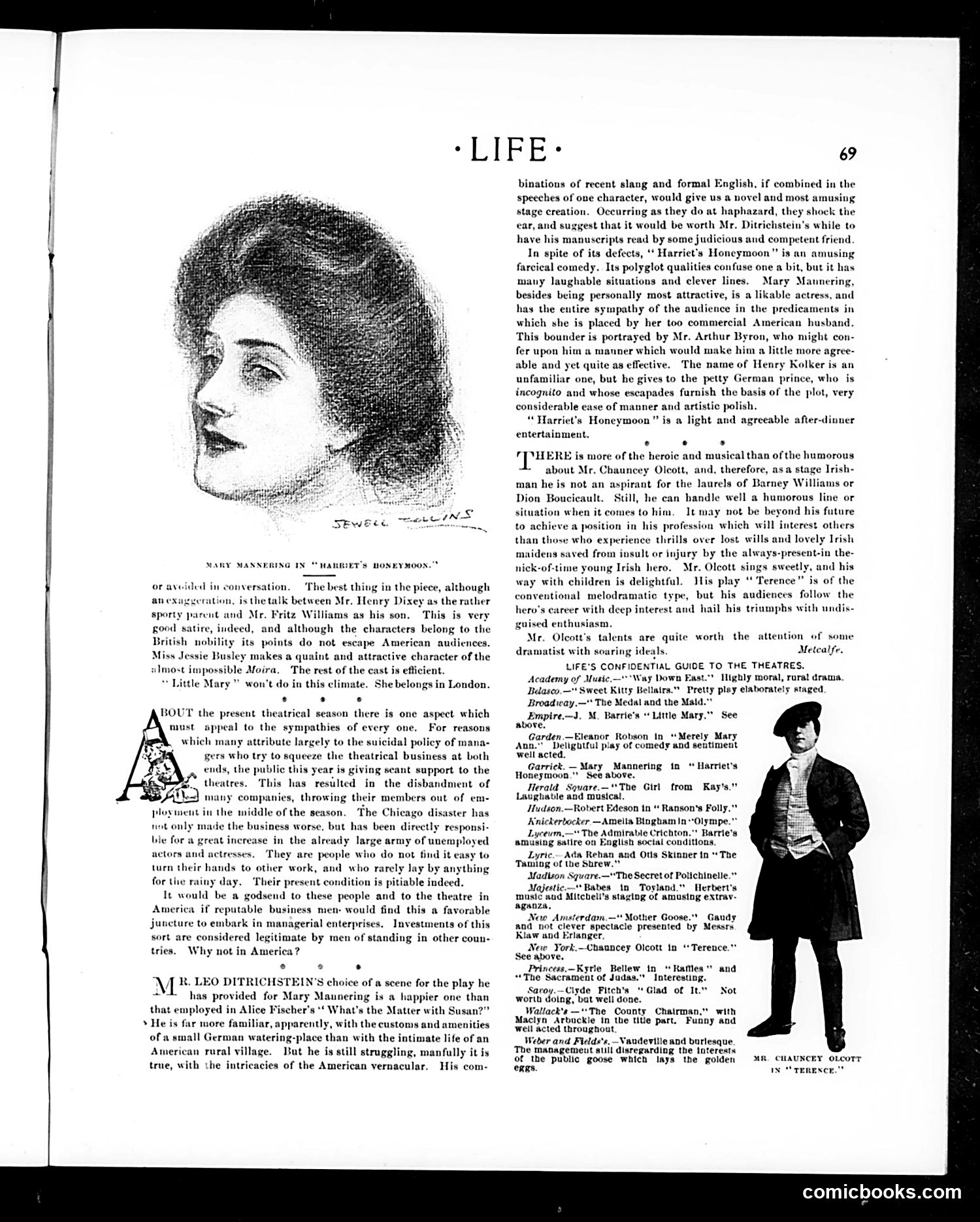
This page reviews contemporary Broadway productions. The two sketched portraits show **Mary Mannering** (left, in "Harriet's Honeymoon") and **Chauncey Olcott** (right, in "Terence"). The critic praises Mannering's attractiveness and sympathy in a German playwright Leo Ditrichstein's farce about an American husband and European intrigue. The humor stems from Ditrichstein's awkward mixing of slang and formal English—a foreigner's struggle with American vernacular. Arthur Byron plays an unlikeable "bounder" (cad); the plot involves a petty German prince's escapades. Regarding Olcott, the reviewer notes he's more "heroic and musical" than comedic, and while not aspiring to rival the great Irish stage comedians (Williams, Boucicault), handles humorous lines competently. The page also laments the theatrical season's struggles, with managers squeezing profits causing company disbandments and actor unemployment—calling for wealthy businessmen to invest in theater as "legitimate" enterprise (as they do abroad).
📄 Transcribed text from this page (OCR, searchable)
Machine-transcribed from the original scan — historical spelling and the odd misread are preserved.
*LIFE- 69 MARY MANNERING HALRIET'S HONEYMOON. or aveided in conversation. ‘The best thing in the piece, although an exaggeration, is the talk between Mr. Henry Dixey as the rather itund Mr. Fritz Williams as his son. This is very good satire, indeed, and although the characters belong to the British nobility its points do not escape American audiences. Miss Jessie Busley makes a quaint and attractive character of the almost impossible Moira. The rest of the cast is efficient. * Little Mary ” won't do in this climate. She belongs in London. . « «6 BOUT the present theatrical season there is one aspect which must appeal to the sympathies of every one. For reasons which many attribute largely to the suicidal policy of mana- gers who try to squeeze the theatrical business at both ends, the public this year is giving scant support to the as theatres. This has resulted in the disbandment of {2} many companies, throwing their members out of em- sporty iddle of the season. The Chicago disaster has not only made the business worse, but has been directly respon: bie for a great inerease in the already large army of unemployed actors and actresses, They are people who do not tind it easy to turn their hands to other work, and who rarely lay by anything for tie rainy day. Their present condition is pitiable indeed. It would be a godsend to these people and to the theatre in America if reputable business men- would find this a favorable juncture to embark in managerial enterprises, Investments of this sort are considered legitimate by men of standing in other coun- tries. Why not in America? ° ° . J &: LEO DITRICHSTELN’S choice of a scene for the play he ~*4 has provided for Mary Maunering is a happier one than that employed in Alice Fischer's “ What's the Matter with Susan?” He is far more familiar, apparently, with the customs and amenities of a small German watering-place than with the intimate life of an American rural village. But he is still straggling, manfully it is true, with the intricacies of the American vernacular. His com- ployment in the binations of recent slang and formal English, if combined in the speeches of one character, would give us a novel and most amusing stage creation. Occurring as they do at haphazard, they shock the car, and suggest that it would be worth Mr. Ditrichstein’s while to have his manuscripts read by some judicious and competent friend. In spite of its defects, * Harriet’s Honeymoon” is an amusing farcical comedy. Its polyglot qualities confuse one a bit, but it has many laughable situations and clever lines. Mary Mannering, besides being personally most attractive, is a likable actress, and has the entire sympathy of the audience in the predicaments in which she is placed by her too commercial American husband. This bounder is portrayed by Mr. Arthur Byron, who might con- fer upon him a manner which would make him a little more agree- able and yet quite as effective. The name of Henry Kolker is an unfamiliar one, but he gives to the petty German prince, who is incognito and whose escapades furnish the basis of the plot, very considerable ease of manner and artistic polish. “ Harriet’s Honeymoon” is a light and agreeable after-dinner entertainment, . . . TPHERE is more of the heroic and musical than ofthe humorous + about Mr, Chauncey Olcott, , asa stage Irish- man he is not an aspirant for the laure rney Williams or Dion Boucicault. Still, he can handle well a humorous line or situation when it comes to him. It may not be beyond his future to achieve a position in his profession which will interest others than those who experience thrills over lost wills and lovely Irish maidens saved from insult or injury by the always-present-in the- nick-of-time young Irish hero. Mr. Olcott sings sweetly, and way with children is delightful. Mis play ‘ is of the conventional melodramatic type, but his audiences follow the hero’s career with deep interest and hail his triumphs with und guised enthusiasm. Mr. Olcott's talents are quite worth the attention of some dramatist with soaring ideals. Metcalfe. LIFE’S CONFIDENTIAL GUIDE TO THE THEATRES. Academy of Musie.—* "Way Down East." Iighly moral, rural drama. Bdasco.—"* Sweet Kitty Bellairs.” Pretty play elaborately staged. Broadway.—"* The Medal and the Mald. Empire.—J. M. Barrie's “ Little Mary.” See above, Garden.—Eleanor Robson in "Merely Mary Ann.” Delightful play of comedy and sentiment well acted. Garrick. — Mary Mannering tn “ Harriet's Honeymoon.’ See above. Herald Square.—“The Girl from Kay's." Laughable and musical. Hudson.—Robert Edeson in “ Ranson’s Folly. Knickerbocker —Ameita Bingham In “Olympe. Lyceum.—* The Admirable Crichton.’ Barrie's amusing satire on English social conditions. Lyric. Ada Rehan and Ots Skinner in “The Taming of tbe Strew." Madison Square.—'The Secret of Polichinelle.”” Majestic.—* Babes in Tosland."’ Herbert's music aud Mitcbell’s staging of amusing extrav- aganza, Neo Amsterdam.—“ Mother Goose.” Gaudy and not clever spectacie presented by Messrs Klaw and Erlanger, New York.—Chaancey Olcott in ‘Terence. ‘See above, Princess.—Kyrie. Bellew in “RamMes” and “The Sacrament of Judas,” Interesting. Saroy.—Ciyde Fitch's “Glad of It." Not worth doing, bat well done. Wallack’s —“"The County Chairman,” with Maclyn Arbuckle in the tie part. Funny and Weil acted throughout. Weber and Fields‘, —Vaudevilie and barlesque. The management still disregarding the interests of the public goose which lays the golden ‘MR. CHAUNCEY OLCOTT ORES. IN “ TERENCE.”* Terence” comicbooks.com