
A complete issue · 22 pages · 1903
Life — December 3, 1903
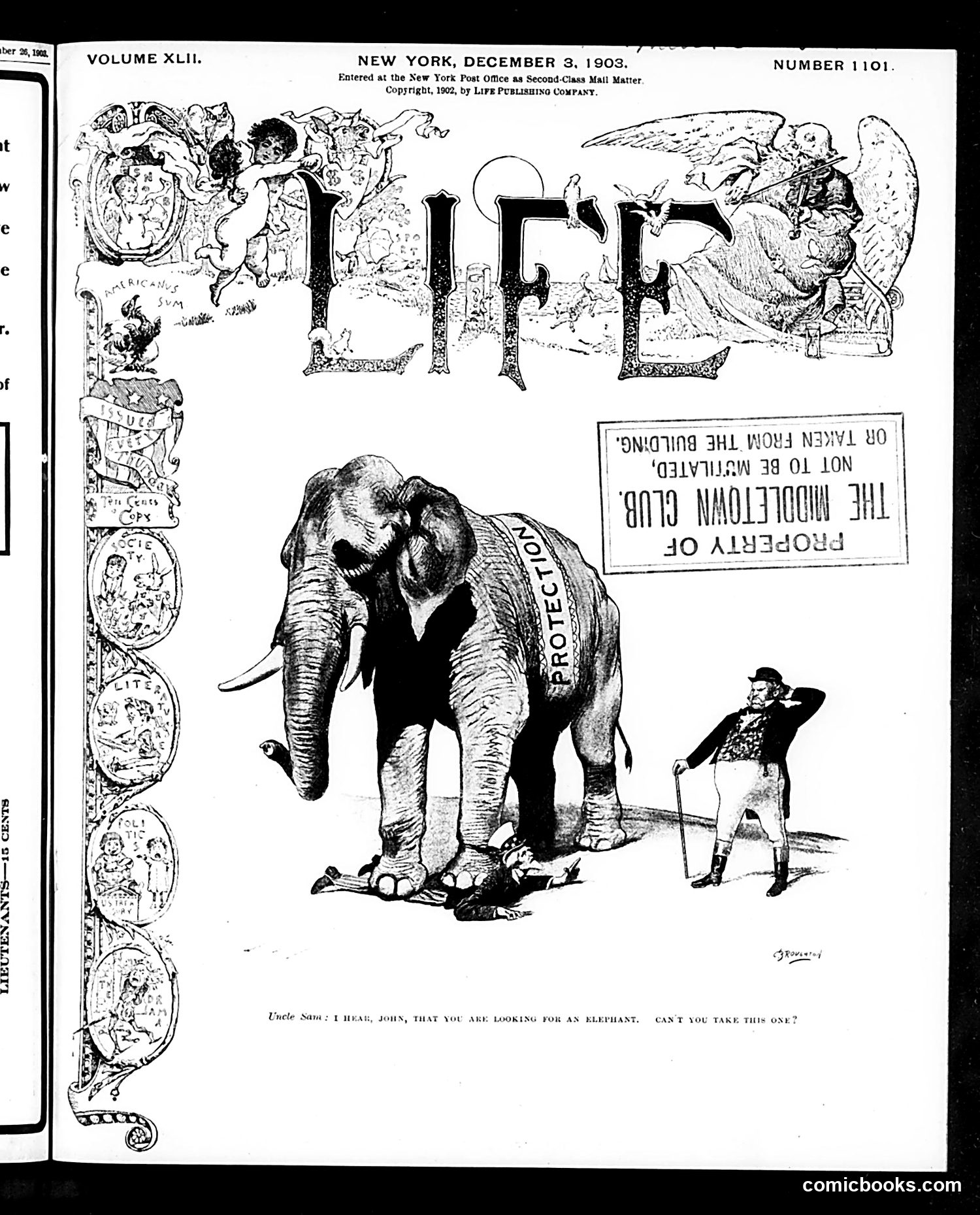
This is the cover of Life magazine's issue from December 3, 1903. The main cartoon depicts a large elephant wearing a blanket labeled "PROTECTED" alongside a small man in formal dress. The caption reads: "Uncle Sam: I hear, John, that you are looking for an elephant. Can't you take this one?" The elephant appears to represent American imperialism or foreign policy expansion. The figure labeled "John" likely refers to John Bull (Britain's personification). The satire suggests the U.S. is offering Britain an unwanted burden—possibly referencing contemporary colonial disputes or American expansionist ambitions in the Philippines or other territories. The "protected" label on the elephant may ironically comment on justifications for American imperial ventures as "protective" measures, which contemporaries viewed with skepticism.
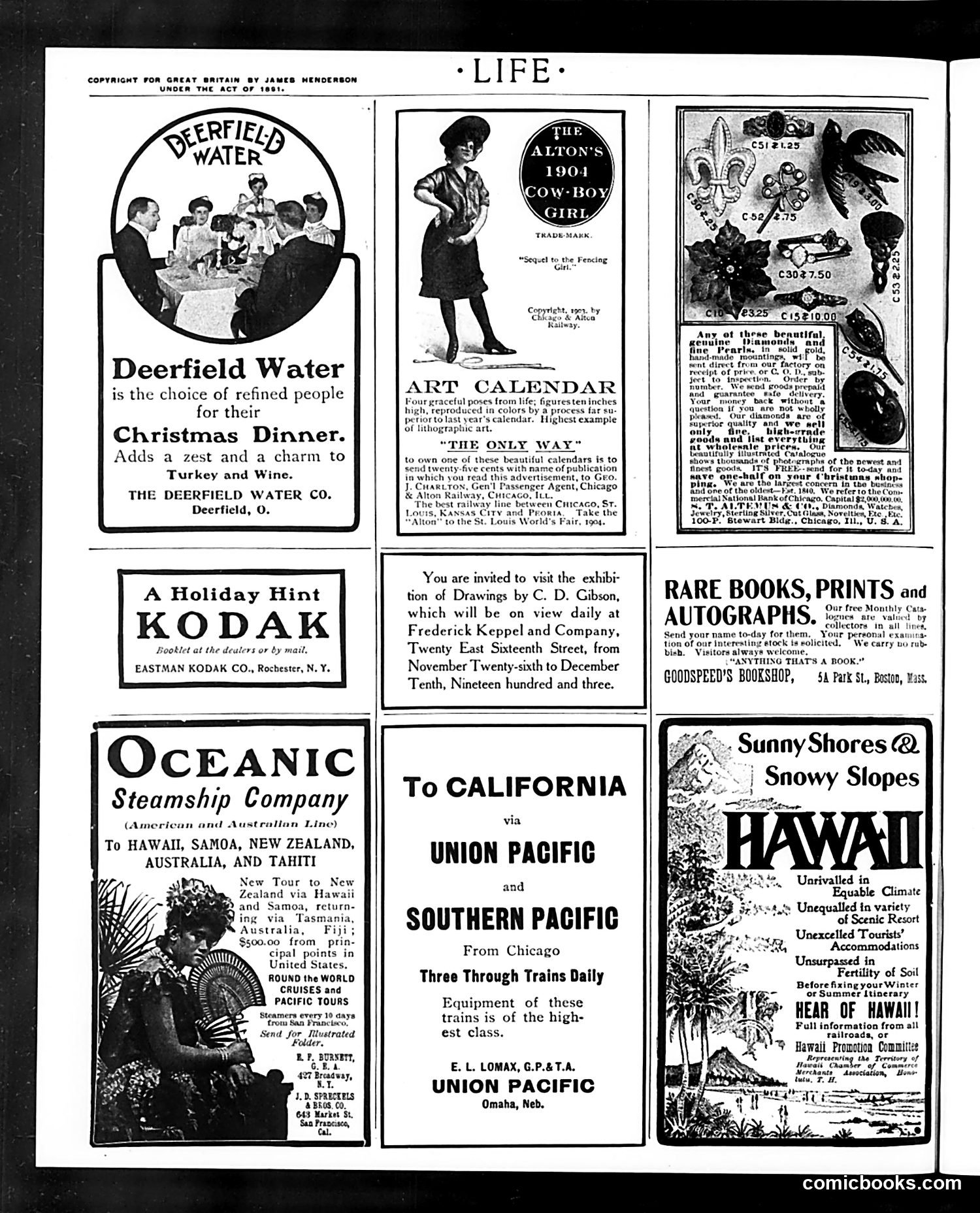
This page is **primarily advertising** with no political cartoons or satirical content to analyze. The ads promote: - **Deerfield Water** as refined for Christmas dinners - **Kodak** photography equipment - **Oceanic Steamship Company** travel to Hawaii, Samoa, and Australia - **Union Pacific and Southern Pacific Railways** California service from Chicago - **Hawaii tourism** via the Hawaii Promotion Committee - **Art Calendar** and rare books/autographs The only visual elements are product illustrations and decorative travel imagery (palm trees, ships). There are no political figures, caricatures, or satirical commentary present. This represents typical turn-of-the-century *Life* magazine advertising rather than editorial satire.
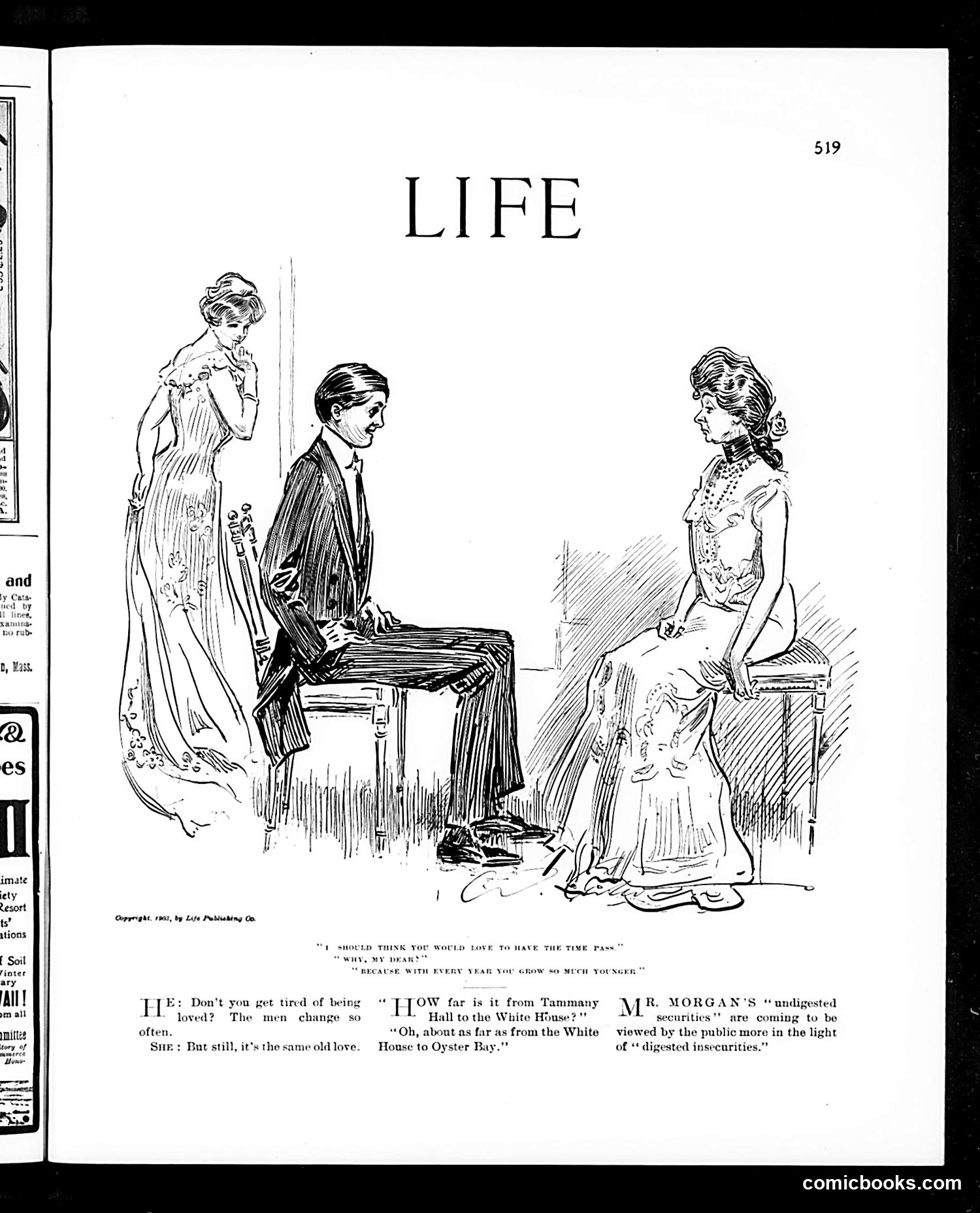
This page contains three separate satirical captions accompanying a single illustration. The drawing depicts a romantic scene: a man seated while two women interact with him—one standing behind, one sitting across from him. The three jokes play on themes of romantic constancy and change: 1. **"HE"** jokes that men change frequently, while women's love remains consistent 2. **"HOW"** references distance (Tammany Hall to the White House), likely alluding to political aspirations or social climbing 3. **"MR. MORGAN'S"** references undigested securities—a pun on J.P. Morgan, the famous banker, suggesting financial speculation or digestion metaphors applied to securities The satire targets both romantic relationships and contemporary financial/political figures through wordplay and double meanings typical of Life magazine's style.
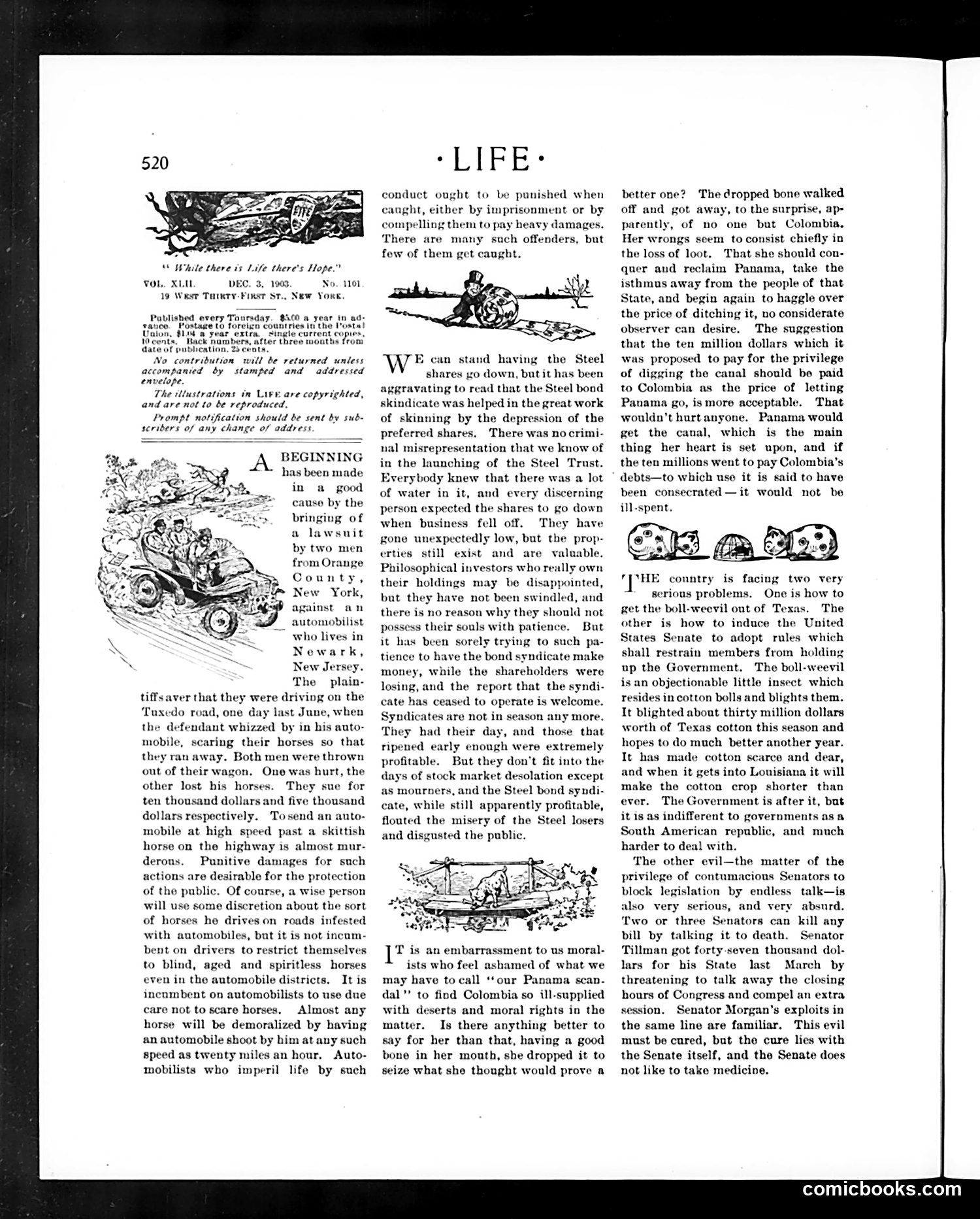
This page contains editorial commentary on contemporary issues rather than political cartoons. The main topics addressed are: 1. **Steel Trust/Stock Market**: Criticism of the Steel bond syndicate for profiting while ordinary shareholders lost money during market decline. 2. **Panama Canal**: A satirical piece criticizing the U.S. proposal to pay Colombia $10 million for canal rights, suggesting this is inadequate compensation and morally questionable given America's interest in the project. 3. **Boll Weevil Problem**: Discussion of the cotton pest threatening Texas agriculture. 4. **Senate Obstruction**: Critique of senators blocking legislation through endless debate—specifically mentioning Senator Tillman's filibuster against closing Congressional session. The illustrations appear decorative rather than caricature-focused, supporting the written satire about corporate greed, political corruption, and legislative dysfunction.
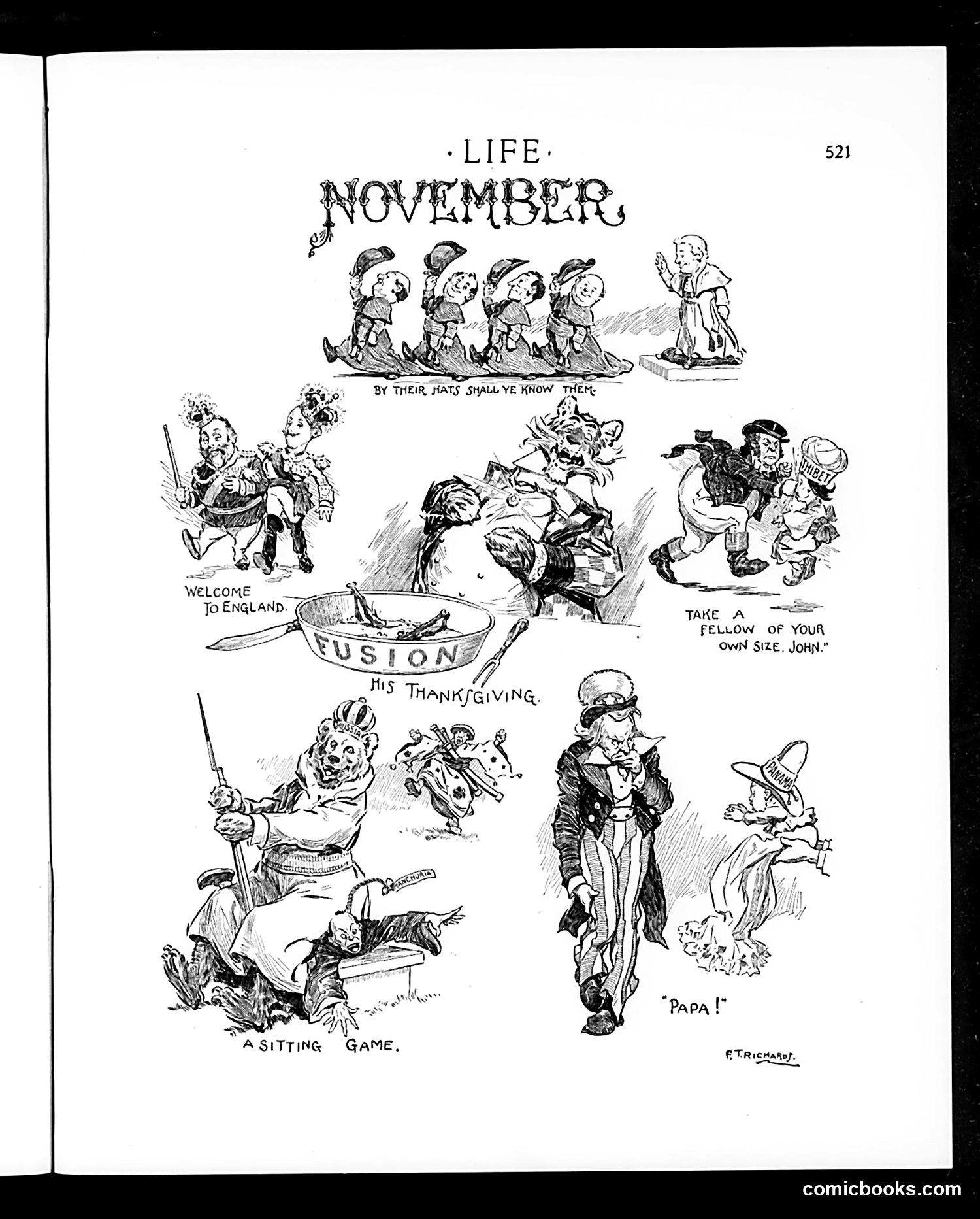
This satirical page depicts November as a month of Thanksgiving and political reconciliation. The central image shows a large bowl labeled "FUSION" with figures being welcomed into England, suggesting a political merger or alliance. The cartoon appears to reference late-19th-century British politics, likely involving the "Fusion" of rival political parties or factions. Various scenes show celebratory activity: children in hats (possibly representing different political groups), a "sitting game" with military/political figures, and references to welcoming newcomers while establishing hierarchy ("take a fellow of your own size, John"). The overall theme satirizes the complex negotiations and compromises involved in political consolidation, portraying it as both festive and contentious. The artist is credited as B. Trichardt.
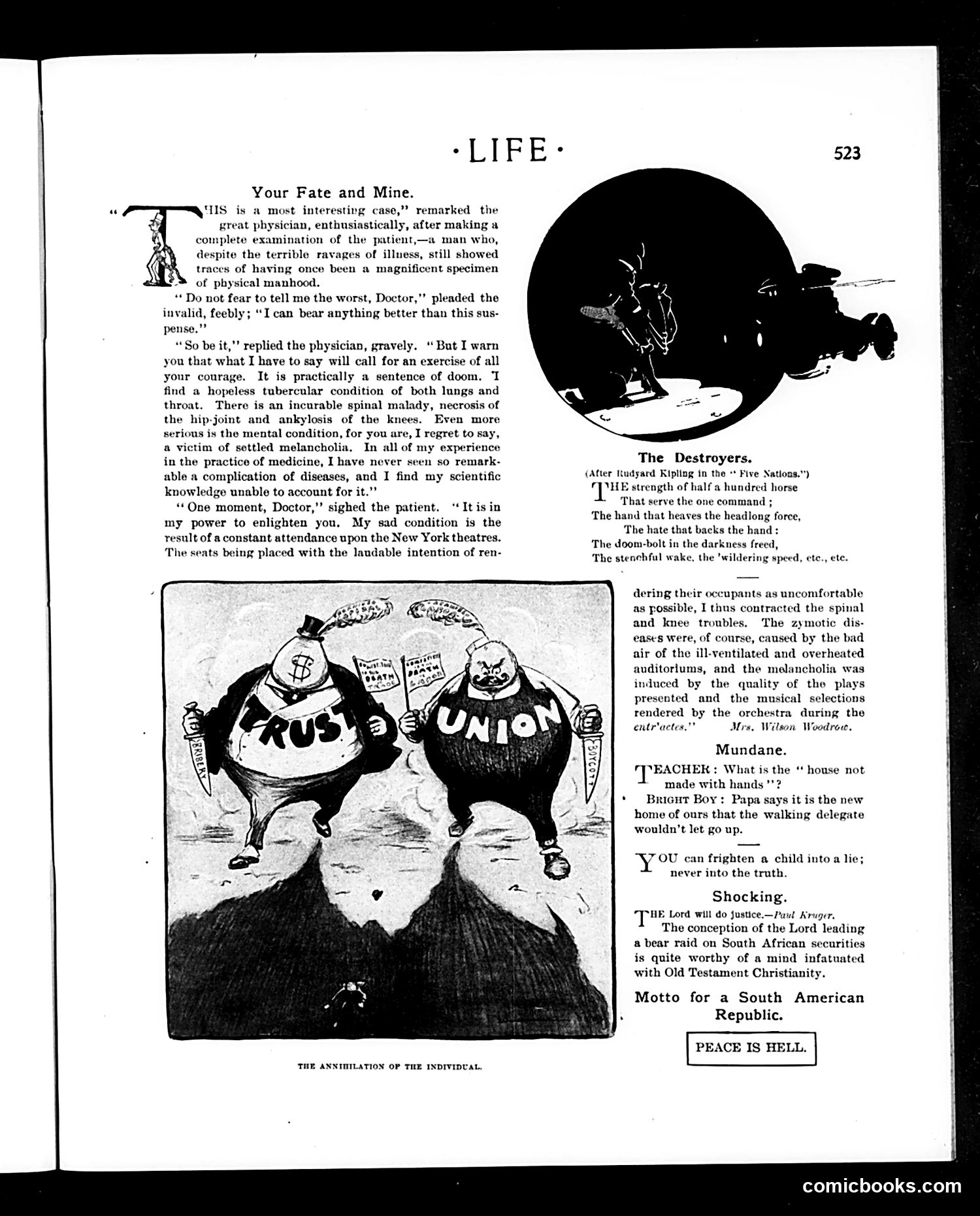
This *Life* magazine page features a medical dialogue where a physician diagnoses a patient with tuberculosis, spinal malady, and notably "settled melancholia"—attributed to attending New York theatres in poor conditions. **"The Annihilation of the Individual"** cartoon depicts two figures labeled "TRUST" and "UNION" squashing a human head between them, symbolizing how large corporate and labor organizations destroy individual autonomy. This reflects early 20th-century anxieties about industrialization's impact on personal liberty. **"The Destroyers"** silhouette depicts a mounted warrior, likely referencing destructive historical forces or imperial aggression. Other brief satirical items mock theatrical pretension and include cynical commentary on power structures ("Peace is Hell").
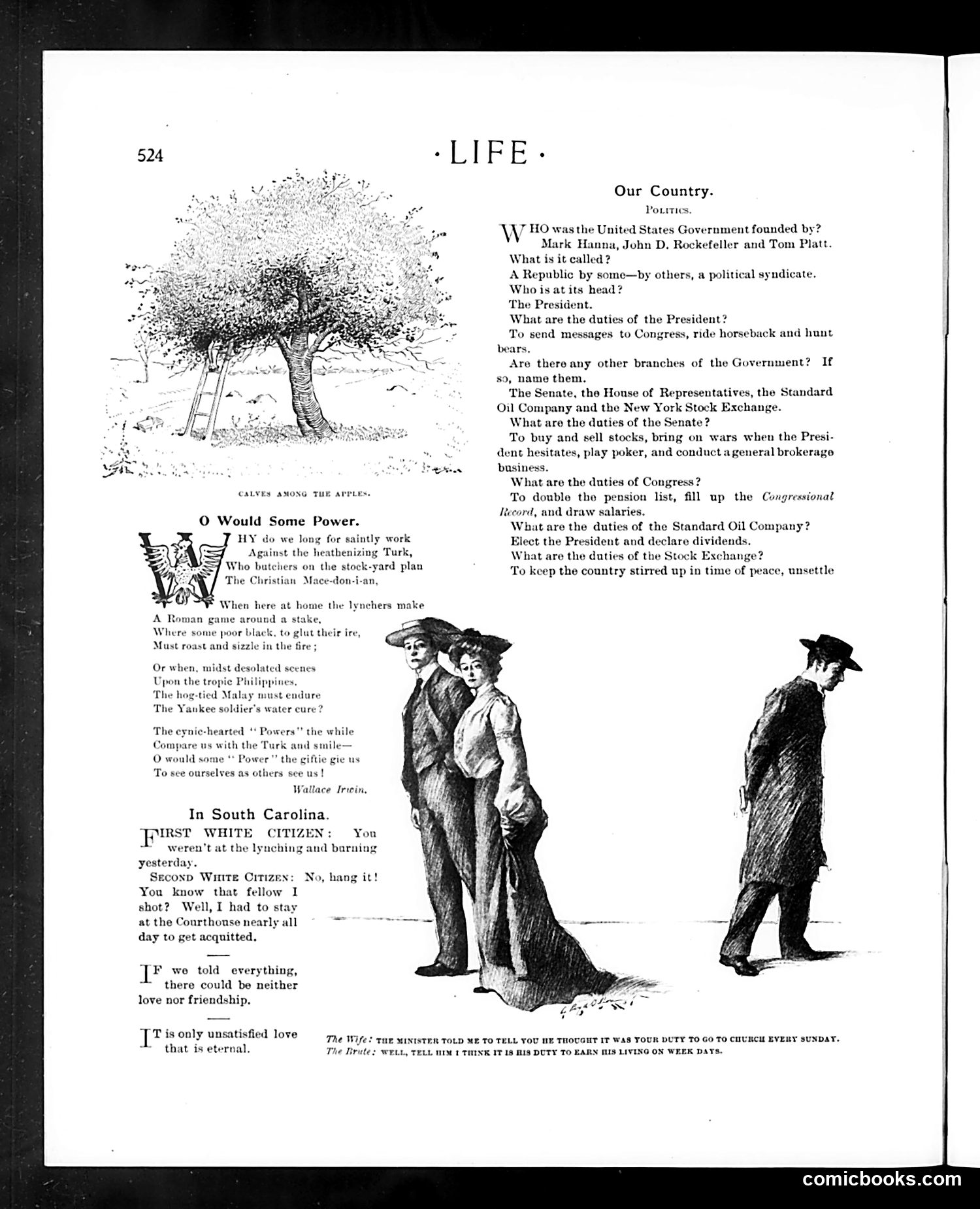
This page contains political satire criticizing government corruption and inequity. The "Politics" section mockingly lists the actual duties of U.S. government branches—exposing how they've been corrupted. For example, the Senate's duties are sarcastically listed as "buy and sell stocks" and "conduct a general brokerage business," while Congress "doubles the pension list" and draws salaries. The Standard Oil Company is listed as a co-equal governmental branch, suggesting corporate control of politics. The "In South Carolina" dialogue satirizes racial violence and judicial corruption, with white citizens openly discussing lynching while authorities do nothing. The illustration and poem "O Would Some Power" by Wallace Irwin critique American imperialism and social inequality, contrasting American claims of moral superiority with actual brutality toward marginalized groups domestically and abroad.
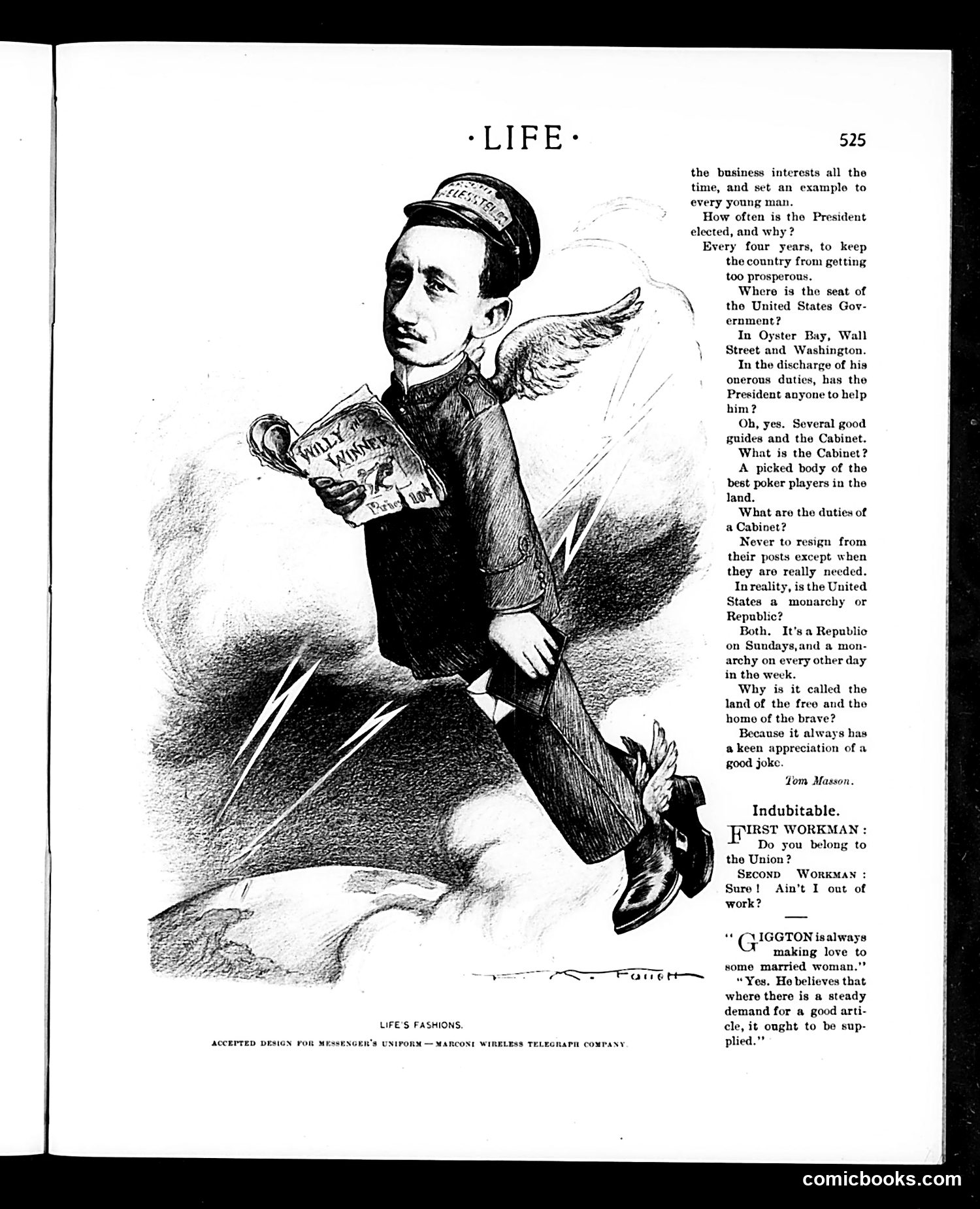
The main illustration, captioned "Life's Fashions," depicts a winged figure in formal dress holding a book labeled "Marconi Wireless Telegraph." The figure appears to represent a cherub or cupid-like personification of modern innovation. The text below notes this is "Accepted Design for Messenger's Uniform—Marconi Wireless Telegraph Company," satirizing the company's prominence and suggesting wireless technology is becoming as omnipresent as classical messengers. The right column contains humorous Q&A exchanges mocking American civics knowledge and workplace dynamics. The final joke about "Giggton" making romantic advances to married women suggests workplace indiscretions were considered fair satirical material in this era. The overall tone suggests early-1900s satire of both new technology enthusiasm and contemporary social pretensions.
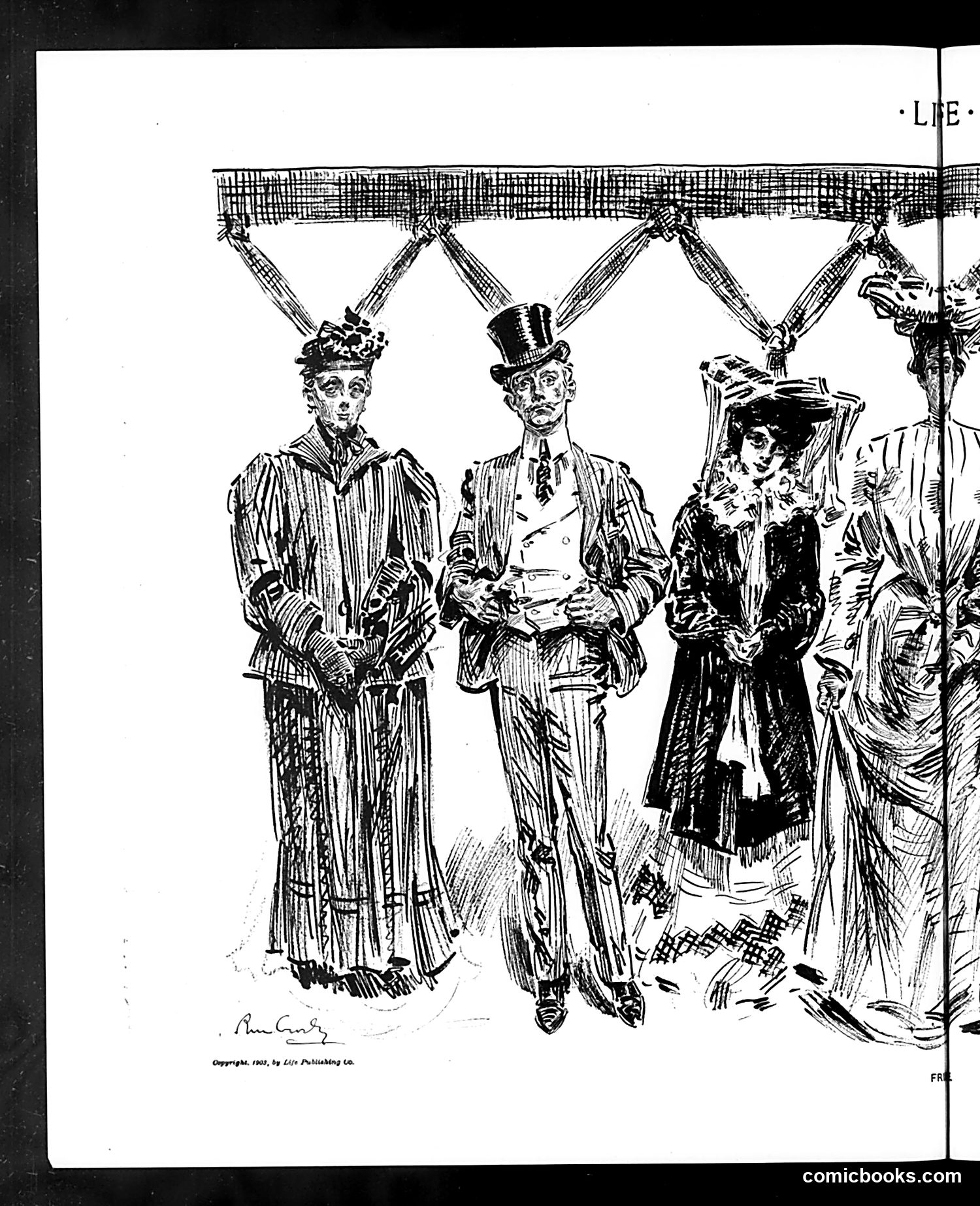
This appears to be a satirical illustration from Life magazine (copyright 1903, by Life Publishing Co., signed by the artist). The drawing depicts four figures suspended by ropes from a horizontal beam—a visual metaphor suggesting they are "hanging" or facing consequences. The figures include two men in formal attire (one wearing a top hat) and a woman in dark clothing with a feathered hat. A fourth figure is partially visible on the right. The style and staging suggest this is political or social commentary, likely targeting specific public figures or institutions of the early 1900s. Without additional context or caption text, the exact identities and specific satirical target remain unclear, though the "hanging" imagery indicates criticism of those depicted.
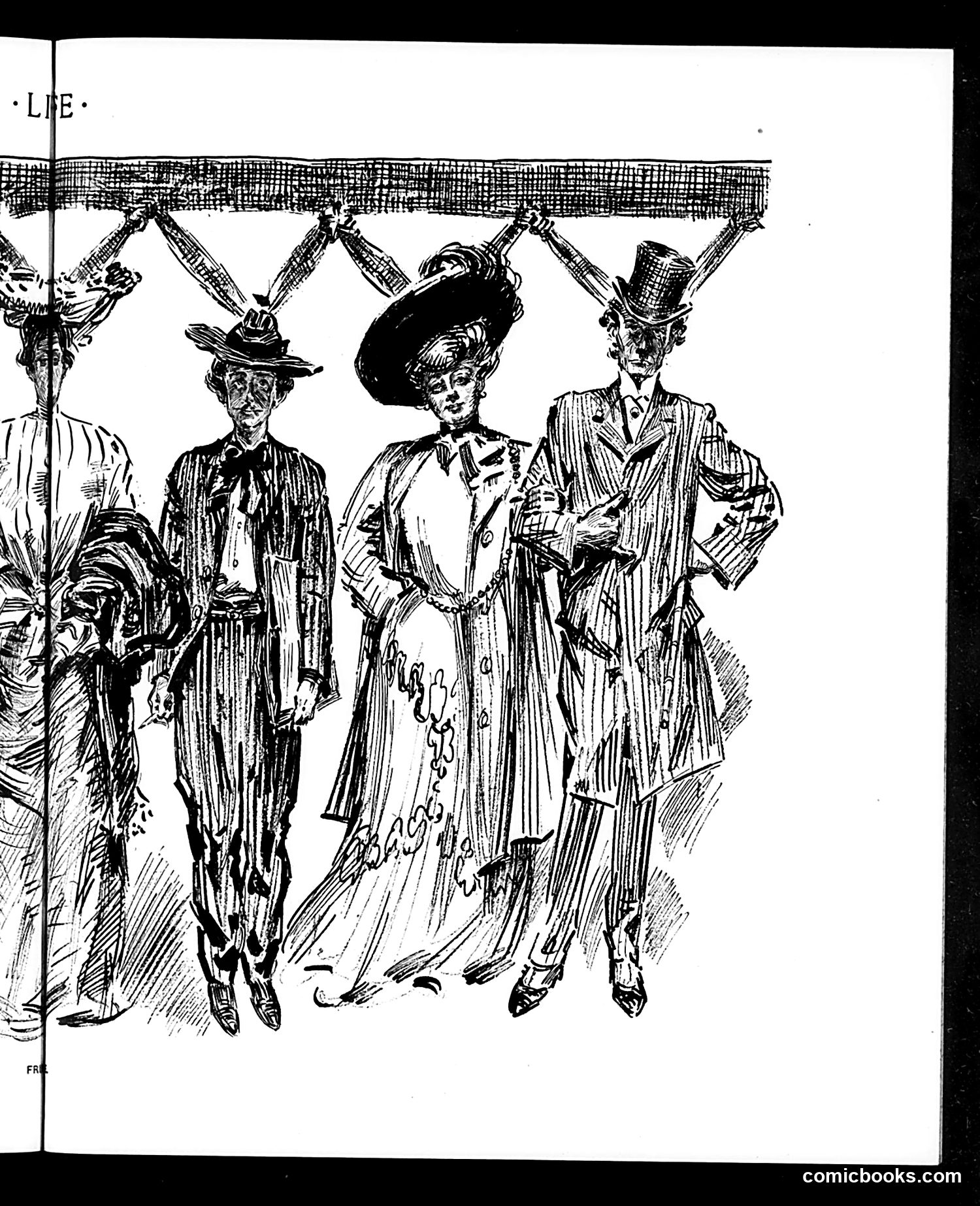
This appears to be a fashion illustration from *Life* magazine rather than a political cartoon. The image shows four elegantly dressed figures standing beneath a decorative awning or canopy, wearing elaborate early 20th-century clothing including long coats, hats with feathers, and ornate details. The OCR text provided is minimal and doesn't clarify the specific content or satire. Without visible text identifying the figures or explaining the context, I cannot definitively identify who these people represent or what social commentary, if any, the illustration intends. The page header reads "LIFE" and there's a small "FR" notation, but the full context—whether this illustrates a social commentary about fashion, society, or specific events—remains unclear from the visible materials.
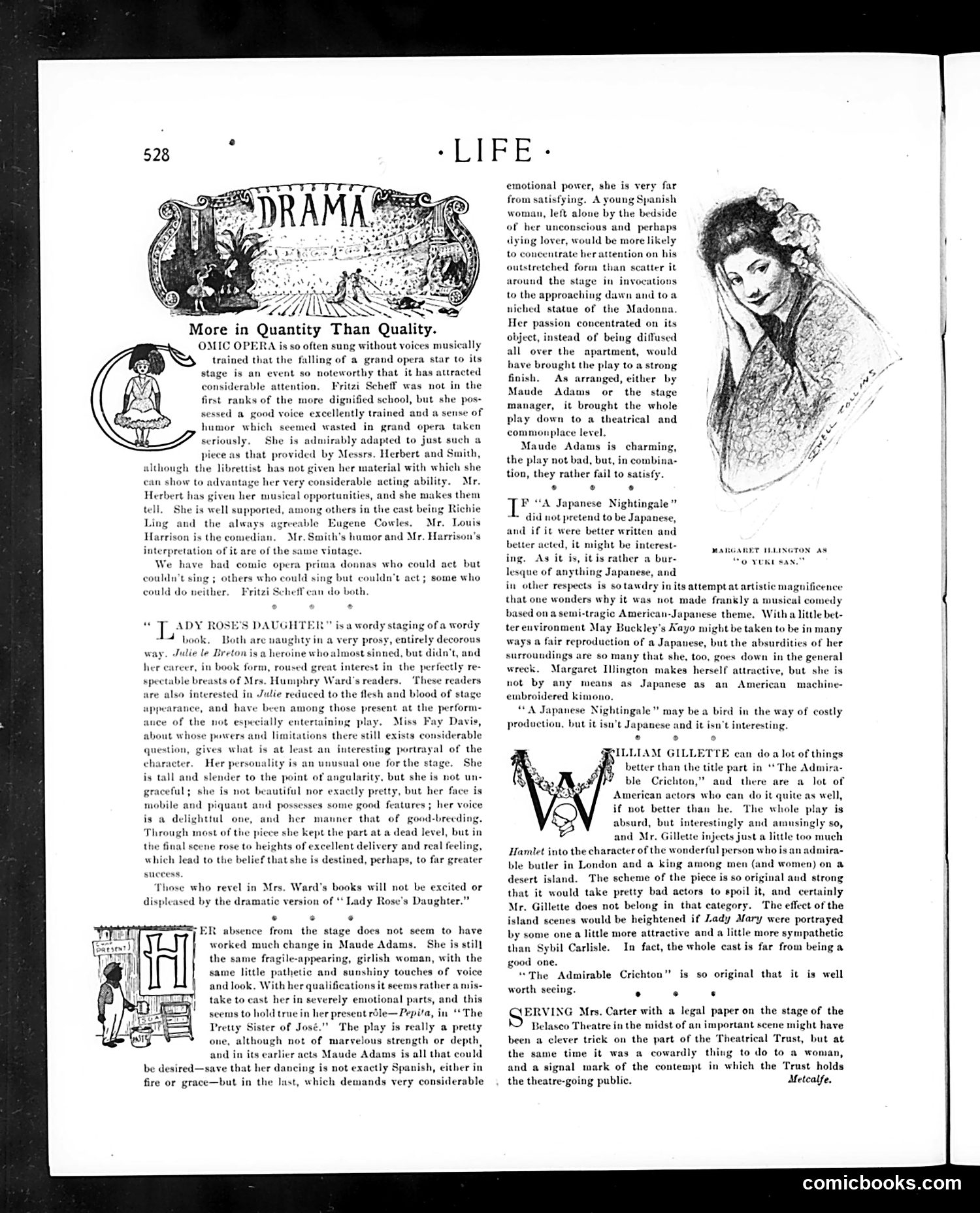
This page critiques early 20th-century operatic and theatrical productions. The "DRAMA" section discusses comic opera's tendency toward quantity over quality—specifically criticizing productions that rely on big-name stars rather than strong casting throughout. The cartoon (left, unlabeled) appears to mock theatrical pretension, though the specific reference is unclear from the image alone. The portrait of "Margaret Illington as 'Yuki San'" relates to critical commentary on Japanese-themed theater, where the text questions whether American productions of Japanese material (like "A Japanese Nightingale") achieve authentic artistry or merely trade in exotic aesthetic appeal. The reviews consistently argue that star power and novelty do not substitute for genuine theatrical quality and ensemble strength—a common satirical target of cultural criticism in this era.
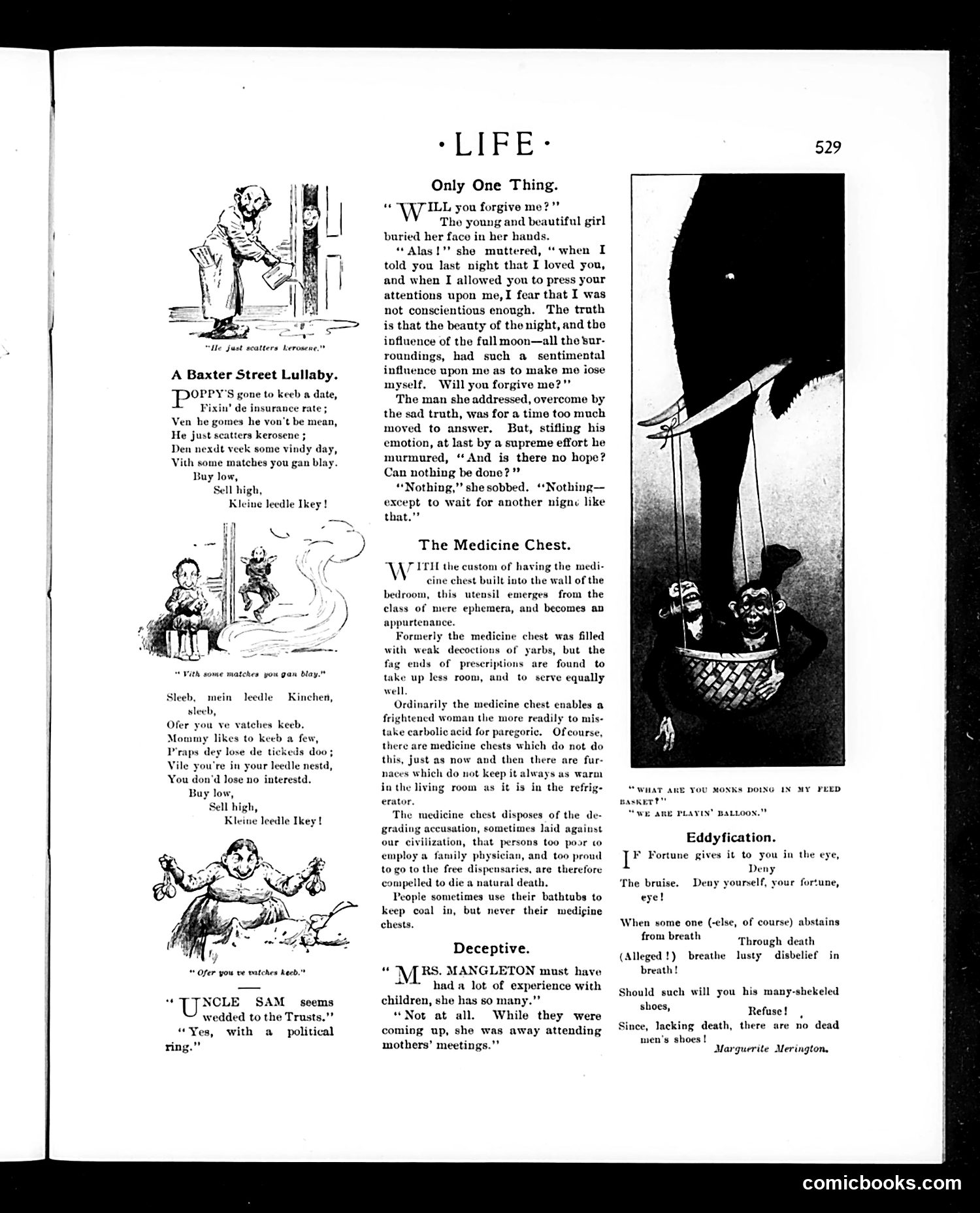
This page contains several satirical pieces targeting turn-of-the-century urban life: **"A Baxter Street Lullaby"** uses Jewish-immigrant dialect (stereotypical spelling like "Kleine leedle Ikey") to mock insurance fraud and arson. The "lullaby" instructs a child: buy insurance low, set fires with matches, collect profits—a dark joke about tenement fires plaguing immigrant neighborhoods, likely referencing actual insurance scams of the era. **"Only One Thing"** is romantic satire—a woman blames moonlight for her impropriety, then suggests waiting for another romantic night rather than committing to actual change or responsibility. The joke mocks sentimental excuses. **"The Medicine Chest"** humorously describes how built-in medicine cabinets enable misuse (confusing poisons), while also satirizing class inequality: the poor can't afford doctors and must self-treat with random prescriptions. **"Deceptive"** jokes that a woman with many children claims experience with children, but actually attended mothers' meetings instead—implying negligent parenting. The page reflects Gilded Age concerns: immigrant life, urban decay, class divisions, and consumer culture.
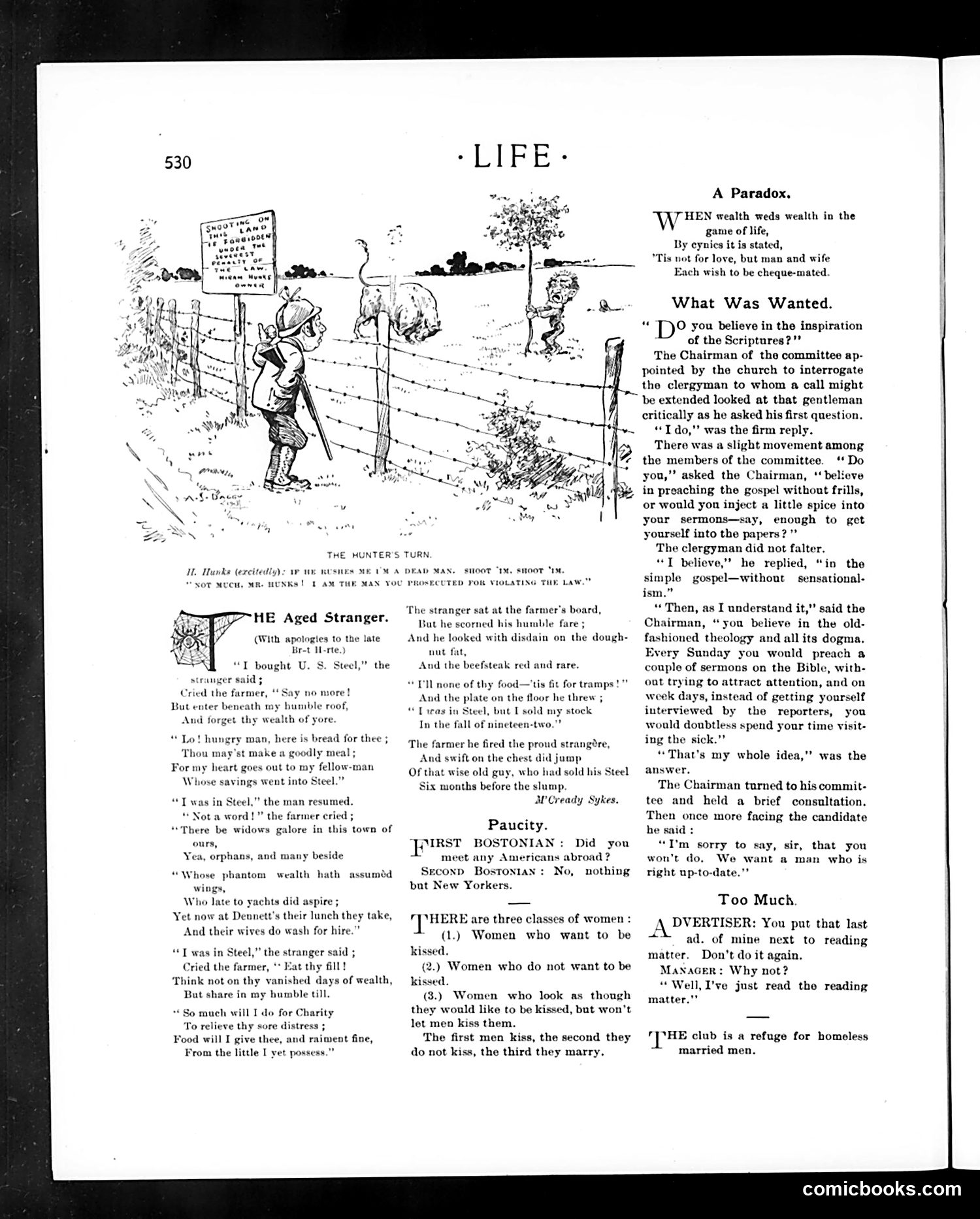
**"The Hunter's Turn"** (main cartoon): A farmer confronts a starving stranger who claims to have lost his wealth in Steel stock investments. The farmer offers charity, but the stranger disdainfully rejects the humble food. The farmer then assaults him—the caption reveals the "stranger" is actually a game warden the farmer had previously shot for trespassing. The satire mocks wealthy people who become destitute through bad investments (likely the 1902 steel market collapse referenced) yet maintain arrogant superiority while depending on others' charity. **"The Aged Stranger"** (poem): Reinforces this theme, describing a once-wealthy man who invested in steel and lost everything, now living in poverty while his former peers' wives do washing work for hire. **Other brief items**: Short satirical pieces about Boston snobbery, classifications of women, church hiring practices (wanting sensational preachers over traditional theology), and advertising complaints. The page reflects Progressive Era anxieties about wealth, charity, and economic vulnerability during industrial boom-bust cycles.
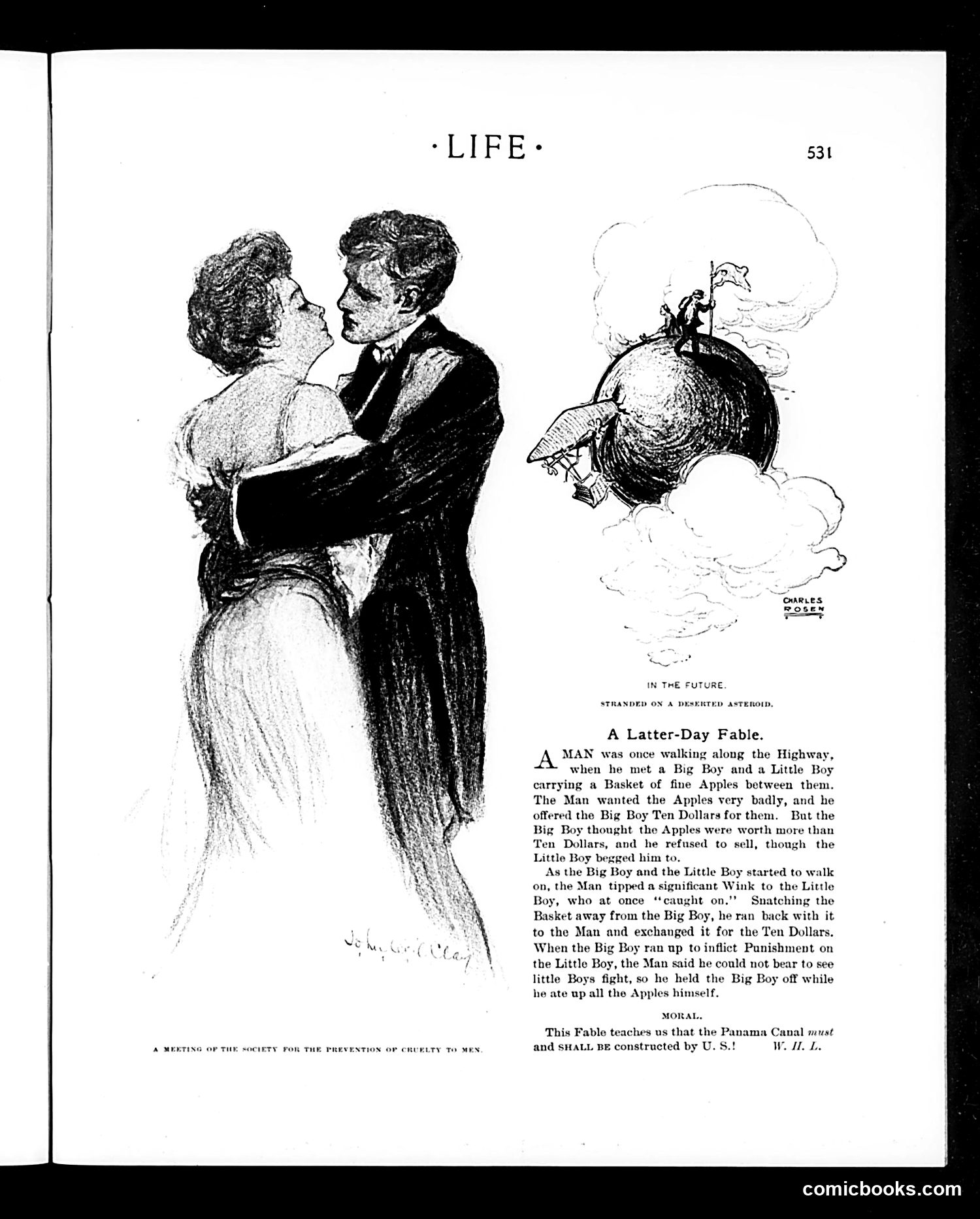
This satirical cartoon and fable from *Life* magazine uses an allegorical story to comment on American imperialism and the Panama Canal construction. **The figures represent:** - The "Man" = the United States - The "Big Boy" = Colombia (which owned Panama) - The "Little Boy" = Panama - The "Apples" = the canal rights **The satire:** The U.S. is portrayed as manipulative and self-serving. It exploits Panama's desire for independence from Colombia by encouraging separation, then seizes control of the canal project for itself—eating "all the Apples" while claiming moral superiority (preventing boys from fighting). The moral's conclusion sardonically asserts U.S. will shall construct the canal, acknowledging American imperial ambitions. **Historical context:** This likely references the 1903 Panama Canal negotiations, when the U.S. supported Panamanian independence from Colombia to gain canal construction rights—a controversial intervention that *Life* critiques through this fable as opportunistic and duplicitous.
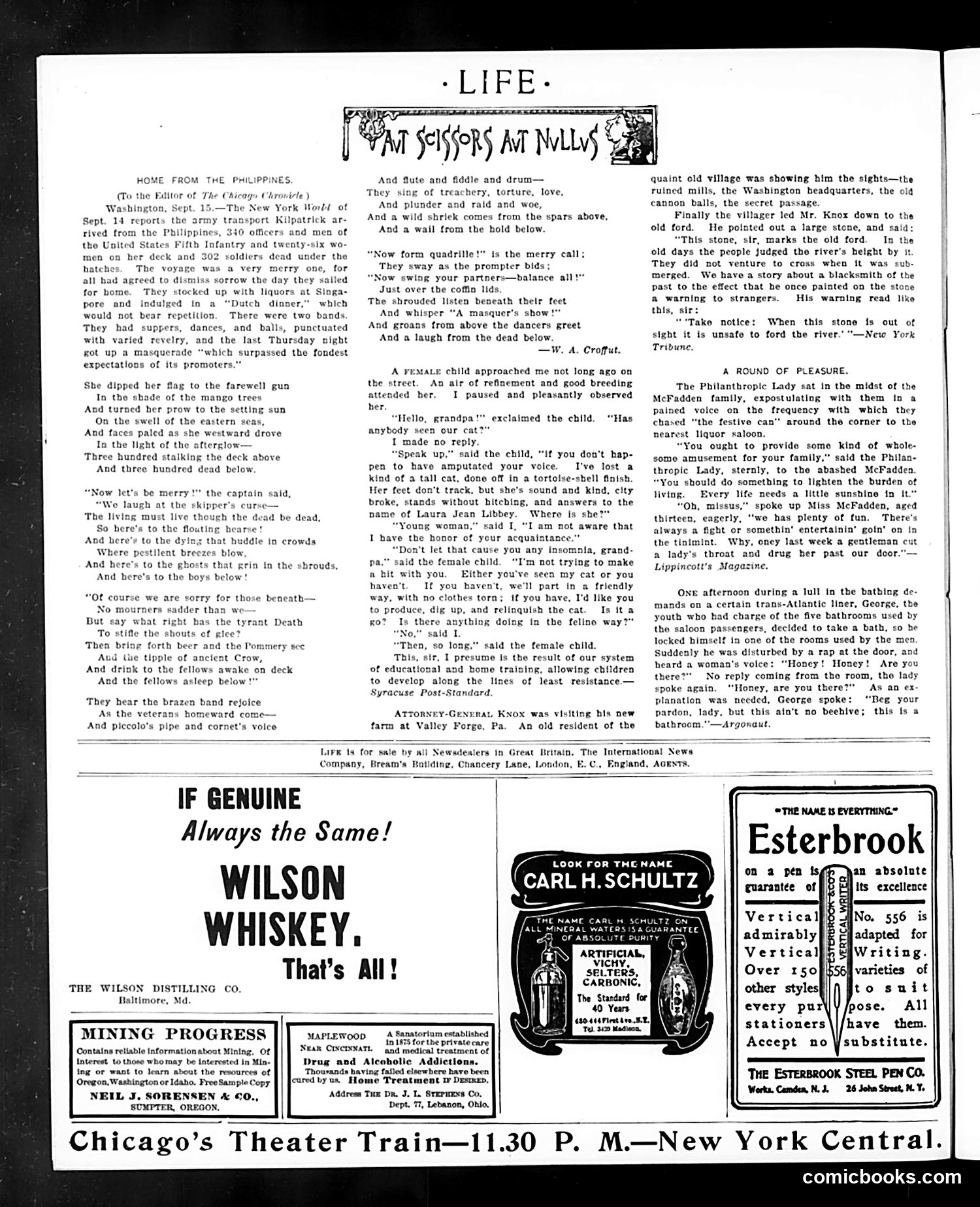
This page from *Life* contains a lengthy satirical poem criticizing the behavior of American soldiers returning from the Philippines. The main narrative describes a troop transport ship carrying 340 officers, 26 women, and crucially, **302 dead soldiers in the hold**. The satire's bitter point: while the living soldiers above deck celebrate with "suppers, dances, and balls" and masquerade balls, the dead lie beneath them. The poem juxtaposes festive gaiety ("Now let's be merry!" the captain says) against the grim reality of death during what was the Philippine-American War (1899-1902). The refrain "And here's to the boys below" sardonically toasts both the living partying and the dead below decks—suggesting the officers' unseemly celebration in light of significant casualties. This reflects *Life*'s anti-imperialist stance on American military involvement in the Philippines, critiquing both the war's human cost and what the magazine saw as moral indifference among military leadership. The secondary humorous piece about a precocious girl addresses unrelated social concerns about modern child-rearing.
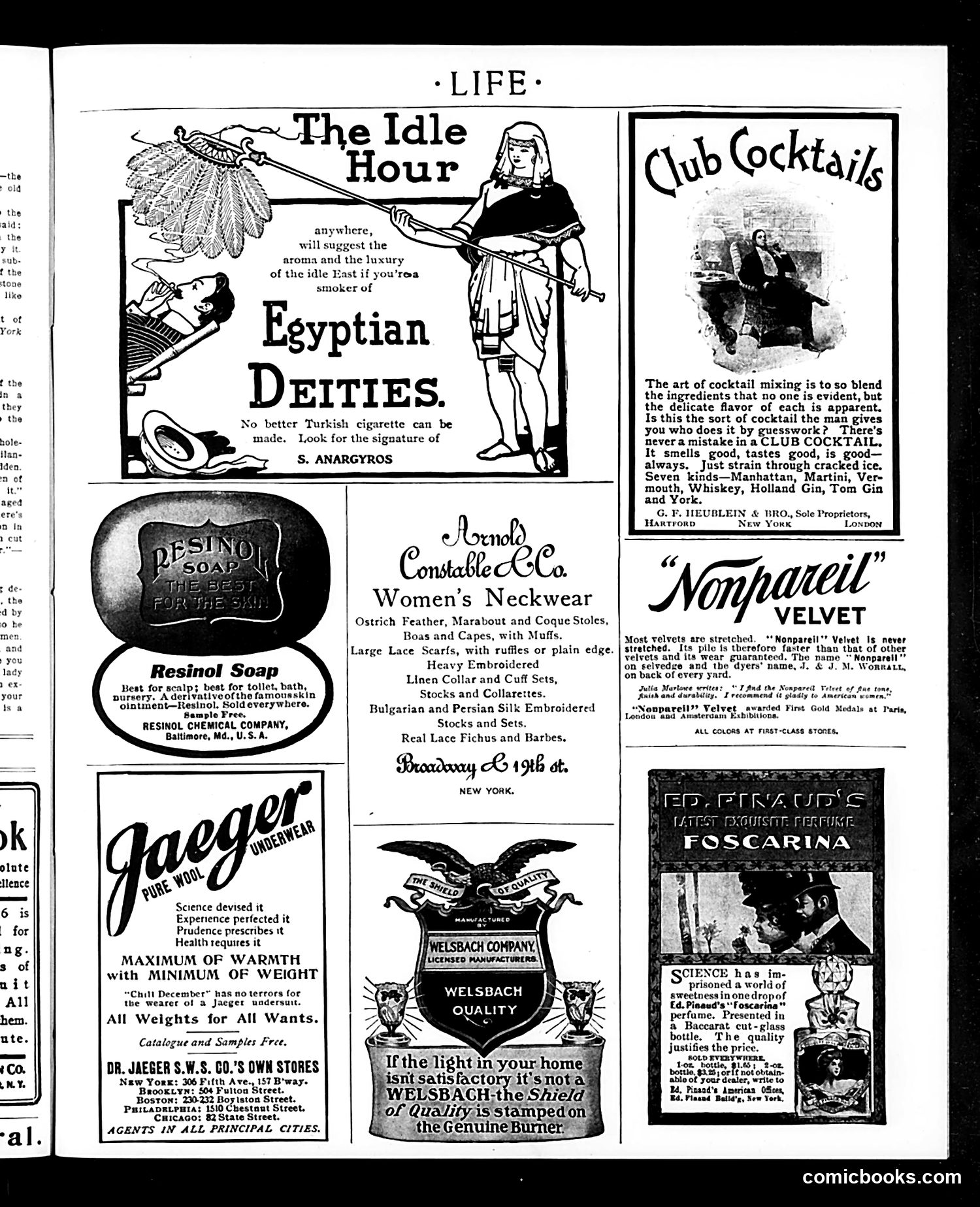
This page is primarily **advertising** rather than political satire. The main cartoon, "The Idle Hour," depicts a classical female figure (likely representing leisure or luxury) holding Egyptian cigarettes. It's a straightforward product advertisement for "Egyptian Deities" cigarettes by S. Anargyros, using Orientalist imagery—popular in early 20th-century marketing—to suggest exotic sophistication and relaxation. The surrounding advertisements (soaps, cocktail mixers, women's neckwear, perfume, underwear) represent typical Life magazine content from this era. There is **no apparent political satire or social commentary** on this page. Rather, it reflects period attitudes: the romanticization of "the East," gender-specific product marketing, and the association of consumption with refinement and leisure that characterized early 1900s American advertising culture.
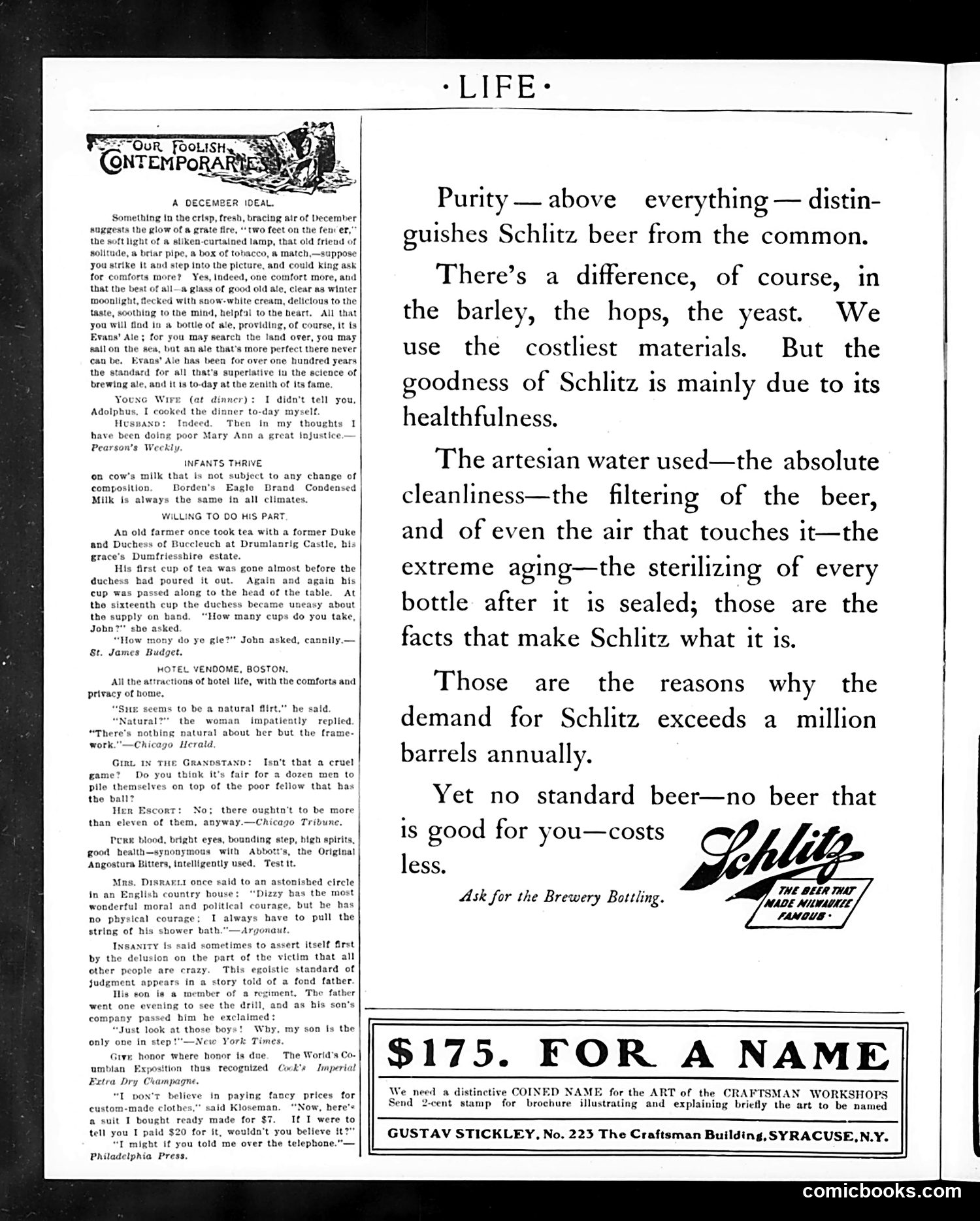
This page combines satirical humor with advertising. The left column features "Our Foolish Contemporaries"—short comic anecdotes mocking human behavior: - A young wife justifiably complains her husband cooked dinner poorly - A farmer attending a duchess's tea drinks sixteen cups, revealing his lack of refinement - A man at a ball game defends his son as the only one "in step" while surrounded by teammates These vignettes satirize social pretension, obliviousness, and class confusion typical of Life's humor. The right side advertises **Schlitz beer**, emphasizing "purity" and "healthfulness" through detailed claims about filtered water, sterilized bottles, and aging processes. This reflects early 1900s marketing that positioned beer as a health product. A separate ad at bottom offers $175 for a distinctive coined name for "Craftsman Workshops," suggesting Arts and Crafts movement interest. The overall page mixes satirical social commentary with era-specific consumer advertising.
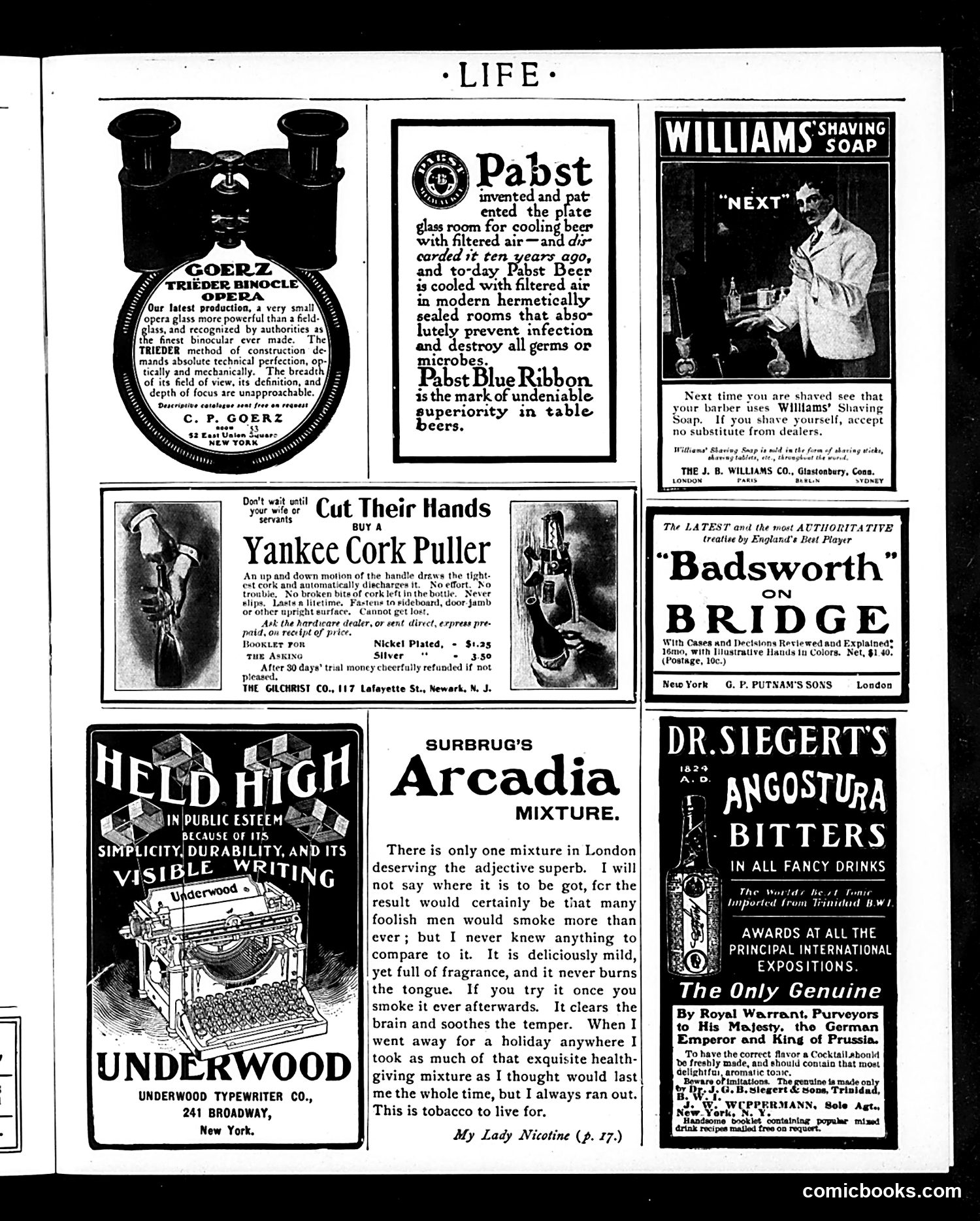
This is primarily an **advertising page** from Life magazine, not a political cartoon. It features various product advertisements typical of the early 20th century, including: - **Goerz Trieder Binocle Opera Glass** — marketed as superior optical technology - **Pabst Beer** — emphasizing modern sanitation (filtered air cooling rooms) - **Williams' Shaving Soap** — with testimonial advertising - **Yankee Cork Puller** — a practical household device - **Underwood Typewriter** — promoting the machine's visible writing and durability - **Surbrug's Arcadia Mixture** (tobacco) — with a literary quote from *My Lady Nicotine* - **Dr. Siegert's Angostura Bitters** — claiming royal patronage and international awards The ads reflect **turn-of-century consumer culture** emphasizing technological innovation, hygiene, and aspirational status. The reference to royal warrants and international expositions suggests marketing to an educated, affluent readership. No satire or political commentary is evident — this is straightforward commercial promotion.
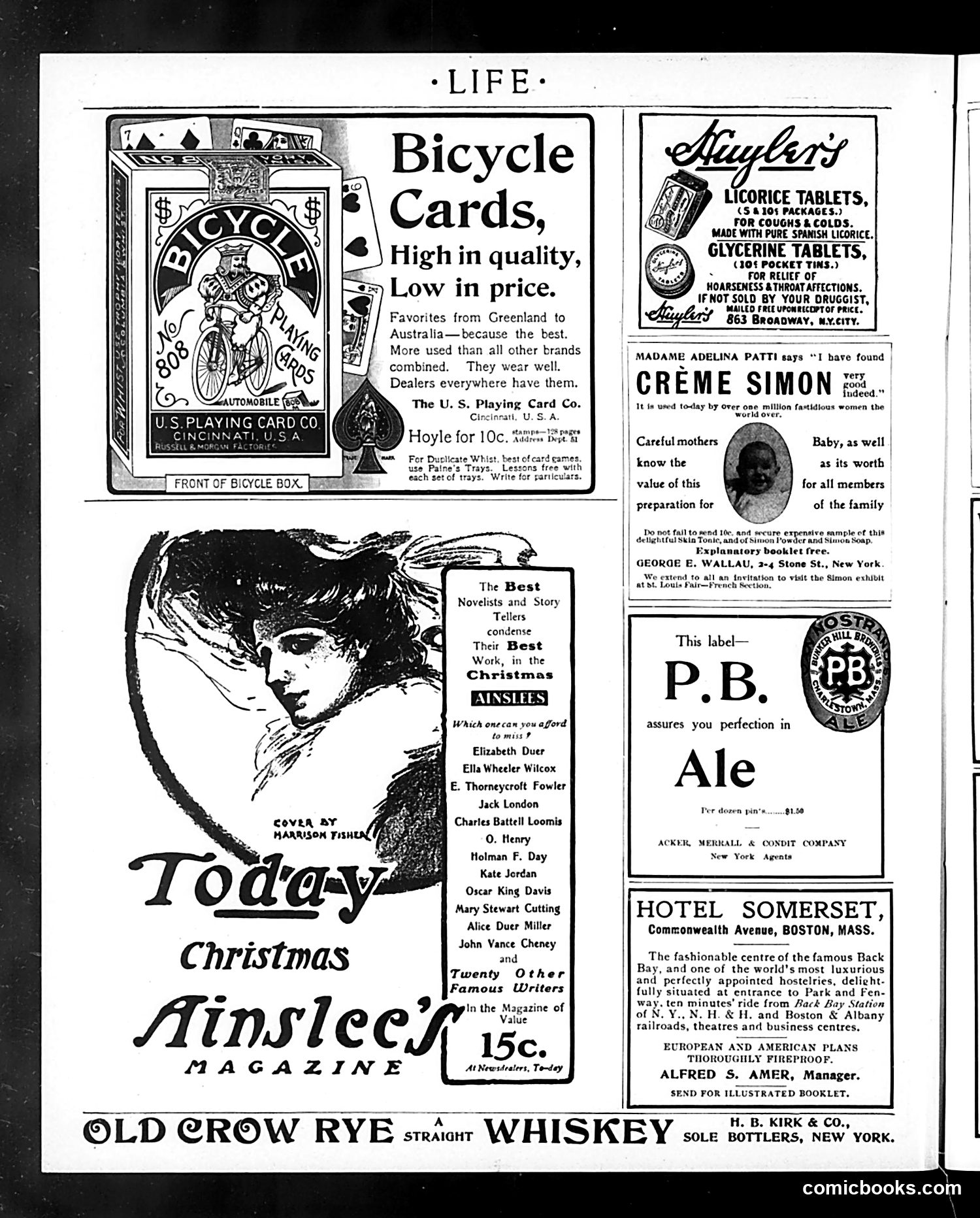
This is primarily an **advertising page** rather than satirical content. It contains multiple product advertisements typical of early 20th-century magazines: **Key advertisements include:** - **Bicycle Playing Cards** (top left) — marketed as superior quality at low cost - **Ainslees Magazine** (center) — promoting its Christmas issue featuring famous authors like O. Henry, Jack London, and Ella Wheeler Wilcox - **Beauty/health products** — Stuyler's licorice tablets, Crème Simon (a cosmetic used by opera singer Madame Adelina Patti), and glycerine tablets - **P.B. Ale** — beer advertisement - **Hotel Somerset** (Boston) — luxury hotel promotion - **Old Crow Rye Whiskey** (bottom) The page reflects early 1900s consumer culture and advertising conventions. The "Today" cartoon illustration appears to be a magazine cover promoting Ainslees' Christmas issue. There is **no political satire** evident on this page—it's straightforward commercial advertising designed to reach affluent readers.
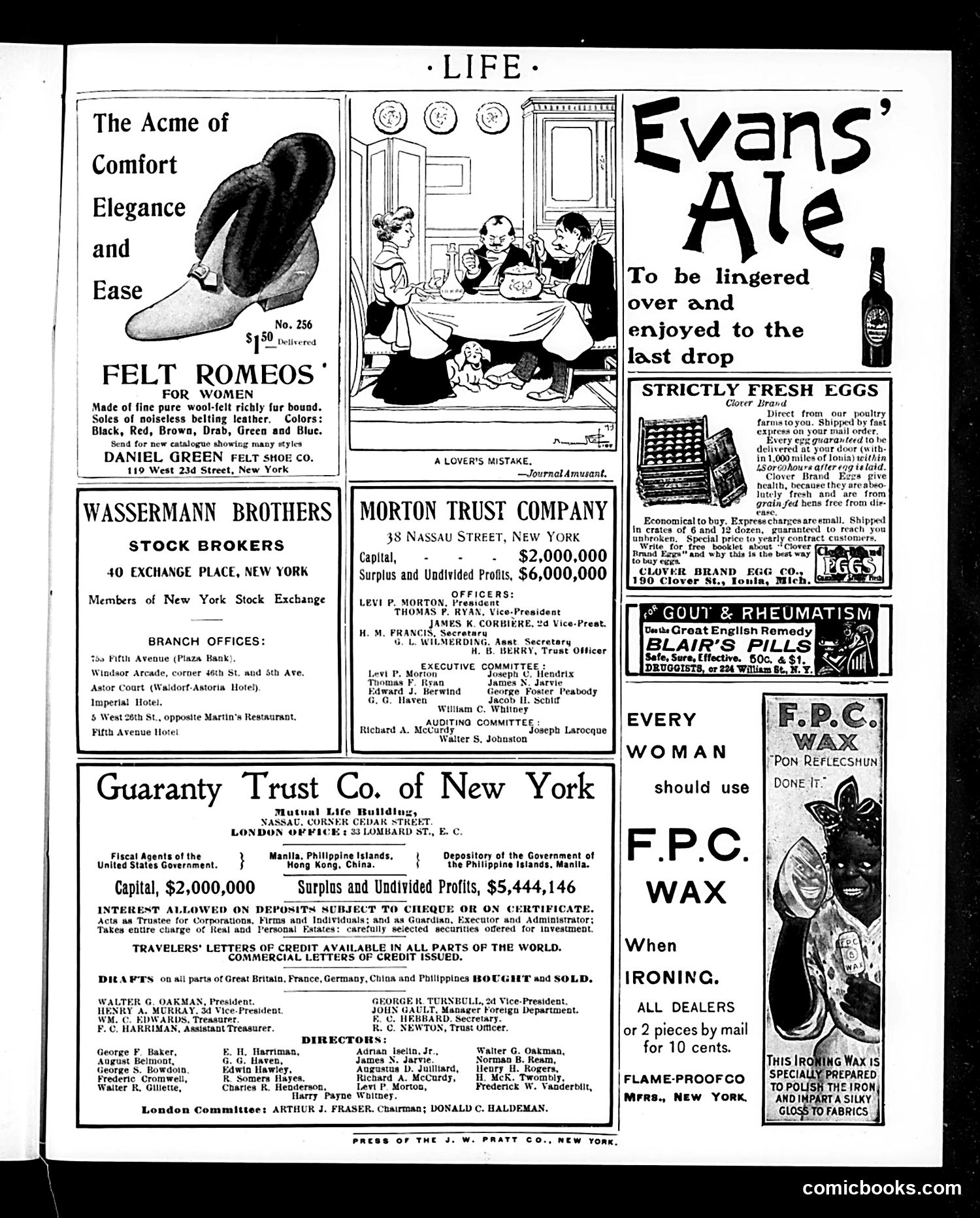
This page is primarily **advertising**, not editorial content or political satire. It contains financial institution ads (Morton Trust Company, Guaranty Trust Co., Wassermann Brothers stock brokers) alongside consumer product advertisements (felt shoes, Evans' Ale, eggs, and F.P.C. Wax). The only cartoon present is small, titled "A LOVER'S MISTAKE" (credited to *Journal Amusant*), depicting a domestic scene where a man appears to be caught in an awkward situation with a woman and child—likely depicting infidelity or marital indiscretion, a common satirical subject of the era. The ads reflect early 20th-century consumer culture: banking services for wealthy investors, women's fashion, home products, and mail-order food delivery. The page serves as a revenue source through advertising rather than as political commentary or satire.
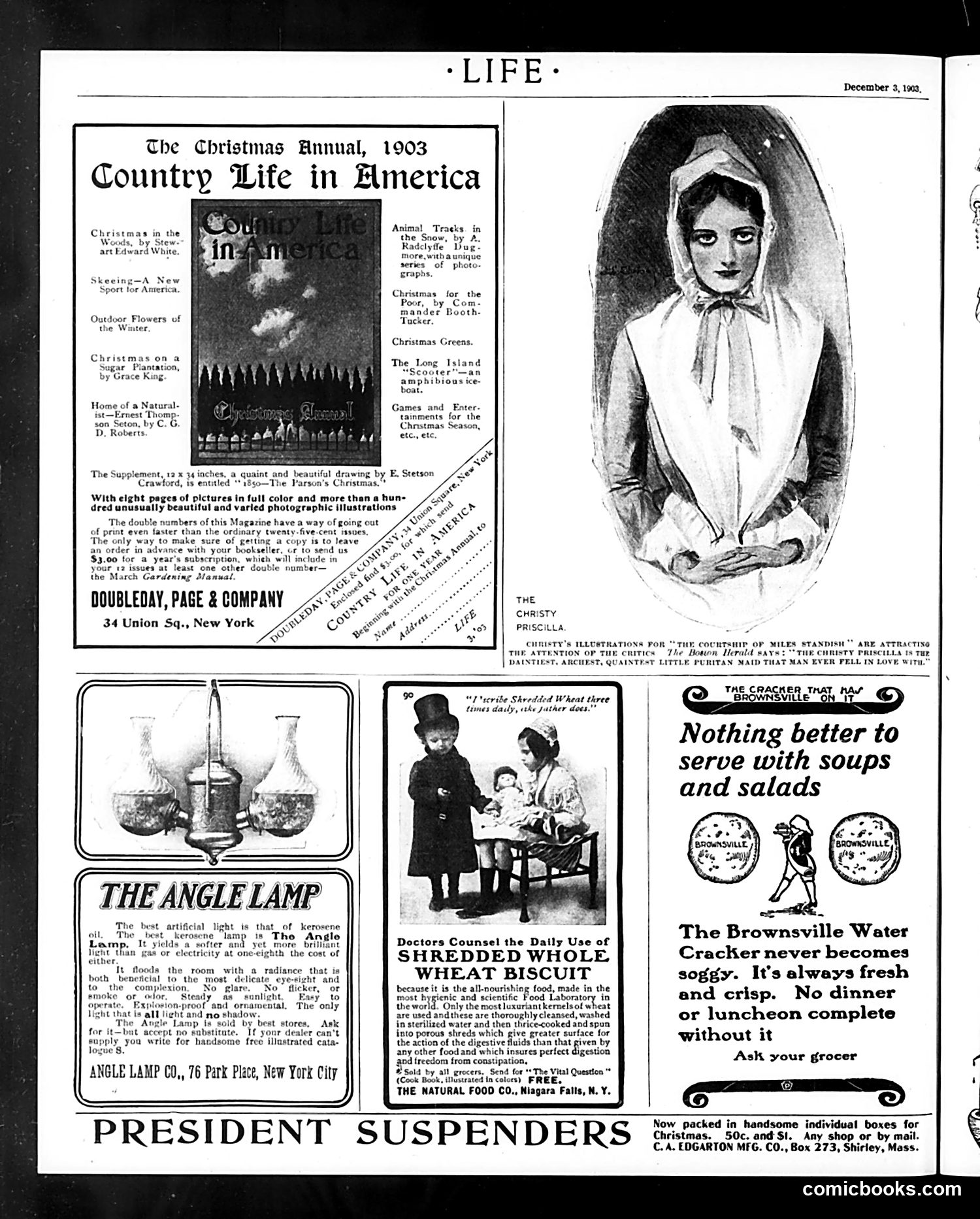
This is primarily a **Christmas Annual advertising and content page**, not a political cartoon. The page announces Life's special holiday issue featuring country life themes, with articles on Christmas traditions, outdoor activities, and seasonal content. The main content includes: 1. **"The Christy Priscilla"** - A portrait illustration of a young woman in a bonnet, promoted as embodying an idealized American type 2. **Product advertisements** for consumer goods: - The Angle Lamp (kerosene lighting) - Shredded Whole Wheat Biscuit (health food) - Brownsville Water Cracker (food product) - President Suspenders (clothing) These ads reflect early 1900s consumer culture emphasizing modern conveniences, health-conscious eating, and practical goods. The page represents Life magazine's dual function as both satirical publication and vehicle for advertising upscale products to its middle-class readership.