
Life, 1903-12-03 · page 12 of 22
Life — December 3, 1903 — page 12: what you’re looking at
What you’re looking at
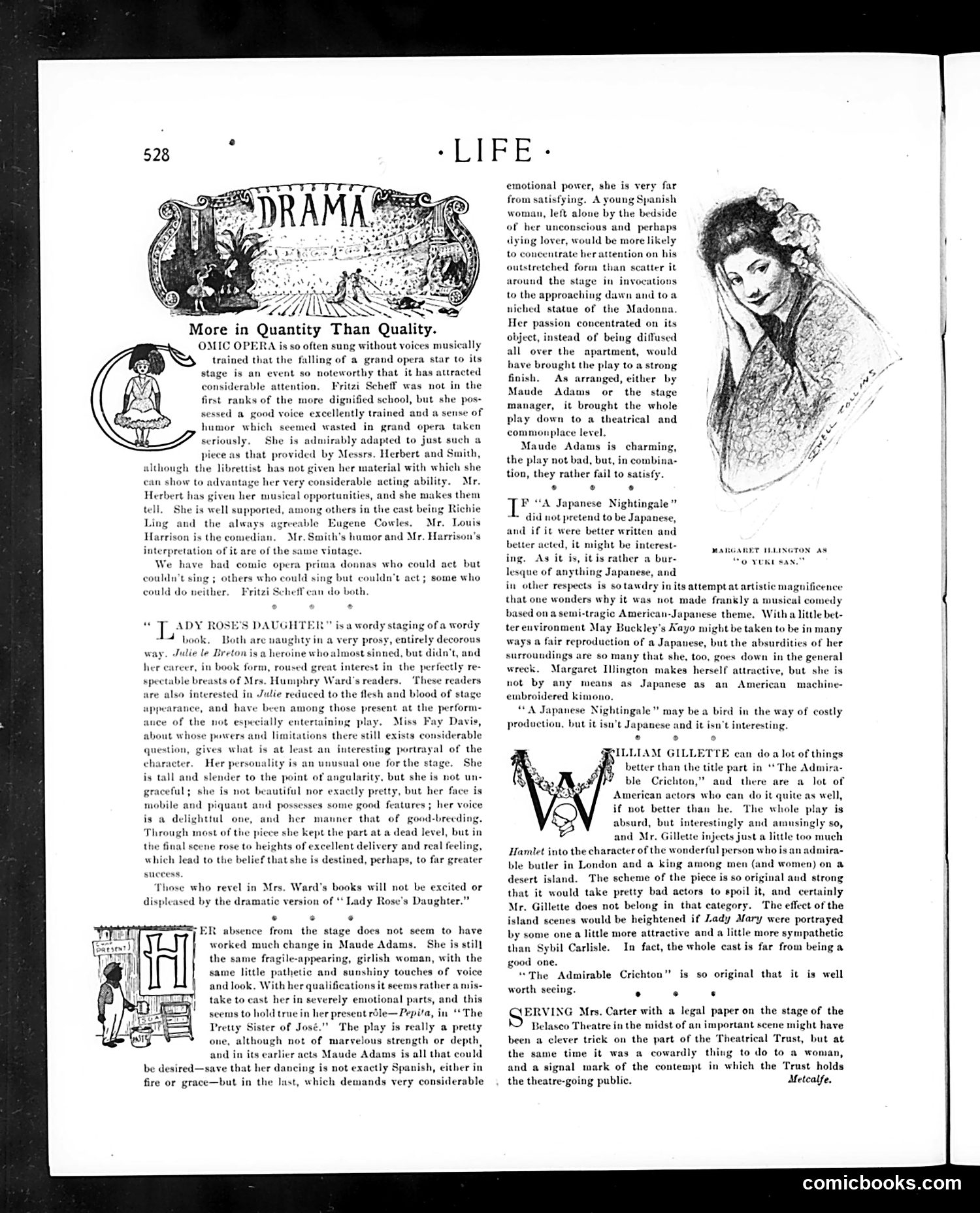
This page critiques early 20th-century operatic and theatrical productions. The "DRAMA" section discusses comic opera's tendency toward quantity over quality—specifically criticizing productions that rely on big-name stars rather than strong casting throughout. The cartoon (left, unlabeled) appears to mock theatrical pretension, though the specific reference is unclear from the image alone. The portrait of "Margaret Illington as 'Yuki San'" relates to critical commentary on Japanese-themed theater, where the text questions whether American productions of Japanese material (like "A Japanese Nightingale") achieve authentic artistry or merely trade in exotic aesthetic appeal. The reviews consistently argue that star power and novelty do not substitute for genuine theatrical quality and ensemble strength—a common satirical target of cultural criticism in this era.
📄 Transcribed text from this page (OCR, searchable)
Machine-transcribed from the original scan — historical spelling and the odd misread are preserved.
More in Quantity Than Quality. OMIC OPERA is so often sung without voices musically ed that the falling of a grand opera star to its t so noteworthy that it has attracted nsides Fritzi Scheff was not in the first ranks of the more dignified school, but she pos- sessed a good voice excellently trained and a sense of humor which seemed wasted in grand opera taken seriously. She is admirably adapted to just such a 1 ded by Messrs. Herbert and Smith, although the librettist has not given her material with which she can show to advantage her very considerable acting ability. Mr. Herbert has given hee musical opportunities, and she makes them tell, She is well supported, among others in the cast being Richie Ling and the always agreeable Eugene Cowles. Mr. Louis Harrison is the comedian. Mr. Smith's humor and Mr. Harrison's interpretation of it are of the same vintage We have bad comic opera prima donnas who could act but others who could sing but some who Fritzi Scheff can do both ge is an eve tention. eas that pro couldn't sing wldn't act could do neither. ADY ROSE'S DAUGHT s a wordy staging of a wordy \ Both are naughty in a very prosy, entirely decorous Julie le Breton isa heroine whoalmost sinned, but didn't, and her ear iterest in the perfectly re- sts of Mrs. Humphry Ward’s readers, interested in Julie reduced to the flesh and blood of stage and have been among those present at the perform- f the not especially entertaining play. Miss Fay Davis, ut whose powers and limitations there still exists cons r, in book form, roused great spectable bre These readers are als ppearan ane erable question, gives what is at least an interesting portrayal of th for the stage. Shi . but she isn etty, but her features ; her voice ner that of good-breeding. Through most of the piece she kept the part at a dead level, but i the final scene rose to heights of excellent delivery and real feeling, which lead to the belief that she is destined, perhaps, to far greater haracter. is tall and slender to the point of angularit she is not beautiful nor exactly p mobile and piquant a Her persouality is an unusual on graceful id possesses some goo is a delighttul one, and her m Those who revel in Mrs, Ward's books will not be excited or displeased by the dramatic version of Lady Rose's Daughter.” ER absence from the stage docs not seem to have 4 worked much change in Maude Adams. She is still T the same fragile-appearing, girlish woman, with th ! same little pathetic and sunshiny touches of voice and look. With her qualifications it seems rather a mis take to cast her in severely emotional parts, and this or present role—Pepi'a, in The Pretty Sister of José.” The play is really a pretty one, although not of mar strength or depth, and in its earlier acts Maude Adams is all that could be desired—save that her dancing is not exactly Spanish, either in fire or grace—but in the last, which demands very considerable seems to hold true inh -LIFE- emotional power, she is very far from satisfying. A young Spanish woman, left alone by the bedside of her unconscious and perhaps dying lover, would be more likely to concentrate her attention on his outstretched form than scatter it around the stage in invocations to the approaching dawn and toa niched statue of the Madonna Her passion concentrated on its object, instead of being diffused all over the apartment, would have brought the play to a strong finis As arranged, either by Maude Adams or the stage manager, it brought the whole down to a theatrical and monplace level. Maude Adams is charming, the play not bad, but, in combina- tion, they rather fail to satisfy. ° ° ° L “A Japanese Nightingale” did not pretend to be Japanese, and if it were better written and better acted, it might be interest- ing. As it is, itis rather a bur- lesque of anything Japanese, and in other respects is so tawdry in its attemptat artistic that one wonders why it was not made based ona semi-tragic American-Japane ter environment May Buck] RGARET HLLINGTON As © YURI san. agnificence ranly a musical comedy ¢ theme, Witha little bet- s Kayo might be taken to be in many ways a fair reproduction of a Japanese, but the absurdities of her surroundings are so many that she, too, goes down in the general wreck. Margaret Illington makes herself attractive, but she is not by any means as Japanese as an American machine- embroidered kimono. “A Japanese Night productio gale” may be a bird in the way of costly . but it isn’t Japanese and it isn’t interesting ° ° ° ILLIAM GILLETTE can do a lot of things better than the title part in “The Adm) ble Crichton,” aud there are a lot of American actors who can do it quite as well, if not better than he. The whole play is absurd, but interestingly and amusingly so, and Mr, Gillette injects just a little too much Hamlet into the character of the wonderful person who is an admira- ble butler in London and a king among men (and women) on a desert island. The scheme of the piece is so original aud strong that it would take pretty bad actors to spoil it, and certainly Mr. Gillette does not belong in that category. The effect of the land scenes would be heightened if Lady Mary were portrayed by some one a little more attractive and a little more sympathetic than Sybil Carlisle. In fact, the whole cast is far from being a good one. “The Admirable Crichton” is so original that it is well worth seeing. . ° . ERVING Mrs. Carter with a legal paper on the stage of the Belasco Theatre in the midst of an important scene might have been a clever trick on the part of the Theatrical Trust, but at the same time it was a cowardly thing to do to a woman, and a signal mark of the contempt in which the Trust holds the theatre-going public. Metcalfe, comicbooks.com