
A complete issue · 20 pages · 1903
Life — November 26, 1903
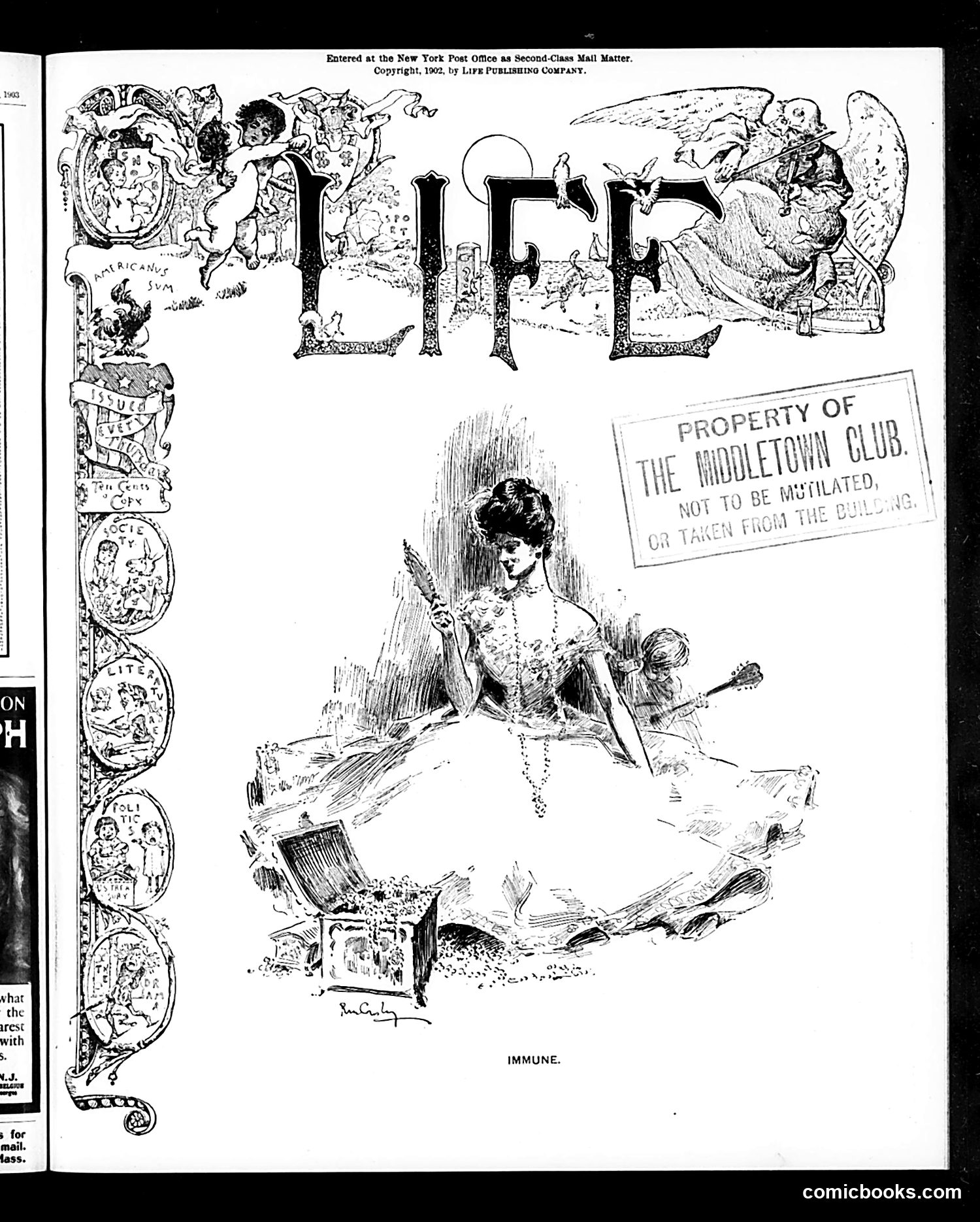
This page features decorative Art Nouveau borders and the title "LIFE" in elaborate lettering. The central illustration, labeled "IMMUNE," depicts a fashionably dressed woman wielding weapons (sword and rifle) amid destruction and debris, suggesting martial prowess or invulnerability. The library stamp indicates this was property of the Middletown Club. The ornate left border contains classical medallions with various figures and scenes. Without additional context or caption text visible, the specific political reference remains unclear. However, the "immune" title combined with the armed female figure suggests satire about either women's rights, military preparedness, or protection from some contemporary threat—likely referencing early 1900s American political or social debates.
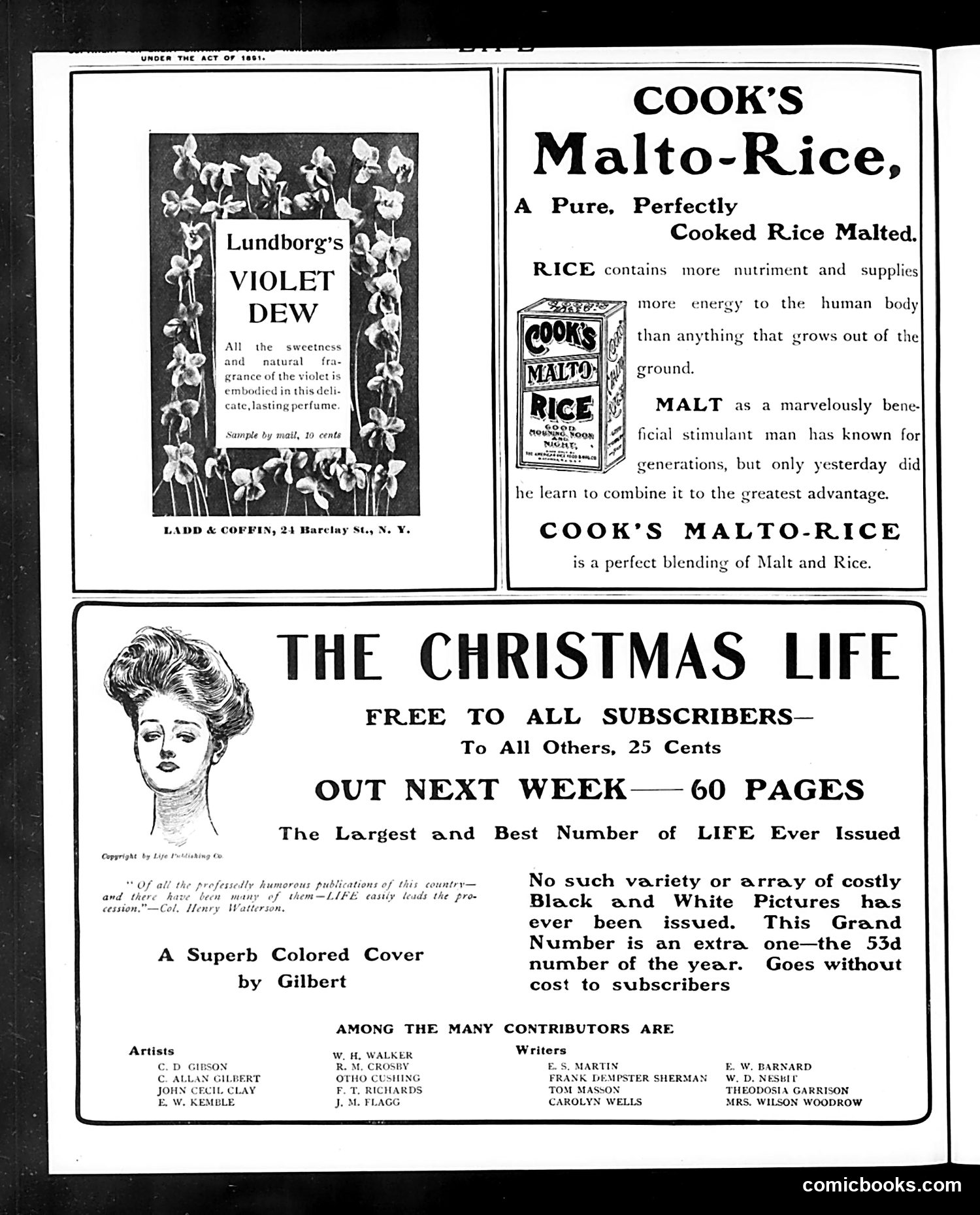
This page contains **advertisements rather than political cartoons**. The three ads are: 1. **Lundborg's Violet Dew** perfume — marketed as capturing "the sweetness and natural fragrance of the violet," available by mail for 50 cents. 2. **Cook's Malto-Rice** — a nutritional product combining malt and rice, claiming superior nutrient content and energy benefits compared to other foods. 3. **The Christmas Life** — promoting an upcoming special 60-page holiday issue of *Life* magazine (priced free to subscribers, 25 cents otherwise), featuring a colored cover illustration by Gilbert and contributions from notable artists and writers of the era. No satire or political commentary is present on this page.
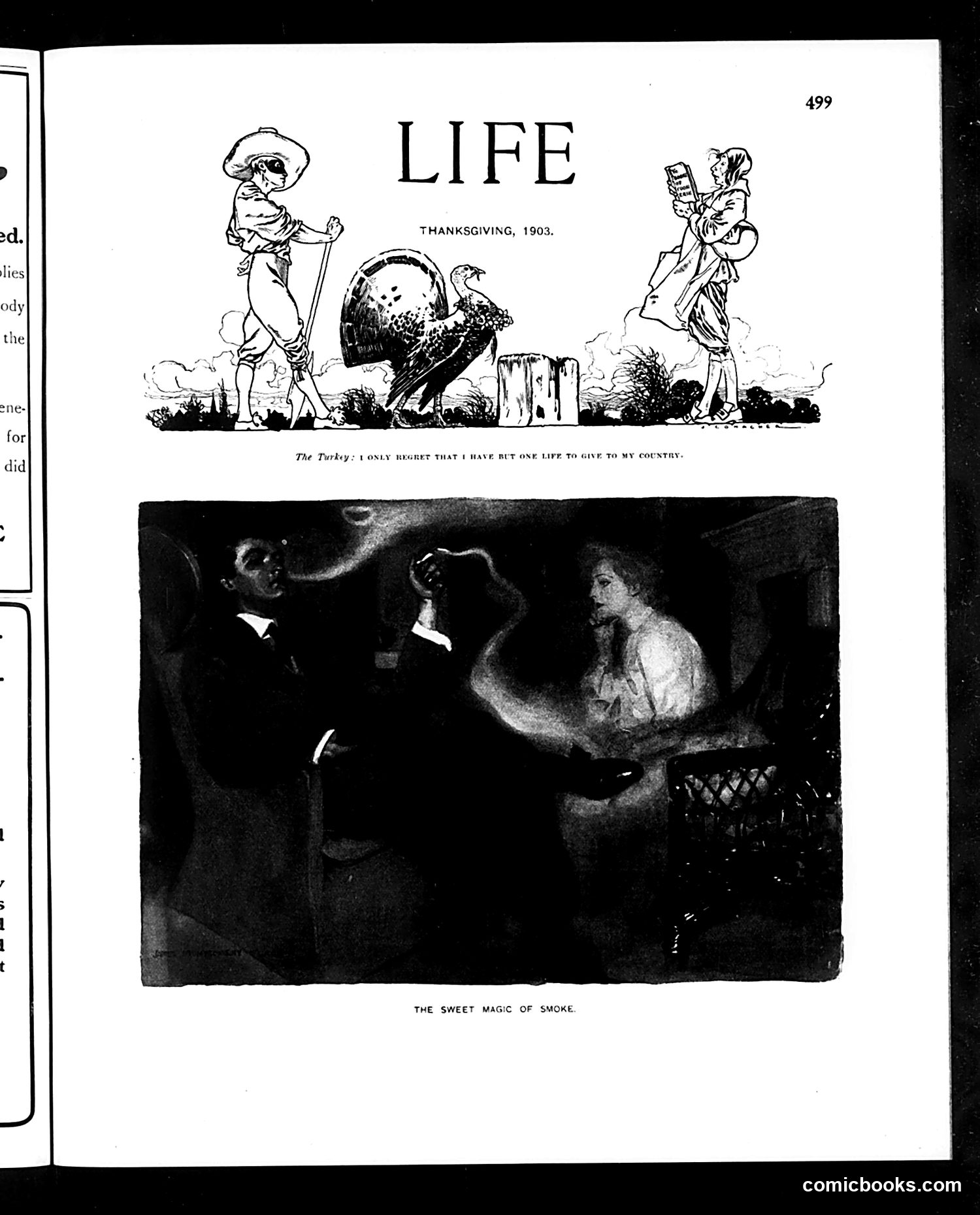
**Top Cartoon:** "The Turkey: I only regret that I have but one life to give to my country." This patriotic parody depicts a turkey facing two armed hunters. The turkey's final words reference Nathan Hale's famous Revolutionary War declaration ("I only regret that I have but one life to give to my country"). The satire treats the holiday's traditional meal with mock-heroic solemnity, humorously elevating the turkey to patriotic martyr status. **Bottom Image:** "The Sweet Magic of Smoke" This darker photograph shows figures in what appears to be an indoor social scene, likely depicting cigar or cigarette smoking. Without additional context, its specific satirical meaning is unclear—it may reference smoking culture or social pretension among the leisure class.
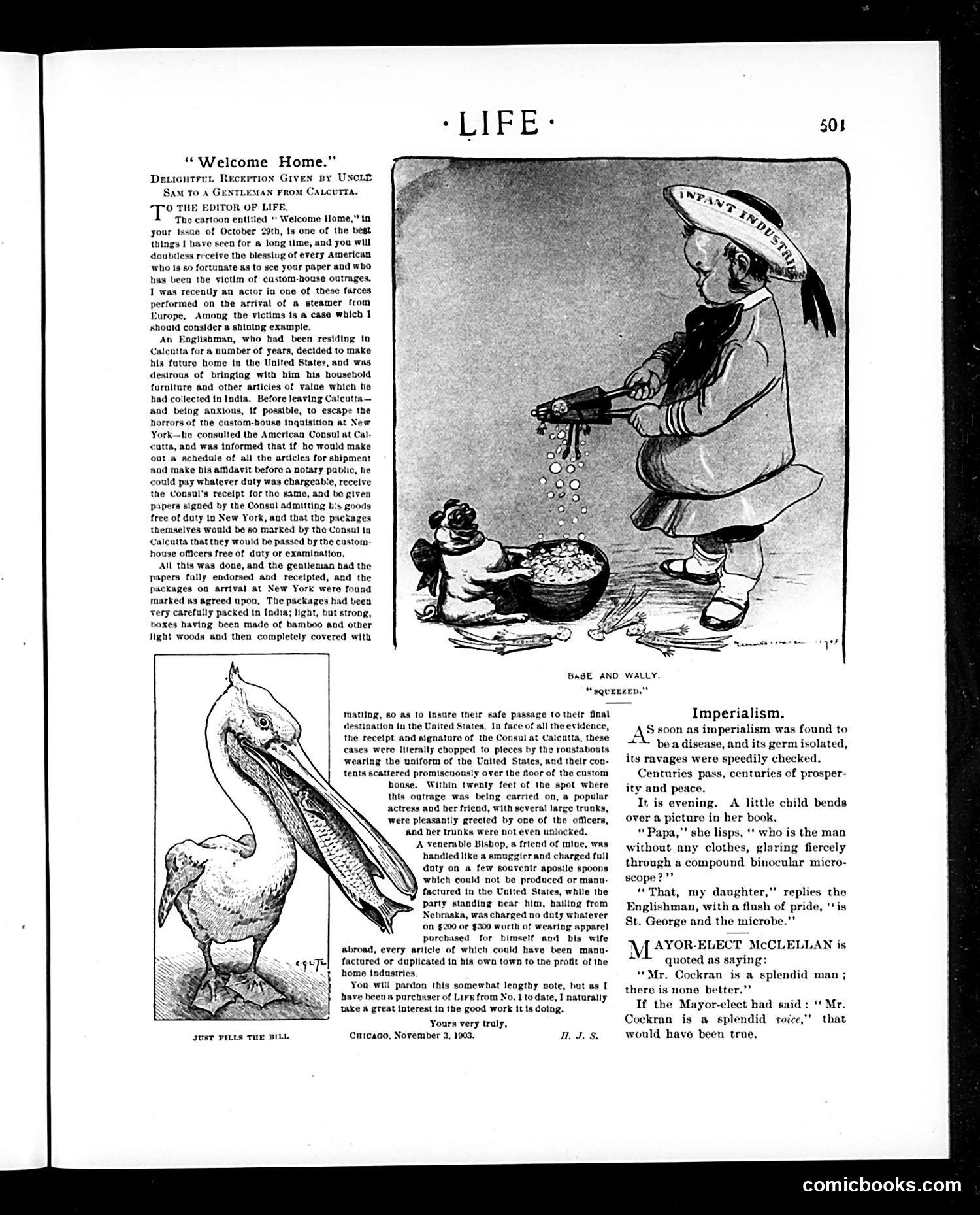
**"Welcome Home" cartoon (top):** This depicts an Englishman returning from Calcutta with household goods and furniture. The satire concerns customs duties and bureaucratic procedures at New York's port. The cartoon illustrates the absurdity of importing goods through official channels—the man must navigate complex paperwork, potential duty charges, and inspections, with packages scrutinized by customs officers. The joke critiques inefficient customs procedures that could damage goods or delay shipments. **"Just Fills the Bill" (bottom left):** An anatomical caricature of what appears to be a pelican or similar bird, likely a visual pun or naturalist satire. **"Imperialism" section (right):** A brief moral commentary on imperialism's decline, paired with anecdotes about British pride and Mr. Cockran's voice, suggesting contemporary political discussion about empire and national character.
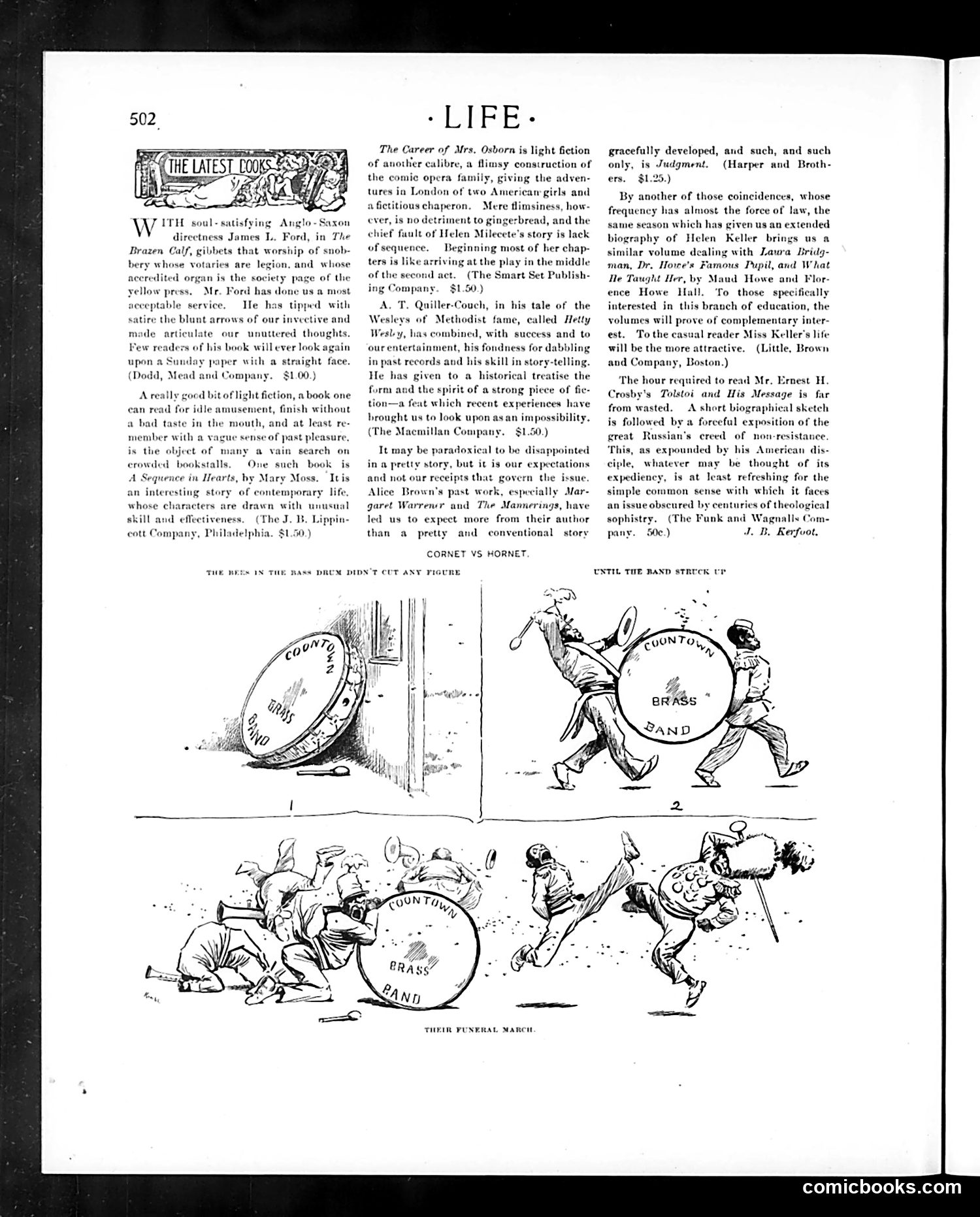
This page contains book reviews in the "Latest Books" section, not political cartoons. The three cartoon panels below the text are humorous illustrations accompanying a joke about a brass band rather than political satire. The cartoons show the "Coontown Brass Band" in sequence: (1) their drum sits unused against a wall, (2) band members rush to grab it, and (3) labeled "Their Funeral March," they chaotically carry the drum in a disorderly procession. The joke plays on the band's incompetence and the funeral march's association with solemn ceremony—here depicted as chaotic slapstick. The term "Coontown" reflects period racial stereotyping common in early 1900s American humor magazines, though the satire targets the band's musical ineptitude rather than making a specific political point.
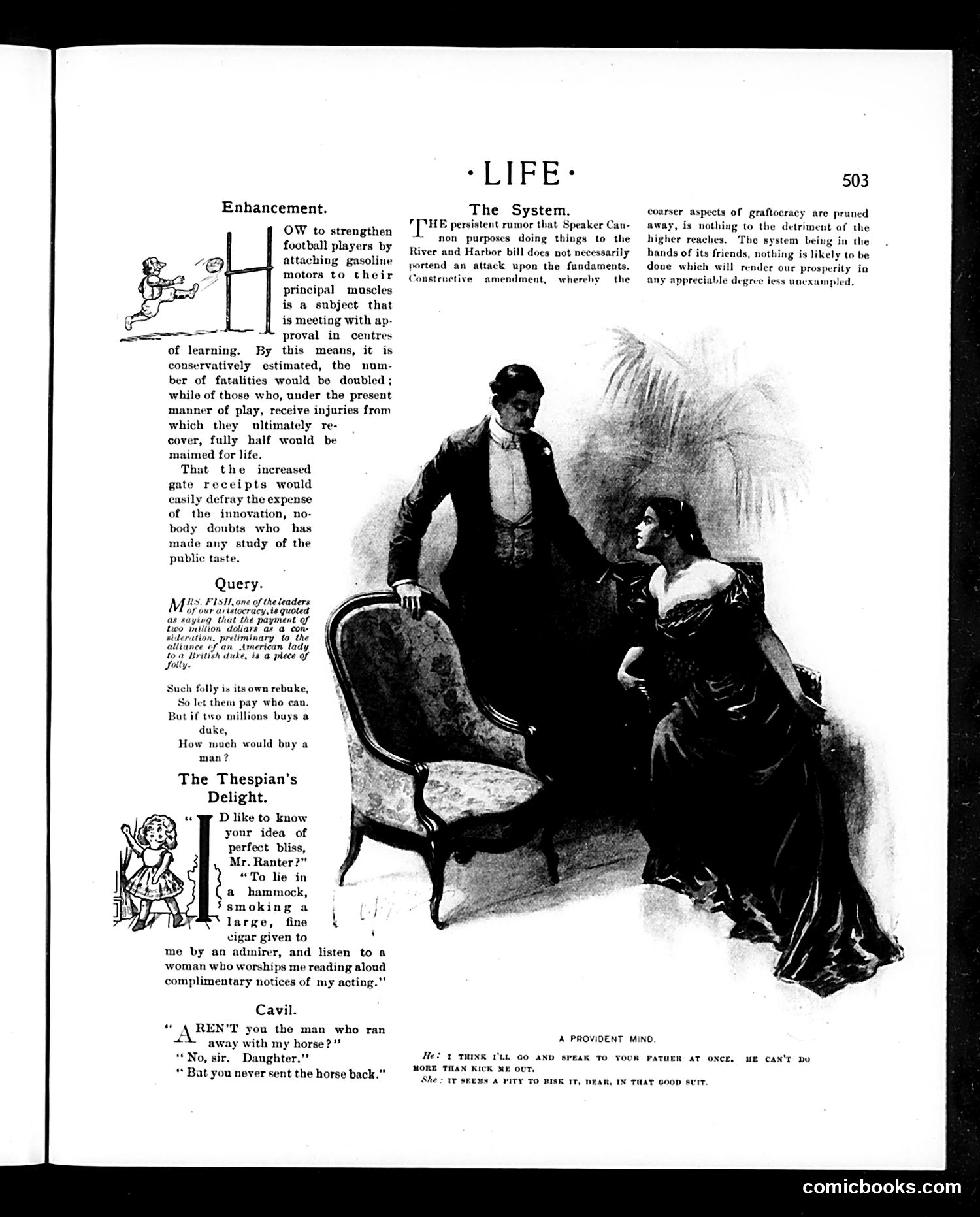
This page contains three separate satirical pieces: 1. **"Enhancement"** critiques attaching gasoline motors to football players to strengthen them—absurdist satire on overcommercialization of college sports. 2. **"The System"** mocks Speaker Cannon's defense of the River and Harbor Bill, suggesting corrupt politicians hide their schemes "in the hands of his friends" while claiming respectability. 3. **"The Thespian's Delight"** ridicules an actor's definition of "perfect bliss": smoking expensive cigars while receiving compliments from admirers and female admirers reading favorable reviews. It satirizes theatrical vanity and ego. 4. **"Cavil"** presents a brief dialogue joke about a runaway horse—the daughter complains the man never returned her horse, and he replies he never sent it back either. The page uses humor to critique excess, corruption, and vanity in American society.
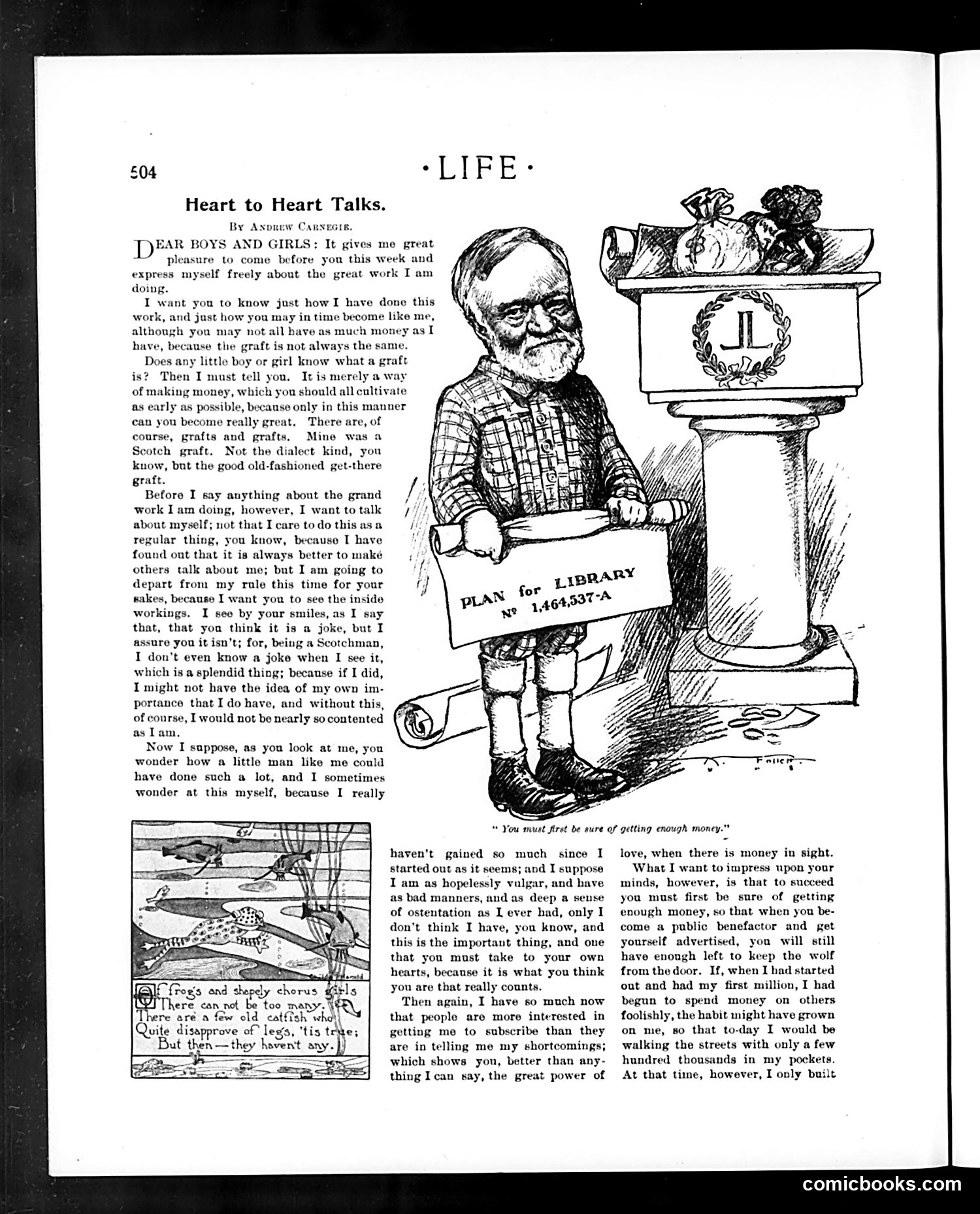
This page features "Heart to Heart Talks" by Andrew Carnegie, the wealthy Scottish-American industrialist and philanthropist. The main illustration shows Carnegie holding architectural plans for a library (labeled "Plan for LIBRARY No. 1,464,537-A"), standing before a pedestal displaying his bust. The satire targets Carnegie's famous library-building campaign: he funded over 2,500 public libraries across America and Britain. The cartoon mocks the scale of this effort through the absurdly high library number, suggesting mass production rather than genuine philanthropy. Carnegie's text discusses "graft" and making money, touching on his rags-to-riches narrative. The smaller cartoon below shows fish discussing disappearing fish—likely satirizing Carnegie's tendency to offer moralistic advice despite questionable business practices during the Gilded Age.
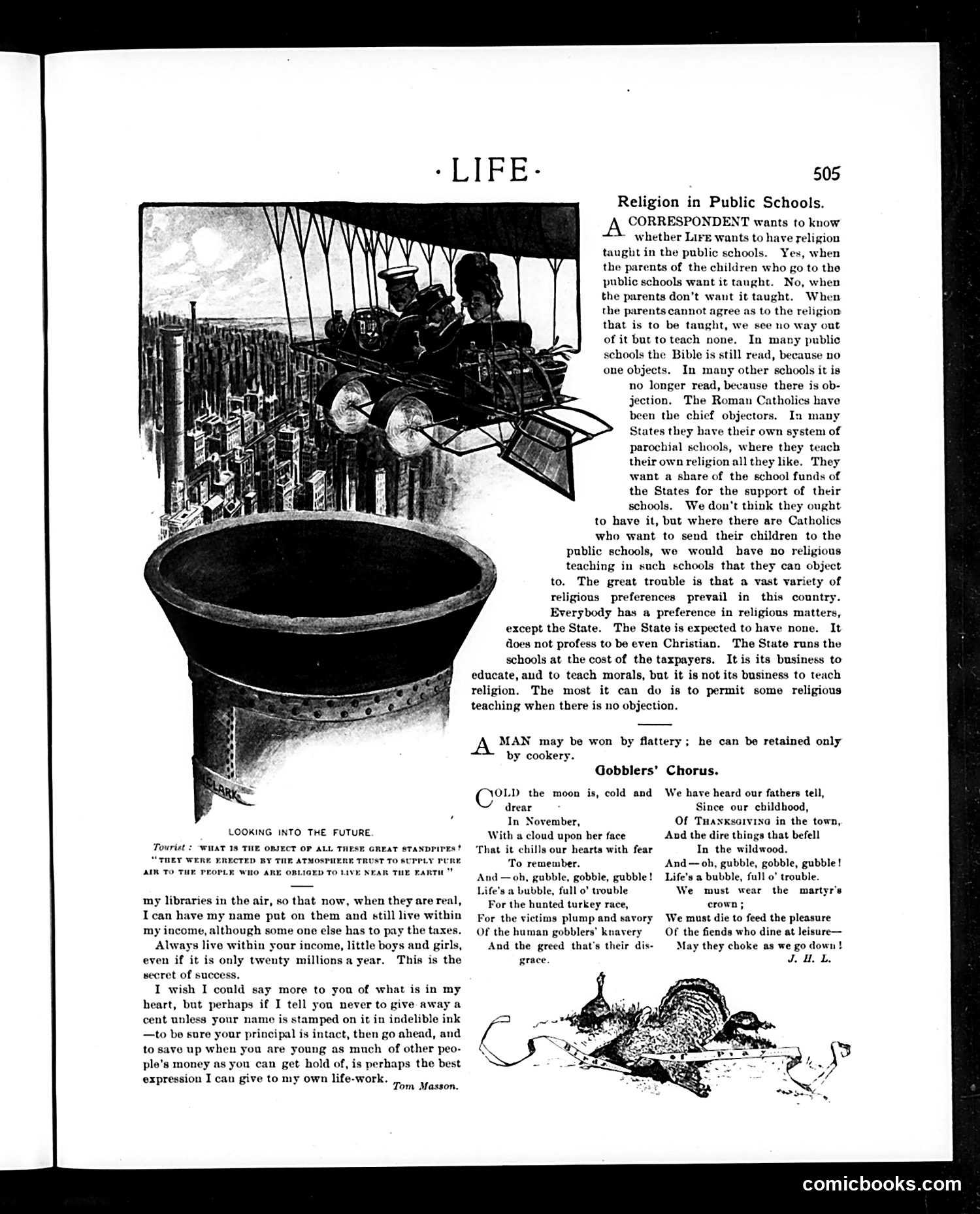
This cartoon depicts a fantastical future where massive cities float in the air via dirigibles/airships, with people and buildings suspended above earth. The caption sarcastically quotes a "Torrid" question about why these structures exist, answering that they float because people must live near earth. The satire targets wealthy individuals hoarding resources: the text below explains that the rich keep "air libraries" to avoid paying taxes on earthbound property while still living luxuriously. The joke is that even in an imagined future, the wealthy find ways to escape financial obligations to society. The accompanying text by Tom Masson critiques how the rich preserve capital through legal loopholes—a pointed commentary on early 20th-century wealth inequality and tax avoidance strategies.
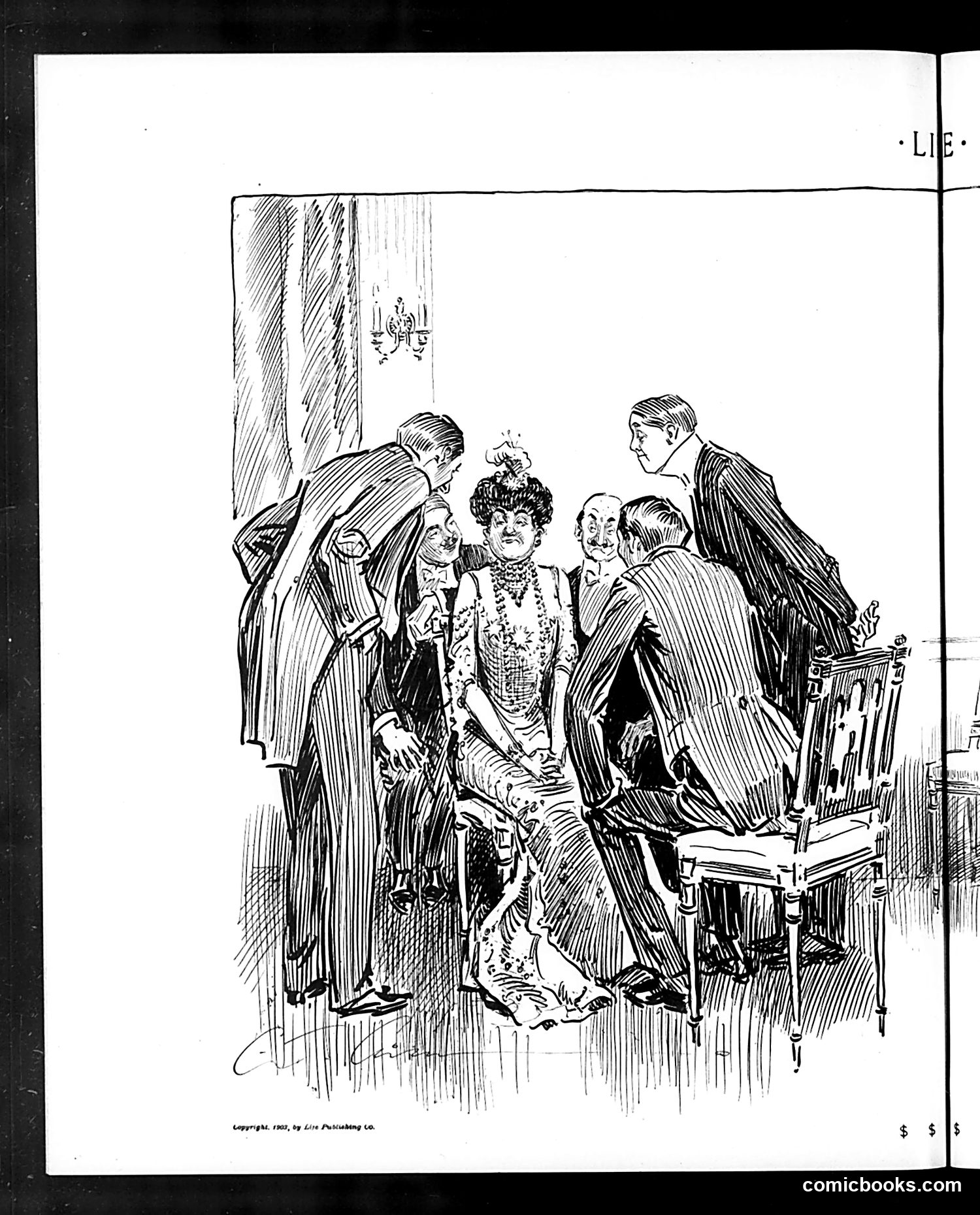
This appears to be a satirical drawing from Life magazine (copyright 1907, per the visible text). The cartoon depicts a wealthy, elaborately dressed woman seated centrally, surrounded by five men in formal attire who appear to be attending to her with exaggerated deference. The satire likely critiques the social dynamics of the Gilded Age—specifically, the power and influence wielded by wealthy society women who commanded attention from prominent men. The woman's ornate clothing, jewelry, and hairstyle emphasize her status, while the men's hovering postures suggest obsequiousness or social climbing. Without additional context, the specific identity of the woman remains unclear, though she may represent a notable society figure of the era. The joke satirizes upper-class social hierarchies and gender dynamics of that period.
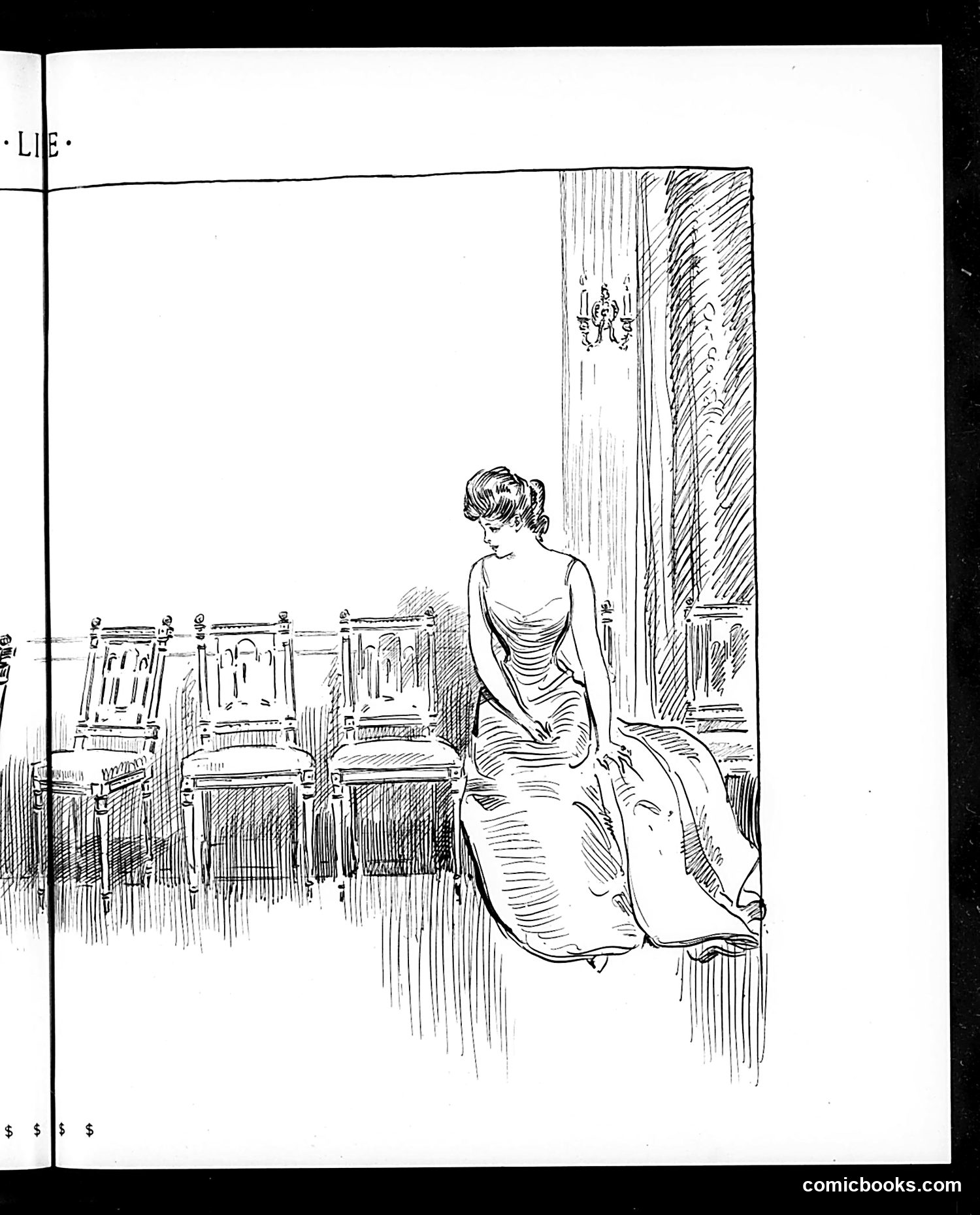
This appears to be an illustration from *Life* magazine showing a woman in an elegant dress seated in a parlor, with several empty chairs arranged nearby. A small spider hangs from above in the upper right corner. The image likely satirizes the social conventions of courtship or matrimony in early 20th-century America. The woman's composed, waiting posture combined with the empty chairs suggests she is waiting for suitors or eligible men—yet they remain absent. The spider imagery may reference the phrase "waiting like a spider in its web," implying either predatory patience or, conversely, the woman as an undesirable catch that potential partners avoid. The satire appears to comment on women's limited agency in romantic affairs or the desperation of unmarried women awaiting male attention, though the exact social critique remains somewhat unclear without additional context.
This is a theater criticism page reviewing several Broadway productions. The main articles critique: 1. **"An Embarrassment of Riches"** - discussing the oversupply of stage entertainment and quality issues in New York theaters 2. **"Red Feather"** - a comic opera at the Lyric Theater, praised for its music and cast 3. **"The Light That Failed"** - adapted from Kipling's novel, criticized as an unsuccessful dramatization that would work better as literature The page includes a confidential theater guide listing current productions and venues. The decorative header features classical theatrical imagery (comedy/tragedy masks and theatrical scenes). This is straightforward theater criticism for educated readers interested in Broadway productions of the era, not political satire.
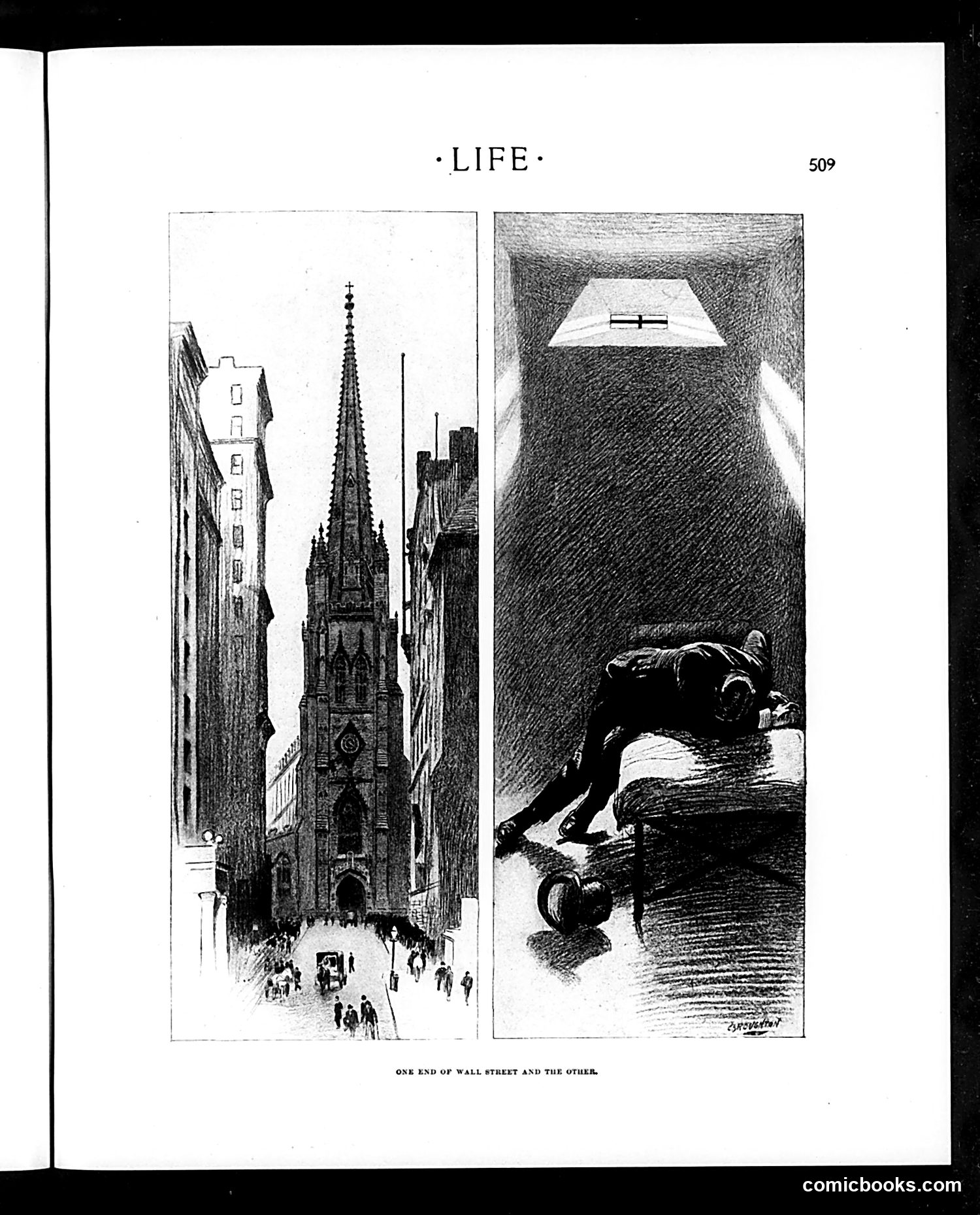
This page presents a satirical two-panel contrast titled "One End of Wall Street and the Other." The **left panel** depicts a Gothic cathedral spire dominating a narrow urban canyon—likely Trinity Church on Wall Street, surrounded by tall office buildings and crowds of pedestrians. This represents the spiritual/historical aspect of the financial district. The **right panel** shows a stark, prison-like interior with a single small window above, a figure hunched in shadow on a cot. This depicts the moral or human cost of Wall Street's wealth-making—suggesting entrapment, despair, or the suffering of those involved in financial speculation. The satire contrasts outward grandeur and religious symbolism with inner spiritual emptiness and human misery, critiquing Wall Street's ethical bankruptcy despite its architectural prominence.
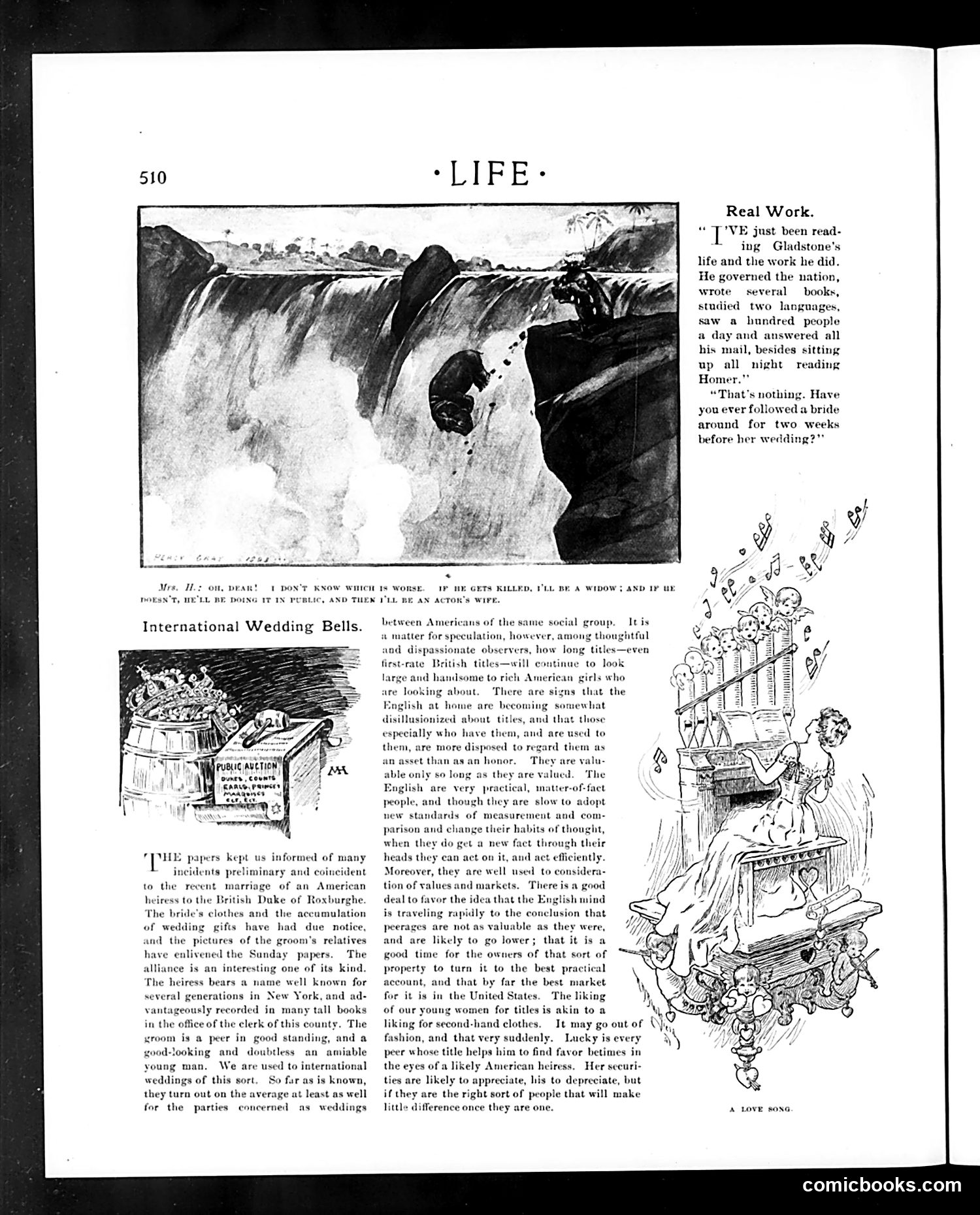
This page satirizes the recent marriage between an American heiress and the British Duke of Roxburghe. The top cartoon shows a couple at Niagara Falls with dialogue mocking the groom's indifference to danger—a jab at the groom's apparent lack of ardor or concern. The main article argues that while such international marriages were fashionable, British titles were becoming mere commodities rather than honors. The satire suggests wealthy American women pursue titles like "second-hand clothes"—temporary status symbols that may suddenly go out of fashion. The English, portrayed as pragmatically calculating, recognize American heiresses as the best "market" to sell deprecating titles to, while the women's "securities" (wealth, youth) will appreciate. The sidebar "Real Work" compares Gladstone's governing the nation and scholarly pursuits to following a bride around for two weeks—satirizing wedding preparations as equally demanding labor. The overall mockery targets both American materialism and British mercenary opportunism in transatlantic marriages.
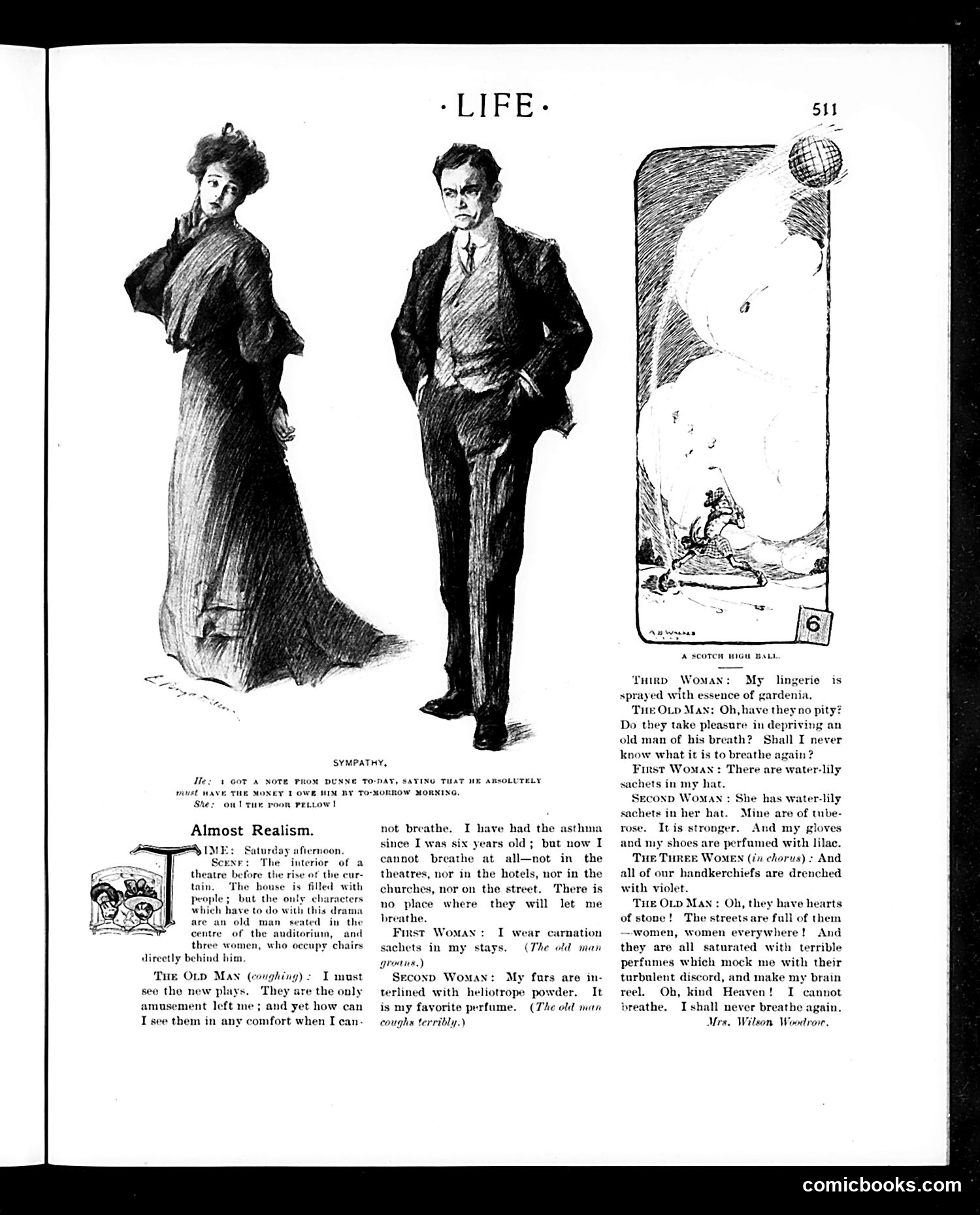
This page satirizes the early 1900s craze for heavy perfumes and scented products among fashionable women. The cartoon depicts an elderly man suffering from asthma trapped in a theater with three women who competitively boast about their elaborate perfuming rituals—sachets in stays, heliotrope-lined furs, gardenia-sprayed lingerie, lilac-perfumed shoes and gloves, violet-drenched handkerchiefs. The joke is dark and exaggerated: the women's vanity literally suffocates him. His desperate pleas for breathable air are met with oblivious one-upmanship about their scent combinations. The title "Almost Realism" suggests this extreme scenario reflects actual social behavior—that such perfume saturation was genuinely common and genuinely problematic in crowded public spaces like theaters. The satire targets both women's fashion excess and their indifference to others' discomfort.
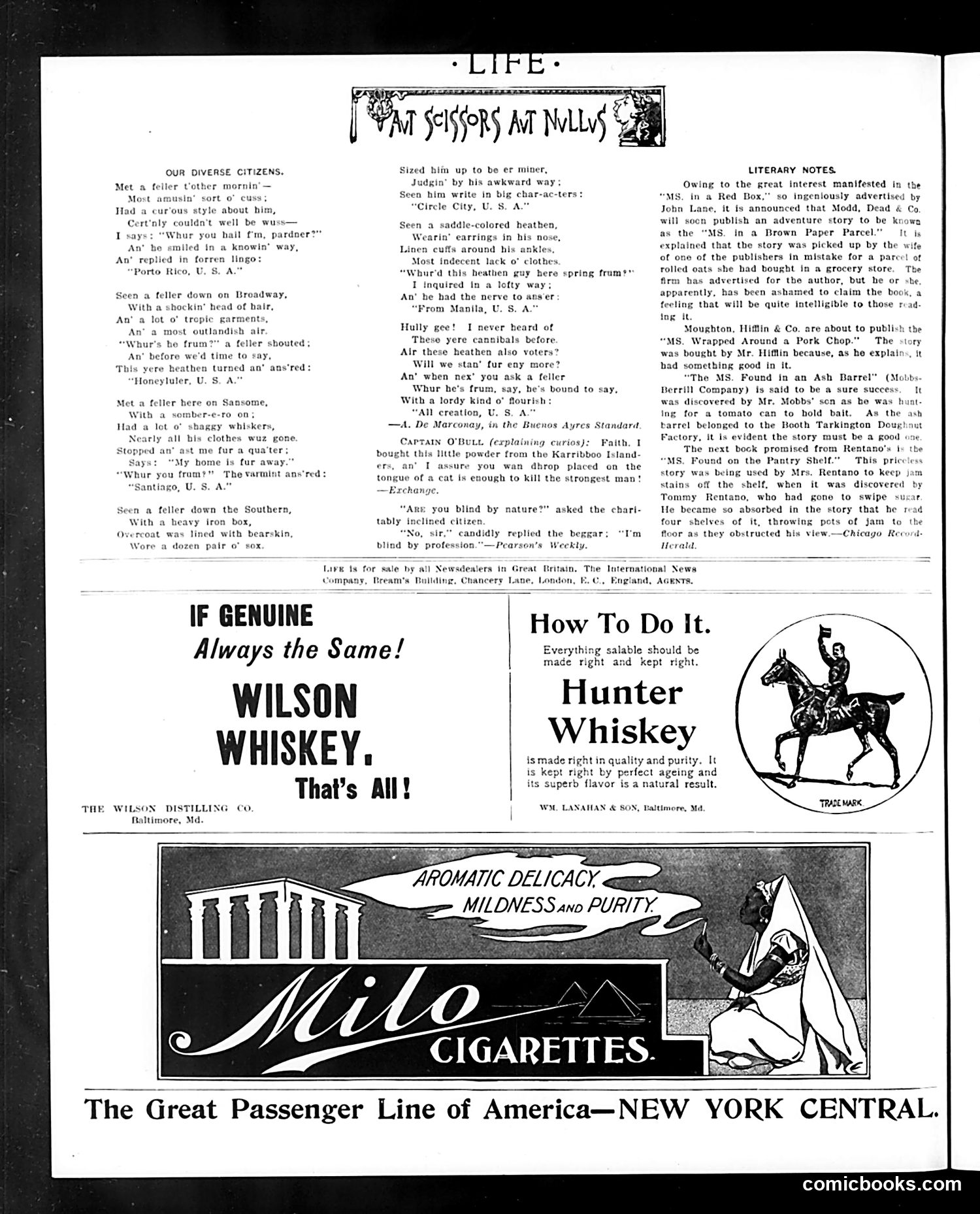
This page from *Life* magazine (early 1900s) is primarily **advertising with some satirical content**. ## The Main Satire: "Our Diverse Citizens" The poem mocks American xenophobia and assimilation anxiety. A narrator repeatedly encounters foreigners in America and expresses shock at their appearance and behavior. Each character—a miner, a man in tropical clothes, a shabby fellow—responds to "Where are you from?" by claiming various U.S. locations (Circle City, Porto Rico, Santiago, Manila). **The joke**: These obviously foreign individuals are already claiming American identity/citizenship, yet the narrator treats them as outsiders. The satire targets nativist anxiety about immigration and the rapid incorporation of newly-acquired U.S. territories (Philippines, Puerto Rico) into American society following the Spanish-American War. ## Supporting Content **Literary Notes** humorously mock sensationalist publisher marketing—books advertised as mysteriously "found" manuscripts to boost sales. The page also contains period **advertisements** for Wilson Whiskey and Hunter Whiskey, and Milo Cigarettes—unrelated to the editorial content.
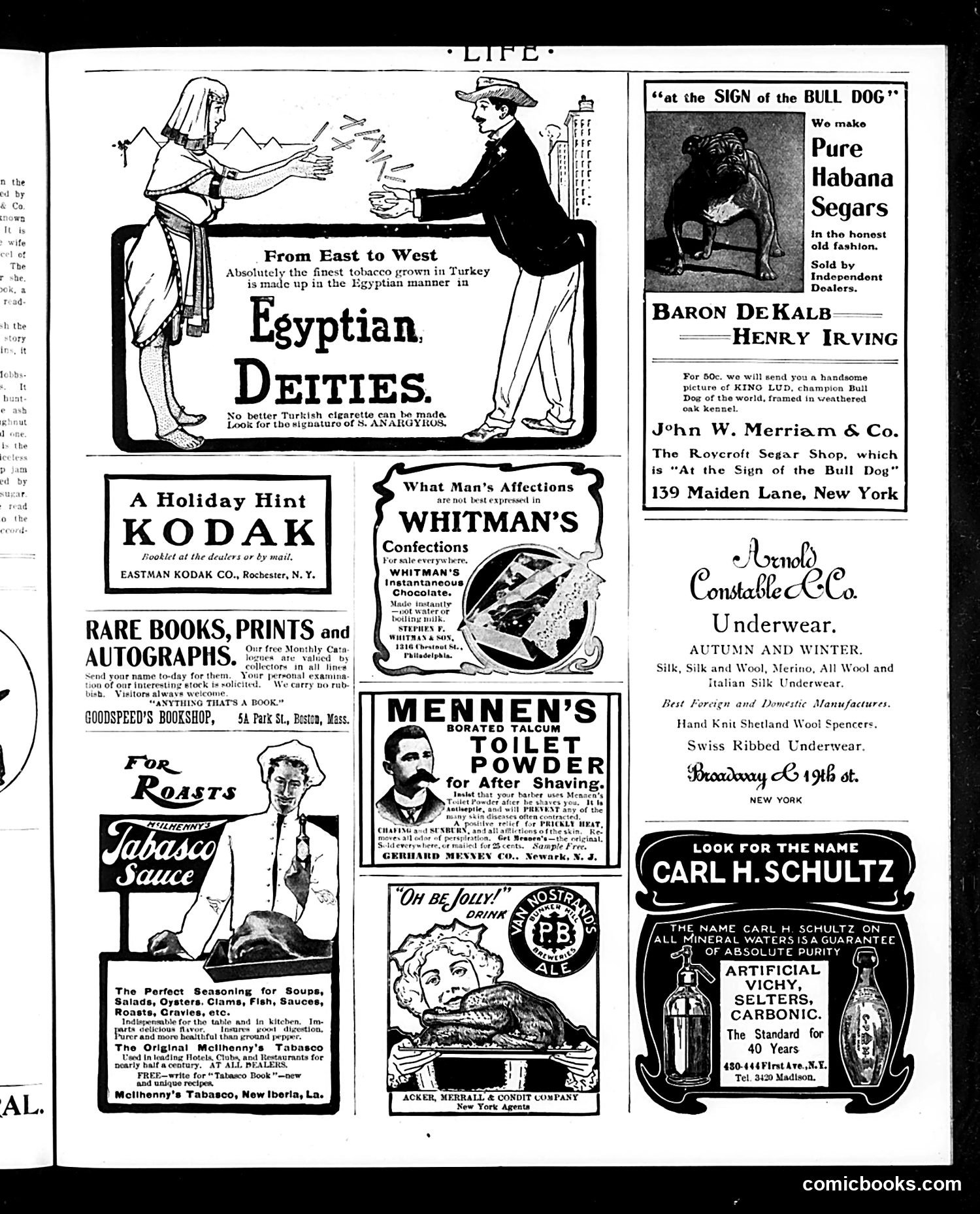
This is primarily a **product advertisement page** rather than political satire. The main cartoon depicts a humorous exchange between an Egyptian woman and a Western man over **Egyptian Deities cigarettes**—a Turkish tobacco brand. The joke appears to be a pun: the woman gestures dramatically as if discussing religious "deities," while the man responds to what he assumes is a sales pitch for the cigarette product. It's a visual wordplay exploiting the double meaning. The remainder of the page contains period advertisements for various consumer goods: Kodak cameras, Tabasco sauce, Whitman's chocolates, Mennen's talcum powder, cigars, mineral waters, and underwear. These reflect early 20th-century luxury and hygiene products marketed to middle/upper-class readers. The "Bull Dog" cigar branding features a prominent dog image, appealing to masculine consumers. No significant political commentary is evident—this is straightforward commercial advertising typical of Life magazine's revenue model.
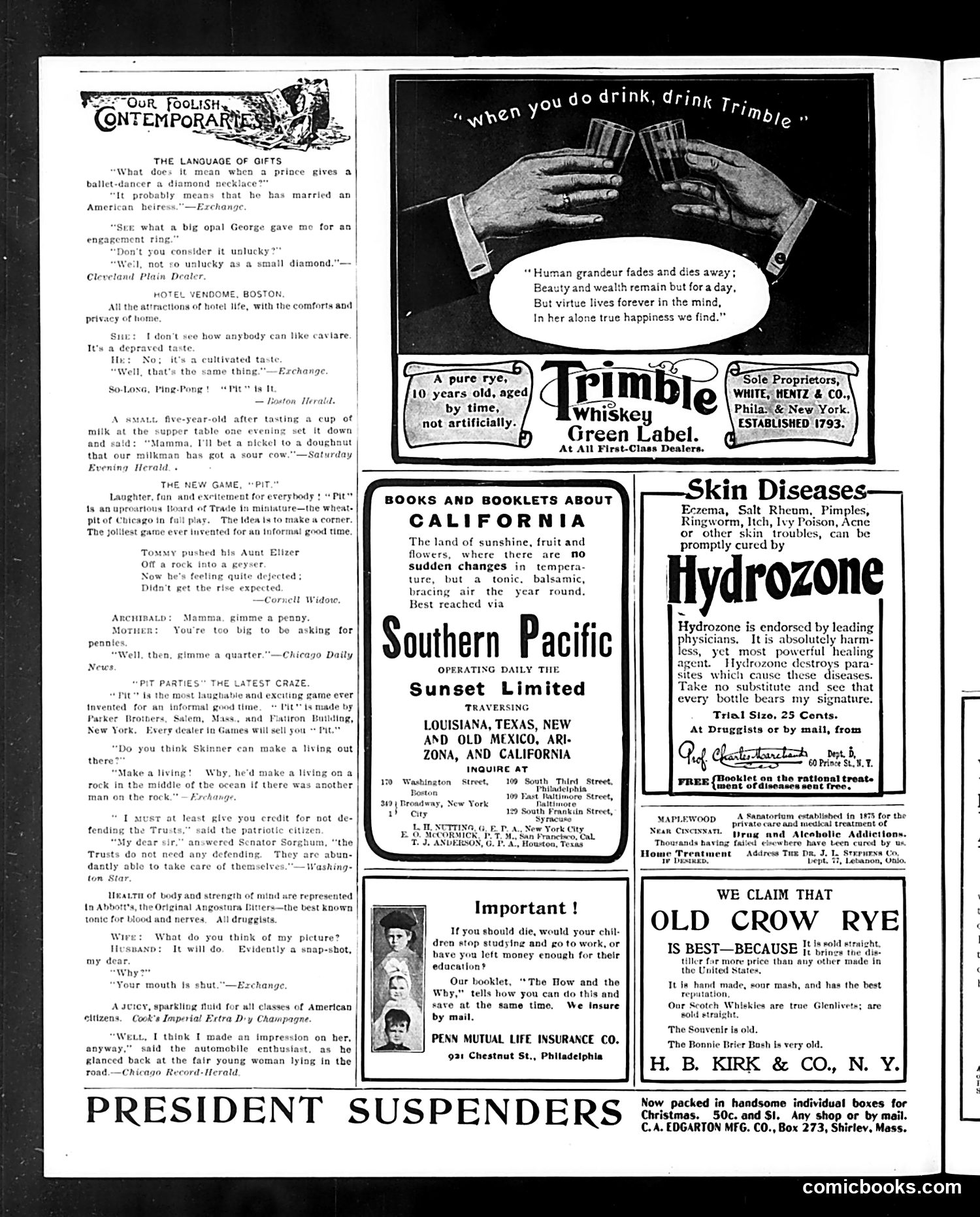
This page from *Life* magazine is primarily a **humor and satire section** mixed with period advertisements. The left side features short comic dialogues and jokes satirizing contemporary social situations—particularly the materialism and pretension of the era. Key satirical targets include: 1. **"The Language of Gifts"** — mockery of how engagement gifts (opals vs. diamonds) signal a man's wealth and intentions, reflecting anxieties about marriage economics. 2. **Social climbing** — jokes about caviar as "cultivated taste" and hotel pretensions. 3. **"Pit" parties** — satire on the latest fad game craze. The right side contains **period advertisements** for whiskey, insurance, skin treatments, and California travel—reflecting actual consumer products of the era. The overall tone is gentle, observational humor about middle-class American society, its obsessions with status symbols, and passing fads. No specific political figures or events appear to be targeted—the satire is broadly social rather than partisan.
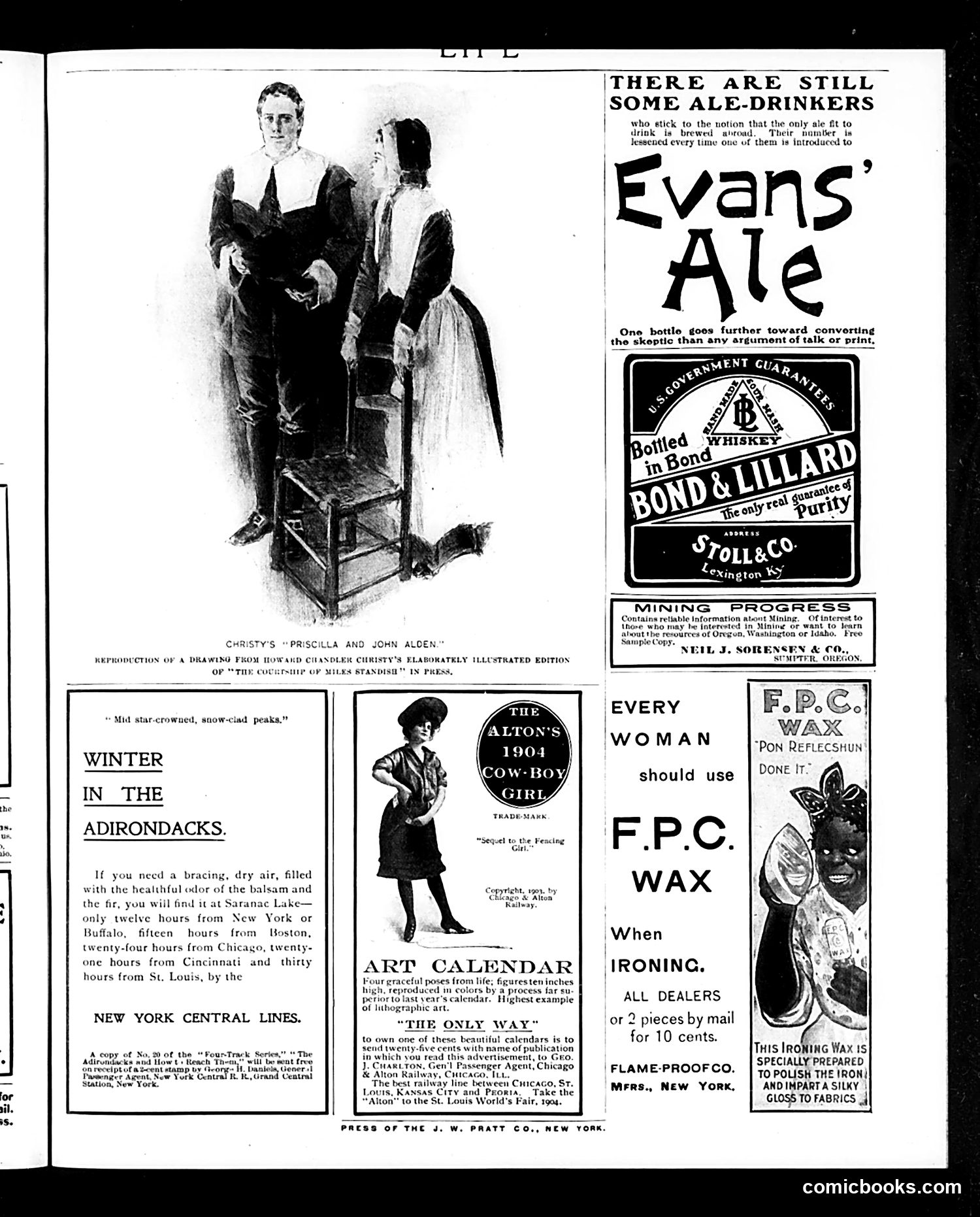
This is primarily an **advertising page** from Life magazine, with one literary illustration. The main illustration reproduces a drawing by Christy from an elaborately illustrated edition of Longfellow's "Courtship of Miles Standish"—depicting Priscilla and John Alden, colonial American figures from the famous poem. The image shows period dress and illustrates the romantic narrative. The page is dominated by **commercial advertisements** typical of early 1900s Life: Evans' Ale (emphasizing American-brewed quality), the Alton railroad line (promoting travel and the 1904 St. Louis World's Fair), F.P.C. ironing wax (marketed to women), an Art Calendar offer, and notices for the Adirondacks and mining information. There is **no political satire** on this page. Life magazine, despite its satirical reputation, regularly included advertising and literary illustrations alongside its humor. The colonial literary reference and period imagery fit the era's sentimental Americana aesthetic.
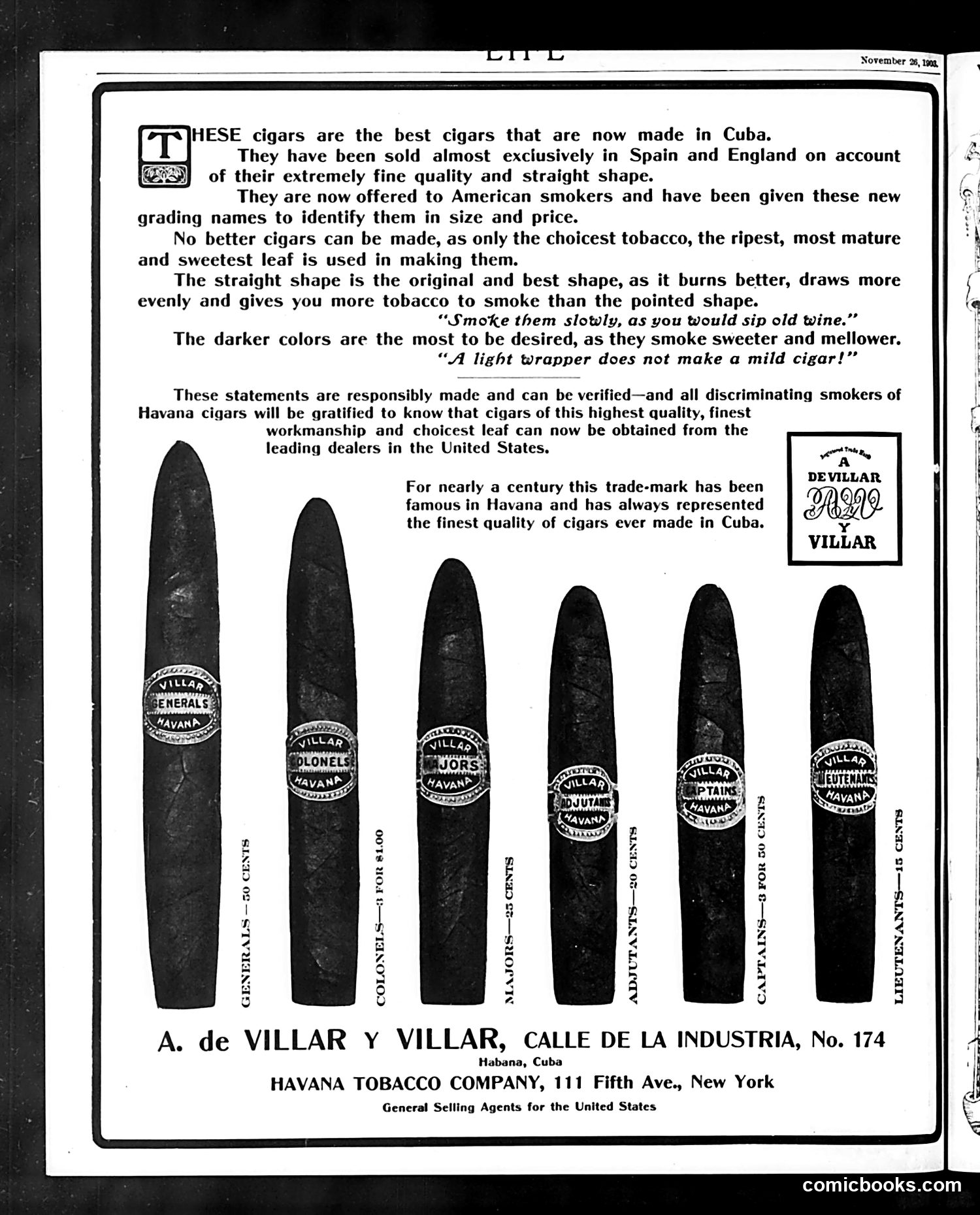
This is **not a cartoon or satire** — it's a straightforward advertisement for Devillar cigars from Cuba, published in *Life* magazine on November 26, 1908. The page promotes premium Havana cigars previously sold only in Spain and England, now marketed to American consumers. Six cigar sizes are displayed with military-themed names: Generals, Colonels, Majors, Lieutenants, Adjutants, and Captains, with corresponding prices. The naming scheme appears designed to appeal to masculine pride and social status — buyers could purchase cigars at various price points while enjoying implied military rank associations. The text emphasizes quality ("choicest tobacco," "finest workmanship") and provides smoking instructions ("Smoke them slowly, as you would sip old wine"). This reflects early 20th-century advertising conventions: premium imported goods marketed with claims of exclusivity and sophistication to upwardly mobile American smokers.