
Life, 1903-11-26 · page 12 of 20
Life — November 26, 1903 — page 12: what you’re looking at
What you’re looking at
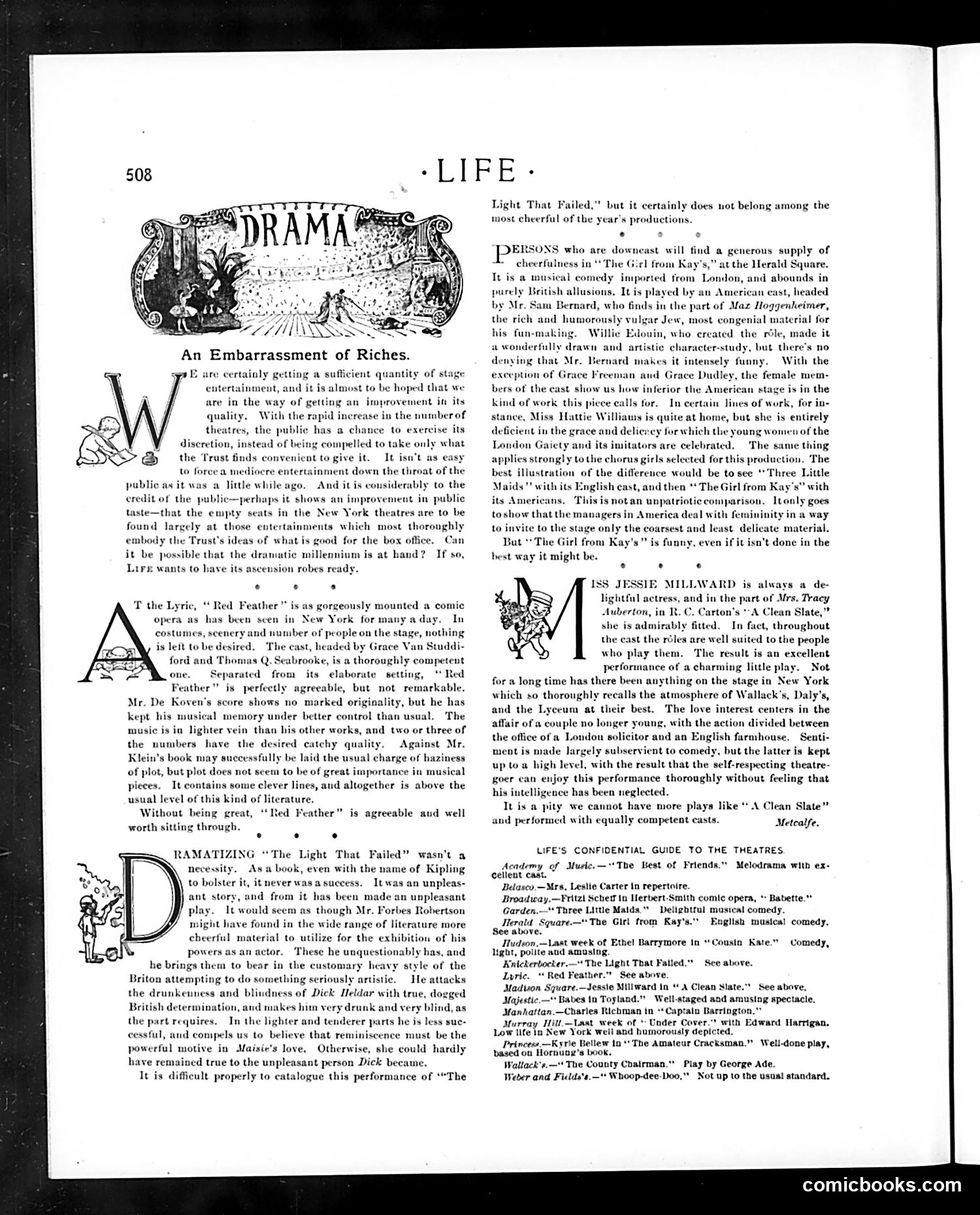
This is a theater criticism page reviewing several Broadway productions. The main articles critique: 1. **"An Embarrassment of Riches"** - discussing the oversupply of stage entertainment and quality issues in New York theaters 2. **"Red Feather"** - a comic opera at the Lyric Theater, praised for its music and cast 3. **"The Light That Failed"** - adapted from Kipling's novel, criticized as an unsuccessful dramatization that would work better as literature The page includes a confidential theater guide listing current productions and venues. The decorative header features classical theatrical imagery (comedy/tragedy masks and theatrical scenes). This is straightforward theater criticism for educated readers interested in Broadway productions of the era, not political satire.
📄 Transcribed text from this page (OCR, searchable)
Machine-transcribed from the original scan — historical spelling and the odd misread are preserved.
+ LIFE: An Embarrassment of Riches. E are certainly entertainment, and it is almost tot are in the way of getting quality. With the rapid increase in the numberof theatres, the public has a chance to discretion, instead of being compelled to take only what the Trust finds convenient to give it. It isn’t as easy to forcea medi tertai of the public as it was a little while ago. And itis considerably to the credit of the publice—perhaps it shows an improvement in public taste—that the empty seats in the New York theatres are to be found largely at those entertainments which most thoroughly embody the Trust's ideas of whatis good for the box office. Can it be possible that the dramatic millennium is at hand? If so, Lire wants to have its ascension robes ready. ting @ sufficient quantity of stage hoped that we 1 improvement in its ercise its ment down the thre e . . T the Lyric, “ Red Feather" is as gorgeously mounted a comic opera as has been seen in New York for many aday. In costumes, scenery and number of people on the stage, nothing is lett to be desired. ‘The east, headed by Grace Van Studdi- ford and Thomas Q. Seabrooke, is a thoroughly competent Separated from its elaborate setting, * Red Feather" is perfectly agreeable, but not remarkable. Mr. De Koven’s score shows no marked originality, but he has kept his musical memory under better control than usual. The music is in lighter vein than his other works, and two or three of the numbers have the desired catchy quality. Against Mr. Klein's book may successfully be laid the usual charge of haziness of plot, but plot does not seem to be of great importance in musical pieces. It contains some clever lines, and altogether is above the usual level of this kind of literature. Without being great, ‘Red Feather” is agreeable aud well worth sitting through. . ° . RAMATIZING “The Light That Failed” wasn’t a necessity. Asa book, even with the name of Kipling to bolster it, it never was.a success. It was an unpleas- ant story, and from it has been made an unpleasant play. It would seem as though Mr. Forbes Robertson might have found in the wide range of literature more cheerful material to utilize for the exhibition of his powers as an actor. These he unquestionably has, and he brings them to bear in the customary heavy style of the Briton attempting to do something seriously artistic. He attacks the drunkenness and blindness of Dick Heldar with true, dogged British determination, and makes him very drunk and very blind, as the part requires. In the lighter and tenderer parts he is less sue~ cessful, and compels us to believe that reminiscence must be the powerful motive in Maisie’s love. Otherwise, she could hardly have remained true to the unpleasant person Dick became. It is difficult properly to catalogue this performance of “The Light That Failed,” but it certainly does not belong among the most cheerful of the year's productions. ° ° ° ERSONS who are downcast will find a generous supply of + cheerfulness in The Girl from Kay's,” at the Herald Square. It is a mus i abounds in purely British allusions. It is played by an American east, headed by Mr. Sam Bernard, who finds in the part of Maz Hoggenheimer, the rich and humorously vulgar Jew, most congenial material for his fun-making. Willie Edouin, who ereated the role, made it a wonderfully drawn and artistic character-study, but there's no denying that Mr. Bernard makes it intensely funny, With the exception of Grace Freeman and Grace Dudley, the female mem- bers of the cast show us how inferior the American stage is in the kind of work this picce calls for. In certain lines of work, for in stance, Miss Hattie Williams is quite at home, but she is entirely deficient in the grace and delicxey for which the young women of the London Gaiety and its imitators are celebrated. ‘The same thing ies strongly tothe chorus girls selected for this production. The best illustration of the difference would be to see Three Little Maids" with its English cast, and then The Girl from Kay's” with its A . Thisisnotan unpatrioticcomparison. Itonly goes toshow that the managers in America deal with femininity in a way to invite to the stage only the coarsest and least delicate material. But ** The Girl from Kay's" is funny, even if it isn’t done in the hest way it might be. comedy imported from London, e . e ISS JESSIE MILLWARD is always a de- lightful actress, and in the part of Mrs. Tracy Auberton, in R. C. Carton’s A Clean Slate,” she is admirably fitted. In fact, throughout the cast the roles are well suited to the people who play them. The result is an excellent performance of a charming little play. Not for a long time has there been anything on the stage in New York which so thoroughly recalls the atmosphere of Wallack’s, Daly's, and the Lyceum at their best. The love interest centers in the affair of a couple no longer young, with the action divided between the office of a London solicitor and an English farmhouse. Senti- ment is made largely subservient to comedy, but the latter is kept up toa high level, with the result that the self-respecting theatre- goer can enjoy this performance thoroughly without feeling that his intelligence has been neglected. It is a pity we cannot have more plays like ‘A Clean Slate” and performed with equally competent casts. Metcalfe, LIFE'S CONFIDENTIAL GUIDE TO THE THEATRES. Academy of Music.—*Tbe Best of Friends. Melodrama with ex- cellent cast. Beasco.—Mrs, Lesite Carter in repertoire. Broadway.—Fritzl Schetf In Herbert-Smith comic opera, * Babette." Garden.—* Three Little Maids.’ Delightful musical comedy. Herald Square.—"*The Giri from Kay's. English musical comedy. See above. Hudeon.—Last week of Ethel Barrymore in “Cousin Kate.” light, polite aud amusing. Knickerbocker.— The Light That Fatled."* Lyric. “ Red Feather.” See above. Maduon Square.—Jessie Millward in A Clean Slate." See above, Majestic.—"* Babes tn Toyland.” Well ged and amusing spectacle, ‘Manhattan.—Charles Ricbman tn ** Captain Barrington.” Murray Iilt.—Last week of © Under Cover.’ with Edward Harrigan. Low life In New York well and humorously depicted. Princess —Kyrie Bellew tn ** The Amateur Cracksman.” Well-done play, based on Hornung’s book. Wallack’s.—* The County Chairman." Weber and Fistds's.—* Whoop-dee-Doo, | comedy, See above. Play by George Ade. Not up to the usual standard. comicbooks.com