
A complete issue · 20 pages · 1903
Life — October 8, 1903
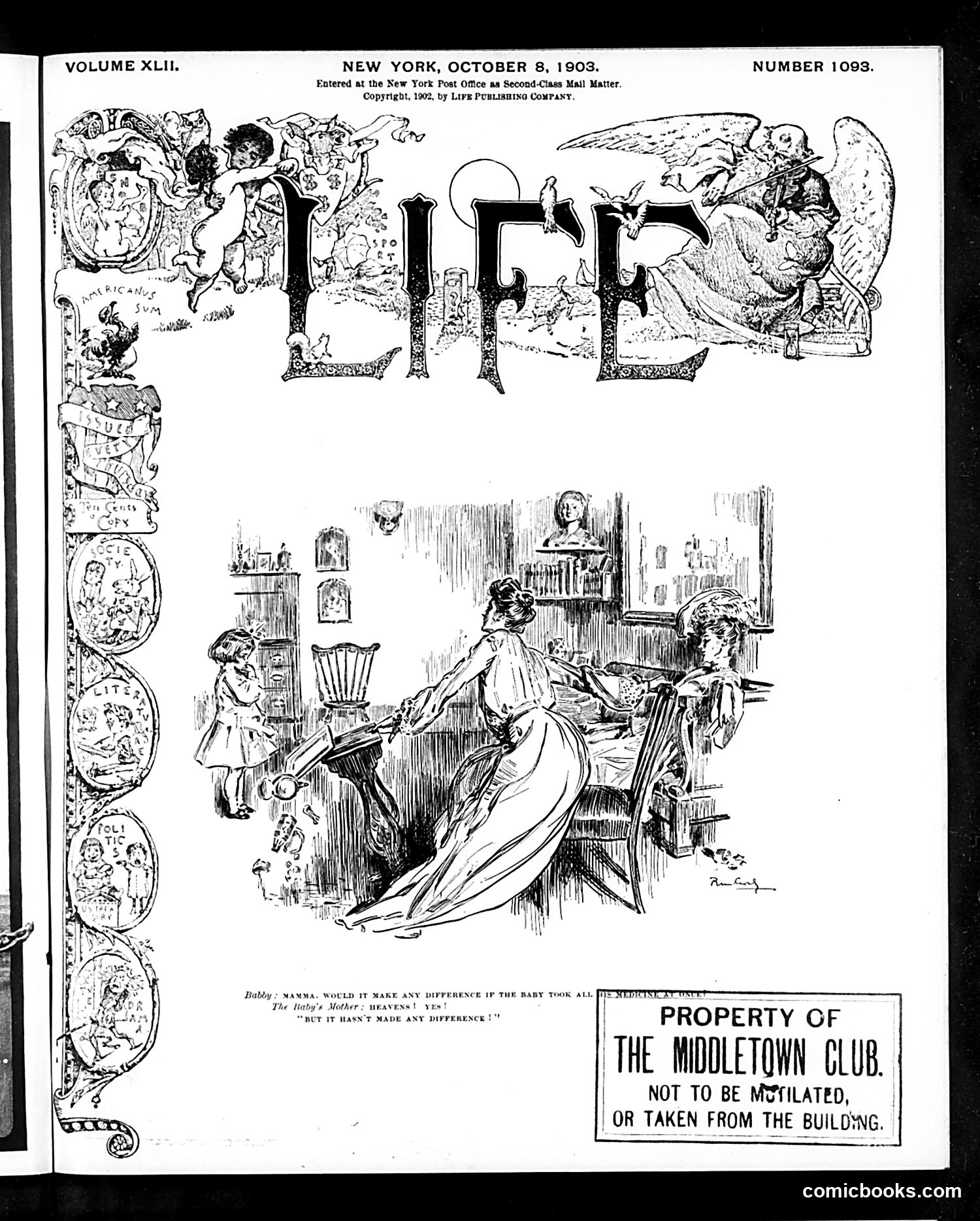
This page features a domestic scene satirizing parenting and child-rearing debates of the era. The main cartoon shows a mother with a baby and young child in an interior setting. The dialogue beneath reads: "Nanna, would it make any difference if the baby took all his medicine at once? The baby's mother: 'Heavens! yes!' 'But it hasn't made any difference!'" The satire appears to mock a mother's frustration—possibly about ineffective parenting advice or medicine. The joke hinges on the gap between expected outcomes and reality. The elaborate decorative borders with cherubs and domestic scenes reinforce the "life and home" theme typical of Life magazine's commentary on American middle-class family life and contemporary anxieties about child health and parenting methods.
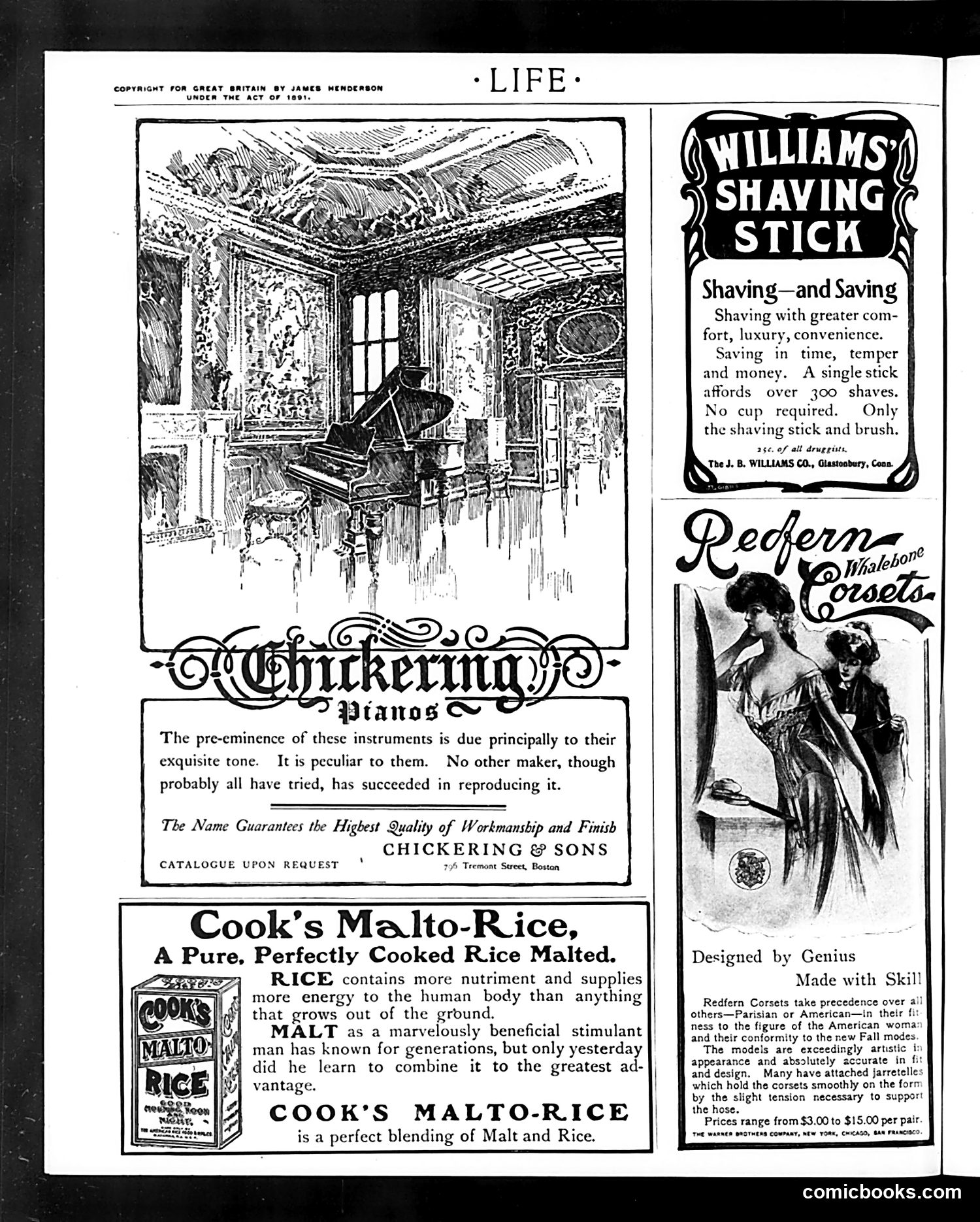
This page is primarily **advertising rather than political satire**. It contains three product advertisements with no discernible political cartoon or satirical content. The main illustration labeled "Chickering Pianos" depicts a woman at a grand piano in an ornate interior—a straightforward luxury goods advertisement emphasizing the instrument's "exquisite tone." Below are ads for Williams' Shaving Stick (emphasizing economy and convenience), Redfern Whalebone Corsets (marketed to fashionable women), and Cook's Malto-Rice (a nutritional food product). These represent typical early 20th-century *Life* magazine advertising: luxury items targeting upper-class consumers. There is no satirical commentary, caricature, or political reference visible on this page.
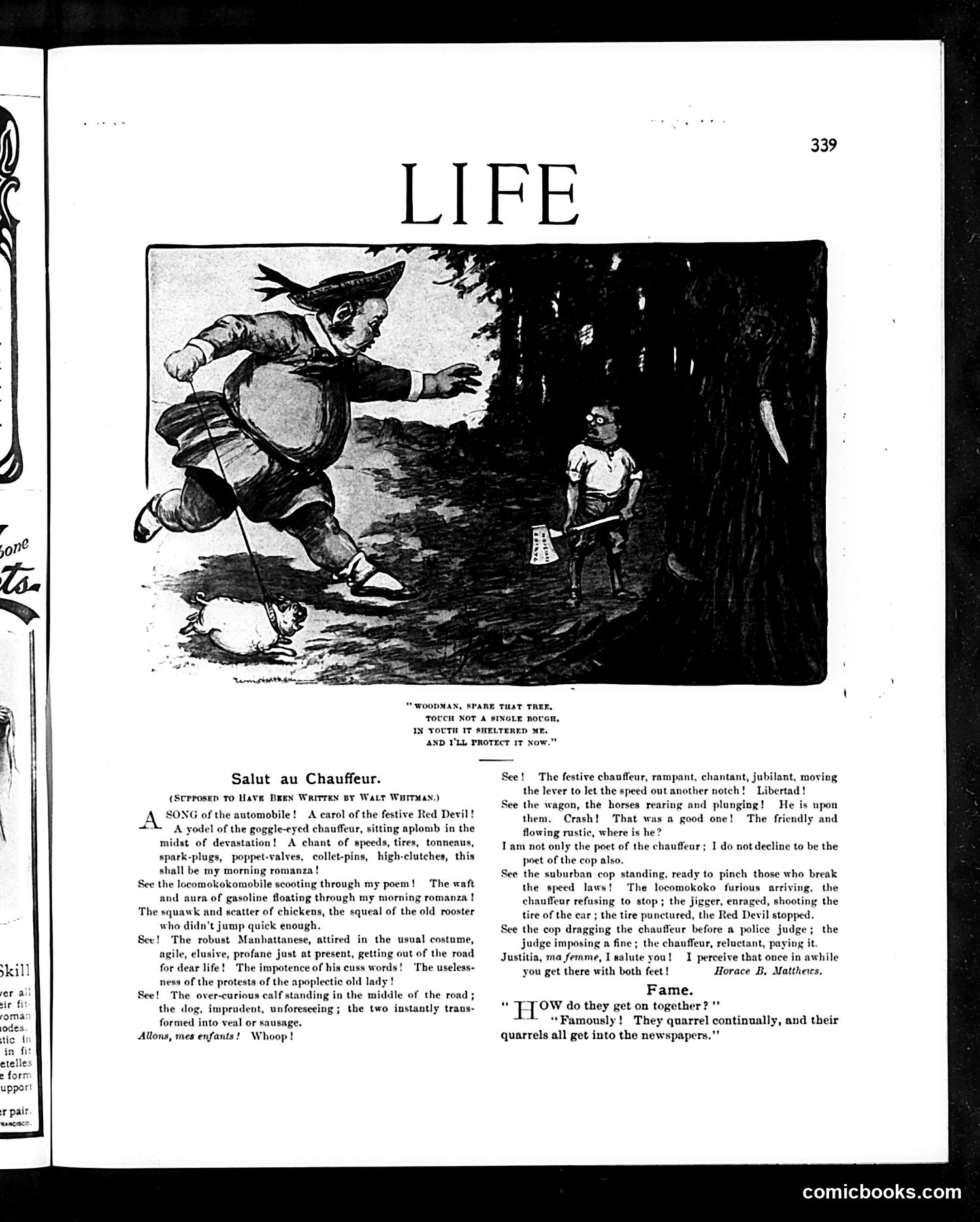
This page celebrates the automobile chauffeur as a modern folk hero. The illustration shows a reckless driver in a peaked cap speeding past a tree where a child sits reading—the caption warns "Woodman, spare that tree...I'll protect it now," sarcastically suggesting the chauffeur endangers what nature preserves. The poem "Salut au Chauffeur" (attributed to Walt Whitman) mockingly praises the "festive Red Devil" driver—speeding, crashing, evading police. It's satirizing both the chauffeur's dangerous recklessness and society's romanticization of automobiles as symbols of liberty and modernity, despite their obvious public hazards. The brief "Fame" section continues the joke, noting quarreling chauffeurs make the newspapers regularly.
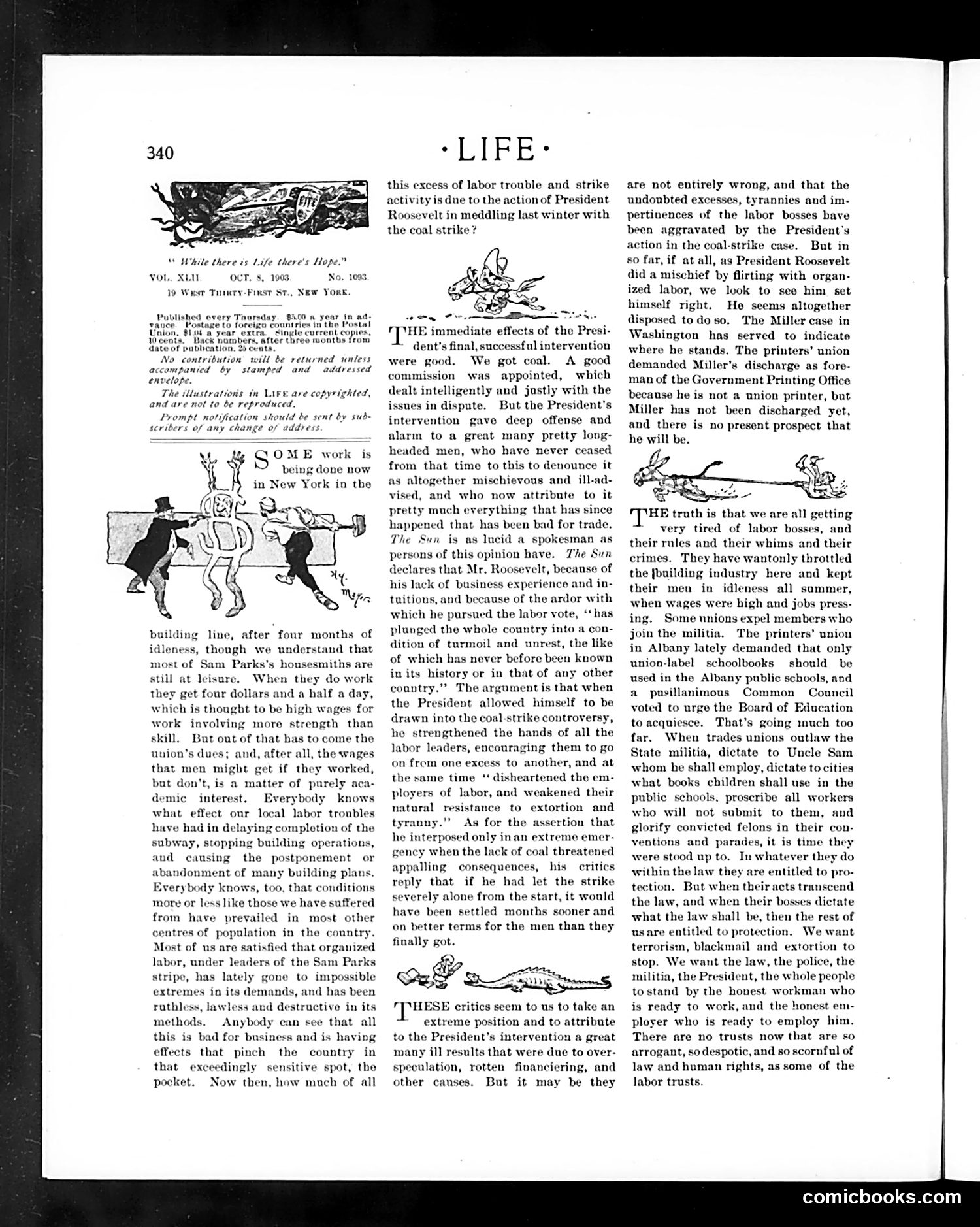
This page discusses **President Roosevelt's intervention in a coal strike**, a major labor dispute. The cartoon depicts men engaged in a tug-of-war, likely representing the conflict between labor and management during this strike. The text criticizes Roosevelt's actions, claiming his intervention gave "deep offense and alarm to a great many pretty long-headed men" and that he "strengthened the hands of all the labor leaders." The article argues Roosevelt's handling of the strike set dangerous precedents, weakening employers' positions and emboldening unions to make further demands. The satire contrasts Roosevelt's intention to resolve the dispute with unintended consequences: strengthening labor's negotiating power and encouraging future union activity. The piece advocates for law and order over union demands.
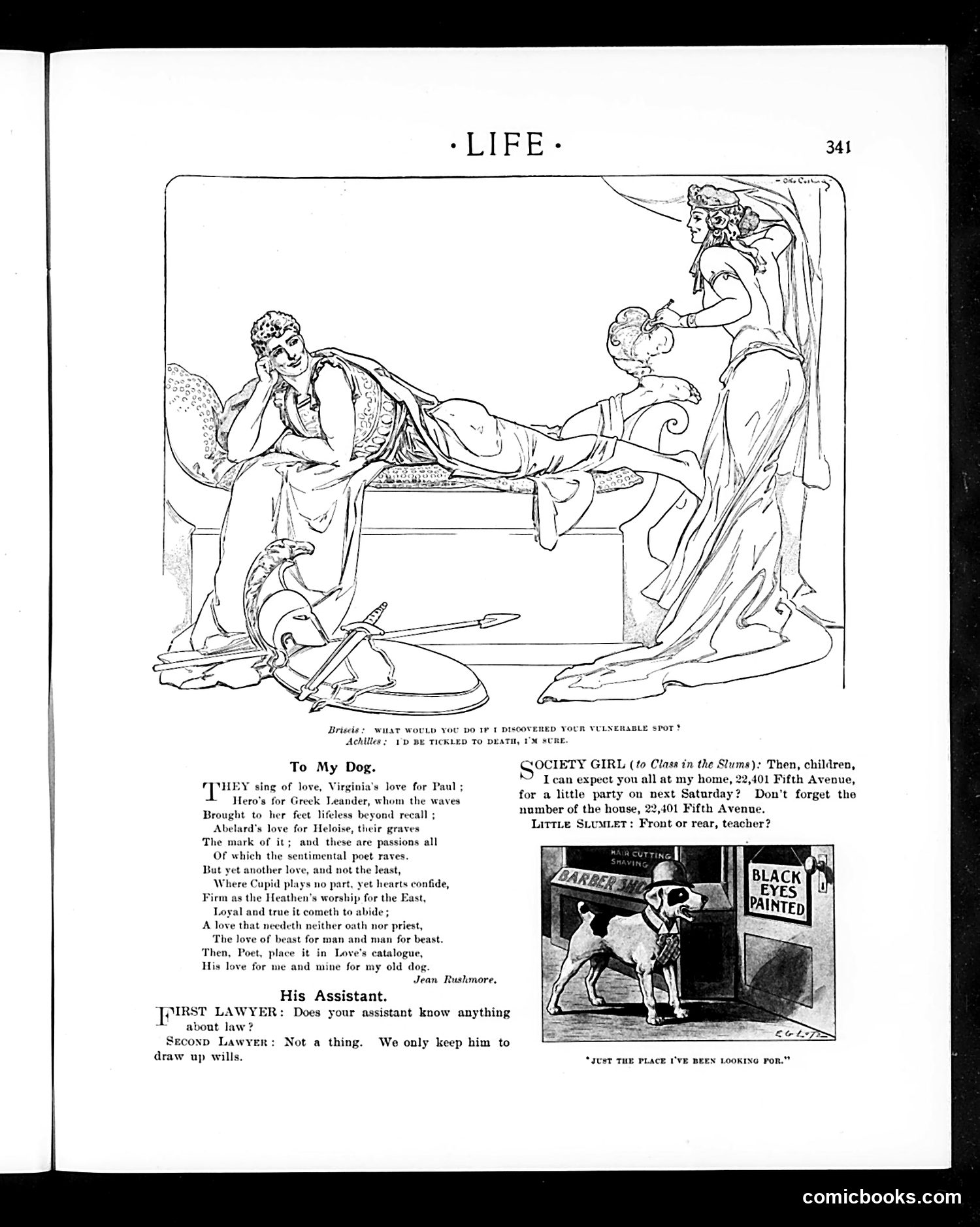
This page contains three separate pieces of humor: 1. **Top illustration**: A classical scene depicting a man reclining while a woman tends to him—likely satirizing romantic idealization or courtship dynamics of the era. 2. **"To My Dog"** (poem by Jean Ingelow): A sentimental Victorian poem celebrating a dog's loyalty, contrasting romantic love with a pet's unconditional devotion. It's unclear if this is sincere or gently mocking Victorian sentimentality. 3. **"His Assistant"** (joke): Two lawyers discuss an assistant who knows nothing about law—he's kept only to "draw up wills." This is a straightforward legal profession joke mocking incompetent staff or the minimal qualifications required for certain clerical positions. 4. **Bottom cartoon**: A dog outside a barber shop labeled "Black Eyes Painted," seeking "the place I've been looking for." The humor plays on the dog's black eyes and the shop's services.
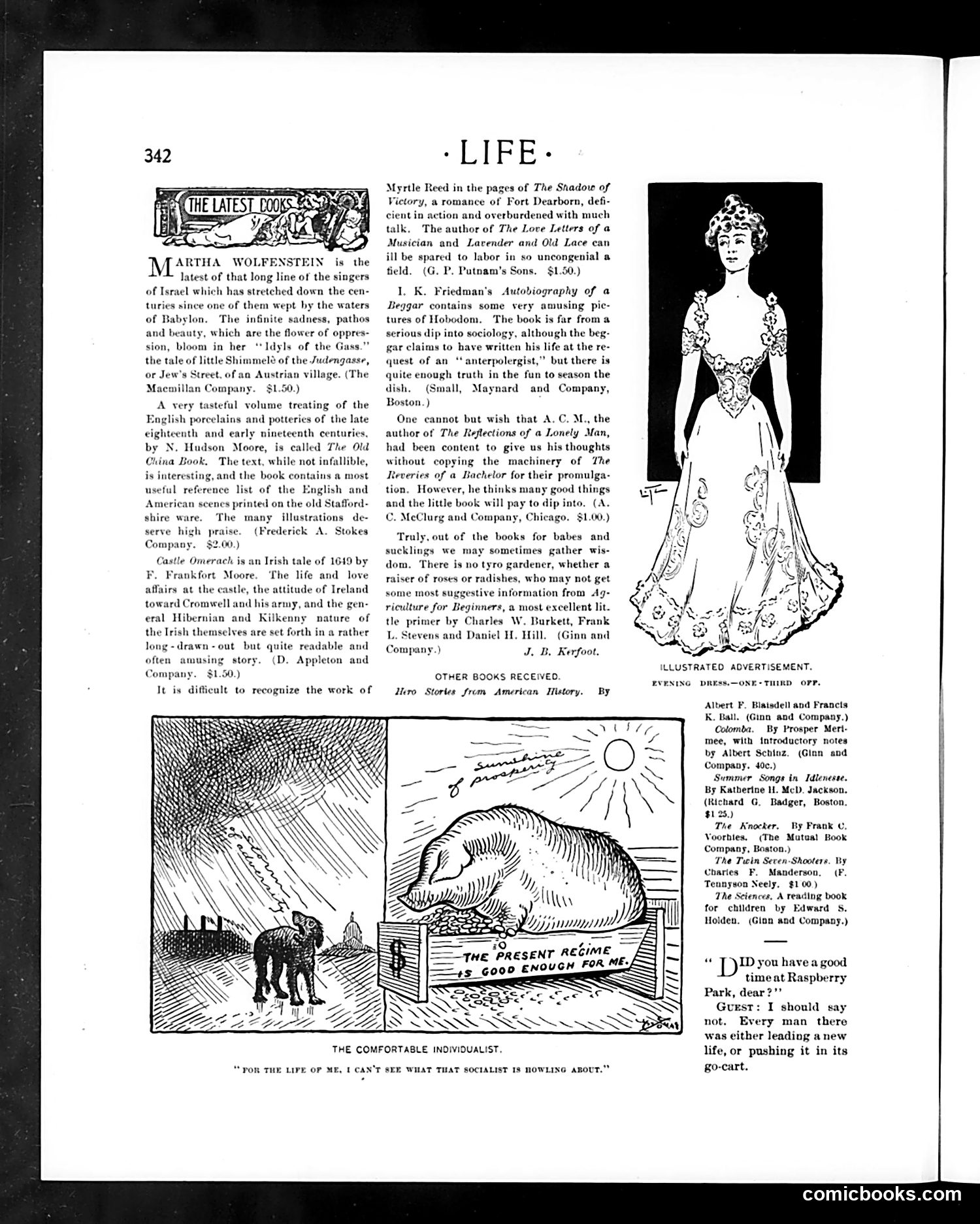
This cartoon satirizes a wealthy person lounging in comfort while dismissing socialism. The figure reclines on an elaborate bed labeled "THE PRESENT REGIME IS GOOD ENOUGH FOR ME," while workers toil in an industrial landscape outside. The caption reads: "FOR THE LIFE OF ME, I CAN'T SEE WHAT THAT SOCIALIST IS HOWLING ABOUT." The satire is straightforward: a privileged individual, benefiting greatly from the current capitalist system, cannot understand working-class grievances because his comfortable position blinds him to others' hardships. The contrasting imagery—his luxury versus workers' labor—underscores the class divide he ignores. This reflects early 20th-century American debates over labor conditions and economic inequality, when Life magazine frequently critiqued both the wealthy and socialist movements.
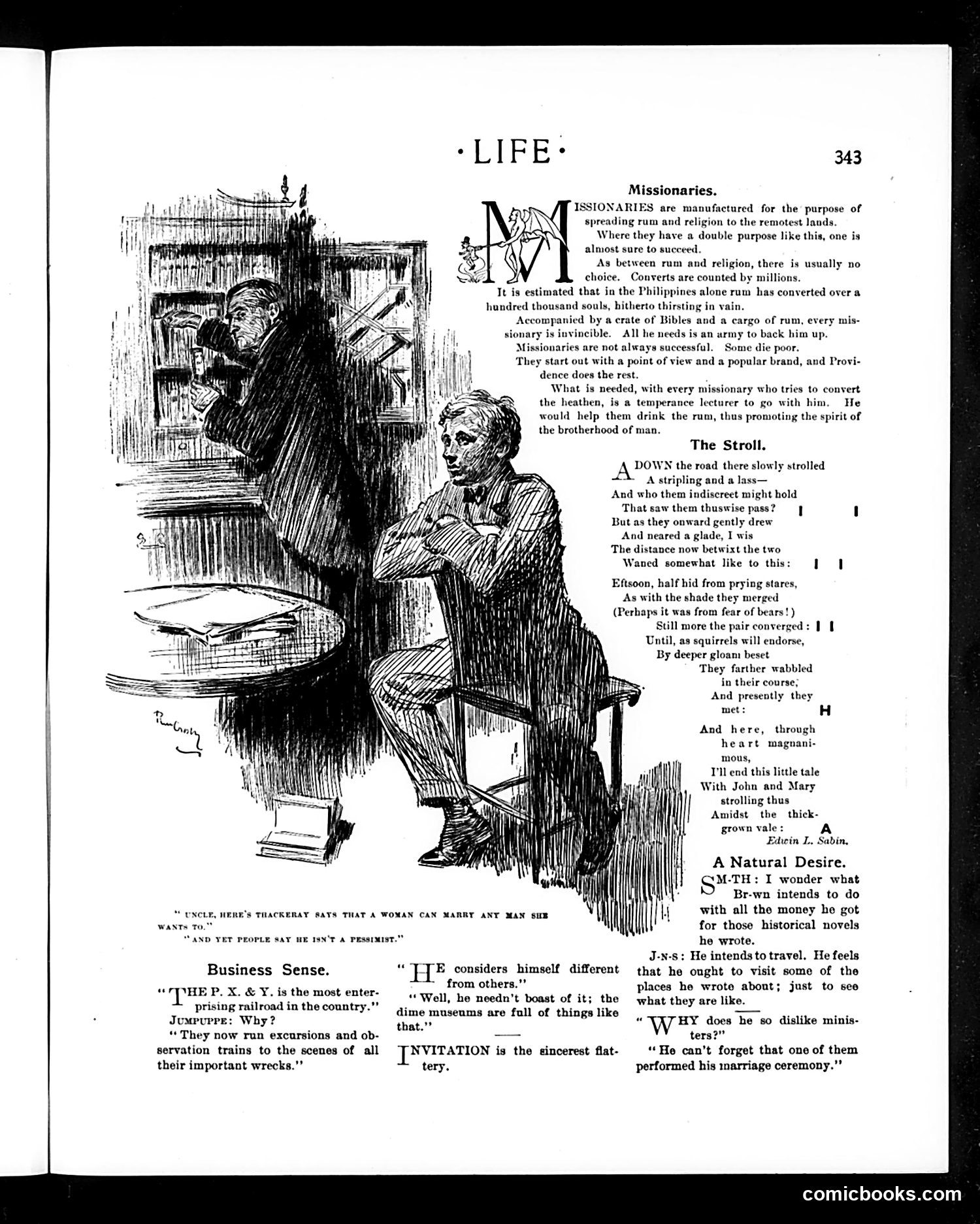
The page contains several satirical pieces. The main cartoon shows two men in what appears to be a room or office—one standing, one seated. The caption reads: "UNCLE, HERE'S THACKERY SAYS THAT A WOMAN CAN MARRY ANY MAN SHE WANTS TO." / "AND YET PEOPLE SAY HE ISN'T A PESSIMIST." This jokes about the writer Thackeray's cynical view of marriage—the implication being that if women can marry anyone they choose, yet people still marry, then Thackeray's pessimism about human nature (particularly male appeal or worth) is confirmed. The page also includes brief satirical pieces on "Business Sense" about railroads, "Missionaries," and other social commentary typical of Life magazine's humorous approach to contemporary society and literature.
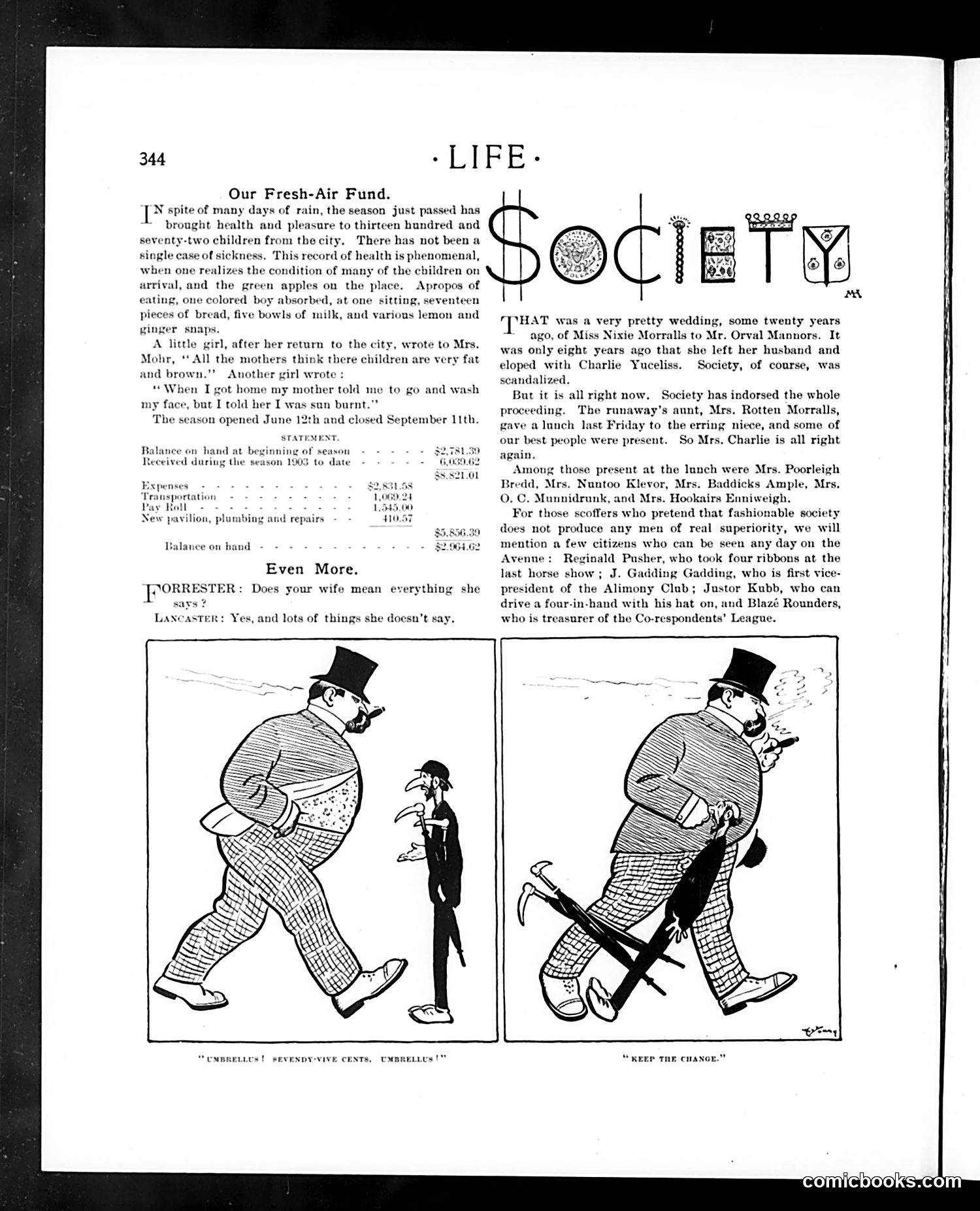
This page contains two distinct sections: **Upper Section:** A "Fresh-Air Fund" report documenting health benefits for urban children sent to the countryside. The text includes testimonials from girls praising the experience, along with financial statements showing expenses and balances. **Lower Section:** A two-panel cartoon titled "Even More" featuring a dialogue between Forrester and Lancaster about wives. The cartoon depicts a rotund gentleman in formal attire with a small woman, illustrating the joke about wives meaning "everything" and "lots of things [they] doesn't say"—a domestic humor joke about marital communication. The second panel, captioned "Keep the Change," shows the same characters in a reversal scenario, suggesting a punchline about financial or power dynamics in marriage. This appears to be early 20th-century American domestic satire.
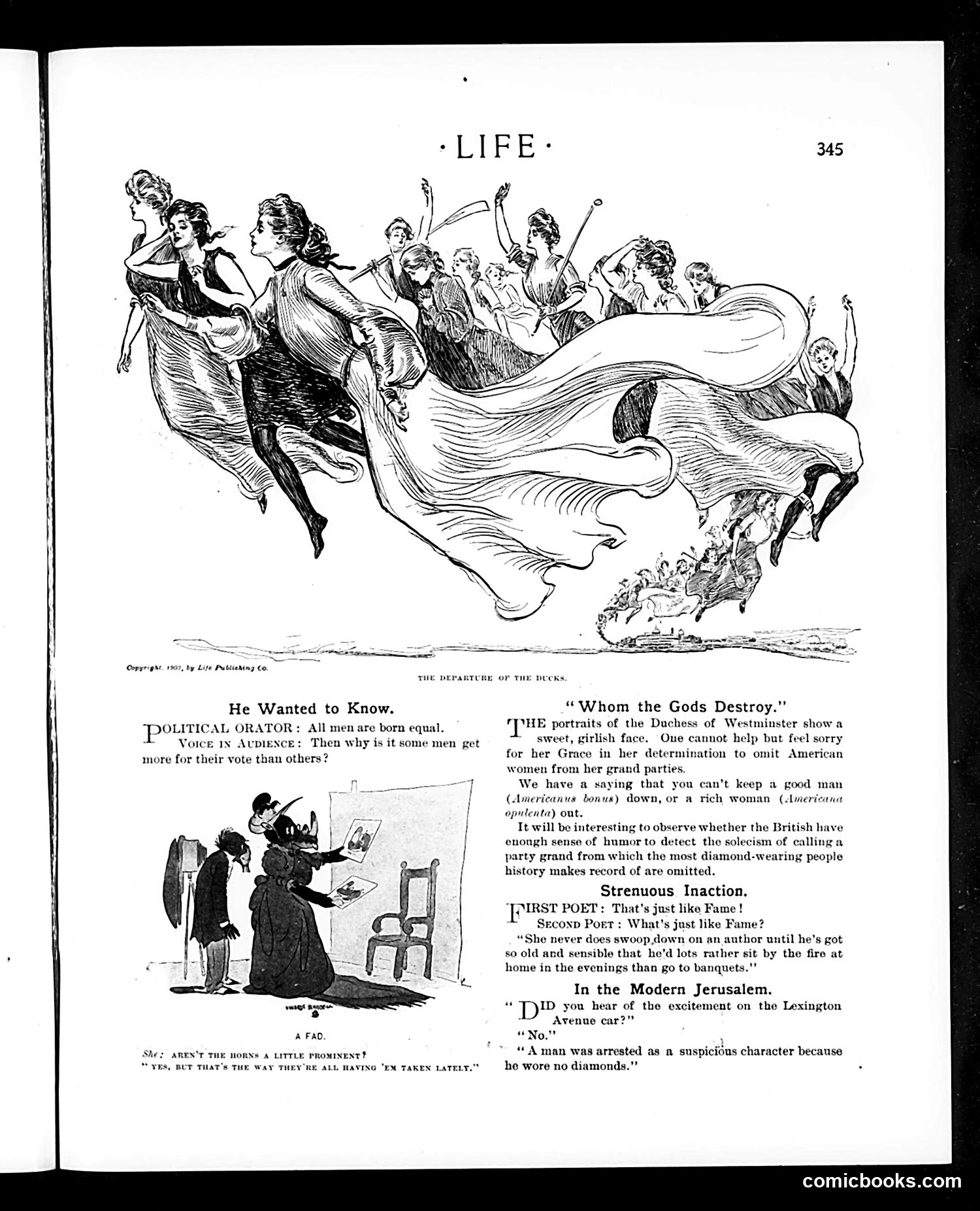
**Top illustration ("The Departure of the Hucks"):** A satirical drawing showing multiple figures being swept away on flowing fabric/clouds, depicting what appears to be a social or political exodus. **"He Wanted to Know":** A political cartoon mocking a naive question about equality. A political orator claims "all men are born equal," but a skeptic asks why some men accumulate more wealth than others. The satire targets the gap between democratic rhetoric and economic reality. **"Strenuous Inaction":** Two poets debate whether fame is worthwhile, with one suggesting famous authors are too dignified to attend literary events—social commentary on intellectual pretension. **"In the Modern Jerusalem":** A brief joke about a man arrested for lacking diamonds—apparently satirizing materialism or social inequality in contemporary society. The page combines political and social satire typical of early Life magazine's reformist humor.
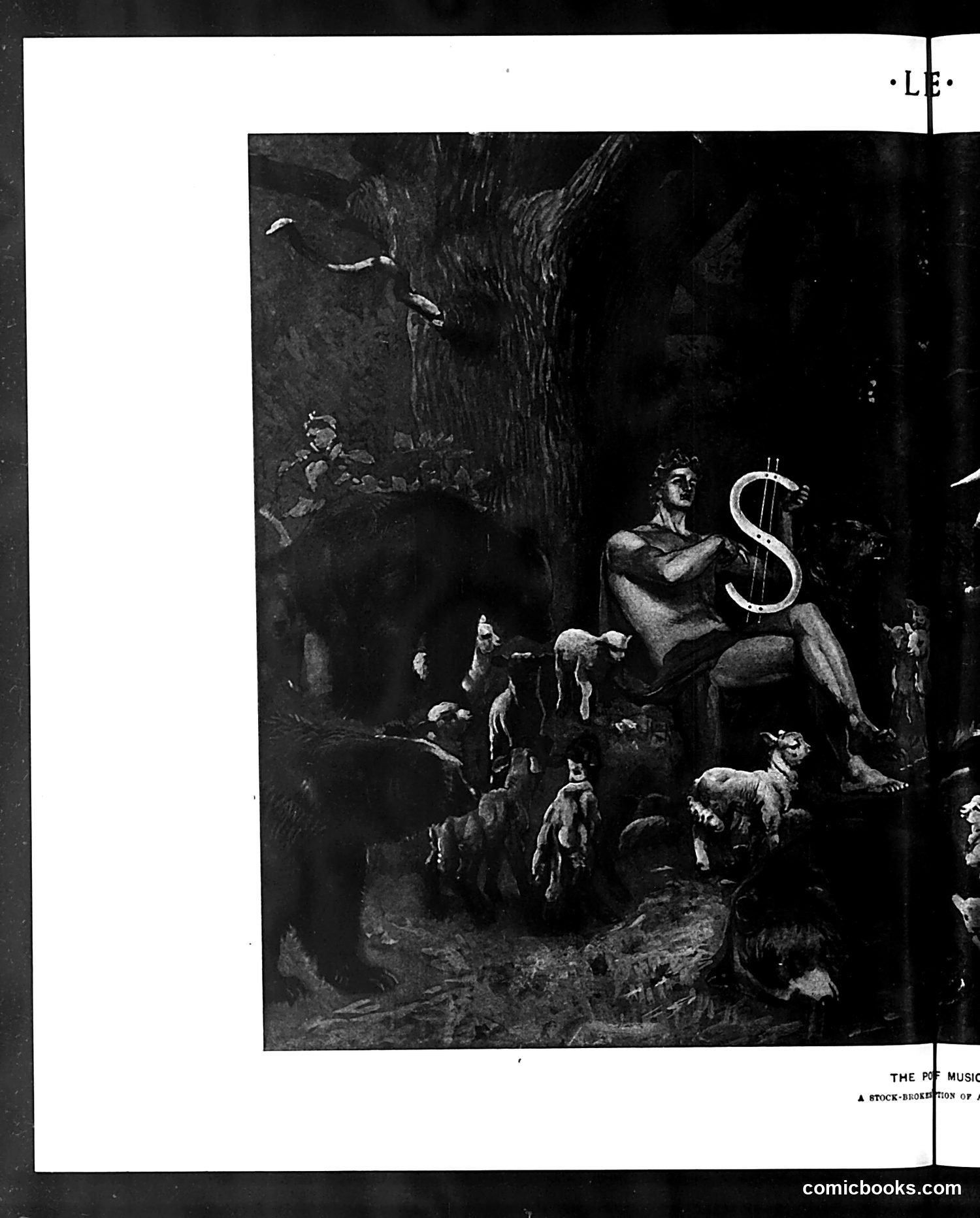
This appears to be a classical/mythological scene rather than a political cartoon. The image shows what looks like Pan or a similar classical figure playing a large dollar sign-shaped instrument (like a lyre or harp) while surrounded by goats and other figures in a cave or rocky setting. The satire likely critiques the commercialization or "music" of money itself—the dollar sign transformed into a musical instrument suggests wealth-making or financial dealings presented as an art form or performance. The attendant figures and animals may represent those enchanted or fooled by financial schemes. The partial caption visible reads "THE PO MUSIC / A STOCK-BROKER[?]ION OF..." which supports this interpretation as commentary on financial/stock market activity, possibly mocking brokers or investors who treat money-making as entertainment or art.
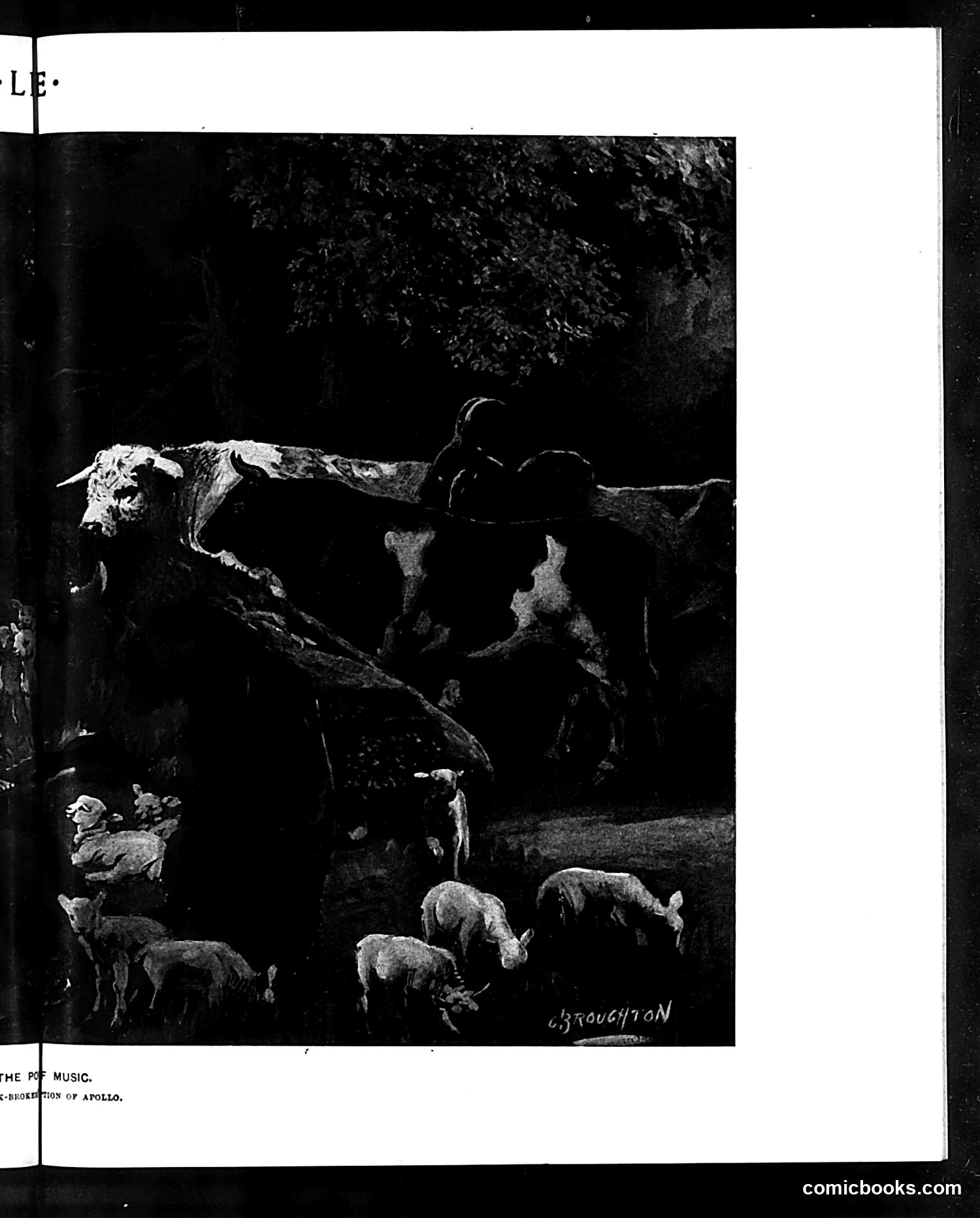
This appears to be a satirical illustration from Life magazine featuring a pastoral scene with goats and a cow arranged on a fallen log. The composition is dramatically lit against a dark background with foliage above. The partial OCR text references "THE POET MUSIC" and "ASCRIPTION OF APOLLO," suggesting this illustrates a classical or literary reference—likely Apollo's association with music and poetry in Greek mythology. The animals seemingly represent human figures or social types engaged in some form of musical or artistic activity, a common satirical device in Life magazine. However, without seeing the complete caption or article text, the specific political or social commentary remains unclear. The arrangement suggests hierarchy or a commentary on artistic pretension, but the exact target of the satire cannot be definitively determined from the image alone.
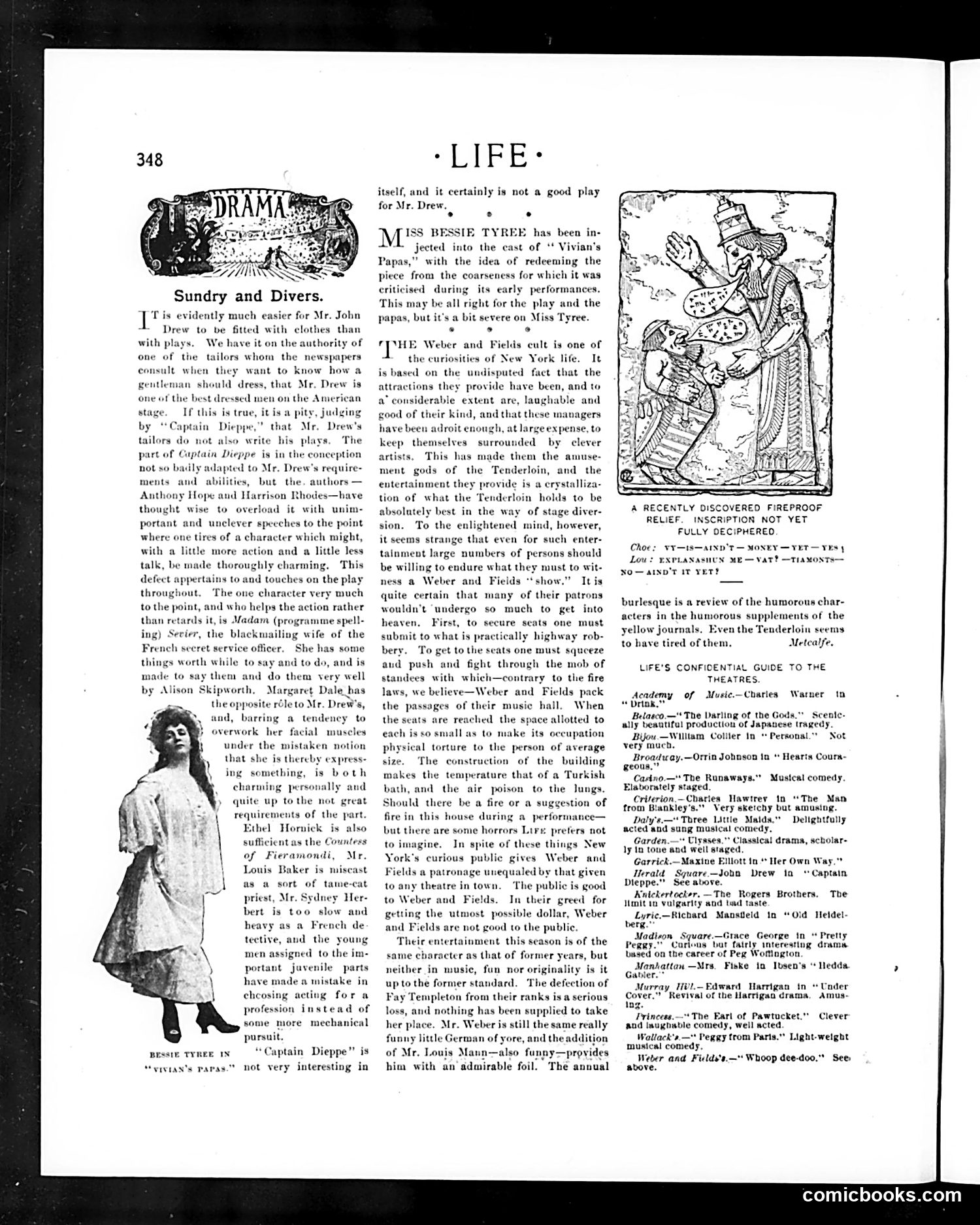
This page is a drama review section discussing Broadway productions. The main cartoon depicts a recently discovered "fireproof relief" sculpture, with a caption joking that it's "not yet fully deciphered" — this appears to be satirizing theatrical set design or stagecraft claims. The text reviews Mr. John Drew's clothing in plays and criticizes the Weber and Fields entertainment acts, which were apparently popular New York attractions known for elaborate (and expensive) staging. The reviewer suggests their shows prioritize spectacle over substance, requiring audiences to endure discomfort to attend. The column includes a photograph of actress Bessie Tyree in "Vivian's Papas," which the text indicates attempted to redeem an otherwise poorly-received play.
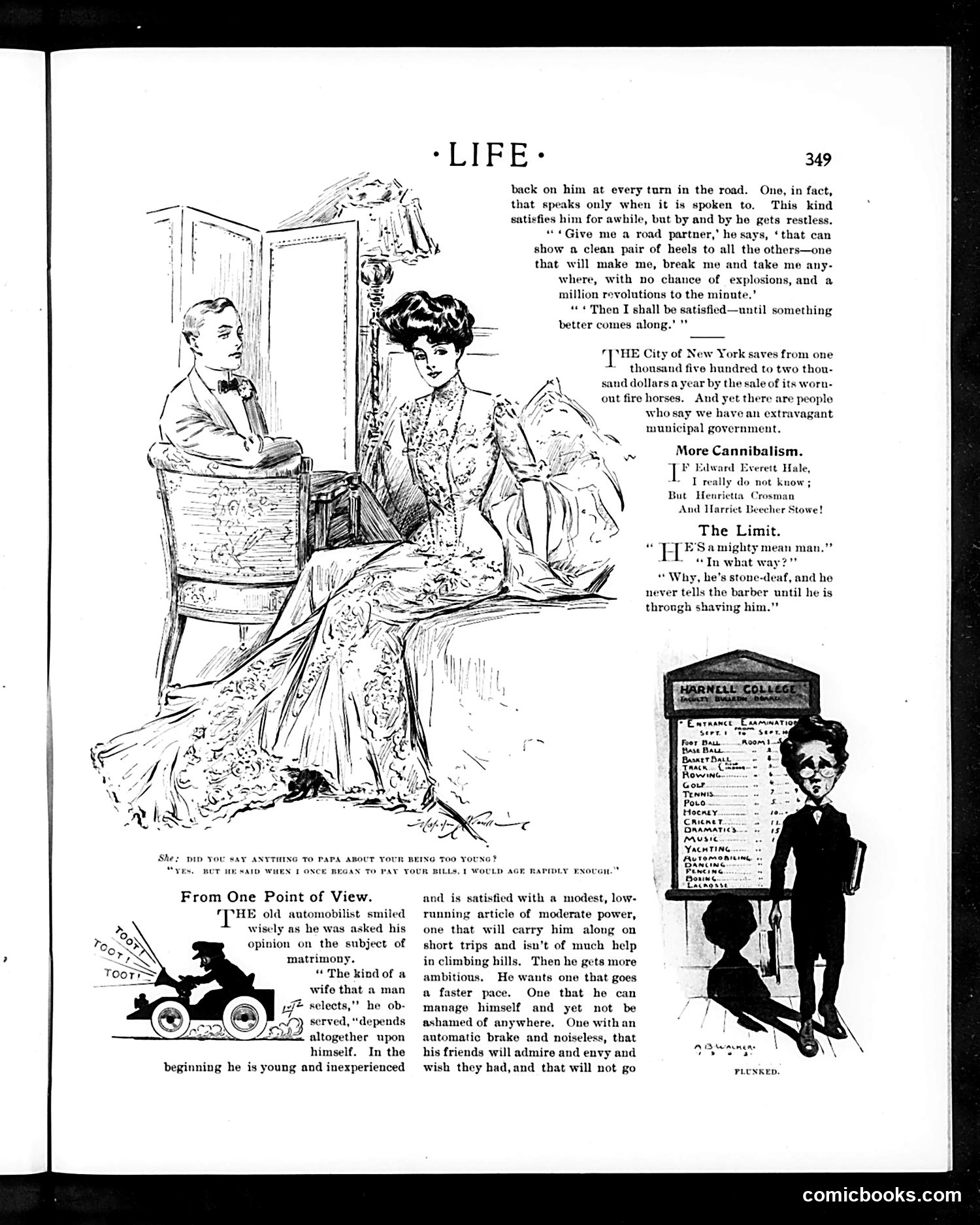
This page contains three separate satirical pieces typical of early 1900s American humor: **Main Cartoon ("From One Point of View"):** An automobile enthusiast compares choosing a wife to selecting a car, progressing from a modest, low-powered vehicle to increasingly ambitious models with better performance and features. The satire mocks both automotive obsession and the era's tendency to reduce matrimonial choice to consumer pragmatism—treating wives as interchangeable commodities like automobiles. **"More Cannibalism":** A brief joke referencing literary figures (Edward Everett Hale, Henrietta Crosman, Harriet Beecher Stowe), likely punning on their names or public personas in a way now obscure. **"The Limit":** A simple joke about a stingy man who avoids telling his barber he's deaf until shaving is complete—presumably to avoid paying or tipping. The page also includes a Harwell College advertisement (right margin) listing entrance examination subjects. The humor relies on period-specific references and attitudes toward gender, consumerism, and social class that require historical context to fully appreciate.
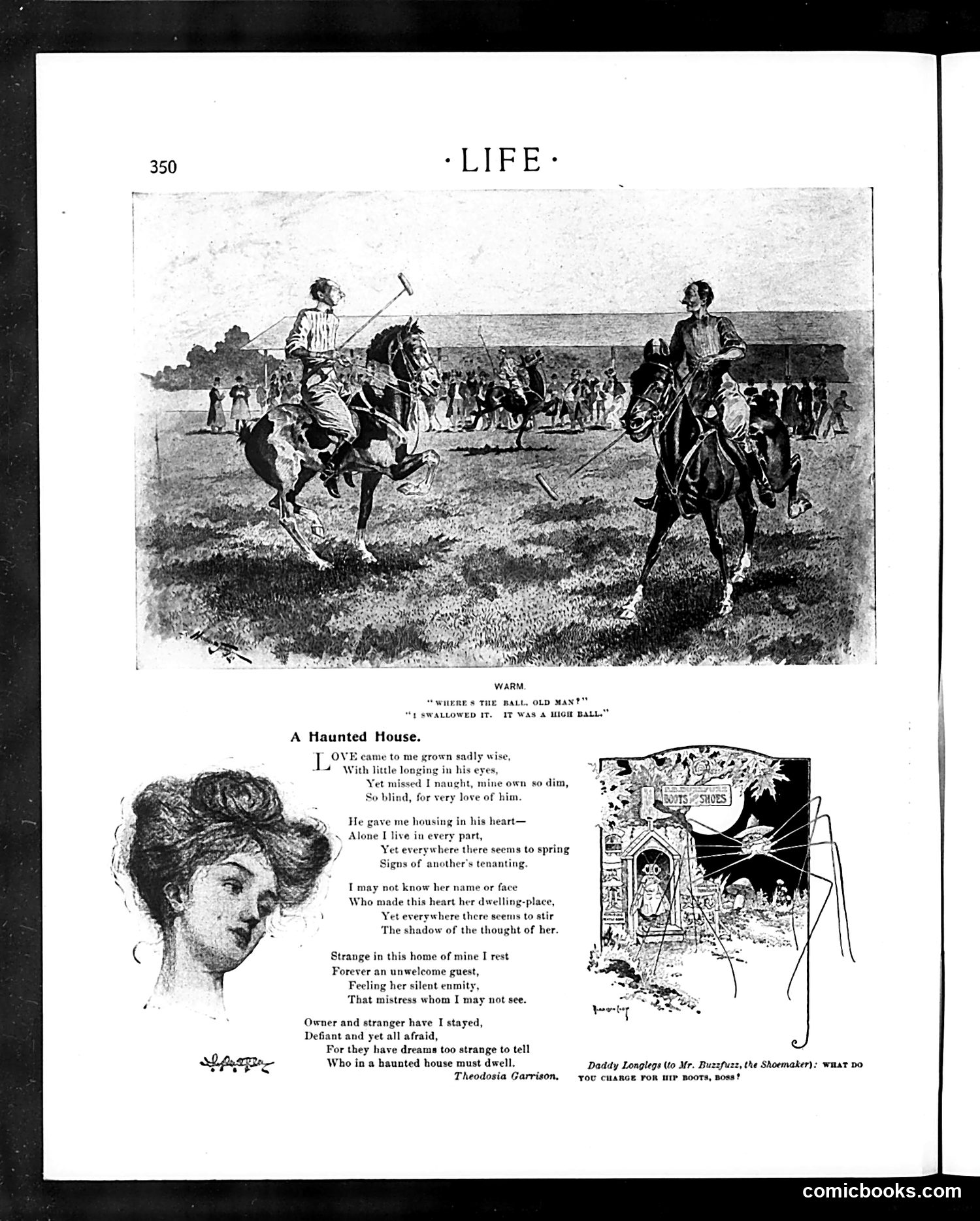
This page features two distinct pieces: **Top illustration**: A polo match scene with the caption "Where's the ball, old man?" / "Swallowed it. It was a high ball." This is a visual pun—"high ball" refers both to a difficult polo shot and an alcoholic drink, suggesting the older player has been drinking rather than playing seriously. **Main content**: Theodosia Garrison's poem "A Haunted House" explores romantic jealousy and insecurity. The speaker describes loving someone whose heart contains memories of a previous love—an invisible "mistress" whose presence haunts their relationship. The poem expresses the emotional limbo of being in a partnership shadowed by a rival's memory. **Bottom cartoon**: A "Daddy Longlegs" comic strip (by unclear artist) shows a tall character asking a shoemaker what he charges for boots, with the shoemaker's response cut off. The page blends sentimental poetry with light humor typical of early 20th-century Life magazine's mix of literary and comedic content.
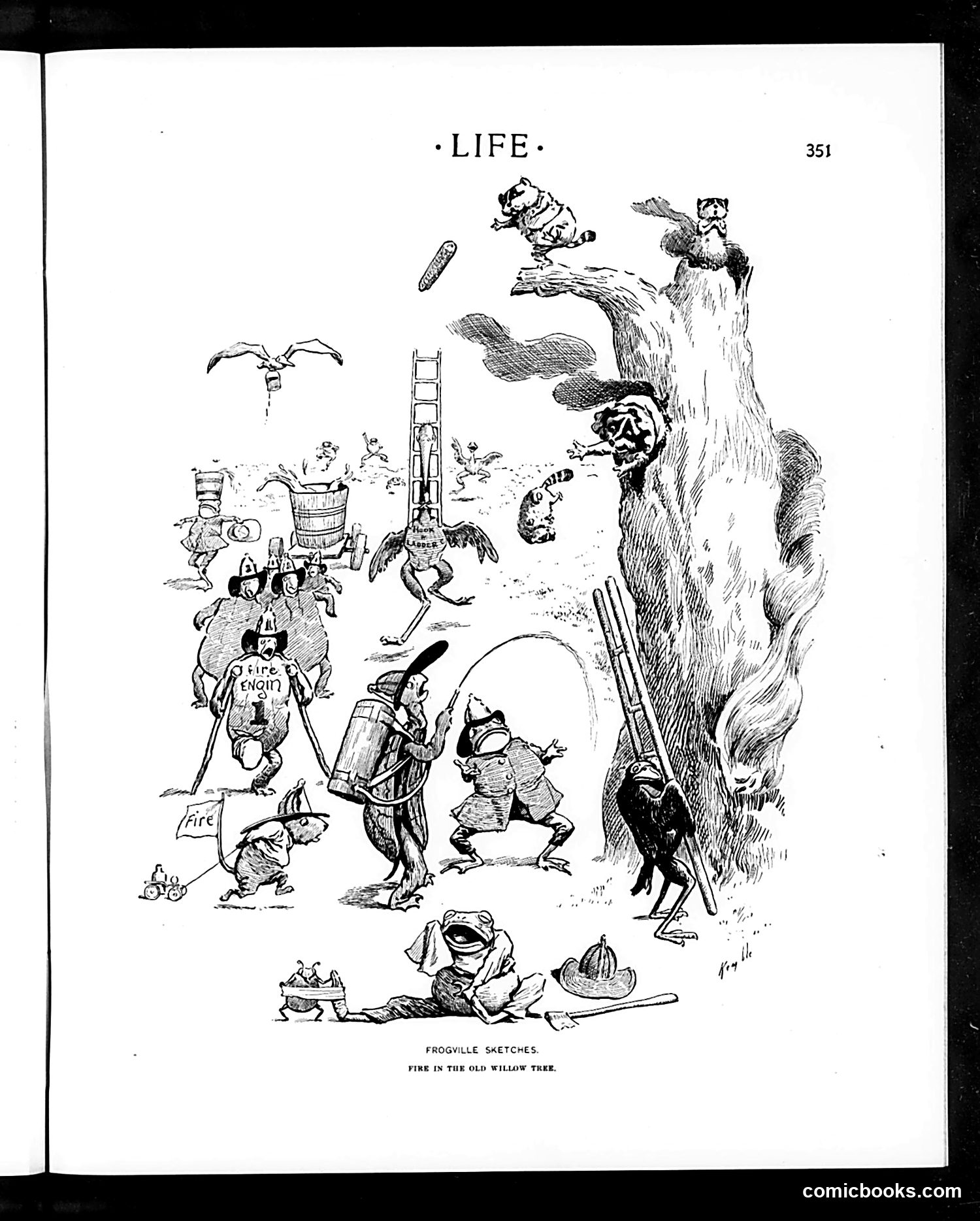
This is a whimsical anthropomorphic comic series depicting frogs responding to a fire in a tree. The sketch shows various frog characters engaged in firefighting activities—some operating what appears to be an early fire engine or pump apparatus, others carrying buckets and tools, and some appearing to panic or flee. A tall willow tree on the right side shows flames. The satire likely mocks contemporary firefighting methods and emergency response procedures of Life magazine's era, using animal characters to humorously exaggerate human behavior during crisis. The frogs' comical chaos and varied reactions—from industrious effort to panicked scrambling—create humor through the contrast between their earnest attempts and the absurdity of the situation itself.
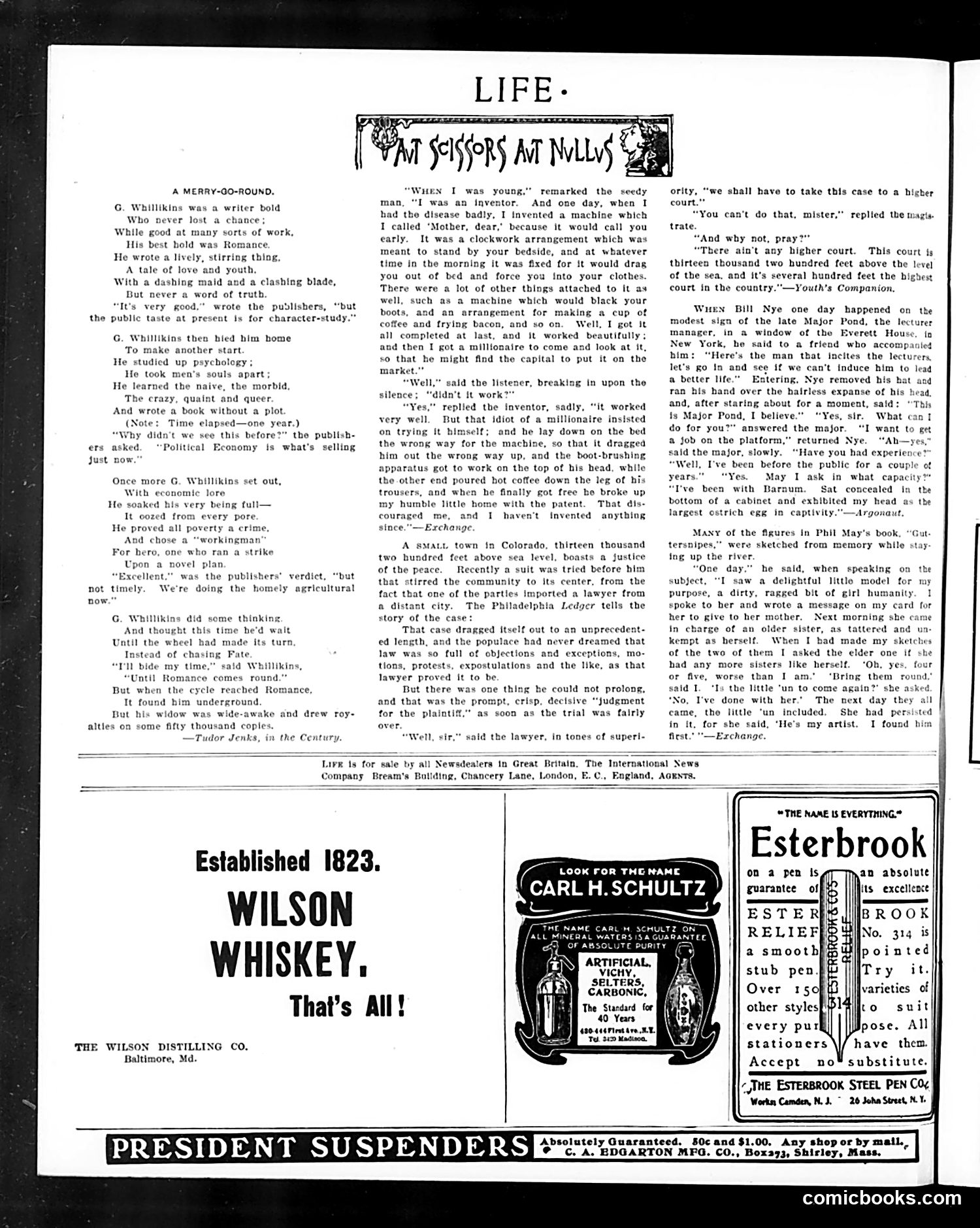
This page contains three satirical pieces about American life and business practices circa early 1900s: **"A Merry-Go-Round"** (main cartoon): A writer named G. Whillikins repeatedly chases publishing trends—shifting from romance novels to psychological character studies to political economy/labor fiction—only to find each genre outdated by the time he finishes. The satire mocks both the fickle publishing industry and writers who abandon artistic integrity to chase commercial fashion. The grim punchline: by the time romance cycles back around, Whillikins is dead, but his widow profits from his backlist. **Two anecdote pieces** below present inventor and lawyer characters facing bureaucratic or circumstantial absurdity—standard early-20th-century humor about impractical innovation and legal pretension. The advertisements (whiskey, pens, suspenders) are period-typical filler. The page essentially satirizes commercial compromise and trend-chasing in publishing.
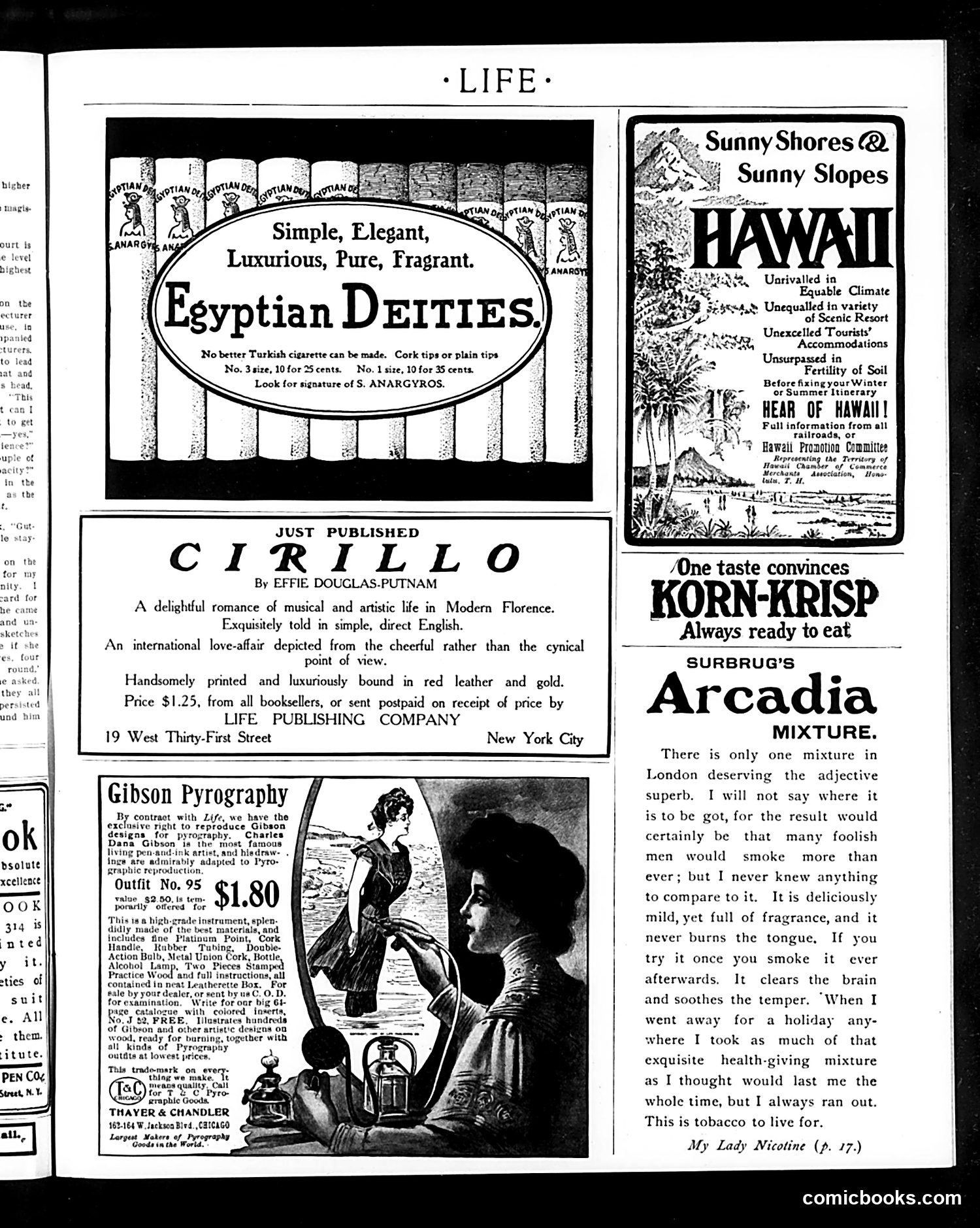
This page is primarily **advertising**, not satirical content. It features multiple product advertisements typical of early 20th-century magazines: **Egyptian Deities cigarettes** promote Turkish cigarettes with claims of superiority ("No better Turkish cigarette can be made"), using cork or plain tips at various prices. **Cirillo** advertises a romantic novel set in Florence, published by Life Publishing Company. **Gibson Pyrography** sells a woodburning kit featuring designs by Charles Dana Gibson, the famous illustrator whose "Gibson Girl" images defined the era's aesthetic ideal. **Hawaii tourism** promotes the islands as an ideal destination, emphasizing climate and scenic beauty. **Korn-Krisp** and **Arcadia Mixture** (tobacco) are food and smoking product ads using testimonial-style copy. The page contains **no political satire or cartooning**—it's a commercial space showcasing consumer goods marketed to affluent readers, reflecting what advertisers believed would appeal to *Life*'s educated, middle-to-upper-class audience.
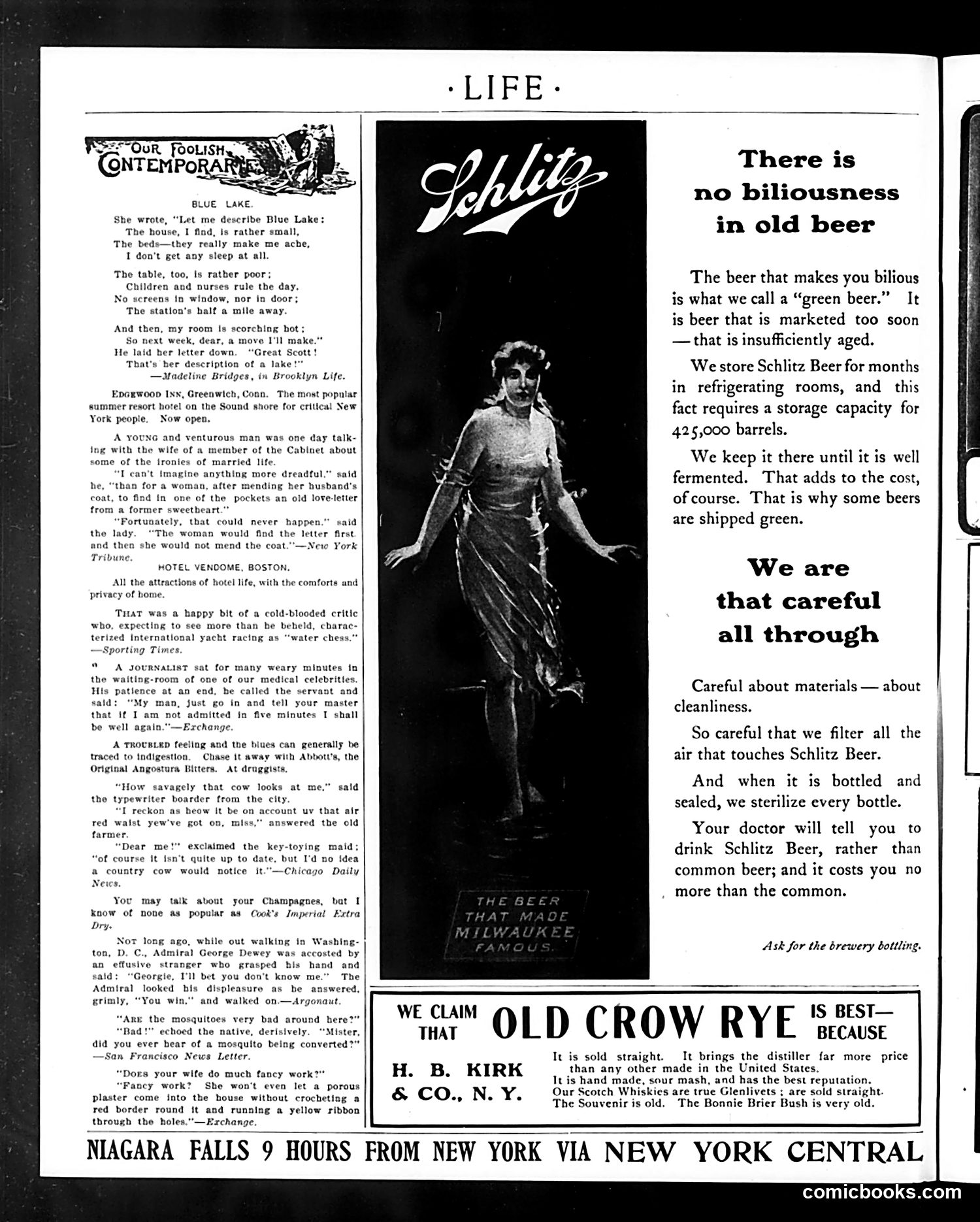
This page from *Life* magazine consists primarily of **humorous anecdotes and advertisements** rather than political cartoons. The left column contains satirical short stories mocking everyday absurdities: a woman complaining about a lakeside resort's poor conditions while claiming to enjoy nature; a joke about finding a love letter in a husband's coat; and Admiral Dewey's dismissive response to an overeager stranger. These represent typical *Life* humor—gentle social satire targeting middle-class pretension and marital ironies. The dominant right side features a **Schlitz Beer advertisement** with an illustration of a woman and heavy emphasis on the product's careful brewing and aging process. The ad explicitly contrasts "old beer" (properly fermented) with "green beer" (insufficiently aged), claiming superior quality justifies higher cost. The page reflects early 20th-century advertising's educational approach: manufacturers didn't just sell products but explained technical superiority. The Schlitz ad's prominent placement suggests beer marketing was a major revenue source for *Life*. The bottom includes an Old Crow Rye Whiskey advertisement. Overall, this is an **advertising-heavy issue** rather than a satirical commentary page.
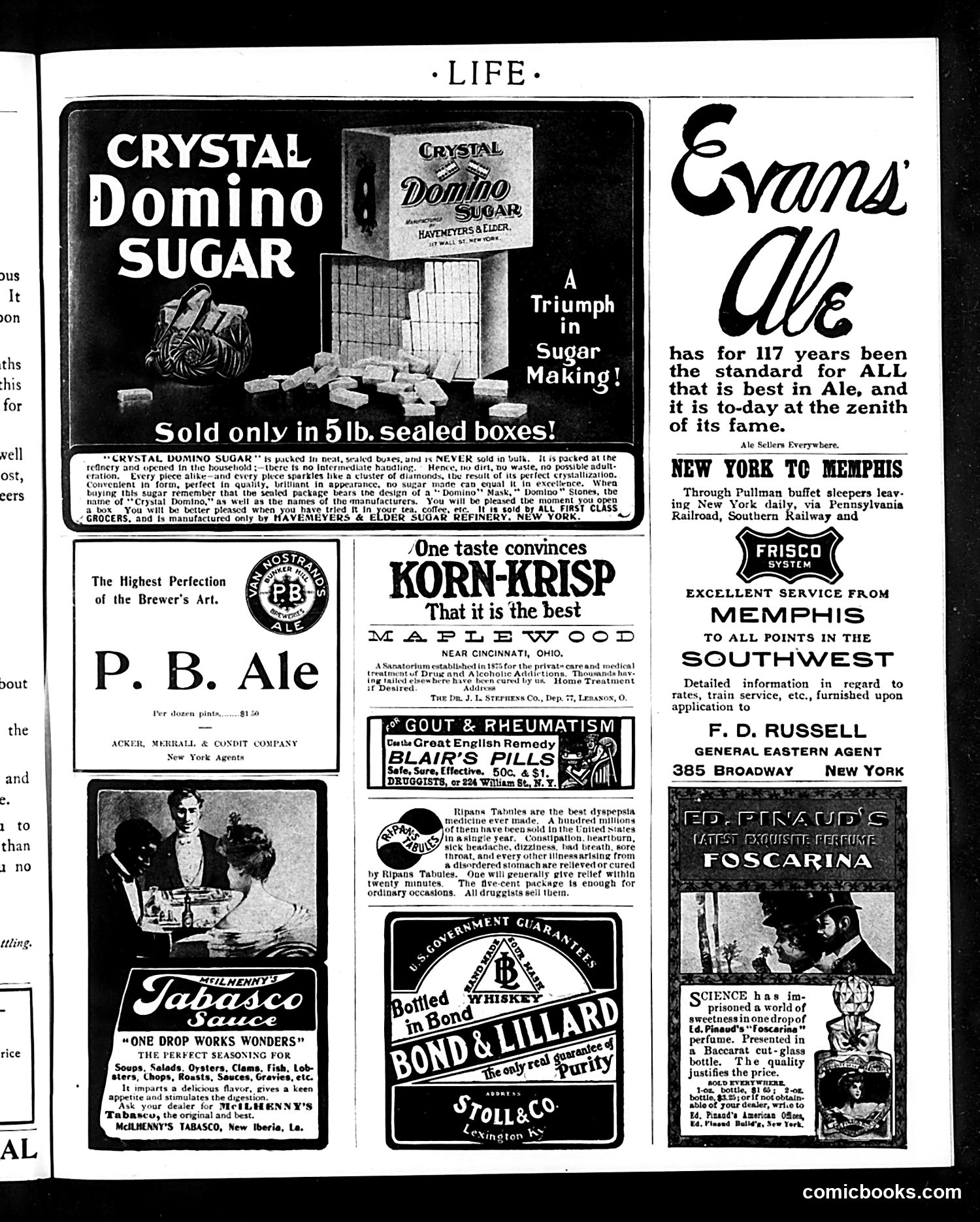
This is **primarily an advertisement page** with no political cartoons or satirical content. It consists entirely of product advertisements from the early 20th century. The ads showcase period consumer goods: Crystal Domino Sugar (emphasizing purity and consistent quality), P.B. Ale and Evans Ale (competing brewers), Korn-Krisp cereal, Tabasco sauce, and medical/pharmaceutical products like Ripans Tabules (digestive remedy) and Blair's Pills (for gout and rheumatism). Notable for modern readers: the ads reference now-obsolete products and medical treatments (like "Drug and Alcoholic Addictions" sanitariums), reveal period marketing strategies (emphasizing purity, consistency, and scientific authority), and show the commercial nature of Life magazine during this era. The page contains no satire, caricatures, or political commentary—it's a straightforward commercial product catalog dressed in period typography and graphic design.
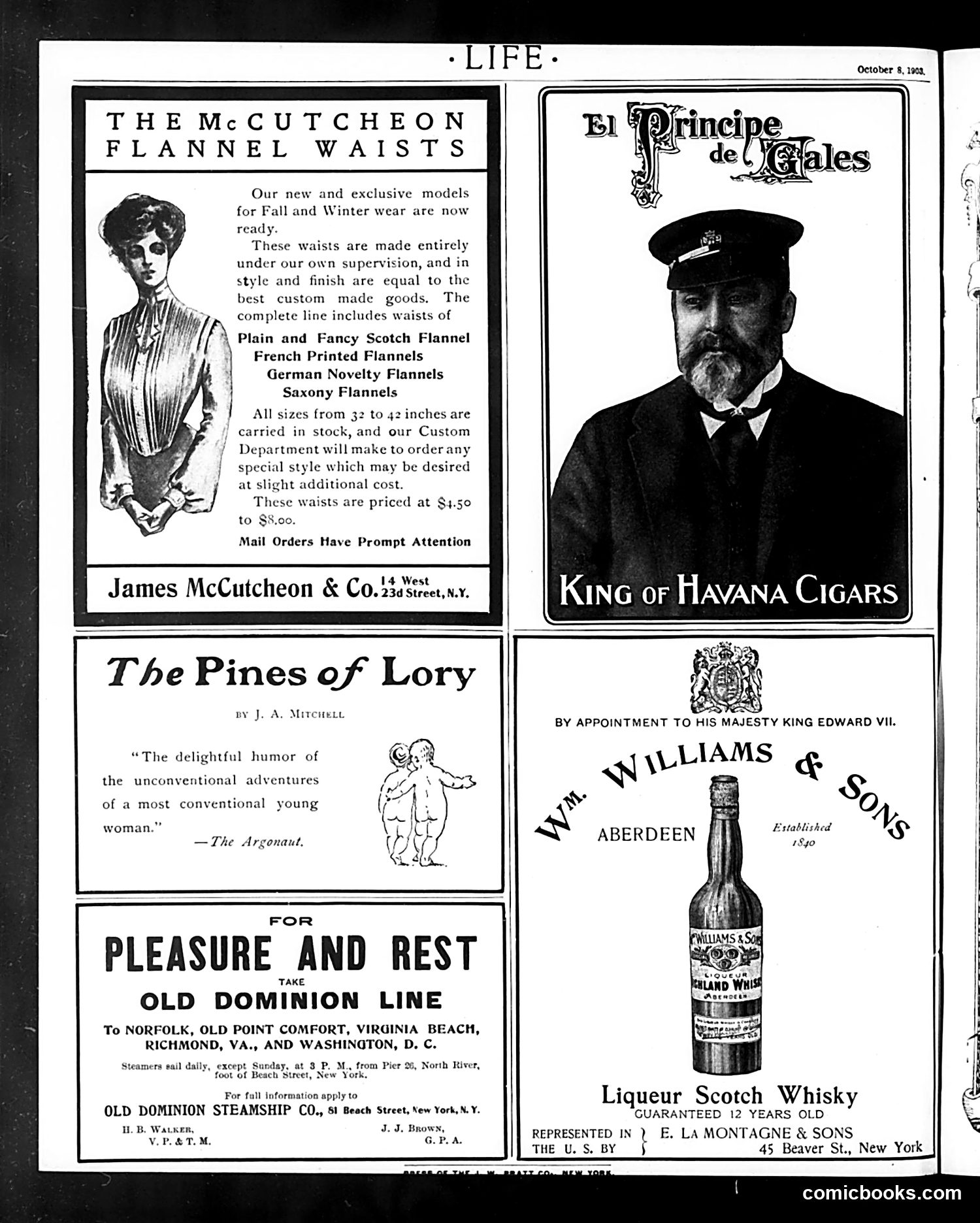
This page contains **no political cartoons or satire**—it is a straightforward advertising section from *Life* magazine's early 1900s era. The ads include: - **McCutcheon flannel waists** for women ($4.50-$8.00), marketed as custom-quality goods in various fabric types - **"The Pines of Lory"** book promotion, described as humorous fiction about an unconventional young woman - **Old Dominion Line** steamship service advertising pleasure cruises to Virginia coastal destinations - **El Príncipe de Gales** cigars (Havana) featuring a bearded gentleman in naval/formal dress - **Williams & Sons** Scottish whisky from Aberdeen, appointed to King Edward VII The page reflects turn-of-the-century American consumer culture: fashionable women's clothing, leisure travel, imported luxury goods (cigars, whisky), and literary entertainment. There is no satire or political commentary visible.