
Life, 1903-10-08 · page 4 of 20
Life — October 8, 1903 — page 4: what you’re looking at
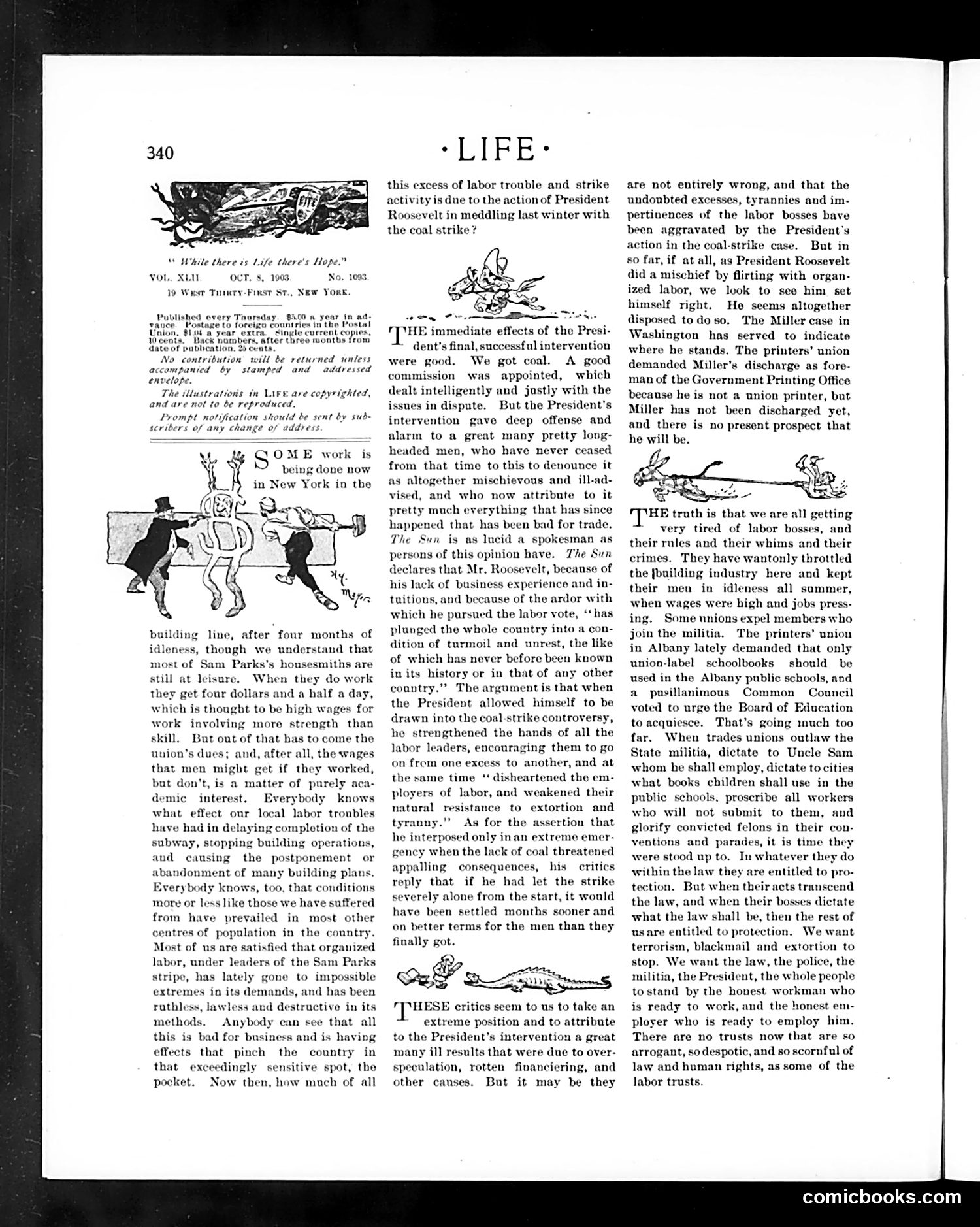
What you’re looking at
This page discusses **President Roosevelt's intervention in a coal strike**, a major labor dispute. The cartoon depicts men engaged in a tug-of-war, likely representing the conflict between labor and management during this strike. The text criticizes Roosevelt's actions, claiming his intervention gave "deep offense and alarm to a great many pretty long-headed men" and that he "strengthened the hands of all the labor leaders." The article argues Roosevelt's handling of the strike set dangerous precedents, weakening employers' positions and emboldening unions to make further demands. The satire contrasts Roosevelt's intention to resolve the dispute with unintended consequences: strengthening labor's negotiating power and encouraging future union activity. The piece advocates for law and order over union demands.
📄 Transcribed text from this page (OCR, searchable)
Machine-transcribed from the original scan — historical spelling and the odd misread are preserved.
“ White there is Life there's Hope.” vou. XLAL No. 1093. 19 West Tiwry-Finst St., New Yore. OUT. 8, 1993. vrrent copies. months from No contribution accompanied by envelope. The illustrations in LiFe are copyrighted, and are not to be reproduced. Prompt notification should be sent by sub- scribers of any change of address. it be returned untess stamped and addressed OME work is being done now in New York in the line, after four months of idleness, though we understand that most of Sam Parks’s housesmiths are still at leisure. When they do work they get four dollars and a half a day, which is thought to be high wages for work involving more strength than skill. But out of that bas to come the union's dues; and, after all, the wages that men might get if they worked, but don't, is a matter of purely a demic interest. Everybody knows what effect our local labor troubles have had in delaying completion of the subway, stopping building operations, and causing the postponement or abandonment of many building plans. Everybody knows, too, that conditions more or less like those we have suffered from have prevailed in most other centres of population in the country. Most of us are satisfied that organized labor, under leaders of the Sam Parks stripe, has lately gone to impossible extremes in its demands, and has been ruthless, lawless and destructive in its methods. Anybody can see that all this is bad for business and is hav: effects that pinch the country in that exceedingly sensitive spot, the pocket. Now then, how much of all building - LIFE* this excess of labor trouble and strike activity is due to the action of President Roosevelt in meddling last winter with the coal strike? ‘TR immediate effects of the Presi- dent's final, successful intervention were good. We got coal. A good commission was appointed, which dealt intelligently and justly with the issues in dispute. But the President's intervention gave deep offense and alarm to a gr many pretty long- headed men, who have never ceased from that time to this to denounce it as altogether mischievous and ill-ad- vised, and who now attribute to it pretty much everything that has since happened that has been bad for trade. The Sun is as lucid a spokesman as persons of this opinion have. The Sun declares that Mr. Roosevelt, because of his lack of business experience and in- tuitions, and because of the ardor with which he pursued the labor vote, ‘has plunged the whole country into a con- dition of turmoil and unrest, the like of which has never before been known in its history or in that of any other country.” The argument is that when the President allowed himself to be drawn into the coal-strike controversy, he strengthened the hands of all the labor leaders, encouraging them to go on from one excess to another, and at the same time ‘' disheartened the em- ployers of labor, and weakened their natural resistance to extortion and tyranny.”’ As for the assertion that he interposed only inan extreme emer- gency when the lack of coal threatened appalling consequences, his critics reply that if he had let the strike severely alone from the start, it would have been settled months sooner and on better terms for the men than they finally got. ; critics seem to us to take an extreme position and to attribute to the President's intervention a great many ill results that were due to over- speculation, rotten financiering, and other c: s. But it may be they are not entirely wrong, and that the undoubted excesses, tyrannies and im- pertinences of the labor bosses bave been aggravated by the President's action in the coal-strike case. But in so far, if at all, as President Roosevelt did a mischief by flirting with organ- ized labor, we look to see him set himself right. He seems altogether disposed todo so, The Miller case in Washington has served to indicate where he stands. The printers’ union demanded Miller's discharge as fore- man of the Government Printing Office because he is not a union printer, but Miller has not been discharged yet, and there is no present prospect that he will be. HE truth is that we are all getting very tired of labor bosses, and their rules and their whims and their crimes. They have wantonly throttled the {building industry here and kept their men in idleness all summer, when wages were high and jobs pres ing. Some unions expel members who join the militia. The printers’ union in Albany lately demanded that only union-label schoolbooks should be used in the Albany public schools, and a pusillanimous Common Council voted to urge the Board of Education to acquiesce. That’s going inuch too far. When trades unions outlaw the State militia, dictate to Uncle Sam whom he shall employ, dictate to cities what books children shall use in the public schools, proscribe all workers who will not submit to them, and glorify convicted felons in their con- ventions and parades, it is time they were stood up to. In whatever they do within the law they are entitled to pro- tection. But when their acts transcend the law, and when their bosses dictate what the law shall be, then the rest of us are entitled to protection. We want terrorism, blackmail and extortion to stop. We want the law, the police, the militia, the President, the whole people tostand by the honest workman who is ready to work, and the honest em- ployer who is ready to employ him. There are no trusts now that are so arrogant, so despotic, and so scornful of law and human rights, as some of the labor trusts. comicbooks.com