
A complete issue · 20 pages · 1903
Life — July 16, 1903
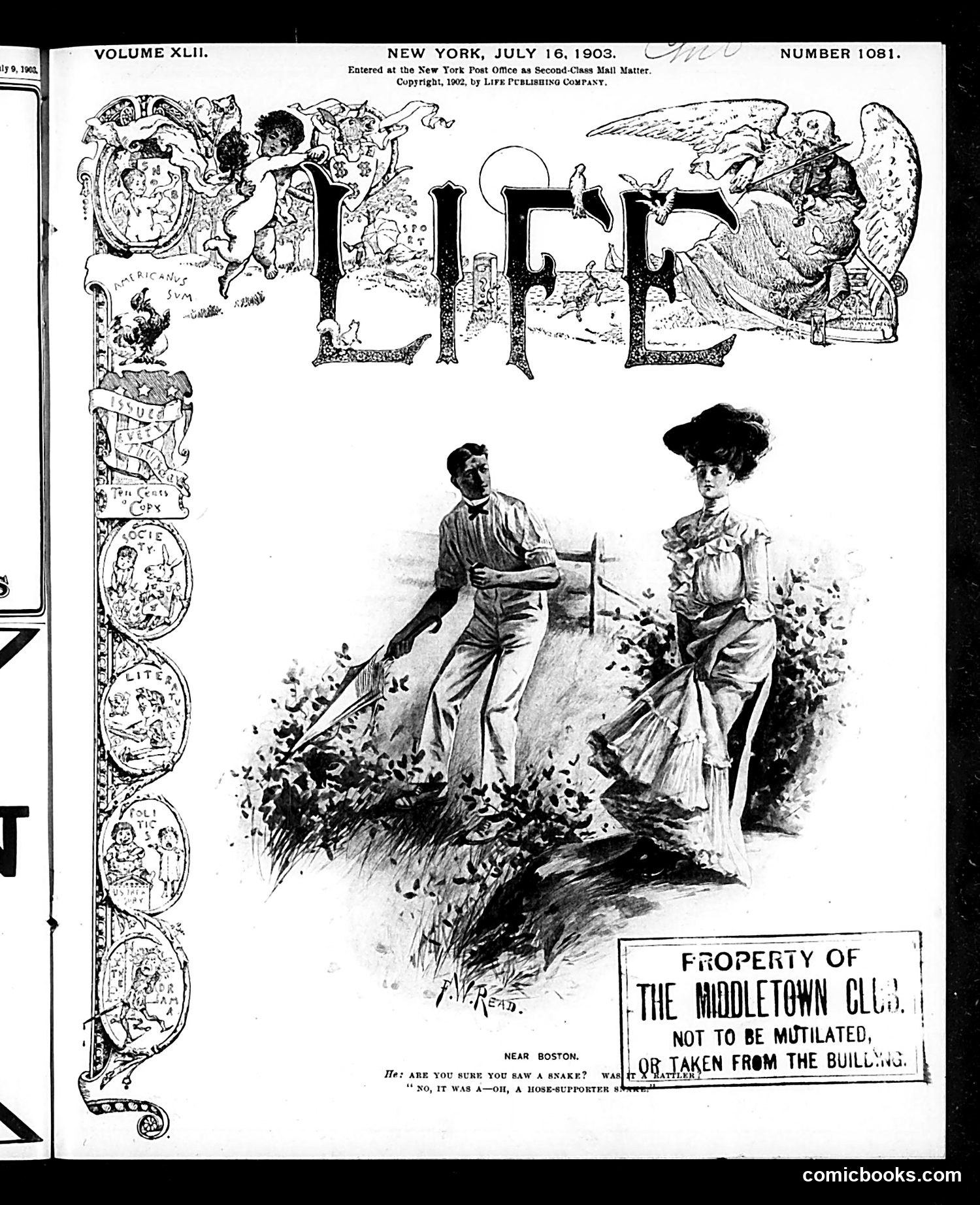
This page features a satirical illustration titled "Life" showing two figures in a garden setting near Boston. A man with a spade stands beside a woman in elaborate dress and a large hat. The caption reads: "He: ARE YOU SURE YOU SAW A SNAKE? WAS IT SO, IT WAS A—OH, A HORSE-SUPPORTER?" The joke appears to satirize early 1900s fashion, specifically women's corsetry and support garments. The "horse-supporter" reference likely mocks the exaggerated understructure needed to maintain the S-bend silhouette fashionable at the time. The woman's dramatically curved posture supports this interpretation—she's so rigidly corseted that her companion mistakes her rigid form for something other than natural anatomy. This reflects contemporary satirical commentary on the impracticality and artificiality of Edwardian women's fashion.
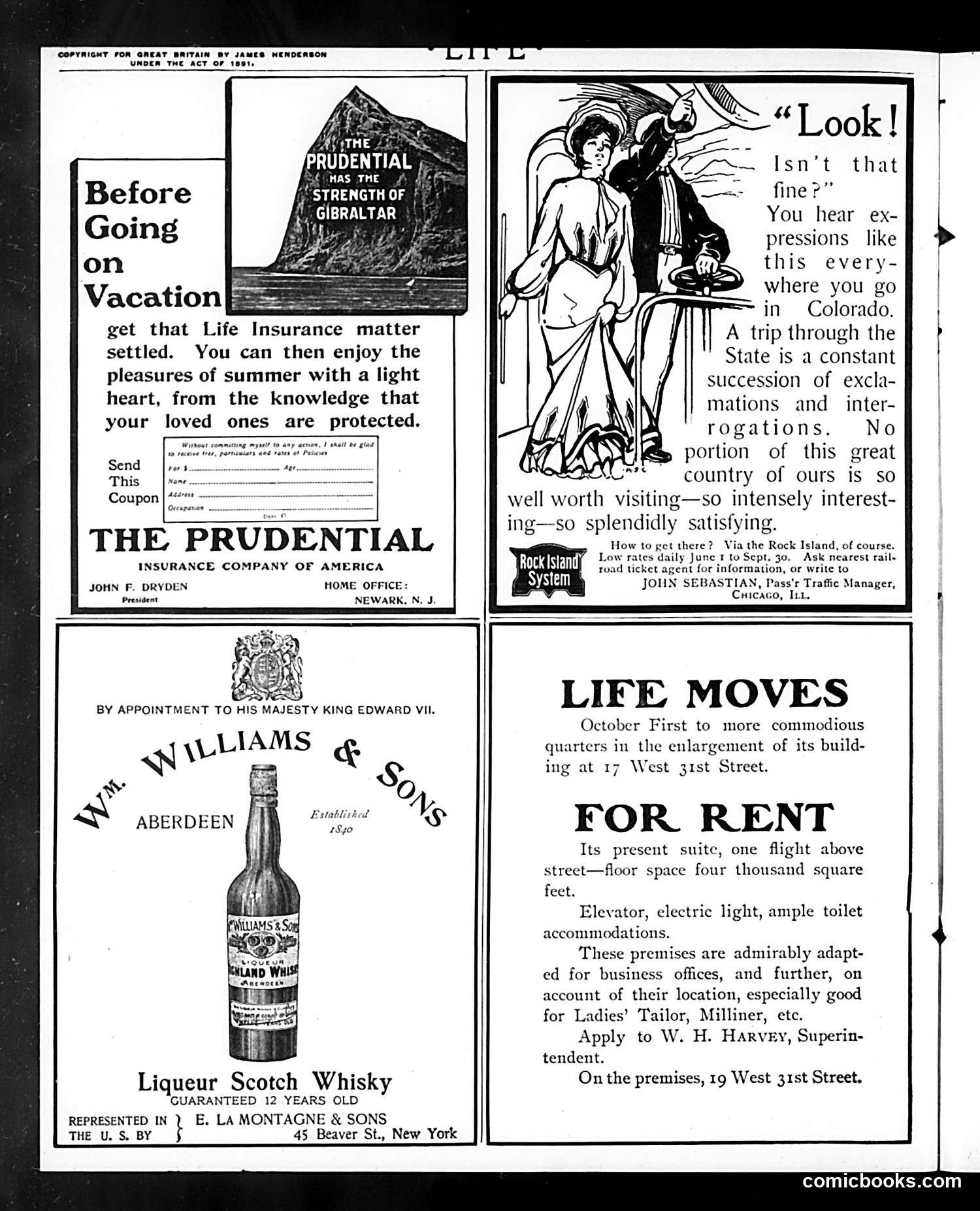
This page is primarily **advertising**, not satire or political commentary. The ads include: - **Prudential Insurance**: Urges vacation-goers to secure life insurance before traveling, so loved ones are protected - **Rock Island System railroad**: Promotes Colorado tourism, emphasizing the state's natural wonders and scenic variety - **W.M. Williams & Sons**: Advertises Scottish whisky (12 years old), represented by a bottle image - **Life Magazine announcement**: Notes the publication is relocating its offices to larger quarters at 17 West 31st Street in New York The Colorado tourism ad features a illustrated couple, with the woman pointing toward scenery, but this is straightforward promotional imagery rather than satire. The page reflects early 20th-century advertising conventions and consumer culture.
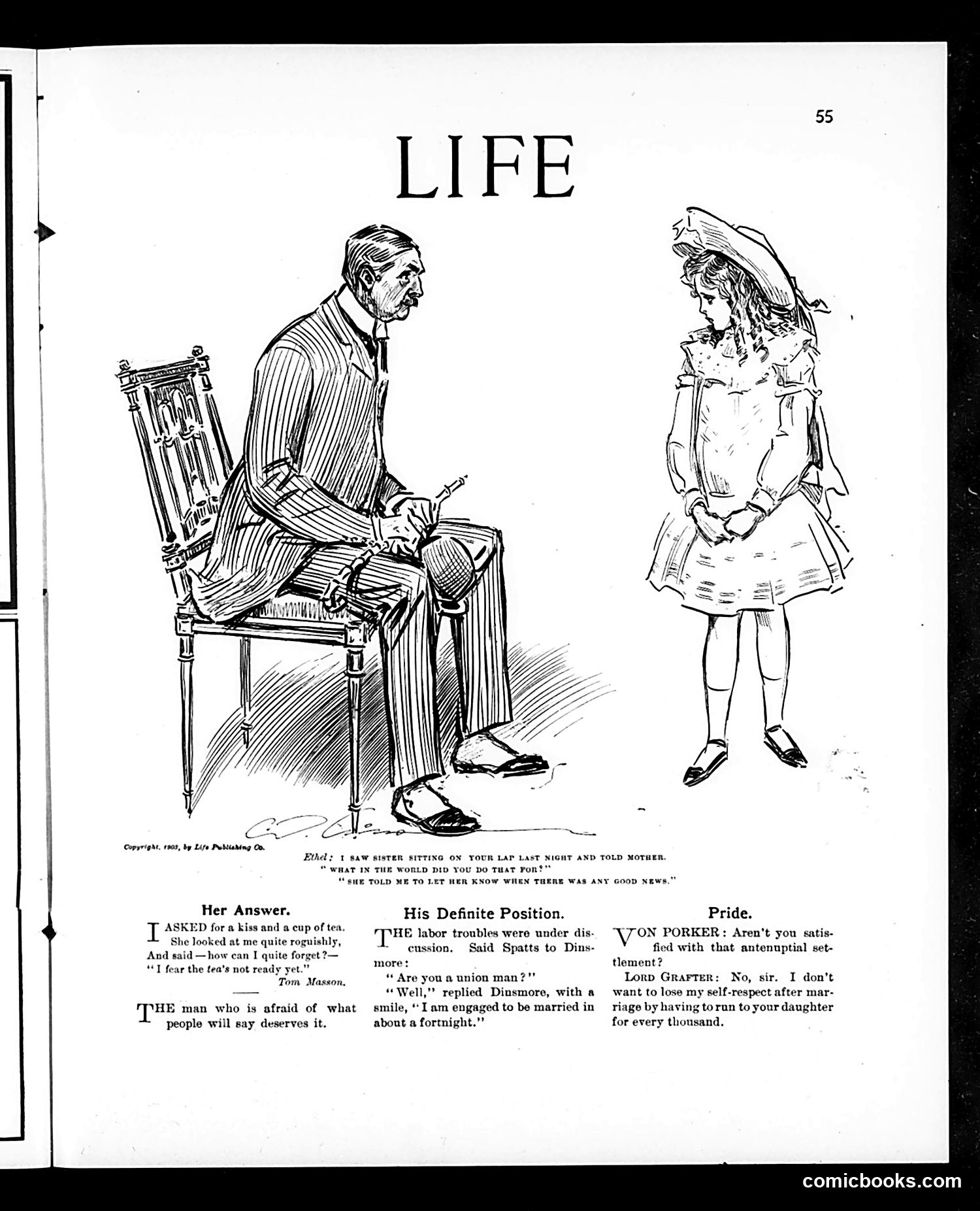
This page from *Life* magazine contains three separate satirical pieces about courtship and marriage customs: **The main cartoon** depicts a man seated while a young girl stands before him. The caption indicates he's asking what she told her mother about their encounter—a joke about propriety and parental concerns regarding unmarried couples. **"Her Answer"** presents a humorous poem about a woman who refuses a suitor's advances, fearing gossip. **"His Definite Position"** satirizes labor disputes by having a man invoke union membership to avoid marriage—treating matrimony like a labor negotiation where he won't accept terms without compensation. **"Pride"** shows a wealthy father refusing to support his daughter's marriage to a poor man, valuing social status over her happiness. These pieces mock Victorian-era courtship conventions, class consciousness, and gender dynamics of the early 20th century.
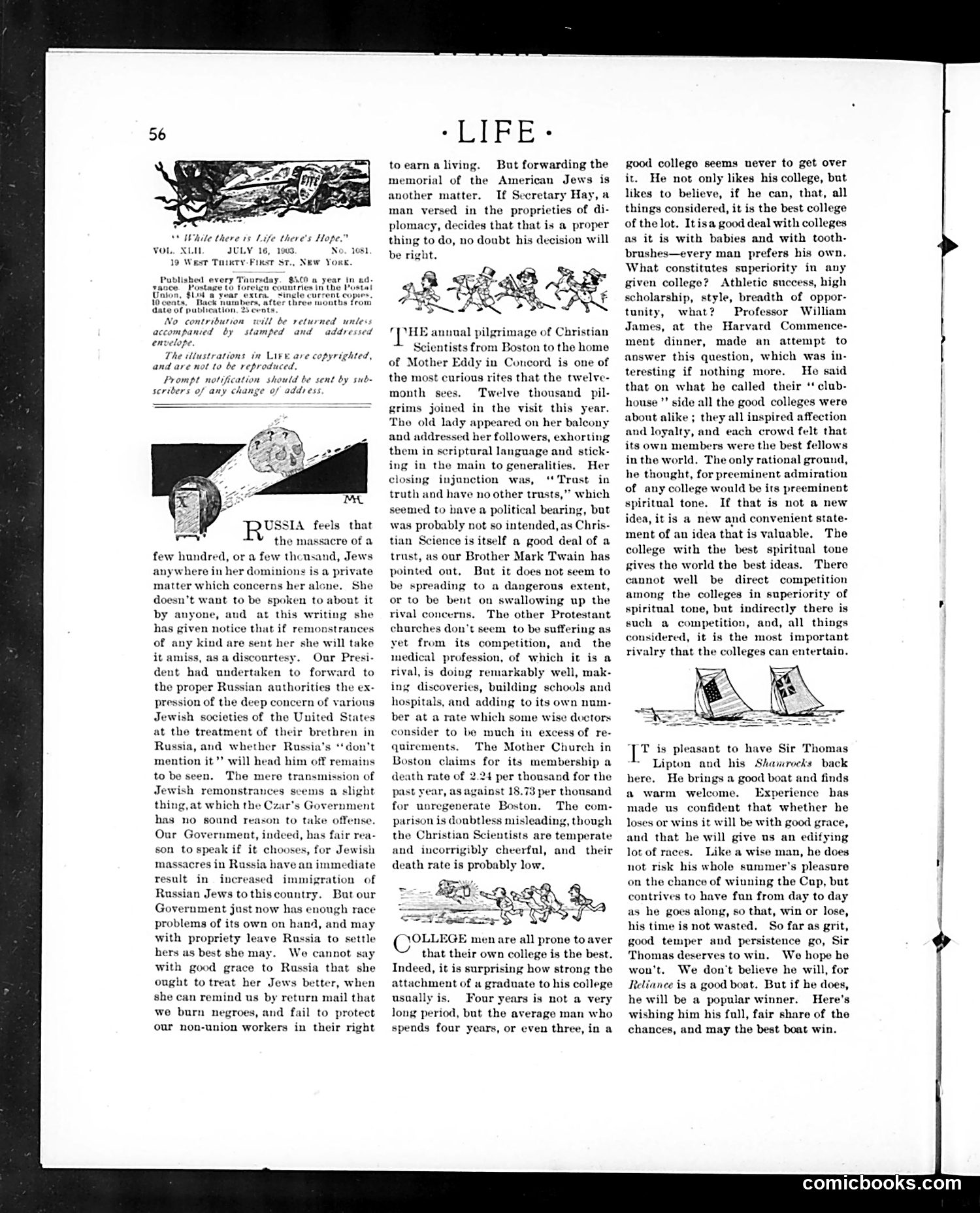
This page contains three distinct editorial sections discussing contemporary issues: 1. **Russia and Jewish Massacres**: The opening article addresses Russia's treatment of Jews, describing massacres in the Pale of Settlement. It argues the U.S. government should protest these atrocities and criticizes inaction toward protecting non-union workers' rights. 2. **Christian Science controversy**: A section discusses the "annual pilgrimage" to Mother Eddy's Concord home and debates Christian Science's spiritual claims versus medical profession competition. The tone is skeptical about its doctrine. 3. **College athletics and character**: The final section critiques colleges' over-emphasis on athletic superiority while neglecting spiritual development. It praises Sir Thomas Lipton's sportsmanship as an ideal example. The page lacks prominent political cartoons—instead offering opinion pieces on immigration, religion, and education reflecting early 1900s Progressive Era concerns.
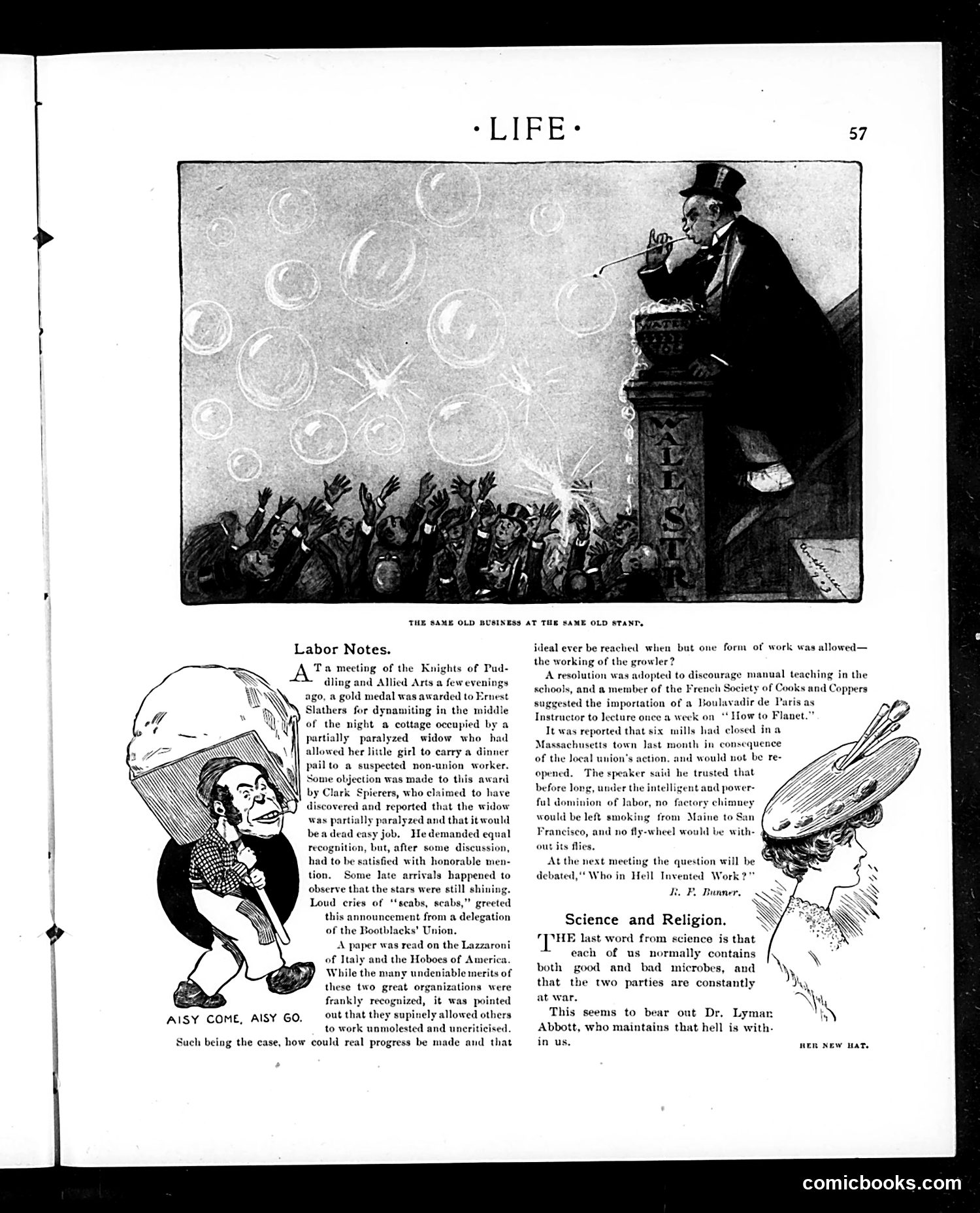
**Main Image ("The Same Old Business at the Same Old Stand"):** A caricatured figure in top hat and cape stands on a platform, blowing bubbles while addressing an enthusiastic crowd below. This appears to satirize political rhetoric or propaganda—the bubbles symbolize empty promises or hot air. The "stand" suggests an established political operation continuing unchanged. **"Labor Notes" Section:** Discusses union organizing efforts, specifically mentioning the Knights of Labor and Allied Arts. References a dispute over a widow's compensation claim and debates about manual labor instruction in schools. The satirical cartoon "Aisy Come, Aisy Go" mocks labor union activities. **"Science and Religion" Section:** Brief commentary on the ongoing tension between scientific and religious worldviews, referencing Dr. Lyman Abbott's philosophy.
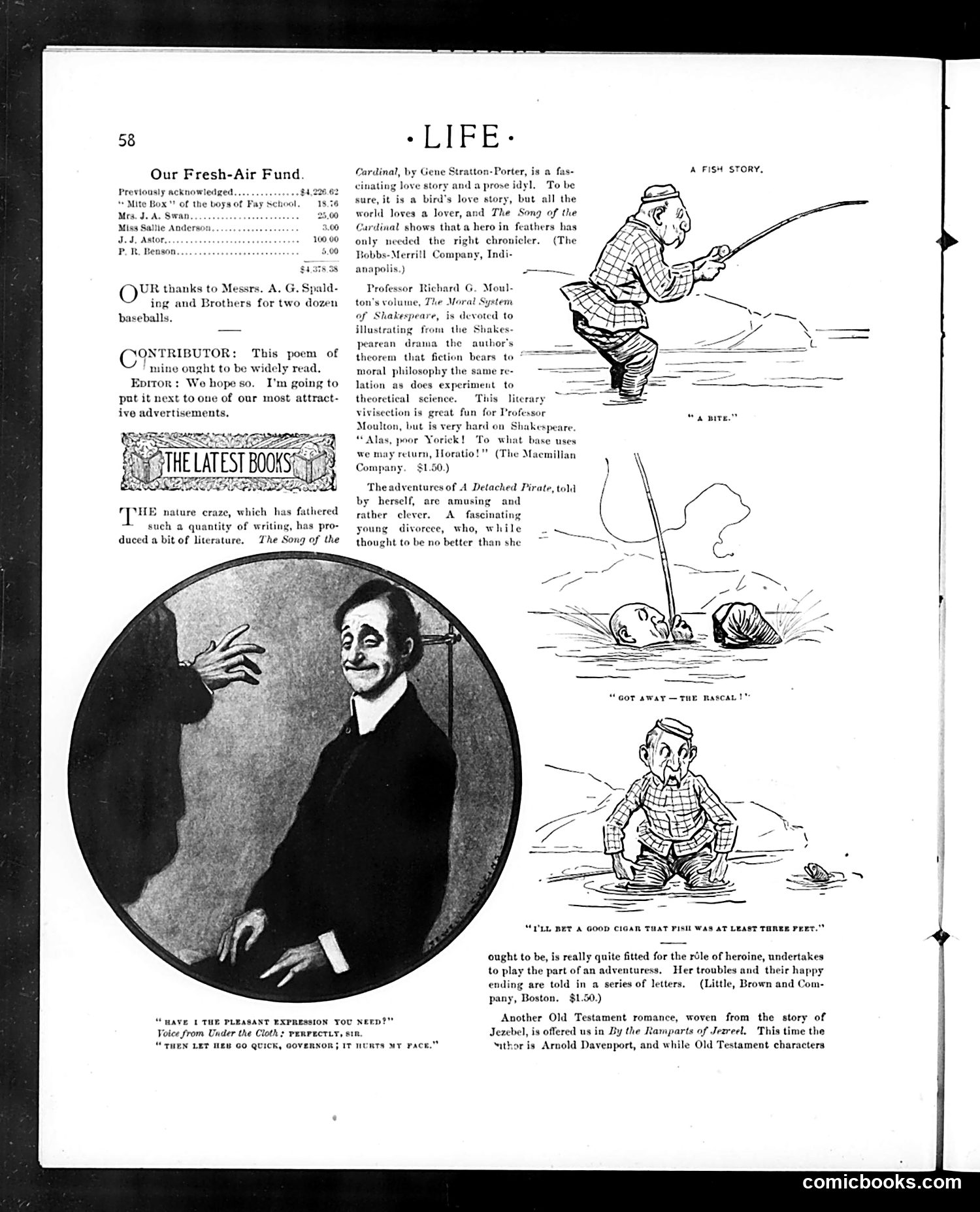
This page combines book reviews with three humorous fishing illustrations titled "A Fish Story." The cartoons depict comedic fishing mishaps—a man being pulled into water by a fish, a man stuck in mud, and another struggling in shallow water with an oversized catch. The main visual element is a circular photograph captioned with a Shakespeare quote: "Have I the pleasure expression you need? / Voice from Under the Couch—'Perfectly, sir. / When let him go quick, governor; it hurts my face.'" This appears to be satirizing theatrical or pompous expression, mocking overwrought dramatic delivery. The page reviews contemporary books including works about morality and adventure narratives. The content targets Victorian literary pretension and overly serious artistic ambitions through contrast with lowbrow humor.
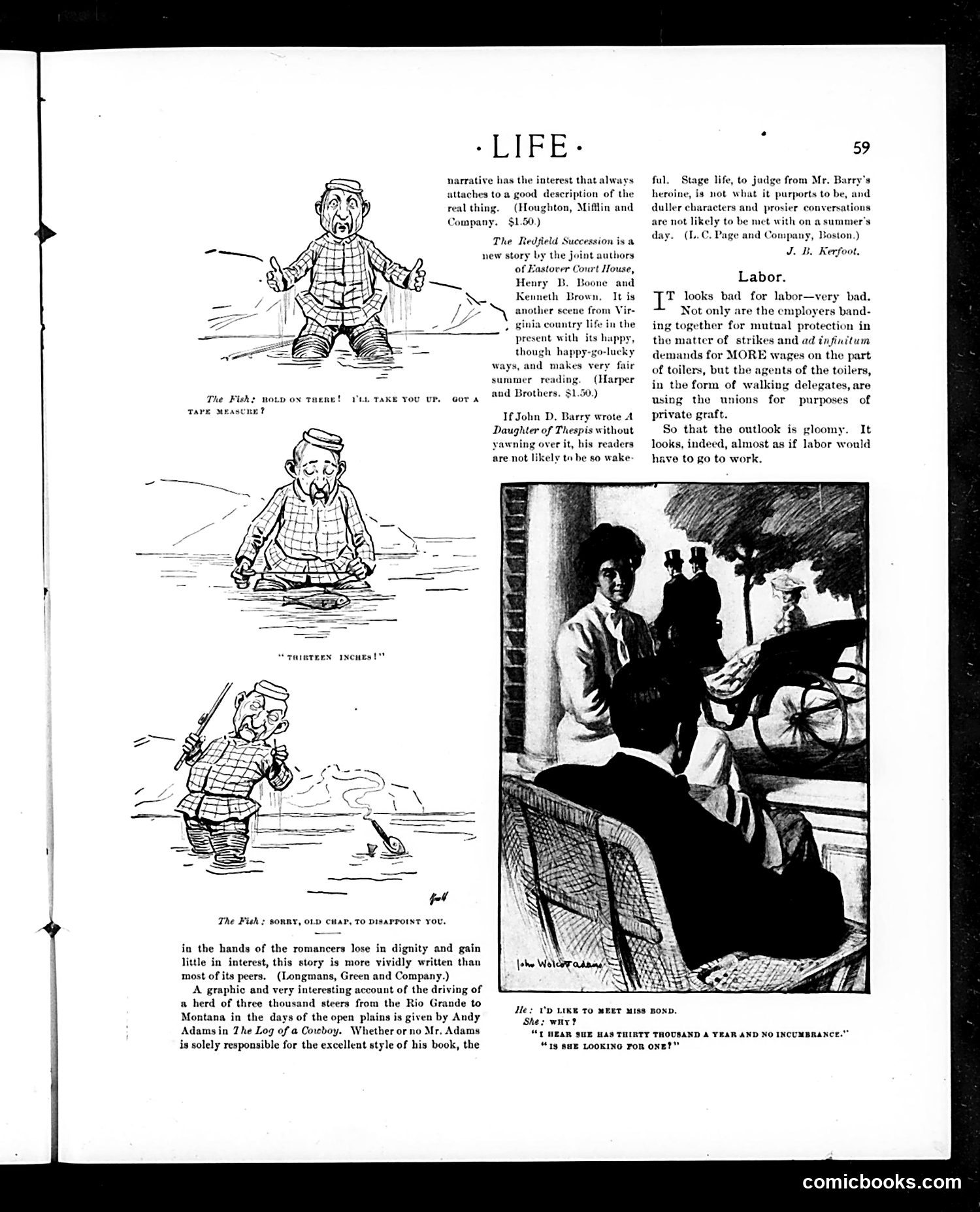
The three sequential cartoons on the left depict a fisherman in progressively worse circumstances while fishing. The humor appears to stem from the fisherman's physical struggle and determination despite mounting difficulties—his repeated assertions about the fish's size ("HOLD ON THERE! I'LL TAKE YOU UP. GOT A TAPE MEASURE?" then "THIRTEEN INCHES!" and finally "SORRY, OLD CHAP, TO DISAPPOINT YOU") suggest he's been exaggerating or fantasizing about landing an impressive catch, only to realize it's trivially small. The right panel titled "Labor" addresses contemporary labor disputes, noting strikes and unionization efforts among workers demanding higher wages. The accompanying illustration depicts what appears to be labor negotiations or street activity. This reflects early 20th-century American labor tensions and working-class organizing movements.
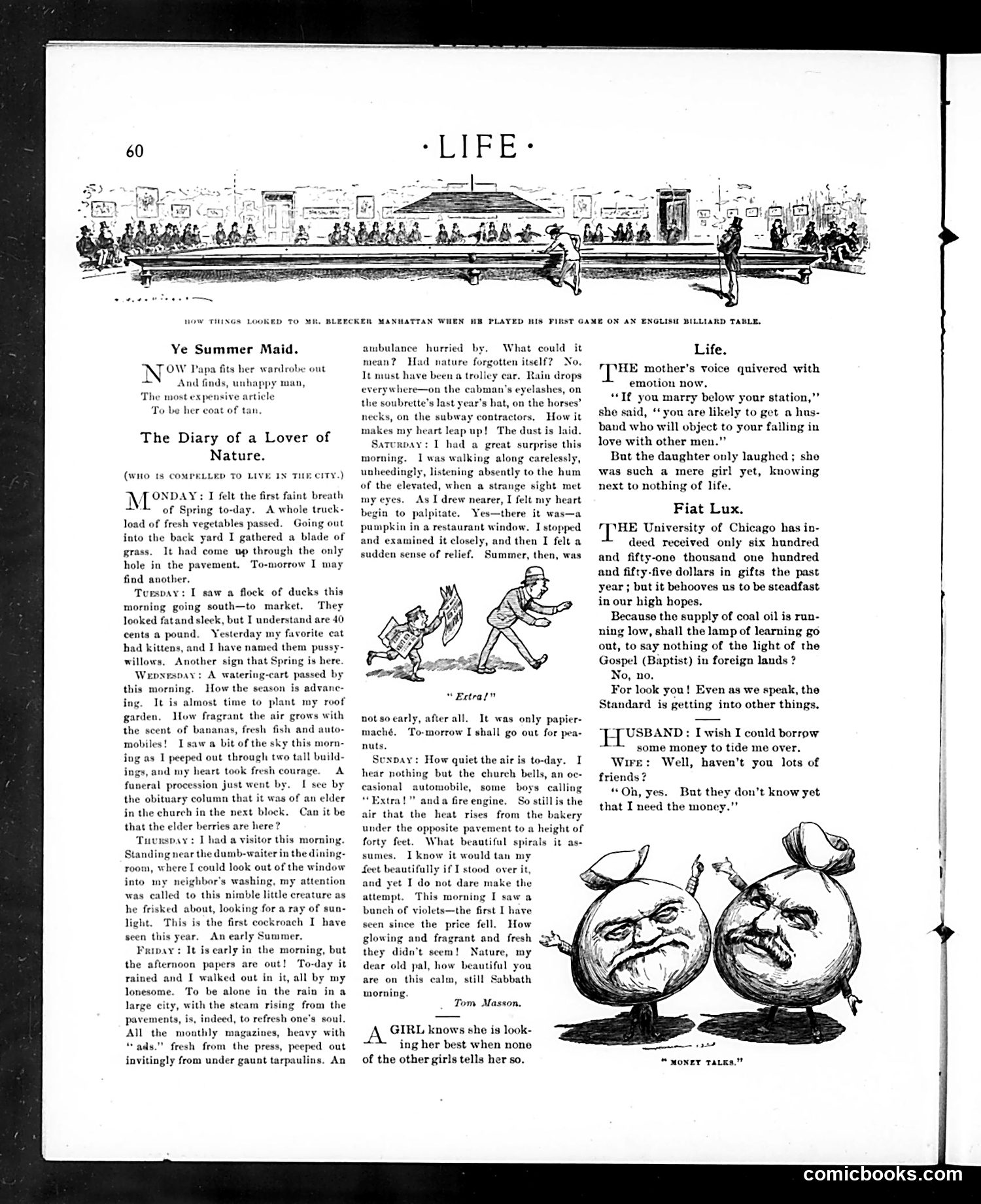
This page contains three separate pieces of satirical content: 1. **"Ye Summer Maid"** - A poem mocking fashionable women's seasonal wardrobes and behaviors. 2. **"The Diary of a Lover of Nature"** - A humorous weekly diary satirizing urban dwellers' attempts to appreciate nature while remaining trapped in city life (seeing ducks at market, a pumpkin in a restaurant window, church bells). 3. **"Life" and "Fiat Lux"** - Short domestic humor pieces poking fun at class consciousness and ineffectual charitable efforts by wealthy institutions (the University of Chicago receiving large donations while coal shortages persist). The illustrations show a billiards scene and a caricatured face, likely accompanying specific articles. These pieces exemplify *Life*'s trademark satire: mocking social pretension, urban ennui, and the gap between wealthy institutions' public generosity and actual community need.
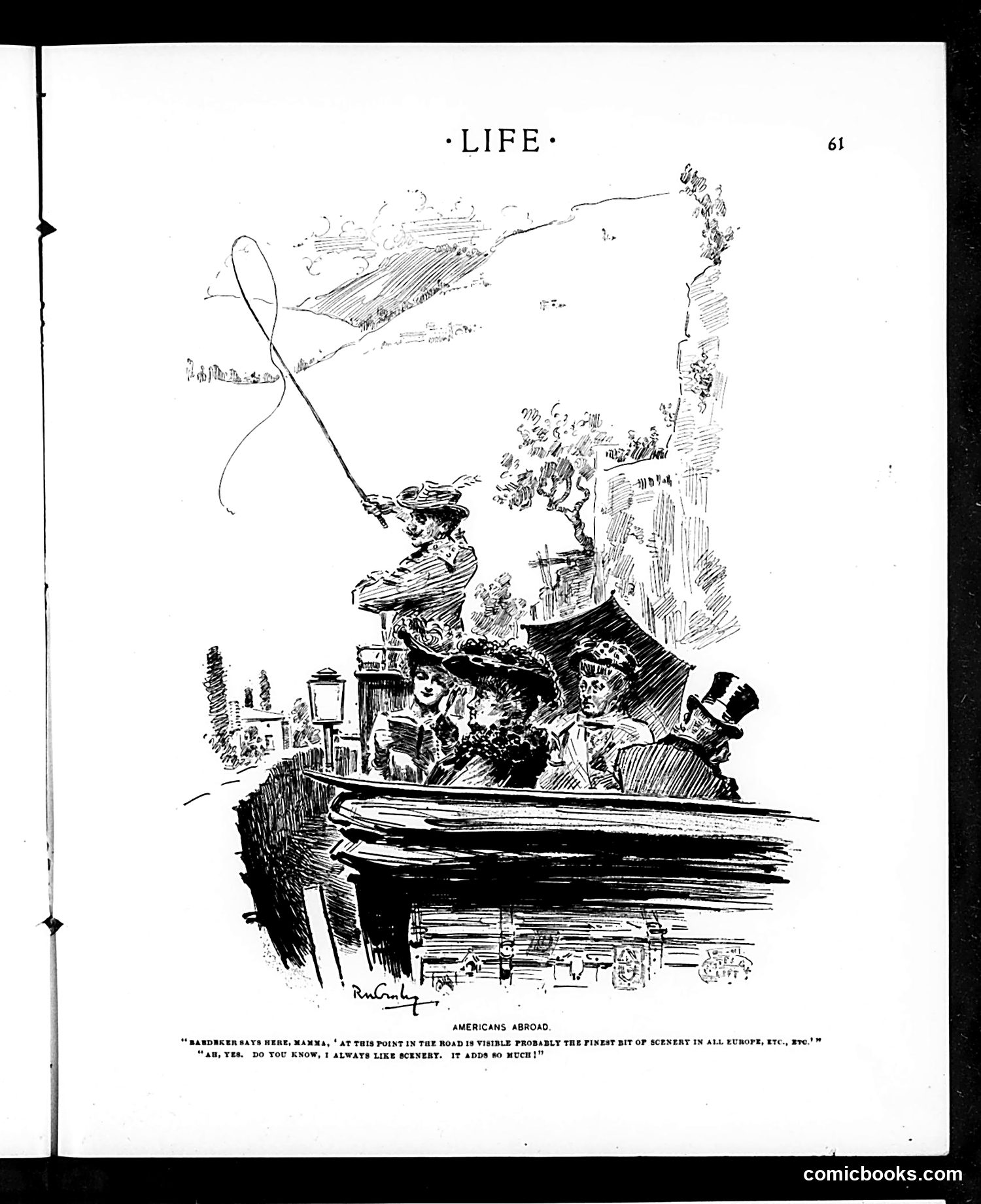
This cartoon satirizes wealthy American tourists traveling in Europe. The caption quotes a character (identified as "Baedeker" — likely referencing the famous Baedeker travel guides) praising a scenic European location as "probably the finest bit of scenery in all Europe," to which another American tourist responds dismissively that they "always like scenery" better back home, adding "it adds so much!" The satire targets the stereotype of affluent Americans traveling abroad who remain culturally insulated and self-satisfied, unable to appreciate European landscapes or culture. Instead of being humbled by or genuinely engaged with Europe's famous beauty, these tourists project American values and tastes onto everything they encounter. The cartoon mocks American provincial arrogance and consumerist attitudes toward cultural tourism.
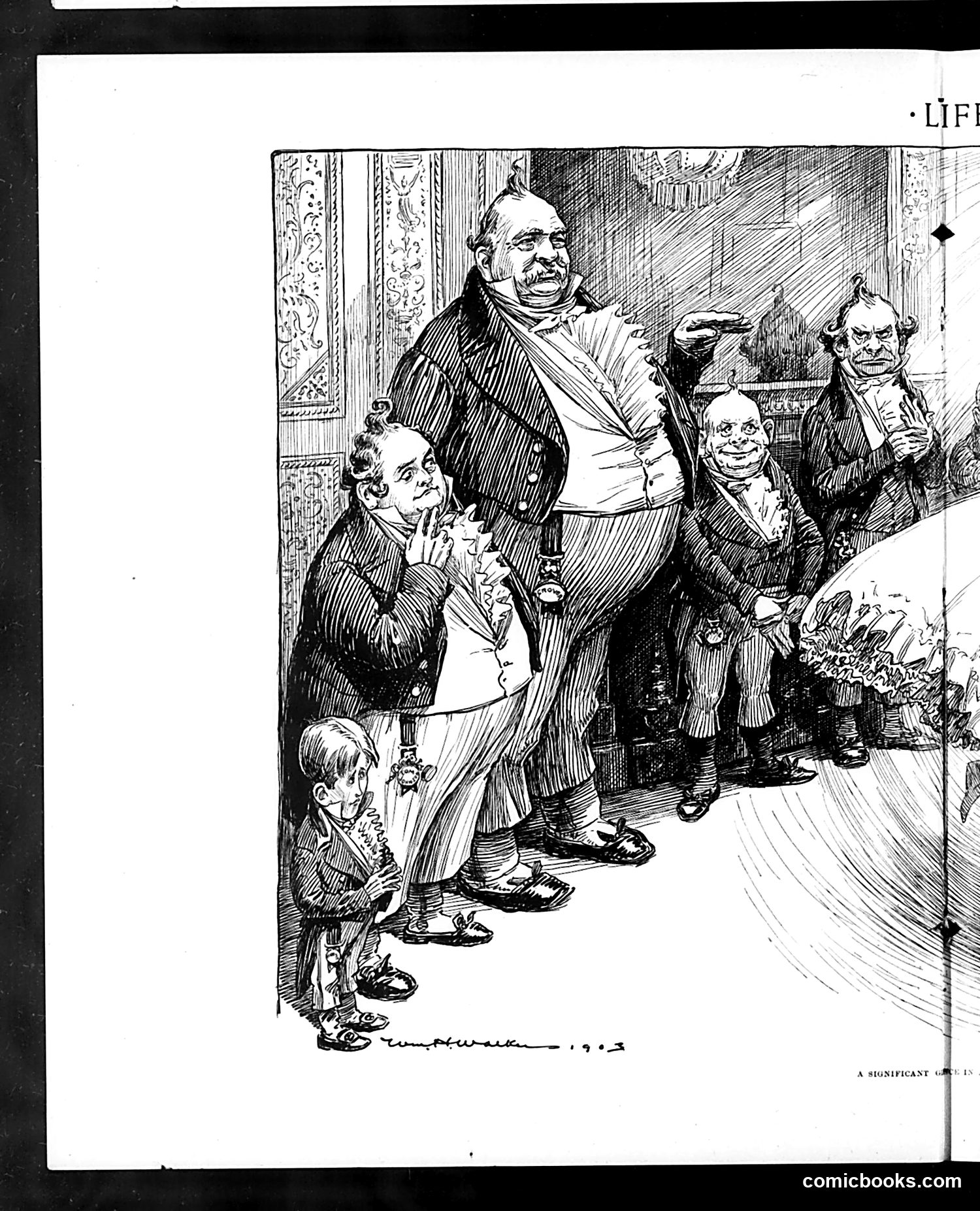
This appears to be a satirical cartoon from Life magazine (dated 1912 based on the signature). The image shows a tall, portly military or political figure standing prominently while smaller men in formal dress surround him. A young boy stands in the foreground, looking up at the central figure with apparent awe or concern. The exaggerated physical proportions—the towering central figure versus the diminished bystanders—suggest satire about power dynamics or inflated authority. The ornate interior setting implies a palace or seat of government. Without clearer text identifying specific individuals, the cartoon likely critiques a particular political leader or military figure whose prominence or influence the cartoonist viewed as disproportionate or problematic. The child's presence may underscore concerns about this figure's impact on the nation's future.
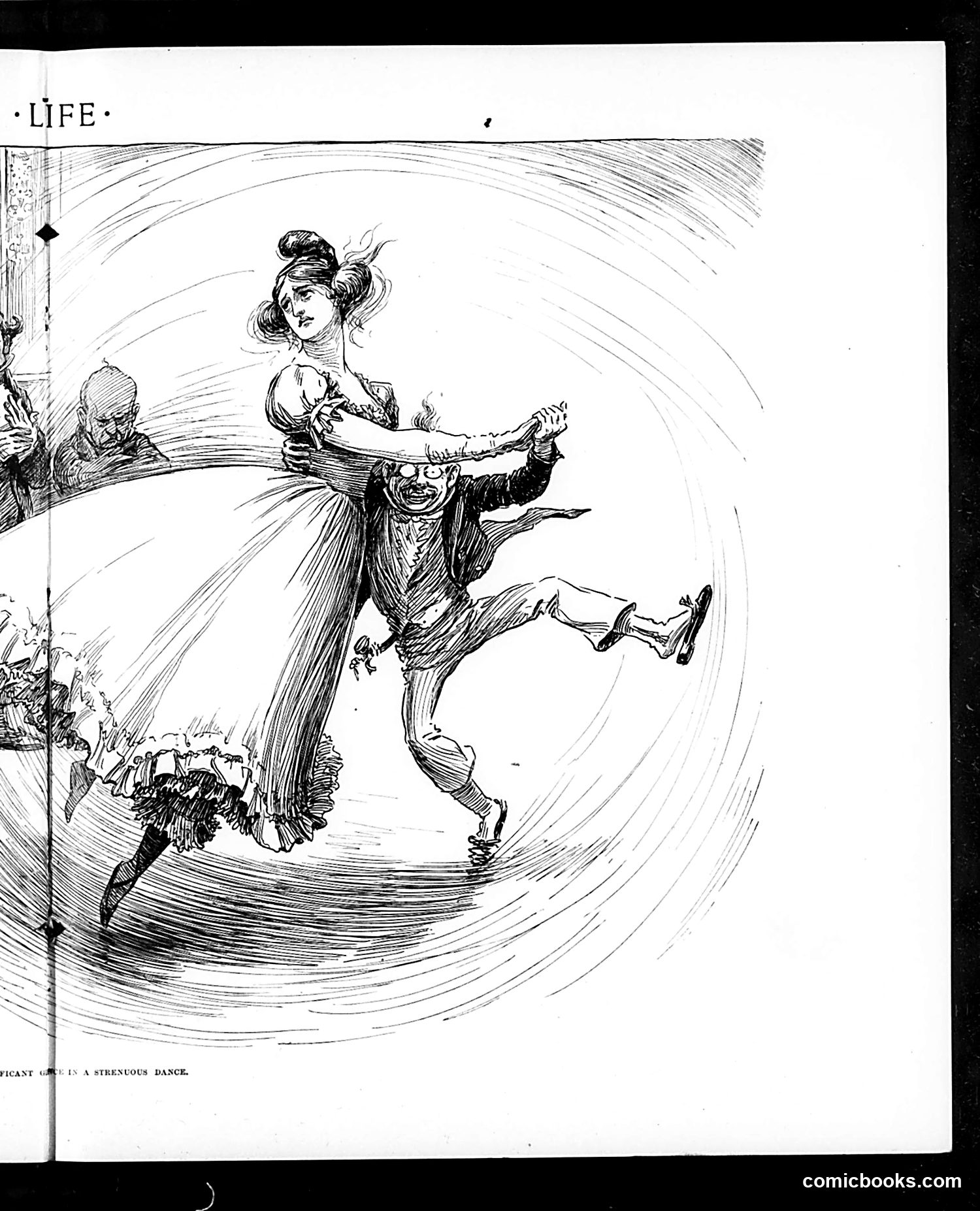
This page from *Life* magazine features a satirical illustration titled "LIFE" at the top, with a caption reading "VICANT LIFE IS A STRENUOUS DANCE." The cartoon depicts a caricatured man in formal attire (appearing to be a politician or public figure) being energetically pulled or manipulated by a woman in an elaborate dress. Observers on the left watch the scene unfold within swirling, dynamic linework suggesting chaos and movement. The satire appears to comment on how "life" — particularly public or political life — has become exhausting and chaotic, with powerful forces (represented by the woman) controlling or dominating the central figure. The "strenuous dance" metaphor suggests contemporary life is demanding, frantic, and perhaps beyond one's control. Without clearer identification of the specific figures, the exact political reference remains unclear, though the commentary on modern exhaustion and manipulation seems evident.
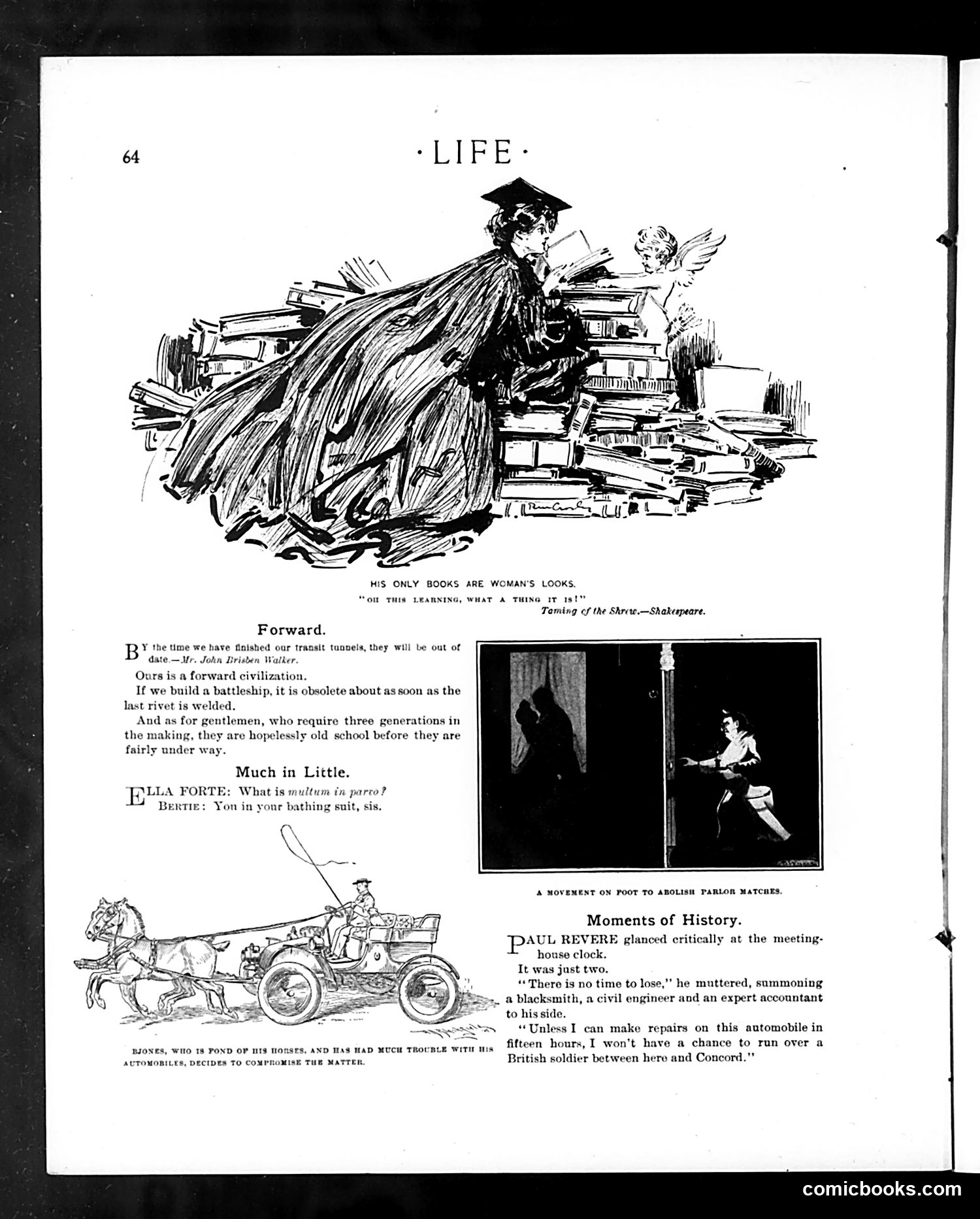
The top illustration depicts a scholar or academic figure surrounded by books, with an angelic cherub, satirizing intellectual pursuits. The caption quotes Shakespeare's *Taming of the Shrew*, suggesting that "books are woman's looks"—a commentary on women's education or intellectual ambitions. The "Much in Little" section contains a Latin phrase joke between characters Ella Forte and Bertie about bathing attire, likely sexual innuendo common to the era's humor. Below is a cartoon about "Bjones," a horseman compromising with automobiles—likely satirizing the tension between old transportation methods (horses) and new technology (cars) during the early automotive age. The "Moments of History" section mocks Paul Revere's famous midnight ride, recontextualizing it as a modern rush to repair an automobile in fifteen hours—a joke about the relative urgency and absurdity of modern vs. historical concerns.
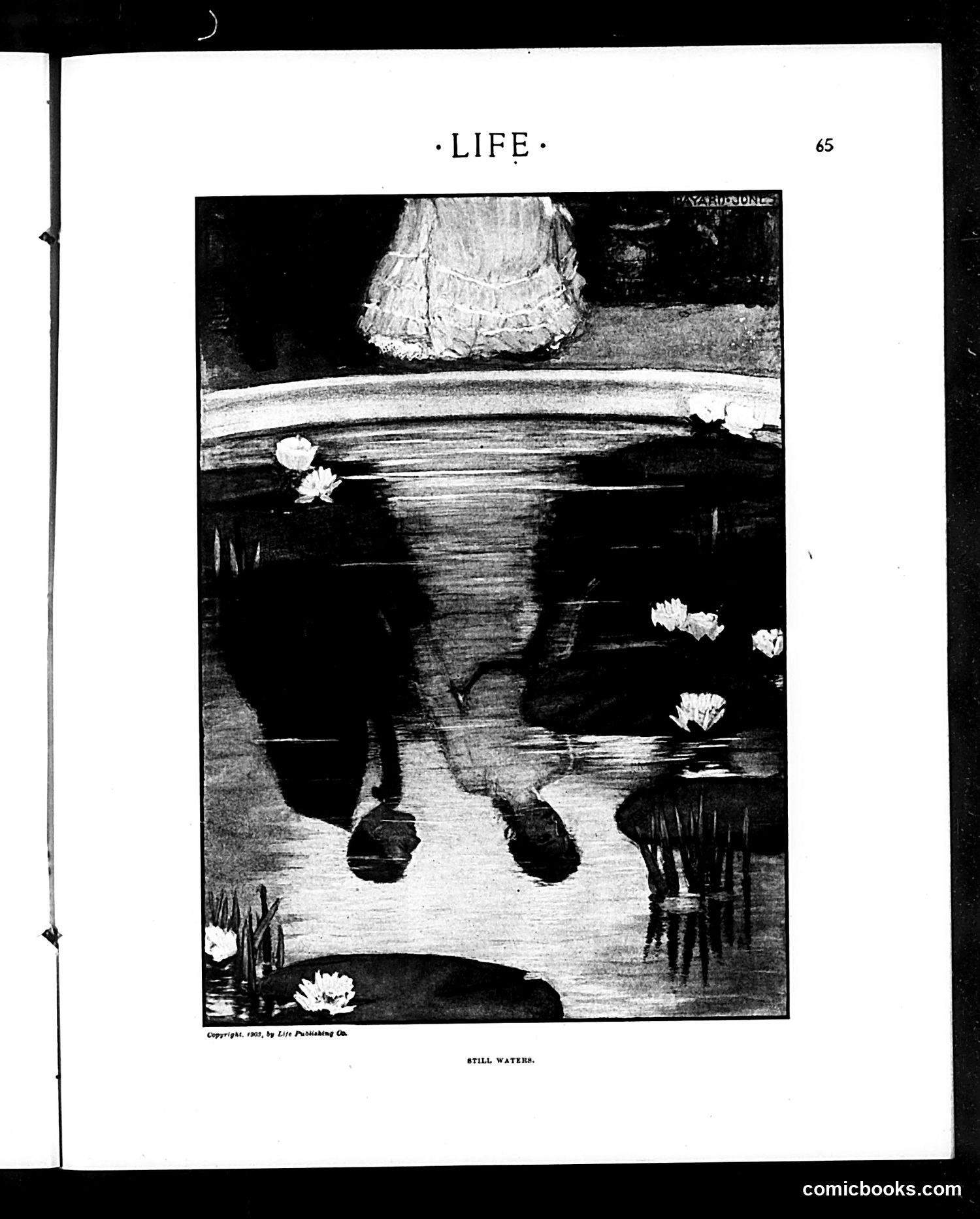
This page from *Life* magazine presents a naturalistic illustration titled "Still Waters," depicting a pond or marsh scene with water lilies, aquatic vegetation, and what appears to be frogs or toads in the water. The image shows a serene natural landscape rendered in black and white with careful attention to reflected light on water. Rather than political satire or caricature, this appears to be a straightforward artistic or nature-focused illustration. The title "Still Waters" likely invokes the proverbial phrase "still waters run deep," suggesting hidden depths or complexity beneath a calm surface—a metaphorical commentary on nature's quiet mystery. Without additional context or visible satirical elements, the piece seems intended primarily as atmospheric artwork rather than social commentary.
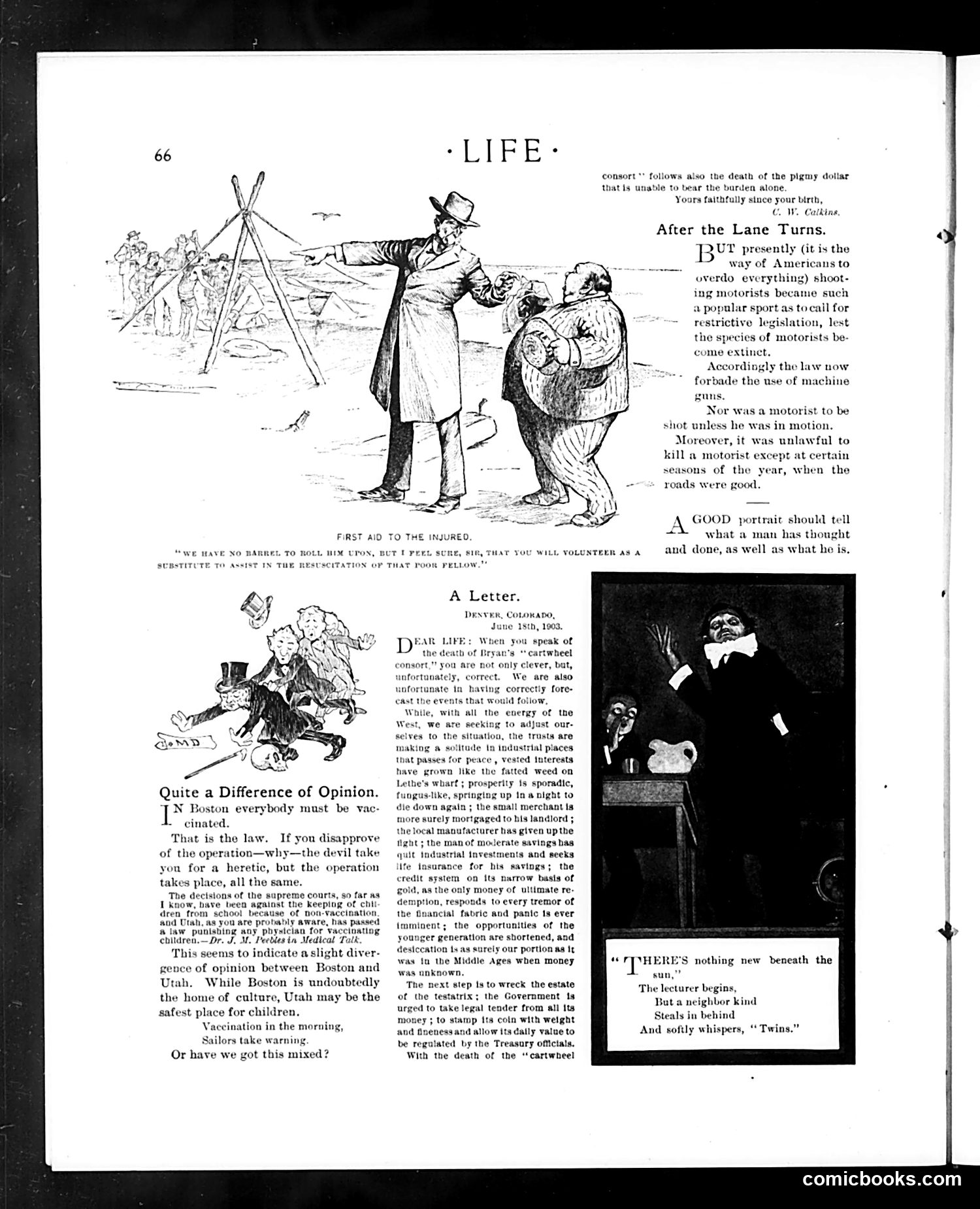
This page contains multiple satirical pieces reflecting early 1900s American concerns: **"First Aid to the Injured"** (top cartoon): Shows a well-dressed man offering to help an injured worker, with the caption suggesting he'll "volunteer as a substitute to assist in the resuscitation of that poor fellow"—satirizing wealthy individuals' condescending charity toward working-class injury victims. **"Quite a Difference of Opinion"** (middle section): Discusses vaccination law disputes between Boston (which mandates it) and Utah (which punishes physicians who vaccinate). This reflects genuine legal/medical disagreements of the era about compulsory vaccination. **"A Letter"** discusses economic troubles: the declining value of silver dollars ("cartwheel consort"), industrial unrest, and financial instability affecting merchants and savers—reflecting post-1903 economic anxieties. **Bottom cartoon**: A lecturer's platitude about nothing being new is interrupted by someone whispering "Twins"—a gentle joke about the predictability of human experience. The overall tone critiques wealth inequality, government overreach, and economic instability.
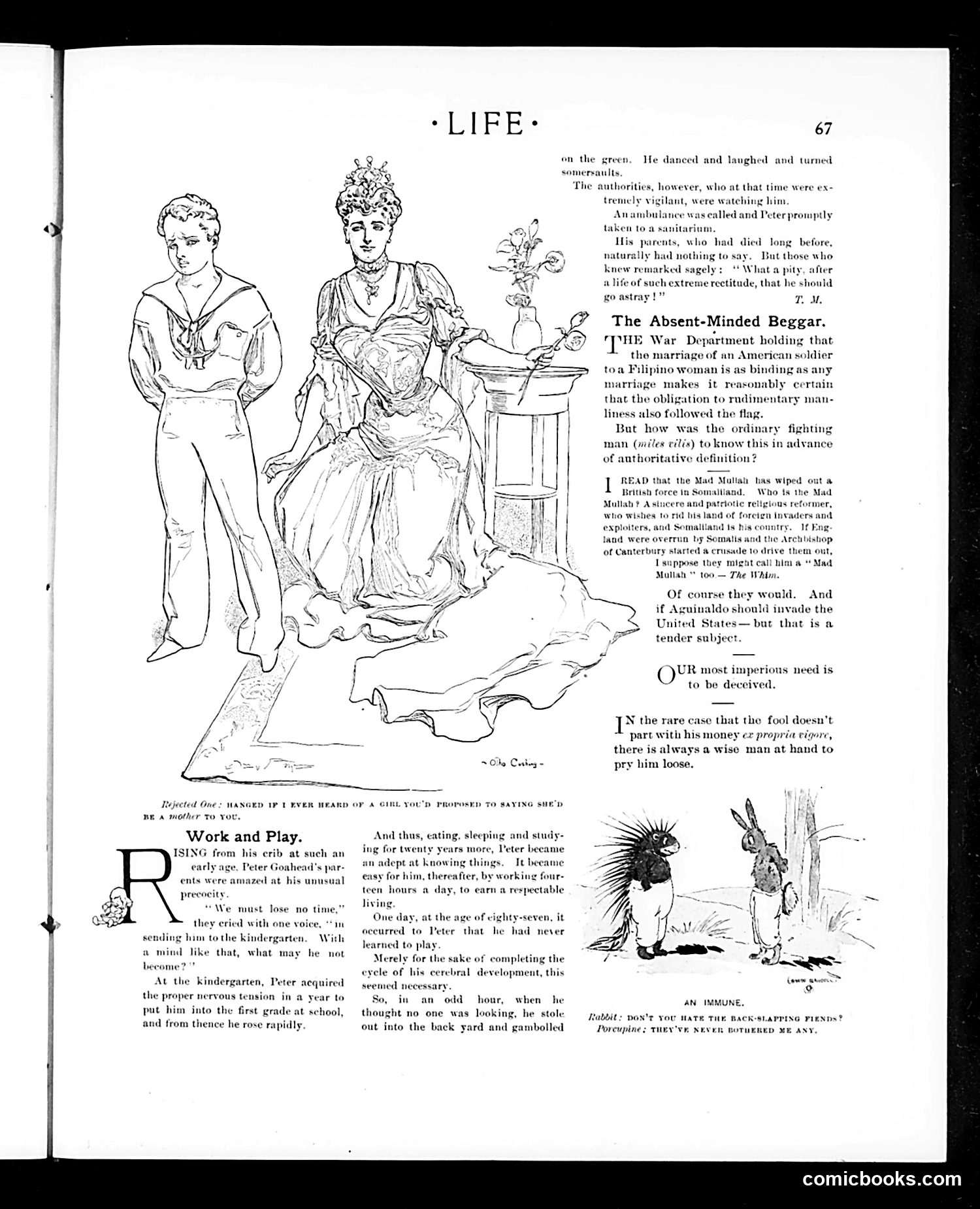
This page contains multiple satirical pieces from Life magazine (likely early 1900s, given references to the Philippine-American War and "Aguinaldo"). **"The Absent-Minded Beggar"** appears to mock the U.S. War Department's stance that American soldiers marrying Filipino women creates binding military obligations. The satire questions how ordinary soldiers could know such rules "in advance of authoritative definition"—criticizing vague military policy during the Philippine conflict. **"Work and Play"** tells of Peter Goahead, a child prodigy who never learned to play, only work. The joke mocks excessive parental emphasis on achievement at childhood's expense. The punchline shows Peter finally playing—gambling in the backyard—suggesting misguided discipline backfires. **The bottom cartoon** shows rabbits discussing "back-slapping fiends," likely satirizing social pretense or false friendship. The page reflects Progressive-era concerns: military overreach, Philippine colonialism, child-rearing philosophy, and social hypocrisy—all delivered through humor and illustration typical of early-1900s American satire.
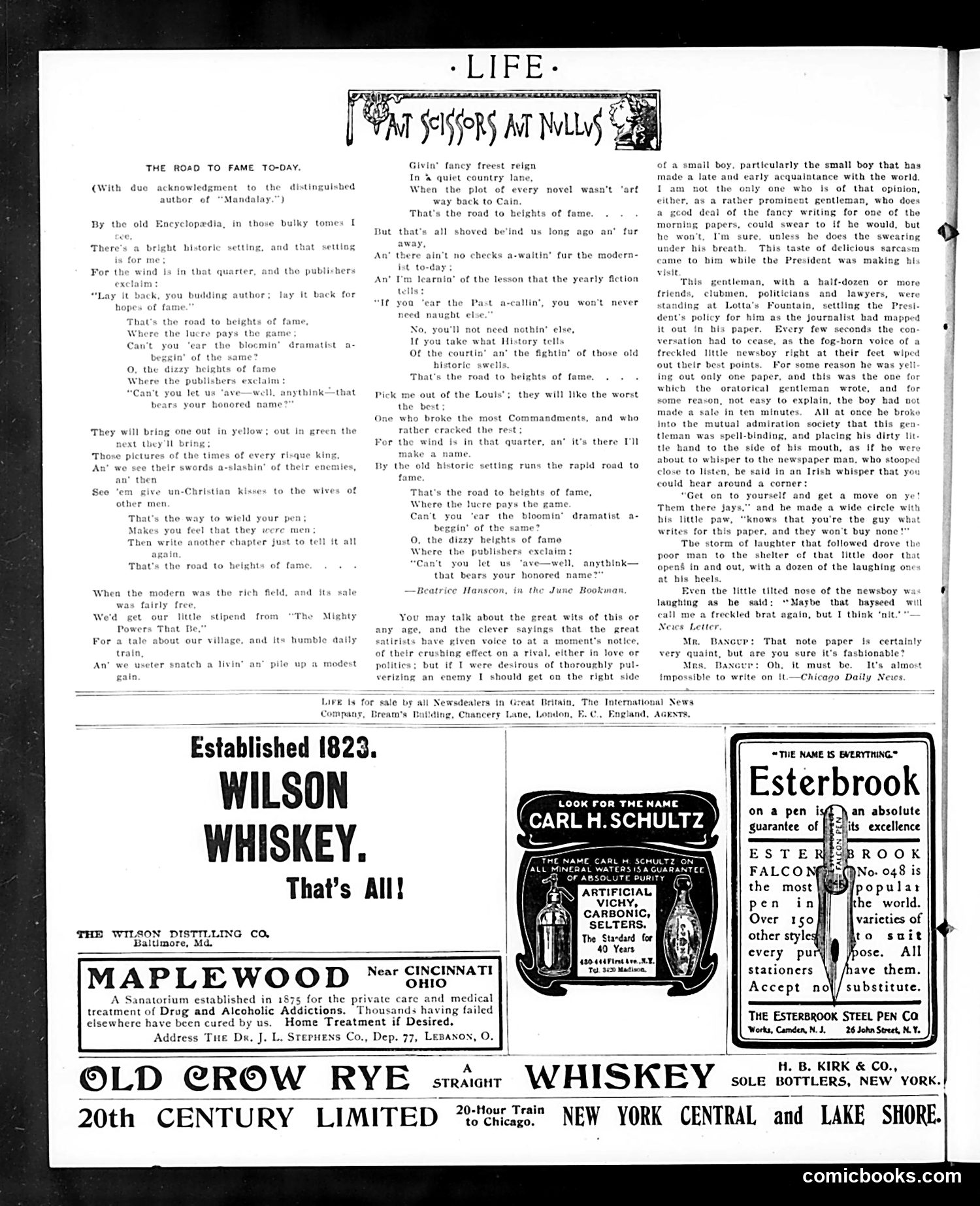
This page satirizes the publishing industry's formulaic approach to popular fiction. The poem mocks novels with predictable plot devices: historical settings, dramatic fights, and narratives stretching "way back to Cain"—critiquing how publishers churn out sensationalized stories to appeal to mass audiences. The accompanying prose narrative illustrates this with an anecdote: a newsboy refuses to sell papers featuring a gentleman writer's work while politicians and socialites discuss presidential policy at Lotta's Fountain (a real San Francisco landmark). The boy's pointed critique—that the writer lacks genuine talent—humorously undercuts the writer's pretensions. The satire targets both hack authors pursuing easy fame and the publishing establishment's commercial cynicism. By giving voice to an ordinary street child, Life suggests that even common people recognize manufactured, artless writing when they encounter it. The advertisements below are period commercial clutter—unrelated to the editorial content.
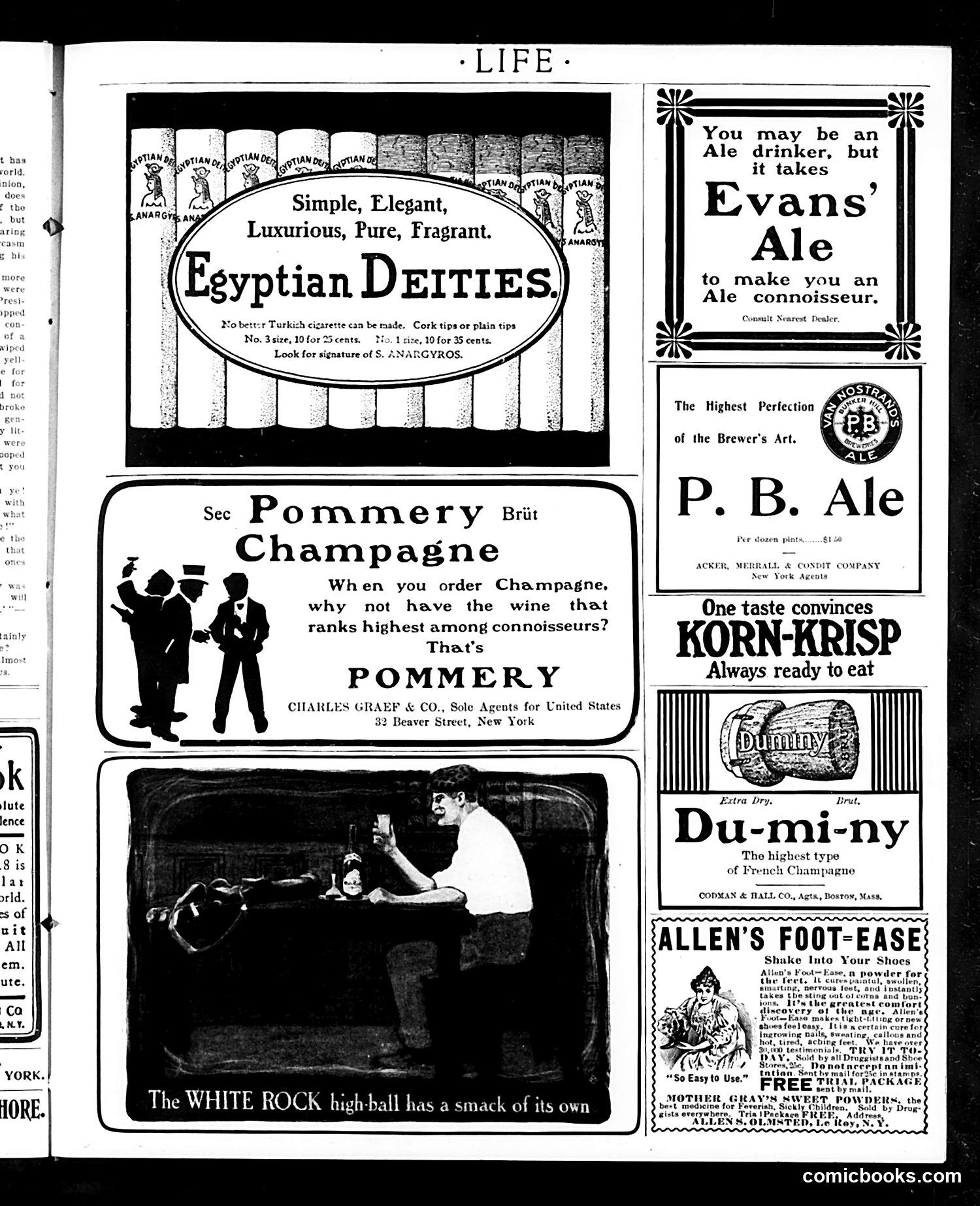
This is primarily an **advertisement page**, not a political cartoon. It features luxury consumer product ads typical of early 20th-century American magazines, targeting affluent readers. The ads promote: - **Egyptian Deities cigarettes** — positioning Turkish cigarettes as sophisticated and elegant - **Pommery Champagne** — emphasizing connoisseurship and social status - **Evans' Ale and P.B. Ale** — competing beer brands claiming superiority - **Du-mi-ny Champagne** — French import marketed as "highest type" - **White Rock high-ball** — a beverage advertisement - **Korn-Krisp cereal** and **Allen's Foot-Ease powder** — everyday products The one illustration shows a couple in a car (likely a "White Rock high-ball" scenario), representing modernity and leisure. **For modern readers**: These ads reflect pre-Prohibition America's open alcohol advertising and the era's emphasis on imported European goods as markers of sophistication and class distinction. The product claims are remarkably unregulated by today's standards.
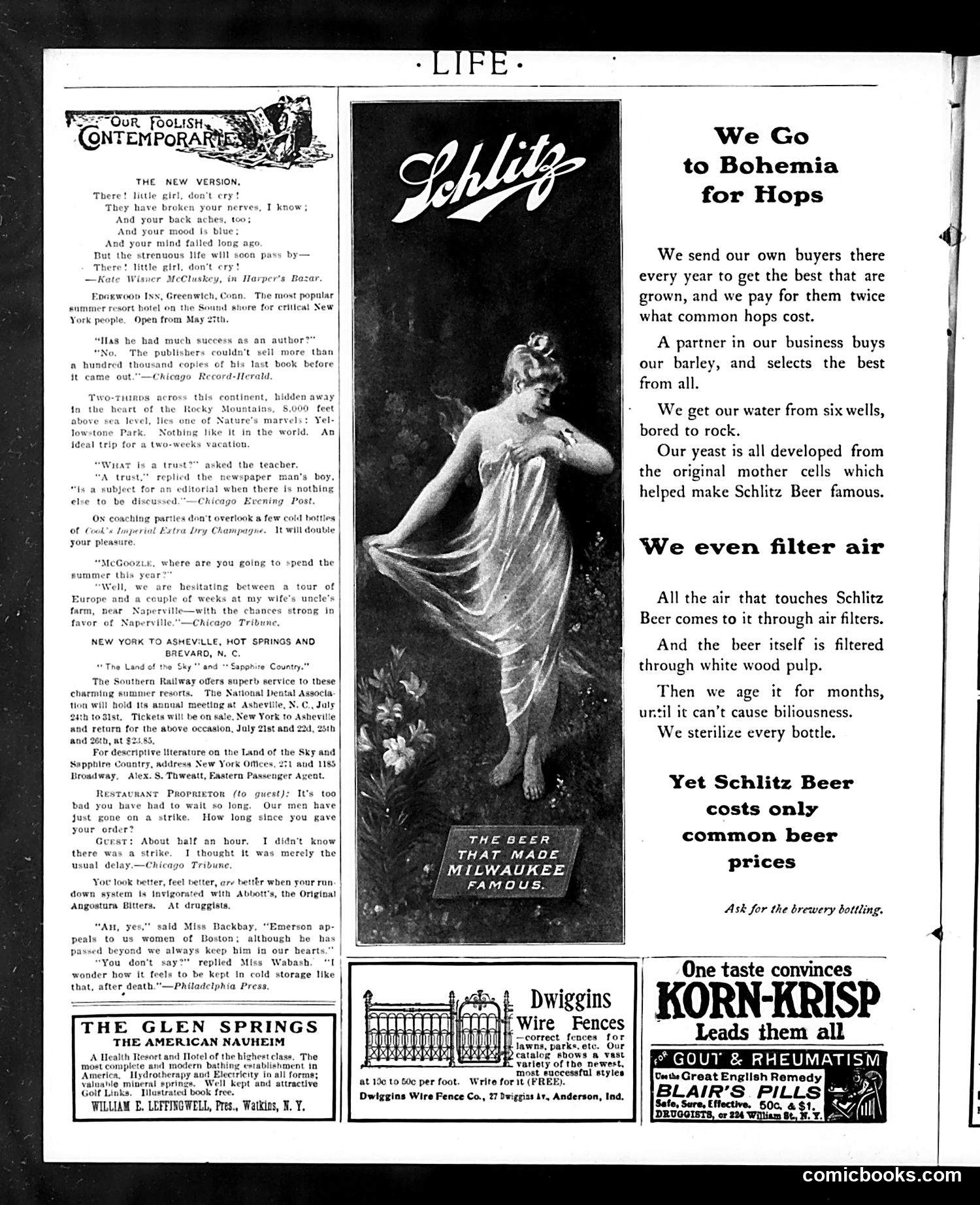
This page is primarily **advertising**, not political satire. The main content features a large Schlitz Beer advertisement (center-right) with an allegorical female figure representing the beer brand. The Schlitz ad emphasizes quality control measures—sourcing hops from Bohemia, filtering air and beer, aging processes, and sterilization—positioning the product as superior despite matching competitors' prices. This reflects early 20th-century marketing that highlighted industrial manufacturing standards to build consumer confidence. The left side contains miscellaneous short humorous items ("Our Foolish Contemporaries"), typical of Life's satirical column format, poking fun at everyday absurdities and social pretension. These are brief, apolitical jokes rather than commentary on specific events or figures. The remaining advertisements (Glen Springs spa, Dwiggins Wire Fences, Korn-Krisp, Blair's Pills) are standard period marketing with no satirical content.
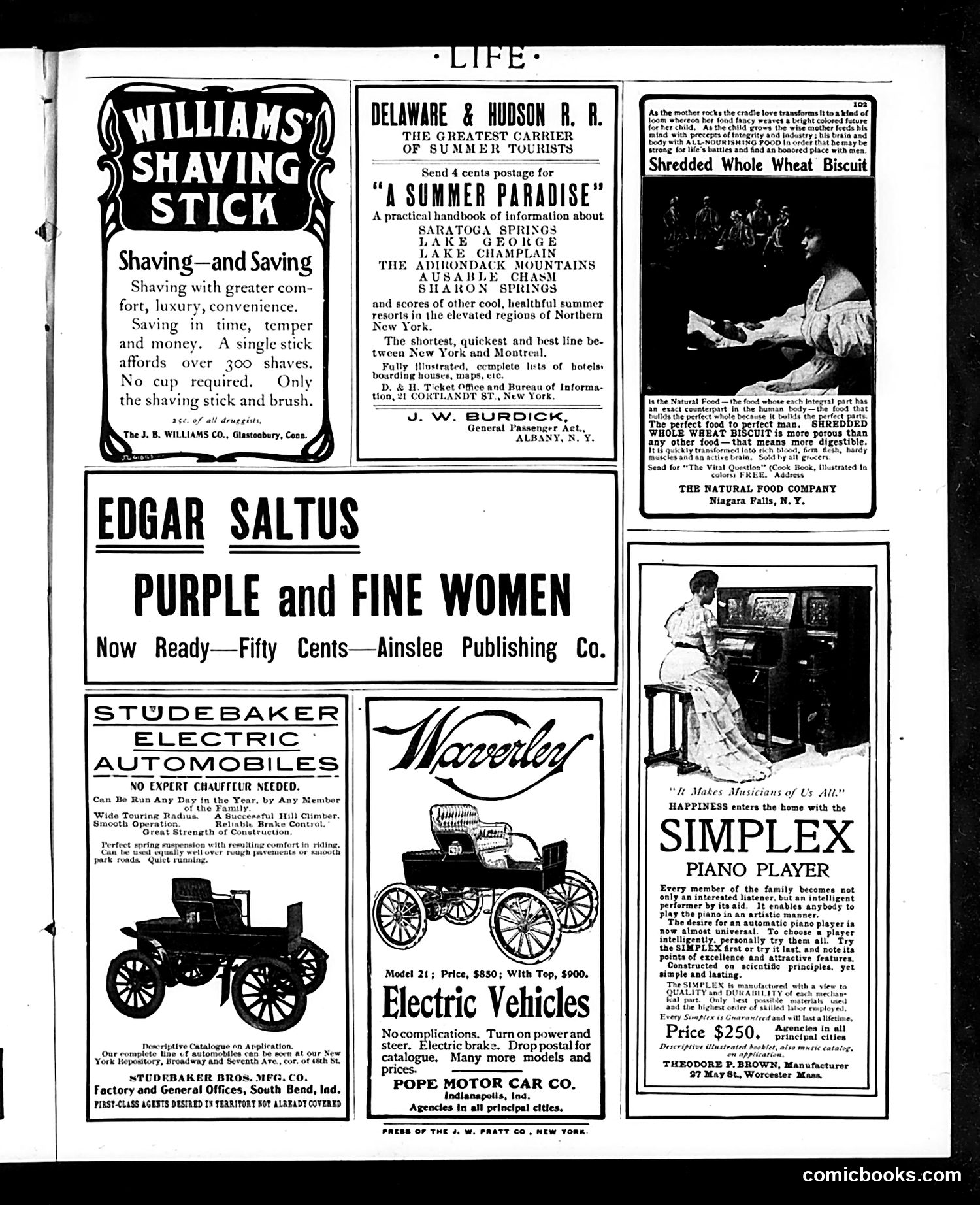
This is primarily an **advertising page** from Life magazine, containing no political cartoons or satirical content requiring historical context. The page features period advertisements for early 1900s consumer products: - **Williams Shaving Stick**: A grooming product emphasizing economy and convenience - **Delaware & Hudson Railroad**: Promoting luxury summer tourism to upstate New York resorts (Saratoga Springs, Lake George, Adirondacks) - **Edgar Saltus book**: A novel titled "Purple and Fine Women" - **Shredded Wheat Biscuit**: Nutritional cereal marketed with maternal/health rhetoric - **Studebaker Electric Automobiles** and **Pope Motor Car Company**: Early electric vehicles positioned as safe, easy-to-operate alternatives requiring "no expert chauffeur" - **Simplex Piano Player**: An automatic piano device democratizing musical performance The ads collectively reflect early 1900s consumer culture: emerging automotive technology, health-conscious food marketing, and leisure tourism for the affluent. No satire or political commentary is evident on this page.
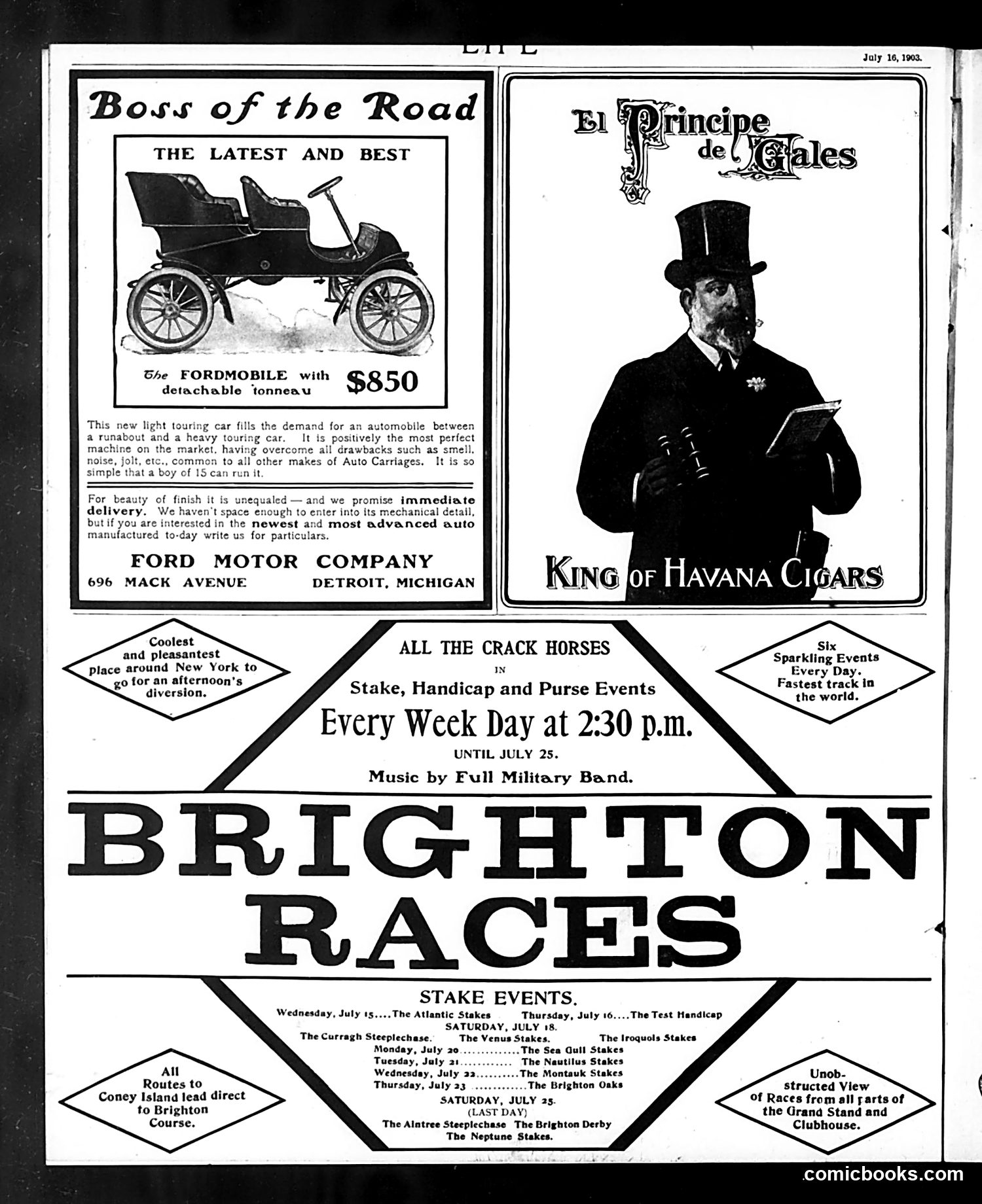
This is primarily an **advertising page** from *Life* magazine (July 16, 1903), not a political cartoon. It contains three main advertisements: 1. **Ford Motor Company**: Promotes the new Fordmobile touring car for $850, claiming it overcomes problems ("smell, noise, jolt") of other automobiles. The "Boss of the Road" title suggests automotive superiority. 2. **El Príncipe de Gales cigars**: Features a gentleman in top hat smoking—a typical luxury product advertisement of the era, playing on aspirational imagery. 3. **Brighton Races**: Announces horse racing events at Brighton with "all the crack horses," musical entertainment, and various stake competitions throughout July. The page reflects 1903 consumer culture: automobiles were still novel luxury items competing against horses; cigars were marketed as elite goods; and horse racing was major entertainment. The ads target affluent readers with leisure time and disposable income. There is no apparent satire or political commentary—this is straightforward commercial advertising.