
Life, 1903-07-16 · page 4 of 20
Life — July 16, 1903 — page 4: what you’re looking at
What you’re looking at
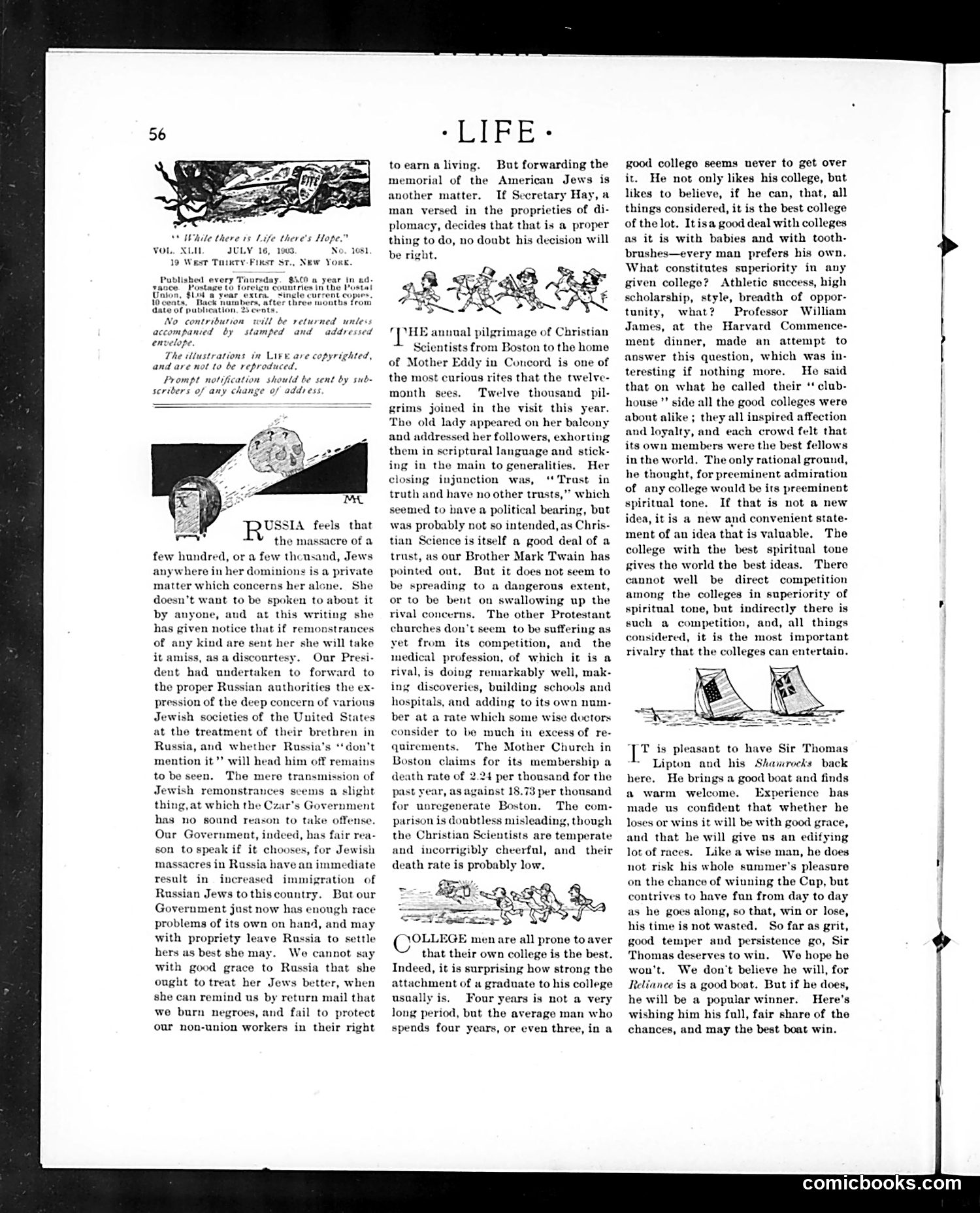
This page contains three distinct editorial sections discussing contemporary issues: 1. **Russia and Jewish Massacres**: The opening article addresses Russia's treatment of Jews, describing massacres in the Pale of Settlement. It argues the U.S. government should protest these atrocities and criticizes inaction toward protecting non-union workers' rights. 2. **Christian Science controversy**: A section discusses the "annual pilgrimage" to Mother Eddy's Concord home and debates Christian Science's spiritual claims versus medical profession competition. The tone is skeptical about its doctrine. 3. **College athletics and character**: The final section critiques colleges' over-emphasis on athletic superiority while neglecting spiritual development. It praises Sir Thomas Lipton's sportsmanship as an ideal example. The page lacks prominent political cartoons—instead offering opinion pieces on immigration, religion, and education reflecting early 1900s Progressive Era concerns.
📄 Transcribed text from this page (OCR, searchable)
Machine-transcribed from the original scan — historical spelling and the odd misread are preserved.
‘+ White there ts Life there's Hope. VOL, XLIL JULY 16, 1903. 19 West Taiery-Piest St, New Yous. 7. ShC0 w We. date of publication. 25 ects will be returned untess stamped and addressed No contribution accompanied by envelope. The illustrations in Lire are copyrighted, and are not to be reproduced. Prompt notification should be sent by sub- seribers of any change of address Russ feels that the massacre of a few hundred, or a few thousand, Jews anywhere in her dominions is a private matter which concerns her alone, She doesn’t want to be spoken to about it by anyone, aud at this writing she has given notice that if remonstrance of any kind are sent her she will take it amiss, as a discourtesy. Our Presi- dent had undertaken to forward to the proper Russian authorities the ex- pression of the deep concern of various _ Jewish societies of the United States hren in at the treatment of their br Russia, and whether Russia's mention it’? will head him off rem to be seen. The mer Jewish remonstranc thing, at which the Czar’ vernment has no sound reason to take offense. Our Government, indeed, has fair rea- son to speak if it chooses, for Jewish massacres in Russia have an immediate result in increased immigration of Russian Jews tothiscountry. But our Government just now has enough race problems of its own on hand, and may with propriety leave Russia to settle hers as best she may. We cannot say with good grace to Russia that she transmission of seems a slight ought to treat her Jews better, when she can remind us by return mail that we burn negroes, and fail to protect our non-union workers in their right EVRE But forwarding the memorial of the American Jews is another matter. If Secretary Hay, a man versed in the proprieties of di- plomacy, decides that that is a proper thing to do, no doubt his decision will be right. YHE annual pilgrimage of Christian Scientists from Boston to the home of Mother Eddy in Concord is one of the most curious rites that the twelve- month se Twelve thousand pil- grims joined in the visit this year. Tho old lady appeared on her balcony and addressed her followers, exhorting them in scriptural language and stick- ing in the main to generalities. Her closing injunction was, ‘Trast in truth and have no other trusts,” which seemed to have a political bearing, but was probably not so intended, as Chris- tian Science is itself a good deal of a trust, as our Brother Mark Twain has pointed out. But it does not seem to be spreading to a dangerous extent, or to be bent on swallowing up the rival concerns. The other Protestant churches don’t seem to be suffering as yet from its competition, and the medical profession, of which it is a rival, is doing remarkably well, mak- ing discoveries, building schools and hospitals, and adding to its own num- ber at a rate which some wise doctors consider to be much in excess of re- quirements. The Mother Church in Boston claims for its membership a death rate of 2.24 per thousand for the past year, as against 18.73 per thousand for unregenerate Boston, The com- parison is doubtless misleading, though the Christian Scientists are temperate and incorrigibly cheerful, and their death rate is ‘Si, low. “YOLLEGE men are all prone toaver that their own college is the best. Indeed, it is surprising how strong the attachment of a graduate to his college usually Four years is not a very long period, but the average man who spends four years, or even three, in a to earn a living. good college seems uever to get over it. He not only likes his college, but likes to believe, if he can, that, all things considered, it is the best college of the lot. Itisa good deal with colleges as it is with babies and with tooth- brashes—every man prefers his own. What constitutes superiority in any given college? Athletic success, high scholarship, style, breadth of oppor- tunity, what? Professor William James, at the Harvard Commen ment dinner, made an attempt to answer this question, which was in- teresting if nothing more. He said that on what he called their ‘‘ club- house ”’ side all the good colleges were abont alike ; they all inspired affection and loyalty, and each crowd felt that its own members were the best fellows in the world. The only rational ground, he thought, for preeminent admiration of any college would be its preeminent spiritual tone. If that is not a new idea, it is a new and convenient state- ment of an idea that is valuable. The college with the best spiritual tone gives the world the best ideas. There cannot well be direct competition among the colleges in superiority of spiritual tone, but indirectly there is such a competition, and, all things considered, it is the most important rivalry that the colleges can entertain. [7 .* ant to have Sir Thomas Lipton and his Shamrocks back here, He brings a good boat and finds a warm welcome. Experience bas made us confident that whether he loses or wins it will be with good grace, and that he will give us an edifying lot of races. Like a wise man, he does not risk his whole summer's pleasure on the chance of wiuning the Cup, but contrives to have fun from day to day as he goes along, so that, win or lose, his time is not wasted. So far as grit, good temper and persistence go, Sir Thomas deserves to win. We hope he won't. We don't believe he will, for Reliance is a good boat. But if he does, he will be a popular winner. Here's wishing him his full, fair share of the chances, and may the best boat win. comicbooks.com