
A complete issue · 20 pages · 1903
Life — January 15, 1903
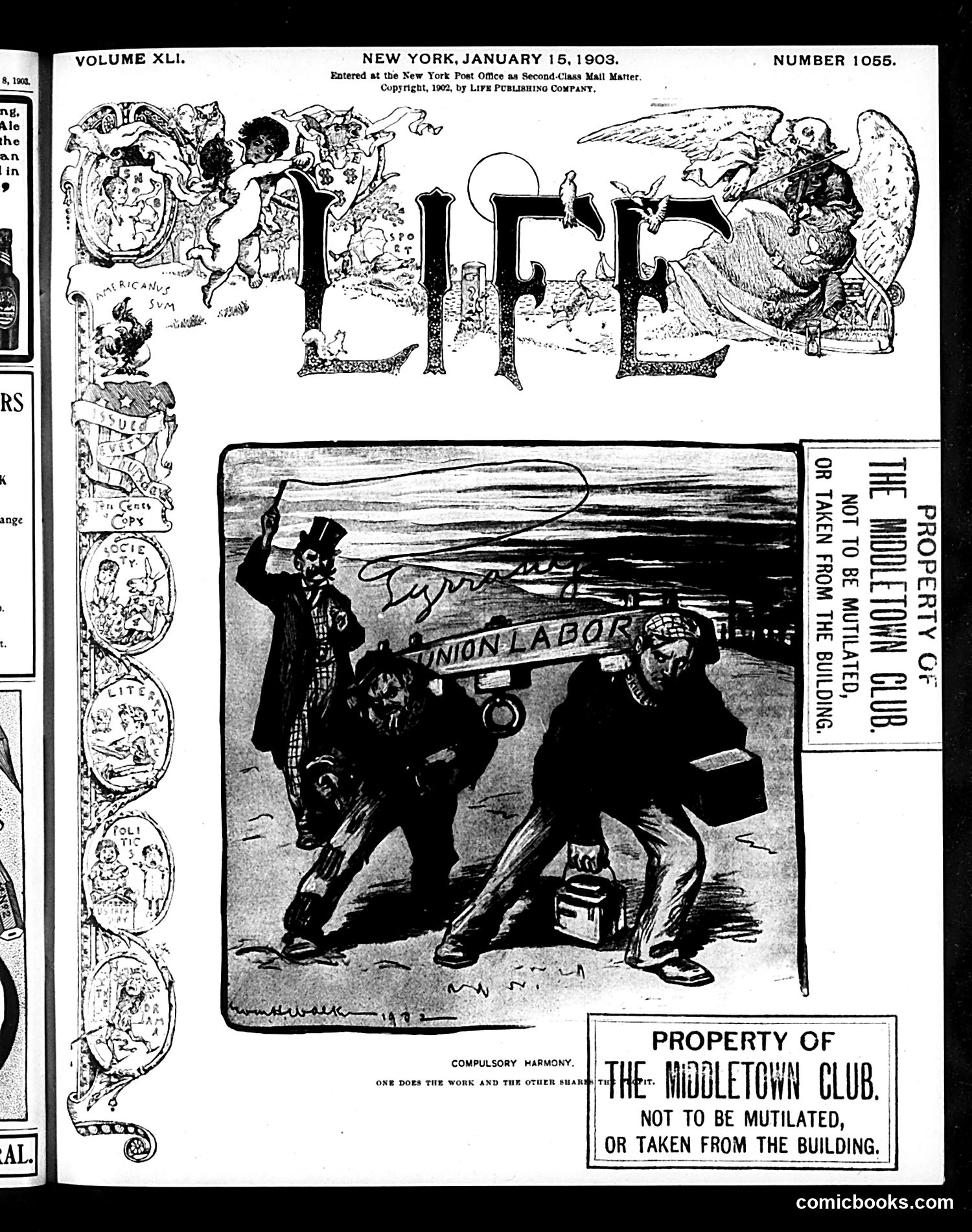
The main cartoon, titled "Compulsory Harmony," depicts a well-dressed man in a top hat labeled "Union Labor" directing two working-class figures carrying a large beam labeled "Union Labor." The caption reads: "One does the work and the other shares the profit." This satirizes labor union leadership—specifically critiquing how union officials ("compulsory harmony") extract profits from workers' labor while the workers themselves do the actual work. The cartoon suggests hypocrisy or exploitation within union structures during the Progressive Era, when labor organizing was contentious. The decorative border contains various satirical vignettes typical of Life magazine's style. The ownership stamp indicates this page belongs to "The Middletown Club."
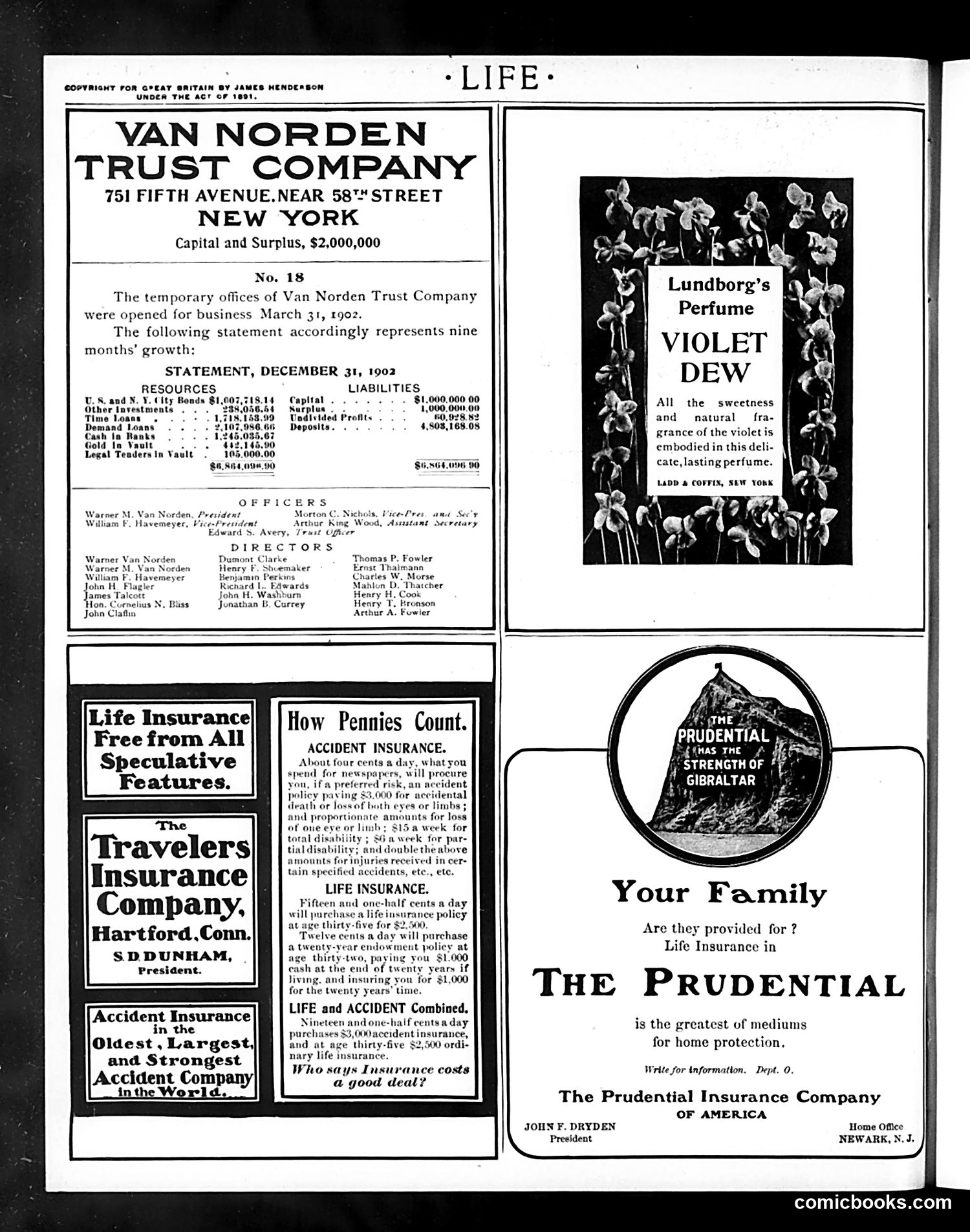
This page is **primarily advertising**, not editorial cartoon content. It contains four separate advertisements: 1. **Van Norden Trust Company** (top left): A financial institution announcement showing their December 31, 1902 statement with capital and liabilities figures. 2. **Lundborg's Perfume** (top right): An ad for "Violet Dew" perfume, featuring decorative violet illustrations. 3. **Insurance advertisements** (bottom left): Multiple ads for The Travelers Insurance Company and life/accident insurance products, emphasizing affordability ("pennies a day"). 4. **The Prudential Insurance Company** (bottom right): An ad asking "Are they provided for?" regarding family life insurance protection. There are no political cartoons or satirical content on this page. It represents typical early-1900s magazine advertising for financial services and consumer products.
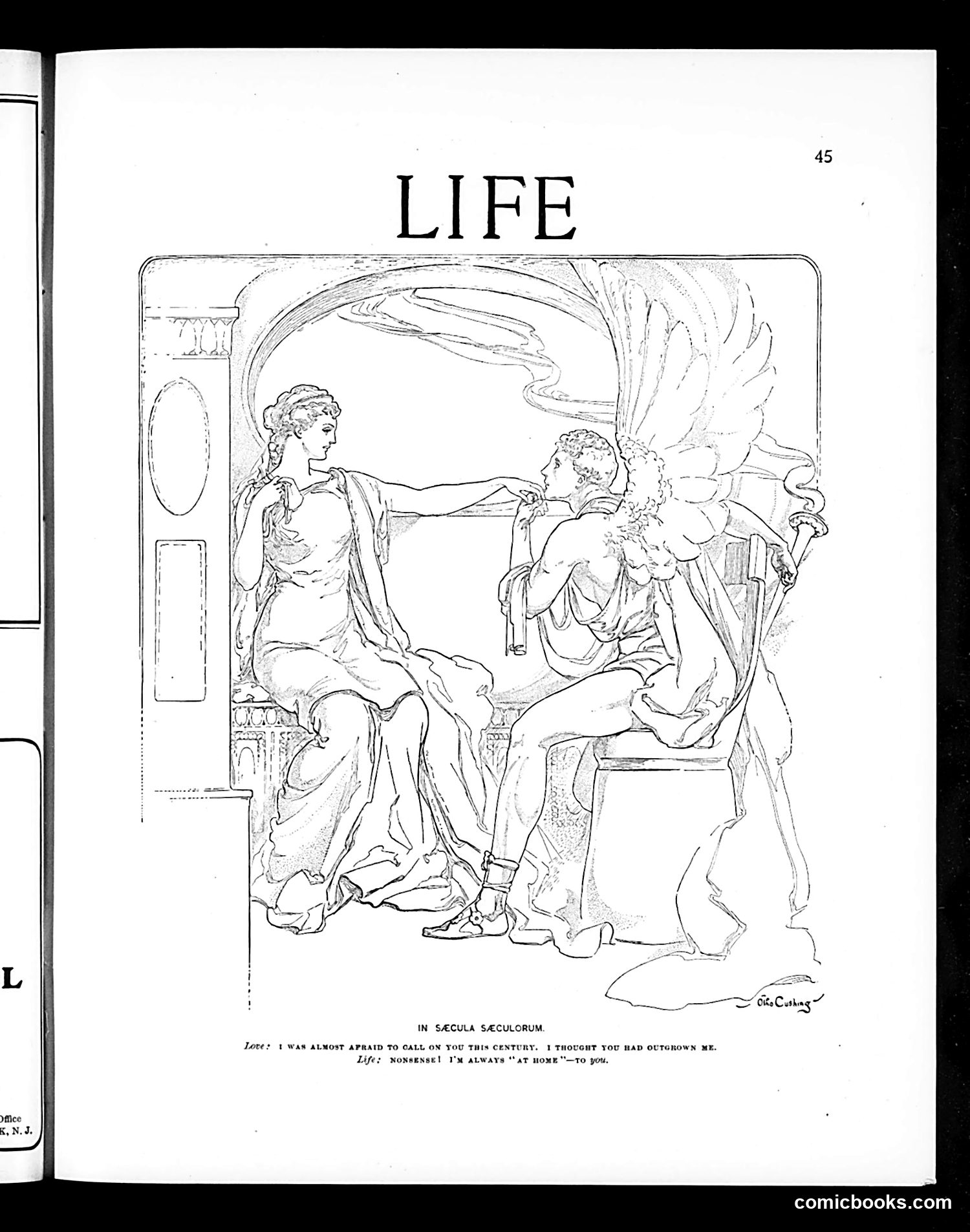
This is a satirical illustration titled "In Saecula Saeculorum" (Latin: "forever and ever"). The cartoon depicts a woman speaking to a winged cupid or cherub figure. The caption reads: "I was almost afraid to call on you this century. I thought you had outworn me" / "Nonsense! I'm always 'at home'—to you." The satire appears to target romantic love and courtship as eternally persistent themes across centuries. Despite changing times and social conditions, the illustration suggests that romantic attraction and pursuit remain constant human behaviors—cupid is always available and ready to inspire love, regardless of how much the world changes. The "at home" phrasing suggests availability and accessibility, making a gentle joke about love's timeless nature in human affairs.
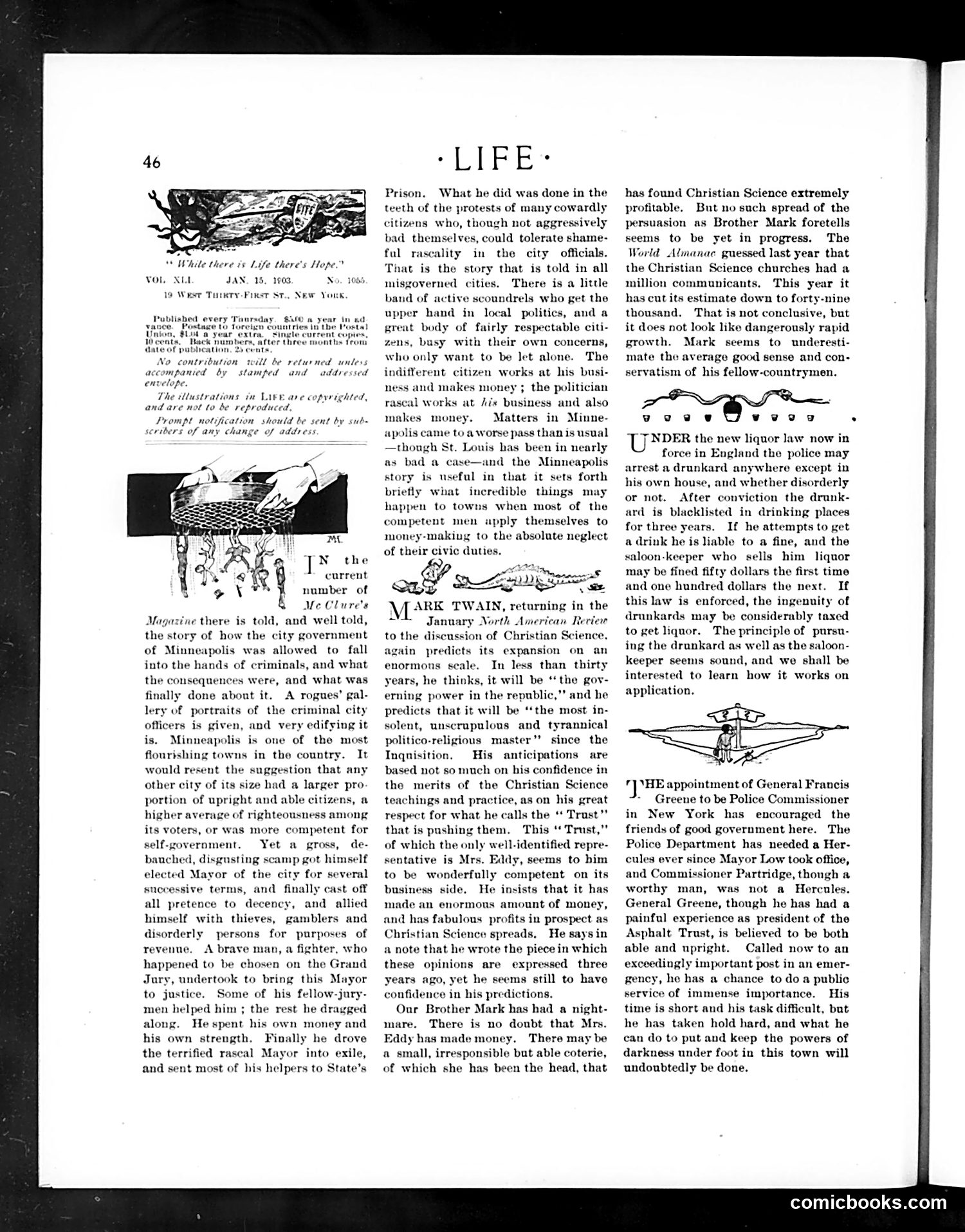
The page contains two distinct editorial commentaries, not traditional political cartoons. The left column discusses Minneapolis civic corruption, referencing a disgraced mayor forced into exile after squandering public funds on cronies and personal enrichment. The article criticizes local officials' tolerance of scoundrels in positions of power. The right column addresses new British police regulations allowing officers to arrest drunks in their homes and fine repeat offenders—a controversial expansion of police authority. The writer expresses concern about enforcement and asks readers to observe how it functions in practice. Both pieces exemplify Life's satirical approach: using specific civic scandals to critique broader governance failures, incompetence, and corruption in American and British institutions circa 1903.
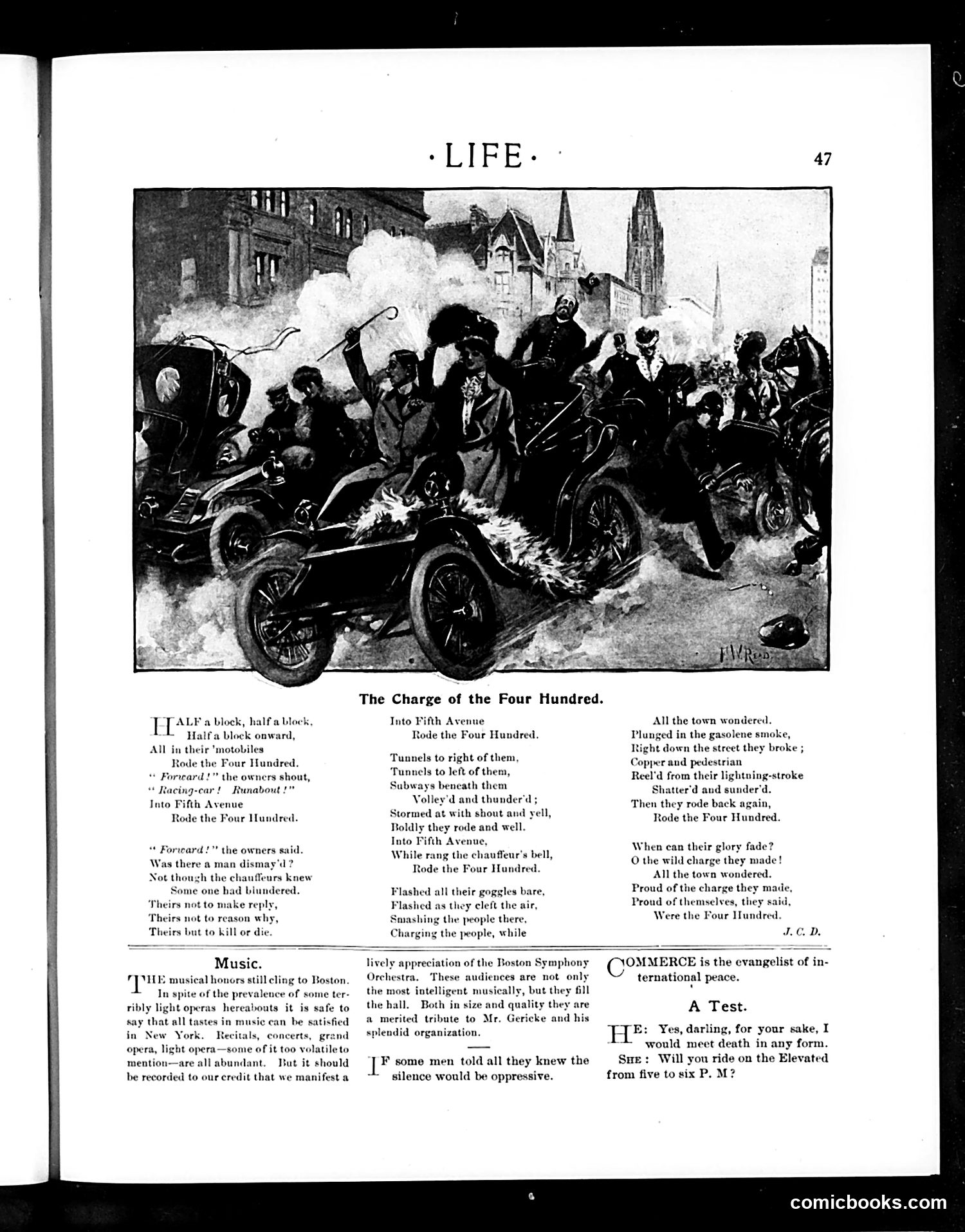
This satirical poem and illustration mock a chaotic automobile parade down Fifth Avenue in New York City. The image depicts early motorcars in collision or disorder, with occupants gesturing wildly amid smoke and confusion. The satire appears to ridicule the reckless behavior of automobile owners—referred to as "the Four Hundred," a term for New York's social elite. The poem emphasizes the danger and spectacle: vehicles "smashing the people there," pedestrians and police confused, goggles flying. The title echoes "Charge of the Light Brigade," treating wealthy motorists' dangerous driving as a mock-heroic folly. The joke targets both the arrogance of early automobile owners and the genuine hazard these vehicles posed to pedestrians in crowded urban streets.
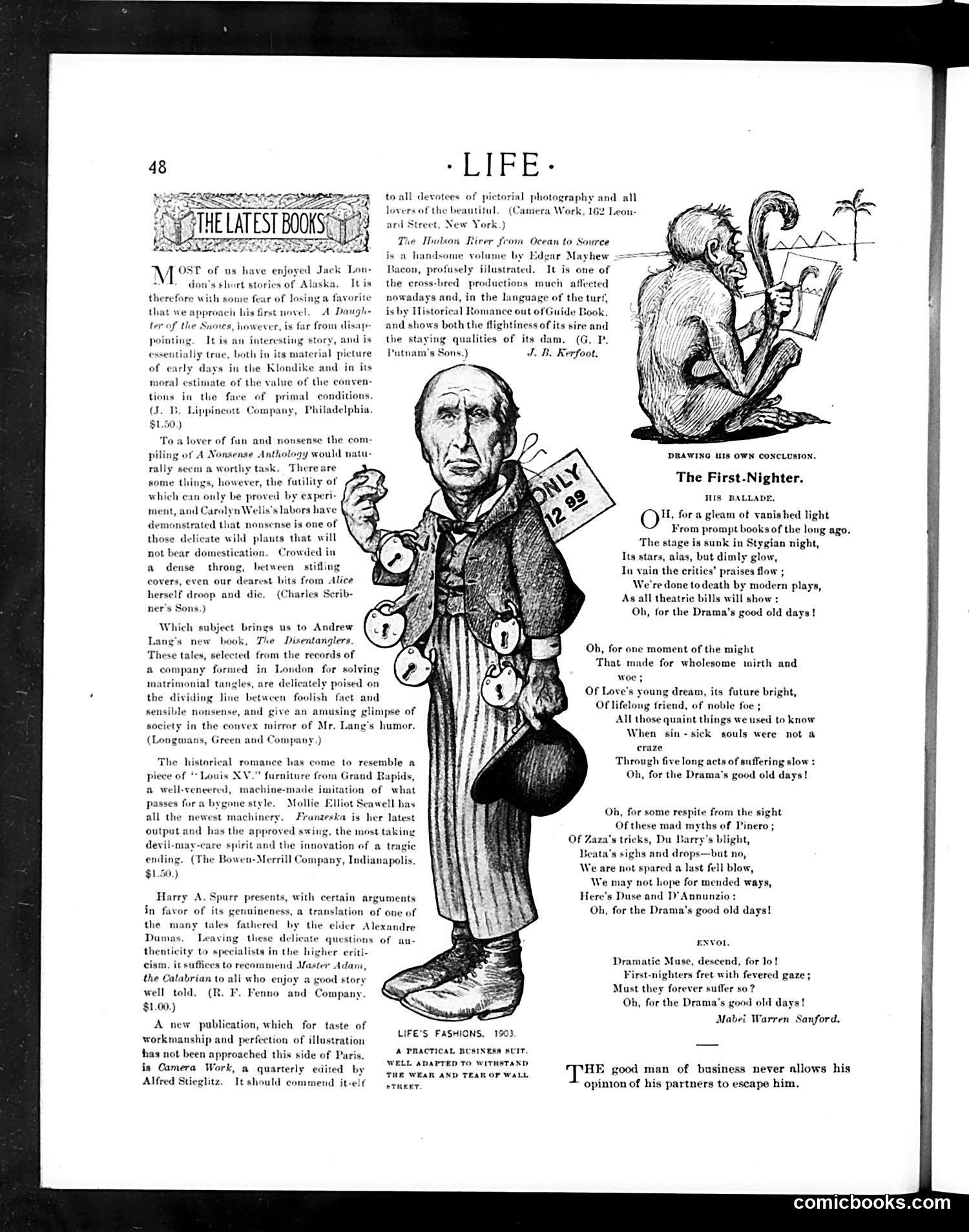
The central cartoon depicts a man in Victorian dress covered with pocket watches and timepieces, labeled "LIFE'S FASHIONS, 1903." The caption indicates this is "A PRACTICAL BUSINESS SUIT CONSTRUCTED TO WITHSTAND THE WEAR AND TEAR OF WALL STREET." This satirizes Wall Street businessmen's obsession with time and punctuality during the Gilded Age. The proliferation of watches suggests both wealth-display and the era's emerging culture of time-consciousness in commerce. The absurdist exaggeration—dressing entirely in watches—mocks the impracticality of such conspicuous consumption while commenting on capitalism's preoccupation with measuring and maximizing productivity. The page also reviews recent books, including works on Alaska and historical romance.
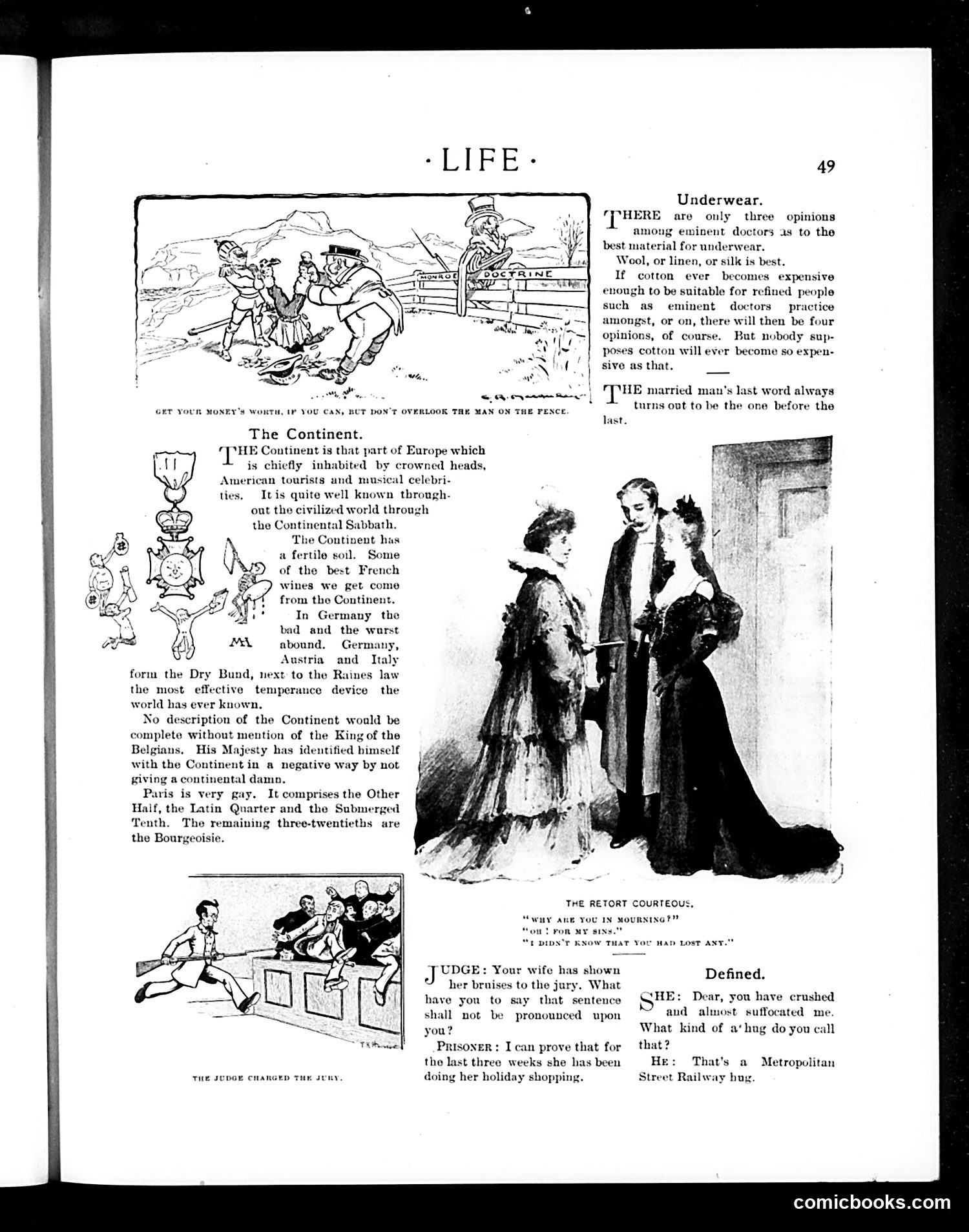
This page contains three separate jokes typical of early Life magazine humor: 1. **"Get Your Money's Worth"** (top): A cartoon about a man on a fence, likely satirizing penny-pinching or miserly behavior—the caption suggests someone trying to avoid paying for something while still benefiting from it. 2. **"The Continent"** (left column): A lengthy article with decorative illustrations mocking European stereotypes—French wines, German beer culture, and Italian characteristics. It's satirizing American tourists' fascination with Continental Europe while poking fun at European national traits. 3. **"The Retort Courteous"** and **"Defined"** (bottom right): Short joke exchanges about a wife's shopping habits and a "Metropolitan Street Railway bug" (likely referencing crowded public transit conditions in cities). The overall tone reflects turn-of-century American satirical humor targeting both domestic and foreign social behaviors.
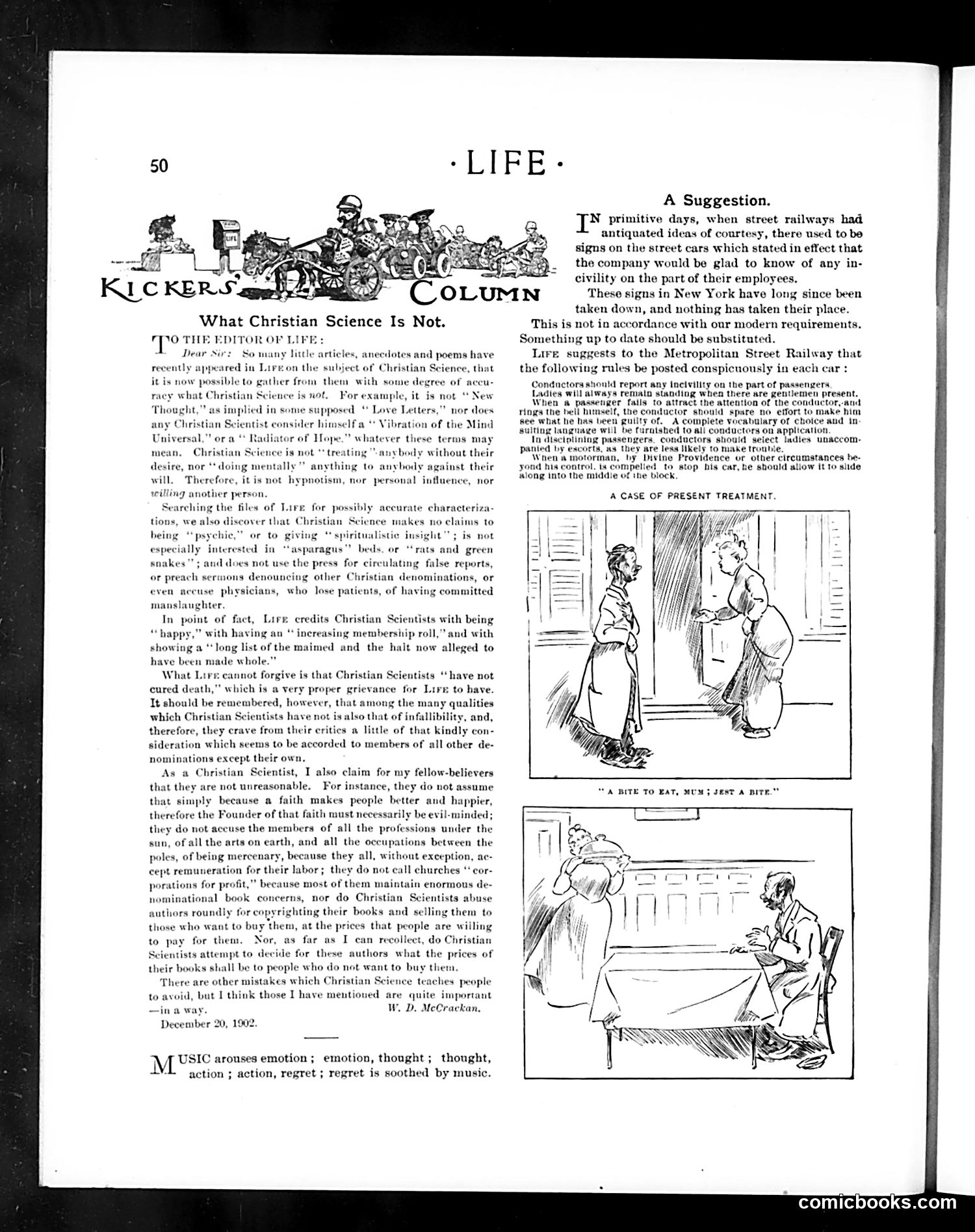
This page contains two elements: 1. **"Kickers' Column"** - An essay by W.D. McCrackan critiquing Christian Science, arguing it makes false claims about healing and personal improvement while avoiding legitimate scrutiny. The author contends Christian Scientists unfairly criticize other denominations while claiming special status. 2. **Two cartoon panels titled "A Case of Present Treatment"** - The caption "A Bite to Eat, M'um? Just a Bite" suggests satirical commentary on the interaction between what appears to be a servant or lower-class figure and a wealthy woman. The specific social critique is unclear from the image alone, but likely concerns class dynamics or employment treatment of the era. The page dates to December 20, 1902.
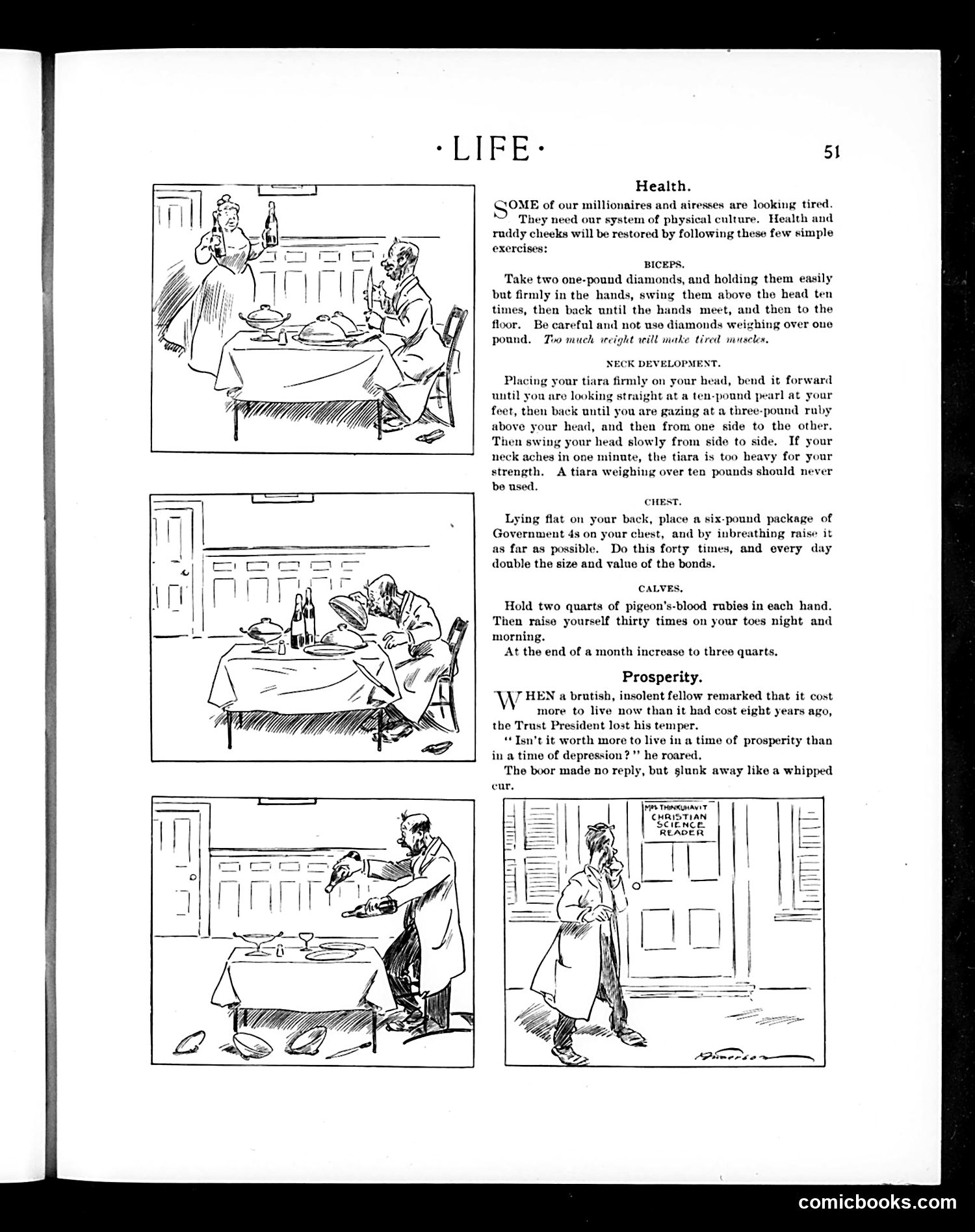
This page contains health and exercise advice satirizing wealthy Americans' vanity during economic hardship. The "Health" section mocks millionaires and socialites pursuing elaborate fitness routines—using one-pound diamonds as dumbbells, wearing heavy tiaras for neck exercises, and performing chest exercises with Government bonds—suggesting they waste resources on frivolous self-improvement. The "Prosperity" section features a cartoon dialogue between a wealthy businessman and a waiter. When the businessman complains that living costs more now than eight years ago, the waiter—appearing frustrated by such obliviousness during economic depression—replies that "it's worth more to live now than in a time of depression," then sarcastically calls him a "whipped cur" for his ingratitude. The satire targets class indifference during economic crisis.
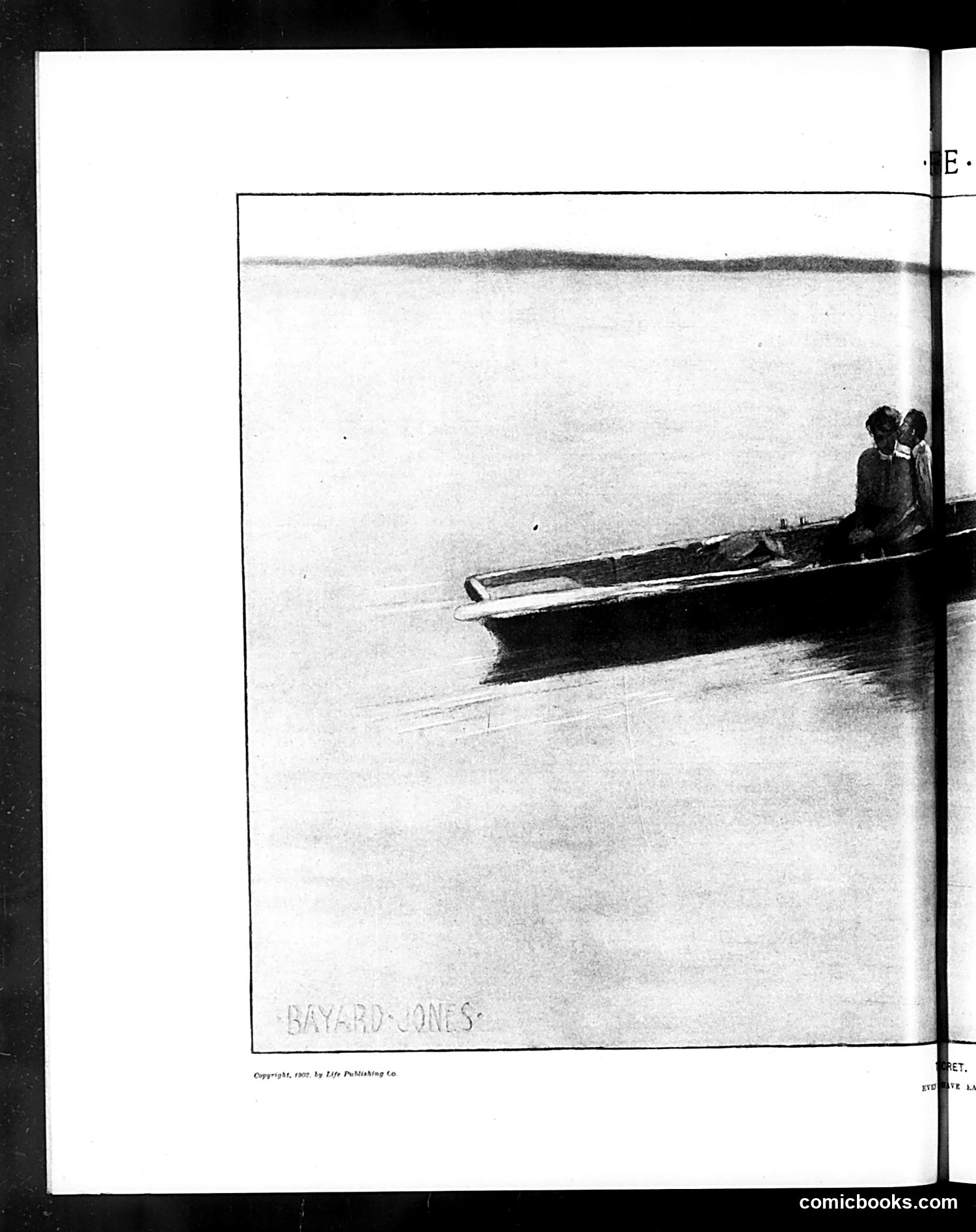
This appears to be a photograph rather than a political cartoon. The image shows two figures sitting in a small rowboat on calm water, with distant shoreline visible. The photograph is credited to "BAYARD JONES" at the bottom. The page includes a copyright notice from 1907 by Life Publishing Co., indicating this is from an early 20th-century issue of Life magazine. Without additional context or caption text visible on the page, I cannot definitively explain what satirical or social commentary this photograph was meant to convey to contemporary readers. It may relate to a specific news event or social situation from 1907, but that information is not apparent from the image alone.
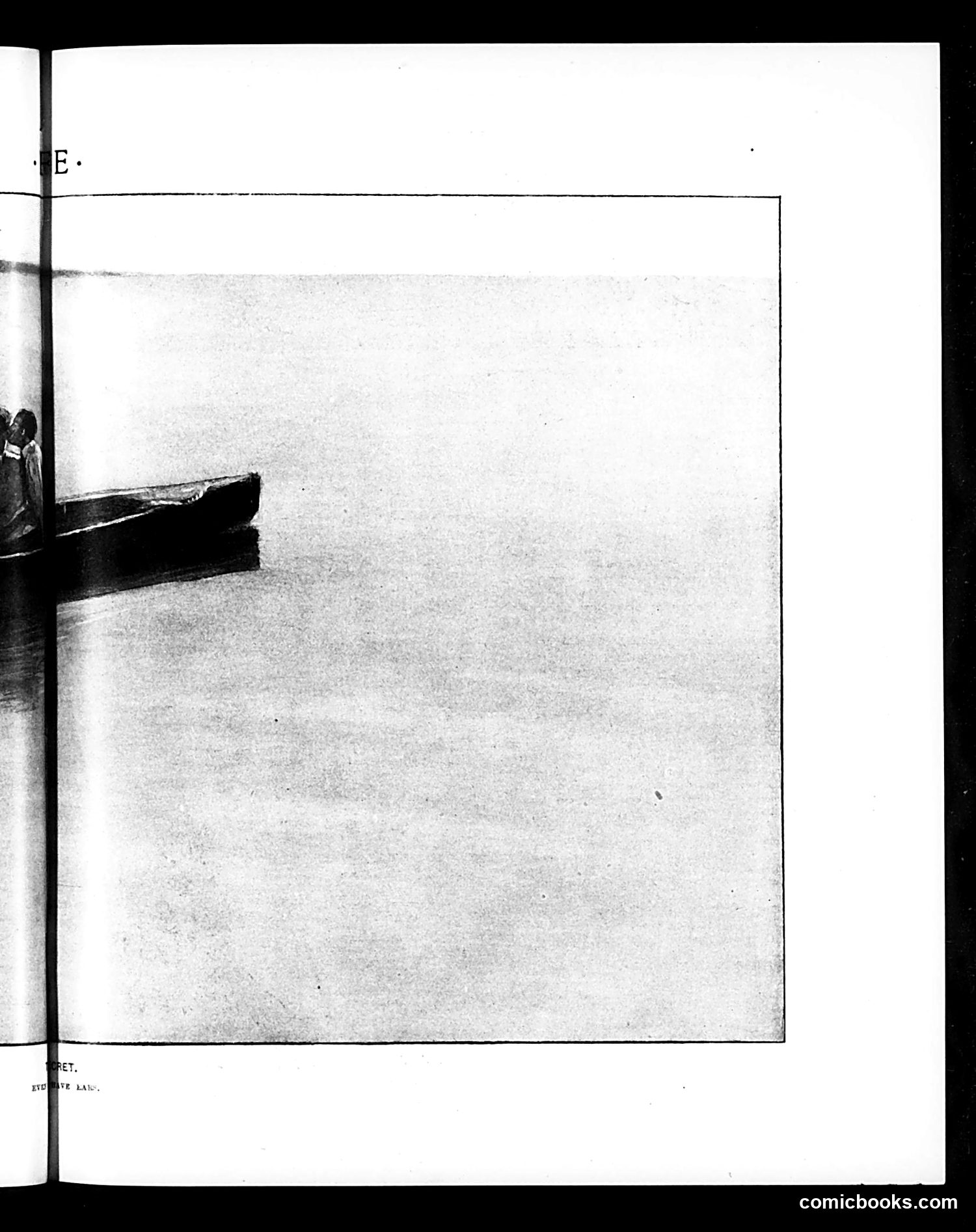
I can see this is a page from what appears to be an early Life magazine, marked with "E" at the top left. However, the image quality is quite poor—it shows mostly a blank or heavily faded page with a rectangular border and what appears to be a small dark object or boat silhouette in the upper left portion of the frame. The OCR text provided is minimal and doesn't offer clear context. Without being able to read any legible text or see a clear cartoon/illustration, I cannot reliably identify specific figures, political references, or explain the satirical intent to a modern reader. The page appears either mostly blank, severely degraded, or the actual content is not clearly visible in this reproduction.
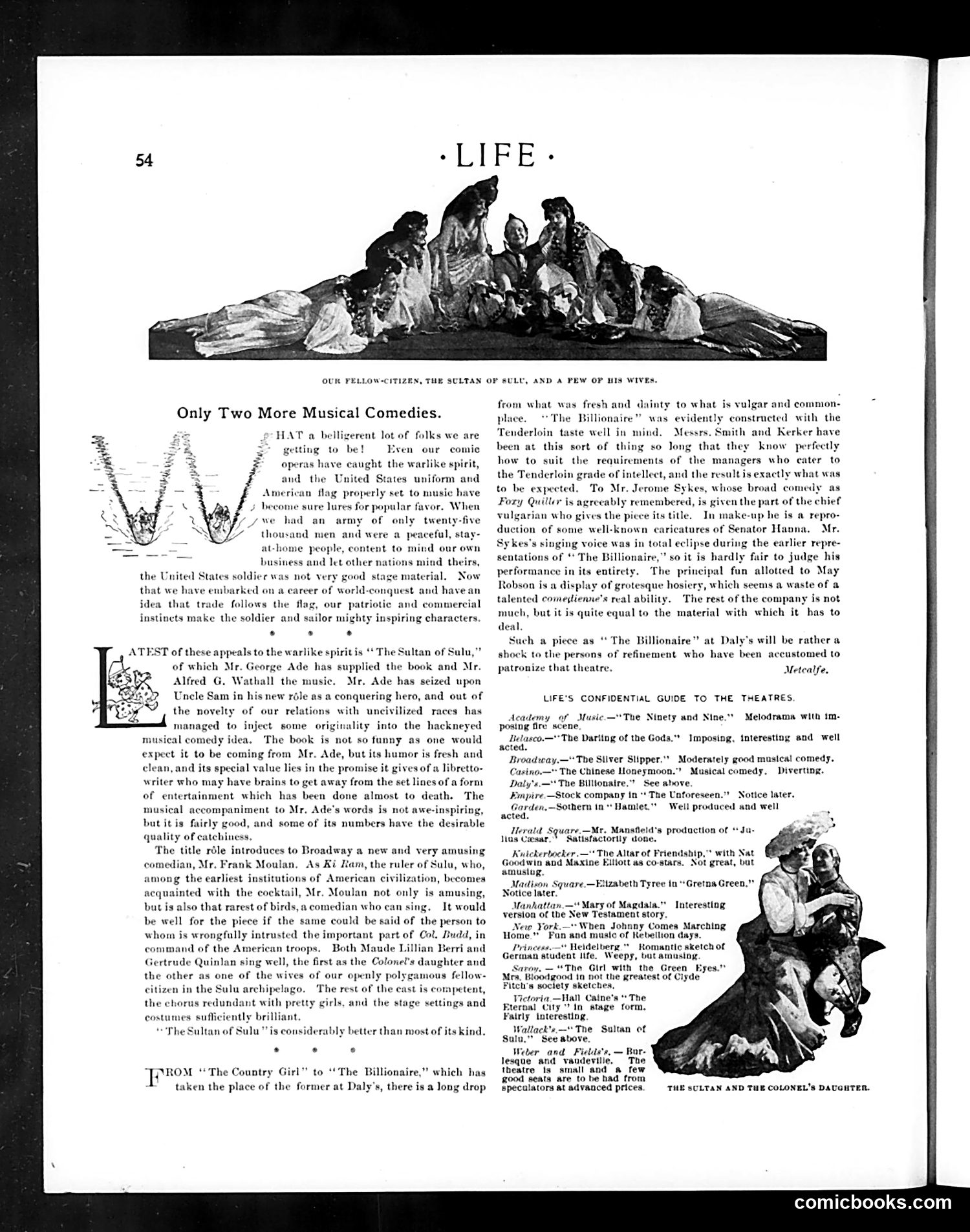
This page discusses theatrical productions, primarily focusing on "The Sultan of Sulu," a musical comedy. The top illustration depicts "Our Fellow-Citizen, the Sultan of Sulu, and a Few of His Wives" — a satirical reference to an actual Philippine leader during the American colonial period. The article criticizes the quality of recent Broadway musicals, noting that even established composers like Mr. Ade have produced uninspired work. The text expresses concern that American entertainment increasingly relies on novelty rather than genuine talent. The bottom illustration labeled "The Sultan and the Colonel's Daughter" appears to reference the musical's plot. The satire reflects early 1900s American attitudes toward colonial subjects treated as exotic theatrical fodder.
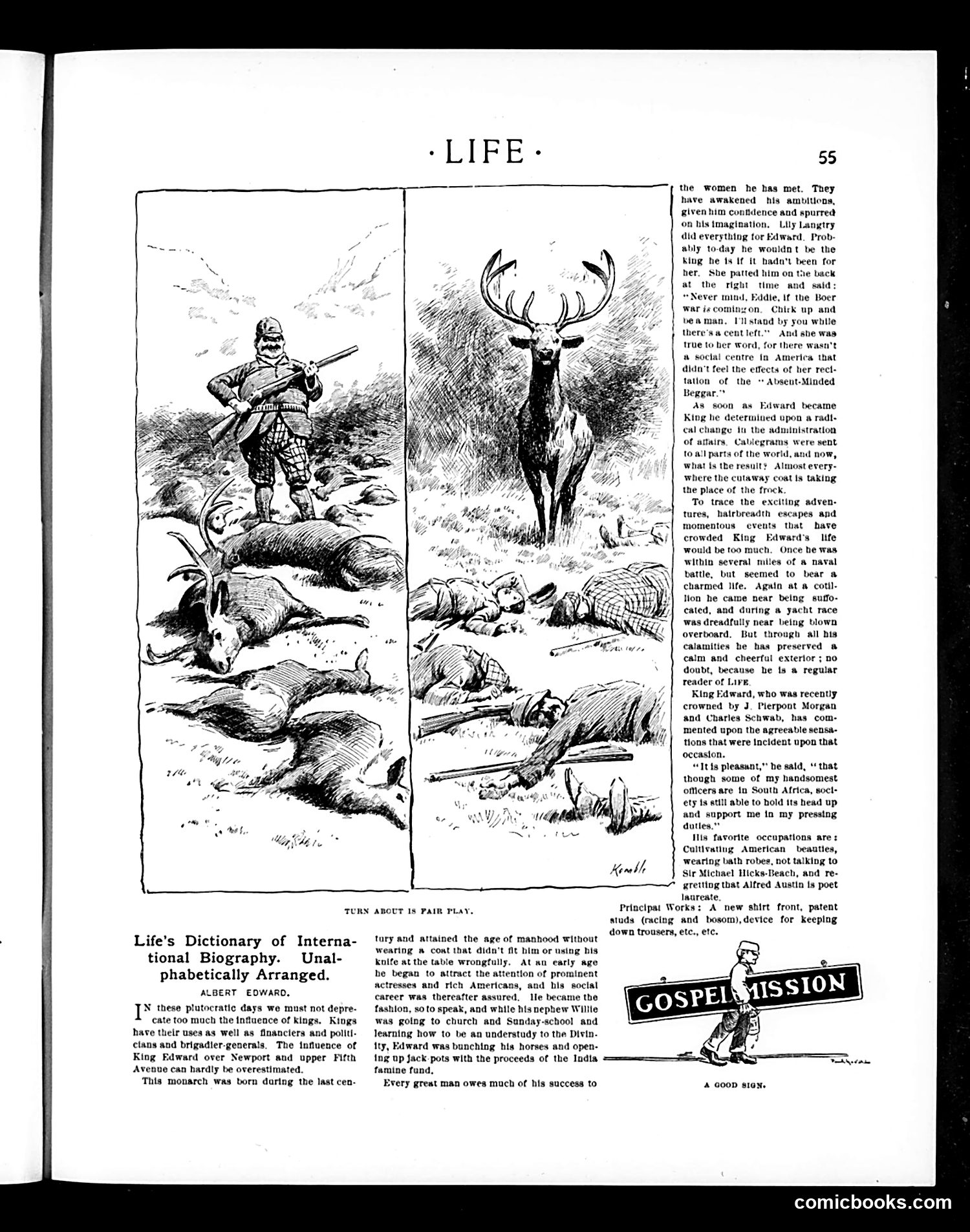
This page satirizes King Edward VII through mock-biographical ridicule. The cartoon depicts Edward as a frivolous, fashion-obsessed monarch whose main accomplishments involve tailoring and socializing rather than governance. The satire targets Edward's reputation for: - **Vanity and fashion influence**: His supposed impact on American high society (Newport, Fifth Avenue) through clothing choices like the cutaway coat - **Womanizing**: References to actress Lily Langtry as his muse and benefactor - **Shallow priorities**: His "Principal Works" hilariously listed as shirt fronts and trouser devices - **Irresponsibility during wartime**: The Boer War and absent British officers are mentioned dismissively while Edward pursues social pleasures The accompanying hunting illustrations ("Turn About is Fair Play") appear to contrast Edward's leisurely pursuits against the serious business of empire and war. The satire suggests American elites foolishly follow this frivolous foreign king's example rather than serious statesmanship.
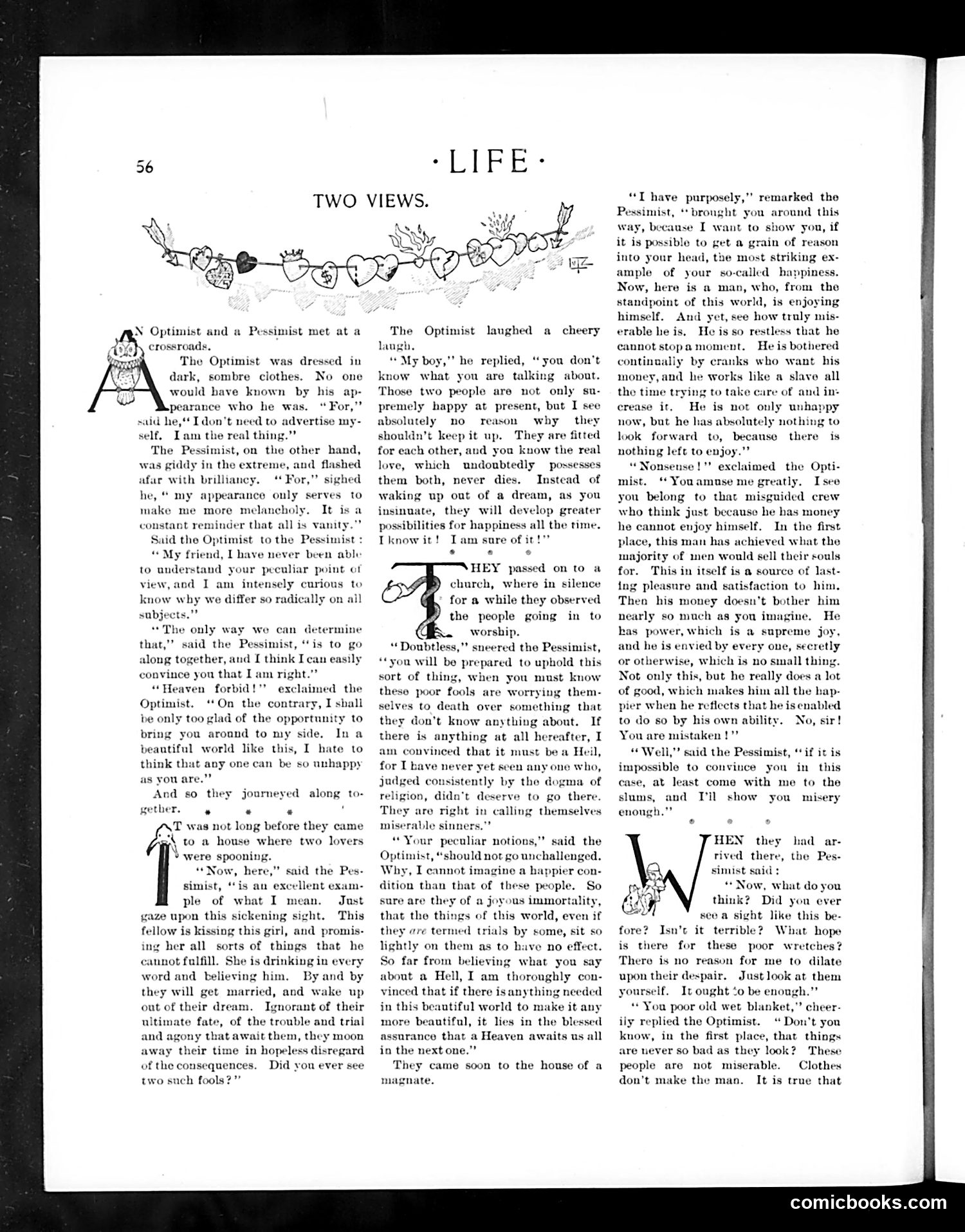
This satirical piece contrasts two philosophical worldviews through a dialogue between an Optimist and Pessimist who encounter three scenes: young lovers courting, church congregants worshipping, and (beginning at page's bottom) an unnamed man. The Optimist—dressed plainly but content—sees inherent goodness: lovers will find lasting happiness, religious devotion brings comfort. The Pessimist—flamboyantly dressed yet miserable—sees foolishness: lovers face inevitable disillusionment, religion exploits people's fear of hellfire. The satire works bidirectionally: the Pessimist's cheerful appearance despite his dark worldview is absurd, while the Optimist's faith in an inherently "beautiful world" seems naive. The page suggests neither philosophy is entirely right—both are caricatured. The piece appears to mock both unrealistic optimism and reflexive cynicism as equally unconvincing life approaches.
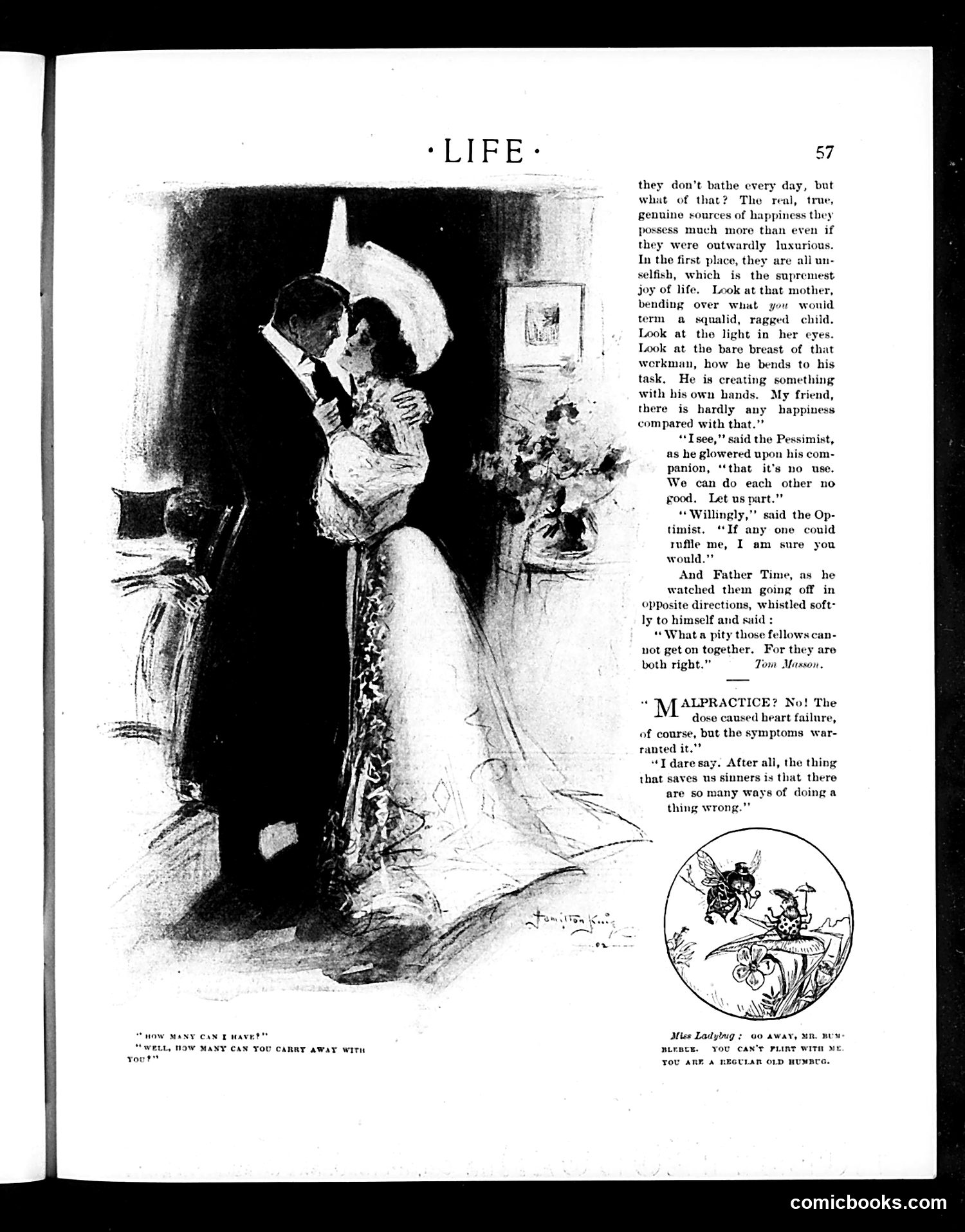
This page presents philosophical dialogue paired with social commentary illustrations. The main feature depicts a debate between an **Optimist and a Pessimist**—archetypal figures representing opposing worldviews. The Optimist celebrates the happiness found in humble labor and selflessness (depicting a working mother and tradesman), while the Pessimist insists such contentment is illusory. Father Time observes they're "both right," satirizing how both perspectives contain truth. Below, a brief medical joke mocks **malpractice**: a doctor defends a fatal dose by claiming the symptoms "warranted it," then philosophizes that sinners are saved because there are "so many ways of doing a thing wrong"—darkly satirizing medical incompetence and moral relativism. The page's humor targets intellectual posturing, social hypocrisy, and professional negligence through contrasting philosophical positions with harsh reality.
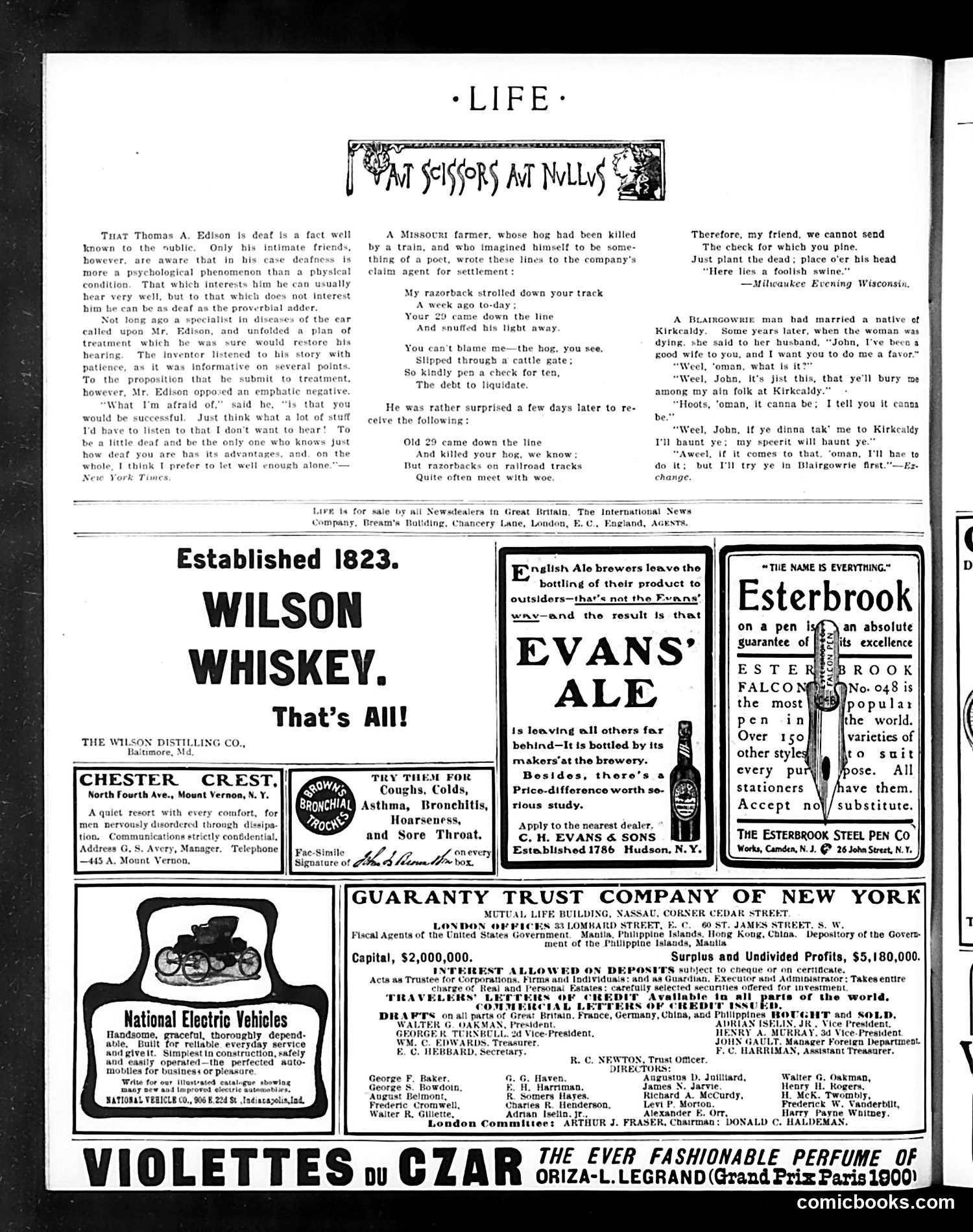
This is primarily an **advertising page** with three humor anecdotes at the top. The three short stories are period humor pieces: 1. **Edison's deafness**: A joke about Thomas Edison being selectively deaf—he hears what interests him but ignores what doesn't. The punch line mocks his refusal to listen to a scheme, suggesting willful deafness as a business advantage. 2. **The dead hog complaint**: A farmer sues a railroad for killing his razorback hog, writing mock-sentimental poetry to the claim agent ("Here lies a foolish swine"). 3. **The Scottish widow**: Dialect humor about a dying Kirkcaldy woman demanding her husband bury her at home. He refuses because he can't afford to transport her body back to Scotland, joking he'll try burying her in Blairgowrie instead. All three rely on early 20th-century sentimental and ethnic stereotype humor conventions. The remainder of the page consists of advertisements for Wilson Whiskey, Evans' Ale, National Electric Vehicles, the Guaranty Trust Company, and perfume—typical of Life's mixed editorial-advertising format.
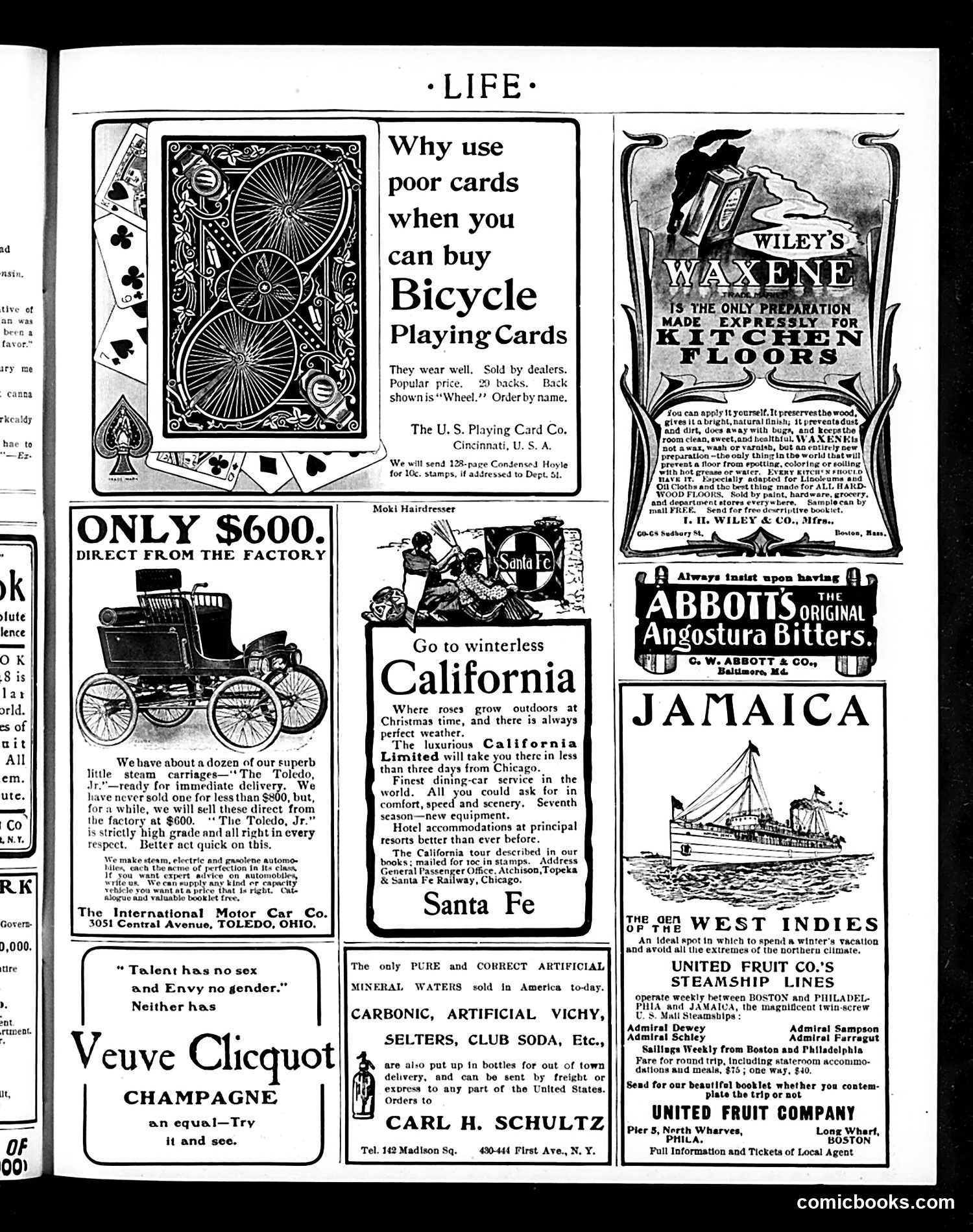
This page is primarily **advertising**, not political satire or comics. It's a collection of period product and service advertisements from an early 20th-century *Life* magazine. Key ads include: - **Bicycle Playing Cards** – promoting durable playing cards with decorative "Wheel" design - **Toledo automobile** – a steam-powered car sold directly from factory for $600 - **California Limited train** – luxurious rail service to winterless California - **Wiley's Waxene** – kitchen floor polish protecting against grease and water - **Veuve Clicquot Champagne** – with a quote claiming talent and envy have no gender - **Carbonic mineral waters** – artificial mineral beverages by mail order - **United Fruit Company steamships** – Jamaica tourism and travel The ads reflect early 1900s consumer culture: automobiles, train travel, household products, alcoholic beverages, and leisure tourism. The champagne ad's gender-equality quote is notably progressive for the era.
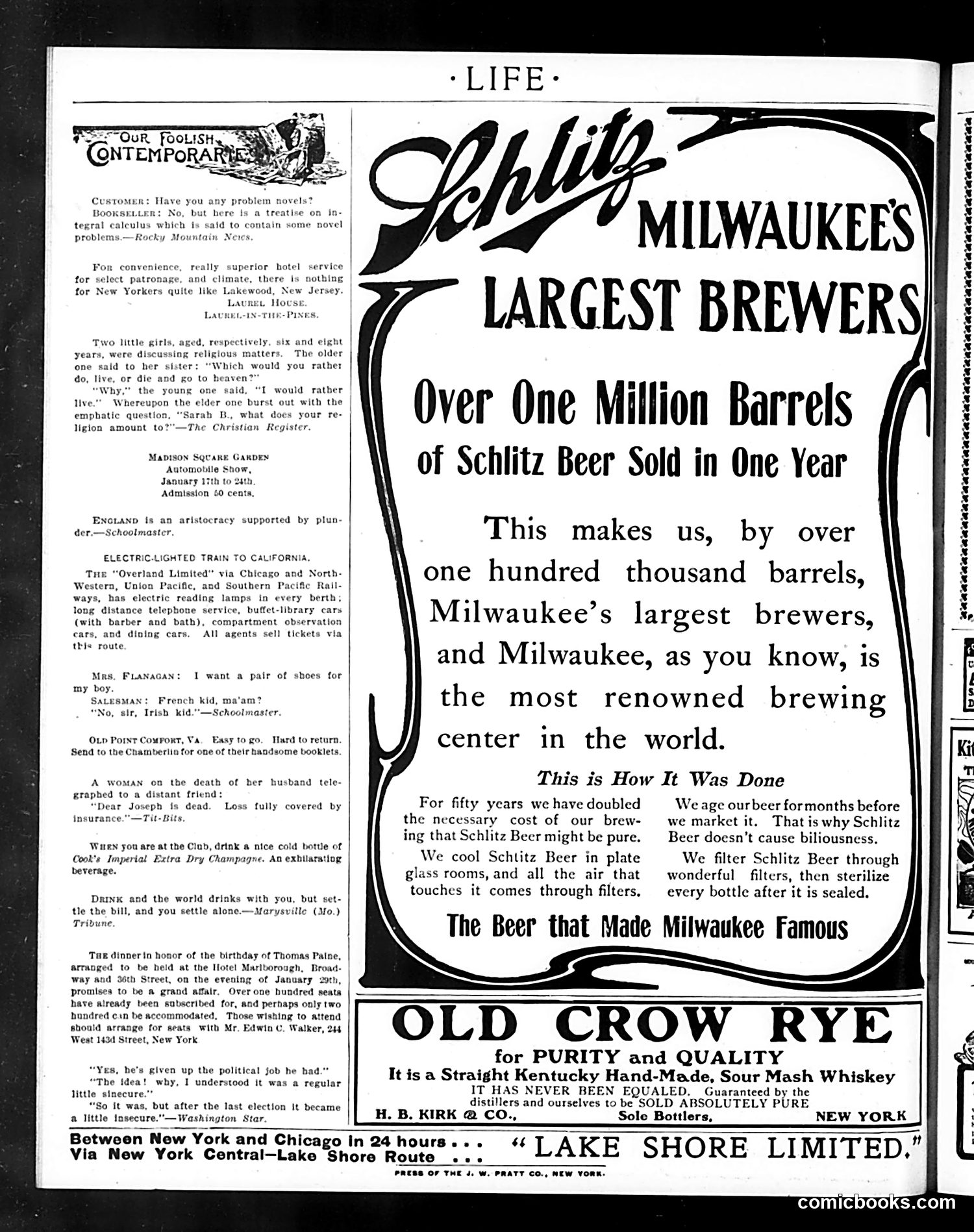
This page is primarily **advertisements and brief humorous anecdotes**, not political cartoons. The main content includes: **"Our Foolish" section**: Short jokes mocking various types of people—a customer asking for "problem novels" containing calculus, a child's religious confusion, a woman buying "Irish kid" shoes instead of "French kid." **Major advertisements**: - **Schlitz Beer** dominates the page, boasting it's Milwaukee's largest brewer, selling over one million barrels yearly. The ad emphasizes purity through aging, filtering, and sterilization—addressing contemporary concerns about contaminated beer causing illness ("biliousness"). - **Old Crow Rye whiskey** advertises "purity and quality" - Various travel and luxury service ads (trains, hotels, automobile shows) **Social context**: The repeated emphasis on purity in beer and whiskey advertisements reflects **genuine public health anxieties** of the era regarding food and beverage safety, before modern regulation. The humor targets class distinctions (French vs. Irish materials) and reflects period attitudes about immigration and social hierarchy.
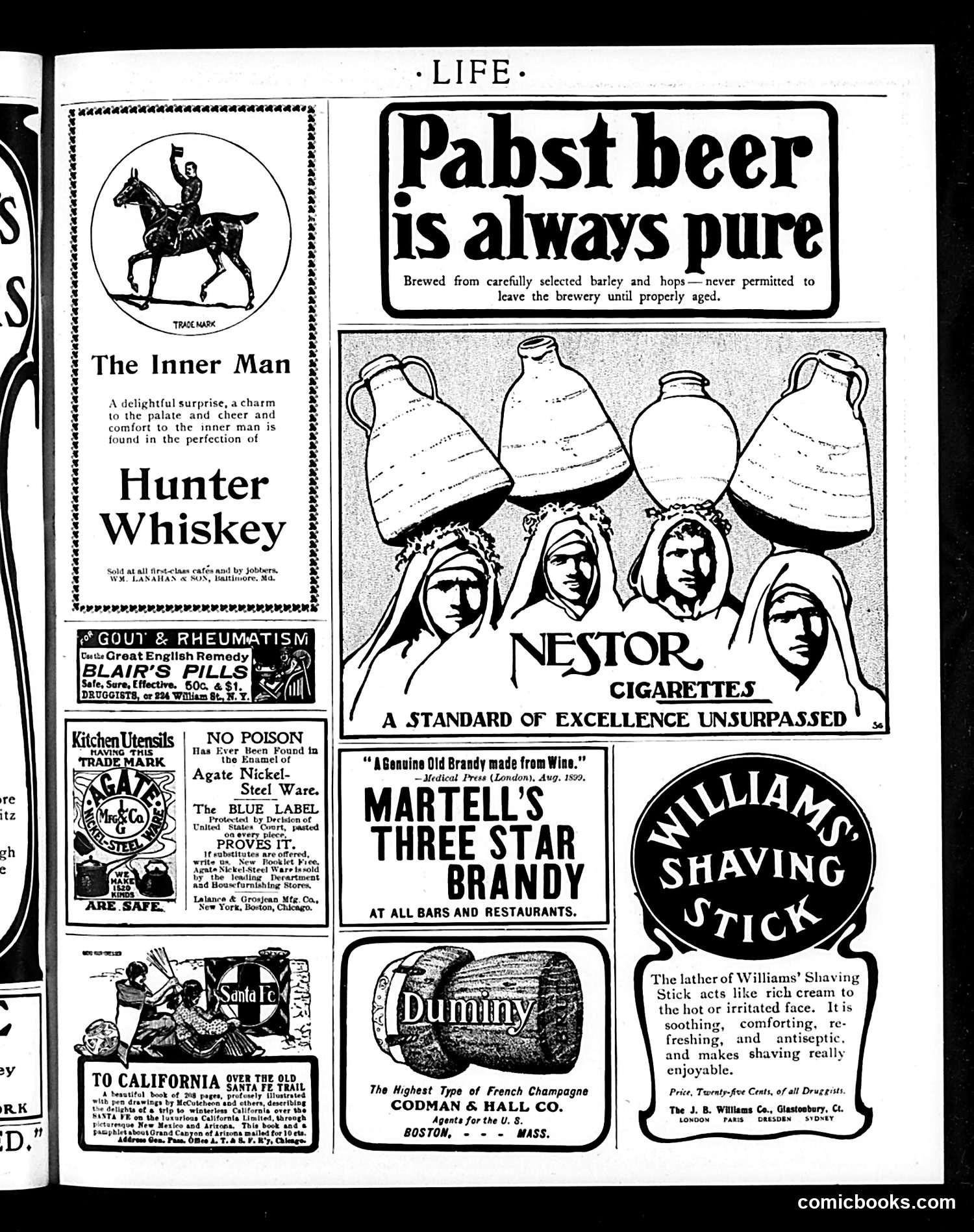
This is primarily a **commercial advertisement page**, not political satire. It features various product ads from the early 1900s targeting affluent male consumers. Notable ads include: - **Hunter Whiskey** and **Pabst Beer**: alcohol products emphasizing purity and quality - **Blair's Gout Pills**: a patent medicine claiming to treat gout - **Agate Nickel-Steel kitchenware**: emphasizing safety ("no poison") - **Nestor Cigarettes** and **Martell's Three Star Brandy**: luxury import goods - **Williams' Shaving Stick**: grooming product - **Santa Fe Railway advertisement** (bottom left, partially visible) The page reflects early 20th-century consumer culture and marketing strategies that are now striking: **patent medicines without regulation**, **alcohol advertised without health warnings**, and **cigarettes marketed without any health concerns**—all normalized at the time but would be prohibited today. There is **no political cartoon or satire** visible on this page.
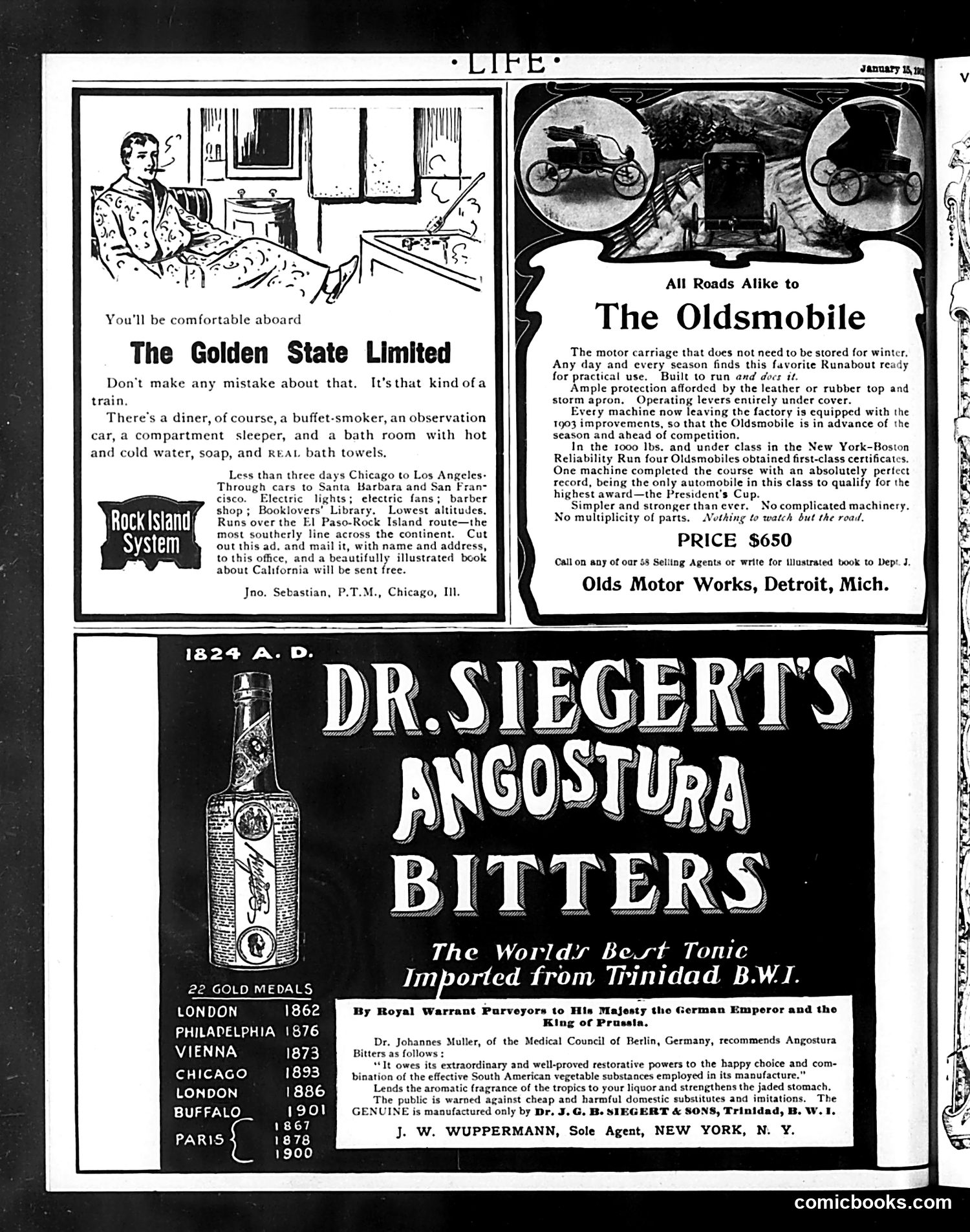
This page consists entirely of **advertisements**, not political satire or cartoons. It contains three product promotions: 1. **The Golden State Limited** (top left): A train advertisement from Rock Island System, promoting luxury rail travel from Chicago to Los Angeles with amenities like diners, observation cars, and sleeping compartments. 2. **The Oldsmobile** (top right): An automobile advertisement priced at $650, emphasizing durability and year-round usability. It highlights the vehicle's reliability through competition awards and boasts of "no complicated machinery." 3. **Dr. Siegert's Angostura Bitters** (bottom): A medicinal tonic from Trinidad, claiming restorative powers and listing multiple gold medals from major cities dating back to 1862. It includes a warning against cheap imitations. These ads reflect early 1900s consumer culture and marketing strategies, using claims of reliability, luxury, and medical efficacy to appeal to middle-class readers.