
Life, 1903-01-15 · page 4 of 20
Life — January 15, 1903 — page 4: what you’re looking at
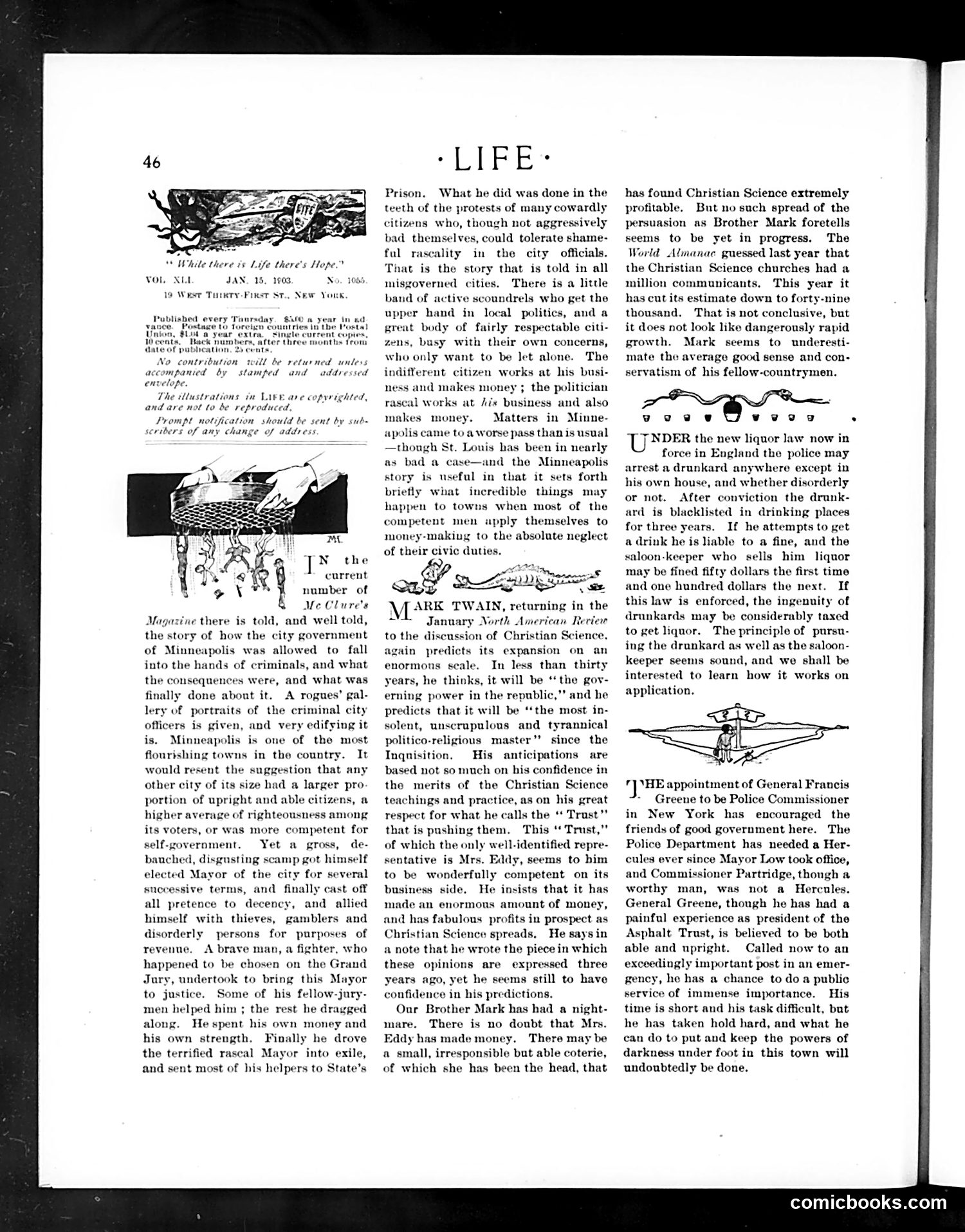
What you’re looking at
The page contains two distinct editorial commentaries, not traditional political cartoons. The left column discusses Minneapolis civic corruption, referencing a disgraced mayor forced into exile after squandering public funds on cronies and personal enrichment. The article criticizes local officials' tolerance of scoundrels in positions of power. The right column addresses new British police regulations allowing officers to arrest drunks in their homes and fine repeat offenders—a controversial expansion of police authority. The writer expresses concern about enforcement and asks readers to observe how it functions in practice. Both pieces exemplify Life's satirical approach: using specific civic scandals to critique broader governance failures, incompetence, and corruption in American and British institutions circa 1903.
📄 Transcribed text from this page (OCR, searchable)
Machine-transcribed from the original scan — historical spelling and the odd misread are preserved.
‘* White there is Life there's Hope.” vol. XU JAN. 15, 1903. N 19 West Tutwry-Fixst St. New Yous safe a every Tanrsday ar in ad 1 will be returned untess stamped and addressed contribution accompanied by The illustrations in Live ave copyrighted, and are not to be reproduce Prompt notification should be sent by sub= scribers of any change of address ] the current number of Me Clure's told, and well told, the story of how the city government of Minneapolis was allowed to fall into the hands of criminals, and what the consequences were, and what was finally done about it. A rogues’ gal- lery of portraits of the criminal city officers is given, and very edifying it is. Minneapolis is one of the most flourishing towns in the country. It would resent the suggestion that any other city of its had a larger pro portion of upright and able citizens, a higher average of righteousness among its voters, or was more competent for self-government. Yet a gross, de- bauched, disgusting scamp got himself elected Mayor of the city for several snecessive terms, and finally cast off all pretence to decency, and allied himself with thieves, gamblers and disorderly persons for purposes of revenue. A brave man, a fighter, who happened to be chosen on the Grand Jury, undertook to bring this Mayor to justice. Some of his fellow-jury- men helped him ; the rest he dragged along. He spent his own money and his own strength, Finally he drove the terrified rascal Mayor into exile, and sent most of his helpers to State’s ‘LIPe Prison, What he did was done in the teeth of the protests of many cowardly izens who, though not aggressively bad themselves, could tolerate shame- ful rascality in the city officials. That is the story that is told in all misgoverned cities. There is a litte band of active scoundrels who get the upper hand in local politics, and a great body of fairly respectable citi- zens, busy with their own concerns, who only want to be let alone. The indifferent citizen works at his busi- ness and makes money ; the politician rascal works at ‘is business and also make: Matters in Minne- apolis came to a worse pass than is usual —though St. Louis has been in nearly as bad a case—and the Minneapolis story is useful in that it sets forth briefly what incredible things may happen to towns when most of the competent men upply themselves to money-making to the absolute neglect of their civic duties. money. ay CE M ARK TWAIN, returning in the M4 January North American Review to the discussion of Christian Science, zain predicts its expansion on an enormons scale. In less than thirty years, he thinks, it will be ‘the gov- erning power in the republic,” and he predicts that it will be ‘the most in- solent, unscrupulous and tyrannical politico-religious master” since the Inquisition, His anticipations are based not so much on his confidence in the merits of the Christian Science teachings and practice, as on his great respect for what he calls the ‘* Trust’’ that is pushing them. This “ Trust,” of which the only well-identified repre- sentative is Mrs. Eddy, seems to him to be wonderfully competent on its business side, He insists that it has made an enormous amount of money, and has fabulous profits in prospect as Christian Science spreads, He says in a note that he wrote the piece in which these opinions are expressed three years ago, yet he seems still to have confidence in his predictions. Our Brother Mark has had a night- mare. There is no doubt that Mrs. Eddy has made money. There may be a small, irresponsible but able coterie, of which she has been the head, that has found Christian Science extremely profitable. But no such spread of the persuasion as Brother Mark foretells seems to be yet in progress. The World Almanac guessed last year that the Christian Science churches had a million communicants. This year it has cut its estimate down to forty-nine thousand. That is not conclusive, but it does not look like dangerously rapid growth. Mark seems to underesti- mate the average good sense and con- servatism of his fellow-countrymen. J NDER the new liquor law now in force in England the police may rest a drunkard anywhere except in his own house, and whether disorderly or not. After cot on the drunk- ard is blacklisted in drinking places for three years. If he attempts to get a drink he is liable to a fine, and the saloon-keeper who sells him liquor may be fined fifty dollars the first time and one hundred dollars the next. If this law is enforced, the ingenuity of drunkards may be considerably taxed to get liquor. The principle of pursu- ing the drunkard as well as the saloon- keeper seems sound, and we shall be interested to learn how it works on application. 1] {HE appointment of General Francis ~ Greene to be Police Commissioner in New York encouraged the friends of good government here. The Police Department has needed a Her- cules ever since Mayor Low took office, and Commissioner Partridge, though a worthy man, was not a Hercules. General Greene, though he has had a painful experience as president of the Asphalt Trust, is believed to be both able and upright. Called now to an exceedingly important post in an emer- gency, he has a chance to doa public service of immense importance. His time is short and his task difficult, but he has taken hold hard, and what he can do to put and keep the powers of darkness under foot in this town will undoubtedly be done. comicbooks.com