
A complete issue · 20 pages · 1902
Life — August 14, 1902
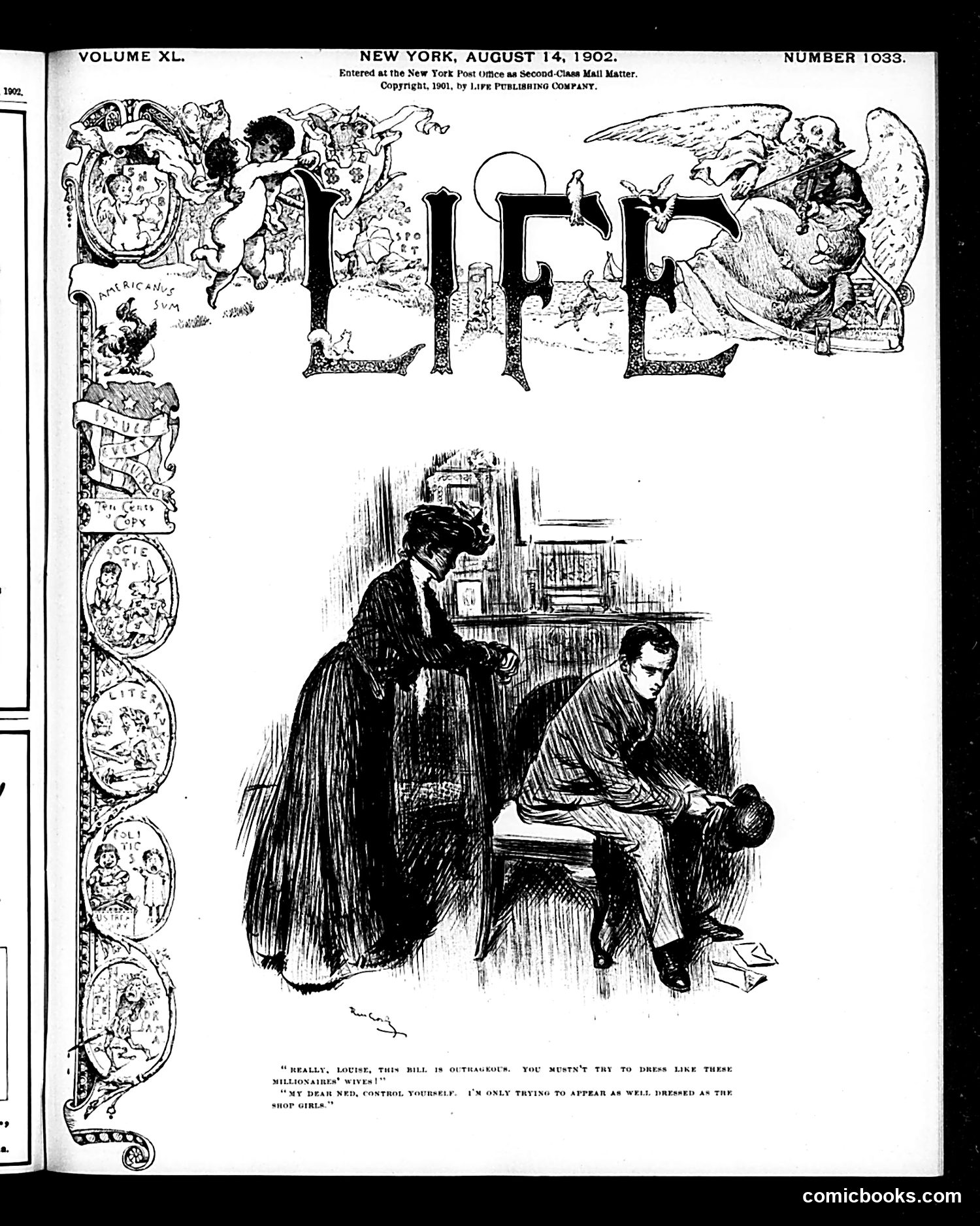
This page features a satirical cartoon about class and fashion. The dialogue reveals the joke: a man sitting down is being criticized by a woman (likely his wife) for dressing inappropriately in shabby clothes. His response—that he's "only trying to appear as well dressed as the shop girls"—is the punchline. The satire targets the era's anxieties about social mobility and fashion pretension. Shop girls (female retail workers) were aspirational figures who dressed beyond their means to appear respectable and fashionable. The man's comment suggests the absurdity of wealthy people dressing down to imitate working-class women who themselves were imitating the wealthy. The ornamental border and elaborate header suggest this is a prominent feature in the magazine's satirical commentary on American manners and social pretension.
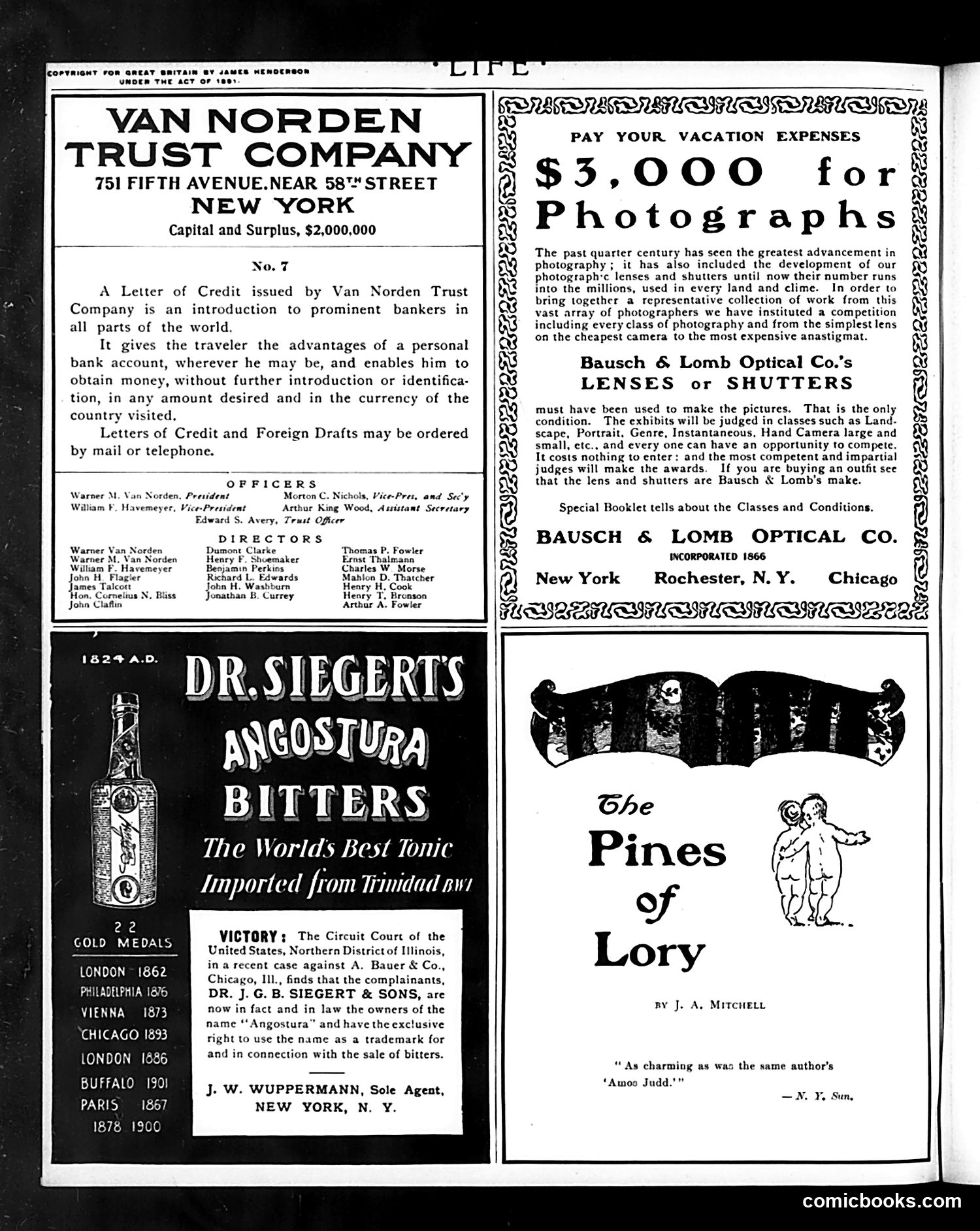
This page contains primarily **advertisements rather than political cartoons or satire**. The top left advertises the **Van Norden Trust Company**, a banking service offering letters of credit for international travelers—a practical financial product for the era's wealthy travelers. The top right promotes a **photography competition** by Bausch & Lomb Optical Co., inviting amateur photographers to submit work using their camera equipment, with judging in various categories. The bottom left advertises **Dr. Siegert's Angostura Bitters**, a medicinal tonic imported from Trinidad, emphasizing its status as "The World's Best Tonic" with gold medals from international exhibitions. The bottom right advertises **"The Pines of Lory,"** a book by J.A. Mitchell with a classical illustration, described as charming like another work titled "Anno Judd." No political satire or caricature is present on this page.
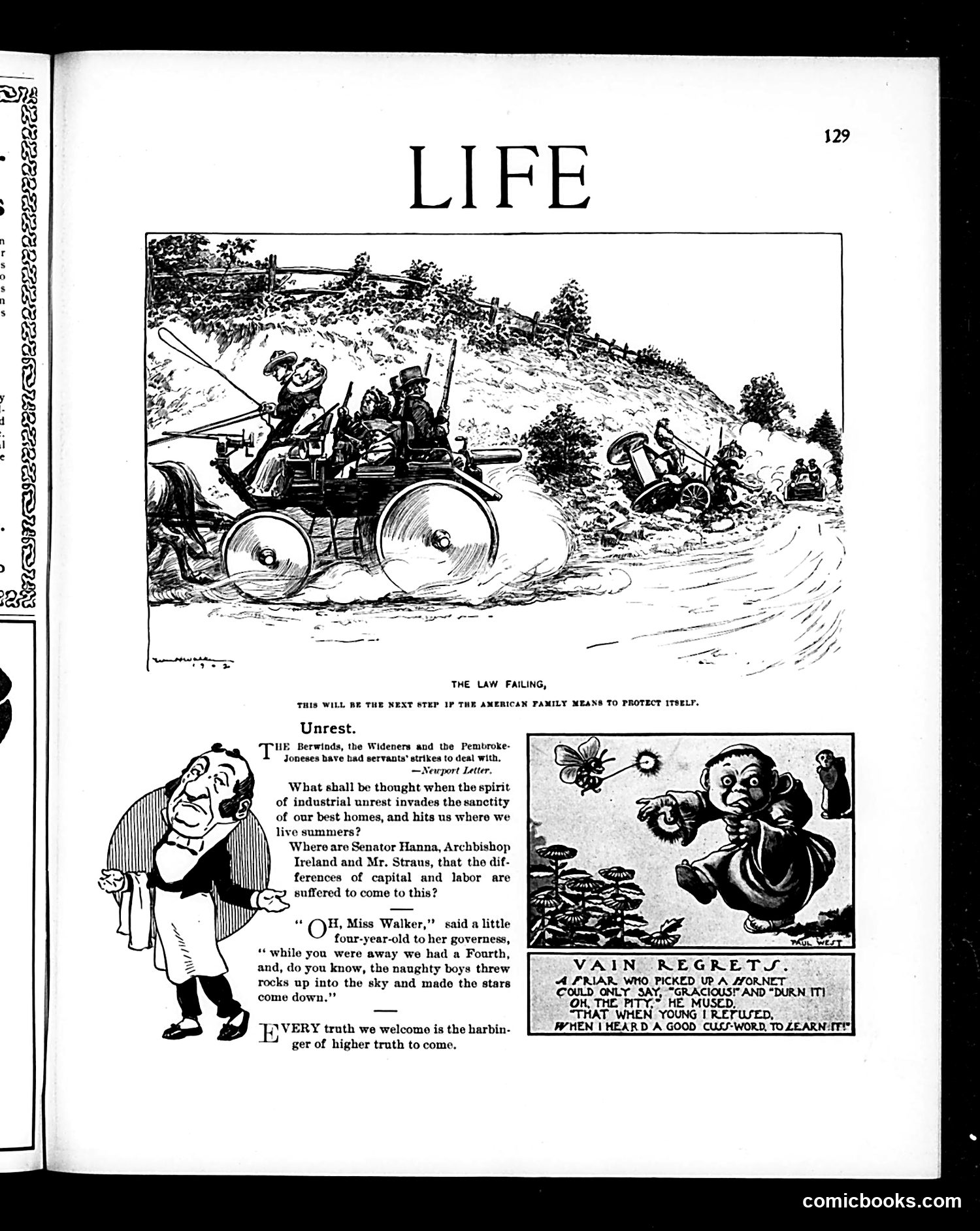
This page critiques labor unrest and industrial violence, likely from the early 1900s. The top illustration depicts armed conflict during a labor dispute, captioned "THE LAW FAILING" with a warning about protecting "the American Family." Below, under "Unrest," a caricatured figure (appearing distressed) references strikes by "Berricks, the Wideners and the Pembroke-Joneses"—likely wealthy industrialists. The text questions where prominent figures like "Senator Hanna, Archbishop Ireland and Mr. Straus" are during this crisis. A dialogue mocks a governess for allowing children mischief while she was absent, using this as an allegory for absent leadership during labor turmoil. The inset cartoon "Vain Regrets" shows someone regretting refusing good advice, reinforcing the page's message about ignoring warnings leading to chaos.
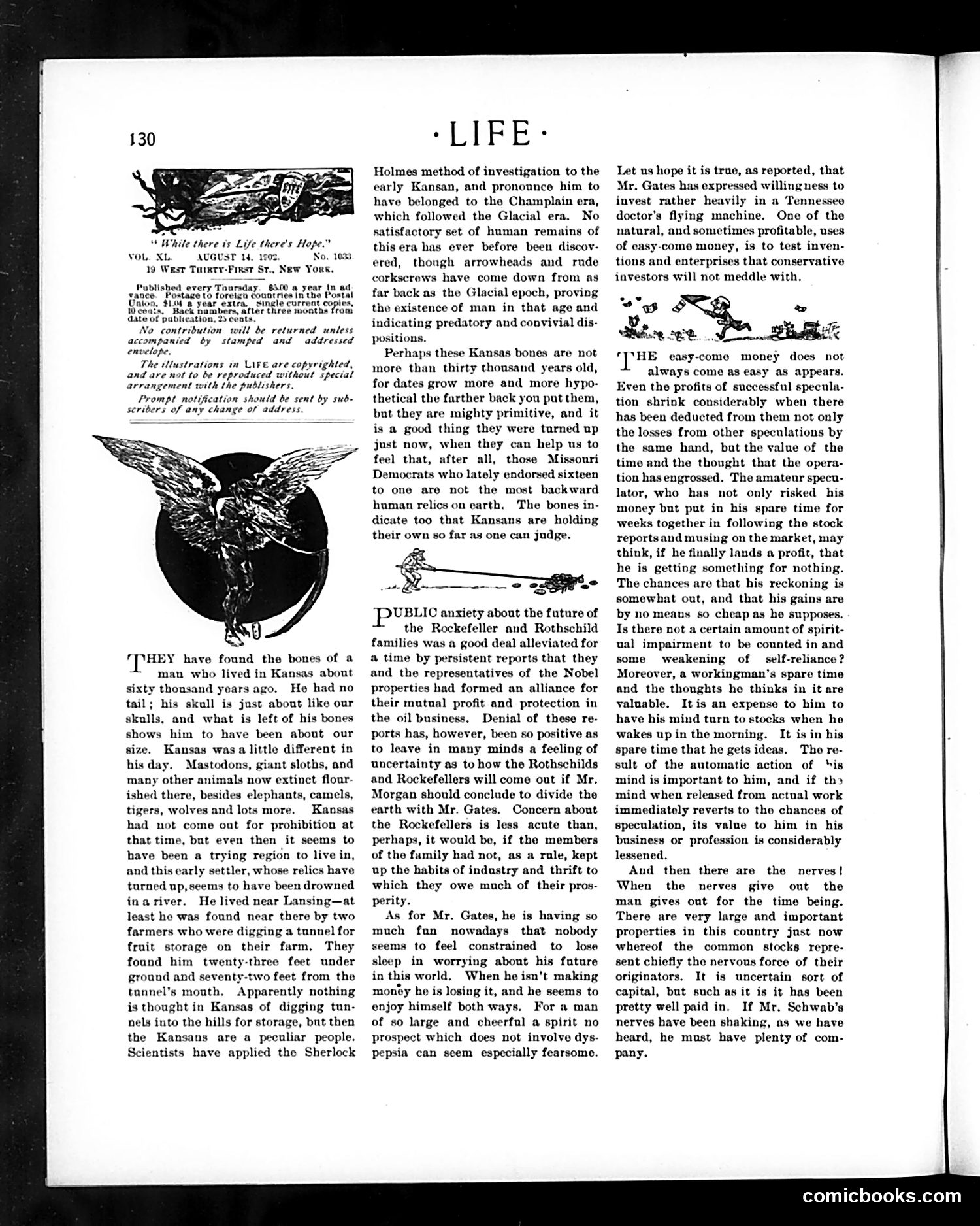
The page contains two distinct editorial cartoons addressing contemporary issues. The **upper cartoon** mocks the discovery of ancient human bones in Kansas. The text discusses whether these 30,000-year-old remains prove early human habitation. The cartoon's point appears satirical about scientific claims regarding prehistoric Kansas life. The **lower cartoon** features an eagle design and addresses the Rockefeller and Rothschild families' business dealings. The text references public anxiety about these wealthy industrialists' financial power and their potential influence over common people's livelihoods. The satirical tone suggests concern about monopolistic wealth concentration and elite families' unchecked economic control during the Gilded Age. Both cartoons reflect Progressive Era anxieties about scientific authority and concentrated wealth.
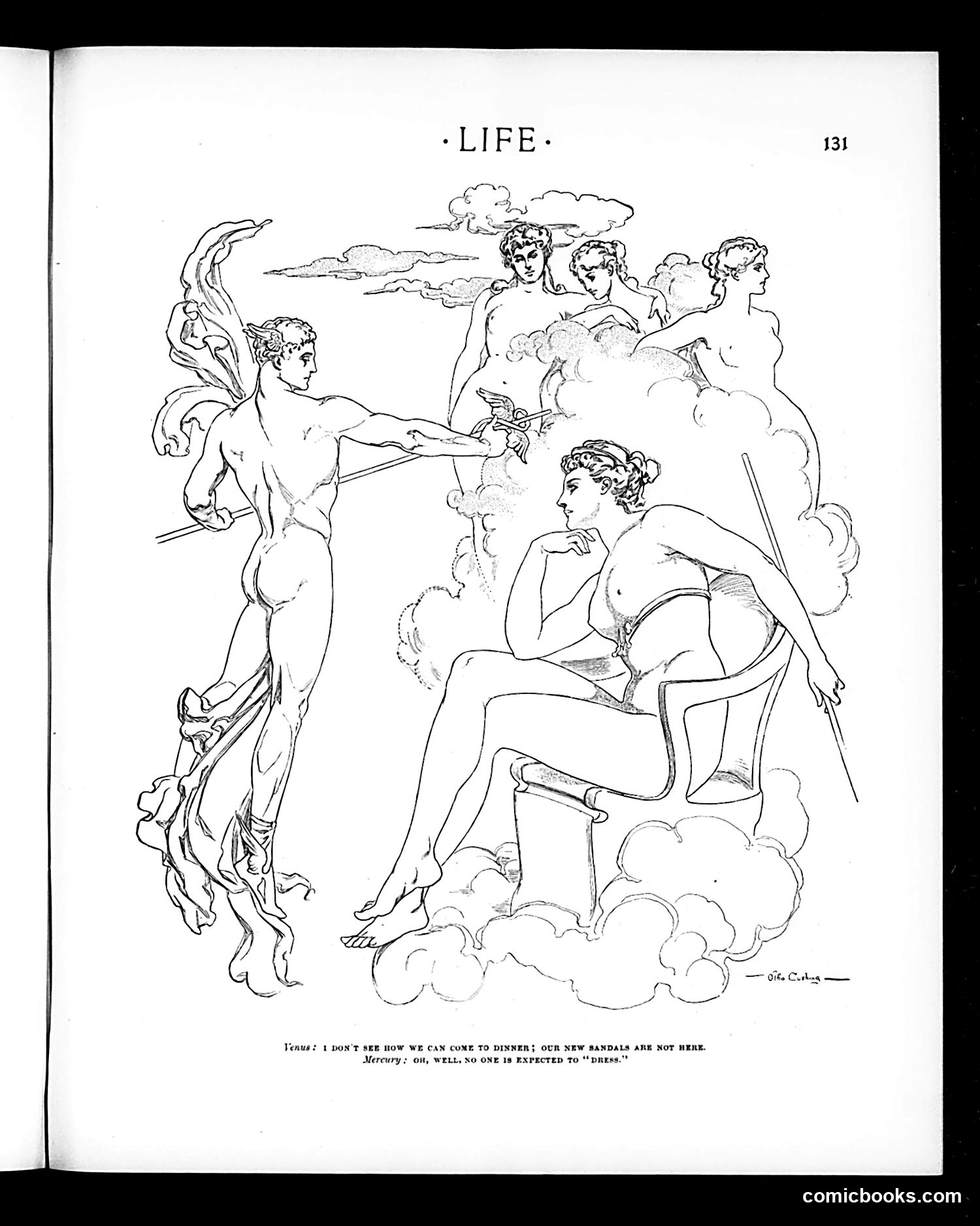
This is a classical mythological scene depicting Venus (the nude figure on the left with flowing drapery) presenting new sandals to Mercury or another figure in a heavenly setting with clouds. The satire plays on fashion and propriety. The caption reads: "I don't see how we can come to dinner; our new sandals are not here" with Mercury's response: "Oh well, no one is expected to 'dress.'" The joke satirizes 1920s social anxieties about proper dress codes and decorum. By placing contemporary fashion concerns (waiting for new sandals to arrive) in a classical mythological context with nude figures, the cartoonist mocks both the obsession with fashionable footwear and the irony of worrying about dress when appearing undressed. The humor derives from this anachronistic collision of modern consumer culture with timeless classical imagery.
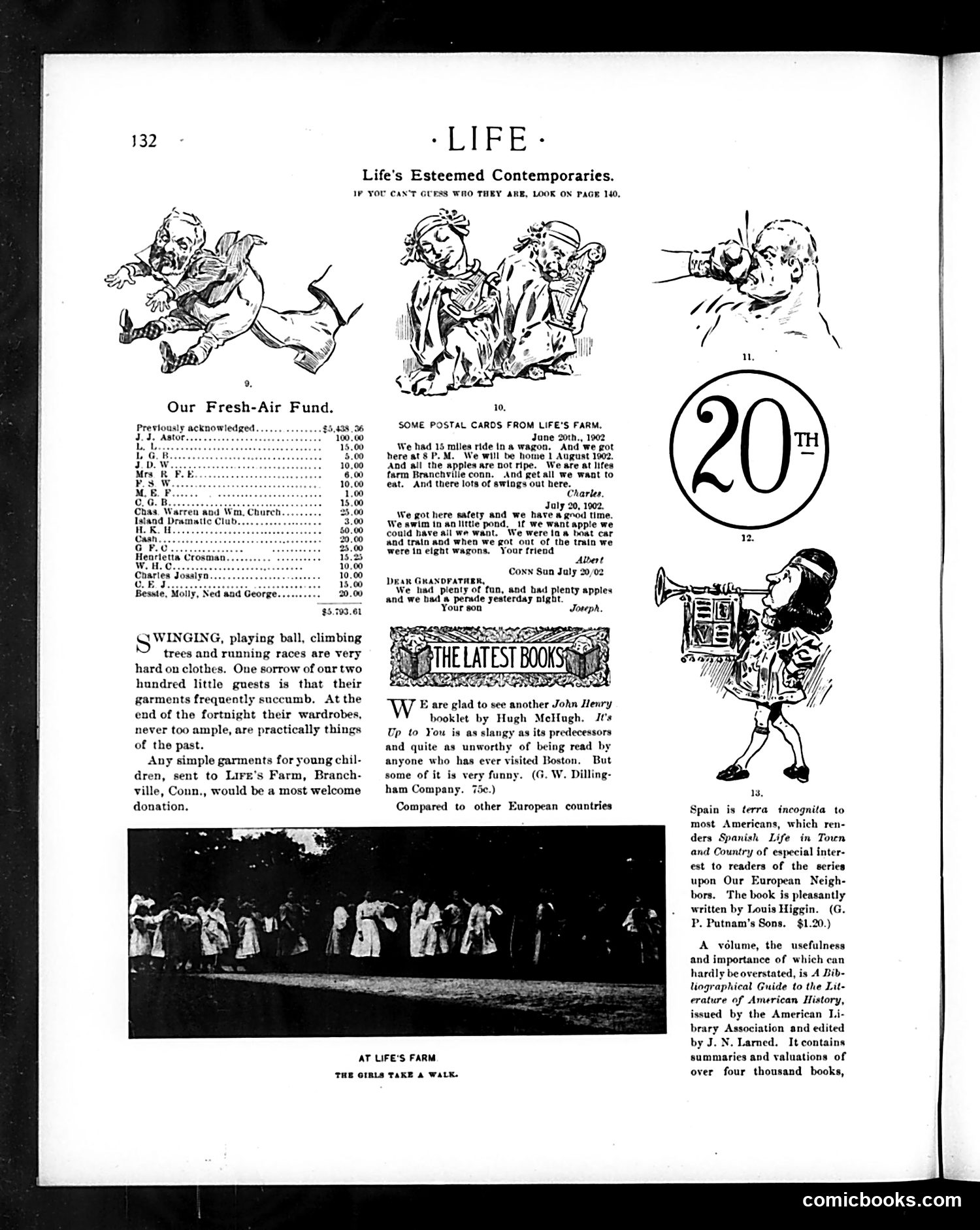
This page combines charitable fundraising with satirical commentary and book reviews. "Our Fresh-Air Fund" lists donors supporting a children's program—a real charitable initiative of the era that sent poor urban children to the countryside for health benefits. The cartoon labeled "Some Postal Cards from Life's Farm" depicts children's summer activities through humorous sketches, reinforcing the fund's wholesome purpose. The bottom photograph shows "The Girls Take a Walk" at Life's Farm, documenting the actual charitable operation. The right column reviews books including a John Henry tale and a work on Spanish life titled *Incognita*. The overall page balances satire (Life's trademark) with genuine philanthropy, reflecting the magazine's dual role as both humorist and social advocate for child welfare during the Progressive Era.
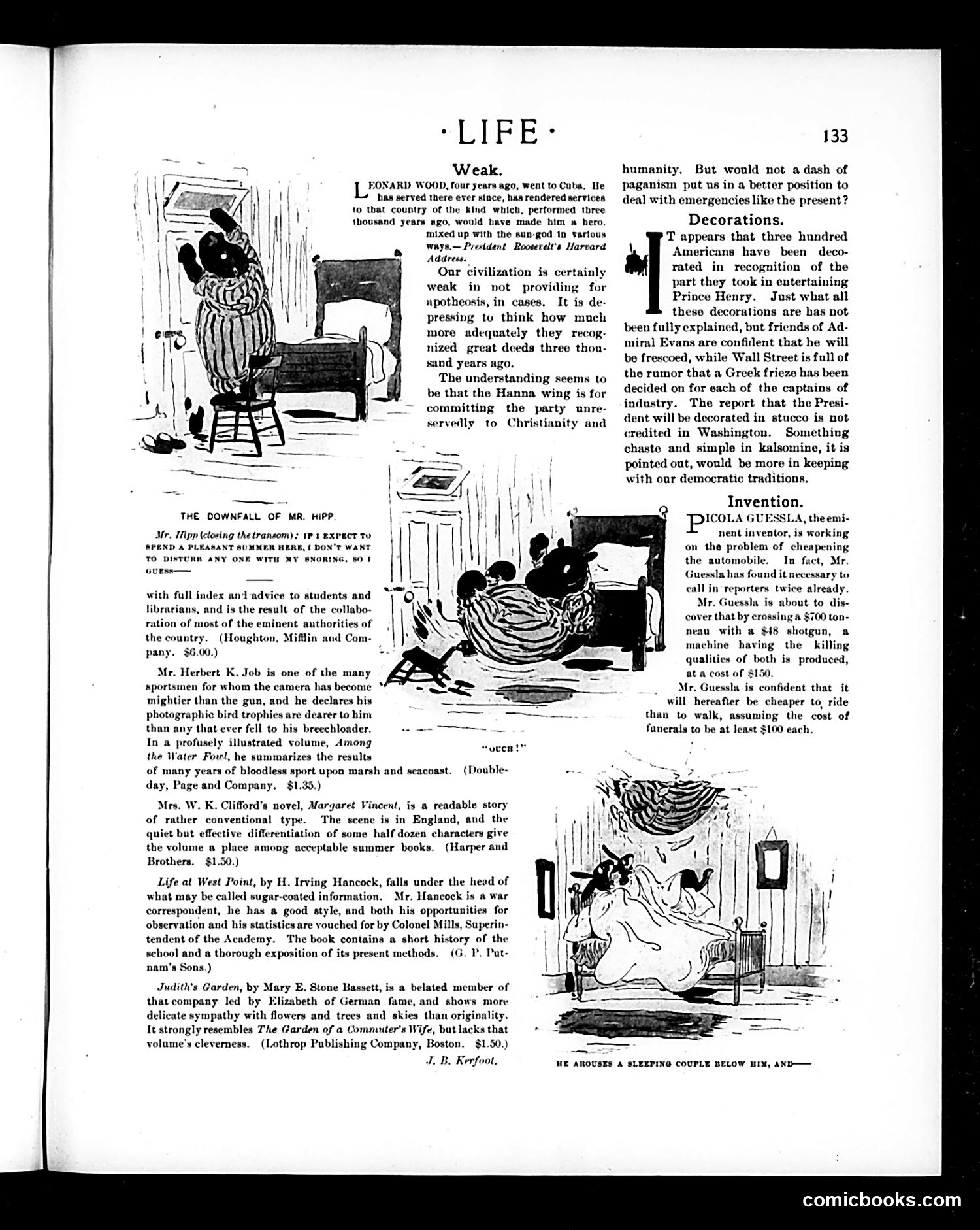
This cartoon satirizes Mr. Hipp (identified in the caption as "belonging the Harrison"), who apparently expected to hire a pleasant servant but instead got one who smokes indoors—a major breach of domestic conduct standards for the era. The humor lies in the servant's casual disregard for employer authority: Hipp sits shocked in a chair while the maid openly flouts his household rules by smoking. The joke targets both changing social dynamics (servants becoming less deferential) and anxieties about domestic order breaking down. The caption's theatrical phrasing ("If I expect to keep a pleasant servant, I must not object to [smoking]") suggests Hipp must accept this indignity or lose household help—reflecting labor shortages or shifting power dynamics in domestic service during this period.
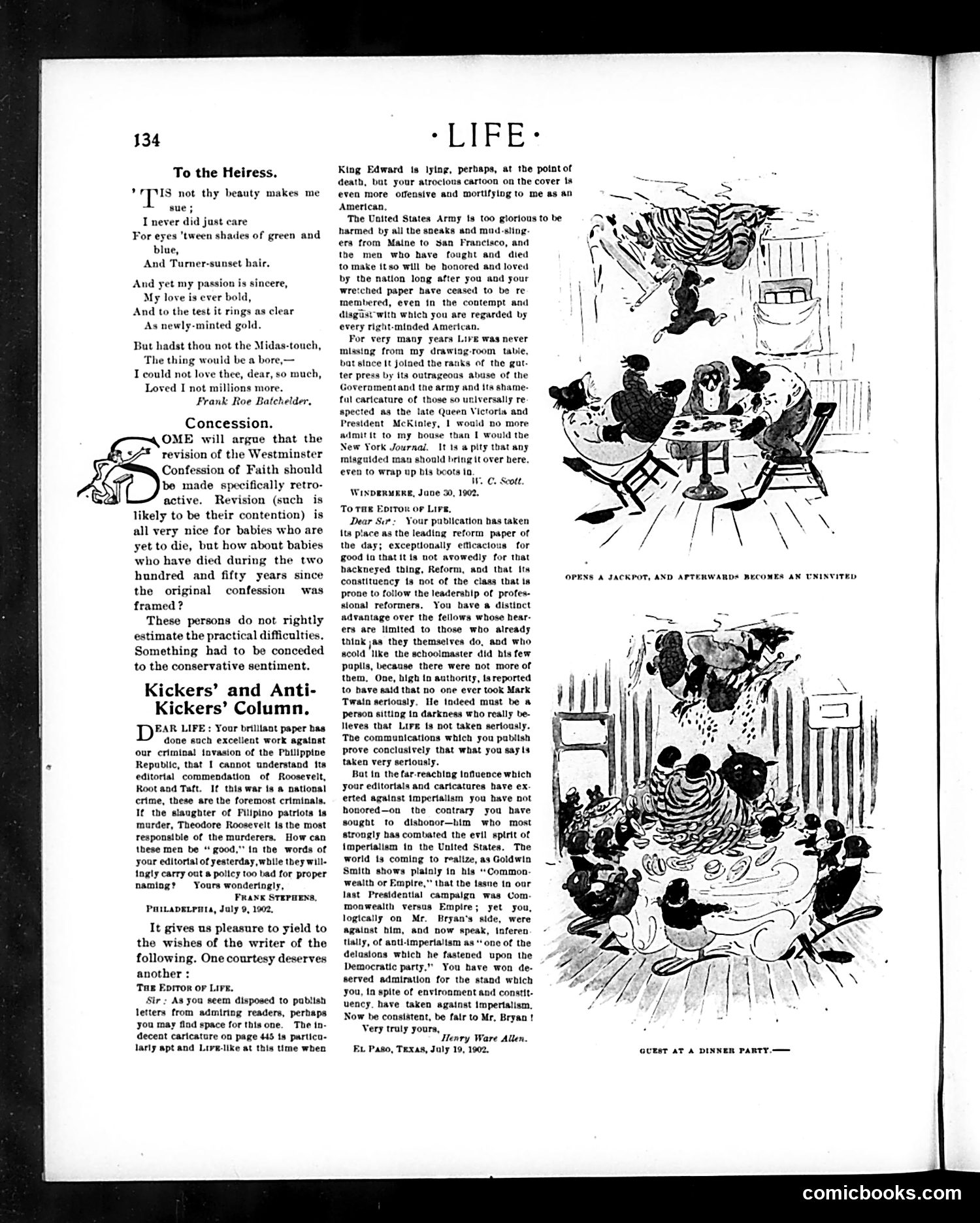
This page contains letters to the editor and two cartoon illustrations satirizing dinner party etiquette and social behavior. The top cartoon depicts a chaotic dinner scene where guests appear to be misbehaving—possibly fighting over food or engaging in rude conduct. The caption reads "OPENS A JACKPOT, AND AFTERWARDS BECOMES AN UNINVITED GUEST," suggesting someone's poor manners at a social gathering results in social ostracism. The bottom illustration, titled "GUEST AT A DINNER PARTY," shows similar dining discord with exaggerated physical comedy. These cartoons likely satirize nouveau riche or socially awkward guests violating Victorian-era etiquette standards—a recurring theme in Life's humor. The letters discuss political topics including imperialism and American military conduct, suggesting the magazine addressed both social propriety and serious political issues during this early 1900s period.
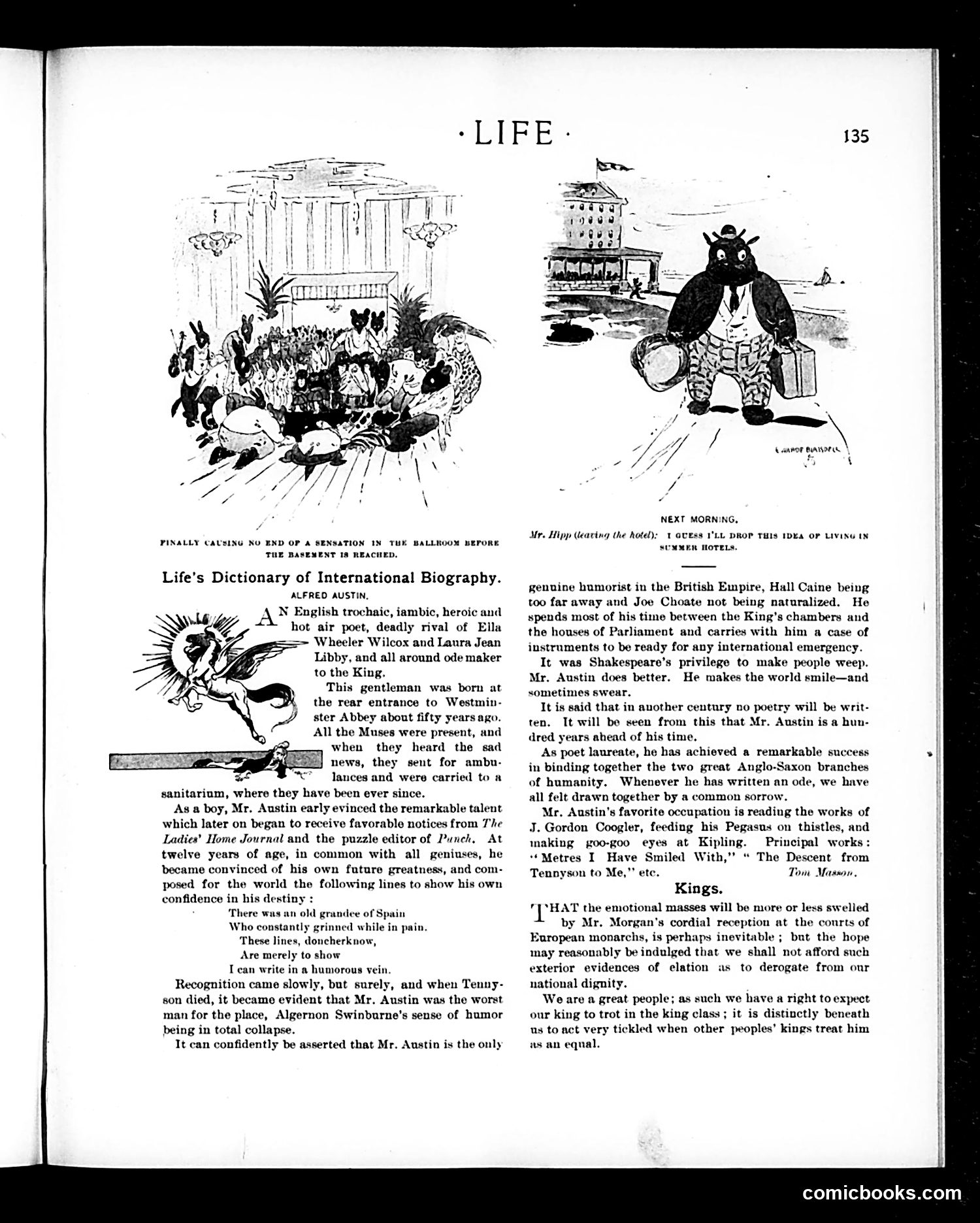
This page contains two cartoons and a biographical entry about poet Alfred Austin. **Top cartoons:** The left shows a crowded balloon basket ascending ("Finally causing no end of a sensation in the Balloon before the Basket is reached"). The right depicts an owl-like creature arriving at a seaside hotel, captioned "Next Morning," with the owl saying he'll abandon this summer hotel idea. **The biography section** introduces Alfred Austin, described as a "prickly" poet and rival to other writers. The text notes his work as a puzzle editor and emphasizes his sense of humor, claiming he's "the only genuine humorist in the British Empire" — clearly ironic praise. The satire suggests Austin was pretentious yet genuinely amusing despite himself. The "Kings" section appears unrelated commentary on monarchical dignity.
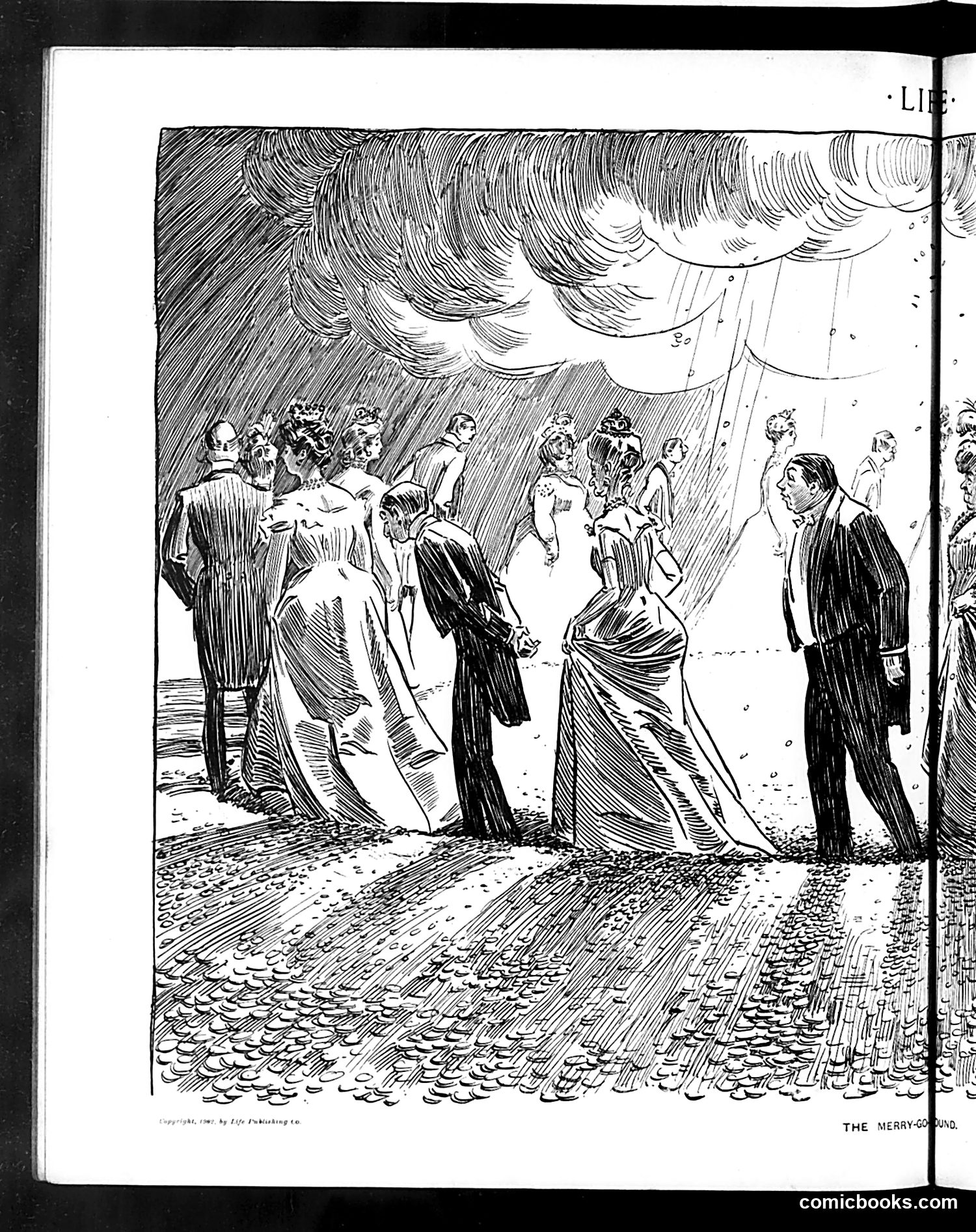
This satirical illustration depicts well-dressed men and women at what appears to be a high-society event or ball, with elaborate drapery overhead. The title "The Merry-Go-Round" suggests circular, repetitive behavior. The cartoon likely critiques the social elite's endless cycle of parties, socializing, and leisure activities—depicting them as going around in circles without meaningful purpose or progress. The formal attire and crowded, somewhat chaotic gathering emphasize the superficiality of upper-class social life. The detailed crosshatching and period clothing suggest this is from the late 19th or early 20th century, when *Life* magazine frequently lampooned wealthy society's frivolous pastimes and disconnect from broader social concerns.
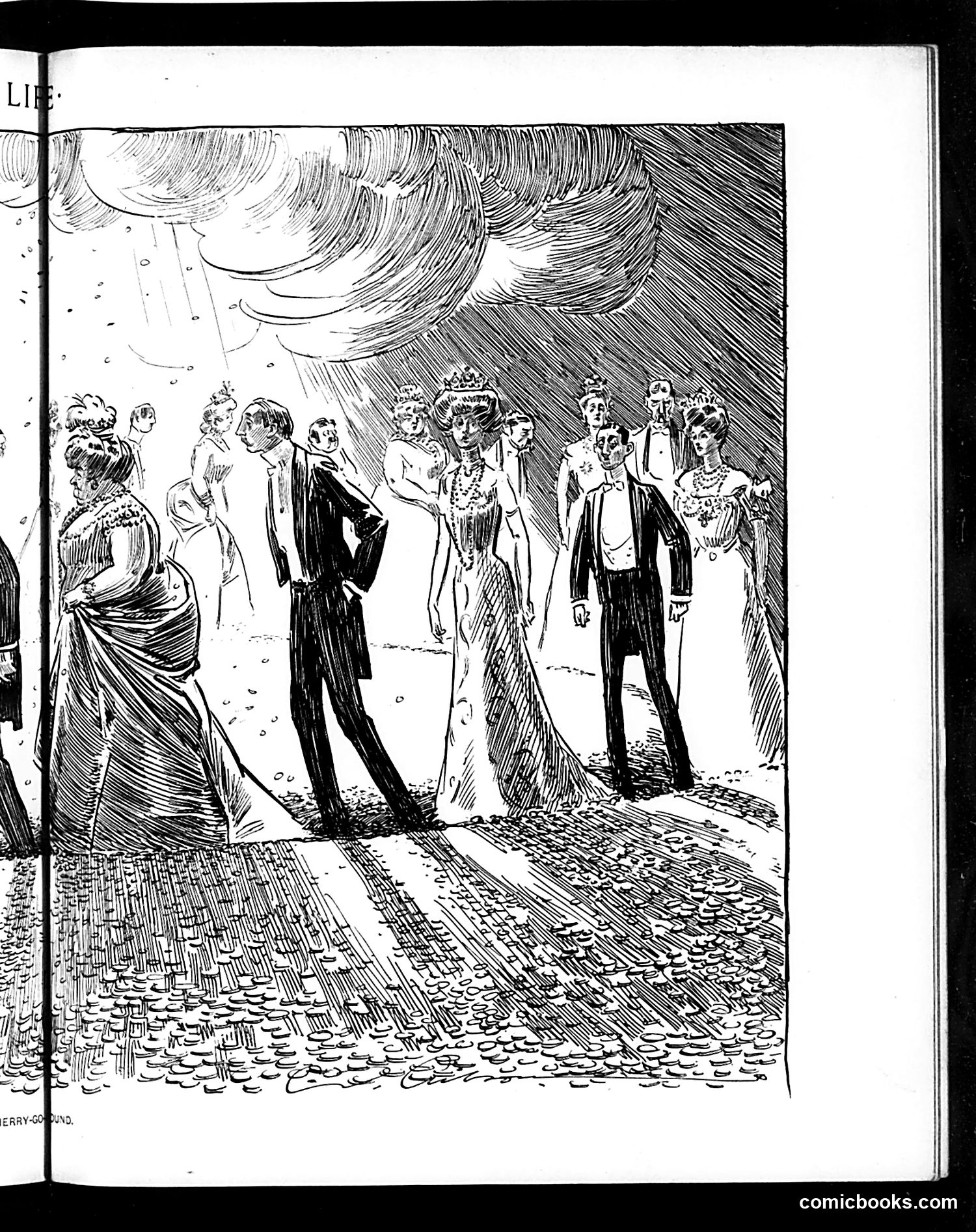
This is a formal royal or diplomatic reception scene rendered in ink. The illustration shows elegantly dressed figures in formal evening wear—men in tuxedos and women in gowns—gathered under elaborate draped ceiling decorations. The scene appears to satirize high society formality and pretense. The exaggerated architectural details and the stiff, posed positioning of the guests suggest mockery of the rigid conventions of aristocratic or elite social gatherings. The ornate drapery above dominates the composition, emphasizing the elaborate staging. Without visible text identifying specific individuals or the publication date, I cannot determine which particular royal event, diplomatic function, or social figures are being lampooned. The satire targets the general pomposity and artificiality of formal high-society occasions rather than specific contemporary political figures or events.
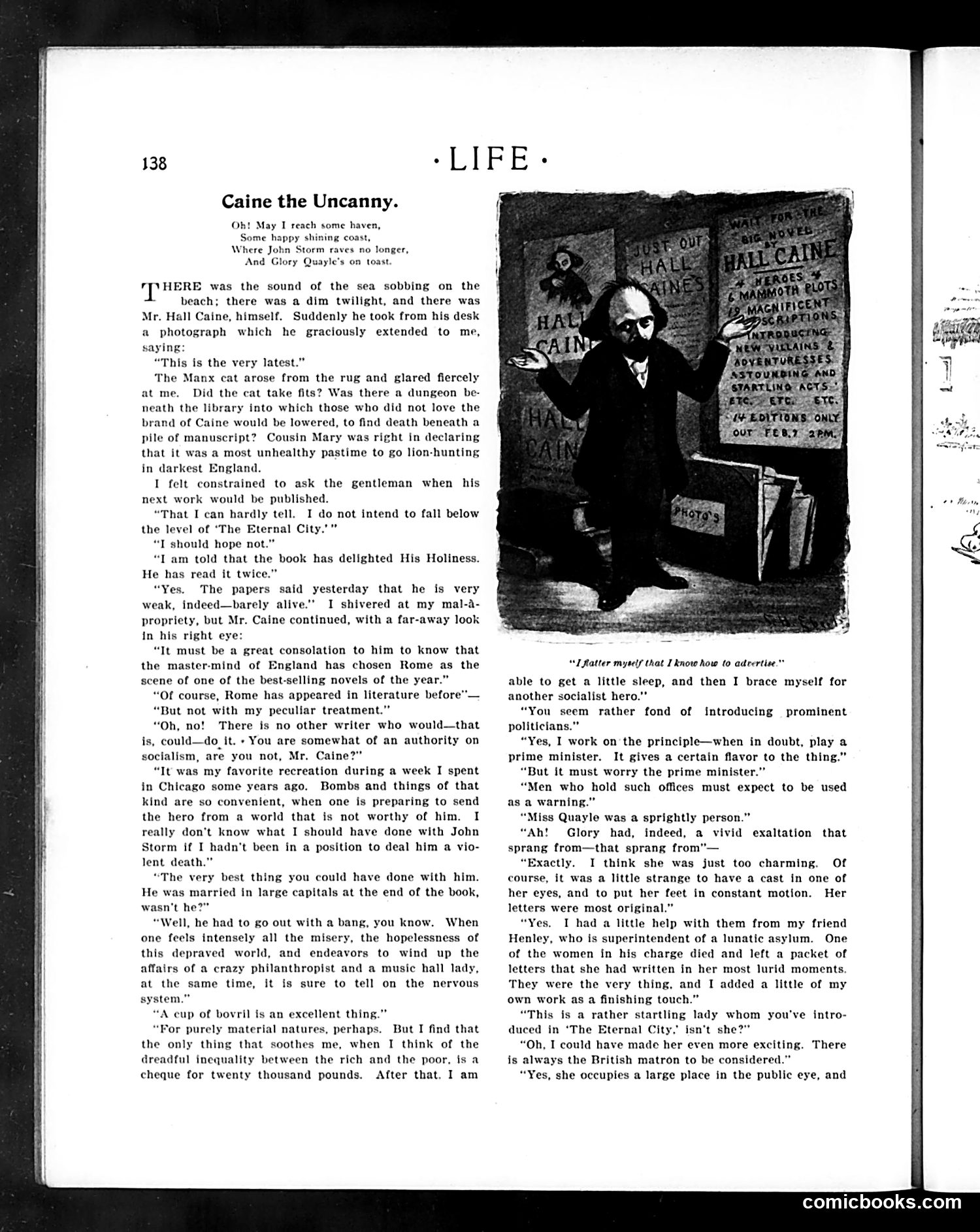
This page features a satirical interview about **Hall Caine**, a popular British novelist. The photograph shows Caine posing dramatically with theatrical posters advertising his works behind him. The satire mocks Caine's literary pretensions and commercial success. The interviewer notes that Caine's work appears in "large capitals at the end of the book," suggesting self-aggrandizement. The text jokes about Caine's serious demeanor ("far-away look in his right eye") while discussing his novels' popularity and his association with prominent politicians. The overall tone ridicules both Caine's earnest artistic aspirations and the British public's appetite for his melodramatic fiction—portraying him as a calculating entertainer rather than serious artist.
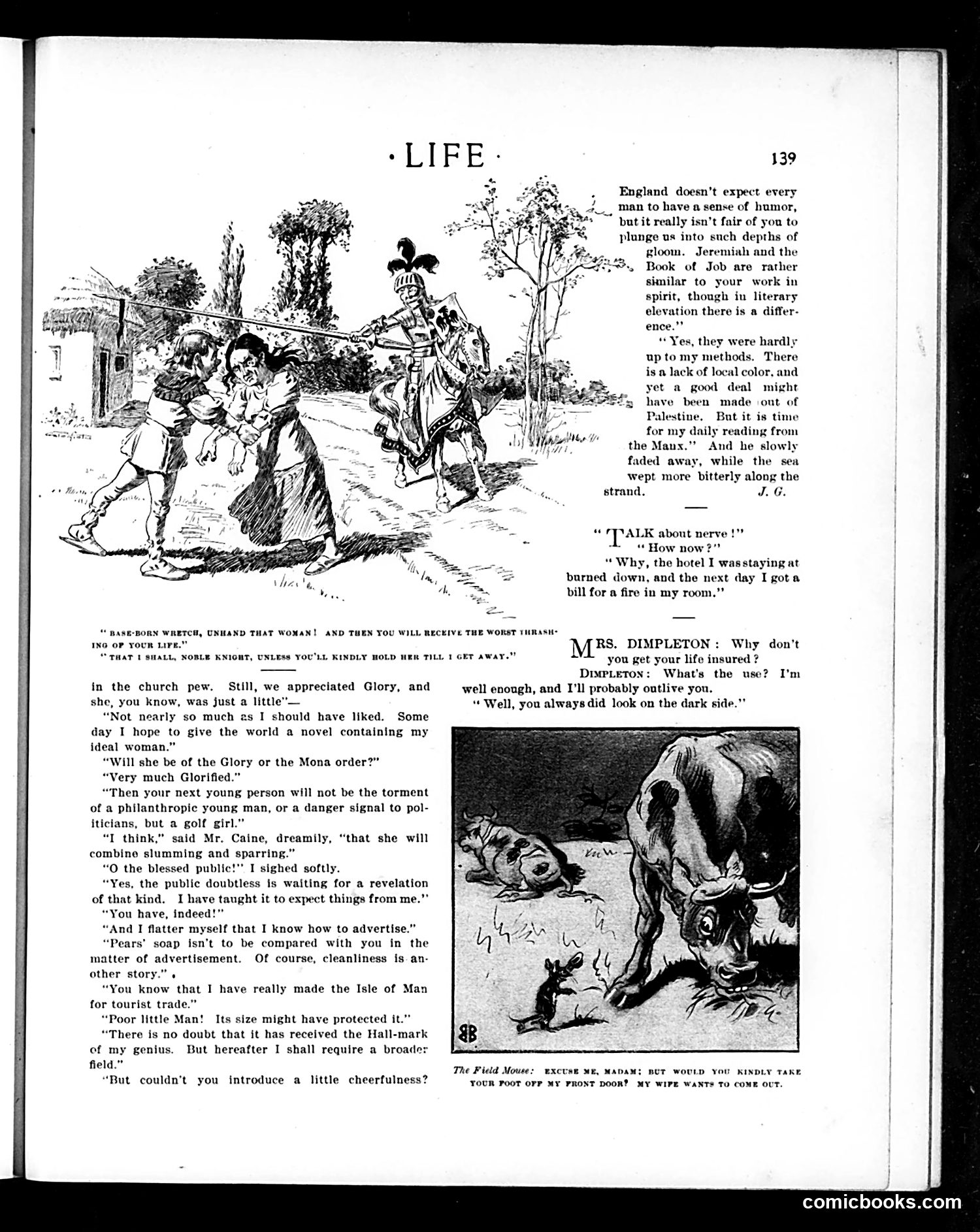
This page contains three distinct satirical pieces: **Top cartoon**: A melodramatic scene mocking overwrought Victorian fiction—a damsel-in-distress scenario with exaggerated dialogue ("Base-born wretch, unhand that woman!") that parodies cheap serial literature and stage plays. **Middle dialogue**: A conversation between Mr. Caine (likely Hall Caine, a popular novelist of the era) and an interviewer. The satire targets Caine's reputation for gloom and self-importance. He's mocked for his pessimistic writing style ("Jeremiah and the Book of Job"), pretentious self-regard about advertising his own genius, and grandiose claims about creating tourist demand for the Isle of Man. **Bottom cartoon**: A field mouse interrupting a marital dispute, requesting the wife move her foot from the mouse's front door so his wife can exit. Dark humor satirizing human selfishness and domestic conflict through animal perspective. **Humor theme**: The page ridicules Victorian melodrama, literary pretension, and pessimism, while finding dark comedy in everyday life's small indignities.
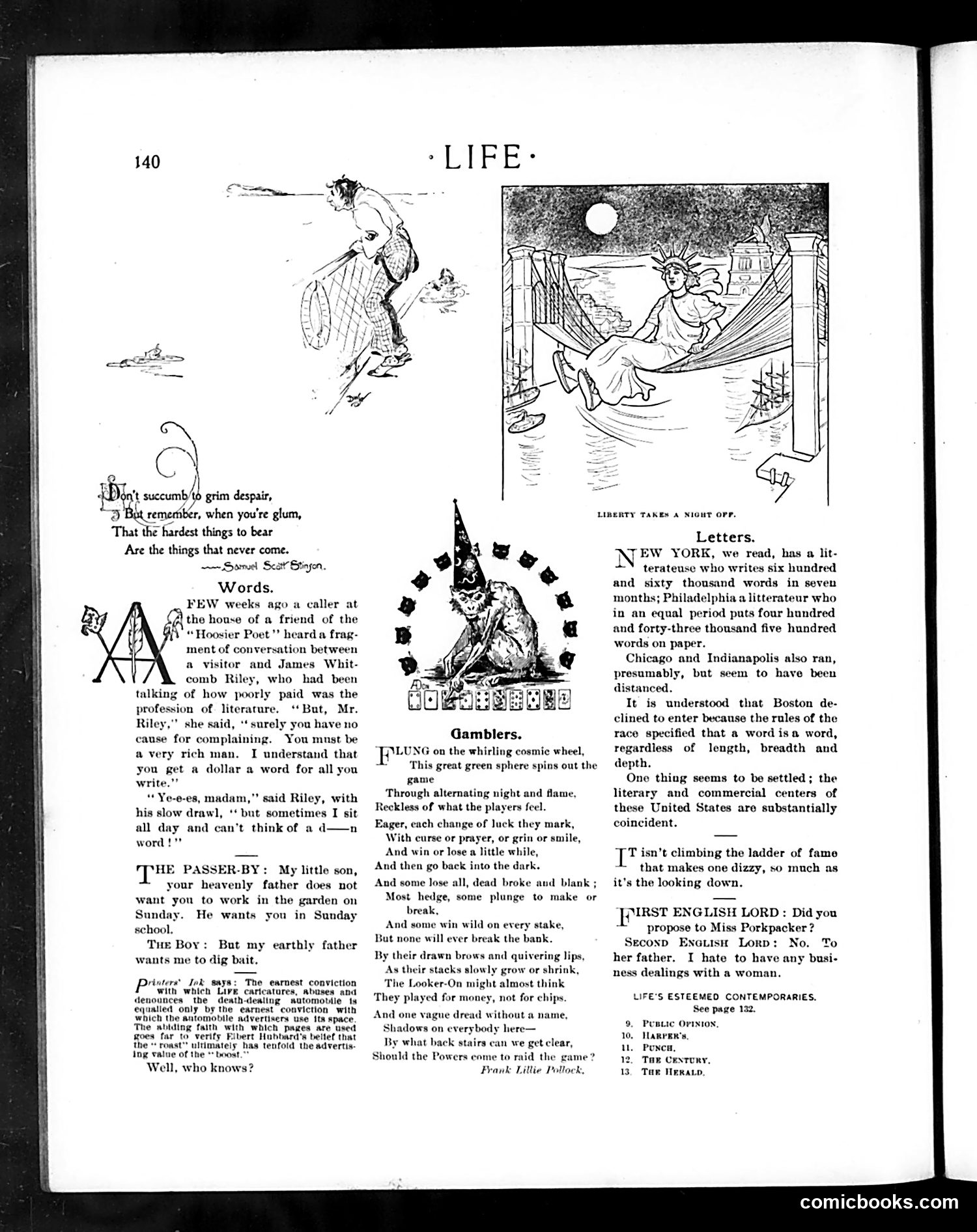
This page contains several satirical pieces targeting early 20th-century American culture: **"Words"** mocks the literary profession through James Whitcomb Riley (the "Hoosier Poet"), a real, famous writer. The joke: despite earning "$1 per word," Riley claims he often sits unable to think of anything—so his actual income is negligible. It's satire about artistic struggle versus public perception of writers' wealth. **"Gamblers"** is a serious poem about compulsive gambling and vice, with undertones of anxiety about police raids on illegal gaming establishments ("Should the Powers come to raid the game?"). **"Letters"** satirizes a productivity race between cities' writers, with New York and Philadelphia competing over word output. Boston supposedly refused to participate because the rules specify "a word is a word" (implying Boston considers itself above such commercial measurement). The joke critiques the commercialization of literature. **Other brief jokes** mock religious hypocrisy, the automobile industry's advertising contradictions, and British aristocratic attitudes toward business. The overall tone: skepticism toward American commercialism, literary pretension, and vice.
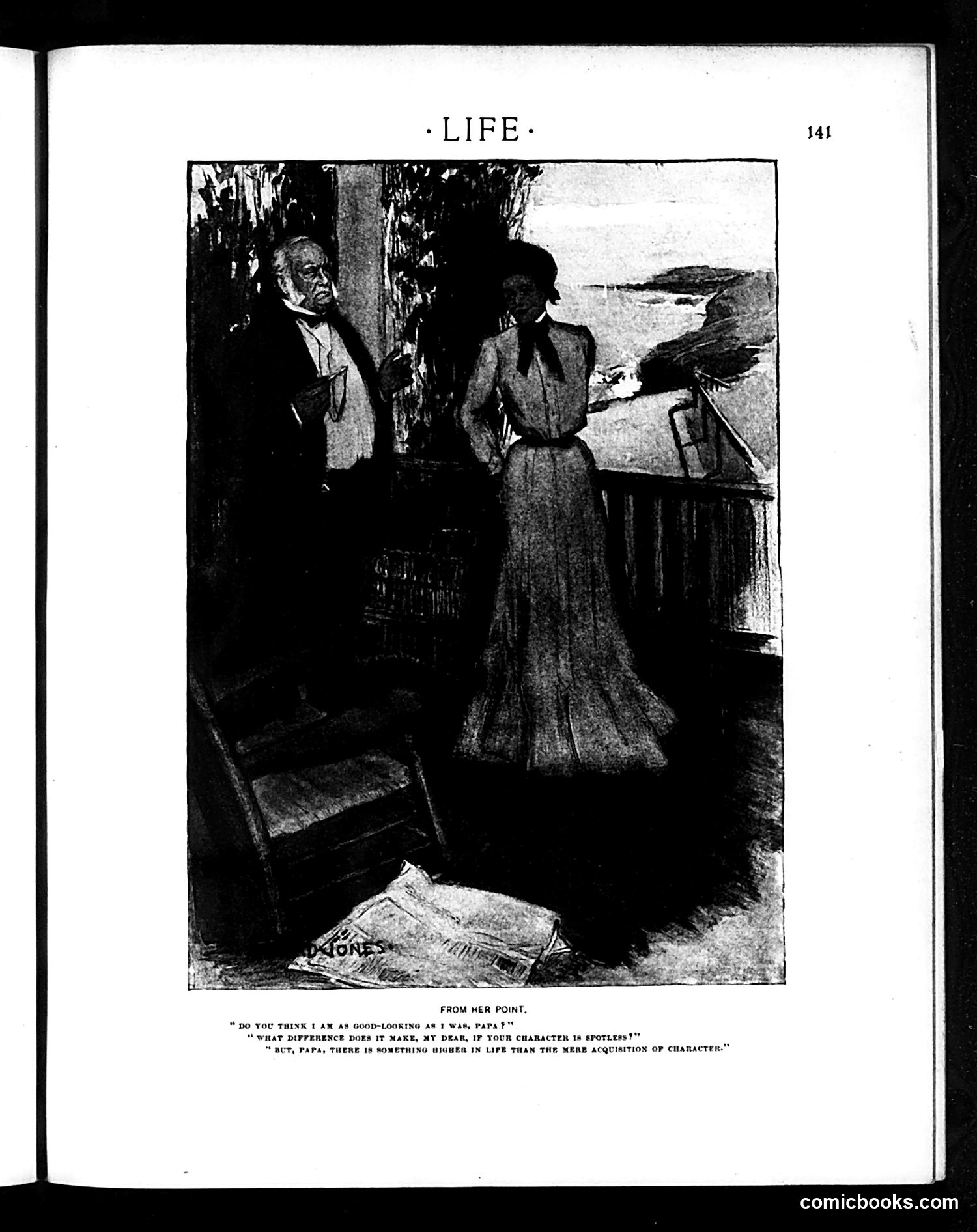
This satirical cartoon depicts a generational disagreement between a father and daughter. The father espouses a Victorian moral philosophy: physical appearance is irrelevant if one possesses spotless character. The daughter counters that life offers something "higher" than mere character acquisition—implying that personal vanity, beauty, or self-fulfillment matter too. The satire mocks stern paternal moralizing by having the daughter challenge the era's rigid emphasis on virtue over aesthetics. She's suggesting that life's meaning extends beyond the older generation's puritanical focus on character alone. The coastal setting and period dress suggest early 20th-century America, when such generational tensions between traditional morality and modern sensibilities were common social commentary in satirical magazines like *Life*.
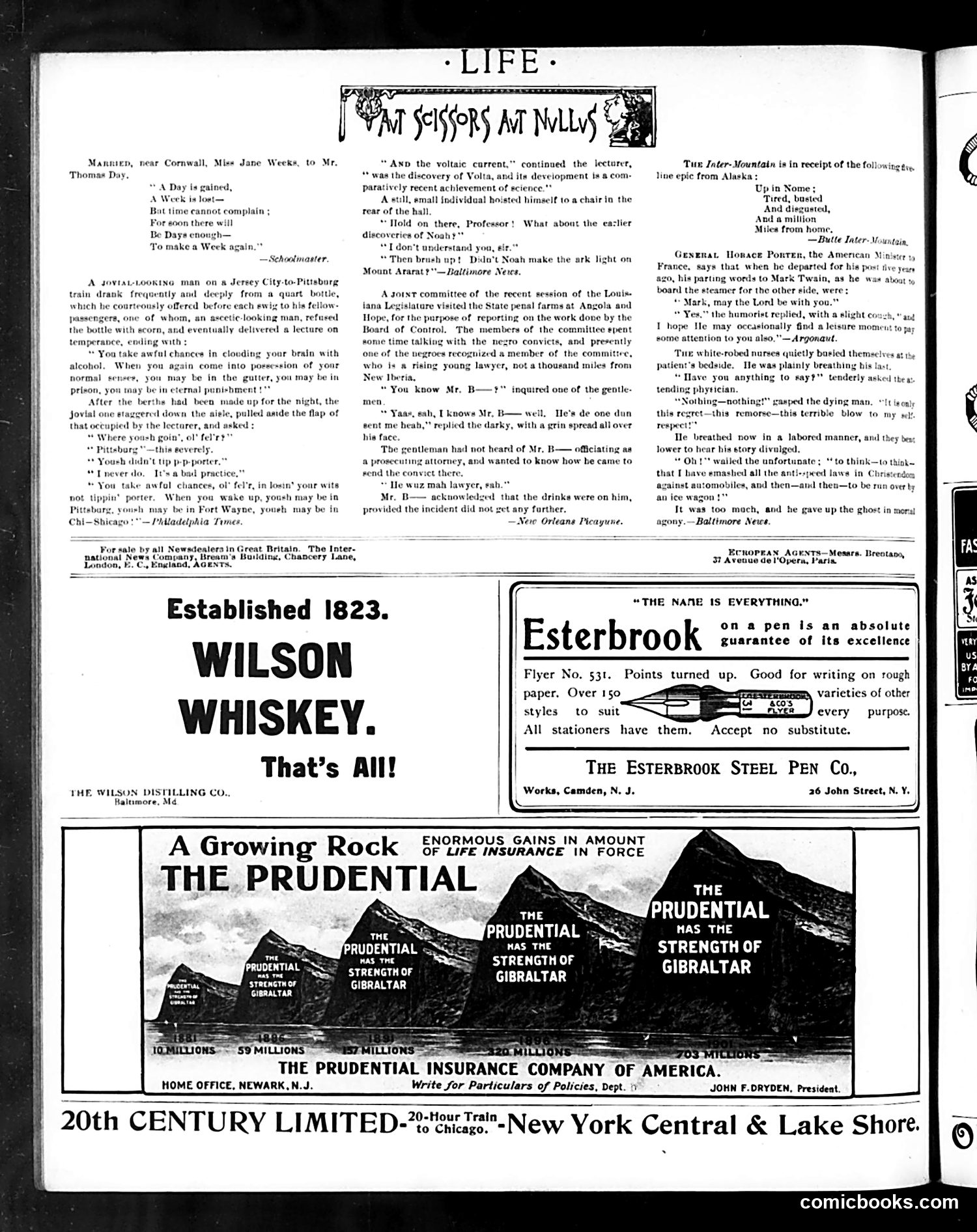
This page from *Life* magazine contains satirical anecdotes and period advertisements rather than political cartoons. The humor relies on contemporary social anxieties: a temperance lecture interrupted by a drunk passenger; a Louisiana penitentiary official ironically failing to recognize a rising young lawyer (Mr. B—) among convicts; and a dying man's final regret being traffic violations rather than moral failings—mocking both automotive-age anxieties and criminal justice. The advertisements reflect early 20th-century products: Wilson Whiskey (ironic placement opposite temperance humor), Esterbrook steel pens, The Prudential Insurance Company (using Gibraltar imagery to suggest strength), and the 20th Century Limited train service. The page offers snapshots of period preoccupations—drinking culture, racial attitudes in the segregated South, emerging automobile dangers, and insurance marketing—without explicit political commentary. The satire is largely domestic and social rather than political.
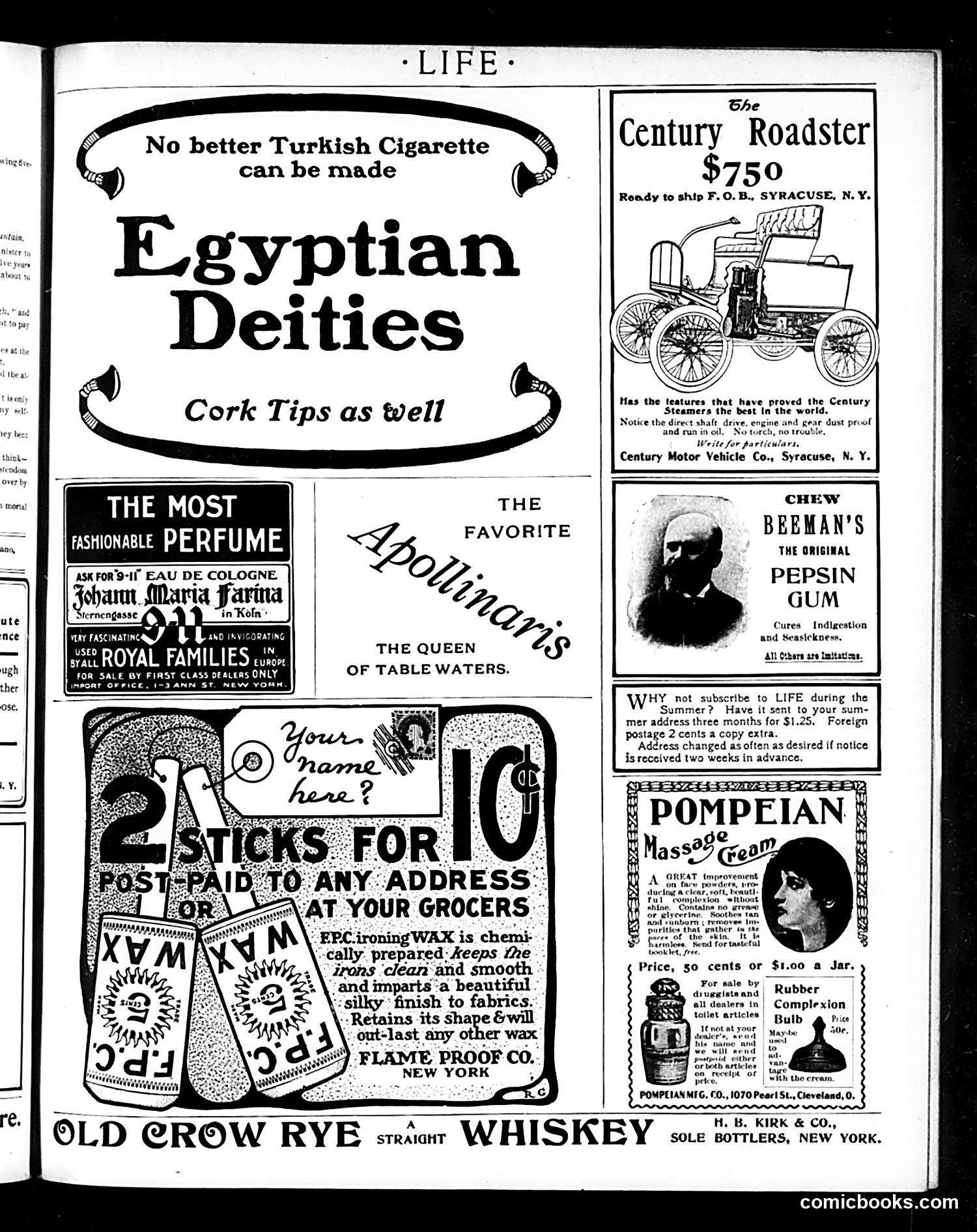
This is primarily an **advertising page** rather than satirical content. It features period product advertisements typical of early 20th-century American magazines. Notable items include: **Egyptian Deities cigarettes**—a Turkish tobacco brand claiming superiority, using an Orientalist marketing approach common to the era. **Century Roadster automobile** ($750)—an early motorcar advertised as ready to ship from Syracuse, N.Y. **Johann Maria Farina perfume**—marketed as "the most fashionable perfume" used by "royal families." **Apollinaris water**—labeled "the queen of table waters." **XVM ironing wax**—a fabric treatment product. **Berman's Pepsin Gum** and **Pompeian Massage Cream**—over-the-counter remedies for common complaints (indigestion, skin care). **Old Crow Rye Whiskey**—straight liquor advertised without restriction (pre-Prohibition). The page reflects early 1900s consumer culture, with emphasis on imported/exotic goods and dubious health claims typical of the pre-FDA regulation era.
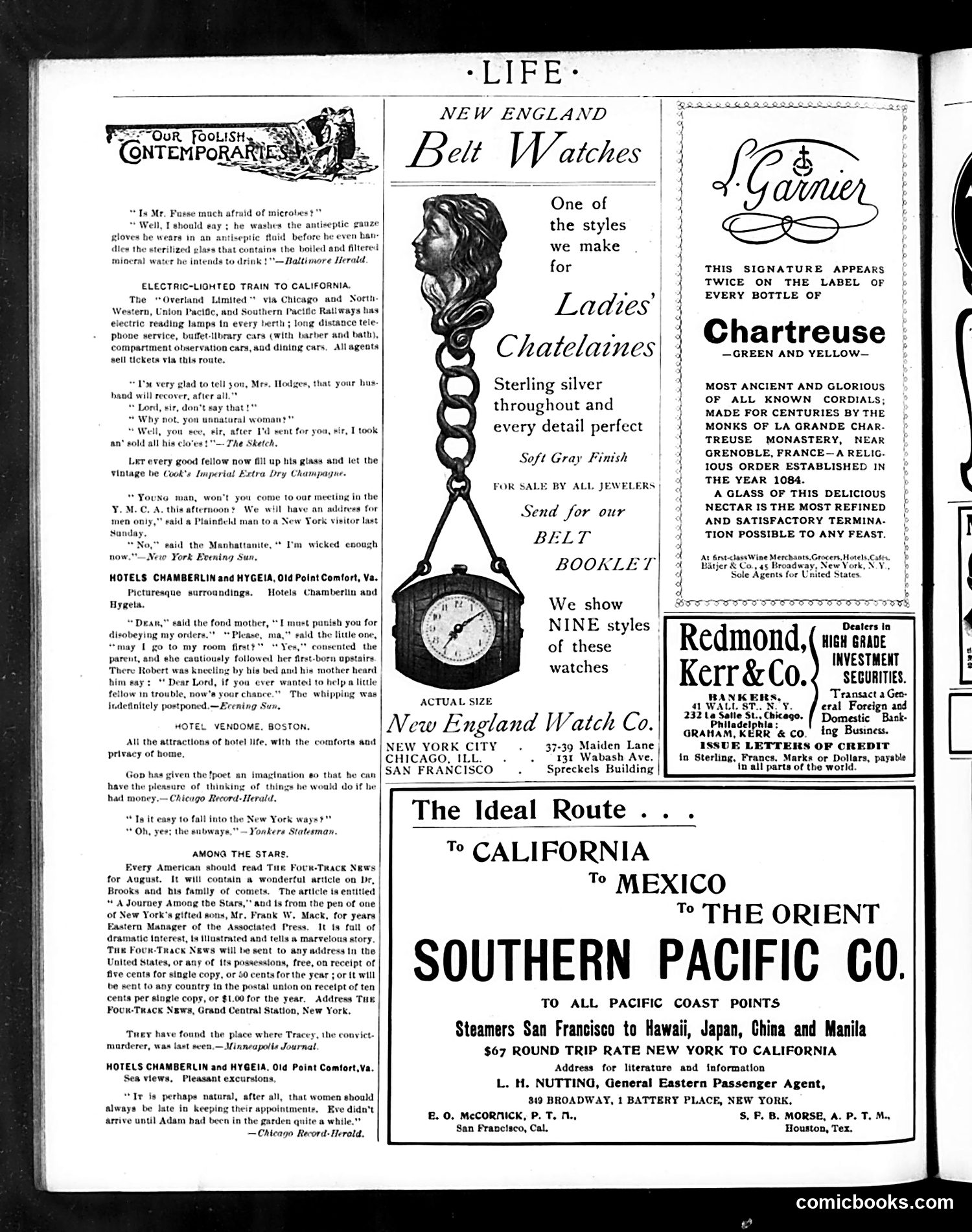
This page is primarily **advertising**, not political satire. The dominant content includes: **Main Advertisements:** - **New England Belt Watches** for ladies: features an ornate pocket watch on a decorative chain, emphasizing sterling silver construction - **L. Garnier Chartreuse liqueur**: highlights its medieval monastic origins (established 1084), marketing refined taste - **Southern Pacific Co.**: promotes steamship routes to California, Mexico, and the Orient - **Redmond, Kerr & Co.**: banking and securities firm **"Our Foolish Contemporaries" Section** (upper left): Contains brief satirical quotations mocking social behaviors—someone worried about microbes in drinking water, marriage miscommunications, and a child's prayer before punishment. These are gentle, domestic humor rather than political commentary. The page reflects **Gilded Age consumer culture**, targeting affluent readers with luxury goods, travel, and financial services. No specific political figures or events are referenced—the humor is purely social observation about everyday life.
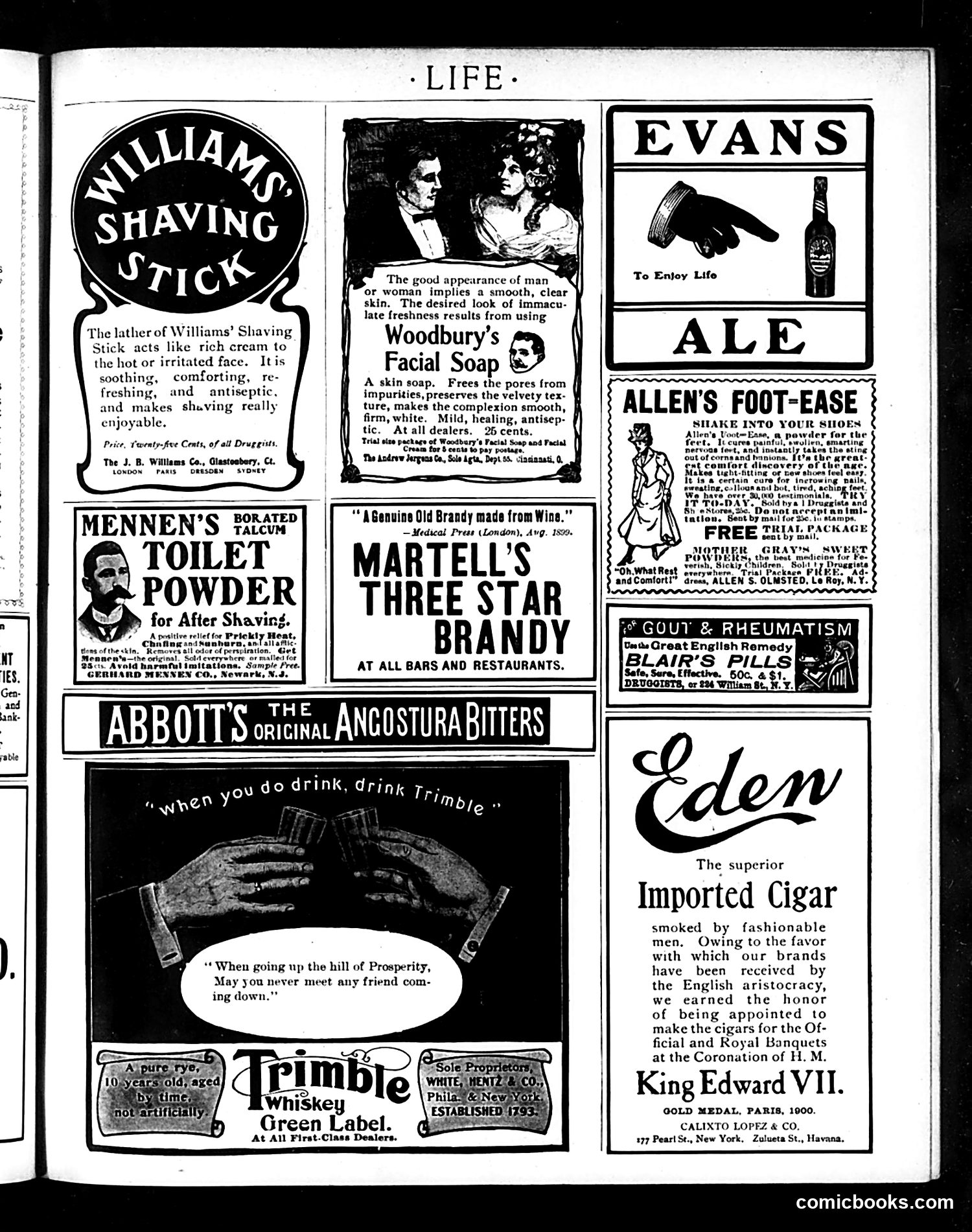
This is primarily an **advertising page**, not a satirical cartoon. It showcases various personal care and luxury products from the early 1900s, reflecting period consumer culture. Notable advertisements include: - **Williams' Shaving Stick** and **Mennen's Toilet Powder** — grooming products emphasizing comfort and antiseptic properties - **Woodbury's Facial Soap** — promoting smooth, clear skin as a marker of respectability - **Trimble Whiskey** — featuring toasting imagery about prosperity - **Martell's Three Star Brandy** and **Evans Ale** — alcoholic beverages - **Allen's Foot-Ease** — a remedy for foot ailments - **Eden Imported Cigar** — luxury goods marketed via royal patronage, claiming appointment to King Edward VII's coronation banquets The page reflects early 1900s consumer values: personal grooming as social necessity, patent medicines as cure-alls, and luxury goods (spirits, cigars) as status markers. No political satire is evident—this represents straightforward period advertising.
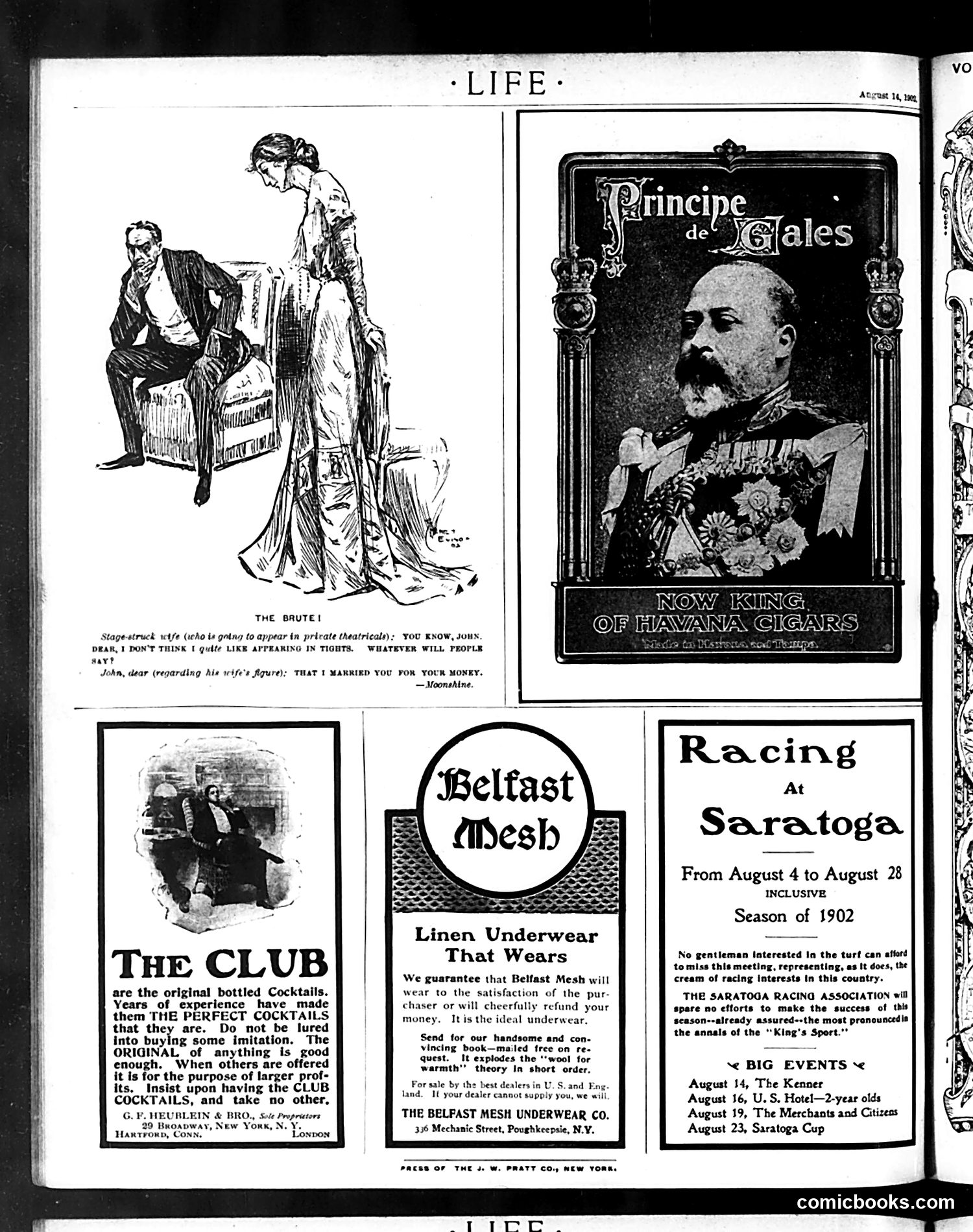
This is a marital satire common to early 1900s humor. A stage-struck wife nervously tells her husband she's uncomfortable appearing in theatrical tights, worrying what people will say about her appearance. The husband's cruel response—that he married her purely for her money, not her looks—is meant to be brutish and darkly comic. The joke relies on contemporary assumptions: wives seeking attention through amateur theatricals were often mocked as vain or frivolous, while husbands' mercenary motivations in marriage were treated as cynical humor. The cartoon satirizes both marital discord and the vanity of society women pursuing private theatrical performances. The page is otherwise devoted to period advertisements (cocktails, underwear, horse racing at Saratoga), typical of Life magazine's revenue model.