
Life, 1902-08-14 · page 4 of 20
Life — August 14, 1902 — page 4: what you’re looking at
What you’re looking at
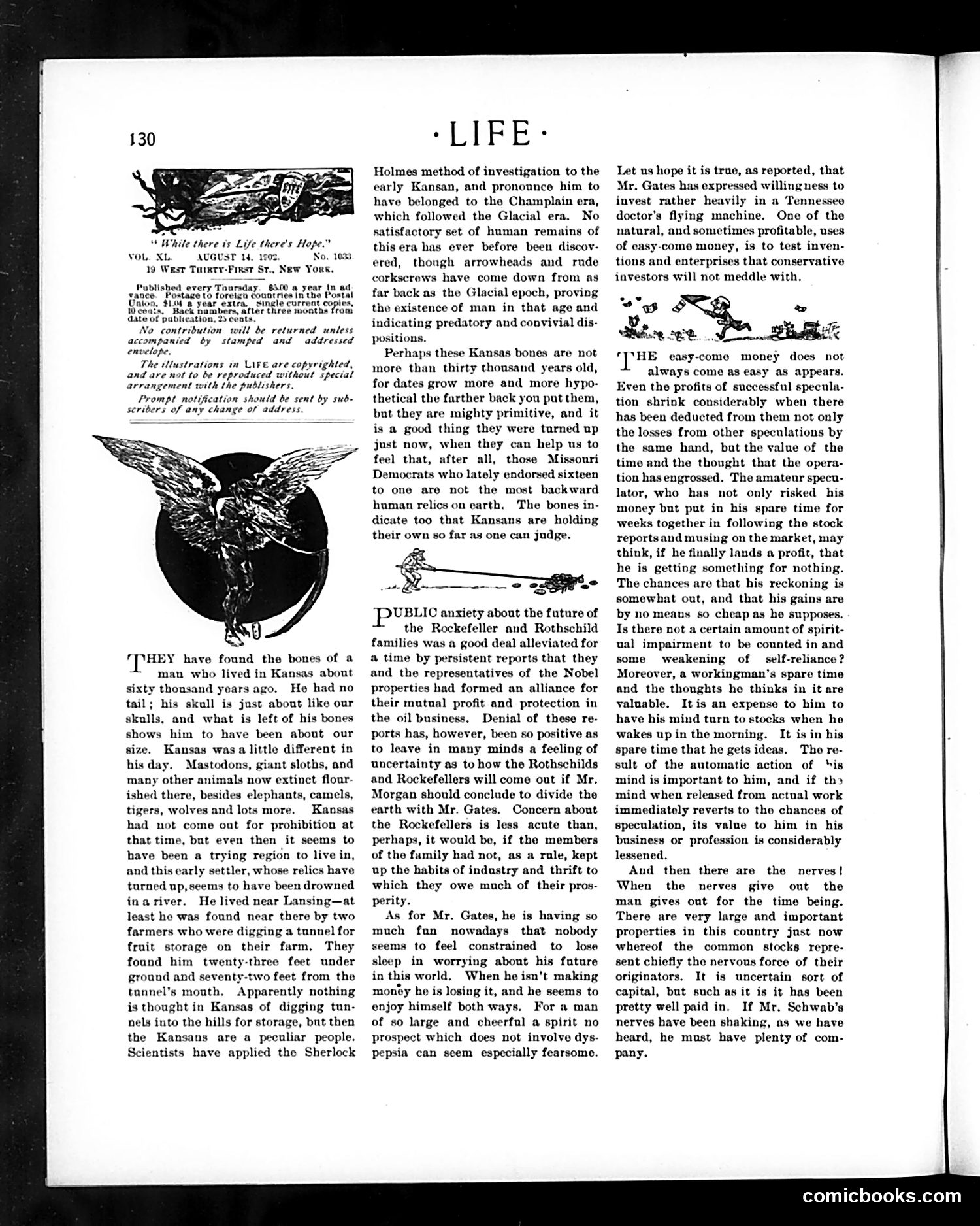
The page contains two distinct editorial cartoons addressing contemporary issues. The **upper cartoon** mocks the discovery of ancient human bones in Kansas. The text discusses whether these 30,000-year-old remains prove early human habitation. The cartoon's point appears satirical about scientific claims regarding prehistoric Kansas life. The **lower cartoon** features an eagle design and addresses the Rockefeller and Rothschild families' business dealings. The text references public anxiety about these wealthy industrialists' financial power and their potential influence over common people's livelihoods. The satirical tone suggests concern about monopolistic wealth concentration and elite families' unchecked economic control during the Gilded Age. Both cartoons reflect Progressive Era anxieties about scientific authority and concentrated wealth.
📄 Transcribed text from this page (OCR, searchable)
Machine-transcribed from the original scan — historical spelling and the odd misread are preserved.
“While there is Life there's Hope.” VOL. XL. AUGUST 14, = No, 1033, 19 Wrst Tairty-Fiest lished every Taursday. $400 a year In ce. Postage to foreign countries in the Post y ingle current copies, loee: three months (rom date of pablication, 2) cea No contribution twill be returned unless accompanied by stamped and addressed envelope. The illustrations in Live are copyrighted, and are not to be reproduced without special arrangement with the publishers, Prompt notification should be sent by sub- scribers of any change of address. TP HEY have found the bones of a man who lived in Kansas about sixty thousand years ago, He had no tail; his skull is just about like our skulls, and what is left of his bones shows him to have been about our size. Kansas was a little different in his day. Mastodons, giant sloths, and many other animals now extinct flour- ished there, besides elephants, camels, tigers, wolves and lots more. Kansas had not come ont for prohibition at that time, but even then it seems to have been a trying region to live in, and this early settler, whose relics have turned up, seems to have been drowned inariver. He lived near Lansing—at least he was found near there by two farmers who were digging a tunnel for fruit storage on their farm, They found him twenty-three feet under ground and seventy-two feet from the tannel’s mouth, Apparently nothing is thought in Kansas of digging tun- nels into the hills for storage, but then the Kansans are a peculiar people. Scientists have applied the Sherlock 2 E* Holmes method of investigation to the early Kansan, and pronounce him to have belonged to the Champlain era, which followed the Glacial era. No satisfactory set of human remains of this era has ever before been discov- ered, thongh arrowheads and rude corkscrews have come down from as far back as the Glacial epoch, proving the existence of man in that age and indicating predatory and convivial dis- positions. Perhaps these Kansas bones are not more than thirty thousand years old, for dates grow more and more hypo- thetical the farther bac! a put them, but they are mighty primitive, and it is a good thing they were tarned up just now, when they can help us to feel that, after all, those Missouri Democrats who lately endorsed sixteen to one are not the most backward human relics on earth. The bones in- dicate too that Kansans are holding their own so far as one can judge. BLIC anxiety about the future of the Rockefeller and Rothschild families was a good deal alleviated for a time by persistent reports that they and the representatives of the Nobel properties had formed an alliance for their mutual profit and protection in the oil business. Denial of these re- ports has, however, been so positive as to leave in many minds a feeling of uncertainty as to how the Rothschilds and Rockefellers will come out if Mr. Morgan should conclude to divide the earth with Mr. Gates. Concern about the Rockefellers is less acute than, perhaps, it would be, if the members of the family had not, as a rule, kept up the habits of industry and thrift to which they owe much of their pros- perity. As for Mr. Gates, he is having so much fan nowadays that nobody seems to feel constrained to lose sleep in worrying about his fature in this world. When he isn't making monty he is losing it, and he seems to enjoy himself both ways. For a man of so large and cheerfal a spirit no prospect which does not involve dys- pepsia can seem especially fearsome. P Let us hope it is trae, as reported, that Mr. Gates has expressed willing ness to invest rather heavily in a Tennesse doctor's flying machine. One of the natural, and sometimes profitable, uses of casy-come money, is to test inven- tions and enterprises that conservative investors will not meddle with, vs @ [HE casy-como money does not always come as easy as appears. Even the profits of successful specula- tion shrink considerubly when there has been deducted from them not only the losses from other speculations by the same hand, but the value of the time and the thought that the opera- tion has engrossed. The amateur specu- lator, who has not only risked his money but put in his spare time for weeks together in following the stock reports and musing on the market, may think, if he finally lands a profit, that he is getting something for nothing. The chances are that his reckoning is somewhat out, and that his gains are by no means so cheap as he supposes. Is there not a certain amount of spirit- ual impairment to be counted in and some weakening of self-reliance? Moreover, a workingman’s spare time and the thoughts he thinks in it are valuable. It is an expense to him to have his mind turn to stocks when he wakes up in the morning. It is in his spare time that he gets ideas. The re- sult of the automatic action of ‘is mind is important to him, and if th> mind when released from actual work immediately reverts to the chances of speculation, its value to him in his business or profession is considerably lessened. And then there are the nerves! When the nerves give out the man gives out for the time being. There are very large and important properties in this country just now whereof the common stocks repre- sent chiefly the nervous force of their originators. It is uncertain sort of capital, but such as it is it has been pretty well paid in. If Mr. Schwab's nerves have been shaking, as we have heard, he must have plenty of com- pany. comicbooks.com