
Life, 1902-08-14 · page 7 of 20
Life — August 14, 1902 — page 7: what you’re looking at
What you’re looking at
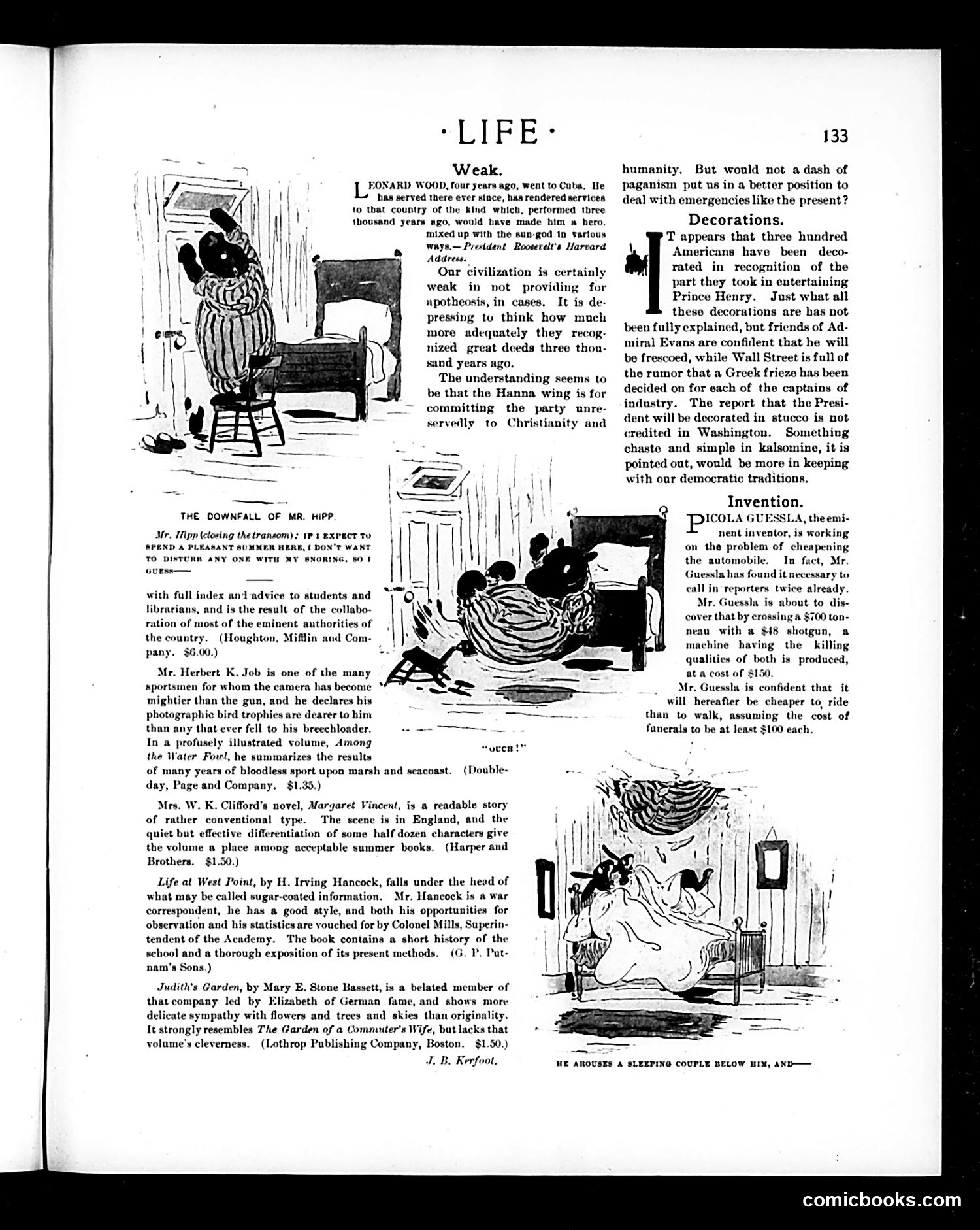
This cartoon satirizes Mr. Hipp (identified in the caption as "belonging the Harrison"), who apparently expected to hire a pleasant servant but instead got one who smokes indoors—a major breach of domestic conduct standards for the era. The humor lies in the servant's casual disregard for employer authority: Hipp sits shocked in a chair while the maid openly flouts his household rules by smoking. The joke targets both changing social dynamics (servants becoming less deferential) and anxieties about domestic order breaking down. The caption's theatrical phrasing ("If I expect to keep a pleasant servant, I must not object to [smoking]") suggests Hipp must accept this indignity or lose household help—reflecting labor shortages or shifting power dynamics in domestic service during this period.
📄 Transcribed text from this page (OCR, searchable)
Machine-transcribed from the original scan — historical spelling and the odd misread are preserved.
“DEE Weak. FONARD WOOD, four years ago, went to Cuta, He has served there ever since, has rendered services to that country of the kind which, performed three thousand years ago, would have made bim # hero. THE DOWNFALL OF MR. HIPP. Mr, Hipp (closing the transom): v1 exvEct Tv SPEND A PLEASANT SUMMER HERE, 1 DON'T WANT TO DIMTURM ANY ONE WITH MY ANORING, 80 1 ours with full index and advice to students and librarians, and is the result of the collabo- ration of most of the eminent authorities of the country. pany. $6.00.) Mr. Herbert K. Job is one of the many sportsinen for whom the camera has become mightier than the gun, and he declares his photographic bird trophies are dearer to him than any that ever fell to his breechloader. In a profusely illustrated volume, Among the Water Forrl, he summarizes the results of many years of bloodless sport upon marsh and seacoast day, Page and Company. $1.35.) mixed up with the sun-god tn various ways.— President Rooserelt’s Harvard Address. Oar civilization is certainly weak in not providing for apotheosis, in cases. It is de- pressing to think how much more adequately they recog- nized great deeds three thou- sand years ago. The understanding seems to be that the Hanna wing is for committing the party unre- servedly to Christianity and (Houghton, Mifflin and Com- “cen!” (Double- 133 humanity. But would not a dash of paganism put us in a better position to deal with emergencies like the present? Decorations. T appears that three hundred Americans have been deco- rated in recognition of the part they took in entertaining Prince Henry. Just what all these decorations are has not been fully explained, but friends of Ad- miral Evans are confident that he will be frescoed, while Wall Street is full of the rumor that a Greek frieze has been decided on for each of the captains of industry. The report that the Presi- dent will be decorated in stucco is not credited in Washington. Something chaste and simple in kalsomine, it is pointed out, would be more in keeping with our democratic traditions. Invention. ICOLA GUESSLA, the emi- nent inventor, is working on the problem of cheapening the automobile. In fact, Mr. Guessla has found it necessary to call in reporters twice already. Mr. Guessla is about to dis- cover that by crossing a $700 ton- neau with a $18 shotgun, a machine having the killing qualities of both is produced, at a cost Mr. Guessla is confident that it will hereafter be cheaper to, ride than to walk, assuming the cost of fanerals to be at least $100 each. Mrs. W. K. Clifford's novel, Margaret Vincent, is a readable story of rather conventional type. The scene is in England, and the quiet but effective differentiation of some half dozen characters give the volume a place among acceptable summer books, (Harper and Brothers. $1.50.) Life at West Point, by H. Irving Hancock, falls under the head of what may be called sugar-coated information. Mr. Hancock is a war correspondent, he has a good style, and both his opportunities for observation and his statistics are vouched for by Colonel Mills, Superin- tendent of the Academy. The book contains a short history of the school and a thorough exposition of its present methods. (G. P. Put- nam's Sons.) Judith’s Garden, by Mary E. Stone Bassett, is a belated member of that company led by Elizabeth of German fame, and shows more delicate sympathy with flowers and trees and skies than originality. It strongly resembles The Garden of a Commuter's Wife, but lacks that volume’s cleverness. (Lothrop Publishing Company, Boston. $1.50.) IB. Rerfoot, HE AROUSES & SLEEPING COUPLE BELOW MIM, AND— comicbooks.com