
A complete issue · 20 pages · 1902
Life — January 16, 1902
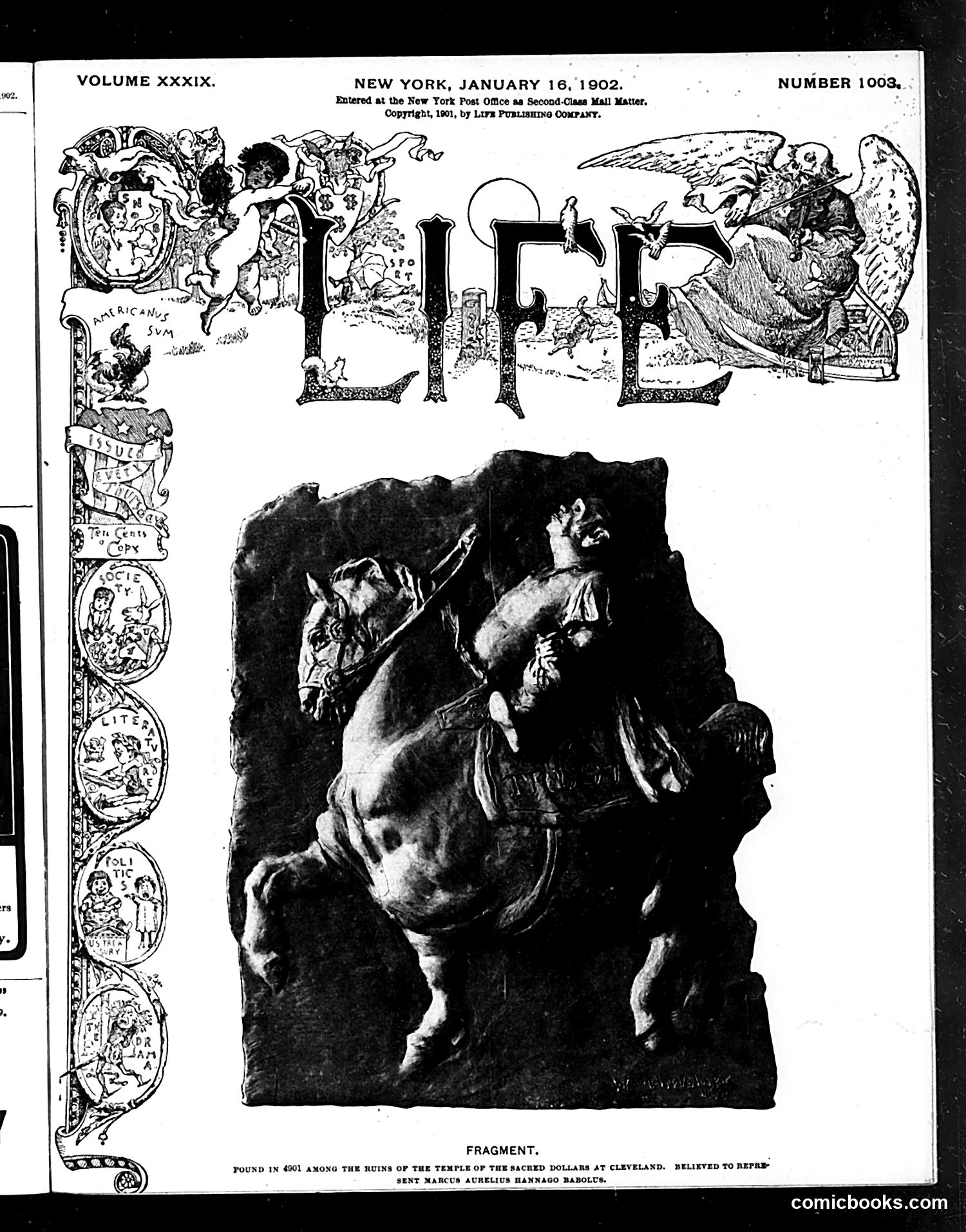
This is the cover of *Life* magazine's issue featuring an ornate decorative header and a classical artistic reproduction titled "Fragment." The caption indicates this is "found in 4601 among the ruins of the Temple of the Sacred Dollars at Cleveland. Believed to represent Marcus Aurelius Hannago Nabolus." The satire appears to mock wealthy Cleveland industrialists or financiers by presenting a modern sculpture/figure as if it were an ancient Roman artifact. By calling the subject "Marcus Aurelius" (the philosopher-emperor) and giving him a mock-Latin name, the cartoonist suggests these contemporary wealthy men fancy themselves as important historical figures, when they're actually just modern robber barons. The "Temple of the Sacred Dollars" explicitly satirizes their worship of money.
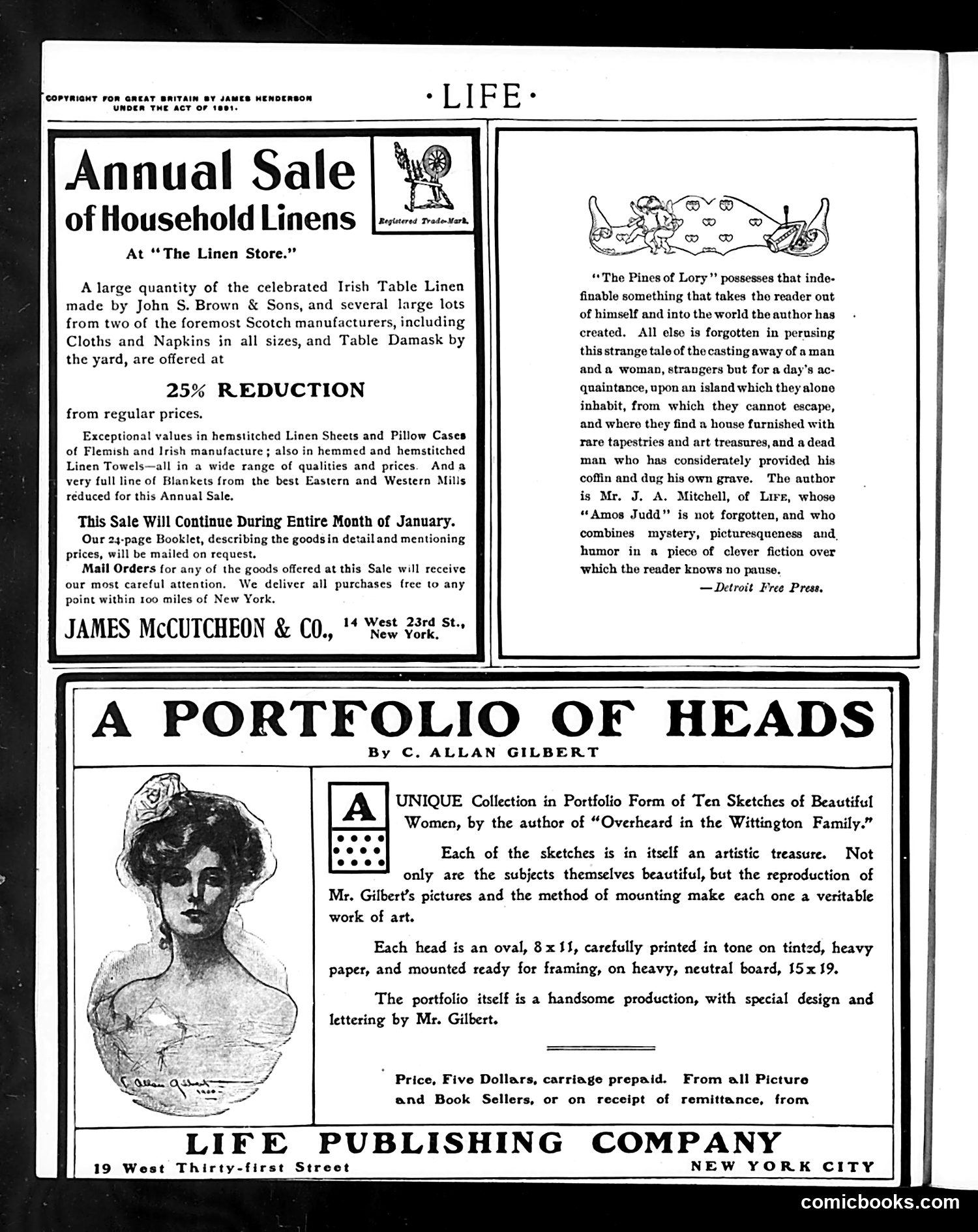
This page is primarily **advertising rather than satirical content**. It contains three advertisements: 1. **"Annual Sale of Household Linens"** by James McCutcheon & Co.—promoting Irish table linens and damask with a 25% reduction, available throughout January. 2. **"The Pines of Lory"** (right)—a book review praising J.A. Mitchell's novel as a piece of clever fiction combining mystery, picturesqueness, and humor. 3. **"A Portfolio of Heads"** by C. Allan Gilbert—advertising a collection of ten sketches of beautiful women, priced at five dollars, available through picture and book sellers. The page reflects early 20th-century *Life* magazine's mixed model of editorial content and paid advertising, rather than presenting political satire or commentary.
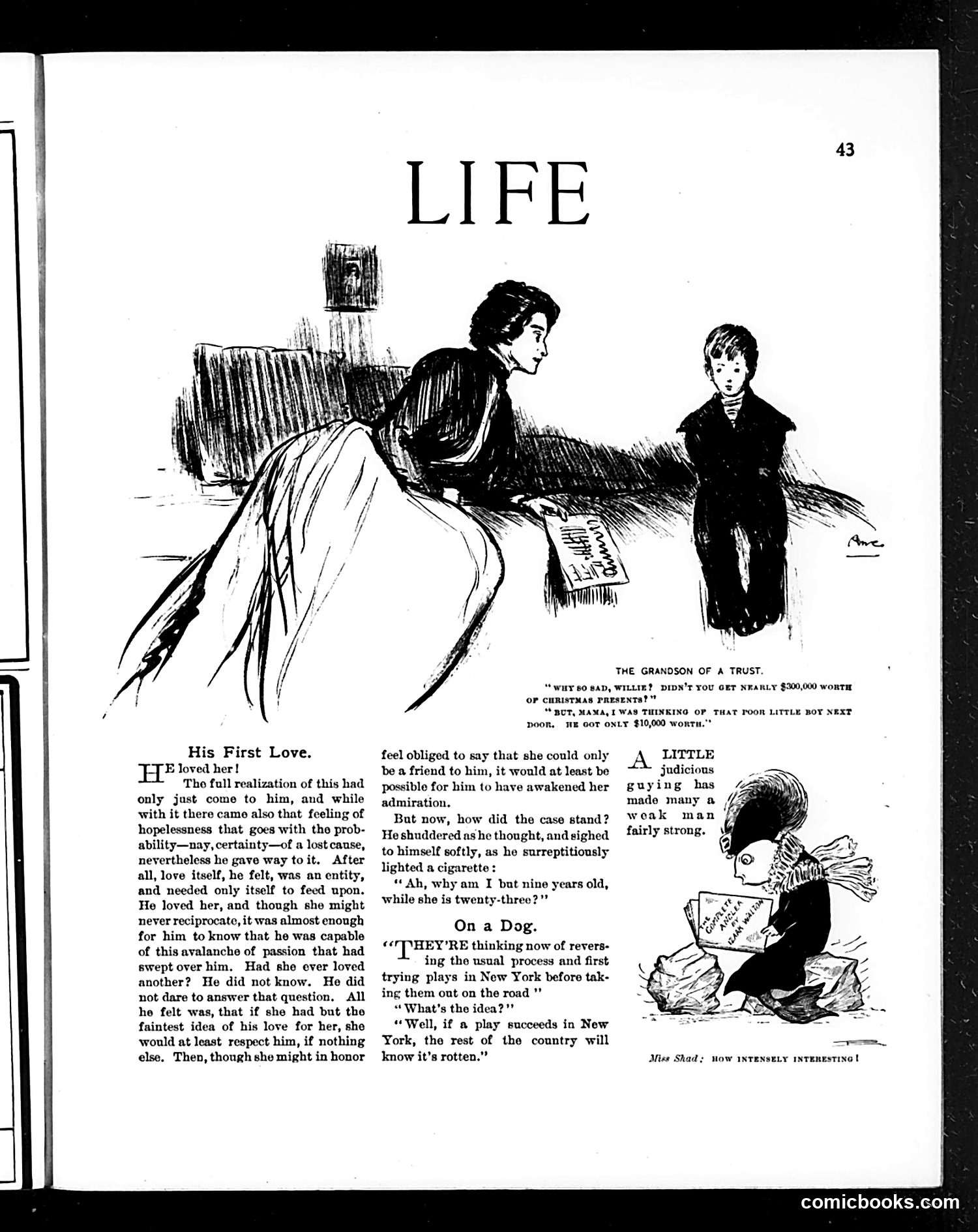
This page contains three satirical pieces about romantic and social themes: **"His First Love"** (left): A narrative about a young man's unrequited love for a woman nine years his senior. The satire mocks his idealization of love and inability to act on his feelings, portraying the helplessness of first romantic infatuation. **"The Grandson of a Trust"** (top right): A cartoon mocking wealthy privilege, depicting a well-dressed boy receiving extravagant Christmas gifts while a poor child gets minimal presents. The caption sarcastically contrasts the "$200,000 worth" of gifts versus "$10,000 worth," satirizing economic inequality and inherited wealth. **"On a Dog"** (bottom): A brief dialogue mocking theater industry aspirations, where characters discuss whether a play's success in New York guarantees national success. The overall page satirizes romantic naïveté, class disparities, and theatrical pretension—common Life magazine targets.
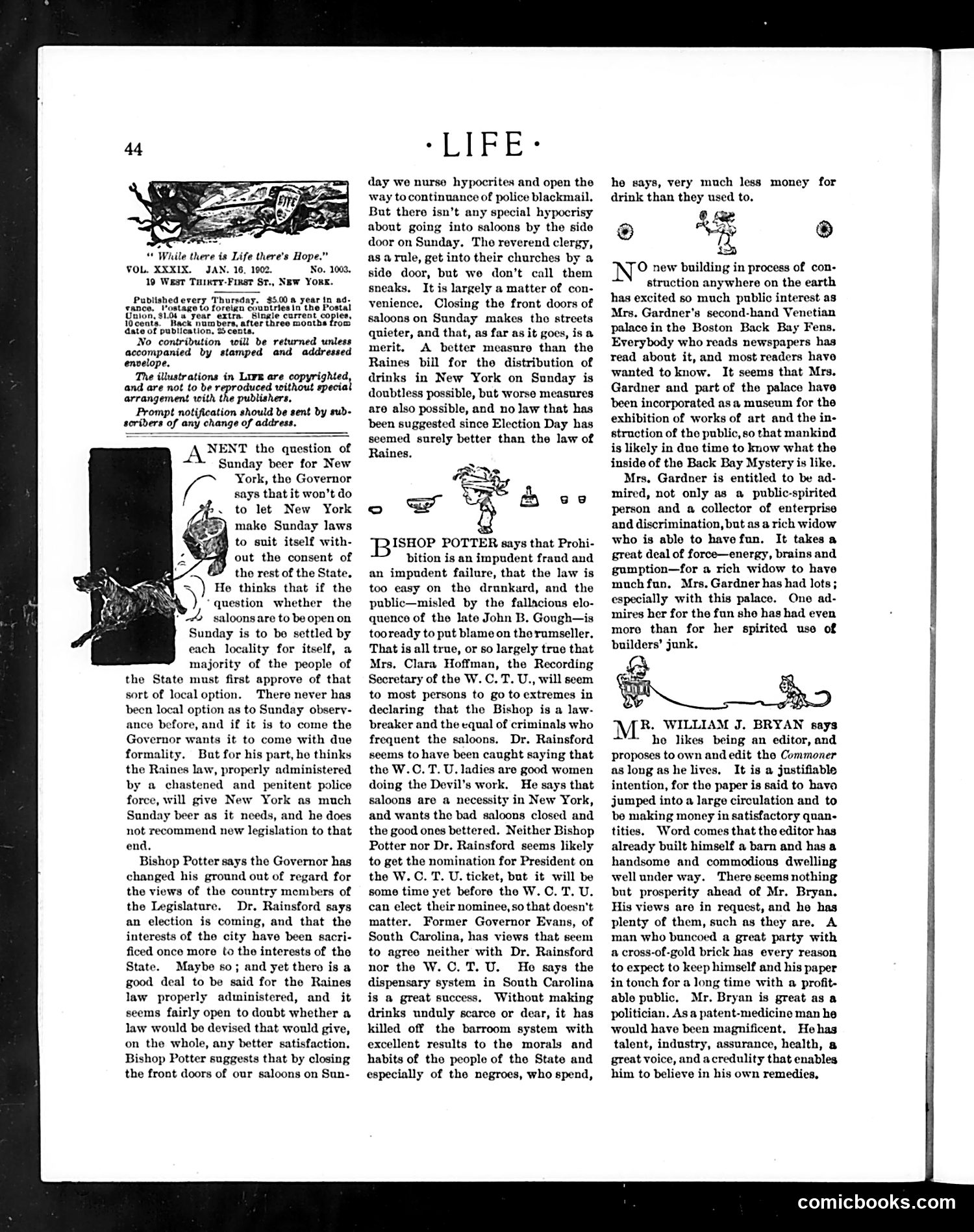
This page contains political commentary on Sunday closing laws for saloons in New York State. The Governor opposes mandatory Sunday closures without local consent, while Bishop Potter and Dr. Rainsford advocate for closing saloons to reduce drinking and its social harms. The left cartoon depicts a figure (likely representing the Governor or a political opponent) being squeezed or pressured—satirizing the tension between different factions on this issue. The text discusses whether prohibition should be state-mandated or locally decided. It references Mrs. Clara Hoffman (Recording Secretary of the W.C.T.U., a temperance organization) and critiques both the Bishop's moral stance and the practical effectiveness of such laws. The satire highlights competing interests: religious reformers, politicians, saloon owners, and questions of governmental authority versus local control.
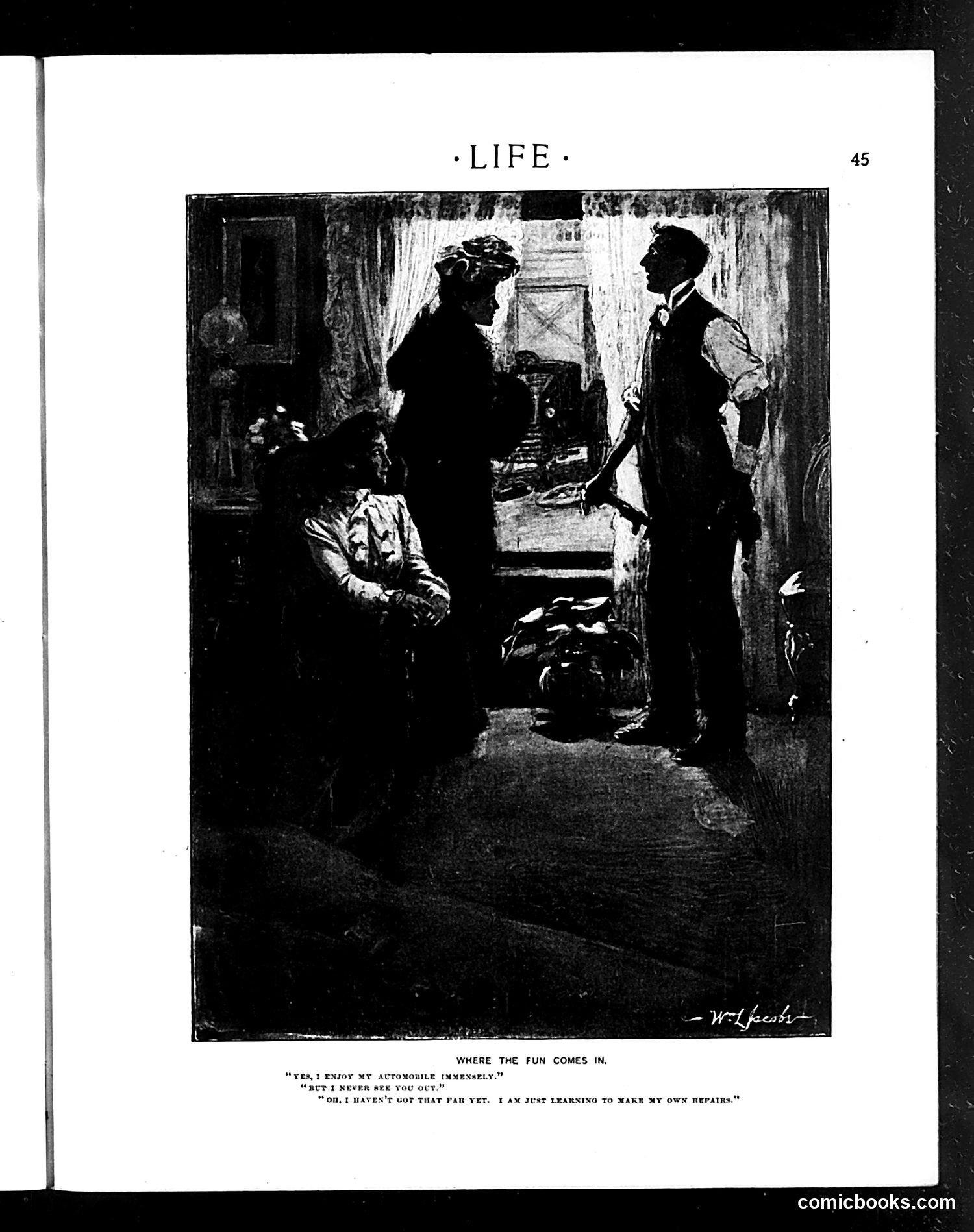
This cartoon depicts an interior domestic scene with three men and a woman. The dialogue reveals the joke's subject: automobiles and self-repair. The caption reads: "Yes, I enjoy my automobile immensely." / "But I never see you out." / "Oh, I haven't got that far yet. I am just learning to make my own repairs." The satire targets early automobile ownership (likely 1910s-1920s), when cars were notoriously unreliable and required constant maintenance. The humor lies in the irony that the owner spends all his time repairing the vehicle rather than actually driving it—the opposite of what one would expect from owning an automobile for enjoyment. The cartoon mocks both the mechanical complexity of early cars and owners who attempt repairs themselves rather than patronizing mechanics.
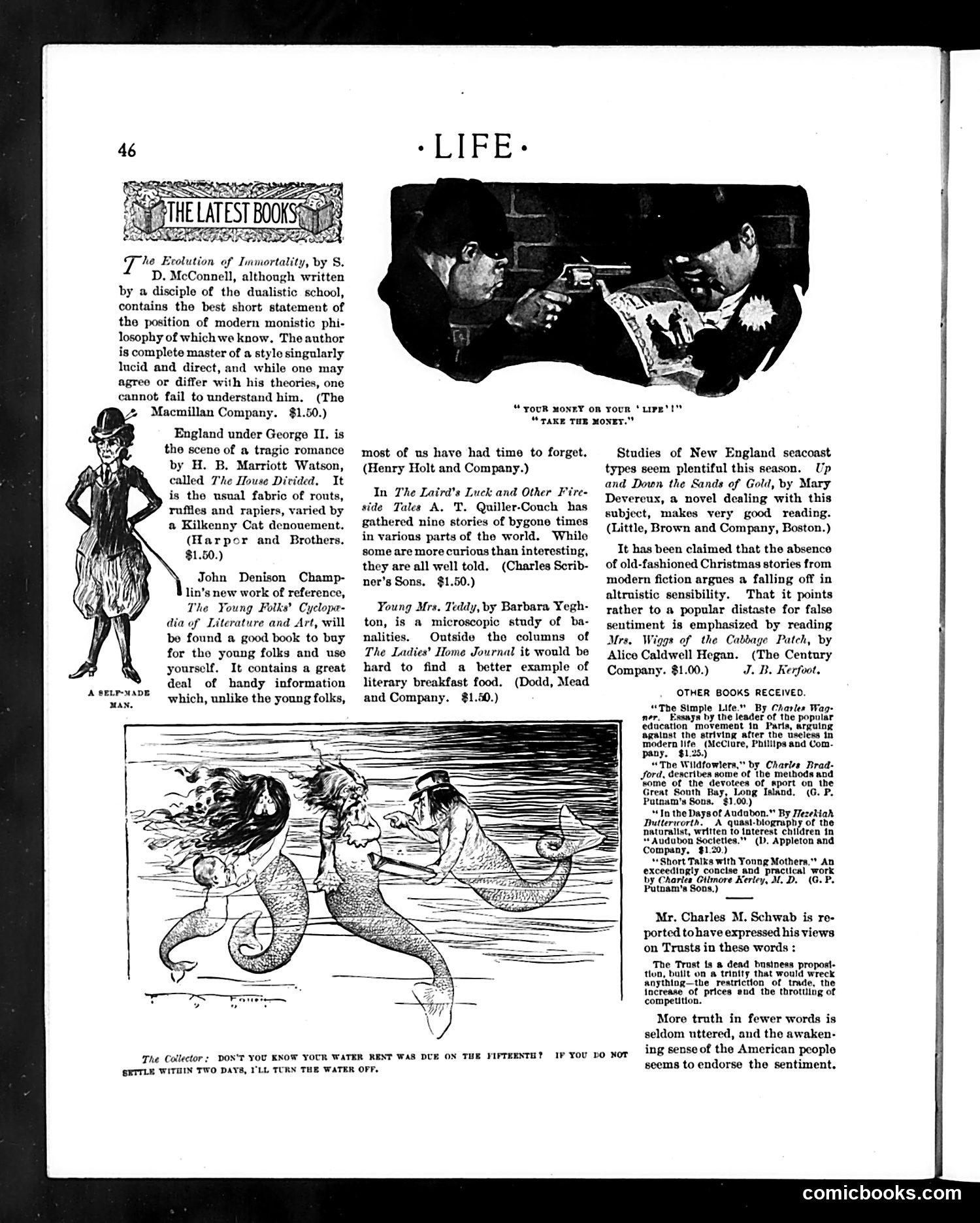
This page features book reviews under "THE LATEST BOOKS" rather than editorial cartoons. The main illustration—a whimsical drawing of mermaids in water—accompanies a caption from "The Collector" making a joke about water billing: "DON'T YOU KNOW YOUR WATER RENT WAS DUE ON THE FIFTEENTH? IF YOU DO NOT SETTLE WITHIN TWO DAYS, I'LL TURN THE WATER OFF." The satire targets municipal utilities and debt collection practices, humorously suggesting that even mythical creatures living in the sea aren't exempt from paying water bills to landlords. It's a commentary on the absurdity of urban bureaucratic systems extending their reach everywhere. The page also reviews contemporary books including works on philosophy, romance, and social commentary, reflecting early 20th-century literary interests.
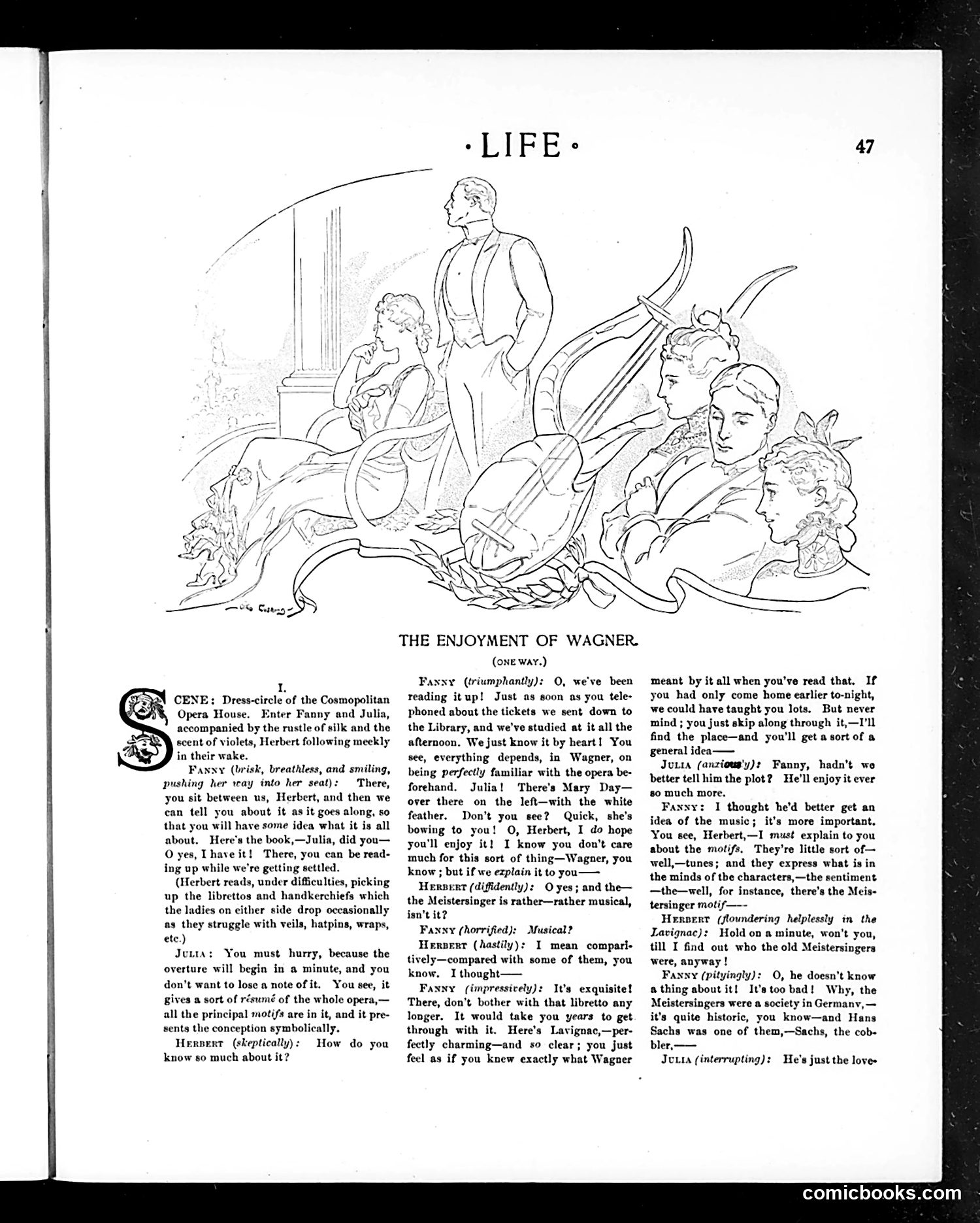
This satirical illustration depicts the Metropolitan Opera House's dress circle during a Wagner opera performance. The cartoon mocks the social pretensions of opera attendees through a dialogue between characters named Fanny, Julia, and Herbert. The satire targets two things: first, the tedious length and complexity of Wagner's operas (characters discuss studying the libretto extensively beforehand); second, the performative nature of high-society opera-going—where attendees care more about being seen in fashionable dress and displaying cultural sophistication than actually enjoying the music. The illustration of elaborately dressed figures with exaggerated features emphasizes that the "enjoyment" is really about social display rather than genuine appreciation for the art form.
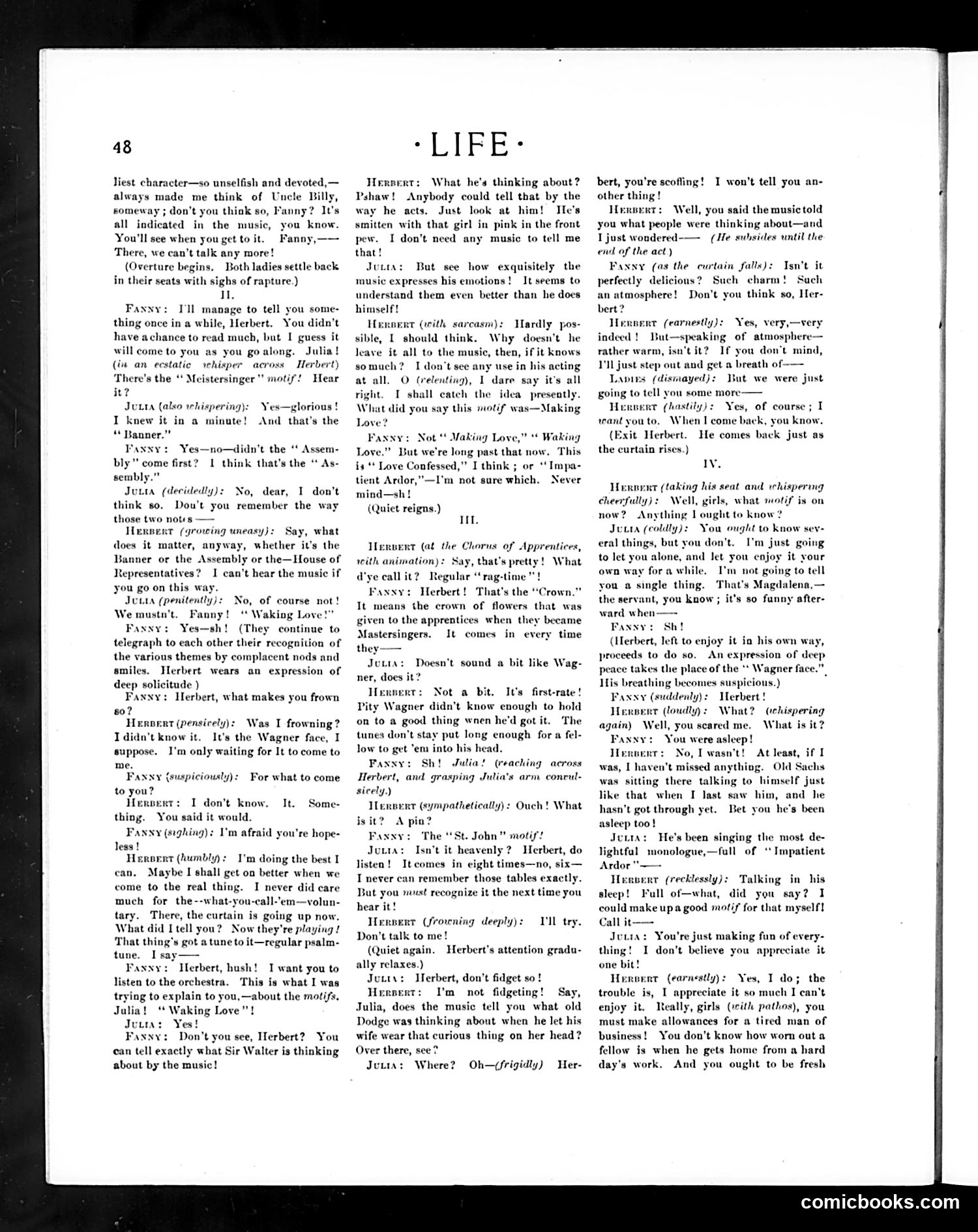
This page from *Life* magazine is a theatrical dialogue scene, not a political cartoon. The text shows a conversation between characters named Fanny, Herbert, and Julia, apparently discussing a stage production or musical performance. The dialogue satirizes theatrical pretension and romantic melodrama. Characters debate whether music in a show genuinely conveys emotion or is merely decorative. Herbert dismisses the song "Waking Love" as overwrought, while others defend its artistic merit. References to "the Crown" (apparently an apprentices' honor) and "Sir Walter" suggest this may parody operatic conventions or contemporary stage productions. The satire targets both affected theatergoers and overwrought theatrical sentimentality—mocking the gap between what audiences *think* they're experiencing emotionally versus what's actually happening onstage.
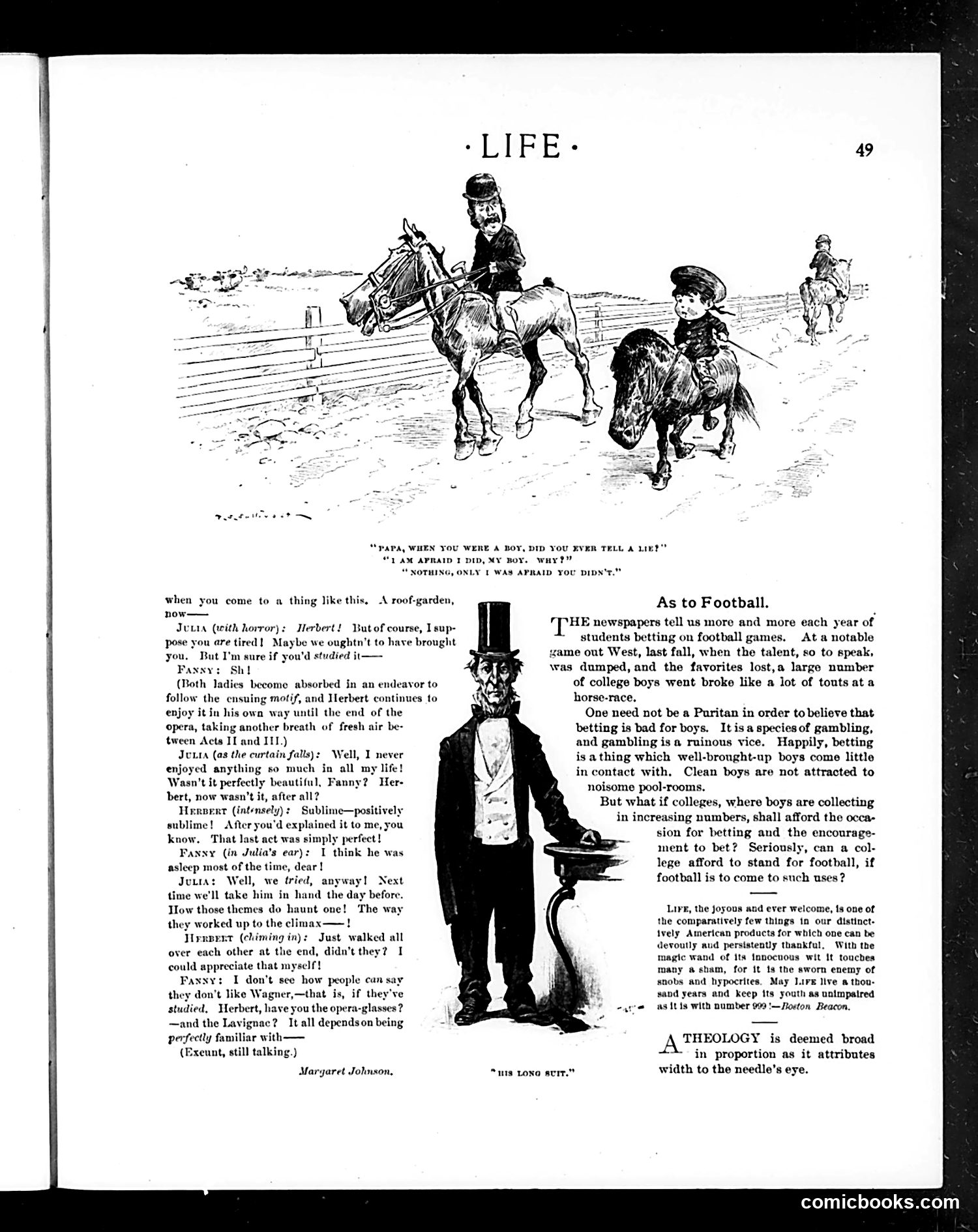
**The Main Cartoon** (top) depicts a conversation between a father and son on horseback about lying. The father claims he never told a lie as a boy; the son replies he's "afraid you didn't"—implying the father is now lying about his past honesty. This is gentle satire on parental hypocrisy and selective memory. **"His Long Suit"** (center illustration) shows a well-dressed gentleman in formal attire. The caption suggests he's known for something specific, though the exact reference is unclear from visible context. **"As to Football"** (right column) criticizes college students' increasing gambling on football games, warning that widespread betting threatens the sport's integrity. This reflects early 20th-century concerns about commercialization and moral decay in college athletics.
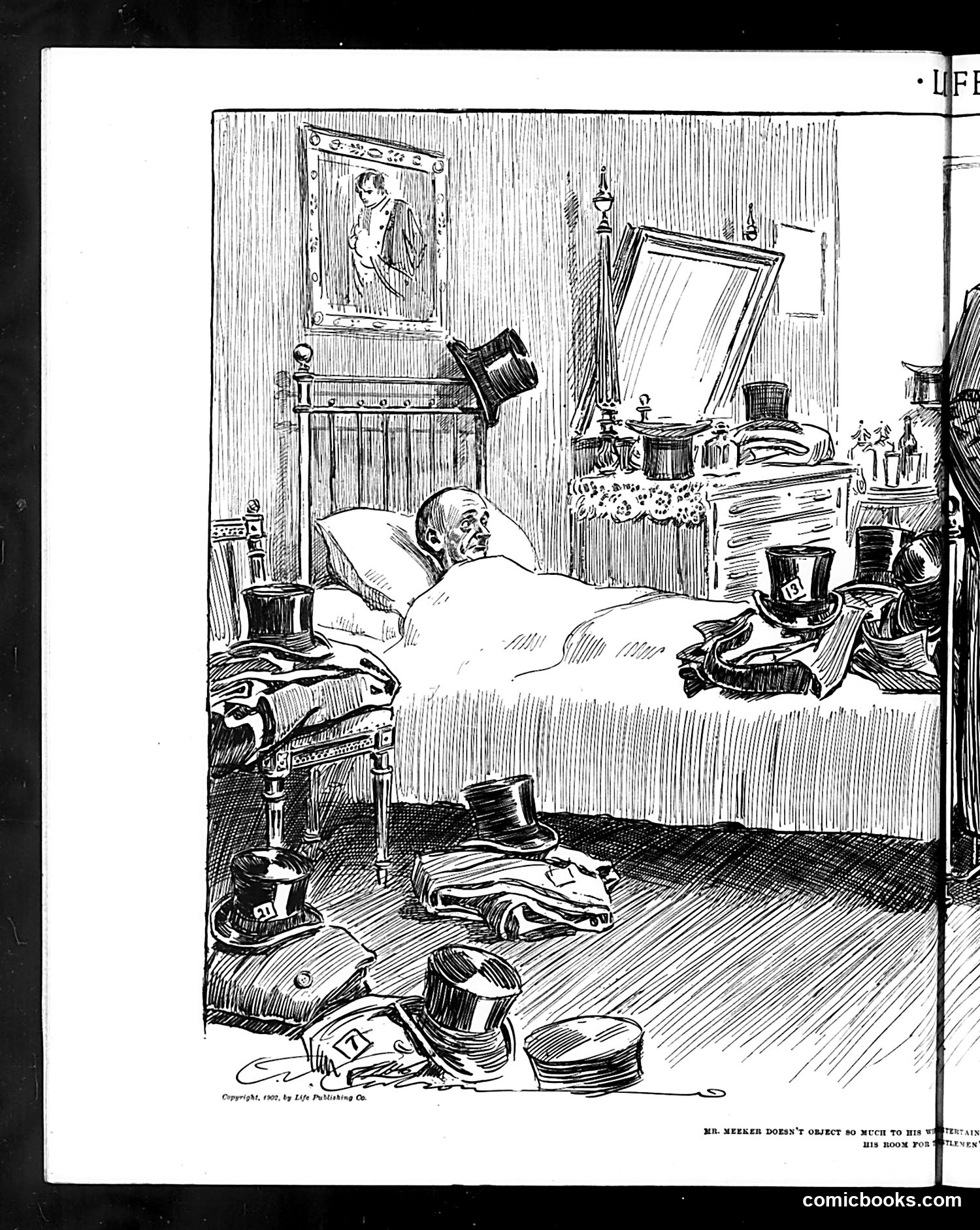
This 1905 satirical illustration depicts a wealthy gentleman in bed surrounded by scattered top hats and formal wear on the floor—suggesting dissolute living or excessive socializing. The caption reads: "MR. SEEKER DOESN'T OBJECT SO MUCH TO HIS WIFE'S ENTERTAINING HIS HOUSE FOR PLEASURE." The cartoon mocks upper-class social hypocrisy. Mr. Seeker appears indifferent to his wife's entertainment activities, but the scattered formal attire and cluttered bedroom suggest questionable propriety. The satire likely critiques how wealthy men tolerated—or benefited from—their wives' social gatherings while maintaining plausible deniability about impropriety. The humor targets turn-of-the-century attitudes about marriage, gender roles, and the performative nature of respectable society among the wealthy.
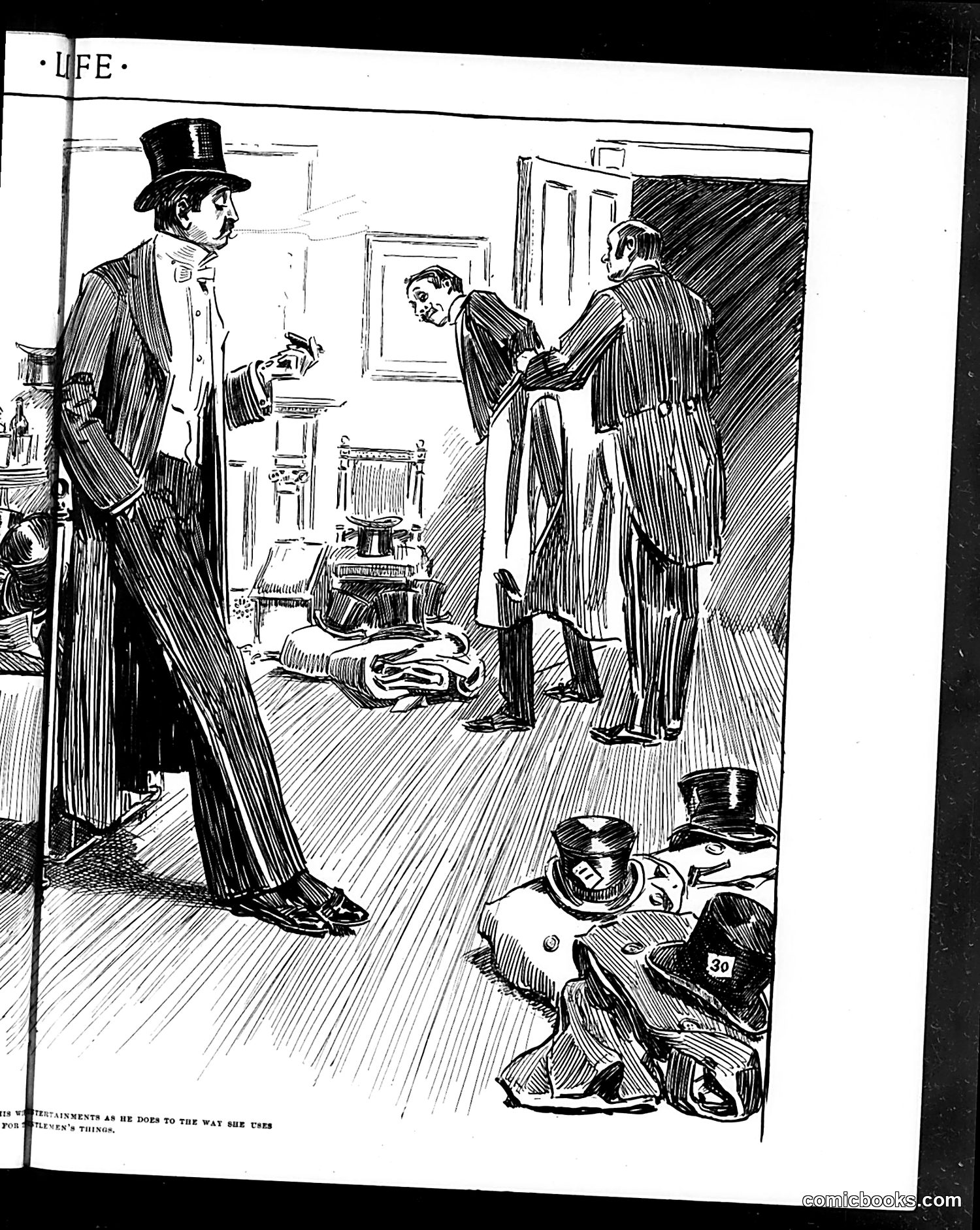
This appears to be a satirical cartoon from *Life* magazine showing a social scene where well-dressed men in top hats and formal attire are conducting business or social interactions in what looks like an elegant interior. The visible OCR text at bottom references "entertainments as he goes to the way she uses for steven's things," which is partially illegible but suggests commentary on social behavior or hypocrisy regarding "Steven's things." The cartoon satirizes upper-class gentleman—their formal dress, posturing, and apparent duplicity. The figures appear to be engaged in some form of deception or contradiction between their refined appearance and their actual conduct. Without clearer text or identifying labels, the specific political figures or events referenced remain unclear, though the satire targets Victorian-era bourgeois pretension and questionable ethics among the wealthy.
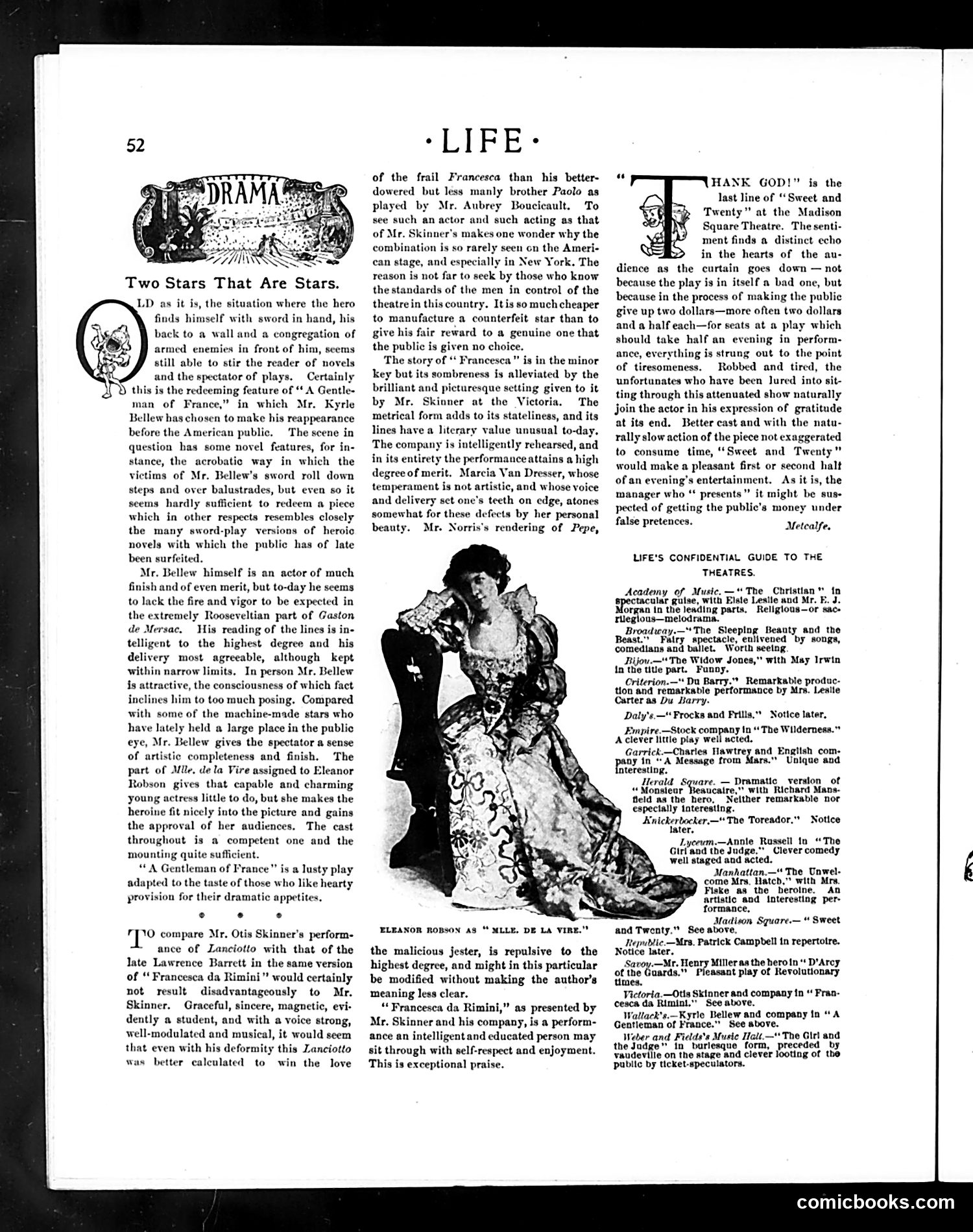
This page contains theatrical reviews rather than political cartoons. The main illustration shows **Eleanor Robson as "Mlle. de la Vire"** in what appears to be a dramatic stage production. The accompanying text critiques several theatrical performances, including reviews of "Francesca da Rimini," "Sweet and Twenty," and other plays at various New York theaters. The content is primarily **entertainment journalism**, discussing actors' performances and dramatic merit. While the text mentions "counterfeiting" and criticizes certain theatrical standards, these are artistic critiques about authenticity in performance rather than political satire. The page represents Life magazine's role as a cultural arbiter commenting on New York's theater scene during this era.
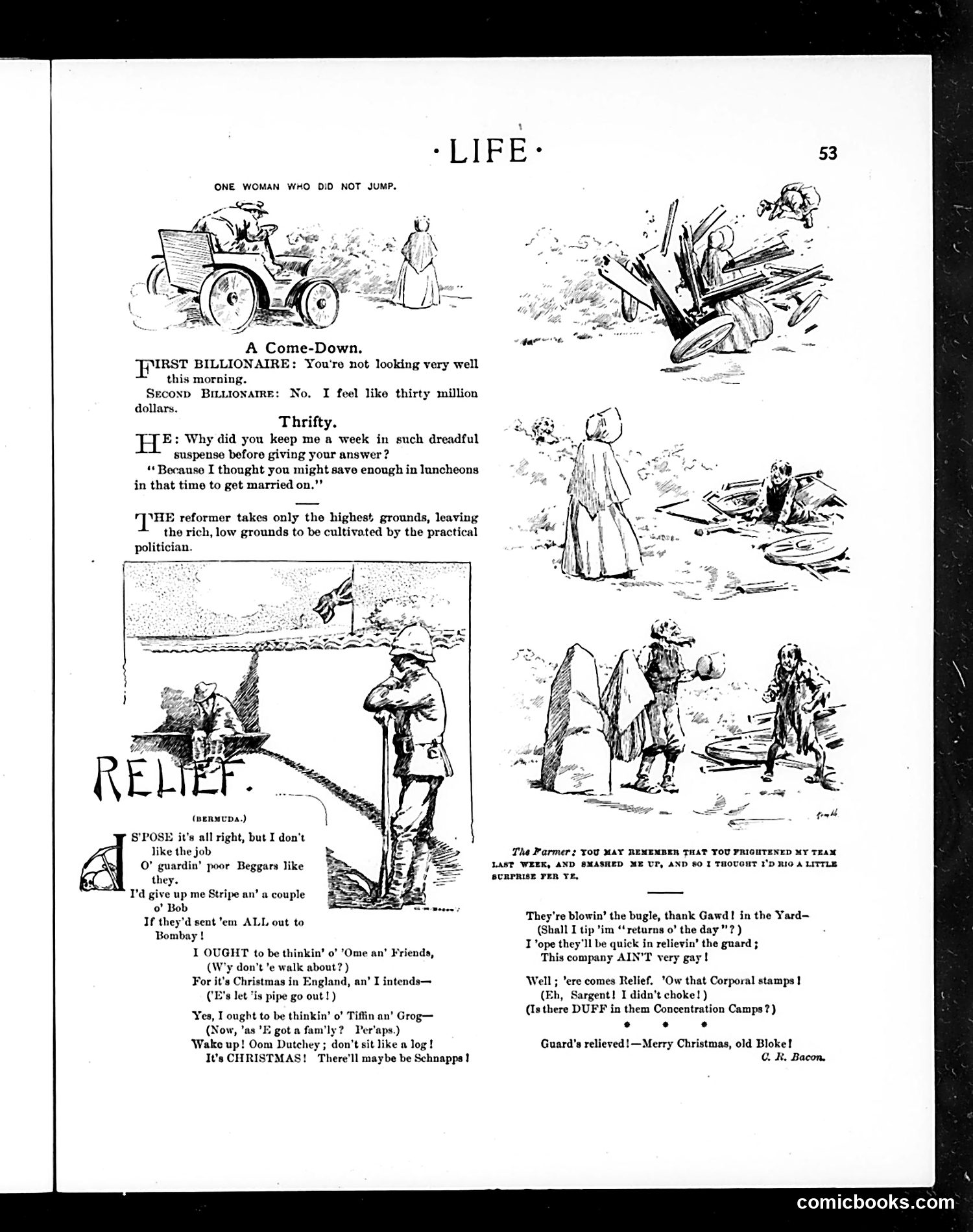
This page contains satirical commentary on wealth inequality and military life during what appears to be the Boer War era (references to "Concentration Camps" and British military contexts). **"A Come-Down"** jokes about billionaire wealth becoming meaningless—one billionaire feels so impoverished he's "like thirty million dollars," inverting normal values through hyperbole. **"Thrifty"** satirizes misers: a man proposes marriage only after a woman saves money on lunches, suggesting courtship reduced to financial calculation. **"Relief"** appears to be a political cartoon (marked "Bermuda") depicting a British soldier guarding poor prisoners or civilians. The soldier resents the duty and wishes the unfortunates sent elsewhere. The verse emphasizes the guard's homesickness at Christmas, contrasting his loneliness with the prisoners' plight—a commentary on the human costs of imperialism and concentration camps. The overall theme critiques wealth disparity, greed, and the moral contradictions of military occupation.
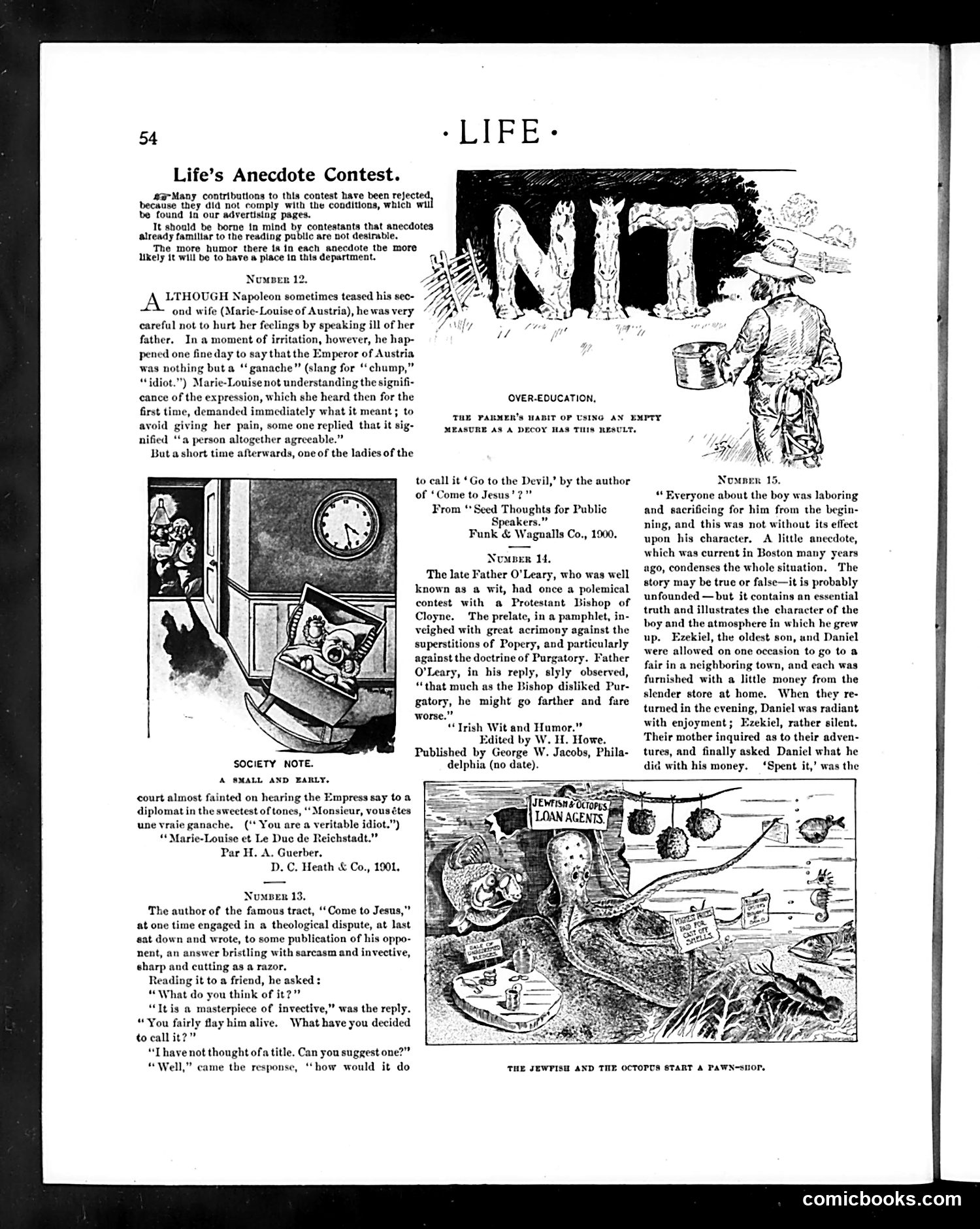
This page presents *Life* magazine's "Anecdote Contest," featuring four humorous historical anecdotes submitted by readers: **Number 12** tells of Napoleon's wife Marie-Louise unknowingly insulting her own father (the Austrian Emperor) by calling him a "ganache" (idiot)—a slang term she didn't understand but was told meant "agreeable." **Number 13** satirizes theological hypocrisy: a religious author writes a scathing attack on an opponent, then struggles to title it—his friend suggests calling it "Go to the Devil" by the author of "Come to Jesus?" **Number 14** features Irish Catholic wit Father O'Leary outwitting a Protestant bishop in debate through clever wordplay about Purgatory. **Number 15** (incomplete here) appears to be a morality tale about two boys at a fair, contrasting their character through how they spent money. The cartoons are unrelated to these anecdotes—one shows "Over-Education" (farmers using deceptive measures), the other depicts "The Jewish and the Octopus Start a Pawn-Shop," likely a period caricature.
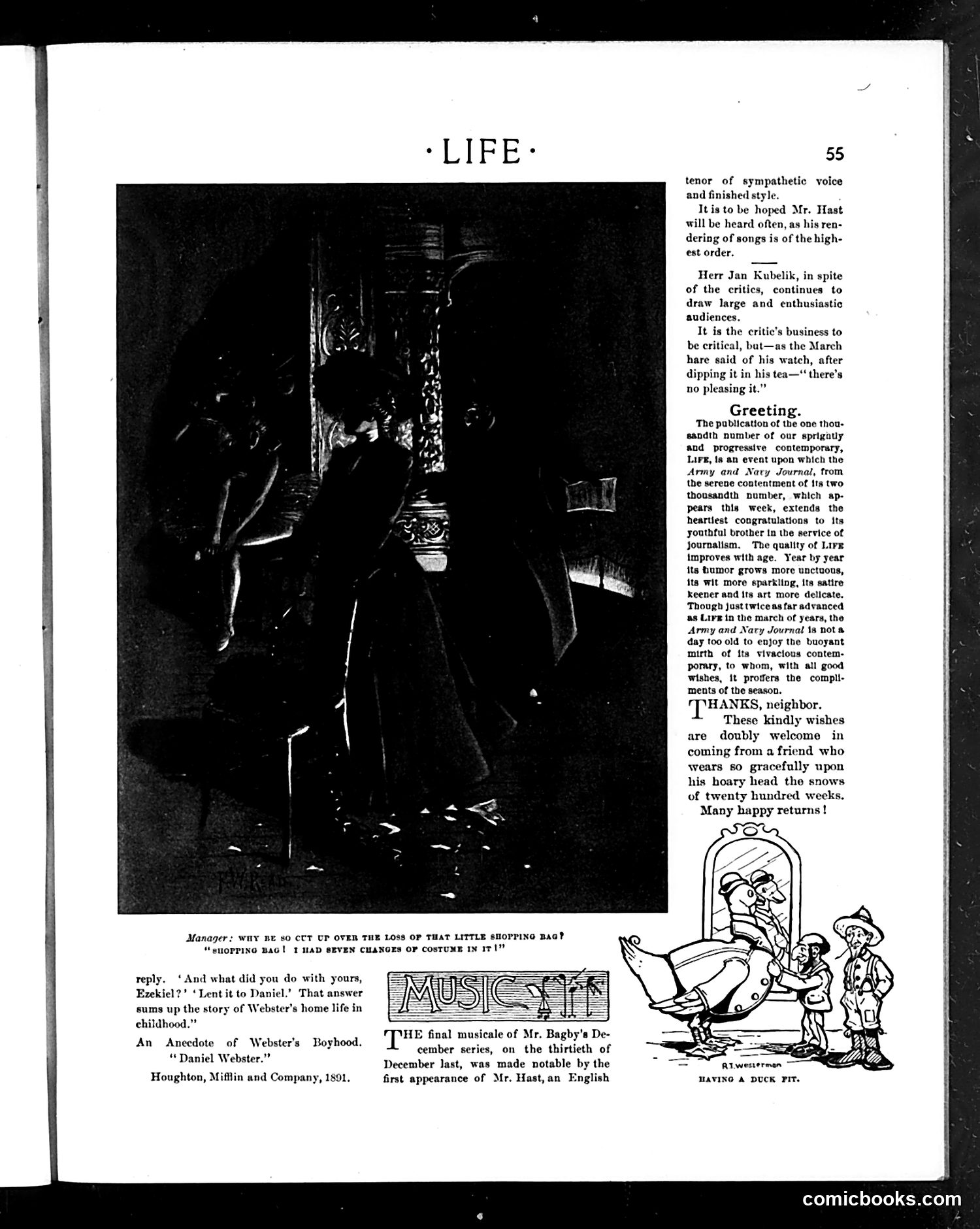
This page contains three distinct items: **Top cartoon**: A manager confronts a performer about losing a shopping bag. The performer claims it contained "seven changes of costume," implying theatrical vanity—the joke being the absurdity of prioritizing costume changes over practical concerns. **Middle anecdote**: A brief story about Daniel Webster's boyhood, illustrating generosity through a dialogue about lending items. **Lower section**: Congratulatory messages to *Life* magazine on reaching its 1,000th issue. The *Army and Navy Journal* (at its 2,000th issue) offers warm praise, noting that *Life's* humor, wit, and satire improve with age. The tone is gracious professional rivalry between two contemporary publications. **Right illustration**: A small cartoon labeled "Having a Duck Fit," showing a figure with what appears to be waterfowl—likely a pun on the phrase meaning an emotional outburst. The page primarily celebrates *Life's* longevity and editorial quality through peer recognition.
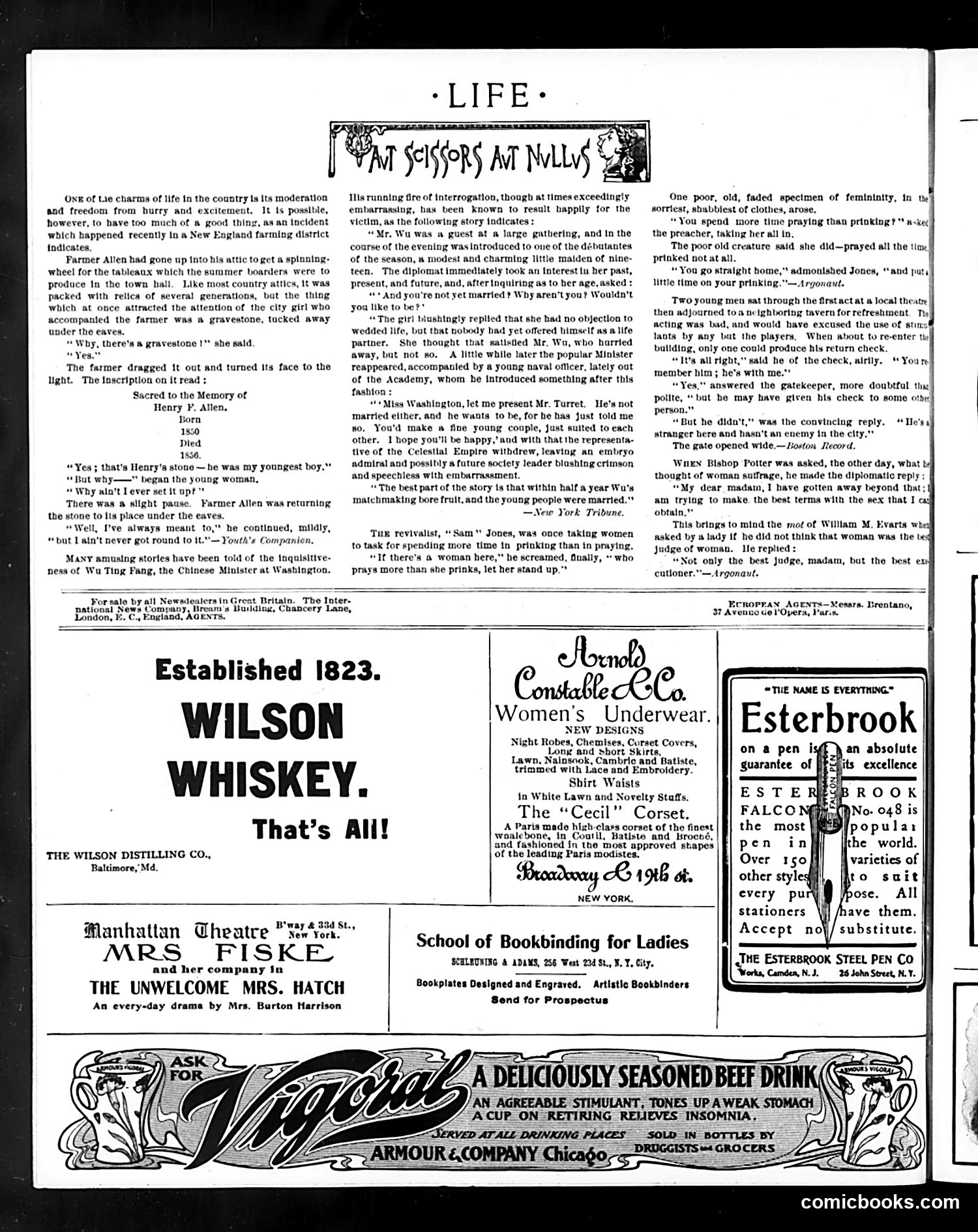
This page contains three humorous anecdotes typical of early 20th-century American humor: 1. **"Farmer Allen's Gravestone"**: A country farmer keeps his dead child's gravestone stored in his attic for years, never getting around to installing it. The joke satirizes rural procrastination and emotional detachment—the farmer's matter-of-fact response ("I've always meant to") to a shocking situation. 2. **"Wu Ting Fang's Matchmaking"**: The Chinese Minister to the U.S. is portrayed as comically blunt and meddlesome, aggressively interrogating a young woman about her unmarried status, then immediately introducing her to a naval officer. The humor relies on characterizing him as socially inappropriate yet accidentally successful. 3. **"Revivalist Sam Jones' Challenge"**: A preacher shames women for prioritizing appearance over piety. An elderly woman demonstrates such dedication to prayer that the preacher ironically tells her to spend *more* time on her appearance—mocking both religious hypocrisy and women's social anxieties about looks. All three stories rely on late-Victorian era sensibilities about propriety, gender roles, and rural/immigrant stereotypes.
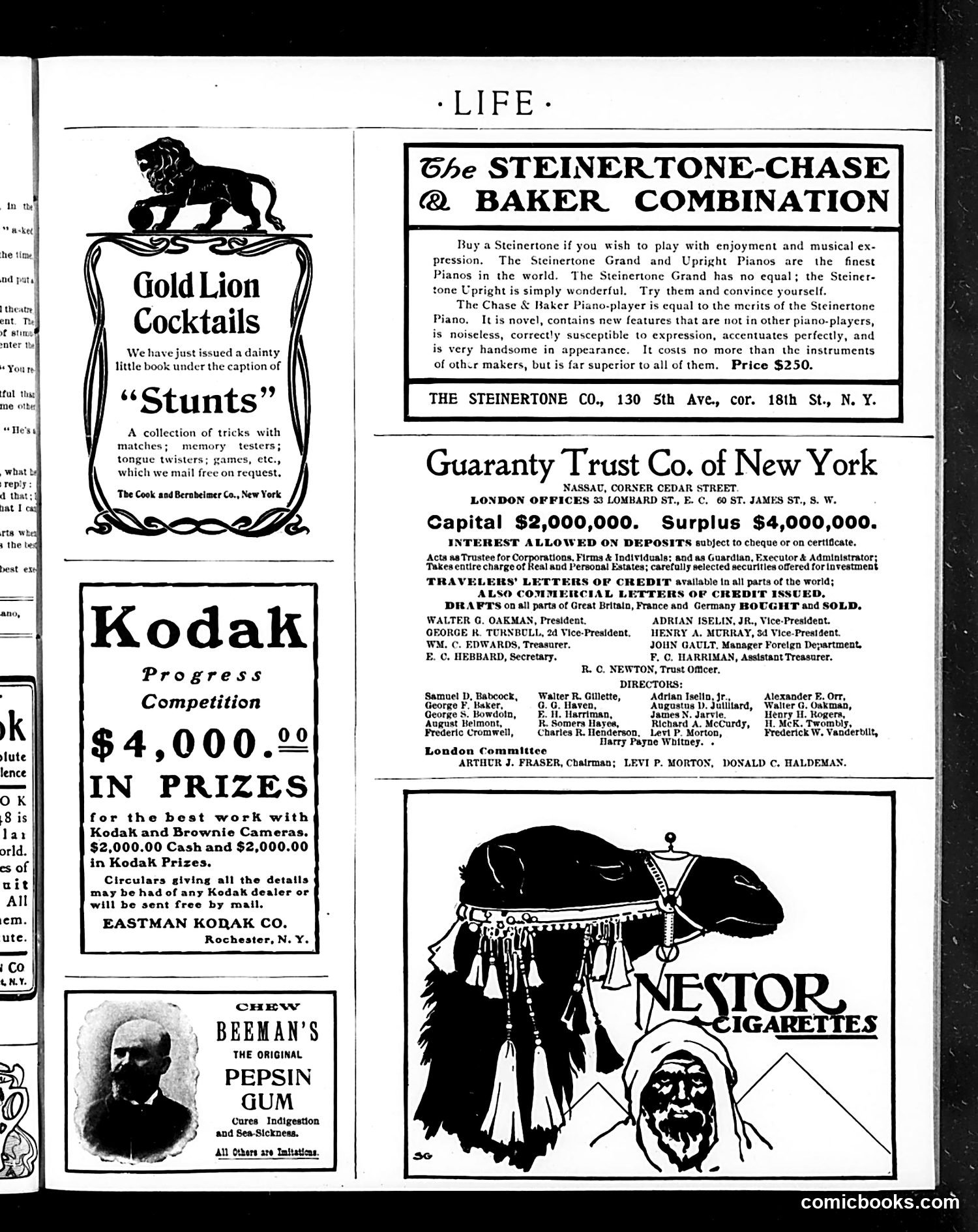
This page is **primarily advertising**, not satire or political commentary. It contains several product advertisements typical of early 20th-century American magazines: The main content includes ads for: - **Gold Lion Cocktails** (with a decorative lion logo and "Stunts" booklet offer) - **Steinertone-Chase & Baker pianos** ($250) - **Guaranty Trust Co. of New York** (a major financial institution listing capital and prominent directors) - **Kodak Progress Competition** ($4,000 in prizes) - **Nestor Cigarettes** (with an illustration of a camel and bearded figure) - **Beeman's Pepsin Gum** (claiming to cure indigestion) The page reflects the commercial interests and luxury goods marketed to affluent early-1900s readers. There is no discernible political cartoon or satirical commentary—it is a straightforward advertising section, likely from *Life*'s middle pages.
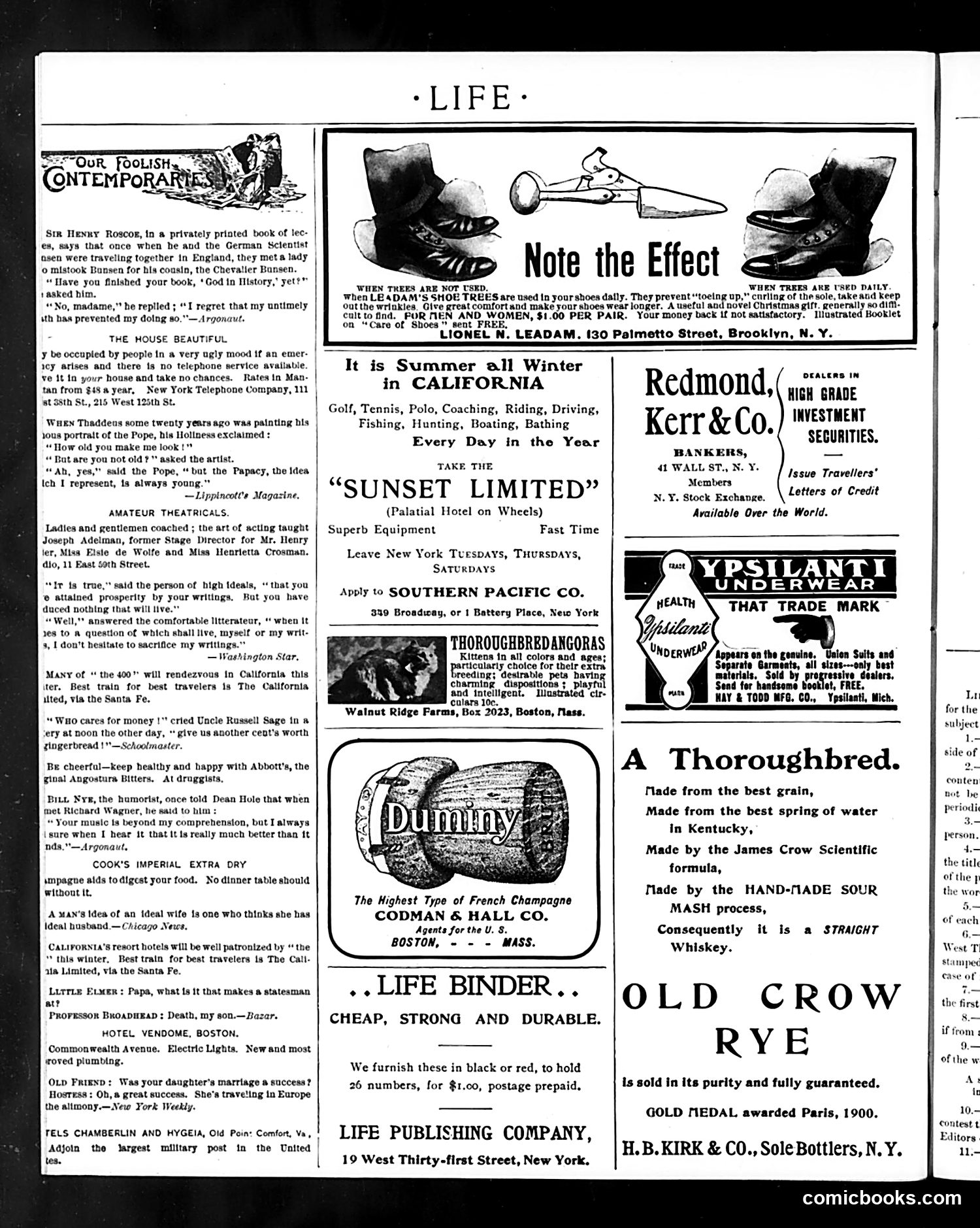
This page is primarily **advertising** with brief satirical anecdotes at the top—typical of Life magazine's format mixing humor and commercial content. The main illustrated advertisement shows **shoe trees** ("Leadam's Shoe Trees") with a before/after comparison demonstrating how the device prevents shoes from curling and wrinkling. The satire lies in the implicit mockery of Victorian consumer culture: the ad seriously markets a mundane product as a practical necessity for fashionable people. The text anecdotes mock intellectual pretension and vanity: one features German scientist Bunsen mistaken for his cousin; another shows a Pope defending his age by claiming the Papacy is eternally young. A third satirizes a writer who prioritizes his own survival over his literary legacy. Additional advertisements promote California travel, champagne, whiskey, and hotels—all pitched to wealthy readers. The overall page reflects **turn-of-century American consumer aspirations** and gentle mockery of the privileged classes' concerns with material goods and self-importance.
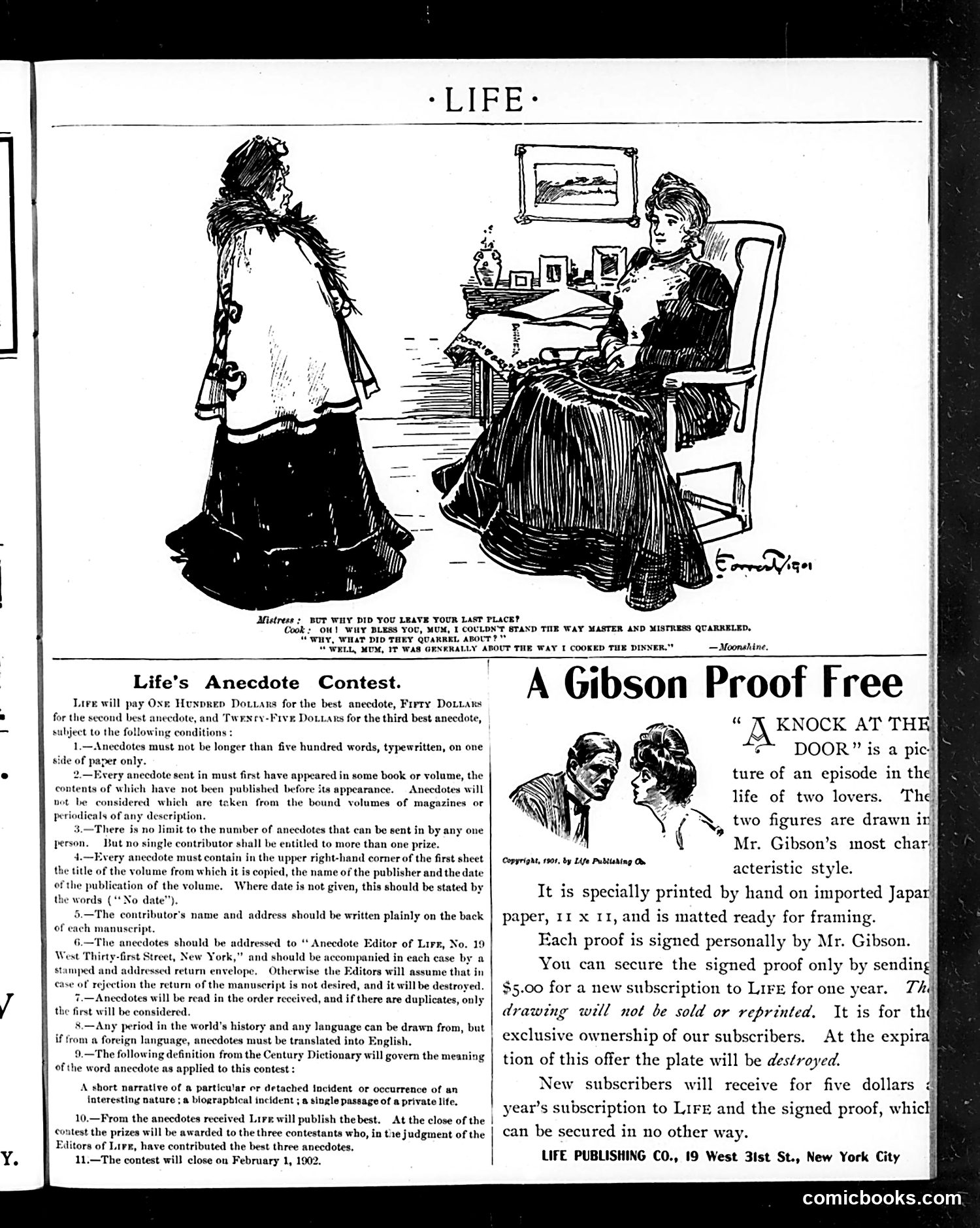
This page combines humor and advertising from Life magazine (circa 1901-1902). **The Cartoon:** A domestic servant explains to a prospective mistress why she left her last position. The joke's irony: she couldn't tolerate her employers' constant quarreling—specifically about *her cooking*. The humor lies in the servant's obliviousness; she's inadvertently revealing her own inadequacy as the cause of the household discord, not understanding she's arguing against her own competence. **The Contests & Advertising:** The bulk of the page announces Life's anecdote-writing contest (with cash prizes up to $100) and promotes Charles Dana Gibson's signed artwork proof ("A Knock at the Door") available exclusively through a $5 subscription. Gibson was Life's famous illustrator; the exclusive, limited-edition approach (the plate would be "destroyed" after the offer) created scarcity value and incentivized subscriptions. Together, these elements showcase Life's business model: humor content mixed with subscription-driving promotions featuring their star artist.
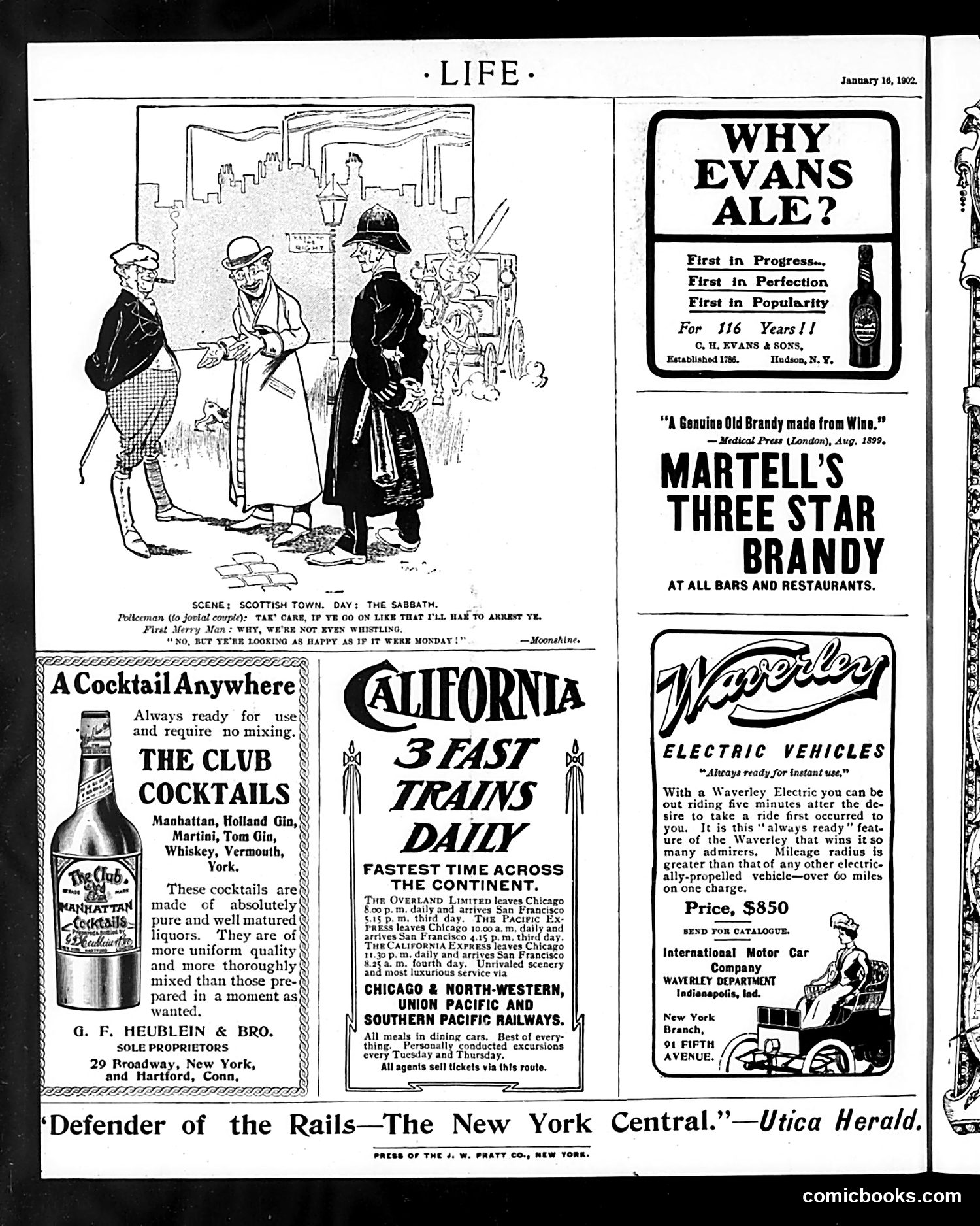
The main cartoon satirizes Scottish Sabbath (Sunday) observance laws. A policeman warns a cheerful couple that merely *looking happy* on Sunday violates religious restrictions—they needn't be doing anything improper (they're "not even whistling"), but their visible contentment on the Lord's day is itself arrestable. The joke targets the strict Calvinist traditions of Scotland, where Sabbath laws historically prohibited worldly behavior and merriment. The humor lies in the absurdity: the couple's mere *demeanor* of Monday-like happiness constitutes a civil offense. This reflects real historical tensions between rigid religious enforcement and ordinary human cheerfulness. The rest of the page comprises period advertisements for cocktails, brandy, trains, and early electric vehicles—typical Life magazine content from 1902. These ads are unrelated to the cartoon's social commentary on religious restriction.