
Life, 1902-01-16 · page 14 of 20
Life — January 16, 1902 — page 14: what you’re looking at
What you’re looking at
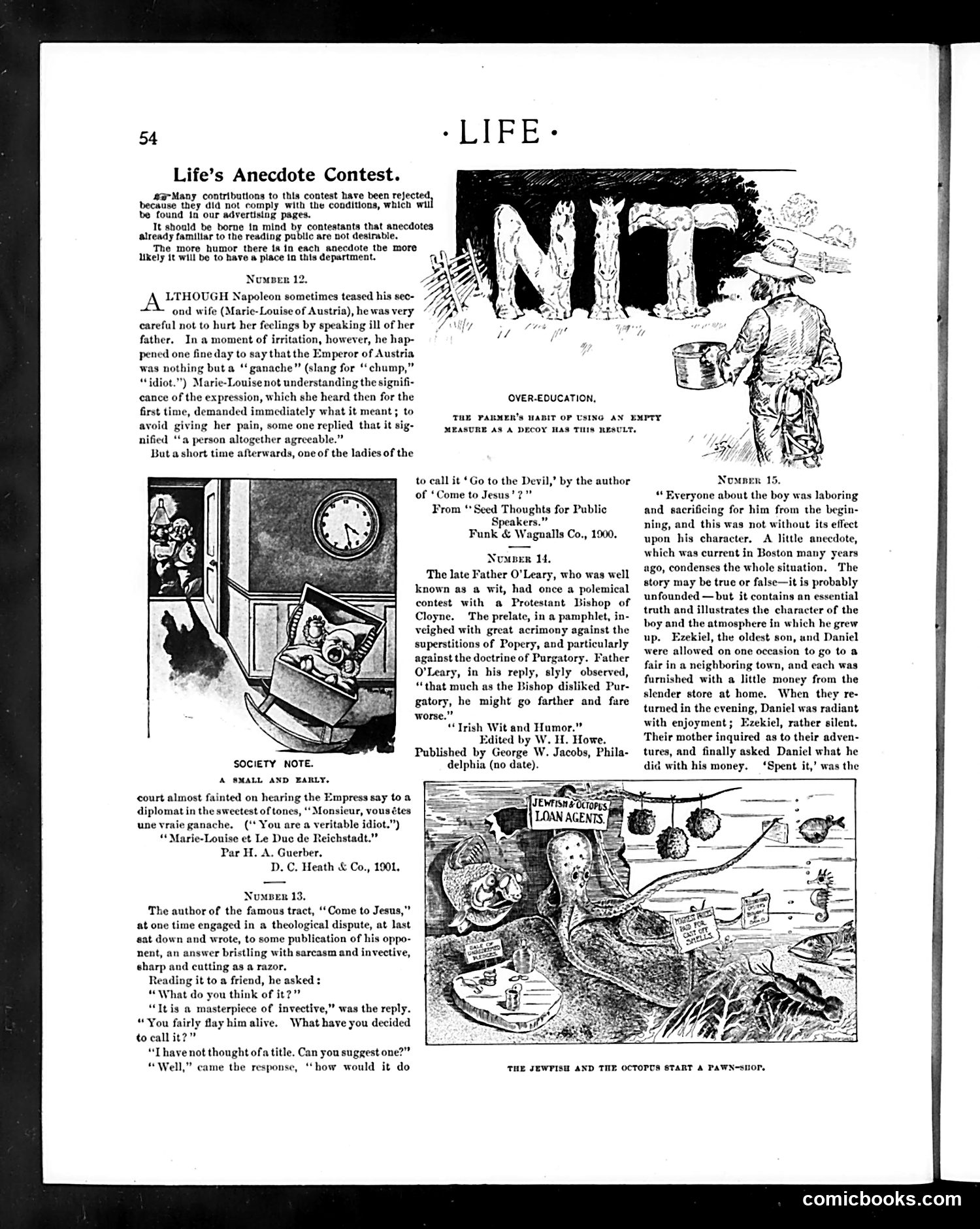
This page presents *Life* magazine's "Anecdote Contest," featuring four humorous historical anecdotes submitted by readers: **Number 12** tells of Napoleon's wife Marie-Louise unknowingly insulting her own father (the Austrian Emperor) by calling him a "ganache" (idiot)—a slang term she didn't understand but was told meant "agreeable." **Number 13** satirizes theological hypocrisy: a religious author writes a scathing attack on an opponent, then struggles to title it—his friend suggests calling it "Go to the Devil" by the author of "Come to Jesus?" **Number 14** features Irish Catholic wit Father O'Leary outwitting a Protestant bishop in debate through clever wordplay about Purgatory. **Number 15** (incomplete here) appears to be a morality tale about two boys at a fair, contrasting their character through how they spent money. The cartoons are unrelated to these anecdotes—one shows "Over-Education" (farmers using deceptive measures), the other depicts "The Jewish and the Octopus Start a Pawn-Shop," likely a period caricature.
📄 Transcribed text from this page (OCR, searchable)
Machine-transcribed from the original scan — historical spelling and the odd misread are preserved.
54 Life’s Anecdote Contest. 4#a-Many contributions to this contest have been reject because they did not comply with the conditions, which be found in our advertising pages. Tt shoald be borne in mind by contestants that anecd already familiar to the reading public are not desirable. Th Ukely it will be to have a place in this department. Nomper 12. LTHOUGH Napoleon sometimes teased his sec- will jotes @ more humor there a in each anecdote the more ond wife (Marie-Louise of Austria), hewas very / careful not to hurt her feelings by speaking ill of her father. In a moment of irritation, however, he hap- pened one fine day to say that the Emperor of Austria was nothing but a “ganache” (slang for “chump,” “idiot.”) Marie-Louise not understanding the signifi- cance of the expression, which she heard then for the first time, demanded immediately what it meant; to avoid giving her pain, some one replied that it sig- nified “a person altogether agreeable.” But a short time afterwards, one of the ladies of the SOCIETY NOTE. A SMALL AND EARLY. court almost fainted on hearing the Empress say to a diplomat in the sweetest of tones, “Monsieur, vous étes une vraie ganache. (‘* You are a veritable idiot.”) “Marie-Louise et Le Duc de Reichstadt.”” Par H. A. Guerber. D.C. Heath & Co., 1901, Number 13, The author of the famous tract, ‘Come to Jesus,” at one time engaged in a theological dispute, at last eat down and wrote, to some publication of his oppo- nent, an answer bristling with sarcasm and invective, sharp and cutting as a razor. Reading it to a friend, he asked: “What do you think of it?” “It is a masterpiece of invective,” was the reply. “You fairly flay him alive. What have you decided to call it?” “Lhave not thought ofa title. Can you suggest one?” “Well,” came the response, “how would it do OVER-EDUCATION, THE PARMER's HABIT OF USING AN EMPTY MEASURE AS A DECOY HAS THIS RESULT. to call it ‘Go to the Devil,’ by the author of ‘Come to Jesus? ?” From “Seed Thoug! Speaker Funk & Wagnalls Co., 1900. for Public Number 14, The Jate Father O'Leary, who was well known as a wit, had once a polemical contest with a Protestant Bishop of Cloyne. The prelate, in a pamphlet, in- veighed with great acrimony against the superstitions of Popery, and particularly against the doctrine of Purgatory. Father O'Leary, in his reply, slyly observed, “that much as the Bishop disliked Pur- gatory, he might go farther and fare worse.” “Trish Wit and Humor.” Edited by W. H. Howe. Published by George W. Jacobs, Phila- delphia (no date). Noopen 15. “ Everyone about the boy was laboring and sacrificing for him from the begin- ning, and this was not without its effect upon his character, A little anecdote, which was current in Boston many years ago, condenses the whole situation. The story may be true or false—it is probably unfounded — but it contains an essential truth and illustrates the character of the boy and the atmosphere in which he grew up. Kiel, the oldest son, and Daniel were allowed on one occasion to go to a fair in a neighboring town, and each was furnished with a little money from the slender store at home. When they re- turned in the evening, Daniel was radiant with enjoyment; Ezekiel, rather silent. Their mother inquired as to their adven- tures, and finally asked Daniel what he did with his money. ‘Spent it,’ was the ‘THE JEWPISH AND THE OCTOPUS START A PAWN-sHor. comicbooks.com