
A complete issue · 20 pages · 1901
Life — July 11, 1901
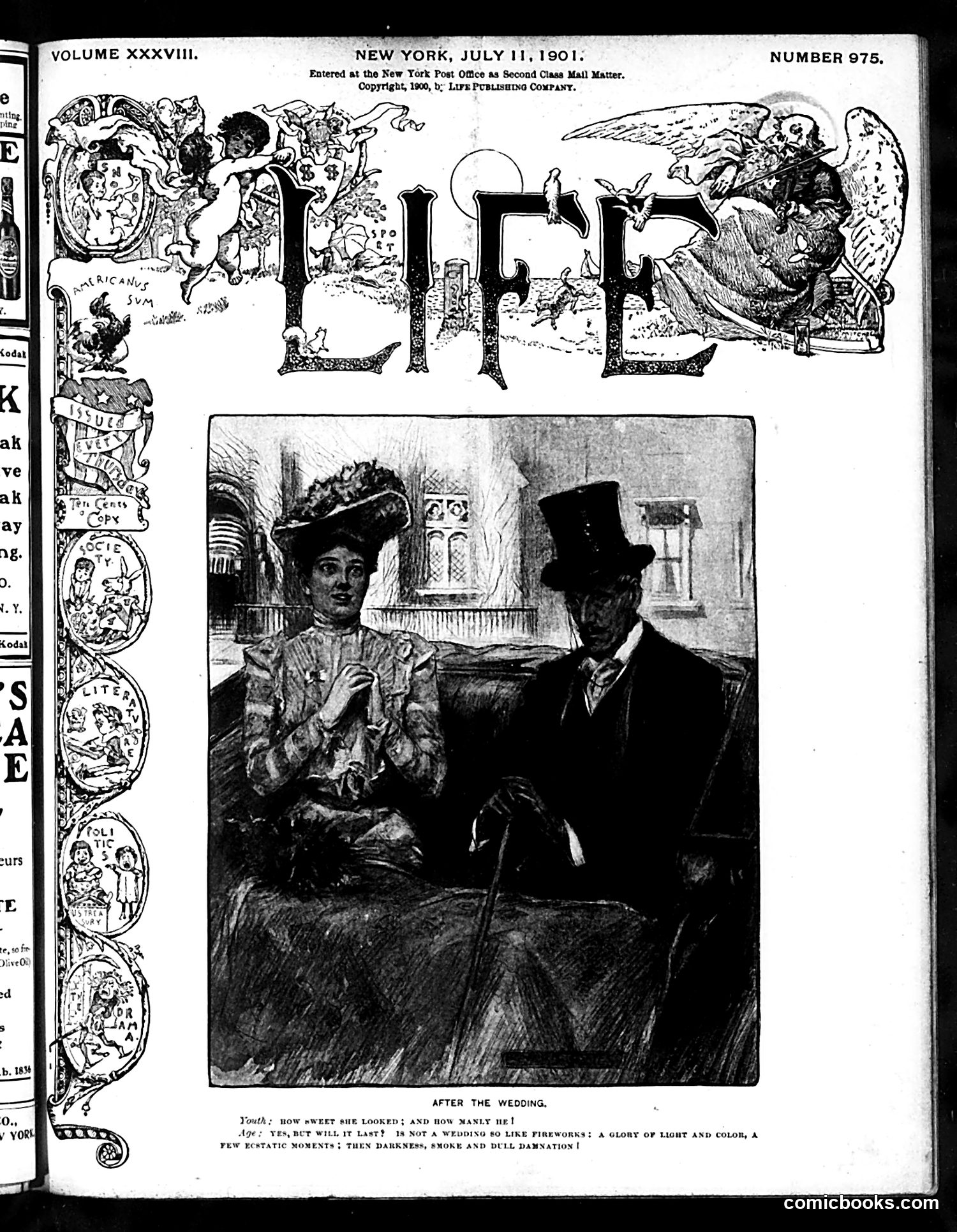
This page features an illustration titled "After the Wedding" showing a couple in a domestic interior. The woman wears an elaborate Edwardian dress and hat; the man wears formal attire with a top hat. The caption reads: "How sweet she looked! and how meekly he / 'Yes, but will it last? Is not a wedding so like the fireworks: a glory of light and color, a few ecstatic moments! then darkness, smoke and dull damnation!" The satire mocks the disillusionment following marriage—contrasting the idealized romantic wedding experience with the mundane or disappointing reality of married life. This reflects early 1900s cynicism about matrimonial expectations, particularly the gap between courtship fantasy and domestic reality. The decorative header with cherubs emphasizes the romantic theme being satirized.
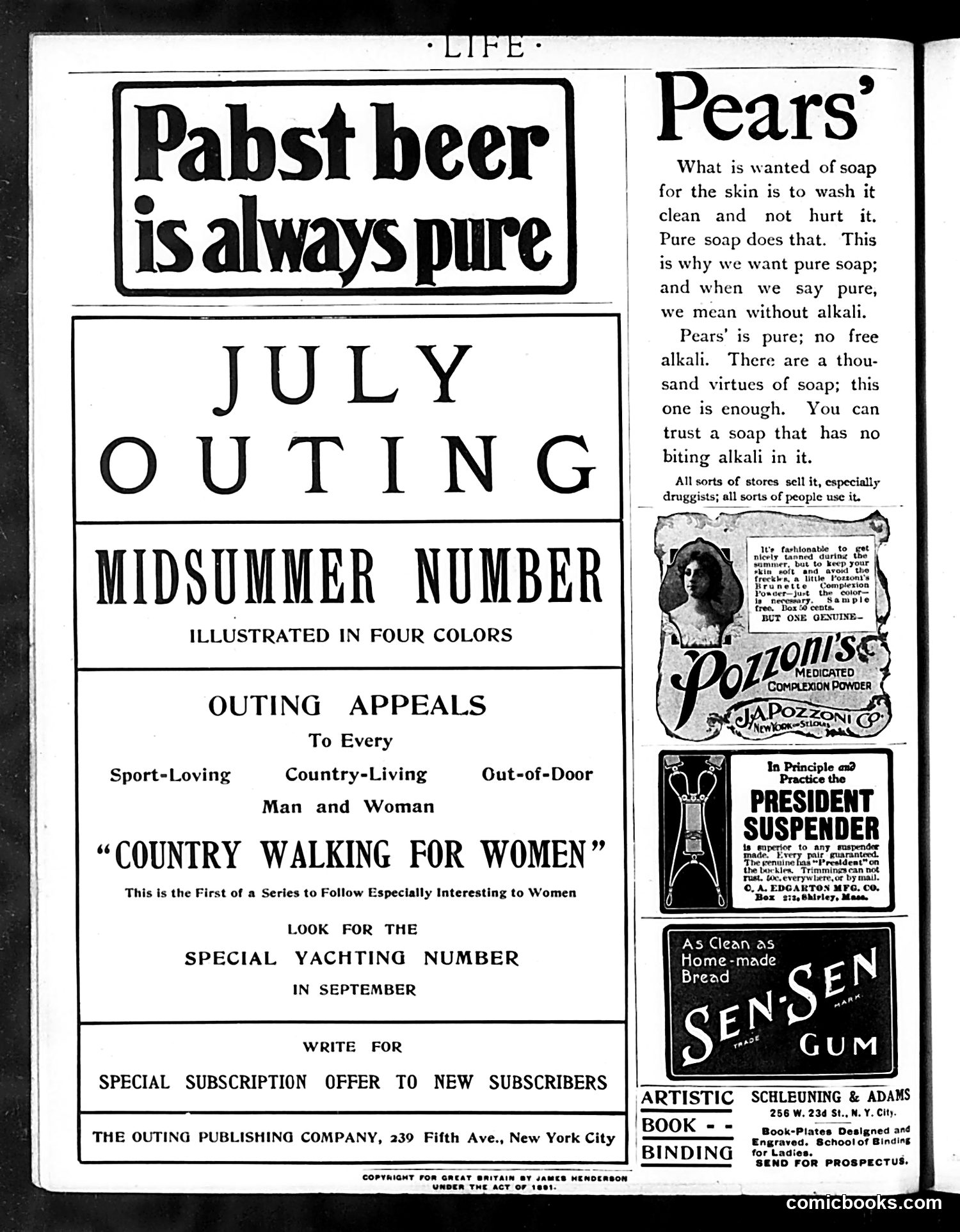
This page is primarily **advertising and promotional content** rather than satirical cartoons. The left side promotes *Life* magazine's July outing midsummer number, featuring outdoor recreation content aimed at "Sport-Loving," "Country-Living," and "Out-of-Door" audiences. It advertises a series on "Country Walking for Women" and upcoming special issues. The right side contains **period product advertisements**: Pears' soap (emphasizing purity and lack of alkali), Pozzoni's medicated complexion powder, a "President Suspender" corset device, Sen-Sen gum, and book binding services. No political cartoons or satire appear on this page. The content reflects early 20th-century consumer culture and gender-specific marketing, with particular emphasis on women's beauty and outdoor leisure activities.
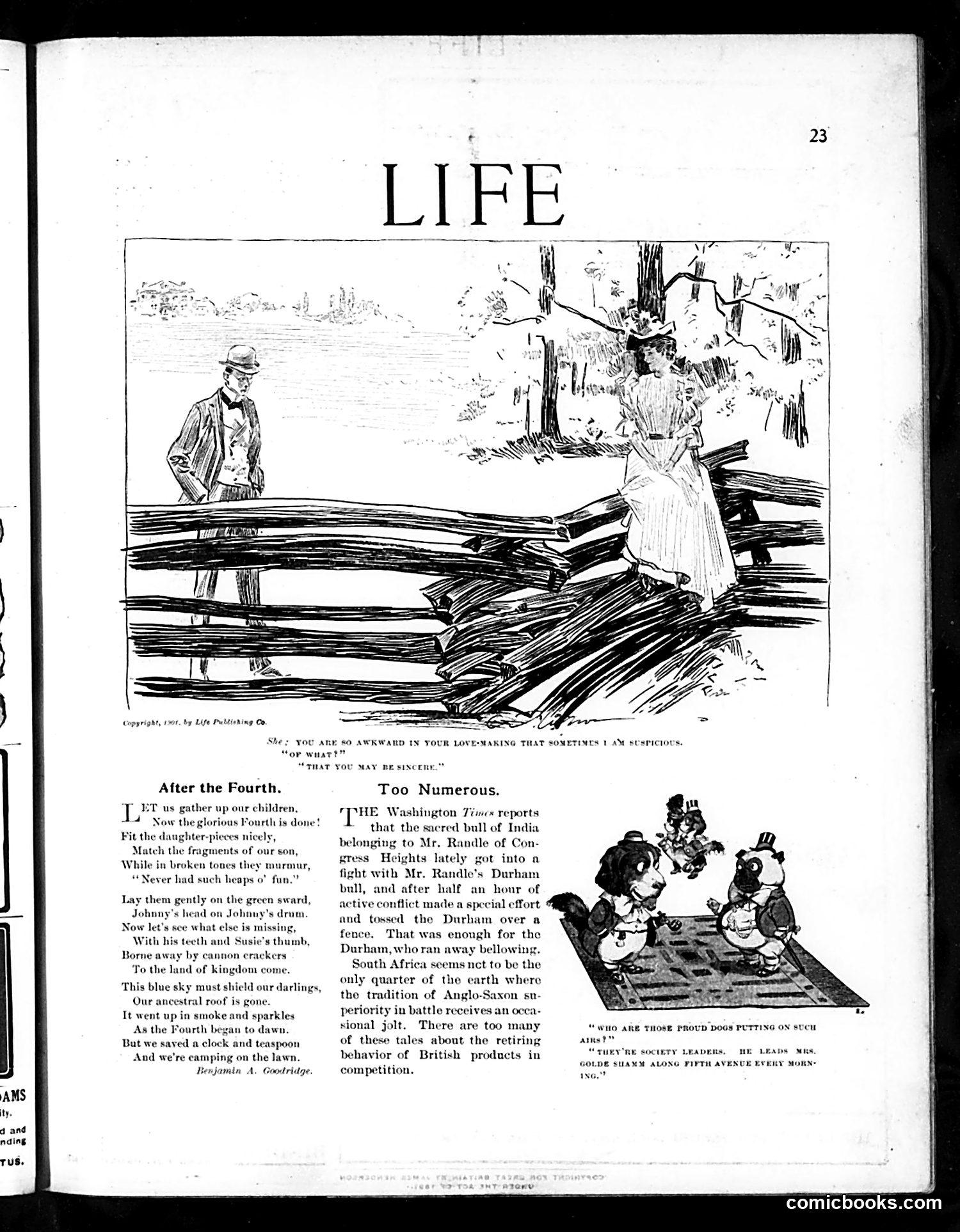
The main illustration shows a man and woman at a rustic fence, with a caption about the man's awkwardness in love-making. This appears to be a romantic/social humor cartoon typical of Life's period content. Below are two articles: "After the Fourth" (a poem by Benjamin Goodridge about Independence Day celebrations) and "Too Numerous" (discussing a Washington Times report of a fight between Mr. Randle and Mr. Randle's Durham bull in Congress Heights, satirizing the chaos and excessive anecdotes about British military conduct in South Africa). The small cartoon at bottom right depicts men with dogs, mocking New York "society leaders" and Goldie Shaw's Fifth Avenue activities—social satire of wealthy New Yorkers. The page combines romantic humor with political/social commentary typical of early 20th-century American satire.
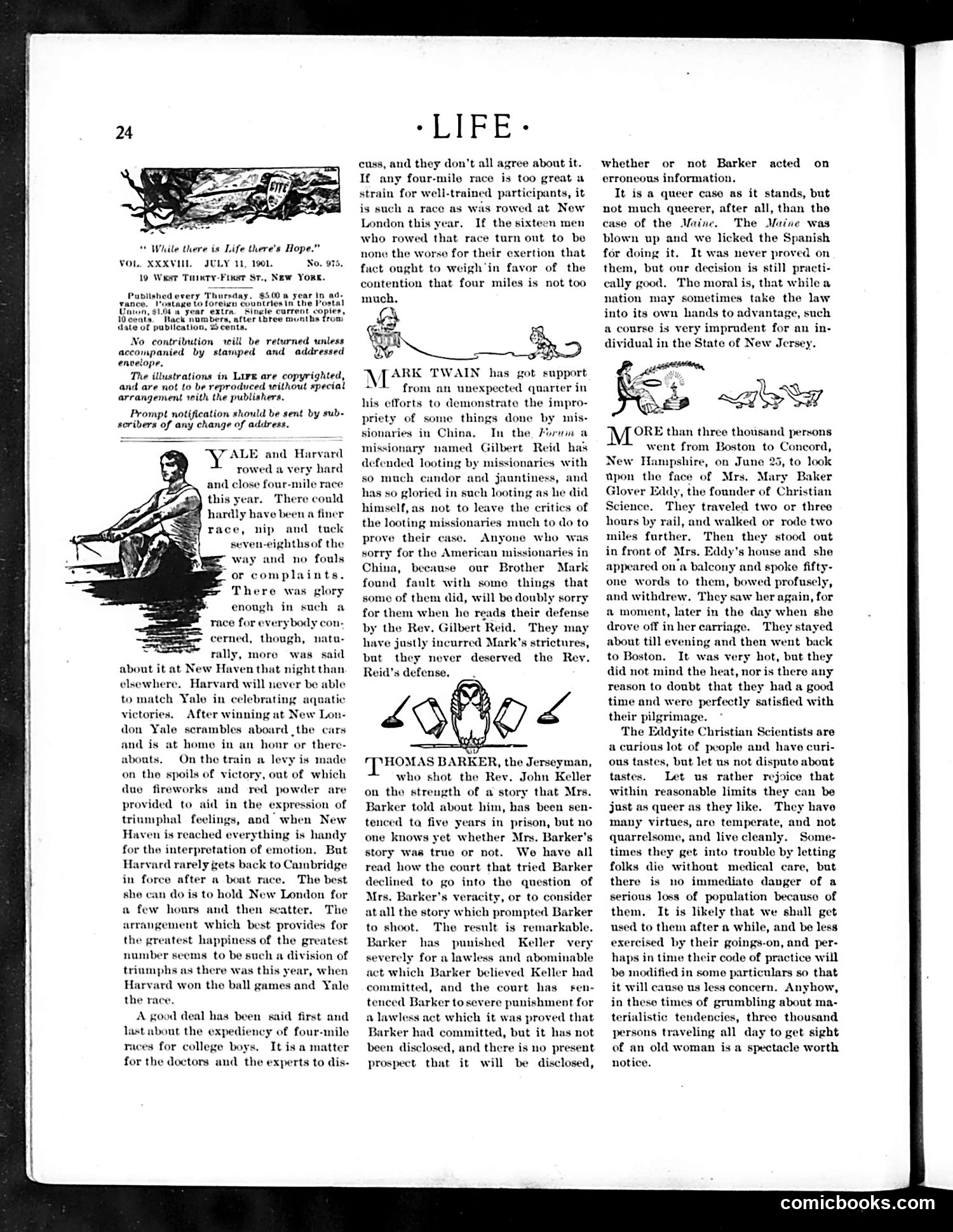
This page contains three distinct pieces of commentary: 1. **Yale vs. Harvard rowing dispute**: The left illustration depicts competitive college rowing. The text discusses a four-mile race controversy between Yale and Harvard, debating whether such distances strain athletes appropriately. 2. **Mark Twain and missionary work**: A paragraph supports Mark Twain's criticism of American missionaries in China, specifically defending his attacks on missionary Gilbert Reid against clerical pushback. 3. **Thomas Barker case**: The main article discusses a New Jersey man convicted of shooting Rev. John Keller. The text examines uncertainty about Mrs. Barker's testimony and whether Barker deserves his five-year sentence, questioning whether justice was properly served. 4. **Ledyite Christian Scientists**: A brief satirical note mocks this religious group's practices and their casual attitude toward medical care and population loss.
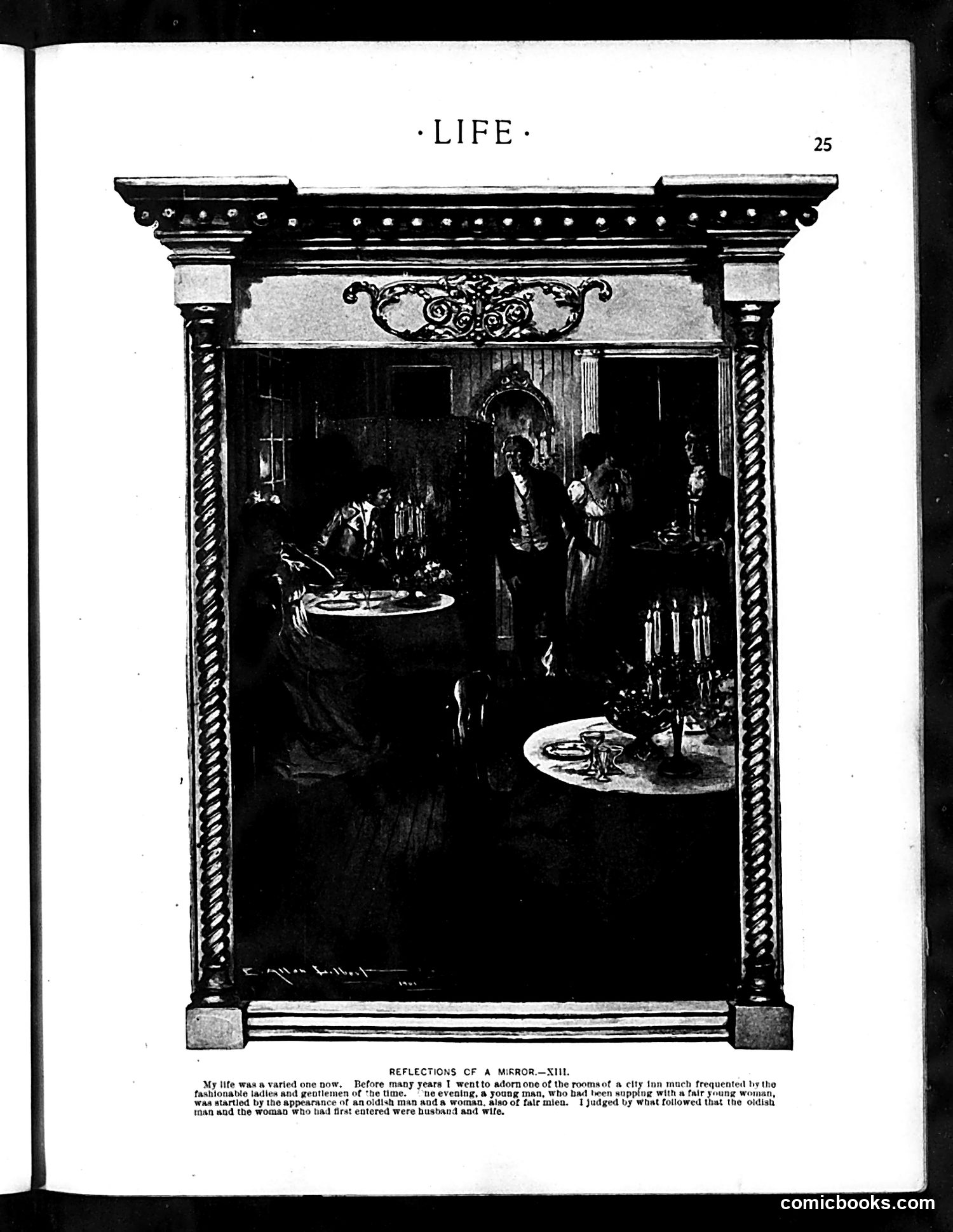
This illustration depicts a formal dinner party scene viewed through an ornate mirror frame. The caption describes the narrator entering a city inn's dining room and observing a "stylish woman and gentleman" at dinner with "a young man, who had been supping with a fair young woman." The narrator notes the woman leaves, and judges by "what followed that the initial man and woman who had first entered were husband and wife." The satire appears to target Victorian-era infidelity and hypocrisy—the contrast between respectable public appearances (the formal dinner) and private moral failings. The mirror frame device suggests exposure of hidden truths about society's "refined" classes.
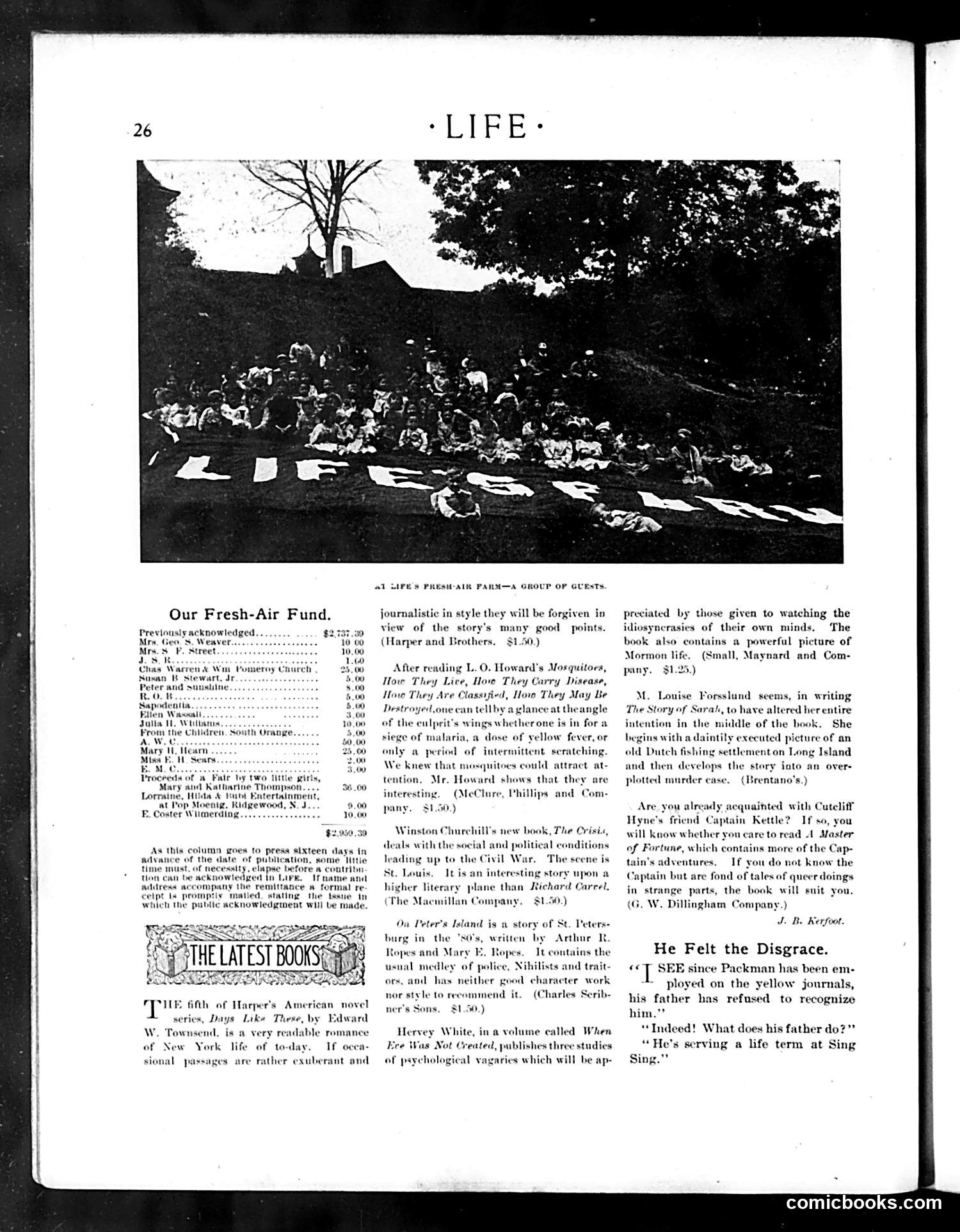
This page is primarily **book reviews and literary criticism**, not political satire. The main image shows a "Fresh-Air Fund" gathering—a charitable picnic for underprivileged urban children. The caption identifies it as "A LIFE + FRESH-AIR FUND—A GROUP OF GUESTS." This reflects Life's occasional coverage of contemporary social welfare initiatives. The page reviews several books including works on Civil War history and social conditions. One review discusses Winston Churchill's *The Crisis*, describing it as dealing with "social and political conditions leading up to the Civil War." The brief story "He Felt the Disgrace" at bottom involves someone named Peckham who's ashamed his father refuses to recognize him and is serving time at "Sing Sing" (the prison). This is primarily **literary content**, not satirical cartooning.
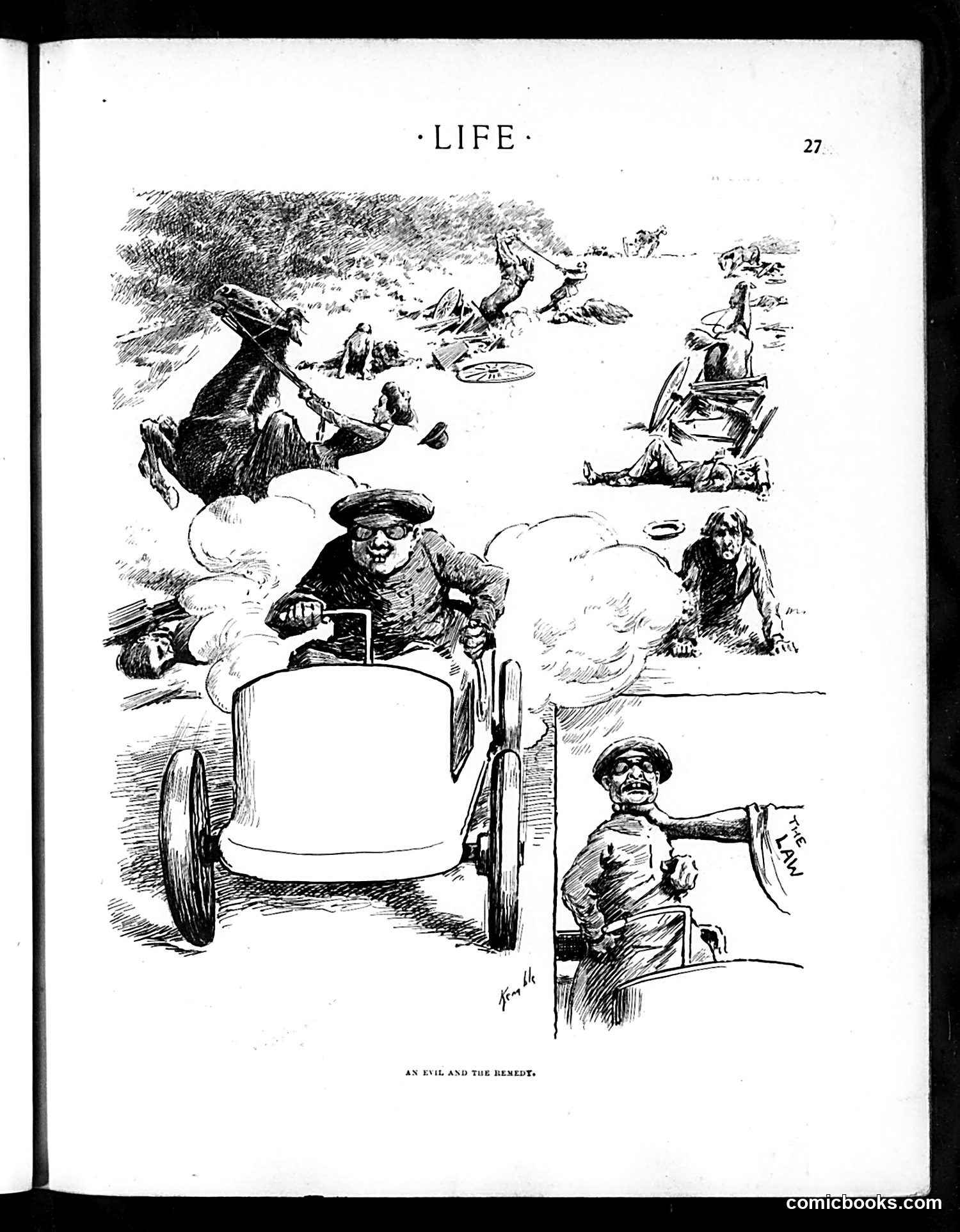
This political cartoon depicts a wealthy, rotund businessman in a large automobile—the "evil"—while a working-class man beside the vehicle represents the "remedy." The contrast suggests satirical commentary on class inequality and labor issues. The chaotic background scenes show various accidents and disasters, implying the automobile (or perhaps capitalism/wealth concentration it represents) causes social harm. The well-dressed driver appears oblivious or indifferent to the carnage around him. The "remedy" figure—likely representing organized labor, reform, or working-class resistance—stands ready to address these problems. This reflects early 20th-century American anxieties about industrialization, wealth disparity, and the need for social reform or worker protections against the excesses of industrial capitalism.
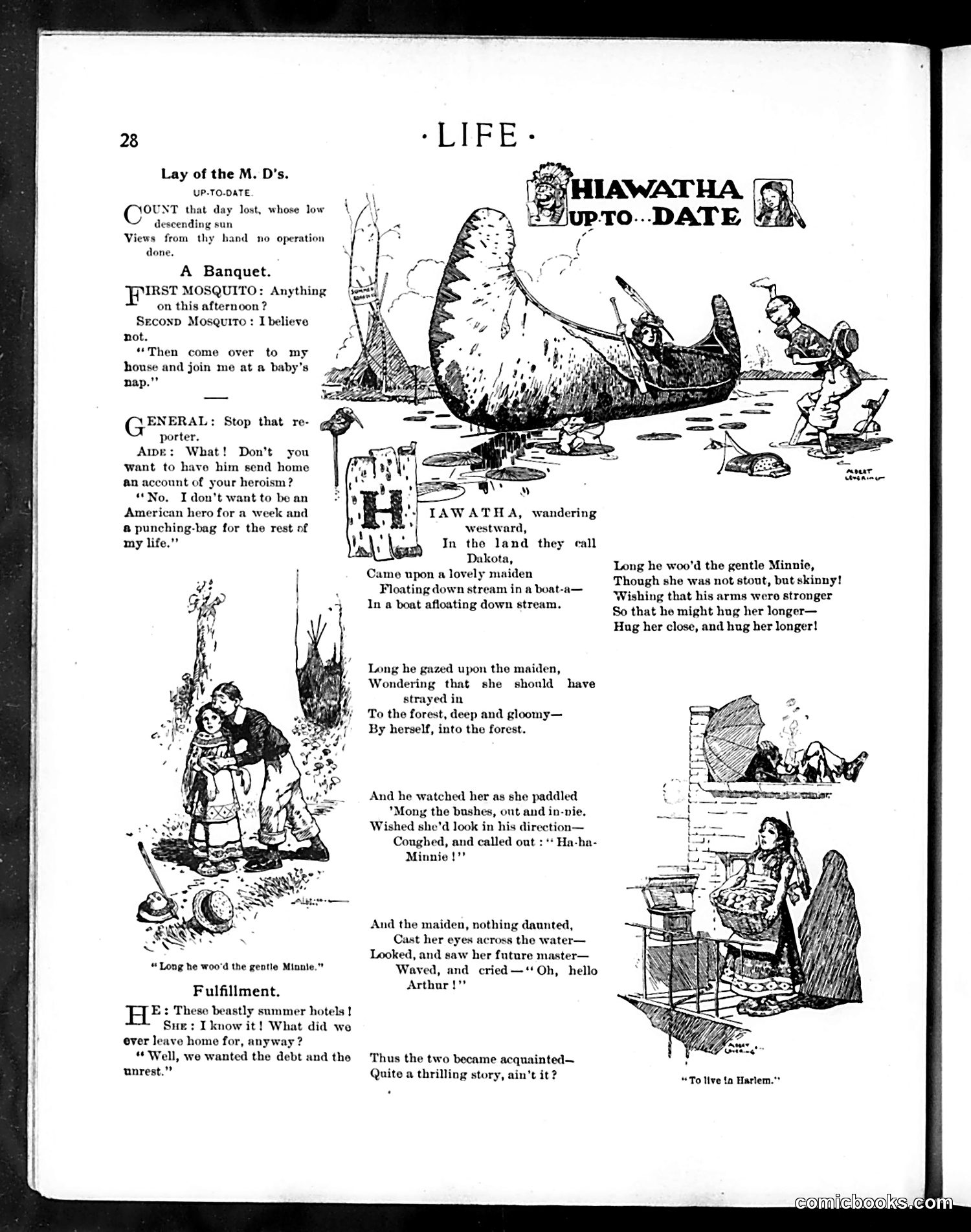
This page presents a humorous adaptation of Longfellow's "Song of Hiawatha" into modern American settings. The satirical feature reimagines the famous Native American romance through contemporary scenes: The central narrative follows Iawatha (a wandering westerner in Dakota) encountering a maiden floating downstream in a boat. The romantic poem is updated with American frontier imagery and dialogue. The left side includes unrelated satirical content mocking wealthy summer hotels ("these beastly summer hotels") and their guests' financial escapades. The cartoons and illustrations throughout employ period stereotypes and comedic exaggeration typical of early 20th-century American satire, treating both literary classics and contemporary social institutions as targets for humorous reinterpretation. The piece relies on readers' familiarity with Longfellow's original text.
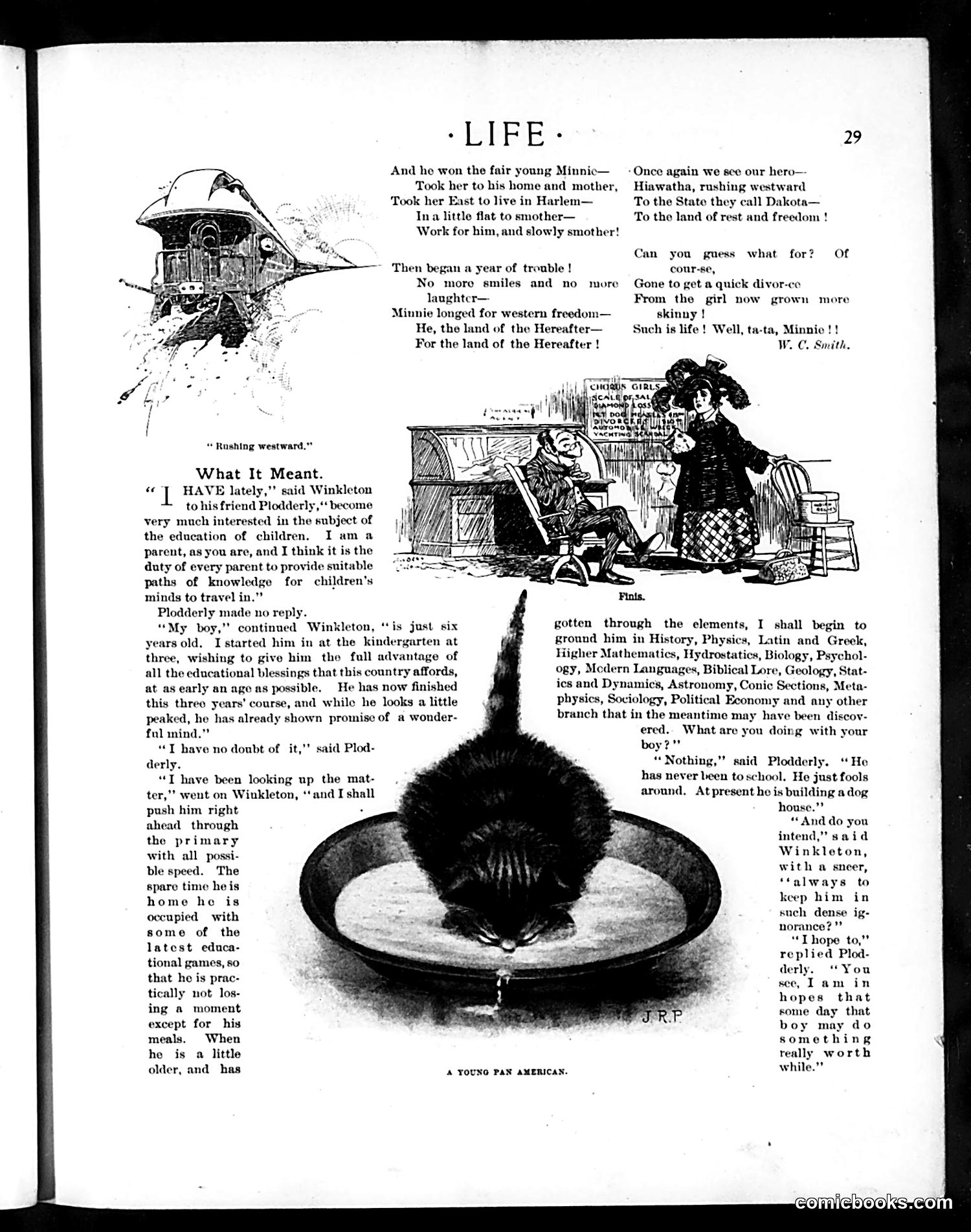
This page from *Life* magazine contains two distinct pieces: **"Rushing Westward"** (top): A poem about a character named Minnie who married a man, moved to Harlem with him, but found married life disappointing ("no more smiles and no more laughter"). She ultimately leaves him to pursue "western freedom" and "the land of the Hereafter"—obtaining a divorce and moving to Dakota. The satire mocks both unhappy marriages and the period's fascination with westward migration as an escape route. **"What It Meant"** (bottom): A dialogue between "Winkleton" and "Plodderly" debating children's education. Winkleton advocates rigorous academics; Plodderly defends letting his six-year-old son remain uneducated, claiming he's "building a dog house." The satire criticizes parental negligence and anti-intellectual attitudes toward childhood development. Both pieces target contemporary social attitudes through exaggeration.
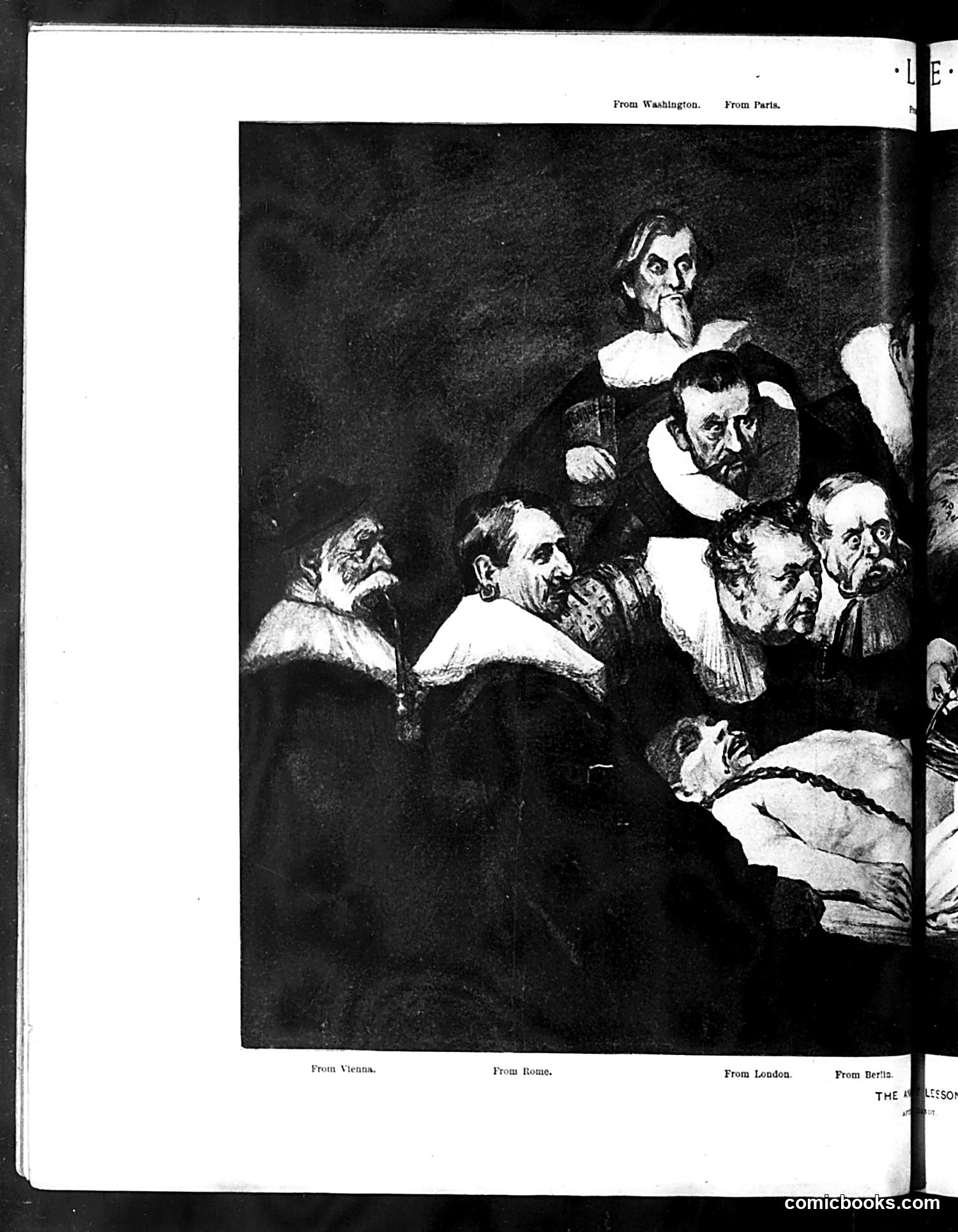
This appears to be a comparative political cartoon showing the same scene rendered by artists "From Washington," "From Paris," "From Vienna," "From Rome," "From London," and "From Berlin." The image depicts what appears to be a formal gathering of several men in period dress (white collars, dark coats), with one figure standing elevated above the others in a commanding position. The seated or lower-positioned figures display various expressions of concern or deference. The satire works by showing how different European and American artistic traditions would depict an identical political scenario differently—through their distinct visual styles and cultural perspectives. This likely comments on international diplomacy or a significant political moment being interpreted through different national viewpoints. The specific historical event, however, cannot be determined from the visible text alone.
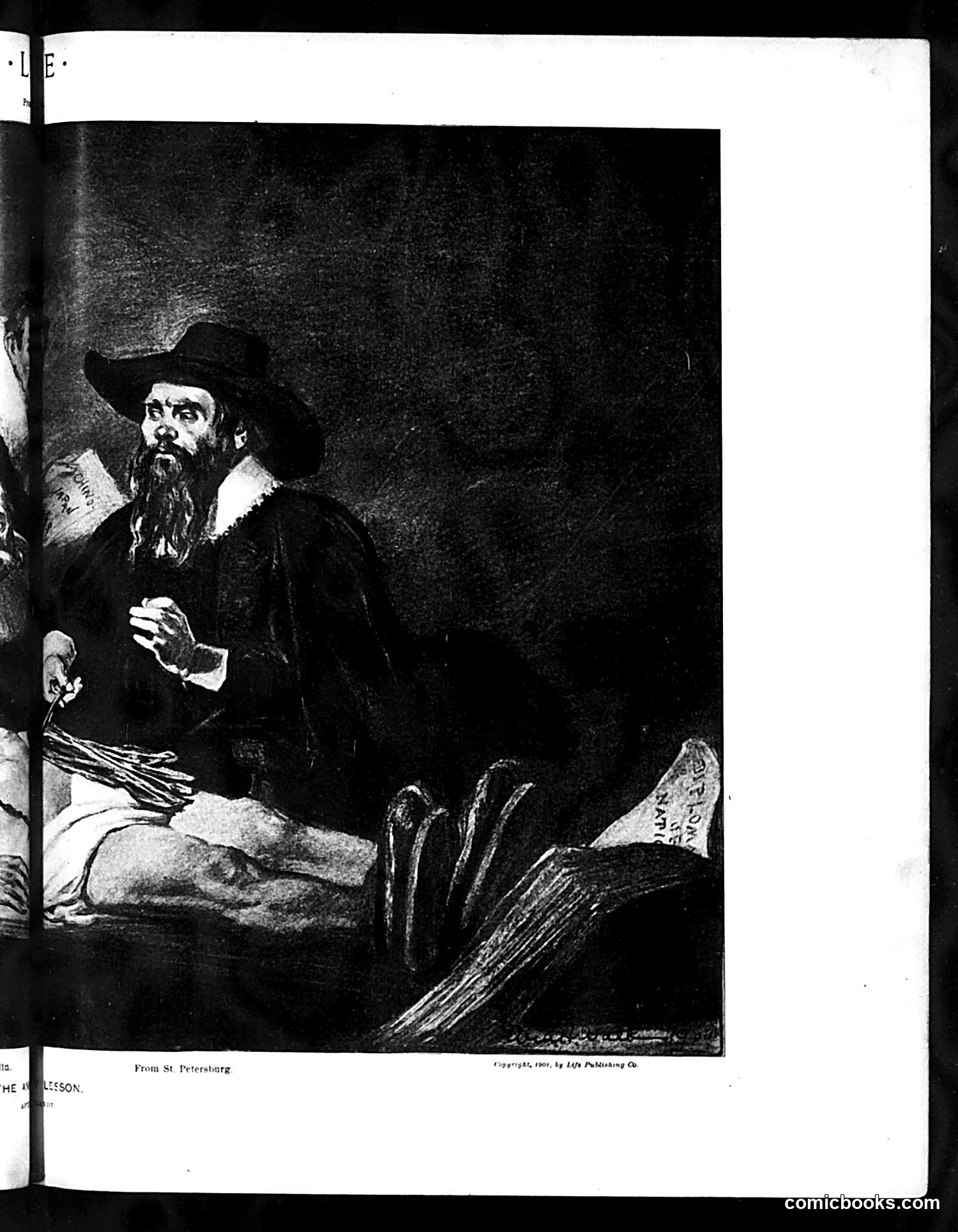
This appears to be a satirical illustration titled "From St Petersburg," depicting a bearded man in period dress (dark coat, white collar, hat) seated and holding what appears to be brushes or artistic implements. The figure is rendered in a style suggesting Russian or Eastern European origin. Without additional visible text identifying the specific subject, I cannot definitively name the figure or explain the precise political satire. However, the "St Petersburg" caption suggests commentary on Russian affairs or a Russian historical/political figure. The artistic implements suggest possible satire about propaganda, artistic control, or cultural influence. The copyright notice indicates publication by Life Publishing Co., dating this to their active period as a satirical magazine. More context would be needed to fully explain the intended satirical message to modern readers.
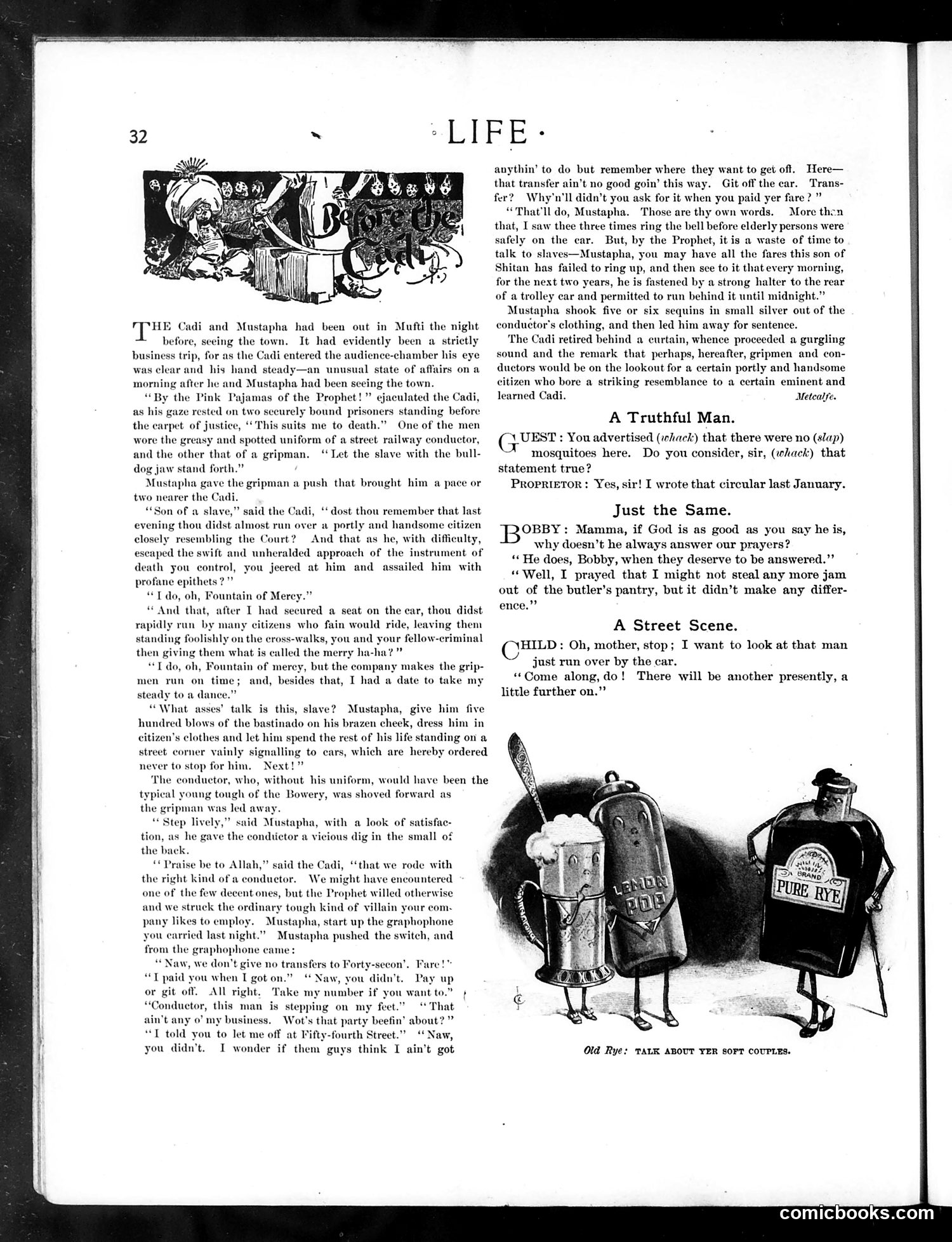
This page contains a serialized story about a streetcar conductor named the Cadi and his interaction with a character named Mustapha. The narrative satirizes the Cadi's abusive treatment of passengers and enslaved people, depicting him as corrupt and brutal—he boasts of assaulting citizens and extorting money. The bottom illustration, titled "Old Rye: Talk About the Soft Couples," shows anthropomorphized bottles of liquor (appears to be Pure Rye whiskey and another spirit) as cartoon characters having a conversation. This is a humorous visual pun using personified bottles as social commentary on alcohol consumption. The page primarily focuses on serialized fiction rather than political satire, though the Cadi story contains social criticism regarding abuse of power.
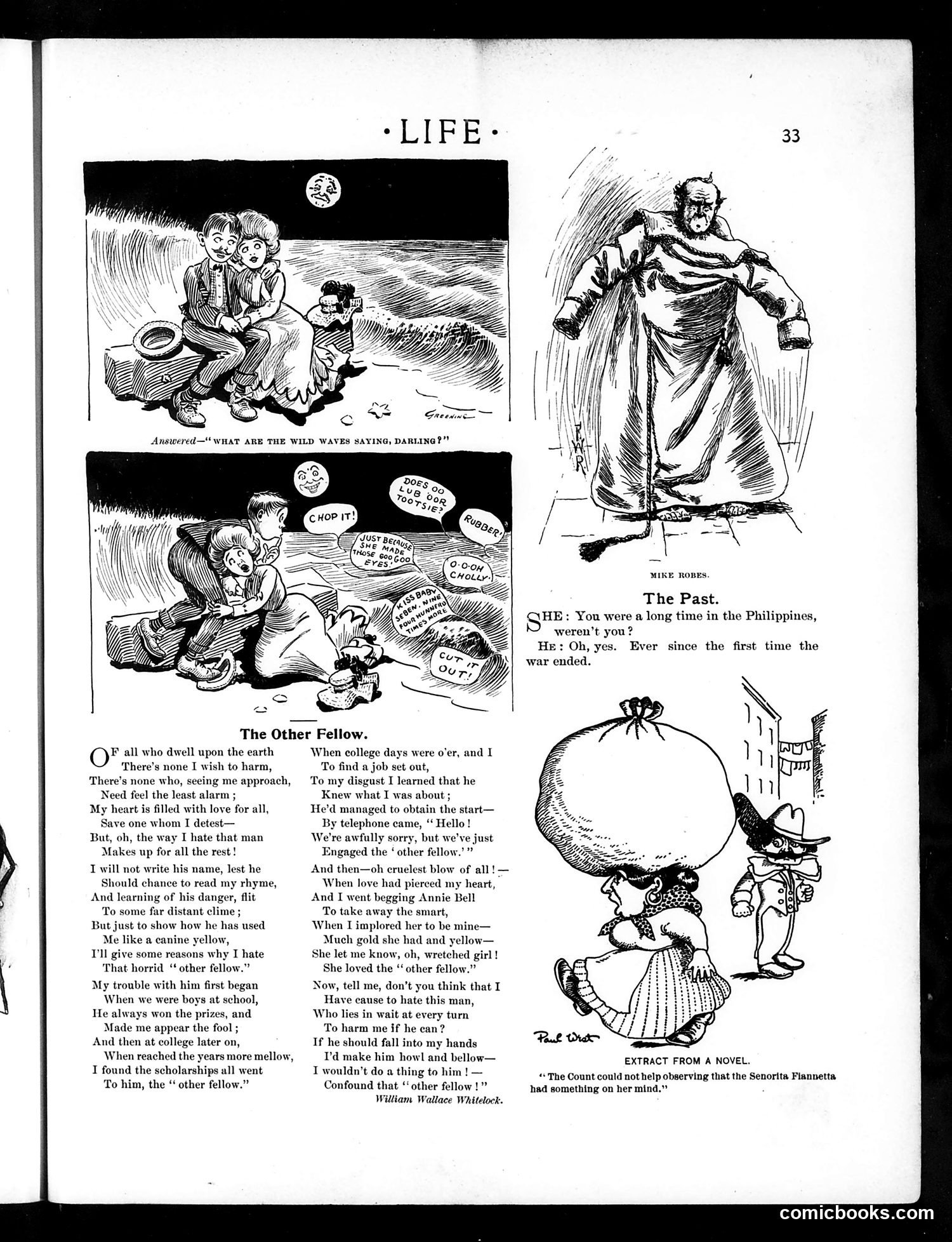
This page contains two distinct pieces of satire: **"The Other Fellow"** (left): A poem by William Wallace Whitelock satirizing competitive envy and petty rivalry. The narrator claims to love everyone except one man who has consistently outcompeted him—winning school prizes, scholarships, job opportunities, and even his romantic interest Annie Bell. The satire works by having the narrator declare he wouldn't actually harm this rival while simultaneously expressing violent rage ("make him howl and bellow"), exposing how trivial grievances can fuel disproportionate hatred. It's social commentary on how people rationalize resentment. **"The Past"** (right): A brief dialogue joke about the Philippine-American War. The humor lies in the phrase "Ever since the first time the war ended"—implying the war had *multiple* endings, likely referencing the conflict's ongoing nature despite official declarations of peace. It mocks the ambiguous or cyclical nature of the conflict rather than its definitive conclusion. Both pieces use humor to critique human behavior and contemporary events.
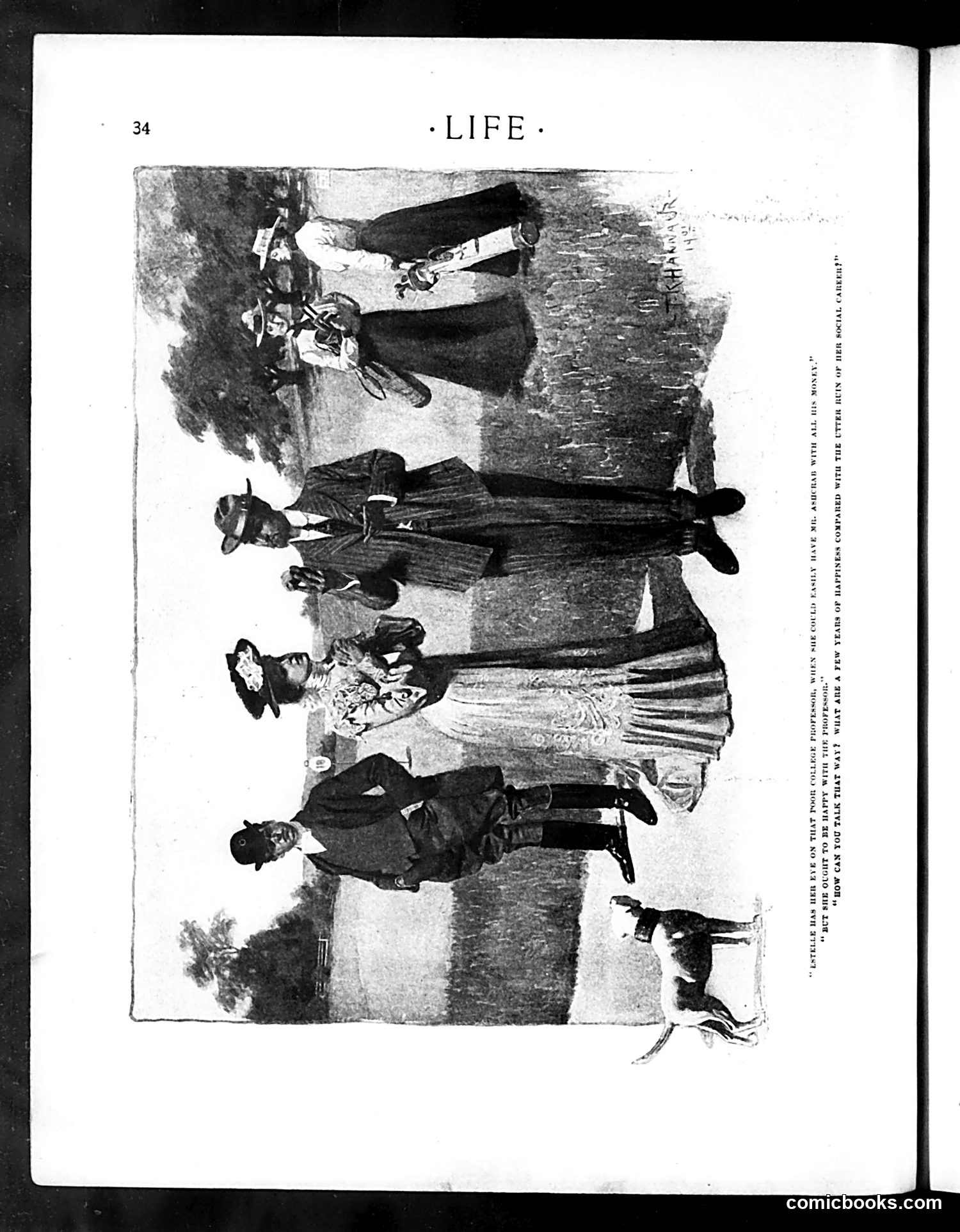
I can see this is page 34 from *Life* magazine, but the image is rotated 90 degrees, making it difficult to read the caption text clearly. The photograph shows what appears to be five people in period clothing (likely early 20th century based on the style), arranged vertically on the page. However, without being able to reliably read the OCR text or caption that would identify these figures and explain the satirical point, I cannot accurately tell you who these people represent, what political or social issue is being referenced, or what the joke or satire is meant to convey. The OCR text provided is too corrupted to be useful. To give you an accurate explanation, I would need either a clearer image or legible caption text.
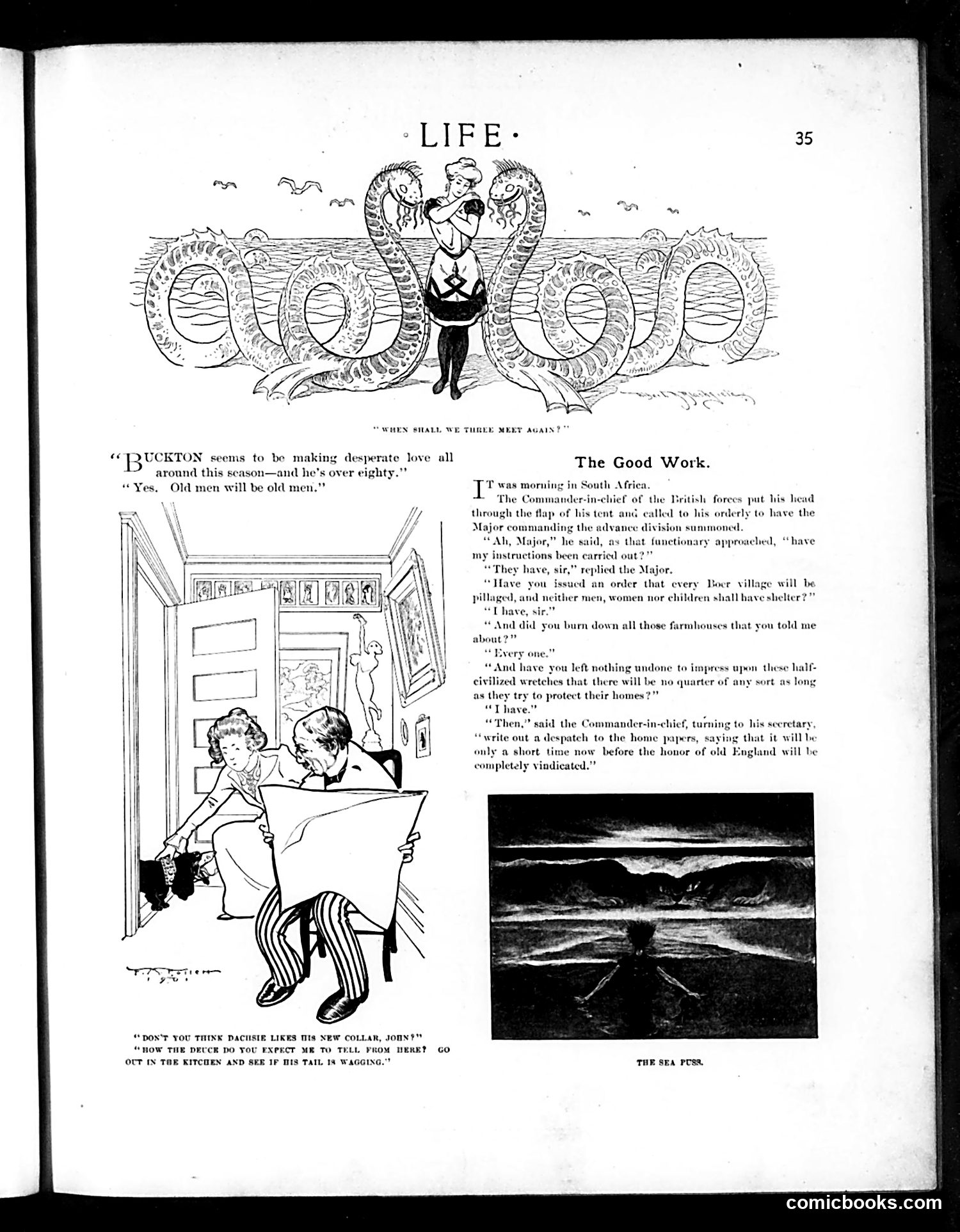
**Top Cartoon:** A satirical drawing of a man surrounded by cobra snakes, captioned "When Shall We Three Meet Again?" This appears to reference someone (possibly a public figure named Buckton) making romantic pursuits in old age—a social joke about elderly men's behavior. **"The Good Work" Story/Cartoon:** This is the page's primary satire, depicting a British military commander in South Africa during the Boer War. The commander orders the destruction of Boer villages, burning farmhouses, and denying shelter to civilians—brutal tactics of collective punishment. He then instructs his secretary to spin this as "vindicating" England's honor in dispatches home. **The Satire:** Life mocks British military brutality in the Boer War by having the commander candidly describe war crimes while simultaneously planning propaganda to justify them to the British public. The contrast between his actual orders (destroy everything, terrorize civilians) and his sanitized public messaging exposes the hypocrisy of imperial warfare conducted under claims of moral superiority. **Bottom cartoon:** Appears unrelated domestic humor about a dog's new collar.
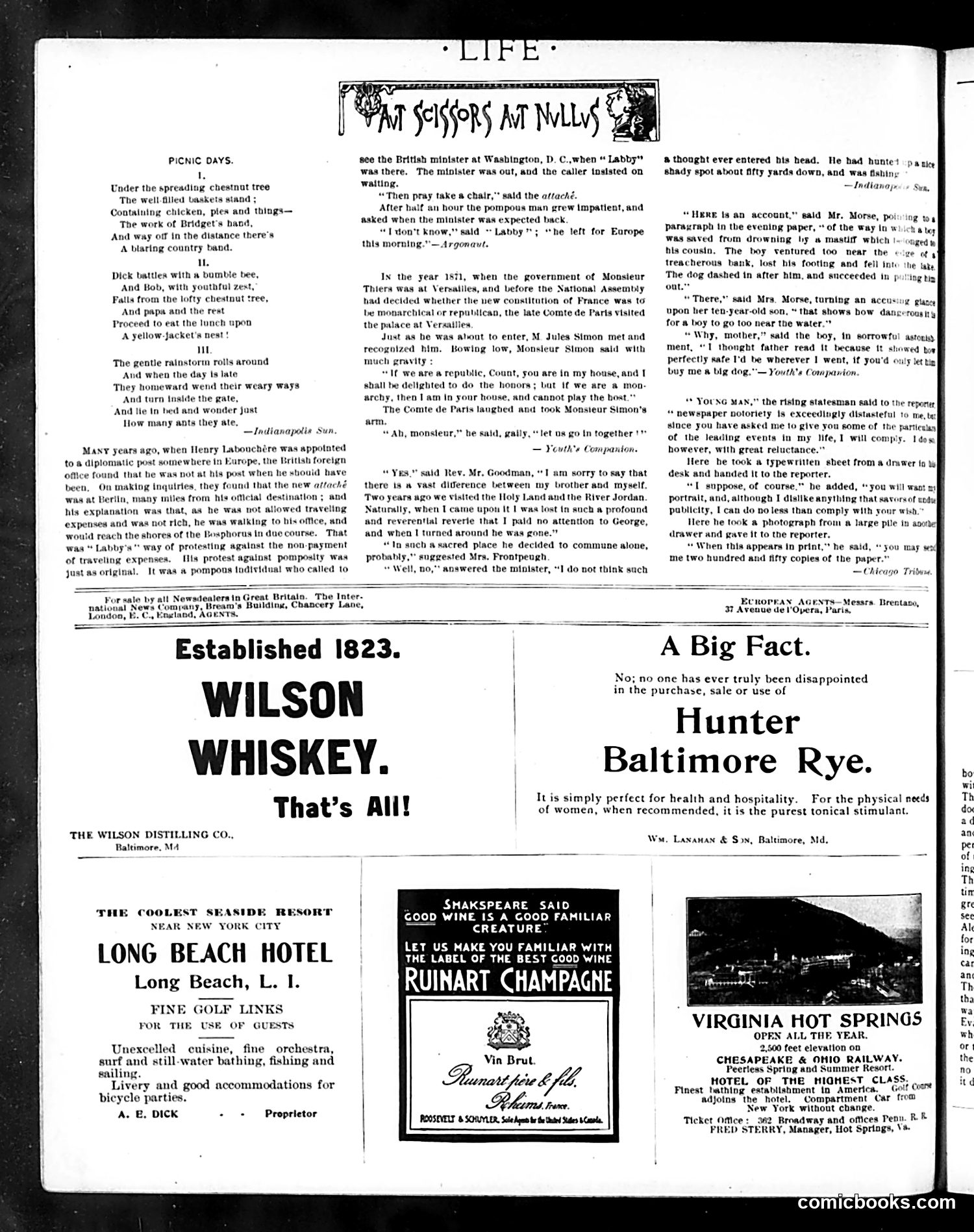
This page primarily contains **humorous anecdotes and advertisements** rather than political cartoons. The main content includes three satirical stories: 1. **"Picnic Days"** — A lighthearted poem about family outings gone comically wrong (ants in food, accidents). 2. **Labouchère anecdote** — A story about Henry Labouchère, a British diplomat appointed to Europe who walked to his post because he received no travel expenses. The humor lies in his protest against bureaucratic pomposity. 3. **Comte de Paris story** — A witty exchange during 1871 France, when the political future (monarchy vs. republic) was uncertain. Monsieur Simon's clever remark about whose house it is depending on the government type was reportedly funny to period readers familiar with the constitutional debates. The remaining content is **vintage advertising**: Wilson Whiskey, Hunter Baltimore Rye, Long Beach Hotel, Ruinart Champagne, and Virginia Hot Springs. This is largely a **humor and advertising page**, not a political cartoon page.
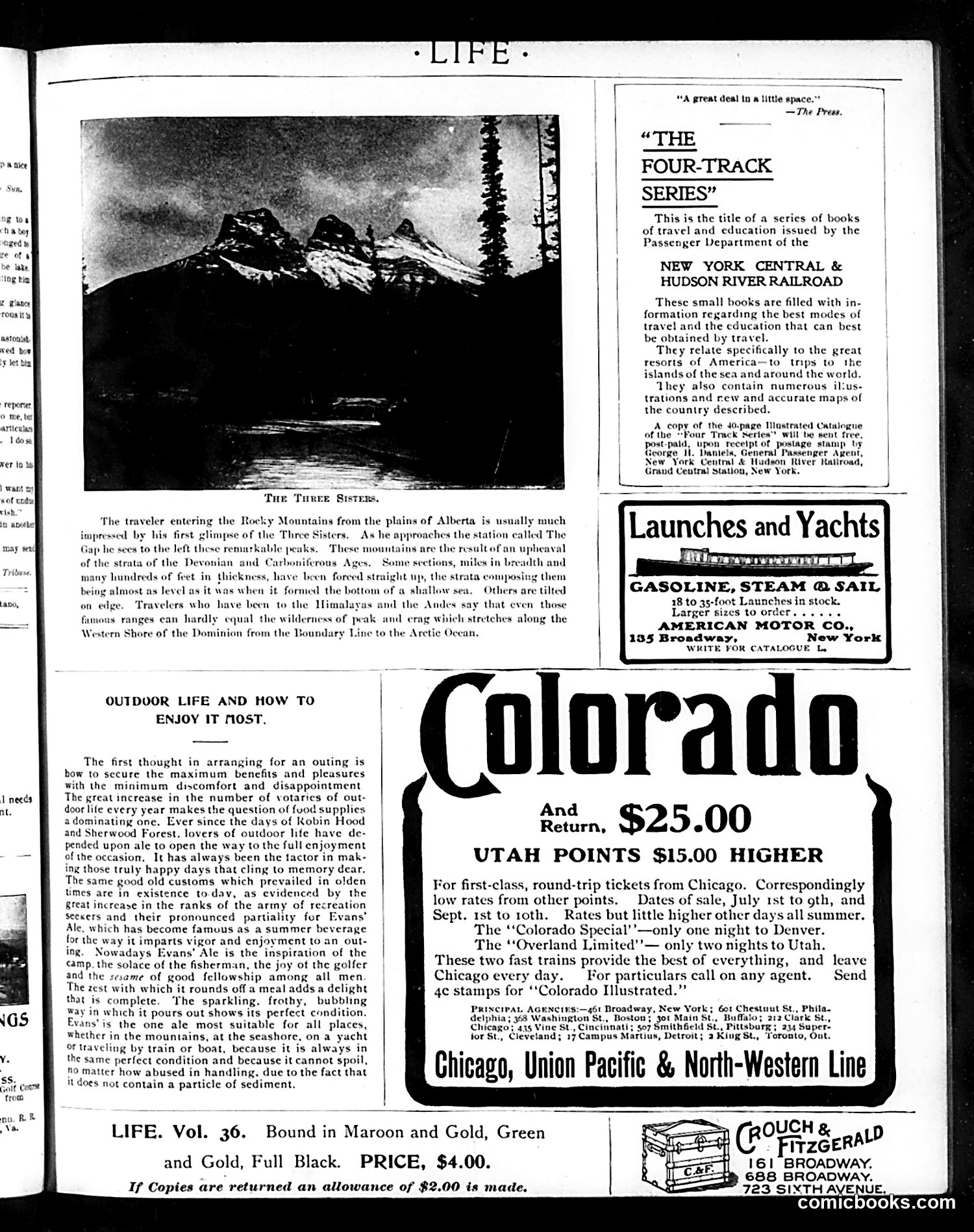
This page is primarily **advertising and travel promotion**, not political satire. The main content includes: 1. **"The Three Sisters" photo essay**: Educational travel content from the New York Central & Hudson River Railroad's "Four-Track Series"—promotional books about scenic destinations and travel modes. 2. **"Outdoor Life and How to Enjoy It Most"**: An article advocating outdoor recreation, prominently featuring **Evans' Ale** as essential to enjoyable outings. This reflects early 20th-century attitudes where alcohol was marketed as wholesome, integral to recreation ("the factor in making those truly happy days"). 3. **Multiple advertisements**: Colorado and Utah rail travel, yacht/launch sales, and luggage. The page represents **commercial culture** rather than political commentary—showcasing how corporations used travel promotion and lifestyle marketing to sell both vacations and consumer products. The ale endorsement is notable as today's readers would find it jarring to see alcohol casually promoted as central to family outdoor activities.
This page is primarily **advertising and light social commentary** from an early 1900s American satirical magazine. The main content includes: **"Our Foolish Contemporaries"** — a humor section mocking social awkwardness, like a woman whose hat wasn't in the service (a pun on divided attention). **Social humor pieces** about hotel life, weather-related flirtation, and leisure activities, typical of upper-class magazine fare. **Major advertisements** dominate: Trimble Whiskey (with a temperance joke about converting drinkers to teetotalers), Kodak film, Pennsylvania Railroad porter services, and a Connecticut inn. **One celebrity reference**: Bertha Runkle, a contemporary author of "The Helmet of Navarre," is mentioned for her dedication to studies—presented as anecdotal gossip rather than satire. The page reflects **Edwardian-era concerns**: class leisure, new technology (Kodak), temperance debates, and railroad modernization. It's light satirical humor aimed at educated readers, not sharp political commentary.
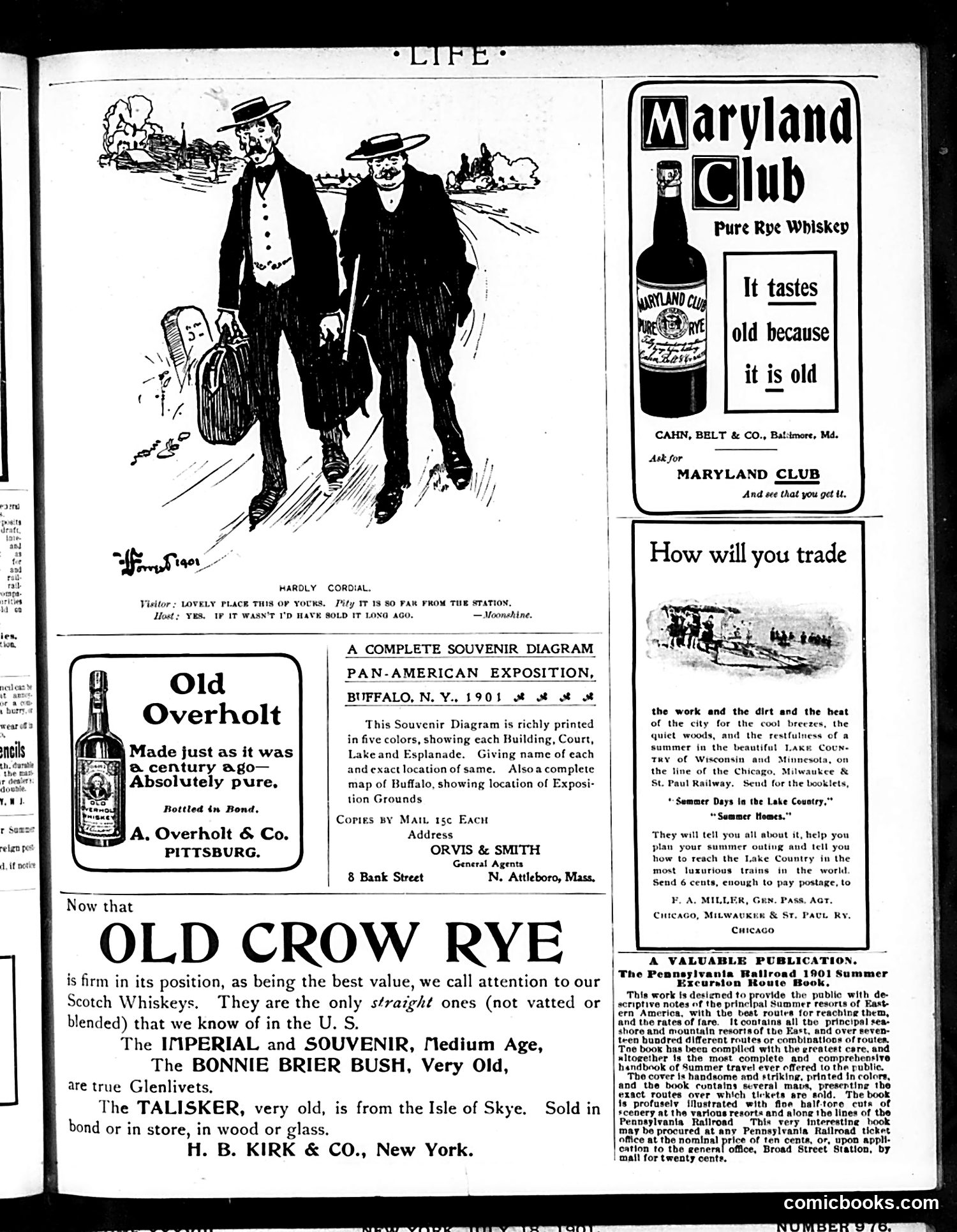
The main cartoon shows two well-dressed men in formal attire walking together. The visitor compliments the host's property, calling it "lovely," but the host responds that he'd have sold it long ago if it weren't so far from the train station. The joke satirizes the tension between rural property ownership and modern convenience—the host's estate is desirable only because of its isolation, yet its distance from transportation makes it nearly worthless to him practically. This reflects early 1900s anxieties about suburban development and the railroad's transformative power over real estate values. The cartoon pokes fun at the contradiction between aesthetic appeal and economic utility in the newly industrialized American landscape. The page is otherwise filled with period whiskey and travel advertisements.
This is primarily an **advertising page**, not a satirical cartoon. It contains multiple product advertisements typical of early 1900s magazines: - **Lea & Perrins Sauce**: A condiment brand warning against imitations - **Violin sales**: A music retailer offering bargains on instruments - **Myles Standish Ginger Ale**: A beverage pitched as a throat soother - **Evans' Ale, Martell's Brandy, Abbott's Angostura Bitters**: Alcoholic beverages marketed for social occasions - **Brighton Races**: The dominant advertisement promoting horse racing at Coney Island with "Lander's Military Band" entertainment The page reflects **Gilded Age consumer culture**: upscale products (brandy, oyster cocktails) marketed to "club men" and the leisure class. The racing venue advertises its "fireproof" grandstand and ocean breezes as attractions for escaping summer heat in New York. No political satire is evident—this is commercial messaging reflecting period advertising standards and the social practices of the era.