
Life, 1901-07-11 · page 12 of 20
Life — July 11, 1901 — page 12: what you’re looking at
What you’re looking at
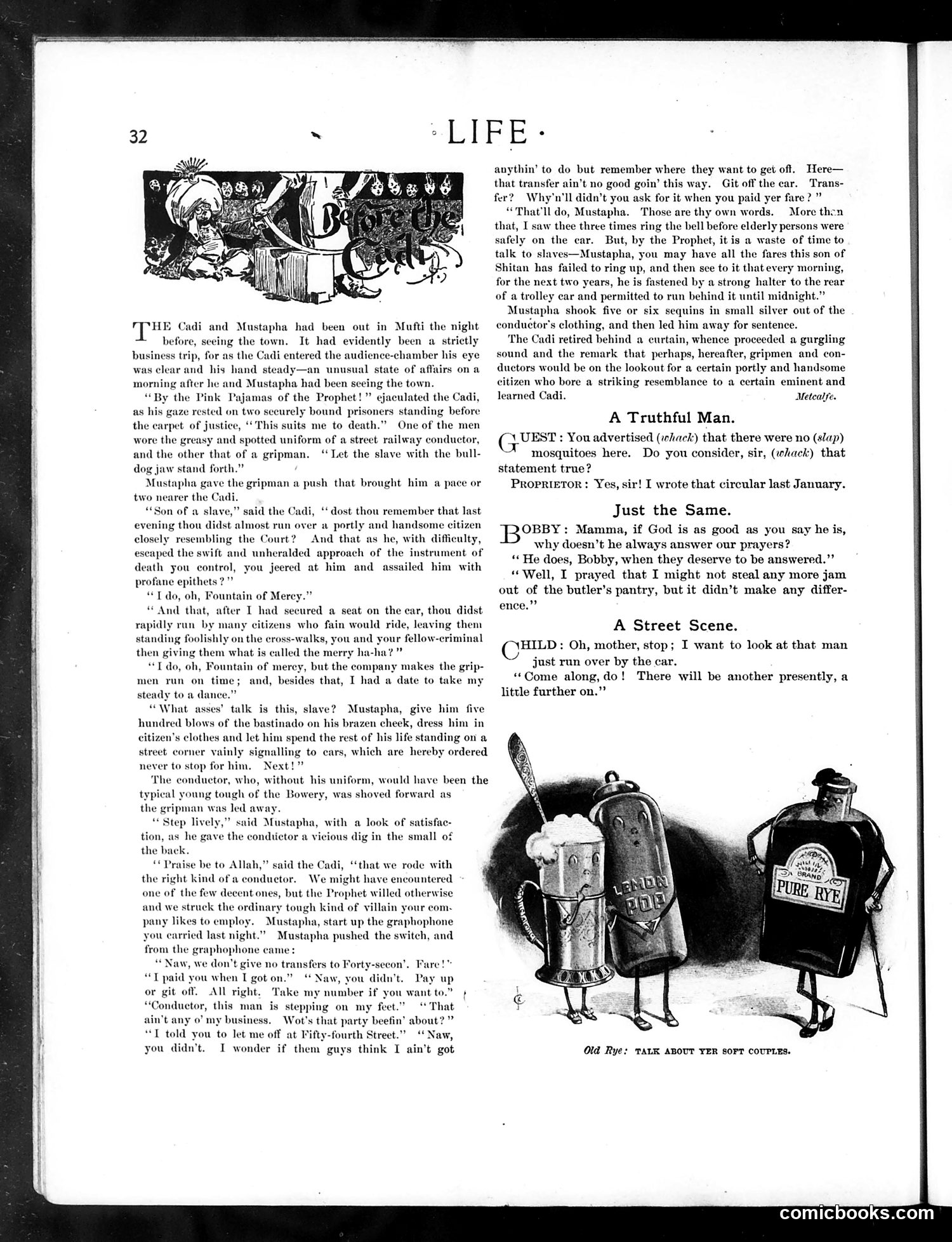
This page contains a serialized story about a streetcar conductor named the Cadi and his interaction with a character named Mustapha. The narrative satirizes the Cadi's abusive treatment of passengers and enslaved people, depicting him as corrupt and brutal—he boasts of assaulting citizens and extorting money. The bottom illustration, titled "Old Rye: Talk About the Soft Couples," shows anthropomorphized bottles of liquor (appears to be Pure Rye whiskey and another spirit) as cartoon characters having a conversation. This is a humorous visual pun using personified bottles as social commentary on alcohol consumption. The page primarily focuses on serialized fiction rather than political satire, though the Cadi story contains social criticism regarding abuse of power.
📄 Transcribed text from this page (OCR, searchable)
Machine-transcribed from the original scan — historical spelling and the odd misread are preserved.
LIFE: HE Cadi and Mustapha had been out in Mufti the night before, seeing the town. It had evidently been a strictly trip, for as the Cadi entered the audience-chamber his eye arand his hand steady—an unusual state of affairs on a after he and Mustapha had been seeing the town. “By the Pink Pa s of the Prophet!” ejaculated the Cadi, as his gaze rested on two securely bound prisoners standing before the carpet of justice, ‘This suits me to death.” One of the men wore the greasy and spotted uniform of a street railway conductor, and the other that of a gripman. ‘Let the slave with the bull- dog jaw stand forth.” Mustapha gave the gripman a push that brought him a pace or two nearer the Cadi. “Son of a slave, said the Cadi, ‘dost thou remember that 1 evening thou didst almost run over a portly and handsome citizen closely resembling the Court? And that as he, with difficulty, escaped the swift and unheralded approach of the instrument of death you control, you jeered at him and assailed him with profane epithets?” “T do, oh, Fountain of Merey.” “And that, after I had secured a seat on the car, thou didst rapidly run by many citizens who fain would ride, leaving them standing foolishly on the cross-walks, you and your fellow-eriminal then giving them what is called the merry “Ido, oh, Fountain of merey, but the company makes the grip- men run on time; and, besides that, I had a date to take my steady to a dane “What asses’ talk is this, slave? Mustapha, give him five hundred blows of the bastinado on his brazen cheek, dress him in citizen's clothes and let him spend the rest of his life standing on a street corner vainly signalling to ears, which are hereby ordered never to stop for him. Next!” The conductor, who, without his uniform, would have been the typical young tough of the Bowery, was shoved forward as the gripman was led away. “Step lively,” said Mustapha, with a look of satisfae- tion, as he gave the condiictor a vicious dig in the small of the back. “*Praise be to Allah,” said the Cadi, ‘that we rode with the right kind of a conductor. We might have encountered. one of the few decent ones, but the Prophet willed otherwise and we struck the ordinary tough kind of villain your com. pany likes to employ. Mustapha, start up the gi y ed last night.” Mustapha pushed the s from the graphophone ea “Naw, we don’t give no transfers to Forty-se “T paid you when I got on.” “ Naw, you didn’t. Pay up or git off. All right. ‘Take my number if you want to.” “Conduetor, this man is stepping on my feet.” “That ain't any 0’ my business, Wot’s that party beefin’ about?” “T told you to let me off at Pifty-fourth Street.”” you didn't. hophone Du ea ch, and. . Fare!” “Naw, I wonder if them guys think I ain't got anythin’ to do but remember where they want to get off. Here— that transfer ain’t no good goin’ this way. Git off the car. Trans- fer? Why'n'll didn’t you ask for it when you paid yer fare?” “That'll do, Mustapha. ‘Those are thy own words. More then that, I saw thee three times ring the bell before elderly persons were safely on the car. But, by the Prophet, it is a waste of time to talk to slaves—Mustapha, you may have all the fares this son of Shitan has failed to ring up, and then sce to it that every morning, for the next two years, he is fastened by a strong halter to the rear of a trolley car and permitted to run behind it until midnight.” Mustapha shook five or six sequins in small silver out of the conductor's clothing, and then led him away for sentence. The Cadi retired behind a curtain, whence proceeded a gurgling sound and the remark that perhaps, hereafter, gripmen and con- ductors would be on the lookout for a certain portly and handsome citizen who bore a striking resemblance to a certain eminent and learned Cadi. Metcalfe. A Truthful Man. \ UEST : You advertised (whack) that there were no (slap) mosquitoes here. statement true? PRopRIETOR: Yes, sir! I wrote that circular last January. Do you consider, sir, (whack) that Just the Same. OBBY: Mamma, if God is as good as you why doesn’t he always answer our prayers? “He does, Bobby, when they deserve to be answered.”’ “Well, I prayed that I might not steal any more jam out of the butler’s pantry, but it didn’t make any differ- ence.” y he is, A Street Scene. CHILD: Oh, mother, stop; I want to look at that man just run over by the car. “Come along,do! There will be another presently, a little further on.” Old Rye: TALK ABOUT YER SOFT COUPLES. comicbooks.com