
Life, 1901-07-11 · page 4 of 20
Life — July 11, 1901 — page 4: what you’re looking at
What you’re looking at
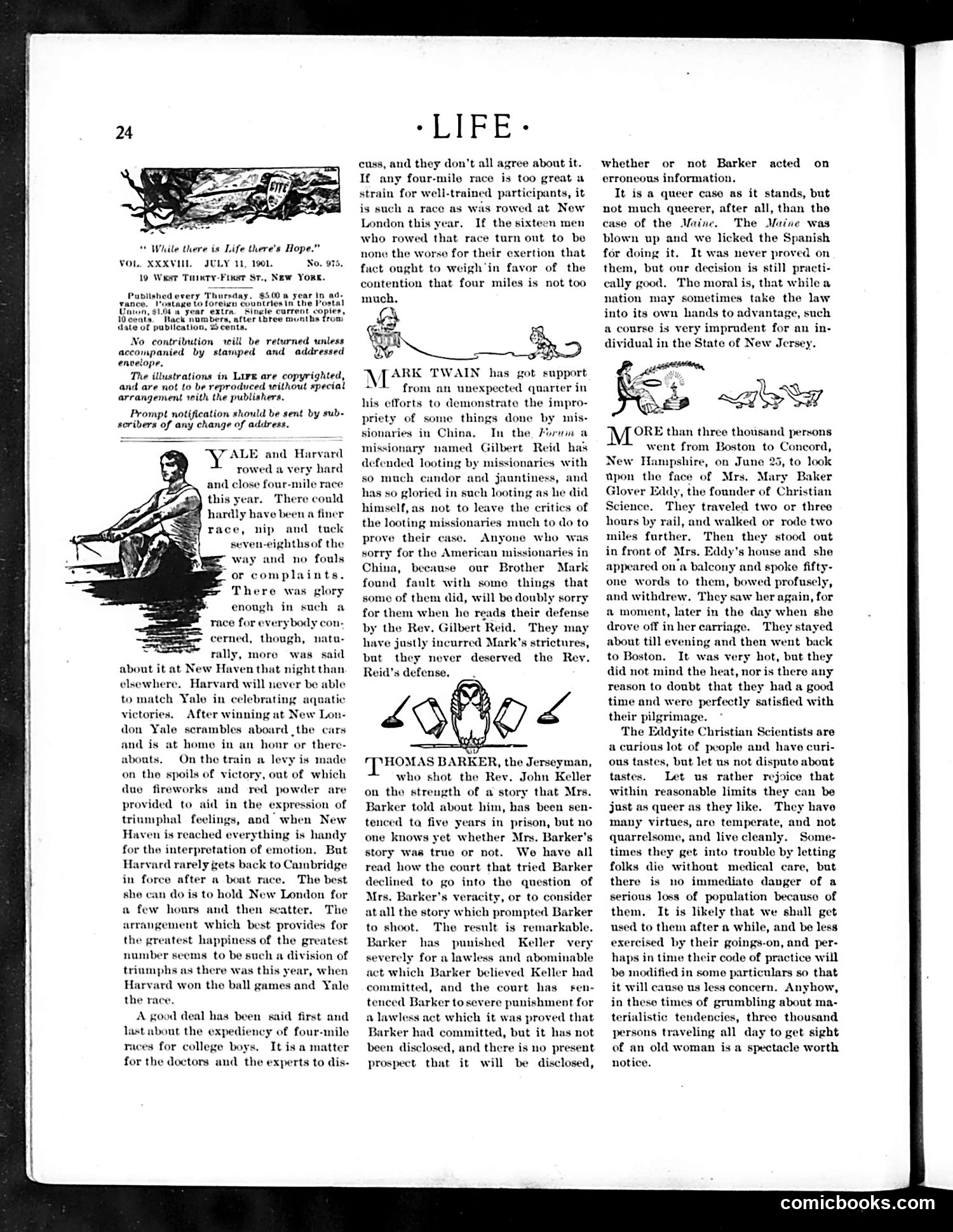
This page contains three distinct pieces of commentary: 1. **Yale vs. Harvard rowing dispute**: The left illustration depicts competitive college rowing. The text discusses a four-mile race controversy between Yale and Harvard, debating whether such distances strain athletes appropriately. 2. **Mark Twain and missionary work**: A paragraph supports Mark Twain's criticism of American missionaries in China, specifically defending his attacks on missionary Gilbert Reid against clerical pushback. 3. **Thomas Barker case**: The main article discusses a New Jersey man convicted of shooting Rev. John Keller. The text examines uncertainty about Mrs. Barker's testimony and whether Barker deserves his five-year sentence, questioning whether justice was properly served. 4. **Ledyite Christian Scientists**: A brief satirical note mocks this religious group's practices and their casual attitude toward medical care and population loss.
📄 Transcribed text from this page (OCR, searchable)
Machine-transcribed from the original scan — historical spelling and the odd misread are preserved.
“| While there is Life there's Hope.” XXXVHL JULY 19 West Tarxty- VOL. edevery Thursday. $5.00 a year tn ad- ‘oatage to forelen Countries in the Postal , $1.06 4 year extra. Single curreot copier, Tack numbers, after three munths trom date of publication, 2 cent No contribution will be returned unless accompanied by stamped and addressed envelope. The illustrations in Lure are copyrighted, and are not to be reproduced without special arrangement with the publishers, Prompt notification should be sent by sub- scribers of any change of address. TY ALE and Harvard rowed a very hard and close four-mile race this year. There could hardly have been a finer race, nip and tuck seven-eighthsof the way and no fouls "or complaints. There was glory enough in such a race for everybody con- cerned, though, natu- rally, more said about it at New Haven that night than elsewhere. Harvard will never be able to match Yale in celebrating aquatic victories. After winning at New Lon- don Yale scrambles aboard the cars and is at home in an honr or there- abouts. On the train a levy is made on the spoils of victory, out of which duo fireworks and red powder are provided to aid in the expression of feelings, and’ when New Haven is reached everything is handy for the interpretation of emotion. But Harvard rarely gets back to Cambridge in force after a boat race. The best she can do is to hold New London for a few hours and then scatter, The arrangement which best provides for the greatest happiness of the greatest number seems to be such a division of triumphs as there was this year, when Harvard won the ball games and Yale the race. A good deal has been said first and last about the expediency of four-mile races for college boys. It is a matter for the doctors and the experts to dis- *LIFE « cuss, and they don’t all agree about it. If any four-mile race is too great a strain for well-trained participants, it is such a race as was rowed at New London this year. If the sixteen men who rowed that race turn out to be none the worse for their exertion that fact ought to weigh’in ‘or of the contention that four miles is not too MARK TWAIN has got support - from an unexpected quarter in his efforts to demonstrate the impro- priety of some things done by mis- sionaries in China, In the Forma a missionary named Gilbert Reid has defended looting by missionaries with so much candor and jauntiness, and has so gloried in such looting as he did himself,as not to leave the critics of the looting missionaries much to do to prove their case. Anyone who was sorry for the American mis China, because our Brother Mark found fault with some things that some of them did, will be doubly sorry for them when ho reads their defense by the Rev. Gilbert Reid, They may have justly incurred Mark's strictures, but they never deserved the Rey. Reid’s defense, HOMAS BARKER, the Jerseyman, who shot the Rev. John Keller on the strength of a story that Mrs. Barker told about him, has been sen- tenced ta five years in prison, but no one knows yet whether Mrs. Barker's story was true or pot. We have all read how the court that tried Barker declined to go into the question of Mrs. Barker's veracity, or to consider atall the story which prompted Barker to shoot. The result is remarkable. Barker has punished Keller very severely for a lawless and abominable act which Barker believed Keller had committed, and the court has sen- tenced Barker to severe punishment for a lawless act which it was proved that Barker had committed, but it has not been disclosed, and there is no present prospect that it will be disclosed, whether or not Barker acted on erroneous information. It is a queer case as it stands, but not much queerer, after all, than the of the Maine. The Maine was blown up and we licked the Spanish for doing it, It was never proved on them, but our decision is still practi- cally good. Tho moral is, that while a nation may sometimes take the law into its own hands to advantage, such a course is very impradent for an in- dividual in the State of New Jersey. cin, —S 4, £e wala } ORE than three thousand persons went from Boston to Concord, New Hampshire, on June 25, to look upon the face of Mrs. Mary Baker Glover Eddy, the founder of Christian Science. They traveled two or three hours by rail, and walked or rode two miles further, Then they stood out in front of Mrs. Eddy’s house and she appeared on’a balcony and spoke fifty- one words to them, bowed profusely, and withdrew. They saw her again, for a moment, later in the day when she drove off in her carriage. They stayed about till evening and then went back to Boston. It was very hot, but they did not mind the heat, nor is there any reason to doubt that they had a good time and were perfectly satisfied with their pilgrimage. The Eddyite Christian Scientists are a curious lot of people and have curi- ons tastes, but let us not dispute about tastes. Let us rather rejoice that within reasonable limits they can be just as queer as they like. They have many virtues, aro temperate, and not quarrelsome, and live cleanly. Some- times they get into trouble by letting folks die without medical care, but there is no immediate danger of a serious loss of population because of them. It is likely that we shall get used to them after a while, and be less reised by their goings-on, and per- ps in time their code of practice will be modified in some particulars so that it will cause us less concern. Anyhow, in these times of grumbling about ma- terialistic tendencies, three thousand persons traveling all day to get sight of an old woman is a spectacle worth notice. comicbooks.com