
A complete issue · 22 pages · 1901
Life — May 2, 1901
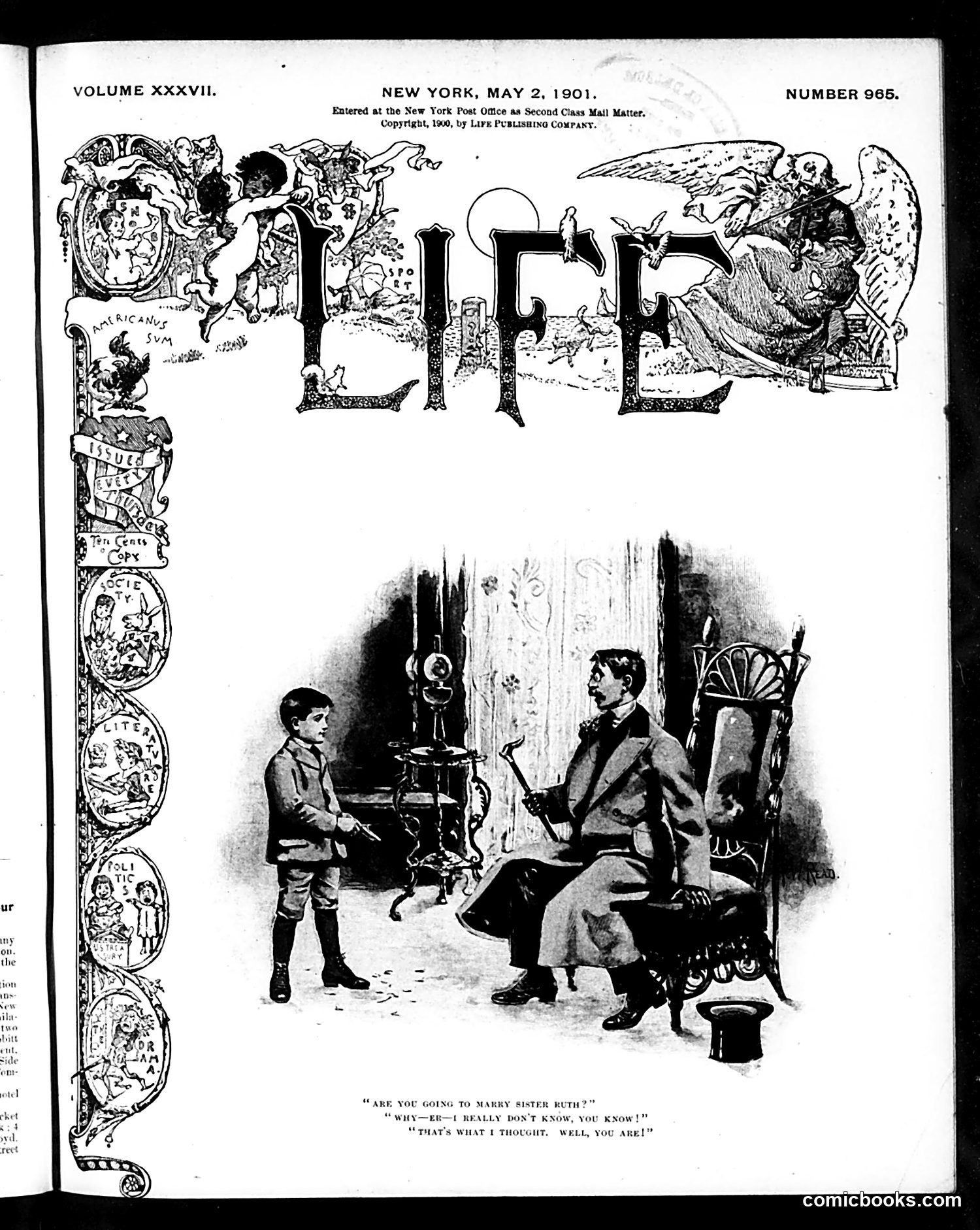
This page features a domestic humor cartoon typical of *Life* magazine's satirical content. The scene depicts an adult (likely a father) seated with a young boy, with dialogue addressing marriage prospects. The boy asks: "Are you going to marry Sister Ruth?" The adult responds: "Why—er—I really don't know, you know!" The boy concludes: "That's what I thought. Well, you are!" The humor relies on childhood logic—the boy's innocent but definitive declaration exposes the adult's evasiveness about romantic commitment. This reflects *Life's* satirical approach to social conventions of the era, particularly the awkwardness surrounding marriage discussions and courtship among the middle class. The joke's appeal lies in the child's blunt certainty contrasting with adult hesitation.
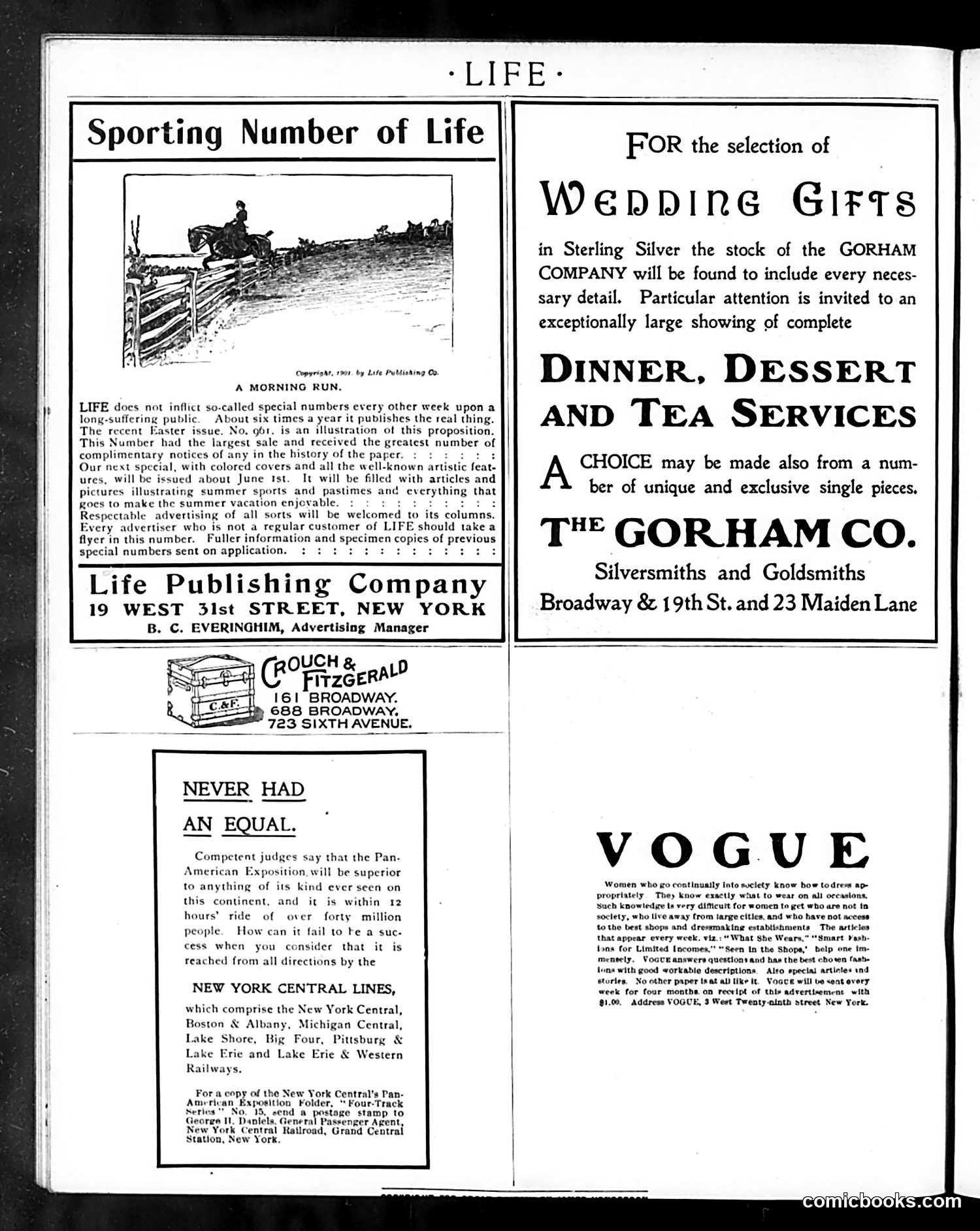
This page is primarily **advertising and promotional content** rather than political satire or comics. The left side features "Sporting Number of Life," promoting an upcoming special issue with a horse-and-rider illustration. The advertisement emphasizes Life's regular special numbered editions and invites advertising in future issues. The remaining space contains **commercial advertisements**: Crouch & Fitzgerald (luggage), The Gorham Company (sterling silver wedding gifts), New York Central Lines (railroad travel), and Vogue magazine. No political cartoons or satirical commentary are present on this page. It reflects early 20th-century magazine economics, where editorial content shared space with paid advertising to support publication costs.
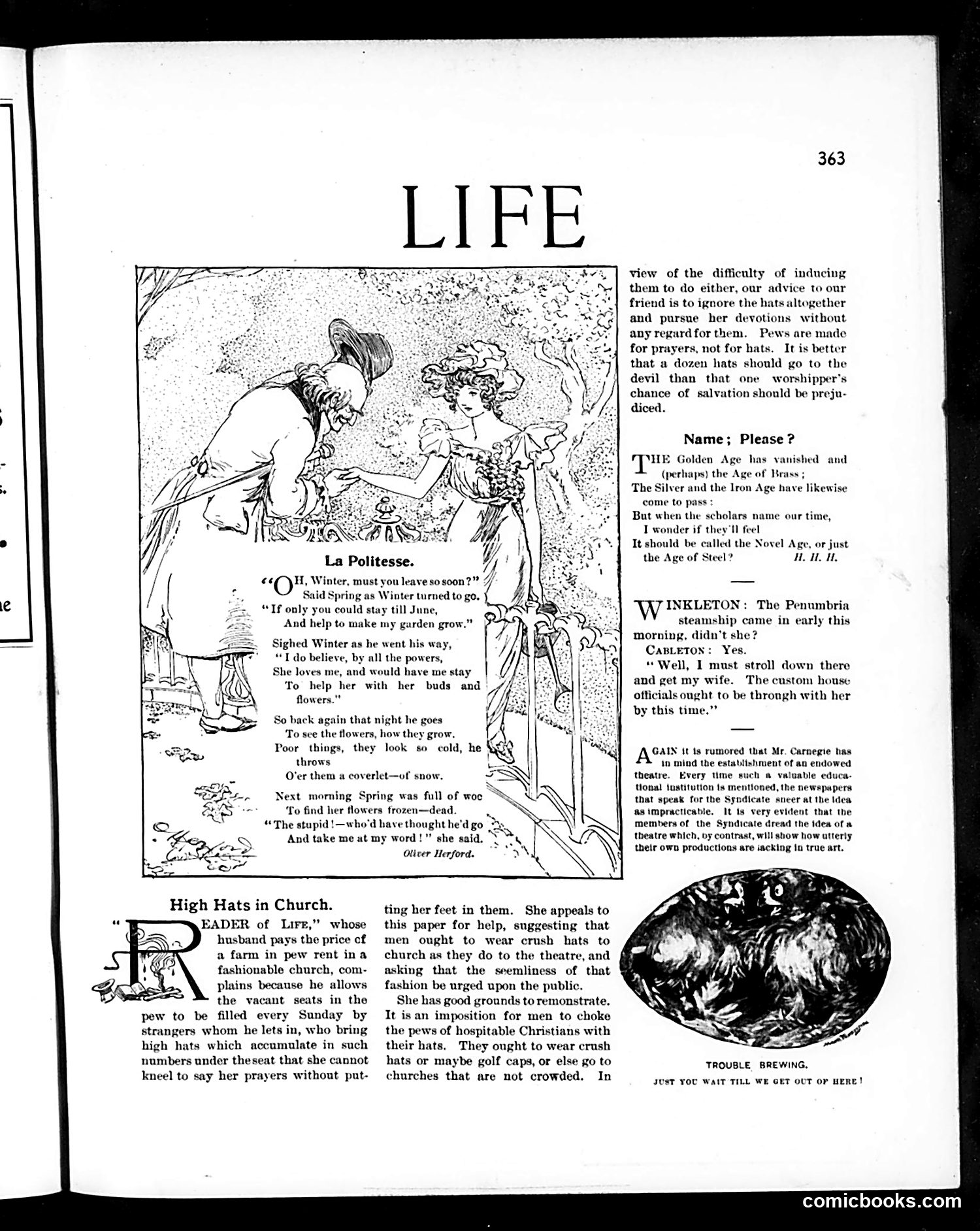
**"La Politesse" (The Politeness)**: This illustrated poem by Oliver Herford depicts Winter departing as Spring arrives. The allegorical figures engage in courteous exchange—Winter asks Spring to help his garden grow, and Spring promises Winter will be missed. The verse contrasts their politeness with the harsh reality that Spring finds Winter's flowers frozen dead. The satire mocks excessive civility masking underlying conflict or disappointment. **"High Hats in Church"**: This section criticizes wealthy parishioners who wear elaborate hats to church, blocking others' views during services. The satire targets fashionable hypocrisy—these same people wouldn't tolerate such obstruction at theaters, yet impose it on fellow worshippers. The author argues this represents inconsistent Christian values and suggests congregation members should enforce hat-removal policies.
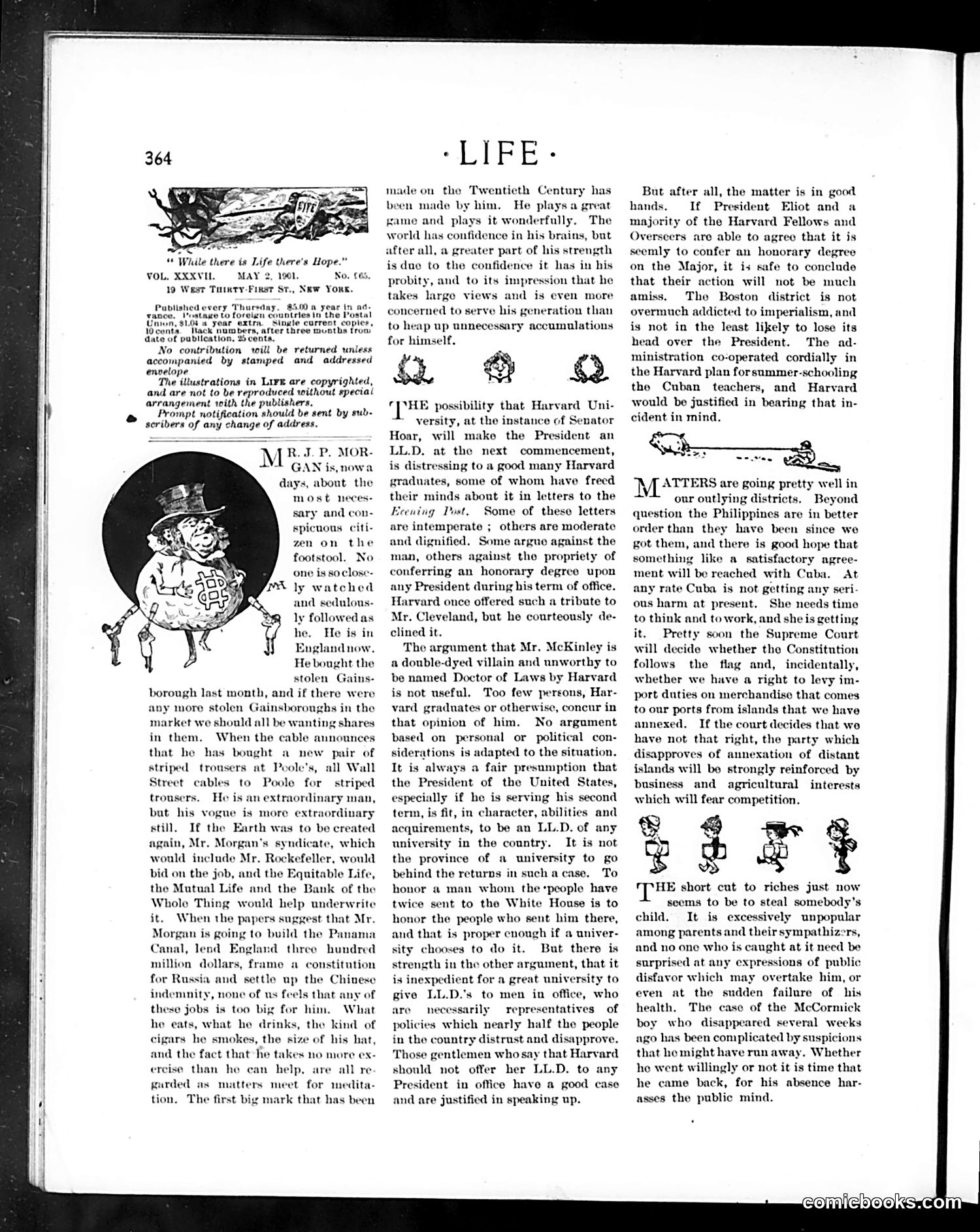
The main cartoon depicts a rotund, well-dressed man in a circular frame, surrounded by decorative elements. Based on the text column titled "R.J.P. Morgan" below it, this caricatures **J.P. Morgan**, the prominent banker and financier. The accompanying text discusses Morgan's recent acquisition of the Gainsborough painting and references his syndicate bidding on infrastructure projects (Panama Canal, Chinese indemnity bonds). The satire criticizes Morgan's immense wealth and influence—suggesting he represents unchecked capitalist power. The cartoon's exaggerated physicality emphasizes his excess and prominence in American business. The piece mocks how Morgan's financial ventures shape national policy, positioning him as a figure whose personal interests drive major American decisions, reflecting Progressive-era anxieties about oligarchic control.
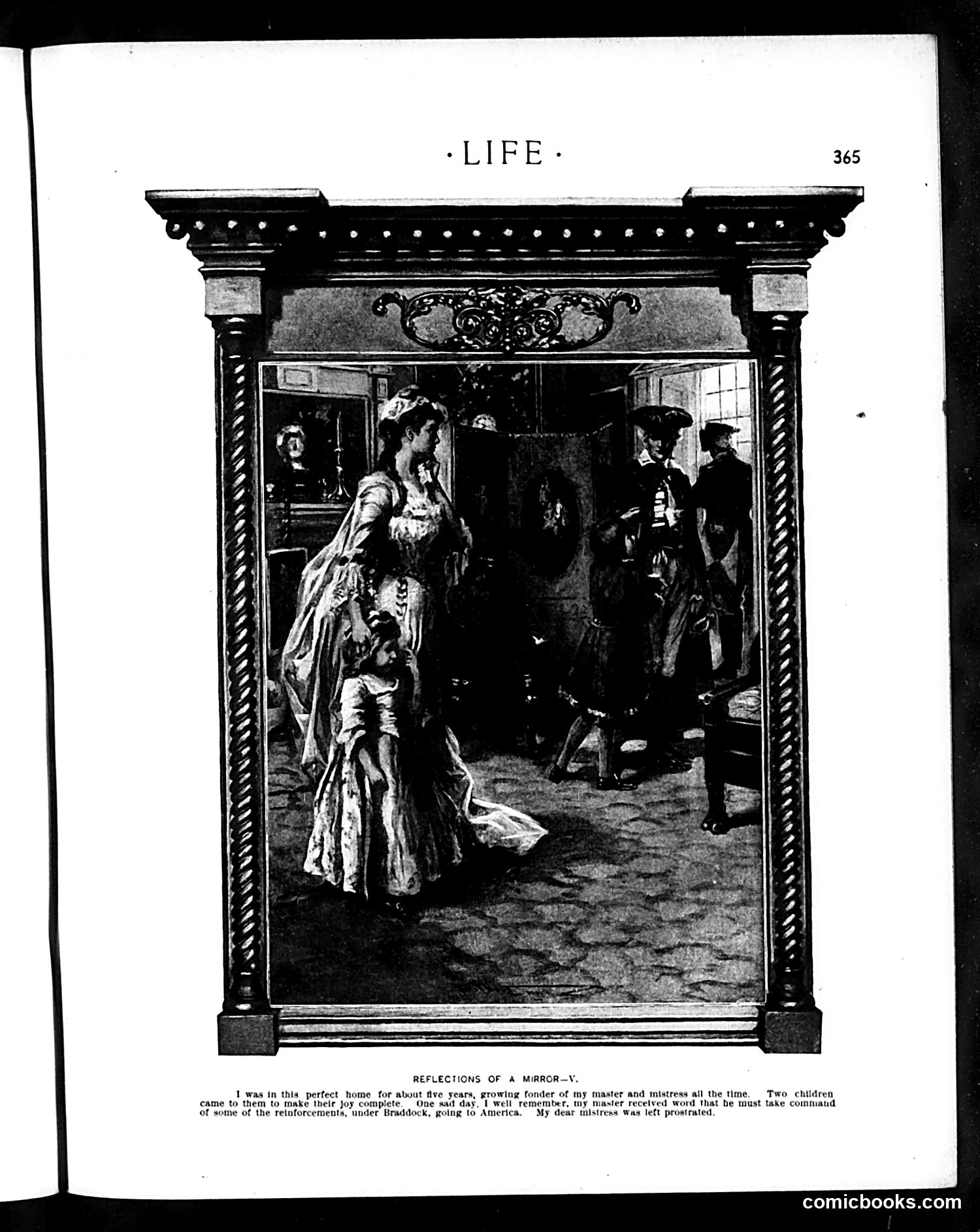
This illustration depicts a domestic scene in what appears to be a wealthy household. A woman in elaborate dress stands prominently on the left, while servants or household staff attend to various tasks. The caption indicates this is part of a serialized story about a "perfect home" where the narrator has spent five years growing fond of the master and mistress. The narrative fragment mentions children and discusses the narrator (likely a servant) receiving instructions that "I must take command of some of the domestic arrangements." This appears to be **fiction/serialized literature** rather than political satire—specifically a narrative about household dynamics and servant experiences in a privileged setting. The "mirror" metaphor likely reflects observations of upper-class domestic life. Without additional context or visible caricatures, this seems to be straightforward storytelling rather than social commentary.
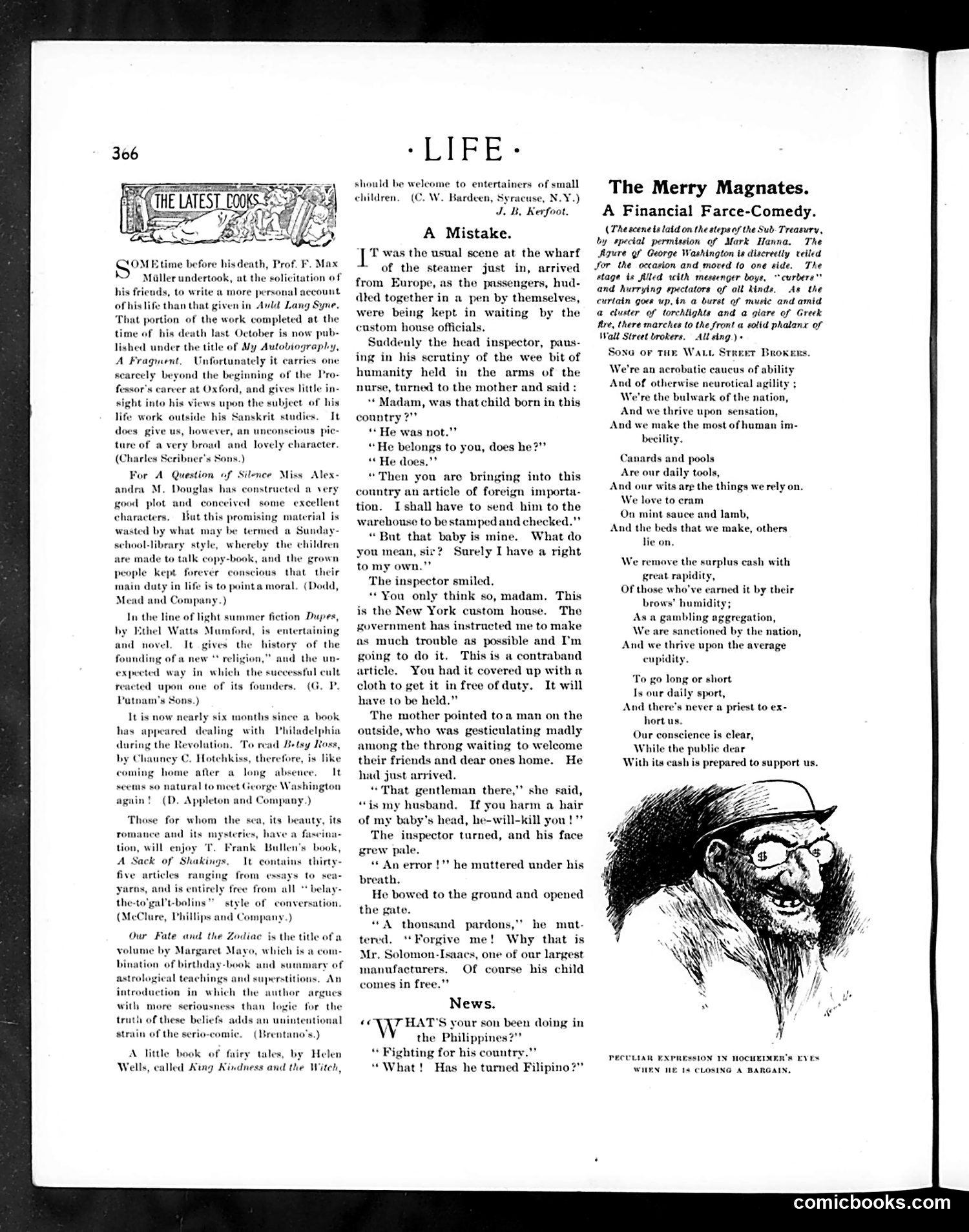
The main illustration shows a grotesque caricature of a wealthy man with exaggerated features—large nose, prominent teeth, and a smug expression—wearing a top hat. The caption reads "PECULIAR EXPRESSION IN HOCHHEIMER'S EYES WHEN HE IS CLOSING A BARGAIN." This appears to be satirizing a specific wealthy businessman or financier named Hochheimer (likely a real contemporary figure, now obscure). The cartoon mocks the predatory behavior of wealthy industrialists during what seems to be the Gilded Age era, suggesting he adopts a distinctive, calculating expression when conducting business deals. The accompanying text is a satirical poem about wealthy financiers ("magnates") who manipulate markets, exploit workers, and use their riches unethically. The satire targets the moral corruption and ruthlessness of wealthy elites.
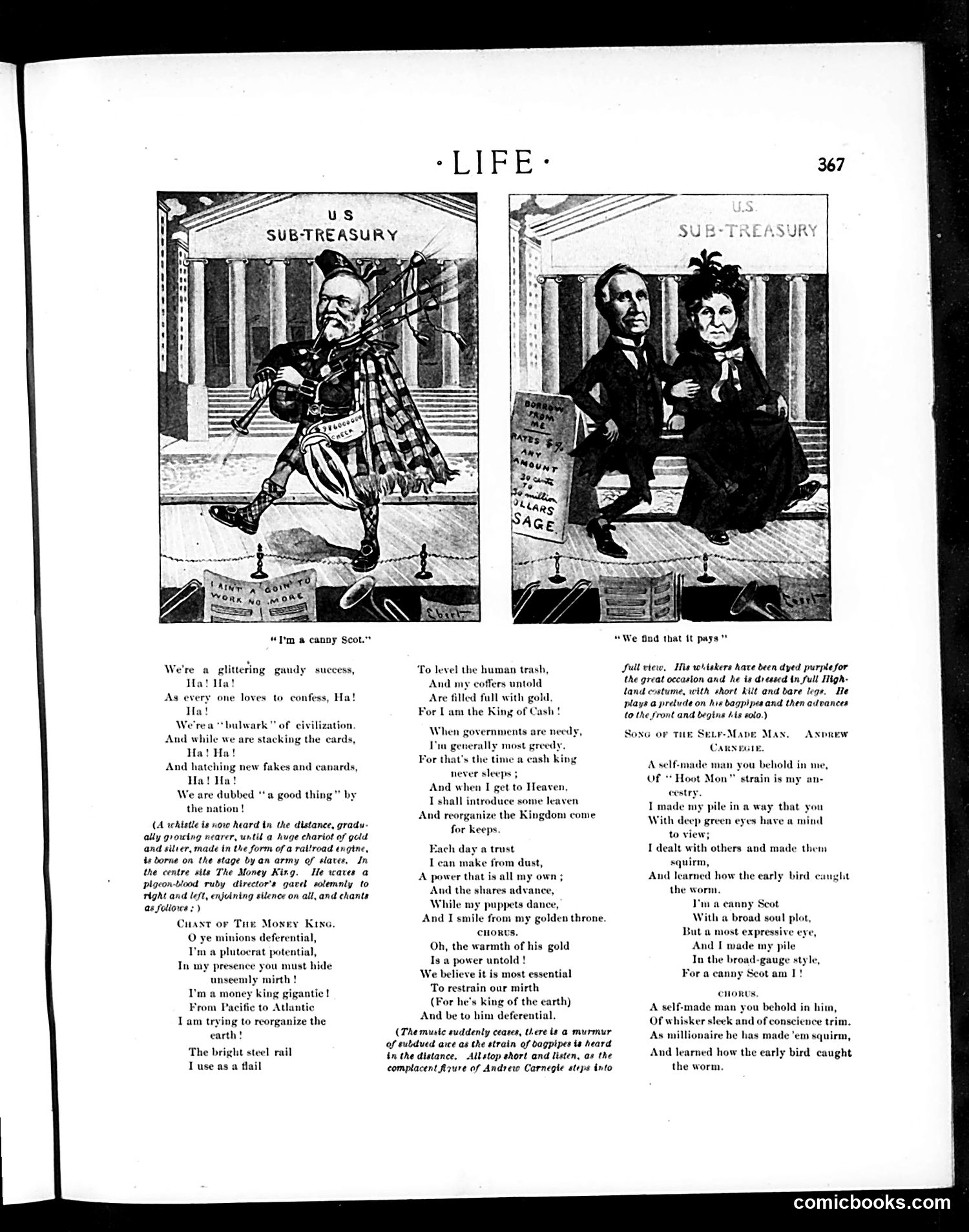
This page contains two cartoons satirizing wealthy industrialists of the Gilded Age, specifically targeting the "Money King" archetype—likely figures like Andrew Carnegie or similar robber barons. **Left cartoon** ("I'm a canny Scot"): Depicts a kilted Scottish character boasting of his success, self-made wealth, and plans to reorganize Heaven itself. The satire mocks the grandiose self-importance of wealthy industrialists. **Right cartoon** ("We find that it pays"): Shows two men discussing how dressing in Highland costume and appearing "self-made" is profitable. The text mocks the hypocrisy of presenting oneself as humble while accumulating vast wealth. Both cartoons ridicule the ego and moral pretensions of wealthy industrial magnates who claimed virtue through self-made mythology while wielding immense economic power.
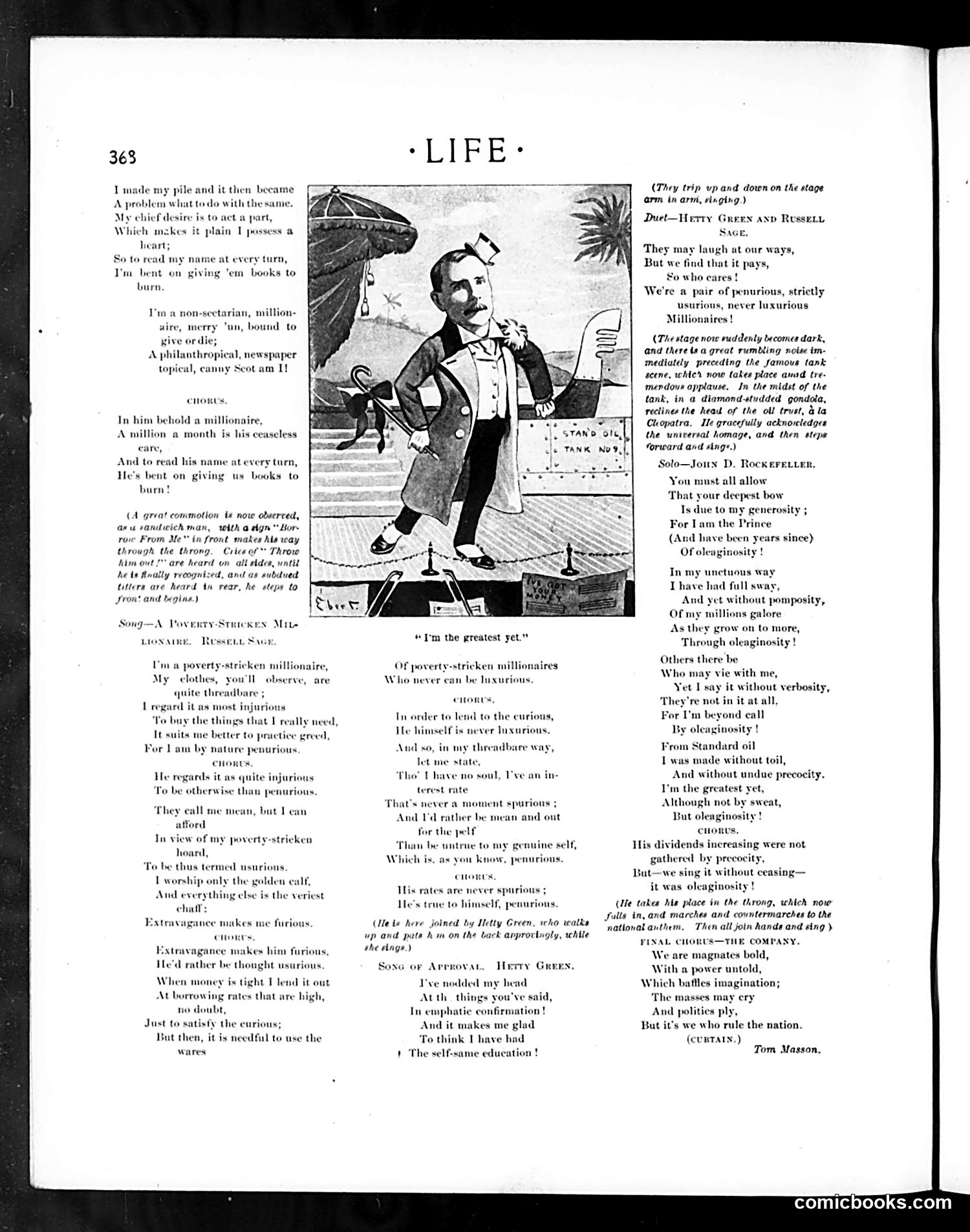
This cartoon depicts a man labeled as a "poverty-stricken millionaire" who claims to be "the greatest yet." The satire mocks the contradiction of someone wealthy who insists he practices austerity and lacks luxury—a "strictly utilitarian" millionaire. The central joke concerns hypocrisy: this figure boasts of his generosity and self-denial while simultaneously bragging about his superiority. The accompanying verses emphasize the absurdity—he claims to have "no soul" and actively avoids luxury, yet paradoxically demands recognition and superiority over others based on his wealth. This appears to satirize Gilded Age millionaires who adopted pseudo-austere public personas while accumulating vast fortunes, presenting themselves as self-made men of principle rather than mere plutocrats.
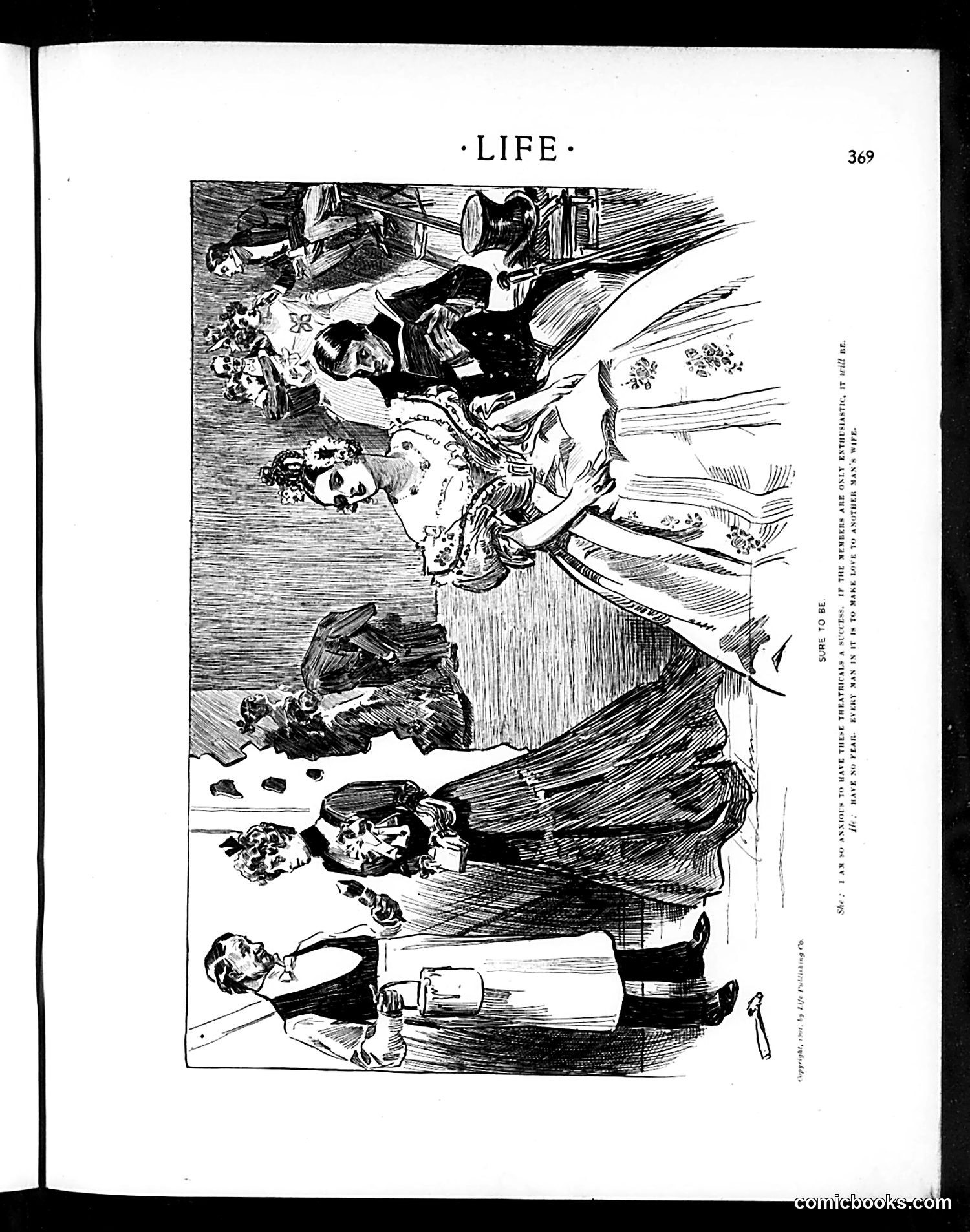
This appears to be a single satirical illustration rotated 90 degrees, depicting what seems to be a social or theatrical scene. The image shows multiple figures in period dress (likely late 19th/early 20th century based on the clothing styles), arranged in an interior setting with furniture and architectural details. The cartoon likely comments on social pretension, behavior, or relationships among the upper classes, though the specific individuals or event referenced are unclear from the image alone. The detailed cross-hatching technique is characteristic of Life magazine's satirical style during this era. **Without clearer identification of the specific figures or accompanying caption text, I cannot definitively explain the particular social or political satire intended.**
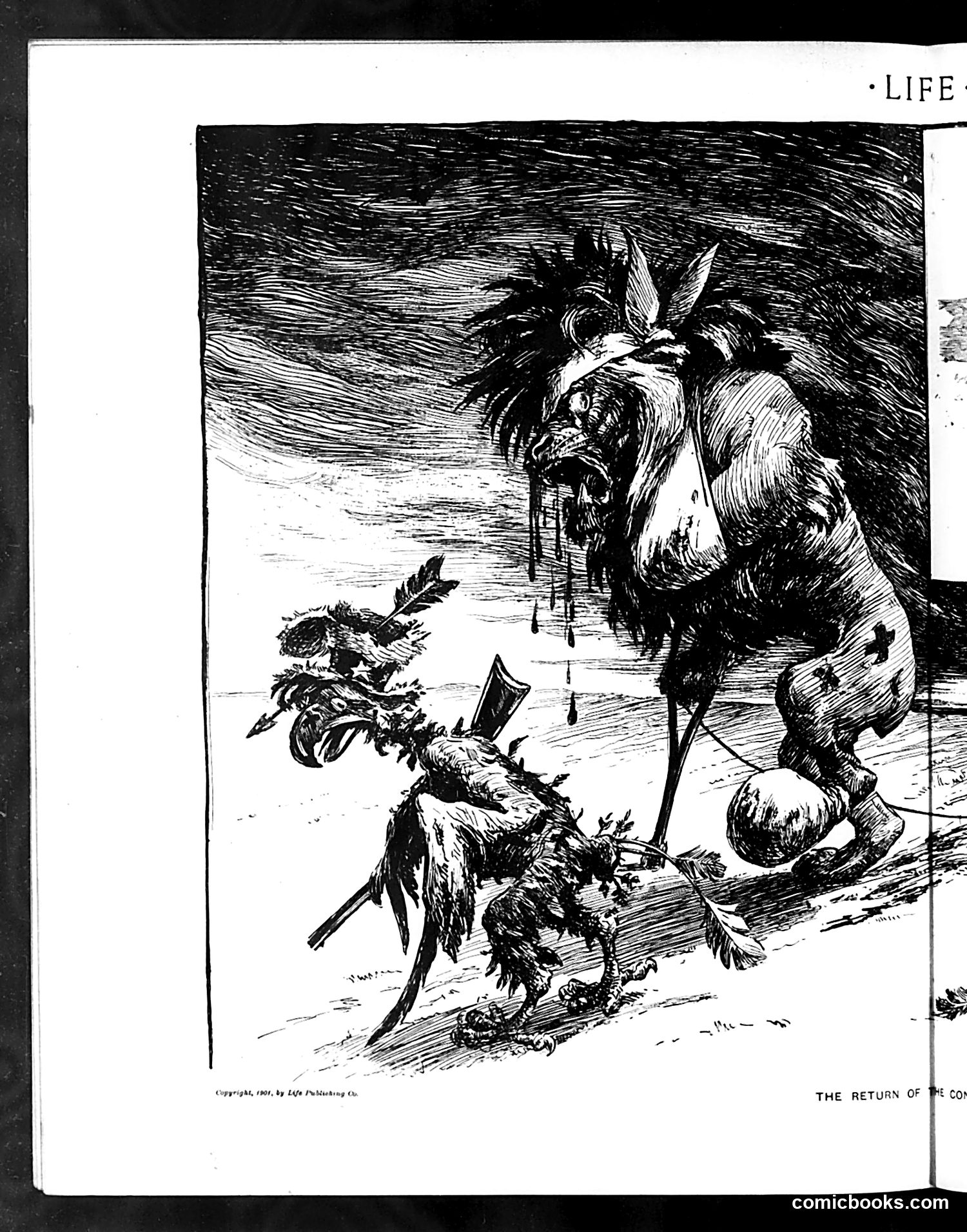
This appears to be a political cartoon satirizing a conflict involving livestock or agricultural policy. The image shows a large horned animal (likely a cow or buffalo) confronting a smaller figure carrying what appears to be a weapon or farming implement. The style and composition suggest the "return" references retaliation or comeuppance. The title "THE RETURN OF THE COW" and the dramatic, somewhat aggressive posturing suggests this cartoon comments on a dispute—possibly involving agricultural tariffs, trade policy, or a specific incident involving livestock. Without clearer dating or additional context, the specific political reference remains unclear, though it's characteristic of Life magazine's satirical commentary on contemporary policy disputes of its era.
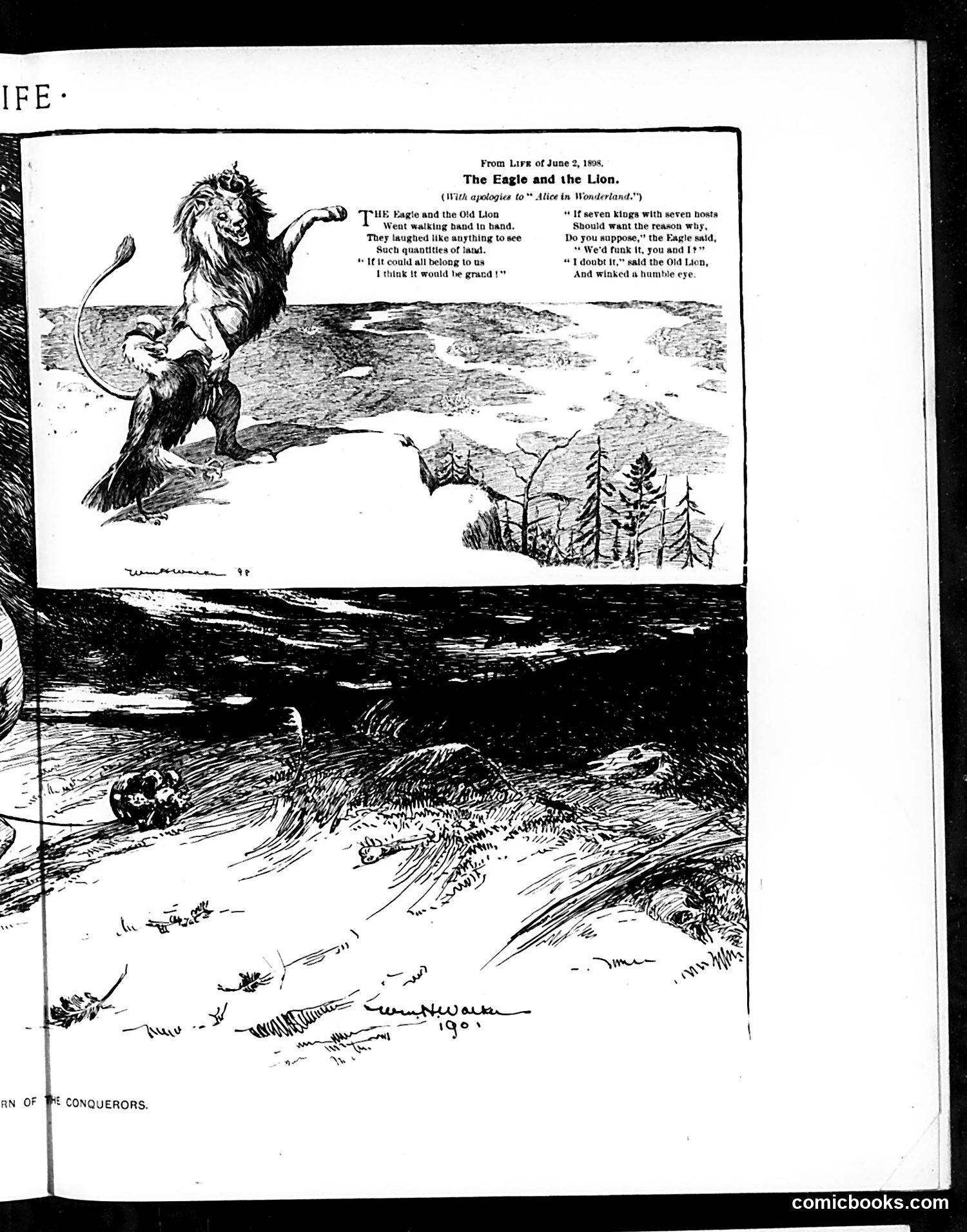
This political cartoon references the Spanish-American War era. The **Eagle** (representing America) and the **Lion** (representing Britain) are walking "hand in hand," laughing together. The Eagles boasts of wanting "seven kings" as trophies, while the Lion questions whether this is wise. The Lion warns: "If it could all belong to us / I think it would be grand!"—suggesting Britain's imperial interest in America's territorial ambitions. The second illustration (underwater scene) appears to show the consequences of colonial expansion, possibly referencing naval warfare or territorial conquest. The cartoon satirizes both nations' imperial aspirations during the 1898 war, when America acquired territories like Puerto Rico, Guam, and the Philippines.
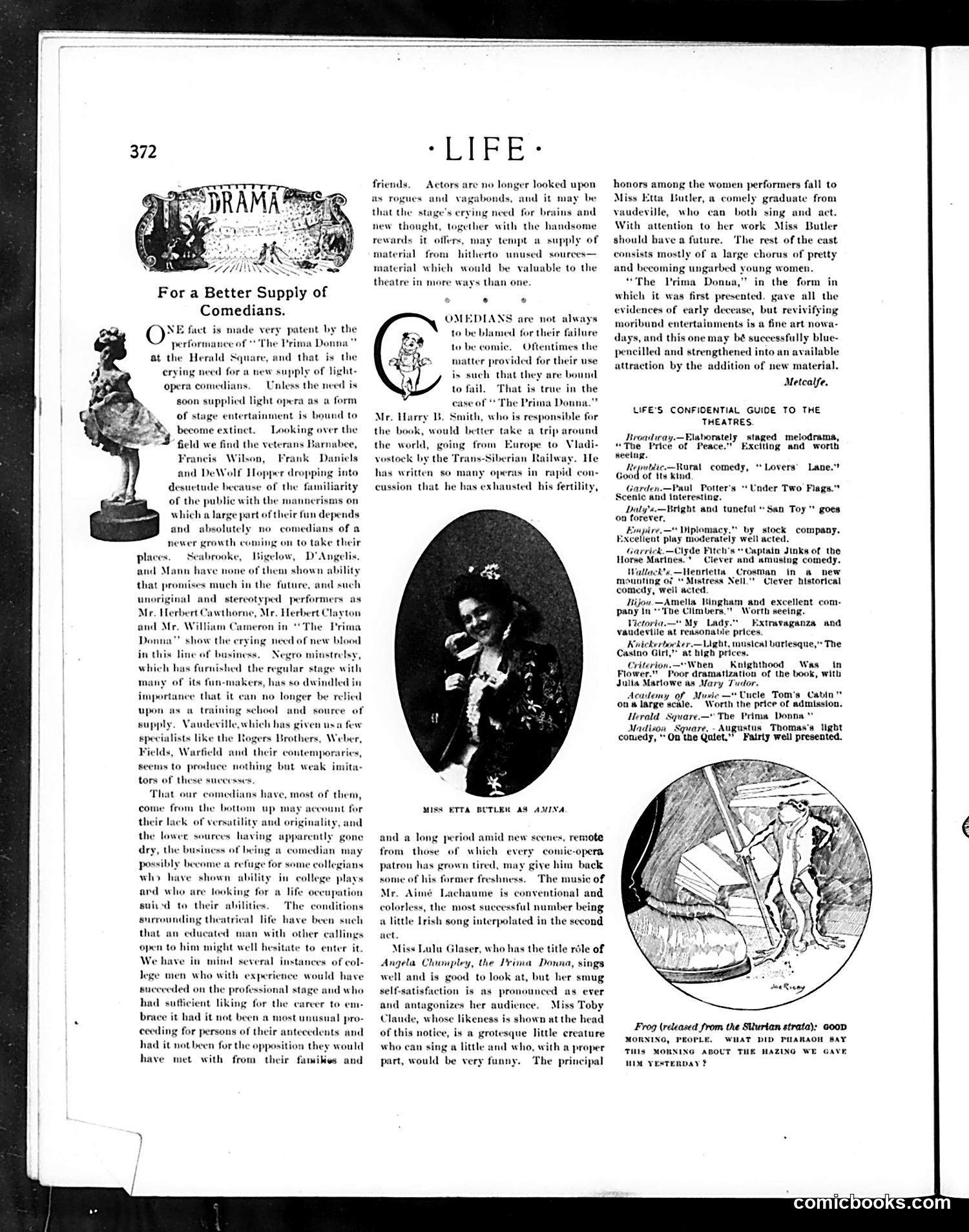
This page discusses comedians and theatrical entertainment, titled "For a Better Supply of Comedians." The article argues that established comedians like Francis Wilson, Frank Daniels, and others are aging, and the theater needs fresh comic talent. It critiques existing performers as overly familiar and stereotyped. The page includes a photograph labeled "MISS ETTA BUTLER AS AMINA" and an illustration captioned "Frog (released from the Sturgeon strafe): GOOD MORNING, PEOPLE. WHAT DID PHARAOH SAY THIS MORNING ABOUT THE HAZING WE GAVE HIS YESTERDAY?" The frog cartoon appears to reference contemporary events (the "Sturgeon strafe" suggests a WWI-era publication), though the specific context is unclear. The overall page advocates for developing new comedic talent rather than relying on aging performers.
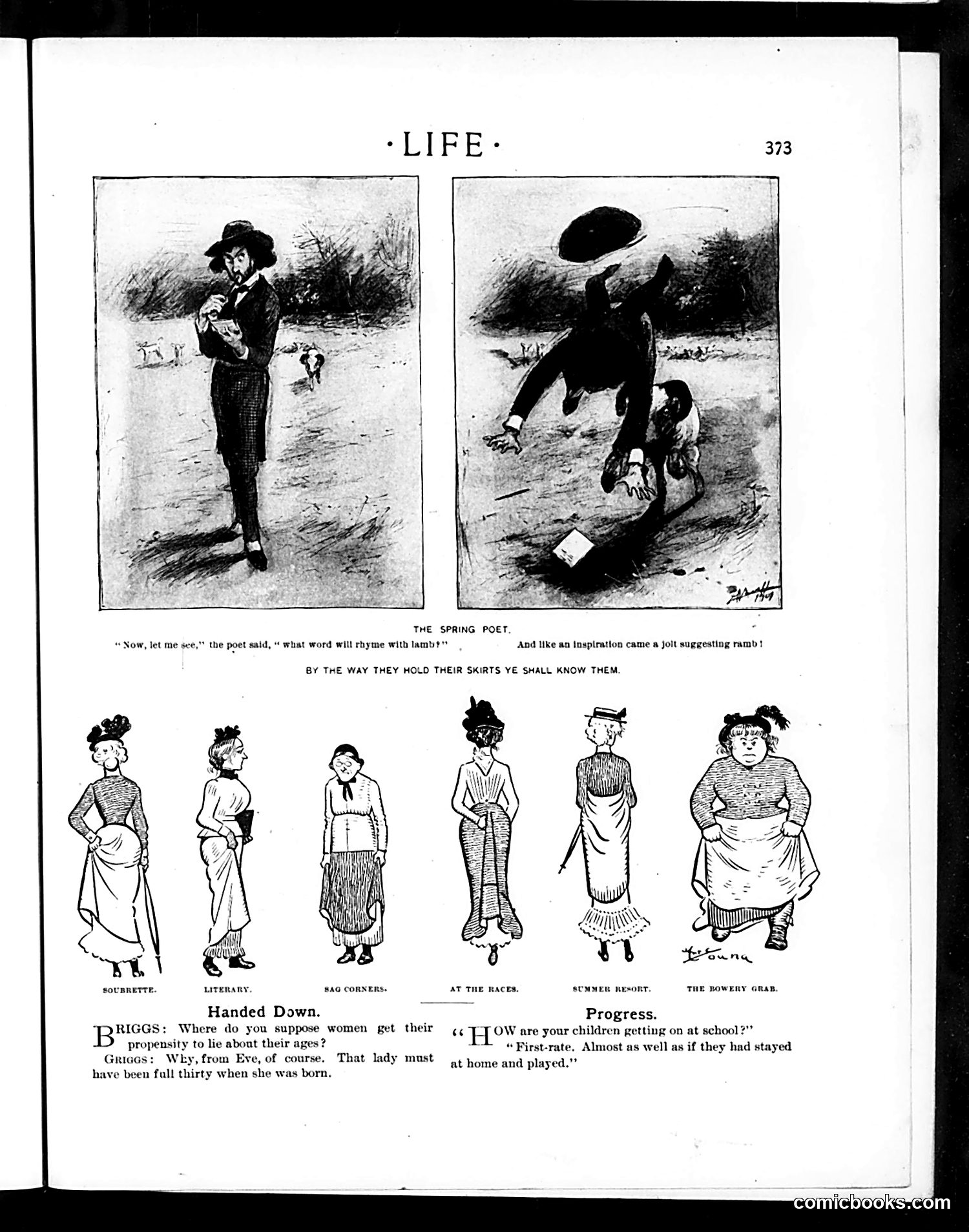
This page from *Life* magazine contains two satirical pieces: **"The Spring Poet"** (top): Mocks amateur poets seeking inspiration. A man asks what rhymes with "lamb," then gets literally struck by a cart—a visual pun on "inspiration" arriving as a physical jolt. The joke ridicules pretentious or struggling poets. **"By the Way They Hold Their Skirts"** (middle): A fashion satire showing six female character types (soubrette, literary woman, "sag corners," racetrack attendee, summer resort visitor, "bowery grab") identified by how they carry their skirts. This stereotypes women by social class and behavior. **"Handed Down" and "Progress"** (bottom): Two brief jokes. The first uses the biblical Eve to explain why women lie about their age—suggesting dishonesty is "natural" to women. The second presents a smug observation that modern schooling produces results "almost as well" as staying home and playing, satirizing progressive education's actual value. The overall tone is satirical humor targeting both pretentious poets and gender stereotypes common to the era.
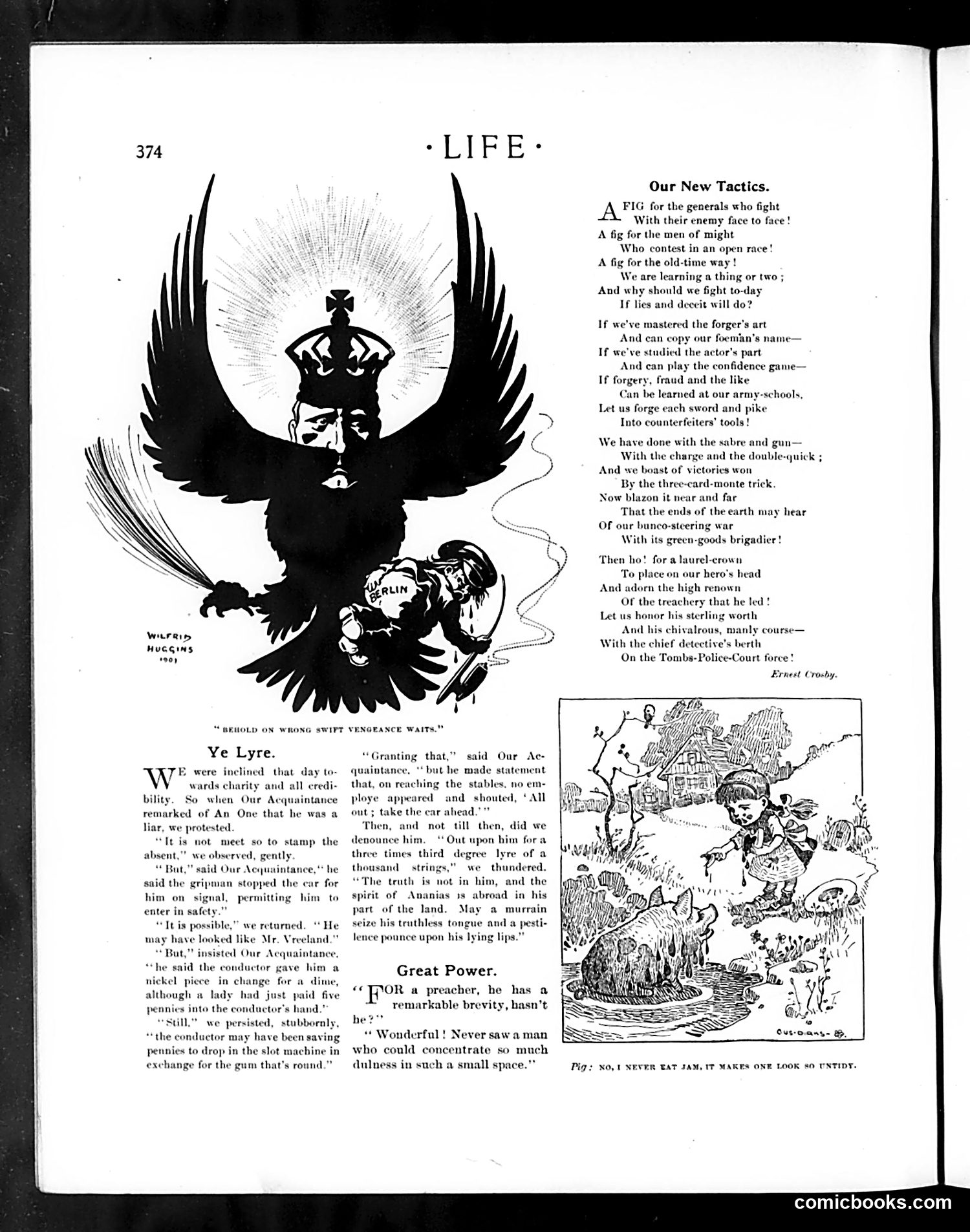
This page contains **satirical critiques of dishonesty and military deception**, likely from the early 1900s (Life's prominent era). **Main Cartoon (left):** A fierce eagle clutches a figure labeled "Berlin," depicted as a traitor or enemy. The title "Behold on Wrong Swift Vengeance Waits" suggests retribution against treachery. **"Our New Tactics" (poem by Ernest Crosby):** This is **anti-war satire mocking modern military strategy**. Rather than traditional combat ("sabre and gun"), the poem sarcastically celebrates using "forger's art," "confidence games," and "three-card-monte tricks"—essentially fraud and deception—as warfare tactics. The speaker ironically calls for honoring such deceit with laurels and detective positions ("Tombs-Police-Court force"), exposing how dishonorable these methods are. **"Ye Lyre" and "Great Power"** sections appear to be unrelated satirical dialogues about lying and brevity. **The small sketch (right):** Shows figures in a pastoral scene, unrelated to the main themes. The page critiques both wartime dishonesty and general moral corruption through ironic praise of dishonorable conduct.
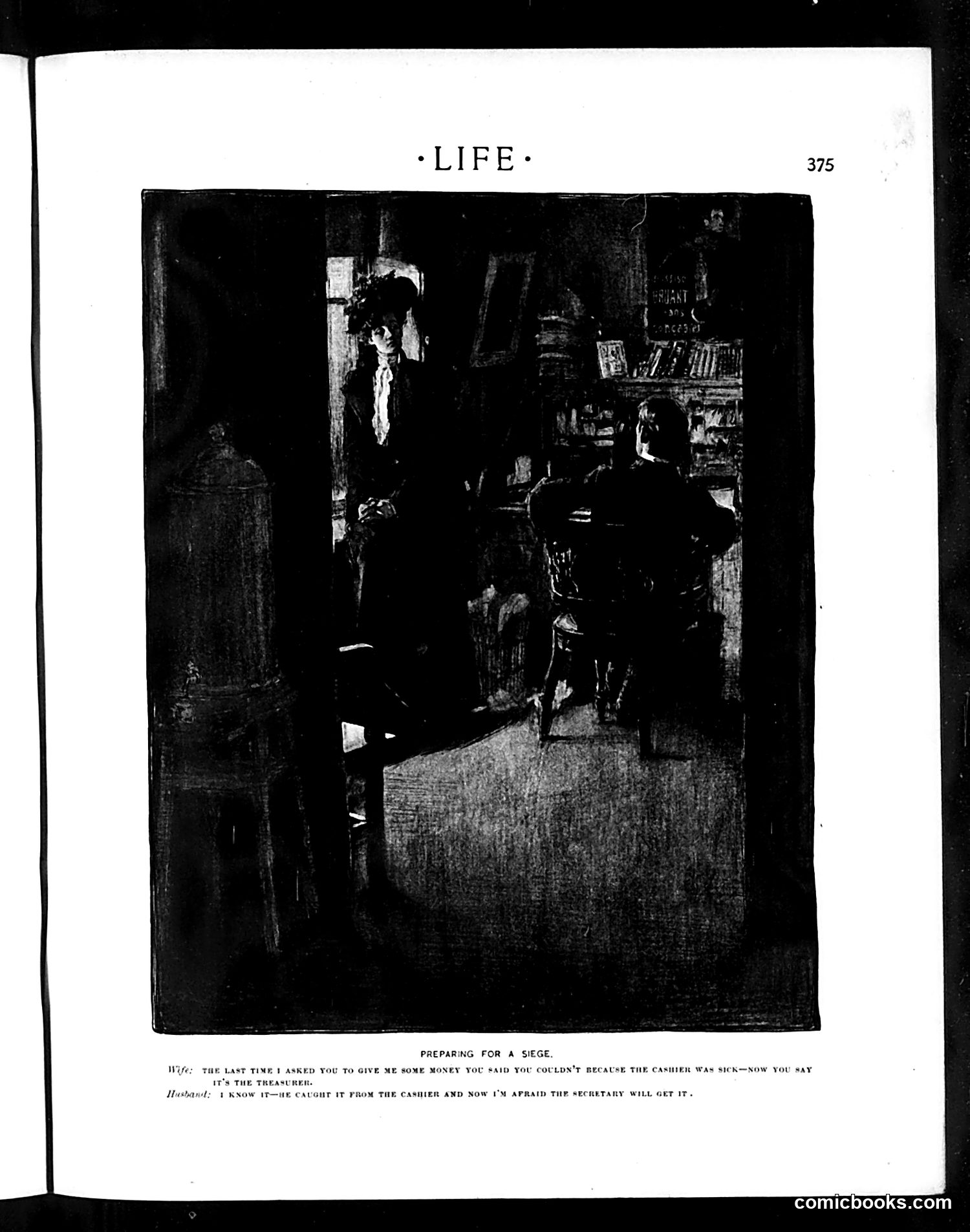
This is a domestic comedy sketch satirizing a husband's persistent excuses for not giving his wife money. The wife (left) confronts the husband (right, seated) about his shifting explanations: previously he claimed the cashier was sick and couldn't access funds; now he worries the secretary will "get it" (discover the money). The joke targets husbands who invent transparent obstacles to avoid giving wives household money—a common marital complaint of the era. The wife's exasperation is clear: each excuse conveniently evaporates, replaced by a new one. The title "Preparing for a Siege" suggests she's girding herself for prolonged financial resistance. This reflects early 20th-century tensions over household economics and women's financial dependence on husbands.
This page is primarily **advertising with literary content**, not political cartoons. The main feature is a romantic poem, "Miss Violet," about a young woman who attracts numerous suitors but remains unattainable. It's sentimental Victorian-era verse typical of *Life* magazine's literary section. Below are several anecdotes and stories, including one about Rajah Schan (likely a fictional or legendary Indian ruler) tricked by Chinese strategists using an elaborate deception about distance, and references to popular theatrical productions (*Florodora*, *When Knighthood Was in Flower*, *Captain Jinks*). The lower half contains **product advertisements** for Wilson Whiskey, Myles Ginger Ale, Hunter Baltimore Rye, Arnold Constable laces, and Ruinart Champagne—typical commercial content from a magazine of this era. There are no political cartoons or satirical commentary visible on this page; it reflects early 20th-century American magazine content mixing literature, humor, and advertising.
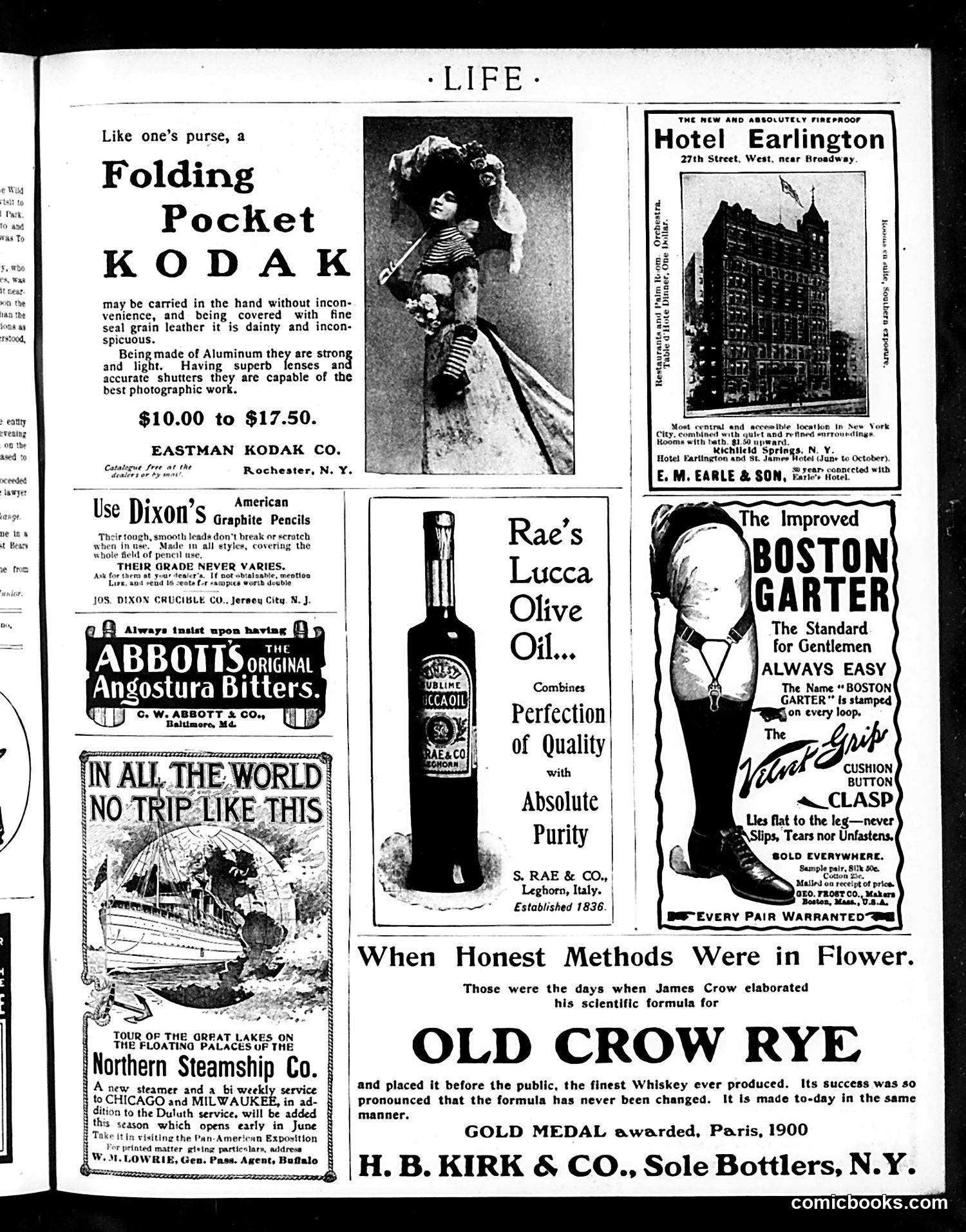
This page is primarily **advertising content**, not satirical cartoons. It features early 1900s product advertisements for consumer goods and services: **Notable ads include:** - **Folding Pocket Kodak** cameras ($10-$17.50) — marketed as portable and convenient - **Dixon's graphite pencils** — emphasizing quality and consistency - **Abbott's Angostura Bitters** — a digestive tonic/liqueur - **Northern Steamship Co.** — Great Lakes tour service to Chicago and Milwaukee - **Hotel Earlington** — a fireproof hotel in New York City - **Rae's Lucca Olive Oil** — Italian import emphasizing purity - **Boston Garter** — men's garter with cushion button (practical hosiery) - **Old Crow Rye whiskey** — claiming unchanged formula since James Crow's time, awarded Gold Medal at Paris 1900 The **Old Crow ad** is notable for its claim about "honest methods" and scientific formula—a sales pitch relying on tradition and authenticity to market the product during the Progressive Era. This reflects turn-of-the-century consumer culture and advertising strategies emphasizing quality, innovation, and prestige.
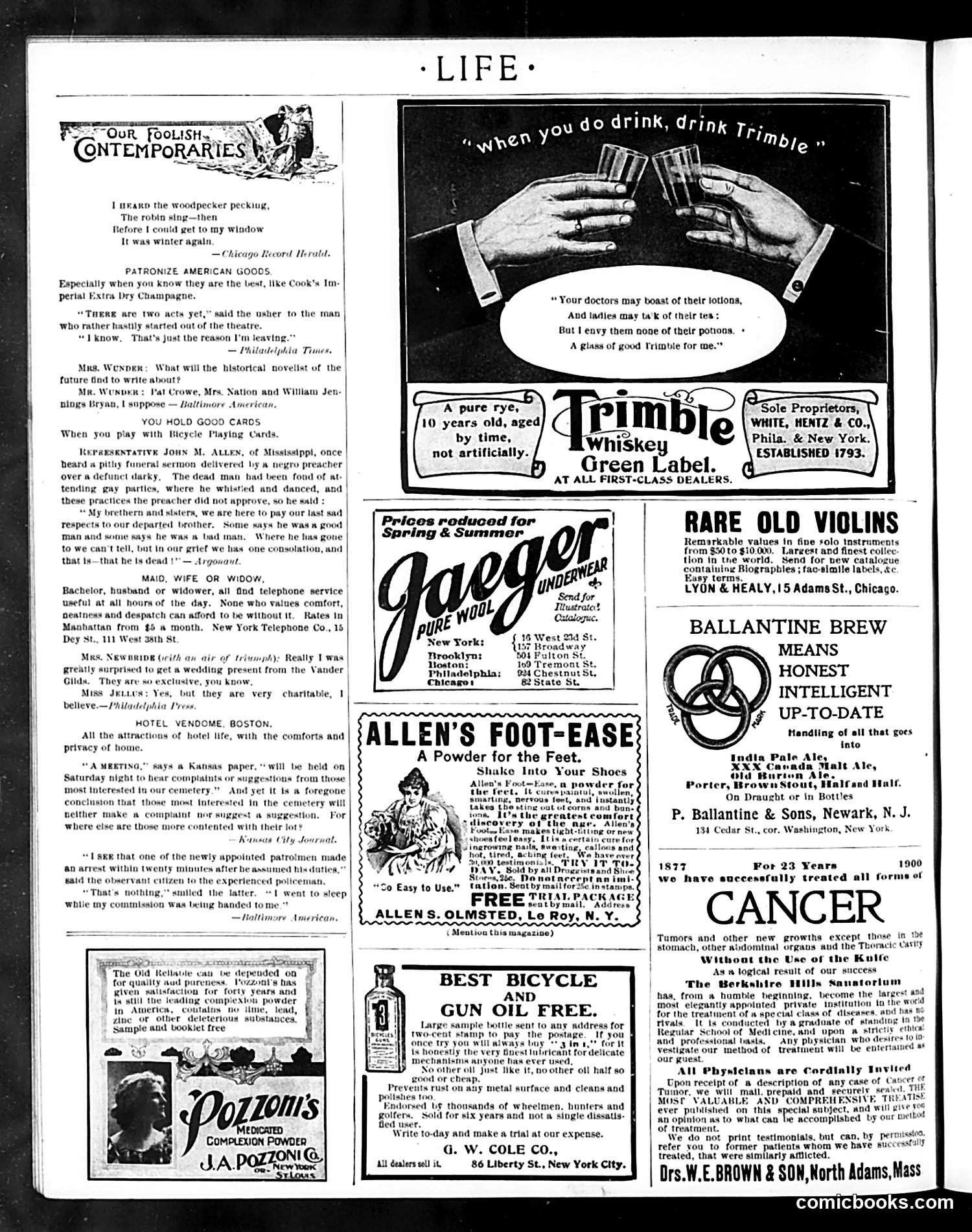
This page is primarily **advertisements and humor snippets** rather than political cartoons. The content reflects turn-of-the-century American commercial culture. The humor pieces are brief, disconnected anecdotes in the style of the era. One notable entry quotes a funeral sermon about a deceased Black man—reflecting the period's casual racial stereotyping through dialect humor (then considered acceptable entertainment). Another anecdote jokes about a new policeman making an arrest too quickly, suggesting institutional incompetence. The "Patronize American Goods" section references **Pat Crowe, Carrie Nation, and William Jennings Bryan**—contemporary figures (a kidnapper, temperance activist, and politician). This suggests topical, gossipy social commentary. The bulk of the page features product advertisements: Trimble whiskey, Jaeger underwear, Allen's Foot-Ease powder, bicycle oil, and Pozzoni's complexion powder. These ads reveal period consumer culture and concerns (foot pain, complexion anxiety). **In context**: This represents Life magazine as a humor and lifestyle publication mixing satirical commentary with heavy advertising—vastly different from modern magazine formats.
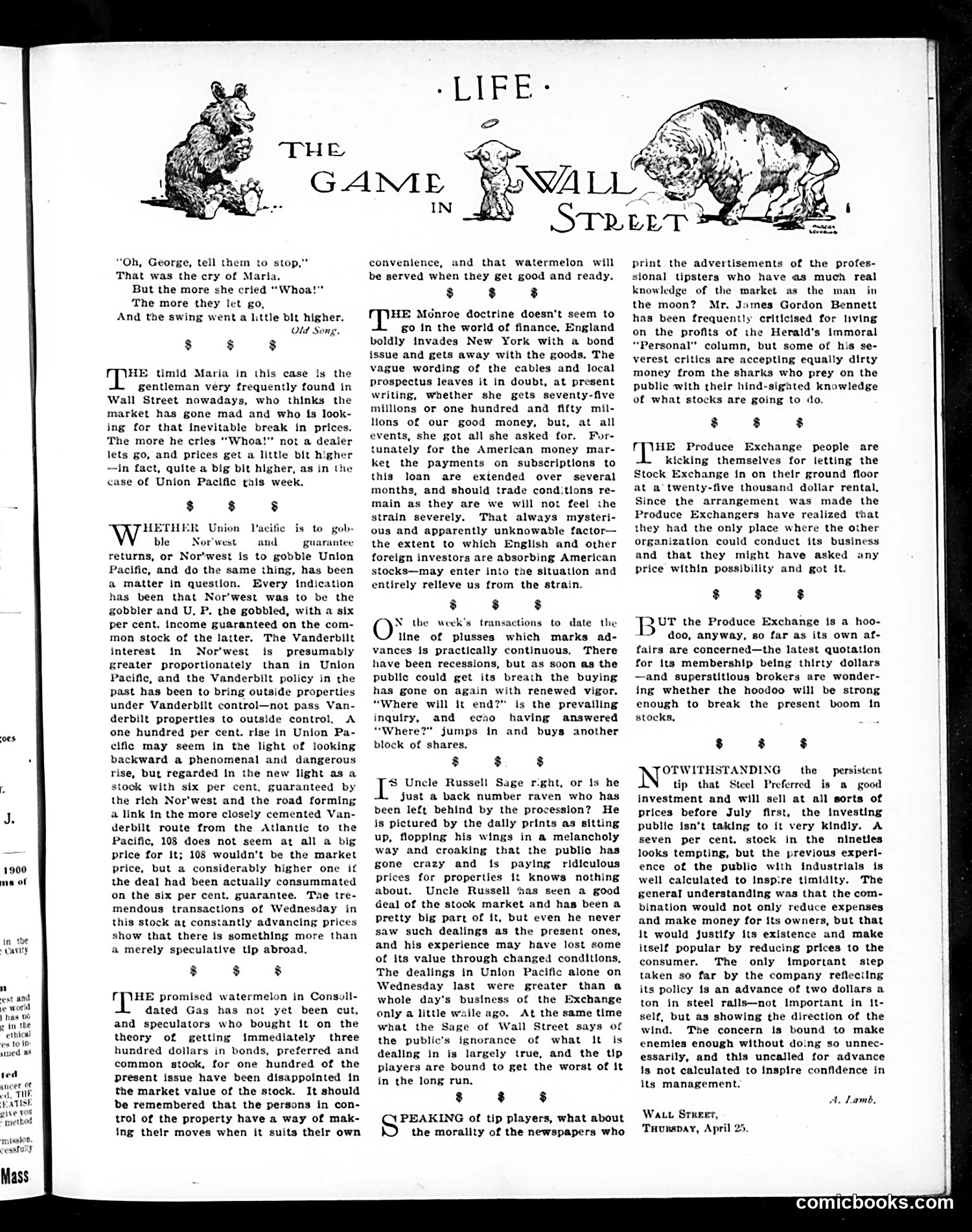
This satirical piece from *Life* magazine (dated April 25, though year unclear from image) uses the metaphor of a child on a swing to mock Wall Street speculators and stock market behavior. **The Main Cartoon/Allegory:** "Maria" represents cautious investors crying "Whoa!" to stop the market's rise, but their warnings only encourage more buying—the swing goes higher. This references Union Pacific railroad stock, which had surged dramatically. **Key References:** - **Union Pacific/Nor'west merger speculation**: Discusses whether railroad magnates (likely the Vanderbilts) would consolidate these companies with guaranteed returns - **Consolidated Gas "watermelon"**: A trick where promised profits never materialize - **England's bond invasion**: British investment in American securities - **Uncle Russell Sage**: A famous (and apparently cautious) speculator being proven wrong by continued market gains **The Satire's Point:** The market is irrational and self-reinforcing—attempts to warn of a crash only fuel further speculation. Skeptics consistently lose money while the boom persists, making their caution appear foolish rather than prudent.
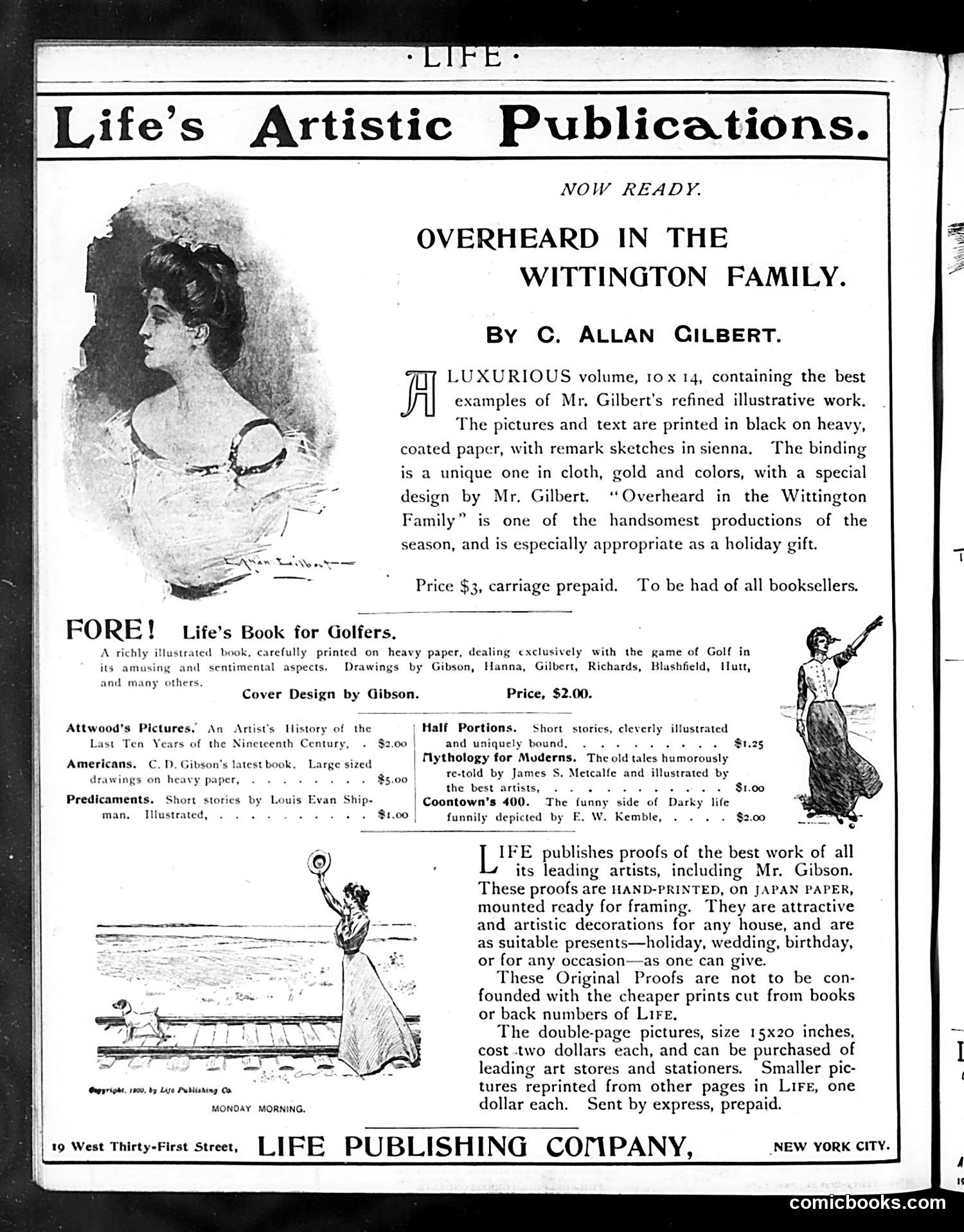
This is primarily an **advertising page** for Life Publishing Company's artistic publications, circa 1900. The page showcases books by prominent illustrators of the era, particularly **C. D. Gibson** (famous for the "Gibson Girl" aesthetic) and **C. Allan Gilbert**. The main advertised work is *"Overheard in the Wittington Family"* by Gilbert—a luxury illustrated volume ($3) featuring refined domestic scenes. Below are other Life publications: *Life's Book for Golfers*, *Attwood's Pictures*, *Americans*, and *Predicaments*. **Notable for modern readers**: The page includes a book titled *"Coontown's 400"* illustrated by E. W. Kemble, using period-appropriate but now-offensive racial terminology. This reflects the casual racism embedded in early 1900s American publishing. The page emphasizes hand-printed proofs on Japanese paper as premium art gifts—demonstrating how illustrated magazines functioned as high-end cultural commodities, not just humor publications.
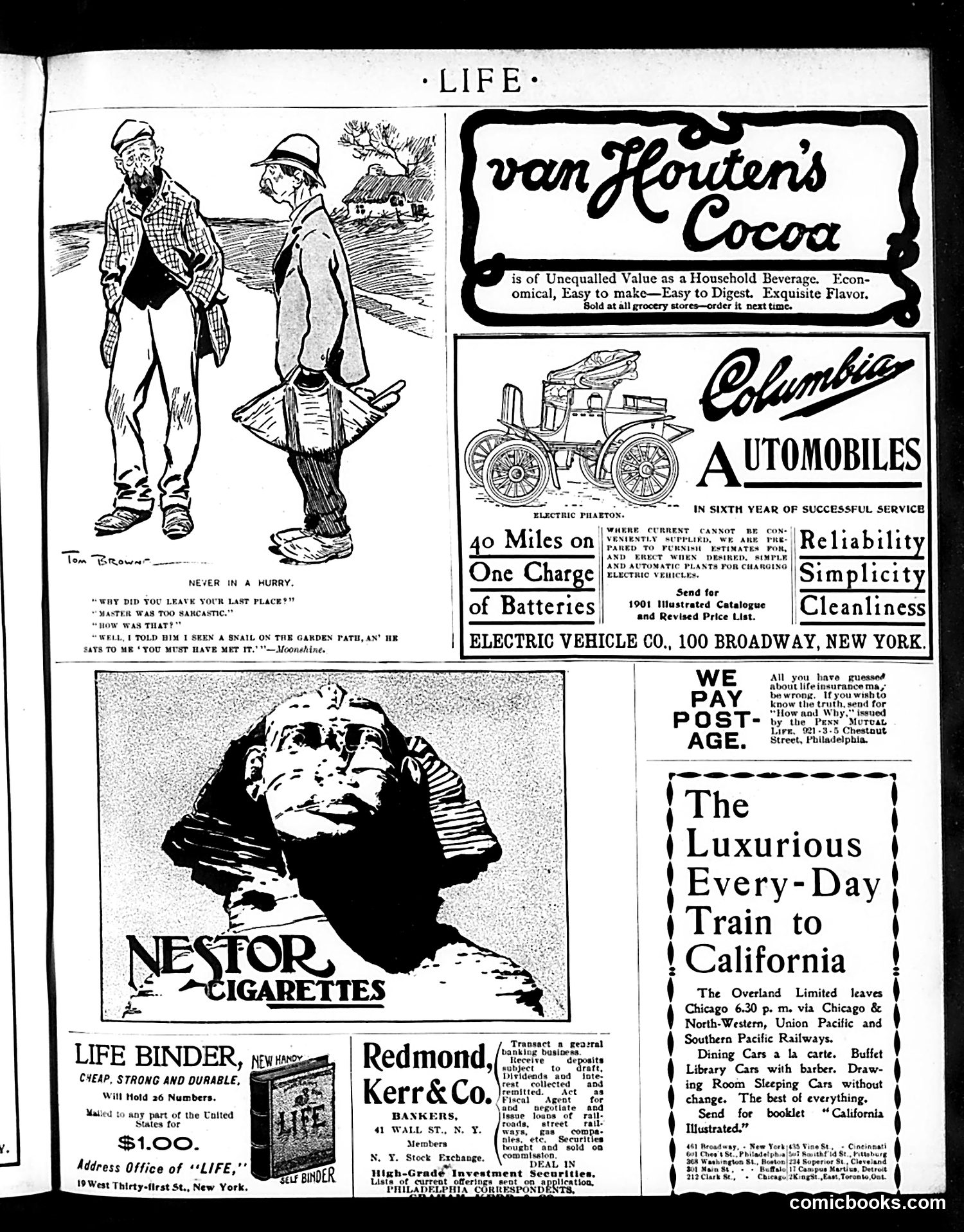
The top cartoon by Tom Bowers depicts two working-class men in a humorous dialogue about job transitions. One appears to be a laborer leaving employment; the quoted exchanges ("Why did you leave your last place?" / "How was that?") suggest comic miscommunication about reasons for quitting. The Mencken attribution indicates satirical commentary on working-class employment instability or the absurdity of exit interviews. The lower half features **Nestor Cigarettes** advertising with an Egyptian pharaoh head—a popular visual trope of the era exploiting "exotic" imagery for product branding. The page is primarily **commercial advertising** for period goods: van Houten's cocoa, Columbia electric automobiles (marketed on reliability and simplicity), the Overland Limited railroad to California, life insurance, and banking services. These ads reflect early 1900s consumer culture targeting middle-class readers. The satirical content is minimal; this is largely a standard magazine advertising page with one humorous cartoon commentary on labor relations.
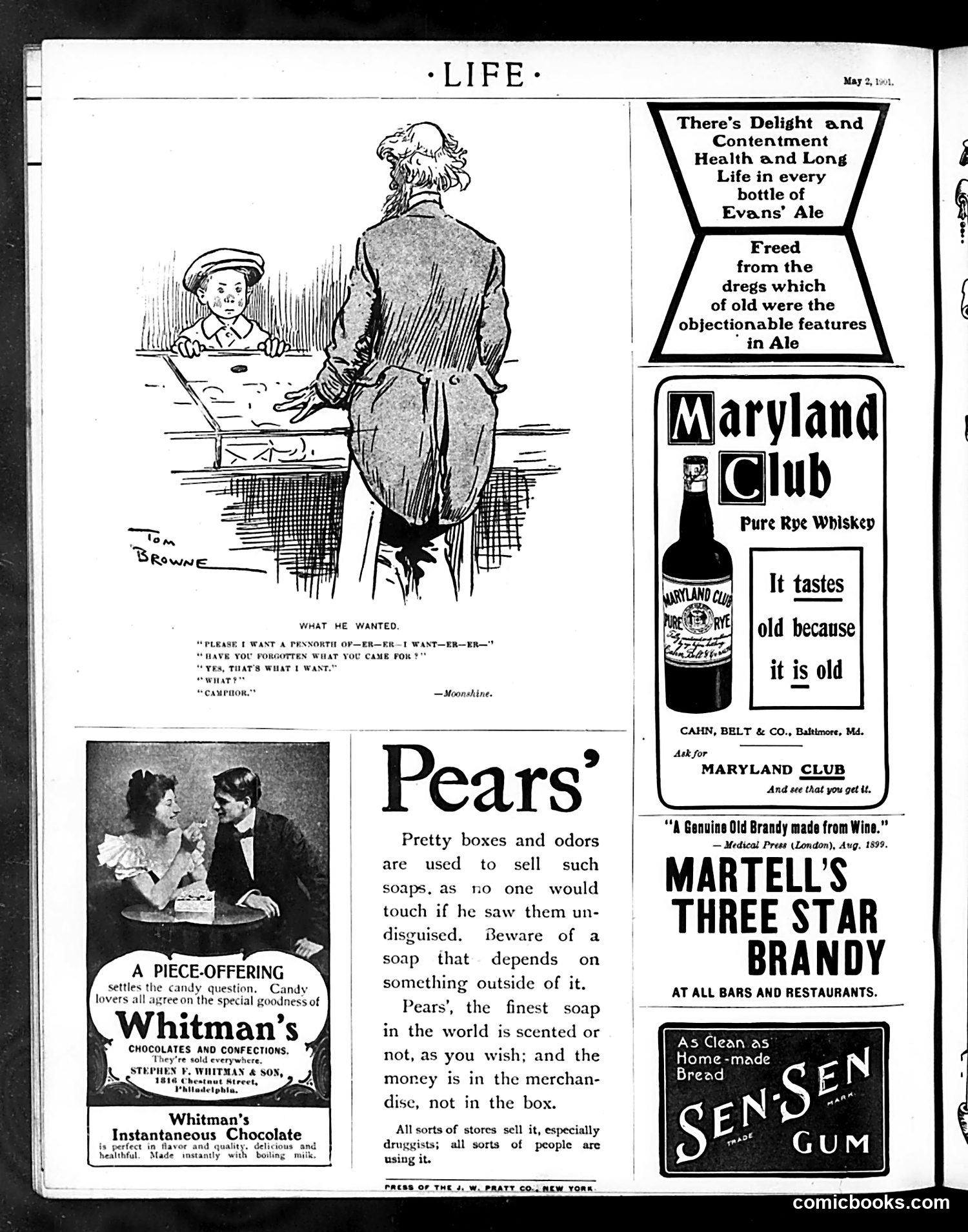
The main cartoon depicts a man at a counter struggling to articulate what he wants, stammering through nonsensical syllables ("ER—FR—I WANT—ER—ER"). The caption identifies this as "Moonshine," referencing illegal homemade liquor during Prohibition. The satire targets how people were forced to speak obliquely about alcohol due to legal restrictions. The man cannot simply say "whiskey" or "beer," so he stammers uselessly—mocking both the absurdity of Prohibition laws and the linguistic gymnastics required to discuss forbidden drink. The page's heavy alcohol advertising (Evans' Ale, Maryland Club whiskey, Martell's brandy) underscores the irony: while these brands advertised openly (likely pre-dating strict Prohibition or in magazines with limited enforcement), ordinary people faced legal jeopardy and had to speak in coded language about what they wanted.