
A complete issue · 22 pages · 1901
Life — April 18, 1901
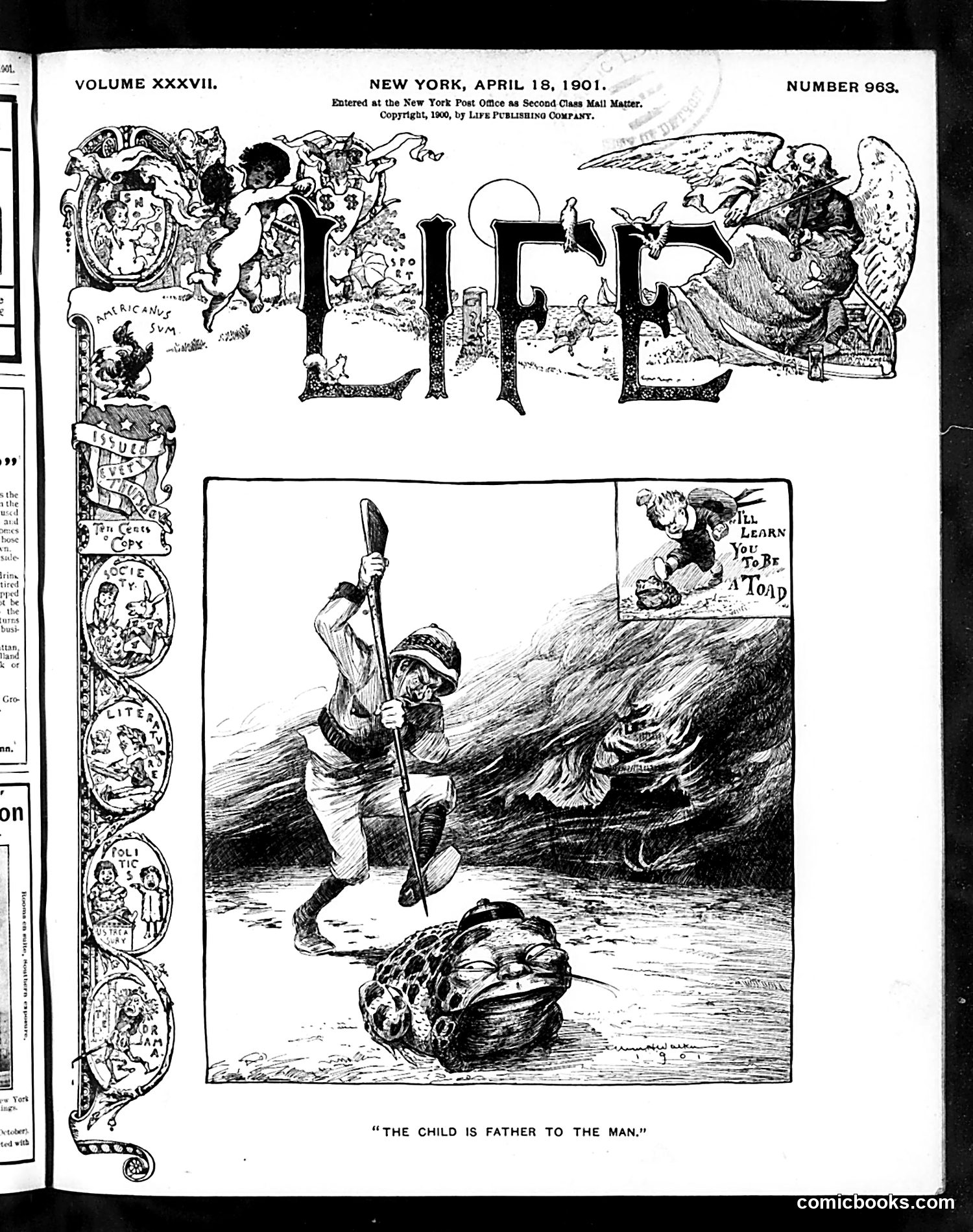
This page features an elaborate decorative title "LIFE" with classical and allegorical imagery. The main cartoon below depicts a child wielding a paddle or bat, striking at what appears to be a large toad or amphibian in water, with the caption "THE CHILD IS FATHER TO THE MAN." This inverts the famous Wordsworth line "The Child is Father of the Man" (about childhood shaping adulthood). The satirical reversal suggests that childish behavior or impulses are driving adult actions—likely a political commentary on reckless leadership or governance around 1901. The toad may represent a corrupt figure or obstacle. The small inset shows text reading "I'LL LEARN YOU TO BE A TOAD," reinforcing the punitive, juvenile tone of the satire.
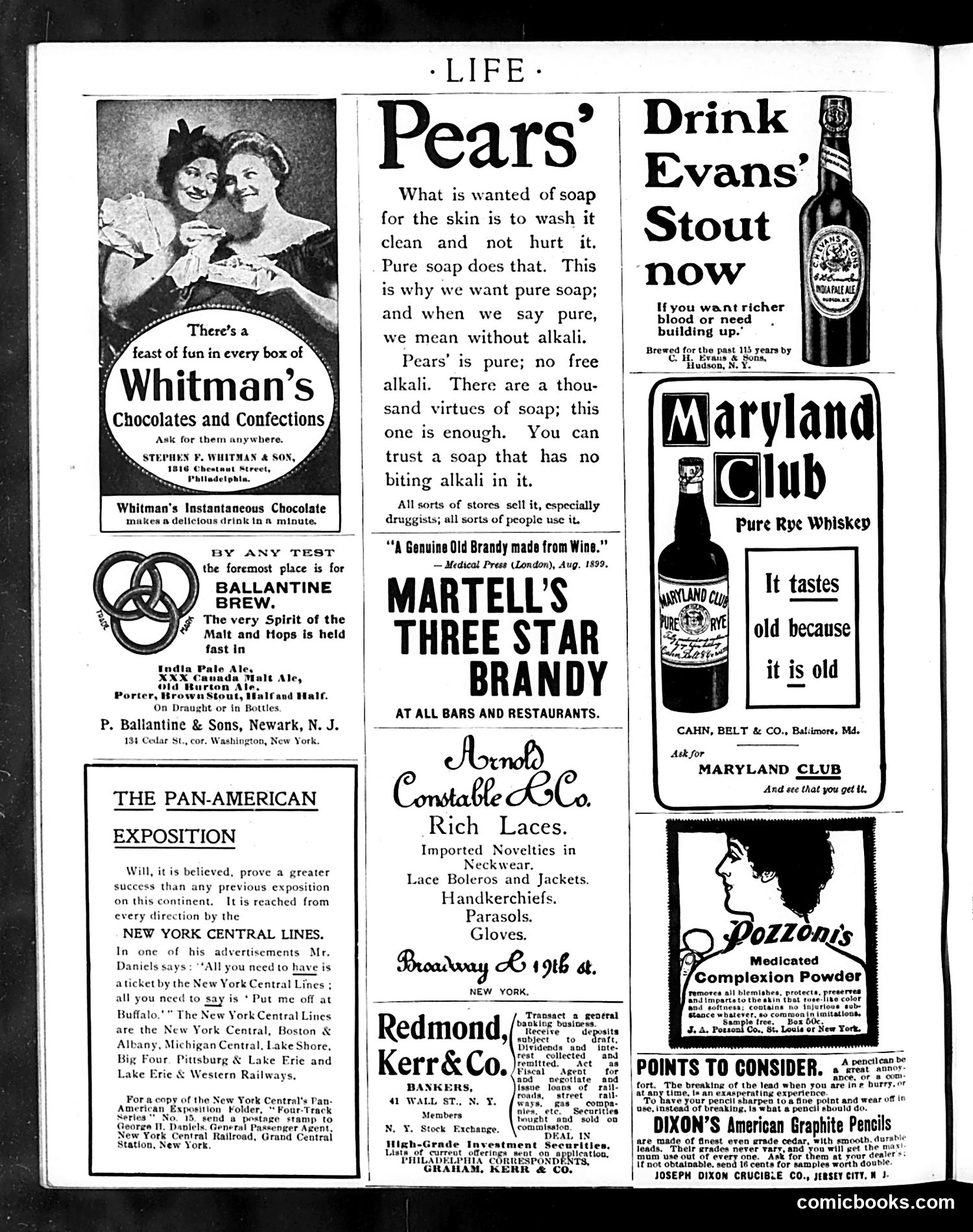
This page is **primarily advertisements**, not satirical content. It contains marketing for: - **Whitman's Chocolates** (featuring two women enjoying the product) - **Ballantine Brew** beer - **Martell's Three Star Brandy** - **Evans' Stout** and **Maryland Club Whiskey** - **Pozzoni's Medicated Complexion Powder** (with a female profile) - **Dixon's American Graphite Pencils** - Various other commercial products The only non-advertisement content is a brief notice about the **Pan-American Exposition**, promoting travel via New York Central Lines. There is **no political cartoon or satirical commentary** on this Life magazine page. It represents typical early 20th-century advertising design, with period typography and modest illustrations. The "satire" brand Life magazine is known for doesn't appear here—this is simply a revenue page from advertisements.
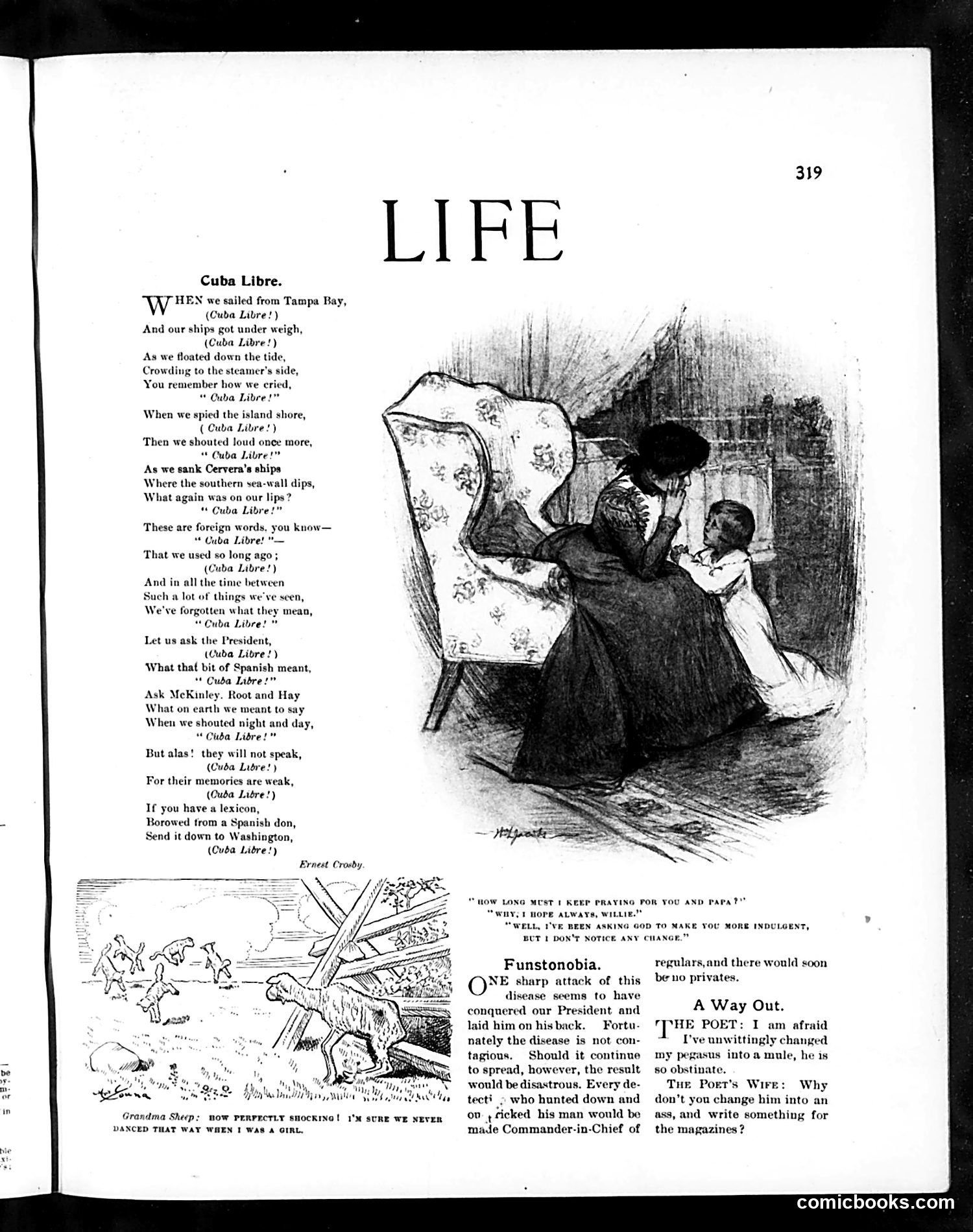
This page contains a poem titled "Cuba Libre" (Spanish for "Free Cuba"), a political rallying cry from the Spanish-American War era. The verses reference sailing from Tampa Bay, sinking ships, and invoke "Cuba Libre" as a repeated refrain—celebrating American military action to liberate Cuba from Spanish colonial rule. The accompanying sketch shows a woman in period dress holding a large flag or banner, likely personifying Cuba itself or American idealism about Cuban freedom. Below is a separate cartoon labeled "Funstonobia" mocking General Frederick Funston, a prominent military figure. It satirizes his purported obsession with disease and military command, playing on contemporary concerns about tropical diseases during the Cuban campaign. The overall page promotes American interventionism in Cuba circa 1898.
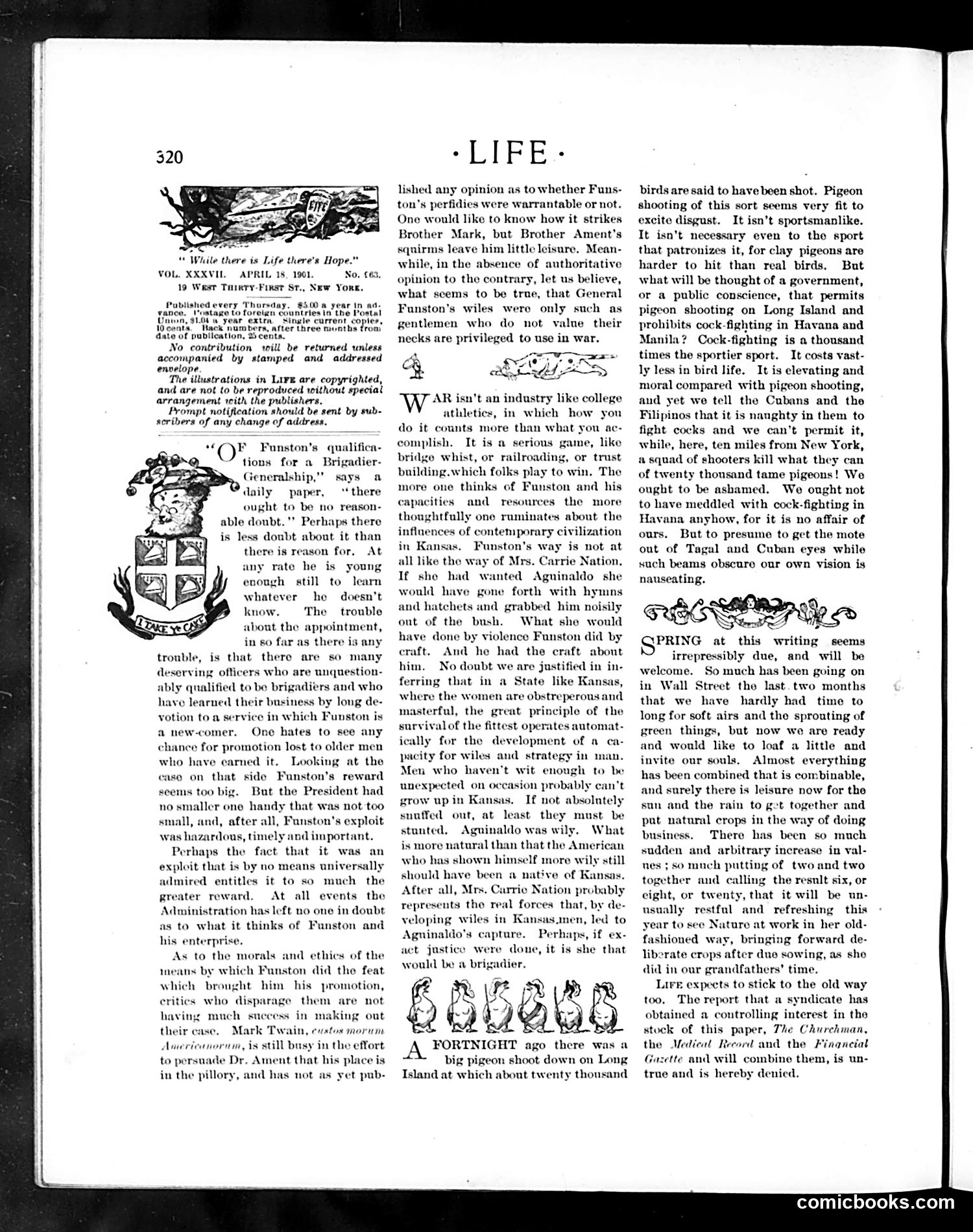
This page contains editorial commentary on General Funston's military conduct, particularly regarding his wives and authority during wartime operations. The text criticizes Funston's qualifications as a brigadier general, questioning whether his success warrants his rank. The main illustrated cartoon (top left) shows a figure with "Life there's Hope" caption, though its specific meaning is unclear from the visible portion. The decorative coat-of-arms emblem and small illustrated vignettes appear to be standard magazine ornamentation rather than political commentary. The text also discusses pigeon-shooting on Long Island and references Mrs. Carrie Nation (the prohibition activist), seemingly contrasting serious military matters with frivolous civilian pursuits to satirize contemporary society. The overall tone criticizes military leadership and administrative judgment during this period.
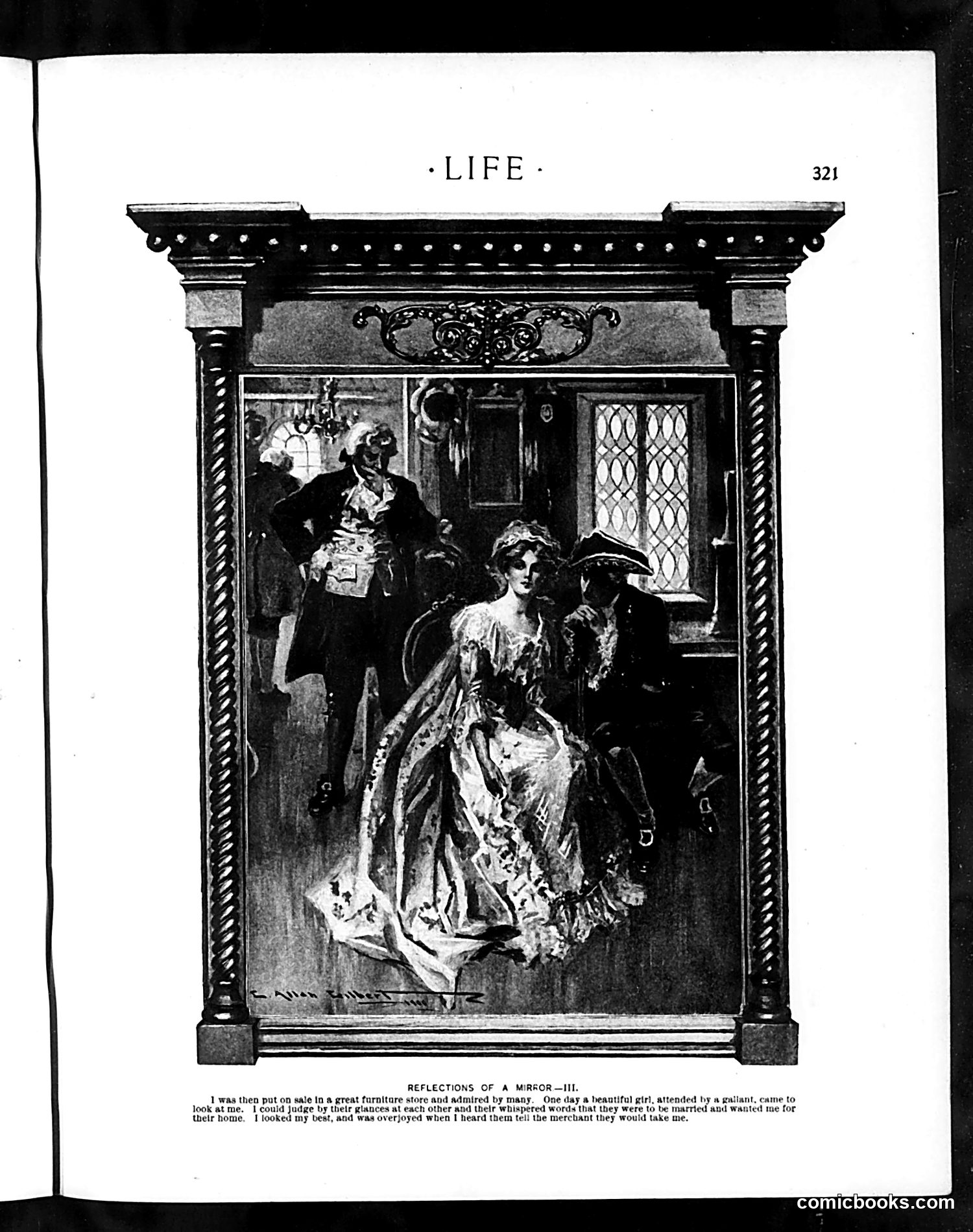
This illustration depicts a social commentary on courtship and marriage prospects. The caption describes a furniture store scene where the narrator observes a beautiful young woman being admired by multiple men—a gallant officer and other suitors—who whisper about marrying her and taking her home. The narrator, positioned as an observer (likely represented by the mirror's "reflection"), expresses skepticism about these men's intentions, noting his discomfort at overhearing their mercenary remarks about her. The satire targets the transactional nature of courtship among the upper classes, where women are treated as desirable acquisitions rather than individuals. The "mirror" metaphor suggests society's superficial values reflected back through social interactions. This appears to be part of a series examining social hypocrisy and romantic pretense.
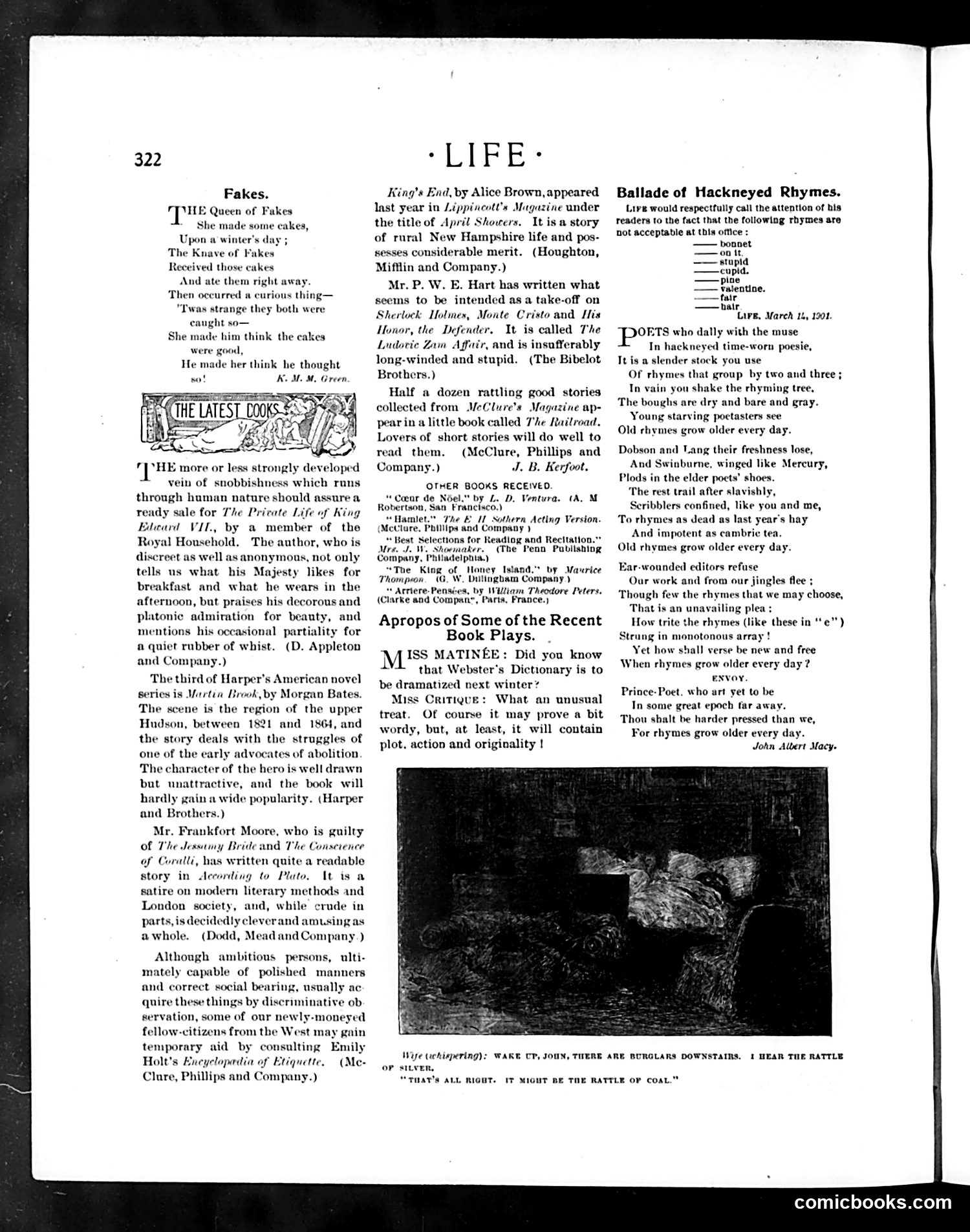
This page contains primarily **book reviews and literary commentary** rather than political cartoons. The left column reviews various novels and short story collections, including works by Alice Brown and P.W.E. Hart. The right side features **"Ballad of Hackneyed Rhymes,"** a poem mocking predictable, overused poetic conventions—criticizing verses that rely on clichés like "old rhymes grow older every day" and "Scribbler confined, like you and me." The **illustration at bottom** shows a domestic interior scene with a caption about burglars and "battle of silver" versus "battle of coal"—apparently satirizing confusion over what's actually valuable during a break-in, likely commentary on working-class versus wealthy concerns. The page is primarily **literary criticism and satire**, not political commentary.
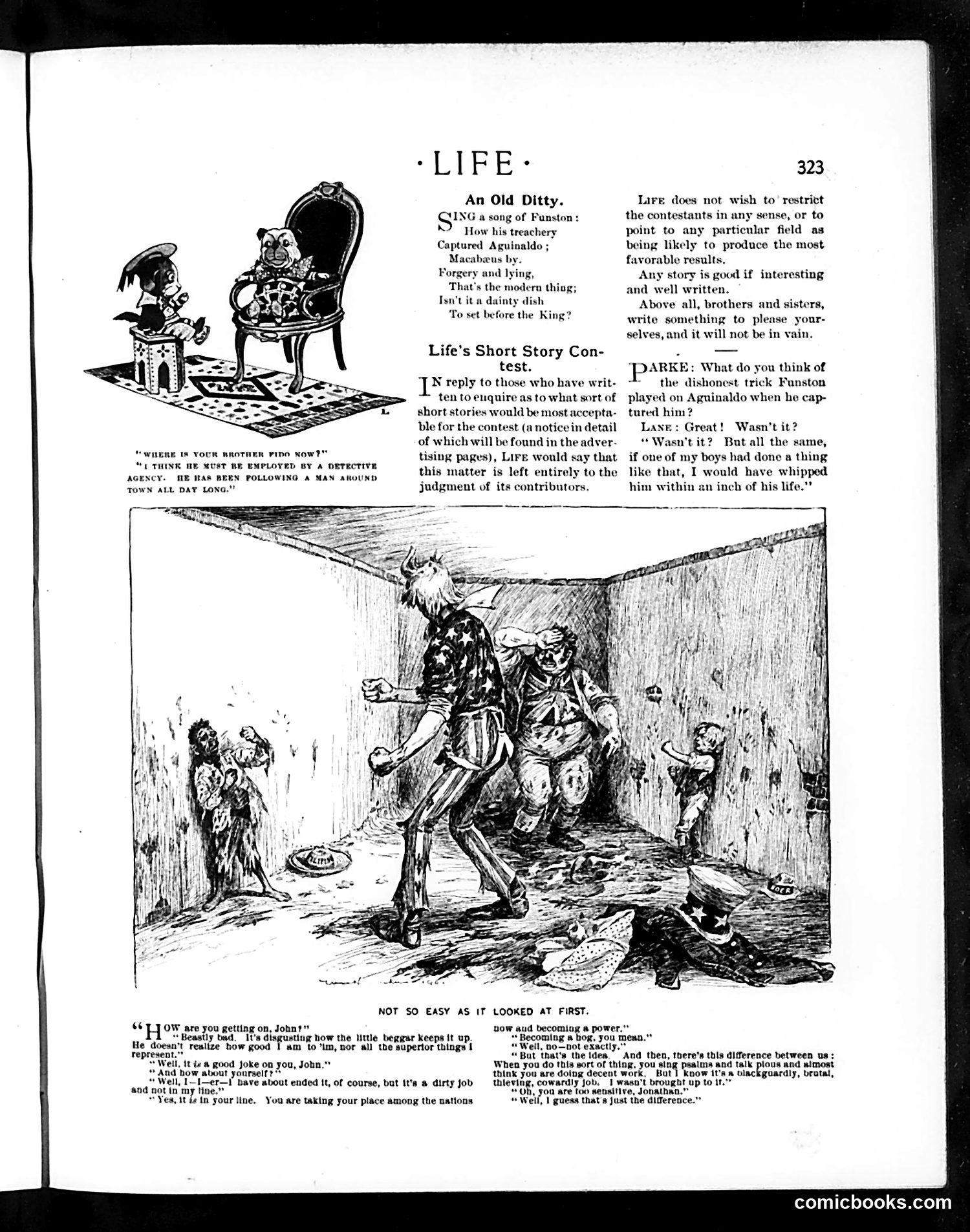
This page satirizes political corruption and treachery through a dialogue set to song, referencing historical figures Funston, Aguinaldo, and Macabeus. The joke involves betrayal and deception ("forgery and lying") presented as "the modern thing"—mocking contemporary political scandals. The lower cartoon depicts a character named John in what appears to be prison or confinement, discussing a job that's "disgusting" and "dirty." He's rationalized his moral compromise by noting he's "taking [his] place among the nations," suggesting cynical acceptance of unethical conduct as normal political practice. The overall message critiques how modern politicians justify corruption and betrayal as inevitable or acceptable aspects of power-seeking.
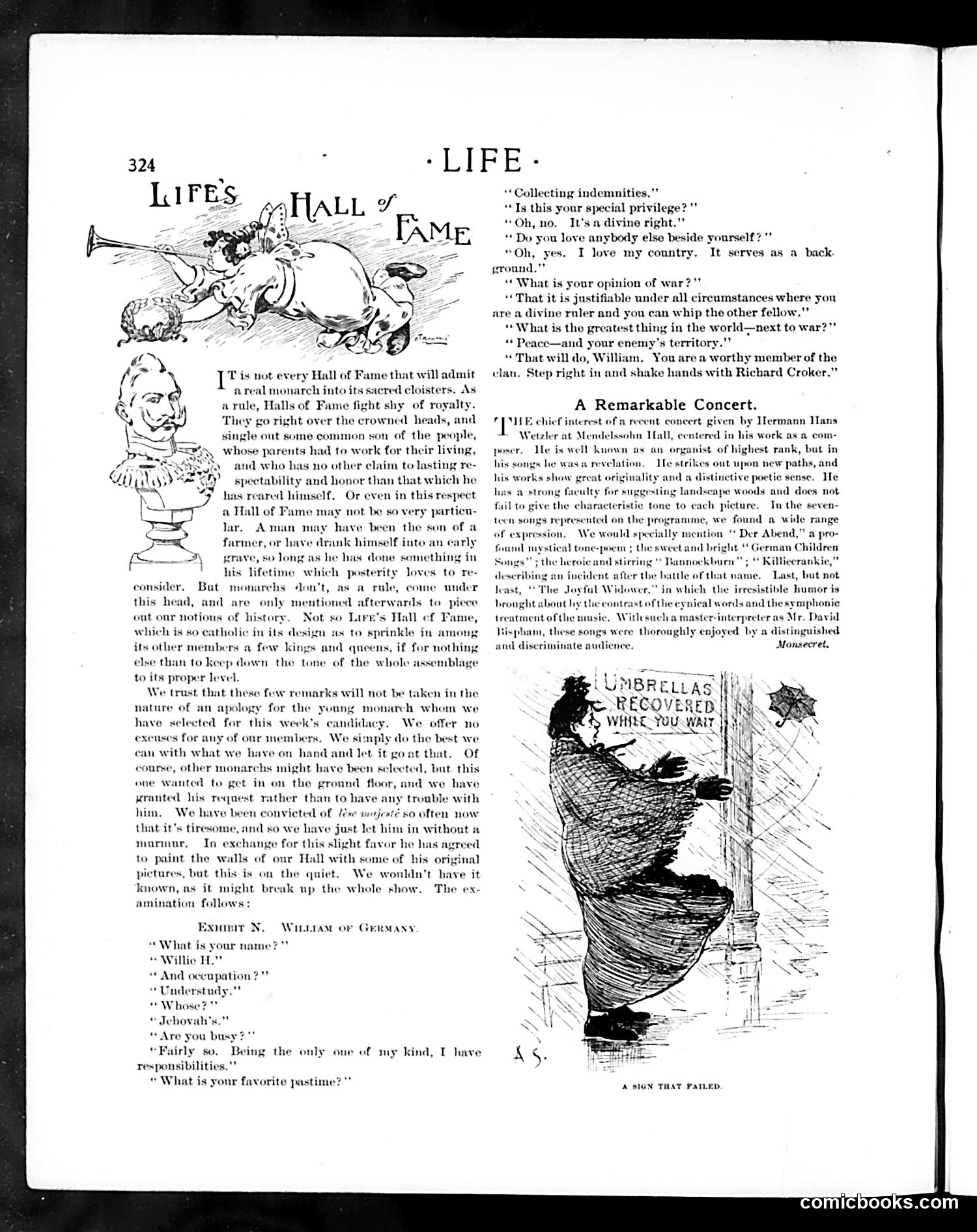
This page satirizes monarchies and their place in an elite "Hall of Fame." The text argues that not every Hall of Fame should admit "real monarchs"—suggesting the magazine questions whether hereditary rulers deserve automatic prestige based on birth alone. The left illustration shows a caricatured figure labeled "William of Germany" (Kaiser Wilhelm II), depicted in military dress. An accompanying interview mockingly examines his qualifications, with responses like "Understudy" and "Fairly so. Being the only one of my kind, I have responsibilities." The right cartoon titled "A Sign That Failed" shows an umbrella sign blown away by wind—likely commenting on failed attempts at propaganda or public relations. The satire targets monarchical pretension during the pre-WWI era.
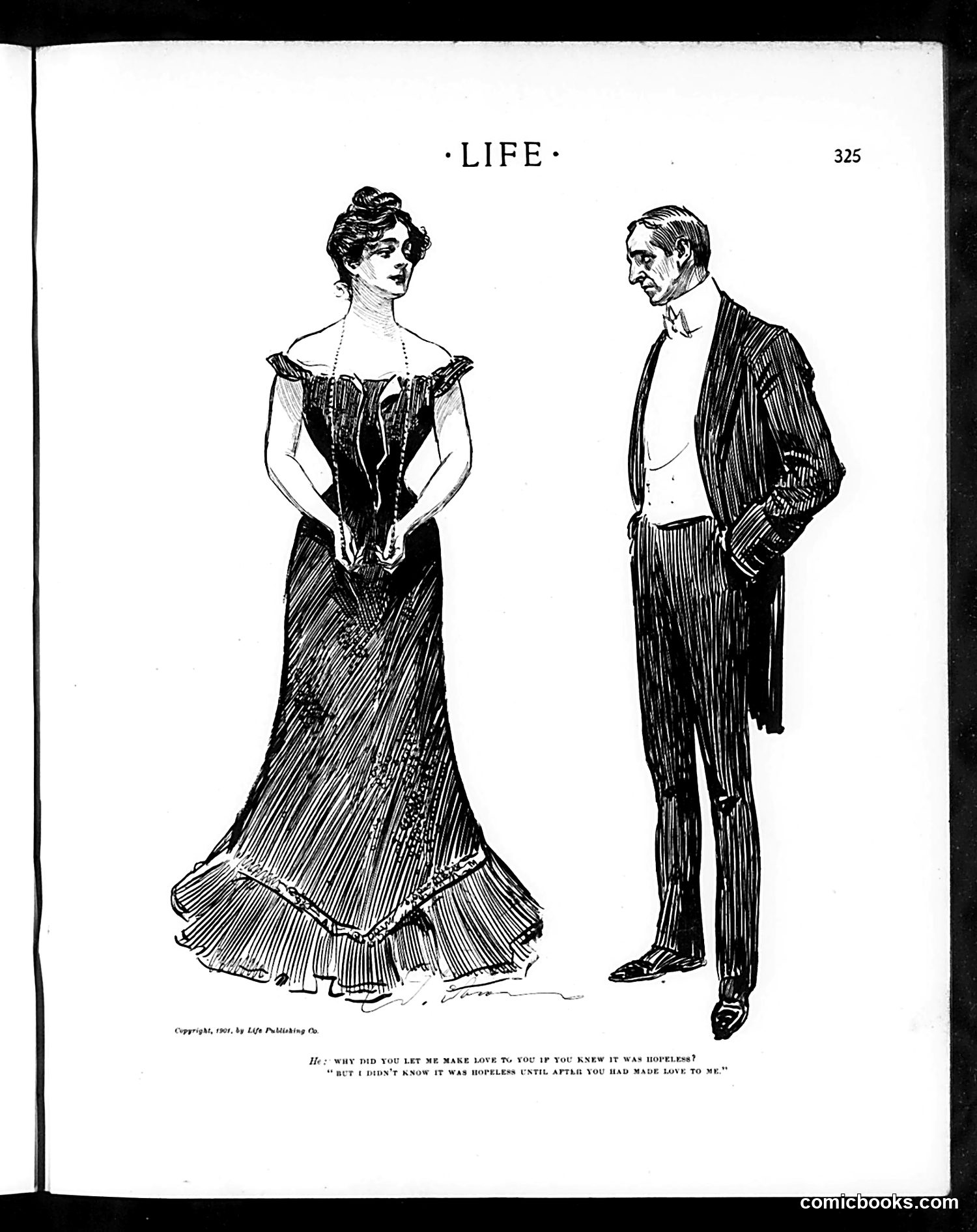
This is a satirical illustration from *Life* magazine (copyright 1907) depicting a romantic dialogue between a man and woman in formal evening wear. The caption presents their exchange: **He:** "Why did you let me make love to you if you knew it was hopeless?" **She:** "But I didn't know it was hopeless until after you had made love to me." The satire targets early 20th-century courtship rituals and female deception. It mocks the convention where women would permit romantic advances without commitment, then claim ignorance of the situation's futility. The joke suggests women's calculated manipulation of men's romantic intentions—a common satirical theme in *Life* magazine's commentary on gender relations and social pretense of the era.
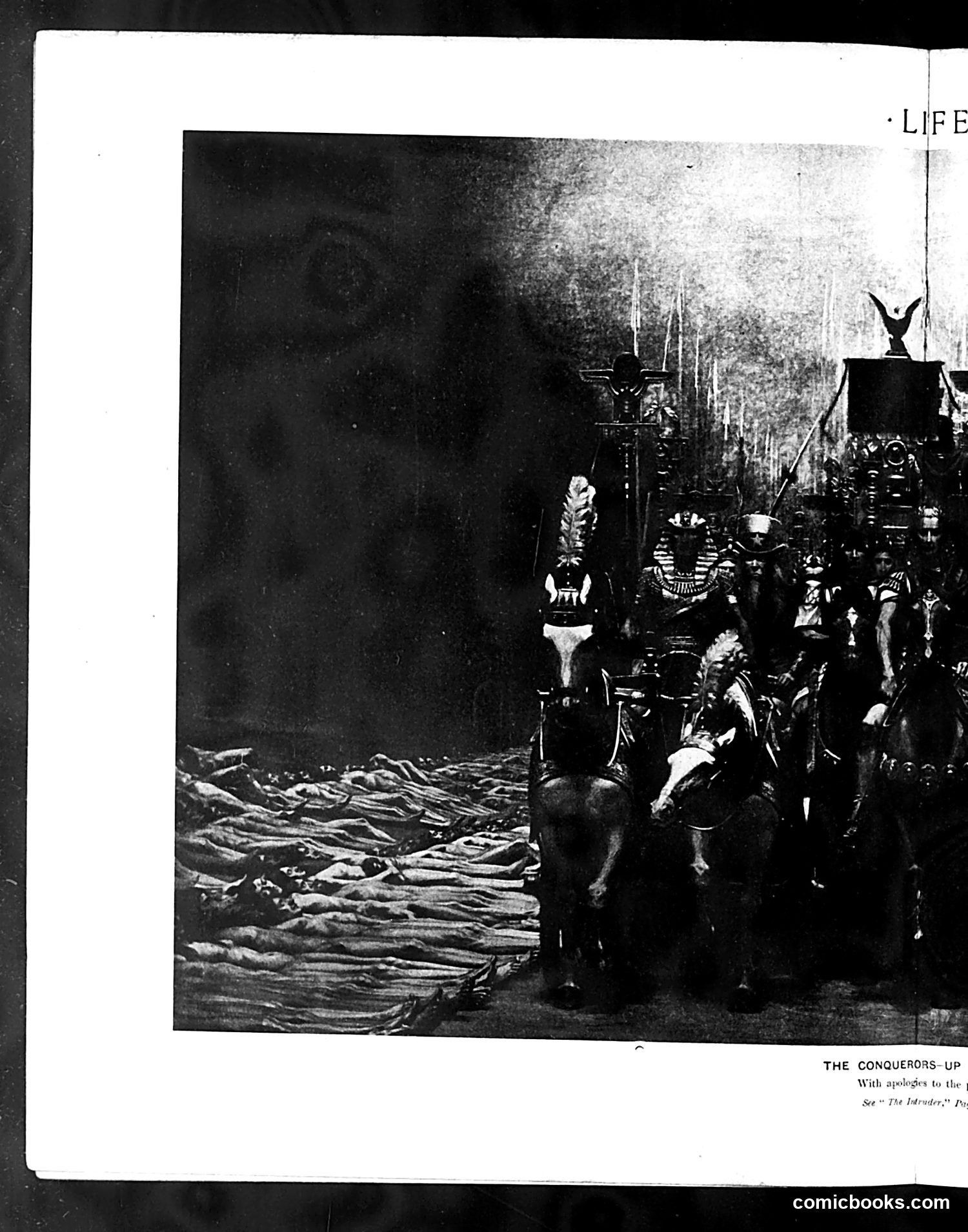
This appears to be a satirical illustration depicting military conquest or imperial subjugation. The image shows elaborately dressed military or royal figures standing over fallen bodies on the ground, suggesting a scene of victory and dominance. The caption "THE CONQUERORS—UP" (with partial text mentioning "With apologies to the" and a reference to "The Invaders") indicates this is likely a satirical commentary on militarism, imperialism, or contemporary warfare. The ironic title—emphasizing the conquerors being "up" while bodies lie below—suggests Life magazine is critiquing the glorification of military conquest or perhaps commenting on a specific historical conflict or political situation. Without the full date and complete caption, I cannot identify the specific historical event referenced, though the ornate costumes suggest either historical reenactment or deliberately exaggerated militaristic pageantry being mocked.
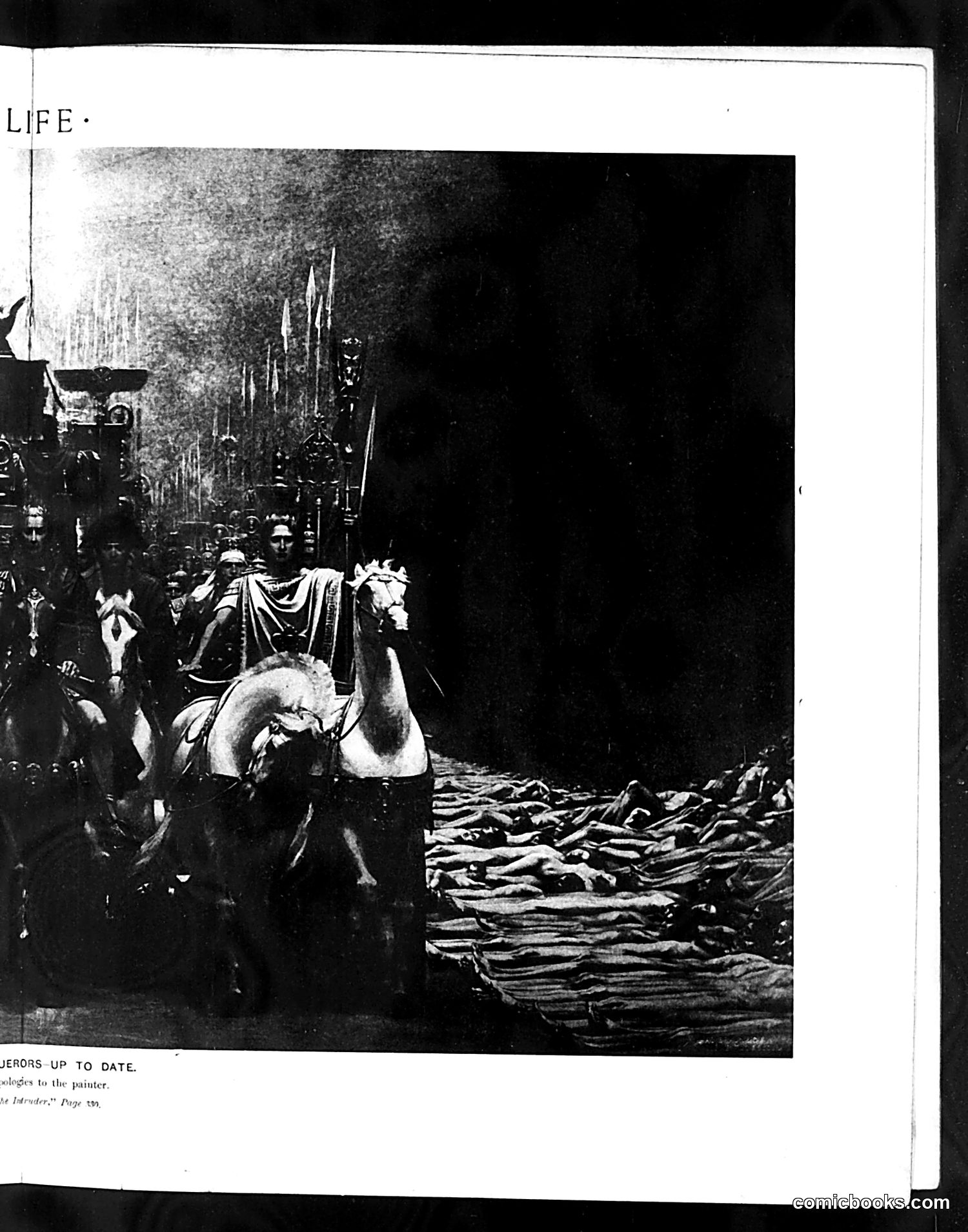
This appears to be a page from *Life* magazine titled "JERORS UP TO DATE" with a subtitle mentioning "offerings to the painter" and reference to "Invaders" (page 182). The black-and-white illustration depicts a medieval or classical scene: armored soldiers on horseback and on foot, carrying spears and banners, positioned before what appears to be a fortified structure or castle. Bodies lie on the ground in the foreground. The caption "JERORS UP TO DATE" is unclear without additional context, though "jerors" may be a misspelling. The image appears to be satirizing something contemporary through historical imagery—possibly commenting on violence, military action, or legal proceedings—but the specific political or social reference cannot be determined from the visible text alone.
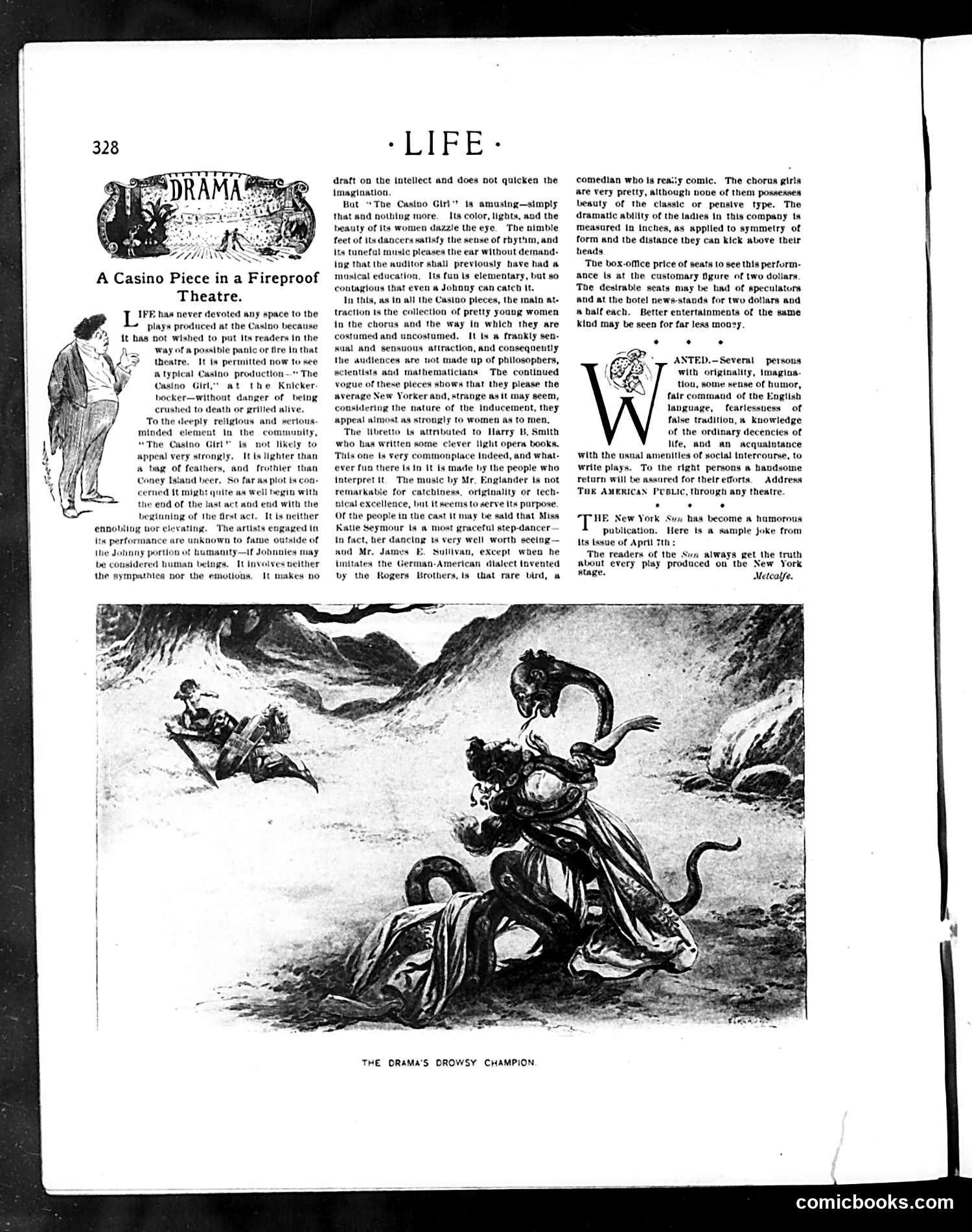
This page reviews "The Casino Girl," a theatrical production. The text praises the show as lighter entertainment than typical Casino pieces—less intellectually demanding but featuring attractive chorus girls in fashionable costumes. The review notes the dancing is worth watching, particularly one performer's work. The illustration titled "THE DRAMA'S GROWSY CHAMPION" depicts a theatrical scene with exaggerated figures in elaborate costumes on a desert landscape. The satirical point appears to mock dramatic pretension—the overwrought, absurdly theatrical posturing contrasts with the review's characterization of the Casino Girl as simple entertainment. The caricature emphasizes the gap between serious theatrical aspirations and actual light comedy productions.
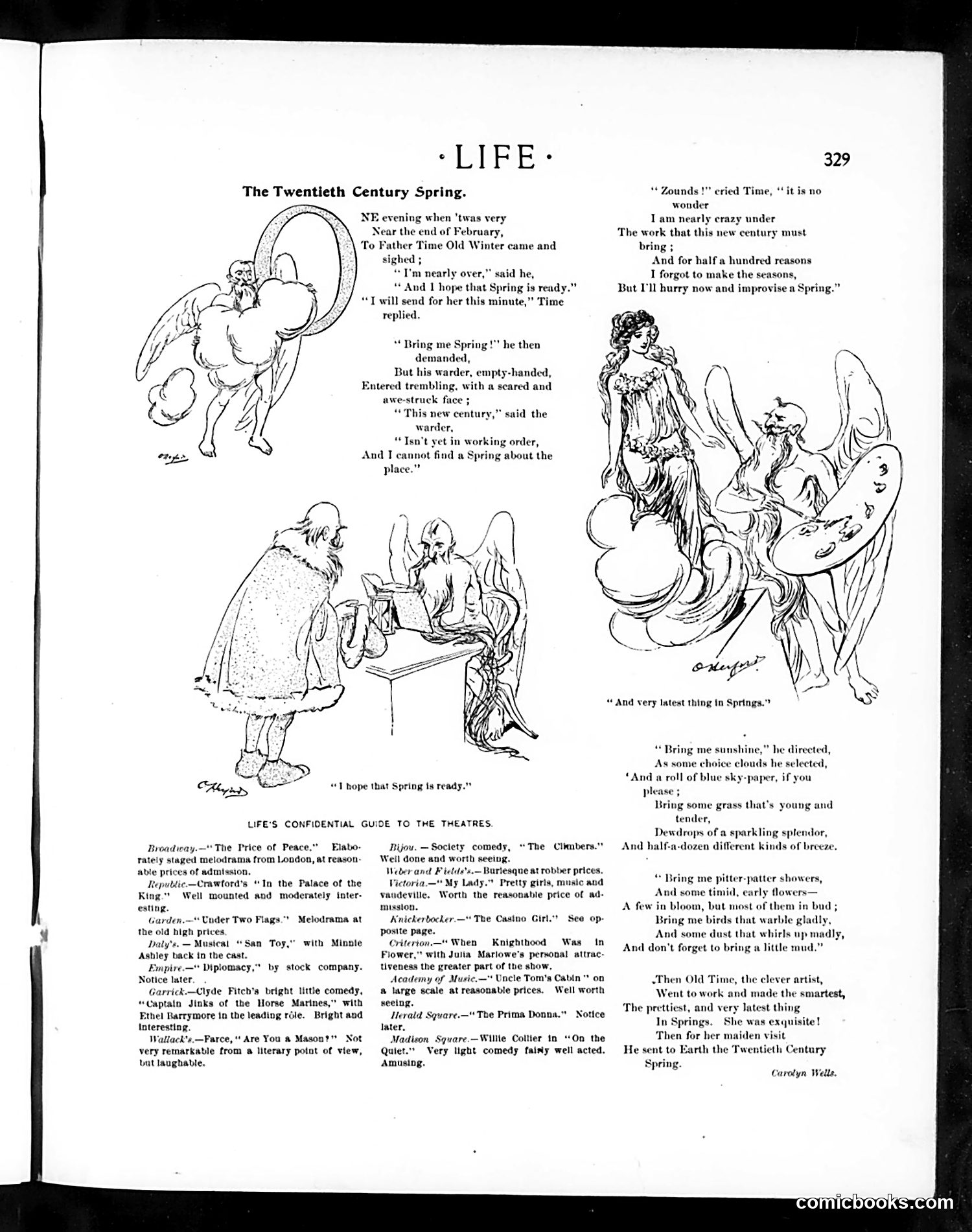
This satirical poem, illustrated with whimsical drawings, jokes about the chaotic transition into the new century (1900). The narrative personifies **Time** as an aging figure demanding **Spring** from his warder, only to discover the "new century isn't yet in working order"—the warder cannot find Spring anywhere. The satire reflects fin-de-siècle anxieties about modernization and industrial chaos. Time must hastily improvise a spring by collecting disparate elements (sunshine, grass, birds, mud), suggesting that the new century's rapid changes feel haphazard and makeshift rather than naturally ordered. The accompanying theater guide signals *Life* magazine's satirical mission: mocking contemporary entertainment while maintaining urbane sophistication. The poem's whimsy contrasts sharply with social commentary about whether progress and modernity can actually deliver promised renewal.
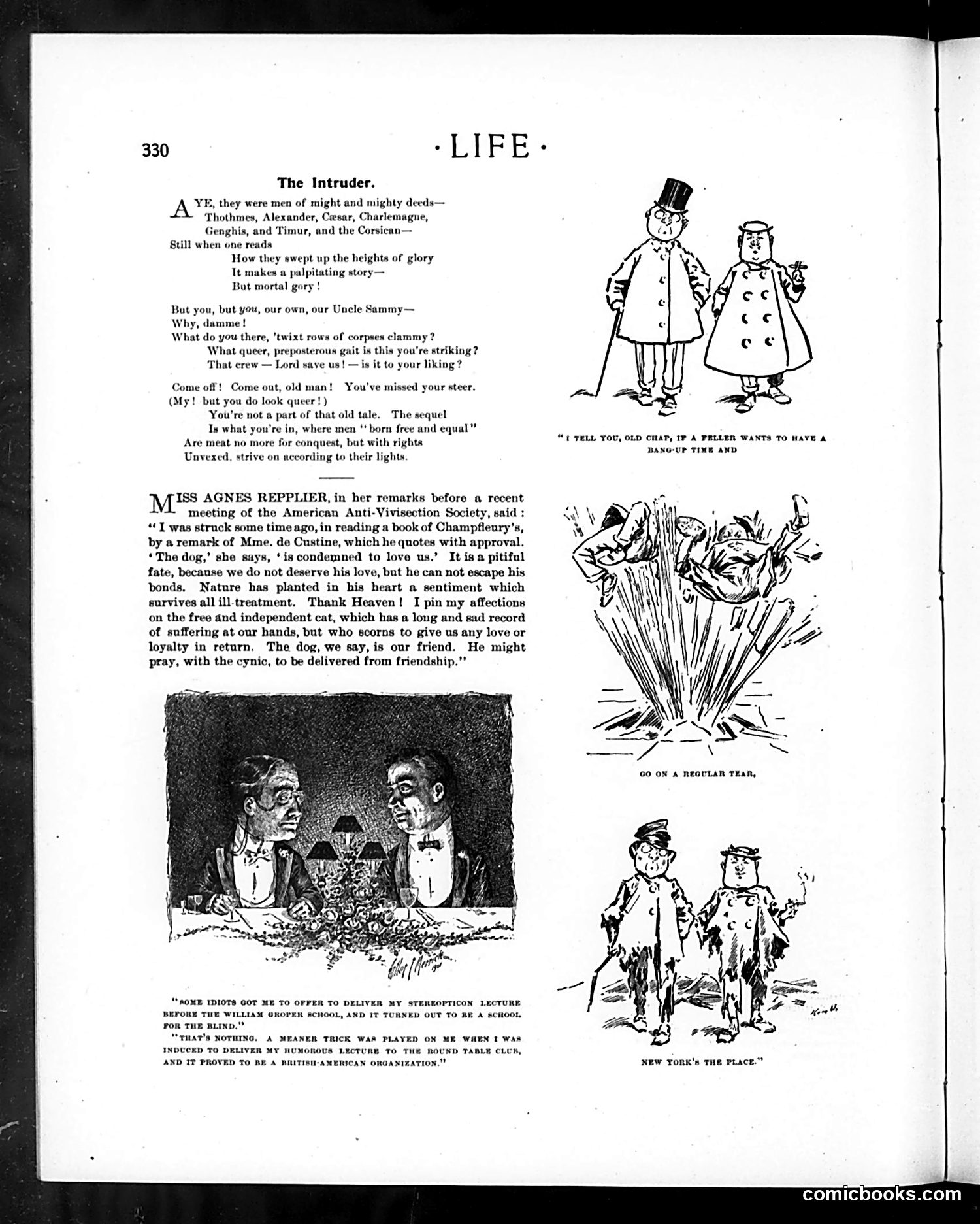
**"The Intruder"** (top poem): This satirical verse contrasts great historical conquerors—Alexander, Caesar, Charlemagne, Genghis Khan, Napoleon—with "Uncle Sammy" (the United States). The poem mocks America for imitating imperial conquest despite its founding principle that men are "born free and equal." The poem suggests the U.S. has abandoned its democratic ideals by pursuing territorial expansion like traditional empires, treating conquered peoples as "meat" rather than respecting their rights. **The cartoons** (right side): Appear to illustrate absurdity—figures in coats, an explosion, ragged children—though specific references are unclear without more context. **Miss Agnes Repplier section**: A quote from an anti-vivisection (animal testing) society meeting praising dogs' loyalty while criticizing humans' mistreatment of animals. **Bottom jokes**: Mock speakers deceived about their audiences (delivering humorous lectures to schools for the blind, or to British-American organizations). The page's central theme criticizes American imperialism as contradicting democratic values.
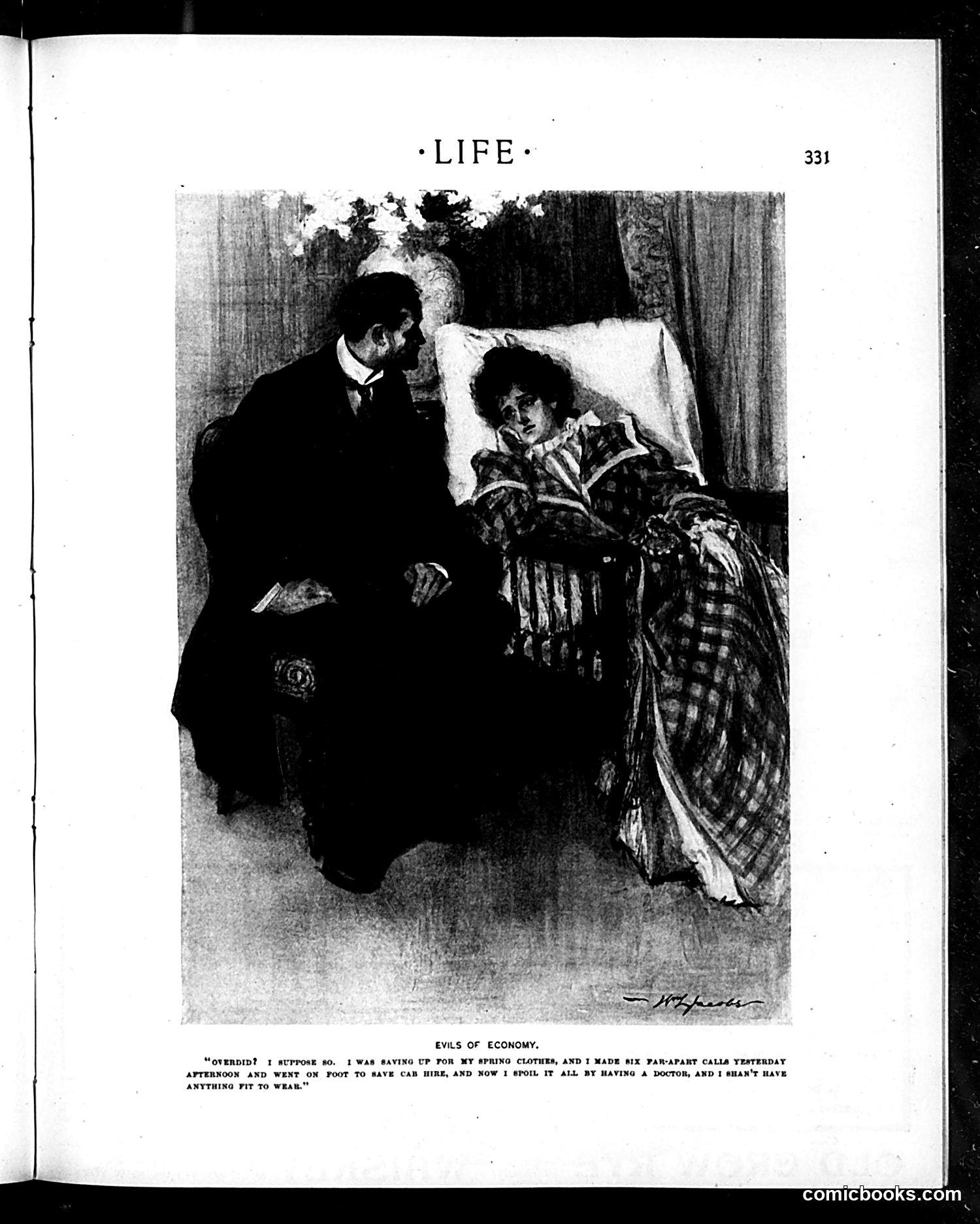
This cartoon satirizes wealthy women's misguided priorities during economically tight times. A fashionably-dressed woman in bed explains to a visiting man (likely a doctor) that she walked extensively to save money on cab fare for her spring wardrobe—but now needs medical attention from the exertion, which will cost her more and ruin her savings plans anyway. The satire targets the contradiction: her attempt at economy through physical deprivation backfired spectacularly. The cartoon mocks both her shallow focus on clothing purchases and her poor judgment in sacrificing health for fashion budget concerns. It's a commentary on class-based vanity and the false logic of certain "economizing" practices among the privileged.
This page from *Life* (circa early 1900s) contains two distinct pieces of political satire: **"Lest You Forget—De Wet"**: A poem celebrating Christian De Wet, Boer general in the Second Boer War (1899-1902), fighting British forces in South Africa. The verse romanticizes his guerrilla resistance, referencing British military disasters (Ladysmith, Mafeking, Spion Kop). This reflects American sympathy for the Boers against British imperialism. **Edward VII's Coronation Mockery**: The *Argonaut* excerpt viciously ridicules King Edward VII's recent accession (1901), describing him as a "short fat man" absurdly draped in ceremonial regalia, surrounded by equally ridiculous courtiers in outdated dress. The satire attacks the pageantry and hereditary monarchy as absurd spectacle unfit for the twentieth century. **The Russian Theater Anecdote**: A brief satirical tale mocking Russian bureaucratic absurdity—an official requiring a dancer to write her own leave request rather than simply granting it. All three pieces share anti-establishment sentiment: anti-British imperialism, anti-monarchy, and anti-authoritarianism.
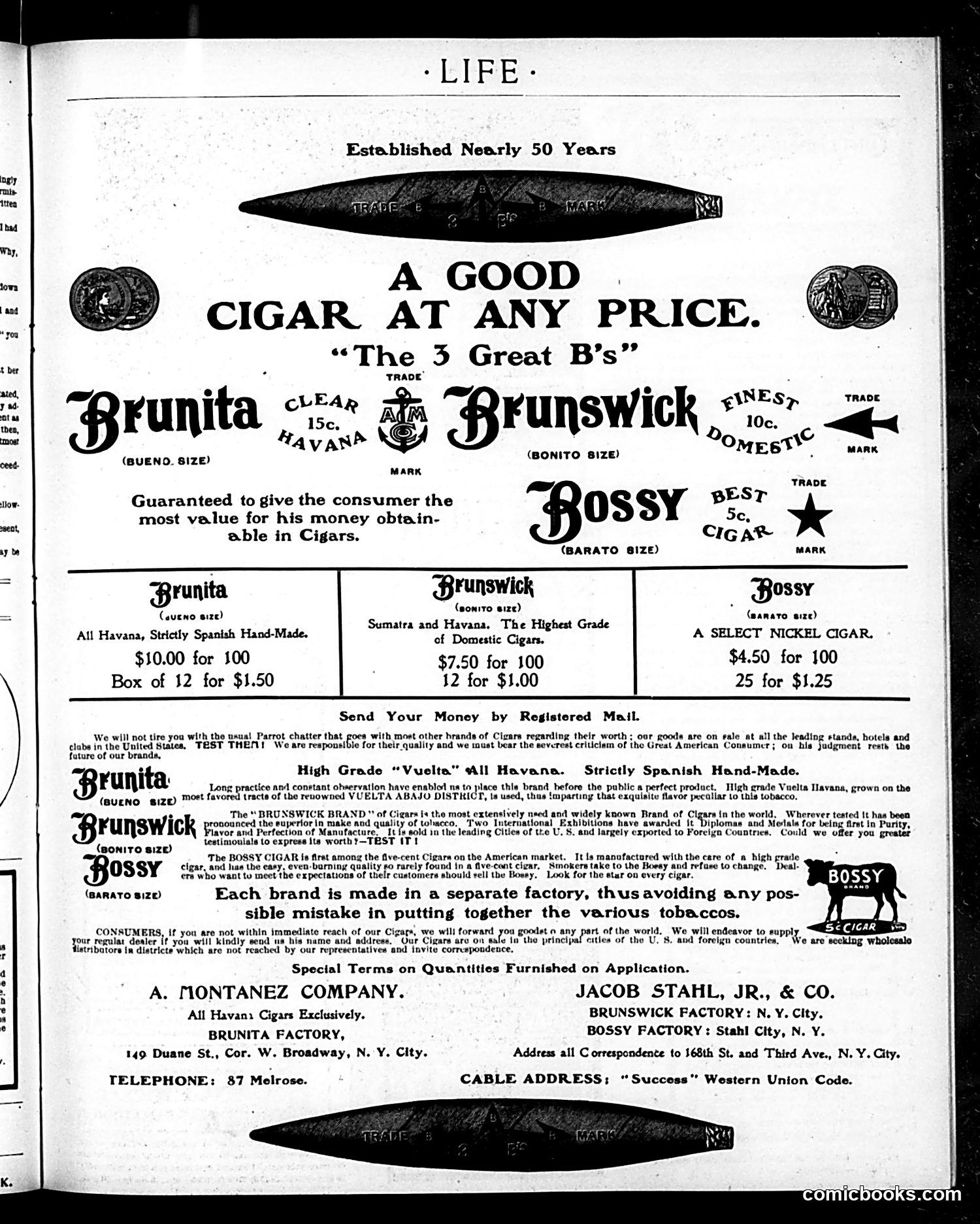
This page is **entirely advertising**, not satire or editorial content. It promotes three cigar brands—Brunita, Brunswick, and Bossy—marketed as "The 3 Great B's." The ad targets different price points and consumers: Brunita ($10 per 100) positions itself as premium "Vuelta" Havana; Brunswick ($7.50 per 100) claims international awards and superior manufacture; Bossy ($4.50 per 100) markets itself as the best five-cent cigar, emphasizing value and quality for working-class smokers. The text uses persuasive language typical of early 20th-century advertising—appeals to testing ("TEST IT!"), guarantees of quality, and claims of widespread availability. The manufacturers (A. Montanez Company and Jacob Stahl, Jr., & Co.) offer mail-order service and seek wholesale distributors. There is no cartoon or satirical commentary; this is straightforward product promotion from *Life* magazine's advertising section.
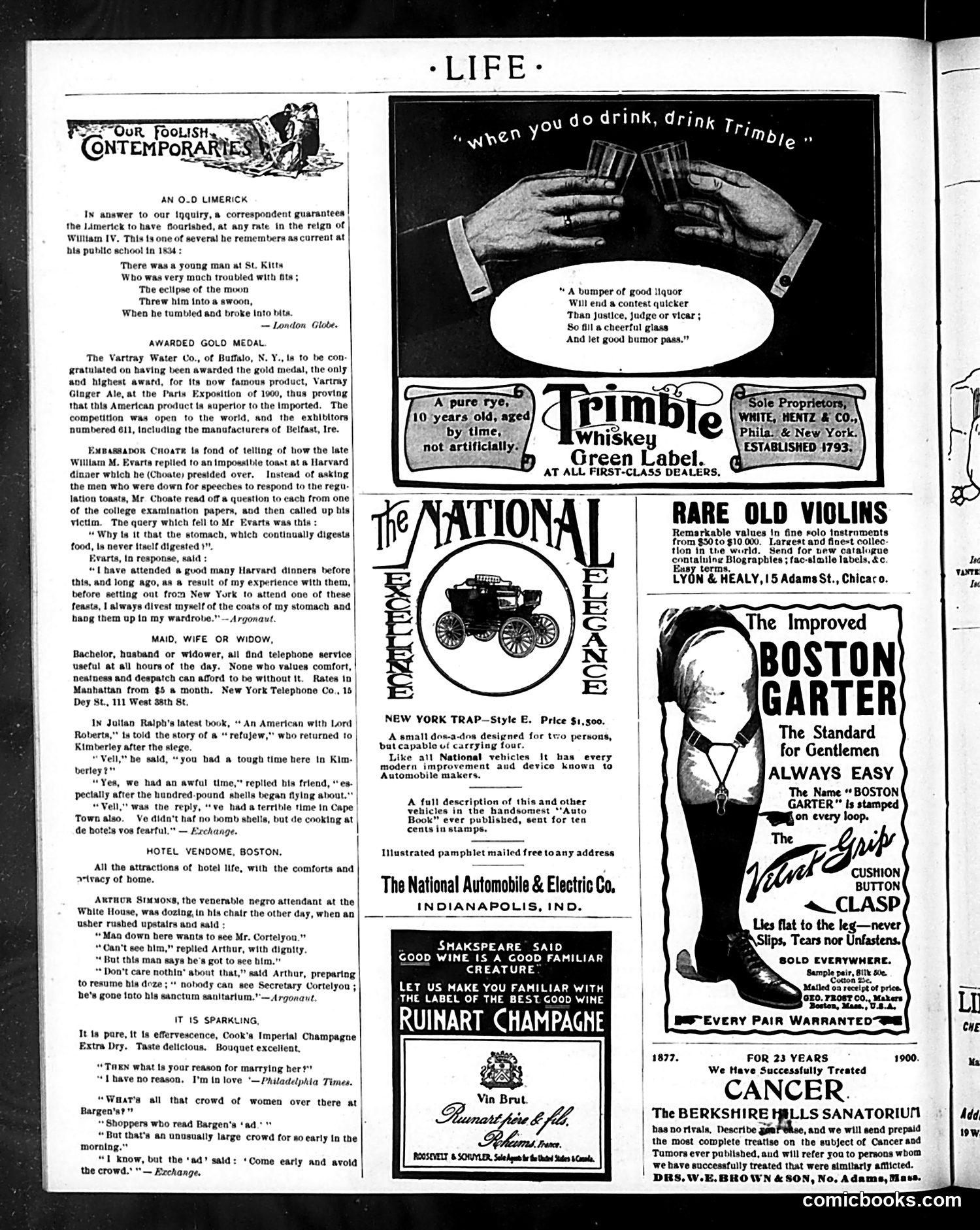
This page is primarily **advertising with humorous filler content**, typical of early 1900s Life magazine format. The main satirical content is "Our Foolish Contemporaries," a recurring column featuring anecdotes mocking contemporary figures and absurdities. Notable items include: - **Ambassador Choate's Harvard dinner anecdote**: Satirizes pretentious academic dinners by describing how William M. Evarts humorously responded to an anatomical exam question rather than offering a traditional toast—mocking the stuffiness of elite gatherings. - **Arthur Simmons anecdote**: A gentle racial humor piece depicting a dignified Black White House attendant refusing an importunate visitor, presenting him as properly protective of Secretary Cortelyou's time. This reflects the era's paternalistic racial attitudes. - **An old limerick from 1834**: Nonsensical verse humor, included to establish the limerick's historical pedigree. The page is dominated by period **product advertisements** (Trimble Whiskey, National Automobile, Boston Garter, Runinart Champagne), reflecting Life's revenue model. The satirical content serves as editorial glue between ads.
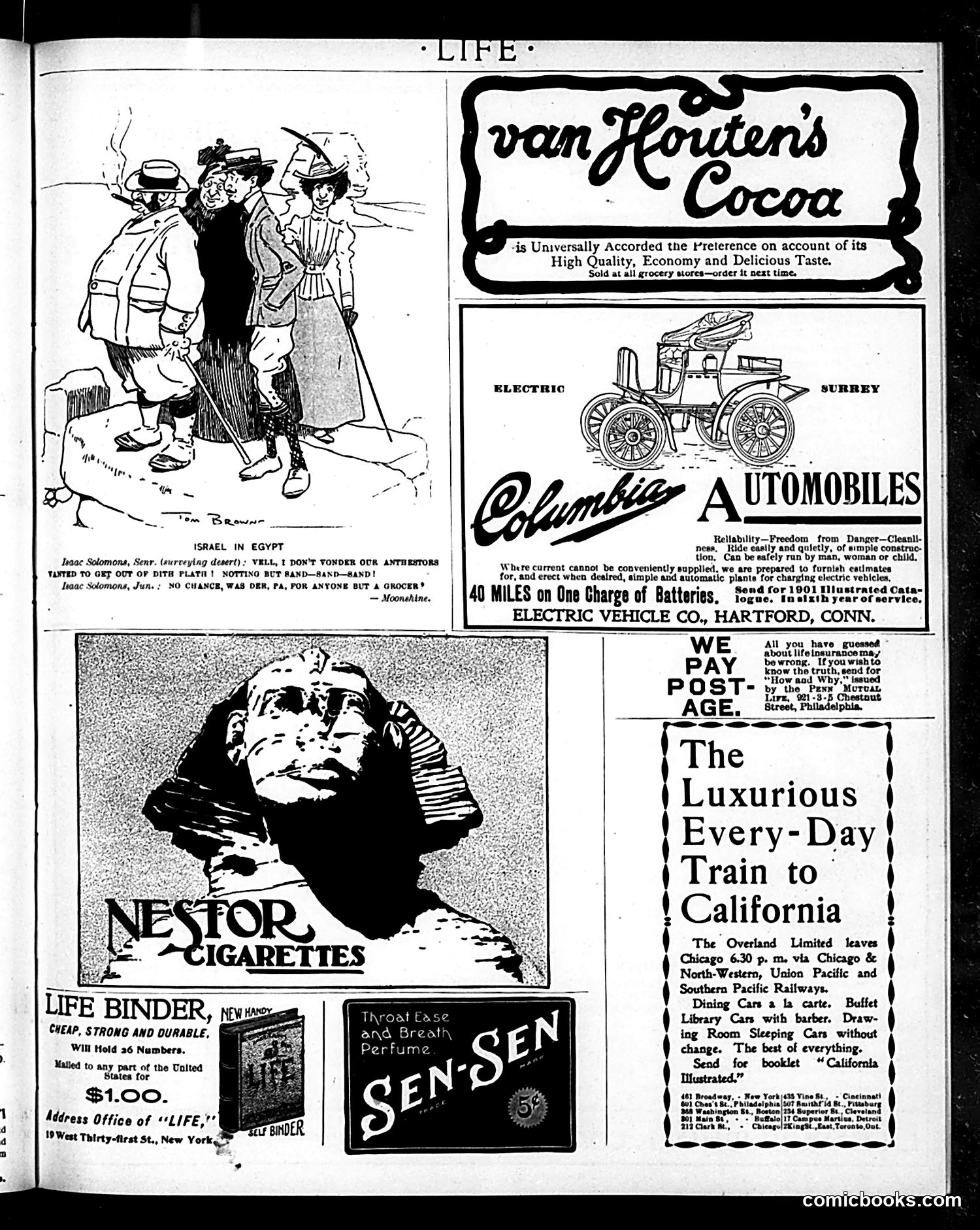
The main cartoon satirizes Jewish immigrants' economic mobility in early 20th-century America. It depicts two figures named Isaac Solomons—father and son—in a desert setting labeled "Israel in Egypt," a biblical reference to Jewish bondage. The joke hinges on a generational contrast: the father laments their ancestors' enslavement in Egypt with "nothing but sand"; the son dismissively responds that today there's "no chance" for anyone but a grocer to escape poverty. This suggests that while biblical Jews faced pharaonic oppression, modern Jewish immigrants face a different constraint—they can only succeed in the grocery business, not other professions. The cartoon reflects period attitudes about Jewish occupational stereotyping and gatekeeping in American society. The title invokes the Exodus narrative to sardonically compare ancient slavery to contemporary economic limitation, implying that professional restrictions constitute a modern form of bondage.
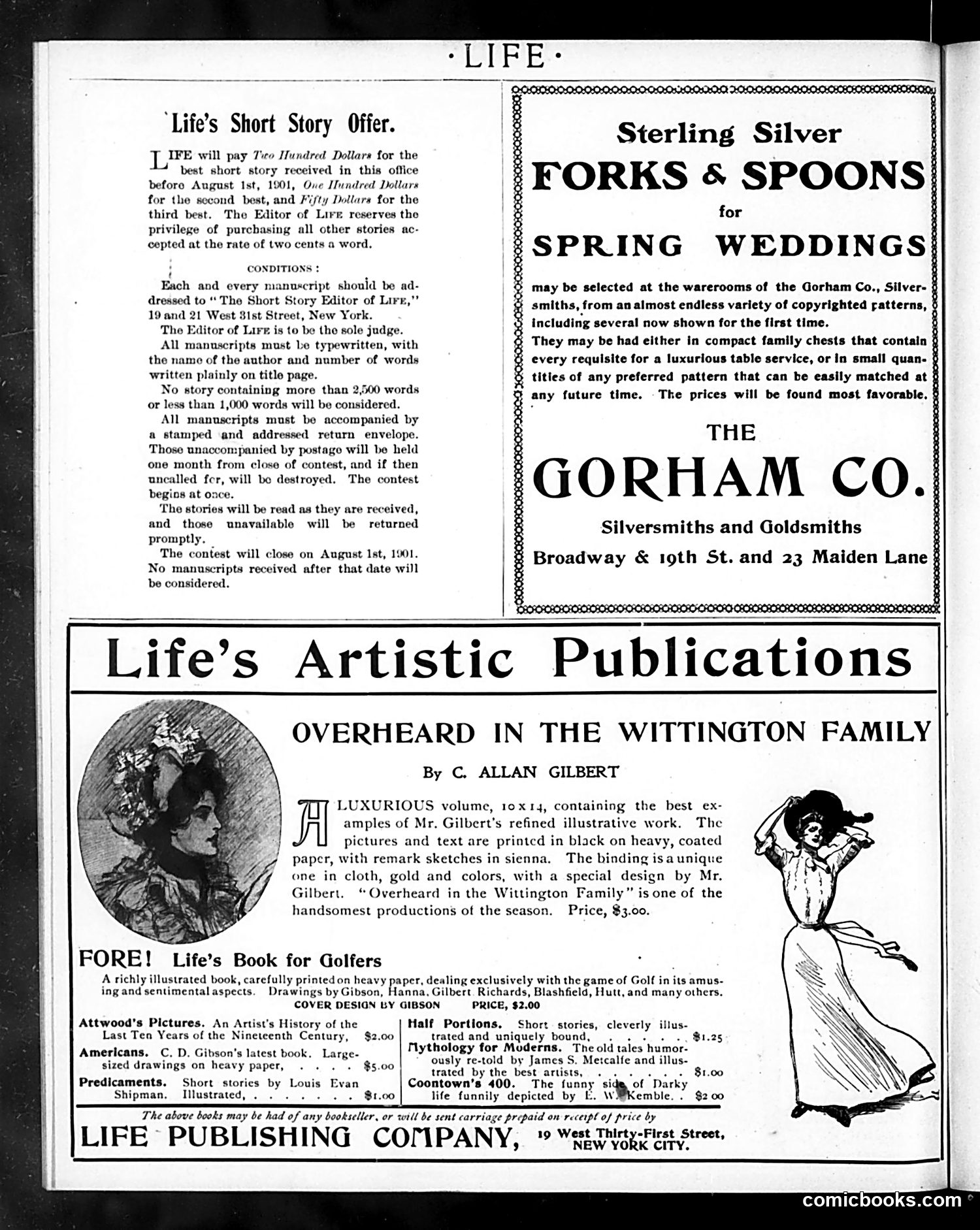
This page is primarily **advertising and editorial announcements**, not satirical content. The main elements are: **Short Story Contest**: Life magazine announces a writing competition offering $200 for the best short story (deadline August 1, 1901), with detailed submission rules emphasizing typewritten manuscripts between 1,000-2,500 words. **Commercial Advertisements**: - Gorham Co. silverware for spring weddings - Life Publishing Company's own books, including "Overheard in the Wittington Family" illustrated by C. Allan Gilbert, golf instruction book "Fore!", and collections of drawings by popular illustrators Gibson, Blashfield, and others **The Cartoon**: A small illustration shows a woman in period dress (appears to be demonstrating or modeling), likely accompanying promotional material for Life's artistic publications. This reflects Life's dual identity as both satirical magazine and publisher of illustrated literary/artistic works—a common business model for magazines of this era. The page targets educated, affluent readers interested in golf, weddings, and fine art.
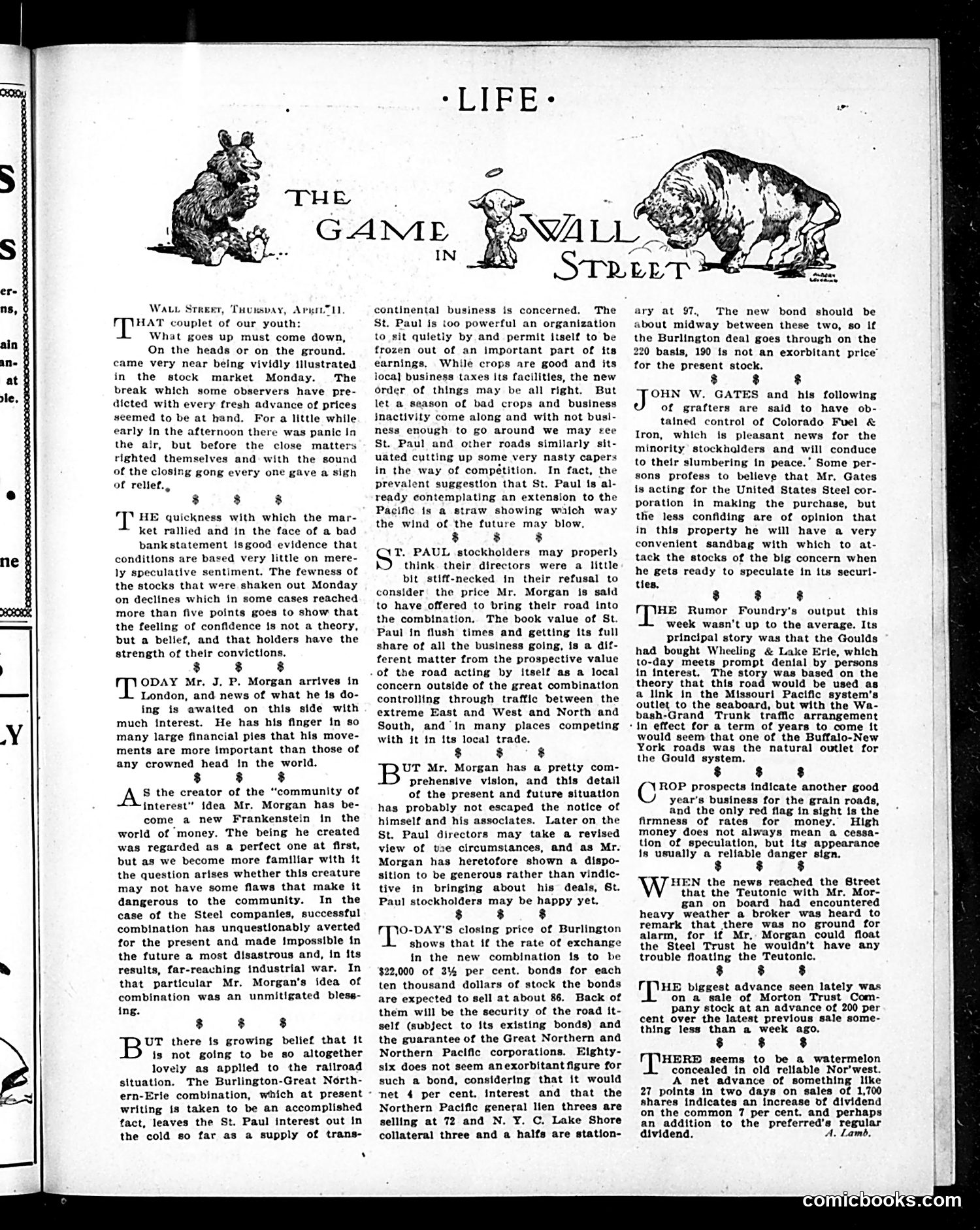
This satirical piece, dated August 11, discusses J.P. Morgan's railroad consolidation efforts. The cartoon depicts two bears (likely representing market volatility) flanking the title—a visual metaphor for the unpredictable "game" of Wall Street trading. The text discusses Morgan's "community of interest" strategy, which combines competing railroads into monopolistic combinations. The author presents Morgan as a modern Frankenstein—his financial "creature" initially seemed beneficial (preventing destructive competition in steel), but now threatens danger, particularly regarding the St. Paul railroad's exclusion from the Burlington-Great Northern-Erie combination. The satire's point: Morgan's consolidations may prove destabilizing rather than stabilizing. Excluded from lucrative transcontinental business, the St. Paul might resort to "nasty capers" (cutthroat competition) during economic downturns. The piece suggests that what appears as rational, benevolent financial engineering may actually create future chaos—a warning about unchecked monopoly power and its destabilizing consequences.
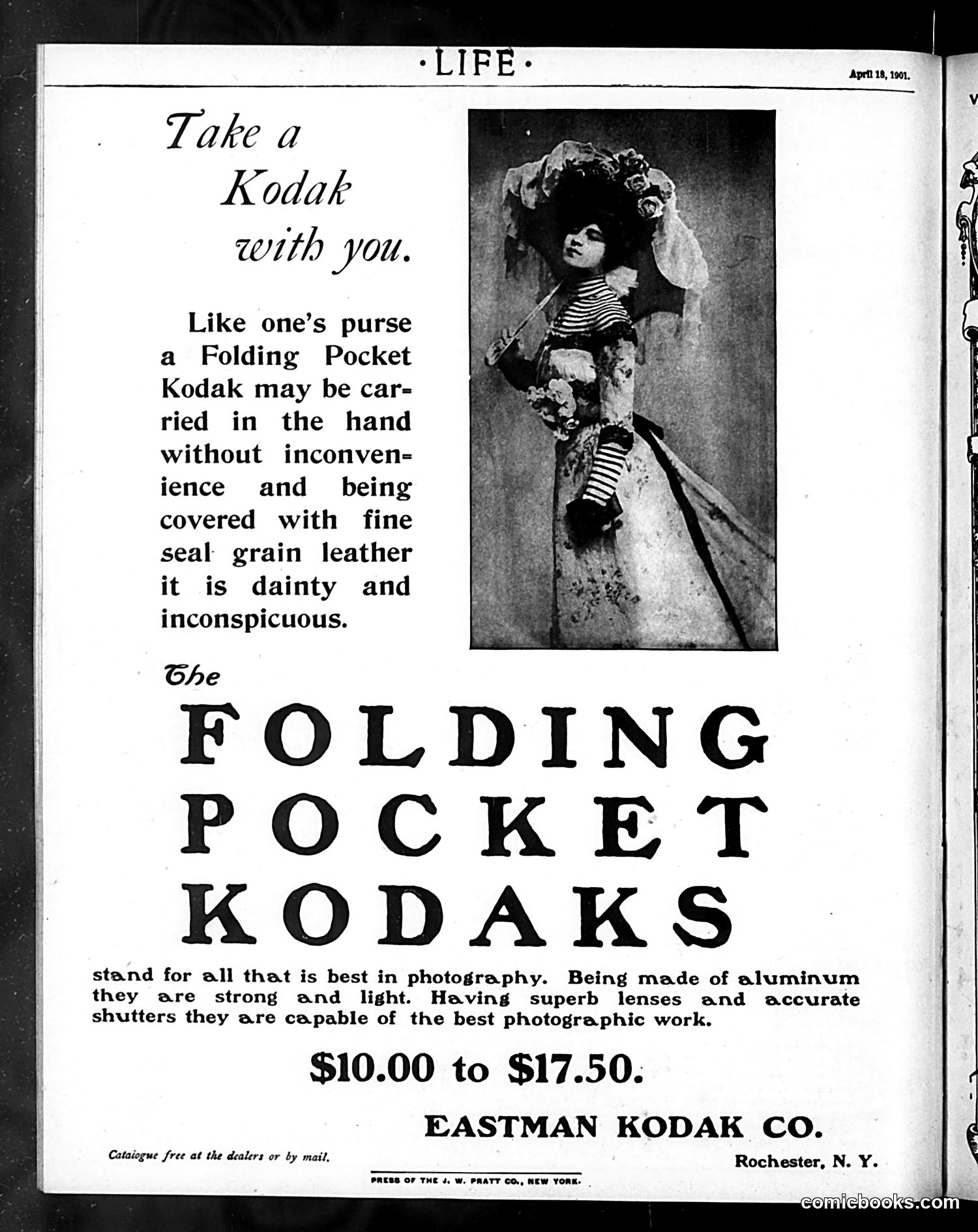
This is **not a cartoon or satire**—it's a straightforward advertisement for Kodak's Folding Pocket cameras, published in *Life* magazine on April 18, 1901. The page promotes the portability and elegance of Kodak's compact cameras through a photograph of an elegantly dressed Edwardian woman holding a camera. The advertising copy emphasizes that the leather-covered camera is "dainty and inconspicuous"—appealing to affluent consumers (particularly women) who could afford a $10-$17.50 camera at a time when that represented a significant luxury purchase. The pitch positions photography as an accessible leisure activity for the well-to-do: "Take a Kodak with you" to social outings. This reflects Kodak's revolutionary marketing strategy of making amateur photography fashionable and affordable to the middle and upper classes, rather than limiting it to professionals. There is no political content or satire present.