
Life, 1901-04-18 · page 6 of 22
Life — April 18, 1901 — page 6: what you’re looking at
What you’re looking at
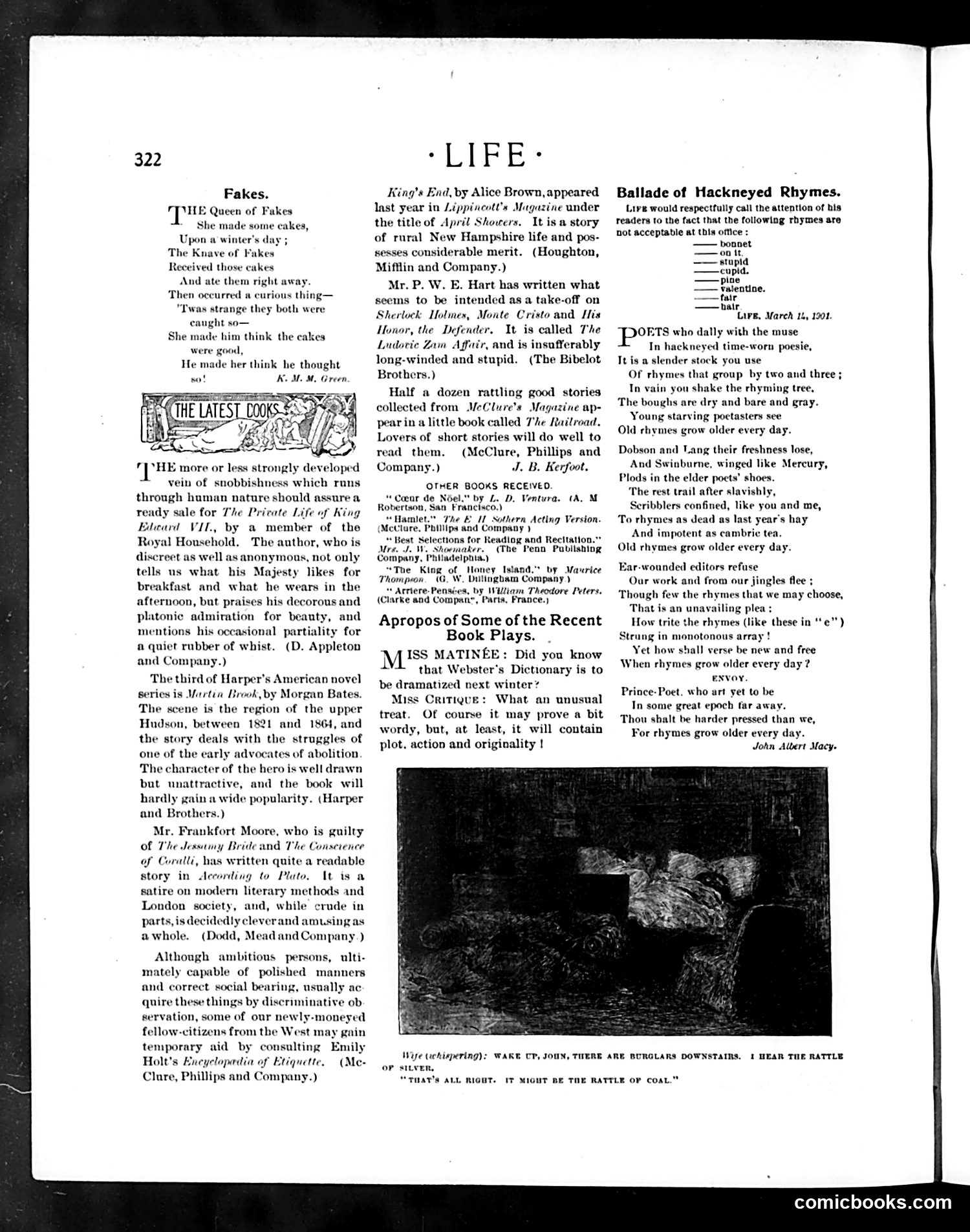
This page contains primarily **book reviews and literary commentary** rather than political cartoons. The left column reviews various novels and short story collections, including works by Alice Brown and P.W.E. Hart. The right side features **"Ballad of Hackneyed Rhymes,"** a poem mocking predictable, overused poetic conventions—criticizing verses that rely on clichés like "old rhymes grow older every day" and "Scribbler confined, like you and me." The **illustration at bottom** shows a domestic interior scene with a caption about burglars and "battle of silver" versus "battle of coal"—apparently satirizing confusion over what's actually valuable during a break-in, likely commentary on working-class versus wealthy concerns. The page is primarily **literary criticism and satire**, not political commentary.
📄 Transcribed text from this page (OCR, searchable)
Machine-transcribed from the original scan — historical spelling and the odd misread are preserved.
Fakes. VHE Queen of Fakes She made some nave of Fakes ved those cakes And ate them right away. Then occurred a curious thing— "Lwas strange they both were caught so— She made him think the cakes good, de her think he thought KM. M, Green i THE LATES 1] ‘HE more or less strongly developed vein of snobbishness which runs through human nature should assure a ready sale for The Private Life of King Edward VIL, by a member of the Royal Household. The author, who is discreet as well as anonymous, not only tells us what his Majesty likes for breakfast and what he wears in the afternoon, but praises his decorous and platonic admiration for beauty, and mentions his occasional partiality for a quiet rubber of whist. (D. Appleton and Company.) The third of Harper's American novel Martin Brook, by Morgan Bates. The scene is the region of the upper Hudson, between 1821 and 1864, and the story deals with the struggles of one of the early advocates of abolition The character of the hero is well drawn but unattractive, and the book will hardly gain a wide popularity. (Harper and Brothers.) Mr, Frankfort Moore, who is guilty of The Jessamy Brideand The Conserence of Coralli, has written quite a readable story in According to Pluto. At is a satire on modern literary methods and London society, and, while crude in parts, is decidedly cleverand amusing as awhole. (Dodd, MeadandCompany.) Although ambitious persons, ulti- mately capable of polished manners and correct social bearing, usually ac quire these things by discriminative ob servation, some of our newly-moneyed fellow-citizens from the West may gain temporary aid by consulting Emily Holt's yclopardia of Etiquette. (Me- Clare, Phillips and Company.) ‘LIFE: King’s End, by Alice Brown, appeared last year in Lippincott's Magazine under the title of April Showers. It isa story of rural New Hampshire life and pos- sesses considerable merit. (Houghton, Mifflin and Company.) Mr. P. W. E. Hart has written what seems to be intended as a take-off on Sherlock Holmes, Monte Cristo and His Honor, the Defender, It is called The Ludovic Zam Affair, and is insufferably long-winded and stupid. (The Bibelot Brothers.) Half a dozen rattling good stories collected from MeClure’s Magazine ap- pearin a little book called The Railroad. Lovers of short stories will do well to read them. (McClure, Phillips and Company.) J. B. Kerfoot. OTHER BOOKS RECEIVED. “ Caur de Noel." by L. D. Ventura. Robertson, San Francisco.) “Hamlet.” The EH Sothern Acting Version. (McClure, Philips and Company y + Best tons for Readlog and Recitation.” Mre. J. W. Shoemaker, (The Penn Pubilshing Company, Philadelphia.) “The King of Money Istand.* by Maurice Thompson. (G. W. Dillingham Company) ** Arriere-Pensin by William Theodore Peters. (Clarke and Compans, Parts, France.) Apropos of Some of the Recent Book Plays. ISS MATINEE: Did you know i that Webster's Dictionary is to be dramatized next winter? Miss Critique: What an unusual treat. Of course it may prove a bit wordy, but, at least, it will contain plot, action and originality ! (ALM Wye Uchtspering): WARE CP, JOUN, THERE ARE BURGLARS DOWNsTaIns. op siuven, “THAT'S ALL RIGHT. Ballade of Hackneyed Rhymes. Live would respectfully call the attention of bis readers to the fuct that the following rhymes are hot acceptable at this office : ‘Lave, Mareh 12, 1201. OETS who dally with the muse In hackneyed time-worn poesie, Tt is a slender stock you use Of rhymes that group by two and three; In vain you shake the rhyming tree, The boughs are dry and bare and gray. Young starving poctasters see Old rhymes grow older every day. Dobson and Lang their freshness lose, And Swinburne, winged like Mercury, Plods in the elder poets’ shoes. ‘The rest trail after slavishly, bblers confined, like you and me, To rhymes as dead as last year's hay And impotent as cambric tea. Old rhymes grow older every day. Ear-wounded editors refuse Our work and from our jingles flee ; Though few the rhymes that we may choose, That is an unavailing plea; How trite the rhymes (like these ine”) Strung in monotonous array ! Yet how shall verse be new and free When rhymes grow older every day ? EXvoY. Prince-Poet. who art yet to be In some great epoch far away. Thou shalt be harder pressed than we, For rhymes grow older every day. John Albert Macy. 1 MEAN THE RATTLE IT MIOUT BE THE RATTLE oF coat.” comicbooks.com