
A complete issue · 20 pages · 1901
Life — February 7, 1901
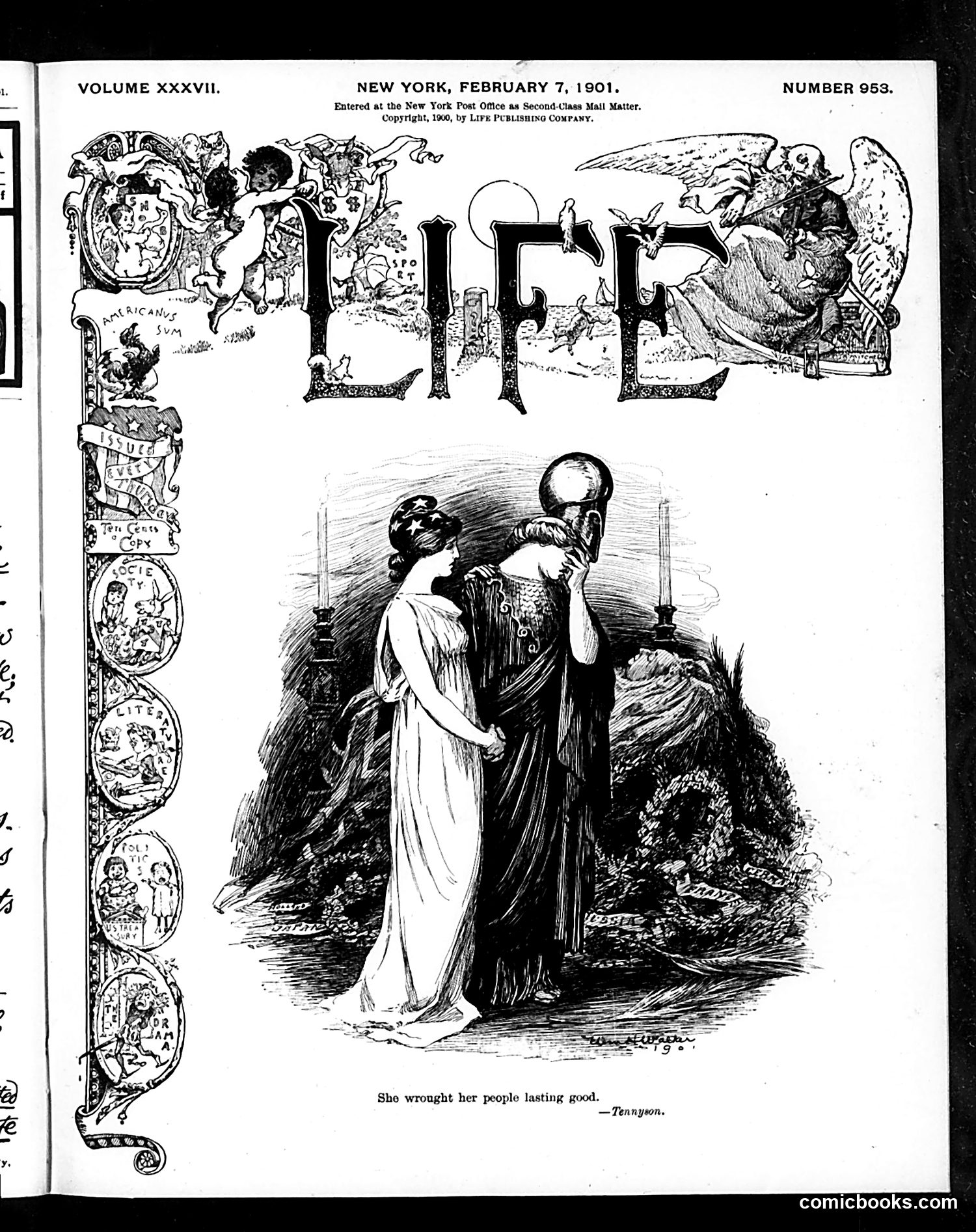
This page features an illustration titled "She wrought her people lasting good," attributed to Tennyson. The image depicts two figures in classical dress: a woman in white and a darker-robed figure holding an orb, set in a nighttime landscape with candles. The caption references Tennyson's poetry, suggesting the illustration relates to a classical or historical female figure of virtue or leadership. Without additional context from the magazine's contents, the specific identity of "her people" remains unclear—this could reference a historical queen, mythological figure, or allegorical representation of a nation or ideal. The ornate left border contains decorative medallions typical of Life's art nouveau styling from this period.
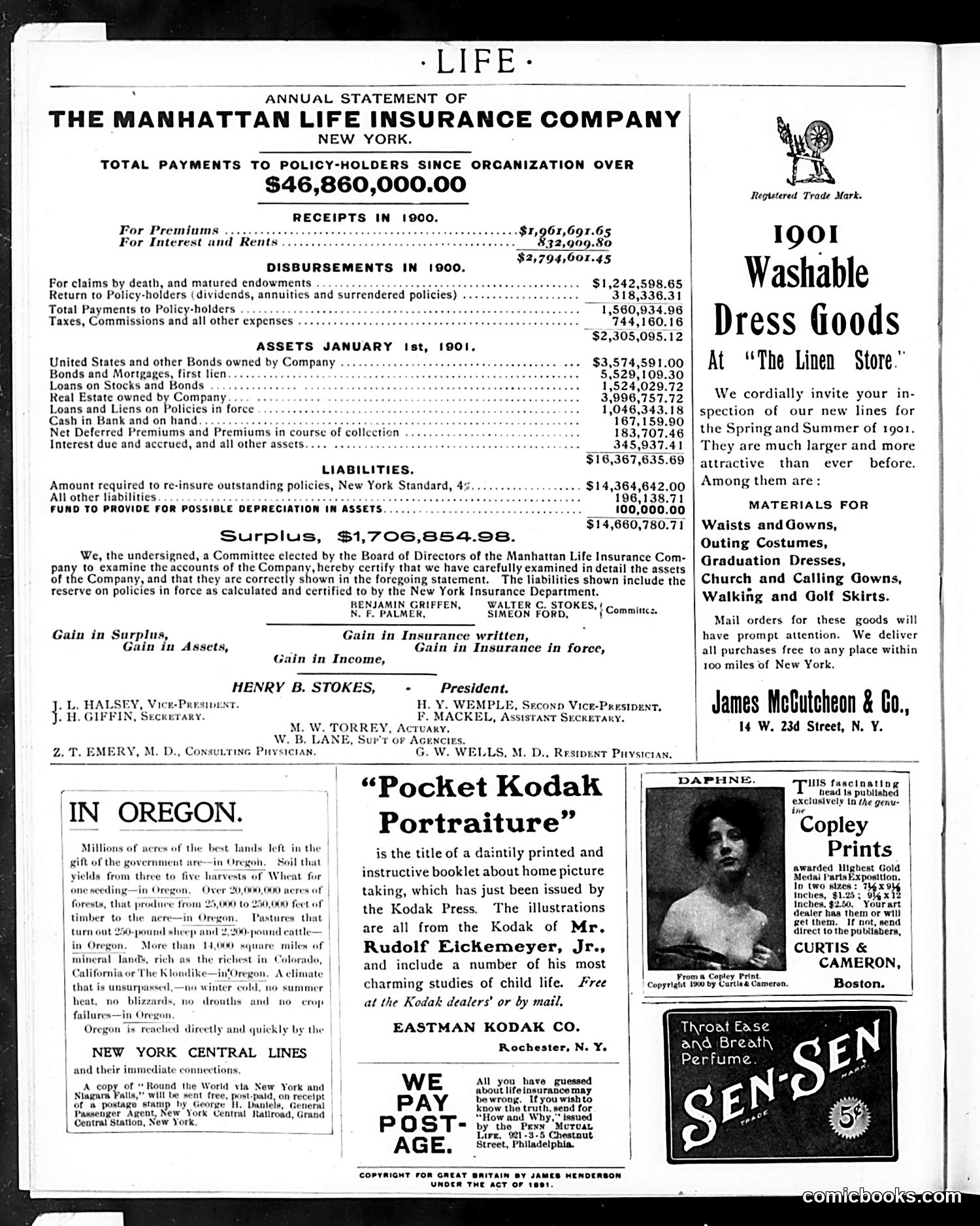
This page is **primarily advertising and financial reporting**, not satirical content. It features: 1. **Manhattan Life Insurance Company's annual statement** (top) — a straightforward corporate financial report showing assets, receipts, and disbursements. 2. **Commercial advertisements** including: - "The Linen Store" promoting washable dress goods - James McCutcheon & Co. clothing - Eastman Kodak Company advertising their "Pocket Kodak Portraiture" booklet - Copley Prints (art reproduction) - Sen-Sen throat perfume 3. **Editorial content** about Oregon land and the New York Central Lines (travel promotion). There is **no political cartoon or satire evident** on this page. It represents typical early-1901 magazine content mixing financial announcements with consumer advertising.
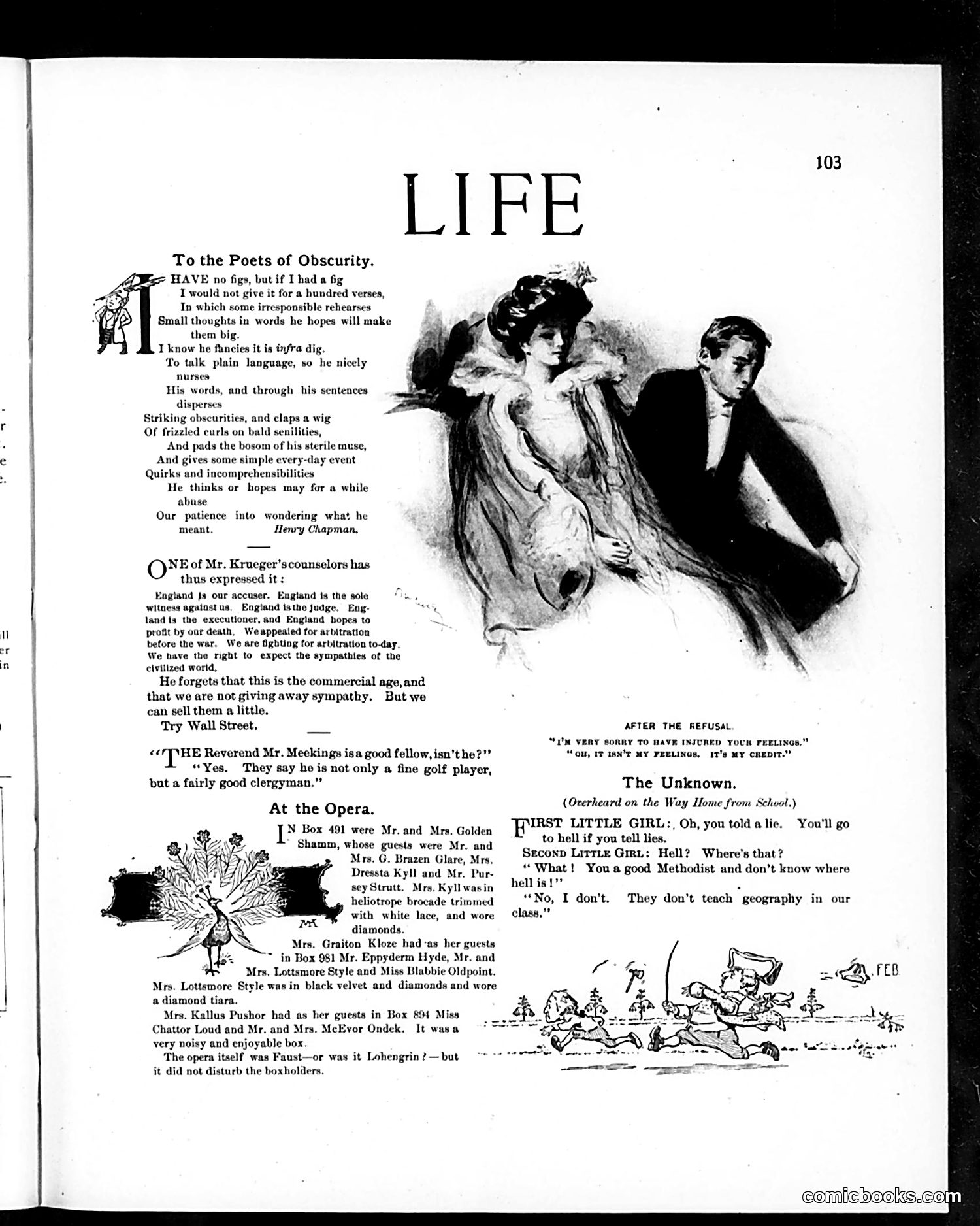
This page contains several satirical pieces about contemporary society. The main cartoon titled "After the Refusal" depicts a couple where the woman rejects the man's proposal, with the caption playing on financial/credit terminology—she's "sorry to have injured your feelings" but it's about credit, not emotion. This satirizes how commercial values infiltrate even intimate relationships. The poem "To the Poets of Obscurity" mocks writers who use unnecessarily complex, obscure language. It argues plain speech is superior to pretentious verbal gymnastics. "Try Wall Street" critiques England's role in international arbitration during what appears to be a commercial dispute, suggesting England profits from conflicts rather than genuinely seeking peace. The opera section provides society gossip about wealthy attendees' fashion and jewelry.
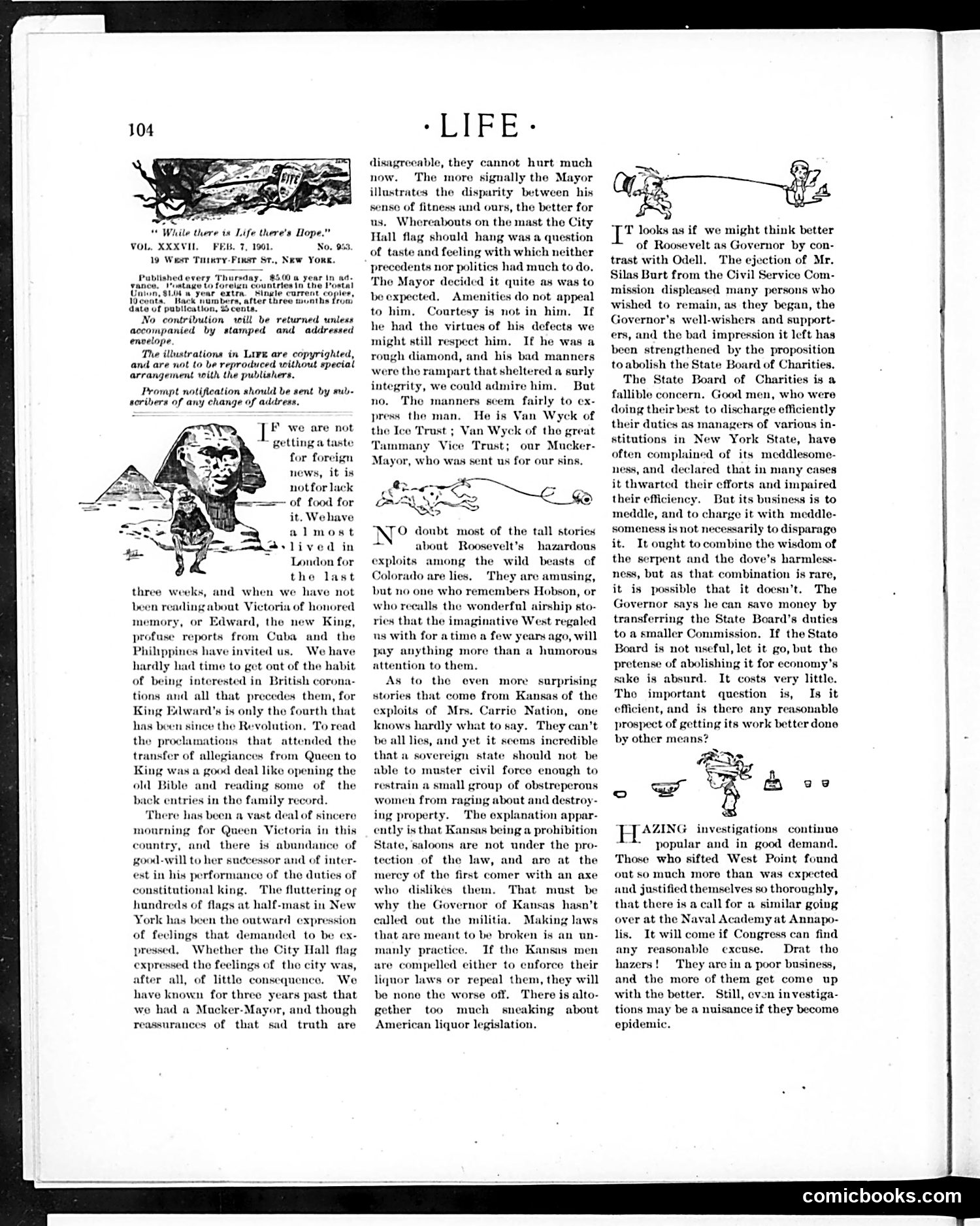
This page contains political commentary rather than a cartoon. The main illustrated figures appear to be caricatures of public officials, likely including Mayor Van Wyck and other New York City administrators, depicted in unflattering style. The text critiques Roosevelt's governorship and various civic scandals. It references specific controversies: the City Hall flag dispute, questions about the Tammany political machine, and debates over whether Kansas should enforce liquor prohibition laws. The satire targets government inefficiency and corruption, suggesting that civil institutions like the State Board of Charities are hampered by political meddling. The author argues that removing the board's independence would be absurd and wasteful—attacking what appears to be proposed administrative consolidation during New York's Progressive Era reform debates.
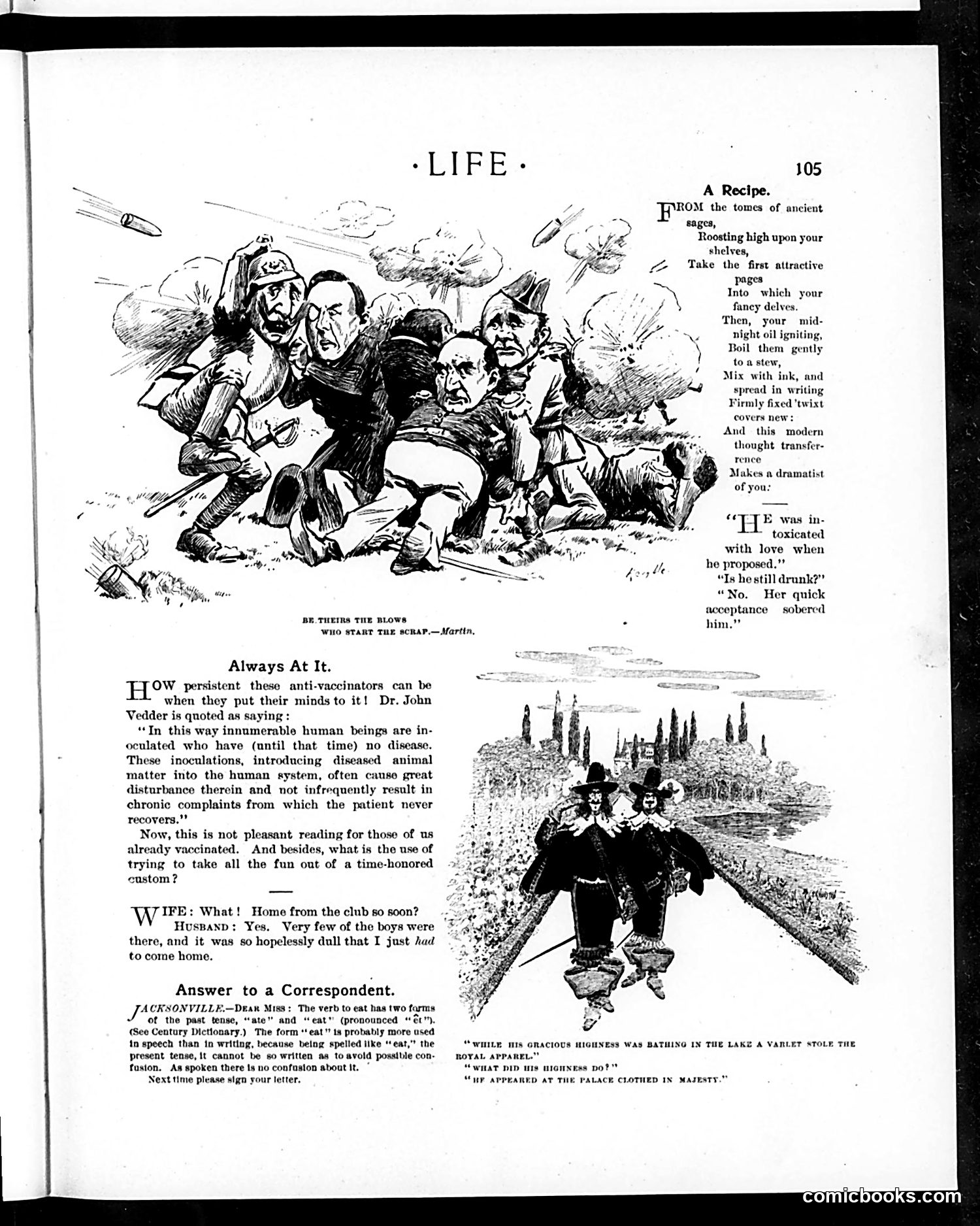
**Top Cartoon ("Be These the Blows Who Start the Scrap"):** This depicts multiple caricatured figures engaged in violent conflict. The exaggerated facial features and body language suggest these are political or public figures of the era, though their specific identities aren't clearly labeled in the visible text. The cartoon critiques these individuals as agitators or troublemakers initiating conflict. **Text Content:** The page primarily contains satirical commentary on anti-vaccination sentiment, quoting Dr. John Tyndall's arguments about vaccination dangers. It mocks those opposing vaccination while also poking fun at club life through a brief husband-wife dialogue about returning home from "the club." The bottom section provides a grammatical answer about past-tense verb forms.
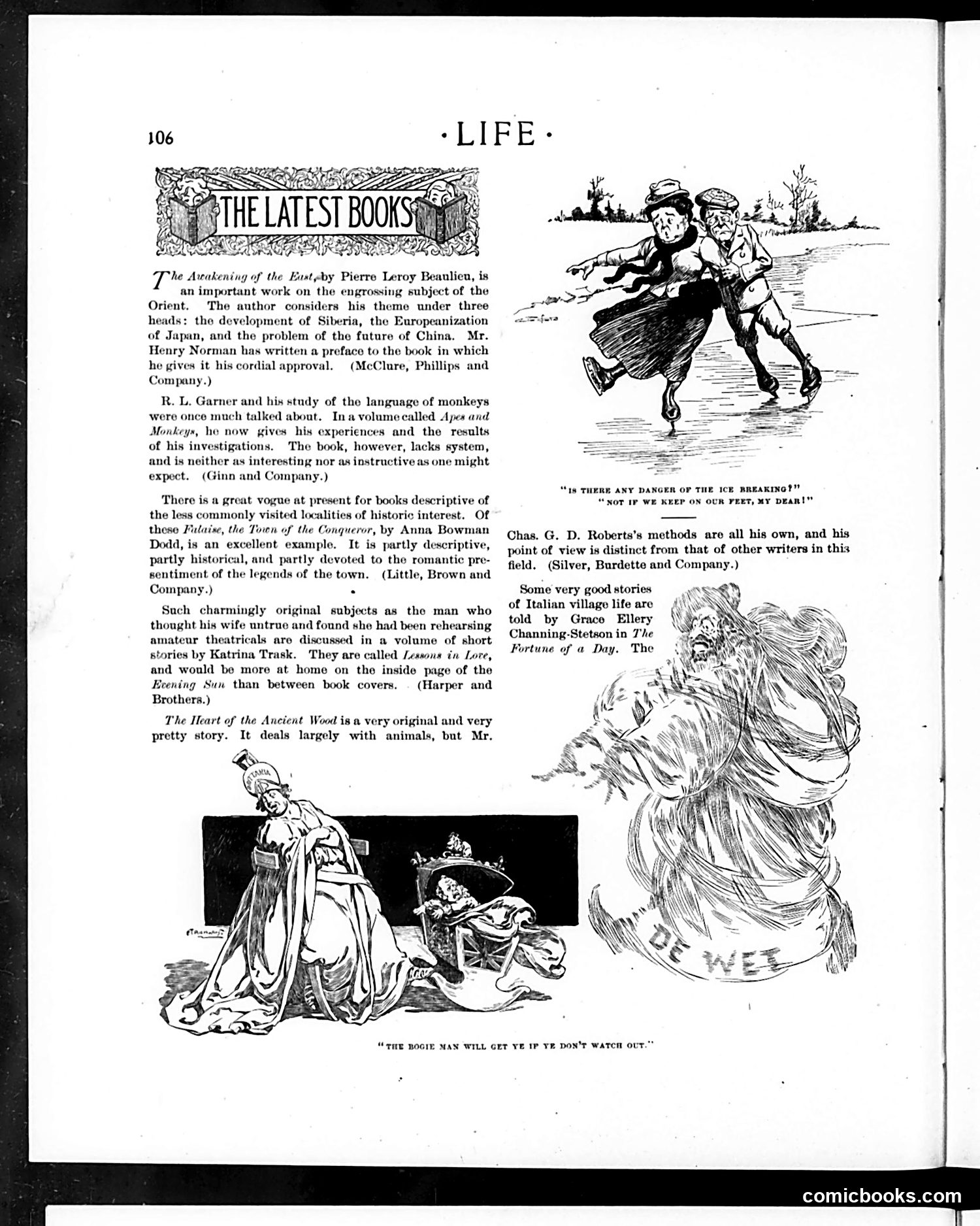
This page reviews contemporary books under "The Latest Books" heading. The cartoons illustrate specific titles: **Top illustration**: Shows two figures ice-skating with the caption "Is there any danger of the ice breaking?" / "Not if we keep on our feet, my dear!" This appears to accompany a book review about navigating precarious situations. **Bottom illustration**: Captioned "The bogie man will get ye if ye don't watch out," depicts a threatening figure approaching a child—a classic children's cautionary tale visualization. The page mixes book reviews (discussing works on the Orient, monkey language studies, and Italian village life) with these accompanying satirical sketches that humorously visualize the books' themes or titles rather than commenting on contemporary politics. The cartoons function as editorial decoration enhancing the literary criticism.
The page contains two separate pieces: **"A Good Workman"** discusses Samuel Lewis, a Jewish money-lender to the British aristocracy. The article praises him as industrious and philanthropic, contrasting him favorably with wealthy industrialists like Sage and Green who hoard money, and Lord Rosebery who merely accumulates wealth. The satire criticizes Britain's richest men for refusing to retire and enjoy their fortunes, instead compulsively accumulating more. **"A Philanthropic Eye for the Future"** (bottom right) is a cartoon captioned "Beside with his rent." The image appears to depict a landlord or wealthy figure overlooking tenants, satirizing the gap between philanthropic rhetoric and actual treatment of the poor—a common turn-of-century critique of wealthy industrialists who claimed charitable intentions while exploiting workers.
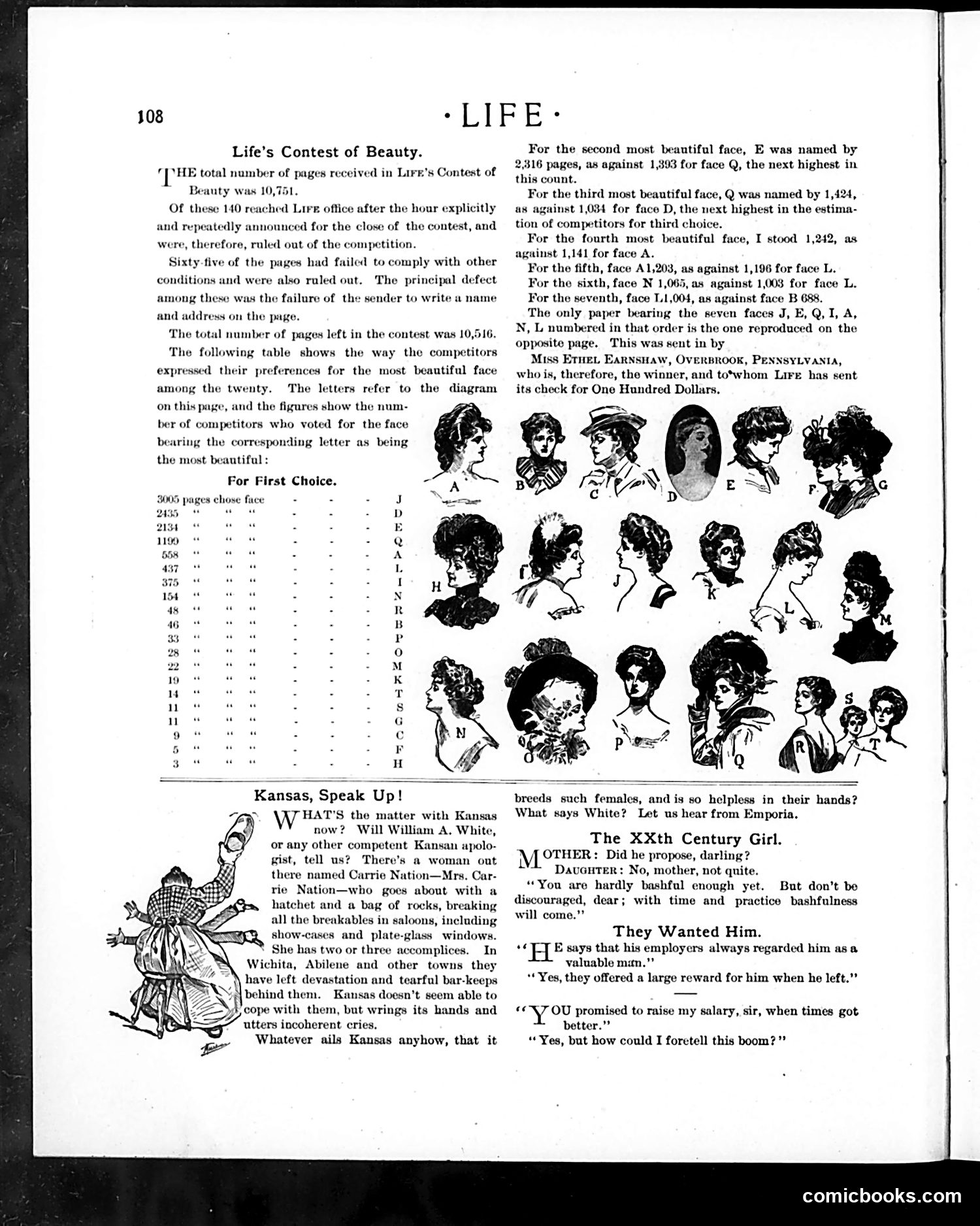
This page documents results from Life's "Contest of Beauty," where readers voted on the most beautiful female face. The central image displays 18 portrait sketches labeled A through S, showing the winning entries ranked by vote count. The lower section, "Kansas, Speak Up!," mocks Kansas's perceived lack of cultural sophistication. An illustrated woman (appearing frazzled, surrounded by farm chaos) represents Kansas stereotypically—rural, chaotic, and unable to cope with modern life. The accompanying text sarcastically suggests Kansas cannot manage its own problems, inviting reader commentary. The page also includes brief comedic dialogue snippets ("The XXth Century Girl," "They Wanted Him") typical of Life's humorous editorial style, poking fun at contemporary social dynamics and gender relations.
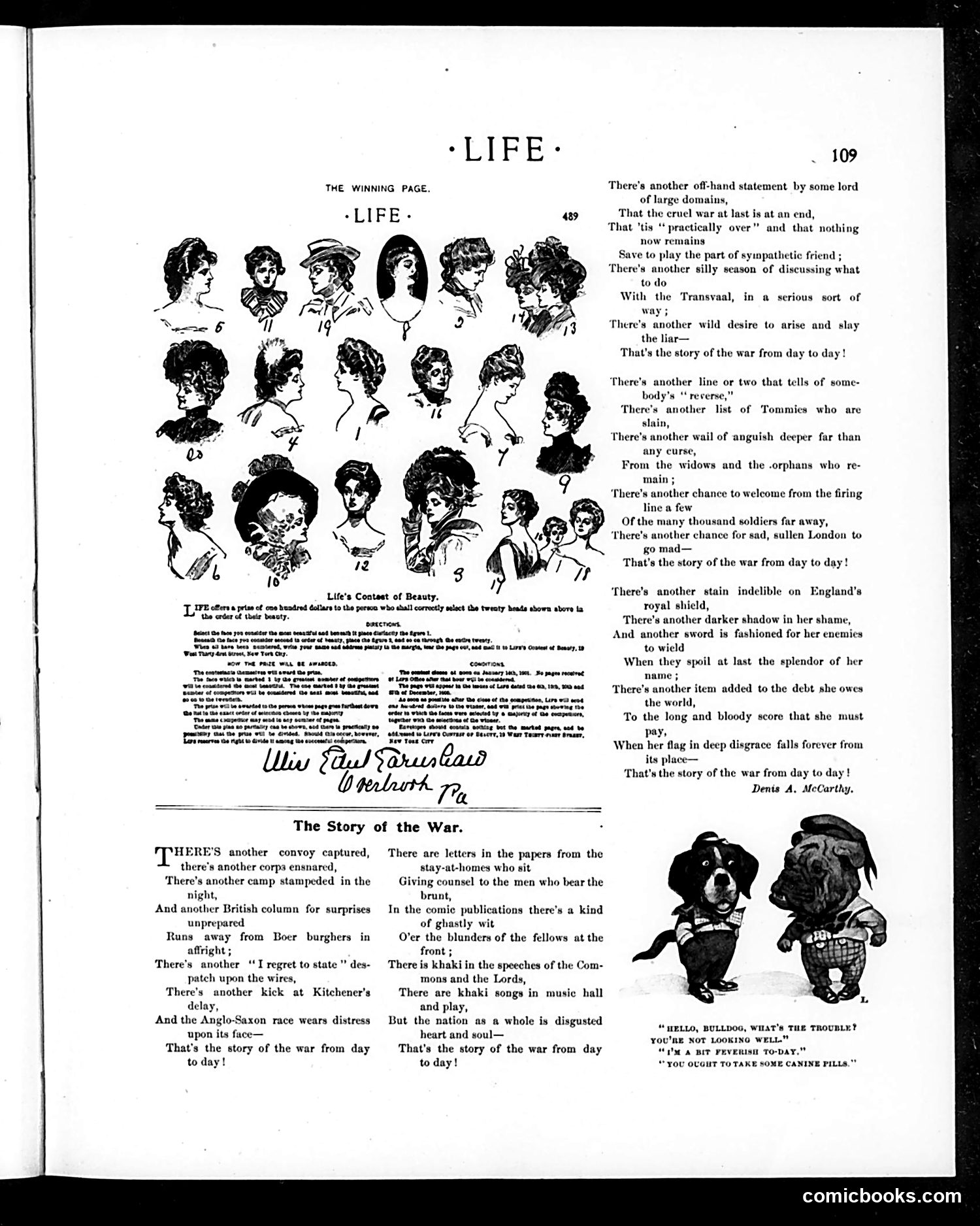
This page presents "The Winning Page," featuring 20 illustrated female heads/portraits labeled as "Life's Contest of Beauty." The accompanying text explains this was a contest where readers voted on beauty standards. The main article, "The Story of the War," by Denis A. McCarthy, is satirical poetry cataloging World War I's ongoing tragedies—"another convoy captured," "corps censured," "another corps shelled in the night." The repeated refrain "That's the story of the war from day to day!" emphasizes the monotonous, grim cycle of wartime losses. At bottom right is a cartoon captioned "Hello, Bulldog, What's the Trouble?" showing two bulldogs discussing one's poor health and need for "canine pills"—likely satirizing either human ailments or political commentary through animal metaphor. The page combines beauty pageantry with war-zone realities, creating dark juxtaposition typical of Life's satirical approach.
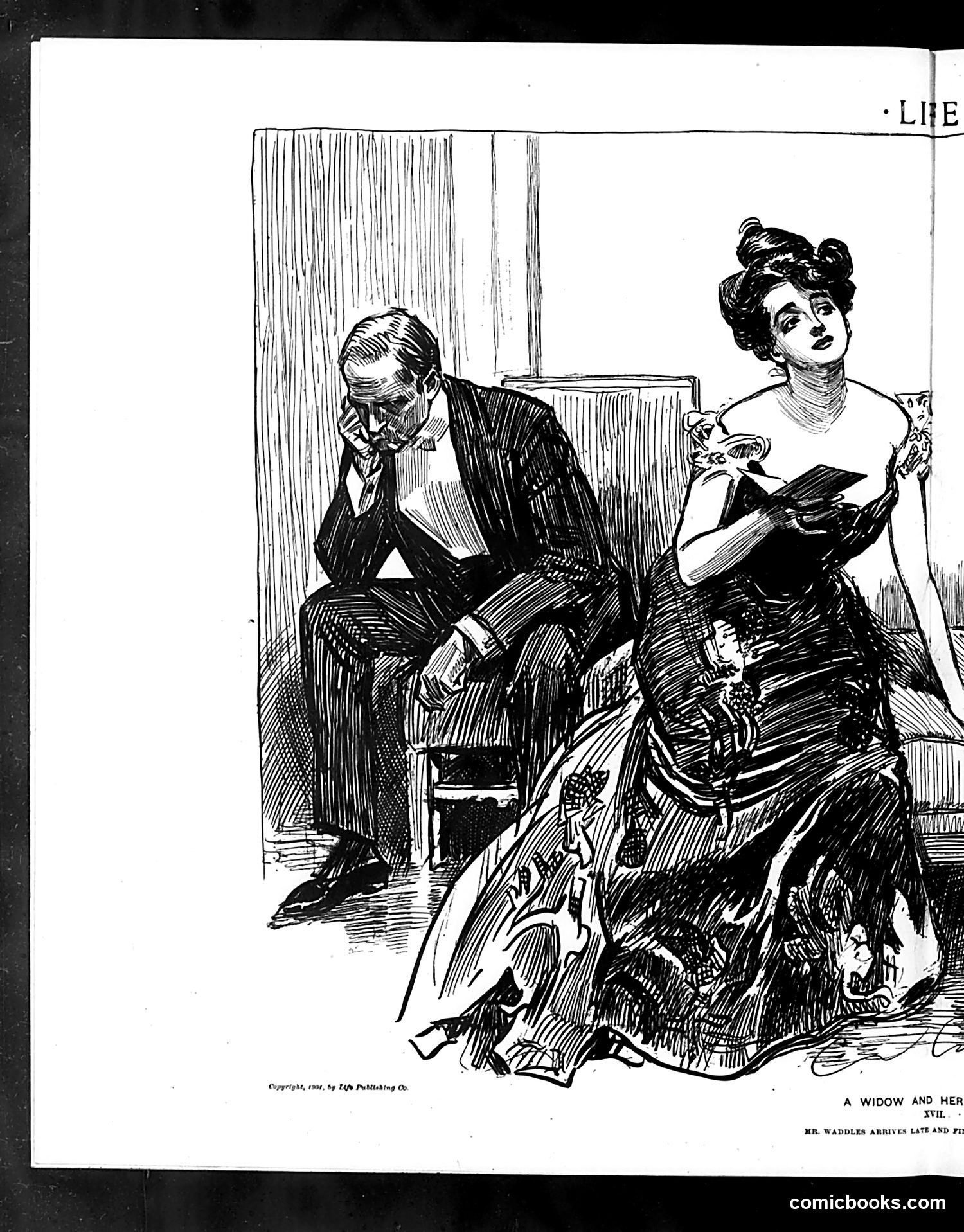
This appears to be an illustration from Life magazine (copyright 1904, Life Publishing Co.) titled "A Widow and Her" with a subtitle mentioning "Mr. Waddles Arrives Late and Fi[ts]"—text that's partially cut off. The sketch shows a well-dressed man in formal attire sitting apart from a fashionably dressed woman reading. The composition suggests social awkwardness or tension between them—possibly depicting a widow receiving a male visitor. The detail "Mr. Waddles" in the caption suggests this is likely satirizing a specific social situation or, possibly, a contemporary figure, though the reference is unclear without additional context. The style is typical of Life's early 1900s satirical commentary on upper-class social interactions and courtship customs.
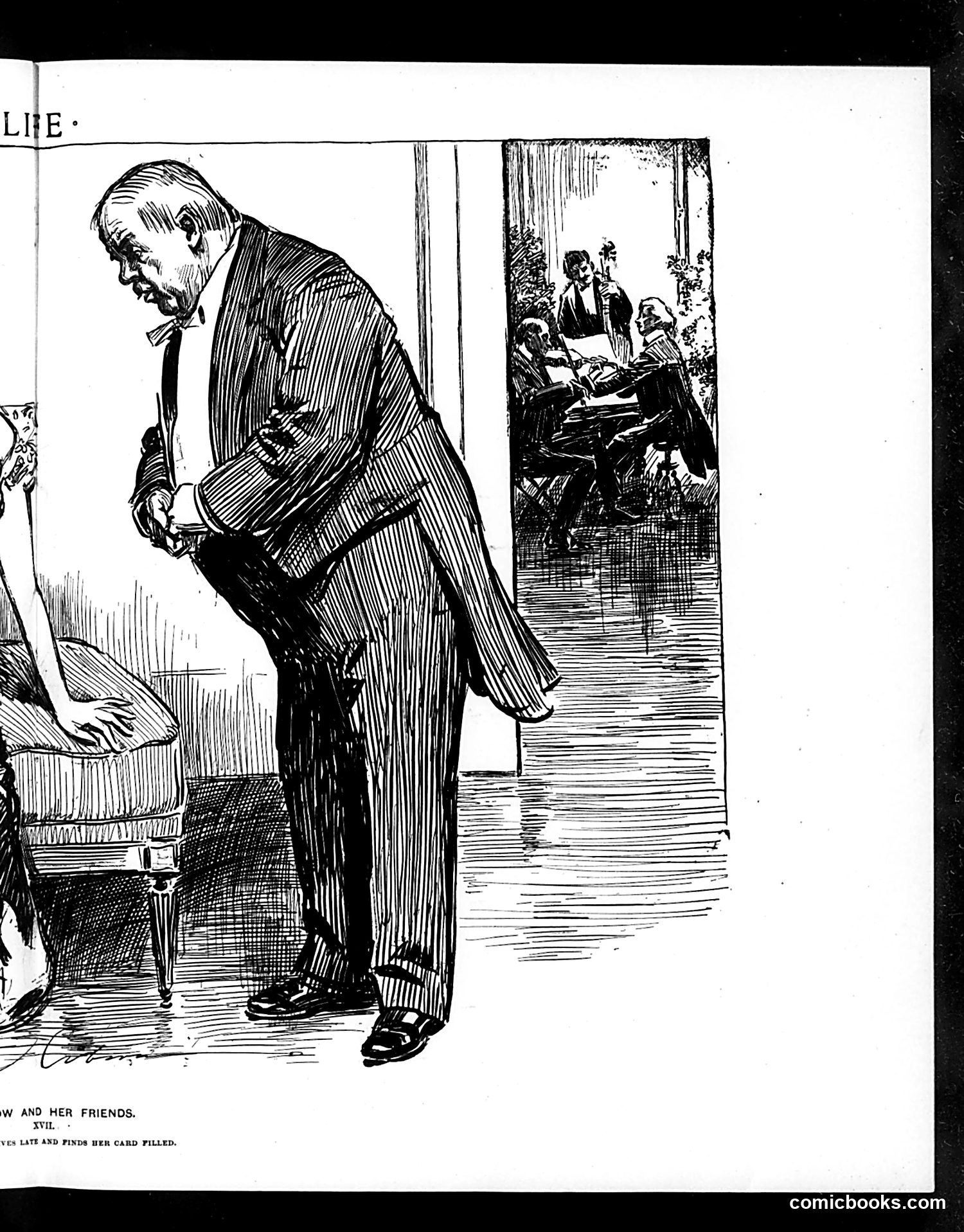
This appears to be a page from *Life* magazine titled "AND HER FRIENDS" (Section XVII), with the caption "LATE AND FINDS HER CARD FILLED." The main illustration shows a well-dressed older man in a pinstriped suit, drawn in a somewhat unflattering caricature style, examining what appears to be a calling card. He displays a concerned or troubled expression. In the background through a doorway, several figures are visible in what looks like a social gathering or parlor scene. The satire appears to target social pretension and romantic entanglements—likely mocking a gentleman discovering that a woman he knows has received numerous suitors (indicated by a "filled" calling card), suggesting either her popularity or questionable reputation. The specific identities of the figures remain unclear without additional context or publication date information.
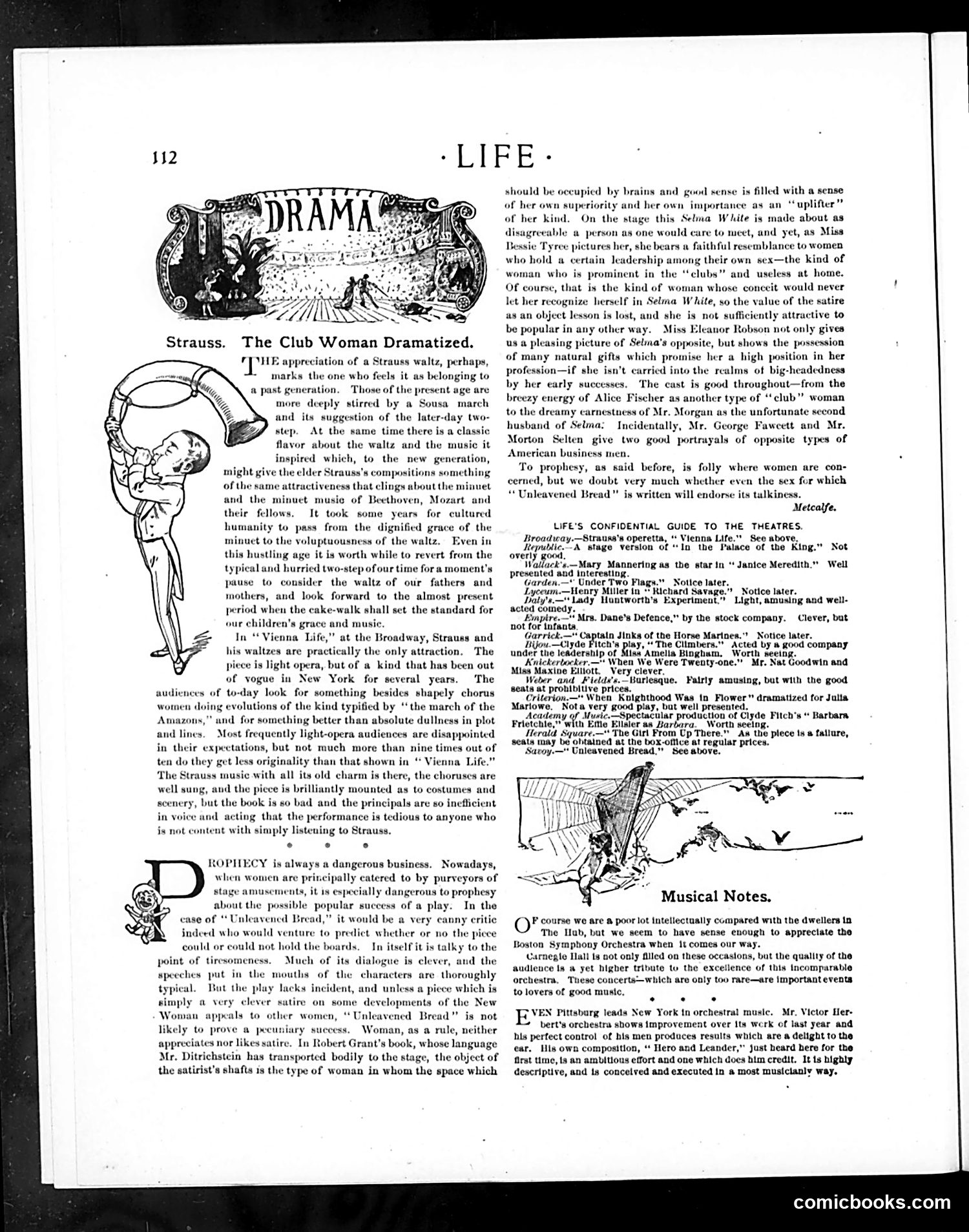
This page features theater reviews from Life magazine's drama section. The main illustration shows a woman in an exaggerated dance pose, likely satirizing the "Club Woman" character type discussed in Strauss's operetta review. The text critiques theatrical trends of the era, particularly mocking the popularity of plays centered on society women and "club women" characters. The reviewer expresses skepticism about whether such roles represent genuine female leadership or merely perpetuate stereotypes. The reviews discuss several Broadway productions, including Strauss's operetta and various dramatic pieces. The tone suggests satire directed at both theatrical producers who exploit formulaic "woman" characters and audiences who consume such entertainment uncritically. The "Musical Notes" section at bottom comments on orchestral performances, indicating this reflects turn-of-century American cultural life and entertainment criticism.
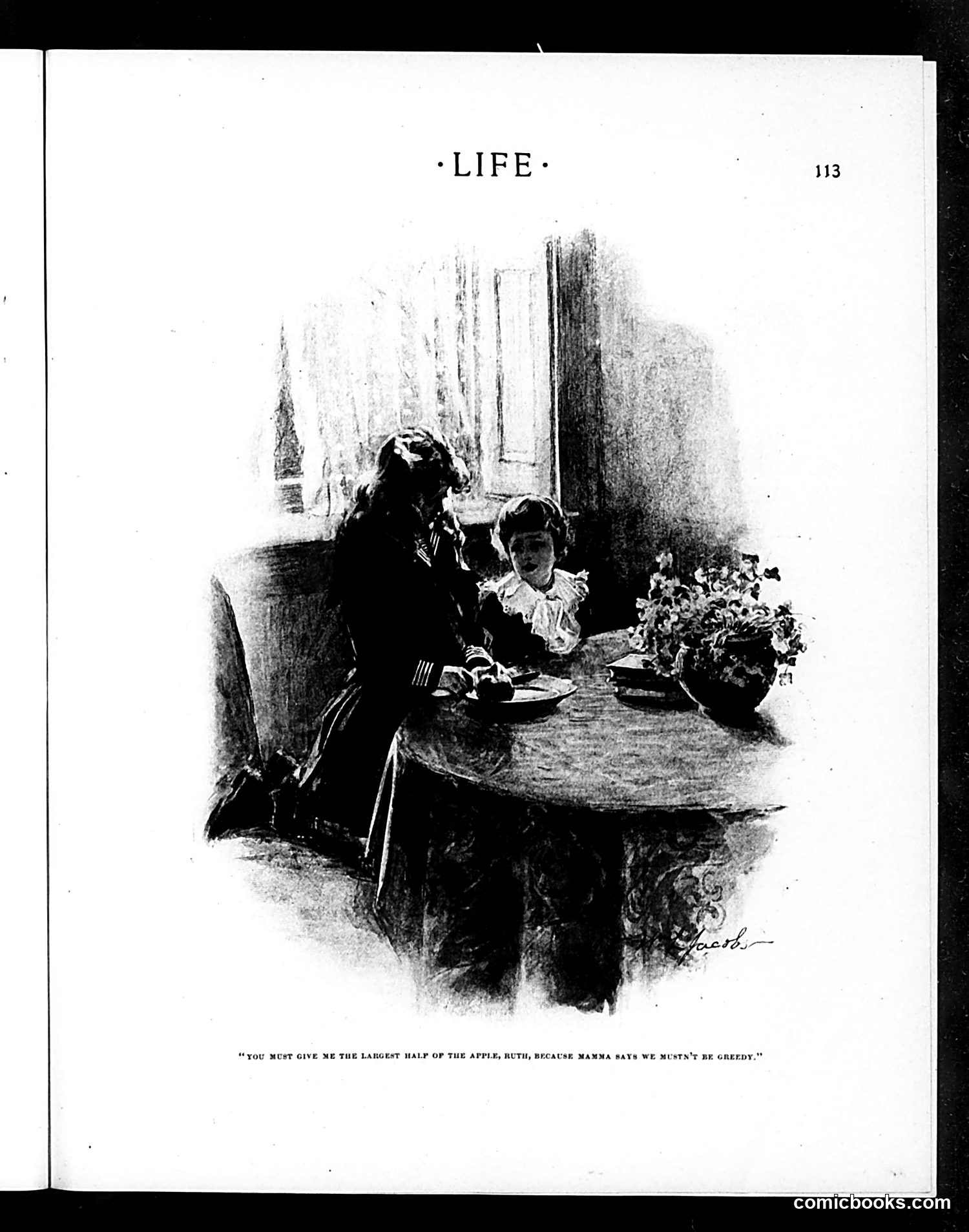
This illustration depicts a domestic scene with two figures at a table with food and flowers. The caption presents a child's request to another person named Ruth, asking for "the largest half of the apple" while claiming this isn't greedy because "mamma says we mustn't be greedy." The satire targets **childish logic and hypocrisy**: the child simultaneously demands the bigger portion while invoking parental rules against greed to justify the demand. This is absurdist humor—the contradiction between the selfish request and the moral reasoning is the joke. The cartoon satirizes how people (not just children) rationalize contradictory behavior, using social norms or parental authority to justify self-serving wants. It's social commentary on human nature wrapped in a domestic, seemingly innocent scene. The specific individuals pictured are unclear from the image alone.
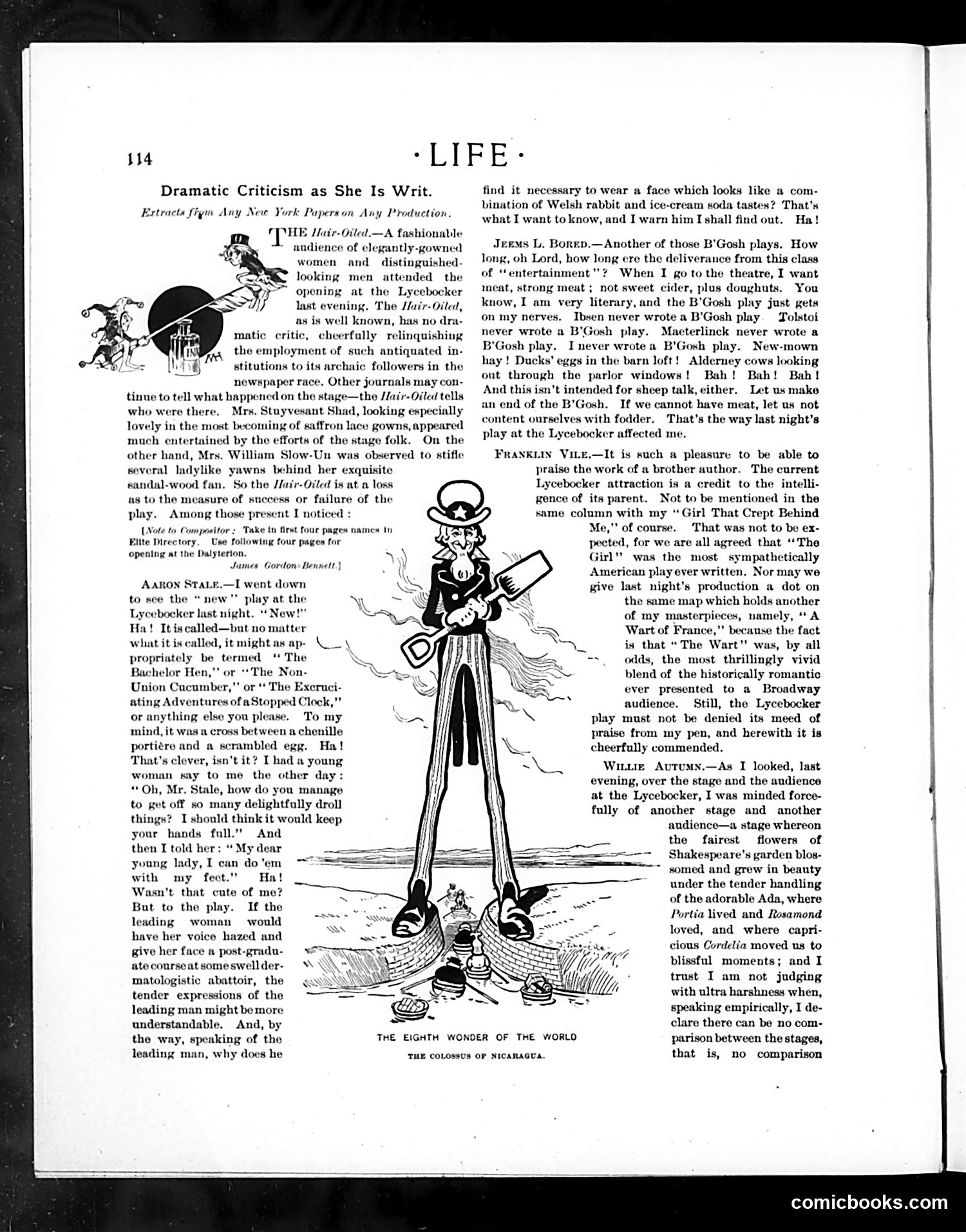
This page satirizes New York newspaper theater critics and their reviewing practices circa early 1900s. **The Main Cartoon** ("The Eighth Wonder of the World—The Colossus of Nicaragua") depicts an absurdly tall, spindly-legged figure—likely a caricature of an exaggerated critical persona or theatrical pretension. **The Text Mocks Five Critic Types:** 1. **The Society Reporter** ("Hair-Oiled")—focuses only on attendees' fashion, not the play itself 2. **Aaron Stale**—uses forced, contrived wordplay ("chenille portiére and scrambled egg") instead of genuine critique 3. **Jeems L. Bored**—pompously name-drops Ibsen and Tolstoi while dismissing the show as "fodder" 4. **Franklin Vile**—praises productions while obsessively promoting his own inferior plays 5. **Willie Autumn**—implied to follow similarly absurd patterns The satire ridicules critics who avoid actual dramatic analysis, replacing it with social gossip, pretentious comparisons, self-promotion, and affected cleverness. It's a complaint about journalism's failure to meaningfully evaluate theater.
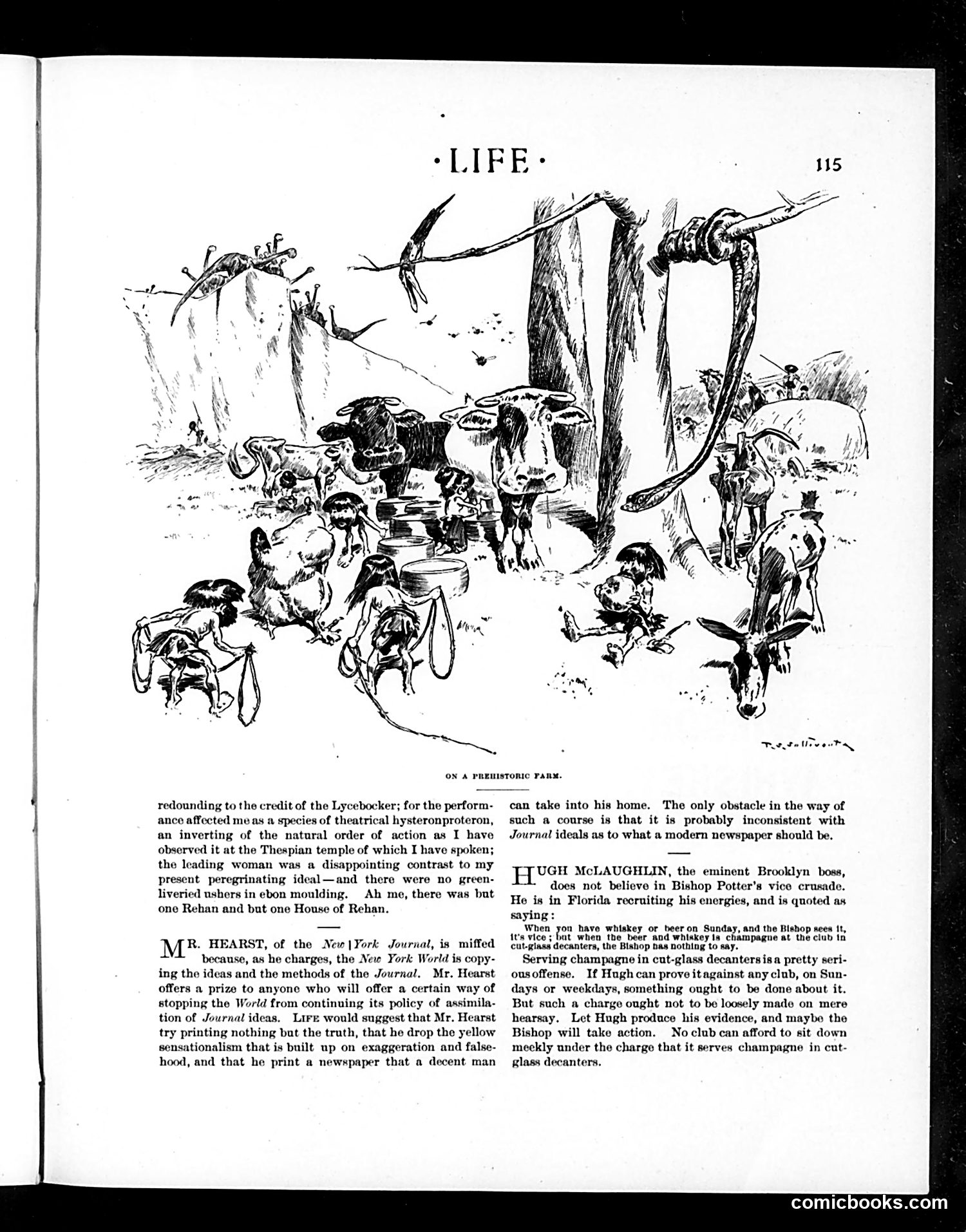
This page satirizes prominent figures of the era through text commentary rather than traditional political cartoons. **Main targets:** 1. **William Randolph Hearst** (New York Journal owner): Mocked for accusing the New York World of copying his sensational methods while practicing yellow journalism himself. Life suggests Hearst's real problem is that the World won't abandon truth-telling and exaggeration as he has. 2. **Hugh McLaughlin** (Brooklyn political boss): Quoted attacking Bishop Potter's vice-crusade as hypocritical class-based morality—condemning beer/whiskey as "vice" while ignoring champagne served in cut-glass at elite clubs. Life sarcastically agrees the practice is serious but demands McLaughlin provide evidence rather than mere hearsay. The illustration labeled "On a Prehistoric Farm" appears decorative, depicting primitive humans with cattle—likely unrelated to the text commentary. **Core satire:** Exposing hypocrisy among powerful men (a newspaper magnate promoting sensationalism; a politician selectively enforcing morality based on class).
This page from *Life* magazine combines light satirical humor with period advertising. The main content includes: **"A Frosty Morning"**: A sentimental poem about winter's pleasures—frost, farmyard sounds, and returning to bed. It's gentle nostalgia rather than satire. **"Wits at Work"**: Three anecdotes mocking public figures and situations. The Bryan story ridicules William Jennings Bryan (prominent 1890s-1900s politician) for his vanity about self-promotion; the Irishman chairman's confusion creates the humor. Other stories involve composer Henry Russell and wedding scenarios—all emphasizing human foibles and miscommunication. **Advertisements**: Period whiskey, champagne, and fabric company ads occupy the lower half, typical of *Life*'s revenue model. The page reflects early 20th-century humor: gentle mockery of ambition, ethnic comedy (the Irish chairman), and sentimental verse. The satire is mild by modern standards—focused on personality quirks rather than political critique.
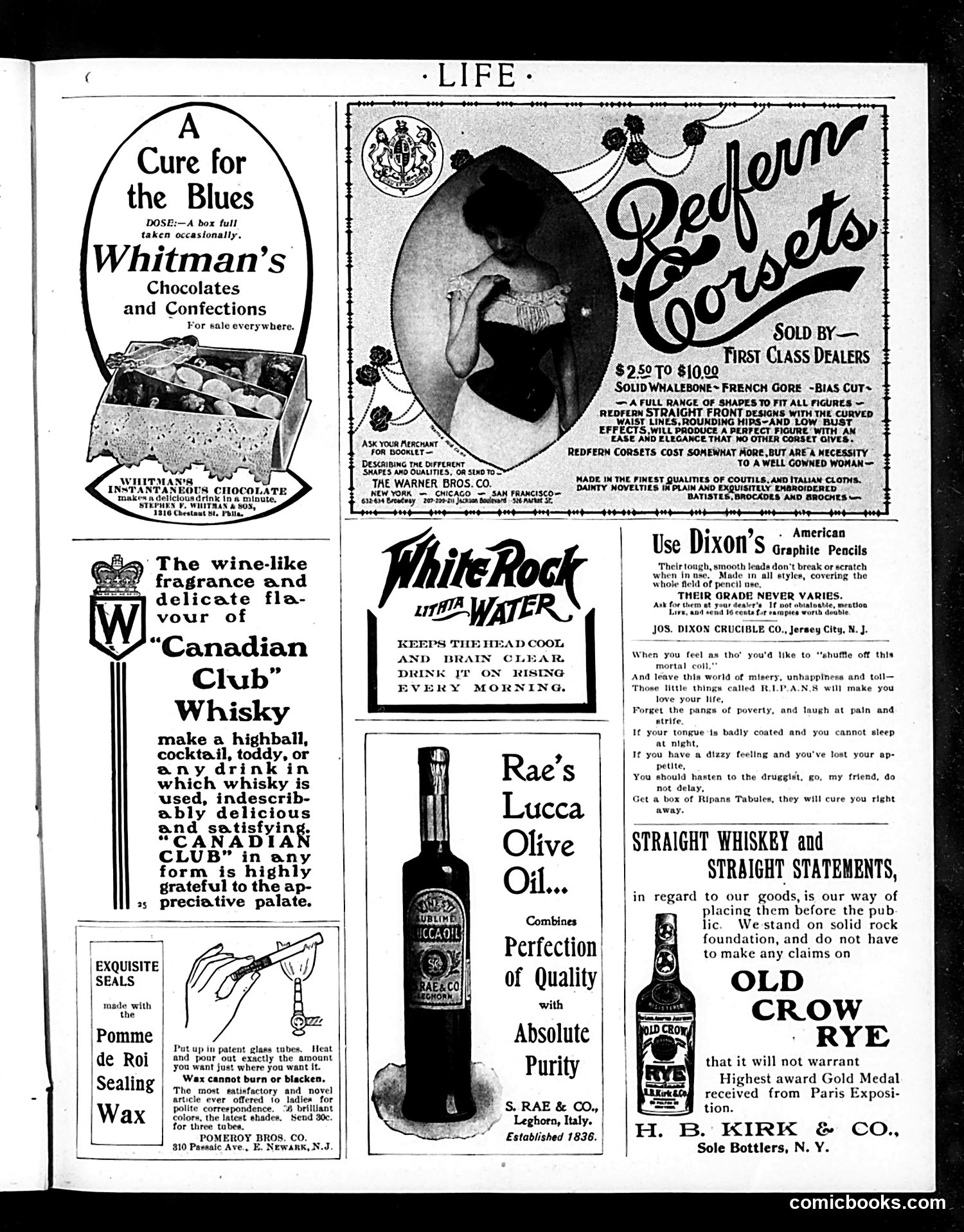
This page is **primarily advertisements**, not satirical cartoons. It showcases early 20th-century consumer products with period-specific marketing appeals: **Notable ads include:** - **Whitman's Chocolates**: marketed as a "cure for the blues," reflecting an era when chocolate was promoted for mood enhancement - **Redfern Corsets**: emphasizes body-shaping ("curved waist lines, rounding hips") as essential for "well-gowned women"—reflecting strict Edwardian fashion standards - **Canadian Club Whisky**: pitched as healthful, suggesting drinking upon waking improves digestion and mental clarity - **Ripans Tabules**: a patent medicine promising cures for depression, insomnia, and digestive issues—typical of the "cure-all" snake oil era before FDA regulation - **Dixon's Pencils** and **Old Crow Rye**: standard product advertisements The ads collectively reveal early 1900s attitudes: unregulated health claims, rigid beauty standards requiring corseting, and product marketing now considered absurd or harmful.
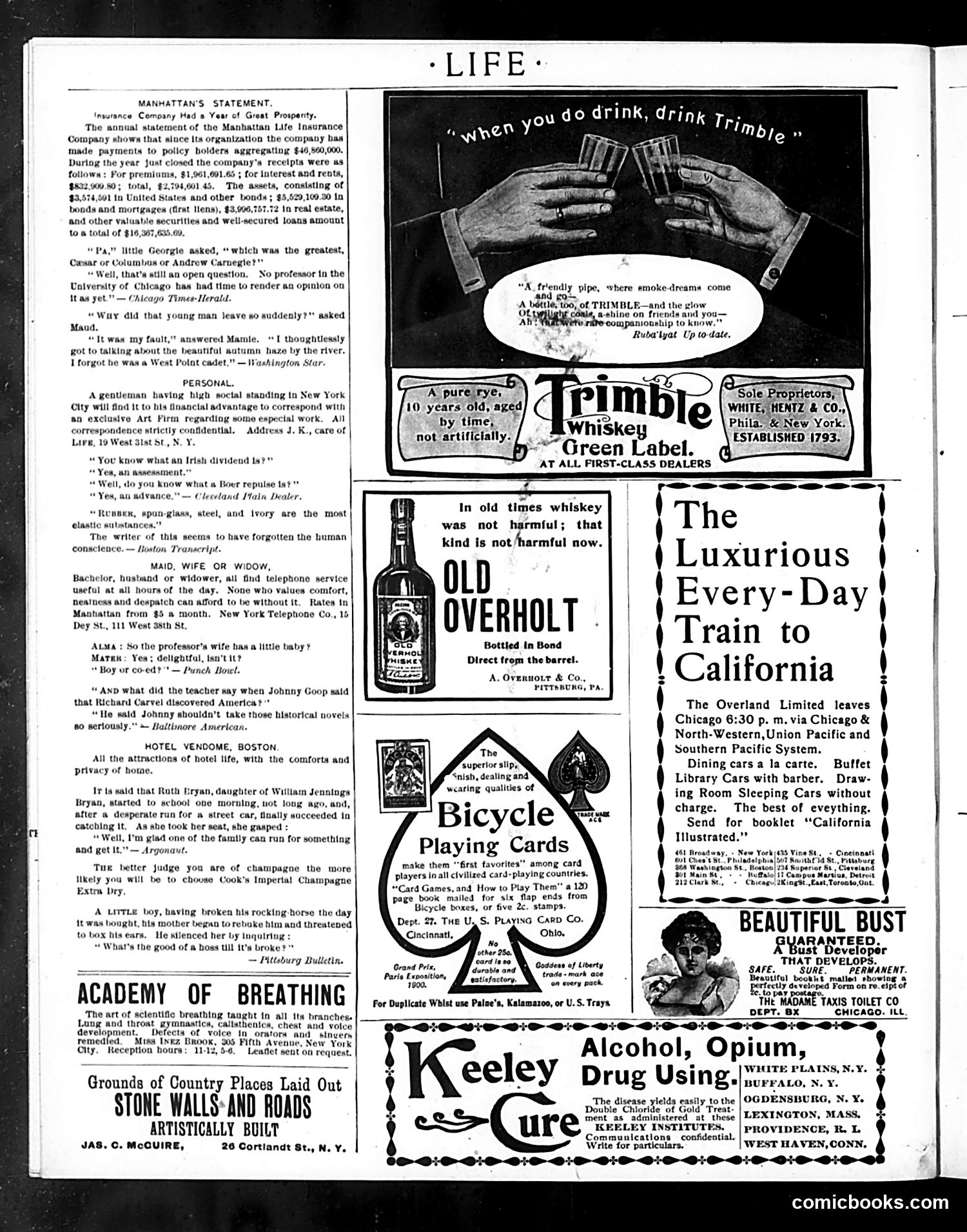
This page is primarily **advertising and humor snippets** rather than political cartoons. The content reflects early 1900s American commercial culture. **Key elements:** The **Trimble Whiskey advertisement** dominates visually, depicting two hands clinking glasses with romantic, poetic language about friendship and tobacco pipes—typical of period marketing that glamorized alcohol consumption. **The humor section** contains brief jokes and anecdotes about contemporary topics: insurance company prosperity, comparisons of historical figures (Columbus, Carnegie), Irish stereotypes ("Irish dividend"), and domestic life. One joke references Richard Carvel, a popular historical novel, mocking students taking fiction too seriously. **The remaining ads** promote mundane services: hotel accommodations, telephone service, breathing exercises, landscape design, bicycle playing cards, and notably, the **Keeley Cure**—a real institution treating "Alcohol, Opium, Drug Using," reflecting period anxieties about substance abuse. The page reveals a society where alcohol advertising coexisted openly with addiction treatment services—a stark contrast to modern regulation.
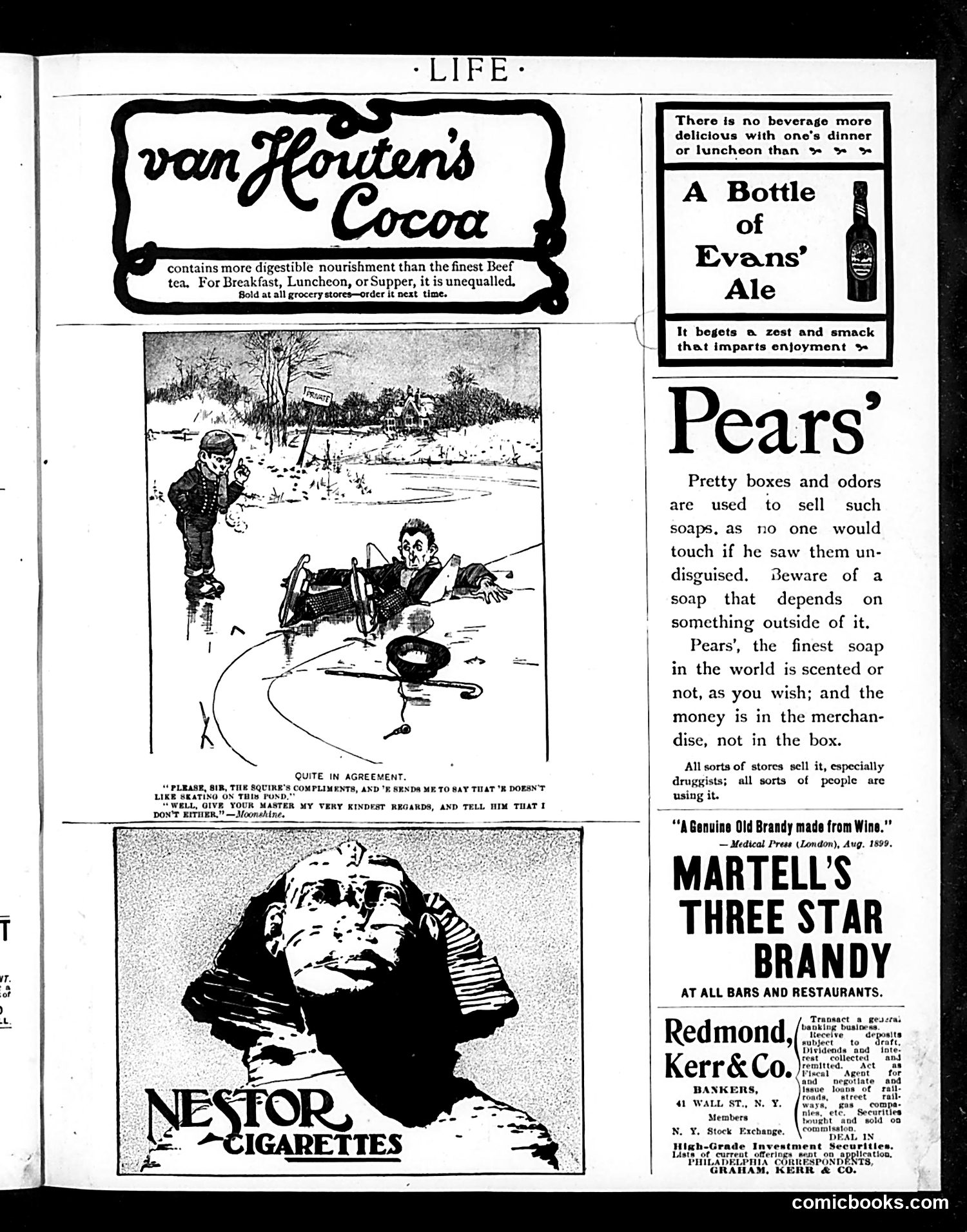
This page is primarily **advertisements** with one small political cartoon. The main cartoon, titled "Quite in Agreement," depicts two figures in a rural setting—a squire (wealthy landowner) and what appears to be a working-class man—in disagreement about labor or class relations. The caption suggests the squire sends a message claiming he doesn't like something, but the worker responds he doesn't either, implying they've found common ground despite their class differences. The satire likely mocks the pretense of class harmony or the difficulty of genuine agreement between rich and poor during this era. The page is otherwise filled with period advertisements for luxury goods (Van Houten's Cocoa, Evans' Ale, Nestor Cigarettes, Pears' Soap, Martell's Brandy) and financial services, typical of Life's revenue model.
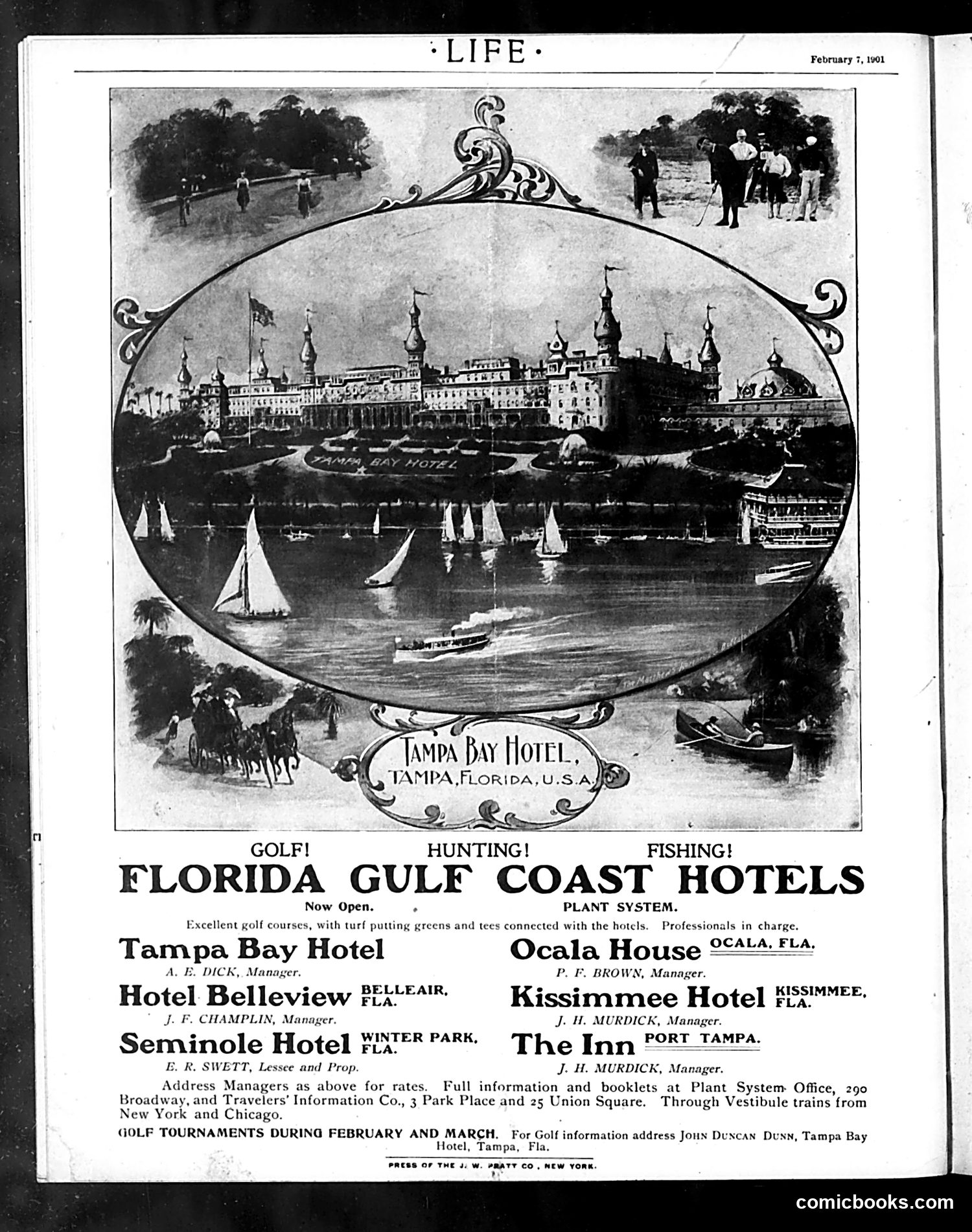
This is a full-page advertisement for Florida Gulf Coast hotels, not a political cartoon. Published February 7, 1901, it promotes resort destinations along Florida's west coast—Tampa Bay Hotel, Hotel Belleview, Seminole Hotel, Ocala House, Kissimmee Hotel, and The Inn. The central image depicts the Tampa Bay Hotel with its distinctive Moorish architecture, surrounded by vignettes showing recreational activities: golf, hunting, and fishing. Small scenes in the corners illustrate leisure activities and local transportation. The advertisement targets wealthy Northern tourists seeking winter recreation, promoting golf tournaments scheduled for February and March. It emphasizes rail connections from New York and Chicago via the Plant System railroad, and provides booking information through New York travel agencies. There is no satire or political commentary—this is straightforward tourism marketing from Florida's Gilded Age resort era.