
Life, 1901-02-07 · page 12 of 20
Life — February 7, 1901 — page 12: what you’re looking at
What you’re looking at
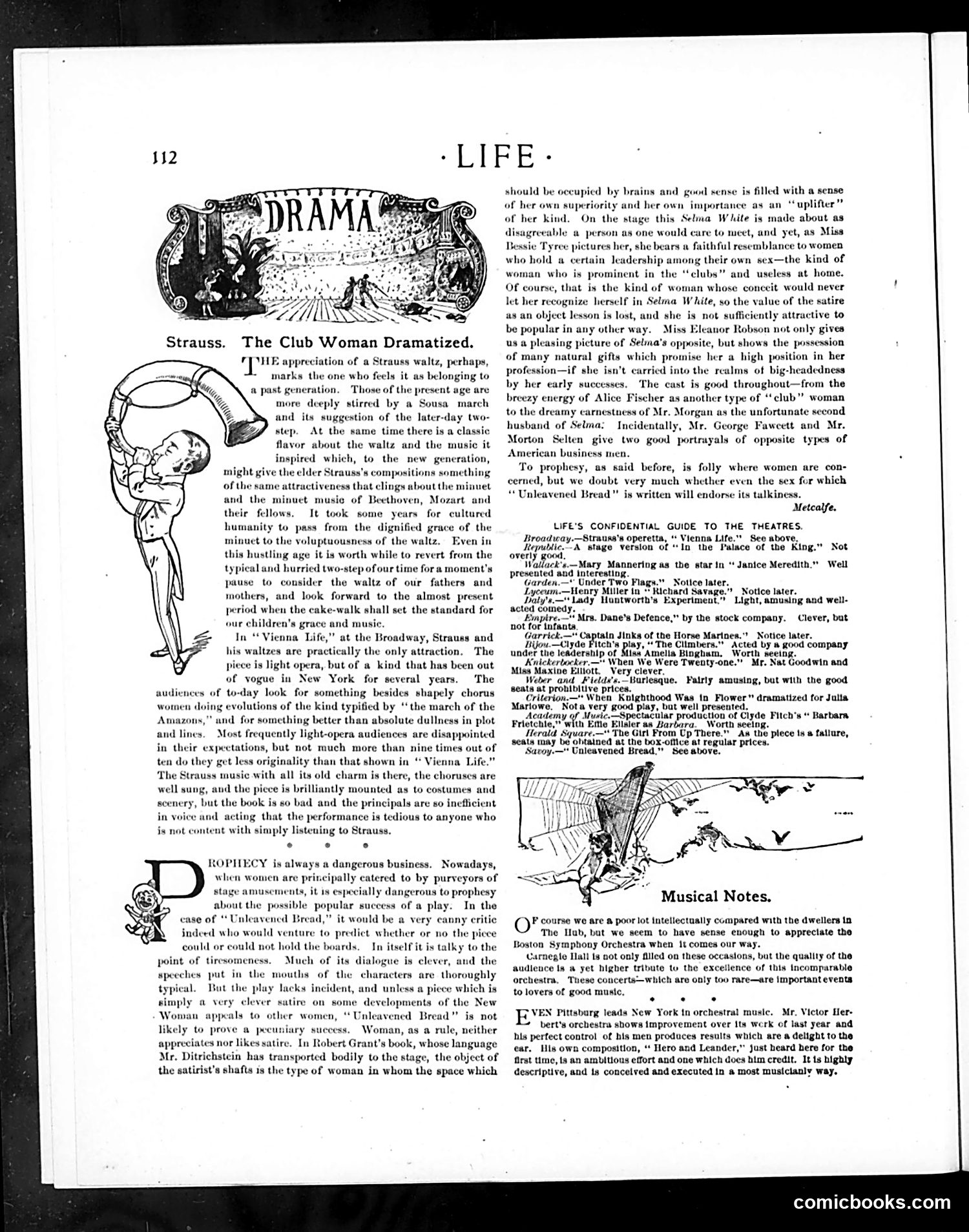
This page features theater reviews from Life magazine's drama section. The main illustration shows a woman in an exaggerated dance pose, likely satirizing the "Club Woman" character type discussed in Strauss's operetta review. The text critiques theatrical trends of the era, particularly mocking the popularity of plays centered on society women and "club women" characters. The reviewer expresses skepticism about whether such roles represent genuine female leadership or merely perpetuate stereotypes. The reviews discuss several Broadway productions, including Strauss's operetta and various dramatic pieces. The tone suggests satire directed at both theatrical producers who exploit formulaic "woman" characters and audiences who consume such entertainment uncritically. The "Musical Notes" section at bottom comments on orchestral performances, indicating this reflects turn-of-century American cultural life and entertainment criticism.
📄 Transcribed text from this page (OCR, searchable)
Machine-transcribed from the original scan — historical spelling and the odd misread are preserved.
Strauss. The Club Woman Dramatized. TPPHE appreciation of a Strauss waltz, perhaps } marks the one who feels it as belonging to a past generation. Those of the present age are more deeply stirred by a Sousa march and its suggestion of the late At the same time there is a class flavor about the waltz and the music it inspired wh might give the elde of the same attra and the minuet n their fellows. It huma: , to the new generation, Strauss’s compositions somethi eness that clings about the minuet usic of Beethoy Mozart and took some years for cultured y to pass from the dignified grace of the minuct to the voluptuousness of the waltz. en in this hustling age it is worth while to revert from the typical and hurried two-step of our time for a moment's pause to consider the waltz of our fathers and mothers, and look forward to the almost present period when the cake-walk shall set the standard for our children’s grace and music In “Vienna Life,” at the Broadway, Strauss and his waltzes are practically the only attraction. ‘The piece is light opera, but of a kind that has been out of vogue in New York for several years. The sof to-day look for something besides shapely chorus 1n doing evolutions of the kind typified by ‘the march of the zons,"" and for something better than absolute dullness in plot and lines. Most frequently light-opera audiences are disappointed in their expectations, but not much more than nine times out of do they get less originality than that shown in ‘The Strauss music with all its old charm is there, the choruses are well sung, a iece is brilliantly mounted as to costumes and but the book is so bad and the pris and acting that the perf ent with simply audien jenna Life.” Is are so ine! mance is tedious to anyone who stening to Strauss. ° e ° ROPHECY is always a dangerous business. Nowadays, when women are principally catered to by purveyors of musements, it 18 especially dangerous to prophesy itthe possible popular success of a play. In the critic In it could or could not hold the boards. elf it is talky to the Much of its dialogue is clever, and the speeches put in the mouths of the characters are thoroughly typical. But the pluy lacks incident, and unless a piece which is simply a very clever sutire on some developments of the New Woman appeals to other women, “Unleavened Bread” is not likely to prove a pecuniary success. Woman, as a rule, neither appreciates nor likes satire. In Robert Grant's book, whose language Mr. Ditrichstein has transported bodily to the stage, the object of the satirist’s shafts is the type of woman in whom the space which point of tiresomeness. + LUPE - should be occupied by brains and good sense is filled with a sense of her own superiority own importance as an ‘uplifter”” of her kind. On the stage this Selma White is made about as disagreeable a person as one would care to meet, and yet, as Miss Ressie Tyree pictures her, she bears a faithful resemblance to women who hold a certain leadership among their own sex—the kind of woman who is prominent in the “clubs” and useless at home. Of course, that is the let her re ind of woman whose conceit would never gnize herself in Selma White, so the value of the satire ve to as an object lesson is lost, and she is not sufficiently be popular in any other way. Miss Eleanor Robson not only us a pleasing picture of Selma’s opposite, but shows the po! of many natural gifts which promise her a high position in her profession—if she isn't carried into the realms of big-headedness by her early successes. ‘The cast is good throughout—from the breezy scher as another type of “club” woman to the dreamy carnestuess of Mr. Morgan as the unfortunate second husband of Selma: Incidentally, Mr. George Faweett and Mr. Morton Selten give two good portrayals of opposite types of American business men. To prophesy, as said before, is folly where women are con- cerned, but we doubt very much whether even the sex for which “ Unleavened Bread" is written will endorse its talkiness. Metcalfe, GUIDE TO THE THEATRES. Vienna Life." See above, LIFE’S CONFIDENTIAL Broadway.—Strauss's operetta, Republic.—& stage version of “In the Palace of the King.” Not overly good Wallack’s.—Mary Mannering as the star in “Janice Meredith.” Well presented and Interesting. Garden.—* Under Two Flags." Zyceum.—Henry Miller tn * Richard Savage.” Notice later. Daty's.—" Lady Muntworth’s Experiment,” Light, amusing and well- acted comedy. Empire.—" Mra. Dane's Defence,” by the stock company. not for infants. Garrick.—" Captain Jinks of the Horse Marine Bijou.—Clyde Fitch's Clever, bat + Notice later. lay, “The Climbers.” Acted by & good company under the leadership of Sisa'Amelia Bingham, Worth seeing. Knickertocker.—* When We Were Twenty-one.” Mr. Nat Goodwin and Miss Maxine Elliott. Very clever. Weber and Fields’s.—Barlesque. Fairly amusing, but with the good seats at prohibitive prices. Criterion.—* When Kntghthood Was tn Flower” dramatized for Julia Marlowe. Nota very good play, but well presented. Academy of Muric.—Spectacilar production of Clyde Fitch's * Barbara Frietchte,* with Ele Ellsler as Barbara. Worth seelog. Herald Square.— The Giri From Up There." Ax the plece ts # failure, ‘seats nay be obtained at the box-office at regular prices. ‘Saroy.—" Unleavened Bread." See above. Musical Notes. OF course wo are a poor lot intellectually compared with the dwellers in ‘The Hub, but we seem to have sense enough to appreciate the Boston Symphony Orchestra when 1t comes our way. Carnegle Hall Is pot only filed on these occastons, but the quality of the audience Is a yet higher tribute to the excellence of this incomparable orchestra, Tuese concerts—which are only tov rare—are important events to lovers of good music. ELVES Pittsburg tends Now York n orchestral musle. Mr. Victor Her- bert's orchestra shows improvement over Its werk of last year and his perfect control of his men produces results which are a delight to the ear. His own composition, + Hero and Leander,” Just heard bere for the frst time, ts an ambitious effort and one which does him credit. It ts highly descriptive, and 1s conceived and executed in a most mustclanly way, . . . comicbooks.com