
Life, 1901-02-07 · page 7 of 20
Life — February 7, 1901 — page 7: what you’re looking at
What you’re looking at
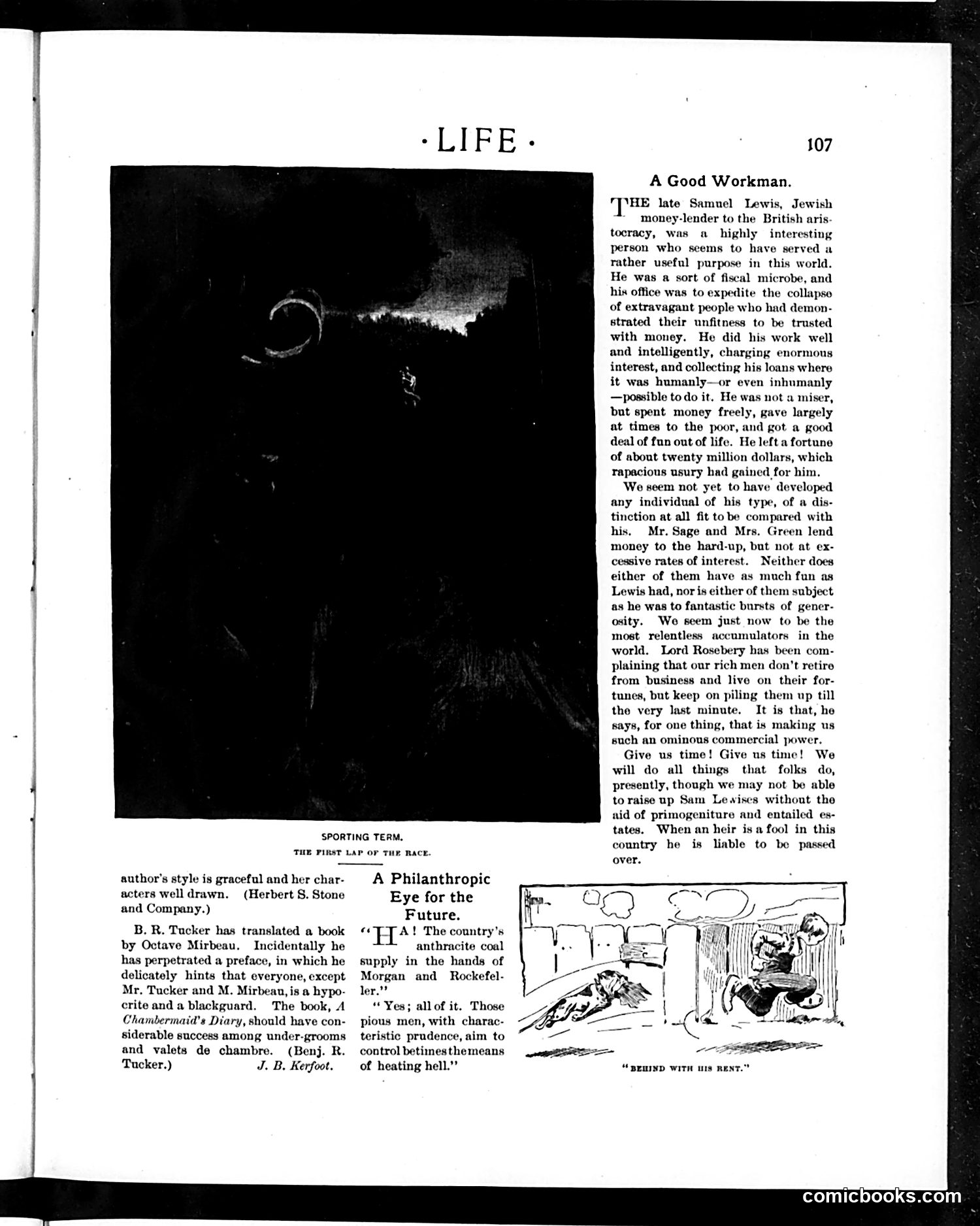
The page contains two separate pieces: **"A Good Workman"** discusses Samuel Lewis, a Jewish money-lender to the British aristocracy. The article praises him as industrious and philanthropic, contrasting him favorably with wealthy industrialists like Sage and Green who hoard money, and Lord Rosebery who merely accumulates wealth. The satire criticizes Britain's richest men for refusing to retire and enjoy their fortunes, instead compulsively accumulating more. **"A Philanthropic Eye for the Future"** (bottom right) is a cartoon captioned "Beside with his rent." The image appears to depict a landlord or wealthy figure overlooking tenants, satirizing the gap between philanthropic rhetoric and actual treatment of the poor—a common turn-of-century critique of wealthy industrialists who claimed charitable intentions while exploiting workers.
📄 Transcribed text from this page (OCR, searchable)
Machine-transcribed from the original scan — historical spelling and the odd misread are preserved.
-LIFE- SPORTING TERM, THE PINST LAP OF THE RACE. author's style is graceful and her char- acters well drawn. (Herbert 8. Stone and Company.) B. R. Tucker has translated a book by Octave Mirbeau. Incidentally he has perpetrated a preface, in which he delicately hints that everyone, except Mr. Tucker and M. Mirbean, is a hypo- crite and a blackguard. The book, A Chambermaid’s Diary, should have con- siderable success among under-grooms and valets de chambre. (Benj. R. Tucker.) J. B. Kerfoot. A Philanthropic Eye for the Future. “ A! The country’s H anthracite coal supply in the hands of Morgan and _ Rockefel- ler.” “Yes; allof it. Those pious men, with charac- teristic prudence, aim to control betimesthemeans of heating hell.”” 107 A Good Workman. ‘HE late Samuel Lewis, Jewish money-lender to the British aris- tocracy, was a highly interesting person who seems to have served a rather useful purpose in this world. He was a sort of fiscal microbe, and his office was to expedite the collapso of extravagant people who had demon- strated their unfitness to be trusted with money. He did his work well and intelligently, charging enormous interest, and collecting his loans where it was humanly—or even inhumanly —possible todo it. He was not a miser, but spent money freely, gave largely at times to the poor, and got a good deal of fun out of life. He left a fortune of about twenty million dollars, which rapacious usury had gained for him. We seem not yet to have developed any individual of his type, of a dis- tinction at all fit tobe compared with his, Mr. Sage and Mrs. Green lend money to the hard-up, but not at ex- cessive rates of interest. Neither does either of them have as much fun as Lewis had, nor is either of them subject as he was to fantastic bursts of gener- osity. We seem just now to be the most relentless accumulators in the world. Lord Rosebery has been com- plaining that our rich men don’t retire from business and live on their for- tunes, but keep on piling them up till the very last minute. It is that, he says, for one thing, that is making us such an ominous commercial power. Give us time! Give us time! We will do all things that folks do, presently, though we may not be able toraise up Sam Lewises without the aid of primogeniture and entailed es- tates. When an heir is a fool in this country he is liable to be passed over. “ REMIND WITH UIs RENT.” comicbooks.com