
A complete issue · 20 pages · 1900
Life — August 16, 1900
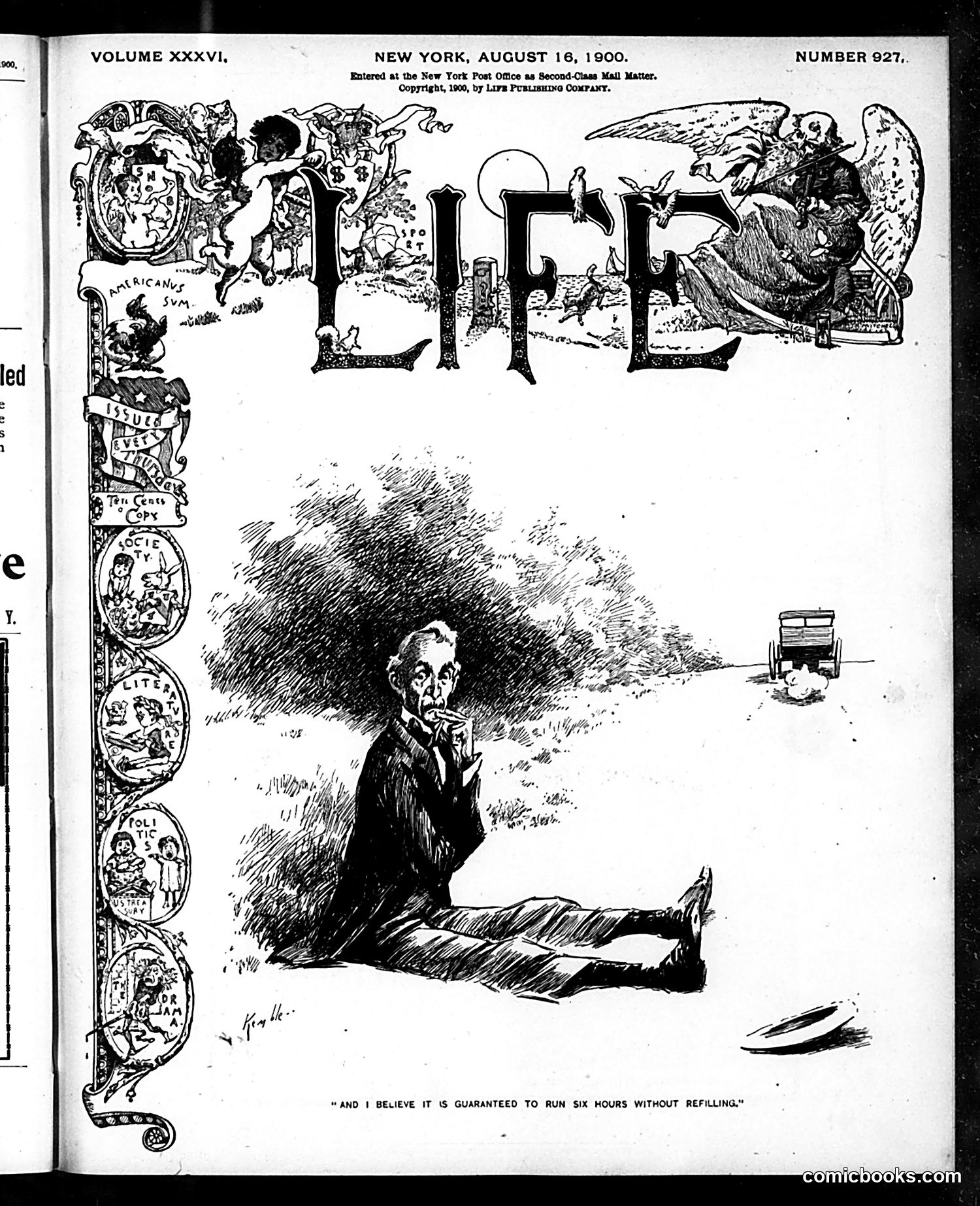
The main cartoon depicts a man sitting exhausted by a roadside, with a broken-down automobile behind him. The caption reads: "AND I BELIEVE IT IS GUARANTEED TO RUN SIX HOURS WITHOUT REFUELING." This is early automotive satire. The figure appears to be testing or promoting a new automobile, but the vehicle has clearly failed—broken down on the road. The joke mocks both the unreliability of early cars and the exaggerated manufacturer claims about their performance. In 1900, automobiles were still experimental novelties, prone to mechanical failure. The cartoon suggests skepticism about both the technology itself and the advertising promises made by manufacturers—a common theme in Life's satirical commentary on emerging technologies and consumer culture.
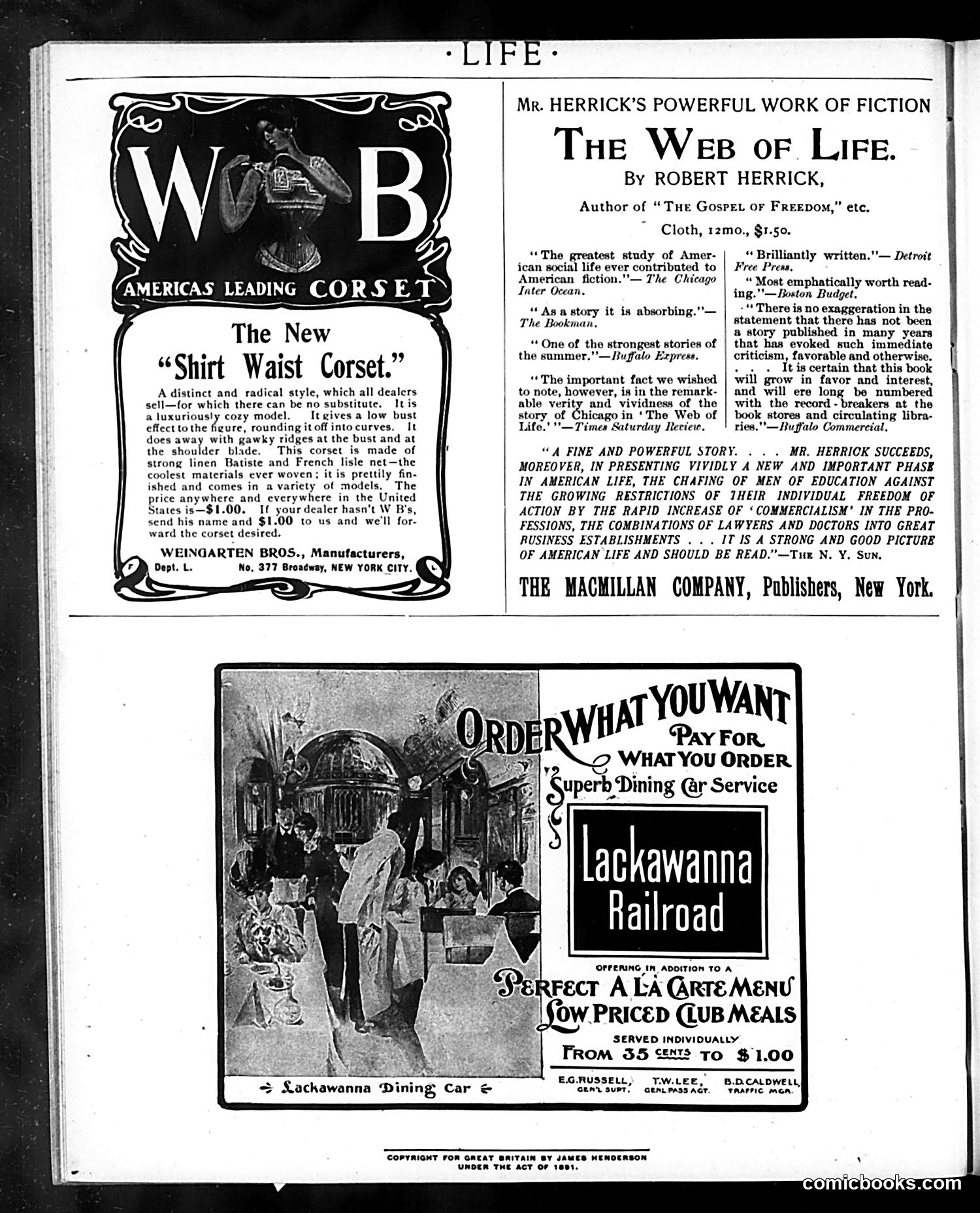
This page contains primarily **advertisements rather than political cartoons**. The main content includes: 1. **W.B. Corset Ad** (top left): Marketing a "Shirt Waist Corset" as a new fashion item for women, priced at $1.00. 2. **Book Advertisement** (top right): Promoting Robert Herrick's novel *The Web of Life*, with glowing reviews from publications like the Chicago Inter-Ocean and Detroit Free Press. 3. **Lackawanna Railroad Ad** (bottom): The dominant image shows an elegant dining car interior, advertising superior dining service with "à la carte" menus and club meals from 35 cents to $1.00. The page reflects early 20th-century consumer culture—fashion, literature, and luxury travel services. There is no discernible political satire or social commentary evident in these advertisements.
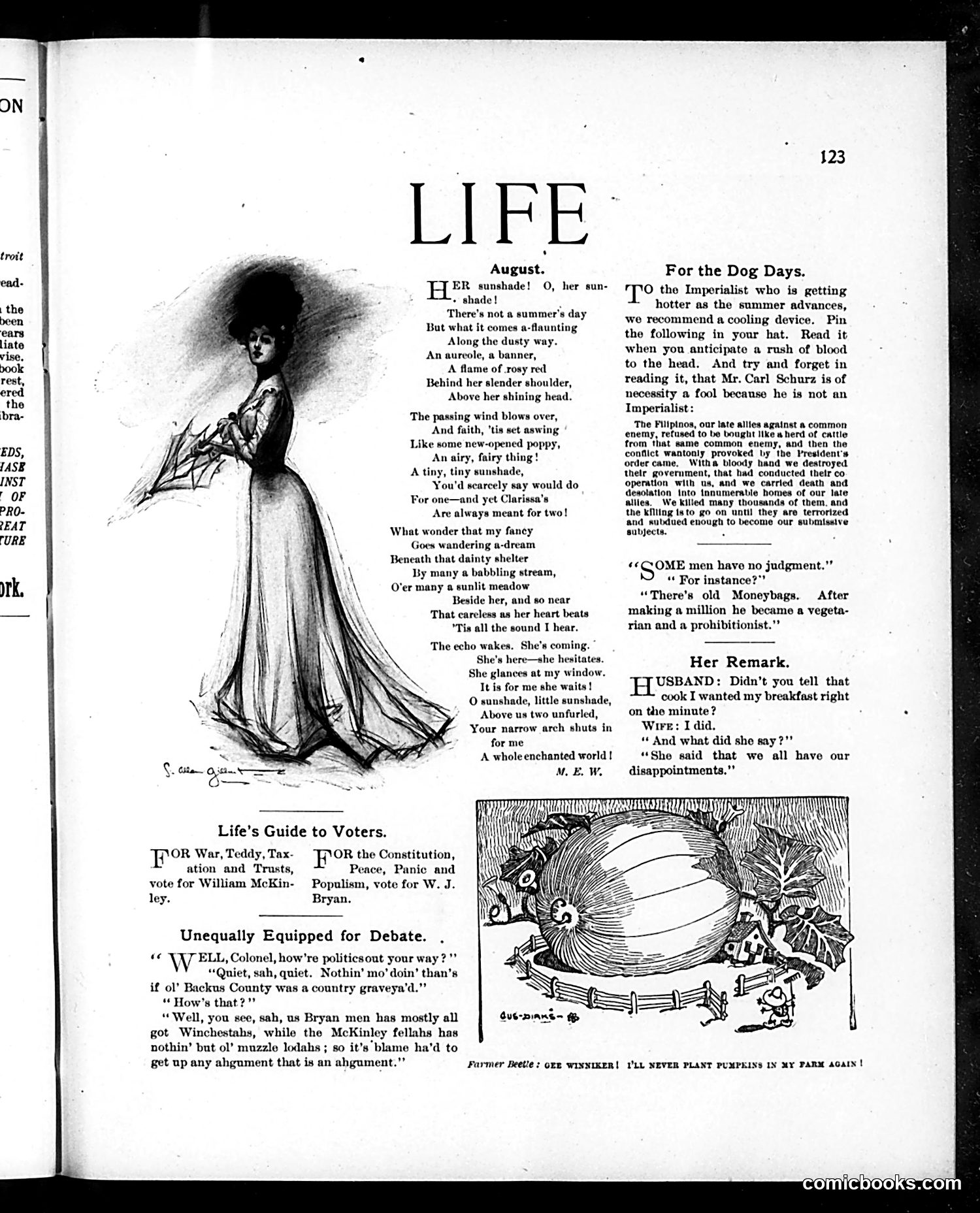
This page from *Life* magazine contains several satirical pieces about the 1908 U.S. presidential election. **"Life's Guide to Voters"** contrasts candidates William McKinley (supporting war, taxation, and trusts) with William Jennings Bryan (supporting the Constitution, peace, and populism). The "Unequally Equipped for Debate" section mocks Bryan supporters as unsophisticated—armed only with "Winchesters" rather than actual arguments, while McKinley's camp has superior weaponry of rhetoric. **"For the Dog Days"** and other brief items are unrelated humor sections typical of the magazine's format. The bottom illustration appears to be a humorous farm scene, unrelated to the political content above. Overall, the page reveals *Life*'s editorial stance favoring McKinley through mockery of Bryan's populist base.
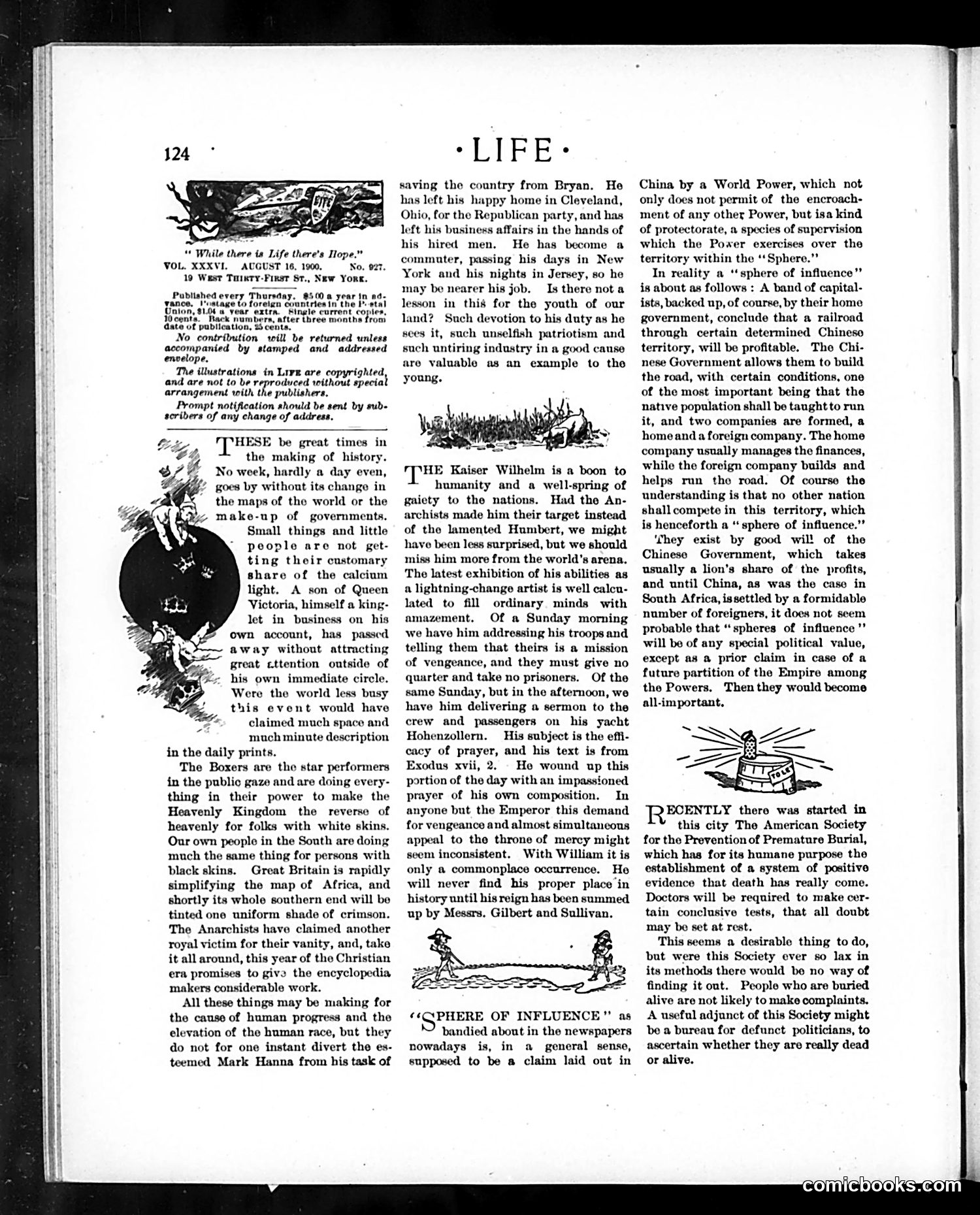
This page contains political commentary rather than traditional cartoons. The text discusses Kaiser Wilhelm II of Germany, praising his artistic abilities while critiquing his political decisions. It references his recent orders to troops regarding "no quarter" (taking no prisoners) during what appears to be military operations. The page also discusses the Boxers in China, British colonial efforts in South Africa, and an "American Society for the Prevention of Premature Burial" — a real organization of the era that checked for signs of life in the deceased before burial, reflecting contemporary anxieties about premature interment. The illustrations appear to be decorative flourishes rather than political cartoons. The text represents *Life's* characteristic satirical commentary on contemporary international affairs and social concerns.
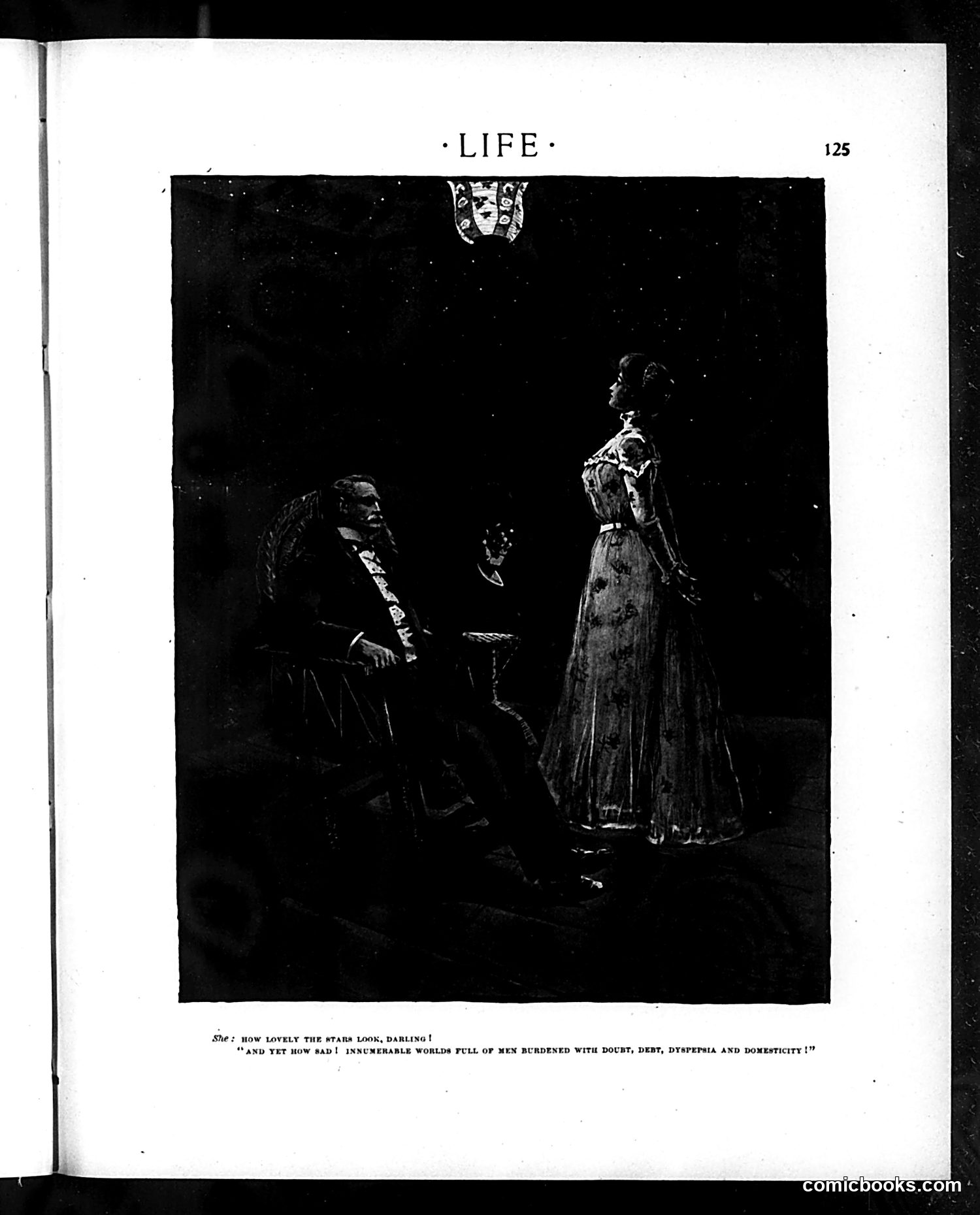
This page from *Life* magazine (page 125) shows a dramatic scene with two figures in formal dress against a dark background. The caption reads: "She: 'How lovely the stars look, darling!' 'And yet how sad! Innumerable worlds full of men burdened with doubt, dread, dyspepsia and domesticity!!'" The satire contrasts romantic idealism with pessimistic realism. While the woman admires the stars romantically, the man's response deflates the moment through cynical philosophical musings. The joke centers on male anxieties of the era—the catalog of complaints ("doubt, dread, dyspepsia and domesticity") suggests frustrations with modern life and marriage itself. This reflects early 20th-century satirical commentary on masculine discontent and the tension between romantic sentiment and world-weary worldliness.
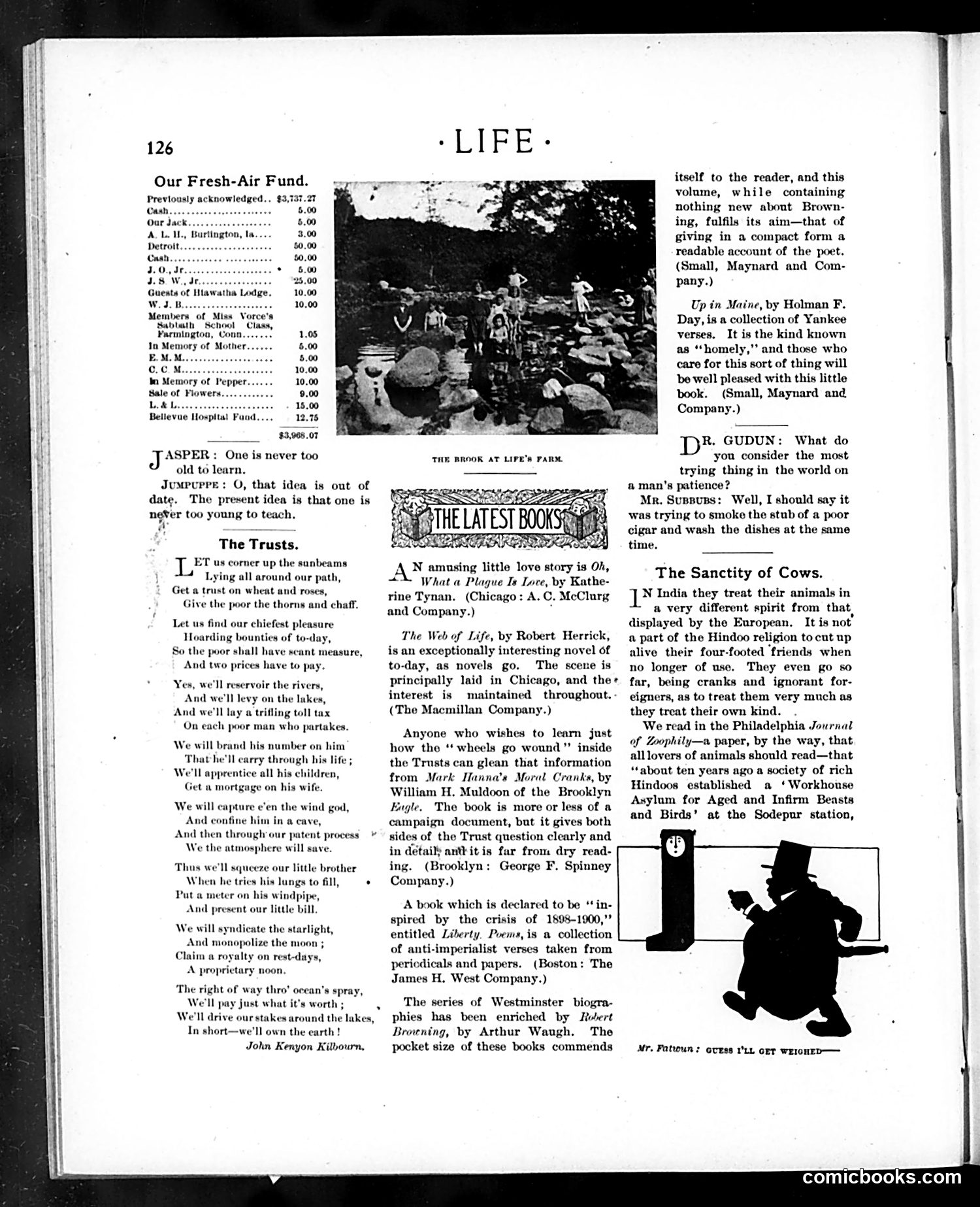
The page contains literary reviews and fund-raising notices rather than political cartoons. The main visual element is a photograph labeled "THE BROOK AT LIFE'S PARK" showing people relaxing outdoors. At the bottom right is a small cartoon labeled "MR. PENURIA: GUESS I'LL GET WEIGHED—" depicting a silhouetted figure at what appears to be a weighing scale. "Penuria" means poverty or want, suggesting social commentary about economic hardship, though the specific satirical point is unclear without additional context. The bulk of the page discusses book reviews and the "Fresh-Air Fund," a charitable initiative providing outdoor recreation for urban populations—reflecting Progressive Era social concerns about public health and welfare.
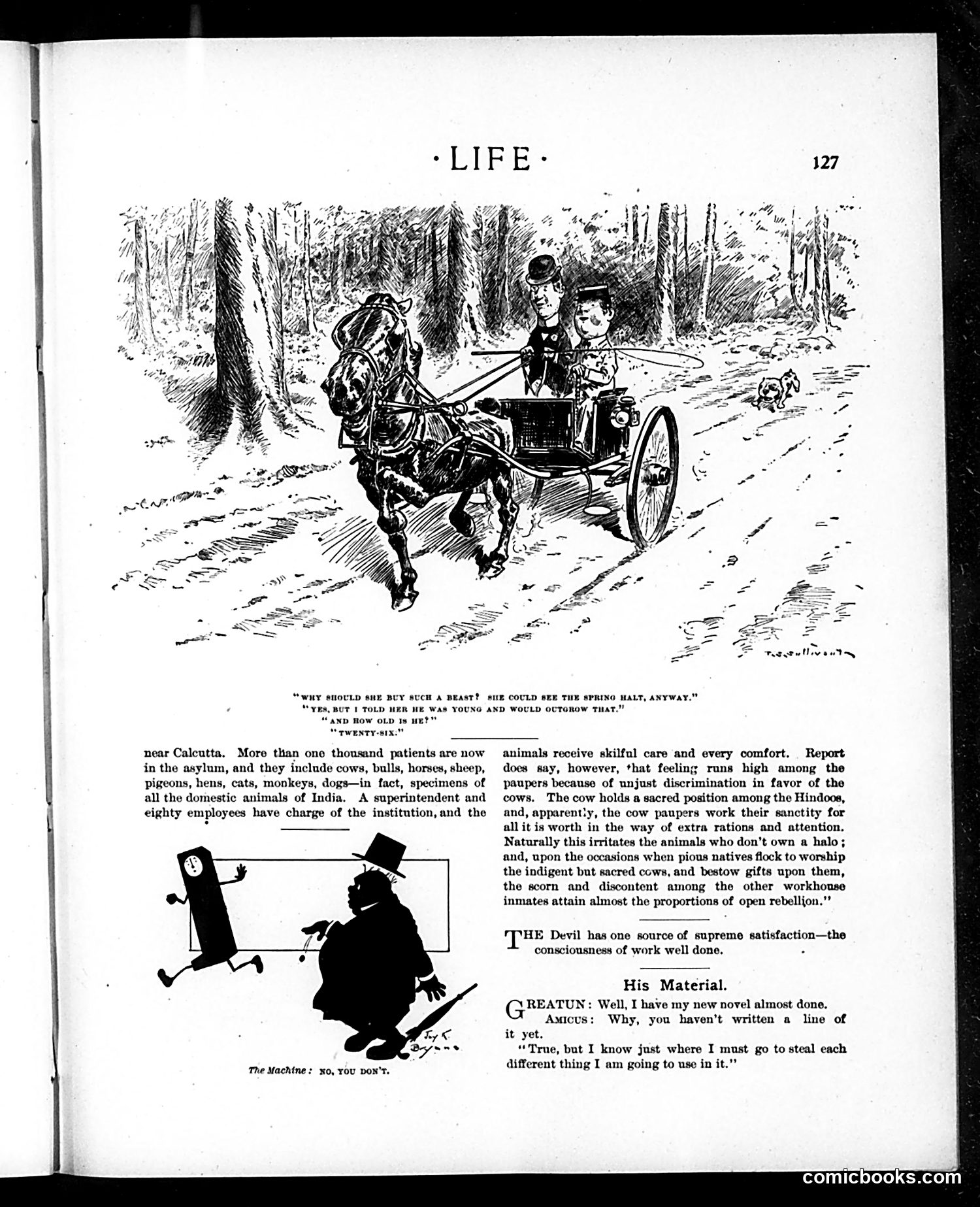
**Main Illustration:** A horse-drawn cart travels through a forest with three well-dressed passengers. The caption quotes dialogue about a "spring halt" and a beast's age ("twenty-six"), suggesting commentary on an aging animal being worked despite its condition. **Article Context:** The text discusses animal welfare at an institution near Calcutta, noting that over 1,000 patients receive care alongside various domestic animals. It criticizes discriminatory treatment favoring cows as "sacred," while other animals face neglect—a social satire on religious hypocrisy and inconsistent ethics. **Lower Cartoon:** Titled "The Machine: No, you don't," depicts a figure refusing to help another, satirizing mechanical indifference or bureaucratic obstruction. **Overall Theme:** The page critiques selective compassion and institutional attitudes toward vulnerable beings.
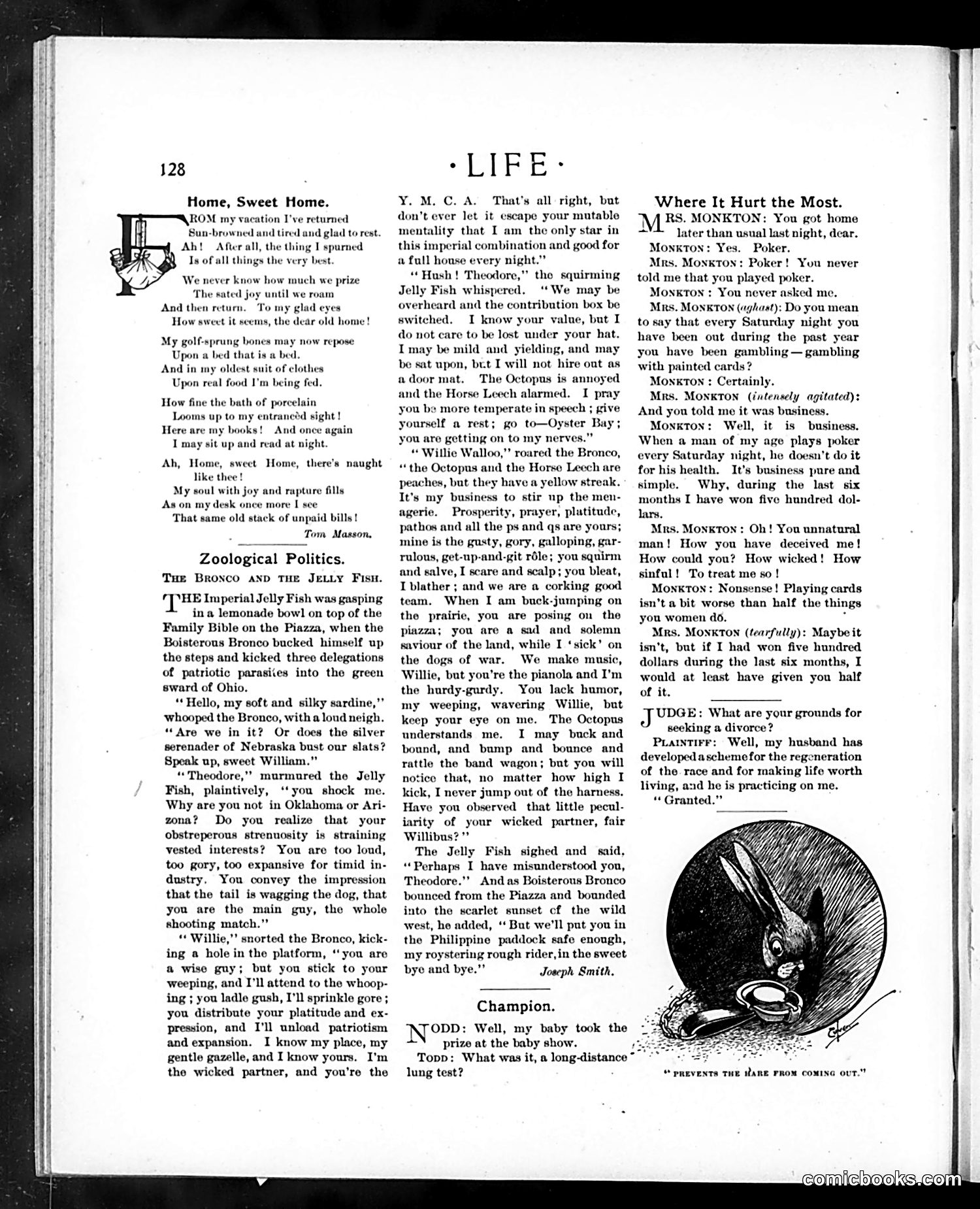
This page contains several short humorous pieces typical of Life's satirical format, rather than political cartoons. **"Home, Sweet Home"** is a sentimental poem about domestic comfort. **"Zoological Politics"** presents a fictional dialogue between animals (a Bronco, Jelly Fish, and Horse Leech) discussing politics and patriotism—appearing to satirize politicians' grandiose rhetoric about serving the nation while actually pursuing selfish interests. The animals' inability to understand each other mirrors human political discord. **"Where It Hurt the Most,"** **"Champion,"** and other brief pieces use humor about social situations—gambling, poker, divorce—to mock contemporary behavior. The small illustration at bottom right shows what appears to be a hare in a shell, captioned "Prevents the Hare from Coming Out"—likely a visual pun on cowardice or avoidance. The page emphasizes social satire over specific political figures.
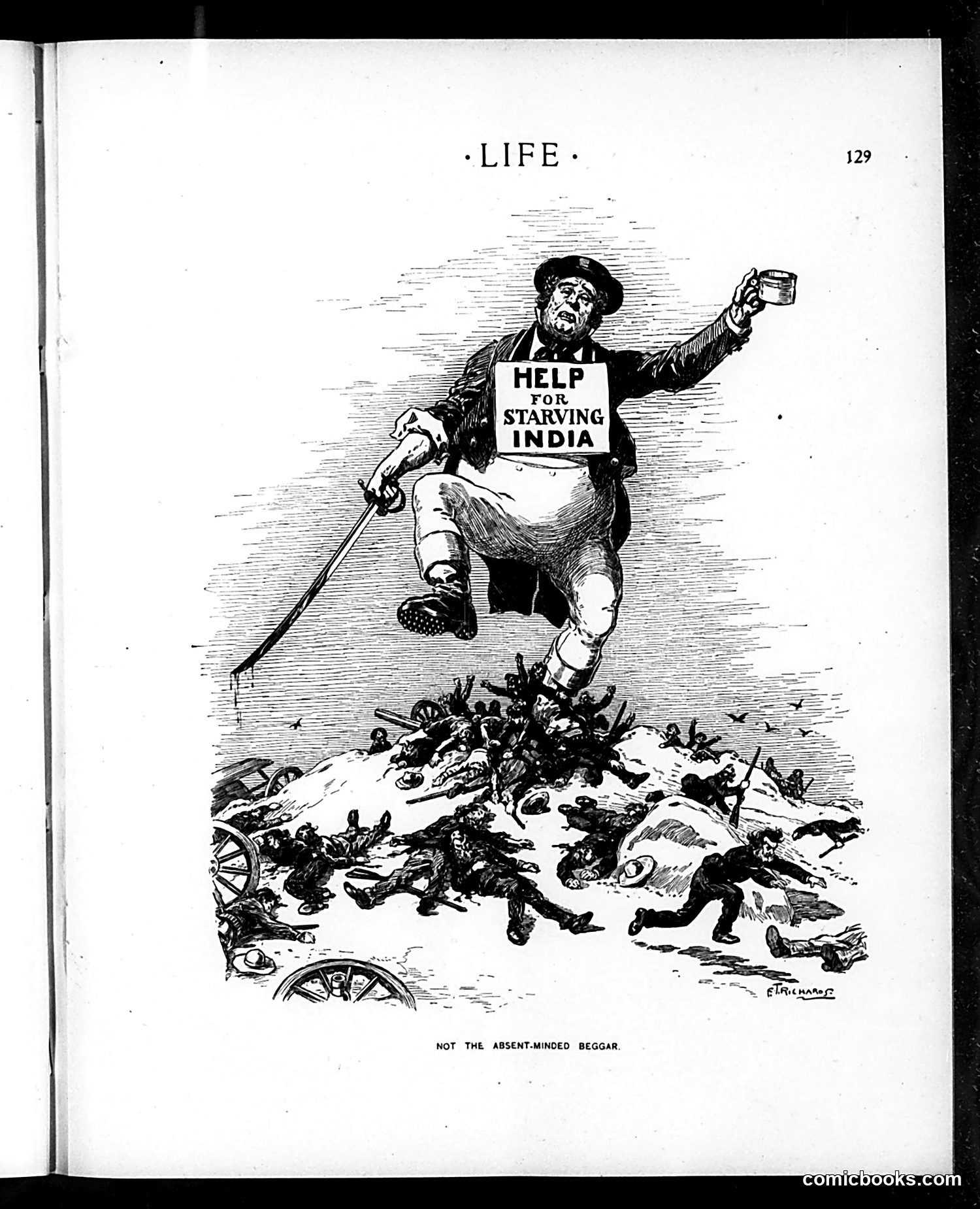
This political cartoon satirizes wealthy or comfortable individuals who claim indifference to India's famine crisis while simultaneously soliciting charitable donations. The figure jumping joyfully over starving people holds a cup labeled "HELP FOR STARVING INDIA," embodying hypocrisy—appearing to help while literally trampling those in need. The title references Rudyard Kipling's 1899 poem "The Absent-Minded Beggar," which actually *did* appeal for aid to British soldiers' families. This cartoon inverts that reference, suggesting the present fundraiser represents someone who is *not* genuinely absent-minded but deliberately callous—profiting from or mocking charitable appeals while indifferent to actual suffering. The cartoon criticizes performative charity and callous indifference masked as fundraising.
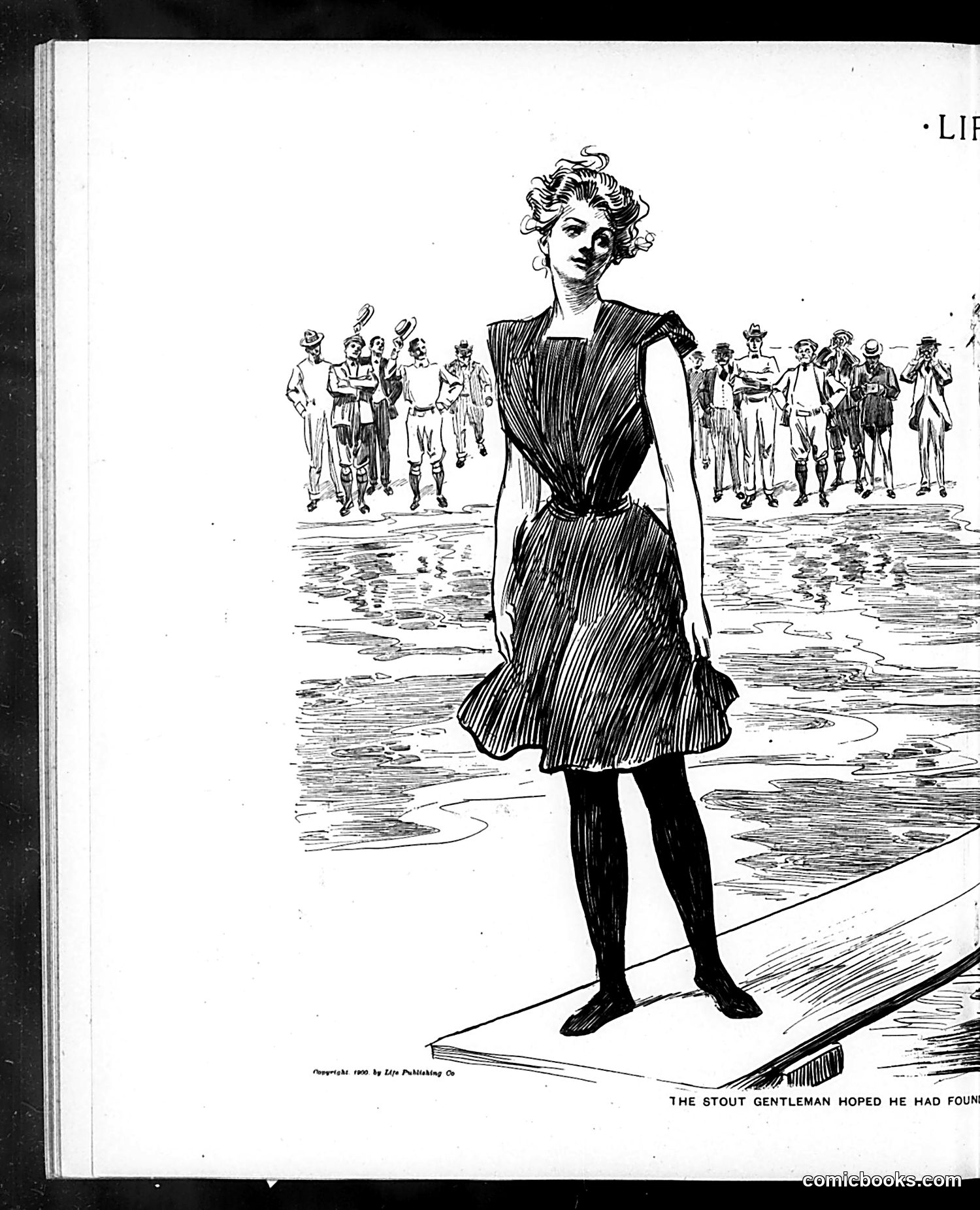
This illustration depicts a woman in a striped dress standing on a beach, observed by a group of men in the background. The caption reads: "THE STOUT GENTLEMAN HOPED HE HAD FOUND..." This appears to be a satirical commentary on early 20th-century beach culture and male behavior. The woman is positioned prominently and somewhat vulnerably, while the men gaze at her from a distance. The humor likely plays on the social awkwardness and impropriety of public beach interactions during this era, when bathing attire and mixed-gender beach gatherings were still relatively novel and subject to moral scrutiny. The incomplete caption suggests the "stout gentleman" has spotted something or someone of interest—likely the woman—creating a humorous setup about male attention and social dynamics at the beach during this period.
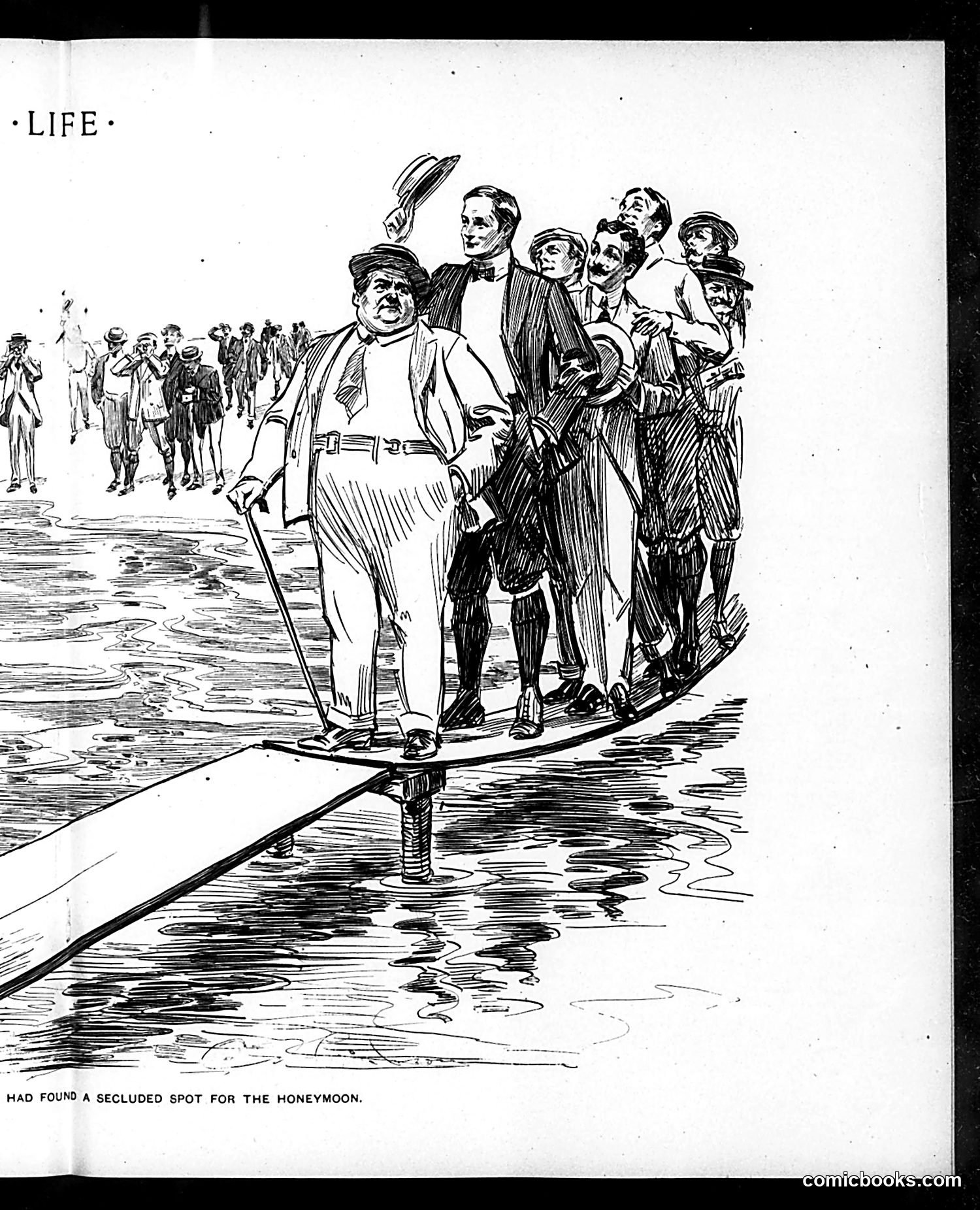
This is a satirical cartoon from *Life* magazine showing a portly man in light-colored clothing standing on a plank over water, surrounded by well-dressed onlookers. The caption reads: "HAD FOUND A SECLUDED SPOT FOR THE HONEYMOON." The joke appears to satirize newlyweds seeking privacy for their honeymoon by finding an isolated location—yet they've been discovered by a crowd of observers. The cartoon mocks either: 1. The impossibility of finding true seclusion in an increasingly populated society, or 2. The couple's poor judgment in choosing their "secluded" spot The heavy-set groom's prominent position and the gathered crowd's presence create the humor through contrast between intention (privacy) and reality (public exposure). This reflects early 20th-century *Life* magazine's typical satirical approach to courtship and marriage customs.
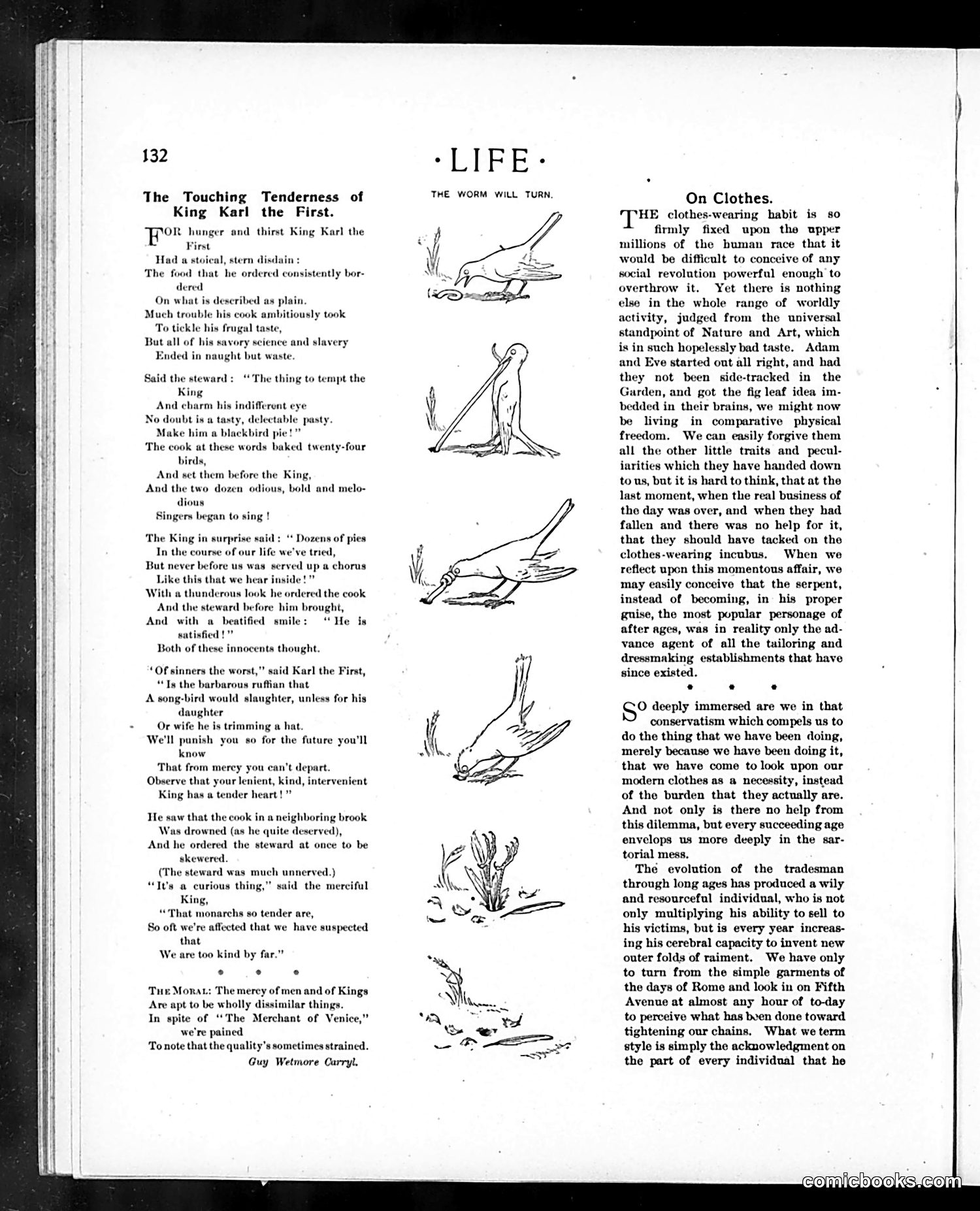
This page contains two distinct sections: **Left side:** A poem titled "The Touching Tenderness of Karl the First," depicting King Karl I as a ruler who struggles with culinary matters. The satire mocks his incompetence—his cook's elaborate dishes fail to please him, and he ultimately orders the cook drowned. The moral, attributed to Guy Wetmore Carryl, critiques both kings and merchants for their inconsistency and poor judgment. **Right side:** An essay "On Clothes" discussing humanity's adoption of clothing as a civilizing marker. It references Adam and Eve's fig leaf, then pivots to criticizing how modern fashion enslaves us to convention—comparing contemporary tailoring standards to Rome's rigid social codes. **Center:** Simple line drawings illustrate the worm-turning metaphor from the title. The page satirizes both royal incompetence and modern social conformity through fashion.
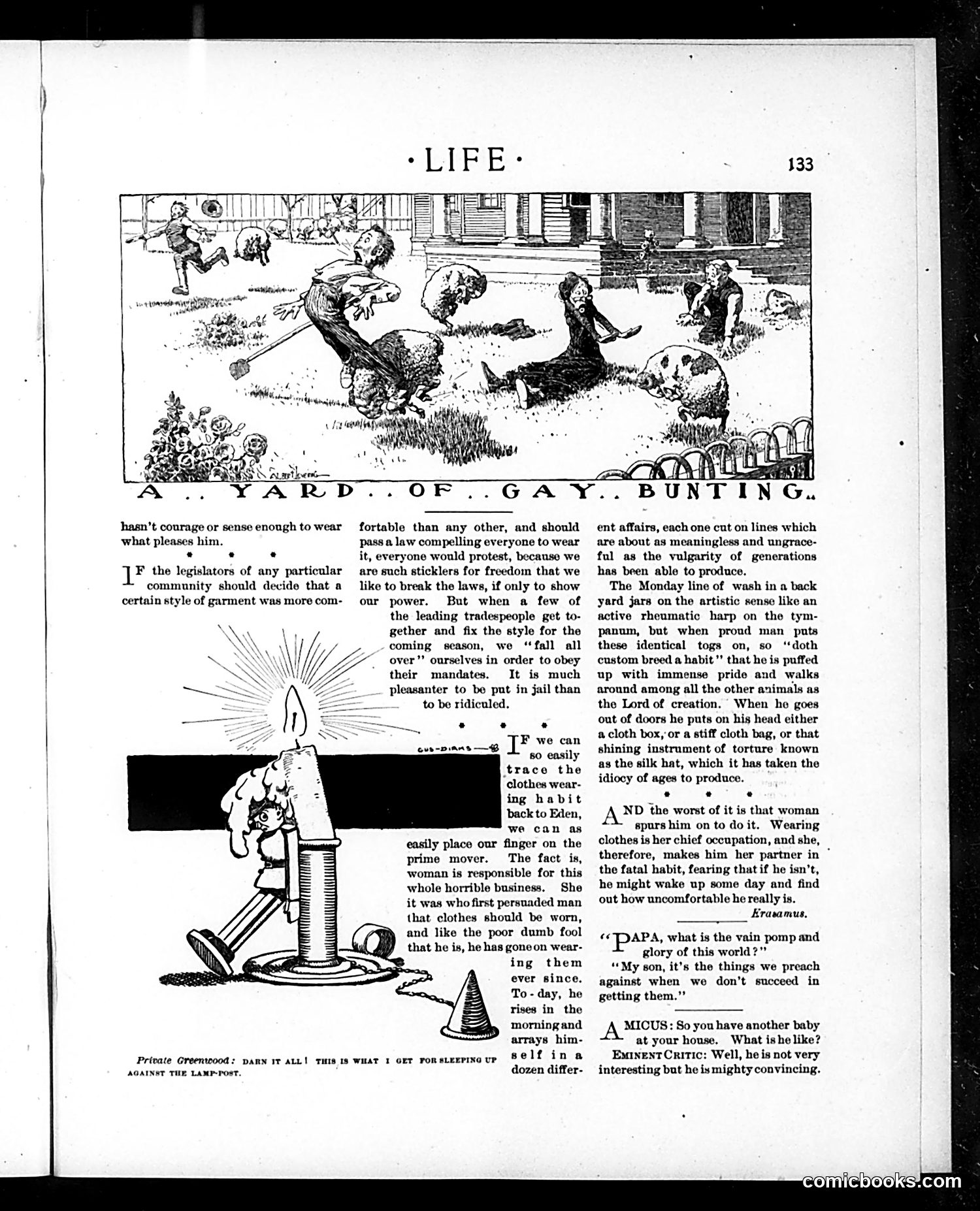
**Top Cartoon**: "A Yard of Gay Bunting" depicts children playing in a yard. The title appears to be a pun—"bunting" refers both to decorative fabric and to the children's active play. **Main Content**: A satirical essay critiquing fashion and clothing conventions. The author argues that: - People claim to value freedom yet blindly follow fashion dictates set by merchants - Women bear responsibility for humanity's obsession with clothing, having first persuaded men to wear garments - Daily dress rituals (changing clothes multiple times) create false pride in humans - Women perpetuate this "fatal habit" in men, fearing they might otherwise question fashion's necessity **Side Illustration**: Shows a figure ("Private Greenwood") sleeping against a lamp post, damaged from the experience—a humorous vignette about the consequences of poor judgment. **Satirical Point**: The piece mocks both fashion's arbitrary nature and society's blind conformity to it, while blaming women as fashion's primary enforcers. This reflects early 20th-century social commentary on consumerism and gender roles.
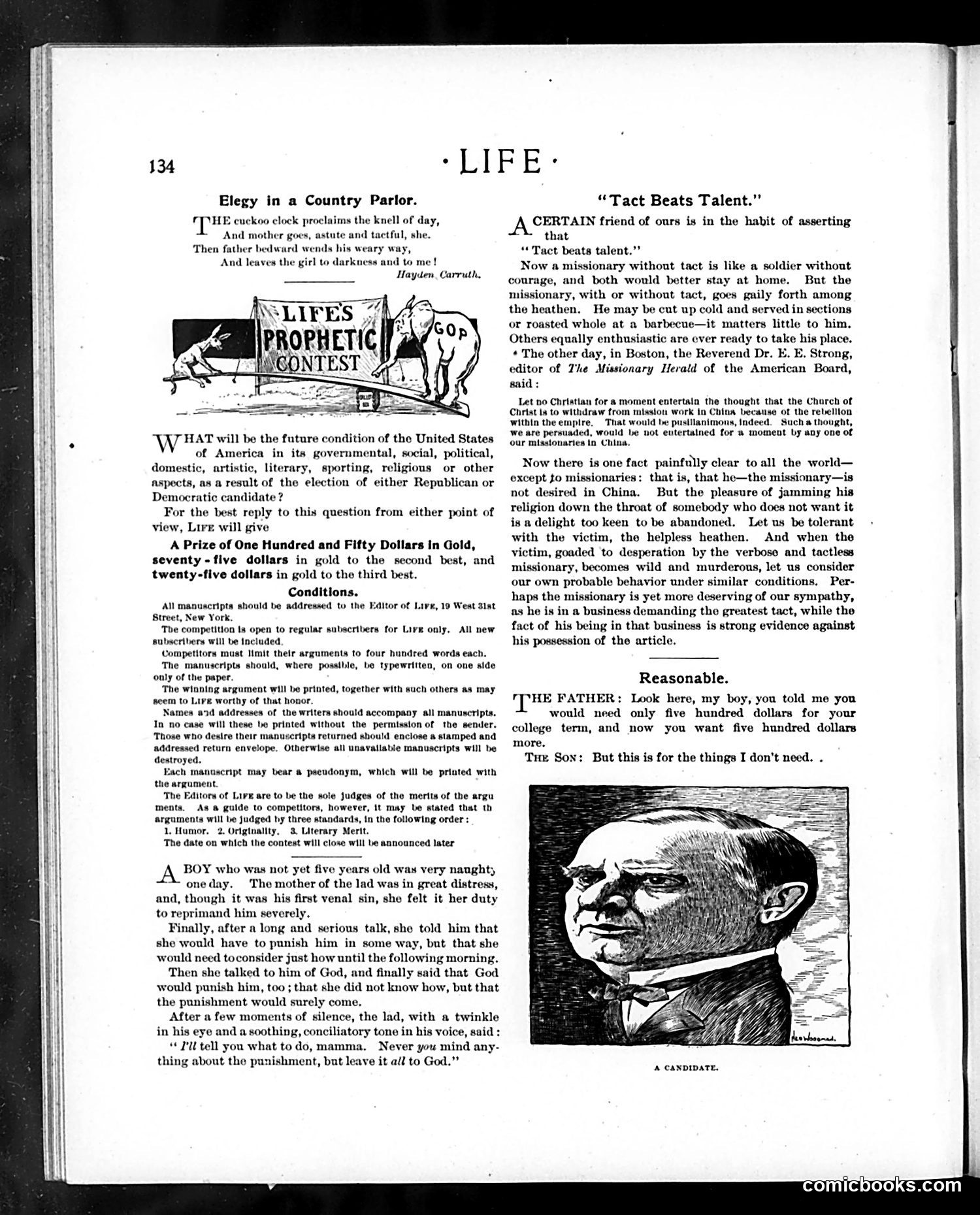
This page contains several distinct pieces of satire typical of Life magazine's format: **"Life's Prophetic Contest"**: Life announces a contest asking readers to predict the future condition of America following either a Republican or Democratic election victory. The prize structure ($150, $75, $25 in gold) suggests this is serious, but the satire lies in the impossibility of the question—no one can genuinely predict such outcomes. Entries will be judged by "Humor, Originality, Literary Merit," undermining the pretense of serious political analysis. **Anecdotes**: Two humorous short stories mock human nature—one about seduction ("darkness and to me"), another about a child cleverly deflecting punishment onto God. **"Tact Beats Talent"**: This editorial excerpt critiques missionary work in China, arguing that missionary zeal matters more than diplomatic skill, even when missionaries face danger ("roasted whole at a barbecue"). The satire questions whether such enthusiasm is admirable or foolhardy. **Cartoon**: The illustration labeled "A Candidate" appears to be a caricatured political figure, though specific identity is unclear from the image alone.
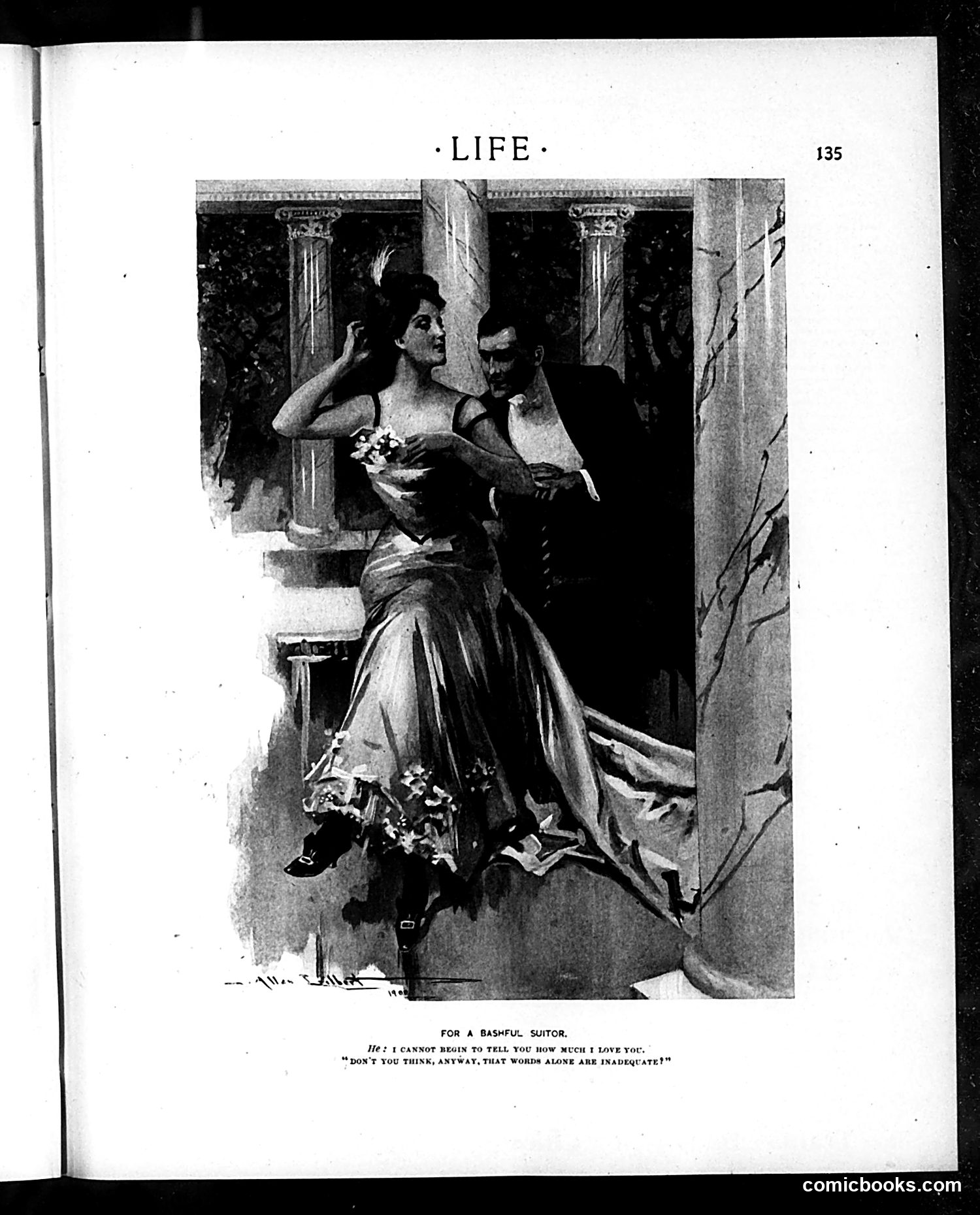
This is a romantic humor cartoon from Life magazine. It depicts a young man attempting to express his love to a woman, but claiming words are insufficient. The caption reveals his actual intent: he's using this excuse to justify physical intimacy ("that words alone are inadequate"). The satire targets male romantic rhetoric—specifically, the bashful suitor who hides his physical desires behind poetic pretense about love being inexpressible. The woman, dressed elegantly with flowers, appears to be accepting or at least engaging with his line. The humor lies in exposing the transparent gap between what he *says* (romantic devotion) and what he *means* (physical affection). This reflects early-20th-century anxieties about courtship propriety and the performances both genders enacted during romantic encounters.
This page is primarily **advertising with humorous literary content**, not political cartoons. The main feature is "William Waldorf Astor's Lament"—a satirical piece mocking the wealthy American businessman William Waldorf Astor. Written as a Shakespearean parody, it depicts Astor as a social climber who exhausted himself pursuing royal favor in England, only to be publicly snubbed (apparently by Sir Berkeley Milne). The joke: this fabulously rich man is brought low by social embarrassment, showing that wealth cannot purchase dignity or acceptance among European aristocracy. The page also contains three humorous anecdotes about notable figures: actor Henry F. Dixey stealing chickens for "method acting," an Irish judge's witty retort to a doctor, and a Georgia man nearly falling into a well—all typical of Life's light satirical content from this era. The advertisements (Wilson Whiskey, Ypsilant underwear, etc.) fill the remaining space.
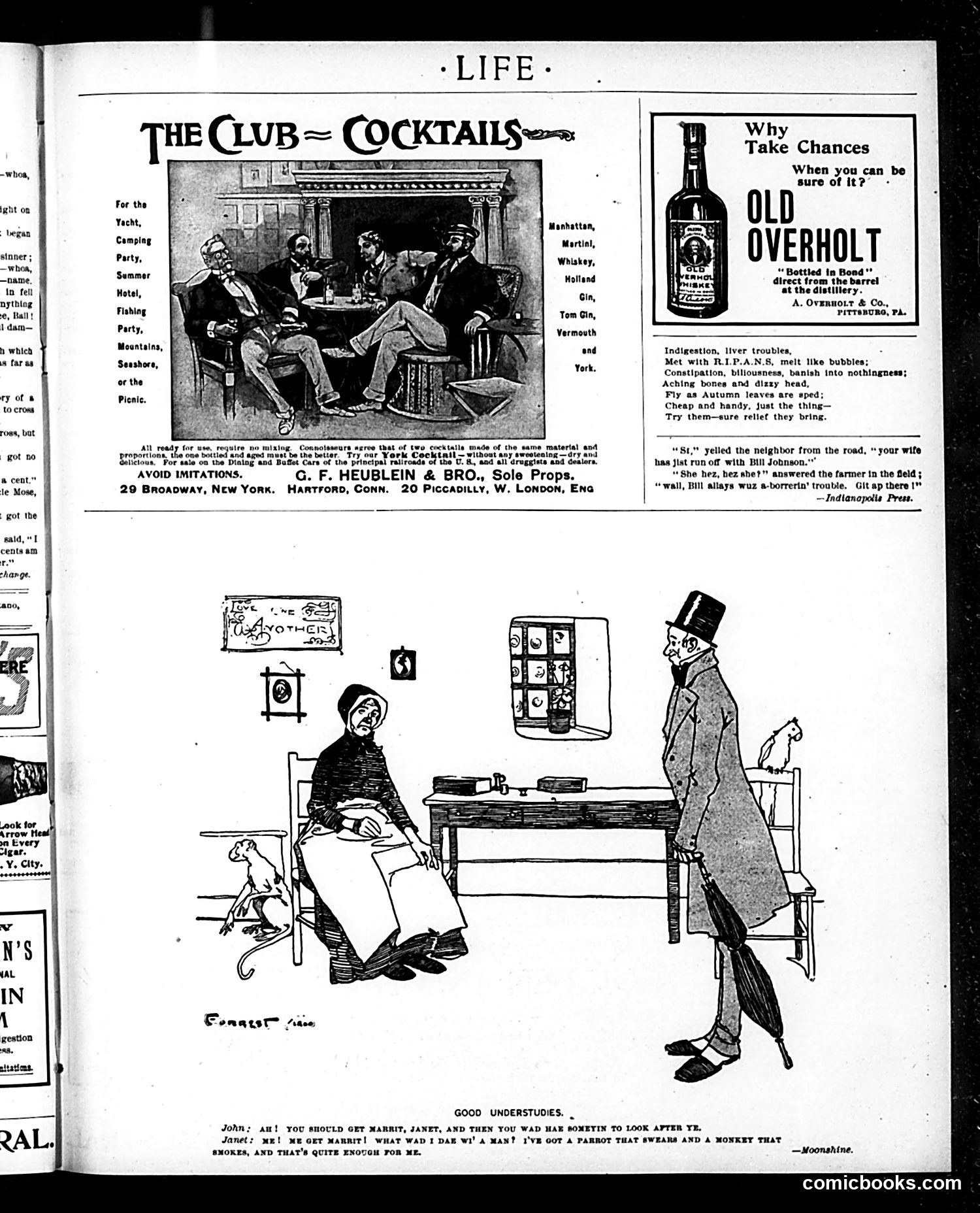
This page mixes advertisements with humor. The top features **"The Club Cocktails,"** an ad for G.F. Heublein & Bros. listing popular cocktail varieties (Manhattan, Martini, Tom Gin, etc.) for social occasions like yacht parties and fishing trips. Beside it, an **Old Overholt whiskey ad** emphasizes reliability. Below is a cartoon titled "Good Understudies" depicting a conversation between John and Janet. John suggests Janet marry so she'd have someone to care for. Janet refuses, claiming her **parrot (which swears) and monkey (which smokes)** already serve that purpose adequately. The satire mocks both marriage expectations and women's independence. It suggests that a husband would be superfluous—merely another dependent requiring care, no different from pets with bad habits. The humor lies in inverting traditional views: rather than marriage being desirable, Janet presents it as an unnecessary burden compared to her current amusing animal companions.
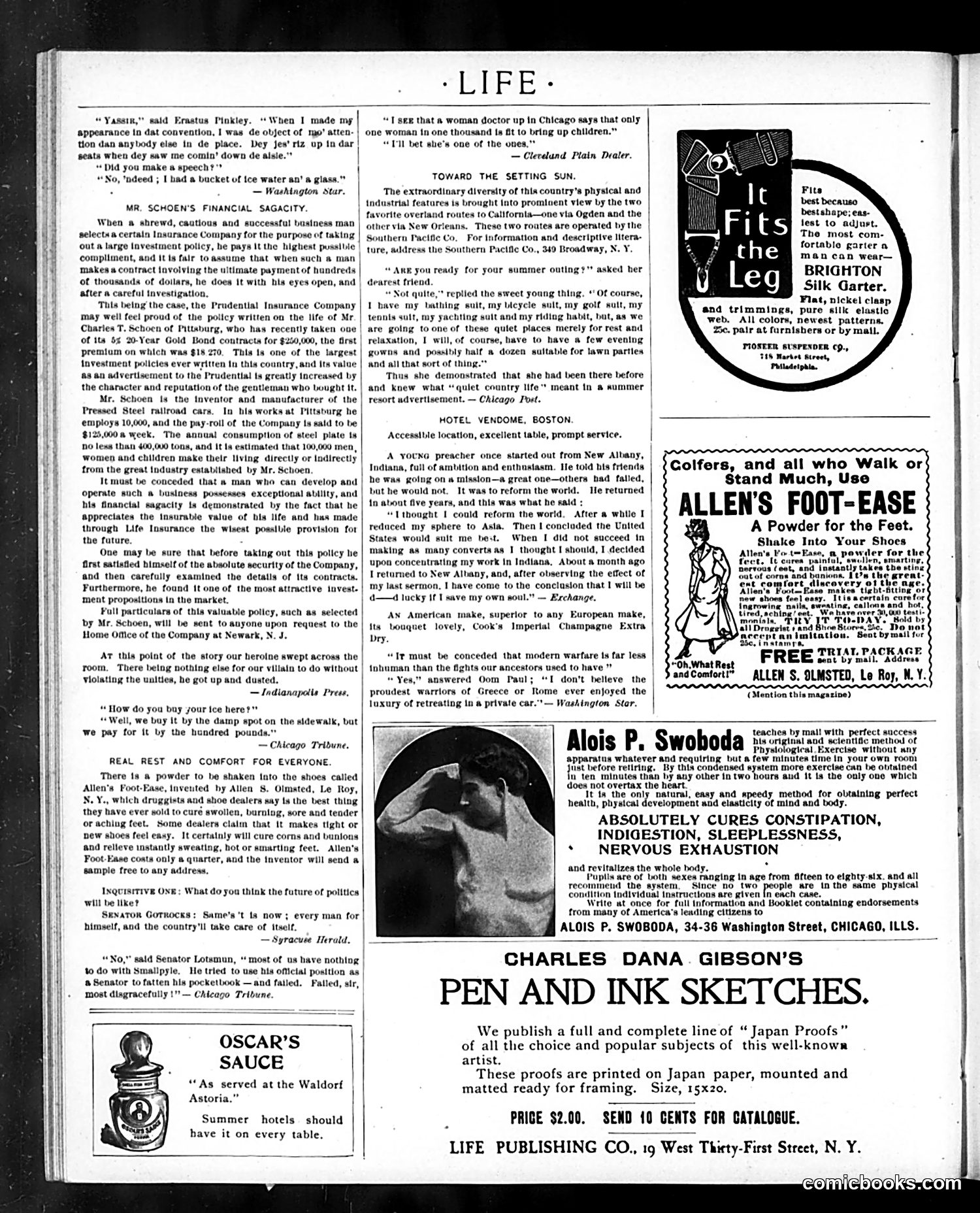
This page from *Life* magazine is primarily **advertising and filler content** rather than political cartoons. The main humorous pieces are brief anecdotes: 1. **"Yassin" dialogue**: A gentle racial stereotype joke about a Black convention attendee named Erastus Pinkley who caused a stir simply by appearing—the punchline being he brought ice water and a glass instead of making a speech. 2. **Ice-buying joke**: A deadpan exchange about purchasing ice by "the damp spot on the sidewalk" but paying by weight—satirizing urban commerce absurdities. 3. **Senator Gotrock's quote**: A cynical jab at political self-interest, suggesting politicians only care about themselves while pretending the country will "take care of itself." The page is dominated by **product advertisements** (Allen's Foot-Ease powder, Oscar's Sauce, Charles Dana Gibson pen sketches), which were *Life*'s primary revenue source. The brief humor pieces are typical of the magazine's satirical style—gentle, observational jabs at social conventions, urban life, and political hypocrisy.
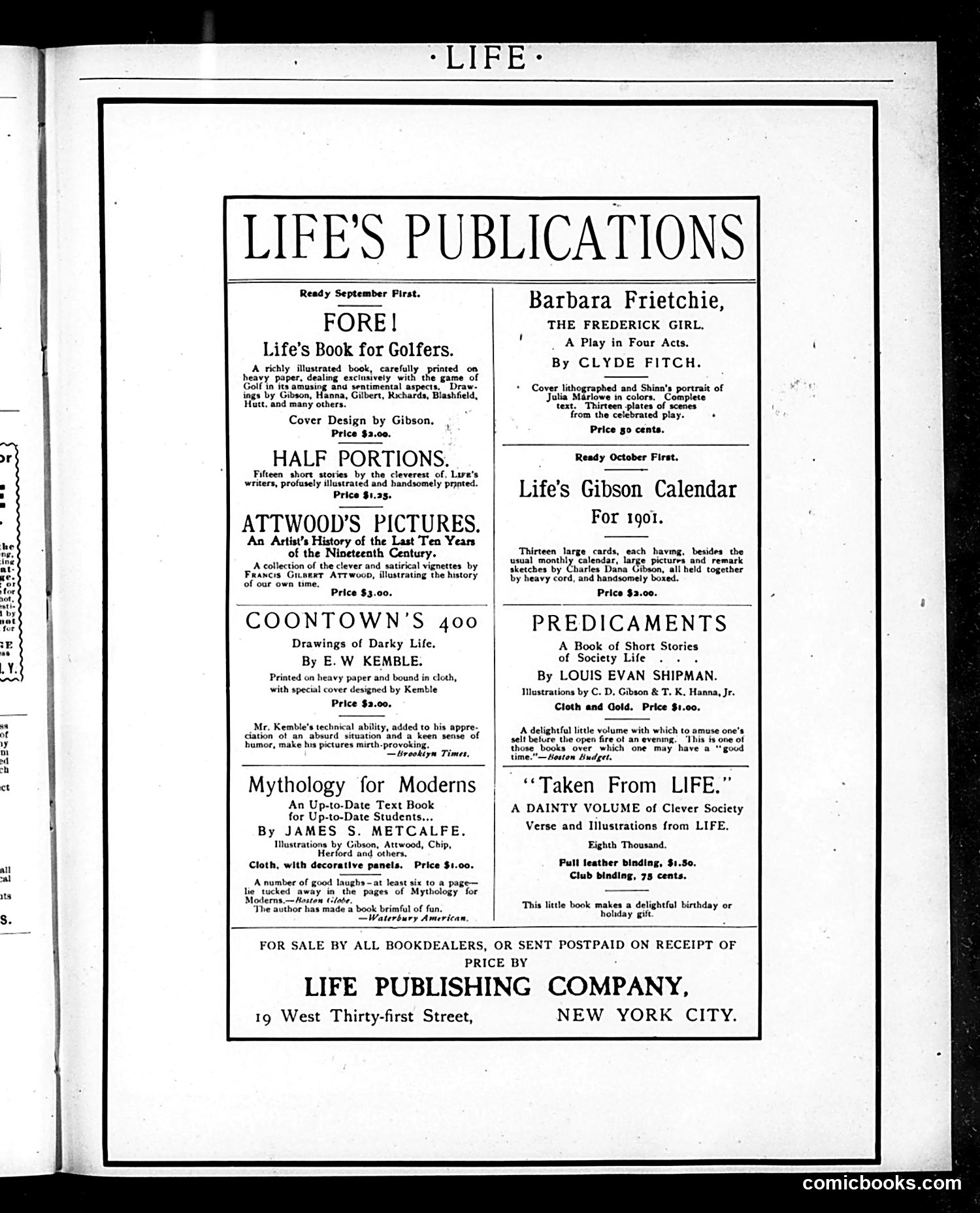
This is a **purely commercial advertisement page**, not political content. Life Publishing Company advertises its upcoming books and products for fall 1900/winter 1901. Notable items include illustrated collections by popular artists of the era (Gibson, Atwood, Kemble), a golf instruction book, theatrical works (notably "Barbara Frietche" featuring Julia Marlowe), and humor collections. One entry—"**Coontown's 400**" by E.W. Kemble—uses period racial terminology reflecting late-19th-century attitudes. Kemble was known for caricatural drawings; the title appears to parody the "400" (New York's social elite), applied mockingly to African American subjects. This reflects the racist conventions of the era's mass media. The page otherwise showcases Life's commercial expansion into book publishing, leveraging its magazine's popular illustrators and humorous content for holiday gift markets.
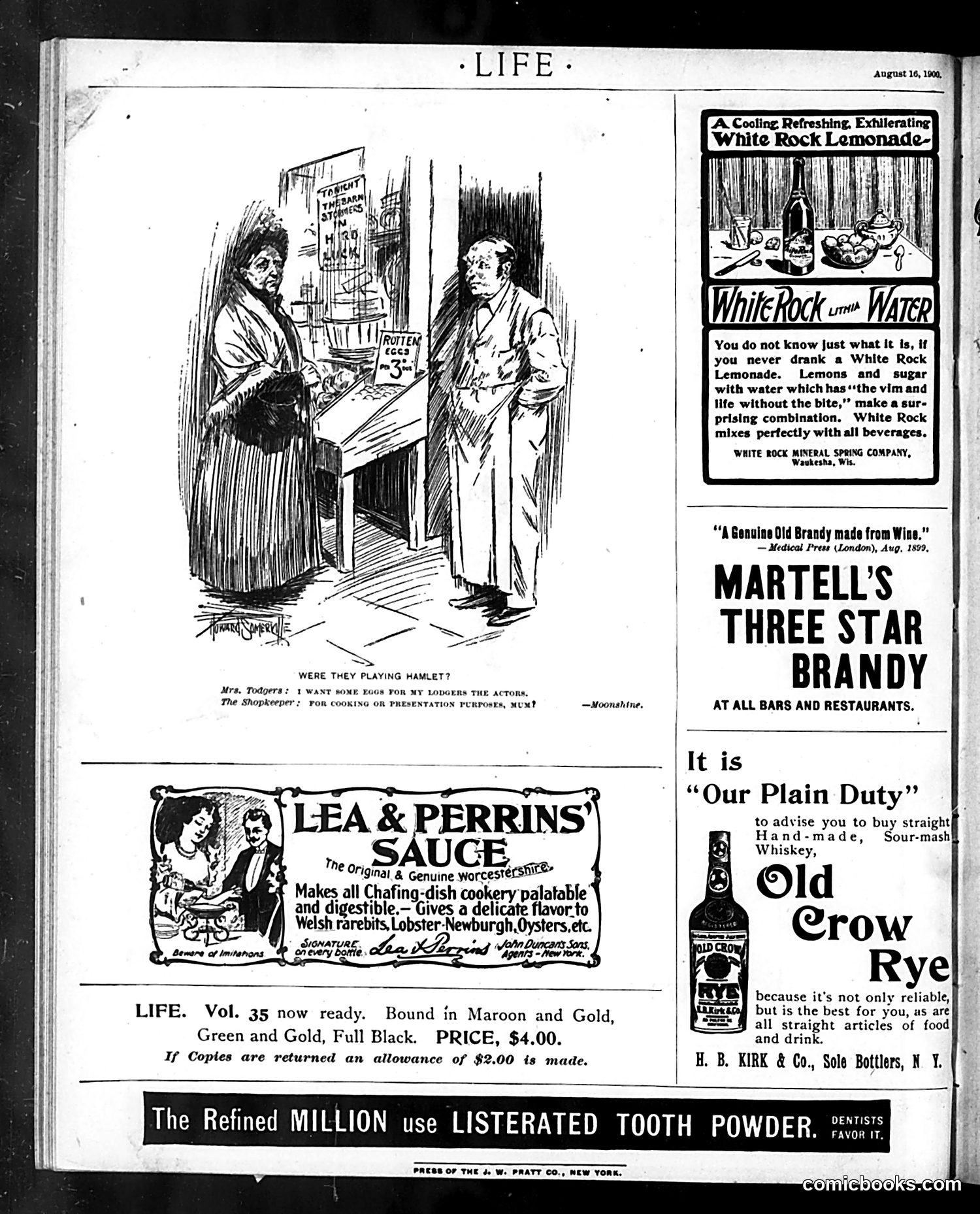
**Main Cartoon:** The sketch titled "Were They Playing Hamlet?" depicts a shopkeeper and a lodging-house proprietor. Mrs. Todgers asks for eggs for her lodgers "the actors," while the shopkeeper asks whether she needs them "for cooking or preservation purposes." The joke plays on the apparent poor quality or preservation state of theatrical boarding-house fare—suggesting eggs might need to be preserved rather than freshly cooked. This mocks both struggling actors' living conditions and the quality of cheap lodging-house food in Edwardian London. **Page Content:** Predominantly advertisements for alcohol (Martell brandy, Old Crow rye whiskey) and beverages, with smaller ads for Lea & Perrins sauce and tooth powder. The layout is typical of Life's satirical format mixing humor with commercial content. The cartoonist is credited as "Moonshine" (a pseudonym for the artist).