
Life, 1900-08-16 · page 12 of 20
Life — August 16, 1900 — page 12: what you’re looking at
What you’re looking at
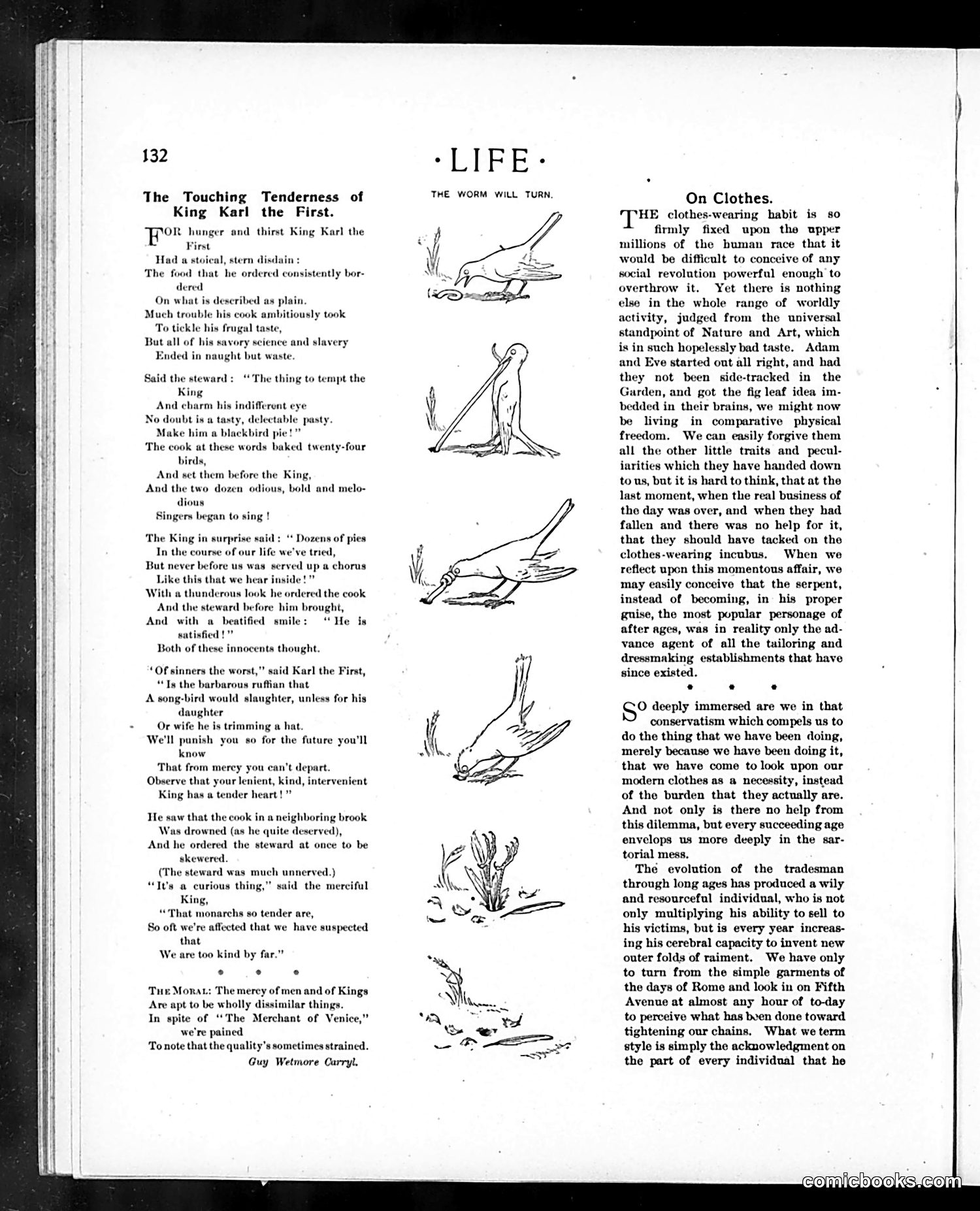
This page contains two distinct sections: **Left side:** A poem titled "The Touching Tenderness of Karl the First," depicting King Karl I as a ruler who struggles with culinary matters. The satire mocks his incompetence—his cook's elaborate dishes fail to please him, and he ultimately orders the cook drowned. The moral, attributed to Guy Wetmore Carryl, critiques both kings and merchants for their inconsistency and poor judgment. **Right side:** An essay "On Clothes" discussing humanity's adoption of clothing as a civilizing marker. It references Adam and Eve's fig leaf, then pivots to criticizing how modern fashion enslaves us to convention—comparing contemporary tailoring standards to Rome's rigid social codes. **Center:** Simple line drawings illustrate the worm-turning metaphor from the title. The page satirizes both royal incompetence and modern social conformity through fashion.
📄 Transcribed text from this page (OCR, searchable)
Machine-transcribed from the original scan — historical spelling and the odd misread are preserved.
— a 132 The Touching Tenderness of King Karl the First. OR hunger and thirst King Karl the First Had a st I, stern disda The food that he ordered consistently bor- dered On what is described as pla Much trouble his cook ambitiously took To tickle his frugal taste, But all of his savory science and slavery Ended in naught but waste Said the steward: ‘The thing to tempt the King And charm his indifferent eye No doubt is a tas table pasty. Make him a blac! The cook at these words birds, And set them before the King, And the two dozen od| dious Singers began to sing ! aked twenty-four , bold and melo- The King in surprise said: “ Dozens of pies In the course of our life we've tried, But never before us was served up a chorus Like this that we hear inside!” With a thunderous look he ordered the cook And the steward before him brought, And with a beatified smile: “He is satisfied !”” Both of thes innocents thought. “Of sinners the worst," said Karl the First, “Ts the barbarous ruffian that A song-bird would slaughter, unless for his daughter Or wife he is trimming a hat. We'll punish you so for the future you'll know ‘That from mercy you can't depart. Observe that your lenient, kind, intervenient King has a tender heart!” Te saw that the cook in a neighboring brook Was drowned (as he quite deserved), And he ordered the steward at once to be skewered. (The steward was much unnerved.) “IUs @ curious thing,” said the merciful King, “That monarchs so tender are, So oft we're affected that we have suspected that We are too kind by far.” ‘Tue Monat: The mercy of men and of Kings Are apt to be wholly dissimilar things. In spite of “The Merchant of Venice,” we're pained ‘Tonote that the quality’s sometimes strained. Guy Wetmore Carryl. LIRE THE WORM WILL TURN. On Clothes. HE clothes-wearing habit is so firmly fixed upon the upper millions of the buman race that it would be difficult to conceive of any social revolution powerful enough to overthrow it. Yet there is nothing else in the whole range of worldly activity, judged from the universal standpoint of Nature and Art, which is in such hopelessly bad taste. Adam and Eve started ont all right, and had they not been side-tracked in the Garden, and got the fig leaf idea im- bedded in their brains, we might now be living in comparative physical freedom. We can easily forgive them all the other little traits and pecul- iarities which they have handed down to us, but it is hard to think, that at the last moment, when the real business of the day was over, and when they had fallen and there was no help for it, that they should have tacked on the clothes-wearing incubus. When we reflect upon this momentous affair, we may easily conceive that the serpent, instead of becoming, in his proper guise, the most popular personage of after ages, was in reality only the ad- vance agent of all the tailoring and dressmaking establishments that have since existed. . . . s° deeply immersed are we in that conservatism which compels us to do the thing that we have been doing, merely because we have been doing it, that we have come to look upon our modern clothes as a necessity, instead of the burden that they actually are. And not only is there no help from this dilemma, but every succeeding age enyclops us more deeply in the sar- torial mess. The evolution of the tradesman through long ages has produced a wily and resourceful individual, who is not only multiplying his ability to sell to his victims, but is every year increas- ing his cerebral capacity to invent new outer folds of raiment. We have only to turn from the simple garments of the days of Rome and look in on Fifth Avenue at almost any hour of to-day to perceive what has been done toward tightening our chains, What we term style is simply the acknowledgment on the part of every individual that he