
A complete issue · 20 pages · 1899
Life — November 9, 1899
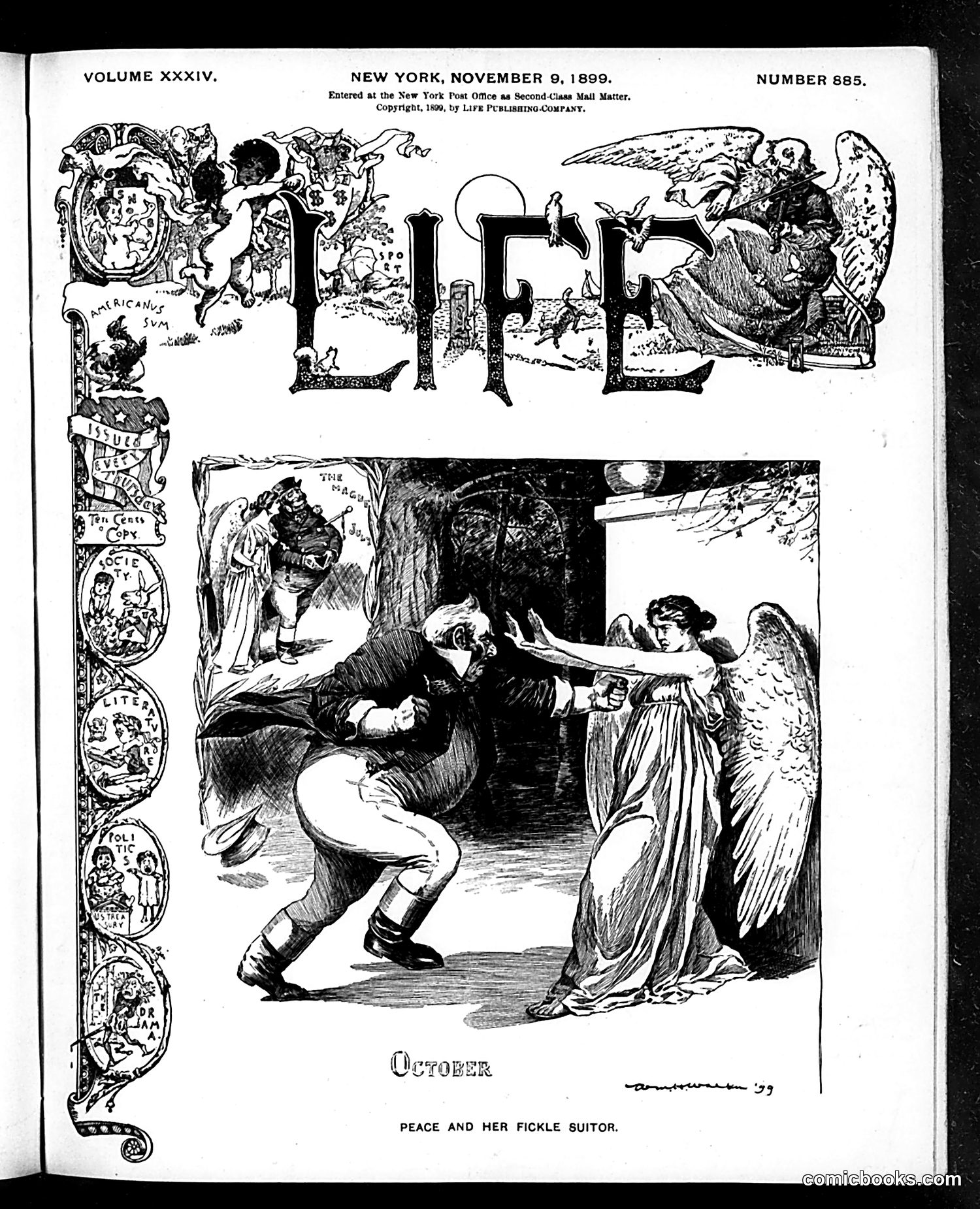
This is the October cover illustration from Life magazine (November 9, 1899). The main cartoon shows a rotund man in formal dress being confronted by two winged allegorical figures representing "Peace" and what the caption calls her "Fickle Suitor." The satire appears to comment on political instability or diplomatic inconsistency during the period—likely referencing the Boer War (1899-1902) or similar contemporary conflicts. The portly figure's defensive posture against Peace's advance suggests critiques of those resisting peace efforts or pursuing warmongering policies. The elaborate decorative border on the left contains smaller satirical vignettes typical of Life's design aesthetic, though their specific subjects are difficult to discern at this resolution. Without clearer identification of the central figure, the precise political target remains unclear, though the theme unmistakably criticizes instability in peace negotiations.
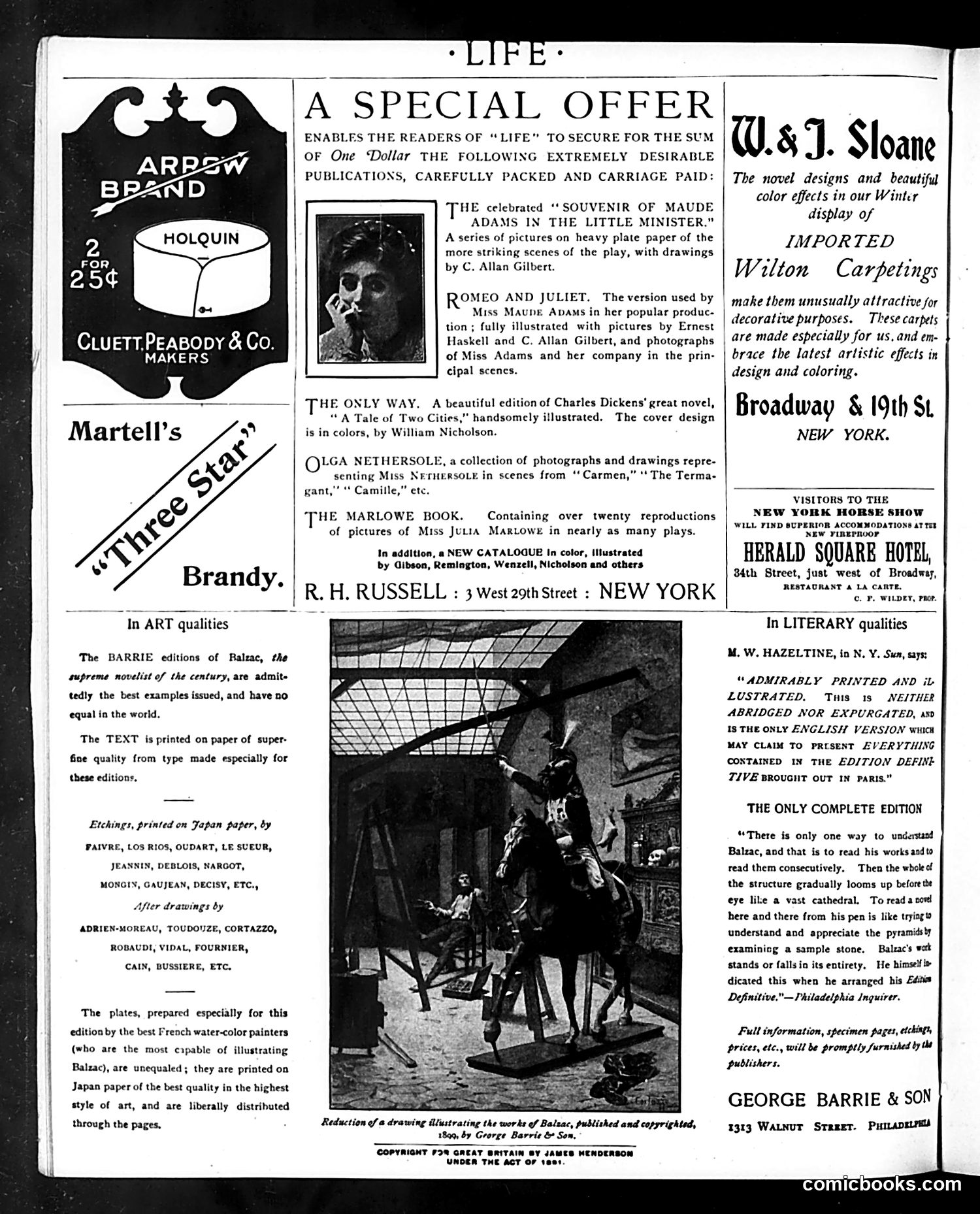
This page is primarily **advertising**, not satire or political commentary. The top section features a "Special Offer" promoting classic literature editions published by R. H. Russell of New York, including illustrated versions of works like "Souvenir of Maude Adams in the Little Minister," "Romeo and Juliet," "A Tale of Two Cities," and "Olga Nethersole" photographs. The central image appears to be an illustration from one of these literary works, likely from a theatrical production given the dramatic staging and period costume visible. The bottom half advertises **W. & J. Sloane's imported Wilton carpetings** and the **Herald Square Hotel** in New York. This is a typical turn-of-the-century magazine page mixing publisher promotions with luxury goods advertising—no political or satirical content is present.
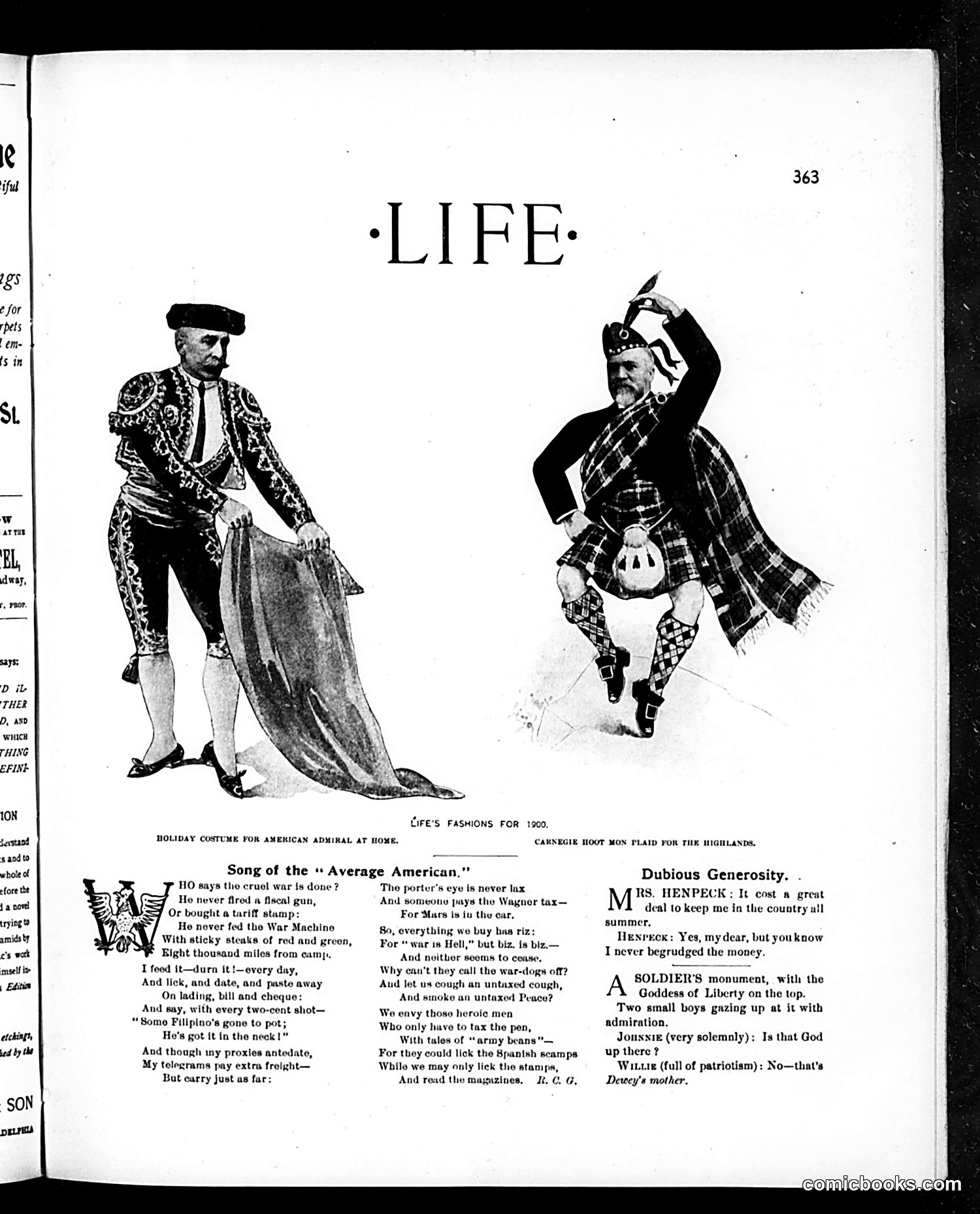
This page from Life magazine (circa 1902, based on the "Holiday Costume for 1902" caption) satirizes American military culture through two illustrations and accompanying verse. The left image shows an American admiral in ornate dress uniform with elaborate embroidery, captioned "Holiday Costume for American Admiral at Home." The right depicts a Scottish Highlander in traditional tartan, labeled "Carnegie Boot and Plaid for the Highlands." The poem "Song of the 'Average American'" mocks American materialism and military spending—complaining about taxes, the Spanish-American War costs, and American consumption habits. The dialogue below titled "Dubious Generosity" appears to joke about patriotic pretense masking selfish motives. The satire critiques American military excess and the gap between patriotic rhetoric and actual values during the post-Spanish-American War period.
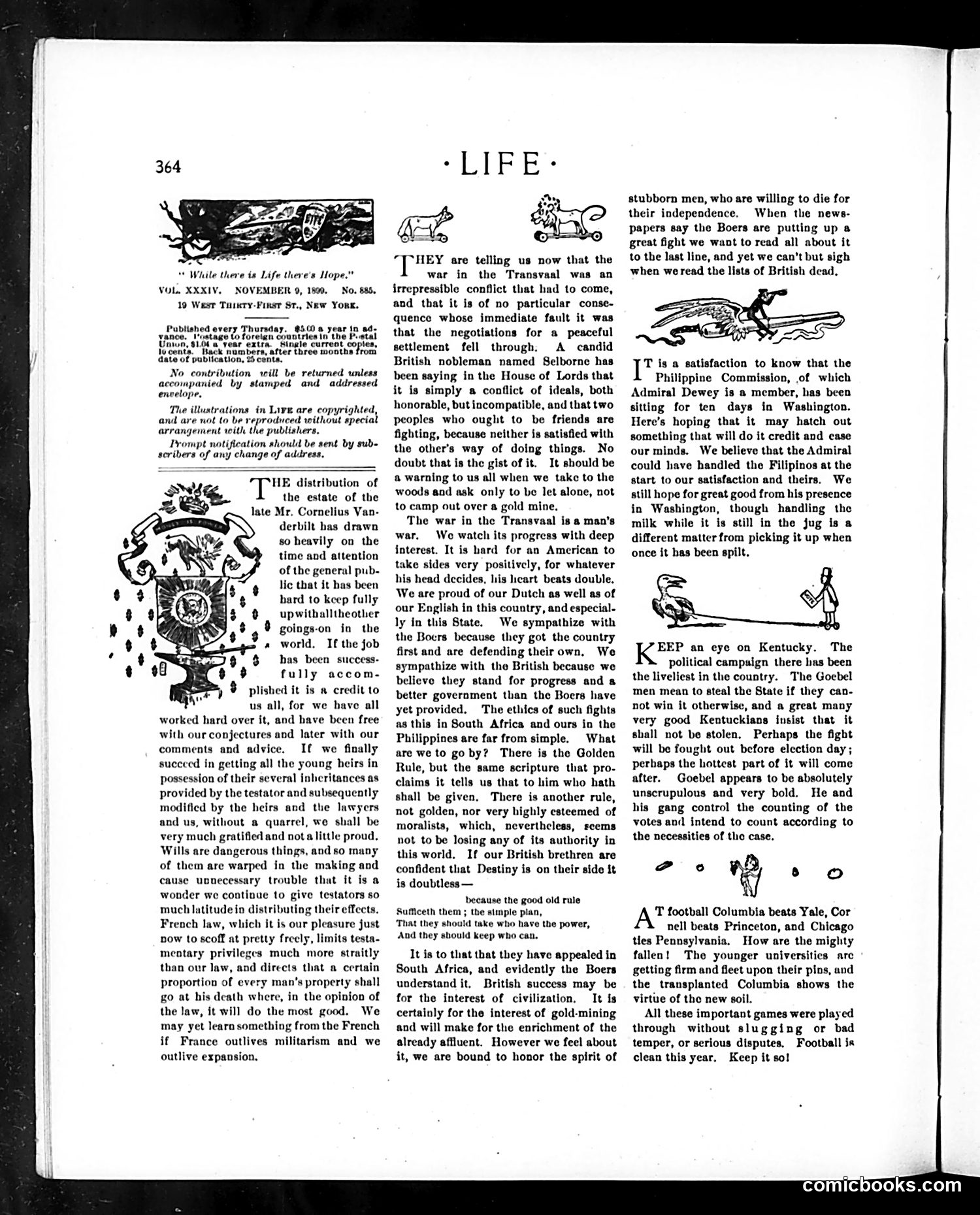
This page contains editorial commentary on the Boer War in South Africa. The text discusses Britain's and the Dutch (Boers') struggle, expressing sympathy for both sides while criticizing the conflict's ideological nature rather than practical justifications. The small illustrations appear to be decorative vignettes typical of Life's layout style—showing various scenes—rather than pointed political cartoons. The editorial takes a moderate American stance: criticizing the war while defending the Boers' right to their territory, and praising Dutch settlers in America. It concludes with a brief note about American college football, unrelated to the main content. The page reflects turn-of-the-century American ambivalence about imperial conflicts and emerging American power.
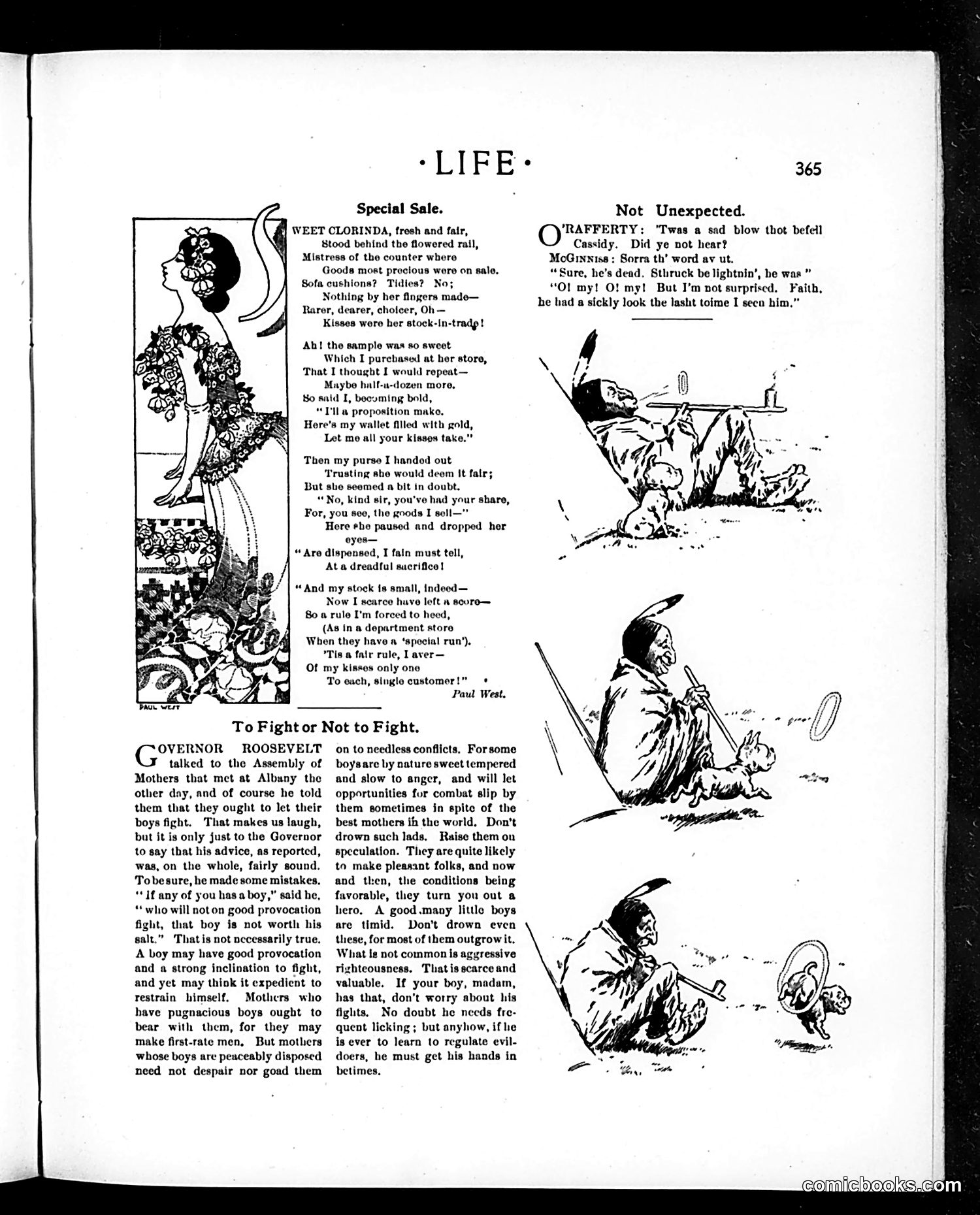
**"Special Sale"** (left): A satirical poem mocking a female shopkeeper's sales pitch. She hawks goods at her store with exaggerated claims, then admits her stock is small and she's forced to follow a harsh "one kiss per customer" rule. The humor targets both aggressive retail marketing tactics and flirtation-based commerce—likely reflecting early 20th-century attitudes about women in business. **"Not Unexpected"** (right): A brief dialogue joke about someone's death ("Cassidy") where the punchline suggests the person "had a sickly look the last time I saw him"—dark humor relying on obvious foreshadowing. **"To Fight or Not to Fight"** (bottom): Governor Roosevelt advises mothers that boys naturally inclined toward fighting shouldn't be discouraged, as aggression builds character. This reflects period debates about masculinity, child-rearing, and physical toughness.
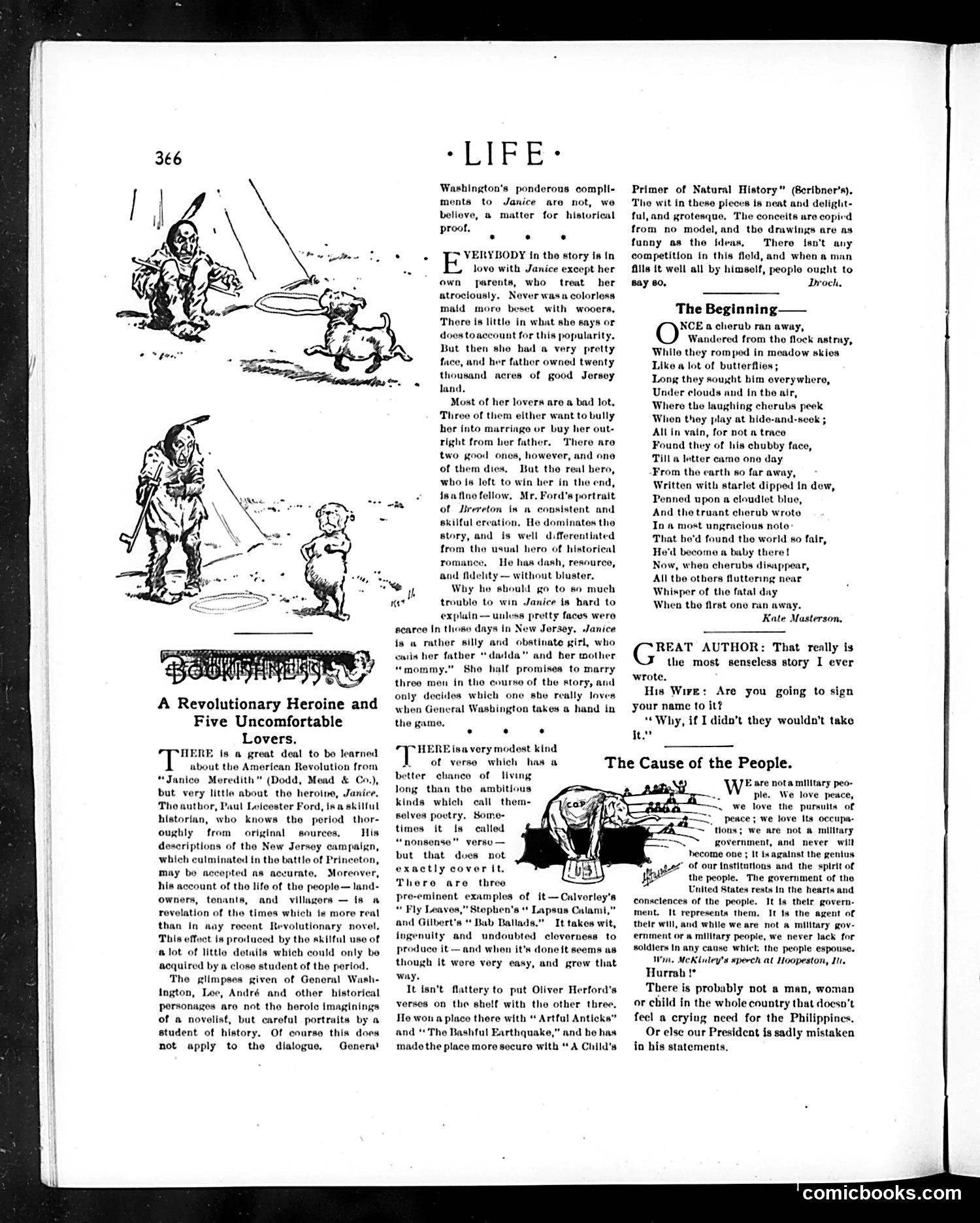
This page contains **literary criticism and social commentary**, not political cartoons. The main content discusses a novel called "Janice" set during the American Revolution, critiquing its historical accuracy and literary merit. The illustrations appear to be **period costume sketches** showing Revolutionary War-era figures—likely characters from the novel being reviewed. The "Great Author" dialogue section mocks pretentious literary culture, with a husband reluctant to endorse his wife's writing, suggesting satire of publishing vanity and marital dynamics around authorship. The "Cause of the People" section addresses military preparedness and U.S. foreign policy, advocating against militarism while supporting national defense—likely reflecting early 20th-century debates about American interventionism. The page functions as **cultural and political commentary through book review**, not direct political cartooning.
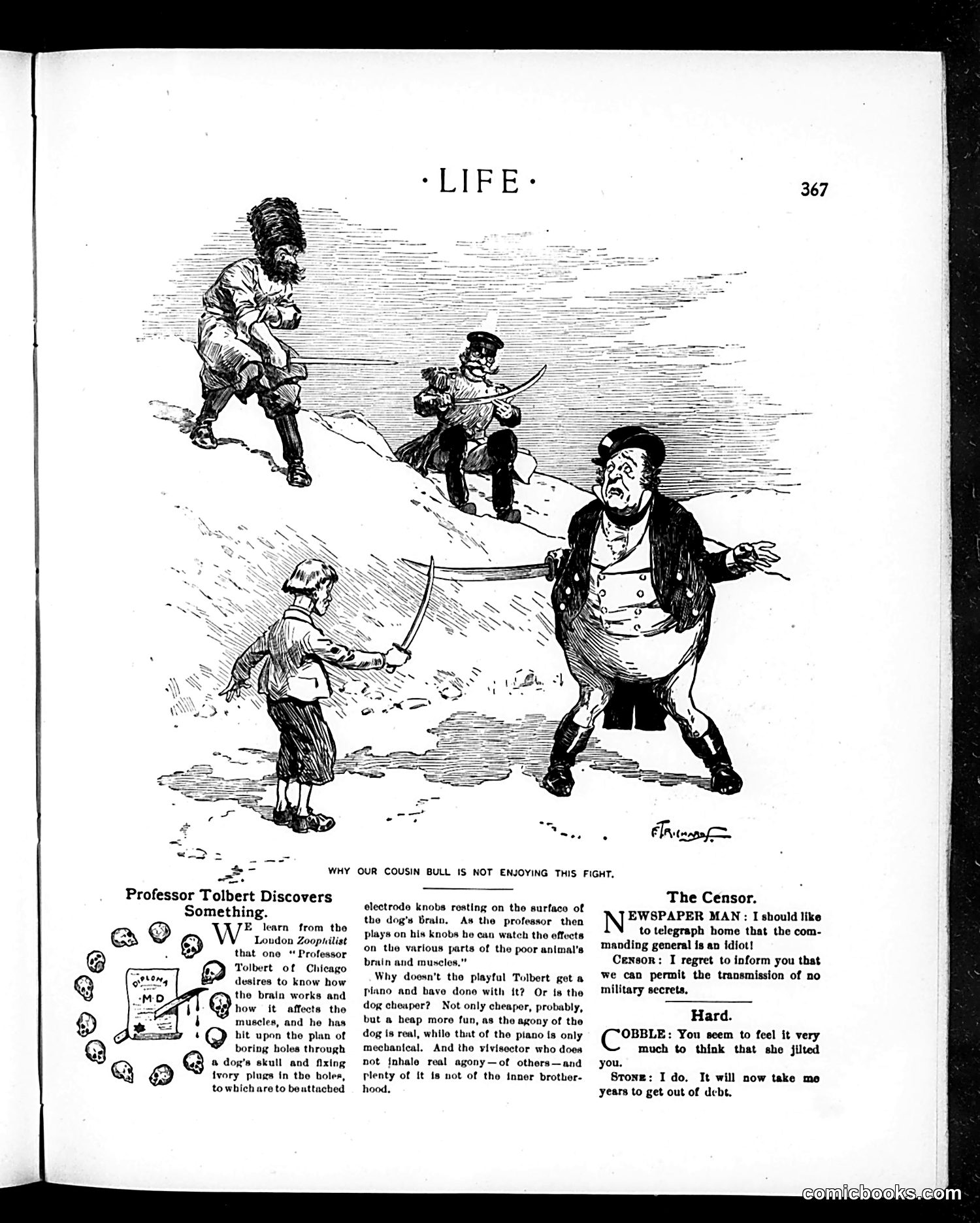
**Main Cartoon:** "Why Our Cousin Bull Is Not Enjoying This Fight" depicts a rotund, well-dressed man being attacked by three soldiers while a fourth watches. The "cousin bull" reference appears to satirize a wealthy or aristocratic figure (possibly representing business interests or a specific political figure) being assaulted—likely commentary on class conflict or labor disputes of the era. **"Professor Tolbert Discovers Something":** A scientific humor piece explaining electrode experiments on a dog's brain to demonstrate nerve responses—typical early 20th-century popular science satire about academic pretension. **"The Censor" / "Hard":** A dialogue mocking newspaper censorship, with a censor preventing publication of "military secrets" while a character named Stokes complains about debt.
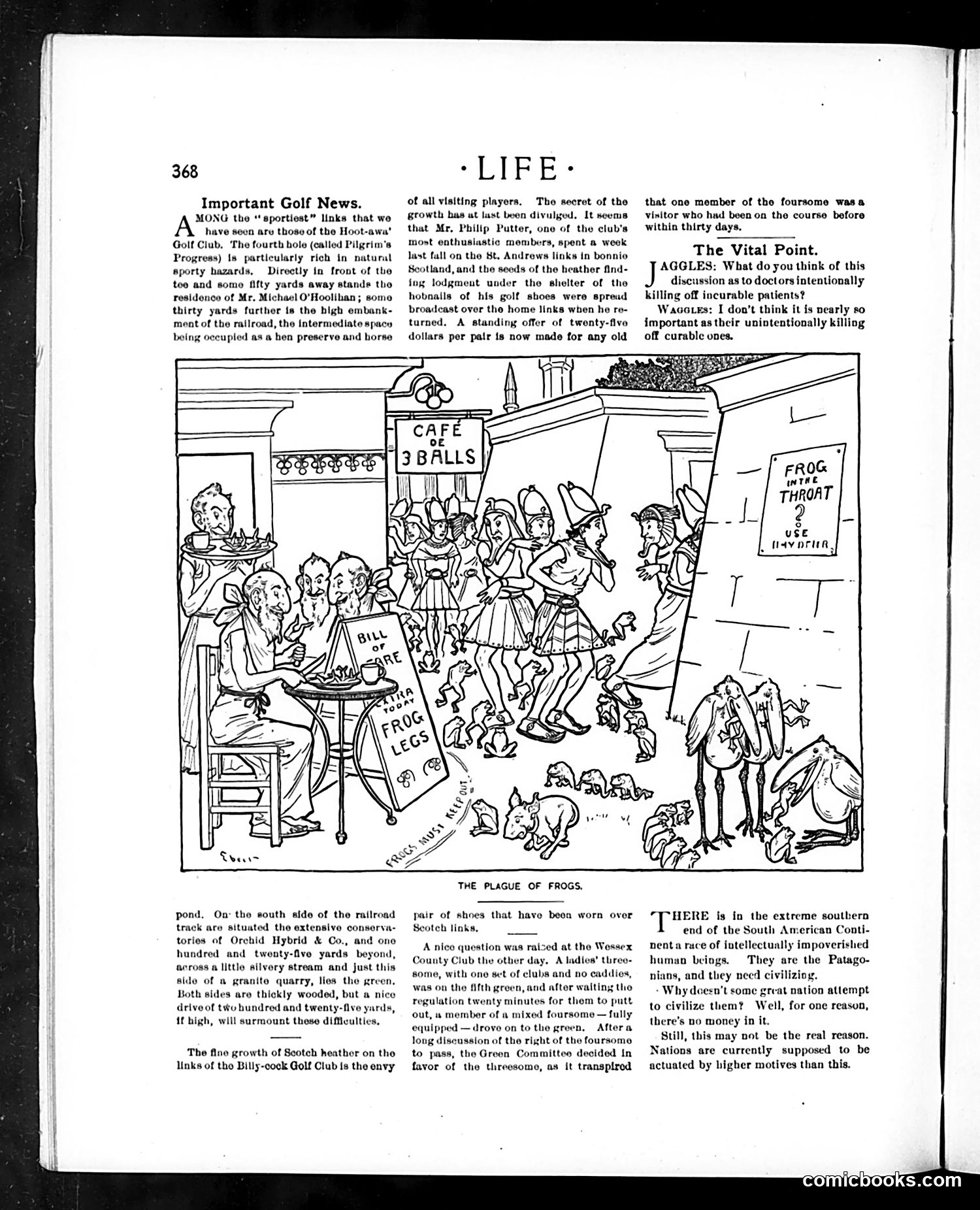
This satirical cartoon depicts a chaotic scene at what appears to be a French café ("Café de 3 Balls") overrun by frogs of various sizes. The illustration references the Biblical plague of frogs from Exodus, repurposing it as social commentary. The signs visible—"Bill of Fare," "Frog's Legs," "Frog in the Throat," and "Use Havana"—suggest this is mocking French dining culture and the popularity of frog consumption. The cartoon likely satirizes either French culinary practices or perhaps the influx of French cultural influence in America during this period, treating French tastes as an invasive "plague" worthy of biblical comparison. The chaotic composition emphasizes absurdity and social disruption.
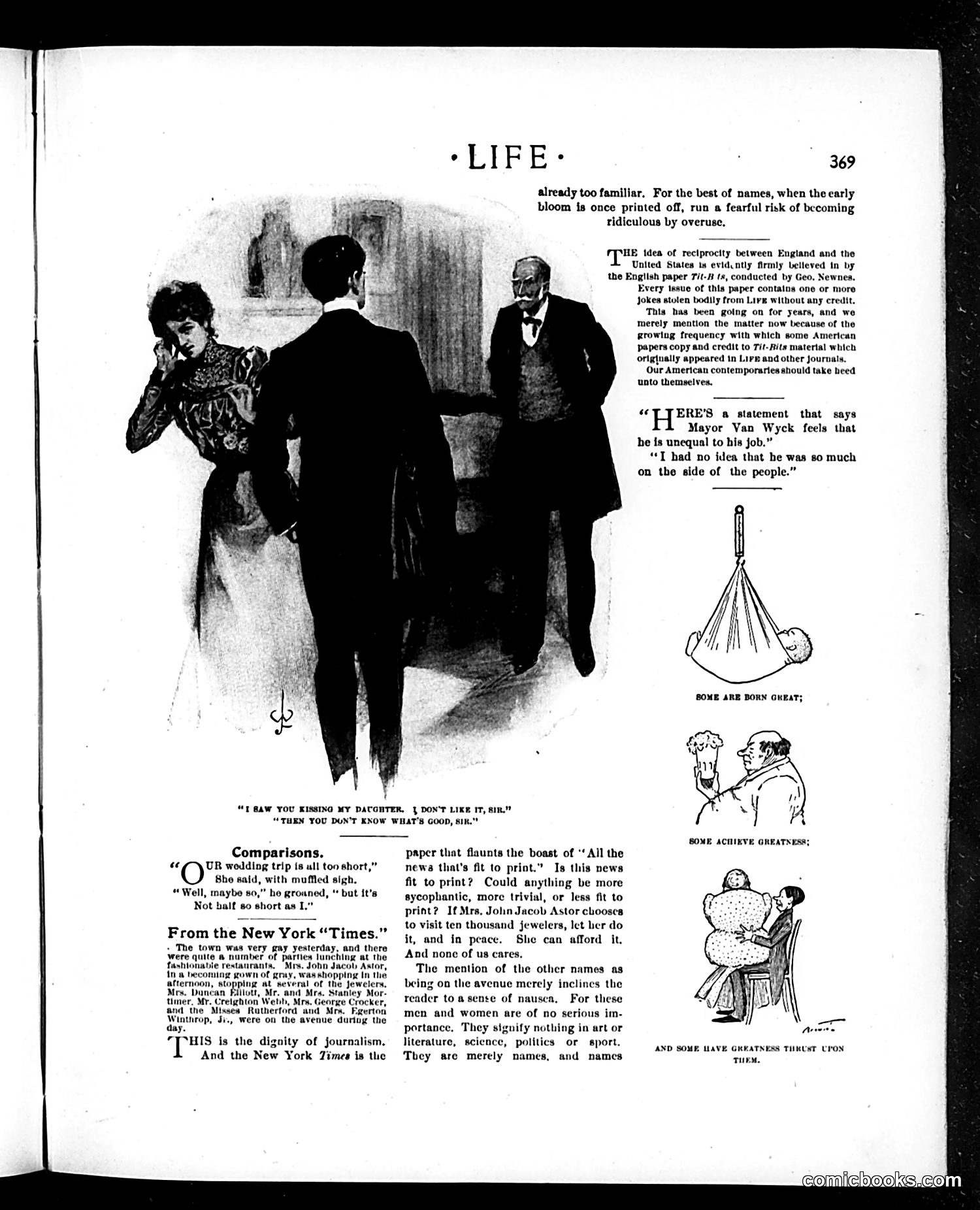
The main cartoon depicts three men in formal attire in what appears to be a hallway, with dialogue: "I saw you kissing my daughter, I don't like it, sir." "Then you don't know what's good, sir." The accompanying text discusses Mayor Van Wyck feeling "unequal to his job" and includes commentary about the New York *Times* publishing gossip about New York society figures and jewelers. The satire critiques both journalistic ethics (reprinting trivial gossip) and the hypocrisy of social elites who publicly condemn improper behavior while privately enjoying it. The three smaller cartoons on the right use visual humor about "greatness"—some are born great, some achieve it, some have it thrust upon them—likely mocking pretensions to social status among the same elite circles being satirized above.
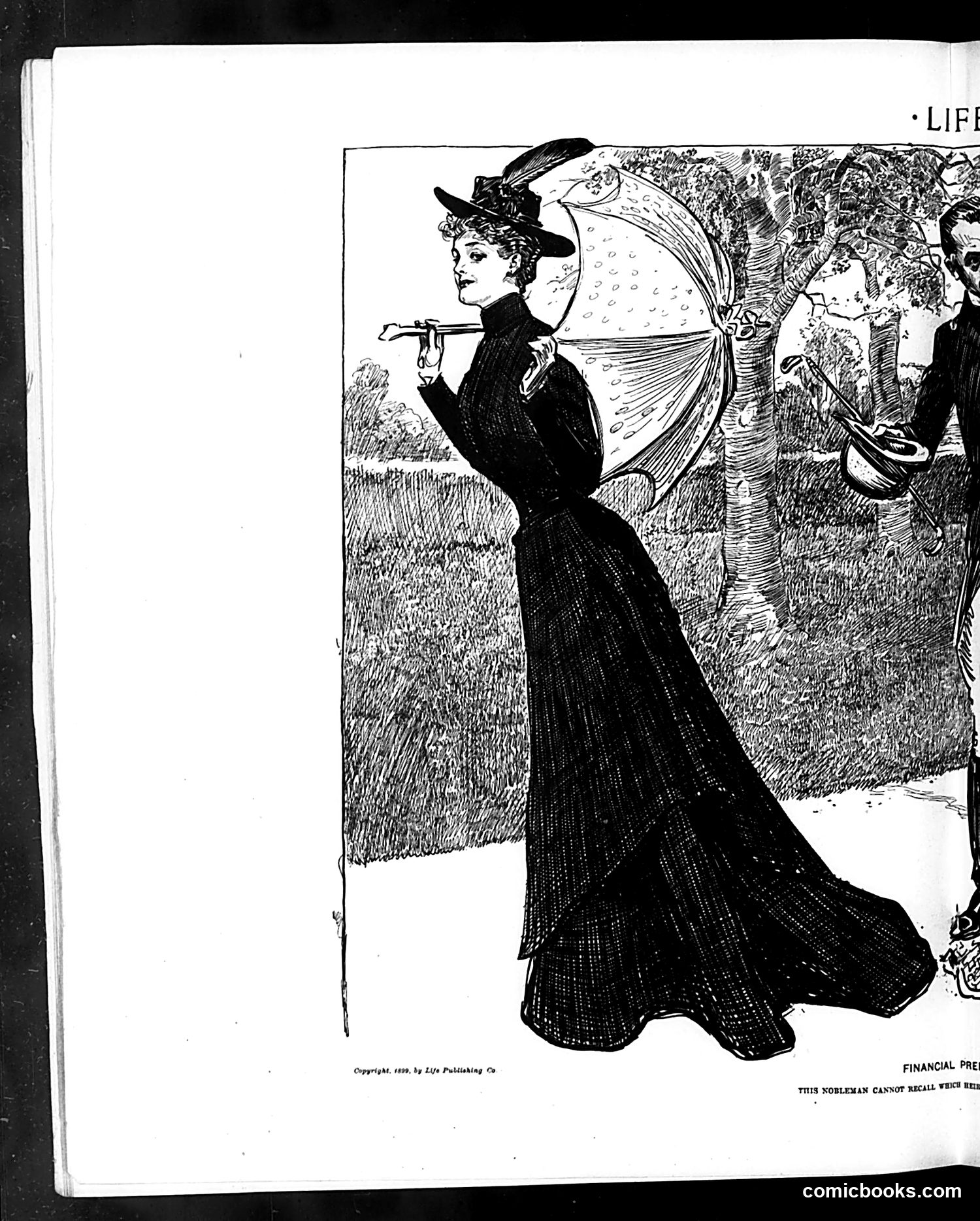
This black-and-white illustration depicts a fashionably dressed woman in Edwardian-era clothing (long dark skirt, fitted jacket, decorative hat) holding a telescope and standing outdoors near trees. The caption reads "FINANCIAL PRESSURE" with text stating "THIS NOBLEMAN CANNOT RECALL WHICH HEIRESS." The satire targets wealthy aristocratic men who pursue marriage for financial gain. The joke suggests a nobleman is so accustomed to courting multiple wealthy women that he cannot distinguish between them—implying these relationships are purely transactional rather than based on genuine affection or individual identity. The woman's prominence and fashionable appearance underscore the satirical point: she is valued primarily as a financial asset rather than as a person.
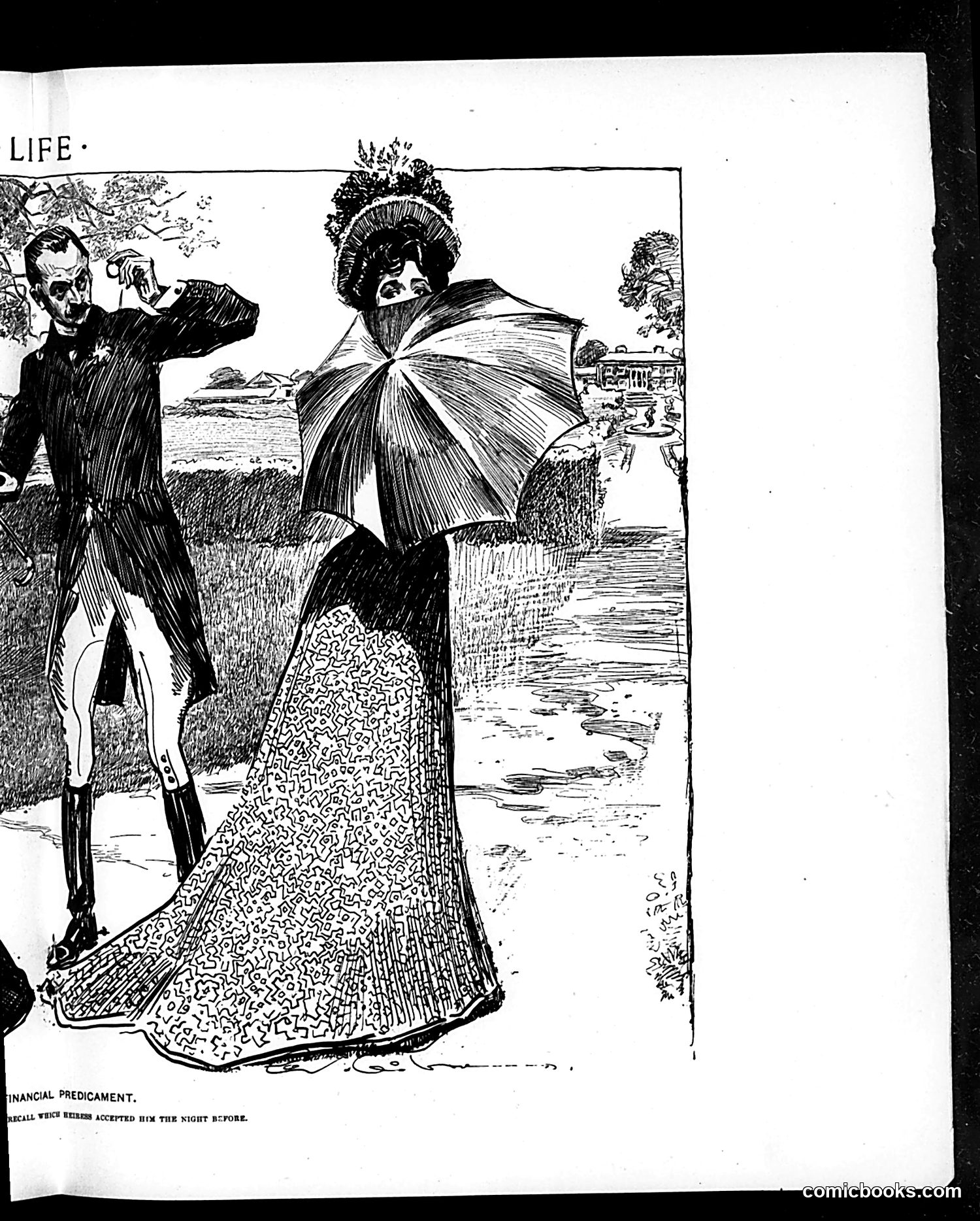
This satirical cartoon depicts a wealthy woman with an umbrella confronting a man in formal dress. The caption reads "Financial Predicament" with a subtitle stating "She Well Knew Begging Accepted Him the Night Before." The satire appears to address marital or romantic dynamics around money. The woman's elaborate dress and parasol suggest wealth and status, while her confrontational posture—holding an umbrella as if as a weapon or barrier—suggests she's defending herself or her finances. The man's gesture and formal attire indicate he may be a suitor or husband seeking financial access. The joke likely satirizes the precarious financial position of men dependent on women's wealth, or critiques marriages undertaken for mercenary reasons. The "night before" reference suggests a proposal or agreement made under different circumstances.
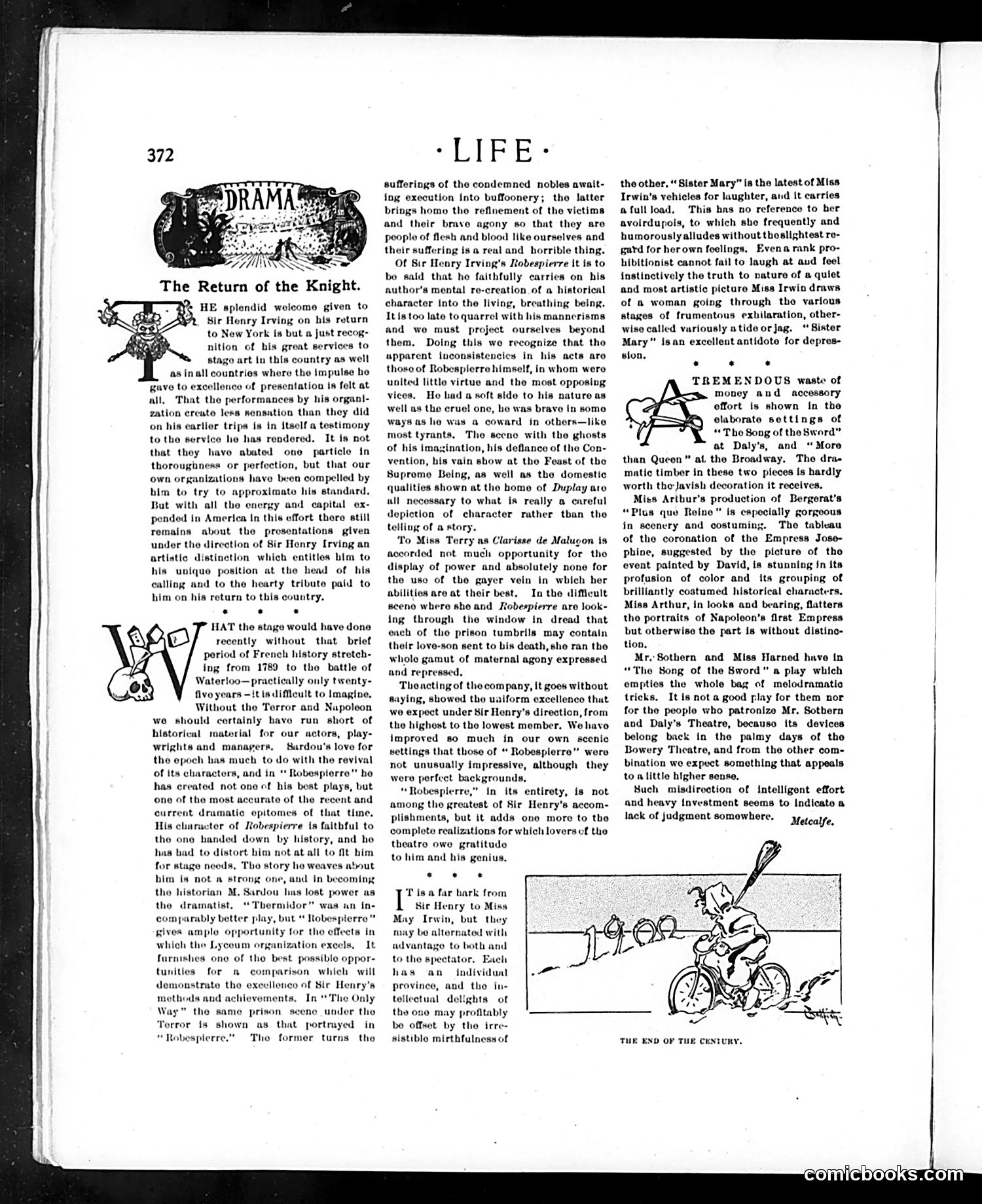
This page contains a theatrical review titled "The Return of the Knight," discussing Sir Henry Irving's performances in plays including "Robespierre" and "The Only Way." The text praises Irving's dramatic abilities and historical authenticity in portraying characters. At the bottom of the page is a small cartoon labeled "THE END OF THE CENTURY" showing figures on bicycles. This likely satirizes the late-1890s bicycle craze that swept America and Europe—bicycles were a novelty symbolizing modernity and progress at century's end. The cartoon's title suggests it's commenting on contemporary culture and technology transforming daily life as the 1800s concluded. The page blends theatrical criticism with social satire typical of Life magazine's content.
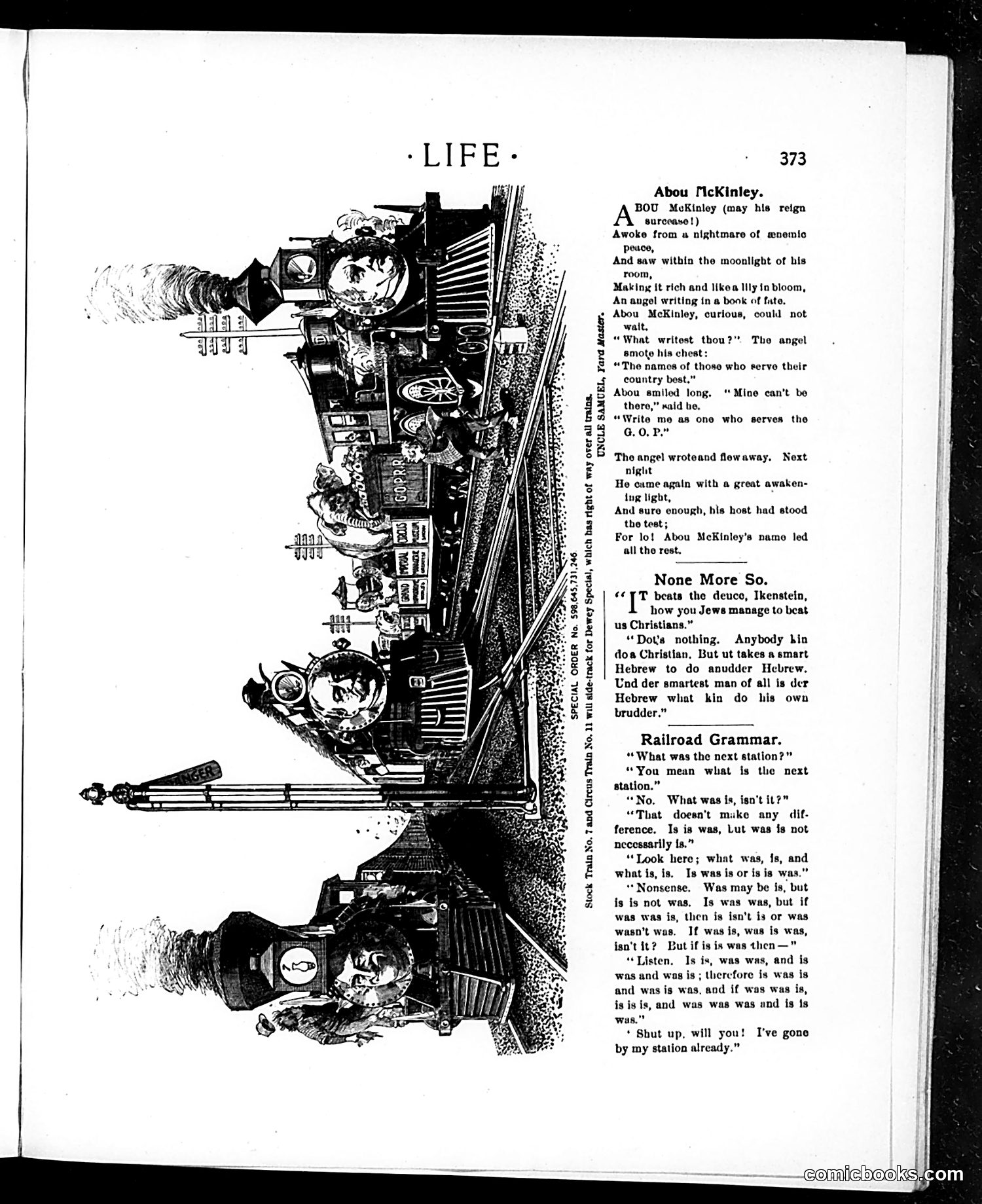
This page contains three satirical pieces mocking President William McKinley and contemporary society. **"Abou McKinley"** parodies a famous poem, suggesting McKinley narcissistically imagines himself as the nation's greatest servant—an angel writes his name first among patriots, despite his "nightmare of mnemio peace" (likely referring to his reluctance regarding military matters). **"None More So"** is a crude ethnic stereotype joke about Jewish business practices, depicting antisemitic tropes about Jews outsmarting Christians and each other through deception. **"Railroad Grammar"** satirizes American speech patterns through a deliberately nonsensical conversation about verb tenses, reflecting contemporary concerns about linguistic standards and education among working-class immigrants (suggested by the dialect humor). The illustration shows a train with passengers in various poses—likely depicting McKinley and his administration. These pieces collectively mock political pretension, ethnic stereotypes, and working-class speech patterns typical of *Life* magazine's satirical approach of that era.
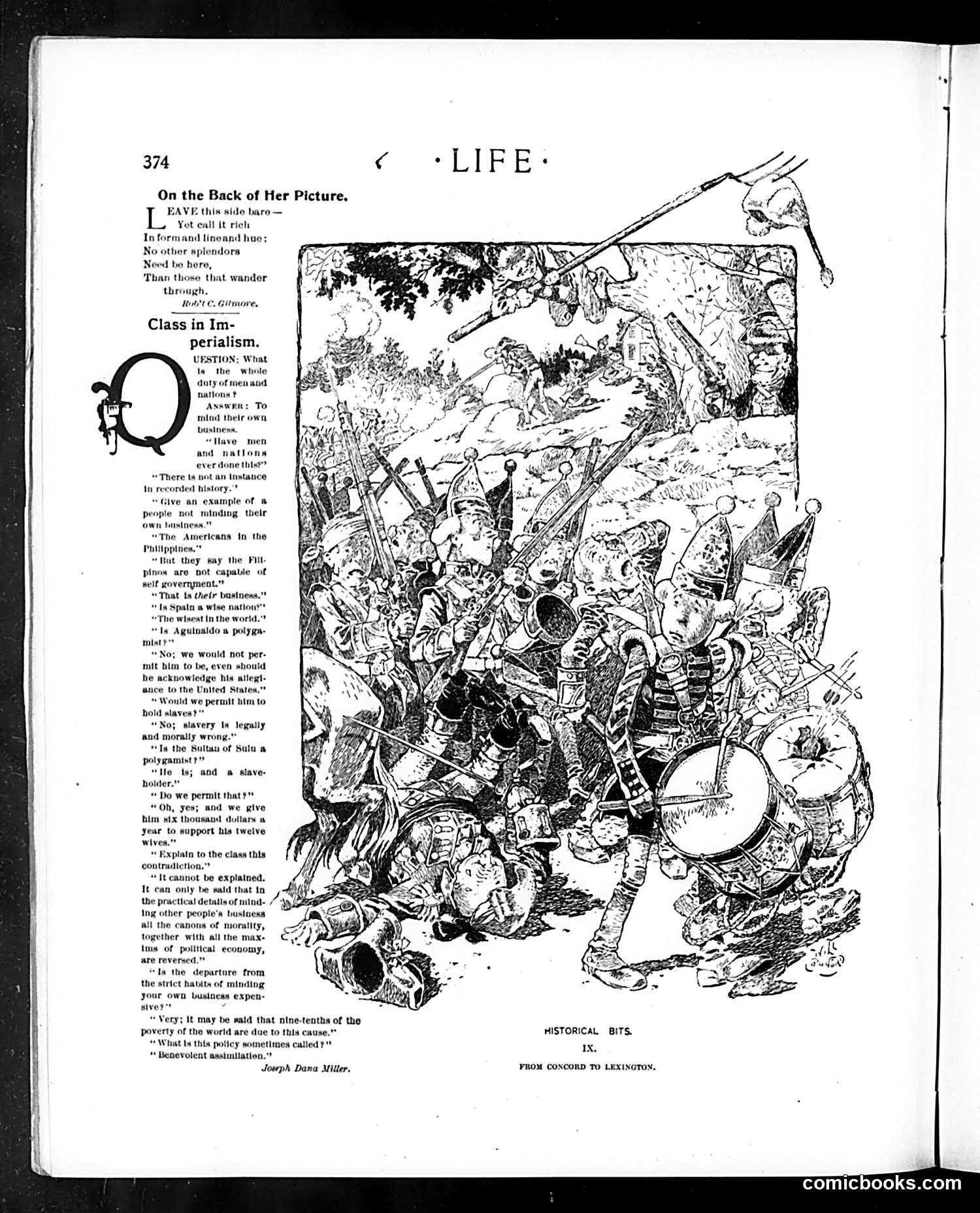
This page satirizes U.S. "benevolent assimilation" policy in the Philippines following the Spanish-American War. The dialogue format critiques the hypocrisy of American colonial administration. The text questions why the U.S. refuses to permit Filipino leader Aguinaldo polygamy or slavery as "morally wrong," yet *does* permit—and financially supports—the Sultan of Sulu to maintain twelve wives and slaves. The contradiction exposes how America applied selective moral standards based on political convenience rather than principle. The satirist (Joseph Dana Miller) argues that this departure from "minding one's own business" violates both morality and economic logic, causing global poverty. The term "benevolent assimilation" is mocked as a euphemism masking imperial control disguised as civilization-spreading. The accompanying illustration (captioned "From Concord to Lexington") likely reinforces the irony: America's Revolutionary origins championed independence, yet the nation now denies it to colonized peoples.
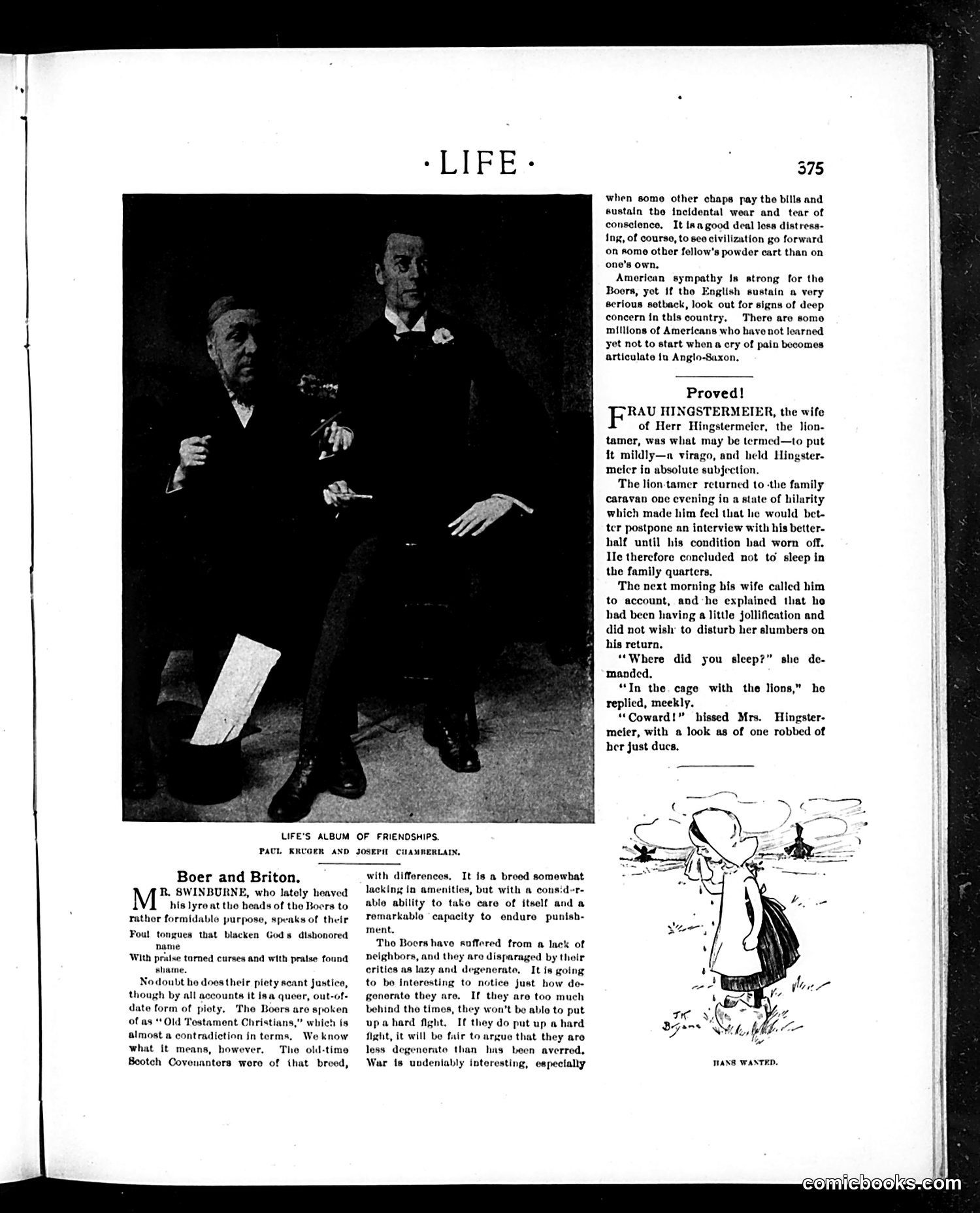
**Main Political Cartoon:** The photograph titled "Life's Album of Friendships" depicts Paul Kruger (Boer leader) and Joseph Chamberlain (British Colonial Secretary), satirizing their opposition during the Second Boer War (1899-1902). The juxtaposition mocks their irreconcilable differences. **"Boer and Briton" Essay:** The accompanying text offers wry commentary on the conflict. It defends the Boers against British characterizations as "degenerate" and "lazy," noting sardonically that if they mount a serious resistance, they'll prove less degenerate than claimed. It critiques American sympathy for the Boers while warning that British military setbacks would trigger Anglo-Saxon solidarity among Americans—exposing their selective morality. **"Proved!" Humor Piece:** An unrelated anecdote about a lion-tamer's wife. He claims he slept in the lion cage to avoid her; she calls him "coward," suggesting even lions are preferable company to her domination—a domestic satire on marital tyranny.
This page contains two humorous short stories typical of Life's satirical content: **"Paddy Flynn's Speaking Tube"** mocks Irish immigrant stereotypes through a dialect-heavy anecdote. An Irish worker named Paddy Flynn, unfamiliar with modern office technology (a speaking tube for internal communication), misunderstands its purpose and asks his boss to stick his head out a window so they can talk across the street—missing the entire point of the device. The joke plays on period anxieties about immigrants and new technology. **"Claude Poodles at the Ball"** satirizes social pretension. A vain, fashionable gentleman attracts admiring attention at an elegant party until disaster strikes: his rented dress coat rips up the back. He quietly exits, his social standing instantly destroyed by this wardrobe malfunction. The satire targets both excessive vanity and the shallow, appearance-obsessed nature of high society. Both stories use exaggeration and physical comedy to mock contemporary social types.
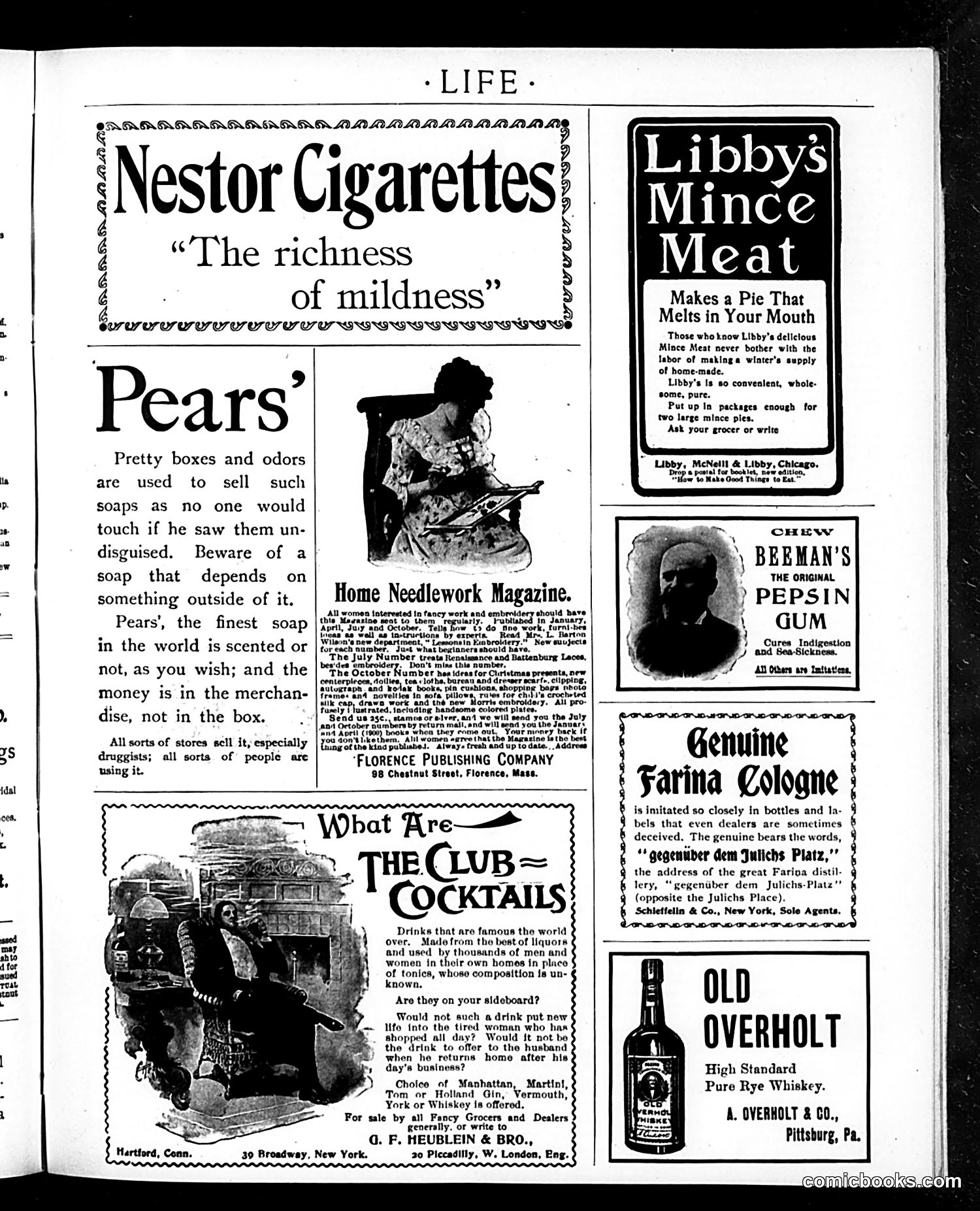
This page is primarily advertising—it contains no political cartoons or satirical commentary. Instead, it features product advertisements typical of early 20th-century magazines. The ads promote consumer goods including Pears' soap (emphasizing quality over packaging), Nestor cigarettes, Home Needlework Magazine, Libby's mince meat, Beeman's pepsin gum, Farina Cologne, Club cocktails, Old Overholt whiskey, and others. One notable element: the Club Cocktails ad suggests these drinks are appropriate household items for offering to tired wives and husbands—reflecting period attitudes about alcohol use in domestic settings, before Prohibition. The Beeman's gum advertisement claims medicinal benefits (curing indigestion and seasickness). The page demonstrates how early Life magazine supplemented satirical content with advertising revenue, and reveals consumer culture and product marketing strategies of the era.
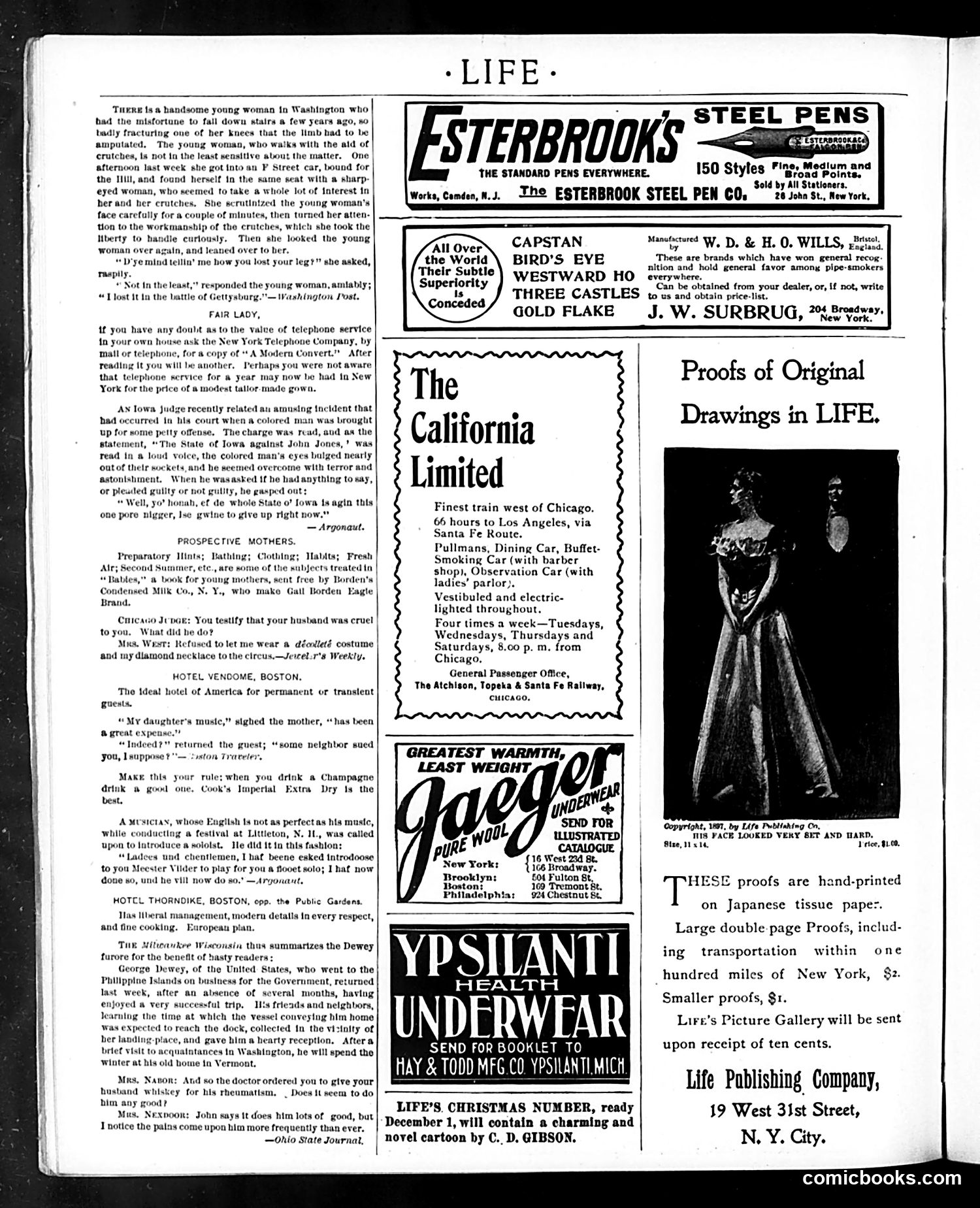
This page is primarily **advertisements and miscellaneous humor columns**, not political cartoons. The text content consists of brief anecdotes and jokes typical of Life's satirical humor: 1. **Opening story**: A Washington woman who lost her leg in an accident encounters a nosy streetcar passenger who assumes she lost it in the Civil War (Battle of Gettysburg). The humor derives from the woman's deadpan lie to a busybody. 2. **Iowa judge anecdote**: A Black defendant, hearing "The State of Iowa" named as prosecutor, assumes he has no chance and surrenders immediately. The joke relies on period racial stereotypes. 3. **Various other brief jokes** about marriage, music lessons, and hotel life—typical Light comedy of the era. The advertisements feature steel pens, train service (California Limited), pen nibs, and women's underwear. One section advertises "Proofs of Original Drawings in LIFE" with what appears to be a fashion illustration. **No significant political commentary is present**—this is entertainment and commercial content from what appears to be an early 20th-century issue.
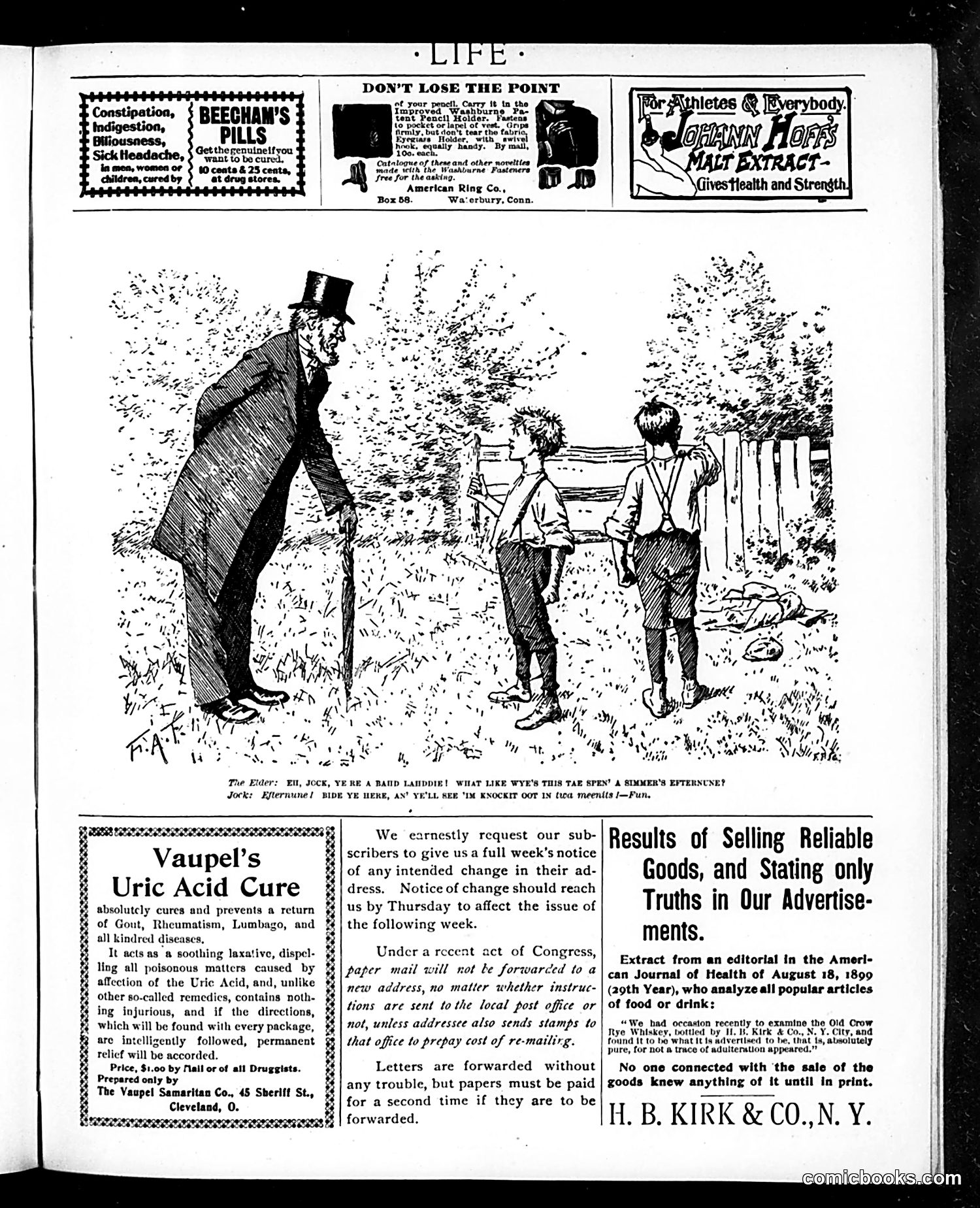
**Main Cartoon:** The large illustration depicts a well-dressed gentleman in a top hat bending down to speak with two boys. The caption, written in Scottish dialect, shows the man asking why the boys are spending their afternoon idly. One boy responds that they'll see one of them "knocked out in ten minutes"—implying they're waiting for a fight or boxing match. This appears to be a satirical commentary on working-class leisure activities and possibly urban youth culture, using the contrast between the gentleman's formal appearance and the boys' rough entertainment. **Advertisements:** The page contains various patent medicine ads (Beecham's Pills, Vaupel's Uric Acid Cure) and health tonics typical of the era, alongside an advertisement for H. B. Kirk whiskey that emphasizes the product's purity and authenticity as verified by independent analysis. The page reflects early 1900s American journalism mixing editorial content, humor, and medicinal advertising.
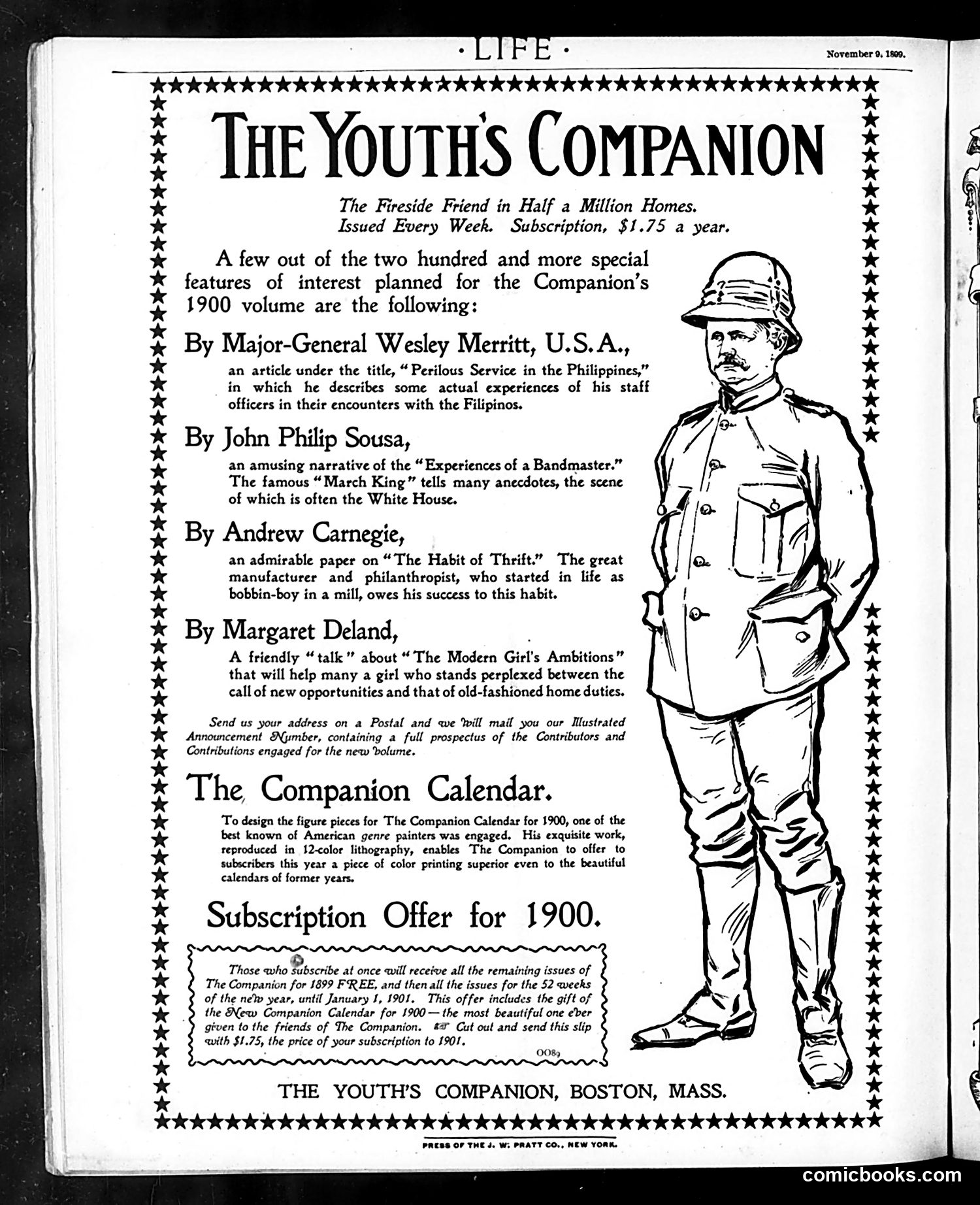
This is primarily an **advertisement page**, not a political cartoon. It promotes *The Youth's Companion*, a weekly magazine for young readers, announcing its 1900 volume. The illustration shows a **U.S. soldier in military uniform**, likely representing Major-General Wesley Merritt, whose article on "Perilous Service in the Philippines" is advertised. This references the **Philippine-American War** (1899-1902), when the U.S. was fighting Filipino insurgents following the Spanish-American War. The page highlights notable contributors—composer John Philip Sousa, industrialist Andrew Carnegie, and author Margaret Deland—to advertise the publication's prestige. The subscription offer ($1.75/year) and promise of a color calendar emphasize value. The soldier imagery and featured military content suggest the magazine positioned itself as patriotic, appealing to American nationalism during the colonial expansion period. There is **no satire evident**; this is straightforward promotional material capitalizing on contemporary military interests.