
Life, 1899-11-09 · page 12 of 20
Life — November 9, 1899 — page 12: what you’re looking at
What you’re looking at
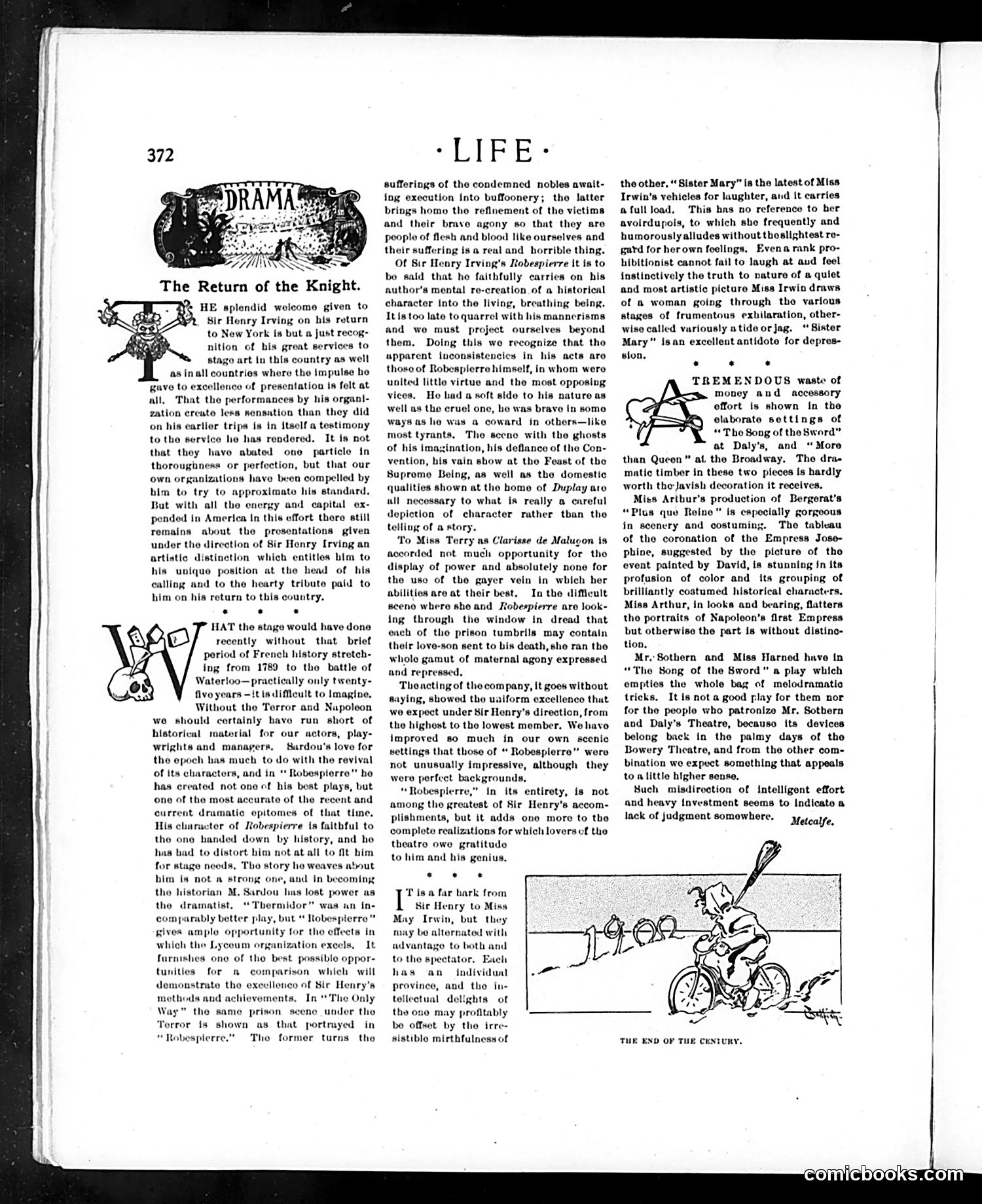
This page contains a theatrical review titled "The Return of the Knight," discussing Sir Henry Irving's performances in plays including "Robespierre" and "The Only Way." The text praises Irving's dramatic abilities and historical authenticity in portraying characters. At the bottom of the page is a small cartoon labeled "THE END OF THE CENTURY" showing figures on bicycles. This likely satirizes the late-1890s bicycle craze that swept America and Europe—bicycles were a novelty symbolizing modernity and progress at century's end. The cartoon's title suggests it's commenting on contemporary culture and technology transforming daily life as the 1800s concluded. The page blends theatrical criticism with social satire typical of Life magazine's content.
📄 Transcribed text from this page (OCR, searchable)
Machine-transcribed from the original scan — historical spelling and the odd misread are preserved.
Ew HE splendid wroloome given to 3 AYA. Sir Henry Irving on bis return es to Now York is but a just recog- ai nition of bis great services to stago art in this country as well as inall countries where the Impulse bo ‘gave to excellence of presentation Is felt at all. That the performances by his organi- zation creuto less sensation than they did on his cartier trips is in itself a testimony to tho service ho has rendered. It is not that they havo abated ono particle in thoroughness or perfection, but that our own organizations have been compelled by him to try to approximate his standard. But with all the energy and capital ex- pended in America in this effort thero still remains about the presentations given under tho direction of Sir Honry Irving an artistic distinction which entitles him to his unique position at the head of his calling and to tho hearty tribute paid to him on his return to this country. * e . HAT tho stage would have dono recently without that brief poriod of French history streteh- ing from 1789 to tho battle of Waterloo—practically only twenty- fivo years ~itisdiMcult to Imagine, Without the Terror and Napoleon wo should certainly bavo run short of historicul material for our actors, play- wrights and managers, Sardou's love for the epoch has much to do with the revival of its characters, and in “ Robespterre” bo has created not one of his best plays, but one of the most accurate of the recent and current dramatic epitomes of that time, His character of Robespierre is faithful to the one handed down by history, and ho has bad to distort him not at all to Mt him for atago needs, Tho story ho weaves about him is not a strong one, and in becoming the historian M, Sardou hus lost power as the dramatist. “Thermidor” was an in- comparably better play, but " Robespierre” gives ample opportunity for tho effects in which the Lyceum organization excels, It furnishes one of the best possible oppor- tunities for a comparison which will demonstrate the exectlonco of Sir Henry's methods and achievements, In “The Only Way” the same prison seeno under the ‘error 18 shown as that portrayed in “Robesplerre." The former turns the “LPB » sufferings of the condemned nobles await- {og execution into buffoonery; tho latter brings homo tho refinement of the victims and their brave agony so that they aro people of flesh and blood like ourselves and thoir suffering is a real and horrible thing. Of Sir Henry Irving's Robespierre it is to bo sald that ho faithfully carries on his author’s mental re-creation of a historical character into the living, breathing being. It is too late to quarrel with his manncrisms and wo must project ourselves beyond them. Doing this wo recognize that tho apparent inconsistencies in his acts aro thosoof Robespierre himself, in whom wero united little virtue and the most opposing vicos, He had a soft side to hia nature as well as the cruel one, he was brave in somo waysas ho was a coward in others—like most tyrants, Tho sceno with the ghosts of his imazination, his deflance of the Con- vention, his vain show at tho Feast of the Bupromo Being, as well as the domestic qualities shown at tho home of Duplay aro ull necessary to what is really a careful depiction of character rather than tho telling of a story. To Miss Terry as Clarisse de Malugon is accorded not much opportunity for tho display of power and absolutely none for the uso of tho gayer vein in which her abilities are at their best, In the difficult sceno whero sho and Robespierre are look- ing through the window in dread that each of tho prison tumbrils may contain their love-son sent to bis death, sho ran tho whole gamut of maternal agony expressed and repressed, Thoncting of thecompany, it goos without saying, showed tho uaiform excellenco thut wo expect under Sir Henry's direction, from the highest to the lowest member, We havo improved so much in our own scenic settings that those of “ Robesplerre” were not unusually impressive, although they were perfect backgrounds, “Robesplerre,” in its entirety, is not among tho greatest of Sir Henry's accom- plishments, but it adds ono more to tho complete realizations for which lovers of the theatro owe gratitude to him and his genius, ‘T isa far bark from Sir Henry to Miss Irwin, but they y bo alternated with advantage to both and to the spectator, Each has an individual province, and the in- tellectual delights of the one may profitably bo offvet by the trre- sistiblo mirthfulness of mi tho other, “ Sister Mary” is the latest of Miss Irwin's vehicles for laughter, and it carries afullload, This has no reference to her avoirdupols, to which she frequently and humorously alludes without thoslightest re- gard for herown feelings, Evena rank pro- hibitionist cannot fail to laugh at aud feel instinctively the truth to nature of a quict and most artistic picture Miss Irwin draws of | woman going through tho various stages of frumentous exhilaration, other- wise called variously atide orjag. “Sister Mary” isan excellent antidote for depres- ston, . . . TREMENDOUS waste of money and accessory effort is shown in the elaborate settings of “Tho Song of the Sword” at Daly's, and “More than Queen” at the Broadway. The dra- matic timber in these two pieces is hardly worth the Javish decoration it receives. Miss Artbur's production of Bergerat’s “Plus que Reine” is especially gorgeous in scenery and costuming. The tableau of the coronation of the Empress Jose- phine, suggested by the picture of tho event painted by David, is stunning in its profusion of color and its grouping of brilliantly costumed historical characters. Miss Arthur, in looks and bearing, flatters tho portraits of Napoleon's first Empress but otherwise the part is without distino- tion, Mr, Sothern and Miss Harned have in “Tho Song of the Sword" a play which empties the whole bag of melodramatic tricks, It is not a good play for them nor for the people who patronize Mr. Sothern and Daly's Theatre, becauso its devices belong back in the palmy days of tho Bowery Theatre, and from the other com- bination we expect something that appeals to alittle higher sense, Such misdirection of Intelligent effort and heavy investment seems to Indicate a lack of judgment somowhere. — sfeteaife, TUE END OF THE CENTURY.