
A complete issue · 20 pages · 1899
Life — October 12, 1899
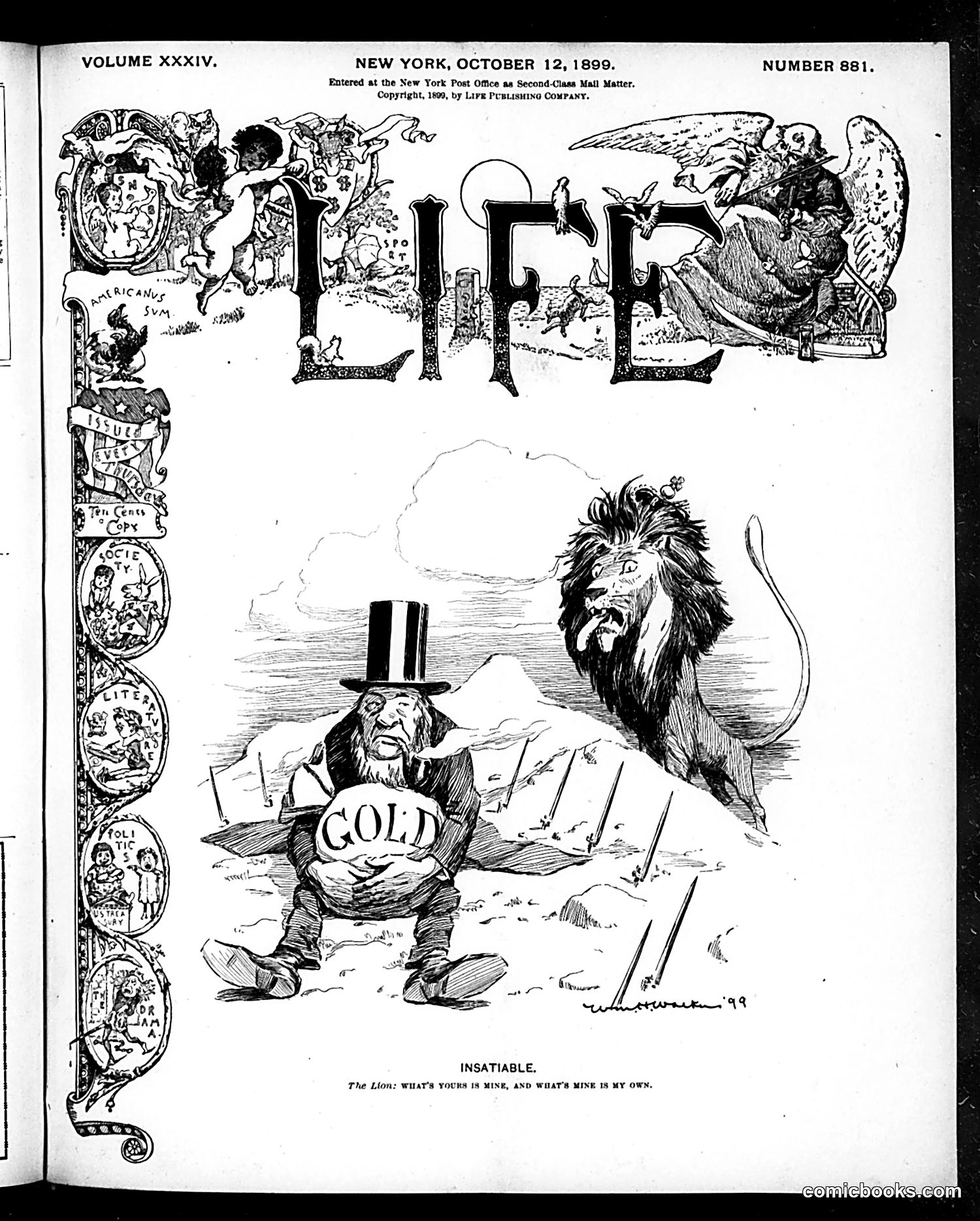
The main cartoon, titled "Insatiable," depicts a bearded man in a top hat sitting on gold, labeled with "GOLD" across his chest. A large lion looms menacingly behind him. The caption reads: "The Lion: what's yours is mine, and what's mine is my own." This appears to be commentary on imperial greed and colonial exploitation during the 1890s—likely referencing the Boer War (1899-1902) or broader British imperial expansion. The "lion" symbolizes Britain; the figure represents a British or colonial interest claiming gold resources (possibly South African). The satire mocks the hypocrisy of imperial powers: demanding access to others' wealth while protecting their own, embodying aggressive territorial acquisition and economic domination of the era.
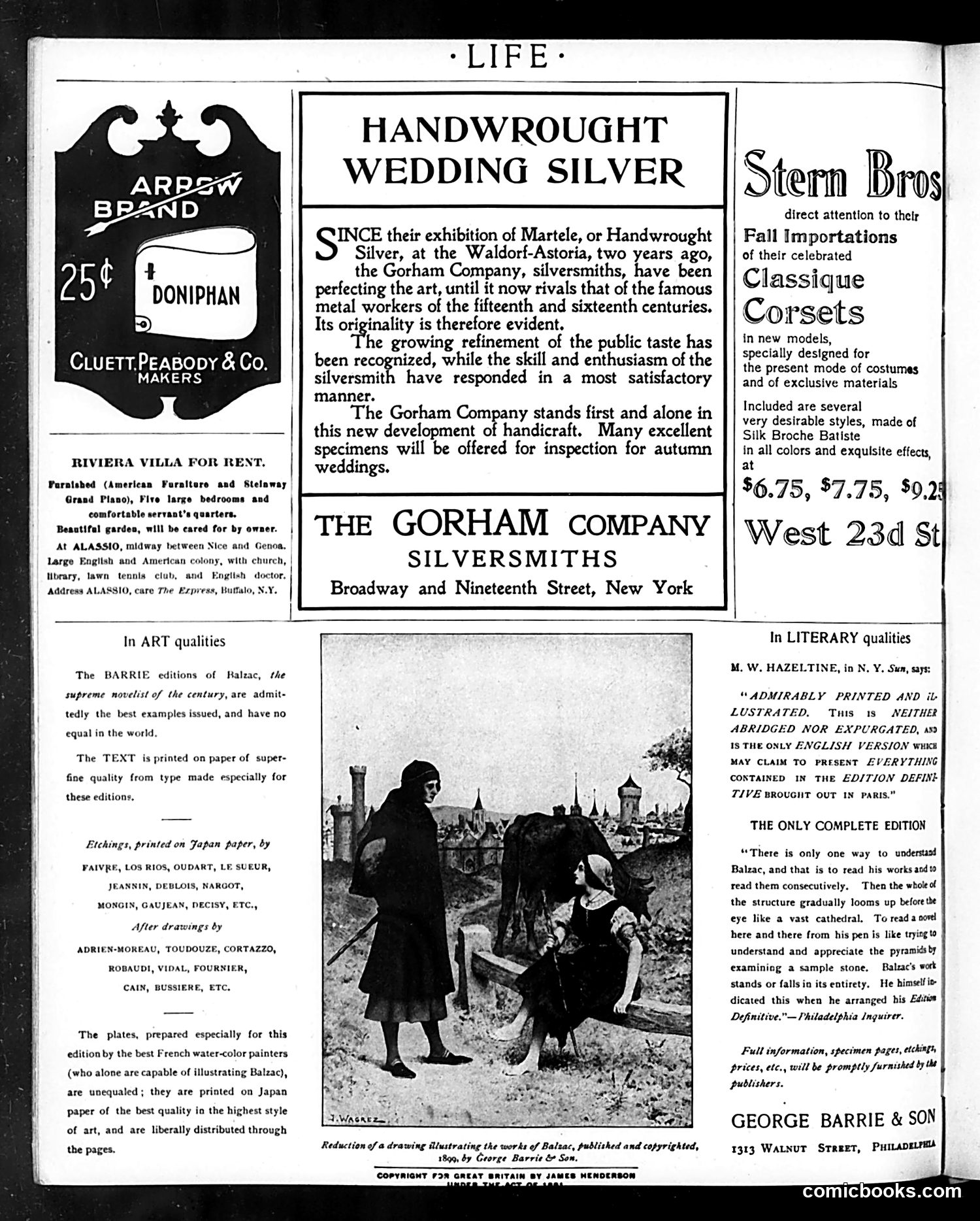
This page is **primarily advertisements** rather than satirical content. The main features are: 1. **Arrow Brand Doniphan** (25¢) - a cigar ad by Cluett, Peabody & Co. 2. **The Gorham Company** - a large advertisement for handwrought wedding silver, emphasizing their superiority in metalwork craftsmanship 3. **Stern Bros** - promoting fall corset imports 4. **George Barrie & Son** - advertising a complete edition of Balzac's works with high-quality illustrations and printing The center image appears to be a **literary illustration** (possibly from Balzac), showing two figures in period clothing in a landscape setting. No political satire or social commentary is evident—this is a commercial publication page showcasing luxury goods and fine editions typical of early 20th-century *Life* magazine advertising.
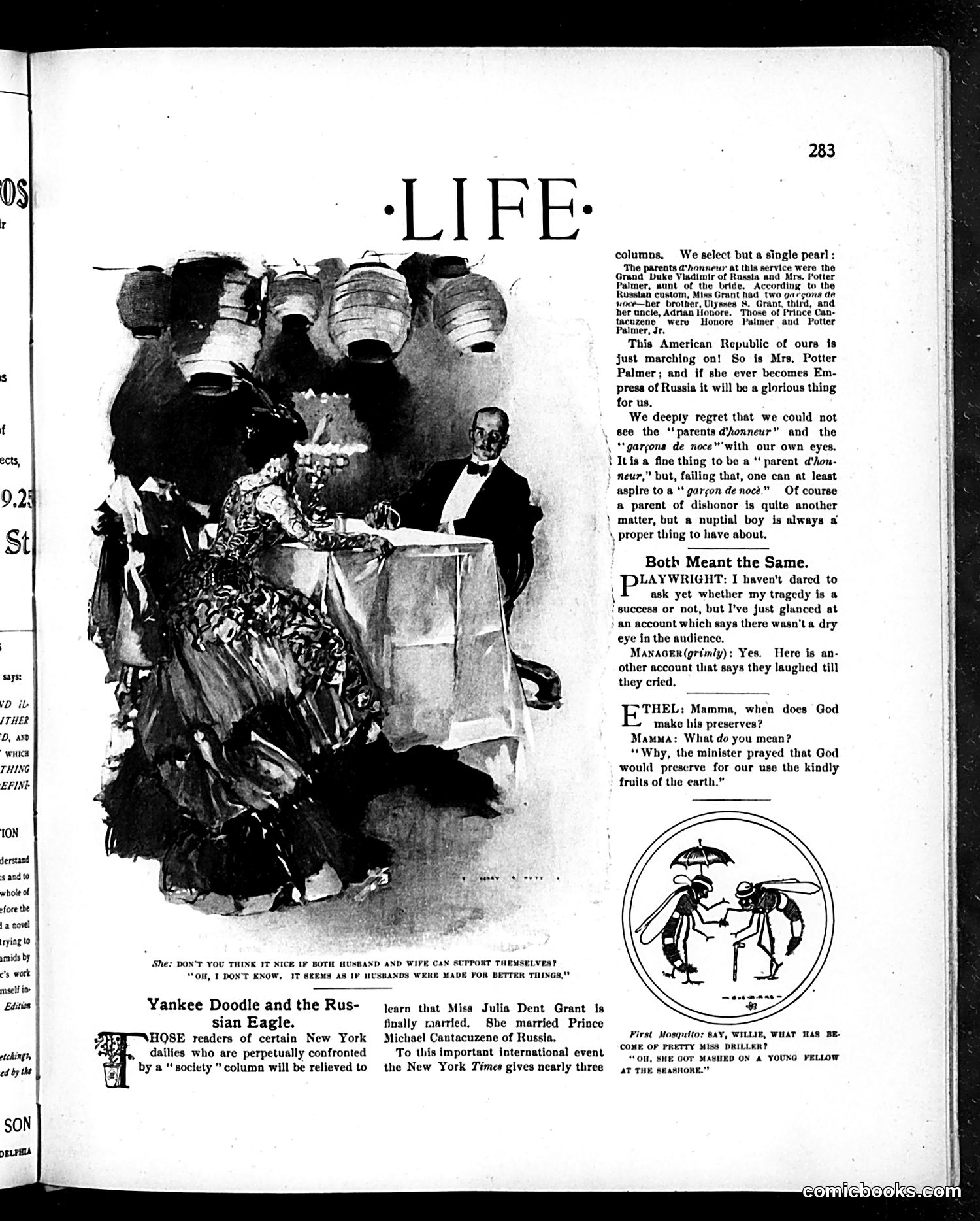
The main illustration depicts a formal dinner scene with three figures around a table. Based on the caption "She: 'DON'T YOU THINK IT NICE IF BOTH HUSBAND AND WIFE CAN SUPPORT THEMSELVES?' He: 'OH, I DON'T KNOW. IT SEEMS AS IF HUSBANDS WERE MADE FOR BETTER THINGS,'" this satirizes gender roles and economic independence in marriage. The accompanying text discusses a Russian/American marriage involving Miss Julia Dent Grant (appears to be related to a Grant family) and Prince Michael Cantacuzene of Russia. The satire mocks outdated masculine attitudes about women's financial independence while simultaneously poking fun at international aristocratic marriages. The small circular illustration below shows two figures with umbrellas, likely another humorous commentary on courtship or matrimonial matters.
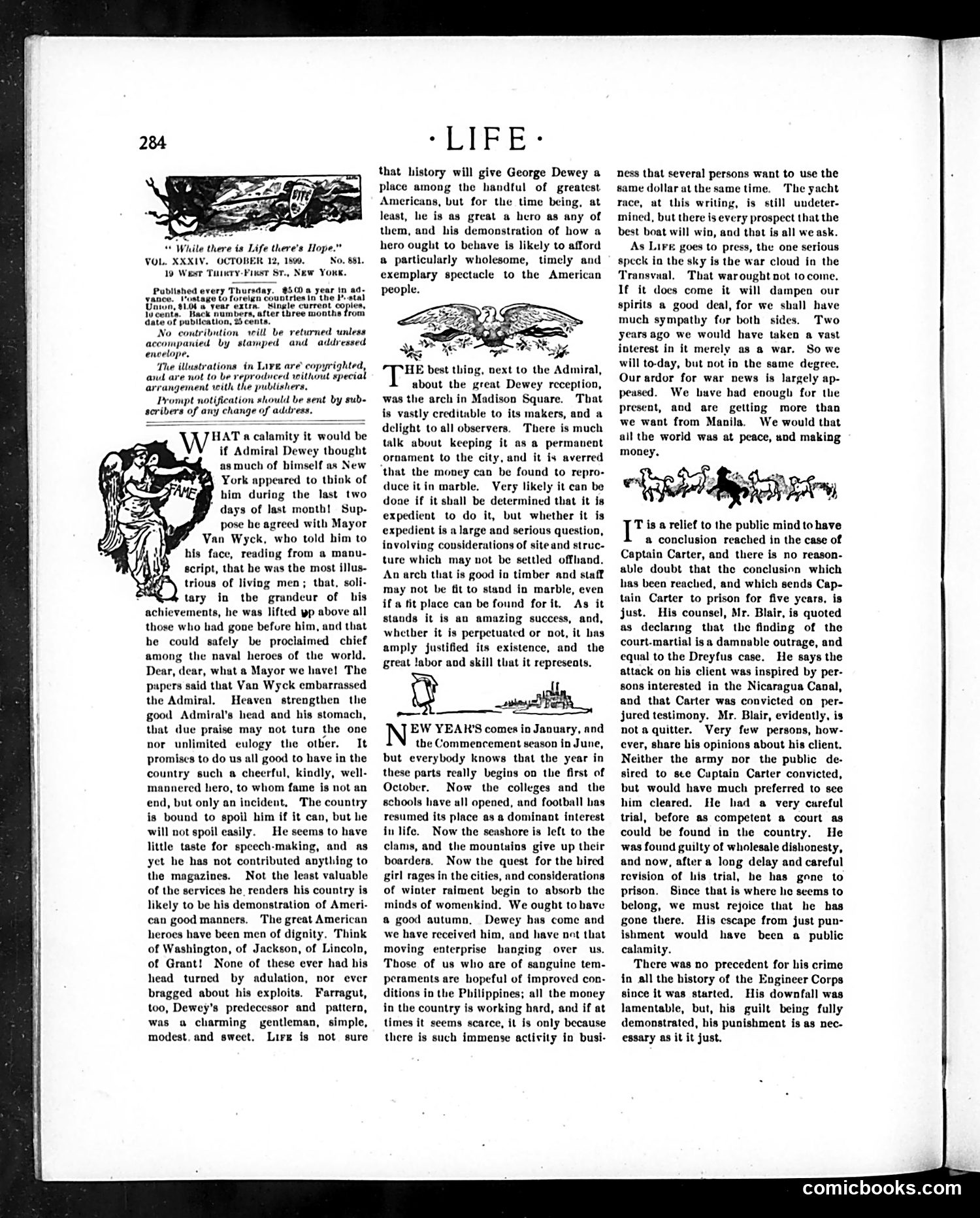
The page contains three editorial cartoons critiquing contemporary figures and events: 1. **Top left**: A caricature appears to comment on Mayor Van Wyck and Admiral Dewey's reception in New York, mocking the mayor's self-aggrandizing behavior during celebrations for the Admiral. 2. **Center**: An illustration of an arch in Madison Square, discussing whether it should be made permanent—satirizing civic debates about monuments and public spending. 3. **Bottom**: References to the Captain Carter court-martial case, criticizing the verdict as a "damnable outrage" and questioning Carter's conviction on allegedly perjured testimony. The text emphasizes these were controversial decisions that sparked public debate about justice, military honor, and civic leadership during the Progressive Era.
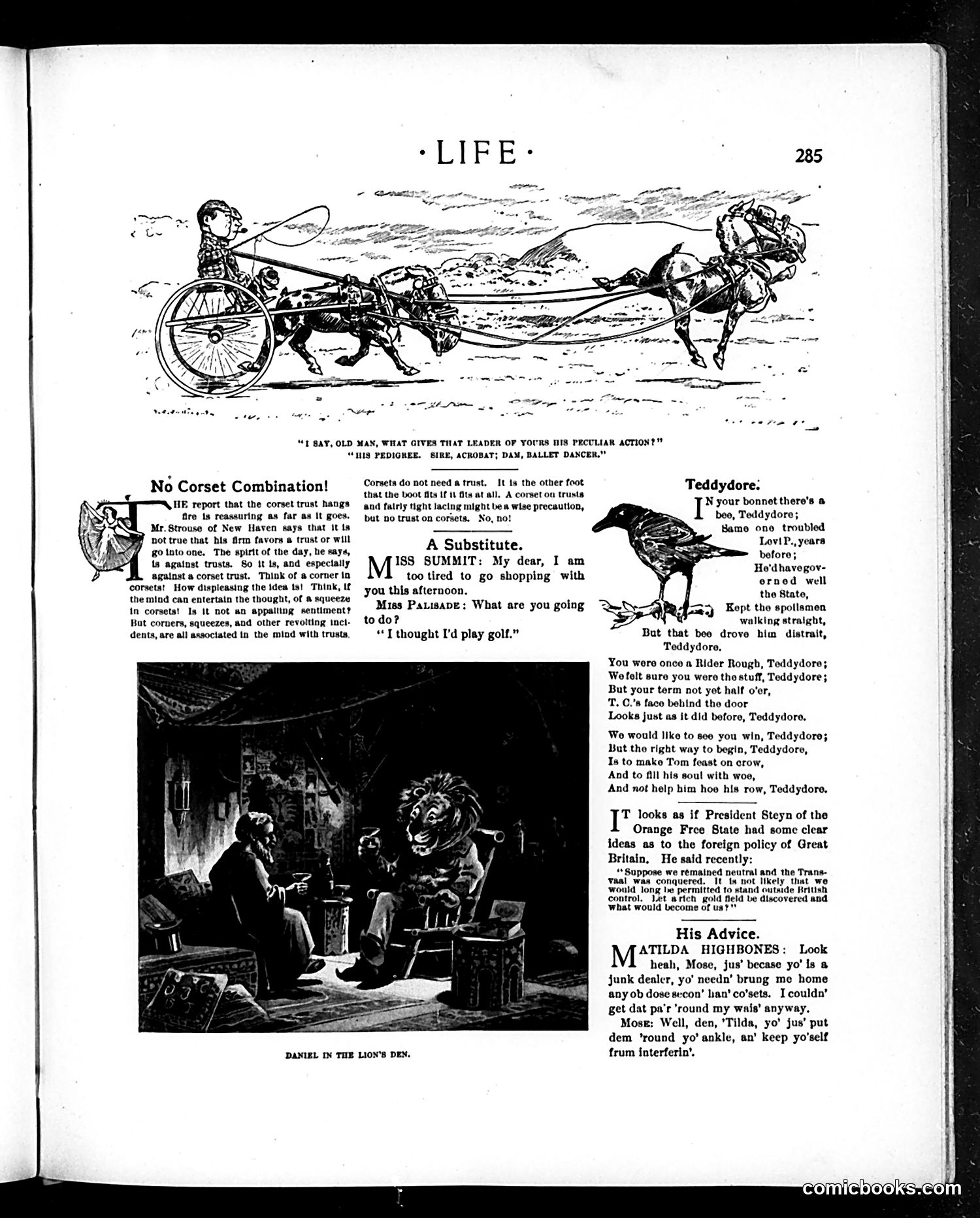
**Top Cartoon:** Depicts a person driving a cart pulled by dogs instead of horses. The caption asks what gives the leader such "peculiar action," with the pedigree identified as "sire, acrobat; dam, ballet dancer"—a joke about breeding for unusual traits. **"No Corset Combination":** Satirizes corset manufacturers' claims that their products prevent trust monopolies. The author argues corsets don't need trusts; the humor lies in equating tight lacing with anti-monopoly sentiment. **"A Substitute":** A brief exchange where Miss Palisade plans to golf instead of shopping—mild satire on women's changing leisure activities. **"Daniel in the Lion's Den":** An illustration (referenced but not clearly explained in visible text) appears to reference the biblical story. **"Teddydore" poem:** Praises Theodore Roosevelt's leadership qualities, using verse to celebrate his political impact.
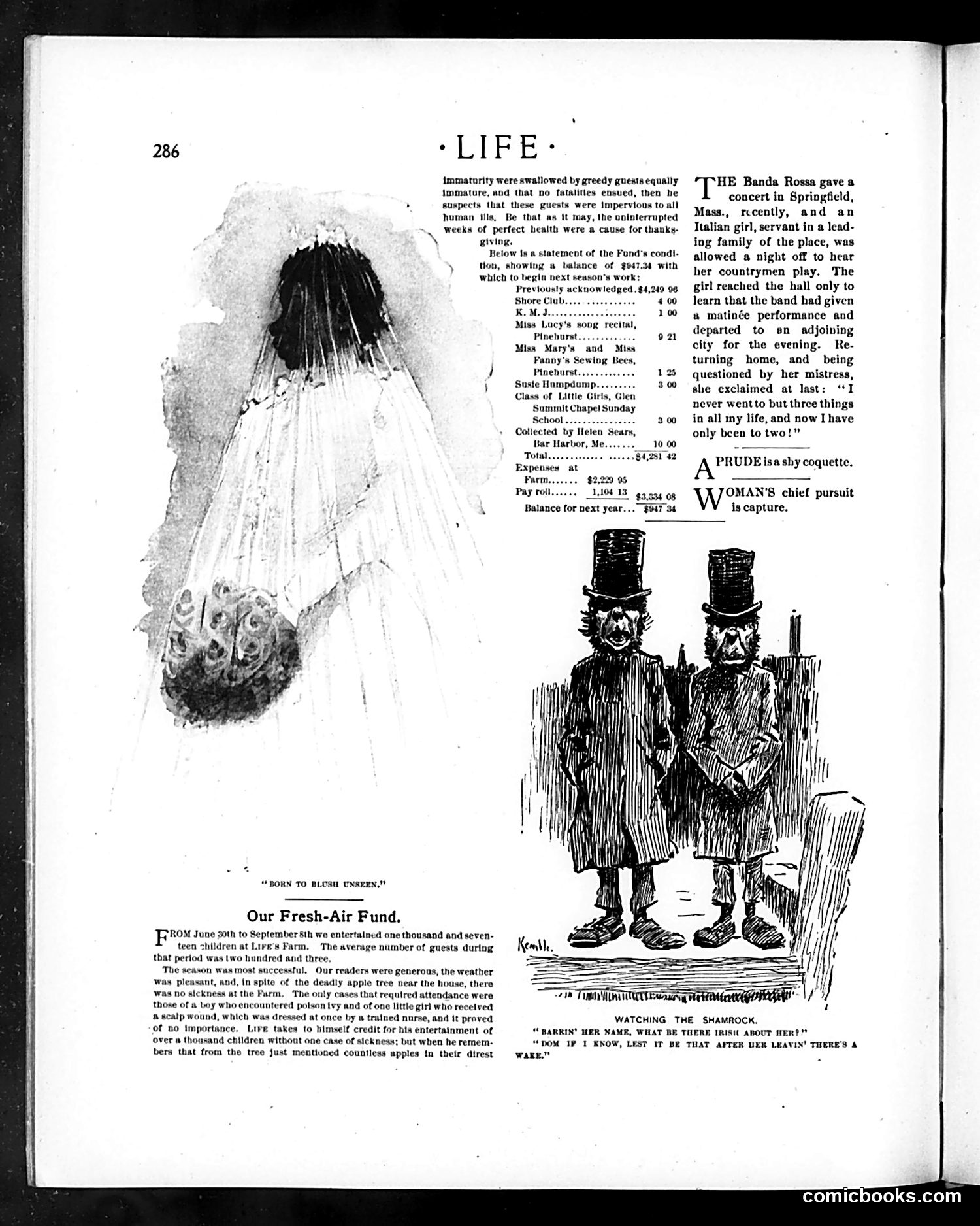
The page contains three distinct elements: 1. **"Born to Blush Unseen"** (left): An illustration of a large flower, accompanying text about the "Fresh-Air Fund," which provided summer activities for underprivileged urban children. The fund entertained over 1,000 children from June-September with minimal illness reported—Life credits the program's success. 2. **"Watching the Shamrock"** (right): A cartoon showing two caricatured figures in top hats labeled with Irish stereotypes. The dialogue mocks Irish-American speech patterns and concerns, likely satirizing Irish immigrants or Irish-American political figures of the era. 3. Financial accounting data for the Fresh-Air Fund appears in the center. The page blends philanthropy reporting with ethnic humor typical of early 20th-century American satire.
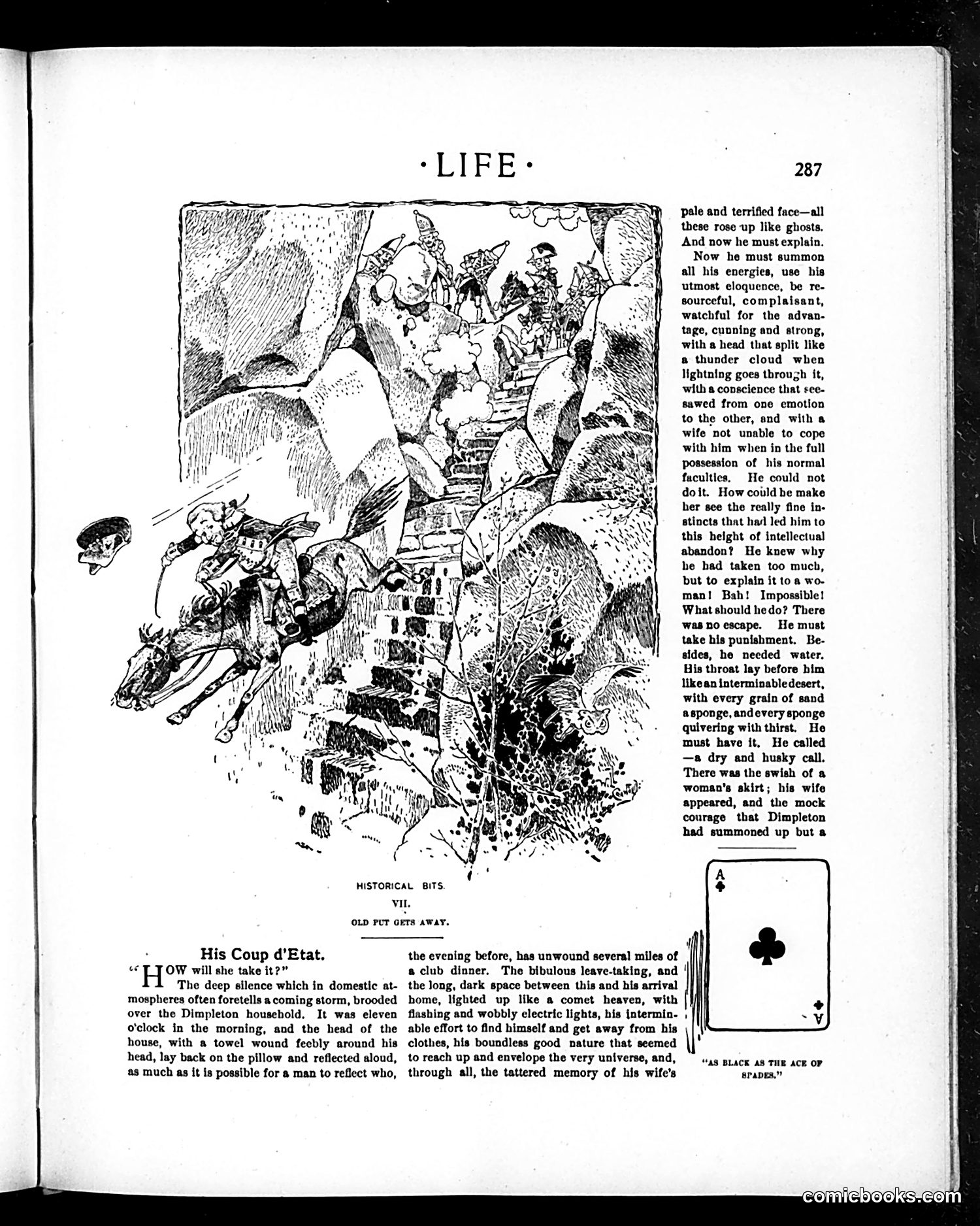
This page contains a section titled "Historical Bits VII: Old Put Gets Away" with an illustration and story about "His Coup d'Etat." The narrative describes a domestic crisis at the Dimpleton household—a man recovering from illness who must manage his wife's emotional distress and physical needs while in a weakened state. The accompanying sketch depicts figures in what appears to be a bedroom or domestic interior scene. The text emphasizes the man's predicament: he's physically depleted yet emotionally responsible for his wife's wellbeing during a crisis. This appears to be satirical domestic humor typical of early Life magazine—using exaggerated domestic scenarios to comment on gender dynamics and marital relations of the era. The specific historical reference "Old Put" remains unclear without additional context.
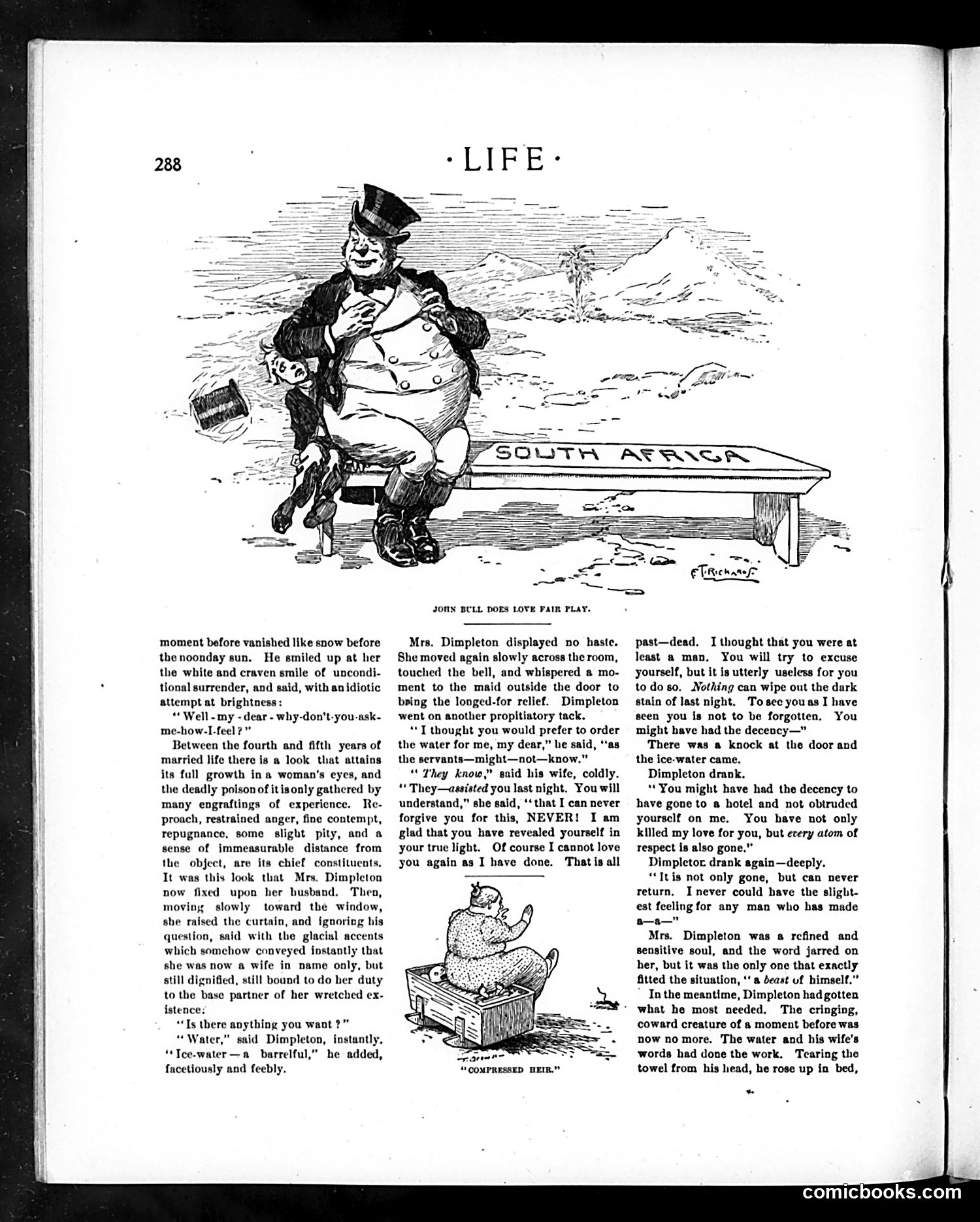
This satirical cartoon depicts **John Bull** (the personification of Britain) sitting on a seesaw labeled "SOUTH AFRICA," counterbalanced by a small figure on the other end. The image critiques British military conduct during the Boer War (1899-1902). The caption "John Bull Does Love Fair Play" is ironic—Britain, portrayed as an enormous, well-fed gentleman, vastly outweighs his opponent, suggesting the conflict is fundamentally unequal. The accompanying story about "Dimpleton" (likely a fictional everyman character) appears to address themes of honor, decency, and moral compromise in wartime. The cartoon satirizes British claims of fair play while depicting overwhelming military superiority against South African forces.
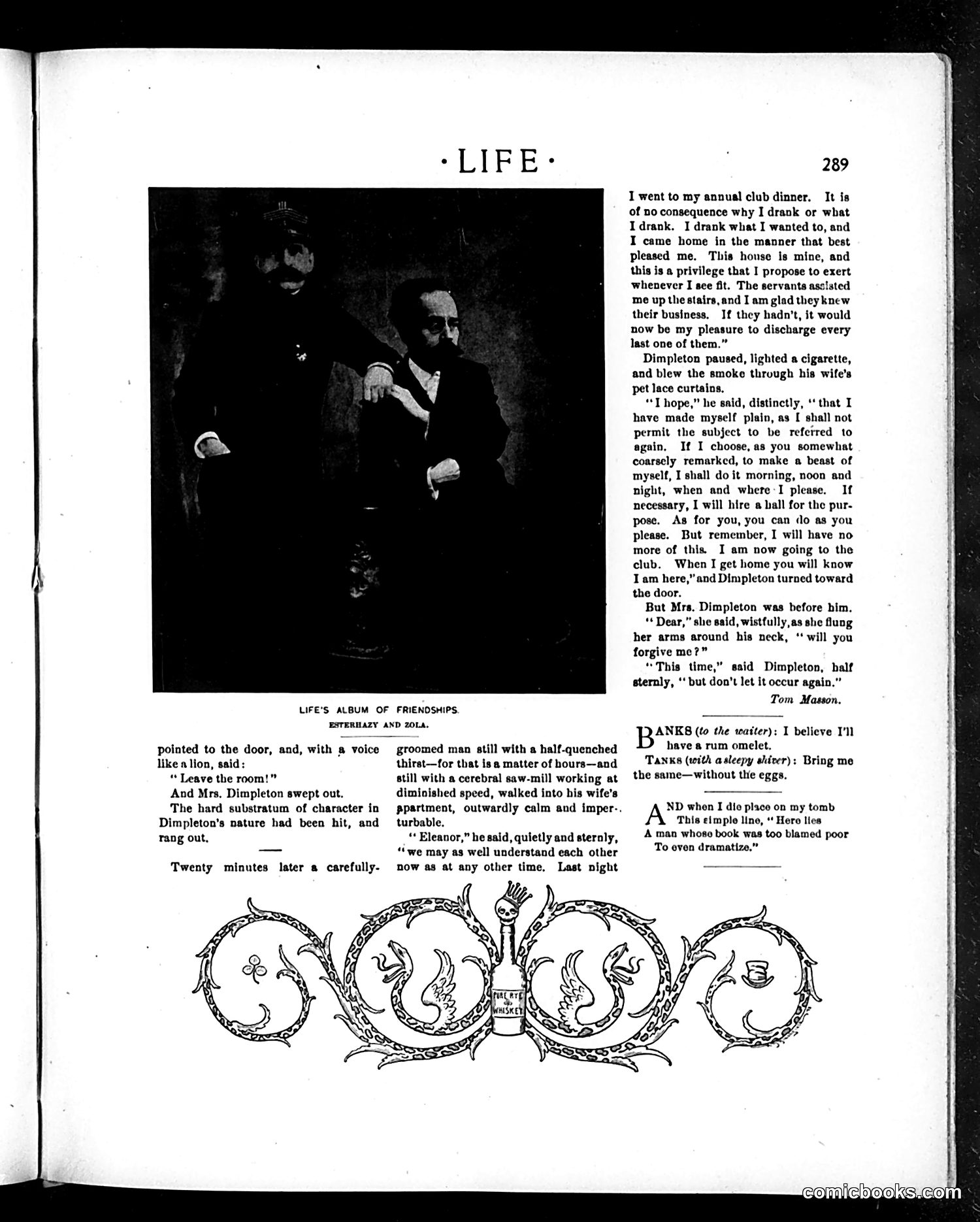
This page from *Life* magazine presents a narrative story titled "Life's Album of Friendships" featuring characters named Dimpleton and Mrs. Dimpleton. The text describes a domestic dispute where Dimpleton, having returned home drunk from his club, dismisses his wife's concerns with imperious declarations about his rights in his own home. He refuses to acknowledge wrongdoing and threatens to leave again. The accompanying photograph shows two men in period dress, though their relation to the story is unclear from the image alone. The piece satirizes male entitlement and marital discord—specifically, the husband's arrogant assertion of domestic authority and refusal of accountability. This reflects early 20th-century social commentary on gender relations and household power dynamics, likely mocking privileged men who abuse domestic privilege.
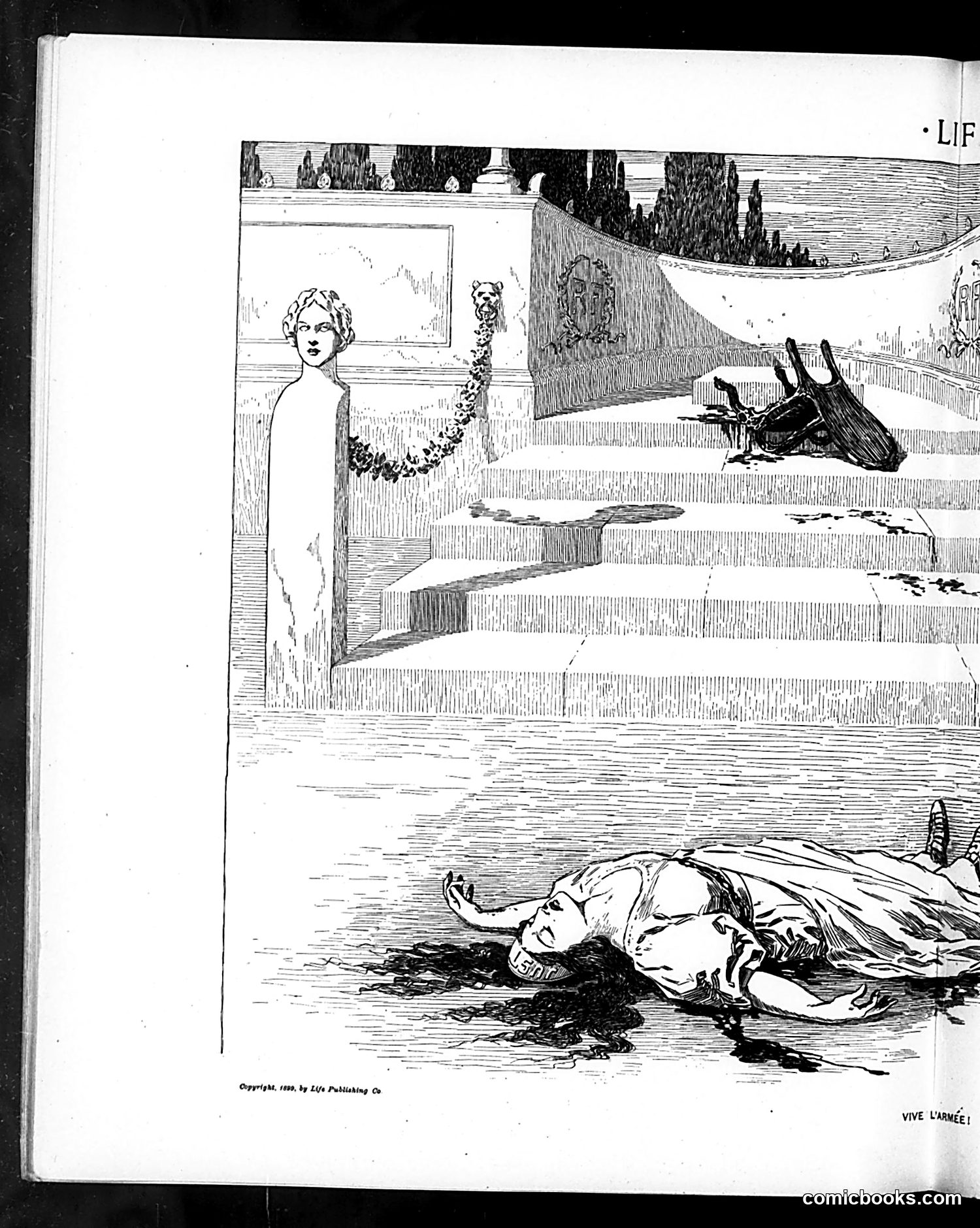
This appears to be a dramatic illustration depicting a tragic scene. A woman in classical dress lies dead or dying on the ground in the foreground, while another woman stands in a doorway above, holding what appears to be a garland of flowers. The setting suggests an ancient or classical Mediterranean villa with cypress trees visible in the background. The caption reads "VIVE L'ARNÉE!" (Long live the army!), suggesting this may be satirizing militarism or wartime sacrifice. The juxtaposition of the standing figure with flowers against the fallen woman below could critique how societies romanticize or celebrate military conflict while actual human cost—particularly to women—goes unheeded. The classical setting may deliberately invoke tragic drama traditions. Without the full article context, the specific political reference remains unclear.
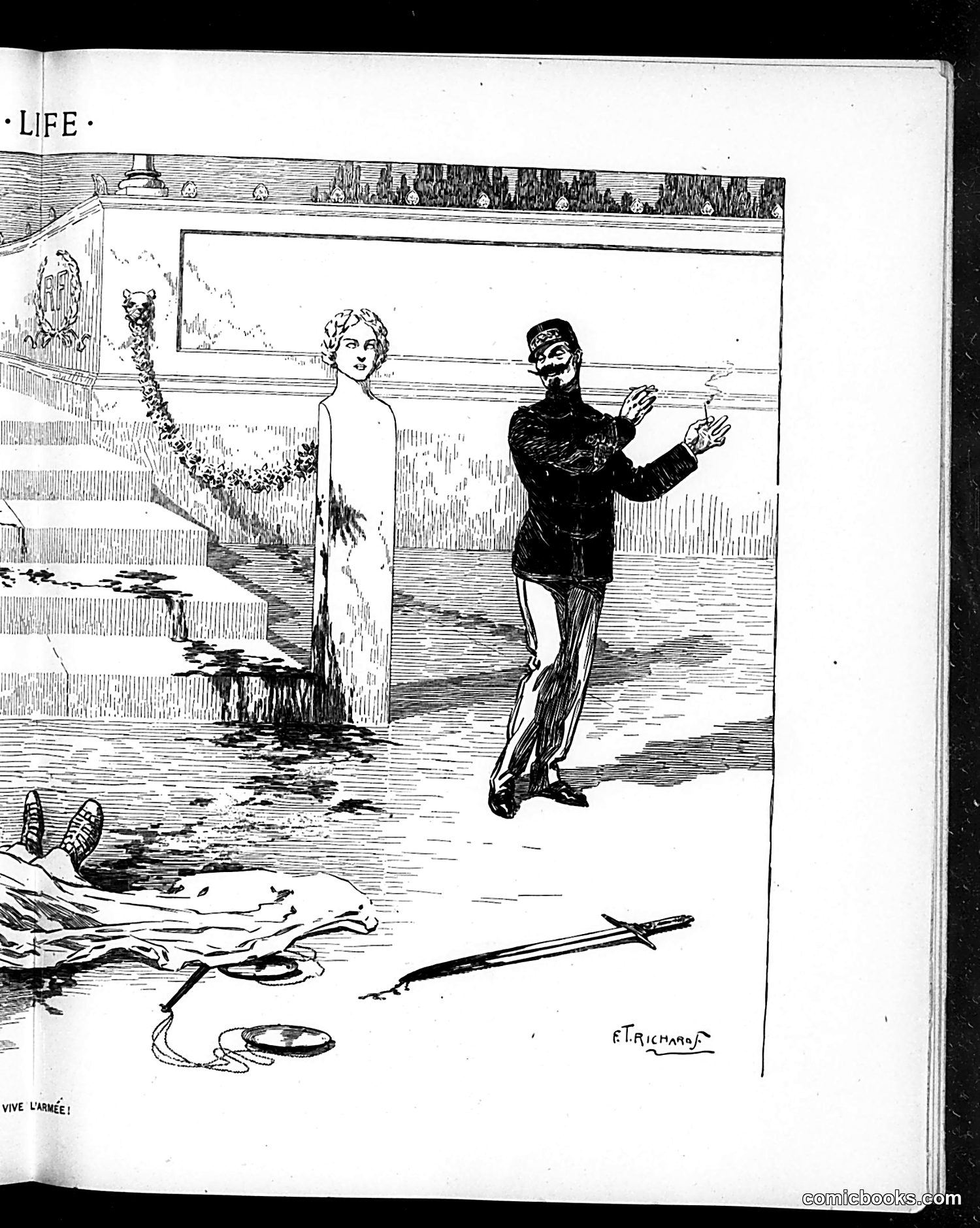
This cartoon from *Life* magazine depicts a military figure (identifiable by his uniform, cap, and mustache) gesturing expressively toward a classical female statue in what appears to be a formal interior setting. The scene appears to satirize military pretension or romantic overture—the officer seems to be making a grandiose gesture or declaration to the statue, as if attempting to court or impress it. The humor likely derives from the absurdity of a uniformed military man directing elaborate attention toward an inanimate classical sculpture rather than real people. This could satirize military pomposity, the disconnect between military authority and civilian life, or perhaps commentary on a specific historical figure's affected behavior. Without additional context or caption text clearly visible, the exact political target remains unclear.
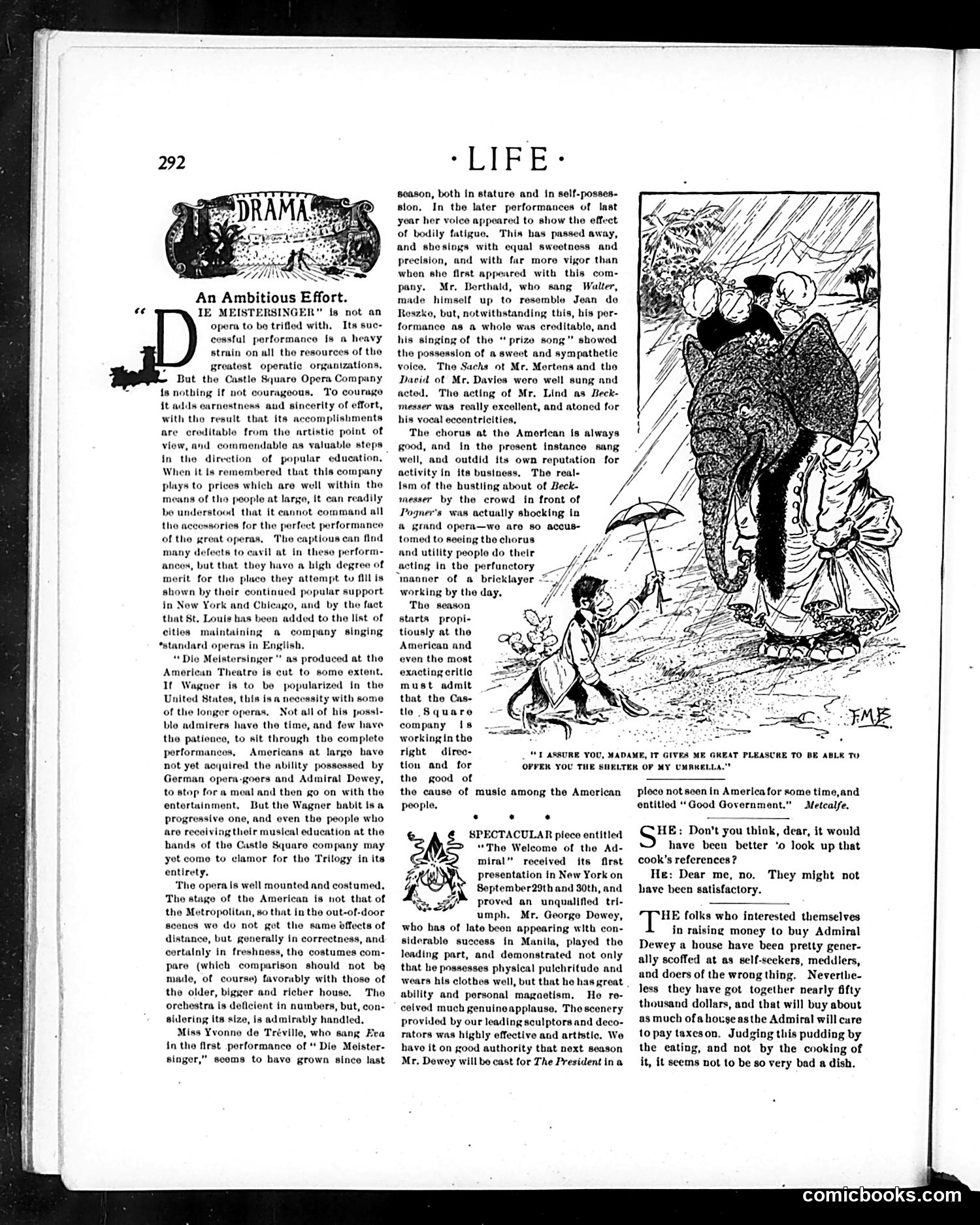
This page reviews opera performances, primarily Wagner's "Die Meistersinger." The main illustration (signed "JME") depicts a scene from the opera showing characters in period costume in what appears to be a street setting. The text praises the Castle Square Opera Company's ambitious production, noting that while the cast performed creditably overall, the chorus sometimes acted like "bricklayers working by the day" rather than dedicated performers. The review particularly commends George Dowey's leading role and the scenic design. A secondary dialogue exchange mocks someone for not checking cook references—likely satirizing domestic hiring practices of the era. The "Admiral Dewey" reference appears to joke about fundraising efforts for a public monument.
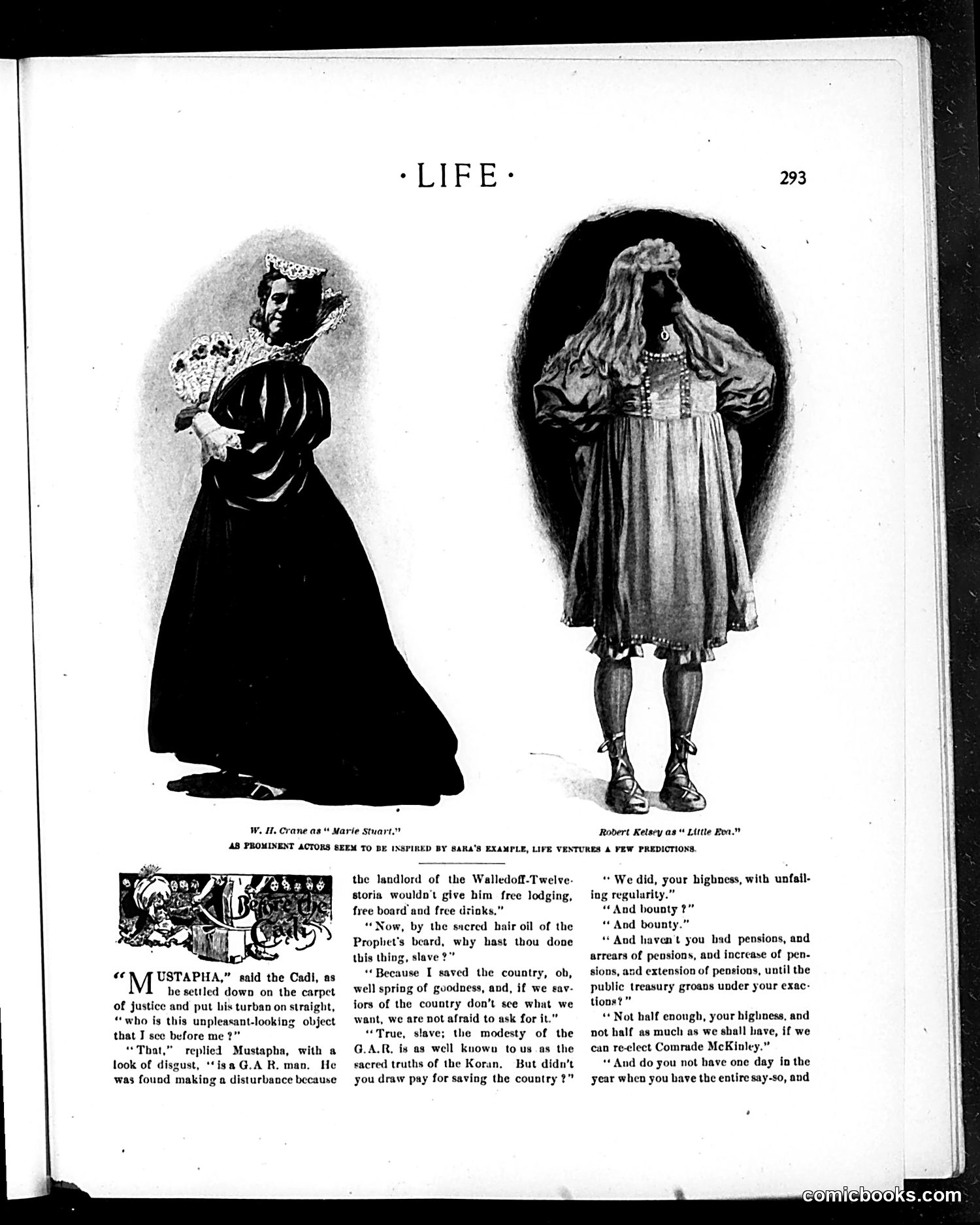
This page satirizes the Grand Army of the Republic (G.A.R.), a powerful Civil War veterans' organization, for aggressive pension-seeking. The framing device uses an Oriental tale where a "Cadi" (Islamic judge) questions why a G.A.R. man demands free lodging and board. The satire targets veteran entitlement: despite receiving regular pay, bounties, pensions, and pension increases during their service, the G.A.R. man still demands more—and threatens to re-elect "Comrade McKinley" (likely President William McKinley) to secure additional benefits. The joke satirizes how veterans leveraged political power to extract ever-expanding government compensation. The top illustration shows theatrical actors, suggesting Life intended predictions about how prominent figures might respond to Sara's (unclear reference) example—possibly suggesting actors would adopt similar shameless demands for public compensation.
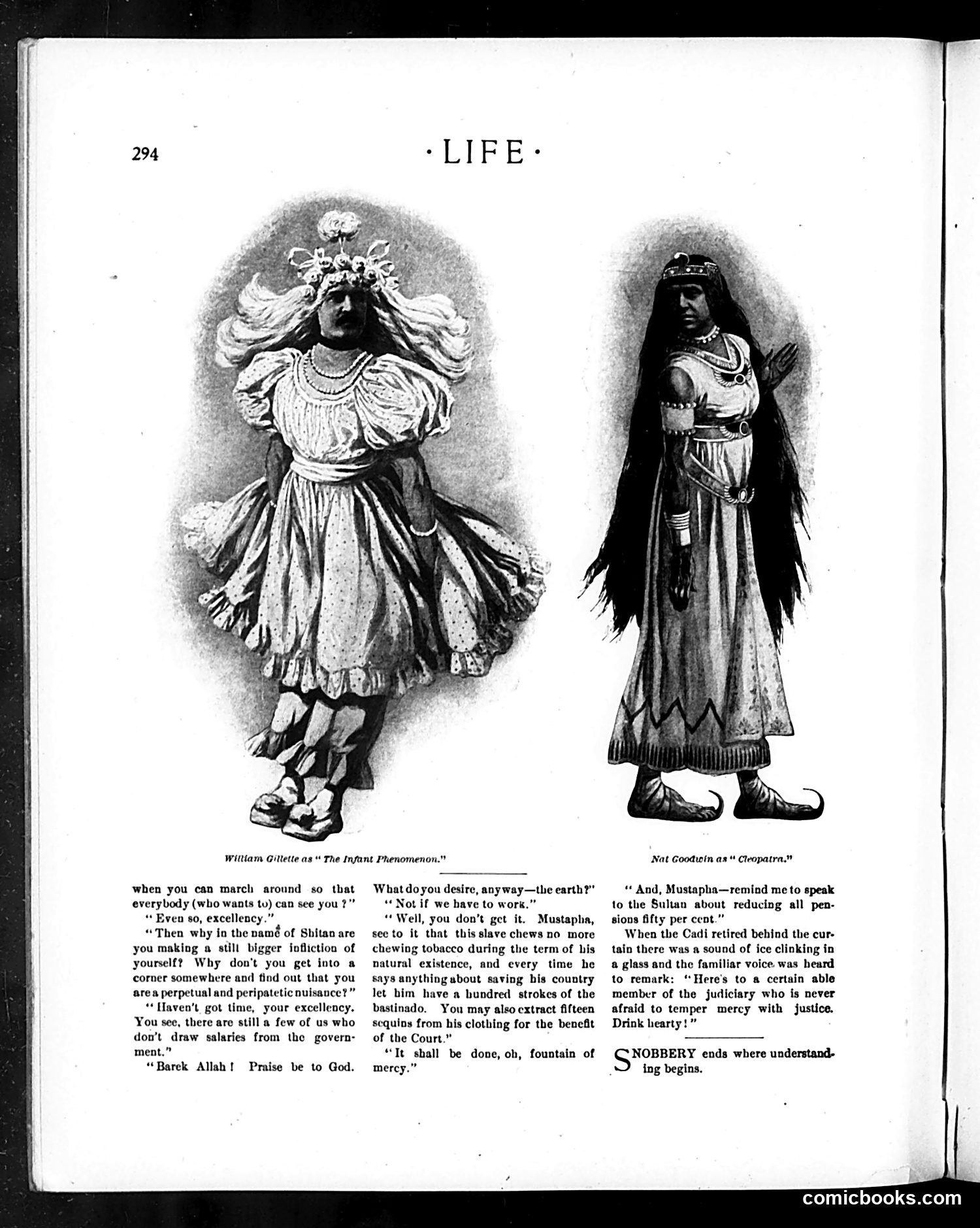
This page features two theatrical scenes satirizing political corruption and judicial hypocrisy in what appears to be an Ottoman or Middle Eastern setting. **Left image**: William Gillette as "The Infant Phenomenon" depicts a confrontation between a corrupt official (likely a Sultan or Pasha) and a citizen attempting civic protest or petition. The satire mocks how authorities dismiss and punish those seeking reform—here, the official orders the man's mouth sealed and demands bribes, while cynically claiming to support justice. **Right image**: Nat Goodwin as "Cleopatra" shows the aftermath: a judge privately celebrating his own hypocrisy with a drink, toasting his ability to appear merciful while actually extracting bribes and cutting pensions. **The joke**: The closing line—"Snobbery ends where understanding begins"—suggests these officials lack genuine understanding, operating through pure self-interest masked as authority. The theatrical framing allows Life to satirize American corruption through exotic costume, a common early-20th-century editorial technique.
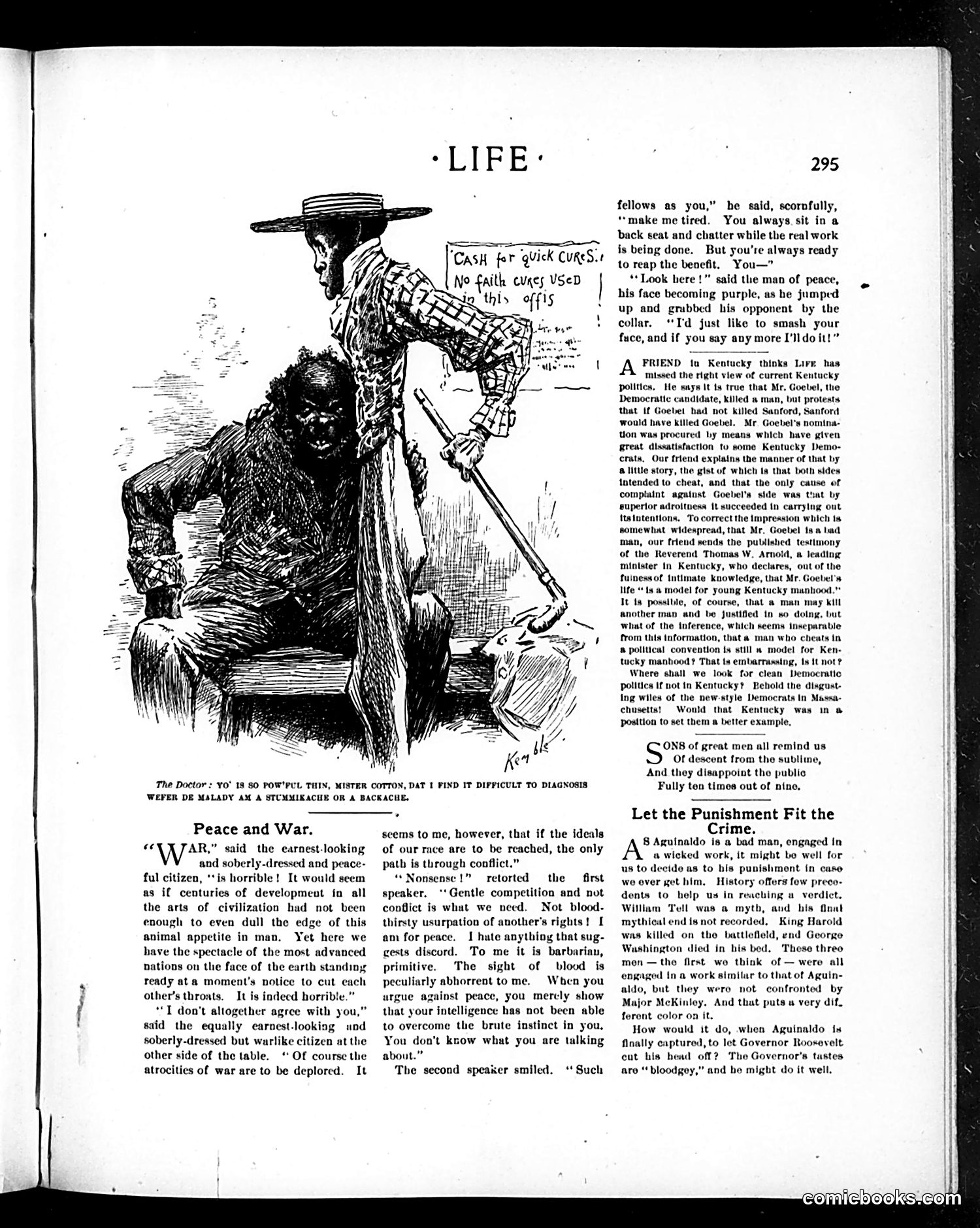
## Main Cartoon The top illustration depicts a doctor examining a patient (appearing to be a Black man) labeled "Mister Cotton," advertising "cash for quick cures" with "no faith cures used." This satirizes quack medical practitioners exploiting vulnerable populations through false remedies. ## "Peace and War" Dialogue Two citizens debate pacifism versus militarism. The "man of peace" argues eloquently against violence, but when challenged, he becomes enraged and violent—physically grabbing his opponent's collar and threatening to "smash your face." The satire reveals the hypocrisy: those preaching peace resort to brutality when their beliefs are questioned, undercutting their moral authority. ## Kentucky Politics Section This discusses Democratic candidate William Goebel, who killed a man (Sanford) during a disputed nomination. A letter defends Goebel's character despite the killing, arguing both sides intended cheating. The editorial sardonically questions whether killing someone at a political convention models "Kentucky manhood"—exposing the contradiction between moral standards and political practice.
This page is primarily **advertising and book announcements** with humorous filler content rather than political satire. The main illustrated content shows a dialogue between Miss Mabella St. Percy and her mother about a marriage proposal from Mr. Moneybags—a satire of **mercenary courtship**. The joke targets the hypocrisy of Victorian social conventions: the mother claims not to influence her daughter's choice while simultaneously highlighting the suitor's wealth (ten thousand pounds yearly, estates in Scotland and Brighton). The daughter's heart conveniently aligns with financial advantage. Additional humor pieces mock **rural obtuseness** (a boy beating a dog after it's "rescued"), **journalistic pretension** (an Austrian boxer unfamiliar with Cecil Rhodes), and **rural dialect** (a subscriber requesting an obituary for someone of unknown age). The page advertises new books from major publishers (Harper & Brothers, Scribner's, Macmillan) and Wilson Whiskey, with no apparent political commentary. It reflects typical late-19th-century *Life* magazine content: genteel social satire aimed at middle-class readers.
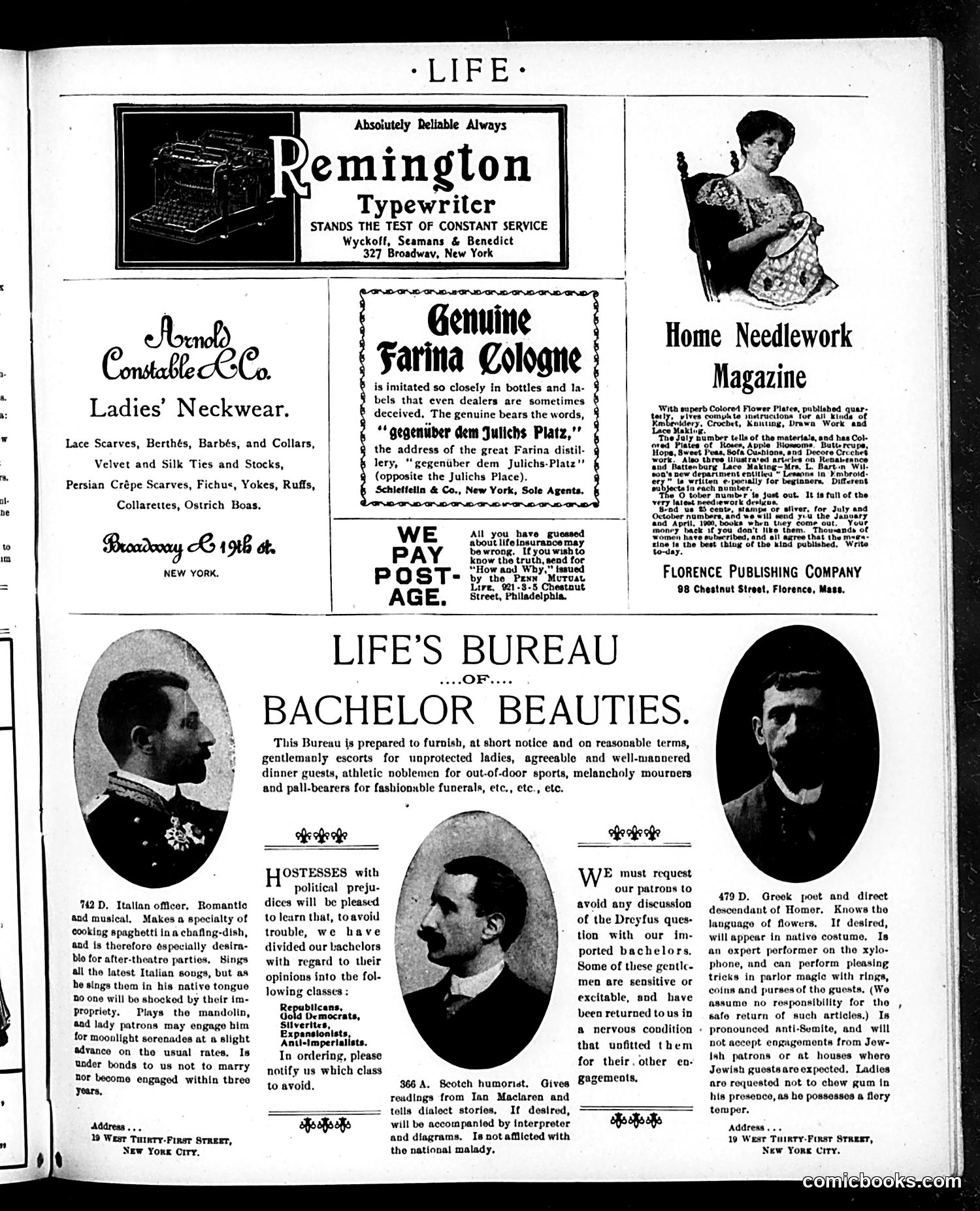
This satirical section of *Life* magazine offers a mock escort service for unmarried women, humorously categorizing available men by their professions and personalities. The jokes target both the bachelors and the social pretensions of the era. The humor hinges on stereotypes: an Italian officer specializes in post-theater dinners (implying romance), a Scottish humorist provides entertainment, and a Greek poet offers classical charm. The most pointed satire appears in the political classifications—bachelors are sorted into Republicans, Democrats, Imperialists, and Anti-Imperialists, with warnings that some are "sensitive" about the Dreyfus question (a divisive contemporary political scandal). One explicitly marked "anti-Semite" comes with a disclaimer excluding Jewish patrons. For modern readers: this reflects early 1900s attitudes where political ideology, ethnic prejudice, and marital eligibility were openly, casually intertwined in social discourse. The satire mocks both elite bachelor culture and the persistent social anxieties about unmarried women needing male "escorts."
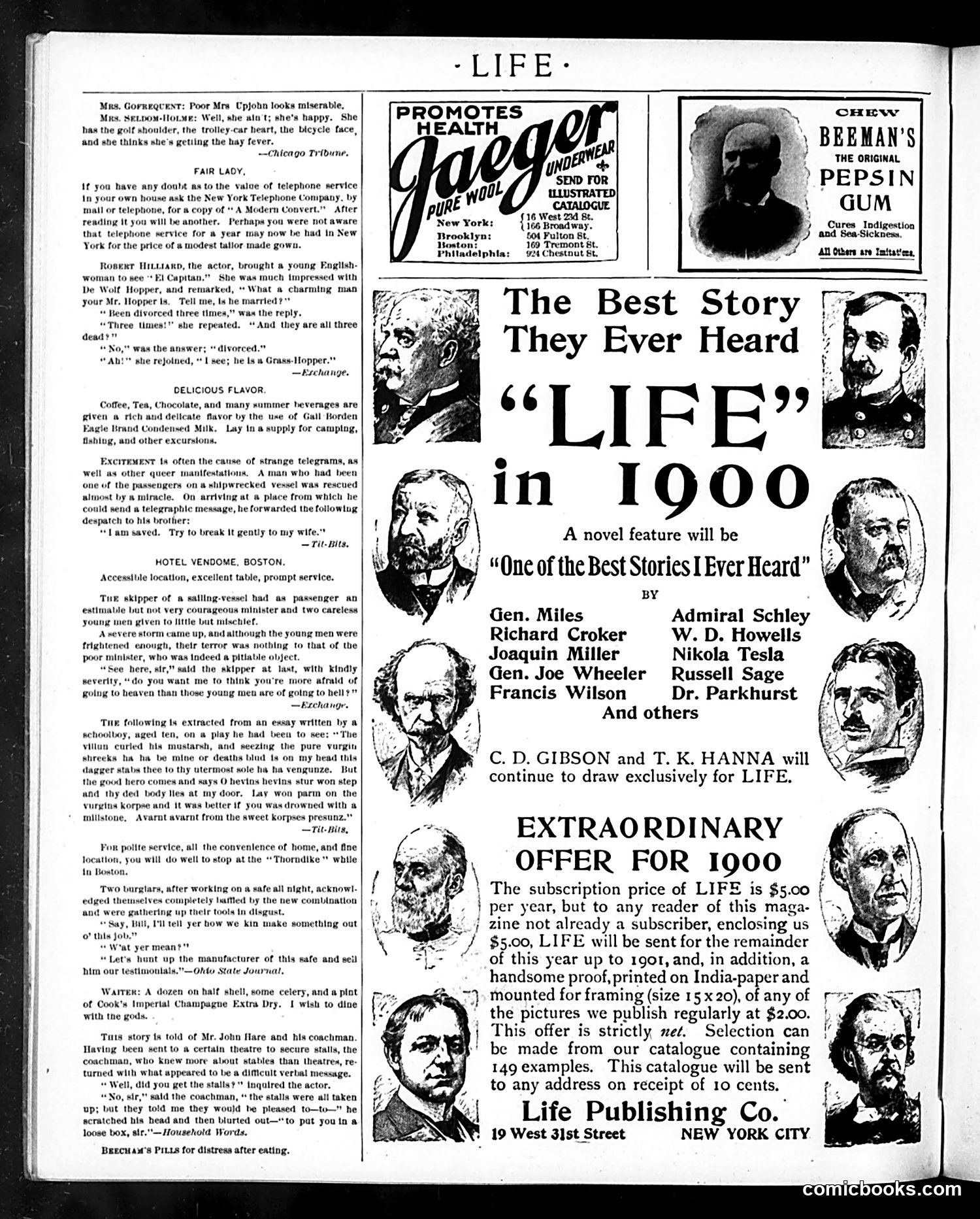
This is primarily an **advertising and humor page** from Life magazine (circa 1900, based on the "Life in 1900" promotion). The page contains: **Advertisements** for Faegol underwear, Beeman's Pepsin Gum, and a major promotion for Life magazine's upcoming serialization of "The Best Story They Ever Heard" featuring contributions from famous figures like General Miles, Admiral Schley, Nikola Tesla, and others. **Humor section** (left side): A collection of brief anecdotes and jokes typical of the era—including wordplay about actor De Wolf Hopper's divorces ("Grass-Hopper"), a telegram mishap, a minister's cowardice during a storm, and burglars trying to sell a safe manufacturer testimonials. **Key context for modern readers**: These are genteel, Victorian-era jokes relying on puns, moral situations (cowardice, divorce), and situational irony. The page demonstrates how Life functioned as both satirical publication and upscale advertiser. The "Life in 1900" promotion suggests millennial-themed marketing even then.
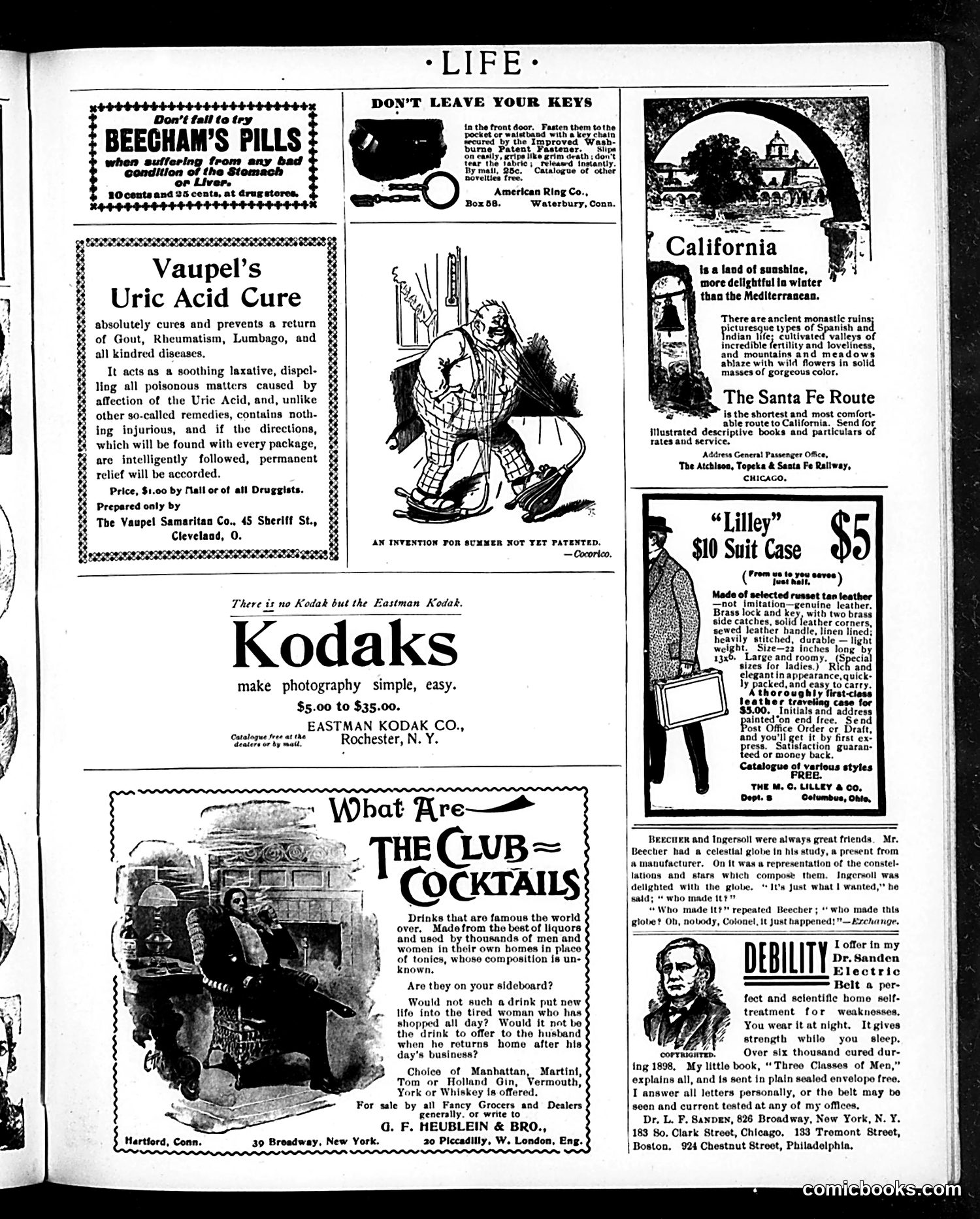
This page is primarily **advertisements** rather than political satire. It features patent medicines, tourist promotions, and commercial products typical of early 20th-century American marketing. Notable content includes: **Medical ads**: Beecham's Pills (stomach/liver remedy), Vaupel's Uric Acid Cure (gout treatment), and Dr. Sanden's Debility Electric Belt—all claiming to cure various ailments through now-discredited methods. **One joke/anecdote**: A brief exchange between Henry Ward Beecher (prominent preacher) and Robert Ingersoll (famous agnostic), where Ingersoll asks who made a celestial globe, and Beecher sarcastically replies "nobody...it just happened"—a dig at Ingersoll's atheism, implying his evolutionary views deny creation. **Tourist/product ads**: Kodak cameras, Santa Fe Railway (California promotion), and a Lilley suit case. The page reflects turn-of-century American commerce and the cultural debate between religious and secular worldviews.
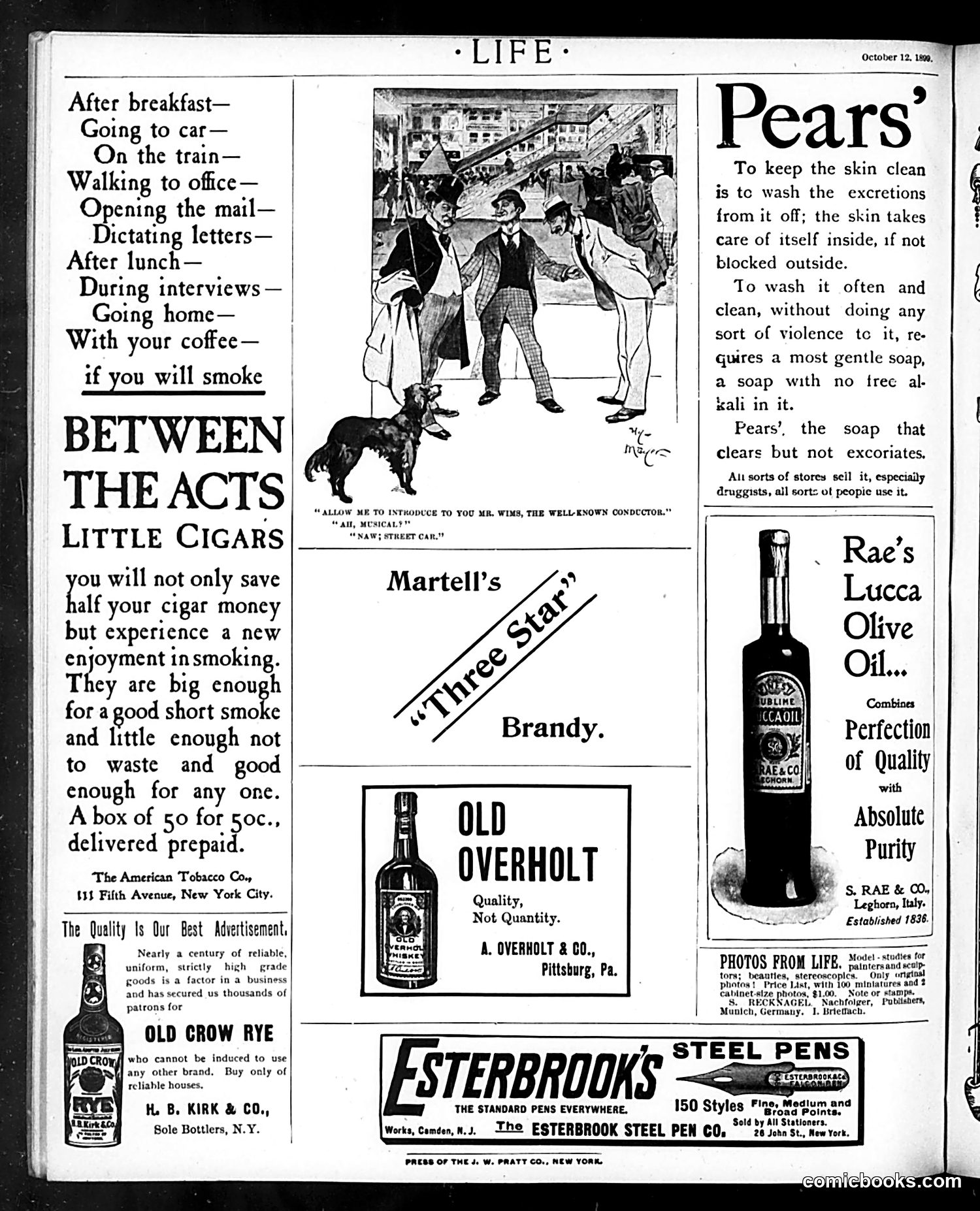
The main cartoon depicts a street scene where a man is introducing his dog to three well-dressed gentlemen, captioning it as introducing "Mr. Wims, the well-known conductor." The joke plays on a pun: the men mishear "conductor" as relating to music, responding "all, musical?" But the introducer clarifies "Naw; street car"—the dog is merely a street-car conductor's dog, not a musical conductor. This is gentle urban humor exploiting class pretensions and the absurdity of formally introducing a dog. The page is primarily filled with period advertisements (cigars, whiskey, soap, olive oil, steel pens) rather than editorial content. The list on the left appears to be advertising copy for "Between the Acts" little cigars, suggesting smoking opportunities throughout a businessman's daily routine. The overall page reflects turn-of-the-century American consumer culture and modest comedic sensibilities aimed at middle-class readers.