
Life, 1899-10-12 · page 4 of 20
Life — October 12, 1899 — page 4: what you’re looking at
What you’re looking at
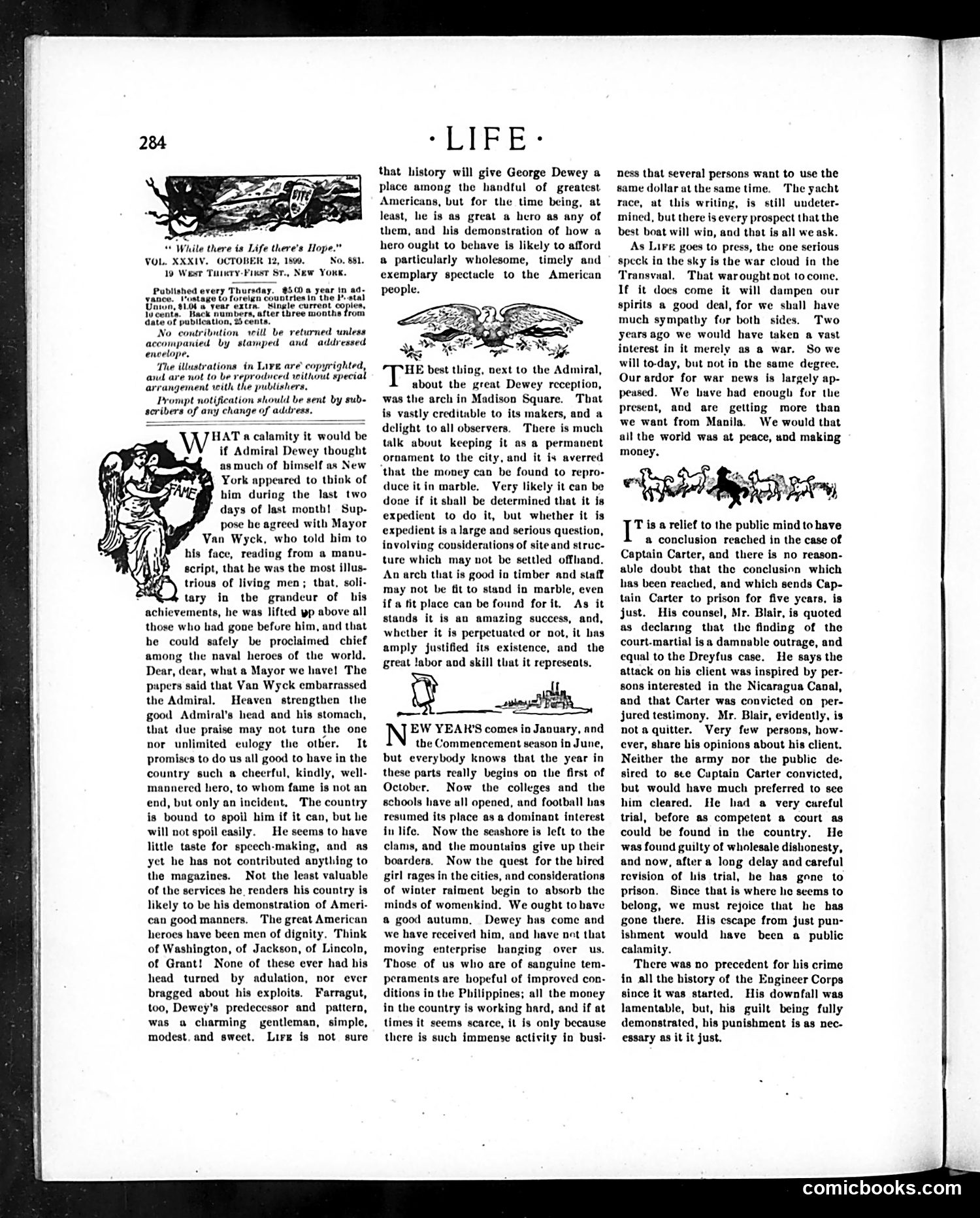
The page contains three editorial cartoons critiquing contemporary figures and events: 1. **Top left**: A caricature appears to comment on Mayor Van Wyck and Admiral Dewey's reception in New York, mocking the mayor's self-aggrandizing behavior during celebrations for the Admiral. 2. **Center**: An illustration of an arch in Madison Square, discussing whether it should be made permanent—satirizing civic debates about monuments and public spending. 3. **Bottom**: References to the Captain Carter court-martial case, criticizing the verdict as a "damnable outrage" and questioning Carter's conviction on allegedly perjured testimony. The text emphasizes these were controversial decisions that sparked public debate about justice, military honor, and civic leadership during the Progressive Era.
📄 Transcribed text from this page (OCR, searchable)
Machine-transcribed from the original scan — historical spelling and the odd misread are preserved.
VOL. XXXIV. OCTOBER 12, 1899. 19 West Tusmry-Pinst St., New Yor ureday. @500 a year in relgn countries in the Psa Year extra. Single current copie lWeents. Back numbers, after three months from date of publication, % cents. No contribution will be returned unless accompanied by stamped and addressed envelope. ‘The illustrations in Live are copyrighted, aud are not to be reproduced without special arrangement with the publishers, Prompt notification should be sent by sub- scribers of any change of address, HAT a calamity it would be if Admiral Dewey thought as much of himself as New A York appeared to think of him during the last two days of last month! Sup- pose he agreed with Mayor y7 Van Wyck, who told him to his face, reading from a manu- script, that he was the most illus- trious of living men; that, soli- . tary in the grandeur of his achievements, he was lifted pp above all those who bad gone before him, and that be could safely be proclaimed chief among the naval heroes of the world, Dear, dear, what a Mayor we have! The pupers said that Van Wyck embarrassed the Admiral. Heaven strengthen the good Admiral’s head and his stomach, that due praise may not tura the one nor unlimited eulogy the other. It promises to do us all good to have in the country such a cheerful, kindly, well- mannered hero, to whom fame is not an end, but only an incident, The country is bound to spoil him if it can, but he will not spoil easily. He seems to have little taste for speech-making, and as yet he has not contributed anything to the magazines. Not the least valuable of the services he renders his country is likely to be his demonstration of Amcri- can good manners. The great American heroes have been men of dignity, Think of Washington, of Jackson, of Lincoln, of Grant! None of these ever had his head turned by adulation, nor ever bragged about his exploits. Farragut, too, Dewey's predecessor and pattern, was a charming gentleman, simple, modest. and sweet. Lirg is not sure ~LIFE- that history will give George Dewey a place among the handful of greatest Americans, but for the time being, at least, he is as great a hero as any of them, and his demonstration of how a hero ought to behave is likely to afford a particularly wholesome, timely and exemplary spectacle to the American 'HE best thing, next to the Admiral, about the great Dewey reception, was the arch in Madison Square. That is vastly creditable to its makers, and a delight to all observers. There is much talk about keeping it as a permanent ornament to the city, and it is averred that the money can be found to repro- duce it in marble. Very likely it can be done if it shall be determined that it is expedient to do it, but whether it is expedient is a large and serious question, involving considerations of site and struc- ture which may uot be settled offhand. An arch that is good in timber and staff may not be fit to stand in marble, even if'a tit place can be found for it. As it stands it is an amazing success, and, whether it is perpetuated or not, it bas amply justified its existence, and the great labor aod skill that it represeats, EW YEAR'S comes in January, and the Commencement season in June, but everybody knows that the year in these parts really Legins on the first of October. Now the colleges and the schools have all opened, and football has resumed its place as a dominant interest in life. Now the seashore is left to the clams, and the mountains give up their boarders. Now the quest for the hired girl rages in the cities, and considerations of wioter raiment begin to absorb the minds of womenkind. We ought to bave @ good autumn, Dewey has come and we have received him, and have not that moving enterprise banging over us. Those of us who are of sanguine tem- peraments are hopeful of improved con- ditions in the Philippines; all the money in the country is working hard, and if at times it seems scarce, it is only because there is such immense activity in busi- ness that several persons want to use the same dollar at the same time. The yacht race, at this writing, is still undeter- mined, but there is every prospect that the best boat will win, and that is all we ask. As Lire goes to press, the one serious speck in the sky is the war cloud in the Transvaal, That war ought not tocome, If it does come it will dampen our spirits a good deal, for we shall have much sympathy for both sides. Two years ago we would have taken a vast interest in it merely as a war. So we will to-day, but not in the same degree, Our ardor for war news is largely ap- peased. We have had enough for the present, and are getting more than we want from Manila. We would that all the world was at peace, und making money, lar Ripley I is a relief to the public mind to have a conclusion reached in the case of Captain Carter, and there is no reason- able doubt that the conclusion which has been reached, and which sends Cap- tain Carter to prison for five years, is just. His counsel, Mr. Blair, is quoted as declaring that the finding of the court-martial isa damnable outrage, and equal to the Dreyfus case. He says the attack on his client was inspired by per- sons interested in the Nicaragua Canal, and that Carter was convicted on per- jured testimony. Mr. Blair, evidently, is nota quitter. Very few persons, how- ever, share his opinions about his client. Neither the army nor the public de- sired to see Cuptain Carter convicted, but would have much preferred to see him cleared. He had a very cureful trial, before as competent a court as could be found in the country, He was found guilty of wholesale dishonesty, and now, after a long delay and careful revision of his trial, he has gone to prison. Since that is where he seems to belong, we must rejoice that he has gone there. His cscape from just pun- ishment would have been a public calamity. There was no precedent for his crime in all the history of the Engineer Corps since it was started. His downfall was lamentable, but, his guilt being fully demonstrated, his punishment is as nec- essary as it it just. comicbooks.com