
A complete issue · 20 pages · 1899
Life — October 5, 1899
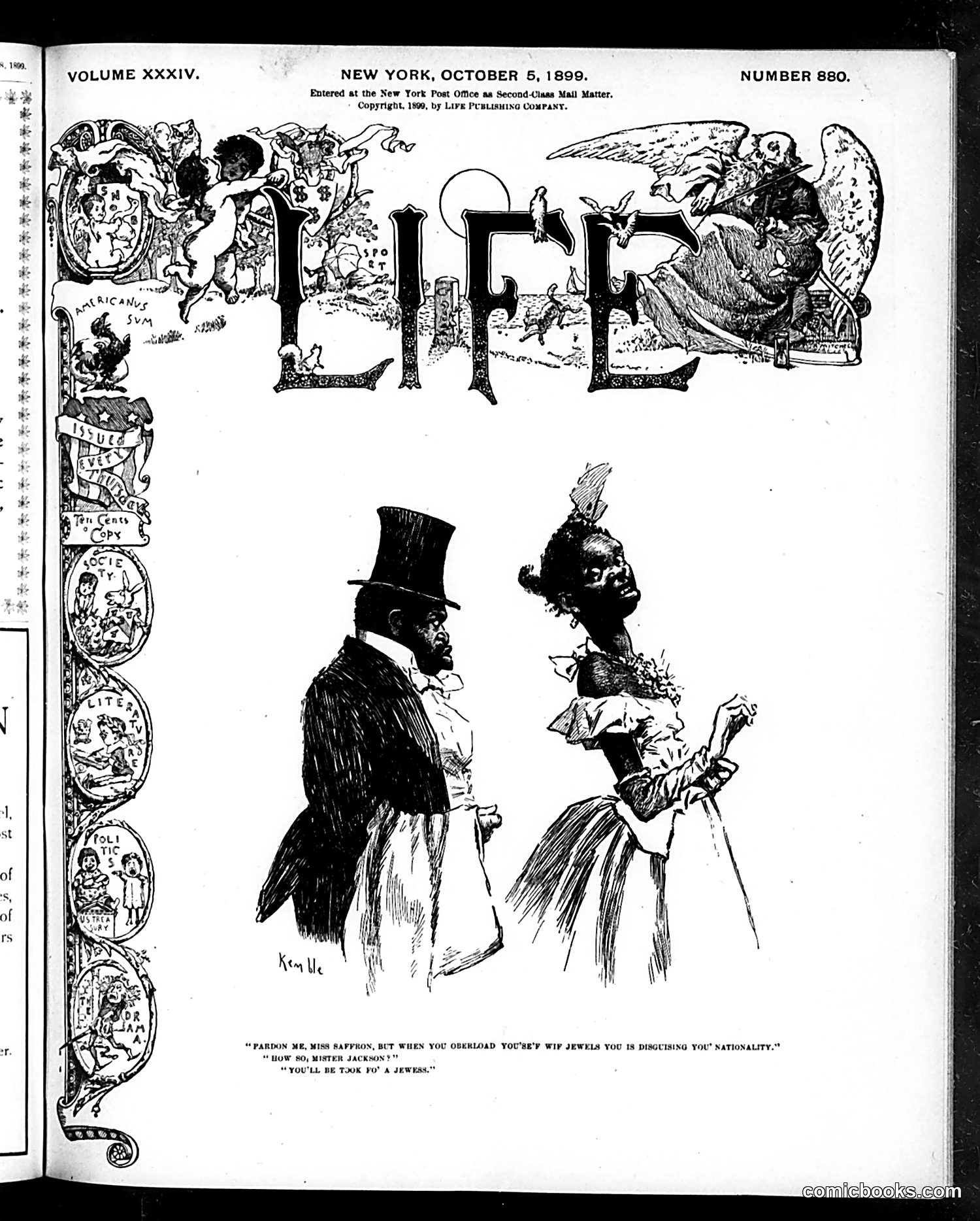
This page contains a satirical cartoon addressing anti-Semitic stereotypes and xenophobic attitudes of the period. The illustration shows two figures in formal dress engaged in conversation. The caption references "Miss Bappson" and "Mister Jackson," with dialogue about "overload[ing]" someone's "wig jewels" and concerns about "nationality." The cartoon appears to mock prejudiced attitudes toward Jewish immigrants or Jewish Americans, specifically satirizing the notion that displaying wealth through jewelry would provoke accusations of foreignness or threaten one's belonging. The artist uses the dialogue to expose the absurdity and hypocrisy of such discriminatory thinking. The ornate decorative border on the left side is typical of *Life* magazine's design aesthetic from this era.
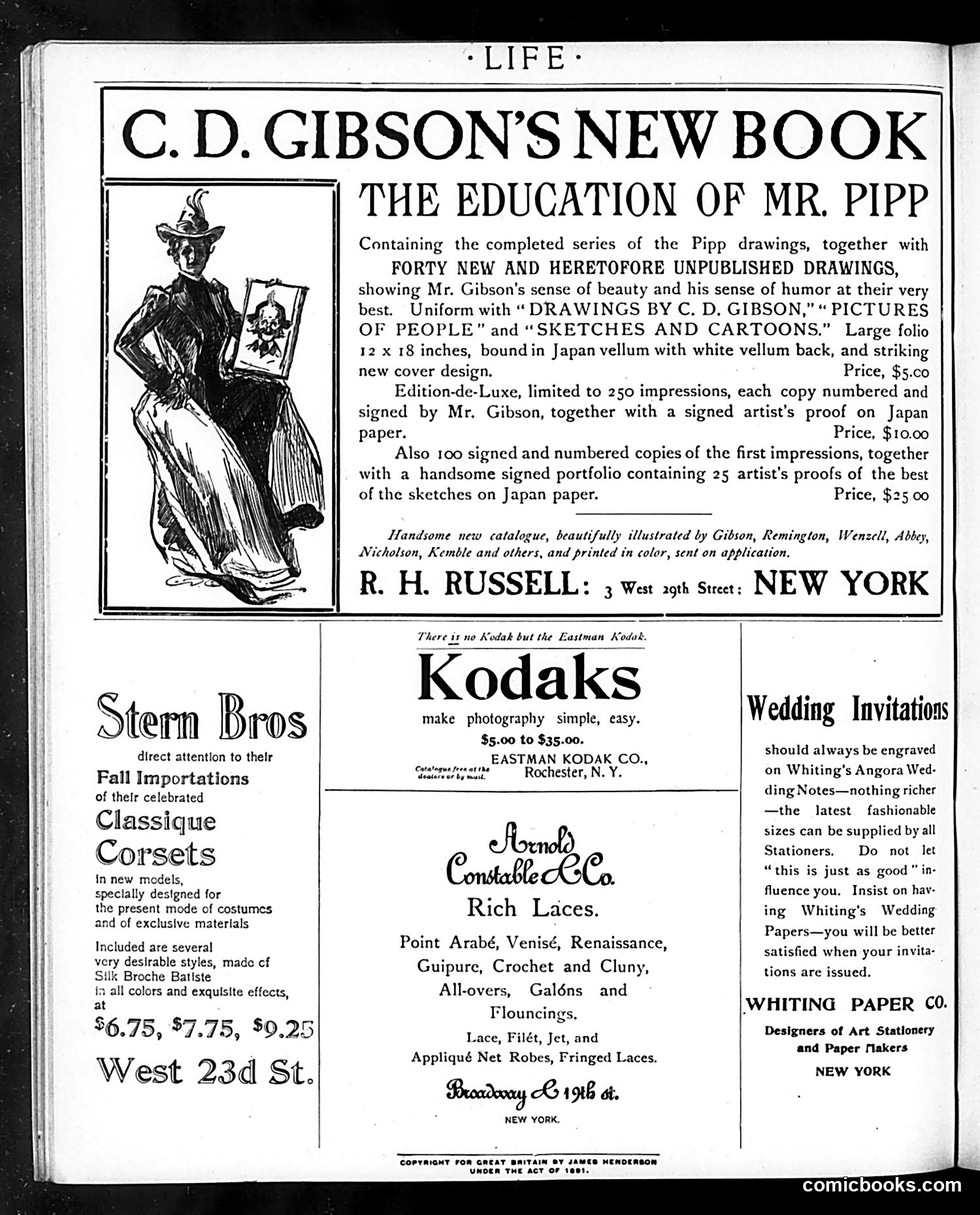
This page is primarily **advertising**, not political satire. The dominant feature is C.D. Gibson's book advertisement for "The Education of Mr. Pipp," featuring his characteristic pen-and-ink illustration of a fashionably dressed woman. Gibson was Life's most famous cartoonist, known for creating the "Gibson Girl" ideal. The remaining advertisements promote corsets (Stern Bros), cameras (Kodak), lace products (Arnold Constable), and wedding stationery (Whiting Paper Co.). These were typical luxury goods marketed to wealthy early-20th-century readers. There is **no apparent political commentary** on this page—it reflects the magazine's dual function as both satirical publication and upscale advertising vehicle for affluent audiences.
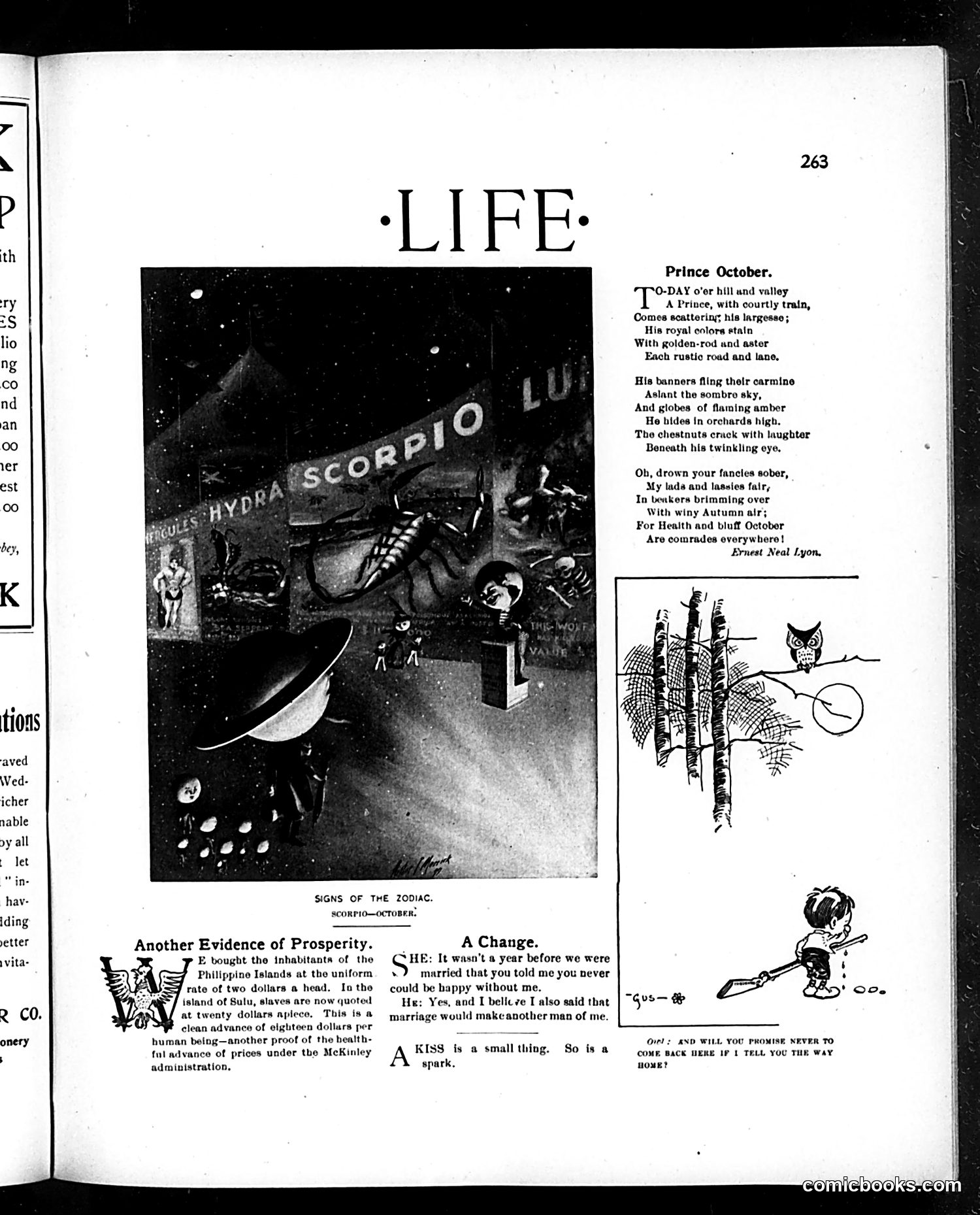
This page contains a poem titled "Prince October" by Ernest Neal Lyon, illustrated with seasonal imagery (an owl, autumn grasses, and a child). The accompanying large illustration labeled "Signs of the Zodiac: Scorpion-October" depicts a mythological scorpion figure in a dramatic celestial scene. Below are two brief satirical items: "Another Evidence of Prosperity" describes economic improvement under McKinley's administration, citing rising wages in the Philippines ($2 to $20 per head). "A Change" presents a marriage joke where the husband claims he'd be unhappy without his wife, contradicting his earlier statement—typical early-1900s marital humor. The page mixes seasonal/astrological content with light political and domestic satire typical of Life magazine's format.
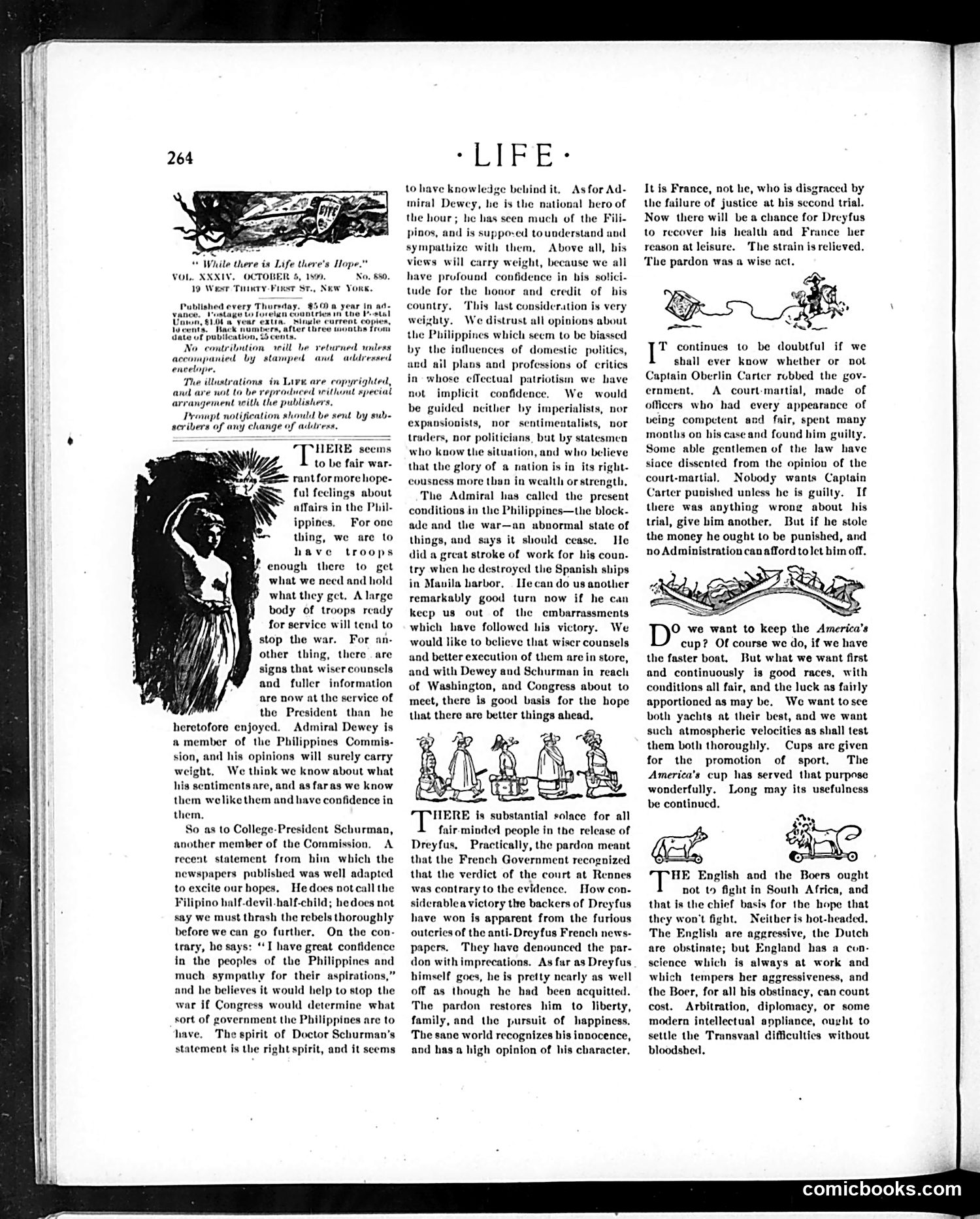
This page discusses Admiral Dewey and the Philippines conflict, referencing his military success destroying Spanish ships in Manila harbor. The text debates whether Dewey should be prosecuted or pardoned for actions taken during the war. The left illustration shows a bearded male figure (likely representing either Dewey or a symbolic authority figure), rendered in bold black ink. The page's central argument concerns Captain Oberon Sheridan, apparently court-martialed for conduct during the Philippines campaign. The text suggests France's pardon of Dreyfus (the famous 1890s case referenced) provides precedent for showing mercy rather than pursuing punishment. The satirical angle critiques whether military justice should prioritize strict accountability versus pragmatic clemency—relevant to post-Spanish American War politics around 1899-1900.
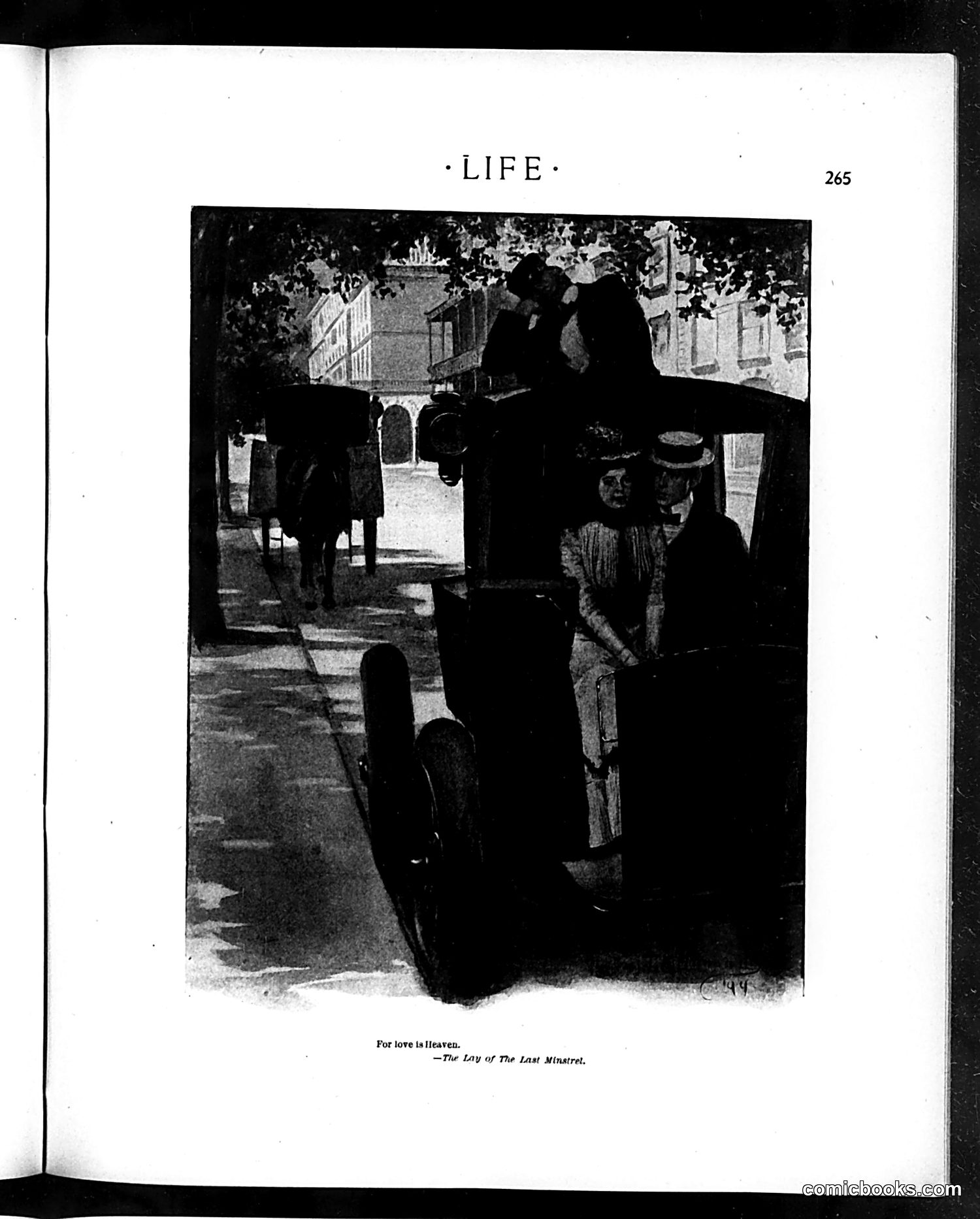
This page from *Life* magazine (page 265) features a black-and-white photograph with the caption "For love is fleeted" attributed to "The Lay of the Last Minstrel." The image shows a street scene with multiple figures in early 20th-century dress gathered near what appears to be a residential building. The dramatic lighting and silhouetted figures create a theatrical mood. However, without additional context about the specific issue date or surrounding articles, it's unclear what political or social event this photograph references or satirizes. The literary quote suggests themes of fleeting romance or lost love, but the connection between the caption and the street scene is ambiguous. The image may be illustrating a contemporary social story or scandal, but the specific reference remains uncertain without more contextual information.
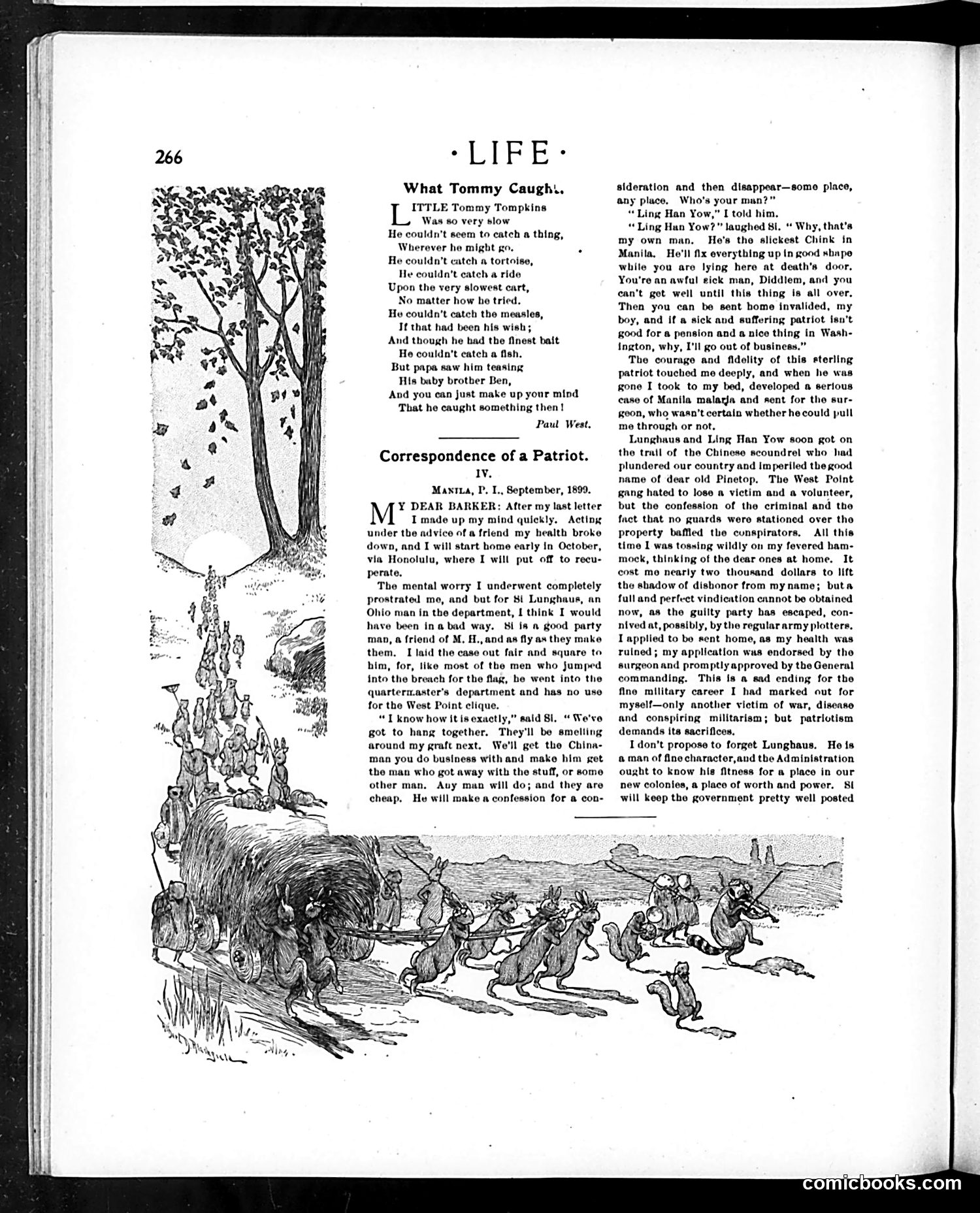
**"What Tommy Caught"** (poem by Paul West): A humorous verse about a boy named Tommy Pumpkins who cannot catch anything—not fish, tortoises, rides, or measles—despite trying various methods. The joke appears to be simply about childhood incompetence. **"Correspondence of a Patriot"** (letter dated Manila, September 1899): A political letter addressing concerns about the Philippine-American War. The writer defends American actions, specifically mentioning Filipino insurgent leaders "Ling Han Yow" and "Lunghaua," and justifies military necessity while criticizing suggestions of impropriety. The letter reflects pro-administration sentiment regarding the controversial Philippine occupation following the Spanish-American War (1898). The bottom illustration depicts what appears to be Filipino fighters or insurgents in combat or retreat.
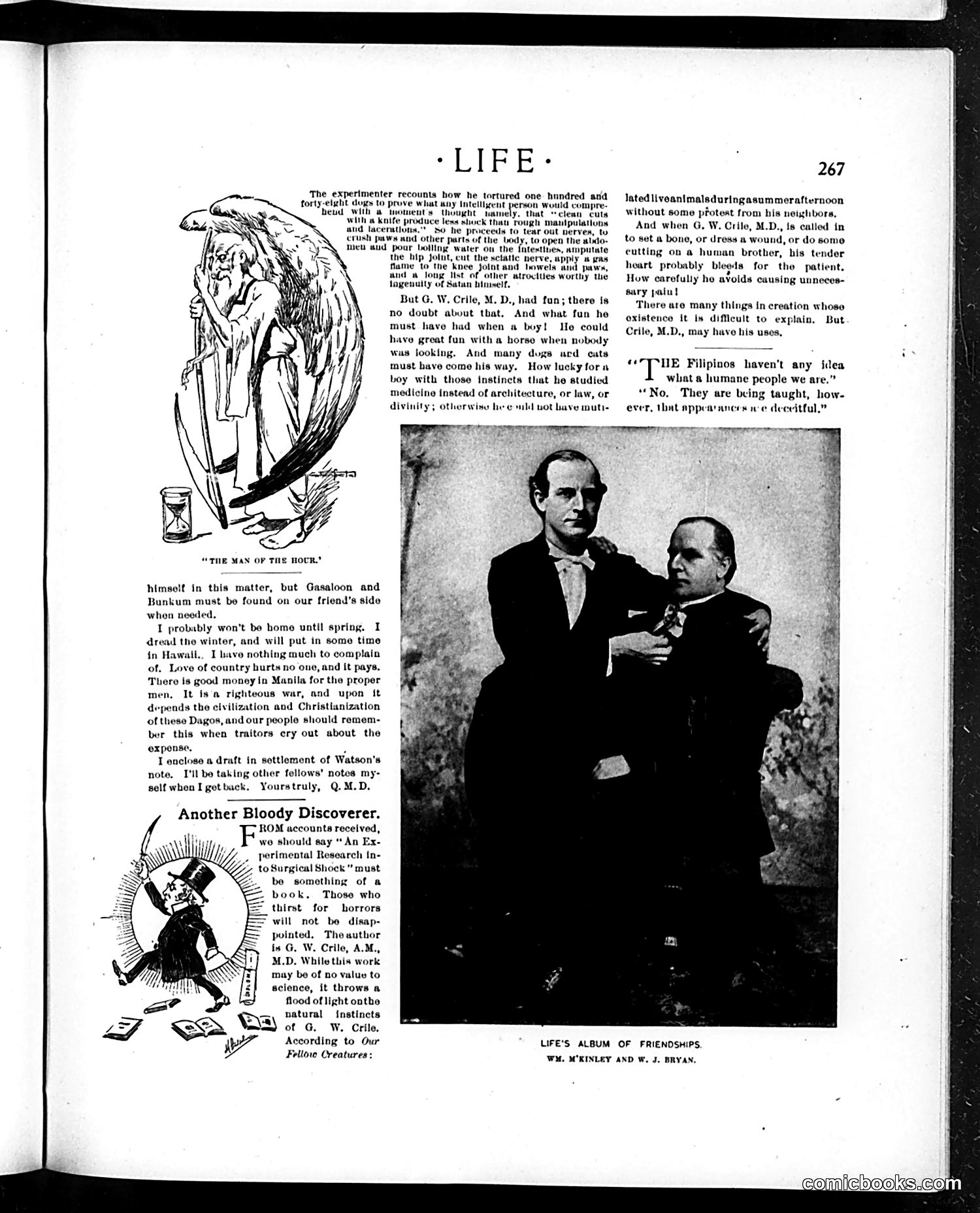
This page contains a satirical piece by G. W. Crile, M.D., critiquing vivisection (animal experimentation). The left illustration titled "THE MAN OF THE HOUR" depicts a grotesque figure conducting surgical experiments, mocking scientists who justify animal testing as necessary progress. Below, "Another Bloody Discoverer" ridicules a research publication on "Experimental Research into Surgical Shock," suggesting such work is sensationalism disguised as science. The cartoon caricature emphasizes the author's (Crile's) skepticism toward claimed medical advances through animal testing. The photograph shows two men identified as "WM. McKINLEY AND W. J. BRYAN"—likely contemporary political figures included for contrast or additional commentary. The satire targets the ethical justification of vivisection and questions whether scientific progress justifies animal suffering.
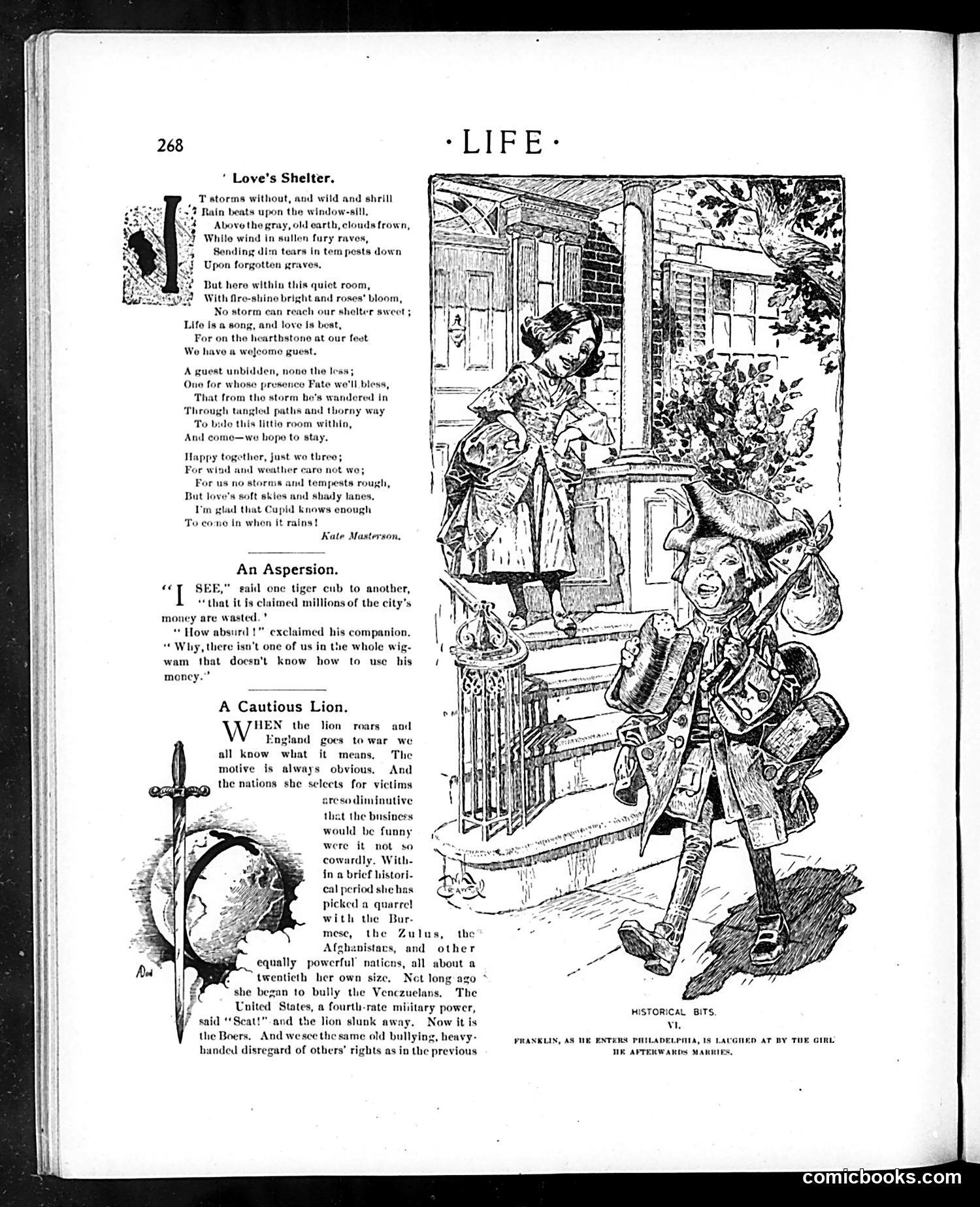
This page contains three distinct pieces: 1. **"Love's Shelter"** by Kate Masterson: A sentimental poem about romantic refuge from life's storms. 2. **"An Aspersion"**: A brief joke about tiger cubs discussing money and class awareness—likely satirizing wealthy individuals' ignorance about finances. 3. **"A Cautious Lion"**: A political cartoon depicting England as a cautious lion reluctant to enter war, despite pressure. The text references England's hesitation before entering a conflict, with historical notes about Venezuela and military power. The accompanying illustration shows **Franklin entering Philadelphia** (captioned as "Historical Bits VI"), appearing to be an unrelated historical reference rather than political commentary on the main piece. The overall page blends humor, sentiment, and political satire typical of Life magazine's format.
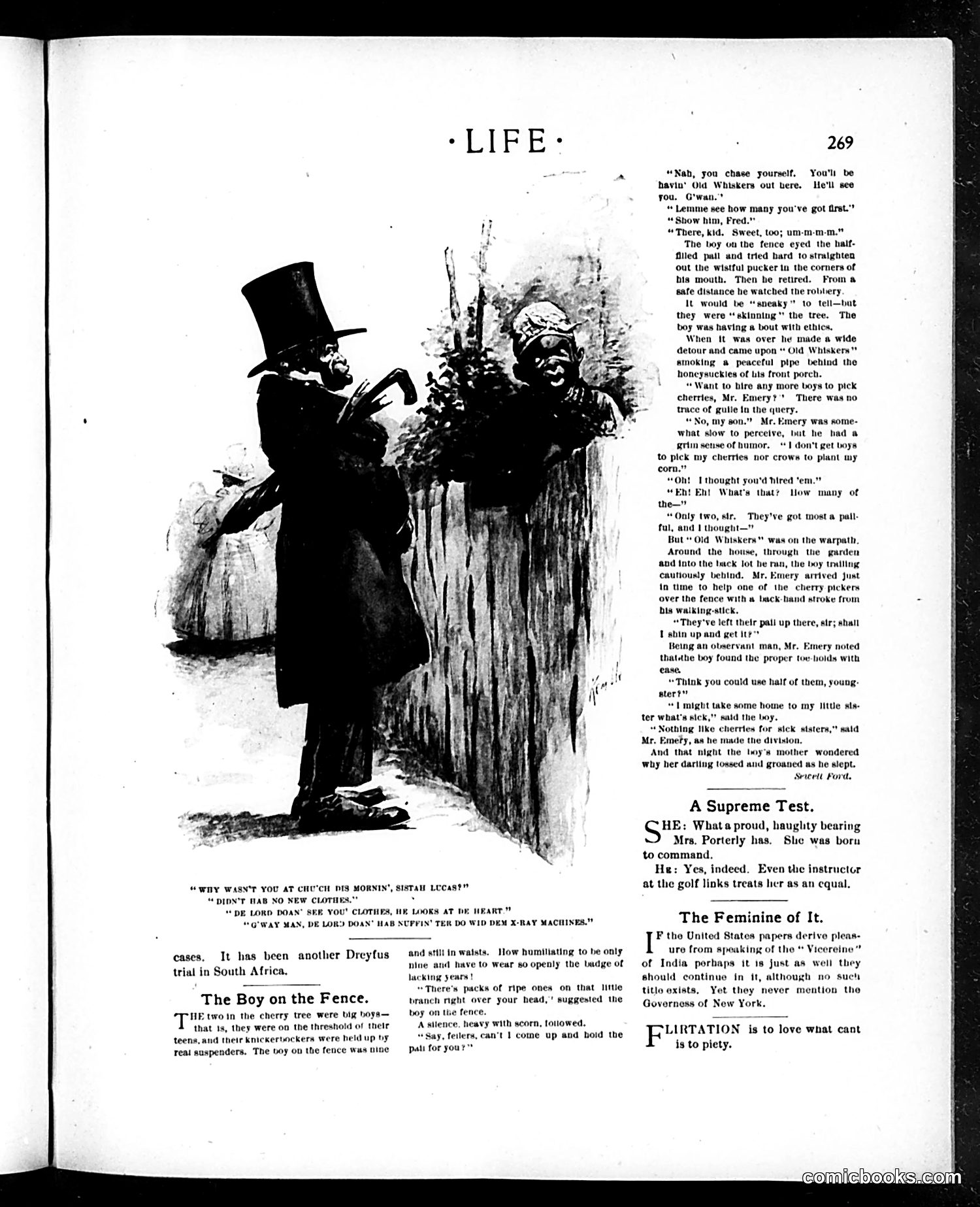
The main illustration shows two figures at a wooden fence in what appears to be a scene of social commentary. The caption beneath reads: "WHY WASN'T YOU AT CHURCH DIS MORNIN', SISTAH LUCAS?" / "DIDN'T HAB NO NEW CLOTHES." / "DE LORD DONE SAID YOU CLOTHES, HE LOOKS AT DE HEART." / "O'WAY MAN, DE LORD DONE' HAB NUFFIN' TER DO WID DEM X-RAY MACHINES." This depicts a satirical critique of materialism and vanity within religious practice. The dialogue suggests a poor African American woman skipped church due to lack of fashionable clothing, contradicting Christian teachings about inner virtue. The "X-ray machines" reference appears to mock the idea that modern society's superficiality (judging by appearances) has replaced spiritual values—a commentary on materialism overtaking faith during the early 20th century.
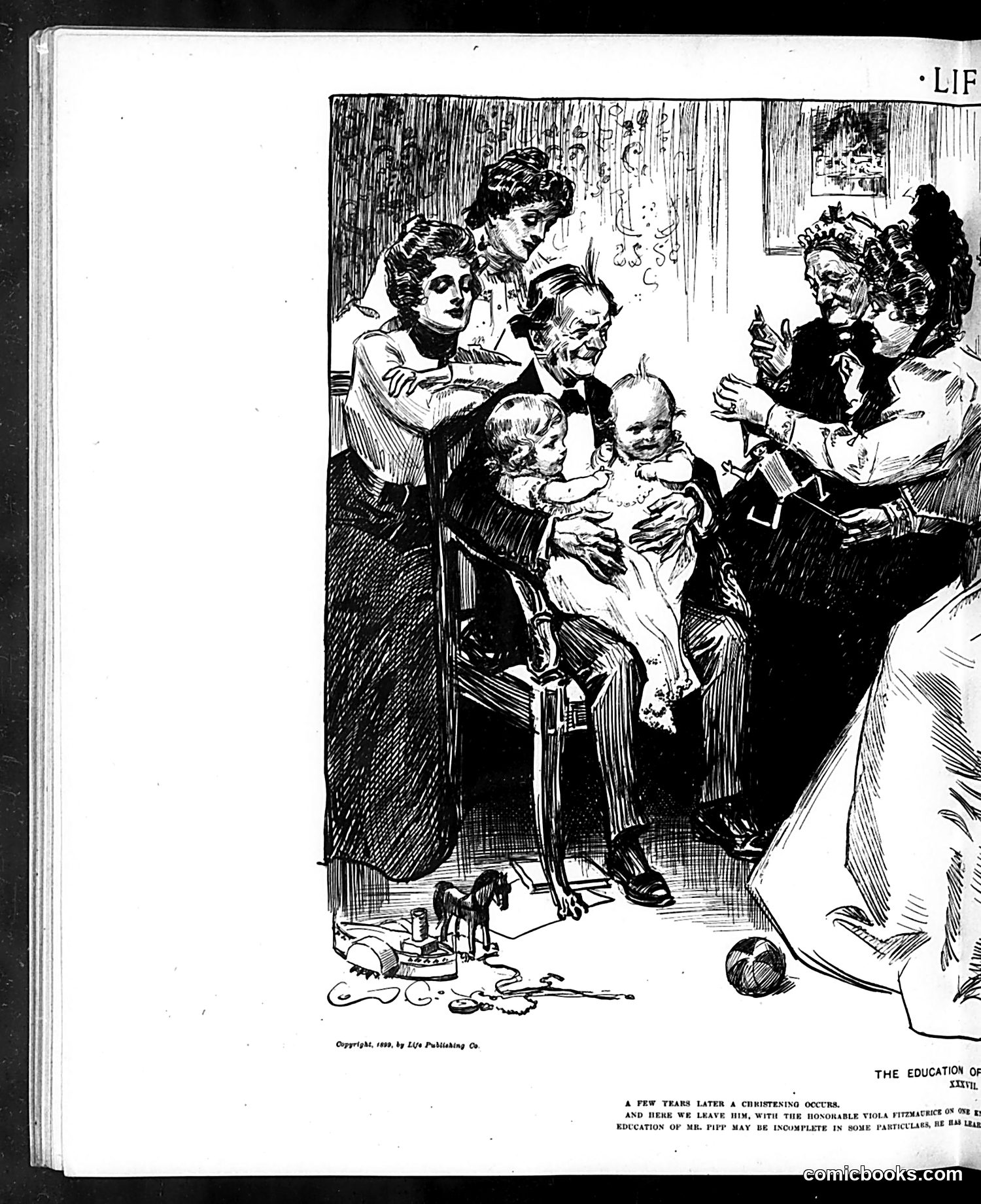
This satirical illustration depicts a christening ceremony for a newborn child, titled "The Education of Lxxvii" (Roman numerals suggesting perhaps the 77th in a series). The scene shows multiple well-dressed adults gathered around an infant being held by a gentleman in formal attire, with toys scattered on the floor below. The satire appears to mock upper-class child-rearing practices and social pretension surrounding infant "education." The various adults—likely representing different social influences or educational philosophies—attend to the baby, suggesting the era's obsession with proper upbringing and social training from birth. The casual toys underfoot contrast with the formal, serious demeanor of the adults, highlighting the cartoon's ironic commentary on overly elaborate approaches to early childhood development among the wealthy.
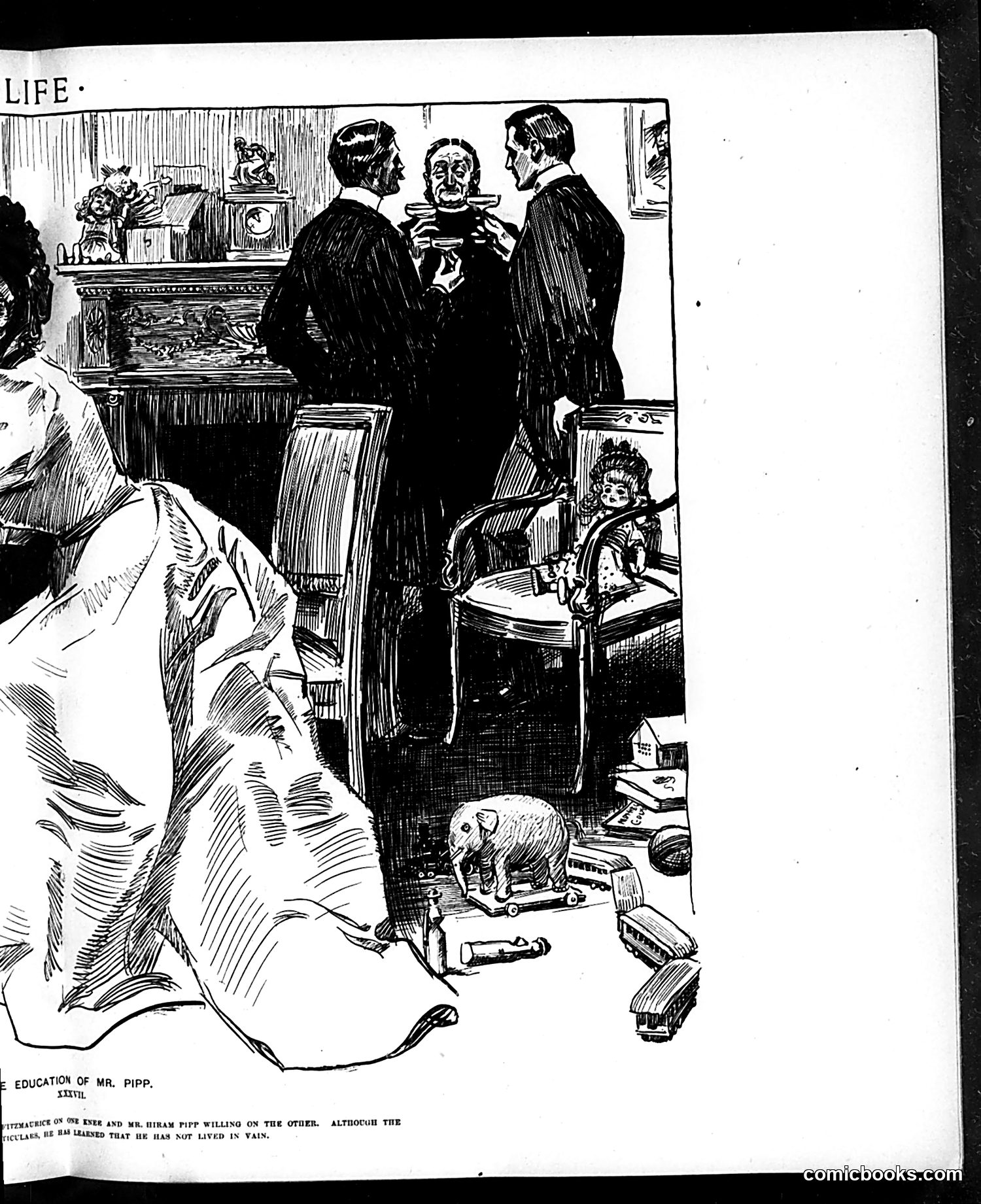
This appears to be an illustration from "The Education of Mr. Pipp" (visible at bottom left). The caption states: "Utterance of one ever and Mr. Hiram Pipp willing on the other. Although the uncles he has learned that he has not lived in vain." The scene depicts a domestic interior where two well-dressed men converse with an older gentleman while a child plays on the floor with toys. The satire likely concerns Mr. Pipp's "education" — possibly mocking how even unremarkable people convince themselves they've made meaningful contributions to society, or satirizing social pretension among the wealthy classes regarding child-rearing and family values. Without additional context about the specific character or historical moment, the precise satirical target remains unclear, though the tone suggests gentle mockery of middle-class self-importance.
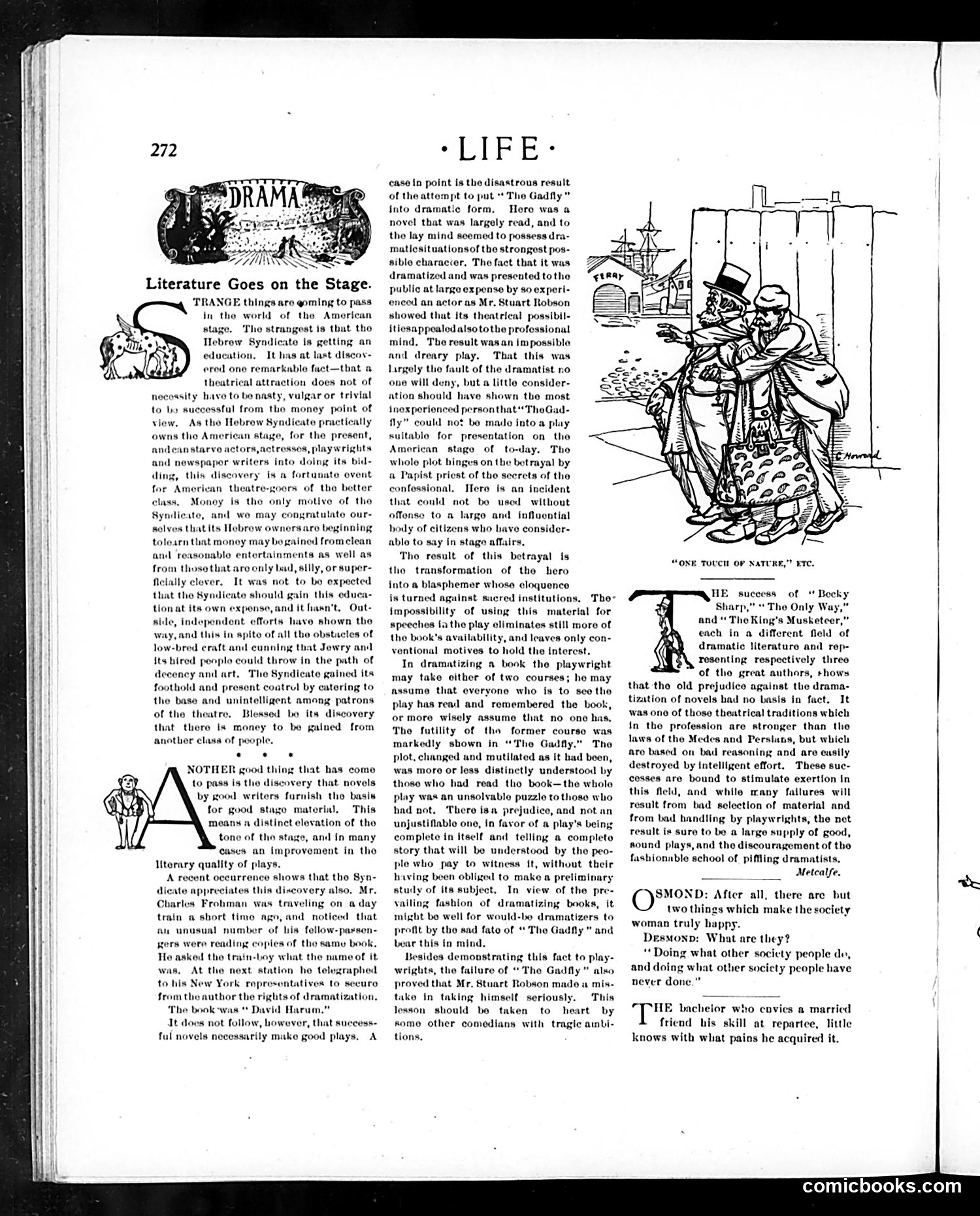
This page discusses the dramatization of novels for theater, specifically critiquing a failed stage adaptation of "The Gadfly." The article argues that successful novels don't necessarily make good plays—the book's literary qualities don't translate to dramatic presentation. The accompanying illustration titled "ONE TOUCH OF NATURE, ETC." depicts what appears to be a theatrical scene or backstage moment, though the specific figures are unclear from the image quality. The satire targets playwrights who assume audiences who've read a novel will automatically accept its theatrical version, and the financial interests of syndicates profiting from dramatization rights—treating literature as mere commodity rather than art requiring genuine dramatic craftsmanship.
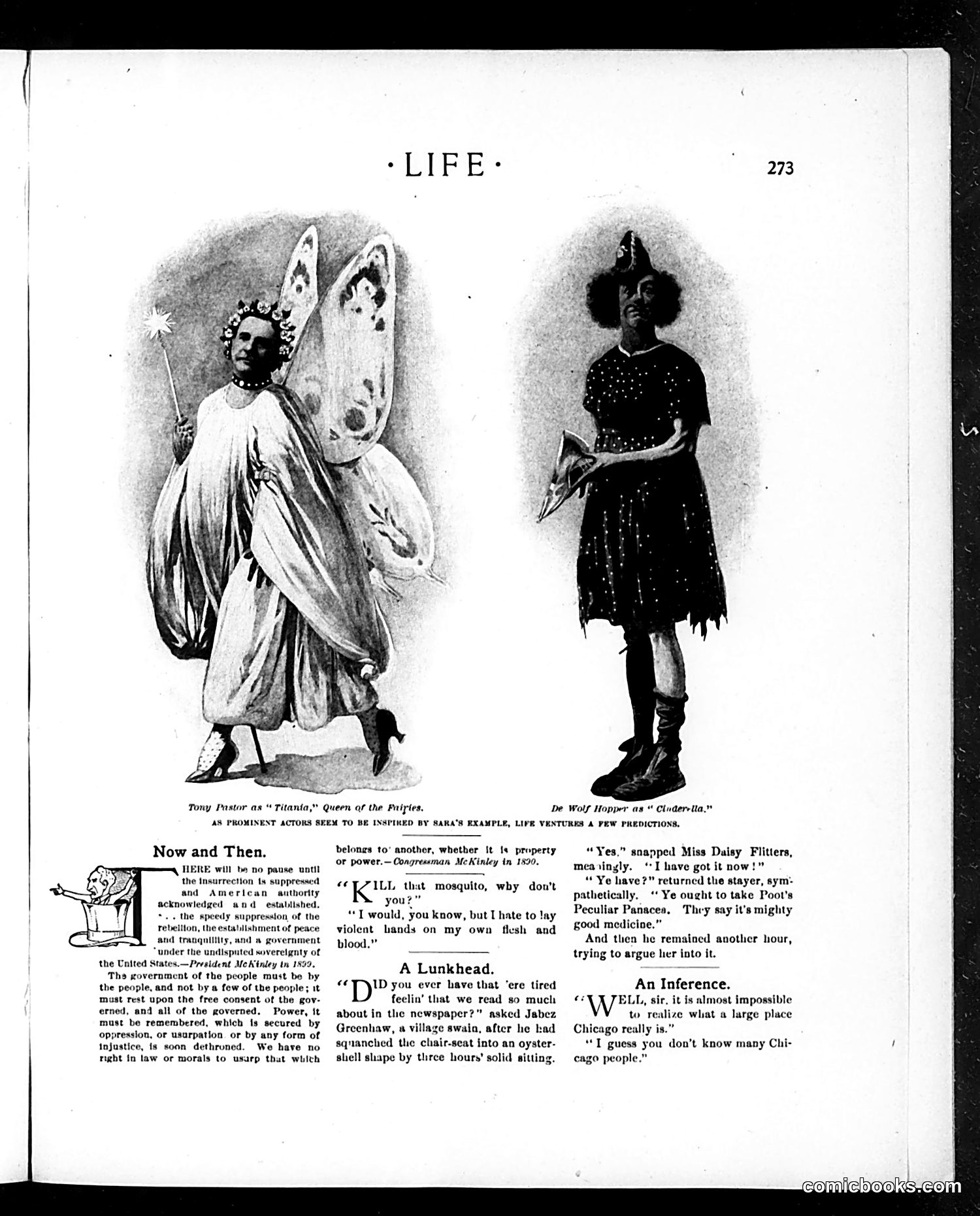
This page combines theatrical satire with political commentary. The top illustrations show actors Tony Pastor and De Wolf Hopper in costume roles, likely referencing contemporary stage productions. The main political content appears in "Now and Then," which contrasts President McKinley's 1890 congressional statement opposing tyranny and supporting government by "consent of the governed" with his 1899 position suppressing the Philippine-American Insurrection. The satire suggests McKinley abandoned his stated principles when facing colonial resistance—a critique of American imperialism. The three short humorous pieces below ("A Lunkhead," "An Inference") are light filler jokes unrelated to politics: one about a man refusing to kill a mosquito because it's his "flesh and blood," another about persistent rural courtship, and a third about Chicago's size. The page primarily mocks McKinley's apparent hypocrisy on democratic governance versus imperial expansion.
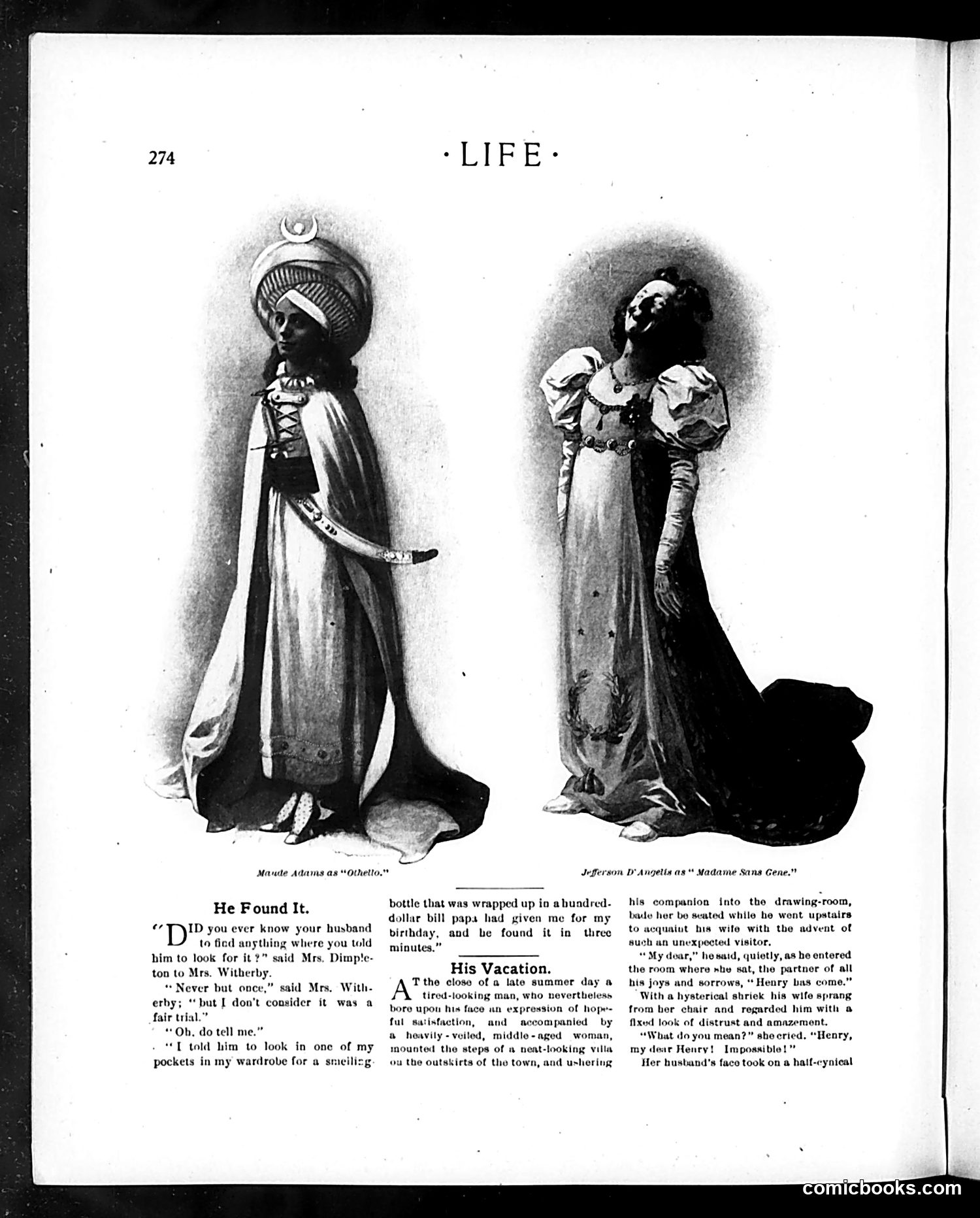
**The Images:** Two theatrical photographs show actresses in costume—one labeled Maude Adams as "Othello" (appearing in masculine dress with turban and curved sword) and Jefferson D'Angelis as "Madame Sans Gene" (in period gown). These likely reference contemporary stage productions from the early 1900s. **The Text:** Two separate comic anecdotes follow: 1. **"He Found It"** jokes about husbands' incompetence at locating things, with a punchline where a wife finally caught her husband finding something—money hidden in her wardrobe—but dismisses it as an unfair test. 2. **"His Vacation"** satirizes marital infidelity: a man brings a mysterious veiled woman home, introducing her to his wife as "Henry" (his male companion). The wife's shocked reaction suggests the husband is either playing a cruel joke or there's an implication of impropriety. The satire reflects period attitudes about marriage dynamics, gender roles, and domestic deception as comic material.
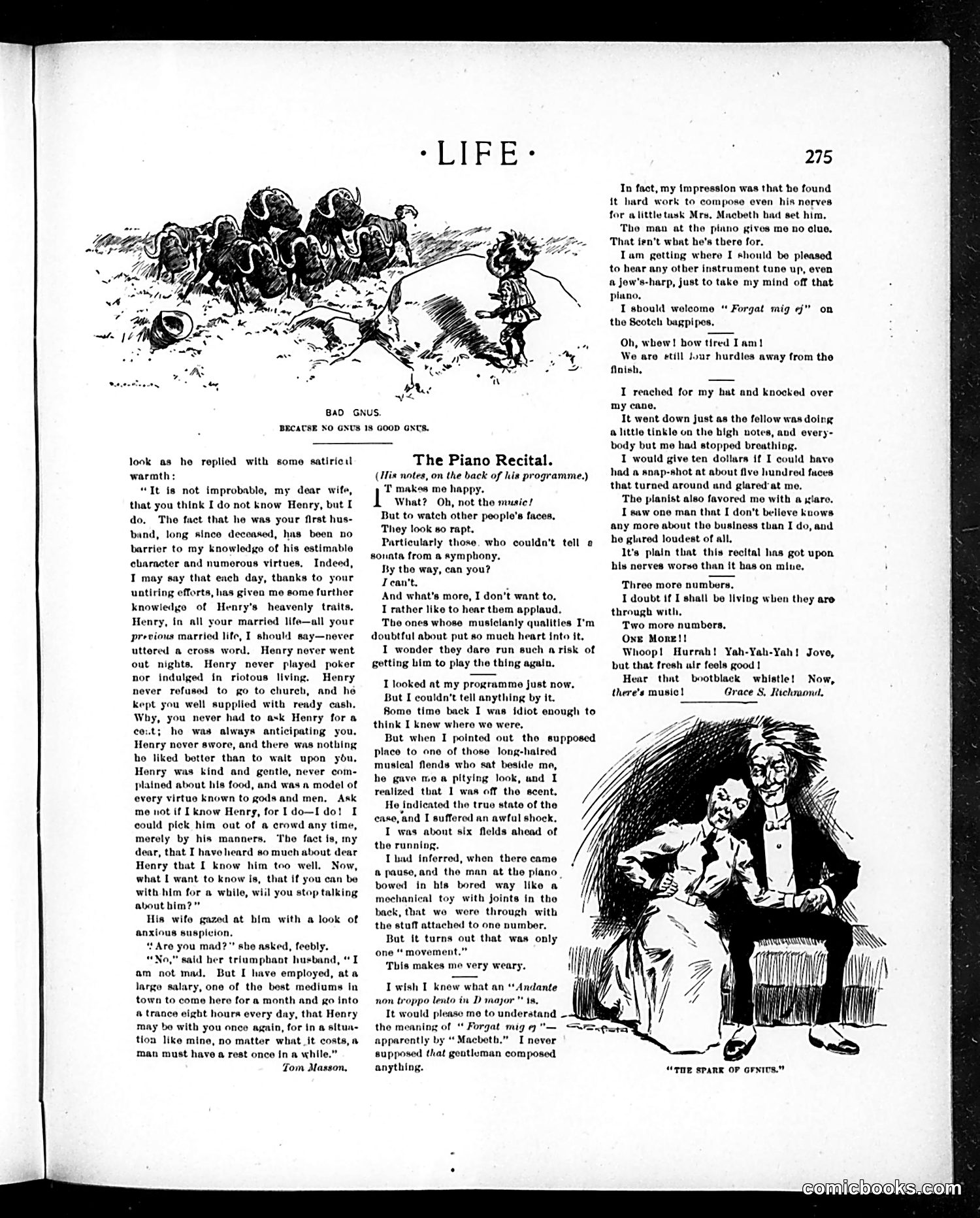
This page contains two humorous pieces satirizing social pretense and musical ignorance among concert attendees. **"The Piano Recital"** mocks the affectations of classical music audiences. The narrator admits he cannot distinguish symphonies from sonatas, doesn't understand musical terminology like "Andante non troppo lento in D major," and loses track of which movement is playing. He observes that musically ignorant attendees applaud most enthusiastically—"running" six movements ahead of reality. The joke targets middle-class social climbers who attend concerts to *appear* cultured rather than for genuine musical appreciation. The narrator's boredom is evident: he'd prefer a Jew's harp or Scottish bagpipes just for relief. **"Bad Gnus"** (top) is a separate domestic humor piece about a husband sarcastically cataloging his wife's first husband Henry's virtues—never cursing, staying home, providing money—to highlight her constant references to him. He sardonically offers to hire a medium so Henry's ghost can visit, giving himself "rest." Both pieces use everyday social situations to deflate pretension.
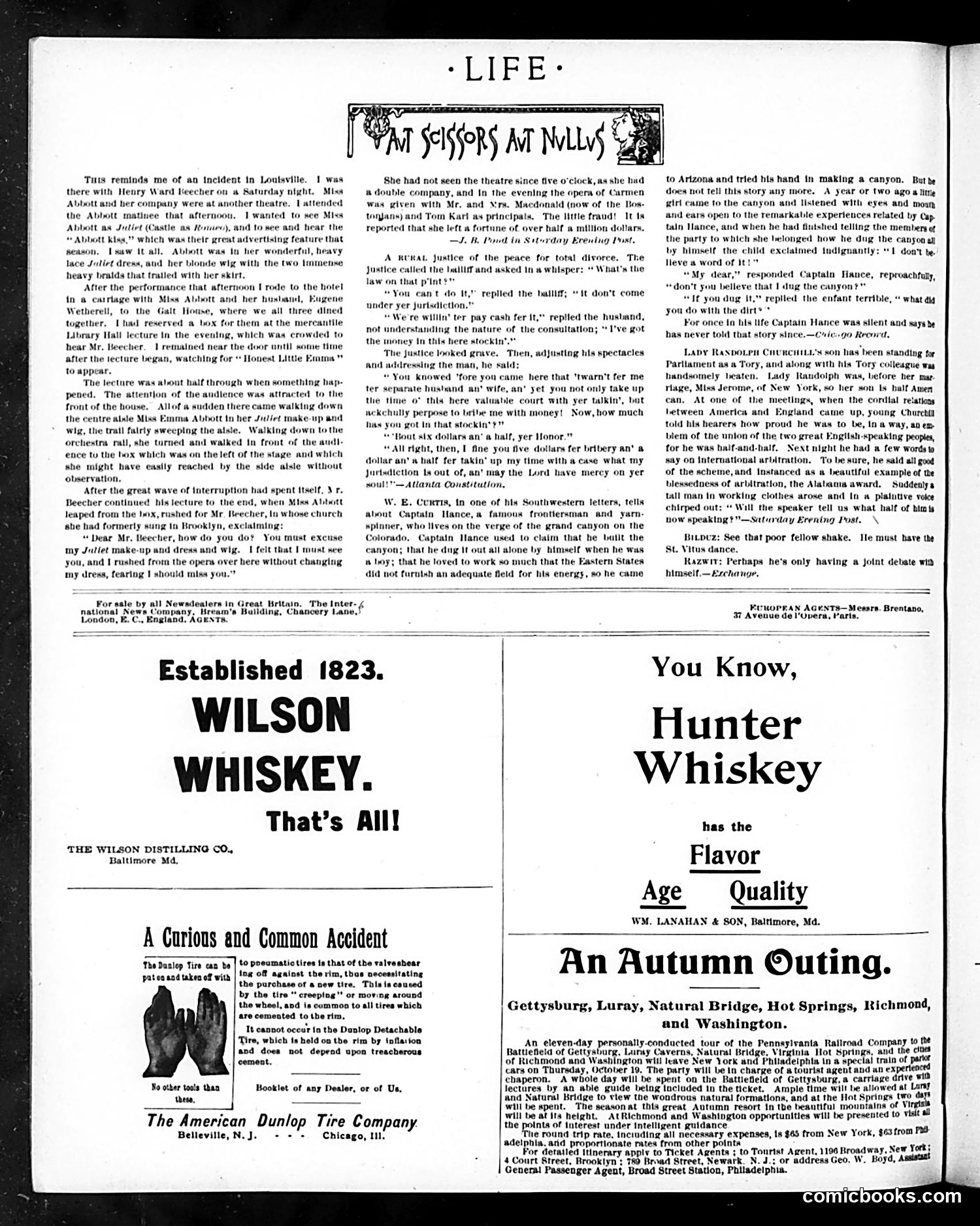
This page from *Life* magazine (a 19th-century American satirical publication) contains **theatrical anecdotes and advertisements** rather than political cartoons. The main narrative describes an incident involving actress **Miss Emma Abbott** performing as Juliet in Louisville with Henry Ward Beecher (a famous preacher) in attendance. The story humorously recounts how Abbott, still in full theatrical costume and makeup, walked through the theater's center aisle during another performance, creating a spectacle that drew the audience's attention away from the stage. The page also includes anecdotes about **Captain Hance** and the Grand Canyon, and a story about **Winston Churchill's son** standing for Parliament as a Tory candidate, with his American mother Lady Randolph Jerome present at political meetings. The remaining content consists of **period advertisements** for Wilson Whiskey, Hunter Whiskey, Dunlop Tires, and a tourist excursion package—typical of *Life*'s revenue model. No significant political satire is evident on this particular page.
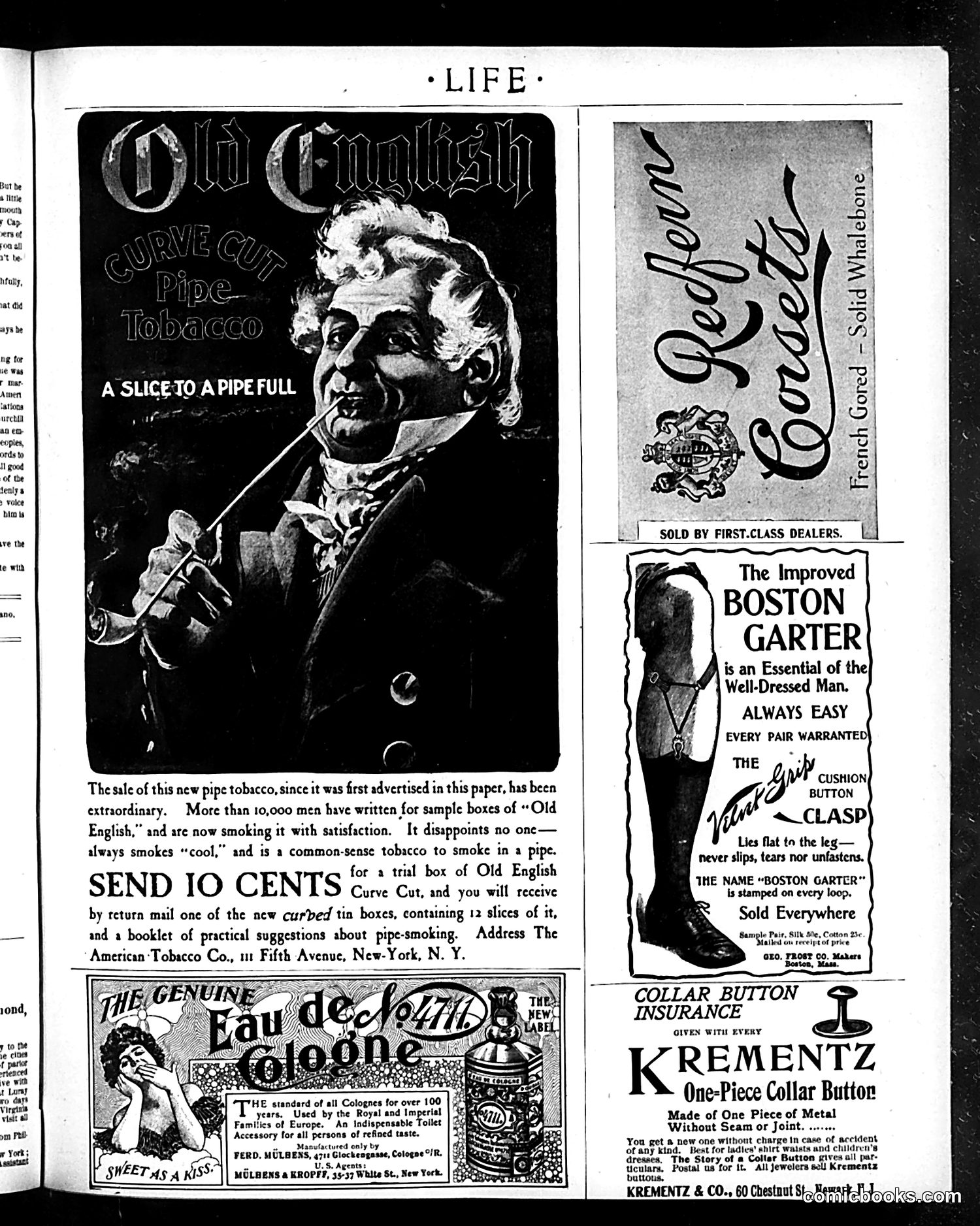
This page is primarily **advertising**, not political satire. It contains four product advertisements from the early 20th century: 1. **Old English Curve Cut Pipe Tobacco** (top left): Features a caricatured elderly man smoking a pipe. The ad claims extraordinary sales success (10,000+ inquiries) and promises the tobacco smokes "cool." It's a straightforward testimonial-style advertisement offering a trial box for 10 cents. 2. **Eau de Cologne** (bottom left): Claims 100+ years of use by European royalty. 3. **Boston Garter** (right): Advertises men's garters as "essential" to being well-dressed, emphasizing they won't slip or tear. 4. **Krementz Collar Button** (bottom right): Promotes a metal collar button with insurance against loss or damage, offering free replacements. These ads reflect **early-20th-century masculine grooming products** and the era's emphasis on refined appearance. No satire or political commentary is evident.
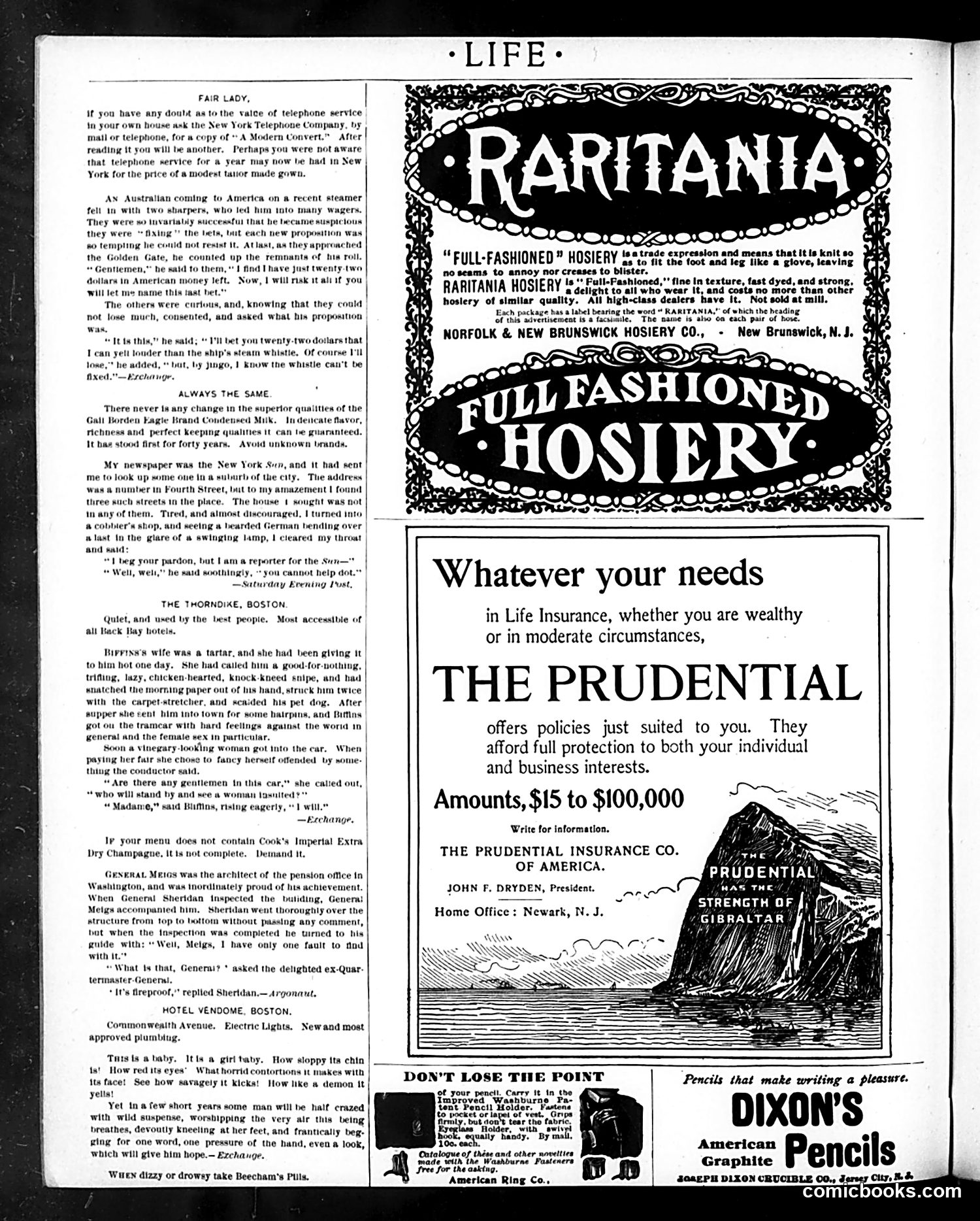
This page contains **primarily advertisements and humorous anecdotes**, not political cartoons. The main content includes: **Advertisements:** Dominant features are ads for Raritania Hosiery ("full-fashioned"), The Prudential Insurance Company, and Dixon's Pencils. **Humorous Stories:** Several brief satirical anecdotes mock human behavior—including a tale of an Australian swindled by con artists, and a domestic squabble where a man endures his wife's verbal abuse. These illustrate Life magazine's satirical style, exposing human folly and social hypocrisy through everyday scenarios. **Social Commentary:** The anecdotes gently mock class pretensions, marital discord, and gullibility. The final story about a woman demanding gentlemen defend her honor is likely satirizing performative outrage and manufactured grievance. There are **no identifiable political figures or cartoon illustrations** on this page—it's primarily text-based humor typical of Life's satirical approach to American life circa the early 20th century.
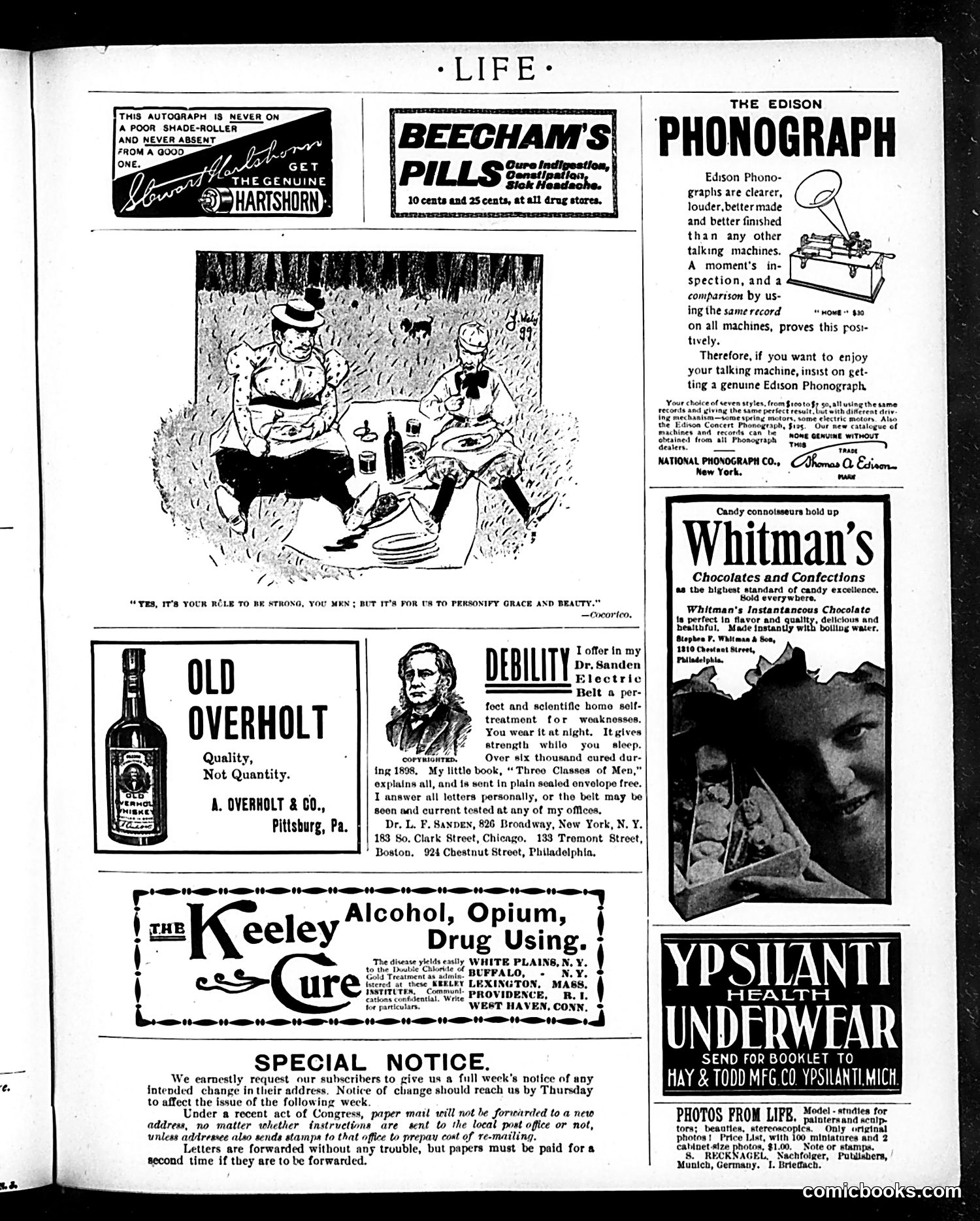
This page is primarily **advertisements** interspersed with one small cartoon. The cartoon depicts two figures picnicking outdoors with a quoted caption attributing the sentiment to "Cocorleo" (likely a misspelling). The quote—"Yes, it's your rôle to be strong, you men; but it's for us to personify grace and beauty"—appears to satirize **gender role expectations** of the era, suggesting women's social function was purely aesthetic while men bore burdens. The surrounding ads reveal **turn-of-century patent medicine culture**: Hartshorn's smelling salts, Beecham's Pills, Dr. Sanden's "Electric Belt" (a dubious electrotherapy device claiming to cure male "weaknesses"), and the Keeley Cure for alcohol and drug addiction. These reflect widespread medical quackery and the era's anxieties about masculinity, substance abuse, and "modern" ailments—a satirical target for *Life* magazine's humor.
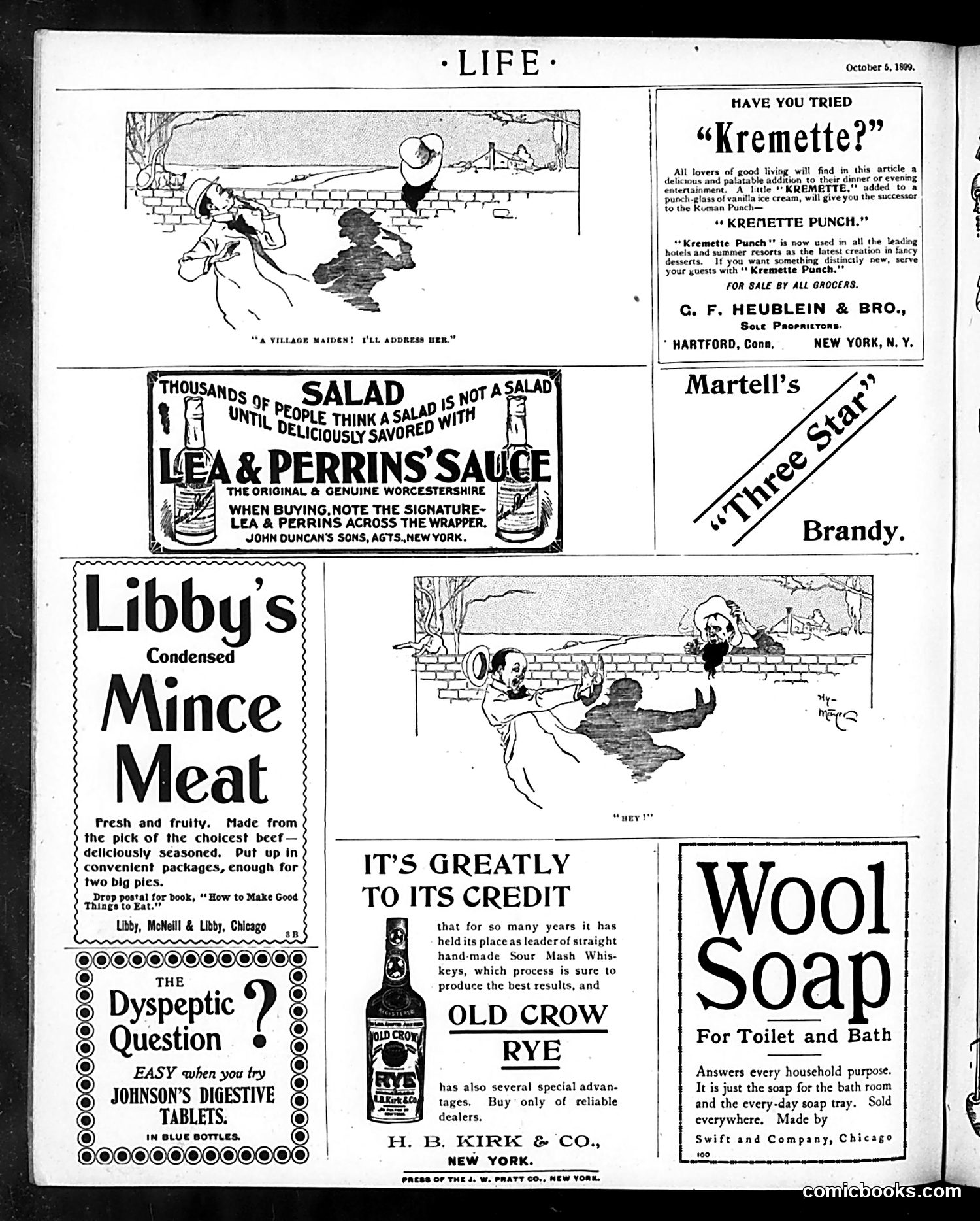
This page is primarily **advertising**, with two cartoon illustrations serving as visual breaks. The top cartoon shows a man addressing a woman ("A Village Maiden! I'll Address Her"), depicting a comedic romantic encounter—likely satirizing clumsy courtship or flirtation common in period humor. The bottom cartoon ("Hey!") depicts what appears to be a physical altercation or collision, typical of slapstick visual humor from this era. The advertisements promote period consumer goods: Kremette (a beverage additive), Lea & Perrins sauce, Libby's mince meat, Johnson's digestive tablets, Old Crow whiskey, Wool Soap, and a treatment for dyspepsia. These ads reveal concerns of the era: digestive ailments were heavily marketed remedies, and branded packaged goods were relatively new luxuries promoted as markers of "good living." The cartoons appear designed chiefly to attract reader attention rather than convey specific satire.