
Life, 1899-10-05 · page 9 of 20
Life — October 5, 1899 — page 9: what you’re looking at
What you’re looking at
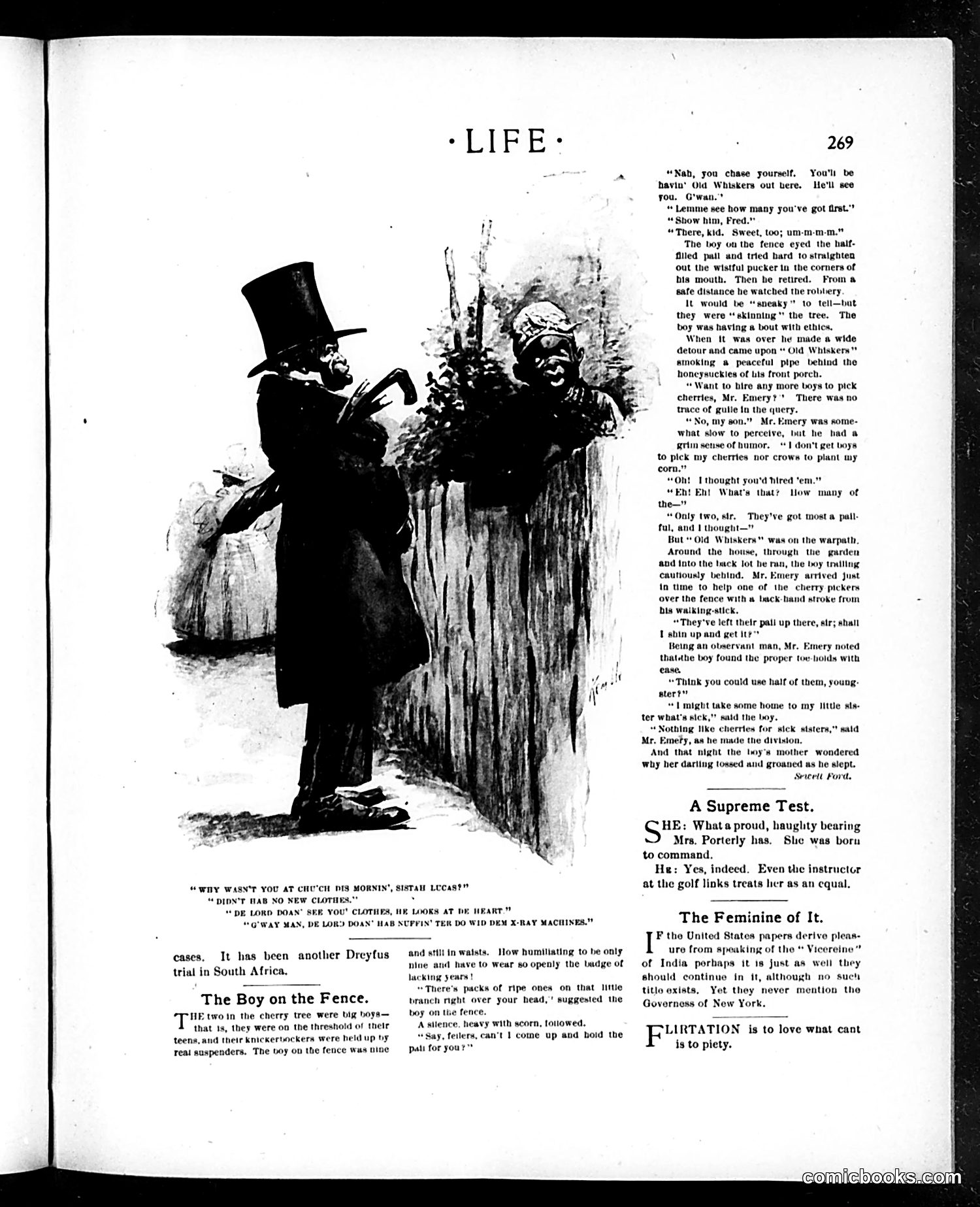
The main illustration shows two figures at a wooden fence in what appears to be a scene of social commentary. The caption beneath reads: "WHY WASN'T YOU AT CHURCH DIS MORNIN', SISTAH LUCAS?" / "DIDN'T HAB NO NEW CLOTHES." / "DE LORD DONE SAID YOU CLOTHES, HE LOOKS AT DE HEART." / "O'WAY MAN, DE LORD DONE' HAB NUFFIN' TER DO WID DEM X-RAY MACHINES." This depicts a satirical critique of materialism and vanity within religious practice. The dialogue suggests a poor African American woman skipped church due to lack of fashionable clothing, contradicting Christian teachings about inner virtue. The "X-ray machines" reference appears to mock the idea that modern society's superficiality (judging by appearances) has replaced spiritual values—a commentary on materialism overtaking faith during the early 20th century.
📄 Transcribed text from this page (OCR, searchable)
Machine-transcribed from the original scan — historical spelling and the odd misread are preserved.
“WHY WASN'T YOU AT CHU'CH DIS MORNIN’, SISTA LUCAST” “ DIDN'T TAB NO NEW CLOTHES."” “DE LORD DOAN’ SER YOU' CLOTHES, HE LOOKS AT “away MAN cases, It has been another Dreyfus trial in South Africa, The Boy on the Fence. HE two in the cherry tree were big boys— that 1s, they were on the threshold of thelr teens, and their knickerbockers were held up by Teai suspenders. The boy on the fence was nine DE LORY DOAN’ MAB NUPPIN' TER DO WID DEM X-RAY MACIINES."” and stilt in watsts. How humiliating to be only nine and have to wear 80 openly the budge of lacking years! “There's packs of ripe ones on that litle branch right over your head," suggested the boy on the fence. Asilence, heavy with scorn, followed. “Say, feilers, can't 1 come up and bold the pati for you?” 269 You'll be He'll see hb, you chase yourself, havin’ Old Whiskers out bere. you. G'wau.”* * Lemme see how many you've got Arst.”” “Show him, Pred." “There, kid. Sweet, too; um-m-m-m." The boy on the fence eyed the halt- filled pall und tried bard to straighten out the wistful pucker tn the corners of bis mouth. Then he retired. From & safe distance he watched the robbery It would be “sneaky” to tell—but they were “skinning ™ the tree. The boy was having a bout with ethics. When tt was over he made a wide detour and came upon * Old Whiskers” smoking @ peaceful pipe behind the honcysuckles of bts front porch. “Want to bire any more boys to pick cherries, Mr. Emery?’ There was no tice of guile in the query. “No, my son.” Mr. Emery was some- what slow to percetve, but he had a Artin sense of humor, don't get boys to pick my cherrtes nor crows to plant my corn.” “Ont [thought sou'd hired tem." “Eb! Eht What's that? How many of the—" “Only two, sir. They've got most a pall- ful, and 1 thought” But Old Whiskers was on the warpath, Around the house, through the gurden And Into the tack Jot be nan, the boy tnuling cautiously bebind. Mr. Emery arrived Just {n ume to help one of the cherry pickers over the fence with a back-hand stroke from bis waiking-stick, “They've left thelr pall up there, tr; shall T abin up and get itr Being an observant man, Mr. Emery noted thatethe boy found the proper toe-holds with ease. “Think you could use half of them, young: stert” “might take some home to my little sls- ter what's sick," sald the boy. * Nothing ke cherrtes for sick sisters," sald Mr, Emery, as he made the division, And that night the boy's mother wondered why her darling tossed and groaned as he slept. Srieett Ford. A Supreme Test. GEE: Whata proud, haughty bearing Mrs. Porterly has. She was boru to command. He: Yes, indeed. Even the instructor at the golf links treats her as an equal, The Feminine of It. F tho United States papers derive pleas- ure from speaking of the * Vicereine” of India porbaps it 18 just as well they should continue in it, although no such title exists, Yet they never mention the Govornoss of Now York. F LIRTATION is to love what cant is to piety.