
A complete issue · 13 pages · 1899
Life — August 24, 1899
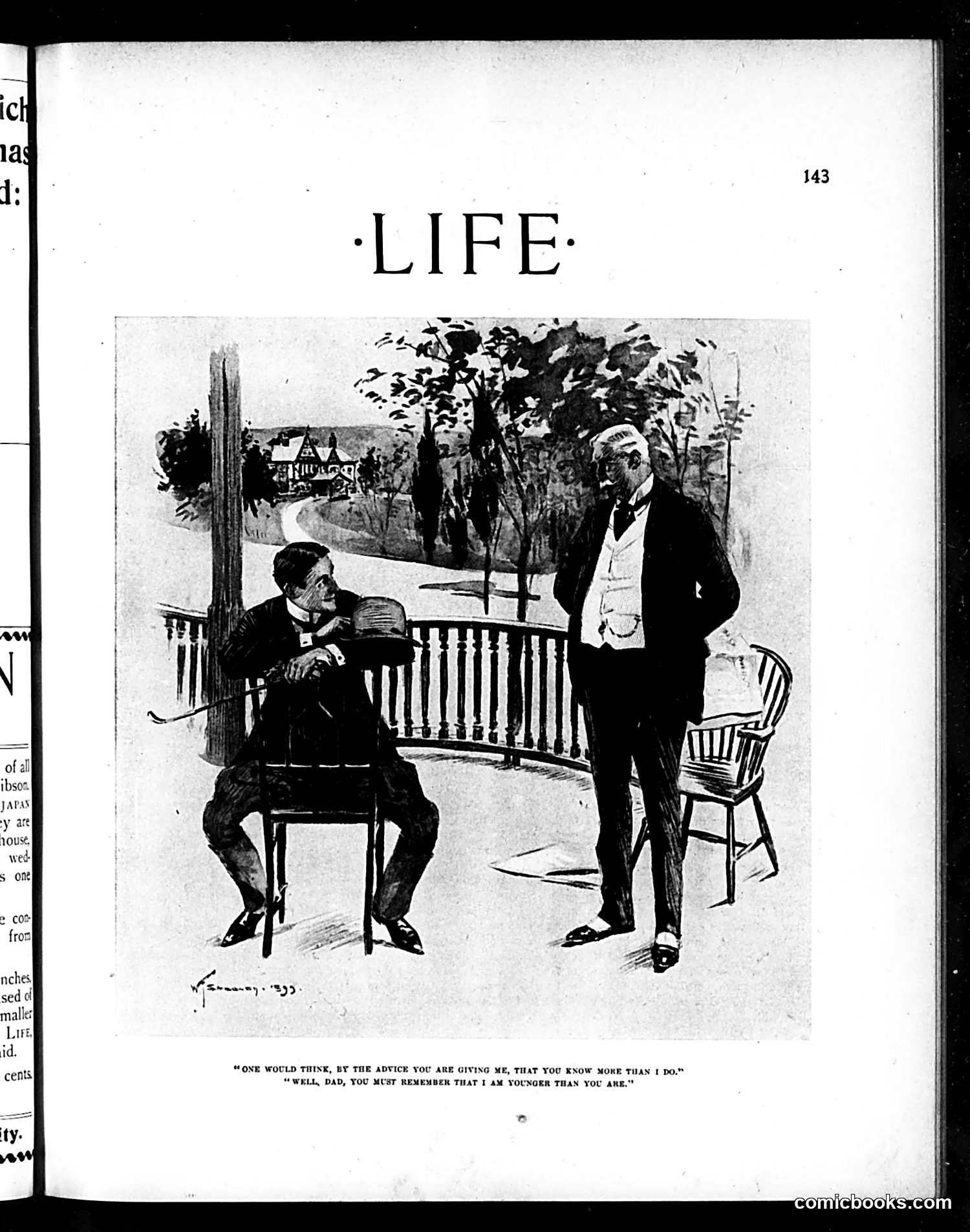
This page from *Life* magazine (page 143) presents a satirical cartoon titled "LIFE" depicting two men on a porch overlooking a pastoral landscape. The seated figure appears to be receiving unsolicited advice from the standing man. The caption reads: "One would think, by the advice you are giving me, that you know more than I do." / "Well, dad, you must remember that I am younger than you are." The satire targets generational presumption—specifically, a younger man condescendingly lecturing his elder (apparently his father) while claiming superior knowledge based merely on youth. This mocks the common trope of younger generations assuming their modernity grants them wisdom over their elders' experience. The joke inverts expectations: the son's logic is absurd, yet he delivers it with confident arrogance.
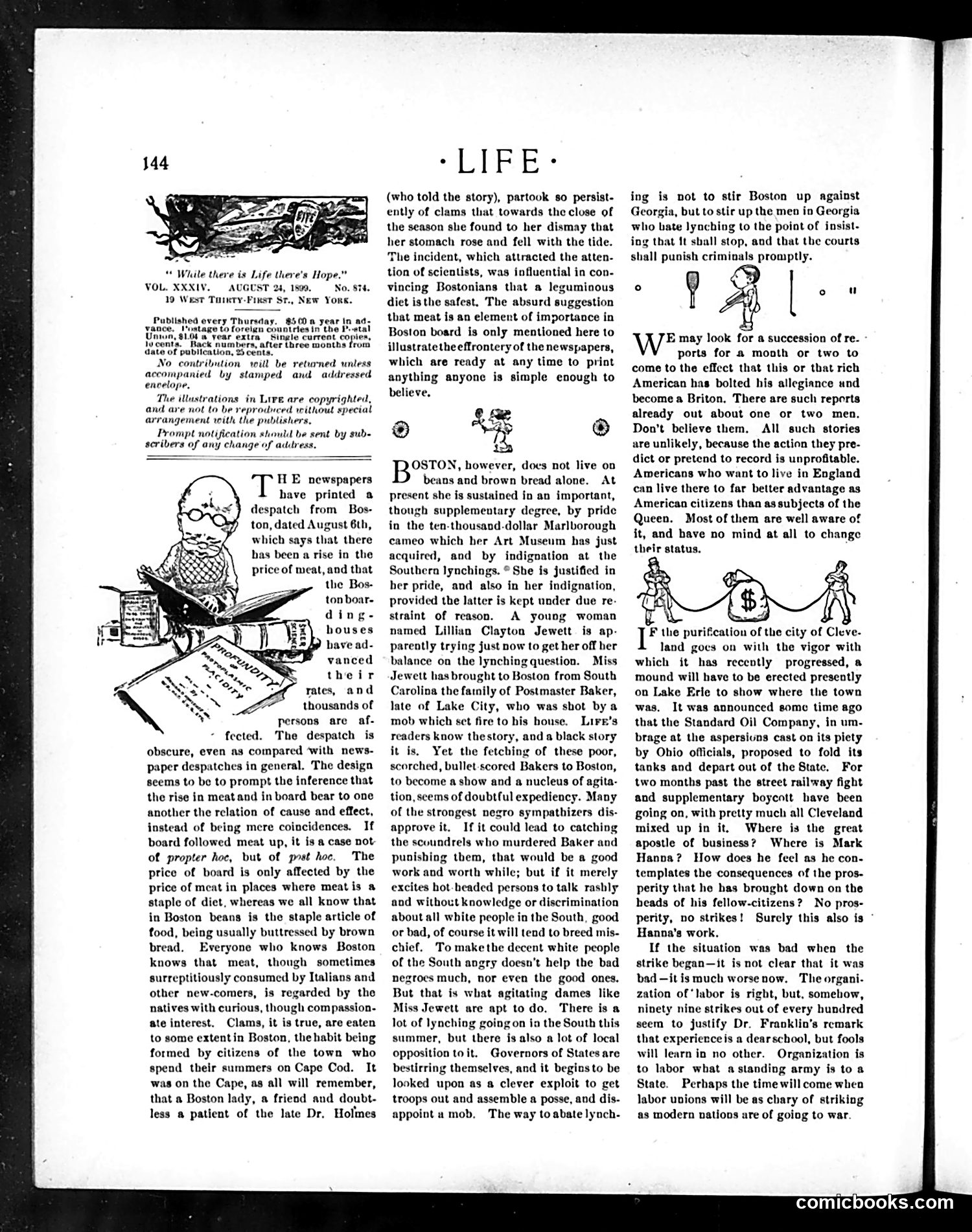
The page contains two editorial cartoons addressing Boston's civic pride and race relations in the American South. **Left cartoon:** Depicts a portly Boston figure surrounded by emblems of the city's cultural institutions (Art Museum, Marlborough cameo). The satire mocks Boston's self-regard—the text notes Bostonians are distressed that their city lacks a rice market, sarcastically suggesting this gap threatens their status. **Right cartoon:** Shows figures labeled with dollar signs and a mound, illustrating civic "purification" projects. The text discusses a proposed Ohio scheme to relocate Black Americans, satirizing both Northern hypocrisy and Southern racial violence. The passage critiques newspapers sensationalizing lynching stories while avoiding substantive solutions to racial injustice. Both cartoons target American pretensions—Boston's smugness and Northern indifference to systematic Southern racism.
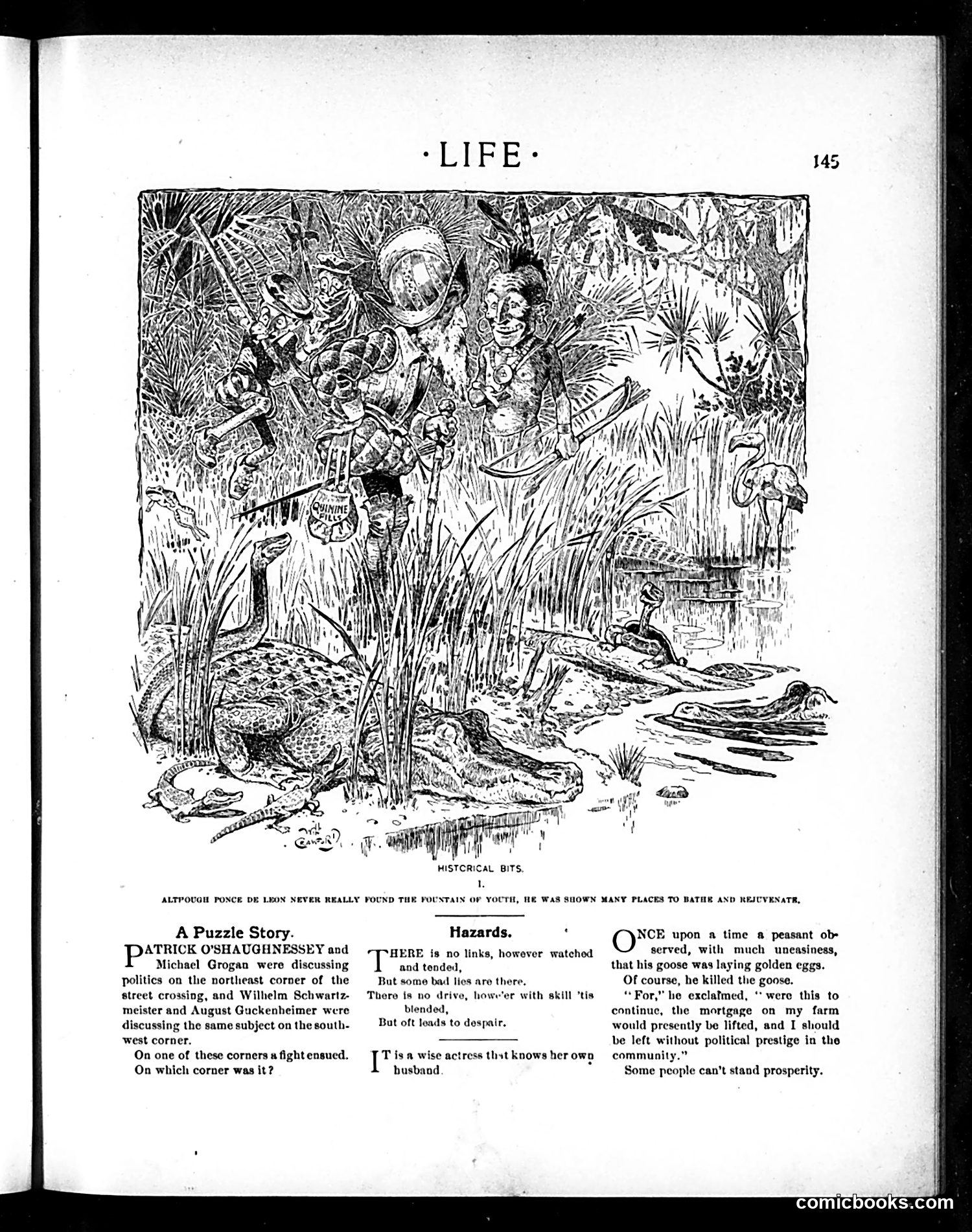
This page contains satirical content from Life magazine's "Historical Bits" section. The main illustration depicts what appears to be a fantastical scene with caricatured figures in a tropical or swampy setting, though the specific historical reference is unclear from the image alone. Below the illustration are three distinct text sections: "A Puzzle Story" about a street-corner political discussion involving Patrick O'Shaughnessy, Michael Grogan, and others debating politics; "Hazards," a poem about natural dangers; and a brief anecdote about a peasant who kills a goose, then regrets it due to financial consequences and loss of community standing. The overall tone is satirical commentary on politics, superstition, and social consequence, typical of Life's editorial approach.
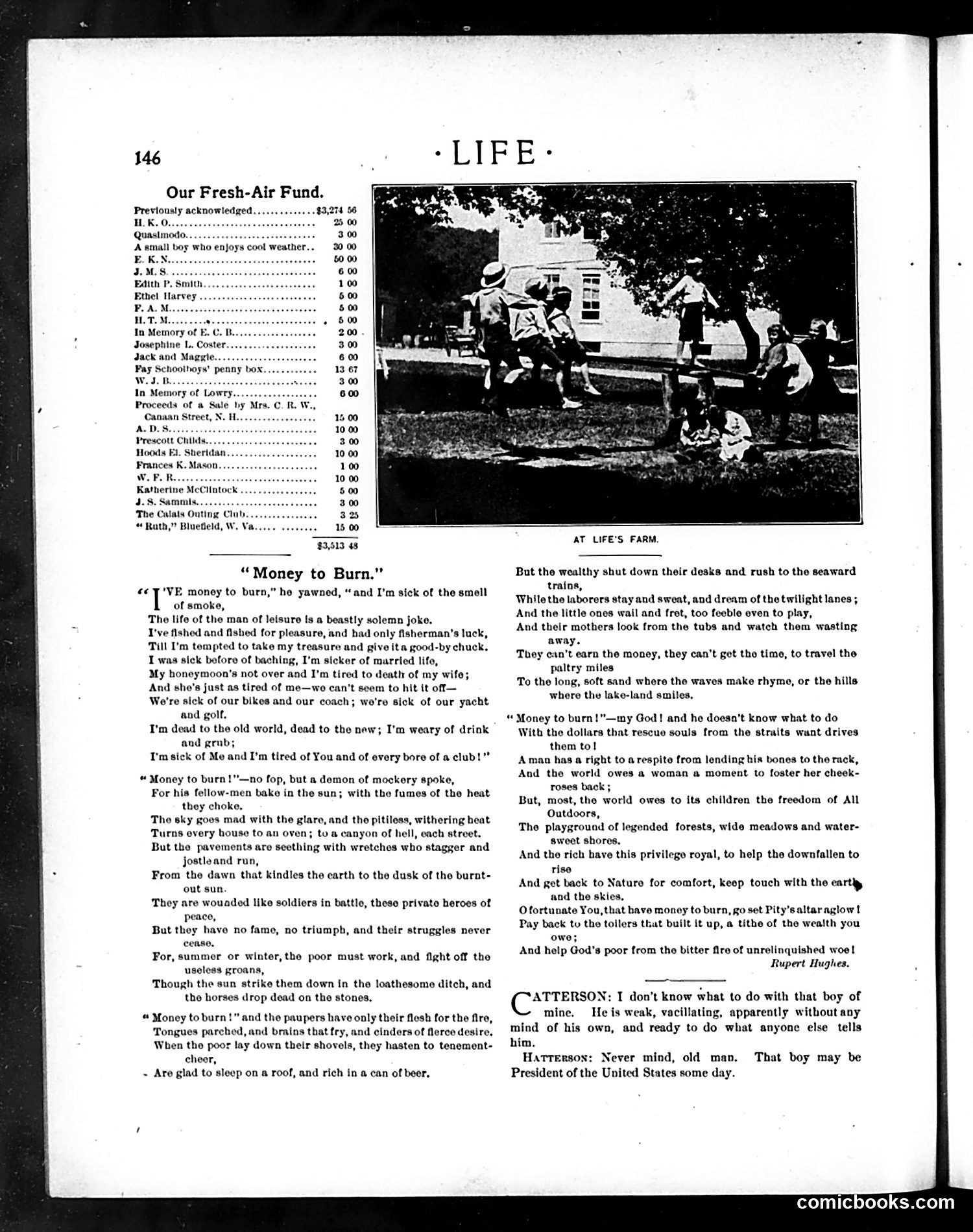
The page features a photograph labeled "AT LIFE'S FARM" showing people relaxing outdoors near a building—a leisure scene emphasizing rest and nature. The main content is a poem titled **"Money to Burn,"** which satirizes wealthy idleness. The speaker complains of boredom despite riches, contrasting himself unfavorably with working poor who at least have purpose. The poem criticizes the privileged for wasting resources and opportunity while laborers struggle. Below the poem, a brief dialogue between **CATTERSON** and **HATTENSON** jokes that a weak, indecisive boy might become President—likely satirizing contemporary political leadership as ineffectual or unqualified. The satire targets class inequality and questions whether wealth without purpose constitutes a meaningful life.
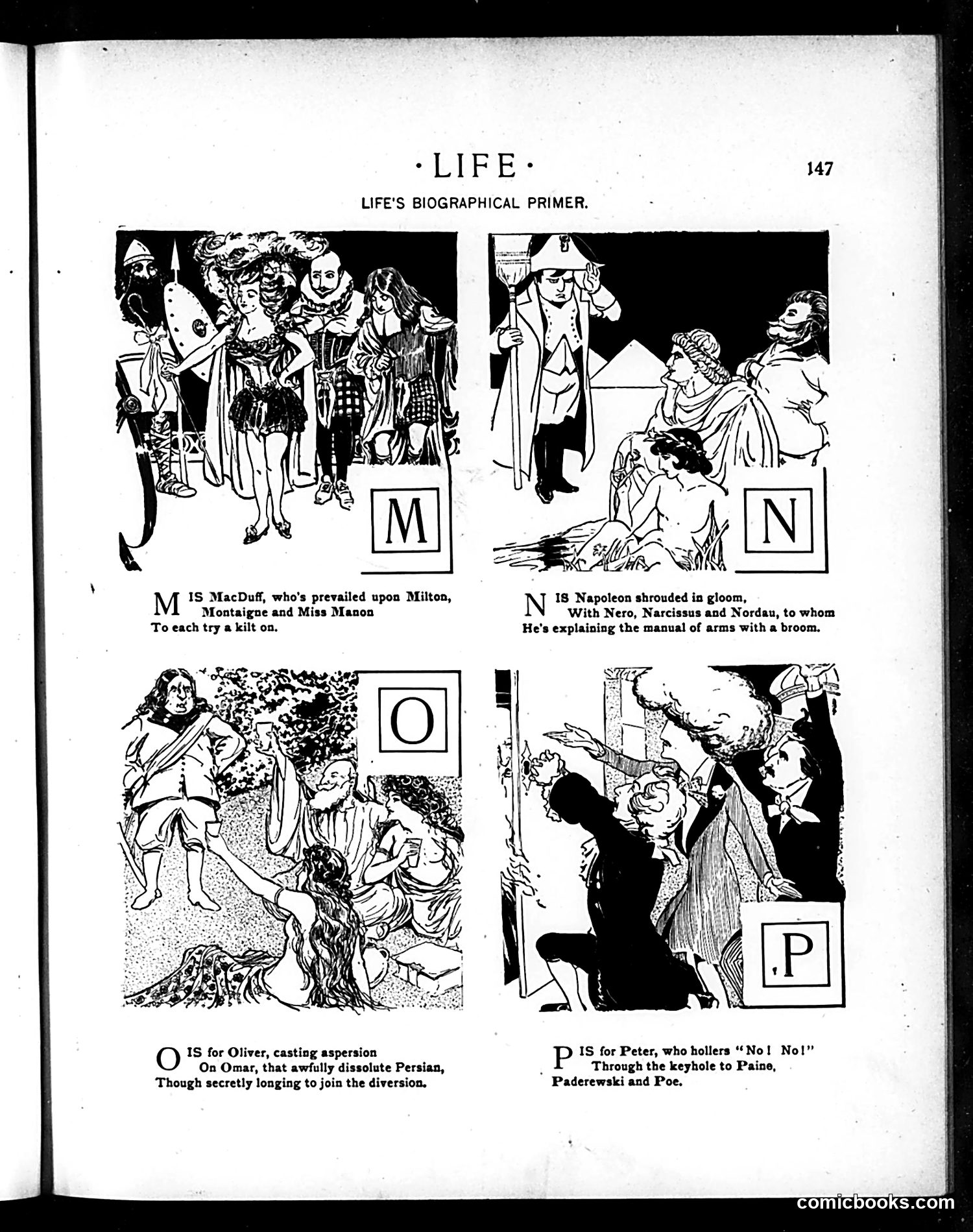
This is a satirical alphabet page from *Life* magazine presenting literary and historical figures as caricatures: **M** depicts MacDuff from *Macbeth*, shown with Milton and Miss Mason in period costume, making a joke about "kill on" (likely a pun on the character's name). **N** shows Napoleon in dark, gloomy surroundings with Nero and Narcissus, presenting him explaining military tactics—a reference to his historical significance. **O** features Oliver (likely from *Oliver Twist*), shown casting "aspersion / On Omar" with Persian characters, depicting Victorian literature characters. **P** shows Peter, described as hollering "No! No!" through a keyhole, referencing Paderewski and Poe—likely a playful literary reference. The page uses exaggerated illustrations and punning text to humorously introduce recognizable cultural figures to readers.
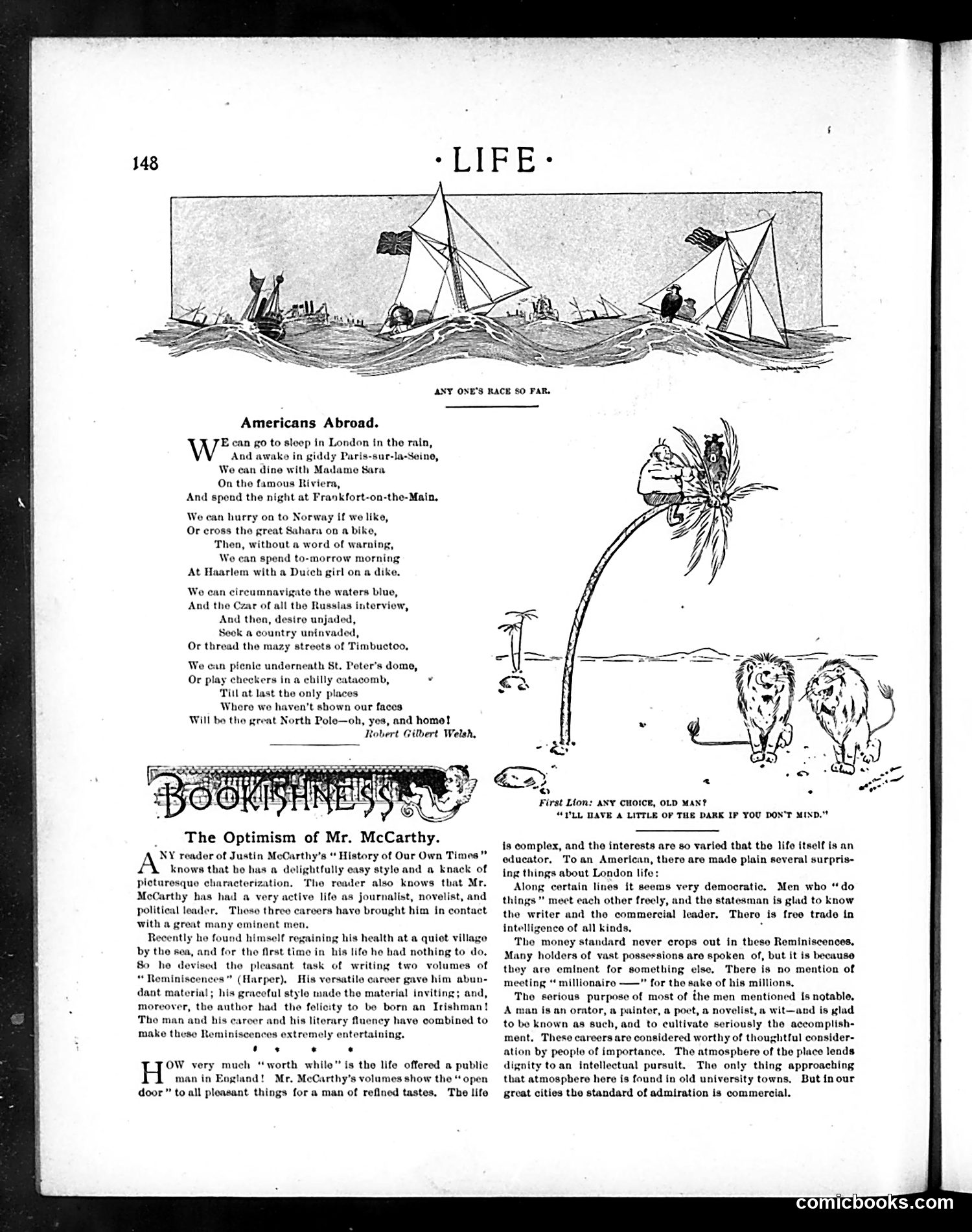
**Top Section ("Any One's Race So Far"):** An illustration of racing steamships and sailing vessels, likely depicting competitive international maritime commerce or naval supremacy—a topical concern for early 20th-century America. **"Americans Abroad" Poem:** Robert Gilbert Welsh's verse satirizes American tourists' casual approach to international travel, mocking their ability to casually visit London, Paris, Norway, and exotic locations without planning or cultural consideration. It's gentle satire of American informality abroad. **Bottom Section ("The Optimism of Mr. McCarthy"):** A lengthy article praising author Justin McCarthy's literary career and his "open door" philosophy of accessible writing. The accompanying cartoon shows a lion and what appears to be a person at a palm tree, captioned "Any Choice, Old Man? I'll Have a Little of the Dark if You Don't Mind"—likely satirizing casual imperialism or colonial attitudes.
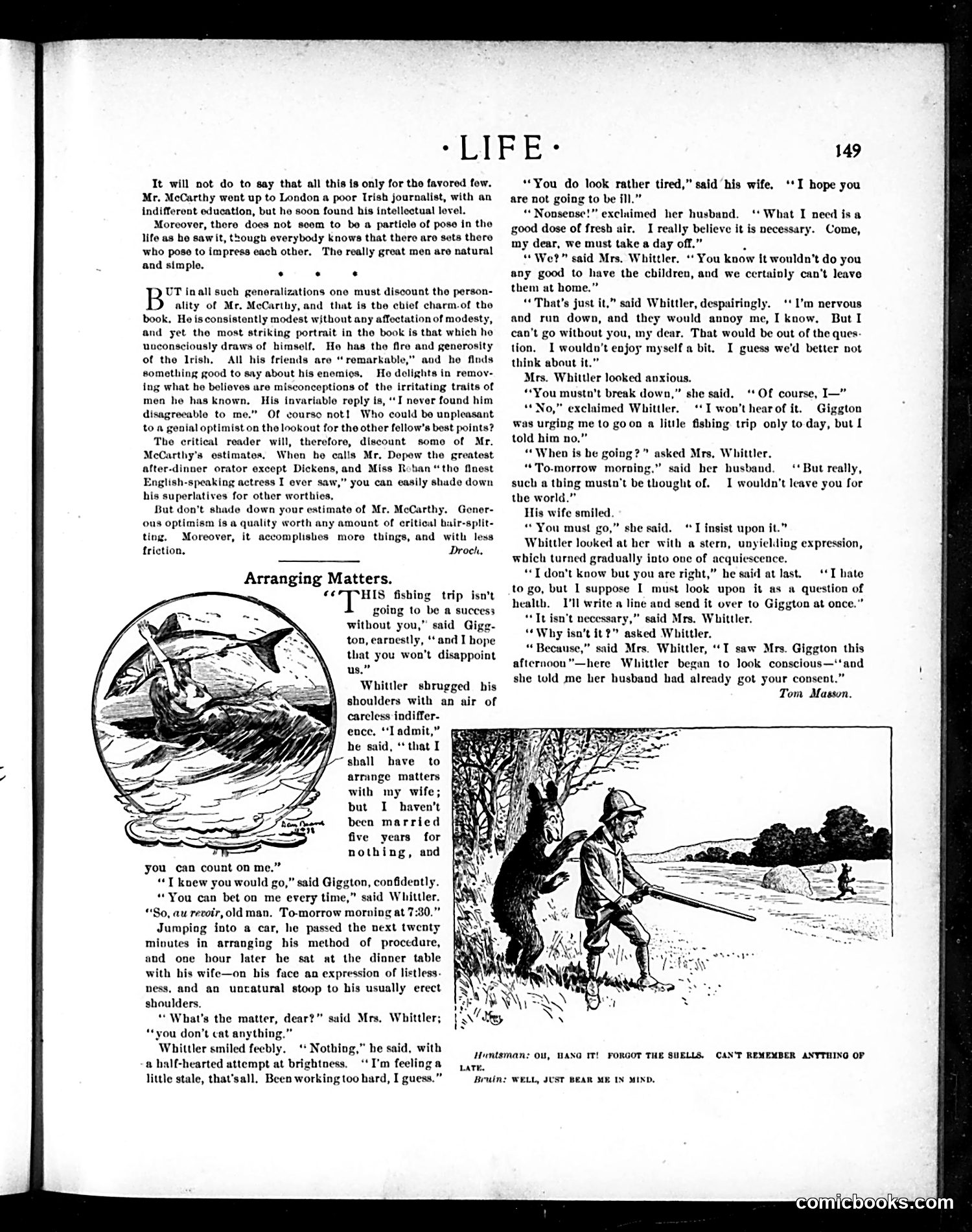
This page contains a fictional narrative titled "Arranging Matters" about a husband (Whittler) and wife negotiating a fishing trip. The central illustration shows two men fishing by a stream. The story satirizes marital dynamics of the era: the husband wants to go fishing despite his wife's objections about his health and their children's needs. The wife initially resists but eventually capitulates after the husband claims he's already secured her consent through a third party (Mrs. Giggton). The satire mocks how men use social manipulation and false claims of agreement to override their wives' actual wishes. It also gently ridicules the husband's transparent excuses about needing fresh air and rest, suggesting men's leisure activities took priority over family concerns in this period's domestic arrangements.
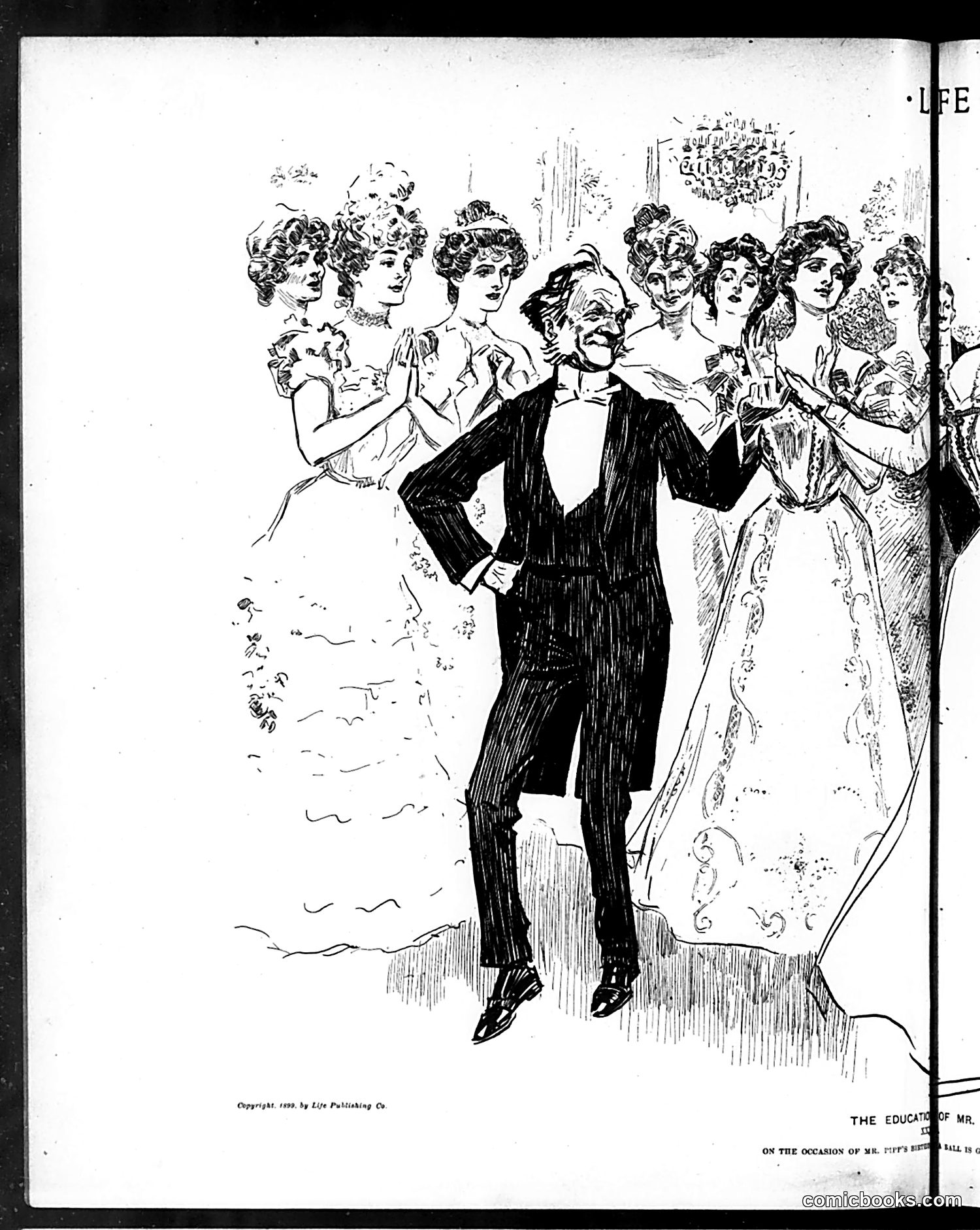
This illustration appears to be from Life magazine's satirical section, dated 1909 based on the copyright notice. The cartoon depicts "The Education of Mr. [Pitt]" — likely referencing a gentleman being instructed or influenced by a group of fashionably-dressed women at what appears to be a formal social gathering. The satire seems to mock the social dynamics of upper-class Edwardian society, where a man is surrounded by multiple women of apparent influence or elegance. The specific joke relates to how such a gentleman might be "educated" or controlled through social interaction with women of higher social standing or sophistication. The exaggerated facial features and the man's somewhat bewildered expression suggest he is the butt of the joke — perhaps satirizing masculine vulnerability to feminine social pressure or the reversal of traditional power dynamics in polite society.
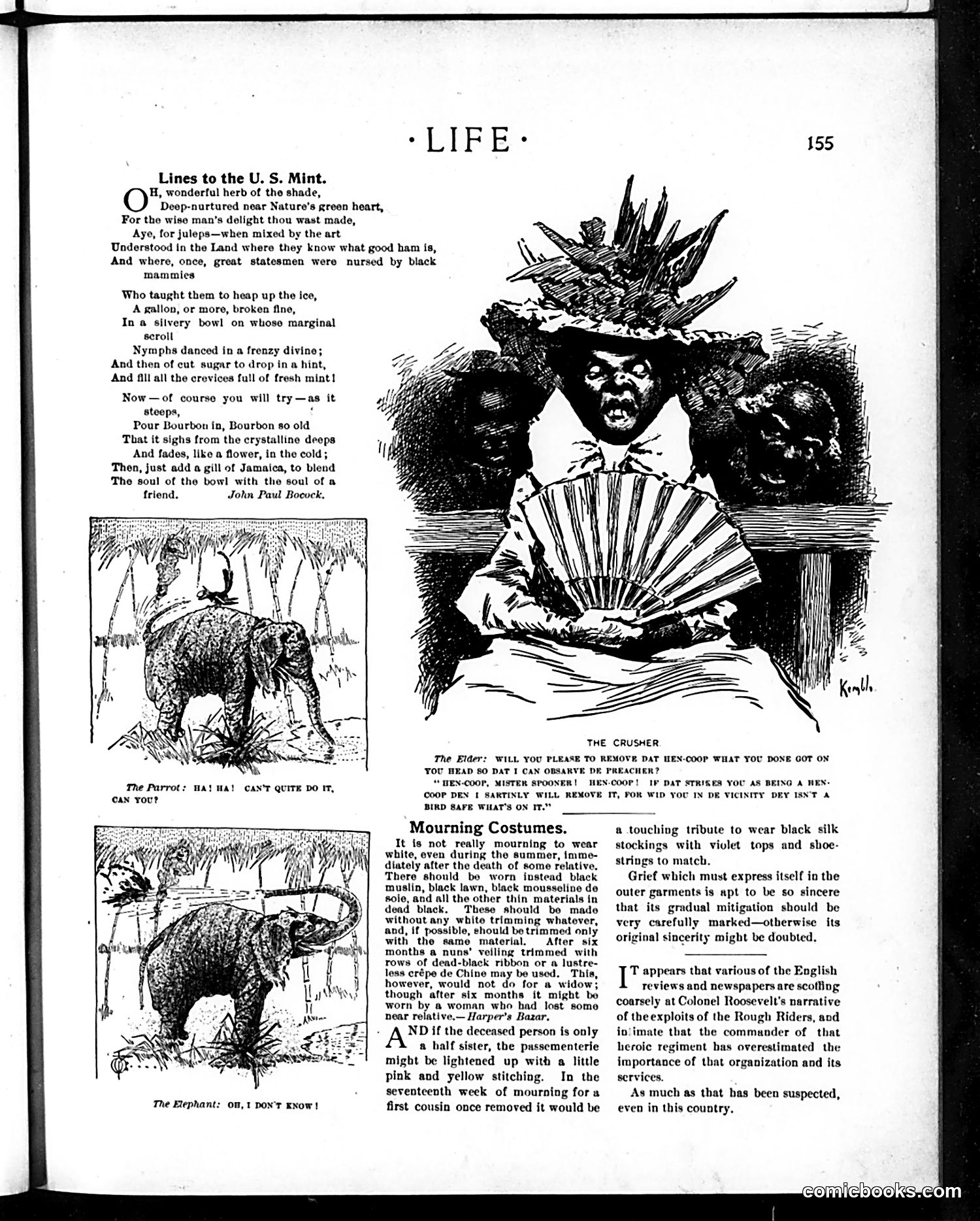
This page contains satirical content mocking rigid social conventions of the era (appears to be early 1900s): **"The Crusher" cartoon**: Shows a caricatured Black man wearing an enormous hat shaped like a hen-coop. The humor relies on racist stereotypes—the "Elder" asks him to remove it so he can see the preacher, but the man responds that with the Elder nearby, no bird is safe. This reflects the era's deeply offensive minstrel-show humor. **"Mourning Costumes" section**: Satirizes the absurdly elaborate and minutely-codified rules governing Victorian mourning dress. Life mocks how grief must be expressed through increasingly specific fabric choices and color combinations—black silk stockings with violet tops for a "first cousin once removed" after exactly seventeen weeks. The satire highlights how obsessive and performative these conventions had become. **Bourbon/Mint Poem**: A straightforward recipe celebrating the mint julep, reflecting Southern gentility. The page demonstrates Life's role as social satirist, targeting both racial prejudice and upper-class affectation.
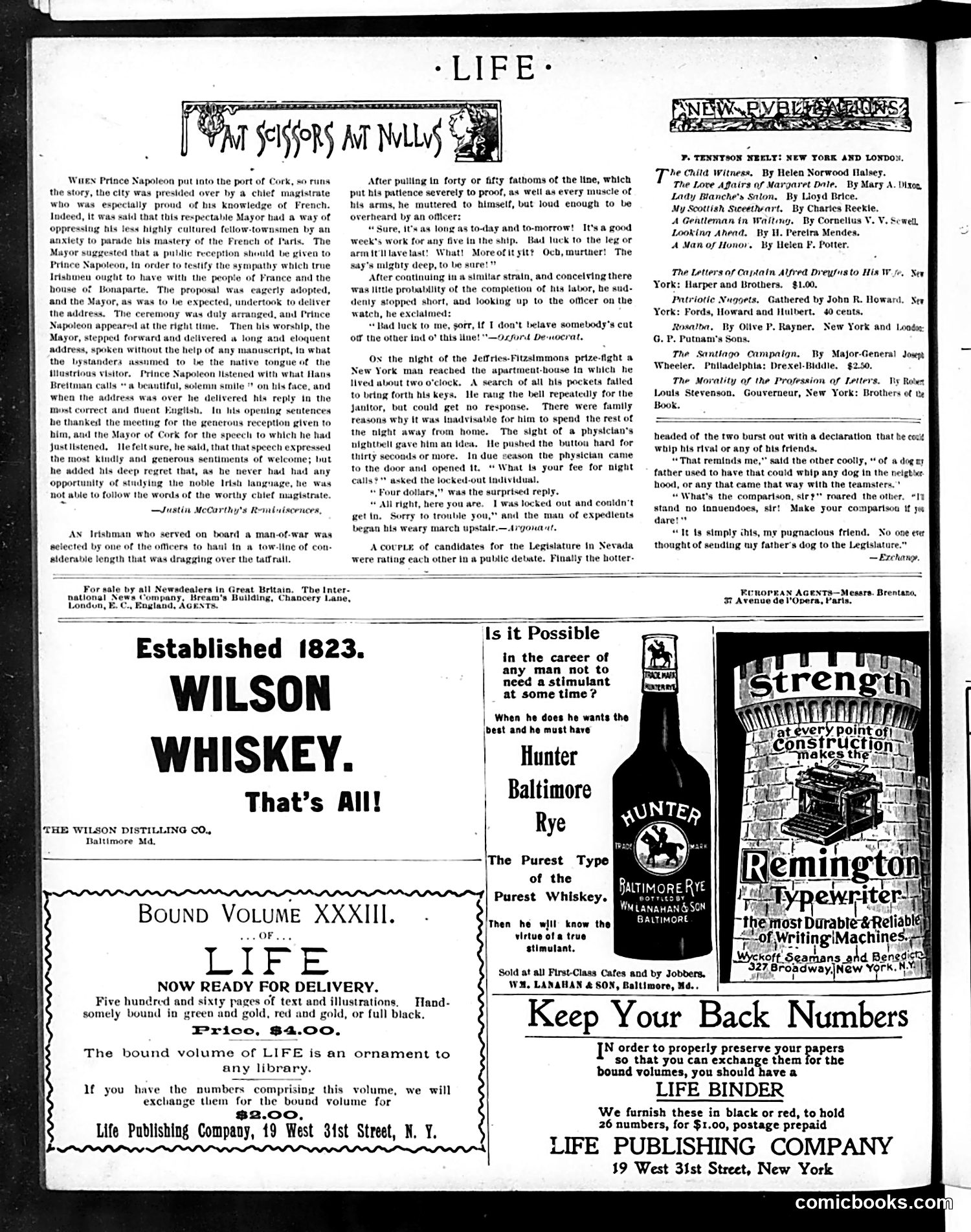
This page is primarily **advertising and announcements** rather than political satire. However, it contains two brief humorous anecdotes: 1. **"Scissors at Nullus"** (top): A story about Prince Napoleon visiting Cork, Ireland. The Irish Mayor, proud of his French, delivers an elaborate address in mangled French to impress the Prince. Napoleon politely replies in perfect English, claiming he "never had any opportunity of studying the noble Irish language"—a gentle satirical jab at the Mayor's pretension and affected Frenchness. 2. **Naval anecdote**: An Irish sailor hauling a seemingly endless rope jokes that someone's cat must have cut the other end, a humorous complaint about futile labor. These are genteel Victorian-era humor pieces relying on ethnic stereotypes (Irish character types) and situational irony rather than sharp political commentary. The rest of the page consists of advertisements for Wilson Whiskey, Remington typewriters, and bound volumes of *Life* magazine itself.
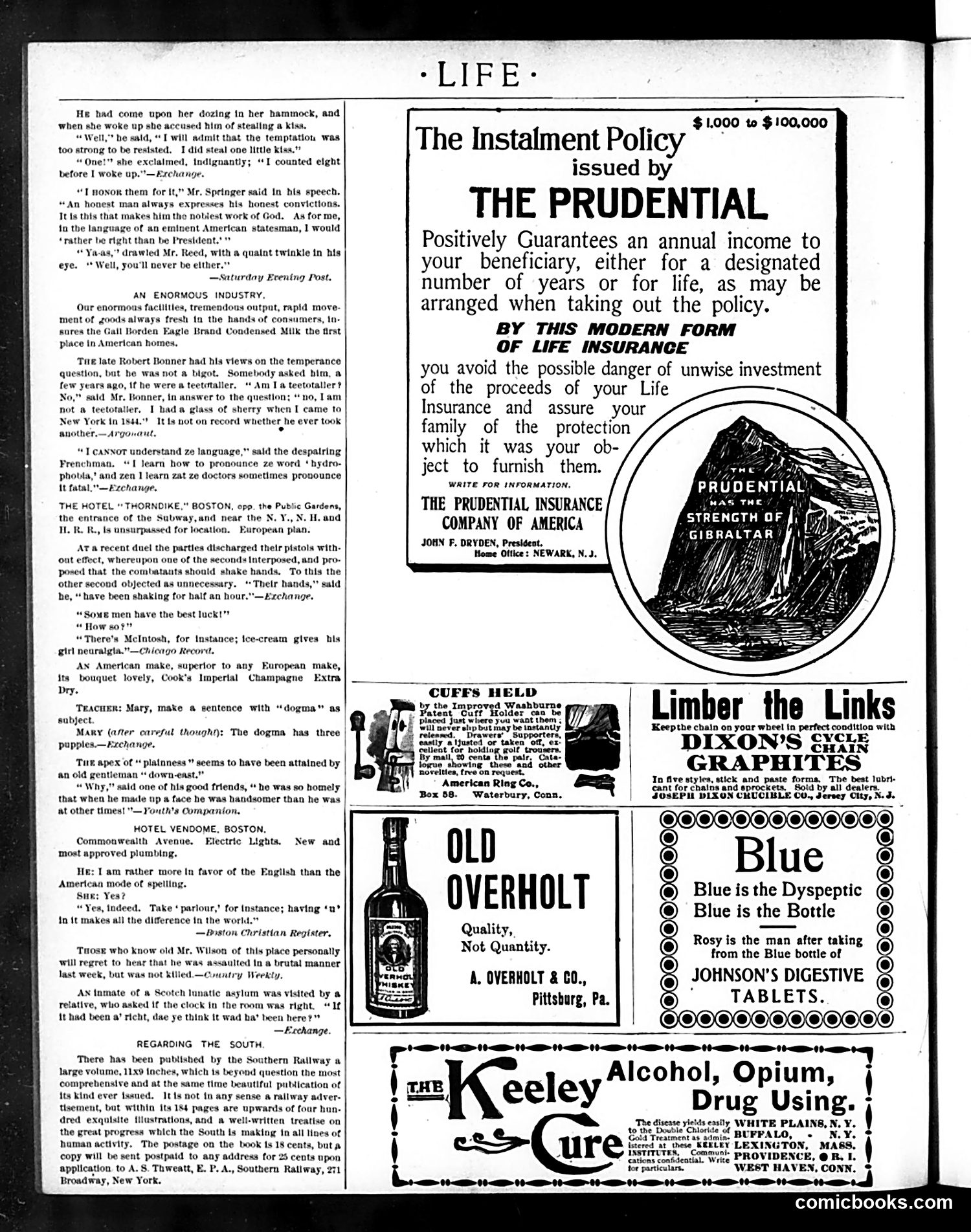
This page is primarily **advertisements and humor snippets**, not political cartoons. The content consists of: **Advertisements** dominate: The Prudential Insurance Company (prominently featuring Gibraltar imagery), Old Overholt whiskey, Johnson's Digestive Tablets, Dixon's Cycle Graphite, and The Keeley Cure (for alcohol and drug addiction). **Humor items** are brief anecdotes and jokes typical of early 20th-century Life magazine—mostly wordplay and domestic situations (a man accused of stealing kisses, ice cream causing neuralgia, etc.). These appear designed for middle-class readers. **Notable context**: The Keeley Cure advertisement references widespread contemporary concern about addiction, while the Prudential ad emphasizes life insurance as modern financial security—both reflecting Progressive Era anxieties about economic stability and social welfare. The page lacks coherent satirical messaging; it's essentially a sampling of period advertising and light humor.
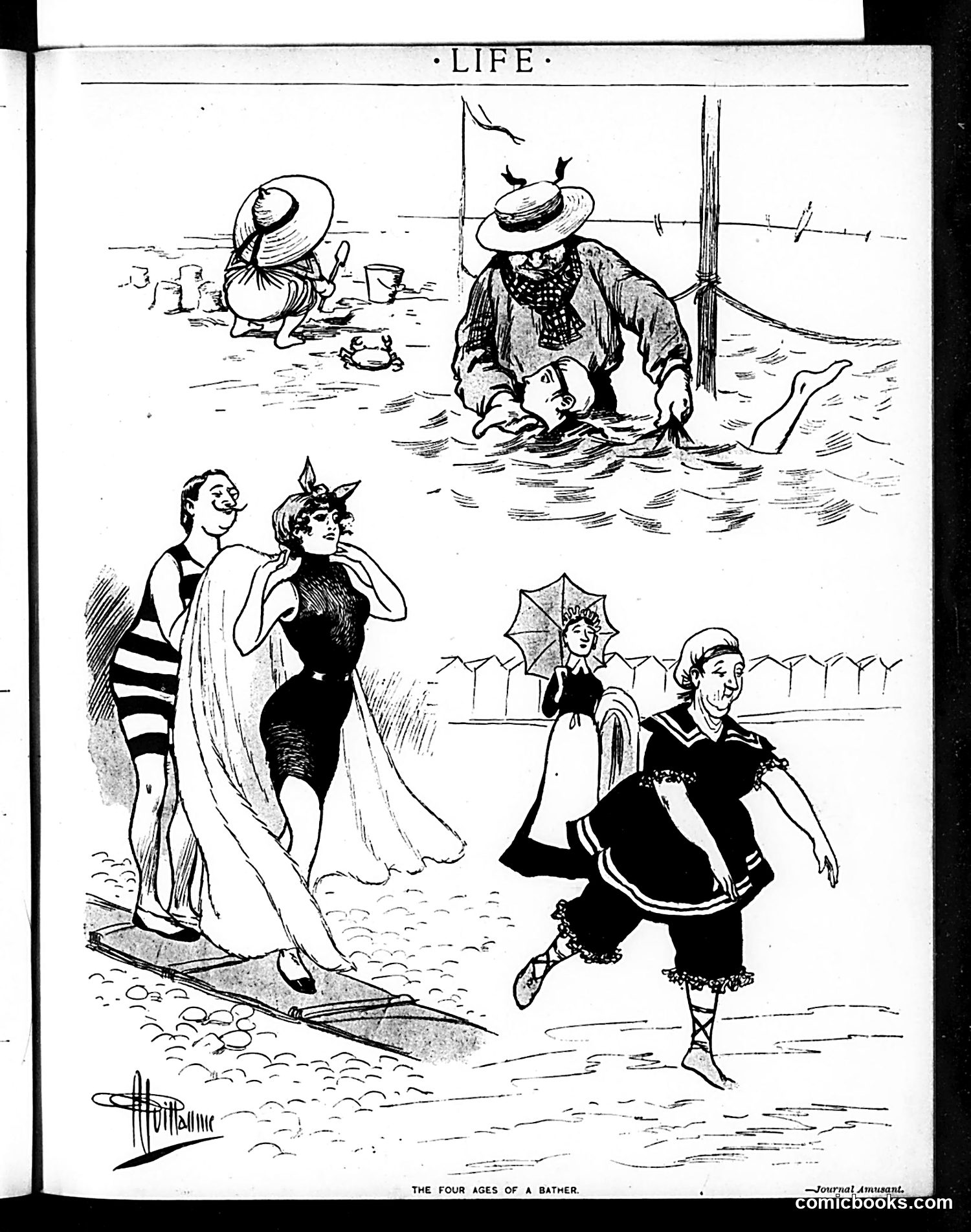
This cartoon illustrates the lifecycle of a beach bather through four stages: 1. **Top left**: A child in a wide hat, digging in sand with simple beach equipment 2. **Top right**: An adult man in period dress (hat, vest) engaged in active fishing or digging 3. **Bottom left**: A young woman in fashionable bathing attire with a male companion, suggesting courtship/leisure 4. **Bottom right**: A woman in sailor-style bathing costume, apparently running or actively enjoying the beach The satire appears to track how beach-going evolves from childhood work/play, through adulthood labor, to romantic pursuit, and finally to independent female recreation. Given the magazine's era and the emphasis on changing women's fashion and autonomy in the bottom panels, the cartoon likely comments on evolving social attitudes toward women's beach activities and independence. The humor derives from the contrast between practical early stages and leisured later ones.
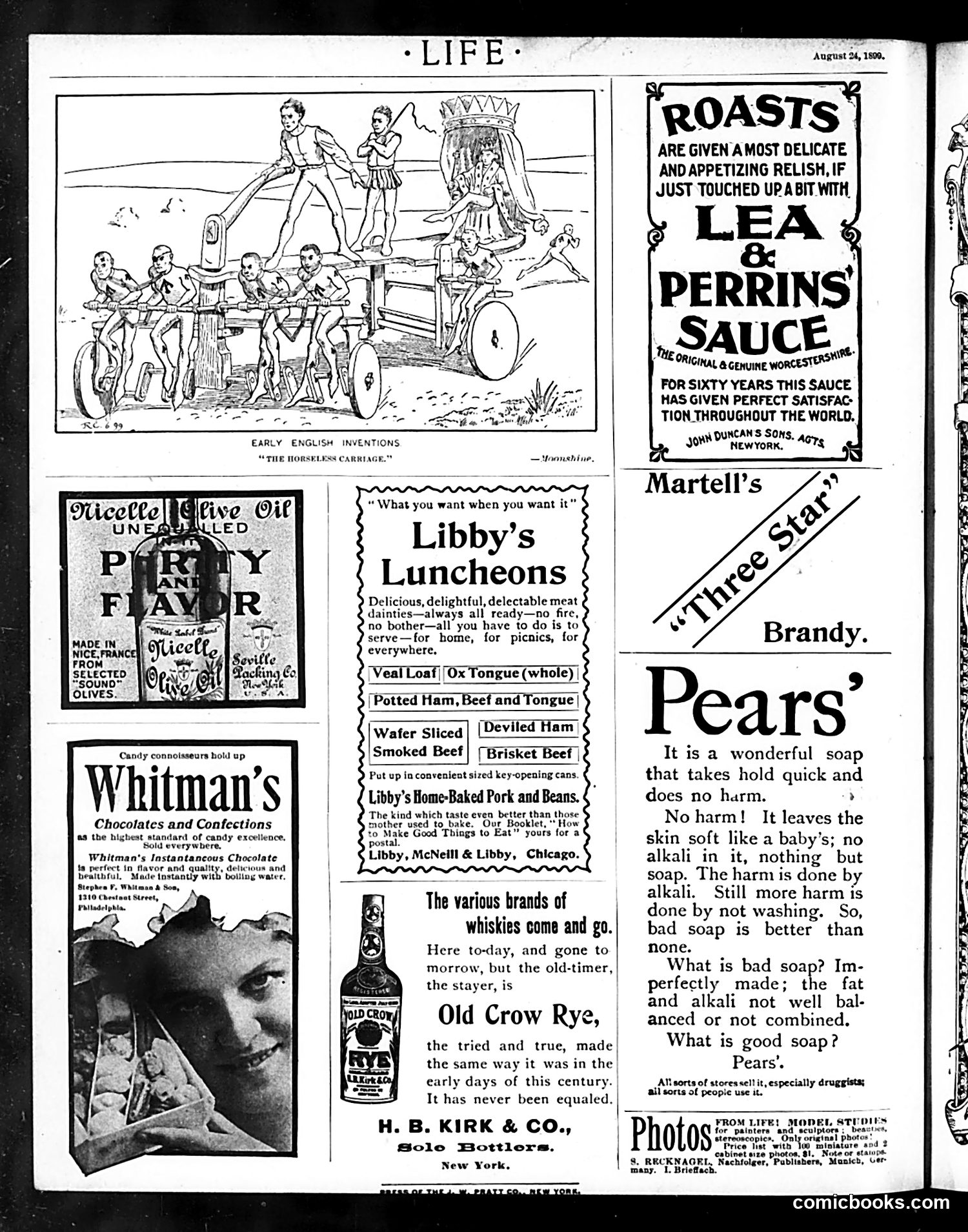
This cartoon satirizes the bicycle as a primitive "invention." Labeled "The Horseless Carriage," it depicts adults and children pedaling a makeshift contraption—essentially showing the bicycle as a comically inefficient substitute for horse-drawn transport. The satire lies in the gap between the grandiose name and the ridiculous reality: multiple people must pedal furiously to move what a horse could pull effortlessly. In 1890, bicycles were genuinely new technology, yet this mocks their impracticality compared to established transportation. The cartoon targets both the bicycle craze and the breathless enthusiasm for "modern inventions" that couldn't match traditional methods. The page is primarily advertisements (Lea & Perrins sauce, Libby's canned meats, Old Crow Rye, Pears' soap) surrounding this single satirical illustration.