
Life, 1899-08-24 · page 4 of 13
Life — August 24, 1899 — page 4: what you’re looking at
What you’re looking at
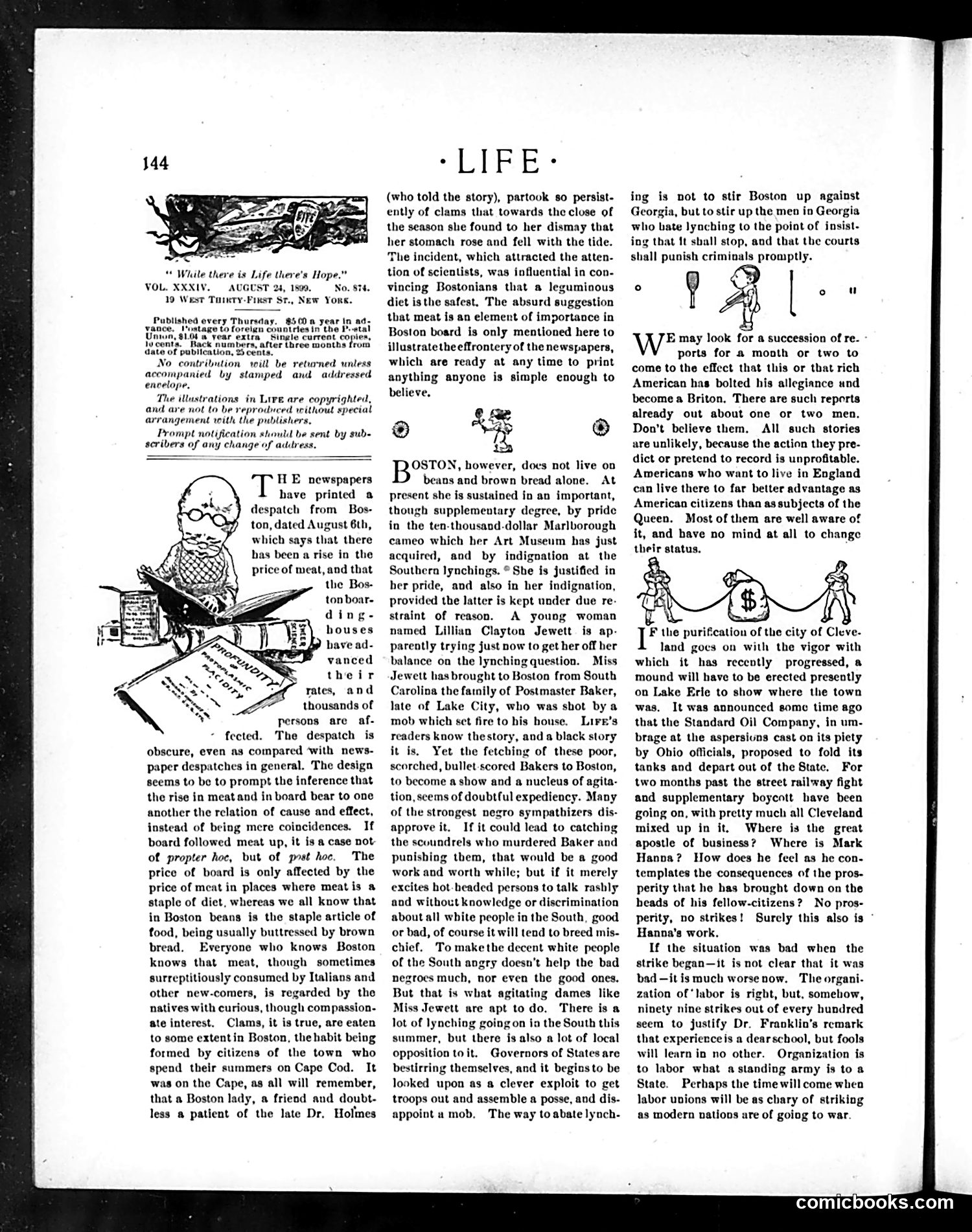
The page contains two editorial cartoons addressing Boston's civic pride and race relations in the American South. **Left cartoon:** Depicts a portly Boston figure surrounded by emblems of the city's cultural institutions (Art Museum, Marlborough cameo). The satire mocks Boston's self-regard—the text notes Bostonians are distressed that their city lacks a rice market, sarcastically suggesting this gap threatens their status. **Right cartoon:** Shows figures labeled with dollar signs and a mound, illustrating civic "purification" projects. The text discusses a proposed Ohio scheme to relocate Black Americans, satirizing both Northern hypocrisy and Southern racial violence. The passage critiques newspapers sensationalizing lynching stories while avoiding substantive solutions to racial injustice. Both cartoons target American pretensions—Boston's smugness and Northern indifference to systematic Southern racism.
📄 Transcribed text from this page (OCR, searchable)
Machine-transcribed from the original scan — historical spelling and the odd misread are preserved.
* While there is Life there's Hope.” VOL. XXXIV. AUGUST 24, 1599, No. S74. 19 West Taiety-Finst St., New YoR«. Published every Thursday. 85.00 0 year In forel ateles in the Fs le current co lucent’. Rack numbers, after three months from date of publication, % cents. No contribution will be returned unless accompanied by stamped and addressed encelope. The illustrations in Live are copyrighted, and are not to be reproduced without special arrangement with the publishers, Prompt notification should be sent by sub- scribers of any change of address. HE newspapers have printed o despatch from Bos- ton, dated August 6th, which says that there has been a rise in the price of meat, and that the Bos- ton boar- ding- houses have ad- vanced their rates, and thousands of Persons are af- fected. The despatch is obscure, even as compared ‘with news- paper despatches in general. The design seems to be to prompt the inference that the rise in meat and in board bear to one another the relation of cause and effect, instead of being mere coincidences. If board followed meat up, it is a case not- of propter hoe, but of post hoc, The price of board is only affected by the price of meat in places where meat is a staple of diet, whereas we all know that in Boston beans is the staple article of food, being usually buttressed by brown bread. Everyone who knows Boston knows that meat, though sometimes surreptitiously consumed by Italians and other new-comers, is regarded by the natives with curious, though compassion- ate interest. Clams, it is true, are eaten to some extentin Boston, the habit being formed by citizens of the town who spend their summers on Cape Cod. It was on the Cape, as all will remember, that a Boston lady, a friend and doubt- less a patient of the late Dr. Holmes ‘LERE « (who told the story), partook so persist- ently of clams that towards the close of the season she found to her dismay that her stomach rose and fell with the tide. The incident, which attracted the atten- tion of scicntists, was influential in con- vincing Bostonians that a leguminous diet isthe safest, The absurd suggestion that meat is an element of importance in Boston board is only mentioned here to illustratetheeffrontery of the newspapers, which are ready at any time to print anything anyone is simple enough to Ae ® OSTON, however, does not live on beans and brown bread alone. At present she is sustained in an important, though supplementary degree, by pride in the ten-thousand-dollar Marlborough cameo which her Art Museum has just acquired, and by indignation at the Southern lynchings. © She is justified in her pride, and also in her indignation, provided the latter is kept under due re- straint of reason. A young woman named Lillian Clayton Jewett is ap- parently trying just now to get her off her balance on the lynching question. Miss Jewett has brought to Boston from South Carolina the fatnily of Postmaster Baker, late of Lake City, who was shot bya mob which set fire to his house, Lire’s readers know thestory, anda black story it is. Yet the fetching of these poor, scorched, bullet-scored Bakers to Boston, to become a show and a nucleus of agita- tion, seems of doubtful expediency. Many of the strongest negro sympathizers dis- approve it, If it could lead to catching the scoundrels who murdered Baker and punishing them, that would be a good work and worth while; but if it merely excites hot-headed persons to talk rashly and without knowledge or discrimination about all white people in the South, good or bad, of course it will tend to breed mis- chief. To makethe decent white people of the South angry doesn’t help the bad negrocs much, nor even the good ones. But that is what agitating dames like Miss Jewett are apt todo. There is a lot of lynching goingon ia the South this summer, but there is also a lot of local opposition to it. Governors of States are bestirring themselves, and it begins to be looked upon as a clever exploit to get troops out and assemble a posse, and dis- appoint a mob, The way to abate lynch. Fa) ing is pot to stir Boston up against Georgia, but to stir up the men in Georgia who bate lynching to the point of insist- ing that {t sball stop, and that the courts shall punish criminals promptly. We may look for a succession of re. ports for 4 month or two to come to the effect that this or that rich American has bolted his allegiance und become a Briton, There are such reports already out about one or two men. Don’t believe them. All such stories are unlikely, because the action they pre- dict or pretend to record is unprofitable. Americans who want to live in England can live there to far better advantage as American citizens than as subjects of the Queen. Most of them are well aware of it, and have no mind at all to change their status. F the purification of the city of Cleve- land gocs on with the vigor with which it has recently progressed, a mound will have to be erected presently on Lake Erle to show where the town was. It was announced some time ago that the Standard Oil Company, in um- brage at the aspersivns cast on its piety by Ohio officials, proposed to fold its tanks and depart out of the State. For two months past the street railway fight and supplementary boycott have been going on, with pretty much all Cleveland mixed up in it, Where is the great apostle of business? Where is Mark Hanna? How does he feel as he con- templates the consequences of the pros- perity that he has brought down on the heads of his fellow-citizens? No pros- perity, no strikes! Surely this also is © Hanna's work. If the situation was bad when the strike began—it is not clear that it was bad —it is much worse now. The organi- zation of ‘labor is right, but, somehow, ninety nine strikes out of every hundred seem to justify Dr. Franklin’s remark that experience is a dearschool, but fools will learn in no other. Organization is to labor what a standing army is to a State. Perhaps the time will come when labor unions will be as chary of striking as modern nations ure of going to war. comicbooks.com