
Life, 1899-08-24 · page 9 of 13
Life — August 24, 1899 — page 9: what you’re looking at
What you’re looking at
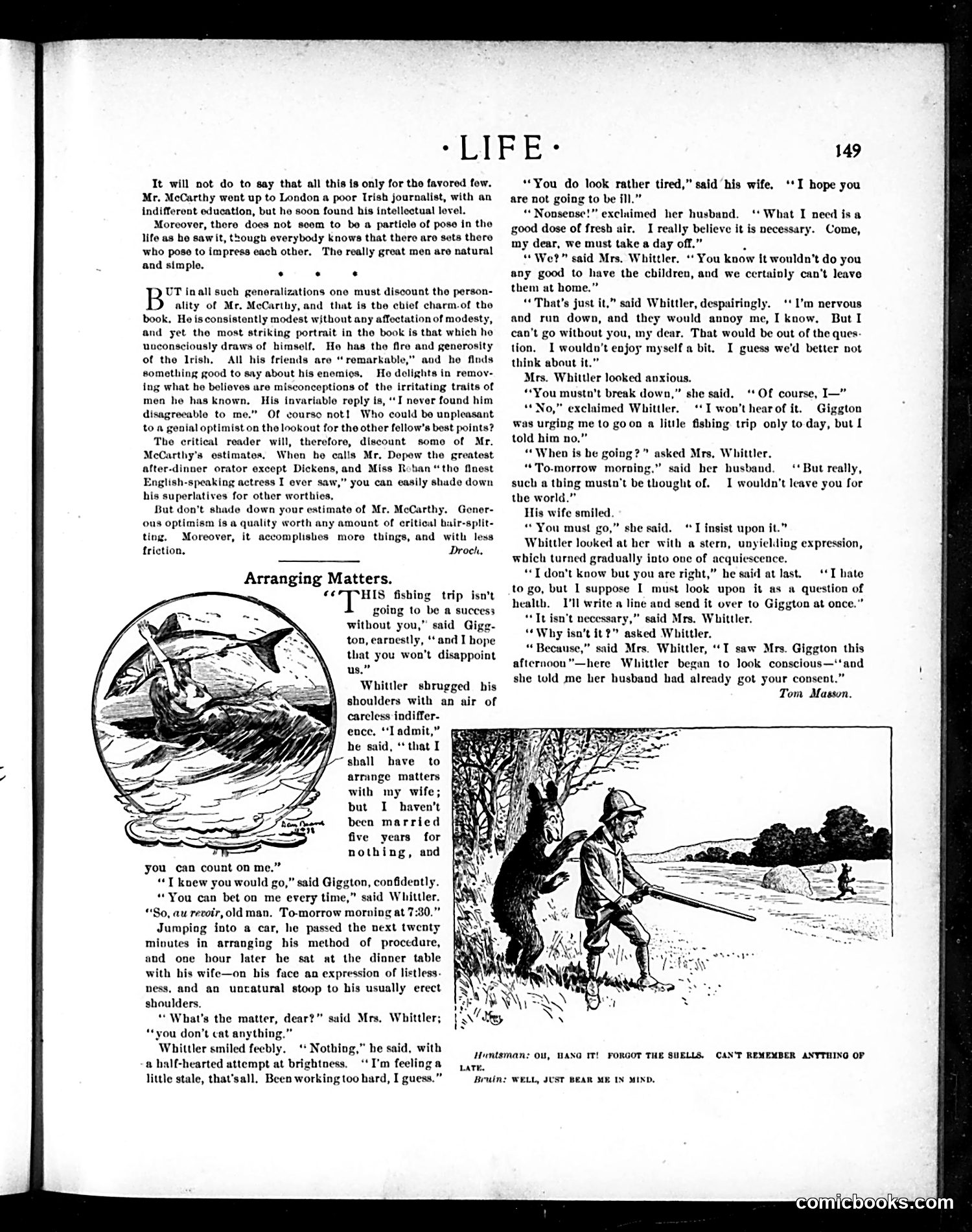
This page contains a fictional narrative titled "Arranging Matters" about a husband (Whittler) and wife negotiating a fishing trip. The central illustration shows two men fishing by a stream. The story satirizes marital dynamics of the era: the husband wants to go fishing despite his wife's objections about his health and their children's needs. The wife initially resists but eventually capitulates after the husband claims he's already secured her consent through a third party (Mrs. Giggton). The satire mocks how men use social manipulation and false claims of agreement to override their wives' actual wishes. It also gently ridicules the husband's transparent excuses about needing fresh air and rest, suggesting men's leisure activities took priority over family concerns in this period's domestic arrangements.
📄 Transcribed text from this page (OCR, searchable)
Machine-transcribed from the original scan — historical spelling and the odd misread are preserved.
“IFES It will not do to say that all this is only for the favored fow. Mr. McCarthy went up to London a poor Trish journalist, with an indifferont education, but ho soon found his intellectual level. Moreover, thore docs not scom to be a particle of pose in the life as ho saw it, though everybody knows that there aro sets there who pose to impress each other, ‘The really great men are natural and simple. . . . UT inall such genoralizations one must discount the person- ality of Mr. McCarthy, and that is the cbief charm-of tho book. He is consistently modest without any affectation of modesty, and yet the most striking portrait in tho book is that which ho unconsciously draws of himsolf, Ho has tho fire and generosity of the Irish, All his friends are “remarkable,” and he flods something good to say about his enemies, Ho dolights in remov- ing what ho believes are misconceptions of the irritating traits of men he has known, His invariable reply ta, “I never found him disagreeable to me.” Of courso not! Who could be unpleasant to a genial optimist on the lookout for the other fellow’s best points? The critical reader will, therefore, discount somo of Mr. McCarthy's estimates, When he calls Mr. Depow the greatest after-dinner orator except Dickens, and Miss Reban “tho nest English-speaking actress I ever saw,” you can easily shade down his superlatives for other worthies, But don’t shade down your estimate of Mr. McCarthy. Genor- ous optimism is a quality worth any amount of critical bair-split- ting, Moreover, it accomplishes moro things, and with less friction. Droch. Arranging Matters. CCT HIS fishing trip isn't going to be a success without you,” said Gigg- ton, earnestly, ‘and I hope that you won't disappoint us.” Whittler shrugged bis shoulders with an air of careless indiffer- ence, “I admit,” he said, “that I “shall have to armnge matters with my wife; but I haven't been married five years for nothing, and you can count on me.” “T knew you would go,” said Giggton, confidently. “You can bet on me every time,” said Whittler. “So, au revoir, old man. To-morrow morning at 7:30.” Jumpiog into a car, he passed the next twenty minutes in arranging his method of procedure, and one hour later he sat at the dinner table with his wife—on bis face an expression of listless. ness, and an uncatural stoop to his usually erect shoulders. “What's the matter, dear?” said Mrs. Whittler; ‘*you don’t cat anything.” Whittler smiled feebly. ‘* Nothing,” he said, with a half-hearted attempt at brightness. ‘I'm feelinga LATE. little stale, that’sall, Been working too hard, I guess.” Huntsman: ou, WANG It! 149 “You do look rather tired,” said his wife, are not going to be ill.” “Nonsense!” exclaimed her husband. ‘* What I need isa good dose of fresh air. I really believe it is necessary. Come, my dear, we must take a day off.” q “We?” said Mrs. Whittler. ‘‘ You know {t wouldn't do you any good to have the children, and we certainly can't leave them at home.” ‘That's just it,” said Whittler, despairingly. ‘I’m nervous and run down, and they would annoy me, I know, But I can’t go without you, my dear, That would be out of the ques- tion. 1 wouldn't enjoy myself a bit. I guess we'd better not think about it.” Mrs. Whittler looked anxious. “You mustn't break down,” she said, ‘* Of course, I—” **No,” exclaimed Whittler. ‘* I won't hearof it. Giggton was urging me to goon a little fishing trip only today, but I told him no,” “ When is he going?” asked Mrs, Whittler, “To-morrow morning.” said her husband. such a thing mustn't be thought of. the world.” His wife smiled “You must go,” she said. “I insist upon it.” Whittler looked at her with a stern, unyielding expression, which turned gradually into one of acquiescence. “IT don't know but you are right,” he said at last. ‘I hate to go, but I suppose I must look upon it as a question of health. I'll write a line and send it over to Giggton at once.” “Tt isn't necessary,” said Mrs. Whittler. “Why isn’t it?” asked Whittler. “ Because,” said Mrs. Whittler, ‘‘T saw Mrs. Giggton this aftcrnoon”—here Whittler began to look conscious—‘tand she tuld me her husband had already got your consent.” Tom Masson. “*T hope you “But really, I wouldn't leave you for FORGOT THE SUELLS, CAN'T REMEMBER ANYTHING OP Bruin: WELL, JUST BEAR ME IN MIND,