
A complete issue · 21 pages · 1899
Life — June 29, 1899
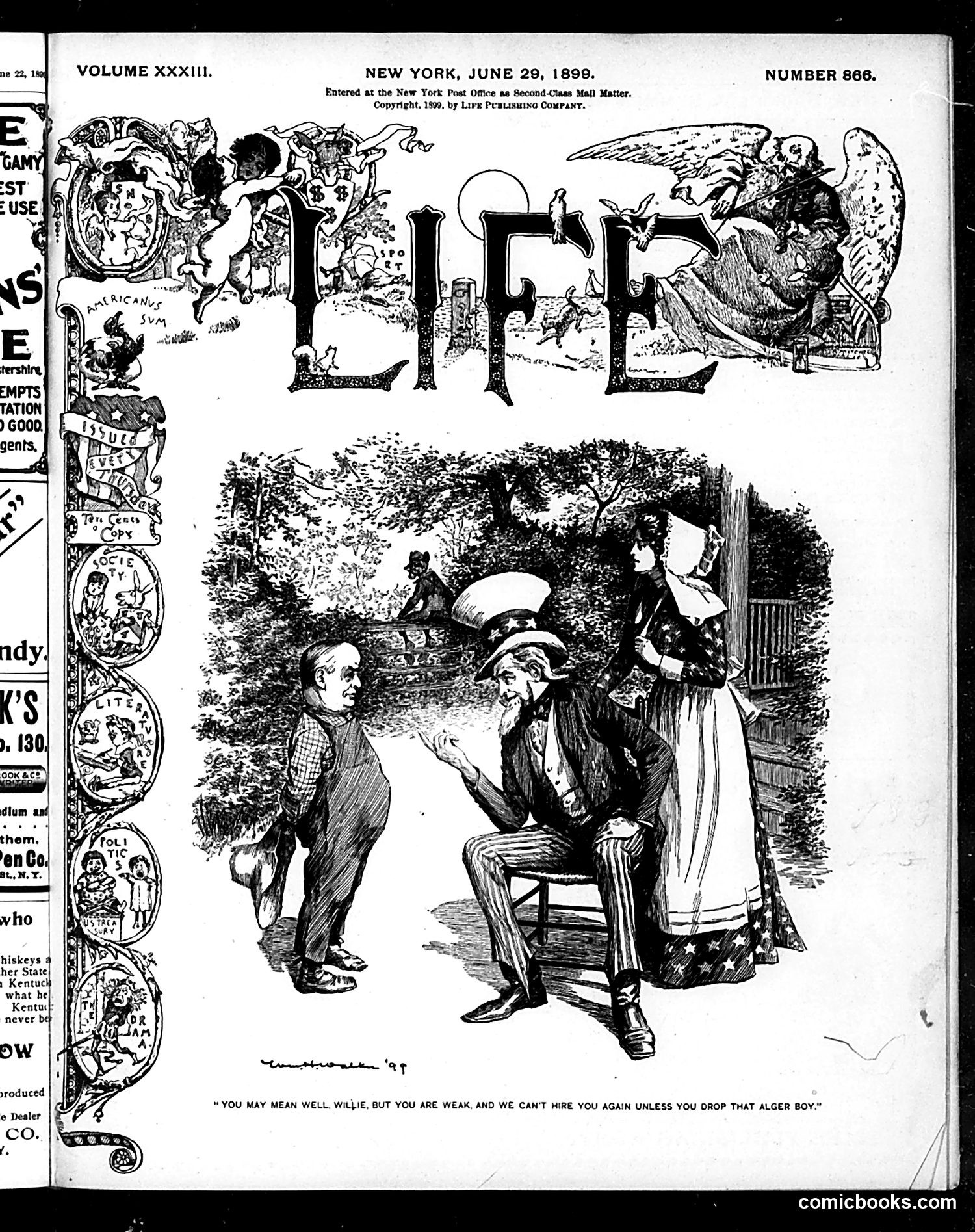
This page features a satirical cartoon showing three men in a rural/outdoor setting. The caption reads: "You may mean well, Willie, but you are weak, and we can't hire you again unless you drop that alger boy." The cartoon appears to address labor disputes or employment conflicts of the 1890s era. "Willie" seems to be an employee being pressured to abandon loyalty to another worker (the "alger boy"). The reference to "weak" suggests Willie is being criticized for maintaining solidarity with a coworker rather than prioritizing his own employment. This likely satirizes labor management practices and union-busting tactics of the Gilded Age, when employers commonly demanded workers choose between keeping their jobs or supporting fellow laborers. The rural setting and working-class dress reinforce the economic theme.
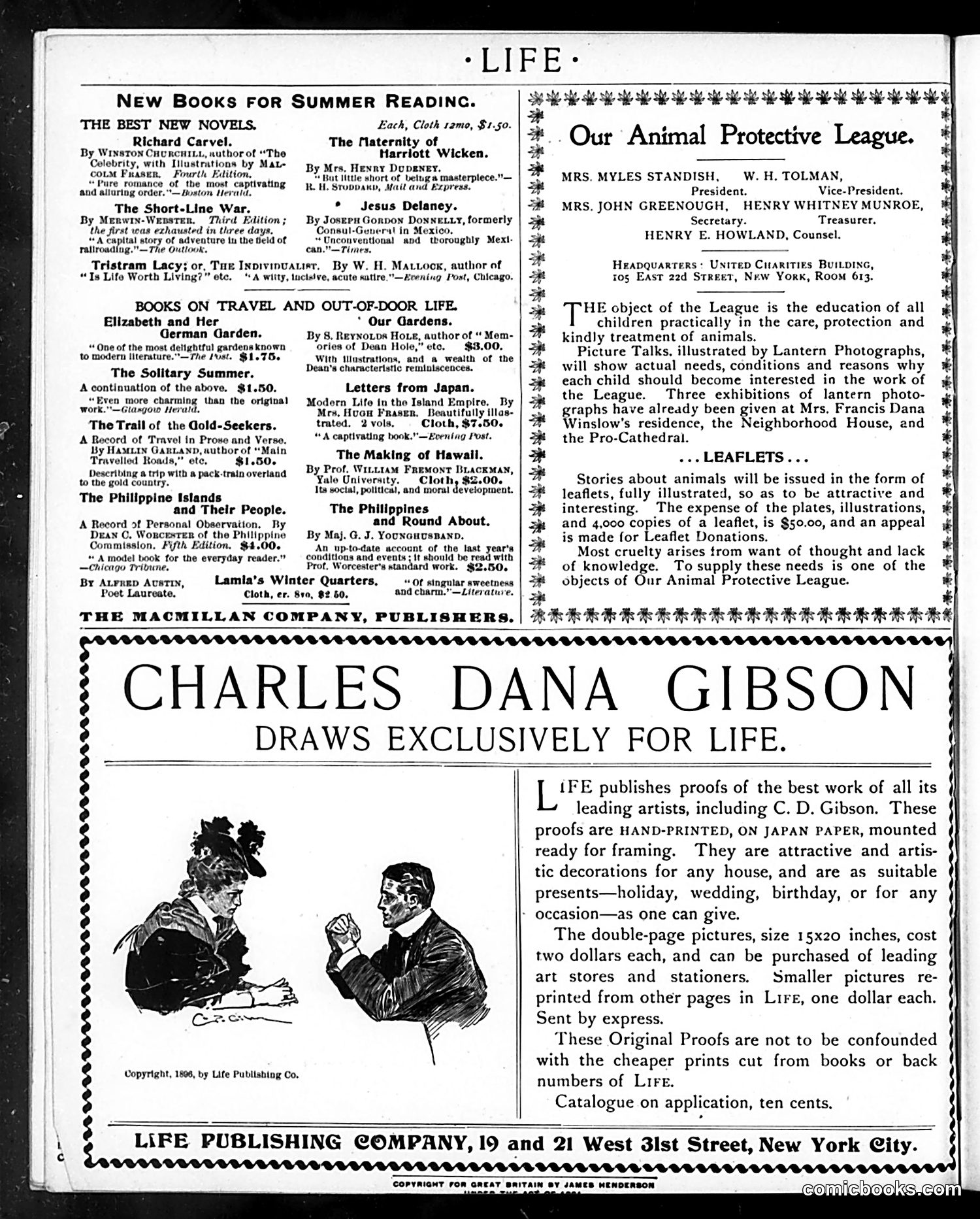
This page is primarily **advertising and editorial content** rather than political satire. The top section advertises new summer books from The Macmillan Company, including novels and travel guides. The right column promotes the **Our Animal Protective League**, describing its mission to educate children about animal welfare through illustrated lantern slide presentations. The lower half features an advertisement for **Charles Dana Gibson's exclusive artwork** published by Life Publishing Company. The cartoon shows two figures in what appears to be a social scene—likely Gibson's characteristic "Gibson Girl" style satirizing upper-class American society, though the specific subjects are unclear from the image alone. The advertisement emphasizes that Gibson's proofs are hand-printed on Japan paper and suitable as gifts.
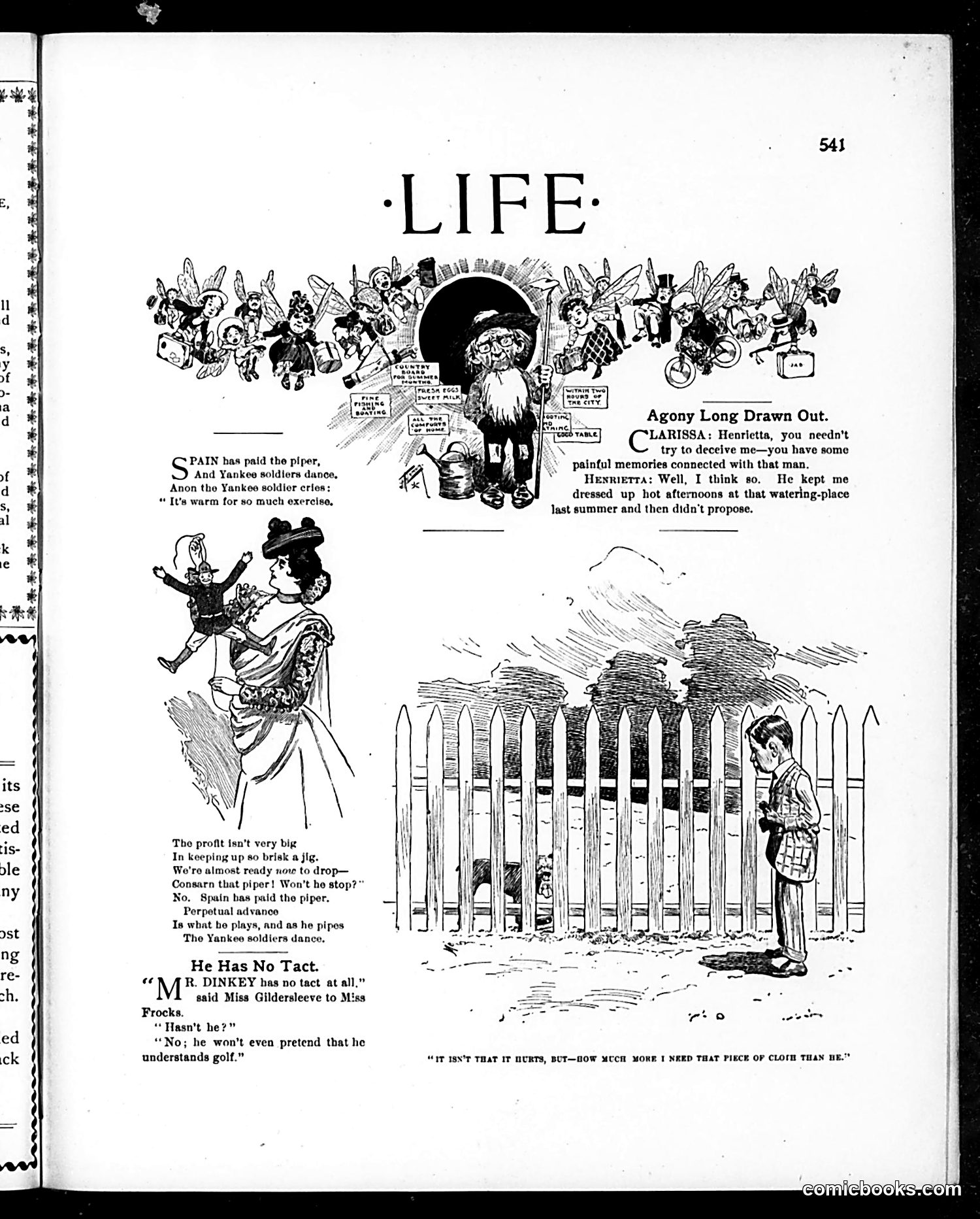
This page contains three distinct satirical pieces from early 20th-century Life magazine: 1. **"Agony Long Drawn Out"**: A dialogue between Larissa and Henrietta about a man who kept Larissa dressed up during hot afternoons at a watering place but never proposed. The satire mocks romantic disappointment and the social custom of courtship rituals. 2. **"He Has No Tact"**: A brief joke about Mr. Dinkey lacking understanding of golf, suggesting he cannot "pretend" to understand the sport—satirizing social pretense and masculine incompetence. 3. **The fence illustration**: Shows a boy examining a fence with the caption "It isn't that it hurts, but—how much more I need that piece of cloth than be."—likely commenting on poverty, necessity, or clothing shortage during a period of hardship (possibly WWI era).
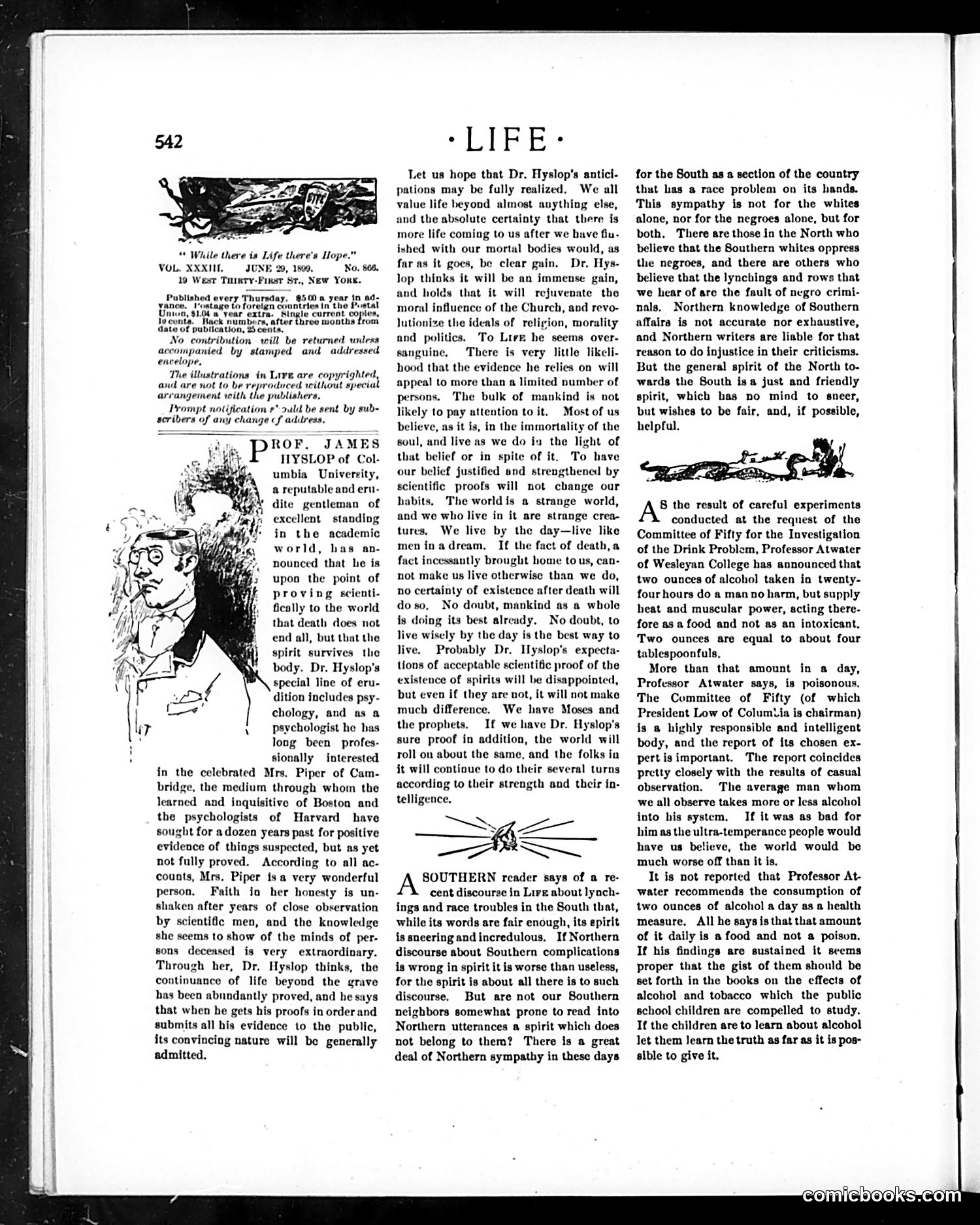
This page primarily contains editorial text rather than political cartoons. The main illustration is a caricatured portrait of **Dr. James Hyslop of Columbia University**, a psychologist and spiritualist researcher mentioned in the accompanying article. The text discusses Hyslop's beliefs in life after death and spiritualism, presenting his ideas with gentle skepticism. A secondary article references Mrs. Piper, described as a "medium" whose supposed psychic abilities were studied by Harvard psychologists over decades—apparently she could withstand scientific scrutiny, suggesting genuine phenomena (or remarkable deception). The page reflects early 20th-century cultural interest in spiritualism and the tension between scientific investigation and belief in the supernatural. The tone suggests Life magazine was bemused by these pursuits rather than mockingly hostile.
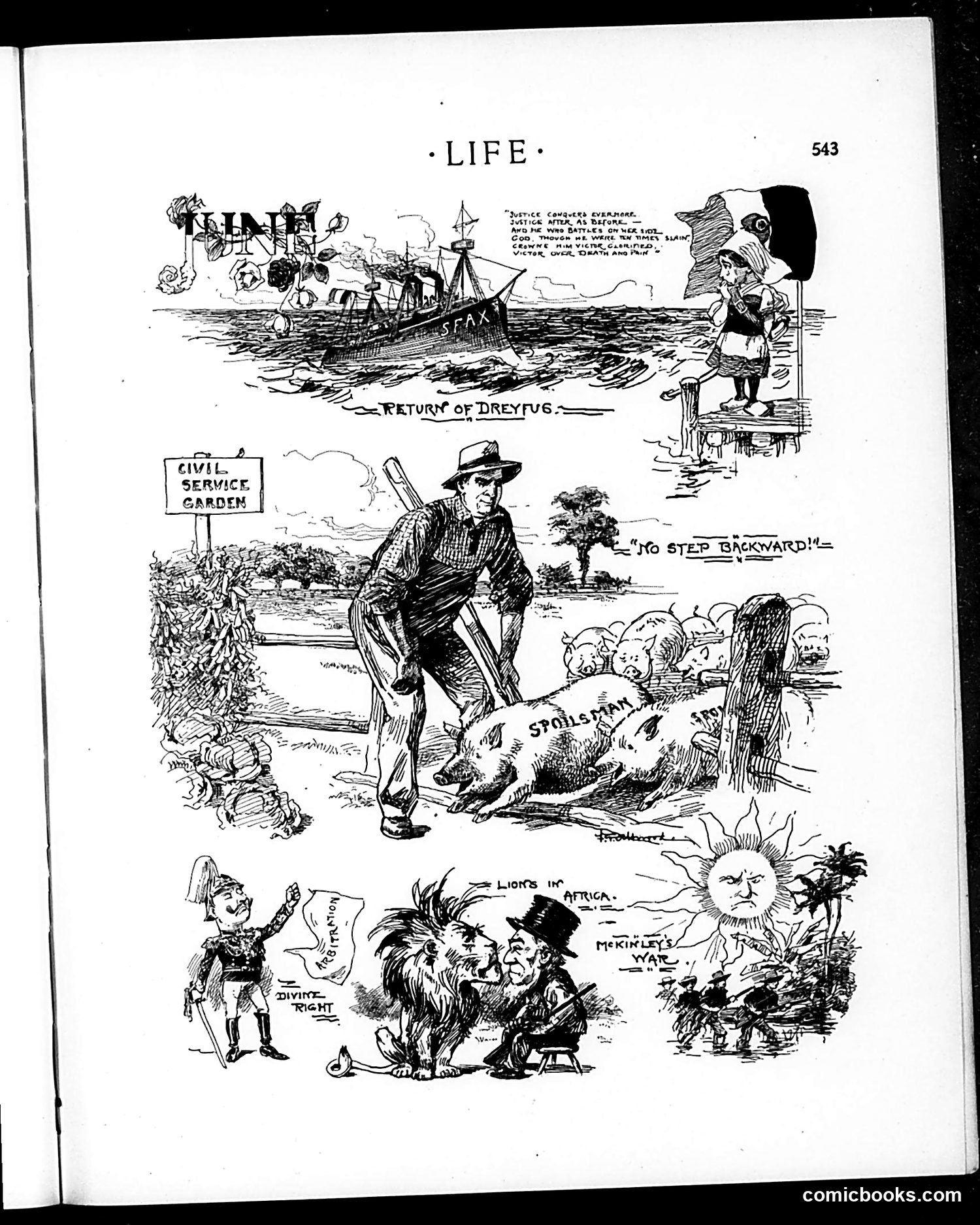
This page from *Life* magazine contains several satirical cartoons commenting on early 20th-century American politics and society: **"Return of Dreyfus"** (top): References the famous Dreyfus Affair, the French scandal involving a falsely accused military officer. The ship's return likely satirizes a comparable American controversy. **"No Step Backward!"** (middle): Shows a man in a Civil Service Garden struggling with a pig labeled "Statism," suggesting anxieties about expanding government power and bureaucratic control. **"Divine Right" and "Lions in Africa/McKinley's Year"** (bottom): Appear to reference President McKinley's policies, with animal symbolism (lion) possibly critiquing American imperialism or domestic political conflicts of his administration. The overall theme seems critical of governmental expansion and foreign policy adventurism.
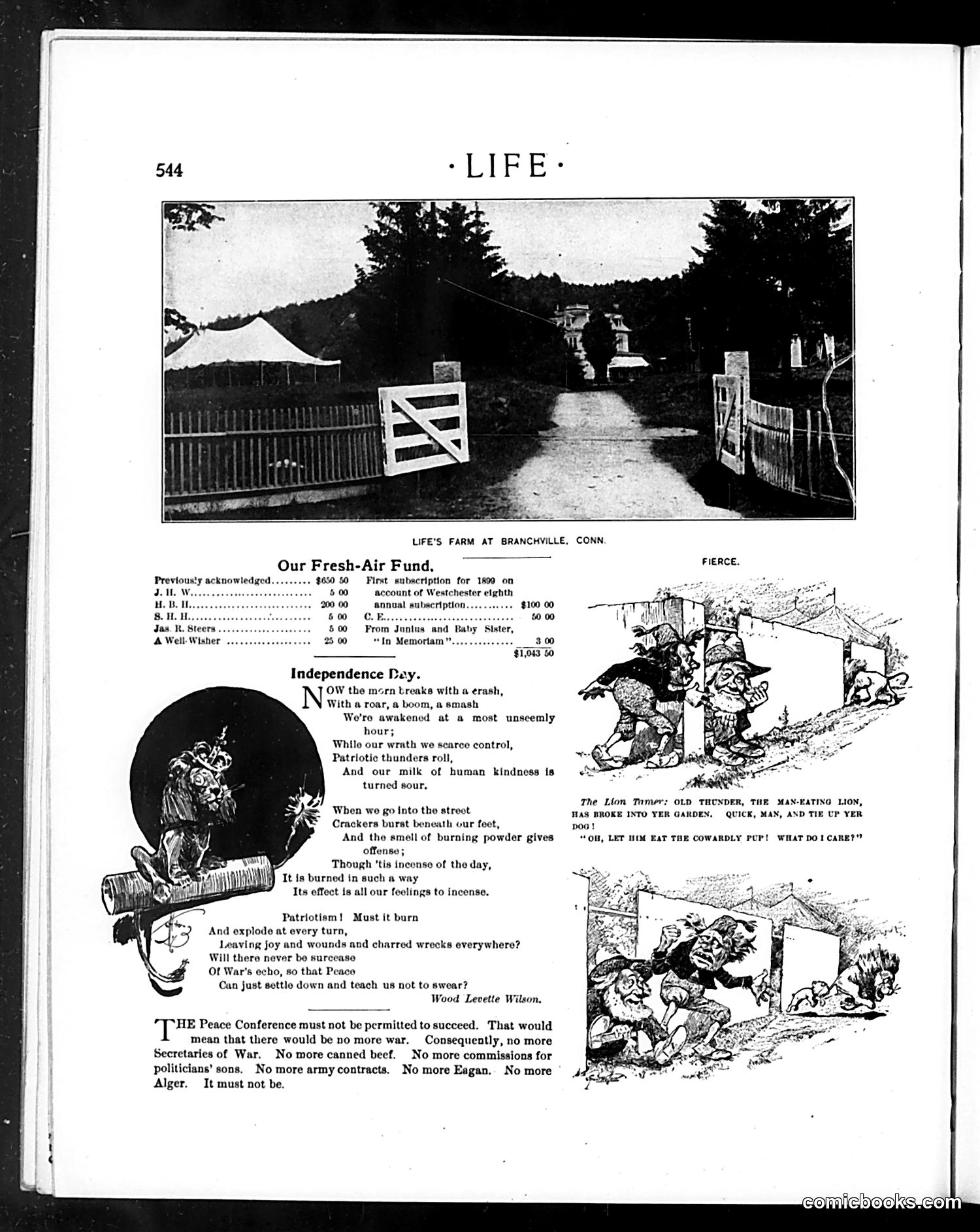
This page contains anti-war satire from the post-World War I era. The "Independence Day" poem by Wood Lovette Wilson is a bitter critique of American militarism, using fireworks as a metaphor for warfare's destruction. It argues that patriotic celebration masks the reality of violence and suffering. The accompanying text block argues against a Peace Conference succeeding—because doing so would eliminate future wars, and therefore eliminate military contracts, government positions, and defense industry profits. This reveals the satirist's view that powerful interests profit from perpetual conflict. The cartoons titled "The Lion Tamer" appear to depict political figures (likely post-war leaders) in dangerous situations, likely commentary on unstable international relations. The page advocates for peace while cynically suggesting economic interests prevent it.
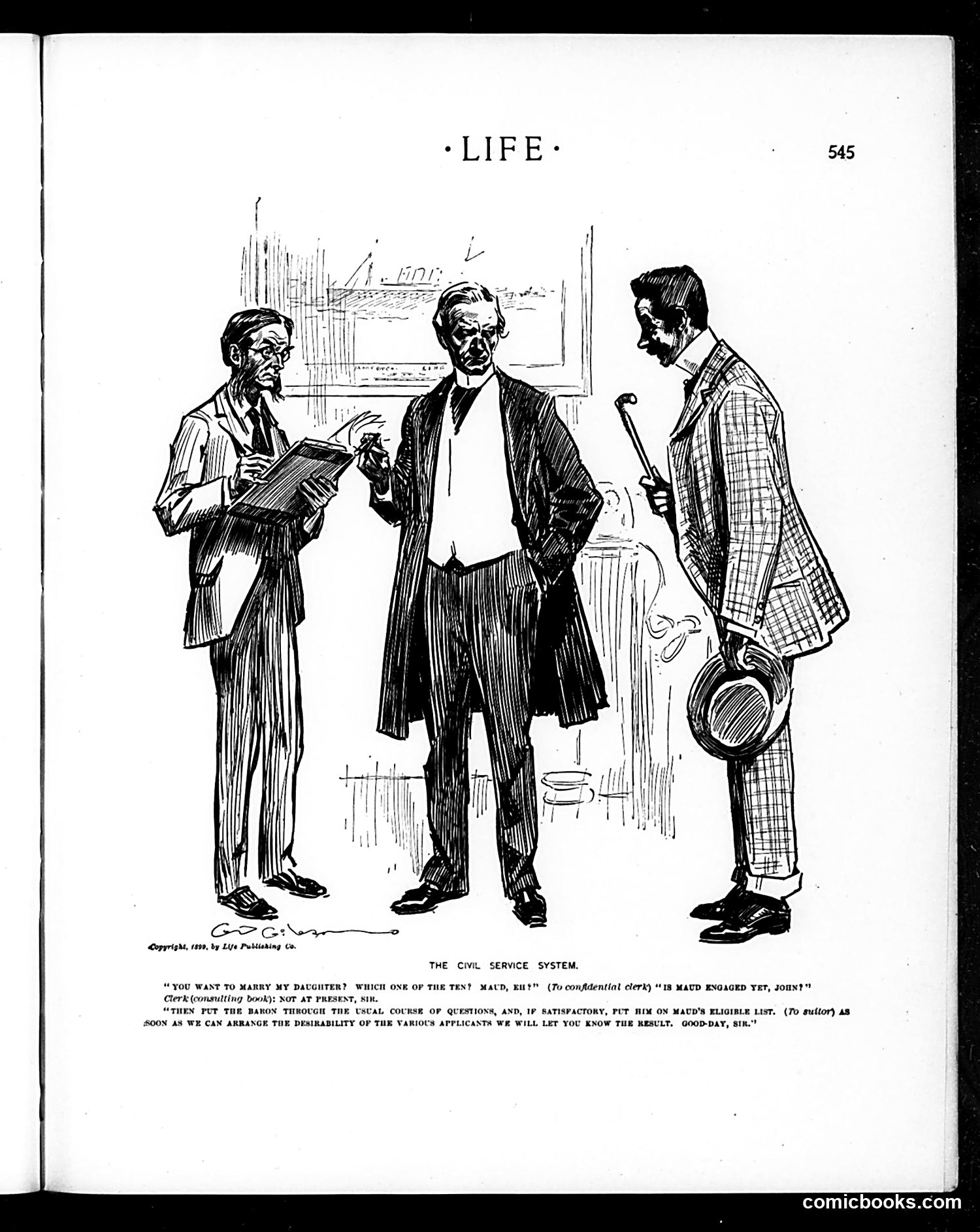
This satirical cartoon mocks the bureaucratic complexity of hiring through the civil service system. Three men in business attire represent different roles in the process: one holds a clipboard (a clerk or administrator), one stands in the middle (an applicant or official), and one holds what appears to be a saxophone or musical instrument (suggesting absurdity or chaos). The caption ridicules how civil service exams create unnecessary obstacles for job applicants. The dialogue indicates that even after passing examinations, an applicant's eligibility depends on bureaucratic processing—a system so convoluted that the outcome remains uncertain. The satire suggests that civil service reform, meant to eliminate favoritism, instead replaced it with impenetrable red tape and procedural nonsense.
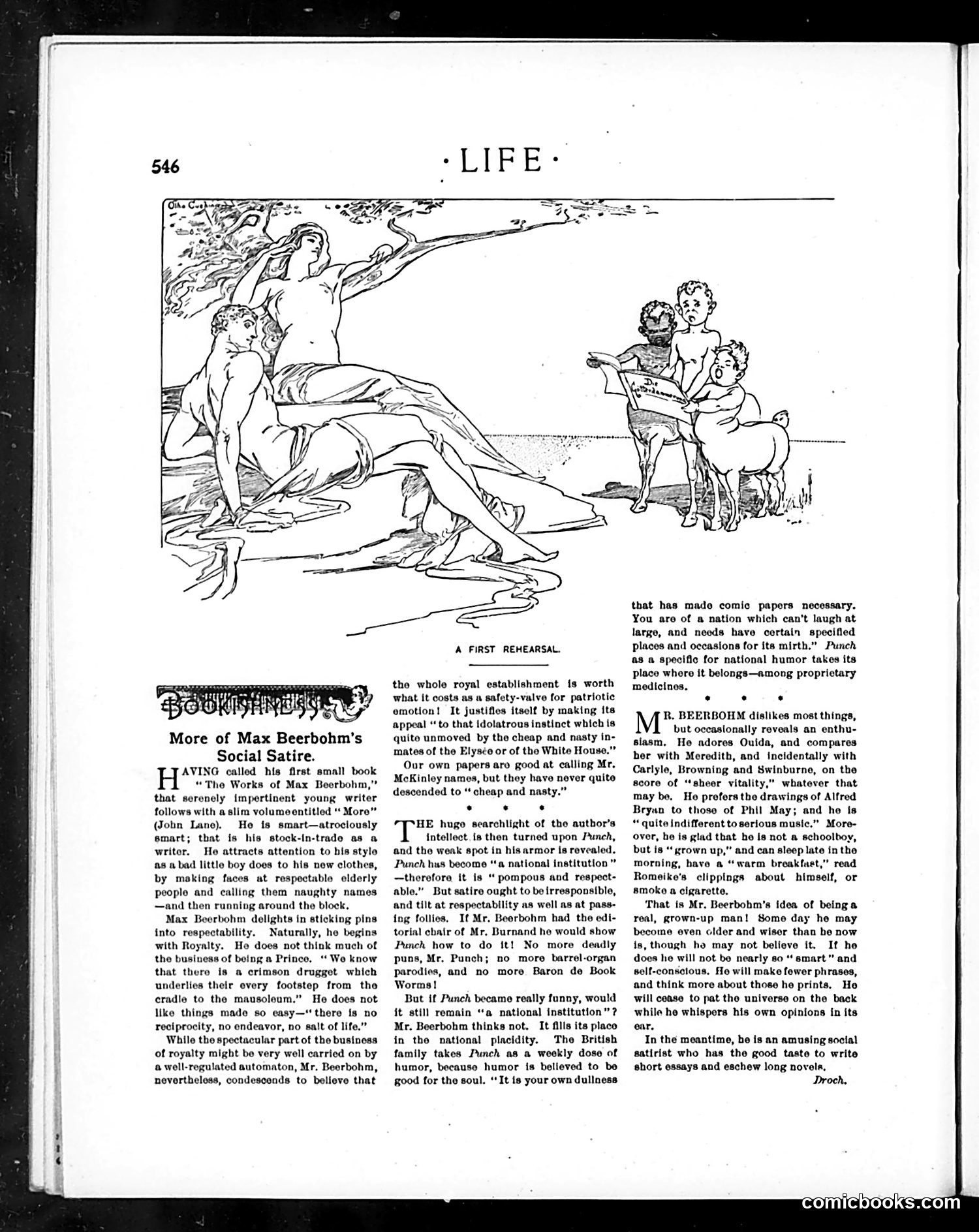
This cartoon satirizes **Max Beerbohm**, a prominent British satirist and caricaturist. The illustration shows an allegorical female figure (likely representing "Punch" or British satire itself) instructing cherubic children in the art of social mockery. The accompanying text critiques Beerbohm's approach to humor: while praising his talent, it argues he's become overly "respectable" and refined, losing the sharp edge necessary for effective satire. The article suggests Beerbohm believes Punch should be a "national institution"—implying his humor has become too genteel and self-conscious rather than genuinely biting. The satire ultimately questions whether Beerbohm can balance artistic sophistication with the irreverent spirit satire requires.
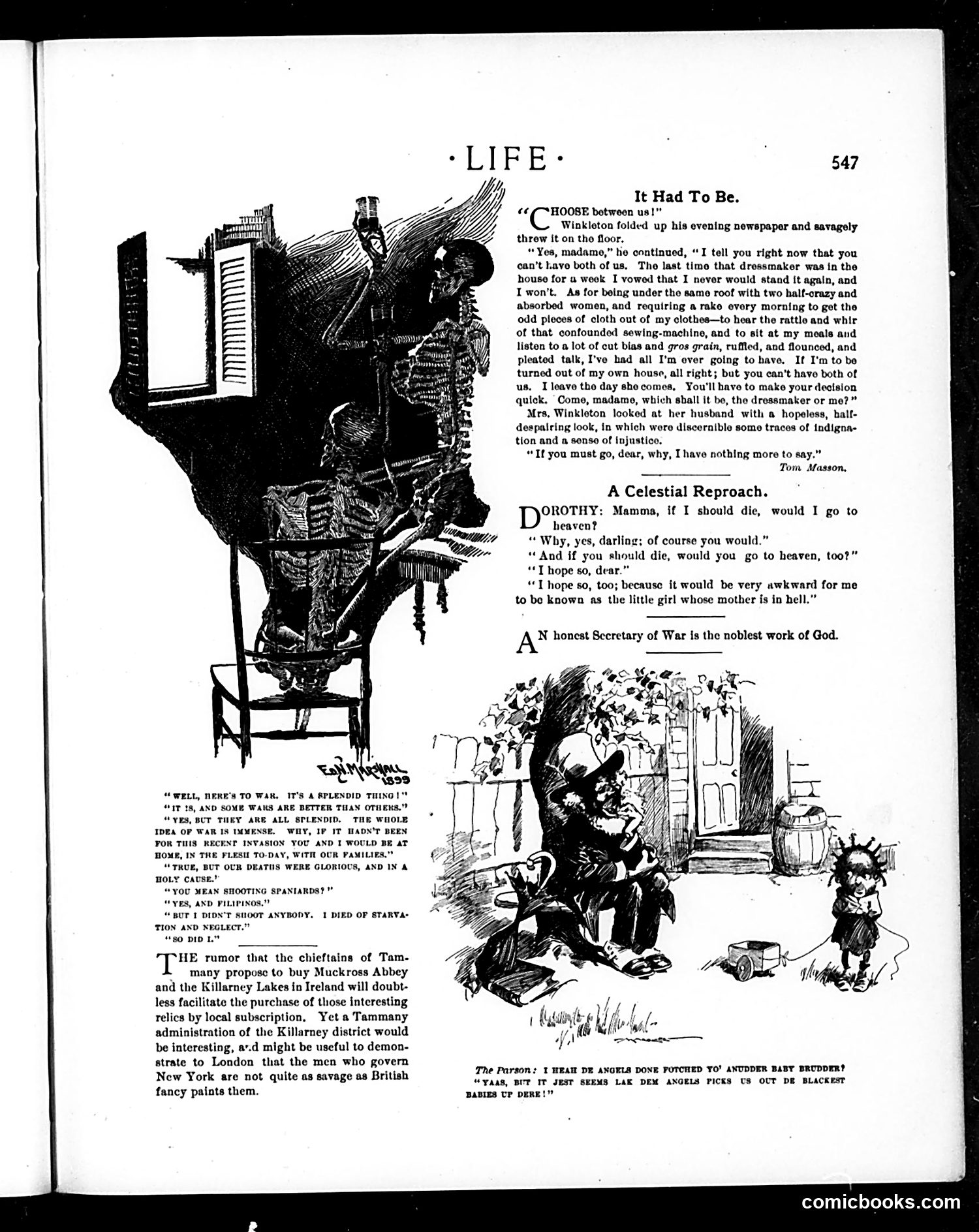
This page contains three distinct satirical pieces: 1. **"It Had To Be"** (top): A domestic quarrel between Mr. and Mrs. Winkleton over whether a dressmaker or wife should stay in their house. The satire mocks marital discord and the triviality of middle-class domestic disputes. 2. **"A Celestial Reproach"** (middle): A brief dialogue between Dorothy and her mother about heaven, likely satirizing sentimentality or religious hypocrisy of the era. 3. **"An Honest Secretary of War Is the Noblest Work of God"** (bottom): A complex political cartoon depicting what appears to be a clergyman or authority figure with a demon/devil character, criticizing government war policy. The dialogue mocks those claiming war is glorious while soldiers starve. This references actual WWI hardships and governmental failures in supplying troops. The Tammany Hall reference indicates early 20th-century American political corruption concerns.
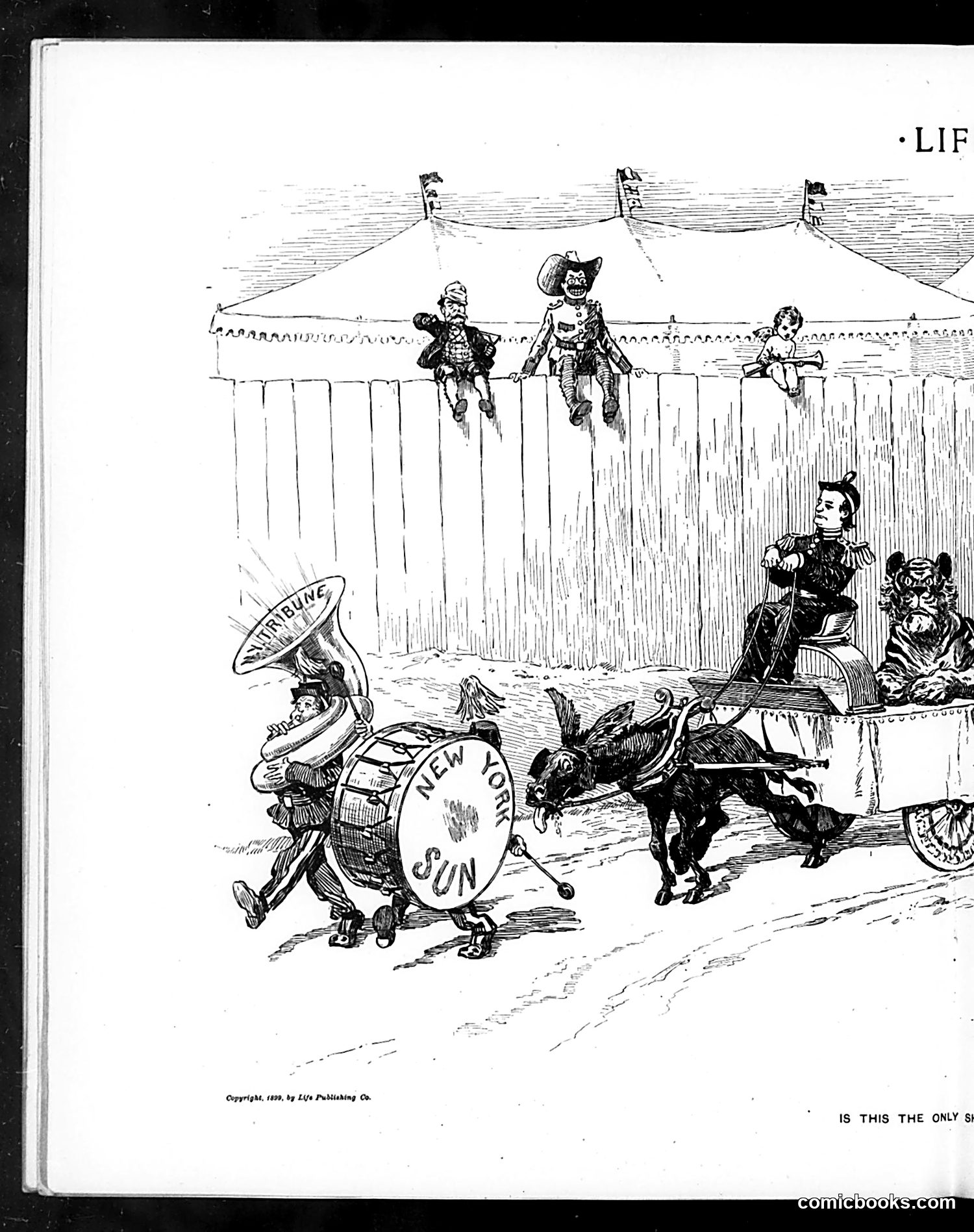
This Life magazine cartoon depicts a circus performance where the "New York Sun" (visible on the drum) is performing as an entertainer or performer. The figure carrying the drum appears to be a caricatured representation of the newspaper itself, with military or formal dress suggesting authority or pretension. The circus setting—complete with tent, ringmaster in the box seats, and audience—is a metaphor for sensationalism or spectacle. The satirical point appears to critique the New York Sun for theatrical, exaggerated journalism or "circus-like" reporting practices. The military figure watching suggests commentary on how newspapers present news with unwarranted grandeur or fabrication. The partial text "IS THIS THE ONLY S[...]" at bottom suggests the cartoon questions whether sensationalism is the newspaper's sole characteristic or purpose.
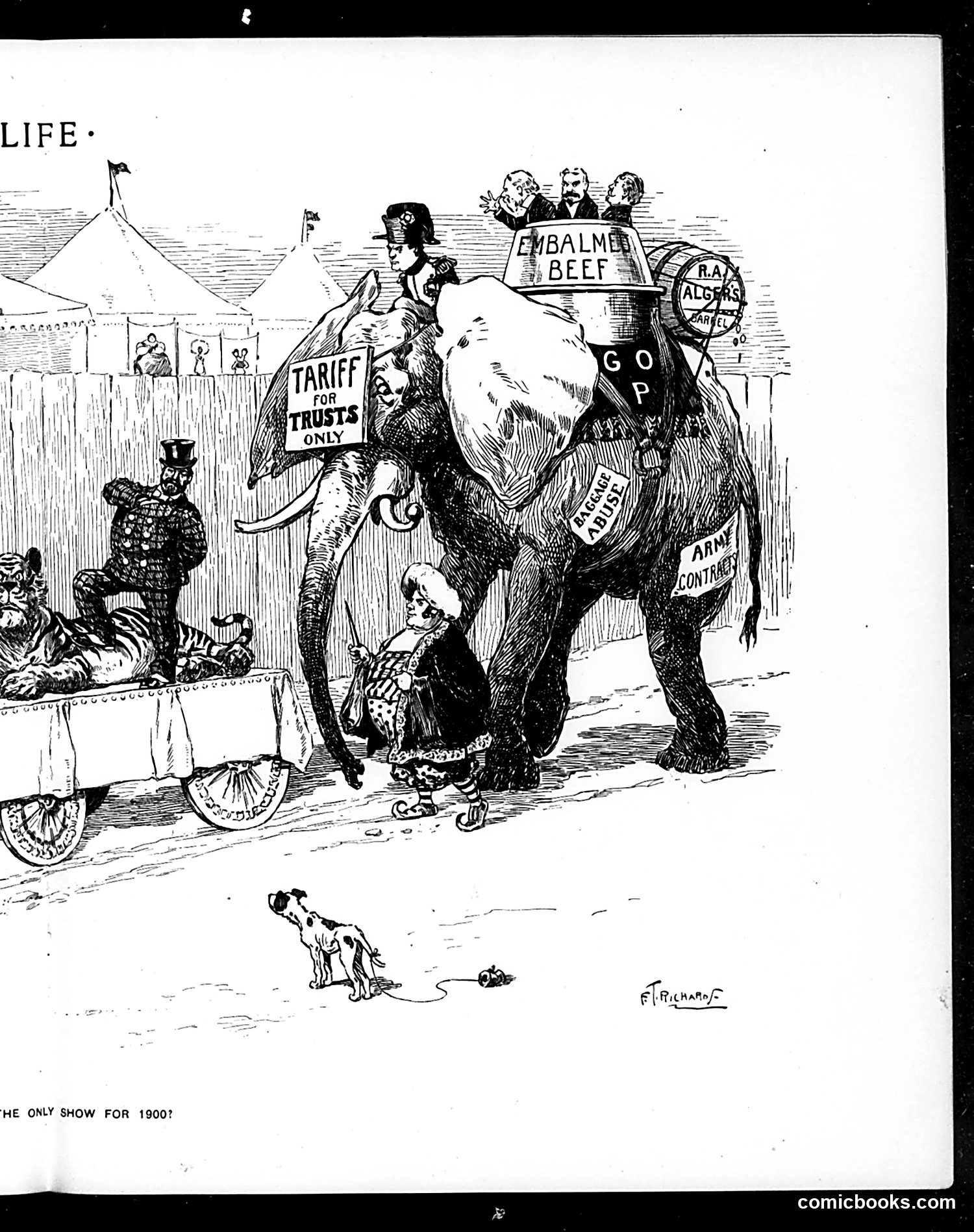
This is a satirical political cartoon from Life magazine, signed by F. Irichardt. It depicts a massive elephant (representing the Republican Party/GOP) at a circus, laden with various labels: "Embalmed Beef," "Raw Alcohol," "Army Contracts," and "Free Silver." A politician rides the elephant holding a sign reading "Tariff for Trusts Only," while wealthy figures sit atop the beast. A small child stands before it, seemingly innocent or vulnerable to its influence. The cartoon critiques Republican policies and corporate corruption, particularly: - Questionable military supply contracts (embalmed beef scandal from Spanish-American War) - Tariff protection benefiting large corporations/trusts - Alcohol policy issues - Currency/monetary policy The "only show for 1900" subtitle suggests these corrupt practices dominated the political landscape heading into the new century's presidential election.
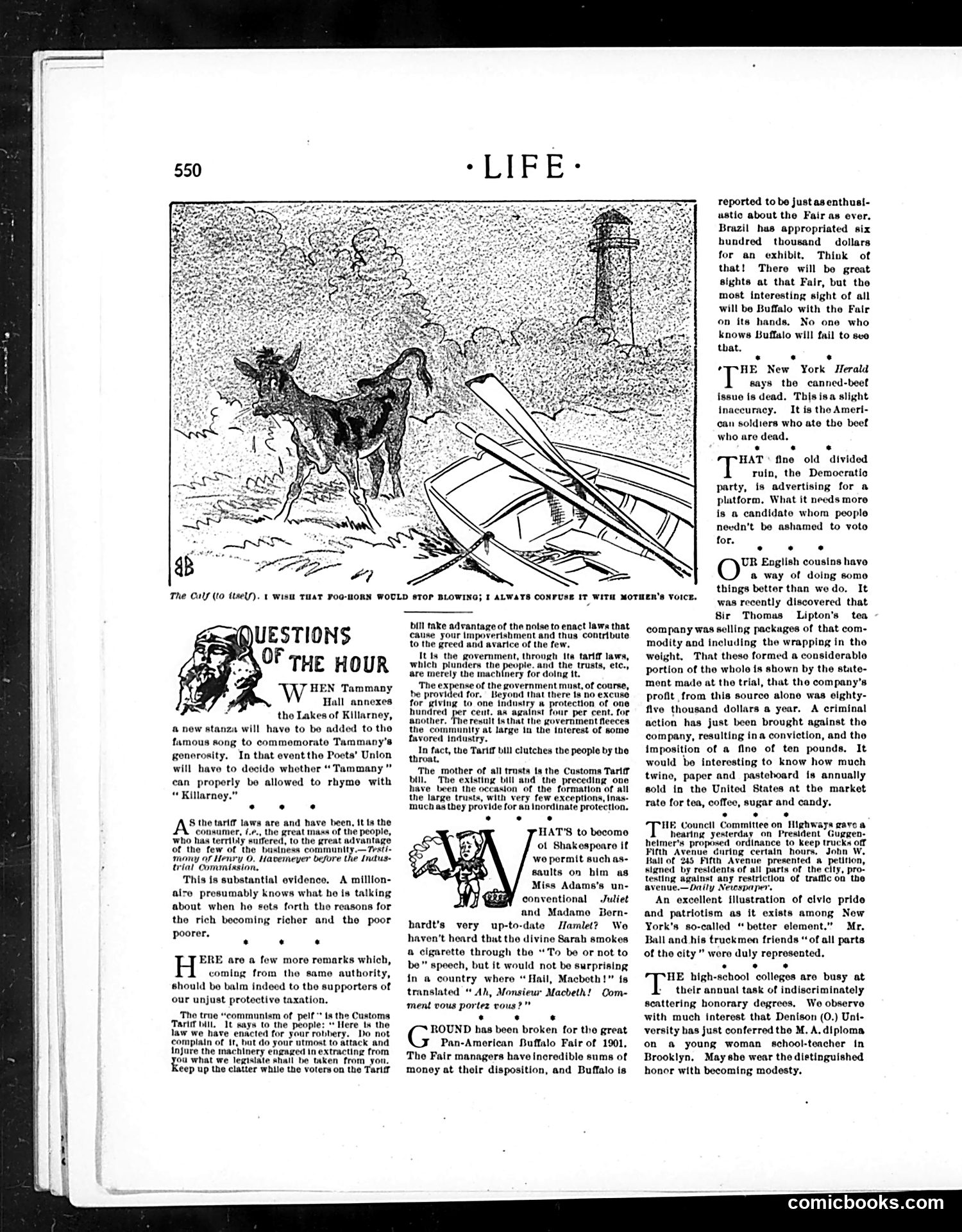
The main cartoon depicts a calf (labeled "The Calf") standing near a lighthouse, with broken wooden structures in the foreground. The caption reads: "I WISH THAT POOR HORN WOULD STOP BLOWING; I ALWAYS CONFUSE IT WITH MOTHER'S VOICE." This appears to be satirizing confusion between natural and artificial sounds—likely commenting on industrial noise pollution or mechanization encroaching on pastoral/rural life. The calf's anthropomorphized perspective creates humor by suggesting animals mistake human-made signals for natural ones. The page also contains a "Questions of the Hour" section discussing tariff laws, the Democratic party platform, and various political/social issues of the era. Without clearer dating, the specific political context remains unclear, though the content addresses early 20th-century American policy debates.
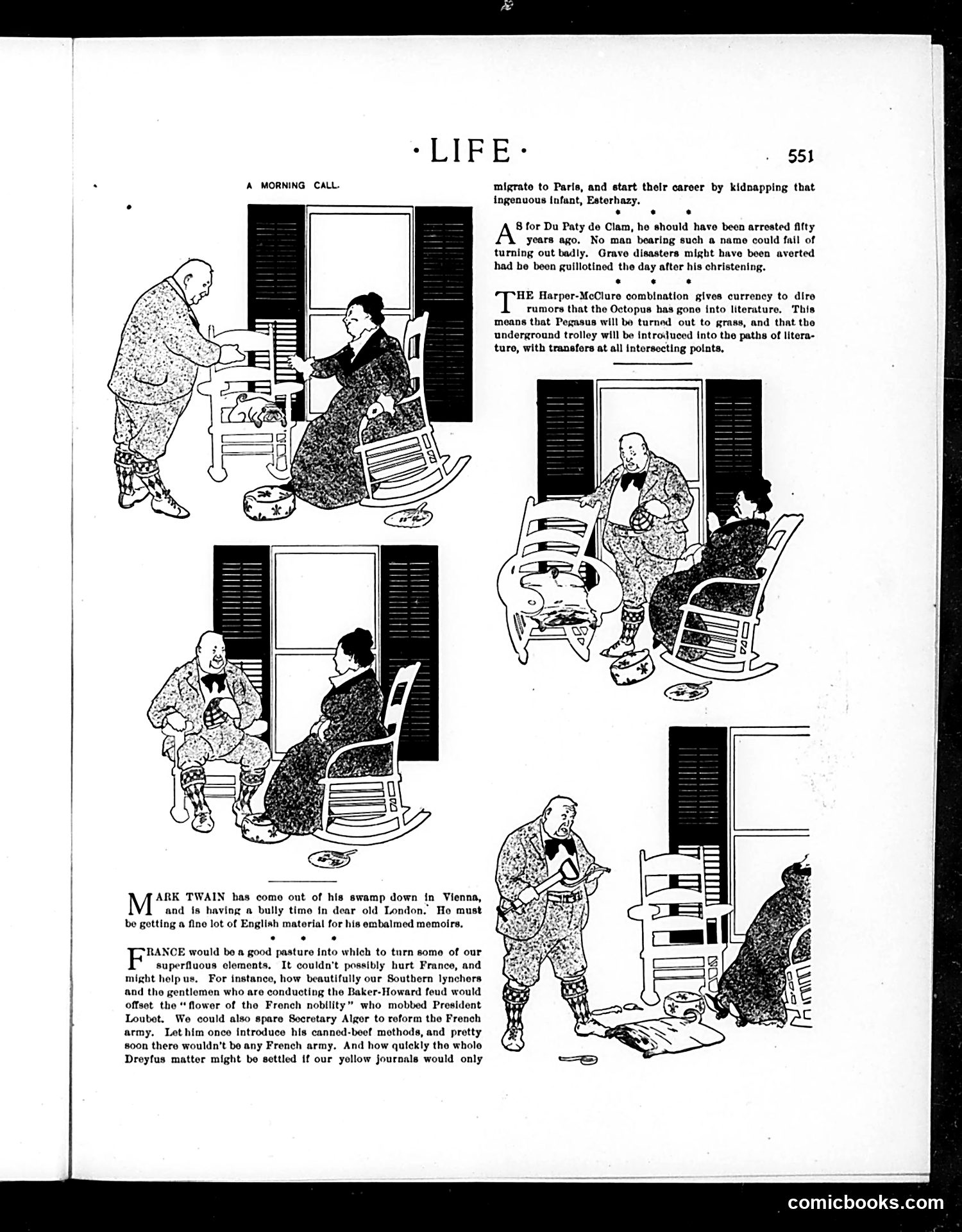
This page contains three separate satirical commentaries on contemporary figures and issues: 1. **Mark Twain in London**: Mocks Twain's presence in England, suggesting he's gathering material for his memoirs while living in Vienna—implying he's out of touch or self-aggrandizing. 2. **France and American Problems**: Proposes "exporting" America's social problems to France as a joke. References include Secretary Alger (likely Elihu Root or Russell Alger), Southern lynch mobs, the Baker-Howard feud, and President Loubet's confrontation with French nobility. The tone is darkly satirical about American violence and corruption. 3. **The Dreyfus Affair**: Mentions Du Paty de Clam, Esterhazy, and Pegasus—all connected to the real Dreyfus scandal in France. Attacks these figures by name while joking that yellow journalism (American newspapers) should migrate to Paris. 4. **Harper-McClure Combination**: Final jab at publishing monopolies ("the Octopus") allegedly entering literature and replacing genuine artistic merit with commercial mass production. The cartoons illustrate these monologues with domestic scenes.
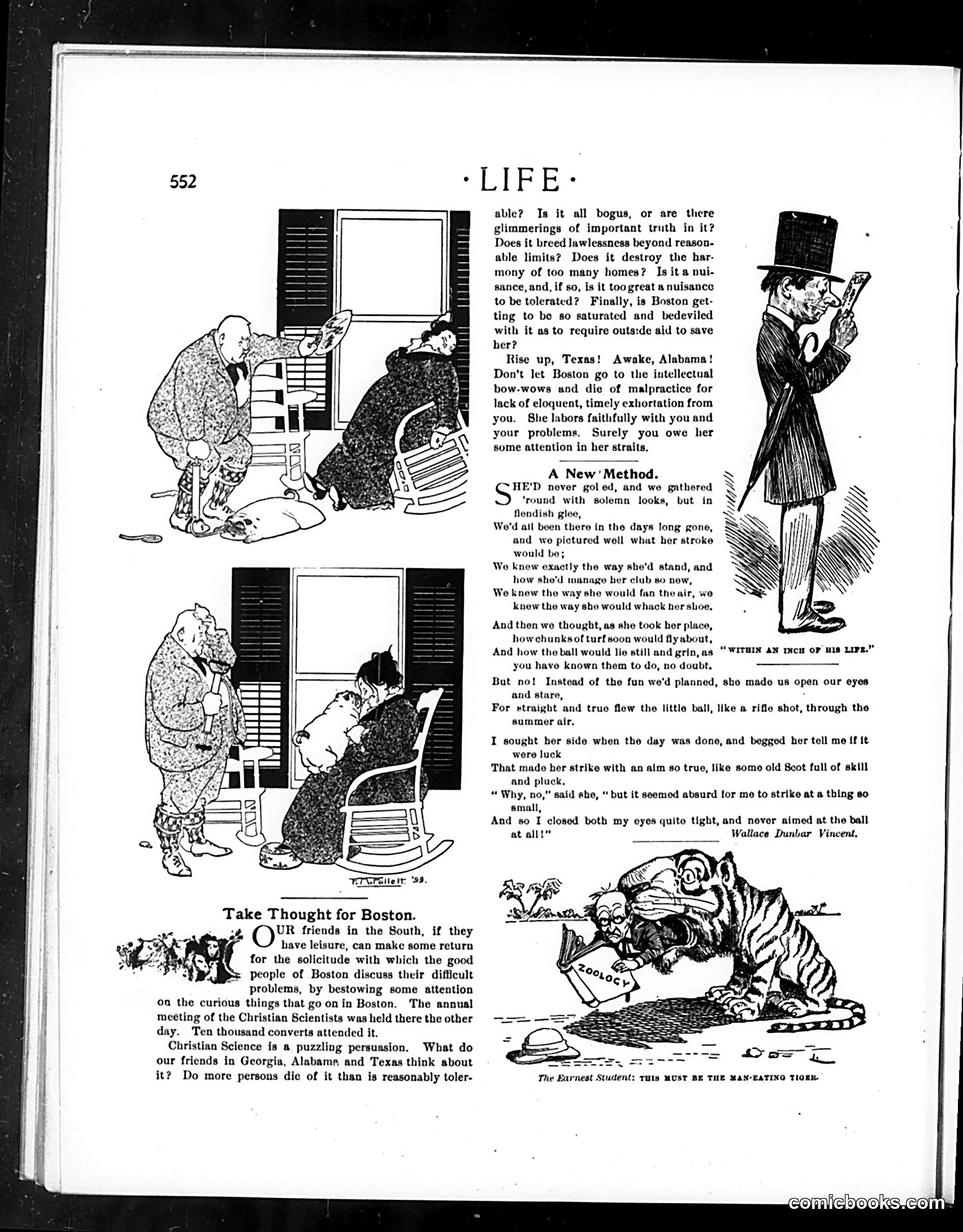
This page contains satirical commentary on Christian Science, a religious movement that gained significant American followers in the late 19th century. The main article "Take Thought for Boston" mocks Boston's embrace of Christian Science—ten thousand converts attended a recent annual meeting—by sarcastically urging Southern states (Texas, Alabama, Georgia) to "save" Boston from this "puzzling persuasion." The satire questions whether Christian Science is fraudulent, breeds lawlessness, destroys families, or has saturated Boston beyond recovery. The accompanying illustrations show two figures (likely representing typical Christian Science practitioners) in domestic scenes, presumably depicting the movement's influence on daily life. A separate piece, "A New Method," is a humorous poem about a woman golfer who closes her eyes while swinging, attributing her unexpected success to avoiding conscious aim—likely a jab at Christian Science's emphasis on mental/spiritual power over material reality. The bottom illustration shows a tiger, captioned as "the man-eating tiger," possibly referencing another unrelated story.
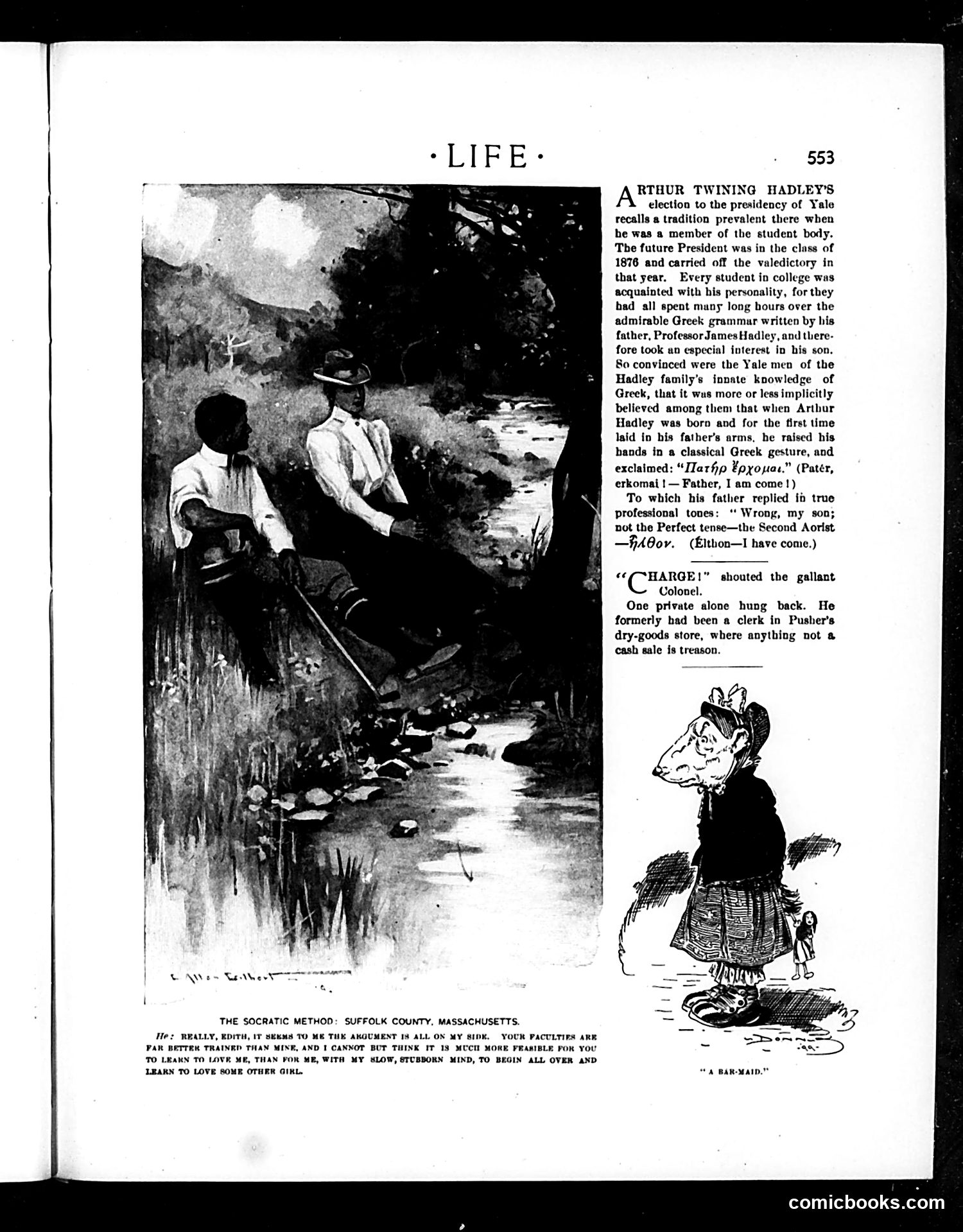
**Upper Section - Arthur Twining Hadley Anecdote:** This is a humorous biographical note about Yale's new president. It references an apocryphal story from when Hadley was born: supposedly he raised his hands in a Greek gesture and spoke classical Greek to his father, Professor James Hadley (a renowned Greek scholar). The joke satirizes the Hadley family's legendary expertise in Greek language—so absolute that even a newborn supposedly possessed it. The exchange between father and son playfully critiques overly precise classical scholarship (correcting the "wrong" tense). **Lower Section - "The Socratic Method" Cartoon:** This depicts a romantic courtship scene in Suffolk County, Massachusetts. A man argues that a woman should learn to love *him* rather than he learn to love someone else, using pseudo-logical reasoning. The title "Socratic Method" sarcastically applies Socrates' philosophical questioning technique to romantic persuasion. The caption "A Barmaid" suggests she's a working-class woman, implying humor in the incongruity of elaborate philosophical arguments deployed in an awkward seduction attempt.
This page contains two humorous domestic sketches mocking Victorian health fads and gender dynamics. **"Scissors at Milly's"** (main cartoon): Mr. Shivvers, inspired by trendy "Health Hints for the Helpless," decides to take a cold-water bath to cure his rheumatism. His wife Mrs. Shivvers expresses horror at the idea. He condescendingly explains the gradual method ("count to six slowly"). The joke: despite his brave instructions to her, when actually immersed in freezing water, he emerges shrieking, chattering, and frantically jumping back to bed. The satire targets masculine pretension—men who lecture women about health and courage while being cowards themselves. **"Military Bazaar" anecdote**: An English officer flirts with a bazaar attendant, asking about a "pretty article." She claims her mother sent it. Pressing for the mother's name, she replies "The Queen of England." The humor here: the officer's social presumption meets instant deflation through wit. Both pieces satirize male vanity and the gap between masculine posturing and actual behavior.
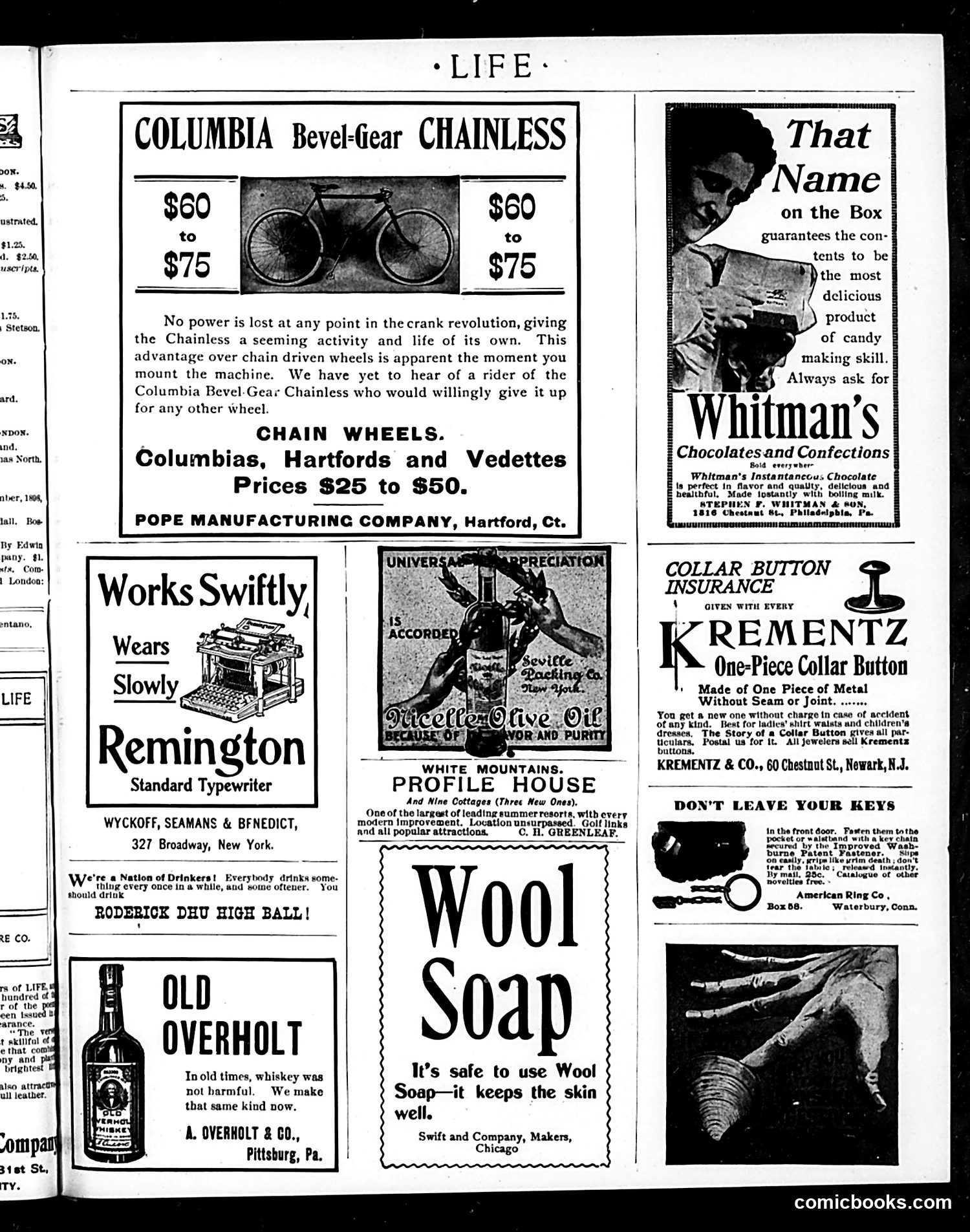
This is primarily an **advertising page** from Life magazine, circa 1890s-1900s, containing no political cartoons or satire requiring historical context. The page showcases period product advertisements including: - **Columbia bicycles** (chainless model, $60-75) — the "chainless" design was a technological innovation of that era - **Remington typewriters** — establishing the brand's dominance - **Whitman's chocolates** — emphasizing product quality via brand recognition - **Wool soap** and other toiletries - **Collar button insurance** — offering replacement guarantees for lost buttons (a common Victorian clothing problem) - **Old Overholt whiskey** — marketed as medicinal ("harmless") - **Profile House** resort advertisement - Various other consumer goods The humor is incidental—primarily in the "collar button insurance" concept, which treats lost buttons as an insurable risk. This reflects genuine period concerns about clothing maintenance and replacement costs. **No satire, caricature, or political commentary is present.** This is straightforward commercial advertising typical of Life's revenue model.
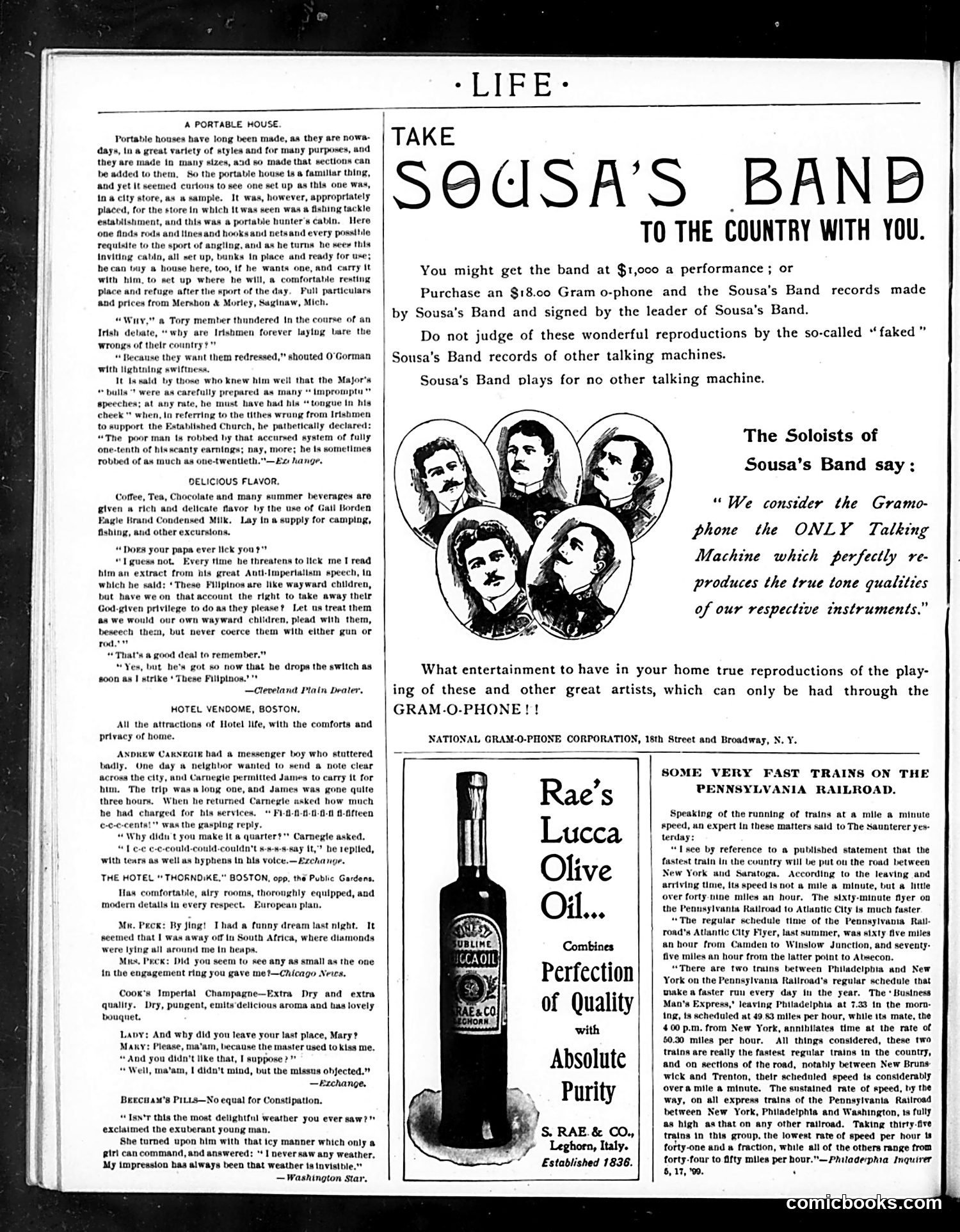
This page is primarily **advertisements and humorous anecdotes** rather than political cartoons. The main content includes: **The Sousa's Band advertisement** (center-right): Promotes John Philip Sousa's Band recordings on Gramophone, positioning them as superior "talking machine" reproductions. The five portraits show band soloists endorsing the technology as authentic. **Humorous anecdotes** scattered throughout mock Irish politics, imperialism, and personal eccentricity: - An Irish parliamentary exchange satirizing British-Irish relations - A joke about a boy reciting anti-imperialist rhetoric (referencing American Philippines policy) to avoid punishment - Anecdotes about Andrew Carnegie and domestic life **Various advertisements** for hotels, condensed milk, olive oil, and train schedules fill remaining space. The page reflects early 1900s American consumer culture and light social satire, with no prominent political cartoons visible. The humor targets imperialism gently and relies on period-specific references (Philippines debate, Sousa's popularity) that require historical context.
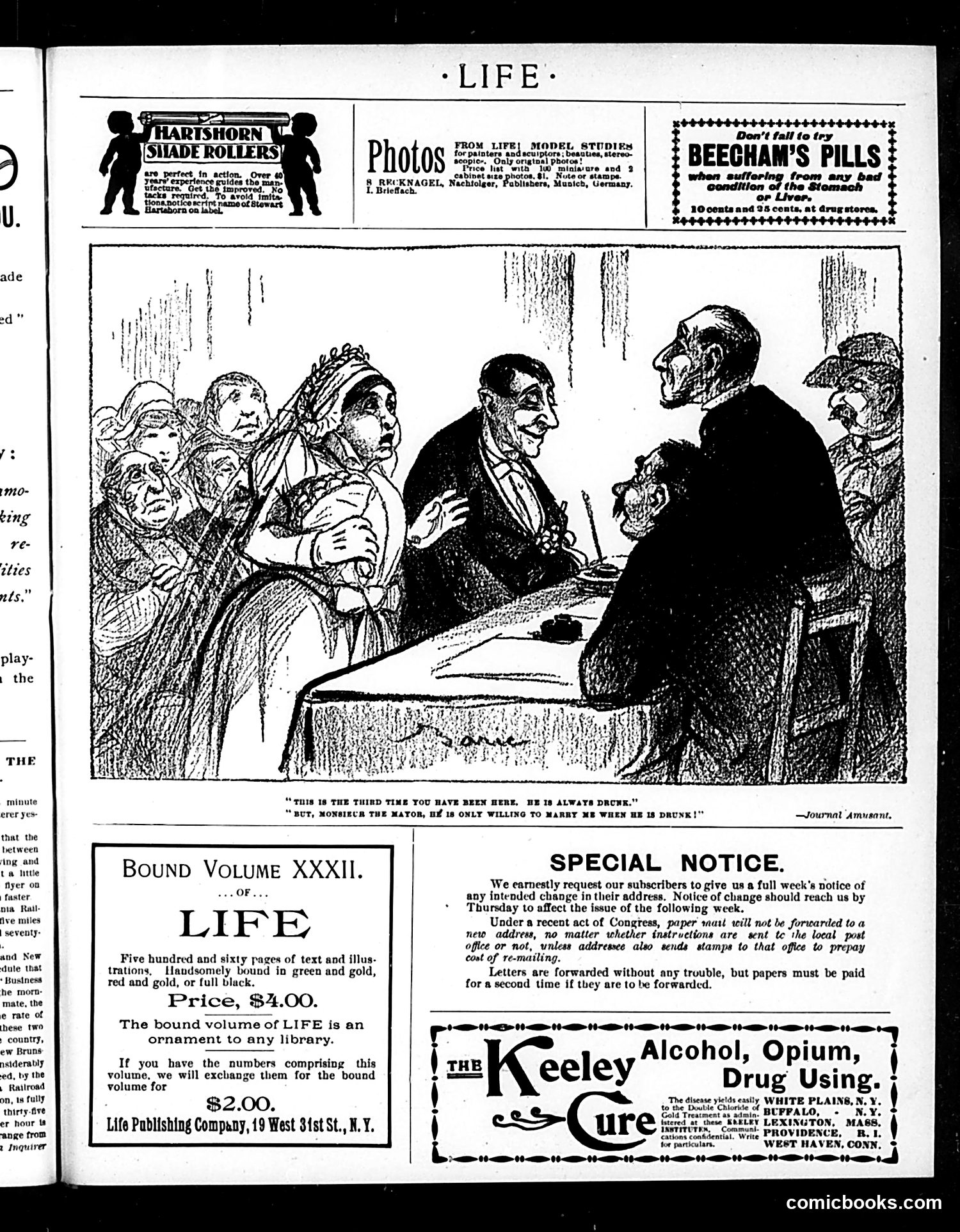
This page contains a satirical cartoon (center) depicting a drunk man at what appears to be a municipal office or courtroom, surrounded by observers. The caption reveals the joke: a woman is pursuing the man for marriage, but he's only willing to marry her when drunk—and this is his third visit while intoxicated. The satire mocks both the man's absurd condition and, likely, the lenient or corrupt municipal officials who repeatedly allow such situations. The cartoon is credited to "Journal Amusant," a French publication, suggesting Life reprinted international humor. The surrounding advertisements (Beecham's Pills, Keeley Cure for drug addiction) and notices are typical period magazine content, not part of the satire itself. The humor relies on the exaggerated caricatures and the absurdity of someone's drunkenness being his only qualification for marriage—social commentary on both marriage attitudes and drinking culture in the era.
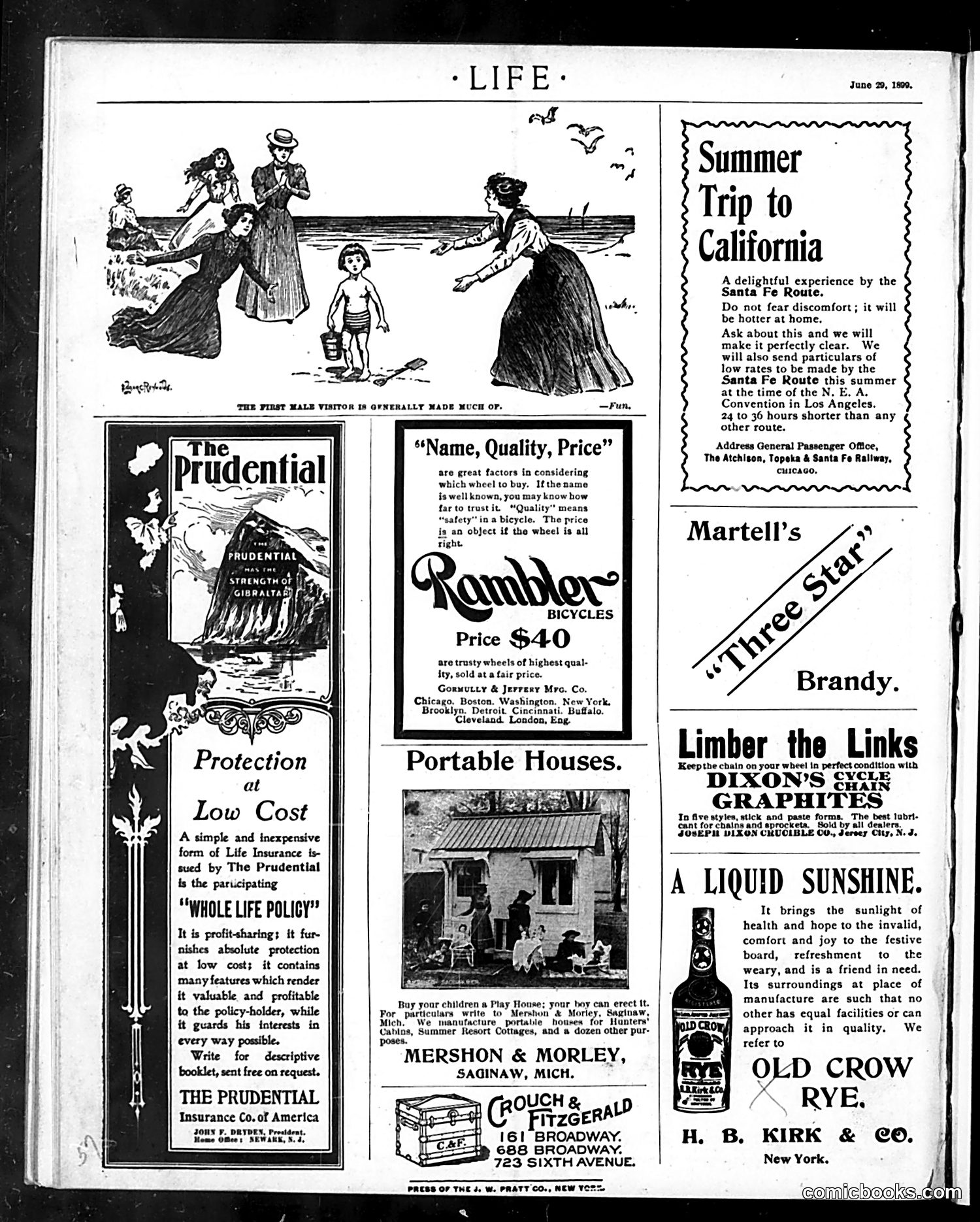
This page is primarily **advertising**, not satire or political commentary. The upper cartoon—titled "The First Male Visitor in Generally Made Much Of"—is a light social joke about beach etiquette: it shows women at the seaside fawning over a single man, illustrating the Victorian-era social dynamic where male attention was prized. The humor is gentle domestic satire, not political. The remainder consists of period advertisements: insurance (Prudential), bicycles (Rambler), portable houses, railroad travel (Santa Fe Route), and liquor (Old Crow Rye). These ads reflect 1890s consumer culture and emerging leisure activities—summer vacations, bicycling, and portable vacation homes were relatively novel luxuries for middle-class Americans. The page offers a snapshot of Gilded Age commerce and social attitudes rather than political critique.

This image appears to be a mostly blank or heavily darkened page from Life magazine, with only minimal visible content. On the left margin, there is partial text visible that includes fragments like "of," "id," "ve," "be," "ed," "of," "no," "an," and "We," suggesting this may be a page break or transition page with text bleeding from adjacent pages. The watermark "comicbooks.com" appears at the bottom right. Without clear cartoon imagery, legible text, or identifiable figures, I cannot reliably determine what political or social satire this page contains or what specific references it makes. The page quality and darkness prevent meaningful analysis of any intended commentary.