
Life, 1899-06-29 · page 4 of 21
Life — June 29, 1899 — page 4: what you’re looking at
What you’re looking at
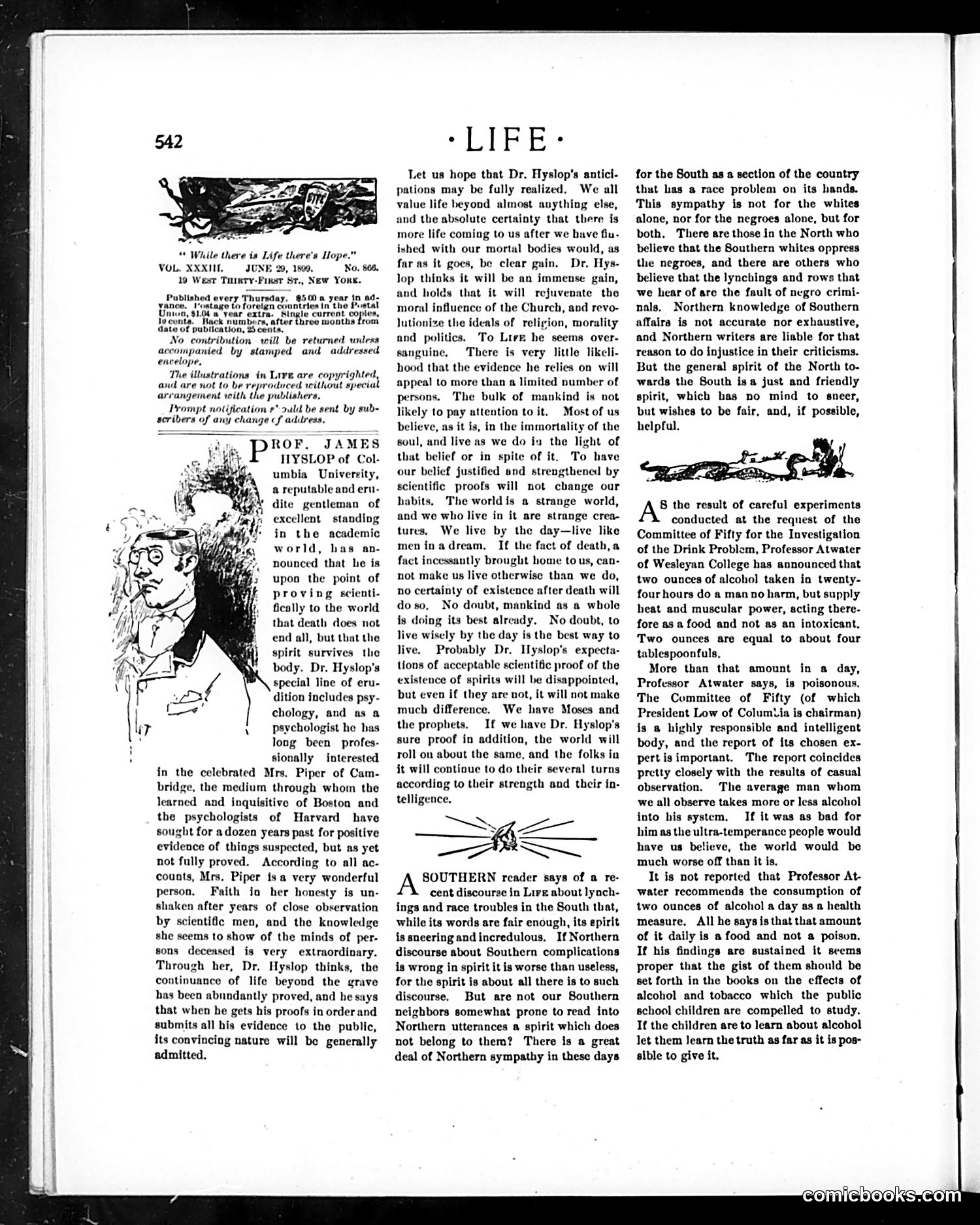
This page primarily contains editorial text rather than political cartoons. The main illustration is a caricatured portrait of **Dr. James Hyslop of Columbia University**, a psychologist and spiritualist researcher mentioned in the accompanying article. The text discusses Hyslop's beliefs in life after death and spiritualism, presenting his ideas with gentle skepticism. A secondary article references Mrs. Piper, described as a "medium" whose supposed psychic abilities were studied by Harvard psychologists over decades—apparently she could withstand scientific scrutiny, suggesting genuine phenomena (or remarkable deception). The page reflects early 20th-century cultural interest in spiritualism and the tension between scientific investigation and belief in the supernatural. The tone suggests Life magazine was bemused by these pursuits rather than mockingly hostile.
📄 Transcribed text from this page (OCR, searchable)
Machine-transcribed from the original scan — historical spelling and the odd misread are preserved.
_Lublished every Thursday. $500 a year in ad: Hostage to foreign countries in the Pestal $1.06 4 year extra. Single curreot copies, Back numbers, after three months from of publication, 2 cents, Yo contribution will be returned unless accompanied by stamped and addressed encelope, The illustrations in Live are copyrighted, and are not to be reproduced without special arrangement with the publishers, Prompt notification #* auld be sent by sub- soribers of any change cf address. ROF, JAMES ITYSLOP of Col- umbia University, a reputable and eru- dite gentleman of excellent standing in the academic world, has an- nounced that he is upon the point of proving scienti- fically to the world that death does not end all, but that the spirit survives the body. Dr. Hyslop's special line of eru- dition includes psy- chology, and as a psychologist he has long been profes- sionally interested in the celebrated Mrs, Piper of Cam- bridge, the medium through whom the learned and inquisitive of Boston and the psychologists of Harvard have sought for adozen years past for positive evidence of things suspected, but as yet not fully proved. According to all ac- counts, Mrs. Piper isa very wonderful person. Faith in her honesty is un- shaken after years of close observation by scientific men, and the knowledge she seems to show of the minds of per- sons deceased is very extraordinary. Through her, Dr. Hyslop thinks, the continuance of life beyond the grave has been abundantly proved, and he says that when he gets his proofs in order and submits all his evidence to the public, its convincing nature will be generally admitted. LIFE Let us hope that Dr. Hyslop’s antici- pations may be fully realized. We all value life beyond almost avything else, and the absolute certainty that there is more life coming to us after we have fiu- ished with our mortal bodies would, as far as it goes, be clear gain. Dr. Hys- lop thinks it will be an immense gain, and holds that it will rejuvenate the moral influence of the Church, and revo- lutionize the ideals of religion, morality and politics, To Live he seems over- sanguine, There is very little likeli- hood that the evidence he relies on will appeal to more than a limited number of persons, The bulk of mankind is not likely to pay attention to it. Most of us believe, as it is, in the immortality of the soul, and live as we do iu the light of that belief or in spite of it. To have our belief justified and strengthened by scientific proofs will not cbange our habits, The worldis a strange world, and we who live in it are strange crea- tures, We live by the day—live like men inadream. If the fact of death, a fact incessantly brought home to us, can- not make us live otherwise than we do, no certainty of existence after death will doso. No doubt, mankind as a whole is doing its best already. No doubt, to live wisely by the day is the best way to live. Probably Dr. Ilyslop’s expecta- tions of acceptable scientific proof of the existence of spirits will be disappointed, but even if they are not, it will not make much difference. We have Moses and the prophets. If we have Dr. Hyslop’s sure proof in addition, the world will roll on about the same, and the folks in it will continue to do their several turns according to their strength and their in- telligence, “tt ee — SOUTHERN reader says of a re- cent discourse in Lire about lynch- ings and race troubles in the South that, while its words are fair enough, its epirit is sneering and incredulous, If Northern discourse about Southern complications is wrong in spirit it is worse than useless, for the spirit is about all there is to such discourse. But are not our Southern neighbors somewhat prone to read into Northern utterances a spirit which does not belong to them? There is a great deal of Northern sympathy in these days for the South as a section of the country thut has a race problem on its hands. This sympathy is not for the whites alone, nor for the negroes alone, but for both. There are those in the North who believe that the Southern whites oppress the negroes, and there are others who believe that the lyncbings and rows that we hear of are the fault of negro crimi- nals, Northern knowledge of Southern affaira is not accurate nor exhaustive, and Northern writers are liable for that reason to do injustice in their criticisms. But the general spirit of the North to- wards the South isa just and friendly spirit, which has no mind to sneer, but wishes to be fair, and, if possible, helpful. 8 the result of careful experiments conducted at the request of the Committee of Fifty for the Investigation of the Drink Problem, Professor Atwater of Wesleyan College has announced that two ounces of alcohol taken in twenty- four hours do a man no harm, but supply heat and muscular power, acting there- fore as a food and not as an intoxicant, Two ounces are equal to about four tablespoonfuls, More than that amount in a day, Professor Atwater says, is poisonous, The Committee of Fifty (of which President Low of Colum‘ia is chairman) is a highly responsible and intelligent body, and the report of its chosen ex- pert is important. The report coincides pretty closely with the results of casual observation. The average man whom we all observe takes more or less alcohol into his system. If it was as bad for him as the ultra-temperance people would have us believe, the world would be much worse off than it is. It is not reported that Professor At- water recommends the consumption of two ounces of alcohol a day as a health measure, All he saysisthat that amount of it daily is a food and not a poisun. If his findings are sustained it seems proper that the gist of them should be set forth in the books on the effects of alcohol and tobacco which the public school children are compelled to study. If the children are to learn about alcohol let them learn the truth as far as it is pos- sible to give it,