
Life, 1899-06-29 · page 8 of 21
Life — June 29, 1899 — page 8: what you’re looking at
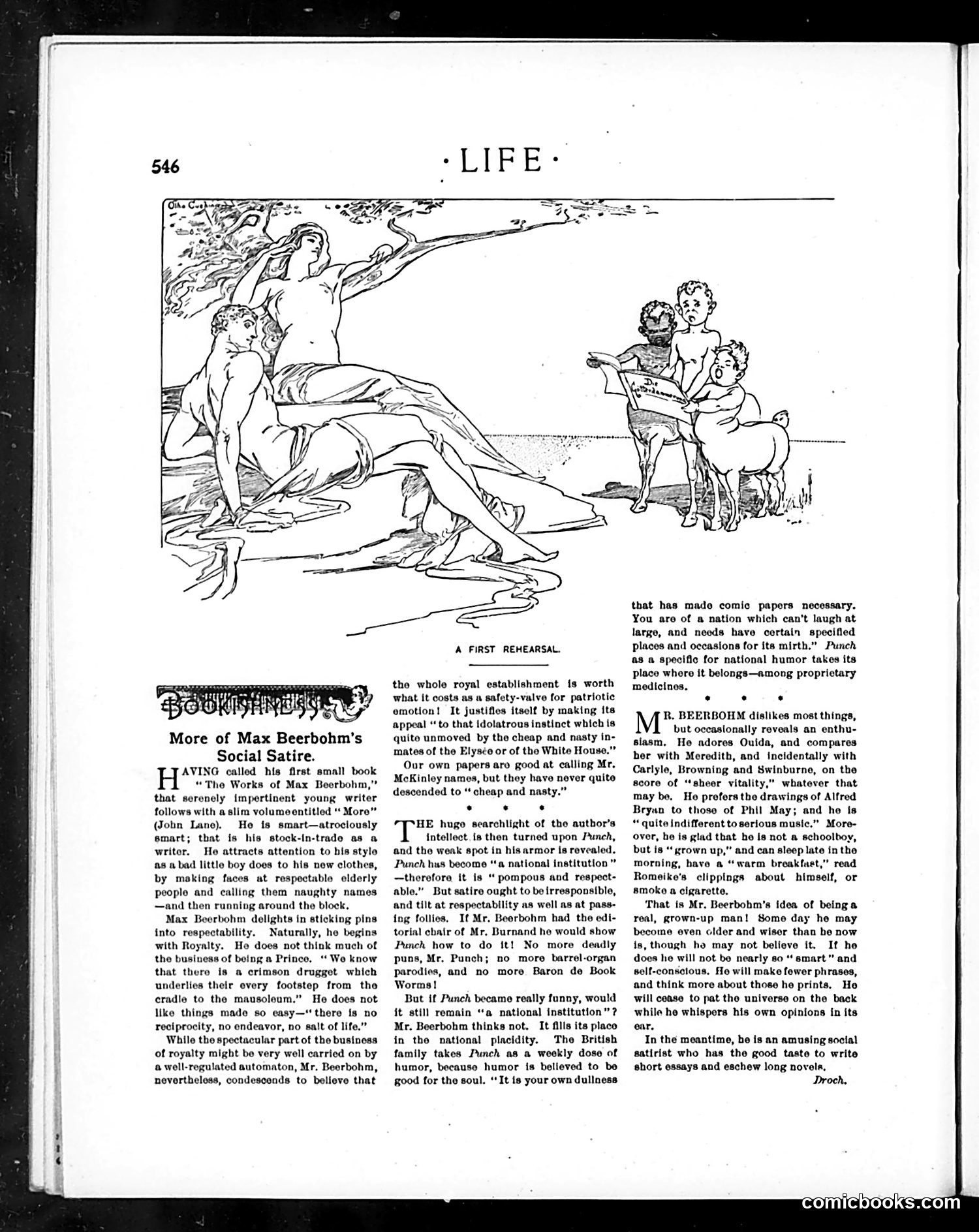
What you’re looking at
This cartoon satirizes **Max Beerbohm**, a prominent British satirist and caricaturist. The illustration shows an allegorical female figure (likely representing "Punch" or British satire itself) instructing cherubic children in the art of social mockery. The accompanying text critiques Beerbohm's approach to humor: while praising his talent, it argues he's become overly "respectable" and refined, losing the sharp edge necessary for effective satire. The article suggests Beerbohm believes Punch should be a "national institution"—implying his humor has become too genteel and self-conscious rather than genuinely biting. The satire ultimately questions whether Beerbohm can balance artistic sophistication with the irreverent spirit satire requires.
📄 Transcribed text from this page (OCR, searchable)
Machine-transcribed from the original scan — historical spelling and the odd misread are preserved.
More of Max Beerbohm’s Social Satire. AVING called his first small book The Works of Max Beerbohm,” that serenely impertinent young writer follows with a slim volumeentitled * More” (John Lano). Ho ts smart—atrociously smart; that is his stock-In-trade as a writer. He attracts attention to his style as abad little boy does to his new clothes, by moking faces ut respectable olderly peoplo and calling them naughty names —and then running around the block. Max Beerbohm delights in sticking pins into respectability. Naturally, he begins with Royalty. Ho does not think much of the business of boing a Prince. Wo know that there is a crimson drugget which underlies their every footstep from the cradle to the mausoloum.” He does not like things made so easy—" there 1s no reciprocity, no endeavor, no salt of life.” While the spectacular part of the business of royalty might be very well carried on by a woll-regulated automaton, Mr. Beorbohm, nevertheless, condesconds to believe that A FIRST REHEARSAL. tho whole royal establishment is worth what it costs as a safety-valve for patriotic emotion! It justifies itself by making its appeal “to that idolatrous instinct which is quito unmoved by the cheap and nasty in- mates of the Elysée or of the White House.” Our own papers aro good at calling Mr. McKinley names, but they have never quite descended to “ cheap and nasty.” . . . HE hugo searchlight of the author's intellect is then turned upon Punch, and the weak spot in his armor is revealed. Punch hus become ‘‘a national institution” —therofore it is “ pompous and respect- able.” But satire ought to be irresponsible, and tilt at respectability ns well as at pass- ing follies, If Mr. Beorbohm had the edi- torial chair of Mr, Burnand ho would show Pinch how to do it! No more deadly puns, Mr, Punch; no more barrel-organ parodies, and no more Baron de Book Worms! But if Punch became really funny, would it still romain “a national institution”? Mr. Beerbohm thinks not. It fills its placo in tho national placidity. Tho British family takes Punch as a weekly dose of humor, because humor {s believed to be good for the soul. “It is your own dullness that has mado comic papers necessary. You aro of a nation which can’t laugh at large, and needs have certain specified places and occasions for ita mirth.” Punch as a specific for national humor takes its placo where it belongs—among proprietary medicines. . . . R. BEERBOHM dislikes most things, but occasionally reveals an enthu- lasm. He adores Ouida, and compares her with Meredith, and incidentally with Carlyle, Browning and Swinburne, on the score of “sheer vitality,” whatever that may be. Ho profers the drawings of Alfred Bryan to those of Phil May; and he is “ quite indifferent to serious music.” More- over, bo is glad that ho is not a schoolboy, but is “grown up,” and can sleep late inthe morning, have a “warm breakfast,” read Romeike's clippings about himself, or smoko a cigarette, That is Mr. Beerbohm’s idea of beinga real, grown-up man! Some day he may become even colder and wiser than be now is, though he may not believe it. If he does he will not be nearly so “ smart" and self-conscious. Ho will make fewer phrases, and think more about those he prints, Ho will cease to pat the universe on the back while he whispers his own opinions in its ear. In the meantime, be is an amusing social satirist who has the good taste to write short essays and eschew long novela, Droch,