
A complete issue · 20 pages · 1899
Life — March 2, 1899
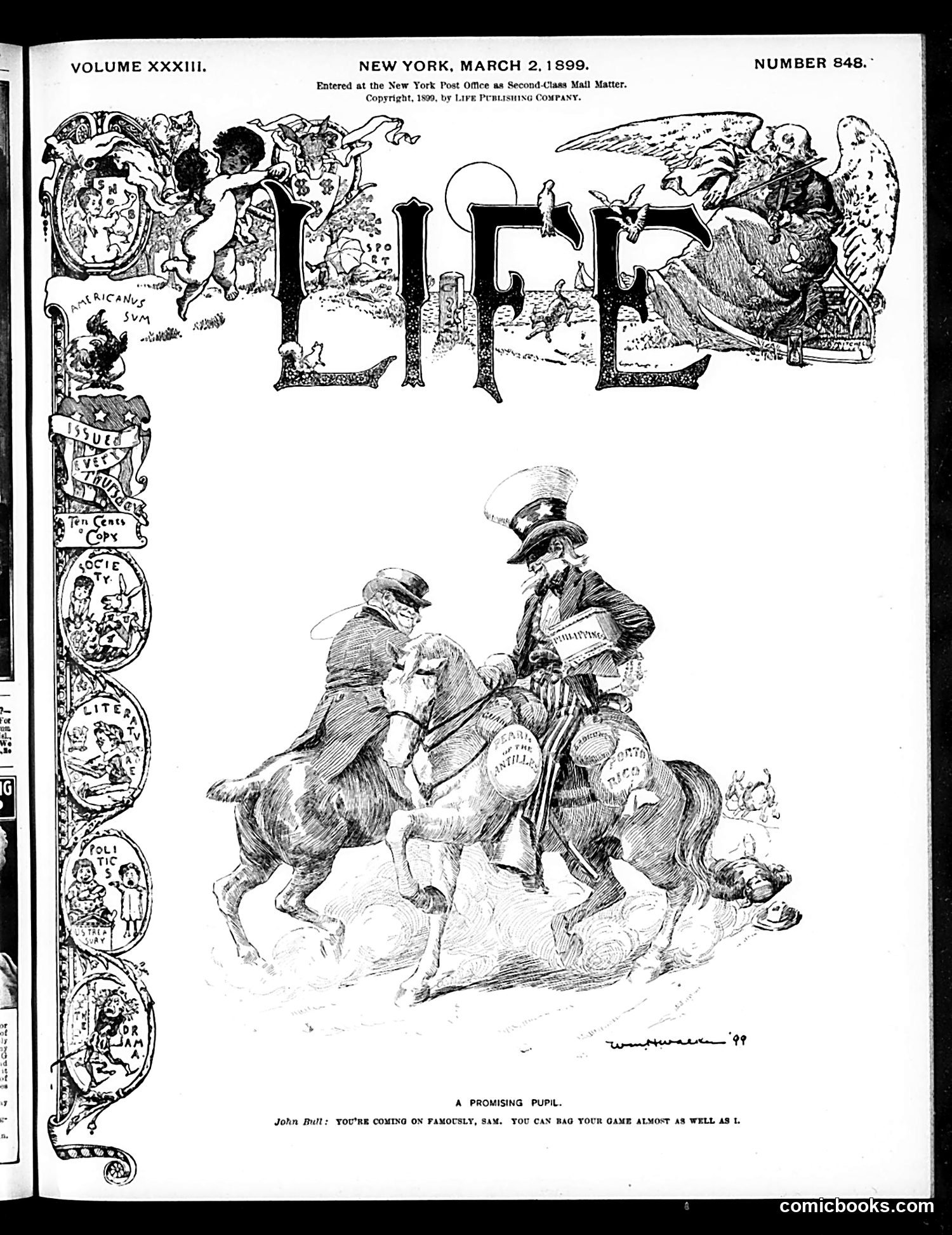
This political cartoon satirizes American imperialism at the turn of the century. Two figures on horseback—one appearing to be Uncle Sam (identifiable by his top hat and stars)—instruct a younger figure labeled as representing a colonial territory or newly acquired possession. The caption reads: "John Bull: 'You're coming on famously, Sam. You can bag your game almost as well as I.'" The satire mocks the United States for adopting European imperial practices, particularly Britain's ("John Bull" represents Britain). The "pupil" reference suggests America is learning colonialism from the experienced British empire. This likely references the Spanish-American War (1898) and America's subsequent acquisition of territories like the Philippines, Puerto Rico, and Guam—marking America's transition into imperial power politics.
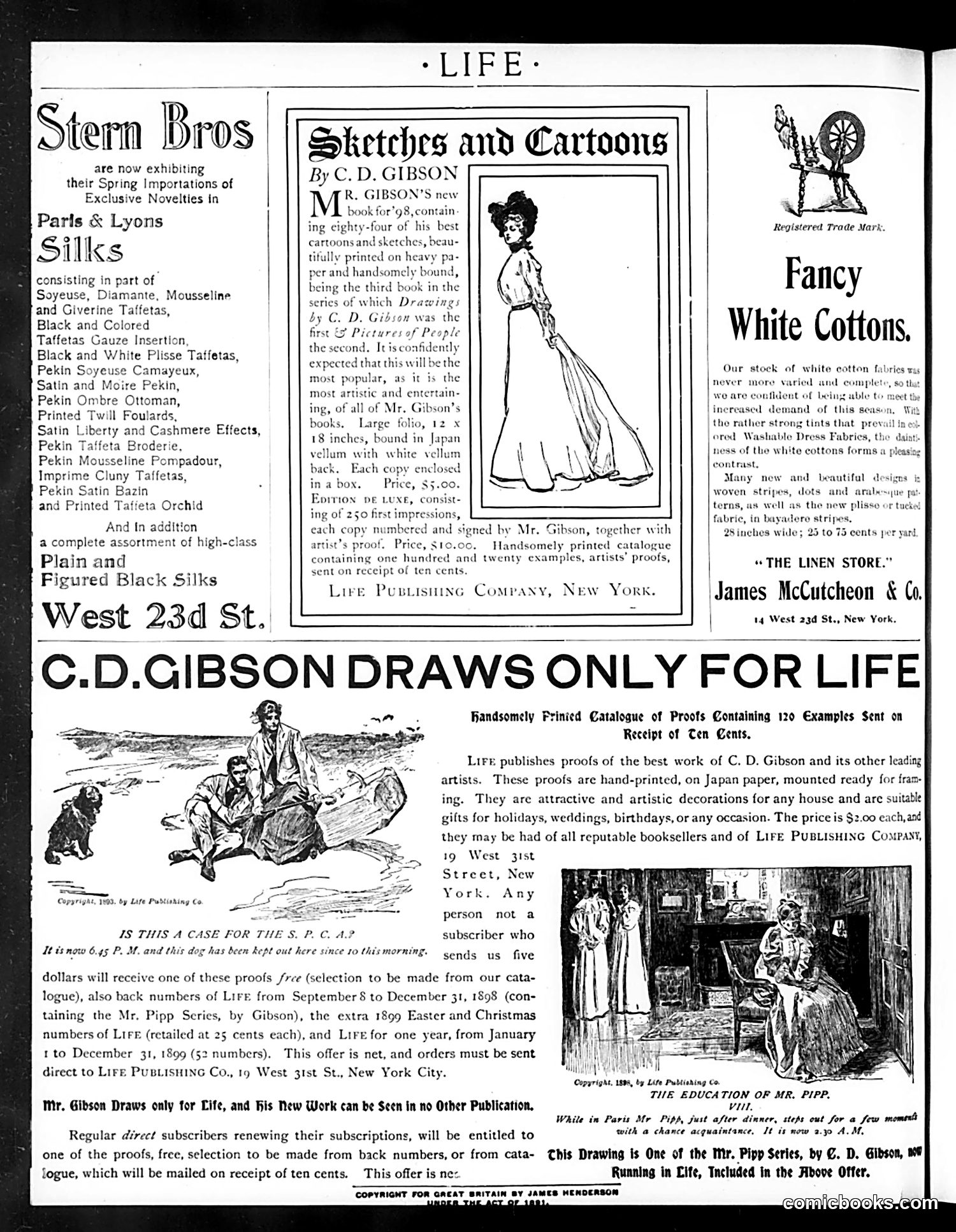
This page is primarily **advertising and promotional content** rather than political satire. The main elements are: 1. **C.D. Gibson advertisements**: Multiple ads promoting Gibson's sketch book and his work appearing exclusively in *Life* magazine. Gibson was a celebrated illustrator famous for depicting idealized women ("Gibson Girls"). 2. **The cartoon** (bottom left) shows figures on a beach and is titled "IS THIS A CASE FOR THE S.P.C.A.?" (Society for the Prevention of Cruelty to Animals). The joke appears to reference animal welfare, though the specific context is unclear from the image alone. 3. **"The Education of Mr. Pipp"** illustration depicts a domestic scene, likely humorous commentary on marriage or household life. The page emphasizes Gibson's commercial appeal and *Life*'s role as his exclusive publisher.
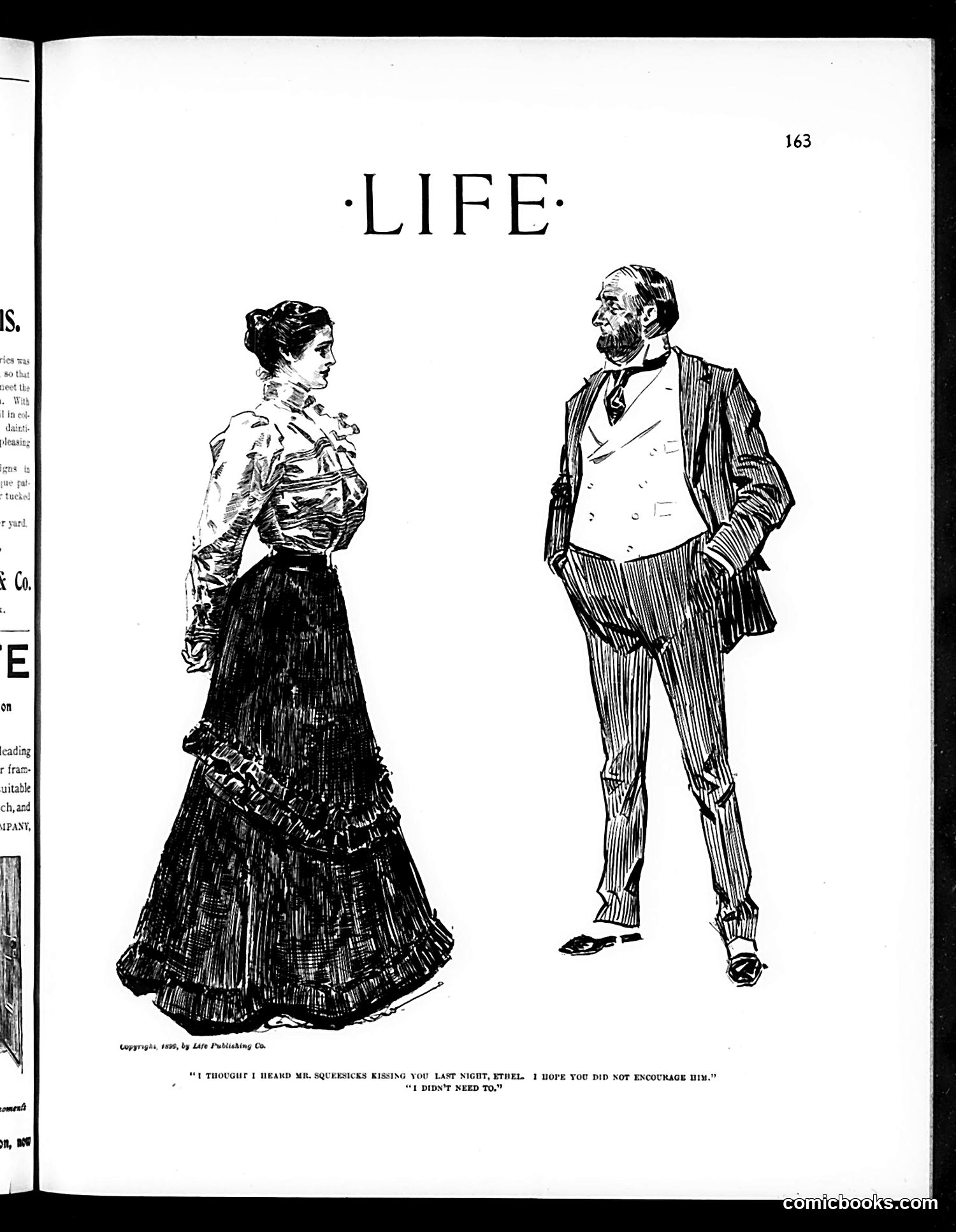
This page from *Life* magazine (page 163) presents a satirical illustration of two figures in formal late-19th or early-20th-century dress. The caption reads: "I THOUGHT I HEARD MR. SQUEAKICKS KISSING YOU LAST NIGHT, ETHEL. I HOPE YOU DID NOT ENCOURAGE HIM." and the woman replies "I DIDN'T NEED TO." The humor appears to be a domestic comedy piece about marital suspicion and female agency. The woman's confident response suggests she's implying the man's romantic advances were enthusiastic enough without her encouragement—a witty retort suggesting male eagerness versus female indifference or superiority. The illustration style and satirical nature are typical of *Life*'s humorous commentary on social interactions and gender dynamics of the era, though the specific identities of "Mr. Squeakicks" and "Ethel" remain unclear without additional context.
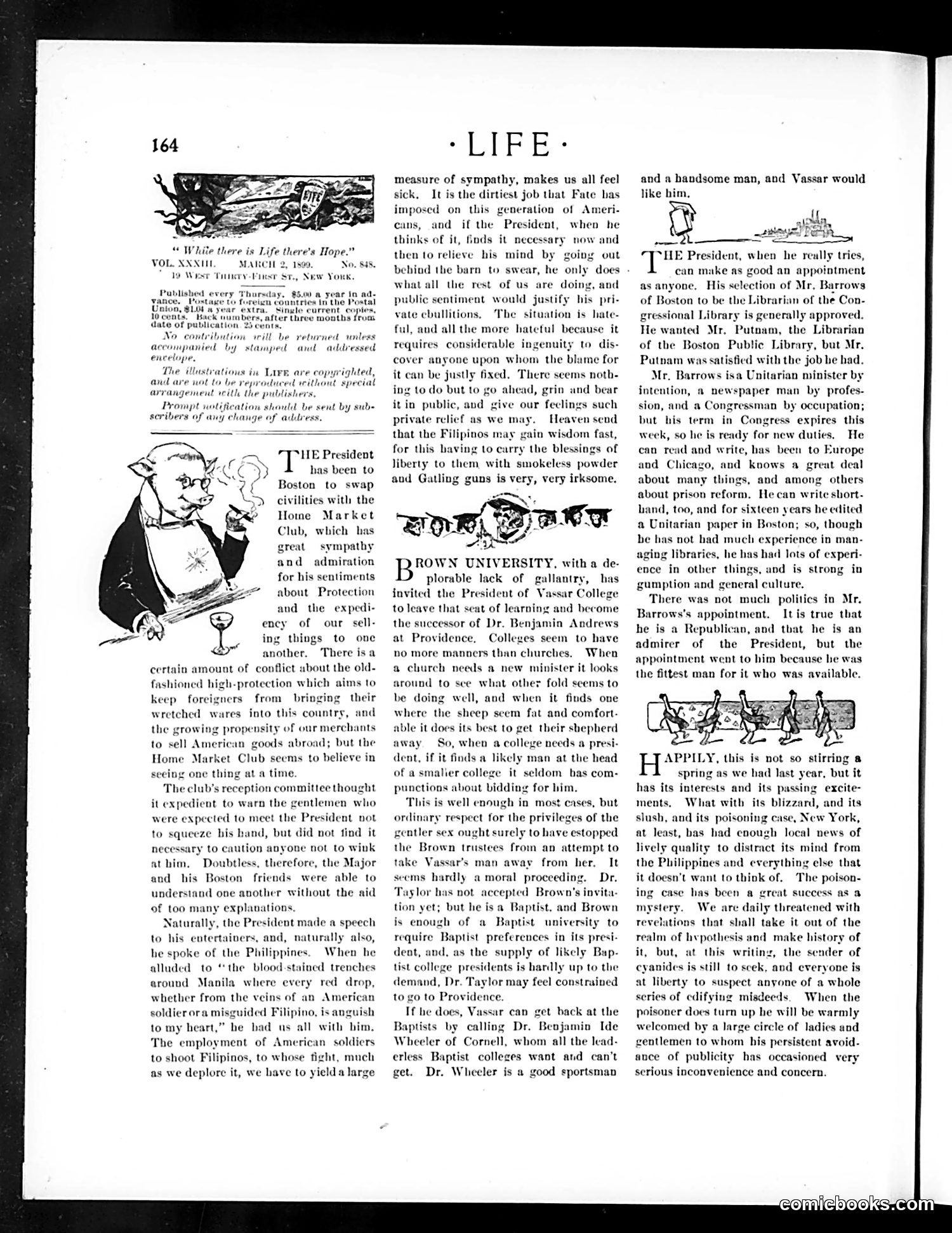
The page contains two political cartoons satirizing President Theodore Roosevelt's administration. The left cartoon depicts a rotund figure (likely a Republican politician or businessman) anxiously consulting with another character about "Protection" and "expediting" sales—a reference to protective tariffs, a contentious Republican policy that critics claimed benefited wealthy merchants over ordinary citizens. The right cartoon shows figures representing the poisoning crisis in New York, satirizing Roosevelt's inability to prevent or resolve public health crises despite his reformist reputation. The text discusses Roosevelt's appointment of Mr. Barrows as Librarian of Congress and critiques the President's general handling of various national issues, suggesting his reformist agenda faces practical limitations. The overall tone mocks the gap between Roosevelt's progressive rhetoric and actual governance outcomes.
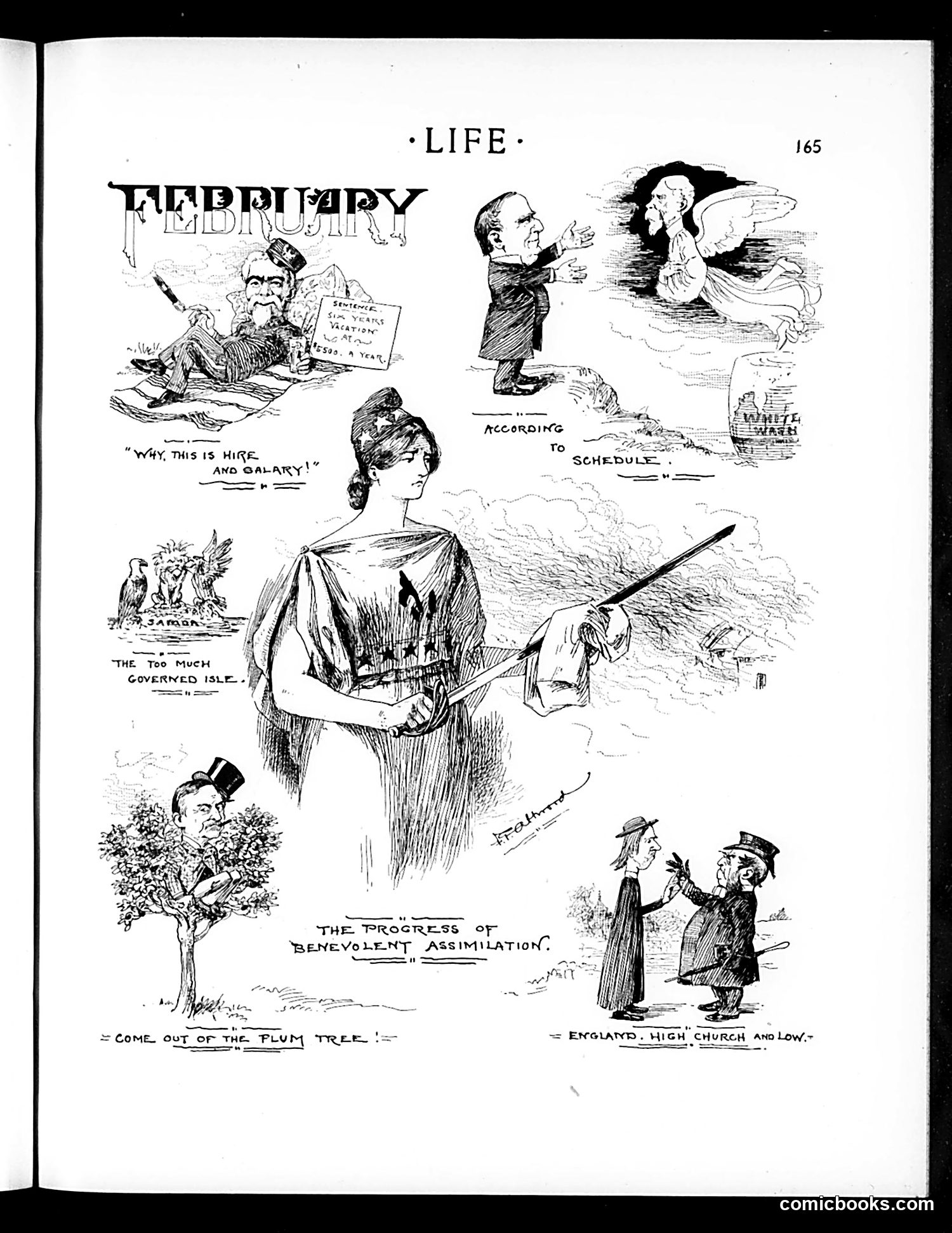
This satirical page uses six vignettes to comment on contemporary social and political issues: 1. **"Why, this is hire and salary!"** - A bearded man (appears to reference labor/wage disputes) complains about compensation. 2. **"According to schedule"** - A man gestures toward a fairy or allegorical figure, likely satirizing political promises versus reality. 3. **"The too much governed isle"** - References British governance, possibly critiquing excessive regulation. 4. **"The progress of benevolent assimilation"** - A woman with a gun—likely satirizing American imperial expansion (possibly Philippine-American relations). 5. **"Come out of the plum tree"** - A figure emerging from vegetation, unclear reference. 6. **"England: high church and low"** - Two figures in conversation, satirizing English religious class divisions. The overall theme appears to be social hypocrisy and unfulfilled political rhetoric.
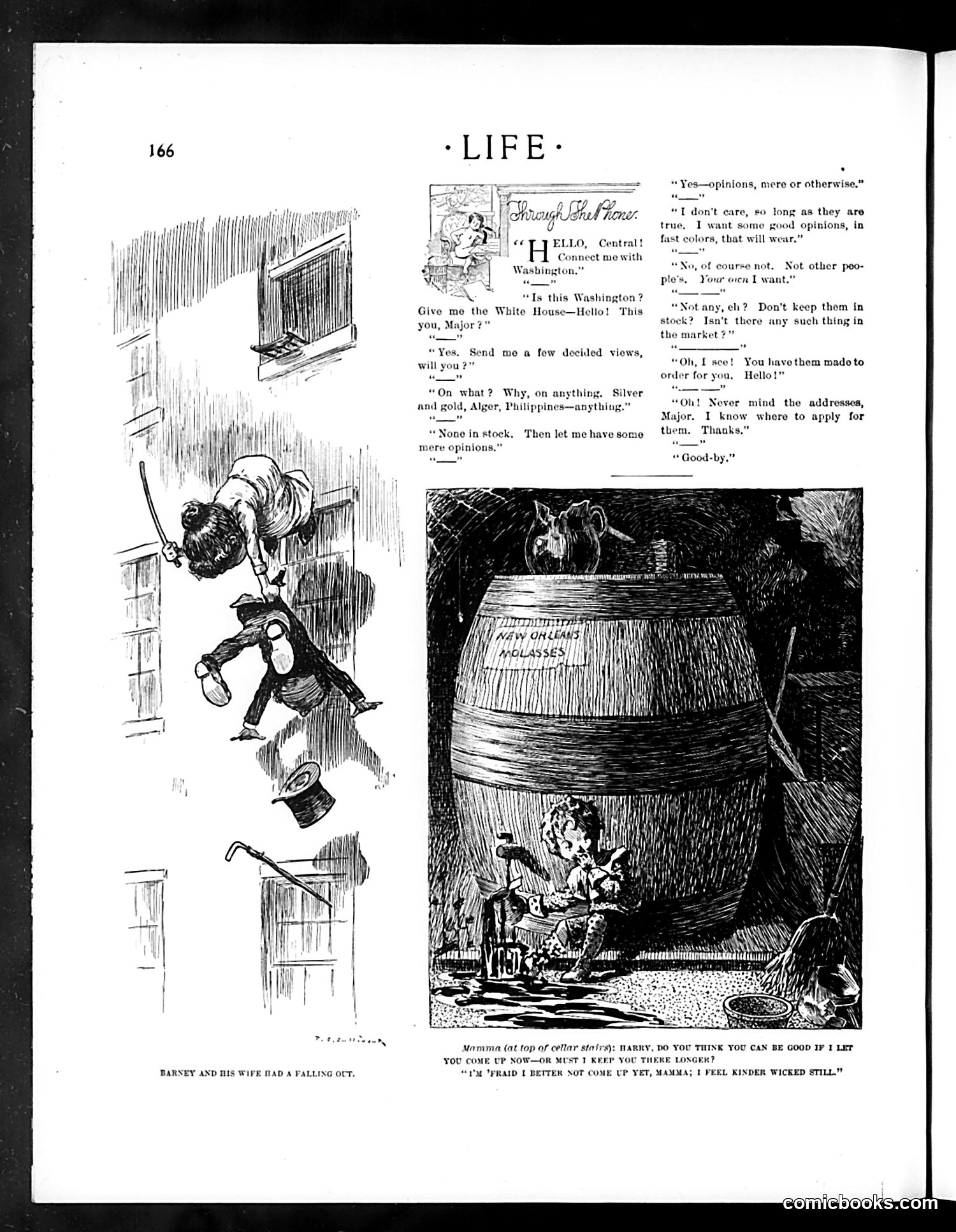
**Top cartoon ("Barney and His Wife Had a Falling Out"):** Shows a man falling from a window or building while a woman leans out above. This appears to be slapstick domestic humor depicting marital conflict ending in physical disaster—a common trope in early 20th-century comic magazines. **Main cartoon (bottom right):** Features a large barrel labeled "New Orleans Molasses" with a small figure inside. This likely references the Great Molasses Flood of January 1919 in Boston, a catastrophic disaster that killed 21 people when a storage tank ruptured. The cartoon uses dark humor to satirize the tragedy. **Top inset dialogue:** Appears to be unrelated telephone conversation satire about ordering "opinions" and stock items—mocking consumer culture or political discourse.
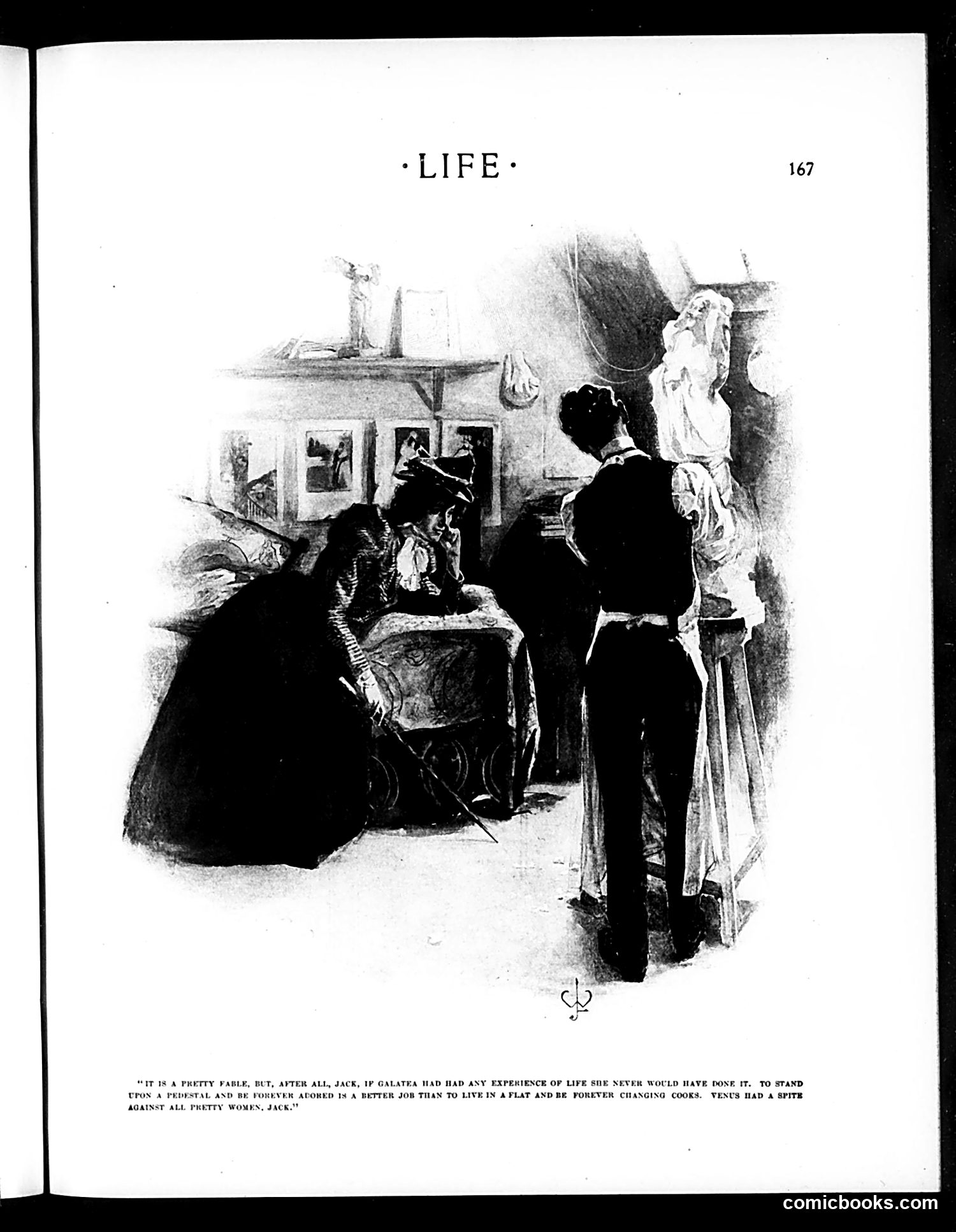
This illustration satirizes romantic idealism versus practical reality. The quote attributes the sentiment to "Jack" speaking about "Galatea" — referencing the mythological sculptor Pygmalion's ivory statue brought to life. The cartoon shows a woman in classical dress (Galatea) on a pedestal being admired, while a man (Jack) views this as foolish. His critique: if Galatea experienced real life, she'd never accept being "forever adored on a pedestal" when she could instead have a practical existence — even as a wife "forever changing cooks." The satire mocks male idealization of women as perfect, untouched objects, arguing that actual women would rationally reject pedestalized perfection for ordinary domestic life. It's a commentary on outdated romantic fantasies versus women's real-world pragmatism.
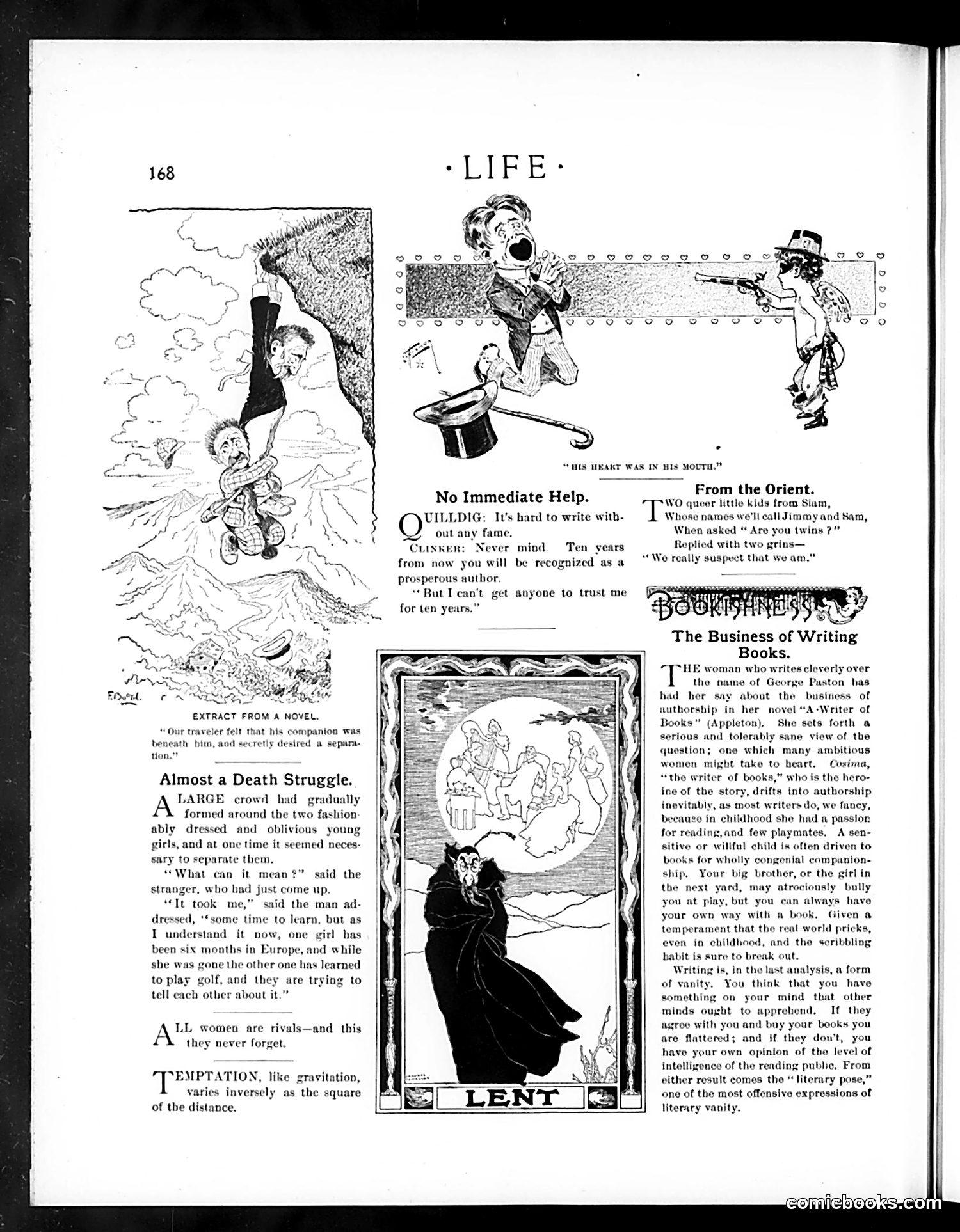
This page contains several satirical pieces. The top cartoon shows a man with his mouth wide open being shot at by another figure—illustrating the caption "His Heart Was in His Mouth," a visual pun on the idiom meaning extreme fear. Below, "No Immediate Help" depicts a conversation between Oildig and Clinker about becoming a famous author. The satire mocks the difficulty of establishing literary credibility—Clinker promises fame in ten years, but Oildig complains he can't find anyone to trust him with money in the meantime. This critiques both slow paths to success and financial exploitation of aspiring writers. The article "The Business of Writing Books" discusses women's authorship, addressing whether female writers achieve serious recognition. The "Lent" illustration shows a dark figure—likely Death or temptation—appearing below children playing, suggesting moral or spiritual peril during the Lenten season.
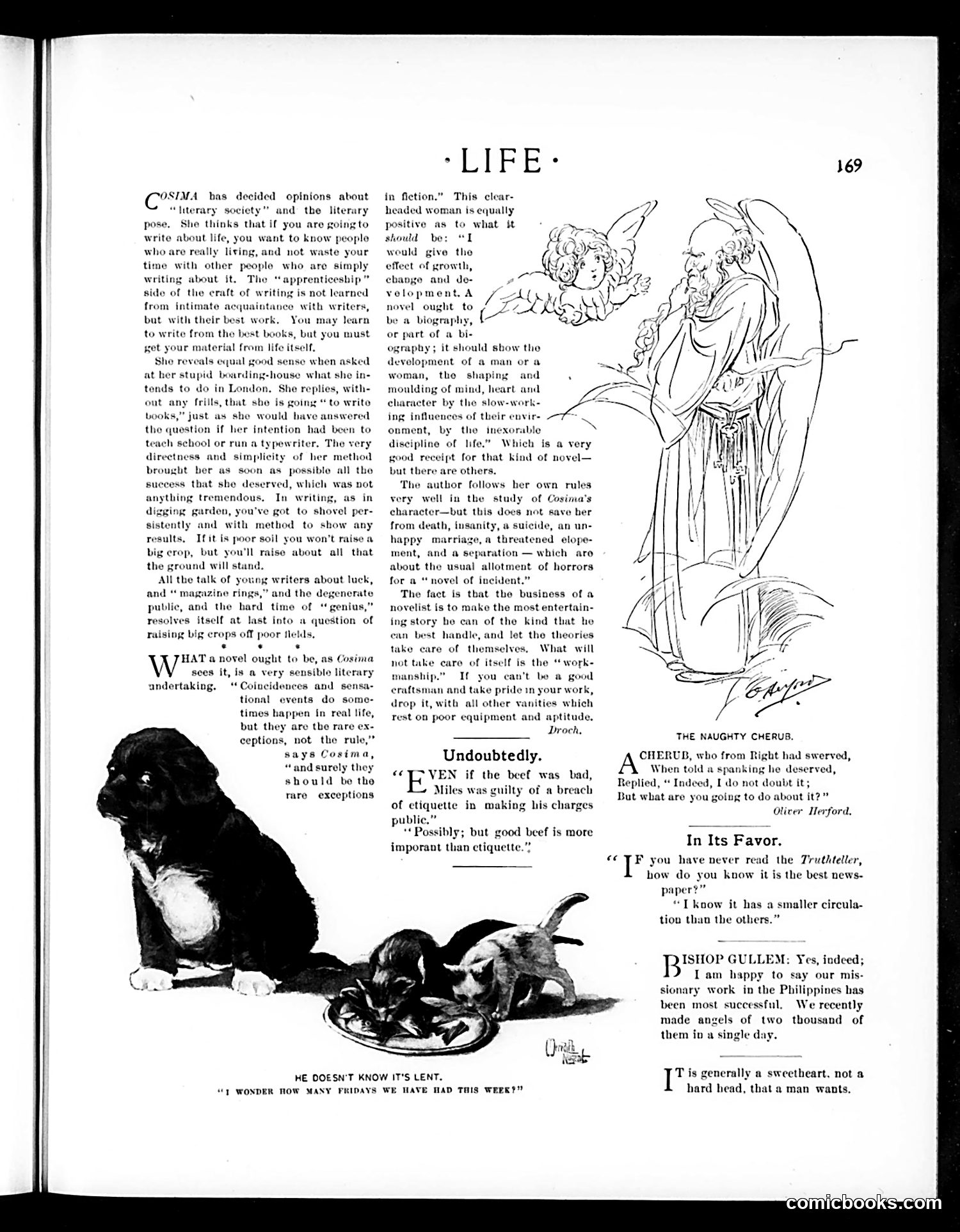
This page contains literary criticism about novel-writing and several brief humorous anecdotes, rather than political cartoons. The main illustration shows a dog and cat with the caption "I WONDER HOW MANY FRIDAYS WE HAVE HAD THIS WEEK!" This is a sight gag about pets not understanding time or the calendar. The right-side illustration depicts "THE NAUGHTY CHERUB" — a classical cherub figure with witty dialogue exchanges below it about topics like newspapers and missionary work in the Philippines. The content represents typical *Life* magazine humor from the early 20th century: gentle domestic satire, animal humor, and classical imagery used for comedic effect. There are no identifiable political figures or sharp social criticism — rather, this reflects the magazine's satirical but generally light-hearted approach to everyday situations.
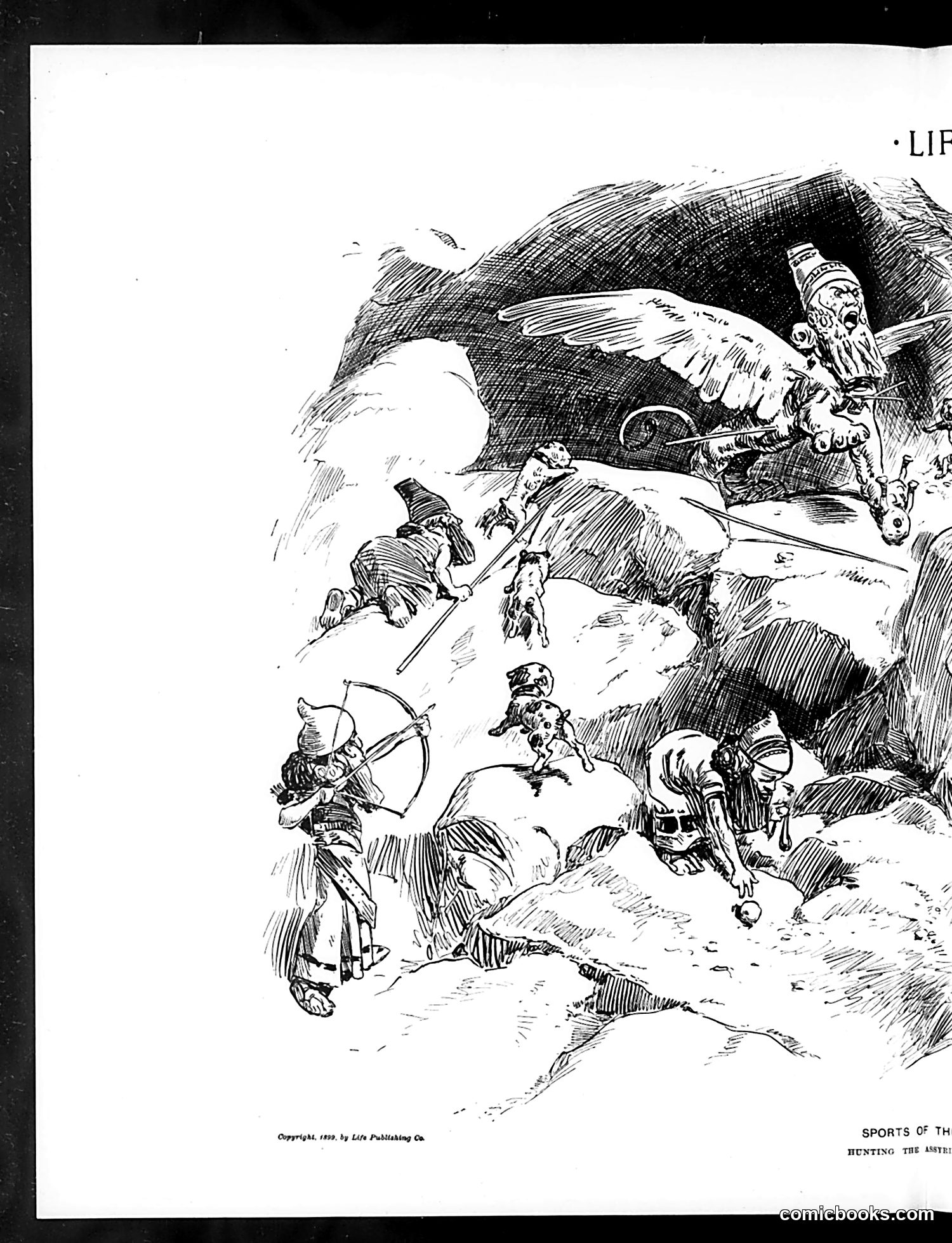
This 1903 Life magazine illustration depicts "Sports of the Asteroids" — a satirical fantasy of hunting on distant planets. The cartoon shows tiny humanoid figures with hunting equipment (bows, rifles) pursuing fantastical alien creatures in a rocky, cratered landscape beneath a large celestial body. The satire appears to mock contemporary big-game hunting culture by projecting it into an absurd cosmic setting. By transplanting Earth's hunting obsessions to imaginary worlds, the artist likely criticizes the era's colonial-era trophy hunting and sportsmen's pretensions. The diminutive hunters pursuing bizarre alien fauna suggests both the foolishness of hunting as sport and humanity's presumptuous desire to dominate nature—even on fictional planets.
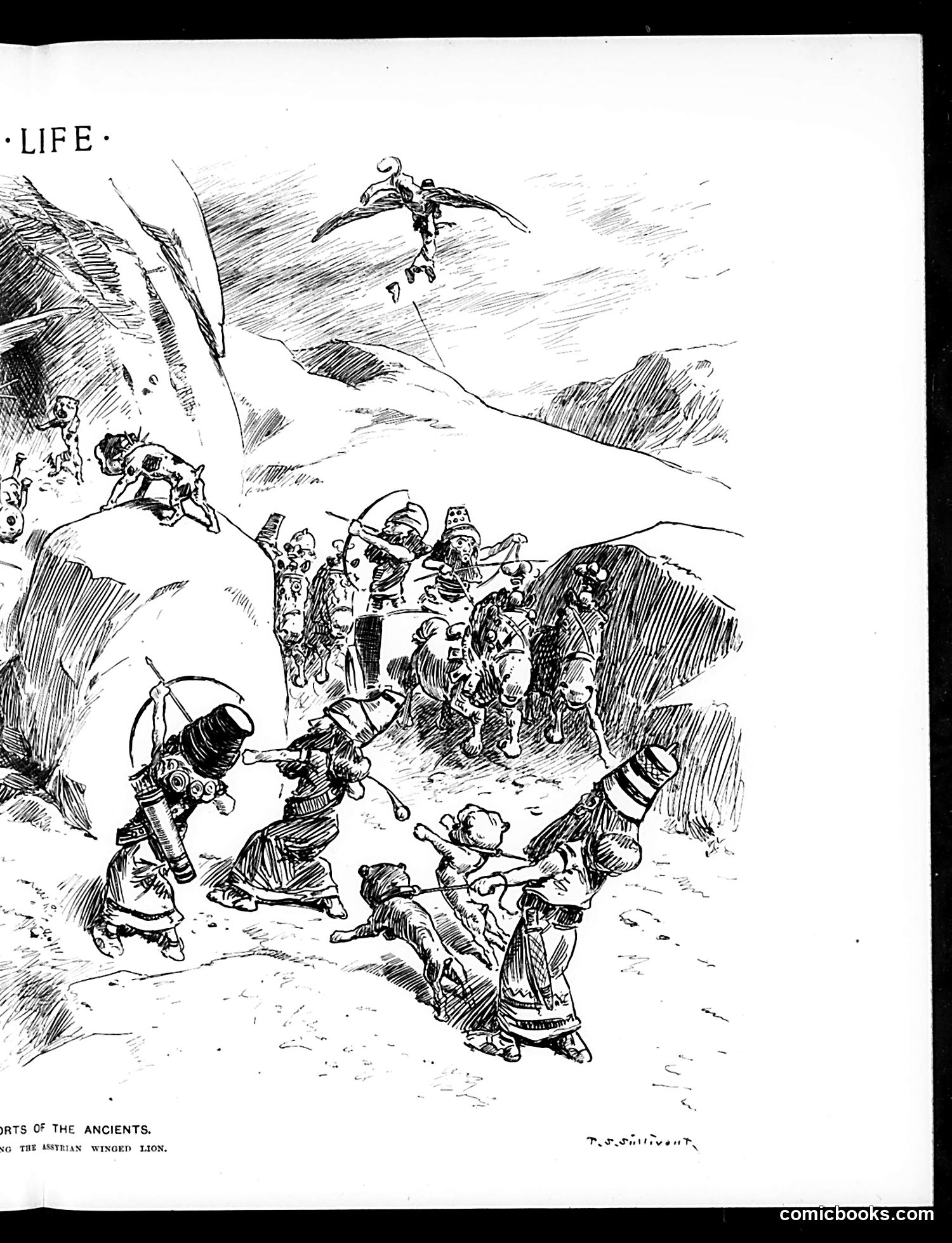
This cartoon satirizes Austrian imperial ambitions, specifically referencing "the Austrian Winged Lion" (visible in the title fragment). The scene depicts ancient warriors engaged in combat in a mountainous landscape, with a figure flying overhead wielding a sword. The satire appears to criticize Austria-Hungary's military aggression or territorial expansion, presenting their imperial ambitions as primitive or barbaric—comparable to ancient warfare rather than modern civilization. The "winged lion" likely represents Austrian power or imperial symbolism. The cartoon uses classical imagery to mock contemporary political actions, a common Life magazine technique. Without the full date visible, this likely references early 20th-century Austro-Hungarian conflicts, possibly related to Balkan tensions or World War I-era militarism.
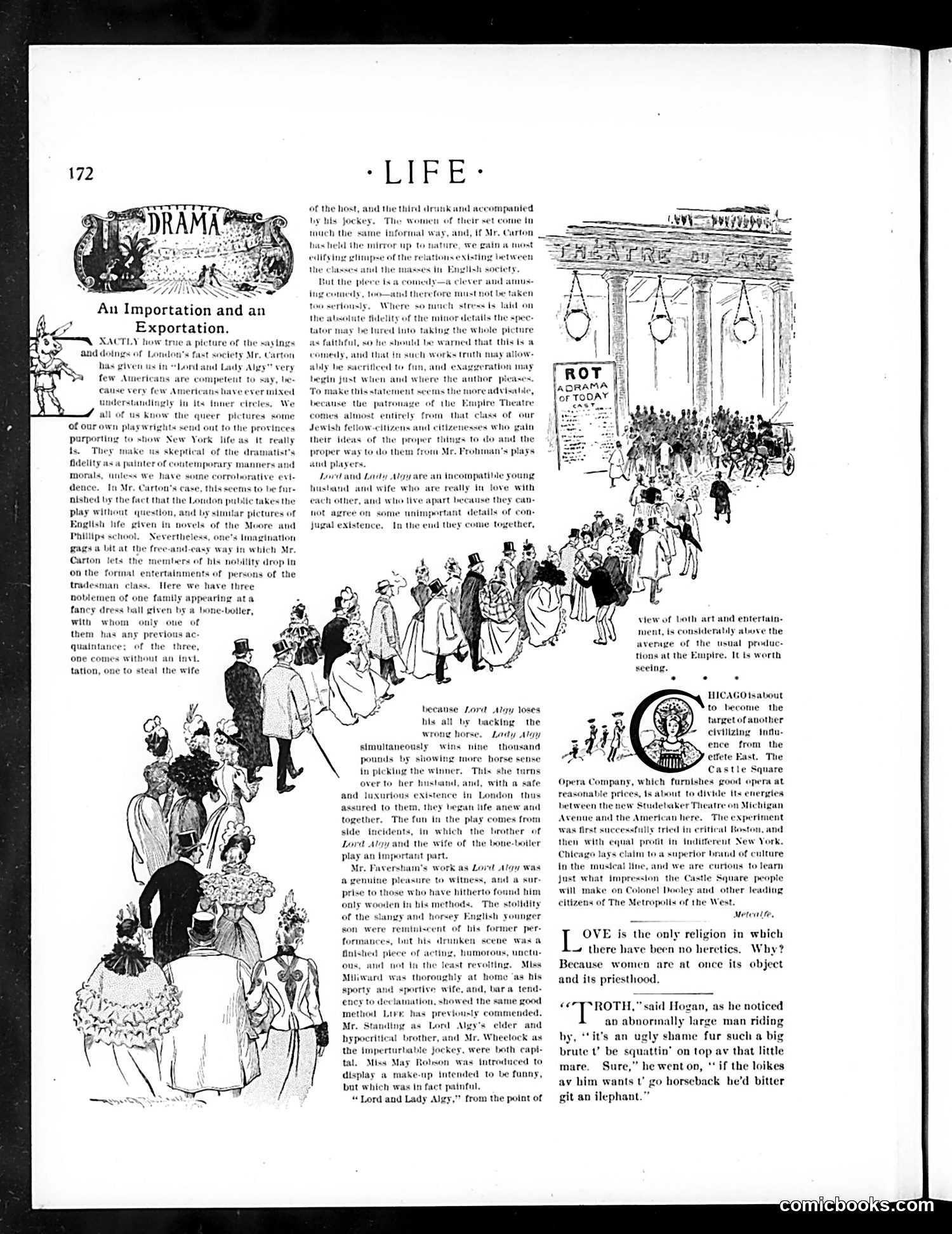
This drama criticism reviews Mr. Carton's play "Lord and Lady Algy," which depicts wealthy English characters in London society. The illustration shows a procession of fashionably-dressed figures, satirizing the upper-class milieu the play depicts. The text critiques the work as relying on exaggerated minor details rather than capturing the whole picture—a common complaint about contemporary comedies. The review notes the play features "side incidents" involving stolen horses and romantic entanglements among aristocrats. The final dialogue joke mocks a character's brutish behavior: when told his horse is an elephant, he threatens to "git an elephant" and ride it aggressively. This appears to satirize the crude behavior of wealthy characters portrayed in such fashionable comedies of the era.
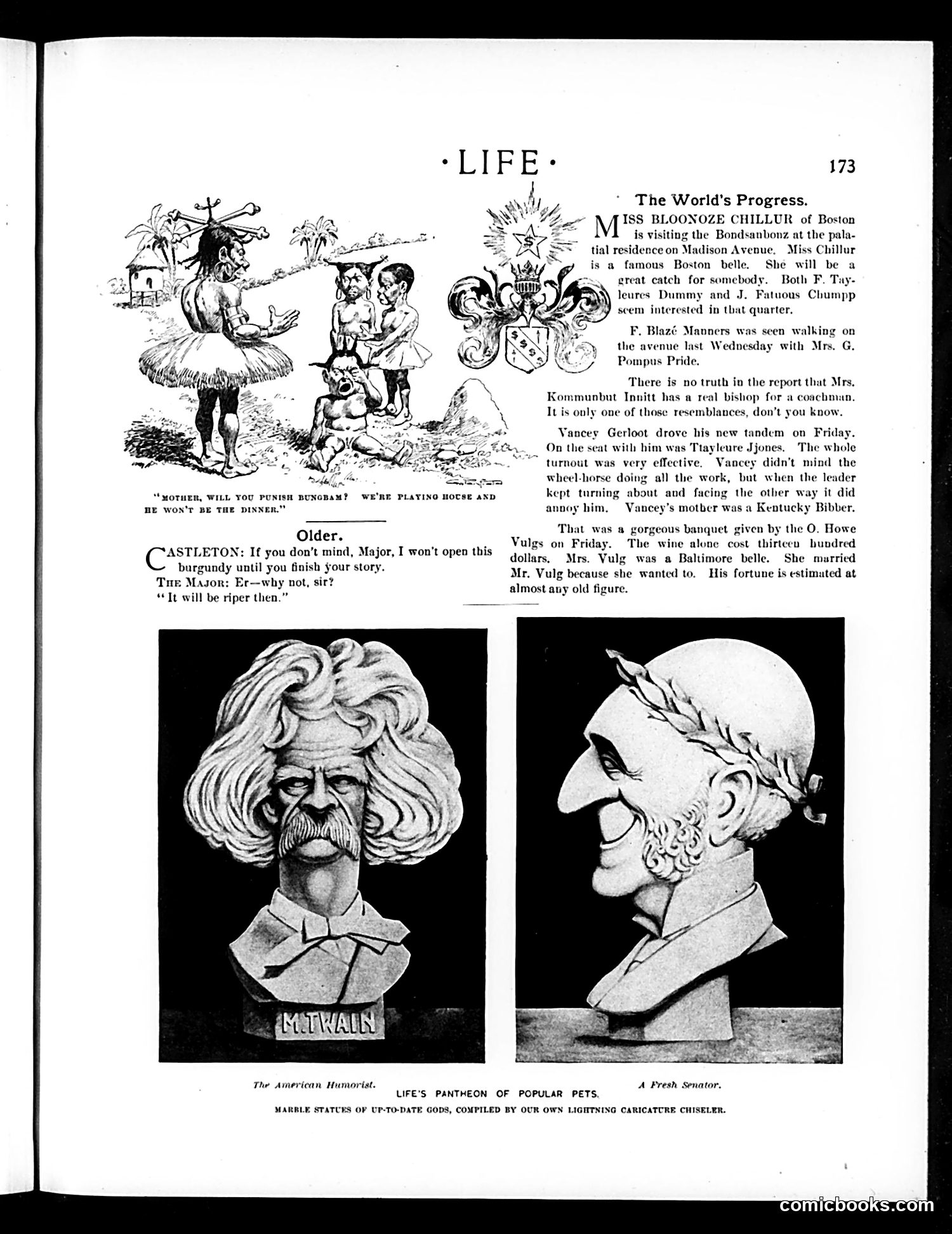
This is a satirical page from *Life* magazine mixing social commentary with humor. The top cartoon mocks children's games and parental discipline. Below, "The World's Progress" section ridicules high-society gossip—wealthy Bostonians with absurd names (Miss Bloonoze Chillur, Vancey Gerloot) engaged in trivial social climbing and conspicuous consumption. The joke about Mrs. Vulg marrying for fortune "estimated at almost any old figure" satirizes wealthy nouveau-riche who lack inherited status. The bottom feature shows marble busts titled "Life's Pantheon of Popular Pets"—caricatures of contemporary celebrities or public figures treated as modern gods. The left bust is labeled "M.T. WAIN" (Mark Twain), shown as "The American Humorist," while the right appears to be another contemporary figure labeled "A Fresh Senator." The satire treats popular entertainers and politicians as objects of worship, mocking American celebrity culture.
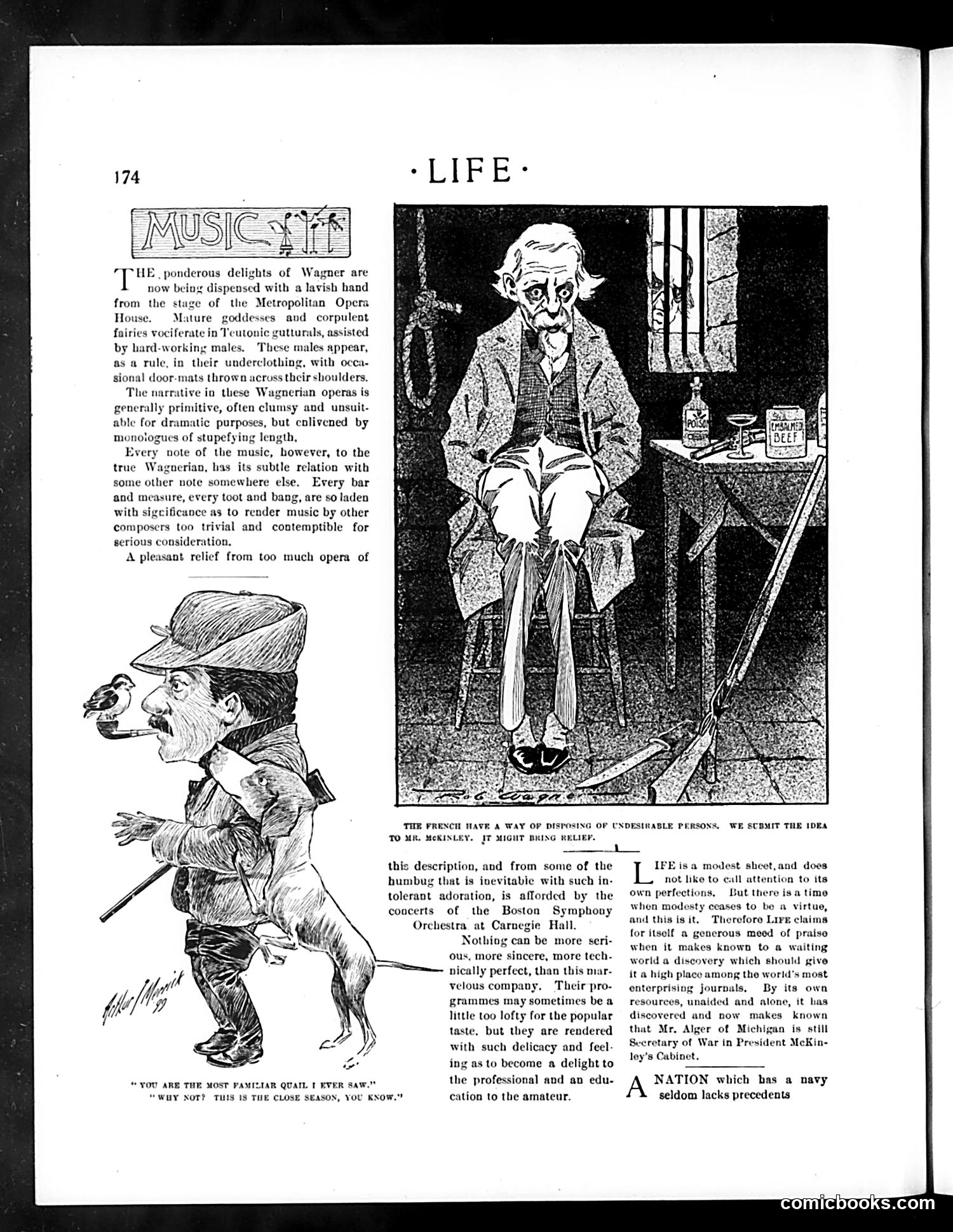
This page contains two distinct satirical pieces: **Top section (Wagner/Music):** A critique of Wagner opera devotees at the Metropolitan Opera House. Life mocks the genre's pretensions—"ponderous," clumsy plots, "stupefying" monologues, and an obsessive belief that every musical note carries profound significance. By contrast, Life praises the Boston Symphony Orchestra at Carnegie Hall as technically superior yet genuinely modest, positioning itself as the discoverer of this truth. **Lower cartoon:** A visual gag showing a hunter and dog discussing quail hunting. The caption jokes that quail are "familiar" because "this is the close season"—meaning the birds should be protected from hunting. This appears to be satirizing either illegal hunting or the hypocrisy of ignoring game laws. **The McKinley reference:** Text mentions discovering that Secretary of War Alger still holds office under President McKinley—likely satirizing either bureaucratic inertia or surprise at Alger's continued employment. The overall tone is elite cultural commentary mixed with political jabs at American government.
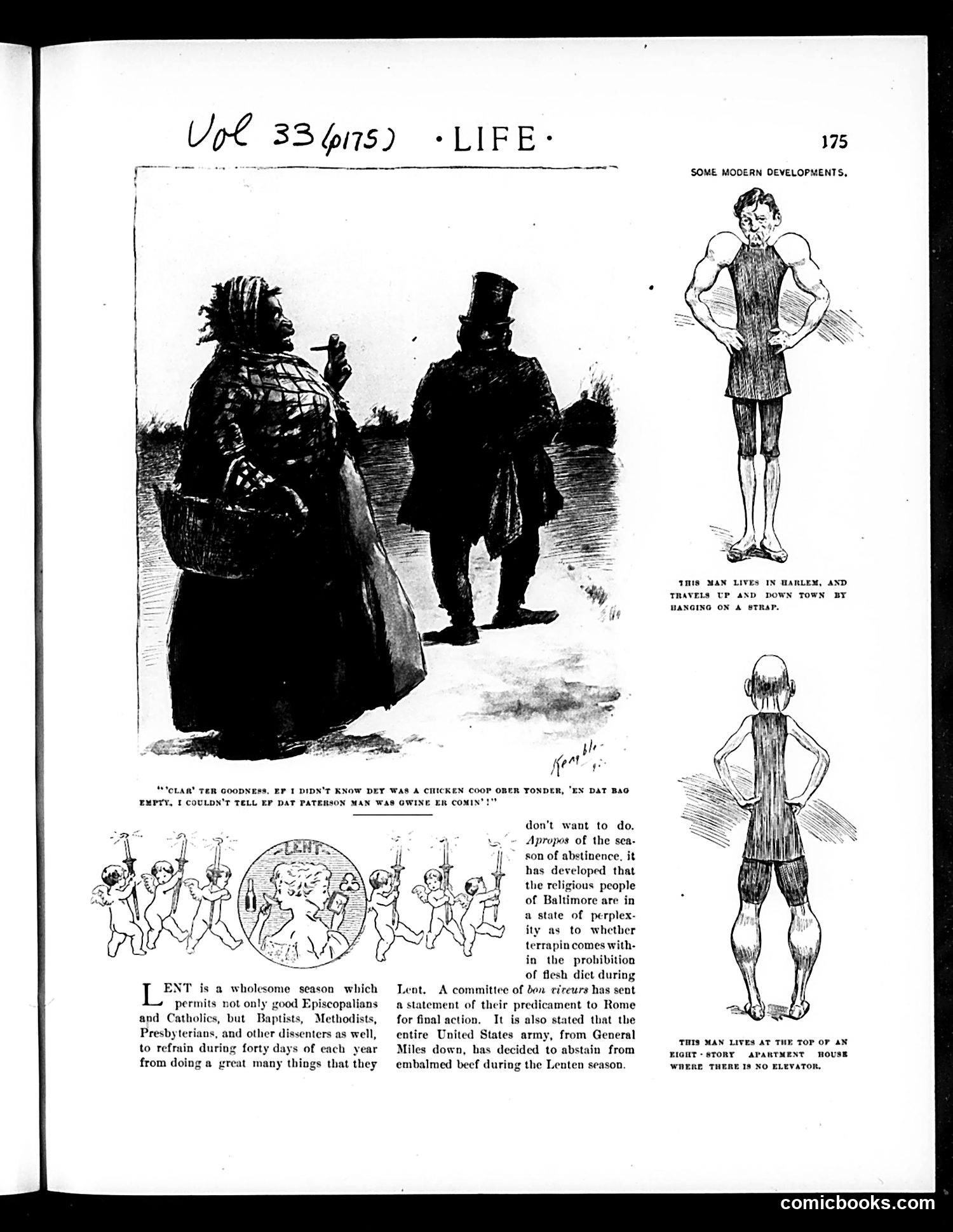
This page satirizes Lenten observance practices around 1900. The main cartoon depicts a dialogue in dialect humor (reflecting period conventions), with a figure noting he couldn't distinguish whether a "Patterson man" was approaching because an empty chicken coop provided no reference point—mocking how people use food availability to gauge situations. The text jokes that Lent is convenient because it lets various Christian denominations (Episcopalians, Catholics, Baptists, Methodists, Presbyterians) abstain from things they "don't want to do anyway"—cynically suggesting religious observance masks convenience rather than genuine devotion. A secondary satire addresses Baltimore's religious community debating whether terrapin (a local delicacy) counts as "flesh" under Lenten dietary restrictions—highlighting the absurdity of theological hairsplitting over loopholes. The U.S. Army's decision to avoid "embalmed beef" during Lent is presented as equally ridiculous institutional compliance. The right-side drawings of apartment dwellers mocking urban living conditions are unrelated visual humor.
This page from *Life* magazine (a 19th-century American satirical publication) contains three humorous anecdotes about notable figures: **Clemenceau story**: Georges Clemenceau, the French politician and newspaper editor, is depicted as brusquely efficient—a man so focused on current events (he's reading about a football game) that he forgets to actually examine patients at his free medical dispensary. The satire mocks his distraction and his willingness to use political influence casually. **Roosevelt and Sharpe anecdote**: Theodore Roosevelt is characterized as so consumed with grand imperial ambitions (purchasing cruisers for millions) that he's oblivious to practical poverty—he can't spare a cent for an umbrella. The joke satirizes the disconnect between massive government spending and everyday financial reality. **Bill Nye story**: A humorous exchange about stammering, illustrating how *Life* filled space with light, observational humor. The page is primarily **advertising** (Liebig's Extract, Cluett collar, hair brushes, theater notices), typical of the era's magazine format.
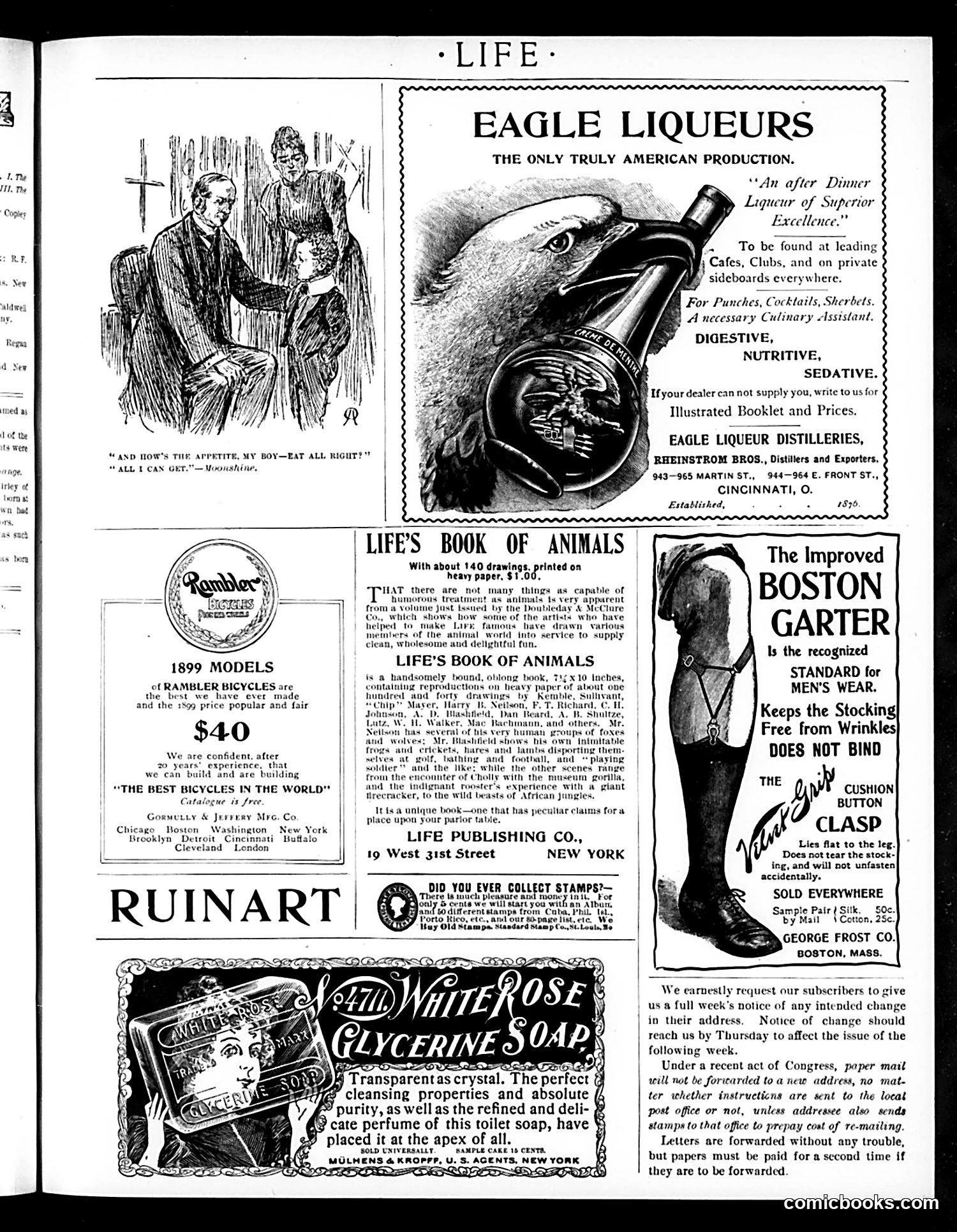
This page is primarily **advertisements and notices** rather than political satire. The one cartoon appears in the upper left: a sketch captioned "AND HOW'S THE APPETITE, MY BOY—EAT ALL RIGHT?" / "ALL I CAN GET."—*Moonshine*. The cartoon depicts a man (possibly thin or malnourished) speaking with another figure, with a reference to "moonshine" (illegally distilled liquor). The joke appears to satirize either poverty or the poor quality of illegal alcohol—the speaker can only afford moonshine, and it's affecting his appetite. The rest of the page consists of period advertisements: Eagle Liqueurs (Cincinnati distillery), Rambler Bicycles ($40), Life's Book of Animals (publisher advertisement), Boston Garter socks, White Rose Glycerine Soap, and various notices. The tone is commercial rather than satirical.
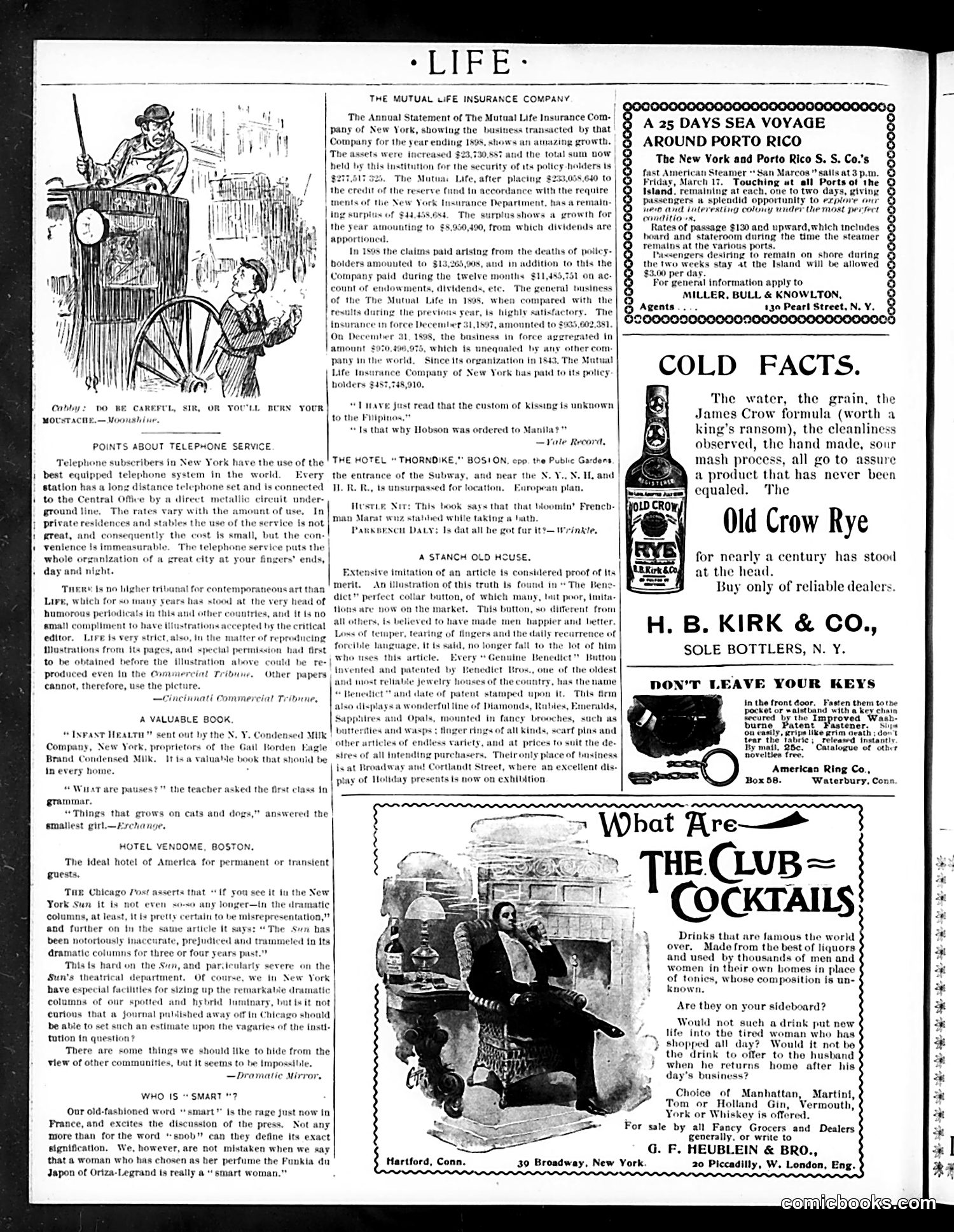
**The Main Cartoon:** The titled cartoon "DO BE CAREFUL, SIR, OR YOU'LL BURN YOUR MOUSTACHE—Moonshine" depicts a cab driver warning a passenger. The satire appears to reference the fashion danger of handlebar mustaches (popular in the 1890s) catching fire from cigar or cigarette smoke—a humorous exaggeration of a real grooming hazard of the era. **Context for Modern Readers:** This reflects late-Victorian male grooming obsessions. Large, waxed mustaches were status symbols requiring careful maintenance. The joke plays on both the impracticality of such facial hair and the prevalence of smoking. **Page Content:** The rest of the page contains insurance advertisements, hotel promotions, and miscellaneous jokes typical of 1890s satirical magazines—including a pun about "pauses" (paws) on dogs and a discussion of French slang.
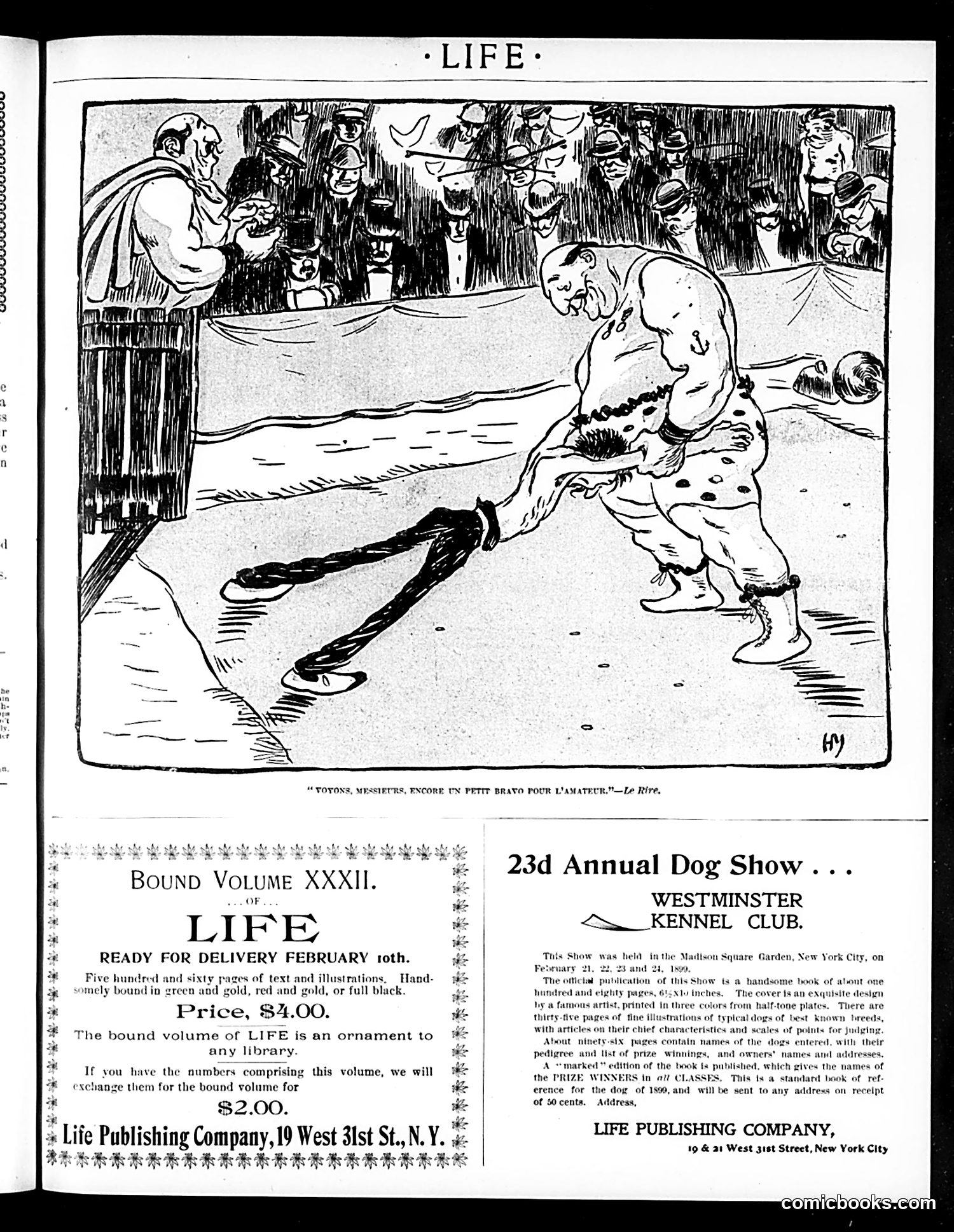
This page mixes editorial content with advertisements. The main cartoon (top) is a French satire from *Le Rire* magazine, captioned "Come now, gentlemen, one more small round of applause for the amateur." It depicts a rotund, muscular man performing or posing before an audience of well-dressed spectators, apparently mocking either amateur athletic competition or vaudeville-style performance. The joke likely satirizes the pretensions of amateur "strongmen" or performers seeking approval from crowds. The rest of the page advertises two products: Bound Volume XXXII of *Life* magazine itself (priced at $4.00, or $2.00 if exchanging previous issues), and the 23rd Annual Westminster Kennel Club Dog Show held in New York City. The page is primarily **commercial**, using the cartoon as decorative filler to attract readers to these advertisements rather than making a political point.
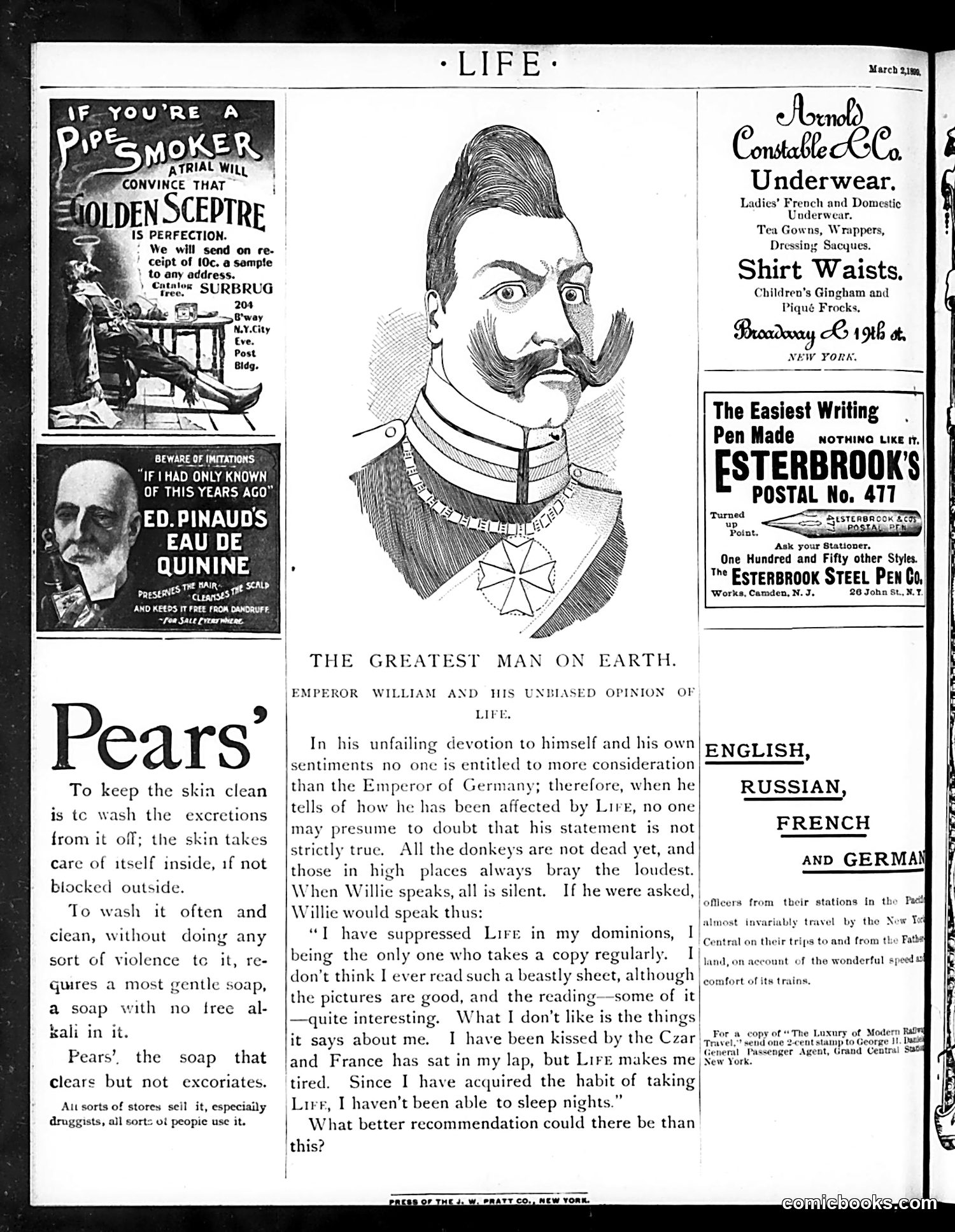
This page satirizes **German Emperor William II** (Kaiser Wilhelm), caricatured in the central portrait with his distinctive upturned mustache. The joke mocks his narcissism and sensitivity to criticism. The fake "testimonial" attributes a quote to the Emperor claiming he suppresses *Life* magazine in his dominions because it criticizes him, yet he secretly reads it regularly and can't sleep because of what it says about him. The humor lies in the contradiction: a supposedly all-powerful ruler reduced to petty insecurity by a satirical magazine. The sarcastic closing—"What better recommendation could there be?"—implies that even the Kaiser's disapproval proves *Life*'s value and influence. This reflects pre-WWI American attitudes toward Germany's increasingly aggressive imperial power and the Kaiser's well-documented vanity and thin skin regarding press coverage. The satire suggests *Life* magazine's fearless criticism of world leaders, positioning itself as independent and influential.