
Life, 1899-03-02 · page 9 of 20
Life — March 2, 1899 — page 9: what you’re looking at
What you’re looking at
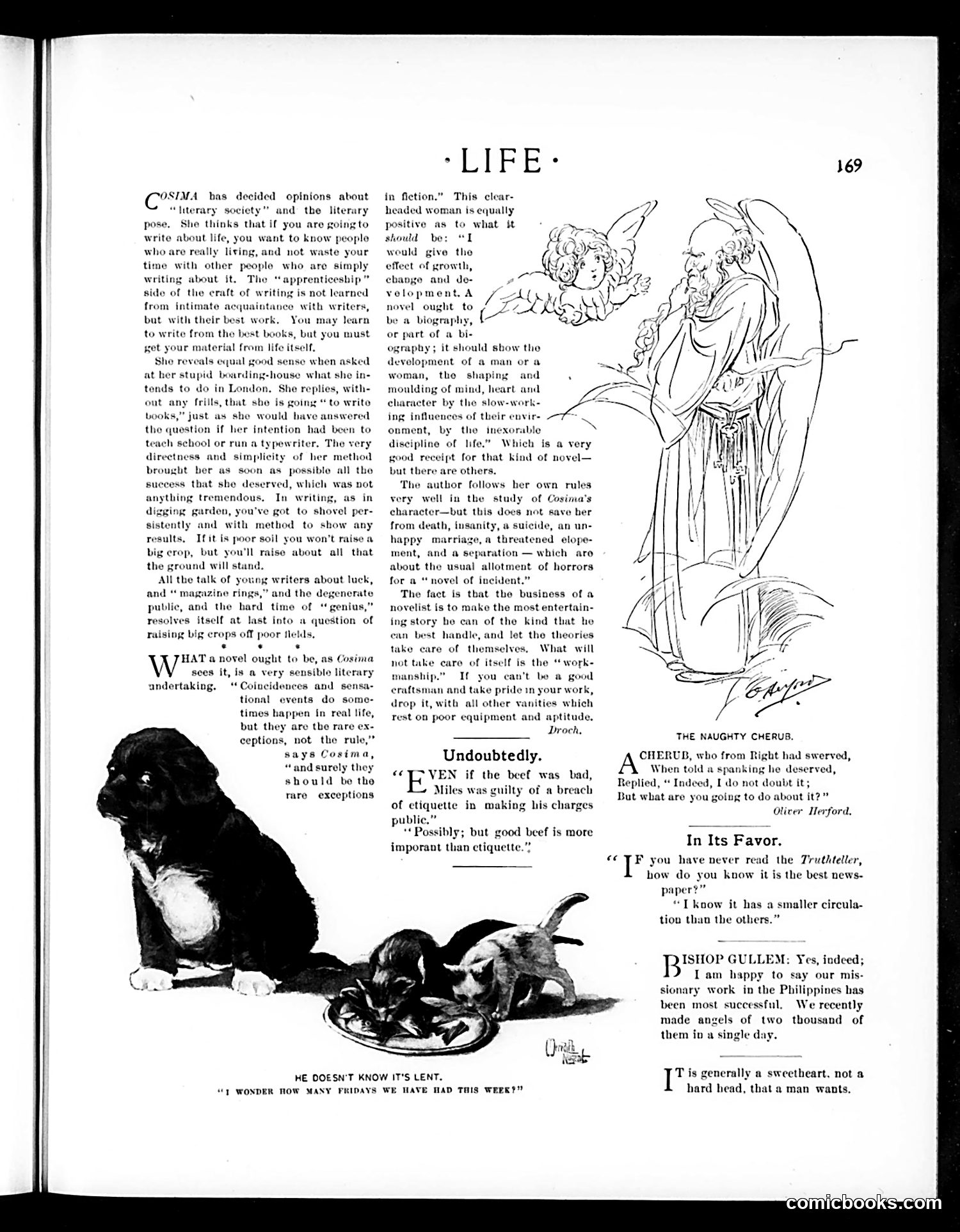
This page contains literary criticism about novel-writing and several brief humorous anecdotes, rather than political cartoons. The main illustration shows a dog and cat with the caption "I WONDER HOW MANY FRIDAYS WE HAVE HAD THIS WEEK!" This is a sight gag about pets not understanding time or the calendar. The right-side illustration depicts "THE NAUGHTY CHERUB" — a classical cherub figure with witty dialogue exchanges below it about topics like newspapers and missionary work in the Philippines. The content represents typical *Life* magazine humor from the early 20th century: gentle domestic satire, animal humor, and classical imagery used for comedic effect. There are no identifiable political figures or sharp social criticism — rather, this reflects the magazine's satirical but generally light-hearted approach to everyday situations.
📄 Transcribed text from this page (OCR, searchable)
Machine-transcribed from the original scan — historical spelling and the odd misread are preserved.
Com bas decided opinions about “literary society” and. the literary She thinks that if you are going to bout life, you want to know people who are really liting, and not waste your time with other people who are simply writing about it. The “apprenticeship side of the craft of writing is not learned from intimate acquaintance with writers, but with their best work, You may learn to write from the best books, but you must get your material from life itself, Sho reveals equal good sense when asked at her stupid boarding-house what she in- tends to do in London. She replies, with- out any frills, that sbe is going “ to write books,” just as she would have answered the question if her intention had been to school or run a typewriter. The very directness and simplicity of her method brought ber as soon as possible all the success that she deserved, which was not anything tremendous. In writing, as in digging garden, you've got to shovel per- sistently and with method to show any results, Ifit is poor soil you won't raise a big crop, but you'll raise about all that the ground will stand. All the talk of you writers about luck, and “ magazine rin, and the dege te public, and the bard time of “genius,” resolves itself at last into a question of raising big crops off poor flelds, . . * HAT a novel ought to be, as Cosima sees it, is a very sensible literary ndertaking. “Coincidences and sensa tional nts do some- times happen in real life, but they are the rare ex- ceptions, not the rule,” says Cosima, “and surely they should be the rare exceptions write ‘LIFE: in fiction.” This cl headed woman is equally positive as to what it be: “1 would give the effect of growth, ebapgo and de- velopment. A ht to raphy, or part of a bi- ography; it should sbow tho development of a man or a woman, the shaping and ulding of mind, heart and should novel ou be a bi ing influences of their e onment, L discipline of life.” Wh good but ther the inexor h is a very ceipt for that kind of novel— e others, author follows her own rules well in the study of Cosima’s character—but this does not save ber from death, insanity, a suicide, an un- happy marriage, a threatened elope- ment, and a separation — which aro about the usual allotment of horrors for a “ novel of incident.” The fact is that the business of a novelist is to make the most entertain- ing story be can of the kind that he can best handle, and let the theories What will not take caro of itself is the “work- manship.” If n't be a good craftsman and take pride in your work, drop it, with all other vanities which rest on poor equipment and aptitude. Droch, Undoubtedly. “<TC VEN if the beef was bad, Miles was guilty of a breach of etiquette in making his charges public, ‘*Possibly; but good beef is more imporant than ctiquette.”? take care of themselves, you HE DOESN'T KNOW IT'S LENT. 1) WONDER NOW MANY PRIDAYS WE HAVE HAD THIS WREK?” THE NAUGHTY CHERUB. CHERUB, who from Right had swerved, When told a spanking he deserved, Replied, “ Indeed, I do not doubt it; But what are you going to do about it?” “T Oliver Herford, In Its Favor. F you have never read the Truthteller, how do you know it is the best news- paper?” “Tkoow it has tion than the othe smaller circula- ISHOP GULLEM: Yes, indeed; Iam happy to y our mis- sionary work in the Philippines has been most successful. We recently made angels of two thousand of them ip a single d: T is generally a sweetheart, not a hard head, that a man wants.